
This put up was initially revealed in 2019 and up to date in 2024
by Terrell Heick
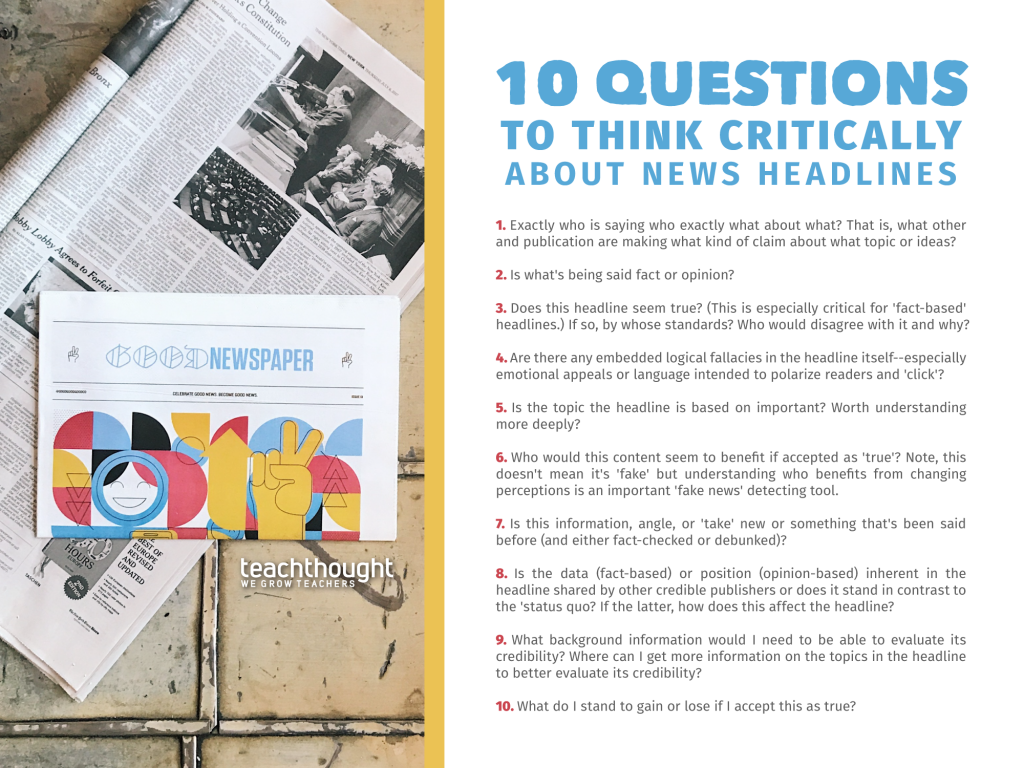
1. Within the article, headline, or social share, ‘who’ is saying ‘what’? That’s, what particular creator and publication are making what sort of declare about what subject or concepts?
2. Is what’s being said or claimed reality or opinion?
3. Does this headline appear true? (That is particularly vital for ‘fact-based’ headlines.) In that case, by whose requirements? Who would disagree with it and why? How can or not it’s fact-checked? Is the creator utilizing ‘gray areas’ of ‘reality’ in a means that appears designed to trigger a stir, forged doubt, affect considering, or in any other case change the opinion of readers?
4. Is that this headline fully ‘true’/correct or based mostly as an alternative on partially true data/knowledge? Deceptive data is usually based mostly on partial truths after which reframed to suit a selected function: to trigger an emotion comparable to anger or concern that results in an end result of some type: a ‘like,’ donation, buy, signup, vote, and so forth.
5. Are there any embedded logical fallacies within the headline itself–particularly straw man arguments, emotional appeals, or charged language supposed to polarize, rally, or in any other case ‘have interaction’ readers?
6. Is the subject the headline is predicated on necessary? Value understanding extra deeply?
7. Who would this appear to learn if accepted as ‘true’?
8. Is that this data, angle, or ‘take’ new or one thing that’s been mentioned earlier than (and both fact-checked or debunked)?
9. Is the info (fact-based) or place (opinion-based) inherent within the headline shared by different credible publishers or does it stand in distinction to the ‘established order’? If the latter, how does this have an effect on the headline?
10. What background data would I would like to have the ability to consider its credibility? The place can I get extra data on the matters within the headline to higher consider its credibility? What do I stand to achieve or lose if I settle for this as true?
11. Does the ‘information story’ precisely symbolize the ‘massive image’ or is it one thing ‘cherry-picked’(in or out of context) designed to trigger an emotional response within the reader?
For the second set of inquiries to assume critically about information headlines, we’re turning to the Information Literacy Venture, a media requirements challenge that created a set of questions to assist college students assume critically about information headlines.
12. Gauge your emotional response. Is it sturdy? Are you indignant? Are you intensely hoping that the data seems to be true or false?
13. Mirror on the way you encountered this. Was it promoted on a web site? Did it present up in a social media feed? Was it despatched to you by somebody you understand?
14. Think about the headline or message:
a. Does it use extreme punctuation or ALL CAPS for emphasis?
b. Does it declare containing a secret or telling you one thing that ‘the media’ doesn’t need you to know?
c. Don’t cease on the headline. Hold exploring!
15. Is that this data designed for straightforward sharing, like a meme?
16. Think about the supply of data:
a. Is it a widely known supply?
b. Is there a byline (an creator’s title) hooked up to this piece? Does that creator have any particular experience or expertise?
c. Go to the web site’s ‘About’ part. Does the location describe itself as a ‘fantasy information’ or ‘satirical information’ website? What else do you discover–or not discover?
17. Does the instance you’re evaluating have a date on it?
18. Does the instance cite a wide range of sources, together with official and professional sources? Does this instance’s data seem in studies from (different) information shops?
19. Does the instance hyperlink to different high quality sources?
20. Are you able to verify, utilizing a reverse picture search, that any photographs in your instance are genuine (i.e., haven’t been altered or taken from one other context)?
21. If you happen to looked for this instance on a fact-checking website comparable to snopes.com, factcheck.org, or politifact.com, is there a fact-check that labels it as lower than true?
Keep in mind:
- It’s straightforward to clone an current web site and create pretend tweets to idiot individuals
- AI and ‘deep fakes’ are grow to be more and more commonplace
- Bots are lively on social media and are designed to dominate conversations and unfold propaganda.
- Propaganda and/or misinformation usually use an actual picture from an unrelated occasion.
- Debunk examples of misinformation everytime you see them. It’s good for democracy!
You’ll be able to obtain the complete ‘checkology’ pdf right here and discover extra sources at checkology.org


