What are the different types of CAD?
Computer-aided design, or CAD, began in the late 1960s and early in the 1970s and was developed internally by big aerospace and car companies to automate repetitive tasks. It has evolved considerably since those early days, becoming more powerful and more accessible as both computer hardware and software design has improved.
2D CAD
An example of 2D CAD drafting in M4 (Image credit: CAD Schroer GmbH)
Originally, CAD was all in 2D, making use of geometric shapes like lines, rectangles, arcs, and circles to create flat drawings. This approach is still used today, often including annotations on drawings using text, dimensions and tables.
2.5D CAD
You may also hear the term 2.5D CAD. This refers to computer-aided design that still displays the depth of objects in geometric shapes like with 2D CAD but applies contour maps to visualise height at different points. Its most common use is in computer numerical control (CNC) machining since it can simplify the manufacture of parts that have several flat surfaces of different depths.
3D CAD
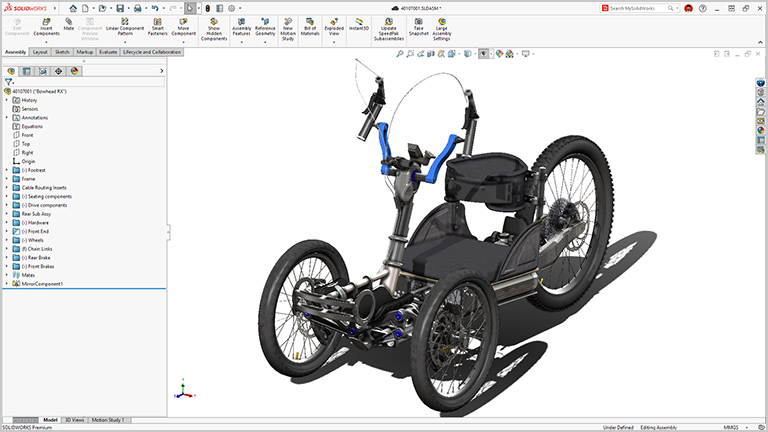
An example of 3D CAD in SolidWorks (Image credit: SolidWorks)
Finally, in 3D CAD, software is used to create a more lifelike model of an object in 3D space. These three-dimensional models include width, height, and depth.
Types of CAD: direct modelling vs parametric modelling
In direct modelling, designers manipulate 3D geometry directly, without relying on predefined features or parametric relationships by pushing, pulling, or twisting faces, edges, or vertices. This allows quick, intuitive changes for rapid prototyping.
Types of CAD geometric modelling
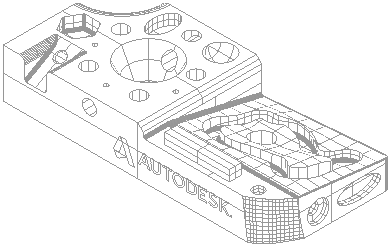
Wireframe modelling in AutoCAD (Image credit: Autodesk)
Geometric modelling is a key technique in CAD that uses mathematical formulas to describe an object’s geometry. This allows designers to create and manipulate 3D models. After creating the initial model, designers can conduct element analysis.
Conclusion
In conclusion, CAD is a broad term that encompasses various types of design, including 2D, 2.5D, and 3D, as well as different modelling techniques such as direct, parametric, surface, and solid modeling. Understanding the different types of CAD and their applications can help designers and engineers create more accurate and efficient designs, and ultimately, improve the quality of their work.
FAQs
Q: What are the main types of CAD?
A: The main types of CAD are 2D, 2.5D, and 3D, with each type having its own strengths and applications.
Post Views: 77



