
Write an article about
How many IoT devices are there today, and how fast will that number grow? Businesses, governments, and consumers face this question as connected devices enter nearly every part of life. From smart homes to predictive maintenance in factories, the Internet of Things changes the way systems work.
Still, many people ask how many IoT devices there will be in 2025 compared to today. A moderate estimate shows about 19.08 billion connected devices in 2025, rising from 17.08 billion in 2024. That growth feels massive, but it also raises questions about costs, security, and adoption barriers. In this blog, we explore the real numbers, growth trends, and future projections to see where IoT stands.
Launch your IoT solution ! Cotact Us
Current Estimates of IoT Devices Worldwide
Analysts debate the number of IoT devices by 2025. Different reports use different definitions, so estimates range from modest to massive. IoT Analytics sets the figure near 27.1 billion IoT connected devices forecast by 2025. On the other hand, more cautious studies show numbers closer to 19 billion.
El País reports that connected devices will exceed 25 billion in early 2026, heading toward 40 billion before 2030. These differences show why people keep asking: how many IoT devices are there currently, and how fast will adoption rise?
Number of IoT devices in use today
Today’s numbers give us a baseline. Most researchers agree that over 17 billion IoT devices are active in 2024. This includes consumer tools like smart speakers, as well as enterprise and industrial systems. The number of IoT devices continues to grow each quarter as more industries embrace automation.
When people ask how many IoT devices are there in the world today, the safest answer is 17–18 billion devices currently in use. This context helps make sense of the next surge in adoption.
Consumer vs. enterprise adoption
Consumer and enterprise adoption both fuel IoT growth, but the balance looks different depending on the market. Consumers eagerly buy smart homes, wearables, and connected cars. Enterprises heavily invest in healthcare devices, logistics tracking, and factory automation.
Both sides answer the question of how many IoT devices are estimated to be in the world. Right now, consumer devices outnumber enterprise units, but revenue impact is larger in enterprise and industrial adoption.
Leading industries in IoT adoption
| Industry | Share of Global IoT Devices (2024–2025) | Examples of Applications |
| Consumer Electronics | 45% | Smart homes, wearables, connected cars |
| Healthcare | 12% | Remote monitoring, telemedicine devices |
| Manufacturing | 15% | Predictive maintenance, robotics integration |
| Retail & Logistics | 10% | Supply chain tracking, smart shelves |
| Smart Cities | 8% | Traffic control, energy grids, safety nets |
| Other Sectors | 10% | Agriculture, utilities, oil & gas |
The number of IoT devices by 2025 will reflect this mix. Industries like healthcare and logistics expand fast as IoT links with artificial intelligence. For example, supply chains now use smart systems as explained in IoT in supply chain.
IoT Growth Trends in Recent Years
The Internet of Things statistics from the last four years tell a clear story. Device adoption accelerates year after year, with small dips only when chip shortages hit. Many experts track the compound annual growth rate, or CAGR, to see the pace. These IoT growth statistics show both opportunity and pressure for companies to adapt.
CAGR of IoT devices from 2020–2024
Between 2020 and 2024, IoT devices increased at a CAGR of nearly 20%, depending on the sector. In 2020, there were around 10–12 billion devices, while by 2024, the number had reached 17 billion. That means billions of new devices connect every year. People who ask how many IoT devices are there in the world today may be shocked at the speed of this growth.
CAGR Growth Table
| Year | Number of IoT Devices (approx) | Growth vs. Previous Year |
| 2020 | 11 billion | — |
| 2021 | 13.5 billion | 0.23 |
| 2022 | 15.1 billion | 0.12 |
| 2023 | 16.2 billion | 0.07 |
| 2,024 | 17.08 billion | 0.05 |
The table shows how many IoT devices are there currently, and why the question of 2025 numbers draws attention. Slower growth in 2023–2024 came from supply issues, but trends suggest a rebound.
Key factors fueling IoT growth
Several factors explain the fast rise in IoT adoption. These drivers shape the answer to how many IoT devices there will be in 2025 and beyond.
| Driver | Description | Impact on IoT Growth |
| Falling Sensor Costs | The price of sensors has dropped from dollars to cents, making IoT devices more affordable. | Expands accessibility and adoption of IoT devices worldwide |
| Expansion of 5G Networks | 5G rollout increases network speed and bandwidth, enabling more devices to connect simultaneously | Facilitates the connection of a larger number of IoT devices |
| Edge Computing Adoption | Devices process data locally at the edge, reducing latency and improving real-time applications | Enhances the performance and scalability of IoT systems |
| Cloud Integration | IoT relies on cloud platforms for data storage and advanced analytics, accelerating growth. | Simplifies management and drives rapid IoT expansion |
| Industry Demand for Automation | Sectors like healthcare and manufacturing require automation for predictive maintenance and monitoring | Boosts the number and use cases for IoT devices |
| Consumer Demand for Smart Living | Growth in smart home devices and wearables reflects rising consumer interest in smart lifestyles | Drives mass adoption and mainstream integration of IoT |
Barriers that slowed adoption
Not every factor drives growth. Some barriers explain why numbers remain lower than early high forecasts. Chip shortages during 2021–2022 limited device availability. Security fears stop some enterprises from scaling adoption. Standards remain fragmented, so devices from one brand may not connect easily with another.
High upfront costs also slow small businesses. These barriers matter because they show why estimates differ when experts discuss how many IoT devices are there in 2025. For companies focused on sustainable adoption, even ESG priorities affect how IoT growth unfolds.
Future Projections: How Many IoT Devices by 2025?
Forecasts for 2025 raise the central question: how many IoT devices are there in 2025 compared to today? The short answer is billions more. The range sits between 19.08 billion devices from Scoop.market.us and 27.1 billion devices from IoT Analytics.
This wide range makes people wonder what definition experts use for IoT devices. Do we count sensors inside factories, or just consumer gadgets? Regardless of method, the number of IoT devices by 2025 nearly doubles what we saw only five years ago.
1. Forecasted global number of IoT devices
Forecasts are useful because they shape budgets and technology planning. Investors ask how many IoT devices are there estimated to be in the world, and the answer drives billions in funding.
Governments need these numbers to plan for 5G rollout, smart cities, and energy grids. Businesses track IoT connected devices forecast to see what consumer demand means for them. Even conservative estimates show billions of new devices connecting each year.
2. Long-term projections beyond 2025
Looking past 2025, forecasts get bolder. El País reports that IoT devices will exceed 25 billion in early 2026 and reach 40 billion before 2030. This pace shows why companies keep asking how many IoT devices are there currently, and how much faster adoption will rise.
The long-term number of IoT devices depends on chip supply, consumer interest, and security fixes. But with new industries joining every year, the Internet of Things statistics keep climbing.
3. Economic impact and revenue growth
Numbers mean little without context on economic impact. McKinsey Global Institute estimates IoT applications could generate between $3.9 trillion and $11.1 trillion per year by 2025. That includes healthcare, manufacturing, smart cities, logistics, and consumer electronics.
Enterprises see IoT as both a cost saver and a revenue driver. This explains why enterprise IoT spending grows from $159 billion in 2021 to $412 billion in 2025. Numbers like these show why companies ask not just how many IoT devices are there in 2025, but how much money those devices will produce.
Regional Distribution of IoT Adoption
The growth of IoT differs by region. Some areas move fast because they have infrastructure, others lag behind due to costs or regulations. Analysts break down the number of IoT devices by 2025 regionally, since different industries dominate in different areas.
North America: Smart homes and enterprise IoT
In North America, smart homes, wearables, and connected cars lead adoption. Enterprises focus on healthcare and logistics. People ask how many IoT devices are there in the US, and the answer is tens of millions across households and businesses. With a strong 5G rollout, the US and Canada keep pace with Europe.
By 2025, North America may host over 6 billion devices. Healthcare is especially strong, with remote patient monitoring becoming standard. Smart farming solutions also rise as seen in smart farming apps.
Europe: Industry 4.0 and sustainable solutions
Europe stands out with Industry 4.0 adoption. Manufacturing plants integrate predictive maintenance and automation at scale. When companies in Europe ask how many IoT devices there are estimated to be in the world, they focus on industry share. Germany, France, and the UK drive adoption in factories.
Sustainability also guides European adoption. Smart energy grids and efficient transportation systems show how IoT aligns with ESG priorities. By 2025, Europe should account for 20–22% of global IoT devices.
Asia-Pacific: Consumer electronics and manufacturing
Asia-Pacific leads the world in IoT adoption. China and India grow fastest due to manufacturing demand and consumer electronics. India alone sees growth above 29% CAGR in Industrial IoT.
By 2025, Asia-Pacific could host 58% of Industrial IoT data, up from 46% in 2020. When people ask how many IoT devices are there in 2025, Asia-Pacific holds most of the answer. Consumer devices like smartphones, wearables, and connected cars grow quickly. Industrial automation in China also fuels billions of connections.
Emerging markets: Middle East, Africa, Latin America
Emerging markets expand slower but show promise. Smart cities in the Middle East drive adoption through energy and water management. Africa sees IoT in agriculture, logistics, and mobile health.
Latin America invests in retail IoT and smart homes. Even though growth is uneven, the question of how many IoT devices are there in the world today includes millions from these regions. By 2025, emerging markets together may account for 10–12% of all IoT devices.
Key Use Cases of IoT Devices in 2025
Numbers alone do not tell the full story. IoT devices show their value in real use cases. People ask how many IoT devices are there in 2025 because they want to understand where adoption happens.
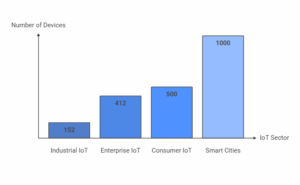
1. Consumer IoT: Smart homes, wearables, connected cars
Consumers buy IoT devices for convenience. Smart homes, wearable devices, and connected cars dominate this sector. These devices explain much of the number of IoT devices by 2025. Smart speakers, thermostats, and security cameras are everywhere in homes. Connected cars give drivers safety and automation. Wearables track health data daily. The growth of IoT devices in this area connects directly to consumer demand for a smarter lifestyle.
2. Enterprise IoT: Healthcare, retail, logistics
Enterprises adopt IoT to save money and improve operations. Healthcare leads with telemedicine and patient monitoring. Retail uses IoT for smart shelves and customer tracking. Logistics uses sensors for supply chain tracking. Enterprise adoption adds billions to how many IoT devices are there currently. IoT growth statistics show strong spending here, with enterprise IoT hitting $412 billion in 2025. Case studies like AI in IoT show why enterprises mix AI and IoT for smarter results.
3. Industrial IoT: Predictive maintenance, automation
Industrial IoT, or IIoT, includes devices in factories, plants, and energy systems. Predictive maintenance uses sensors to reduce downtime. Automation boosts output. By 2025, Industrial IoT may reach 152 million devices worldwide.
These numbers matter because they add depth to how many IoT devices are there in 2025. Manufacturing in Europe and Asia grows fast, while North America and India follow close.
4. Smart Cities: Energy grids, traffic, safety systems
Smart cities highlight IoT’s impact on society. IoT devices power energy grids, monitor traffic, and keep streets safe. The Internet of Things statistics show billions invested in smart infrastructure by 2025. Governments often ask how many IoT devices are there in the world today to plan city budgets. From Barcelona to Dubai, smart city IoT adoption shapes urban living.
Build your scalable IoT system today!Let’s build it!
The Impact of IoT Device Growth on Businesses
Businesses cannot ignore IoT adoption. Growth in devices changes business models, customer service, and data management. Leaders ask how many IoT devices are there estimated to be in the world, because these numbers drive competition and strategy.
Opportunities for startups and enterprises
Startups find opportunity in IoT apps and platforms. Enterprises expand into automation, logistics, and smart services. The number of IoT devices by 2025 ensures markets for developers, service providers, and hardware suppliers. Companies see IoT as a way to cut costs and reach new markets. The spread of IoT in supply chains shows how startups can build supply chain apps to meet enterprise demand.
Data privacy, interoperability, and security challenges
The rise of billions of devices means billions of risks. Data privacy becomes harder to control. Interoperability challenges mean devices from different brands may not connect. Security gaps make IoT a target for cyberattacks. Many executives who ask how many IoT devices are there in 2025 also ask how secure those devices are. Without clear standards, growth comes with risks.
Global IoT Outlook: Stats Table
To close the analysis, here is a summary table with the top forecasts, long-term outlook, and economic impact.
| Metric | Estimate/Forecast |
| IoT devices in 2025 | 19.08 billion |
| IoT devices in 2025 | 27.1 billion |
| IoT devices early 2026 | >25 billion |
| IoT devices by 2030 | 40 billion |
| IoT economic impact 2025 | $3.9–11.1 trillion annually |
| Enterprise IoT spending 2025 | $412 billion |
This table brings clarity to how many IoT devices are there in 2025 and what economic value they carry.
Why Choose LITSLINK for IoT Development in 2025
The question of how many IoT devices are there in 2025 matters because businesses need expert partners to build real solutions. At LITSLINK, we work with startups and enterprises on IoT apps, industrial systems, and smart city projects.
Our team brings strong skills in both software and hardware integration. We guide companies from idea to launch, helping them manage costs, security, and scalability.
By 2025, experts forecast between 19 to 27 billion IoT devices worldwide. Growth comes from consumer electronics, industrial systems, and smart cities, driving trillions in economic impact. This surge reshapes industries and daily life with connected solutions.
The Internet of Things statistics point to billions of devices and trillions in impact, but what matters most is how your business uses that opportunity. If you plan IoT adoption, you need a partner who listens, builds, and supports.
So, the final question: are you ready to join the IoT growth wave and make your business part of the future? Contact LITSLINK today and let us help you build your next IoT success.
More devices mean more data, smarter systems, and better decisions. Start your IoT transformation today!
Contact us now!
The post IoT Devices by the Numbers: How Many Are Expected in 2025? appeared first on Litslink.
.Organize the content with appropriate headings and subheadings ( h2, h3, h4, h5, h6). Include conclusion section and FAQs section with Proper questions and answers at the end. do not include the title. it must return only article i dont want any extra information or introductory text with article e.g: ” Here is rewritten article:” or “Here is the rewritten content:”


