
The emergence of generative AI has ushered in a brand new period of potentialities, enabling the creation of human-like textual content, pictures, code, and extra. Nevertheless, as thrilling as these developments are, information scientists usually face challenges relating to growing UIs and to prototyping and interacting with their enterprise customers. Historically, constructing frontend and backend functions has required information of internet growth frameworks and infrastructure administration, which could be daunting for these with experience primarily in information science and machine studying.
AWS gives a robust set of instruments and providers that simplify the method of constructing and deploying generative AI functions, even for these with restricted expertise in frontend and backend growth. On this publish, we discover a sensible resolution that makes use of Streamlit, a Python library for constructing interactive information functions, and AWS providers like Amazon Elastic Container Service (Amazon ECS), Amazon Cognito, and the AWS Cloud Improvement Equipment (AWS CDK) to create a user-friendly generative AI utility with authentication and deployment.
Answer overview
For this resolution, you deploy a demo utility that gives a clear and intuitive UI for interacting with a generative AI mannequin, as illustrated within the following screenshot.
The UI consists of a textual content enter space the place customers can enter their queries, and an output space to show the generated outcomes.
The default interface is straightforward and simple, however you possibly can prolong and customise it to suit your particular wants. With Streamlit’s flexibility, you possibly can add extra options, alter the styling, and combine different functionalities as required by your use case.
The answer we discover consists of two fundamental elements: a Python utility for the UI and an AWS deployment structure for internet hosting and serving the appliance securely.
The Python utility makes use of the Streamlit library to supply a user-friendly interface for interacting with a generative AI mannequin. Streamlit permits information scientists to create interactive internet functions utilizing Python, utilizing their present expertise and information. With Streamlit, you possibly can rapidly construct and iterate in your utility with out the necessity for intensive frontend growth expertise.
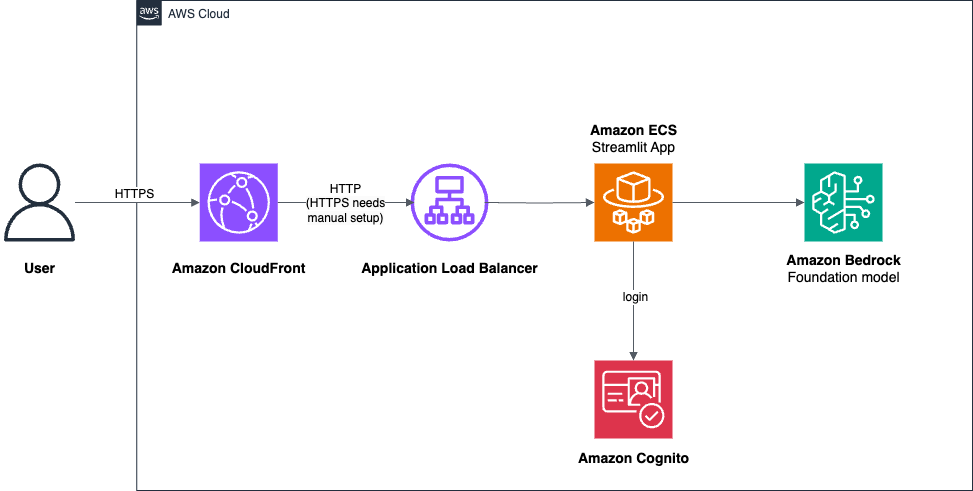
The AWS deployment structure makes certain the Python utility is hosted and accessible from the web to authenticated customers. The answer makes use of the next key elements:
- Amazon ECS and AWS Fargate present a serverless container orchestration platform for working the Python utility
- Amazon Cognito handles consumer authentication, ensuring solely licensed customers can entry the generative AI utility
- Software Load Balancer (ALB) and Amazon CloudFront are chargeable for load balancing and content material supply, so the appliance is on the market for customers worldwide
- The AWS CDK lets you outline and provision AWS infrastructure assets utilizing acquainted programming languages like Python
- Amazon Bedrock is a totally managed service that gives a selection of high-performing generative AI fashions by means of an API
The next diagram illustrates this structure.
Stipulations
As a prerequisite, it is advisable to allow mannequin entry in Amazon Bedrock and have entry to a Linux or macOS growth surroundings. You possibly can additionally use a Home windows growth surroundings, during which case it is advisable to replace the directions on this publish.
Entry to Amazon Bedrock basis fashions will not be granted by default. Full the next steps to allow entry to Anthropic’s Claude on Amazon Bedrock, which we use as a part of this publish:
- Register to the AWS Administration Console.
- Select the us-east-1 AWS Area from the highest proper nook.
- On the Amazon Bedrock console, select Mannequin entry within the navigation pane.
- Select Handle mannequin entry.
- Choose the mannequin you need entry to (for this publish, Anthropic’s Claude). You may as well choose different fashions for future use.
- Select Subsequent after which Submit to substantiate your choice.
For extra info on the best way to handle mannequin entry, see Entry Amazon Bedrock basis fashions.
Arrange your growth surroundings
To get began with deploying the Streamlit utility, you want entry to a growth surroundings with the next software program put in:
You additionally have to configure the AWS CLI. One method to do it’s to get your entry key by means of the console, and use the aws configure command in your terminal to arrange your credentials.
Clone the GitHub repository
Use the terminal of your growth surroundings to enter the instructions within the following steps:
- Clone the
deploy-streamlit-apprepository from the AWS Samples GitHub repository:

- Navigate to the cloned repository:
Create the Python digital surroundings and set up the AWS CDK
Full the next steps to arrange the digital surroundings and the AWS CDK:
- Create a brand new Python digital surroundings (your Python model ought to be 3.8 or higher):
- Activate the digital surroundings:
- Set up the AWS CDK, which is within the required Python dependencies:
Configure the Streamlit utility
Full the next steps to configure the Streamlit utility:
- Within the
docker_applisting, find theconfig_file.pyfile. - Open
config_file.pyin your editor and modify theSTACK_NAMEandCUSTOM_HEADER_VALUEvariables:- The stack title allows you to deploy a number of functions in the identical account. Select a distinct stack title for every utility. In your first utility, you possibly can go away the default worth.
- The customized header worth is a safety token that CloudFront makes use of to authenticate on the load balancer. You may select it randomly, and it should be saved secret.

Deploy the AWS CDK template
Full the next steps to deploy the AWS CDK template:
- Out of your terminal, bootstrap the AWS CDK:
- Deploy the AWS CDK template, which can create the required AWS assets:
- Enter
y(sure) when requested if you wish to deploy the modifications.
The deployment course of might take 5–10 minutes. When it’s full, be aware the CloudFront distribution URL and Amazon Cognito consumer pool ID from the output.
Create an Amazon Cognito consumer
Full the next steps to create an Amazon Cognito consumer:
- On the Amazon Cognito console, navigate to the consumer pool that you just created as a part of the AWS CDK deployment.
- On the Customers tab, select Create consumer.

- Enter a consumer title and password.
- Select Create consumer.

Entry the Streamlit utility
Full the next steps to entry the Streamlit utility:
- Open a brand new internet browser window or tab and navigate to the CloudFront distribution URL from the AWS CDK deployment output.
When you’ve got not famous this URL, you possibly can open the AWS CloudFormation console and discover it within the outputs of the stack.
- Log in to the Streamlit utility utilizing the Amazon Cognito consumer credentials you created within the earlier step.
You need to now be capable to entry and work together with the Streamlit utility, which is deployed and working on AWS utilizing the offered AWS CDK template.

This deployment is meant as a place to begin and a demo. Earlier than utilizing this utility in a manufacturing surroundings, it is best to completely evaluate and implement acceptable safety measures, akin to configuring HTTPS on the load balancer and following AWS finest practices for securing your assets. See the README.md file within the GitHub repository for extra info.
Customise the appliance
The aws-samples/deploy-streamlit-app GitHub repository gives a strong basis for constructing and deploying generative AI functions, nevertheless it’s additionally extremely customizable and extensible.
Let’s discover how one can customise the Streamlit utility. As a result of the appliance is written in Python, you possibly can modify it to combine with totally different generative AI fashions, add new options, or change the UI to raised align along with your utility’s necessities.
For instance, let’s say you need to add a button to invoke the LLM reply as an alternative of invoking it robotically when the consumer enters enter textual content. Full the next steps to switch the docker_app/app.py file:
- After the definition of the
input_senttextual content enter, add a Streamlit button:
- Change the if situation to examine if the button is clicked as an alternative of checking for
input_sent:

- Redeploy the appliance by coming into the next within the terminal:
The deployment ought to take lower than 5 minutes. Within the subsequent part, we present the best way to check your modifications domestically earlier than deploying, which can speed up your growth workflow.
- When the deployment is full, refresh the webpage in your browser.
The Streamlit utility will now show a button labeled Get LLM Response. When the consumer chooses this button, the LLM will probably be invoked, and the output will probably be displayed on the UI.

This is only one instance of how one can customise the Streamlit utility to satisfy your particular necessities. You may modify the code additional to combine with totally different generative AI fashions, add extra options, or improve the UI as wanted.
Check your modifications domestically earlier than deploying
Though deploying the appliance utilizing cdk deploy lets you check your modifications within the precise AWS surroundings, it may be time-consuming, particularly through the growth and testing part. Thankfully, you possibly can run and check your utility domestically earlier than deploying it to AWS.
To check your modifications domestically, comply with these steps:
- In your terminal, navigate to the
docker_applisting, the place the Streamlit utility is positioned:
- If you happen to haven’t already, set up the dependencies of the Python utility. These dependencies are totally different from those of the AWS CDK utility that you just put in beforehand.
- Begin the Streamlit server with the next command:
This can begin the Streamlit utility on port 8080.
You need to now be capable to work together with the domestically working Streamlit utility and check your modifications with out having to redeploy the appliance to AWS.
Bear in mind to cease the Streamlit server (by urgent Ctrl+C within the terminal) once you’re carried out testing.
By testing your modifications domestically, you possibly can considerably velocity up the event and testing cycle, permitting you to iterate extra rapidly and catch points early within the course of.
Clear up
To keep away from incurring extra expenses, clear up the assets created throughout this demo:
- Open the terminal in your growth surroundings.
- Be sure to’re within the root listing of the challenge and your digital surroundings is activated:
- Destroy the AWS CDK stack:
- Verify the deletion by coming into
surewhen prompted.
Conclusion
Constructing and deploying user-friendly generative AI functions now not requires intensive information of frontend and backend growth frameworks. Through the use of Streamlit and AWS providers, information scientists can deal with their core experience whereas nonetheless delivering safe, scalable, and accessible functions to enterprise customers.
The complete code of the demo is on the market within the GitHub repository. It gives a precious start line for constructing and deploying generative AI functions, permitting you to rapidly arrange a working prototype and iterate from there. We encourage you to discover the repository and experiment with the offered resolution to create your personal functions.
Because the adoption of generative AI continues to develop, the flexibility to construct and deploy user-friendly functions will grow to be more and more vital. With AWS and Python, information scientists now have the instruments and assets to bridge the hole between their technical experience and the necessity to showcase their fashions to enterprise customers by means of safe and accessible UIs.
In regards to the Writer
 Lior Perez is a Principal Options Architect on the Building staff primarily based in Toulouse, France. He enjoys supporting clients of their digital transformation journey, utilizing huge information, machine studying, and generative AI to assist clear up their enterprise challenges. He’s additionally personally enthusiastic about robotics and IoT, and continually appears for brand spanking new methods to make use of applied sciences for innovation.


