
OpenAI is bringing real-time web search capabilities to ChatGPT, enhancing the functionality of the AI chatbot.
Key Updates
ChatGPT can now deliver real-time data, including news, sports scores, stock prices, and weather updates.
Search results are displayed automatically based on queries or triggered manually using a dedicated search icon.


You can verify information through a “Sources” sidebar that contains reference links.

Technical Framework
The search functionality is powered by a fine-tuned version of GPT-4o, which has been improved using synthetic data generation techniques and integration with the company’s o1-preview system.
The platform combines third-party search capabilities with content from direct partners.
OpenAI has partnered with several news organizations, including the Associated Press, Axel Springer, the Financial Times, and Reuters.
Future Development
OpenAI plans to expand its search capabilities, particularly in the shopping and travel sectors.
The company also intends to integrate the feature with its Advanced Voice and Canvas products.
All website owners and publishers can participate in ChatGPT’s search results.
The Search AI Race
While Microsoft Copilot and Google Gemini have offered real-time search for months, ChatGPT’s implementation differs in key ways:
- ChatGPT: Offers both manual and automatic search triggering, includes a source attribution sidebar, and supports interactive maps.
- Google Gemini: Integrated with traditional search, ad-supported, and features an extensive knowledge graph.
- Microsoft Copilot: Integrates with Bing, supports multimodal search, and includes shopping features.
Meta is reportedly working on its own AI search solution, while Google recently announced $49.4 billion in search revenue in Q3. The competition for search market dominance is higher than ever.
Hands-On Testing
Real-Time Search Capabilities
ChatGPT can now access up-to-date information and provide responses that include cited sources.
Initial testing indicates that response times are similar to traditional search engines, with results available within minutes.
In breaking news situations, the system has shown strong accuracy.
When asked about Apple’s latest product announcements, ChatGPT provided precise information supported by citations from major technology publications.

Publisher Attribution and Traffic Tracking
A key feature for publishers is the use of UTM tracking parameters in outbound links.
All citations include “utm_source=chatgpt.com,” enabling publishers to track traffic from the platform directly in their analytics.
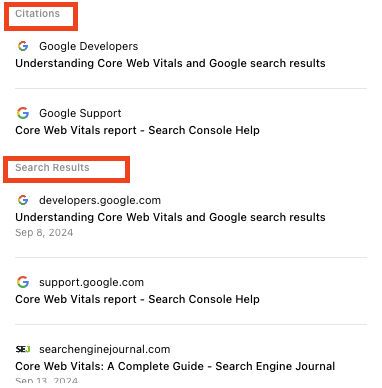
The system categorizes sources into two groups: direct citations used within responses and additional related search results.
Content Freshness & Accuracy
ChatGPT demonstrated the ability to retrieve articles published within the past hour; however, testing revealed some inconsistencies in its awareness of time.
When asked about recent Google updates, it returned outdated 2019 information pointing to potential issues with accurately dating content.
On the other hand, the system exhibited strong fact-checking abilities by correctly identifying and declining to validate incorrect premises.
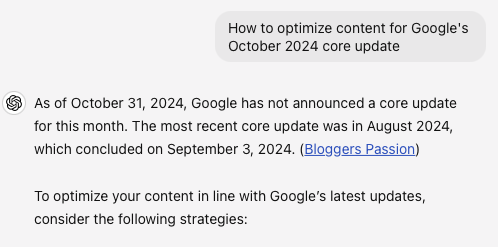
When queried about a non-existent Google core update in October, it accurately referenced the most recent update from August instead.
Coverage Limitations
Testing revealed a potential bias toward official sources in certain scenarios.
For instance, when discussing Google’s helpful content update, ChatGPT emphasized official statements while omitting widespread industry discussions about negative impacts.
Additionally, OpenAI’s partner publications are consistently cited throughout ChatGPT’s responses.
Availability and Access
The search feature is launching today for ChatGPT Plus and Team subscribers and users on the SearchGPT waitlist.
Enterprise and educational users will gain access in the coming weeks, and a broader rollout to free users is planned over the next several months.
This marks an important development in AI-powered search, but its full impact on search traffic patterns is still unknown.
We encourage you to monitor your analytics for ChatGPT referral patterns and evaluate your content’s visibility within the new system.
Conclusion
OpenAI’s integration of real-time search capabilities into ChatGPT marks a significant advancement in AI-powered search, offering users a more natural and conversational experience. As the search landscape continues to evolve, it is essential for publishers and SEO professionals to stay up-to-date with the latest developments and optimize their content accordingly.
FAQs
Q: How does ChatGPT’s real-time search feature work?
A: ChatGPT uses a fine-tuned version of GPT-4o and synthetic data generation techniques to power its real-time search capabilities.
Q: What are the limitations of ChatG


