Home Blog

Generate single title from this title From idea to AI app: Creating intelligent research assistants with Strands in 100 -150 characters. And it must return only title i dont want any extra information or introductory text with title e.g: ” Here is a single title:”

0

Write an article about

Building an AI app shouldn’t require a PhD in machine learning (ML) or months of wrestling with complex architectures. Yet that’s exactly what happens when you try to orchestrate multiple API calls, manage conversation state, and create agents that can reason on their own. I’ve seen straightforward AI ideas balloon into sprawling projects that demand specialized knowledge in natural language processing and distributed systems. But here’s what changed: using Strands Agents and AWS services, I built a fully functional AI research assistant in just 30 lines of code. In this post, I walk you through exactly how I did it—from initial concept to working application.

Amazon Web Services (AWS) offers multiple options for building agentic AI applications. Amazon Bedrock provides access to foundation models (FMs) that can power intelligent agents, while services like Kiro enable developer-focused AI assistance directly within the IDE. You can use these tools to create custom AI agents tailored to specific use cases and domains.

Kiro is an AI-powered IDE that writes code so developers can focus on decisions. Kiro Powers extend the Kiro IDE with specialized, on-demand capabilities by packaging MCP servers, steering files, and hooks into reusable units. The Strands power, for example, bundles SDK documentation search, getting started guides, and correct API patterns so Kiro can scaffold agents accurately. With over 50 curated powers from AWS, partners, and the community—covering design, deployment, security, and observability—developers install with one click and start building immediately.

Strands Agents is an open source framework that directly addresses these development challenges by providing a straightforward way to create intelligent agents that can perform tasks like research, analysis, and content generation. Strands Agents combine the capabilities of large language models (LLMs) with custom logic and APIs through Python code. For more information about Strands Agents, see Introducing Strands Agents, an Open Source AI Agents Software Development Kit (SDK).

Why choose Strands Agents: Simplified AI development for AWS environments

Strands Agents addresses the core challenges you face when building AI applications through its model-driven approach. Instead of complex hardcoding, it uses LLMs for autonomous reasoning and planning, so you can create agents with only a prompt and tools list while the LLM handles the logic and tool usage.

The framework’s flexible architecture supports everything from single agents to multi-agent networks and hierarchical systems, making it suitable for projects of various scale. You can integrate external functions and APIs through the @tool decorator, while the model-agnostic design works with various LLM providers including Amazon Bedrock, Anthropic, and OpenAI.

For AWS environments, Strands integrates naturally with services like Amazon Bedrock and AWS Lambda, and it’s already production-ready. AWS teams use it in services like Amazon Q and AWS Glue. The open source framework is Apache-2.0 licensed with active community contributions, and the same code runs smoothly in both local development and production environments. Real-time streaming responses make it a good fit for interactive applications that need immediate feedback.

For more information about the technical deep dive, see Strands Agents SDK: A technical deep dive into agent architectures and observability.

Prerequisites

Before you dive into the solution, make sure that you have the following in place:

  • An AWS account.
  • User configured in AWS IAM Identity Center or Builder ID.
  • Install Kiro.
  • Configure AWS credentials to access Amazon Bedrock — Set up authentication using AWS IAM Identity Center (the recommended approach for human access). Run the following commands to configure and log in:

aws configure sso

aws sso login –profile research-assistant

  • Next, attach a scoped inline AWS Identity and Access Management (IAM) policy to the role or permission set that you use. This policy grants only the necessary permissions for this tutorial—invoking the Claude Sonnet model through Amazon Bedrock.

{
“Version”: “2012-10-17”,
“Statement”: [
{
“Effect”: “Allow”,
“Action”: [
“bedrock:InvokeModel”,
“bedrock:Converse”
],
“Resource”: “arn:aws:bedrock:us-west-2::foundation-model/anthropic.claude-3-5-sonnet-20241022-v2:0”
}
]
}

Solution overview

Building an intelligent research assistant

This section shows how Strands Agents streamline the development of agentic AI capabilities. Our example research assistant showcases how you can quickly integrate intelligent features into your applications with minimal code. You start by creating an agent with an Agent() initialization, then define the agent’s behavior through prompt engineering. Next, you add autonomous research capabilities by providing tools and process responses for clean output.

The solution requires only 30 lines of code, demonstrating how Strands can reduce AI development complexity into straightforward implementation. While we use Streamlit for visualization, the core functionality lies in Strands’ ability to handle autonomous reasoning, tool selection, and task execution with minimal intervention from you.

Getting started with Strands Agents:

You will start by building a straightforward Q&A style research assistant using Strands Agents. In your IDE, install the Strands Agents SDK:

Kiro -> Terminal

pip install strands-agents

We also need Streamlit for our research assistant, so use the following command to install Streamlit:

Then you will create your first agent as a Python file. Let’s call it research.py.

from strands import Agent

# Create an agent with default settings
agent = Agent()

# Ask the agent a question
agent(“Tell me about agentic AI”)
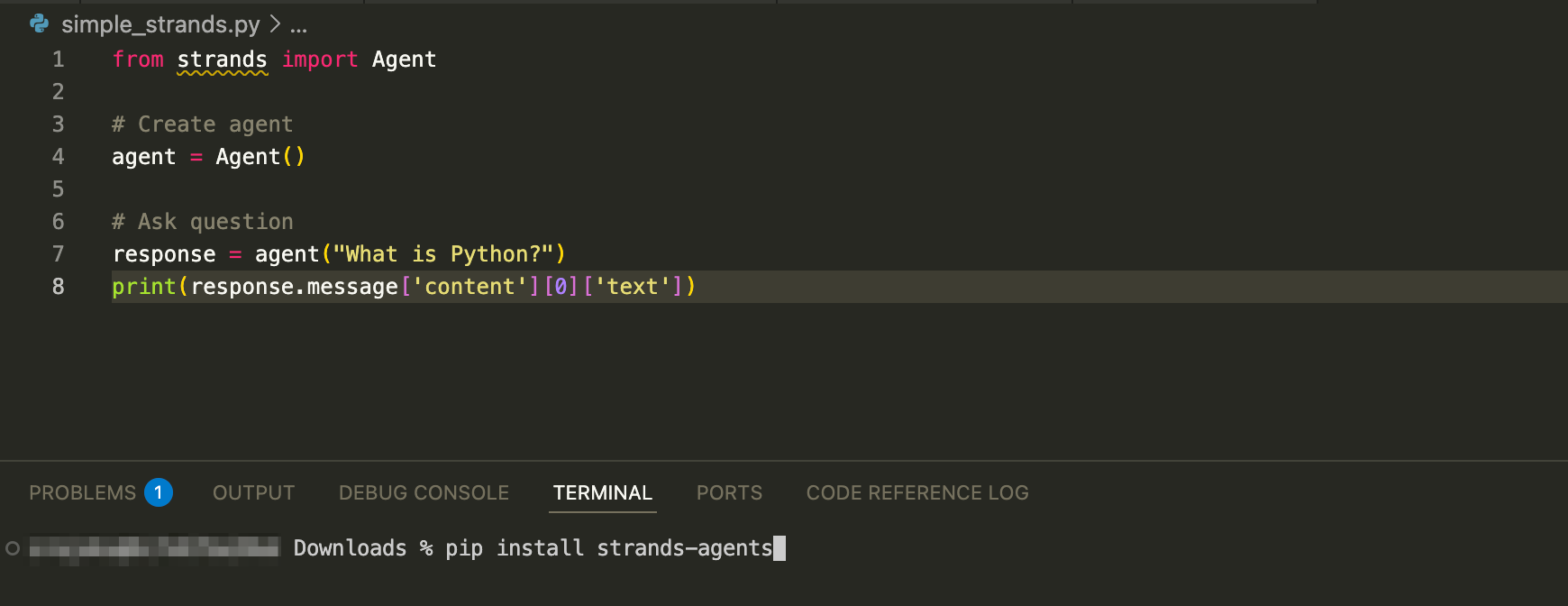
That’s it. You’ve just built your first AI agent. Now, let’s see what it can do when you run it.

In your terminal, run the following command:

With this foundation established, let’s enhance our implementation by using prompt engineering to create a more sophisticated research assistant. We will build a web interface using Streamlit that can be used to dynamically input topics and receive comprehensive research reports powered by Strands Agents.

AI-assisted development with Kiro: Generating our research assistant implementation

Let’s accelerate our development process by using capabilities of Kiro to generate our research assistant code through natural language prompting and conversation. We will use natural language to describe our requirements, and Kiro can help us create a functional research assistant application with Strands Agents and Streamlit.

Complete the following steps:

  1. Open Kiro.
  2. Create a new Python file (for example, research_assistant.py).
  3. Provide the following prompt:

Create a Streamlit research assistant app using strands Agent library with these exact requirements:

1. App title: “Research Assistant” with subtitle “Enter a topic to get research analysis and recommendations”
2. Text input field with placeholder “e.g., renewable energy, artificial intelligence”
3. “Generate Research Report” button that when clicked:
– Shows spinner with “Researching and analyzing…” message
– Redirects stdout to prevent terminal output interference (import sys, os and use devnull)
– Creates Agent() instance
– Uses this exact prompt template: “You are a research assistant. For the topic ‘{topic}’: 1. Overview of the topic in about 50 words 2. Find recent 2 articles about {topic} in 20 words each 3. Things to know relevant to the topic and description as prerequisites in 20 words each like if topic is agentic ai then prereq is machine learning and generative ai 4. 2 key contributors and well known people in this field of research topic including their bio in 25 words each 5. give relevant 2 urls to read more and any research papers from https://arxiv.org/”
– Displays response using st.subheader(f”Research Report: {topic}”) and st.write(response.message[‘content’][0][‘text’])
– Restores stdout in finally block
– Shows warning if no topic entered

Use try/finally pattern for stdout redirection. Keep code minimal and functional.

Kiro will generate the complete implementation, which we can then save and run.

The following is the code from Kiro.

import sys
import os
import streamlit as st
from strands import Agent

st.title(“Research Assistant”)
st.write(“Enter a topic to get research analysis and recommendations”)

topic = st.text_input(“Research Topic”, placeholder=”e.g., renewable energy, artificial intelligence”)

if st.button(“Generate Research Report”):
if topic:
with st.spinner(“Researching and analyzing…”):
old_stdout = sys.stdout
try:
sys.stdout = open(os.devnull, “w”)
agent = Agent()
response = agent(
f”You are a research assistant. For the topic ‘{topic}’: ”
f”1. Overview of the topic in about 50 words ”
f”2. Find recent 2 articles about {topic} in 20 words each ”
f”3. Things to know relevant to the topic and description as prerequisites in 20 words each ”
f”like if topic is agentic ai then prereq is machine learning and generative ai ”
f”4. 2 key contributors and well known people in this field of research topic including their bio in 25 words each ”
f”5. give relevant 2 urls to read more and any research papers from https://arxiv.org/”
)
finally:
sys.stdout = old_stdout

st.subheader(f”Research Report: {topic}”)
st.write(response.message[“content”][0][“text”])
else:
st.warning(“Please enter a topic to research.”)

Note: Without a web-browsing tool, the agent generates URLs from its training knowledge. These may not reflect the latest papers. For live retrieval, add appropriate MCP server as a tool.

Choosing MCP servers responsibly

  • Pin the MCP server to a specific version or commit hash (for example, pip install “arxiv-mcp==X.Y.Z”).
  • Review the source before installing. I recommend Amazon Bedrock-native retrieval (Knowledge Bases/RAG) for production use cases.
  • For customer-facing or cross-organization deployments, route third-party MCP servers through your organization’s legal and security review process.
  • MCP servers share the agent’s process privileges, including any AWS credentials available to the process. Treat them as part of your trust boundary.

For production workloads, consider AWS managed remote MCP servers via Amazon Bedrock AgentCore, which provide process isolation, centralized auth, and eliminate local credential exposure.

Security considerations for production

  • Validate user input. Cap topic length and strip non-printable characters before passing the string to the agent (see the code in this post).
  • Enable Amazon Bedrock Guardrails. Attach a guardrail to the model call for prompt-injection and unsafe-output filtering. For more information, see Detect and filter harmful content by using Amazon Bedrock Guardrails.
  • Turn on logging. Enable Amazon Bedrock model-invocation logging and AWS CloudTrail data events on bedrock:InvokeModel and bedrock:Converse so you can attribute misuse and reconstruct incidents.
  • Bound cost. Set an Amazon Bedrock on-demand quota alarm and a per-session query cap to prevent topic-flood/cost-exhaustion.
  • Classify persisted data. If you store conversation history, classify the data and redact sensitive values before writing.
  • Review the shared responsibility model. See the AWS Shared Responsibility Model for the split between what AWS manages and what you own.

If you want to understand the code better, you can ask Kiro Can you explain code in context?
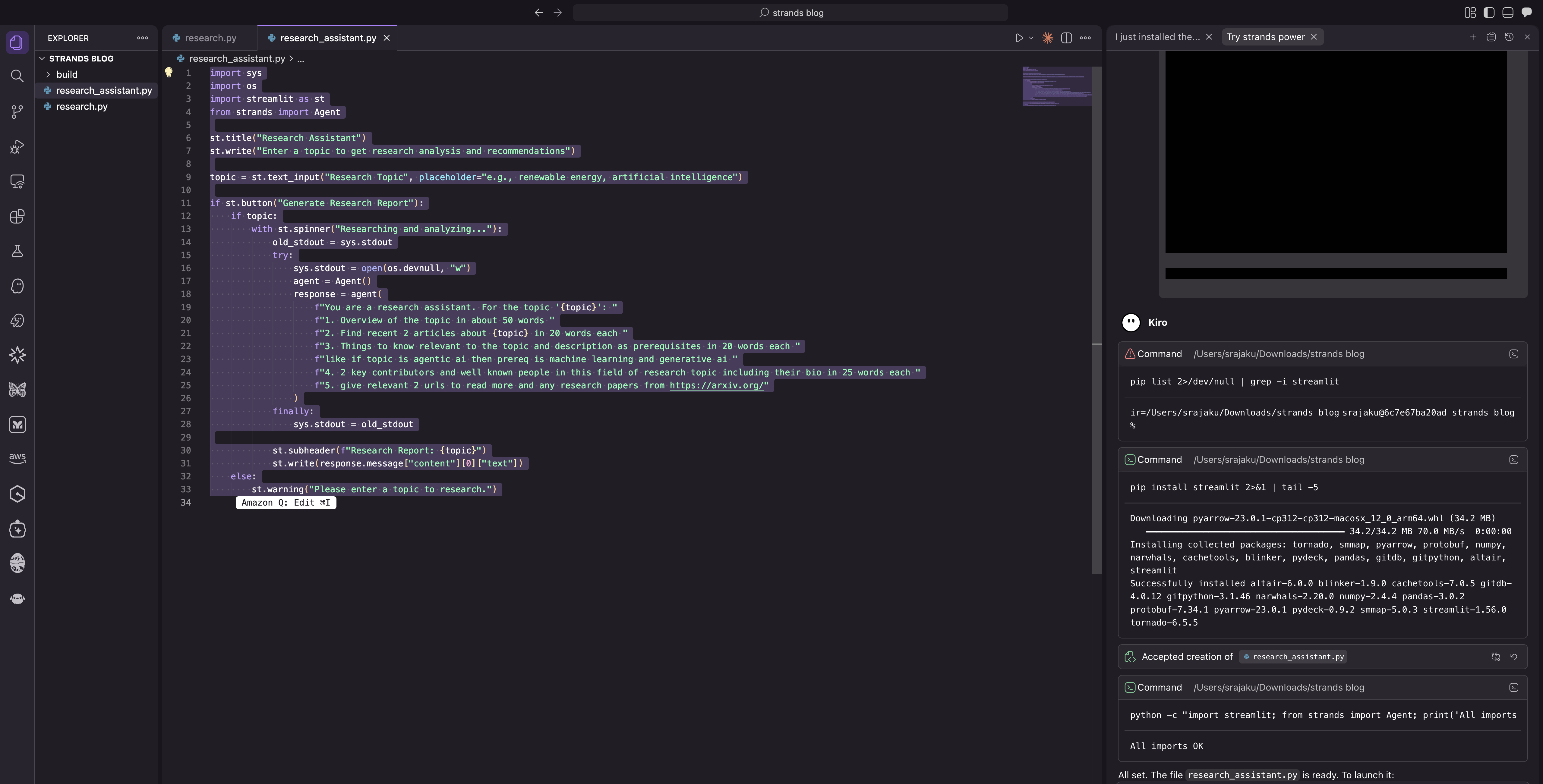
Kiro responds as follows:
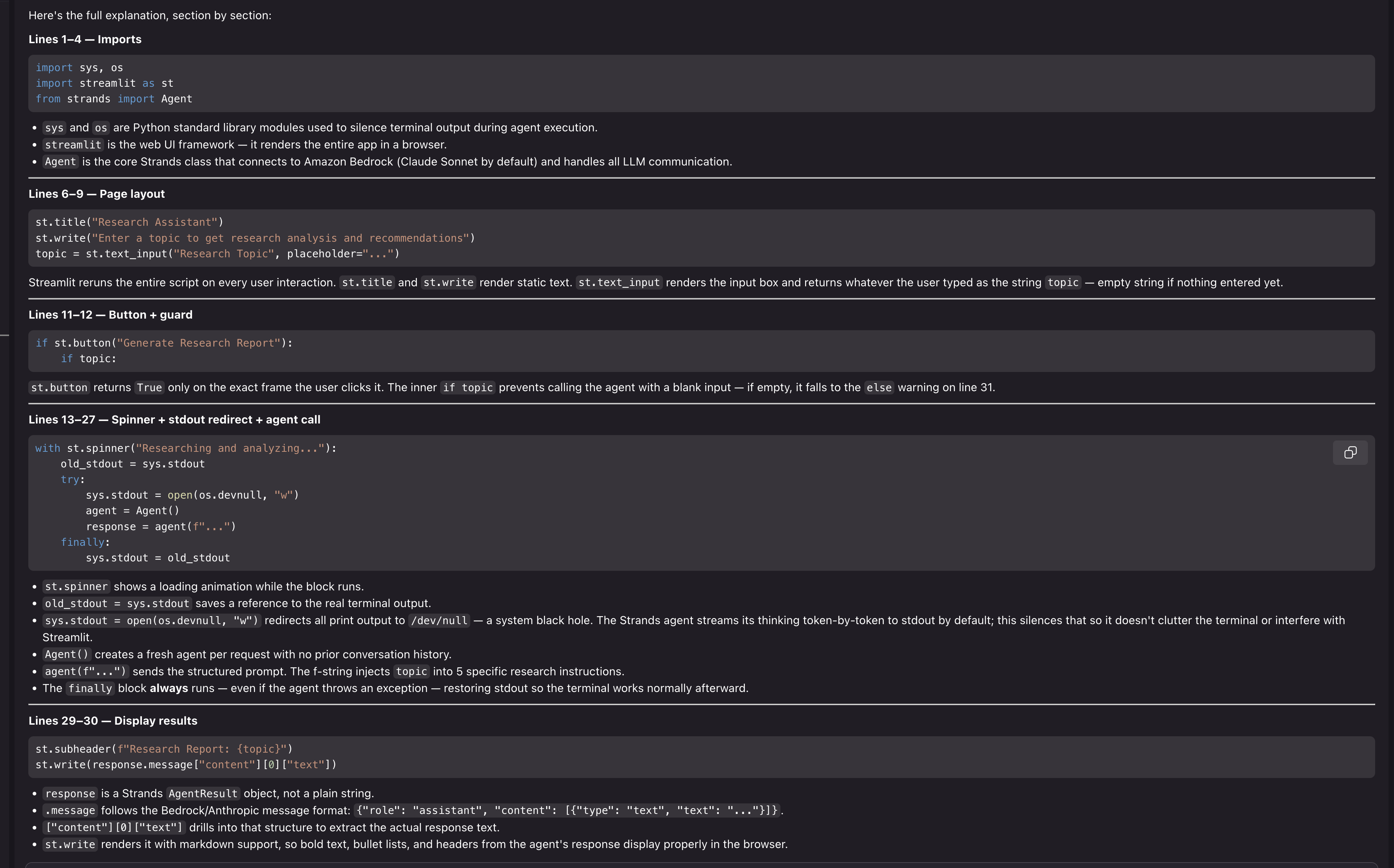
During initial development, the agent’s output was streaming correctly in the Streamlit interface but also appearing in the terminal, where it would get cut off abruptly. While this didn’t affect the application’s functionality, it created unnecessary noise in the development environment. Through further conversation with Kiro, I refined the code to include stdout redirection, to verify the agent’s responses would only display in the intended interface.

This illustrates a key advantage of coding with Kiro—the ability to iteratively improve your implementation through natural language feedback. When you encounter such edge cases, you can describe the desired behavior, and Kiro will help modify the code accordingly – for example, try asking Kiro to add error handling for empty or malformed agent responses.

Let’s now see our refined application in action.

Bringing your agent to life

In the terminal, go to the directory where the file research_assistant.py is saved and run the following command:

streamlit run research_assistant.py

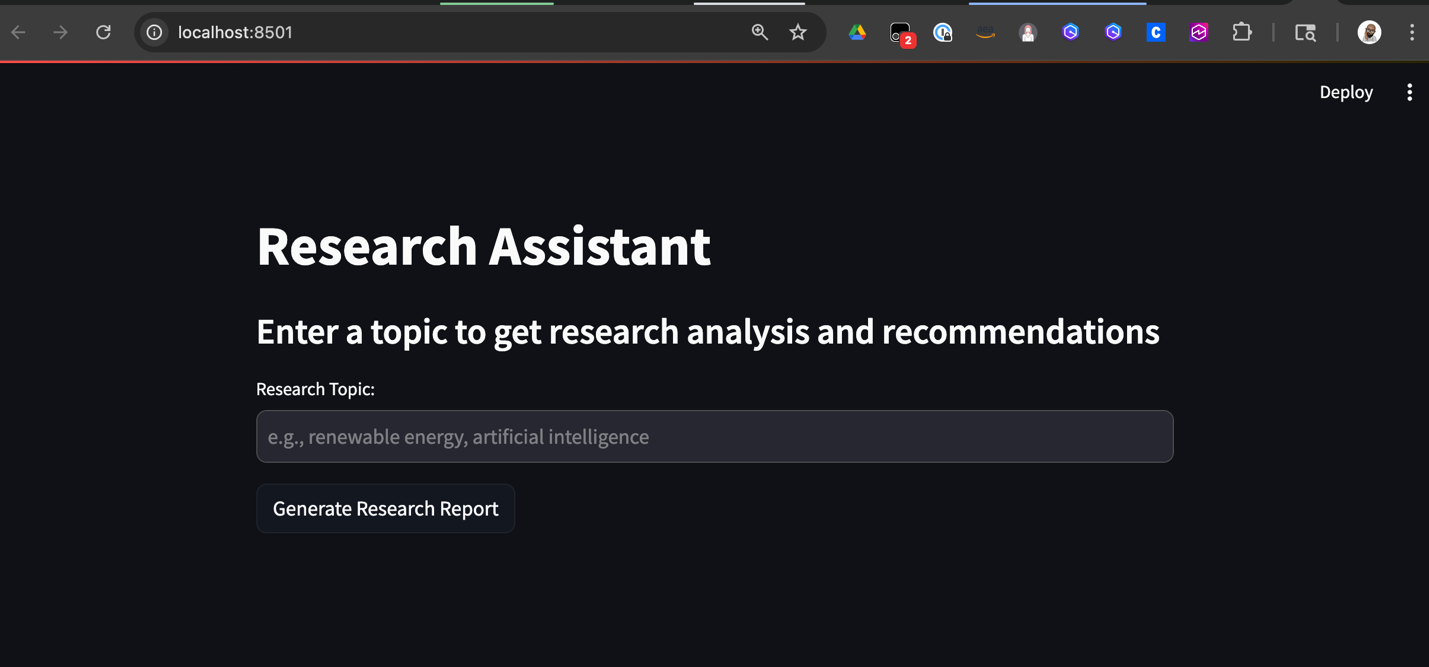
This will bring up the Streamlit app.

Note: streamlit run binds to 127.0.0.1 by default, so the UI is reachable only from this machine. Don’t expose it to the LAN (–server.address=0.0.0.0) or the internet without adding authentication, CSRF protection, and an Amazon Bedrock cost cap. Browser DNS-rebinding against localhost is a known concern for local developer tools. Consider Streamlit’s built-in authentication or reverse-proxying through an authenticated gateway for any shared use.

After you run the previous command, you will be greeted with following note. You can choose to leave the email as blank.

Welcome to Streamlit!

If you’d like to receive helpful onboarding emails, news, offers, promotions,

and the occasional swag, please enter your email address below. Otherwise,

leave this field blank.

Email:

Next, you will get the link to open Streamlit app.

You can enter a topic of interest and choose Generate Research Report.
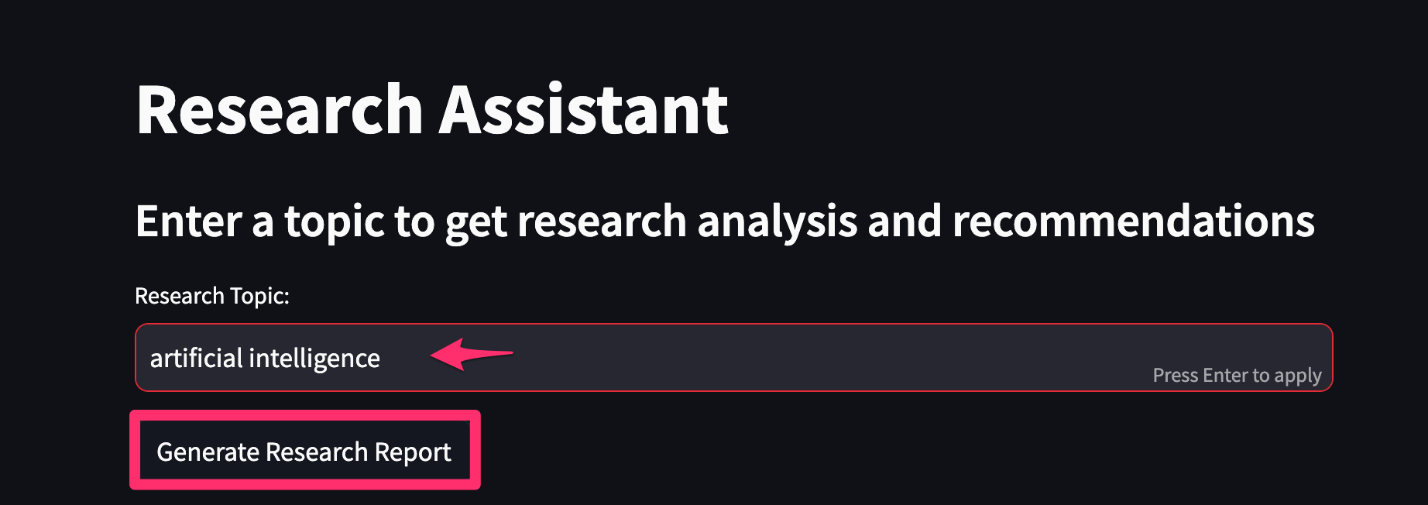
which will generate the research report as follows:
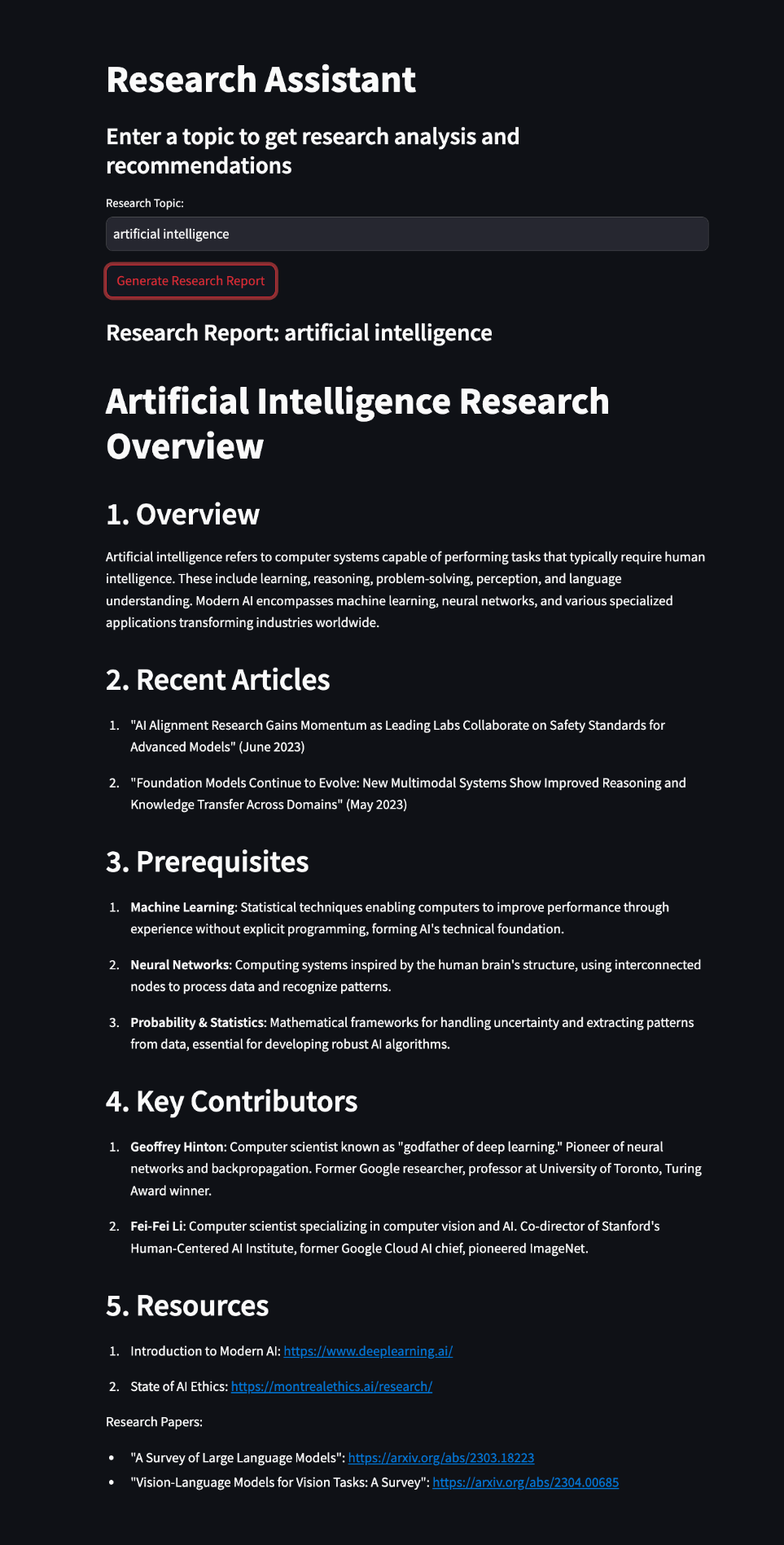
If you want to get a different report or other details, you can ask Kiro to modify the code when you have the file in context or you can proceed to alter the code yourself.

Conclusion

In this post, we explored how Strands Agents streamline the development of agentic AI applications. By combining the power of Strands’ model-driven approach with Kiro’s code generation capabilities, I demonstrated how you can build sophisticated AI features with minimal code.

Our exploration shows that Strands Agents can reduce complex AI development through intuitive agent creation, while Kiro can enhance your productivity through AI-assisted coding. The resulting applications are both powerful and maintainable, and you can quickly make custom modifications through prompt engineering. As AI continues to evolve, tools like Strands Agents and Kiro are making it increasingly accessible for you to create intelligent, autonomous applications that can enhance your specific use cases and workflows.

License & disclaimer

The example code in this post is licensed under MIT-0. This post and its code are provided as-is without warranty; readers are responsible for the security, cost, and operational posture of any system they deploy based on this guidance.

Considerations before using in production

  • Cost — each research query consumes Amazon Bedrock tokens; set a quota alarm and a per-session query cap before exposing this app beyond a single user.
  • Data — research topics and the model’s output are sent to a foundation model; do not submit confidential or regulated data without appropriate controls.
  • Operational — the tutorial ships with no audit trail, no input validation, and no authentication on the Streamlit UI. See the Security considerations for production section above before reusing this pattern.

About the author

Rajakumar Sampathkumar is a Principal Technical Account Manager at AWS, supporting strategic customers in achieving operational excellence on AWS. He focuses on machine learning, Generative AI, and data analytics architectures. Outside of his customer work, Raj actively builds and experiments with AI agents—including internal tools powered by Amazon Bedrock and Strands—bridging the gap between emerging AWS capabilities and real-world enterprise adoption.

.Organize the content with appropriate headings and subheadings ( h2, h3, h4, h5, h6). Include conclusion section and FAQs section with Proper questions and answers at the end. do not include the title. it must return only article i dont want any extra information or introductory text with article e.g: ” Here is rewritten article:” or “Here is the rewritten content:”


Generate single title from this title 5 ways AI can strengthen your teaching this school year in 100 -150 characters. And it must return only title i dont want any extra information or introductory text with title e.g: ” Here is a single title:”

Write an article about

Key points:

  • The future of education is not defined by AI, but by educators who use it wisely
  • Schools are building AI rules before they know the destination
  • Leading with AI and technology in the age of personalized learning
  • For more news on AI and teaching, visit eSN’s Digital Learning hub

A year ago, many educators were still asking whether artificial intelligence belonged in the classroom. Some were cautiously experimenting with AI-generated lesson plans, while others were focused on preventing students from using it altogether.

Today, the conversation has evolved.

Across the country, school districts are developing AI guidance, investing in educator-specific platforms, and providing professional learning around responsible implementation. Teachers are moving beyond asking, “Can AI write a lesson plan?” and beginning to ask a much more meaningful question: “How can AI help me become a more effective teacher?”

That’s an important distinction.

The best educators aren’t using AI to replace their expertise. They’re using it to amplify it.

But the real promise of AI isn’t that it helps teachers produce more. It’s that it helps educators protect more time for the human work of teaching. When technology reduces the hours spent formatting materials, rewriting directions, or completing repetitive administrative tasks, teachers gain more opportunities to greet students at the door, confer with them about their learning, notice when something feels off, and build the trust that makes meaningful learning possible.

AI should never create greater distance between teachers and students. Used thoughtfully, it should do the opposite. It should give educators more capacity to create belonging—because before students respond to instruction, feedback, or expectations, they need to know they are seen, supported, and valued.

As you prepare for the 2026–27 school year, here are five ways AI can strengthen your teaching while keeping relationships—and learning—at the center.

1. Build an AI workflow, not just an AI toolbox

One of the biggest shifts over the past year is that AI is no longer a single tool or website.

Today’s educators are using different AI platforms for different purposes:

  • Brainstorming lesson ideas
  • Creating differentiated instructional materials
  • Developing formative assessments
  • Translating family communication
  • Designing visuals and presentations
  • Analyzing student work
  • Summarizing research
  • Organizing instructional resources

Rather than asking, “What’s the best AI tool?” begin asking, “What’s the best AI tool for this task?”

Just as we don’t rely on one program for grading, email, presentations, and data analysis, we shouldn’t expect one AI platform to meet every instructional need.

The goal isn’t mastering every new tool that appears. It’s building a workflow that helps you teach more intentionally and efficiently.

2. Differentiate faster—without lowering expectations

Differentiation has always been one of the most rewarding—and time-intensive—parts of teaching.

AI can now help teachers quickly create:

  • Multiple reading levels of the same text
  • Vocabulary supports
  • Sentence stems
  • Graphic organizers
  • Extension activities
  • Accommodations for diverse learners
  • Multilingual resources

The objective isn’t to make learning easier.

It’s to make learning more accessible.

When teachers spend less time recreating the same lesson five different ways, they gain more time to meet with students individually, facilitate meaningful discussions, and provide targeted support.

Technology shouldn’t replace high expectations. It should remove unnecessary barriers so every student has an opportunity to meet them.

3. Let AI support student thinking—not replace it

Perhaps the most important evolution in AI has been the shift from simply generating answers to supporting the learning process itself.

Instead of asking students to use AI to complete assignments, encourage them to use it to deepen their thinking.

Students can ask AI to:

  • Explain a difficult concept in another way
  • Identify gaps in their reasoning
  • Practice academic conversations
  • Revise their writing
  • Generate practice questions before an assessment
  • Reflect on their own learning

The most powerful AI doesn’t think for students.

It helps students think more deeply.

That subtle shift changes AI from a shortcut into a learning partner.

4. Make AI literacy part of every classroom

Today’s students don’t simply need rules about AI.

They need instruction.

Just as we teach digital citizenship and media literacy, AI literacy has become an essential skill.

Students should learn how to:

  • Write thoughtful prompts
  • Recognize inaccurate or fabricated information
  • Identify bias in AI-generated responses
  • Verify information using reliable sources
  • Acknowledge when AI has been used appropriately
  • Decide when AI is helpful—and when independent thinking is the better choice

Teaching students how to think critically about AI may prove more valuable than teaching them how to use any single platform.

Technology will continue to evolve.

Critical thinking will always matter.

5. Use AI to create more time for belonging before behavior

Teachers didn’t choose this profession because they enjoy formatting documents, rewriting directions, or drafting routine emails.

They chose it because they wanted to make a difference in the lives of young people.

AI can help educators reclaim valuable time by assisting with tasks such as:

  • Drafting family communication
  • Creating rubrics and instructional materials
  • Summarizing formative assessment data
  • Organizing meeting notes
  • Brainstorming intervention and enrichment ideas
  • Developing first drafts of newsletters or classroom updates

But saving time isn’t the goal.

The real question is: What will you do with the time you get back?

If we believe that belonging comes before engagement, before motivation, and yes, before behavior, then every minute AI gives back to us is another opportunity to strengthen the relationships that make everything else possible.

Use that time to greet students at the door.

Sit beside a reluctant reader.

Conference with a writer.

Celebrate a student’s growth.

Call home with good news.

Check in with the student whose behavior has suddenly changed.

Laugh with your class.

Listen before you redirect.

Those moments will never be generated by artificial intelligence.

They can only be created by a caring educator.

Technology should never make teaching less human. It should create more opportunities for the relationships that make learning possible. Before students engage with curriculum, feedback, or expectations, they need to experience belonging.

AI is at its best when it helps educators become more present—not simply more productive.

Final thoughts

The biggest change over the past year isn’t the technology.

It’s our mindset.

The conversation is no longer about whether AI belongs in education.

It’s about ensuring educators lead its implementation with purpose, ethics, and sound instructional practice.

The future of education is not AI replacing the teacher at the center of the classroom. It is thoughtful educators using AI to protect what technology cannot replicate: professional judgment, empathy, trust, and human connection.

The most meaningful measure of AI’s value will not be how much more work educators produce. It will be whether the time it saves allows them to know students more deeply, respond more thoughtfully, and build classrooms where every learner feels seen and supported.

As the 2026–27 school year begins, let’s embrace AI not as a replacement for great teaching, but as a tool that allows us to do more of what has always mattered most.

Because the future of education isn’t defined by artificial intelligence.

It’s defined by the educators who use it wisely.

And the best use of AI may simply be this: helping us spend more time being the teachers our students need us to be.

.Organize the content with appropriate headings and subheadings ( h2, h3, h4, h5, h6). Include conclusion section and FAQs section with Proper questions and answers at the end. do not include the title. it must return only article i dont want any extra information or introductory text with article e.g: ” Here is rewritten article:” or “Here is the rewritten content:”

Generate single title from this title Samsung health AI models analyse wearable biosignal data in 100 -150 characters. And it must return only title i dont want any extra information or introductory text with title e.g: ” Here is a single title:”

Write an article about

Samsung Research America’s Digital Health Team has presented two AI foundation models designed to learn from wearable biosignals. The work centres on data captured by smartwatches, including heart activity, sleep, and physical activity.

The company discussed its Connected Care vision at the Health Forum during Galaxy Unpacked in July 2026. Samsung described a future of preventive, personalised, and connected care, supported by health technology and healthcare partnerships. Its research team positions health foundation models as one component of new consumer health experiences.

Sharanya Desai, Head of Digital Health Algorithms at Samsung Research America, said: “This research is significant because it lays the technical groundwork for delivering health insights that are efficient, precise, and continuous through a health foundation model.

“We will continue to develop and advance health foundation models that can be applied to a variety of biosignals and health features that can operate on-device with limited sensors and computing resources.”

Samsung’s health AI foundation model research

A health foundation model uses self-supervised learning to identify features in unlabeled biosignal data. Samsung says that pretraining on large health datasets allows one model to support downstream tasks such as biosignal analysis, biomarker development, and health issue prediction.

The research covers two models with different aims. xMAE, short for Physiology-Aware Masked Cross-Modal Reconstruction for Biosignal Representation Learning, learns temporal relationships between different biosignals. HiMAE, or Hierarchical Masked Autoencoder, learns health patterns across multiple time scales in wearable time-series data.

Samsung says xMAE was accepted to the International Conference on Machine Learning. HiMAE was accepted to the International Conference on Learning Representations. The company describes both as work on physiological relationships and temporal structures in biosignal data.

The models address different parts of wearable-data analysis. xMAE connects two cardiac signals that measure related activity through different mechanisms. HiMAE analyses data at short and long intervals, allowing one pretrained model to support classification, numerical prediction, and data generation.

Electrocardiograms, or ECGs, measure the heart’s electrical activity directly. Samsung describes ECG as useful for measuring heart rate and heart-rate variability. It can also identify abnormal heart rhythms and risks associated with conditions such as atrial fibrillation.

Wearable ECG readings generally require a user to pause and take an active measurement. Photoplethysmography, or PPG, takes a different approach. PPG detects changes in blood flow and can run passively through sensors in wearable devices such as smartwatches.

Both signals originate from cardiac activity. They occur with a time difference, which Samsung compares with hearing thunder after seeing lightning. xMAE learns that temporal relationship by reconstructing masked parts of an ECG signal from PPG data.

This design aims to analyse cardiovascular-health features through continuously measured PPG data without separate manual ECG measurements. The model’s pretraining used about 9,400 hours of ECG and PPG data.

Subbu Venkatraman, Head of the Digital Health Research Lab at Samsung Research America, commented: “Biosignals are inherently dynamic, with unique time-varying physiological properties. The key contribution of this research lies in proving the viability of health foundation models capable of capturing both the inter-signal relationships and their underlying temporal structures.

“We remain committed to advancing foundational health AI research and translating it into healthcare solutions that meaningfully improve people’s health and wellbeing.”

Samsung reports that xMAE outperformed unimodal biosignal models and existing multimodal learning methods in 15 of 19 evaluation tasks. Those tasks covered cardiovascular disease prediction, abnormal test-result detection, and sleep-stage classification. The company also says the learned features showed potential for use across sensor devices, body locations, and data-gathering environments.

HiMAE analyses wearable data across time scales

Wearable data can carry different information over different time periods. Short segments can show fast-changing signals such as heartbeats. Longer segments can reveal patterns that build over time, such as sleep or physical activity.

HiMAE uses multiple encoders to analyse short and long data segments separately. Samsung says this arrangement enables the model to identify the time scale needed for a health task. Heart-rate analysis and sleep prediction can therefore draw on different parts of the time-series data.

The training method reconstructs masked portions of wearable data. Samsung says this lets HiMAE learn patterns from biosignals where labelled data is limited. The model then supports classification, numerical prediction, and data generation from a single pretrained system.

Samsung says HiMAE achieved high performance with a smaller model than existing models. The company also reports that it can produce results in less than one millisecond on a smartwatch-class central processing unit.

That processing claim places the model’s analysis on the device rather than on cloud servers. Foundation models trained on unlabelled physiological streams provide a mechanism to extract diagnostic markers, run predictive health classifications, and generate user guidance from consumer hardware all without continuous server connectivity.

See also: Google AI health coach to use Abbott glucose data

Want to learn more about AI and big data from industry leaders? Check out AI & Big Data Expo taking place in Amsterdam, California, and London. The comprehensive event is part of TechEx and is co-located with other leading technology events including the Cyber Security & Cloud Expo. Click here for more information.

AI News is powered by TechForge Media. Explore other upcoming enterprise technology events and webinars here.

.Organize the content with appropriate headings and subheadings ( h2, h3, h4, h5, h6). Include conclusion section and FAQs section with Proper questions and answers at the end. do not include the title. it must return only article i dont want any extra information or introductory text with article e.g: ” Here is rewritten article:” or “Here is the rewritten content:”
Generate single title from this title Key Trends & Data for 2026 in 100 -150 characters. And it must return only title i dont want any extra information or introductory text with title e.g: ” Here is a single title:”

Write an article about

Key Takeaways

  • 97% of organizations are already using or planning to use AI-powered cybersecurity tools, and 73% run agentic AI inside their security function (All About AI 2026; CISO AI Risk Report 2026).
  • AI and automation cut the average breach by $1.9 million — $3.62M with AI versus $5.52M without, a 34% reduction (IBM Cost of a Data Breach Report 2025).
  • The fastest recorded eCrime breakout time is now 27 seconds; the average is 29 minutes, 65% faster than 2024 (CrowdStrike 2026 Global Threat Report).
  • AI-driven phishing jumped 204% — one malicious email every 19 seconds, and AI-written messages are clicked 4× more often than traditional ones (Hoxhunt / The European 2026).
  • The AI in cybersecurity market reaches $25.53 billion in 2026 and is projected at $50.83 billion by 2031 (MarketsandMarkets); Gartner puts AI-related security spend near $51.3 billion this year.
  • EU AI Act enforcement for general-purpose AI begins August 2, 2026, with penalties up to €35M or 7% of global annual turnover.

In 2025, the world generated roughly 181 zettabytes of data — and 2026 projections push that figure to approximately 221 ZB, according to IDC. Traditional security tools were never built for this scale. And they weren’t built for adversaries who can put together a convincing phishing email in five minutes flat. Each employee still opens up to 200 attack vectors. The math hasn’t gotten friendlier.

What has shifted is the nature of the threat. CrowdStrike’s 2026 Global Threat Report documented that AI-enabled adversaries increased operations by 89% year-over-year. The fastest recorded eCrime breakout time — the window between initial compromise and lateral movement — is now 27 seconds. If your security stack is still running on scheduled scans and signature-based detection, you’re not just behind. You’re exposed before you’ve finished your morning coffee.

This article covers AI in cybersecurity statistics that reflect the real landscape in 2026, drawn from IBM, Gartner, Darktrace, CrowdStrike, Microsoft Security, Experian, and others publishing current data — not recycled 2024 roundups.

Build your AI security solution today!

Get started now!

AI in Cybersecurity Statistics 2026: Key Metrics at a Glance

AI is already embedded in both offense and defense. These 2026 benchmarks reflect where the industry actually stands:

The dual-role dynamic is the defining story of 2026: AI is simultaneously the most effective defensive capability available and the adversary’s preferred force multiplier.

AI Cybersecurity Market: Growth and Spending 2026

These aren’t long-range projections. Gartner’s Q4 2025 forecast found that by 2027, more than 40% of enterprise AI security spending will directly tie to AI-driven tooling — a jump from just 8% in 2023. The reallocation is already underway, not pending.

Breach Economics: What IBM’s Data Actually Shows

IBM’s Cost of a Data Breach Report 2025 produced one of the year’s most cited findings: the global average breach cost dropped to $4.44 million, down 9% from $4.88M in 2024. Taken at face value, that looks like progress.

The real story lives in the breakdown. Organizations with extensive AI and automation in their security stack averaged $3.62M per breach. Organizations running without it averaged $5.52M. That $1.9 million gap — a 34% reduction — is now the clearest ROI argument any security team can bring to a budget conversation.

Speed improved alongside cost. AI-deployed organizations identified breaches in 181 days on average versus 232 days without AI — 51 days faster. Mean time to identify and contain reached 241 days, the lowest recorded in nine years.

IBM did flag an “AI oversight gap” in the same report: AI adoption is outrunning governance. Security tools are being deployed before risk frameworks exist to manage them. For CISOs scaling AI-powered defenses in 2026, that’s the operational risk hiding inside the good news.

The Dual Role of AI: Defense vs. Malicious Use

AI doesn’t choose sides. The same capabilities that accelerate threat detection are being turned against organizations at a scale that wasn’t technically possible three years ago. Understanding both trajectories is the only way to build a realistic security posture.

AI Threat Detection and Prevention

The foundational use cases for defensive AI are well understood at this point. The numbers:

The 2026 landscape adds several new data points that change the scale of what “fast” means in threat response:

  • CrowdStrike’s 2026 Global Threat Report recorded a 27-second eCrime breakout time — the fastest on record. At that speed, human response alone is structurally insufficient.
  • IBM X-Force’s 2026 Threat Index found AI-driven attacks escalating broadly, with basic gaps — unpatched systems, weak credentials, missing MFA — remaining the most exploited entry points despite years of remediation guidance.
  • 1.8 billion credentials were stolen by infostealers in just H1 2025 (IBM X-Force data).
  • 1 in 8 AI-related breaches now involves autonomous agents operating without direct human oversight.
  • Microsoft Security reported in March 2026 that threat actors exploited legitimate GenAI tools against more than 90 organizations using malicious prompt injection — turning enterprise AI tools into attack vectors.

IBM’s threat monitoring platform processes 150 billion+ security events per day. That’s the baseline processing requirement for modern defense. It’s not achievable without AI-driven triage and prioritization.

Malicious Use of AI in 2026

Office worker reviews emails as a security alert warns of AI-powered phishing threats

Phishing is where the AI-enabled escalation is most visible and most documented:

One case study worth citing: in January 2026, a European bank was targeted by AI-generated deepfake calls impersonating C-suite executives. The attack resulted in $12 million in unauthorized wire transfers on February 3, 2026. Not a red team exercise. A live breach.

Experian’s 2026 Fraud Forecast documented AI-enabled fraud growing at 1,210% compared to 195% for traditional fraud methods in the same period. And 63% of organizations have no dedicated deepfake defense budget to respond to it.

AI for Cyber Defense: What’s Shipping in 2026

Several major vendors expanded agentic AI security capabilities in Q1 2026:

  • CrowdStrike launched “Charlotte AI Agent” in March 2026 for autonomous threat response — detection, investigation, and remediation without constant analyst input.
  • Palo Alto Networks shipped “XSIAM Autonomous Response” in March 2026 for real-time, cross-platform threat containment.
  • Microsoft Defender introduced purpose-built agentic AI capabilities specifically to protect enterprise AI agents from attacks targeting the agent layer itself.
  • Google Cloud Next 2026 unveiled autonomous threat hunting and detection engineering agents within Security Command Center.
  • Darktrace “ActiveAI” continues deployments — at Aviso, a Canadian wealth management firm with $140B+ AUM, it generated 73 actionable alerts, autonomously investigated 23 million events, and blocked 18,000+ malicious emails that legacy filters had cleared through.

The emerging agentic AI security market stands at an estimated $1.65 billion in 2026, with MarketsandMarkets projecting $13.52 billion by 2032 at a 42.0% CAGR. This sub-segment is growing faster than the broader AI cybersecurity market.

Agentic AI: The Double-Edged Frontier of 2026

SOC team monitors AI security analytics on large screens, showing agentic AI in enterprise cybersecurity

Agentic AI — autonomous systems that plan, execute, and adapt with minimal human supervision — is reshaping the security landscape in both directions.

Adoption data from Q4 2025 and Q1 2026 surveys:

  • Gartner predicts more than 80% of enterprises will run autonomous AI agents in production by end of 2026, up from less than 5% at the start of 2025.
  • 73% of organizations already use or are actively developing agentic AI within cybersecurity (CISO AI Risk Report 2026 survey).
  • 81% of enterprises are actively scaling agentic AI across security teams.
  • Darktrace’s 2026 study (1,540 security leaders, 14 countries) found 92% are concerned about security implications of deploying AI agent workforces.
  • 47% of executives described themselves as “very or extremely concerned” about AI agents with access to sensitive enterprise data.
  • 1 in 8 AI-related breaches now involves autonomous agents operating without direct human oversight.

CISA’s late-2024 guidance identified agentic AI as a new and expanding attack surface. That framing has only become more relevant since. The “Shadow Agent” problem — unauthorized or untracked AI agents operating within enterprise environments — is shaping up as 2026’s version of the Shadow IT problem that IT teams spent the previous decade trying to contain.

Shadow AI: The Threat Nobody Mapped

Shadow IT had a playbook. Shadow AI doesn’t — at least not yet.

The 2026 numbers show how quickly the problem scaled:

  • 75% of CISOs discovered unsanctioned GenAI tools already operating in their environments; another 16% weren’t certain they hadn’t.
  • Shadow AI is a contributing factor in 1 of every 5 breaches.
  • 67% of CISOs report limited visibility into AI activity across their environments.
  • More than 38% of employees share sensitive information with AI tools without organizational permission.

The risk isn’t just data leakage in the obvious sense. Shadow AI tools frequently arrive pre-wired with embedded credentials, API tokens, and OAuth connections that carry elevated permissions and leave minimal audit trails. They plug into enterprise systems and operate quietly. Finding them requires purpose-built AI discovery tooling that most organizations didn’t budget for in 2024 — and many still haven’t prioritized heading into 2026.

Regulatory Context: EU AI Act and the 2026 Compliance Deadline

Enforcement timelines are no longer hypothetical. The EU AI Act’s full General-Purpose AI model obligations take effect on August 2, 2026.

For cybersecurity teams, the practical requirements are substantial:

  • High-risk AI system obligations include: risk management systems, data governance processes, technical documentation, logging and audit trails, transparency requirements, human oversight mechanisms, and — explicitly — cybersecurity requirements including robustness and accuracy standards.
  • Non-compliance penalties: up to €35 million or 7% of global annual turnover for the most serious violations.
  • AI models already on the market before August 2, 2025 have until August 2, 2027 to comply.

In the US, the NIST AI Risk Management Framework functions as the de facto baseline and is increasingly referenced in federal procurement. ISO/IEC 42001 is emerging as the third pillar alongside EU AI Act and NIST AI RMF — particularly for organizations operating across jurisdictions.

For security teams, the operational implication is direct: AI systems used in access management, threat detection, and incident response now require documented governance processes. Deployment without governance is a compliance exposure, not just a technical risk.

Enterprise vs. SME: The 2026 Adoption Landscape

The 85% “insufficient budget” finding among senior security leaders is worth pausing on — given the scale of investment being made. The problem isn’t awareness or intent. It’s that the threat surface is expanding faster than any realistic budget cycle can follow. AI tools help close that gap, but they’re not free, and the governance overhead adds cost that’s easy to underestimate at the procurement stage.

FAQ: AI in Cybersecurity 2026

What percentage of organizations use AI in cybersecurity in 2026?

97% are using or planning to use AI-powered cybersecurity tools (All About AI 2026). Of those, 73% already have agentic AI deployed or in active development within their security function.

How much does AI reduce data breach costs?

IBM’s Cost of a Data Breach Report 2025 documented a $1.9M average reduction per breach for organizations with extensive AI and automation — $3.62M average versus $5.52M for those without. That’s a 34% cost difference.

What is shadow AI and why is it a problem in 2026?

Shadow AI refers to unsanctioned AI tools employees adopt without organizational approval or visibility. 75% of CISOs found these tools in their environments. Shadow AI is now a contributing factor in 1 in 5 breaches, and most organizations lack the discovery tooling to find and inventory them.

How fast are AI-driven cyber attacks today?

The fastest recorded eCrime breakout time in 2026 is 27 seconds (CrowdStrike 2026 Global Threat Report). The average is 29 minutes — 65% faster than 2024’s average.

What is the cost of cybercrime in 2026?

Estimates range from $10.5 trillion to $11.88 trillion globally. The 2028 projection reaches $13.82 trillion (Cybersecurity Ventures, Proxyrack, forecast aggregate).

What does the EU AI Act mean for cybersecurity teams?

Starting August 2, 2026, organizations deploying high-risk AI systems in security-critical contexts face mandatory governance requirements: risk management, logging, robustness, and documented human oversight. Penalties reach €35M or 7% of global annual turnover for serious violations.

How do AI agents change the security perimeter?

Autonomous agents can hunt threats, respond to incidents, and investigate alerts without human input — which expands defensive capacity significantly. But they also create new attack surfaces: 1 in 8 AI-related breaches now involves autonomous agents, and “Shadow Agents” operating outside IT governance are an emerging blind spot without a standard playbook yet.

Which vendors lead AI cybersecurity in 2026?

The names appearing in every major analyst report: CrowdStrike (Charlotte AI Agent), Palo Alto Networks (XSIAM Autonomous Response), Microsoft (Defender agentic AI), Darktrace (ActiveAI), IBM (X-Force), and Google Cloud (Security Command Center). All launched or significantly expanded AI-native capabilities between Q4 2025 and Q1 2026.

Future Outlook

The short-term trajectory points toward more complexity, not less:

  • Cybercrime is projected to reach $13.82 trillion by 2028.
  • Post-quantum cryptography is moving from theoretical concern to active threat: ransomware families began adopting PQC ciphers in 2026. The post-quantum cryptography market is forecast to grow from $0.42B (2025) to $2.84B by 2030 (MarketsandMarkets).
  • Gartner projects that 40% of enterprise applications will include task-specific AI agents by end of 2026 — up from less than 5% at the start of 2025. Every new agent is a new attack surface.
  • The World Economic Forum noted in May 2026 that AI has the potential to democratize cybersecurity — making enterprise-grade capabilities accessible to organizations that previously couldn’t afford dedicated security operations. That’s the optimistic scenario, and it’s worth taking seriously alongside the threat data.
  • 84% of security professionals still flag AI training data quality as a fundamental reliability concern. Darktrace’s 2026 data layers in a different worry: 92% are concerned specifically about the security implications of deploying AI agent workforces.
  • 85% of senior security leaders using AI say current budgets are insufficient to address AI-driven threats at current scale.

The signal across every major 2026 source is consistent: AI is the defining force in both the attack and the defense, it’s compounding, and organizations that haven’t moved past legacy tooling are falling further behind with each passing quarter — not holding steady.

Build AI-Powered Security Solutions with LITSLINK

LITSLINK builds AI-powered cybersecurity products for organizations that need real, production-grade capabilities — not off-the-shelf integrations that create their own shadow AI footprint. Whether you’re building a threat detection layer, an intelligent SOC assistant, custom AI security tooling, or agentic workflows for incident response, our engineering team brings depth in LLM applications, real-time data pipelines, and production AI systems.

Related reading: explore LITSLINK’s AI development services and more analysis from our Artificial Intelligence blog.

Build your AI security solution today!

Get started now! .Organize the content with appropriate headings and subheadings ( h2, h3, h4, h5, h6). Include conclusion section and FAQs section with Proper questions and answers at the end. do not include the title. it must return only article i dont want any extra information or introductory text with article e.g: ” Here is rewritten article:” or “Here is the rewritten content:”

Generate single title from this title Serve Qwen3.8-2.4T-A95B, a 2.4T-Parameter Model, with Configurable Reasoning on NVIDIA GB300 NVL72 in 100 -150 characters. And it must return only title i dont want any extra information or introductory text with title e.g: ” Here is a single title:”

0

Write an article about

Alibaba released the open weights for Qwen3.8-2.4T-A95B (Qwen3.8-Max), its largest open-weight model, bringing near-frontier capabilities to the open ecosystem. It has 2.4T total parameters with 95B activated per token. It’s a fine-grained mixture of experts (MoE) architecture with a hybrid of full and linear attention, a context window of up to one million tokens, and an output length of up to 128K, designed for demanding reasoning and agentic workloads. 

Deploying a 2.4T parameter open-weight model requires data-center-scale accelerated compute. Inference at this scale depends on extreme co-design across chips, system architecture, and software. NVIDIA is working with the open-source ecosystem to bring the model to multinode deployments through optimized kernels, inference runtimes, and distributed serving recipes.   

Without additional model tuning, the model achieves a throughput of over 4K tokens per second per GPU and over 350 tokens per second per user on NVIDIA GB300 NVL72 in FP8 precision on Day 0. Further optimizations, including NVFP4 precision, are expected to deliver enhanced performance gains over time.  

Architectural innovations for long-context inference 

Qwen3.8-2.4T-A95B is built for the hardest agentic workloads like coding, large-scale document analysis, and long-running multi-step workflows. Unlike chat-first models that send a single prompt and receive a single reply, agentic applications accumulate system instructions, tool outputs, retrieved documents, code, logs, and multi-step reasoning traces across a workflow. As context grows, attention, compute, and KV cache memory become the binding constraints. 

The full-attention and linear-attention hybrid architecture addresses this, and the model alternates between the two. In the full-attention layers, every token attends to every other token, and in the linear-attention layers, the growing KV cache is replaced with a bounded recurrent state. Qwen3.8-2.4T-A95B keeps both compute and memory bounded as context scales to up to one million tokens. 

Fine-grained MoE makes the 2.4T parameter count practical to serve. Instead of a small number of large experts, capacity is distributed across a larger population of smaller experts, improving specialization and routing efficiency per unit of activated compute. A learned router activates only the experts needed per token, so serving costs track active parameters, not the full 2.4T parameters, delivering frontier-scale capacity at a fraction of the cost of a comparable dense model. 

Built-in reasoning controls (low/high/xhigh) enable developers to configure inference depth per request, trading compute for reasoning quality depending on the task: dial up for complex multi-step reasoning or dial down for high-throughput document processing. 

Figure 1. Overview of the Qwen3.8-2.4T-A95B linear gated delta networks plus full attention with fine-grained MoE architecture  

Qwen3.8-2.4T-A95B optimized performance on GB300 NVL72 

The GB300 NVL72 features a rack-scale architecture that integrates 72 NVIDIA Blackwell Ultra GPUs into a single platform. Its large, 72-GPU NVIDIA NVLink domain enables efficient all-to-all communication at 130 TB/s, eliminating bottlenecks that appear when expert traffic must cross traditional off-the-shelf networks.

Out of the box, Qwen3.8 2.4T-A95B running on NVIDIA Blackwell GB300 NVL72 delivers over 4K tokens per second per GPU and over 350 tokens per second per user, enabling AI factories to run large-parameter models in production at high throughput and low latency.

Qwen3.8-2.4T-A95B FP8 performance on NVIDIA GB300 NVL72  throughput vs. interactivity using TensorRT-LLM.

Figure 2. A Pareto curve showing Qwen3.8-2.4T-A95B achieving over 4K tokens per second per GPU at peak throughput on NVIDIA GB300 NVL72

Post-train Qwen3.8-2.4T-A95B and choose a serving path

NVIDIA supports multiple inference stacks to meet a variety of developer needs. SGLang, vLLM, and NVIDIA Dynamo provide open-source inference recipes for developers who require greater control over performance on the NVIDIA-accelerated platform. 

It’s also available to deploy via a model-free NVIDIA NIM, a single inference container that serves any supported model. Download the model weights and deploy on Day-0 to serve fine-tuned checkpoints, and scale to production. 

Developers can post-train the model for domain-specific use cases using NVIDIA NeMo AutoModel, a PyTorch-native fine-tuning library with Day-0 Hugging Face checkpoint support. Train directly on existing checkpoints without model conversion, with support for full SFT or memory-efficient LoRA fine-tuning. 

Get started with Qwen3.8-2.4T-A95B  

Try out the model from these hosted APIs: DeepInfra, DigitalOcean, Fireworks AI, Modal, and OpenRouter   

Download Qwen3.8-2.4T-A95B model weights from Hugging Face or ModelScope and deploy with a model-free NVIDIA NIM from NVIDIA NGC. 

.Organize the content with appropriate headings and subheadings ( h2, h3, h4, h5, h6). Include conclusion section and FAQs section with Proper questions and answers at the end. do not include the title. it must return only article i dont want any extra information or introductory text with article e.g: ” Here is rewritten article:” or “Here is the rewritten content:”

Robot orders increase to $622 million in Q2 as automation demand broadens across industries

0

New A3 data shows second-quarter growth across semiconductors/electronics, automotive components, food and consumer goods, metals and life sciences North American companies ordered 8,940 robots valued at $622 million in the second quarter of 2026, according to new data released by the Association for Advancing Automation (A3). Compared to the second quarter of 2025, this represents […]

Why Consistent and Embedded Programs Win

0

If recognition at your company feels like a lottery—great on some teams, non-existent on others, entirely dependent on which manager you got assigned—you’re not imagining it. Quantum Workplace surveyed nearly 600 employees and found that 67% of organizations have a formal recognition program, and 40% of employees inside those very programs still don’t find the recognition they get meaningful.

Companies are spending real budget and good intentions on recognition, and a lot of employees are still going unnoticed.

We grouped recognition programs into five distinct states, and only the last one—consistent and embedded—actually moves the numbers people leaders care about. Employees at organizations in that state are 7.2 times more likely to say it would take a lot to get them to leave.


What are the five states of recognition?

Most companies can spot their state once they know what to look for. Here’s what each one tends to look like day-to-day.

State

What It Looks Like

1. Rare or Absent

Recognition rarely comes up in day-to-day conversation, if at all. About 1 in 5 employees say they received zero recognition in the past year, and most wouldn’t know where to go to give or receive it.

2. Inconsistent & Random

Some teams recognize often, others almost never. 47% of employees don’t believe recognition is consistently tied to meaningful contributions, and 22% say it feels generic or inauthentic.

3. Top-Down Only

Recognition comes almost entirely from managers, with little peer-to-peer activity. 19% of employees haven’t received any recognition from their manager in the past year, and what managers miss simply goes unseen.

4. Controlled & Programmatic

Recognition exists mainly through formal events or requires sign-off before it happens. 1 in 5 employees say approval requirements make recognition difficult, and 1 in 3 admit they simply forget to give it.

5. Consistent & Embedded

Recognition happens weekly or more, flows from anyone to anyone, and often includes a reward employees can choose. It shows up in the tools people already use, not as a separate task.

If you read that and thought “we’re somewhere between 2 and 4,” that’s normal. Most organizations are.


Why consistent and embedded recognition outperforms

Here’s the encouraging part: getting to consistent and embedded isn’t reserved for companies with unlimited budgets. More than half (53%) of organizations with a formal recognition program already describe their culture that way. They got there by making a handful of deliberate choices—not by having anything the rest of us don’t.

And the payoff compounds. In the weeks after being recognized, 65% of employees start looking for more ways to contribute, 59% put in extra effort, and for 38% of them, the good feeling sticks around for months rather than days. Recognition, done well, doesn’t just make someone’s Tuesday better. It changes what they do next.


4 key elements of consistent and embedded recognition

1. Frequency turns recognition into a habit, not an event

Right now, only 5% of employees get recognized weekly or more, even though two-thirds say they want more of it. That gap matters —employees recognized monthly or more are 80% highly engaged, compared to those who rarely or never hear it. Most companies aren’t short on things worth recognizing. They’re short on the habit of doing it.

2. Personalize rewards create meaning

82% of employees say recognition lands better with a reward attached, and people who get one are 4.8 times more likely to call the recognition meaningful. And yet, 54% of employees get no reward at all as part of their recognition. Here’s the twist: Rewards sound expensive, but employees don’t need much. 35% of employees say any reward is appreciated regardless of size or type—but 87% of employees who get to choose their own reward call it meaningful, versus just 52% of those who don’t get a say. A reward you didn’t pick can feel like a transaction. One you did pick feels like someone paid attention.

3. Visibility multiplies the signal

Recognition only the recipient sees does one job—it makes that person feel good. Recognition the whole team sees does two: it recognizes the person, and it teaches everyone watching what good work actually looks like around here. Interestingly, who gives the recognition barely matters to people—54% have no preference about who it comes from, and 45% say the source doesn’t change how lasting the impact is. What people care about is that it happened, and that it was seen.

4. Ownership across every level turns a program into a culture

When only managers or HR can hand out recognition, it stays a program—something the company runs. When anyone can give it, it becomes culture—something the company is. That matters practically, too: a manager can only see a slice of what their team actually does. Whatever they miss goes unseen by everyone. And when recognition data connects to the rest of your talent stack, it stops being a nice gesture and starts working as an early signal—you can often spot where strong performance is building before it ever hits a formal review. Most companies aren’t set up to catch that yet: 84% of leaders are working across three to ten disconnected platforms, and only 5% have anything fully connected.


3 examples of consistent and embedded recognition in action

These design principles aren’t theoretical. Here’s what they look like inside real organizations that shifted toward a consistent and embedded state.

1. Anchoring recognition to core competencies, not generic praise

Plant with Purpose worried that opening recognition up to everyone would flood the feed with hollow praise for expected behaviors. Their fix was specificity: tying every acknowledgement to a core competency instead of leaving it open-ended.

“Maintaining the personal touch at scale has been our biggest challenge,” says their Director of People and Culture. “We counter it by anchoring recognition to our core competencies and emphasizing specificity, so acknowledgements stay meaningful rather than generic.”

This is design fix #1 in practice: recognition tied to a specific value or behavior doesn’t leave room for empty praise, no matter how many people are giving it.

2. Making rewards a habit employees build on their own

Lavu Inc gave every employee a monthly allowance to recognize teammates, rather than gating rewards behind approval or reserving them for a few big moments. The program was introduced during onboarding, and adoption grew from there without ongoing direction from HR.

“Tying real dollars to recognition made a real difference,” says Jacquelyn Turcich, VP Global People at Lavu Inc. “Employees are using their gifting allowances every month. Over 90% of our team uses the platform actively, without any direction from HR.”

This pairs two fixes at once: a monthly budget that refreshes on its own rhythm, and a reward employees can direct toward what actually matters to them.

3. Using frequent, visible recognition to unify a distributed culture

CoAd used recognition to bring together teams spread across geographies and legacy organizations after a series of changes. Frequent, visible recognition became a way to build one shared culture instead of several disconnected ones.

“Frequent and visible recognition shapes culture in real time,” says Susan Gearhart, Chief Human Resources Officer at CoAd. “As we’ve brought together teams across geographies and legacy organizations, recognition has helped us break down silos and build one culture.”

Visibility did the heavy lifting here. When recognition is seen across teams that don’t otherwise interact much, it teaches everyone the same standard for what great work looks like.

A quick checklist for evaluating your own recognition program

  • Is recognition tied to specific behaviors and values, not generic praise?
  • Can employees give and receive recognition weekly, without waiting on approval?
  • Does your program include a reward, with some element of employee choice?
  • Can recognition come from peers and leaders alike, and is it visible to the broader team?
  • Is recognition data connected to your engagement, performance, and development data?


Using Quantum Workplace to build consistent and embedded recognition

Building a recognition habit that sticks starts with making it visible, easy, and part of how work already gets done. Quantum Workplace helps you move recognition out of the occasional shoutout and into the daily rhythm of your teams—so appreciation isn’t left to chance. With tools that make it simple for managers and peers to give timely, specific recognition, you can help every leader build the habit of catching great work in the moment, not months later during a performance review.

When recognition is embedded into the tools your teams already use, it becomes part of your culture rather than an extra task on someone’s to-do list. Quantum Workplace connects recognition to the fuller picture of engagement and performance, so you’re not just celebrating wins—you’re building a clear, connected view of what drives your best people.

The result: managers who lead with confidence, employees who feel valued and seen, and a culture of consistent recognition that fuels thriving teams and lasting business impact.


Frequently Asked Questions

What are the five states of recognition?

They are rare or absent, inconsistent and random, top-down only, controlled and programmatic, and consistent and embedded. Consistent and embedded is the only state that reliably drives engagement, retention, and advocacy.

Why does consistent and embedded recognition outperform the other states?

It combines frequency, visibility, peer-to-peer participation, and personalized rewards. Each element reinforces the others, so employees are more than twice as likely to stay compared with organizations where recognition is rare or absent.

Does recognition need to include a reward to be effective?

Rewards make a measurable difference. Employees who receive rewards alongside recognition are 4.8 times more likely to say that recognition felt meaningful to them.

How much should organizations budget for employee recognition?

Meaningful impact can start with as little as $5 per employee per month. Use the Employee Recognition Budget Calculator to estimate a program that fits your team’s size and goals.

Does recognition have to come from managers?

No. 54% of employees have no preference for those who recognize them, and 45% say the source doesn’t change whether recognition has a lasting impact. Peer-to-peer recognition matters just as much.

How does recognition connect to performance and engagement data?

Recognition is a real-time signal of strong performance. Connecting it to engagement, performance, and development data turns everyday appreciation into leadership intelligence leaders can act on.


Data center infrastructure company Tate boosts welding productivity 12-fold with fleet of 58 Hirebotics cobots

0

Hirebotics, a provider of collaborative robot solutions for the metal fabrication industry, has announced that data center infrastructure company Tate, has deployed a fleet of 58 Hirebotics Cobot Welder systems across manufacturing facilities in Arkansas, Virginia and Kentucky. According to a new Hirebotics case study, Tate has achieved a 12x increase in per-welder throughput on […]

Generate single title from this title Gen Z Now Treats Claude And OpenAI Like Consumer Brands, But Trust Is Still An Issue in 100 -150 characters. And it must return only title i dont want any extra information or introductory text with title e.g: ” Here is a single title:”

0

Write an article about

Claude’s Consideration score among U.S. Gen Z adults nearly doubled in the second quarter of 2026, climbing from 14.2% to 28.1% and landing the highest score of any brand in YouGov’s newest ranking. OpenAI more than doubled its own score too, jumping from 10.1% to 22.1%. If you check referral traffic and citation share every Monday and consider the AI question handled, this number measures something referral logs never will. Gen Z isn’t just using these products. A growing share of them is starting to think of Claude and OpenAI the way they think of a sneaker brand or a streaming service.

What YouGov Measured

That’s the finding at the center of “Brands Rising Among Gen Z in the U.S. in 2026,” a new analysis YouGov shared with me this week. The company tracks more than 2,000 brands daily through YouGov BrandIndex and ranked the 10 fastest quarter-over-quarter improvers in Consideration, meaning the share of people who say they’d consider buying from a brand the next time they’re in the market. Reuben Staines, YouGov America’s head of marketing, sent me the analysis directly and flagged what he called a few surprises in the ranking. Johnnie Walker topped the list, with Consideration among Gen Z of legal drinking age rising from 7.5% to 20.0% behind a refreshed “Keep Walking” campaign running across streaming, social, and out-of-home media. But OpenAI and Claude landed in the top 10 alongside it, and ChatGPT, tracked separately in BrandIndex, grew more than 50%, from 16.3% to 25.4%.

Marketers love to reach for “Gen Z” the way they used to reach for “Millennials,” as though a birth year range tells you something a behavioral segment wouldn’t tell you better. Michael Dimock, Pew Research’s president, has said as much about generational labels, and I’ve made this argument before about other surveys that lean too hard on age cohorts. The number worth attention here isn’t that Gen Z specifically warmed up to Claude and OpenAI. It’s that two AI companies climbed into the same quarterly ranking as Johnnie Walker, REI, and Dove Baby at all. A year ago, that would have been a strange sentence to write, and now it’s a brand-tracking dataset.

Google Assistant Is A Warning About Reading This Chart

Google Assistant’s rise complicates the picture further. Its Consideration score climbed from 8.1% to 15.8% during a quarter when Google was actively steering people away from Assistant and toward Gemini, following Google I/O’s wave of Gemini announcements in May and the launch of the company’s first new smart speaker in six years. That’s not a brand winning on the strength of a campaign; it’s closer to residual name recognition catching a lift from adjacent news. Worth remembering the next time a Consideration chart gets treated as a clean signal of deliberate strategy.

REI Proves The Ranking Isn’t Secretly An AI Story

REI belongs in this conversation too, if only to prove the ranking isn’t secretly an AI story wearing a Gen Z costume. Its Consideration score rose from 9.0% to 17.2% behind a spring sale that discounted more than 6,000 products and picked up coverage across lifestyle and outdoor press. Stacy’s, Philips, Bridgestone, Dove Baby, and Bumble Bee all posted real gains too. None of that has anything to do with GEO, AI Overviews, or a chatbot. It’s seasonal timing, promotional spend, and category demand doing what they’ve always done. That’s the part of the ranking I’d want a client to ground-truth before they conclude that Gen Z Consideration is now an AI category.

How Anthropic And OpenAI Got Here

Anthropic and OpenAI didn’t get here the same way. Anthropic used its first Super Bowl spot to make a single point, that Claude would stay free of advertising, and backed it up during the quarter by shipping Claude Cowork, Claude Design, and new models, while loosening usage limits. OpenAI leaned on a high-profile Super Bowl campaign built around Codex and kept iterating on ChatGPT’s default model through the spring.

In a different YouGov study I wrote about last month, a 19-market survey on search behavior put U.S. trust in AI assistants at just 28%, a full 42 points behind the trust searchers place in a traditional search engine and even further behind maps and navigation apps. Put those two studies side by side and you get a genuinely uncomfortable gap for anyone building a GEO strategy around AI platforms. Gen Z will apparently consider buying from Claude or OpenAI. A much smaller share of Americans overall are ready to trust either one to hand them a factual answer. Consideration and trust are not the same currency.

That gap is the whole opportunity for SEO practitioners right now, which is more actionable than the brand ranking by itself.

3 Ways To Work The Gap

To leverage this gap, stop treating “AI visibility” as one metric. Track brand Consideration and awareness for the AI platforms your audience uses as a separate signal from whether your content actually gets trusted enough to be cited in an AI answer. They move on different timelines and respond to different inputs, one to advertising and product news, the other to source credibility and accuracy.

Second, look at what actually moved the Consideration needle this quarter. It wasn’t GEO tactics. Johnnie Walker used paid media across streaming and out-of-home. REI used a seasonal sale that earned lifestyle press coverage. If your 2026 plan is entirely weighted toward earning AI citations, this ranking is a reminder that broad-channel brand building still moves consumer consideration, often faster than content optimization does.

Third, build your content and PR strategy around closing the trust gap specifically, not the awareness gap. Named sources, verifiable data, and transparent methodology are what YouGov’s own trust research says will move that 28% number. Chasing Consideration numbers without addressing why people don’t trust AI answers gets you a browsing habit, not a citation.

Consideration is a starting gate, not a finish line. Claude and OpenAI have shown they can win a quarter’s worth of Gen Z attention. What happens with that attention, whether it turns into a trusted source people actually cite and act on, is still very much unwritten. I’d rather build a strategy for that second question than celebrate the first one.

More Resources:

Featured Image: EF Stock/Shutterstock

.Organize the content with appropriate headings and subheadings ( h2, h3, h4, h5, h6). Include conclusion section and FAQs section with Proper questions and answers at the end. do not include the title. it must return only article i dont want any extra information or introductory text with article e.g: ” Here is rewritten article:” or “Here is the rewritten content:”

Generate single title from this title Data Science • AI • Advanced Analytics in 100 -150 characters. And it must return only title i dont want any extra information or introductory text with title e.g: ” Here is a single title:”

Write an article about

Earlier this week, Microchip and Micron unveiled a new PCIe Gen6 AI storage architecture that points to a larger trend across the industry. It goes beyond any single hardware platform. It is about AI infrastructure entering a stage where storage performance matters more than ever before. 

Enterprises continue to deploy larger training clusters and expand inference workloads. This means that a key challenge is delivering data quickly enough to keep increasingly powerful accelerators working at full capacity. This is exactly what is putting storage technologies under the spotlight. 

“Advancing data center performance is not solved by any single component and our work with Micron highlights the importance of taking a cohesive approach,” said Brian McCarson, corporate vice president and GM of Microchip’s data center solutions business unit. 

The goal, according to McCarson, is to combine the companies’ strengths in storage and switching to create AI systems that can handle larger workloads and move data more efficiently.

(Shutterstock/DC-Studio)

It was not long ago that the conversation was almost entirely about securing enough GPUs. Not anymore. Hyperscalers and enterprise IT teams are looking much more closely at the rest of the stack. 

Networking, memory and storage are all becoming critical to overall system performance because even the most powerful accelerators deliver less value if they spend time waiting for data. And this is not going to become any easier. Having the fastest chips matters. However, as AI systems continue to scale, the winners may those that can move data through the system most efficiently. 

The pressure isn’t coming from one workload. It’s coming from all of them at once. Training still moves enormous amounts of data, but inference is quickly becoming just as demanding. This is partly due to enterprises deploying more AI assistants, coding tools and retrieval-augmented (RAG) applications. 

Those systems constantly pull from vector indexes and other datasets. This means storage is spending less time in the background and more time on the critical path.

That’s one reason storage vendors have become much more visible in the AI conversation over the past year. Companies such as VAST Data, Pure Storage and now Microchip and Micron are all trying to solve different parts of the same problem. The GPU may be doing the computation, but the surrounding infrastructure now determines how much of that performance organizations can actually use.

The timing is no coincidence. AI infrastructure spending has accelerated over the past two years. Every new generation of hardware is exposing different bottlenecks. First it was GPU availability. Then it was networking and power. Now storage is joining that list as organizations deploy larger clusters and try to keep expensive AI systems running at high utilization. 

These changing dynamics have resulted in new opportunities for vendors that can improve data movement across the entire infrastructure stack. 

(Pingingz/Shutterstock)

Storage vendors are making a similar argument. Rather than focusing on faster SSDs alone, they’re increasingly talking about complete storage architectures that can keep pace with modern AI systems. 

“AI infrastructure is entering a new era in which storage performance and ecosystem interoperability must advance in lockstep,” said Larry Hart, senior director of solutions marketing for Micron’s Core Data Center Business Unit. 

“Together, the Micron 9650 SSD, the industry’s first mass-produced PCIe Gen 6 SSD, and Microchip’s Switchtec PCIe Gen 6 switching technology demonstrate how a scalable storage architecture can help data centers achieve higher throughput, lower latency and more efficient data movement for next-generation AI, HPC and cloud workloads.” 

The emphasis on interoperability is noteworthy. AI infrastructure is becoming too complex for any single component to determine overall performance. Faster GPUs help, but so do faster networks, memory subsystems and storage. If one part of the stack falls behind, it can limit the performance of everything else. That’s why infrastructure vendors are increasingly talking about complete platforms rather than individual products. 

.Organize the content with appropriate headings and subheadings ( h2, h3, h4, h5, h6). Include conclusion section and FAQs section with Proper questions and answers at the end. do not include the title. it must return only article i dont want any extra information or introductory text with article e.g: ” Here is rewritten article:” or “Here is the rewritten content:”