Home Blog Page 143

Europe Seeks Alternatives to US Cloud Providers

Cloud Computing: EU Firms Seek Alternative to US-Based Providers

EU Firms Seek Alternative Cloud Providers

Steffen Schmidt, the CEO of Medicusdata, a company that provides text-to-speech services to doctors and hospitals in Europe, says that having data in Europe has always been a must. However, his customers have been asking for more in recent weeks. "Since the beginning of 2025, in addition to data residency guarantees, customers have actively asked us to use cloud providers that are natively European companies," Schmidt says, adding that some of his services have been moved to Nöbauer’s Exoscale.

AWS Responds to Concerns

Harry Staight, a spokesperson for AWS, says it is "not accurate" that customers are moving from AWS to EU alternatives. "Our customers have control over where they store their data and how it is encrypted, and we make the AWS Cloud sovereign-by-design," Staight says. "AWS services support encryption with customer-managed keys that are inaccessible to AWS, which means customers have complete control of who accesses their data." Staight says the membership of the PCLOB does not impact the agreements around EU-US data sharing and that the CLOUD Act has "additional safeguards for cloud content." Google and Microsoft declined to comment.

European Cloud Alternatives Gain Popularity

The potential shift away from US tech firms is not just linked to cloud providers. Since January 15, visitors to the European Alternatives website increased more than 1,200 percent. The site lists everything from music streaming services to DDoS protection tools, says Marko Saric, a co-founder of European cloud analytics service Plausible. "We can certainly feel that something is going on," Saric says, claiming that during the first 18 days of March the company has "beaten" the net recurring revenue growth it saw in January and February. "This is organic growth which cannot be explained by any seasonality or our activities."

Small Impact for Now

While there are signs of movement, the impact is likely to be small—at least for now. Around the world, governments and businesses use multiple cloud services—such as authentication measures, hosting, data storage, and increasingly data centers providing AI processing—from the big three cloud and tech service providers. Cottlehuber says that for large businesses, it may take many months, if not longer, to consider what needs to be moved, the risks involved, plus actually changing systems. "What happens if you have a hundred petabytes of storage, it’s going to take years to move over the Internet," he says.

Conclusion

The recent surge in interest in European cloud alternatives is a sign of a growing trend. While the shift may be slow, it is a significant indication that EU firms are seeking to reduce their reliance on US-based providers. As the landscape continues to evolve, it will be interesting to see how this trend unfolds and what impact it has on the cloud computing industry as a whole.

FAQs

Q: Are customers moving from AWS to EU alternatives?
A: According to AWS, this is not accurate, and customers have control over where they store their data and how it is encrypted.

Q: Why are EU firms seeking alternative cloud providers?
A: EU firms are seeking to reduce their reliance on US-based providers and to ensure data residency guarantees.

Q: What is the impact of this trend?
A: The impact is likely to be small for now, but it is a significant indication of a growing trend.

Q: How long will it take for large businesses to consider alternative cloud providers?
A: It may take many months, if not longer, for large businesses to consider what needs to be moved, the risks involved, plus actually changing systems.

Reimagining Data Interactions

The Rise of Digital Twins: Revolutionizing Data Visualization and Decision Making

As businesses and research institutions face increasingly complex data environments, the concept of the digital twin has emerged as a game-changer. A digital twin is a virtual replica of a physical object, system, or environment that updates in real-time using live data feeds. Originally developed for engineering and aerospace applications, digital twins are now gaining traction across industries—from smart cities and industrial operations to healthcare and laboratory settings.

The Power of 3D Data Visualization

At the heart of digital twin technology lies the ability to visualize and interact with data in a dynamic, spatially accurate context. Rather than viewing information in tables or static charts, users can explore a real-time simulation that reflects the state and performance of physical assets. This approach turns passive observation into proactive insight.

Unlocking Immersive Insights

A key enabler of this transformation is 3D data visualization. When combined with real-time sensor inputs, 3D visualization allows users to interact with a digital twin as if they were physically present. Imagine a manufacturing plant where operators can walk through a virtual model to inspect machines, monitor energy usage, and detect anomalies—without stepping away from their desks. This immersive interface offers context that traditional dashboards can’t replicate, revealing patterns and inefficiencies that might otherwise go unnoticed.

Real-World Applications

In pharmaceutical and clinical lab environments, digital twins enable researchers to simulate workflows, optimize space utilization, and monitor critical conditions like air quality and equipment temperature. A lab manager can see a real-time 3D map of incubators, storage freezers, and cleanroom areas—each color-coded according to current status and conditions. Integrated alerts notify staff when readings fall outside safe parameters, helping prevent sample degradation or experimental failure.

The Advantages of Digital Twins

The advantages extend beyond visualization. Digital twins also support scenario testing and predictive analytics. For example, a facility can simulate how changes to airflow or layout would affect energy efficiency or experiment quality. Maintenance teams can model how machinery will perform over time, reducing downtime through predictive service schedules. All of this happens in the virtual environment—saving time, reducing costs, and avoiding unnecessary risk.

Implementing an Effective Digital Twin

To implement an effective digital twin, organizations must:

  • Connect physical assets to a centralized data platform using IoT sensors and APIs.
  • Choose a visualization tool capable of handling real-time, interactive 3D environments.
  • Ensure data accuracy and consistency through regular calibration and validation protocols.
  • Integrate with other systems, such as ERP, LIMS, or a laboratory temperature monitoring system, for a complete operational view.

Conclusion

As data volumes grow and environments become more complex, digital twins offer a new way to understand and optimize the physical world. They bring clarity to chaos, enabling faster decisions, improved collaboration, and more resilient operations. For teams seeking to stay ahead of the curve, investing in digital twin technology—powered by intuitive 3D visualization—is not just a smart move. It’s the future.

Frequently Asked Questions

Q: What is a digital twin?
A: A digital twin is a virtual replica of a physical object, system, or environment that updates in real-time using live data feeds.

Q: What are the benefits of digital twins?
A: Digital twins offer real-time visualization, scenario testing, and predictive analytics, enabling faster decisions, improved collaboration, and more resilient operations.

Q: How do I implement a digital twin?
A: To implement a digital twin, organizations must connect physical assets to a centralized data platform, choose a suitable visualization tool, ensure data accuracy, and integrate with other systems.

Q: What industries benefit from digital twins?
A: Digital twins are gaining traction across industries, including smart cities, industrial operations, healthcare, and laboratory settings.

Actors Wanted for AI Model Creation

Stay Informed with Free Updates

Sign Up to the Artificial Intelligence myFT Digest — Delivered Directly to Your Inbox.

Company Stock Offered to Actors for AI Avatars

London-based artificial intelligence start-up Synthesia is offering company stock to the human actors it uses to generate digital “avatars” of people, in a radical move for the AI industry that rethinks how workers are compensated for helping to train the cutting-edge technology.

How It Works

The company, which hit a $2.1bn valuation this year, announced on Tuesday that it is creating a pool of company shares at present worth $1mn through which it will reward actors with equity in return for the use of their likeness and help in crafting new products and features.

Recognition of Actors’ Role

Synthesia chief executive Victor Riparbelli said the initiative was a recognition that the actors it hired to train its AI models were also the faces of the company.

"Everyone who works at Synthesia has shares in the company," Riparbelli said. "Ultimately, the actors are also employees to some extent."

How Actors are Compensated

Synthesia licenses actors’ likenesses to build its hyper-realistic AI avatars for three years. It pays them in cash for about a day’s worth of work. Actors can opt out of their appearance and voice being used in the avatars at any time. The new stock programme will be offered to actors with the most popular avatars.

Addressing Industry Concerns

The move addresses one of the key concerns of people in the creative industries, who have argued they are not being properly paid for the use of their work to train sophisticated AI models and products. Actors and musicians are often offered one-off fees by AI companies, but must then allow them to use that work in perpetuity.

Industry Reactions

The move comes as leading tech groups such as OpenAI have sought to make multimillion-dollar deals with media organisations and content publishers, while also being sued by other groups over claims they have already breached copyright laws in training their models.

Expert Insights

Synthesia’s move to offer shares "recognises the financial and reputational significance for actors licensing their synthetic likeness", said Henry Ajder, an expert on generative AI and deepfakes, who is not part of the initiative.

Potential Risks

However, even with better content moderation and safety features, no AI system was entirely immune from potential misuse, warned Ajder.

"Actors need to be aware of this when considering how their synthetic likeness might appear in the world outside of their immediate control and whether the potential risk, however small, is something they are willing to accept," he added.

Conclusion

Synthesia’s move marks a significant shift in the way AI companies compensate workers who help train their models, and could set a precedent for other companies in the industry.

Frequently Asked Questions

Q: How will actors be compensated for their work with Synthesia?
A: Actors will be paid in cash for their work and will also be offered company stock.

Q: How long will actors’ likenesses be used to build AI avatars?
A: Actors’ likenesses will be used for three years to build AI avatars.

Q: Can actors opt out of their appearance and voice being used in the avatars?
A: Yes, actors can opt out at any time.

Q: Is this a new trend in the AI industry?
A: This move could set a precedent for other AI companies to offer similar compensation packages to actors.

US Faces Crucial Decision on AI Chip Export Rules

US to Implement Sweeping Restrictions on AI Chip Sales Abroad

Background

The US is poised to implement sweeping restrictions on the sale of advanced AI chips overseas. If the rules take effect as planned on May 15, American tech companies such as NVIDIA could face major obstacles in the global AI race.

The Proposed System: "AI Diffusion"

Under the proposed system, countries are grouped into three tiers based on their closeness with the US. Top allies like Japan and most of Europe would have relatively smooth access to AI tech. A broad second tier, including nations like India, Brazil, and Saudi Arabia, would face tighter controls. They would be limited in the computing power they can buy and would have to meet strict security standards. China and Russia are predictably in the third tier, effectively blocked from importing cutting-edge US AI chips.

Consequences for American Chipmakers

The restrictions have raised alarm bells among American chipmakers. NVIDIA, for one, gets almost half its revenue abroad. The company warns the rules could put a large dent in its sales.

The Wider Context: Global Collaboration and Competition

But it’s not just about money. The export controls are part of a wider US effort to maintain its AI advantage. Some experts, though, caution that being too restrictive could backfire. They point out that many key AI breakthroughs have come from global collaboration. Cutting too many countries out, they argue, could ultimately hurt American interests.

The Balancing Act

As the May 15 deadline looms, the Trump administration faces a balancing act. There’s bipartisan support for protecting US tech, but also economic risks in alienating allies.

The Rise of China’s AI Industry

The rise of China’s AI industry has only raised the pressure. Beijing has made tech self-sufficiency a top priority. It’s pouring money into homegrown chip development. And it’s getting results.

DeepSeek: A Chinese AI Startup to Watch

Just look at DeepSeek. In months, the Chinese startup has gone from obscurity to drawing comparisons with OpenAI. Its rapid progress, fueled by ample government support and unrivaled access to data, is turning heads from Silicon Valley to Washington.

The Stakes

For some, DeepSeek’s ascent is AI’s "Sputnik moment" – a wake-up call that America could be losing its edge.

Conclusion

As the clock ticks down to May 15, the choices made – to clamp down on AI exports or take a more open approach – could have ripple effects across a tech industry facing uncertainty. The chips, as they say, are on the table. The question now is how the US will play its hand.

FAQs

Q: What is the proposed "AI Diffusion" system?
A: The proposed system divides countries into three tiers based on their closeness with the US, with different access to AI tech.

Q: Which countries are in each tier?
A: Top allies like Japan and most of Europe are in the first tier, while India, Brazil, and Saudi Arabia are in the second tier, and China and Russia are in the third tier.

Q: How will the restrictions affect American chipmakers?
A: The restrictions could put a large dent in the sales of companies like NVIDIA, which gets almost half its revenue abroad.

Q: What is the goal of the export controls?
A: The goal is to maintain the US’s AI advantage, but some experts warn that being too restrictive could backfire.

Vention unveils AI-powered bin picking system to ‘transform robots into reliable, autonomous operators’

0

Vention, the provider of a software and hardware automation platform, will debut its AI-driven bin-picking technology at Nvidia GTC, an artificial intelligence (AI) conference for developers, held recently in San Jose, California, in the US.

This new AI-driven process eliminates complex and expensive custom solutions that require programming – simplifying adoption of this in-demand automation solution. Vention is slated to commercialize its AI-driven bin-picking technology later this year.

During a live demonstration, an ABB GoFa CRB 15000 robot – equipped with vision, finger grippers, and connected to a Vention MachineMotion AI controller – will demonstrate its autonomous capabilities.

Using only an uploaded CAD file of the part being processed, the robot understands how to detect, select, pick and organize the part with industry-leading speed and precision. This level of autonomy is possible through the powerful foundation models.

Etienne Lacroix, founder and CEO of Vention, says: “AI is evolving at an unprecedented pace, and it’s helping Vention make automation even more accessible to businesses of all sizes.

“Our latest innovation, developed by integrating hardware and AI models from Nvidia, pushes autonomous bin picking beyond simple identification and retrieval – it adds intelligence and organization that reduces the need for expensive integration and programming time.

“This will ultimately make bin-picking automation more affordable to manufacturers.”

Deepu Talla, VP of robotics at Nvidia, says: “Generative AI and simulation technologies have reached a tipping point to accelerate physical AI deployments across manufacturing.

“Using Nvidia Isaac Robotics platform, Vention is bringing the latest advances in AI to factories of all sizes, addressing both high-mix and high-volume manufacturing.”

Using AI to solve real-world challenges

The demonstration is part of an ongoing development project with McAlpine & Co, a Vention customer and a leading UK plumbing manufacturer with over a century of expertise, which has been seeking a bin-picking and machine-loading automation solution.

John Gordon, McAlpine general manager, says adopting automation for bin-picking has been a challenge for the company, despite being a seemingly simple task.

“McAlpine & Co. Ltd has been seeking an automation partner we can trust to deliver our vision of using innovative solutions that align with our rigorous quality management standards.

“At the core of this vision is a collaborative environment where machines take on labour-intensive and highly repetitive tasks, enabling our people to focus on value-added activities.

“Having successfully worked with Vention on our initial automation project, we believe now is the right time to develop a state-of-the-art AI-powered bin-picking solution together.”

Vention Intelligence delivers value faster

Vention’s MachineMotion AI controller, accelerated by Nvidia Jetson Orin module-on-compute platform is the backbone of this breakthrough – delivering the real-time processing needed for autonomous bin picking at scale.

This next-generation control system goes beyond traditional PLC-based automation’s deployment times and capabilities.

By integrating state-of-the-art AI Nvidia Isaac CUDA-accelerated libraries and models such as FoundationPose, Vention ensures manufacturers benefit from proven AI advancements that are quickly entering the marketplace.

Francois Giguere, chief technology officer at Vention, says: “Our integration-first intelligence strategy ensures that as new AI models emerge, we can rapidly incorporate them into our turnkey and customizable work cells – keeping our valued manufacturing customers at the forefront.”

Vibe Coding: The Future of App and Game Development?

0

What is Vibe Coding?

Vibe coding is a term coined by OpenAI co-founder Andrej Karpathy to describe a new way of programming where you can stop worrying about the code and simply follow "vibes" by using text-based generative AI tools to program. With vibe coding, you can describe what you want to make using text prompts in plain language, and the AI will generate the code for you. This approach is often referred to as a "no-code" or "low-code" solution.

How Does Vibe Coding Work?

The process of vibe coding involves using a generative AI tool powered by a large language model (LLM) like GPT. You provide the AI with a text prompt describing what you want to create, and the AI generates the code for you. You can then review the code and make changes as needed, or simply use the generated code as-is.

Vibe Coding Examples

Some developers have used vibe coding to speed up their workflows, while non-coders see it as democratizing coding. For example, Pieter Levels built a simple flight simulator game called Fly Pieter in just 30 minutes using the Cursor platform. Eteitaxiv, a non-coder, built a basic website using Sonnet 3.7 and was able to achieve results they couldn’t have otherwise.

The Limits of Vibe Coding

While vibe coding has its advantages, it also has its limitations. AI tools can make coding quicker and easier, but they can also make mistakes or generate code that is difficult to debug or scale. Additionally, AI-generated code may not be maintainable or understandable by humans, which can lead to problems down the line.

Conclusion

Vibe coding is a new approach to programming that uses AI tools to generate code based on text prompts. While it has its advantages, it’s essential to understand the limitations of this approach and use it responsibly. Vibe coding is best suited for personal projects, low-stakes development, and prototyping, rather than critical projects that require complex or maintainable code.

FAQs

Q: What is vibe coding?
A: Vibe coding is a new approach to programming that uses AI tools to generate code based on text prompts.

Q: How does vibe coding work?
A: You provide a text prompt describing what you want to create, and the AI generates the code for you.

Q: Is vibe coding a new code?
A: No, vibe coding is not a new programming language, but rather a way of using AI tools to generate code.

Q: Is vibe coding only for developers?
A: No, vibe coding is accessible to anyone, including non-coders, as long as they have a basic understanding of what they want to create.

Q: Are there any risks associated with vibe coding?
A: Yes, there are risks, including the potential for AI-generated code to be buggy, difficult to debug, or maintainable by humans.

Brands’ Fear of Colour: The Beigeification of Design

0

From Bold to Bland

From Bold to Bland

It’s tempting to blame Apple. Steve Jobs and Jony Ive’s obsession with clean lines and elegant packaging created a design religion – minimalism as luxury. The white iPhone box, with its precise suction-lid reveal, didn’t just sell tech; it sold a feeling of sophistication. Soon, everyone wanted in. From toothpaste to turtlenecks, minimal became premium. A plain wordmark? Modern. Muted packaging? Upscale. Beige? The colour of wealth – or at least the illusion of it.

A Global Taste for Nothingness

Visit a coffee shop in Berlin, Bangkok or Buenos Aires and you’ll likely find the same white walls, birch plywood counters, sans-serif menus and carefully curated cactus. Design critic Kyle Chayka dubbed this phenomenon AirSpace – an aesthetic homogeneity that makes every city feel like an Instagram-friendly co-working lounge.

Blanding Everywhere

In branding, “blanding” has become shorthand for the safe, samey visual identities of the digital age. Logos in lowercase, sans-serif, and indistinguishable. Think of any DTC startup from the past five years – you’re probably picturing a clean font, a desaturated pastel, and some copy that thinks it’s your friend. The problem? When everyone zigs to the same degree, no one stands out. Safeness rules. Brands have become afraid to polarise, forgetting that distinctiveness – not sameness – builds memory.

But is Colour Coming Back?

There are signs of revolt. Gen Z’s TikTok tastes have turned to maximalism and “cluttercore” – a joyous rejection of minimal perfection. Burberry recently brought back its equestrian knight. In interiors, maximalist “grandmillennial” florals and antique curios are edging beige out of the frame.

Conclusion

Design, like fashion, moves in cycles. Beige, ironically, may have overstayed its welcome because it was trying not to. Its quest for timelessness made it feel dated. When everything looks like nothing, boldness becomes the true luxury. So here’s a thought: bring back the colour, the clutter, the quirks. Make things that feel something again. You don’t need to scream like a Jaguar in the night – but maybe stop whispering. The world doesn’t need more iPhone boxes. It needs more beautiful, brave design.

FAQs

Q: What is the Beigeification of Design?
A: The Beigeification of Design is a phenomenon where design has become overly homogenised, with a focus on minimalism, simplicity, and a lack of personality.

Q: Who is responsible for the Beigeification of Design?
A: Apple, under Steve Jobs and Jony Ive, is often credited with popularising the trend towards minimalism and simplicity in design.

Q: Is the Beigeification of Design a global phenomenon?
A: Yes, the trend towards homogenised design is global, with many countries and cultures adopting a similar aesthetic.

Q: Is the Beigeification of Design a bad thing?
A: Some critics argue that the Beigeification of Design has led to a lack of creativity, individuality, and personality in design, resulting in a homogenised and unmemorable aesthetic.

DeepSeek V3-0324 beats rival AI models in open-source first.

0

DeepSeek V3-0324 has achieved a landmark milestone by becoming the highest-scoring non-reasoning model on the Artificial Analysis Intelligence Index. This achievement is a significant step forward for open-source AI, as it surpasses proprietary models such as Google’s Gemini 2.0 Pro, Anthropic’s Claude 3.7 Sonnet, and Meta’s Llama 3.3 70B.

DeepSeek V3-0324: A New Era for Open-Source AI

Non-reasoning models, which generate answers instantly without deliberative "thinking" phases, are crucial for real-time use cases like chatbots, customer service automation, and live translation. DeepSeek’s latest iteration now sets the standard for these applications, eclipsing even leading proprietary tools.

Benchmark Results

The Artificial Analysis Intelligence Index, a leading benchmark for AI models, has recognized DeepSeek V3-0324’s exceptional performance. The model’s results are shown in the following graph:

[Image: Benchmark results of DeepSeek V3-0324 in the Artificial Analysis Intelligence Index]

Key Specifications

DeepSeek V3-0324 retains most specifications from its December 2024 predecessor, including:

  • 128k context window (capped at 64k via DeepSeek’s API)
  • 671 billion total parameters, necessitating over 700GB of GPU memory for FP8 precision
  • 37 billion active parameters
  • Text-only functionality (no multimodal support)
  • MIT License

Open-Source AI is Bringing the Heat

While proprietary reasoning models like DeepSeek R1 maintain dominance in the broader Intelligence Index, the gap is narrowing. Three months ago, DeepSeek V3 nearly matched Anthropic’s and Google’s proprietary models but fell short of surpassing them. Today, the updated V3-0324 not only leads open-source alternatives but also outperforms all proprietary non-reasoning rivals.

Conclusion

DeepSeek’s progress signals a shift in the AI sector, where open-source frameworks increasingly compete with closed systems. For developers and enterprises, the MIT-licensed V3-0324 offers a powerful, adaptable tool – although its computational costs may limit accessibility. As the community awaits another potential leap in AI performance with R2 on the horizon, DeepSeek is driving the frontier of non-reasoning open-weights models.

FAQs

Q: What is DeepSeek V3-0324?
A: DeepSeek V3-0324 is a non-reasoning AI model that has achieved the highest score on the Artificial Analysis Intelligence Index.

Q: What are the key specifications of DeepSeek V3-0324?
A: The model has a 128k context window, 671 billion total parameters, 37 billion active parameters, and is limited to text-only functionality.

Q: What is the significance of DeepSeek V3-0324’s achievement?
A: This milestone marks a significant step forward for open-source AI, as it surpasses proprietary models in non-reasoning applications.

Q: What is the future of AI development?
A: The community awaits another potential leap in AI performance with R2 on the horizon, as DeepSeek continues to drive the frontier of non-reasoning open-weights models.

NIM Microservices Now Available on RTX AI PCs

Ready, Set, NIM!

Though the pace of innovation with AI is incredible, it can still be difficult for the PC developer community to get started with the technology.

NVIDIA NIM Microservices

Bringing AI models from research to the PC requires curation of model variants, adaptation to manage all of the input and output data, and quantization to optimize resource usage. In addition, models must be converted to work with optimized inference backend software and connected to new AI application programming interfaces (APIs). This takes substantial effort, which can slow AI adoption.

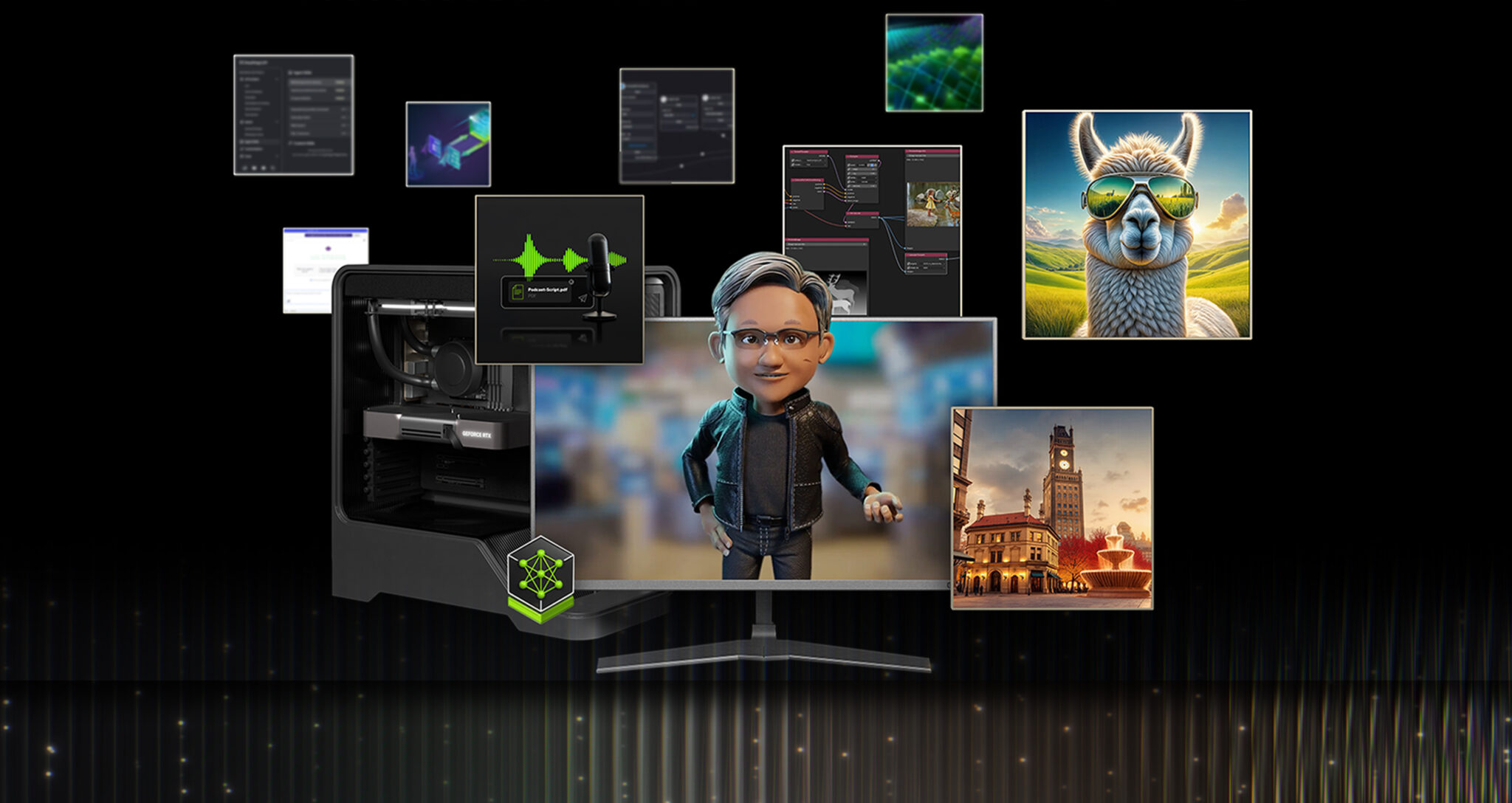
NVIDIA NIM microservices help solve this issue by providing prepackaged, optimized, easily downloadable AI models that connect to industry-standard APIs. They’re optimized for performance on RTX AI PCs and workstations, and include the top AI models from the community, as well as models developed by NVIDIA.

NIM Microservices Support

NIM microservices support a range of AI applications, including large language models (LLMs), vision language models, image generation, speech processing, retrieval-augmented generation (RAG)-based search, PDF extraction, and computer vision. Ten NIM microservices for RTX are available, supporting a range of applications, including language and image generation, computer vision, speech AI, and more. Get started with these NIM microservices today:

  • NIM microservices are also available through top AI ecosystem tools and frameworks.

AI Blueprints Will Offer Pre-Built Workflows

NVIDIA AI Blueprints give AI developers a head start in building generative AI workflows with NVIDIA NIM microservices.

PDF to Podcast AI Blueprint

The PDF to podcast AI Blueprint will transform documents into audio content so users can learn on the go. By extracting text, images, and tables from a PDF, the workflow uses AI to generate an informative podcast. For deeper dives into topics, users can then have an interactive discussion with the AI-powered podcast hosts.

3D-Guided Generative AI

The AI Blueprint for 3D-guided generative AI will give artists finer control over image generation. While AI can generate amazing images from simple text prompts, controlling image composition using only words can be challenging. With this blueprint, creators can use simple 3D objects laid out in a 3D renderer like Blender to guide AI image generation. The artist can create 3D assets by hand or generate them using AI, place them in the scene, and set the 3D viewport camera. Then, a prepackaged workflow powered by the FLUX NIM microservice will use the current composition to generate high-quality images that match the 3D scene.

NVIDIA NIM on RTX With Windows Subsystem for Linux

One of the key technologies that enables NIM microservices to run on PCs is Windows Subsystem for Linux (WSL).

Project G-Assist Expands PC AI Features With Custom Plug-Ins

As part of Project G-Assist, an experimental version of the System Assistant feature for GeForce RTX desktop users is now available via the NVIDIA App, with laptop support coming soon.

G-Assist: AI-Powered PC Assistant

G-Assist helps users control a broad range of PC settings — including optimizing game and system settings, charting frame rates and other key performance statistics, and controlling select peripherals settings such as lighting — all via basic voice or text commands.

Get Started with G-Assist

G-Assist is built on NVIDIA ACE — the same AI technology suite game developers use to breathe life into non-player characters. Unlike AI tools that use massive cloud-hosted AI models that require online access and paid subscriptions, G-Assist runs locally on a GeForce RTX GPU. This means it’s responsive, free, and can run without an internet connection. Manufacturers and software providers are already using ACE to create custom AI Assistants like MSI’s AI Robot engine, the Streamlabs Intelligent AI Assistant, and upcoming capabilities in HP’s Omen Gaming hub.

Building and Customizing G-Assist Plug-Ins

G-Assist was built for community-driven expansion. Get started with this NVIDIA GitHub repository, including samples and instructions for creating plug-ins that add new functionality. Developers can define functions in simple JSON formats and drop configuration files into a designated directory, allowing G-Assist to automatically load and interpret them. Developers can even submit plug-ins to NVIDIA for review and potential inclusion.

Conclusion

NVIDIA NIM microservices for RTX are available at build.nvidia.com, providing developers and AI enthusiasts with powerful, ready-to-use tools for building AI applications. Download Project G-Assist through the NVIDIA App’s "Home" tab, in the "Discovery" section. G-Assist currently supports GeForce RTX desktop GPUs, as well as a variety of voice and text commands in the English language. Future updates will add support for GeForce RTX laptop GPUs, new and enhanced G-Assist capabilities, as well as support for additional languages.

FAQs

Q: What are NIM microservices?
A: NIM microservices are prepackaged, optimized, easily downloadable AI models that connect to industry-standard APIs.

Q: What applications do NIM microservices support?
A: NIM microservices support a range of AI applications, including large language models (LLMs), vision language models, image generation, speech processing, retrieval-augmented generation (RAG)-based search, PDF extraction, and computer vision.

Q: How do I get started with NIM microservices?
A: Get started with NIM microservices at build.nvidia.com.

Q: What is G-Assist?
A: G-Assist is an AI-powered PC assistant that helps users control a broad range of PC settings, including optimizing game and system settings, charting frame rates and other key performance statistics, and controlling select peripherals settings such as lighting.

Q: How do I get started with G-Assist?
A: Get started with G-Assist through the NVIDIA App’s "Home" tab, in the "Discovery" section. G-Assist currently supports GeForce RTX desktop GPUs, as well as a variety of voice and text commands in the English language.

Metal Gear Solid 2: Visionary Masterpiece

0

Retro Gaming: Reappraising the Impressive Metal Gear Solid 2

A Leap of Faith

Video games today may seem like a world away from where they were at the start of the century, but it’s easy to forget just how impressive some old games were back in the day. One example that’s currently seeing a bit of a rediscovery is Metal Gear Solid 2.

The Power of the PS2

Perhaps inspired by Konami’s upcoming Unreal Engine 5 MGS Snake Eater remake, gamers have been reappraising the developer’s PS2 game. And they’re noticing just how impressive it was for its time. "Playing Metal Gear Solid 2 right after MGS1 is making me appreciate how seismic the leap was from PS1 to PS2," comments gaming YouTuber Radec. "Having each bottle be breakable and even seeing individual ice cubes slowly melt over time is an insane level of detail. This must’ve been mind blowing back then in 2001."

Attention to Detail

Metal Gear series always paid a lot of attention to detail, and Konami made the most of the PS2’s improved capabilities and fidelity to fully develop characters and the game’s world, making it a landmark release for the console.

Gamers’ Memories

Gamers describe having spent days just shooting ice and bottles in the first part of the game on the ship. Others recall that video game stores would have this on as a demo because it was such a good display of the PS2’s capabilities. "This and Final Fantasy X were mind blowing coming off of the PS1," one person recalls. "Impossible to explain nowadays how impactful it was."

Environmental Interactivity

Some argue that the level of interactivity remains impressive today. "That’s honestly more environmental interactivity than you see in many modern AAA titles," one person suggests. "Sometimes it feels like devs stopped giving a shit about adding little flourishes like this."

The Evolution of Graphics

While today’s graphics continue to evolve, with best game development software like Unreal Engine 5 unlocking new possibilities for developers, perhaps we’ve become overly used to photorealistic graphics while missing smaller details that add a touch of delight.

A Leap of Faith in the Future

Some suspect we’ll never see a leap as big as from PS1 to PS2. "The gap between PS2 and PS3 was smaller, the gap between PS3 and PS4 even smaller, and I can’t even tell the difference between the PS4 and PS5," one person writes.

Conclusion

As gamers await the MGS Snake Eater remake, rumoured to be coming in August, it’s refreshing to see how Metal Gear Solid 2 holds up today. The level of attention to detail and interactivity is still impressive, and it’s a reminder that even in the past, games could be just as engaging and immersive as they are today.

Frequently Asked Questions

Q: What is Metal Gear Solid 2?
A: Metal Gear Solid 2 is a game developed by Konami for the PlayStation 2.

Q: What is the MGS Snake Eater remake?
A: The MGS Snake Eater remake is a remade version of the original game, currently rumored to be coming in August.

Q: How does Metal Gear Solid 2 compare to modern games?
A: Metal Gear Solid 2 has a level of environmental interactivity that is still impressive today, with details such as breakable objects and melting ice cubes.