Home Blog Page 163

Who Should Reign Supreme: Tech or Marketing?

Understanding the Landscape

The global AI market is projected to grow from $757.58 billion in 2025 to $3.6 trillion by 2034, with a compound annual growth rate (CAGR) of 19.20% during this period. It’s clear that AI is a huge deal and will play a significant role in any organization.

The Golden AI Rule

An argument can be made that the CTO should oversee everything technical, including AI. However, does that mean the CTO should dictate what AI tools your creative team uses? Does the CTO understand the fundamentals of what makes good content or the company’s marketing objectives?

The Person Who Should Lead AI Initiatives

AI doesn’t live in a vacuum. It isn’t just a marketing thing or a tech thing. It’s bigger than that. AI is now a strategy thing, you feel me? In our company, the decision-making process related to anything tech is simple. No department tells another department what tools they should use to do their job.

My Simple Yet Effective Approach

Here is a simple but effective checklist your team can use to decide what AI tool to deploy:

  • Collectively define the goal for the AI tool
  • Identify who will use it daily and clearly understand their needs and wants
  • Test the AI solution to make sure it works as intended
  • Have the CTO check security and confirm it integrates smoothly into existing systems (if necessary)
  • Measure if the AI makes things better once deployed
  • Periodically check if a better solution exists that could improve the workflow

My Two Cents

AI isn’t a one-size-fits-all solution. It touches every part of your business, and all those parts have different needs and objectives. AI is a strategy. It’s not just another piece of tech or a random tool. That’s why I firmly believe AI should never be a one-size-fits-all decision. The person who decides which AI tool to use should always be the person doing the actual work.

Conclusion

AI is a strategy, and it’s not just about tech or marketing. It’s about understanding the needs of each department and making sure the right tools are chosen. By following the simple checklist outlined above, you can ensure that your AI strategy is practical, relevant, and effective.

Frequently Asked Questions

Q: Who should lead AI initiatives in an organization?
A: The person who decides which AI tool to use should always be the person doing the actual work.

Q: What is the golden AI rule?
A: The golden AI rule is that AI is a strategy, and it’s not just about tech or marketing. It’s about understanding the needs of each department and making sure the right tools are chosen.

Q: What is the simple yet effective approach to deciding which AI tool to deploy?
A: The simple yet effective approach is to follow the checklist outlined above, which includes defining the goal for the AI tool, identifying the needs and wants of the person using it, testing the solution, and measuring its effectiveness.

The System Shock 2

0

Nightdive Studios Makes Good on Six-Year-Old Promise with System Shock 2: 25th Anniversary Remaster

Nightdive Studios and Sony have announced a trailer and release date for System Shock 2: 25th Anniversary Remaster, a remastered version of the classic Looking Glass game. The game will be available on June 26th for PC, Xbox One and Xbox Series X|S, and PlayStation 4 and 5 consoles.

What to Expect from the Remastered Version

The remastered version will feature light visual updates, including sharpened graphics and enemy models, but it will maintain the feel of a 25-year-old game. The trailer and screenshots show off these updates, which include visible hands holding weapons and other small improvements. The game’s original RPG overlay look is still included, and cross-play support is available for the game’s cooperative multiplayer mode.

Improved Controls and Mod Support

The remastered version will also include updated controls, including DualSense support and a quickbar for weapons and abilities. The game will also come with some of the original’s existing community mods, as well as broader mod support. According to Nightdive’s website and a moderator in the studio’s Discord server, the game will ship with the SS2 Community Patch or SCP, which rebalances some frustrating features, among other patches.

Release Date and Platforms

The System Shock 2: 25th Anniversary Remaster will be released on June 26th for PC, Xbox One and Xbox Series X|S, and PlayStation 4 and 5 consoles.

Conclusion

The System Shock 2: 25th Anniversary Remaster is a great opportunity for fans of the original game to relive the experience with improved graphics and controls. The inclusion of community mods and broader mod support is also a significant bonus for fans of the game.

FAQs

Q: When is the System Shock 2: 25th Anniversary Remaster releasing?

A: The game will be released on June 26th for PC, Xbox One and Xbox Series X|S, and PlayStation 4 and 5 consoles.

Q: What platforms will the game be available on?

A: The game will be available on PC, Xbox One and Xbox Series X|S, and PlayStation 4 and 5 consoles.

Q: What kind of visual updates can I expect from the remastered version?

A: The remastered version will feature light visual updates, including sharpened graphics and enemy models, but it will maintain the feel of a 25-year-old game.

Q: Will the game have mod support?

A: Yes, the game will come with some of the original’s existing community mods, as well as broader mod support. The game will also ship with the SS2 Community Patch or SCP, which rebalances some frustrating features, among other patches.

Unlocking Efficiency with AI-Powered Transformation in Power and Utilities

Driven by population and economic growth, global energy demand is expected to continue increasing in the coming years.

The proliferation of distributed energy resources (DERs) is also leading power providers to rethink how they operate. DERs could dramatically reduce the need for centralized power generation, but they could also push traditional operational technology (OT) environments to their limits and create heightened need for security.

A modern, flexible, and secure grid with unified information technology (IT) and OT will become increasingly important for grid operators as consumers add solar panels, electric vehicles, or battery storage and seek to connect to the grid. In fact, a recent survey conducted by Guidehouse shows that 61% of utilities executives believe that utility infrastructure investments should prioritize increased flexibility to improve energy system resilience.

Artificial intelligence (AI) has the potential to boost resilience by helping providers forecast and manage load demand, maintain power balance, enhance security, support predictive analytics and maintenance, and optimize workforce management and dispatch, among many other use cases.

Power and utilities companies aren’t alone in recognizing the benefits of AI. A recent study on AI adoption shows that over the next three years, 92% of companies will increase their AI investments, particularly in generative AI; yet only 1% consider their AI deployment to be "mature," indicating there’s still tremendous opportunity to drive continued AI transformation for improved business outcomes.

Critically, employees are ready for this change. In fact, three times more employees are using generative AI for 30% or more of their work than their leaders imagine. It’s a sign that for many companies, the AI transformation is already underway, and teams are eager to unlock new levels of creative potential and productivity.

An adaptive cloud approach helps streamline operations and provide critical power service

Through comprehensive cloud, data, and AI offerings, Microsoft and its global partner ecosystem support power and utility providers as they digitally transform and drive sustainable business growth while meeting customer demand. The adaptive cloud approach seamlessly integrates IT and OT, bringing together on-premises control systems and edge intelligence with cloud-scale analytics. This lays the foundation for unlocking the power of their data, further allowing them to utilize AI to meet increasing energy demand and solve their most complex challenges.

Take Uniper, for example. As the world’s largest power generation company, Uniper needed a solution to help standardize IT and OT so it could manage all applications in a uniform manner. An adaptive cloud strategy helped standardize IT and OT environments, launch new services faster, and optimize performance.

Emirates Global Aluminum (EGA) has another adaptive cloud success story. EGA’s on-premises environment couldn’t deliver the level of flexibility needed to manage data-intensive operations with scalable computing infrastructure. A hybrid approach allowed them to move part of their server base to the Microsoft Azure public cloud and another part to run hybrid at the edge with Azure Local. This helped optimize latency, support advanced AI and automation solutions, and offer sustaining commercial savings by applying intelligence at the edge.

Sharing success stories and insights at DISTRIBUTECH

In an era where the imperative for clean, reliable, and accessible energy has never been greater, Microsoft relies on the knowledge and innovative potential of its partners and customers to help spearhead progress. The success stories mentioned above are made possible through the collective efforts of a complete partner and customer energy ecosystem. The company looks forward to connecting with this ecosystem at important energy industry events like the upcoming DISTRIBUTECH International 2025 conference, where it’ll share the latest in AI-powered insights at the annual energy transmission and distribution event.

Highlighting Microsoft’s partner ecosystem

Microsoft will join several energy and technology partners at DISTRIBUTECH to further the discussion on global collaboration and partnership as critical aspects of the energy transition. It will serve as a guest speaker for Schneider Electric’s Knowledge Hub session on grid technologies, diving into the ways that AI and digital transformation are revolutionizing grid operations and management.

The occasion marks another milestone in the deep Microsoft partnership with Schneider Electric as we collaborate on the release of its new digital grid solution. Powered by Azure and AI, the new solution is designed to equip utilities with the digital tools to navigate modern energy challenges and support more resilient energy infrastructure.

Conclusion

As the energy landscape continues to evolve, power and utilities companies must adapt to stay ahead of the curve. By embracing AI, cloud, and edge computing, they can unlock new levels of efficiency, resilience, and innovation. Microsoft is committed to supporting this transformation, and we look forward to connecting with our partners and customers at DISTRIBUTECH 2025 to share success stories, insights, and best practices.

Frequently Asked Questions

Q: What is the current state of the energy industry?
A: The energy industry is experiencing rapid growth, driven by population and economic growth, as well as the proliferation of distributed energy resources (DERs).

Q: How is AI changing the energy industry?
A: AI has the potential to boost resilience, improve forecasting and management, enhance security, and support predictive analytics and maintenance, among many other use cases.

Q: What are the benefits of an adaptive cloud approach in the energy industry?
A: An adaptive cloud approach helps streamline operations, provide critical power service, and unlock the power of data, further allowing companies to utilize AI to meet increasing energy demand and solve complex challenges.

Q: What is DISTRIBUTECH, and why is it important?
A: DISTRIBUTECH is an annual energy industry event that brings together leaders, innovators, and experts to share knowledge, best practices, and insights on the latest trends and technologies shaping the energy industry. Microsoft is a key participant in this event, sharing its expertise and showcasing its solutions in the field of energy and utilities.

Find the Admin Panel

Here is the rewritten article:

Overview
🚀

Find The Admin Panel is an advanced web scanning tool designed to discover administrative interfaces, login pages, and control panels on web applications. It features an interactive menu system, multiple scanning modes, and comprehensive configuration options to suit different scanning needs.

Features
🔧

Core Features

  • Interactive menu system with easy navigation
  • Multiple scanning modes (Simple, Aggressive, Stealth)
  • Real-time progress tracking with ETA
  • Comprehensive settings management
  • Results viewer with filtering capabilities

Scanning Capabilities

  • Admin panel detection
  • Login form identification
  • Technology fingerprinting
  • Security header analysis
  • CAPTCHa detection
  • Form analysis
  • Path enumeration

Advanced Features

  • Proxy/VPN support
  • Headless browser integration
  • Custom User-Agent rotation
  • Rate limiting
  • Connection pooling
  • SSL/TLS support

Reporting

  • Interactive HTML reports
  • JSON/CSV exports
  • Real-time statistics
  • Confidence scoring

Installation
🛠️

Windows

  1. Install Python: Download Python 3.7+ from python.org. During installation, check "Add Python to PATH".
  2. Install Git: Download Git from git-scm.com.
  3. Clone and Setup: Open Command Prompt or PowerShell, navigate to the directory where you want to install Find The Admin Panel, then run the following commands:
    git clone https://github.com/dv64/Find-The-Admin-Panel.git
    cd Find-The-Admin-Panel
    pip install -r requirements.txt
    pip install playwright
    playwright install chromium

Troubleshooting

Common Issues

  • Connection Errors: Increase timeout by running python Finder.py -u https://example.com --timeout 30.
  • Memory Usage: Reduce batch size by running python Finder.py -u https://example.com --batch-size 10.
  • Rate Limiting: Enable proxy rotation by running python Finder.py -u https://example.com --proxy-file proxies.txt.
  • SSL Errors: Disable SSL verification by running python Finder.py -u https://example.com --no-verify.
  • Browser Issues: Disable headless mode by running python Finder.py -u https://example.com --no-headless.

Contributing
🤝

Contributions are welcome! Please feel free to submit pull requests.

License
📜

This project is licensed under the MIT License – see the LICENSE file for details.

Made by DV64

SeaPerch: A robot with a mission | MIT News

0

The SeaPerch underwater robot is a popular educational tool for students in grades 5 to 12.  Building and piloting SeaPerch, a remotely operated vehicle (ROV), involves a variety of hand fabrication processes, electronics techniques, and STEM concepts. Through the SeaPerch program, educators and students explore structures, electronics, and underwater dynamics.  

“SeaPerch has had a tremendous impact on the fields of ocean science and engineering,” says Andrew Bennett ’85, PhD ’97, MIT SeaGrant education administrator and senior lecturer in the Department of Mechanical Engineering (MechE).

The original SeaPerch project was launched by MIT Sea Grant in 2003. In the decades that followed, it quickly spread across the country and overseas, creating a vibrant community of builders. Now under the leadership of RoboNation, SeaPerch continues to thrive with competitions around the world. These competitions introduce challenging real-world problems to foster creative solutions. Some recent topics have included deep sea mining and collecting data on hydrothermal vents.

Play video

An underwater robot with a mission
Video: Department of Mechanical Engineering

SeaPerch II, which has been in development at MIT Sea Grant since 2021, builds on the original program by adding robotics and elements of marine and climate science. It remains a “do-it-yourself” maker project with objectives that are achievable by middle and high school students. Bennett says he hopes SeaPerch II will enable an even greater impact by providing an approachable path to learning more about sensors, robotics, climate science, and more.

“What I think is most valuable about it is that it uses hardware store components that need to be cut, waterproofed, connected, soldered, or somehow processed before becoming part of the robot or controller,” says Diane Brancazio ME ’90, K-12 maker team leader for the MIT Edgerton Center, who co-leads the MIT SeaPerch initiative with Bennett. “[It’s] kind of like making a cake from scratch, instead of from a mix — you see what goes into the final product and how it all comes together.”

SeaPerch II is a family of modules that allow students and educators to create educational adventures tailored to their particular wants or requirements. Offerings include a pressure and temperature sensing module that can be used on its own; an autonomy module that the students can use to construct a closed-loop automatic depth control system for their SeaPerch; and a lesson module for soft robotic “fingers” that can be configured into grippers, distance sensors, and bump sensors.

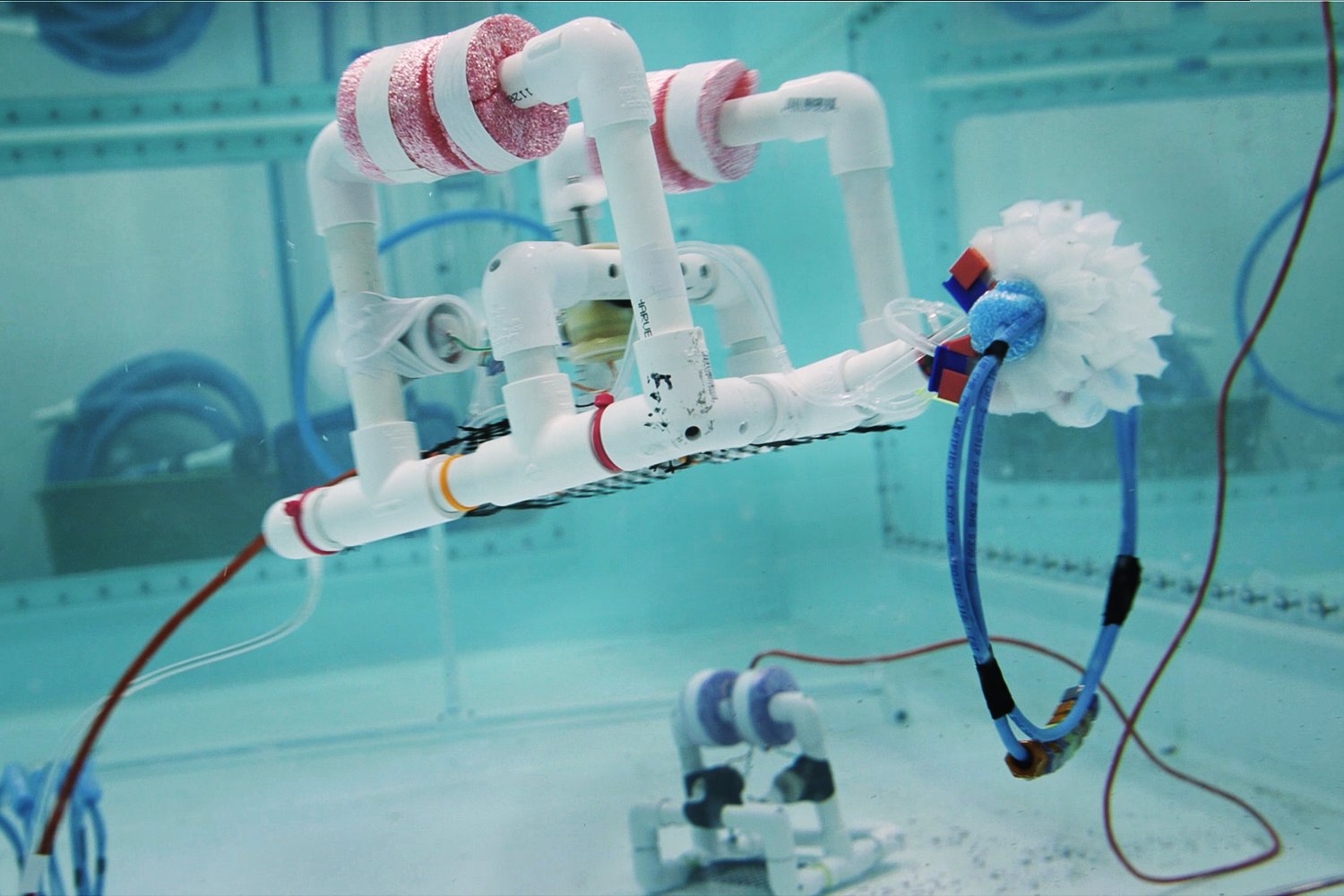
The basic SeaPerch is a PVC pipe structure with three motors and a tether to a switch box. Through the building process, students learn about buoyancy, structural design, hand fabrication, and electric circuits. SeaPerch II leverages technologies that are more advanced, less expensive, and more accessible than they were when SeaPerch was first conceived. Bennett says SeaPerch II is meant to extend the original SeaPerch program without invalidating any of the existing system.

Teagan Sullivan, a third-year student in mechanical engineering, first became involved with the project in January 2023 through an Undergraduate Research Opportunities Program project with MIT Sea Grant. Initially, she continued development of the soft robotics portion of the project, before switching to a more general focus where she worked on frame design for SeaPerch II, making sure components could fit and that stability could be maintained. Later she helped run outreach programs, taking feedback from the students she worked with to help modify designs and make them “more robust and kid-friendly.”

“I have been able to see the impact of SeaPerch II on a small scale by working directly with students,” Sullivan says. “I have seen how it encourages creativity, and how it has taught kids that collaboration is the best road to success. SeaPerch II teaches the basics of electronics, coding, and manufacturing, but its best strength is the ability to challenge the way people think and encourage critical thinking.”

The team’s vision is to create opportunities for young people to engage in authentic science investigations and engineering challenges, developing a passion for engineering, science, and the aquatic environment. MIT Sea Grant is continuing to develop new SeaPerch II modules, including incorporating land-water communication, salinity and dissolved oxygen sensors, and fluorometers.

Sullivan says she hopes the program will reach more students and inspire them to take an interest in engineering while teaching the skills they need to be the next generation of problem-solvers. Brancazio says she hopes this project inspires and prepares young people to work on climate change issues.

“Robots are supposed to help people do things they couldn’t otherwise do,” Brancazio says. “SeaPerch is a robot with a mission.”

AI in Everything

0

Got You Covered

T-Mobile recently partnered with Starlink to provide connectivity to customers in reception dead zones. Starlink on T-Mobile, Sag says, is an example of this satellite technology being implemented in a simple and effective way. If you go out of the range of a terrestrial T-Mobile reception tower, your phone can connect to Starlink passively, without having to fiddle with changing networks yourself.

Seamless Connectivity

“They worked extremely closely with Google and Apple to make sure that this was a super, super easy experience,” Sag says. “You don’t need an app and you don’t have to click any buttons. It just works.”

Satellite Internet: The Next Frontier

Terrestrial wireless connections already have that sort of interoperability built in. If you’re traveling and lose connection with a cell tower, there’s probably another one close by that your device will automatically connect to. Satellite internet provides that same unbroken experience even when there are no cell towers to connect to—for phones, trackers, and a litany of connected gadgets.

The Global Constellation

Of course, Starlink’s satellites are not the only ones on the launchpad. The same day T-Mobile first announced its partnership with Starlink, the European Commission also announced it had signed a contract to put a constellation of 290 satellites into orbit as part of its own Infrastructure for Resilience, Interconnectivity and Security by Satellite (IRIS²) program.

Amazon’s Project Kuiper already has prototypes in the sky, and is aiming to get more than 3,000 satellites into orbit to provide broadband internet service. Google’s parent company, Alphabet, has spun off its own satellite provider named Taara to better compete in the field. Three Chinese firms have joined the fray, which also includes players like Lynk Global and Eutelsat OneWeb.

AT&T and Verizon are both working with the Texas satellite company AST Space Mobile to expand their coverage areas. (Verizon has also been working with Project Kuiper since 2021.) Apple has invested $1.5 billion into the satellite company Globalstar with the goal of building out its own constellation that can enable Apple devices to use features like Emergency SOS and car crash detection in remote areas without a cell signal.

Platform-Agnostic or Not?

The way that ease of interoperability could go awry, Christensen cautions, is if devices themselves are locked to proprietary satellite systems. So if Globalstar satellites only worked on Apple phones or vice versa, there could be some gaps in the constellation of coverage. That doesn’t seem like the plan for the companies involved, however. A more likely evolution of this globe-spanning network, Christensen says, is that satellites become platform-agnostic, much the way land-based telecom operations are.

Conclusion

The future of satellite internet is looking bright, with multiple companies investing heavily in the technology. With the potential to provide seamless connectivity even in areas with no cell towers, satellite internet has the potential to revolutionize the way we stay connected.

FAQs

Q: What is Starlink on T-Mobile?

A: Starlink on T-Mobile is a partnership between T-Mobile and Starlink to provide connectivity to customers in reception dead zones.

Q: What is the goal of the European Commission’s IRIS² program?

A: The goal of the European Commission’s IRIS² program is to put a constellation of 290 satellites into orbit to provide broadband internet service.

Q: Which companies are investing in satellite technology?

A: T-Mobile, Amazon, Google, Apple, AT&T, Verizon, and several Chinese firms are all investing in satellite technology.

Q: What is the potential for satellite internet to revolutionize connectivity?

A: Satellite internet has the potential to provide seamless connectivity even in areas with no cell towers, making it a game-changer for remote communities and individuals.

AI Agents for Secure Financial Transactions

The Growing Need for AI in Fraud Detection and Compliance

The Growing Need for AI in Fraud Detection and Compliance

Financial fraud is becoming more complex. Identity theft, transaction fraud, and money laundering are now more sophisticated than ever before. In fact, a survey in 2023 found that identity theft alone accounted for nearly $12.5 billion in losses globally.

As a result, financial institutions face increased regulatory pressure to comply with complex rules. Traditional, rule-based fraud detection systems often can’t keep up. They are limited in detecting new types of fraud, which can lead to false positives.

The Role of AI in Fraud Detection and Compliance

AI agents are transforming fraud detection and compliance, but their impact goes beyond financial services. Learn how to build an AI agent and integrate it into different industries.

Here’s how AI is stepping in:

  • AI agents for finance offer faster, more accurate fraud detection.
  • Conversational AI for finance helps handle customer queries and fraud alerts.
  • Finance AI solutions continuously adapt to new fraud patterns.
  • Finance agents assist in real-time fraud prevention.
  • Conversational AI in banking ensures better compliance with regulations.

These advancements offer a way forward for financial institutions to stay ahead of fraud.

How AI Agents Enhance Fraud Detection

Fraud detection in the financial industry is a constant battle. With more fraudsters targeting financial institutions, traditional methods are often too slow and ineffective. That’s where AI agents for finance come in.

These advanced systems powered by conversational AI for finance are making a real difference.

Key Ways AI Enhances Fraud Detection

  • Faster, more accurate fraud detection.
  • Real-time fraud prevention.
  • Continuous adaptation to new fraud patterns.
  • Improved compliance with regulations.

ROI Analysis – Cost vs. Benefits of AI Adoption

Before investing in AI solutions, it’s important to analyze the ROI. While the upfront costs of implementing AI can be high, the long-term benefits, such as reduced fraud and improved compliance, often outweigh the costs. Tools like AI financial assistants can save your business both time and money by automating tedious tasks.

Final Thoughts

AI agents for finance have proven to be a game-changer in fraud detection and compliance. With conversational AI for finance, financial institutions can enhance customer service, monitor transactions in real-time, and improve regulatory compliance.

By adopting finance AI solutions and finance agents, businesses gain the ability to detect fraud faster and more accurately, saving time and money. Conversational AI in banking is revolutionizing how banks engage with customers, providing seamless assistance through AI financial assistants.

FAQs

  • What are AI agents for finance?
    AI agents for finance are smart digital assistants that help with tasks like fraud detection and customer service, automating processes in financial institutions.
  • How does conversational AI for finance work?
    Conversational AI in finance uses chatbots to interact with clients, answer questions, and perform tasks like fraud checks and compliance monitoring in real-time.
  • What are the benefits of using AI financial assistants?
    AI financial assistants provide 24/7 support, improve efficiency, reduce errors, and help with tasks like budgeting and managing investments.
  • How to choose an AI agent for finance?
    Choose an AI agent for finance that is secure, easy to use, trained on financial data, and integrates well with your existing systems.
  • Is conversational AI in finance secure?
    Yes, conversational AI in finance follows strict security protocols to protect financial data and comply with global privacy standards like GDPR.

What Works in Large Language Models

0

The Key To Brand Citation In AI Chatbots: Deep Content

The last 12 months have seen significant progress in our understanding of AI chatbots like ChatGPT and Co. We know that:

  • Adoption is growing rapidly.
  • AI chatbots send more referrals to websites over time.
  • Referral traffic from AI chatbots has a higher quality than that from Google.

However, there is a lack of content on examples and success factors of content that drives citations and mentions in AI chatbots.

To address this, I analyzed over 7,000 citations across 1,600 URLs to content-heavy sites, focusing on AI chatbots (ChatGPT, Perplexity, and AI Overviews) in February 2024, with the help of Profound.

The Key To Brand Citation In AI Chatbots: Deep Content

My goal was to figure out:

  • Why some pages are more cited than others, so we can optimize content for AI chatbots.
  • Whether classic SEO factors matter for AI chatbot visibility, so we can prioritize.
  • What traps to avoid, so we don’t have to learn the same lessons many times.
  • If different factors influence mentions and citations, so we can be more targeted in our efforts.

The Research Findings

Boost your skills with Growth Memo’s weekly expert insights. Subscribe for free!

The Key To Brand Citation In AI Chatbots: Deep Content

Image Credit: Kevin Indig

My correlation analysis shows that none of the classic SEO metrics have strong relationships with citations. LLMs have light preferences: Perplexity and AI Overviews weigh word and sentence count higher. ChatGPT weighs domain rating and Flesch Score.

Takeaway: Classic SEO metrics don’t matter nearly as much for AI chatbot mentions and citations. The best thing you can do for content optimization is to aim for depth, comprehensiveness, and readability (how easy the text is to understand).

The Most-Cited Content

The following examples demonstrate those attributes:

The Top 10% of Most-Cited Pages

The two factors that stand out are sentence and word count, followed by the Flesch Score. Metrics related to backlinks and traffic seem to have a negative effect, which doesn’t mean that AI chatbots weigh them negatively but simply that they don’t matter for mentions or citations.

The Top 10% of Most-Cited Pages Across All Three LLMs Have:

  • Much less traffic, rank for fewer keywords, and get fewer total backlinks.
  • How does that make sense? It almost looks like being strong in traditional SEO metrics is bad for AI chatbot visibility.

Splitting the Data up by AI Chatbot Shows You Their…

Context: Not all AI chatbots mentioned brands with the same frequency. Even though ChatGPT has the highest adoption and sends the most referral traffic to sources, Perplexity mentions the most brands per average in answers.

Prompt Structure Matters for Brand Visibility:

  • The word “best” was a strong trigger for brand mentions in 69.71% of prompts.
  • Words like “trusted” (5.77%), “source” (2.88%), “recommend” (0.96%), and “reliable” (0.96%) were also associated with an increased likelihood of brand mentions.
  • Prompts including “recommend” often mention public organizations like the FDA, especially when the prompt includes words like “trusted” or “leading.”
  • Google AIOs show the highest brand diversity, followed by Perplexity, then ChatGPT.

Takeaway: Prompt structure has a meaningful impact on the brands that come up in the answer.

Tech Traps to Avoid

Context: In my research, I encountered several ways brands unintentionally sabotage their AI chatbot visibility.

  • I surface them here because the pre-requisite to being visible in LLMs is, of course, their ability to crawl your site, whether that’s directly or through training data.

The Most Cited Domain in Perplexity in My Dataset is Blocked.Goodrx.com

GoodRX blocks users from non-U.S. countries, and it seems it accidentally or intentionally blocks Perplexity.

Takeaway: Monitor your site, especially if all wanted URLs are indexed, in Google Search Console and Bing Webmaster Tools. Double-check whether you accidentally block an LLM crawler in your robots.txt or through your CDN.

Summary: 6 Key Learnings

  1. Classic SEO metrics don’t strongly influence AI chatbot citations.
  2. Content depth (higher word and sentence counts) and readability (good Flesch Score) matter more.
  3. Different AI chatbots have distinct preferences – monitoring multiple platforms is important.
  4. Brand popularity (measured by search volume) is the strongest predictor of brand mentions in AI chatbots, especially in ChatGPT.
  5. Prompt structure influences brand visibility, and we don’t yet know how user phrase prompts.
  6. Technical issues can sabotage AI visibility – ensure your site isn’t accidentally blocking LLM crawlers through robots.txt or CDN settings.

Frequently Asked Questions

Q: What is the key to brand citation in AI chatbots?
A: Deep content with high word and sentence counts, and good readability (Flesch Score).

Q: Do classic SEO metrics matter for AI chatbot visibility?
A: No, they don’t.

Q: What are the top 10% of most-cited pages like?
A: They have less traffic, rank for fewer keywords, and get fewer total backlinks.

Q: Do different AI chatbots have distinct preferences?
A: Yes, they do.

Open Power AI Consortium

Powering Up AI to Energize Operations, Drive Innovation

The power and utilities sector keeps the lights on for the world’s populations and industries. As the global energy landscape evolves, so must the tools it relies on.

The Open Power AI Consortium

To advance the next generation of electricity generation and distribution, many of the industry’s members are joining forces through the creation of the Open Power AI Consortium. The consortium includes energy companies, technology companies, and researchers developing AI applications to tackle domain-specific challenges, such as adapting to an increased deployment of distributed energy resources and significant load growth on electric grids.

Leading the Charge

Led by independent, nonprofit energy R&D organization EPRI, the consortium aims to spur AI adoption in the power sector through a collaborative effort to build open models using curated, industry-specific data. The initiative was launched today at NVIDIA GTC, a global AI conference taking place through Friday, March 21, in San Jose, California.

Industry-Led Innovation

“Over the next decade, AI has the great potential to revolutionize the power sector by delivering the capability to enhance grid reliability, optimize asset performance, and enable more efficient energy management,” said Arshad Mansoor, EPRI’s president and CEO. “With the Open Power AI Consortium, EPRI and its collaborators will lead this transformation, driving innovation toward a more resilient and affordable energy future.”

Domain-Specific AI Models

As part of the consortium, EPRI, NVIDIA, and Articul8, a member of the NVIDIA Inception program for cutting-edge startups, are developing a set of domain-specific, multimodal large language models trained on massive libraries of proprietary energy and electrical engineering data from EPRI. These models can help utilities streamline operations, boost energy efficiency, and improve grid resiliency.

Early Access to AI Models

The first version of an industry-first open AI model for electric and power systems was developed using hundreds of NVIDIA H100 GPUs and is expected to soon be available in early access as an NVIDIA NIM microservice.

Industry Partnerships

The Open Power AI Consortium’s Executive Advisory Committee includes executives from over 20 energy companies, such as Duke Energy, Exelon, Pacific Gas & Electric Company, and Portland General Electric, as well as leading tech companies like AWS, Oracle, and Microsoft. The consortium plans to further expand its global member base.

Global Energy Challenges

Global energy consumption is projected to grow by nearly 4% annually through 2027, according to the International Energy Agency. To support this surge in demand, electricity providers are looking to enhance the resiliency of power infrastructure, balance diverse energy sources, and expand the grid’s capacity.

AI in the Power Sector

AI agents trained on thousands of documents specific to this sector – including academic research, industry regulations and standards, and technical documents – can enable utility and energy companies to more quickly assess energy needs and prepare the studies and permits required to improve infrastructure.

Conclusion

The Open Power AI Consortium aims to bring AI to the global power sector in a much more accelerated way by working together to develop foundation models for the industry and collaborating with the power sector to apply solutions tailored to its unique needs.

Frequently Asked Questions

Q: What is the Open Power AI Consortium?
A: The Open Power AI Consortium is a collaborative effort between energy companies, technology companies, and researchers to develop AI applications to tackle domain-specific challenges in the power sector.

Q: What is the goal of the consortium?
A: The goal of the consortium is to spur AI adoption in the power sector through the development of open models using curated, industry-specific data.

Q: Who leads the consortium?
A: The consortium is led by independent, nonprofit energy R&D organization EPRI.

Q: What are the potential applications of AI in the power sector?
A: AI can be used to enhance grid reliability, optimize asset performance, and enable more efficient energy management, among other applications.

Yahoo’s Tsunami Billboard is All Kinds of Horrifying

0

A Powerful Billboard Ad: A Sobering Reminder of the 2011 Tōhoku Earthquake and Tsunami

A Haunting Reminder

Back in 2017, a striking billboard appeared across the entire height of a building opposite Japan’s Shibuya Station, marking the sixth anniversary of the Tōhoku earthquake and tsunami in 2011, which claimed tens of thousands of lives. The ad has recently reappeared on Reddit, where it is provoking emotional responses all over again.

The Ad

The ad includes a bold red line indicating the height of the tsunami, and how that would have looked if it had reached Shibuya. It’s a shocking demonstration of the sheer scale and power of the natural disaster, one that, like all the best billboard ads, lingers in the mind long after being viewed.

The Message

The translated billboard reads: "Six years have already passed since the Great East Japan Earthquake. On 3-11, in Iwate Prefecture’s Ofunato City, the maximum height at which the tsunami was observed as 16.7 meters. If [it] had happened here, in the middle of Ginza, it would be exactly this [red line’s] height. Just by knowing how high it is, the actions we take can change. We can make preparations here and now."

Reactions

An image of the billboard is currently the top post on Reddit’s r/DesignPorn page. "I feel a twist in my heart when I see this," one user comments, while another adds, "I cannot forget the fear and shock of that day."

Controversy

However, the ad is also provoking another kind of unease. The fact that it’s ultimately promoting a brand – in this case, Yahoo Japan, isn’t sitting well with everyone. "Piggy backing a tragedy for an ad, dystopian," reads one Reddit comment, while another adds, "An incredible message that I was jarred out of at the last line. Yahoo!" Another user pithily summarizes, "Billboard reminders are definitely the best form of disaster prevention lol."

Conclusion

The ad is certainly a powerful and sobering reminder of the devastating impact of natural disasters. While some may question the use of a tragedy for promotional purposes, the message itself is an important one. As the ad so starkly illustrates, knowing the scale of a disaster can motivate individuals to take action and prepare for the worst.

FAQs

Q: What was the Tōhoku earthquake and tsunami?
A: The Tōhoku earthquake and tsunami occurred on March 11, 2011, and was one of the deadliest natural disasters in Japanese history.

Q: What is the purpose of the billboard ad?
A: The ad aims to raise awareness of the devastating impact of natural disasters and encourage individuals to take action to prepare for the worst.

Q: Who created the billboard ad?
A: The billboard ad was created by Yahoo Japan.