Home Blog Page 18

SmartThings Blog

0

Samsung Wallet, Aliro Locks, and SmartThings turn a simple tap into total home control

What if getting into your home didn’t require fumbling for keys, digging through bags, or wondering whether you locked the door on your way out? With the Samsung Wallet, SmartThings, and Aliro-certified smart locks from trusted brands like Aqara, Nuki, ULTRALOQ, and Schlage, your Galaxy phone can become your new door key, unlocking a smarter, safer, and more convenient home experience.

Now available on Samsung.com, Aliro-certified locks integrate with SmartThings and Samsung Wallet, giving you tap-to-unlock access, remote control, and powerful home automations that start the moment you walk through the door.

Tap to Unlock. Walk Right In.

Ever arrive home from a run with nowhere to stash your keys?

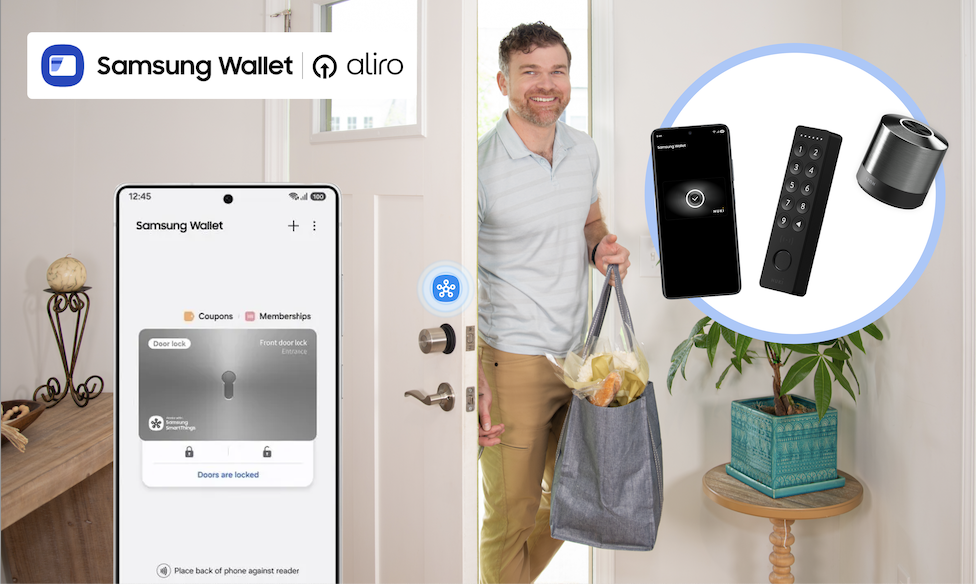
Instead of slowing down, soon you can simply tap your Galaxy phone on your smart lock. The door unlocks instantly, no physical keys required. Samsung Wallet securely stores your digital keys, while SmartThings keeps everything connected behind the scenes. It’s a simple gesture that makes everyday routines feel effortless.

Unlocking your door can trigger far more than just entry. When paired with SmartThings and a compatible hub, Aliro-certified smart locks can become the starting point for your entire home:

  • Lights turn on as you step inside
  • Thermostat adjusts to your preferred temperature
  • Security cameras shift modes
  • Alarms disarm and re-arm automatically

Heading out? Lock the door from your phone when you leave, and SmartThings takes care of the rest, shutting off lights or securing devices so you can leave with peace of mind.

Designed for Real-Life Moments

Technology should make life easier, especially in the moments that matter most.

Active lifestyles: Going for a run or walking the dog? Leave your keys behind. Your Galaxy has you covered.

Locked-out scares: Step outside to take out the trash and hear the door click shut? No panic required, tap your phone and get back in.

Family members: Share secure digital keys with family members through Samsung Wallet, and use SmartThings to manage alarms and routines while they’re inside. Members added to SmartThings can use a designated PIN as well to use the features. 

Built for What’s Next: Aliro-Certified Smart Locks

Samsung’s tap-to-unlock experience is powered by Aliro Home Key certification, an industry standard created to make digital access to your home more secure, reliable, and interoperable across devices.

Aliro-certified smart locks will work seamlessly with Galaxy phones through Samsung Wallet, delivering consistent tap-to-unlock access whether you’re coming home from work, heading out for a run, or letting in a guest remotely.

And this ecosystem is growing.

Samsung is partnering with a broad range of Aliro-certified lock makers, including Aqara, Nuki, and Allegion brands like Schlage, giving homeowners more flexibility and choice when upgrading their front door.

That means confidence today and peace of mind that your home is ready for what comes next.

How to Set Up an Aliro-Certified Lock with Galaxy

Getting started is easier than you might think.

Step 1: Install Your Aliro-Certified Lock

  • Follow the manufacturer’s instructions to physically install your lock.

Step 2: Add the Lock in the SmartThings App

  • Open the SmartThings app.
  • Tap Add device and follow the on-screen prompts to connect your lock.

Step 3: Add Your Digital Key to Samsung Wallet

  • Once connected, you’ll receive the option to add your home key to Samsung Wallet.
  • Confirm and authenticate, your Galaxy phone is now your key.

Step 4: Test Tap-to-Unlock

  • Hold your Galaxy phone near the lock.
  • Tap. Unlock. Done.

Want a Routine to try? Try This!

Routine Name: “I’m Home!”

Trigger: When front door unlocks

Actions:

  • Turn on entryway and living room lights
  • Adjust thermostat to comfort setting
  • Disarm security system
  • Turn on Samsung TV Plus automatically 

Now your home responds automatically the moment you walk in.

You can customize this routine for mornings, evenings, guests, or even specific users.

Ready to upgrade? Shop the Aliro-compatible smart locks, Galaxy Devices, and SmartThings hubs now on Samsung.com and fully unlock your home’s potential.

Generate single title from this title The screen-time debate’s blind spot in 100 -150 characters. And it must return only title i dont want any extra information or introductory text with title e.g: ” Here is a single title:”

Write an article about

Key points:

Last fall, during a professional development session I was running with a group of teachers in São Paulo, a fifth-grade teacher raised her hand and asked a question I have since heard in every country I work in: “I want to use AI to plan better lessons. But how do I do that without just putting kids in front of another screen?”

She already knew what the research said. She saw what too much screen time did to her students’ attention spans, to their handwriting, to their ability to sit with a problem that did not have a loading bar. She was not asking me to justify AI. She was asking me whether AI could work in a way that left her classroom alone.

That question is one the current debate is not answering.

The critique coming from researchers like neuroscientist Jared Cooney Horvath deserves to be taken seriously. The footprint of educational technology in K-12 classrooms has grown faster than our evidence base for it. Devices arrived before pedagogy did, and we handed students tools that were engineered to hold adult attention. Cooney Horvath and others who share his concerns are pointing at something real.

But here is what troubles me about where the conversation goes from there: The critics and the edtech industry have ended up agreeing on the same premise. Both assume that AI in education means AI in front of students. The critics say that is dangerous, and they are right. The industry says it is inevitable, and keeps building that way. Neither side has stopped to ask whether the premise is the problem.

The blind spot is this: AI does not have to face students. It can face the teacher.

I have spent 15 years training teachers–mostly in Brazil, but also in North America. The number one thing teachers ask for is not a smarter student-facing app. It is time and structure. Help me build the lesson. Help me find the right activity for a class that is half kinesthetic learners and half kids who shut down the moment they feel embarrassed. Help me design a discussion that does not fall apart in the first five minutes.

That is a prep problem, not a delivery problem. And it is exactly the kind of problem AI is well-suited to solve.

Here is what this looks like in practice. A teacher sits down on a Sunday afternoon with a learning objective and a rough sense of her students. She describes her class to an AI tool: the range of levels, the topics that have gone flat before, the kid in the back row who will either derail everything or be the best participant depending on how the opening is framed. The AI helps her build a lesson structure, suggest discussion questions, draft a short formative check. She edits, pushes back, refines. She arrives Monday with a plan that is tighter and more responsive than anything she had time to build alone.

Monday morning, the AI is nowhere in sight. No student accounts. No dashboards tracking engagement metrics on nine-year-olds. No devices open on desks. There is a teacher, a lesson, and 30 kids who are about to have a discussion about something that matters.

This model solves three things at once.

First, it returns time to teachers. Prep is where teachers bleed hours they do not have. A well-structured AI tool for lesson design handles the scaffolding so the teacher can spend that hour on the work only she can do.

Second, it improves lesson quality in the places where teachers most want support. The weakest point in a lesson is usually not delivery. It is structure. The sequencing of activities, the transition between independent and group work, the moment a discussion needs a pivot. These are designable in advance, and AI is quite good at helping design them.

Third, it resolves the false choice that has paralyzed so many principals and district leaders. You do not have to choose between the anti-screen camp and the full-AI camp. You can use AI to make teachers more effective and keep the classroom fully human. Both at the same time.

I want to be honest about what this model asks of teachers, because it asks more, not less. Teacher-facing AI does not simplify teaching. It deepens the prep work. It asks the teacher to think clearly about her learning objectives before she gets to the tool. It requires her to evaluate what the AI produces and push back when it is generic. That is not a shortcut. It is craft with a better starting point.

The point is not to replace the teacher. The point is to give her more of what she actually needs: time and structure, so she can be fully present with students.

To edtech builders: The most useful thing you can build right now is something teachers open at 9 p.m. and students never see. Design for the person who carries the lesson, not the person who receives it.

To principals and district leaders: The next time a vendor puts a device in a student’s hand during a demo, ask what happens if you take it away. If the answer is “nothing, because the teacher still has everything she needs,” that is the product worth your budget.

The screen-time debate has been asking the right question in the wrong direction. The screen we should be thinking about is the teacher’s.

Adriana Perusin, IASEA & Flip Education

Adriana Perusin is a Canadian-Brazilian educator with over 20 years of experience in education and over 15 years training more than 1,000 teachers in active learning and social-emotional skills. She founded IASEA in Brazil for teacher professional development and is co-founder of Flip Education, which builds AI co-teacher tools designed to be used by teachers, not students.

Latest posts by eSchool Media Contributors (see all)

.Organize the content with appropriate headings and subheadings ( h2, h3, h4, h5, h6). Include conclusion section and FAQs section with Proper questions and answers at the end. do not include the title. it must return only article i dont want any extra information or introductory text with article e.g: ” Here is rewritten article:” or “Here is the rewritten content:”

Human-machine teaming dives underwater | MIT News

0

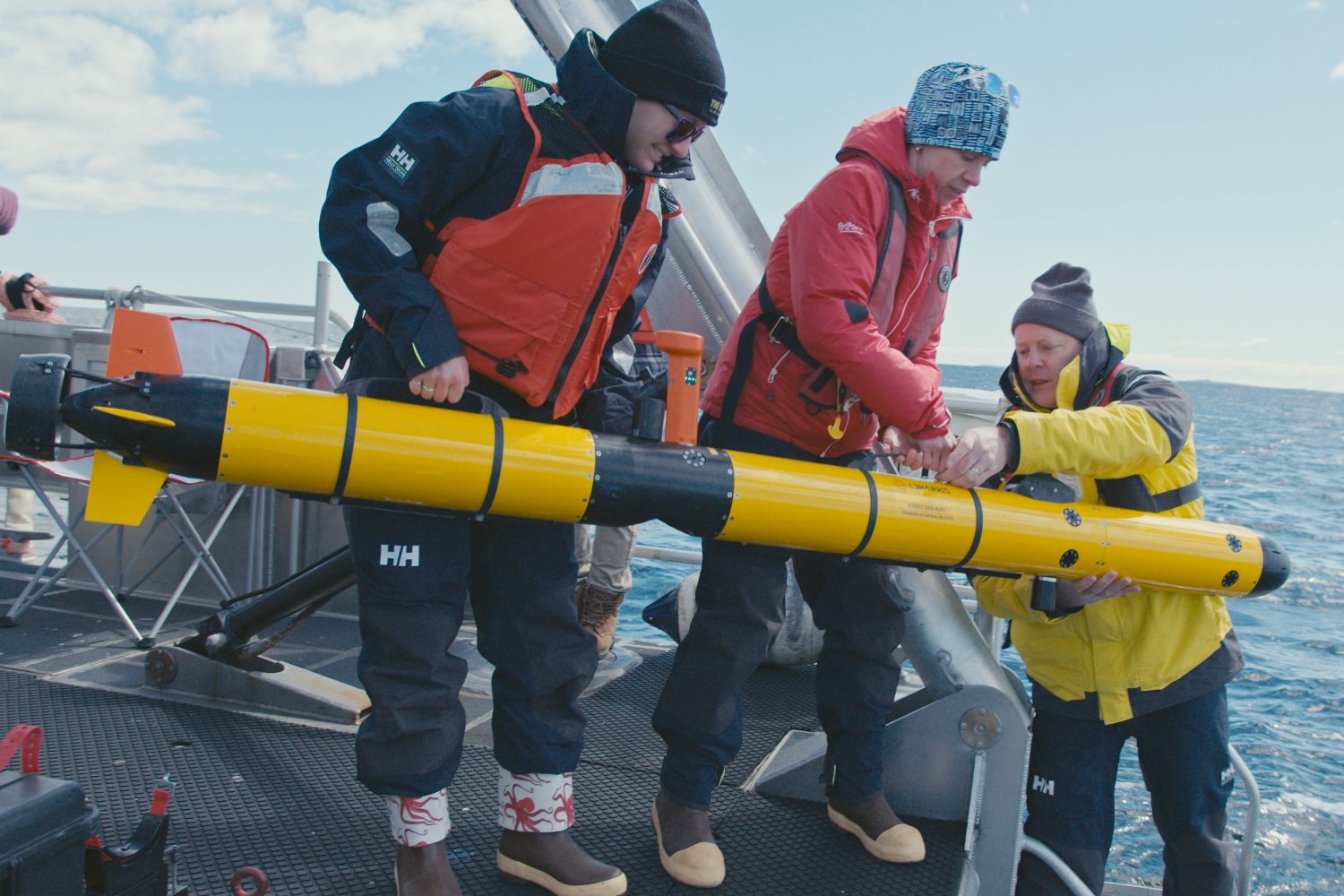
The electricity to an island goes out. To find the break in the underwater power cable, a ship pulls up the entire line or deploys remotely operated vehicles (ROVs) to traverse the line. But what if an autonomous underwater vehicle (AUV) could map the line and pinpoint the location of the fault for a diver to fix?

Such underwater human-robot teaming is the focus of an MIT Lincoln Laboratory project funded through an internally administered R&D portfolio on autonomous systems and carried out by the Advanced Undersea Systems and Technology Group. The project seeks to leverage the respective strengths of humans and robots to optimize maritime missions for the U.S. military, including critical infrastructure inspection and repair, search and rescue, harbor entry, and countermine operations.

“Divers and AUVs generally don’t team at all underwater,” says principal investigator Madeline Miller. “Underwater missions requiring humans typically do so because they involve some sort of manipulation a robot can’t do, like repairing infrastructure or deactivating a mine. Even ROVs are challenging to work with underwater in very skilled manipulation tasks because the manipulators themselves aren’t agile enough.”

Beyond their superior dexterity, humans excel at recognizing objects underwater. But humans working underwater can’t perform complex computations or move very quickly, especially if they are carrying heavy equipment; robots have an edge over humans in processing power, high-speed mobility, and endurance. To combine these strengths, Miller and her team are developing hardware and algorithms for underwater navigation and perception — two key capabilities for effective human-robot teaming.

As Miller explains, divers may only have a compass and fin-kick counts to guide them. With few landmarks and potentially murky conditions caused by a lack of light at depth or the presence of biological matter in the water column, they can easily become disoriented and lost. For robots to help divers navigate, they need to perceive their environment. However, in the presence of darkness and turbidity, optical sensors (cameras) cannot generate images, while acoustic sensors (sonar) generate images that lack color and only show the shapes and shadows of objects in the scene. The historical lack of large, labeled sonar image datasets has hindered training of underwater perception algorithms. Even if data were available, the dynamic ocean can obscure the true nature of objects, confusing artificial intelligence. For instance, a downed aircraft broken into multiple pieces, or a tire covered in an overgrowth of mussels, may no longer resemble an aircraft or tire, respectively.

“Ultimately, we want to devise solutions for navigation and perception in expeditionary environments,” Miller says. “For the missions we’re thinking about, there is limited or no opportunity to map out the area in advance. For the harbor entry mission, maybe you have a satellite map but no underwater map, for example.”

On the navigation side, Miller’s team picked up on work started by the MIT Marine Robotics Group, led by John Leonard, to develop diver-AUV teaming algorithms. With their navigation algorithms, Leonard’s group ran simulations under optimal conditions and performed field testing in calm waters using human-paddled kayaks as proxies for both divers and AUVs. Miller’s team then integrated these algorithms into a mission-relevant AUV and began testing them under more realistic ocean conditions, initially with a support boat acting as a diver surrogate, and then with actual divers.

“We quickly learned that you need more sensing capabilities on the diver when you factor in ocean currents,” Miller explains. “With the algorithms demonstrated by MIT, the vehicle only needed to calculate the distance, or range, to the diver at regular intervals to solve the optimization problem of estimating the positions of both the vehicle and diver over time. But with the real ocean forces pushing everything around, this optimization problem blows up quickly.”

On the perception side, Miller’s team has been developing an AI classifier that can process both optical and sonar data mid-mission and solicit human input for any objects classified with uncertainty.

“The idea is for the classifier to pass along some information — say, a bounding box around an image — to the diver and indicate, “I think this is a tire, but I’m not sure. What do you think?” Then, the diver can respond, “Yes, you’ve got it right, or no, look over here in the image to improve your classification,” Miller says.

This feedback loop requires an underwater acoustic modem to support diver-AUV communication. State-of-the-art data rates in underwater acoustic communications would require tens of minutes to send an uncompressed image from the AUV to the diver. So, one aspect the team is investigating is how to compress information into a minimum amount to be useful, working within the constraints of the low bandwidth and high latency of underwater communications and the low size, weight, and power of the commercial off-the-shelf (COTS) hardware they’re using. For their prototype system, the team procured mostly COTS sensors and built a sensor payload that would easily integrate into an AUV routinely employed by the U.S. Navy, with the goal of facilitating technology transition. Beyond sonar and optical sensors, the payload features an acoustic modem for ranging to the diver and several data processing and compute boards.

Miller’s team has tested the sensor-equipped AUV and algorithms around coastal New England — including in the open ocean near Portsmouth, New Hampshire, with the University of New Hampshire’s (UNH) Gulf Surveyor and Gulf Challenger coastal research vessels as diver surrogates, and on the Boston-area Charles River, with an MIT Sailing Pavilion skiff as the surrogate.

“The UNH boats are well-equipped and can access realistic ocean conditions. But pretending to be a diver with a large boat is hard. With the skiff, we can move more slowly and get the relative motion in tune with how a diver and AUV would navigate together.”

Last summer, the team started testing equipment with human divers at Michigan Technological University’s Great Lakes Research Center. Although the divers lacked an interface to feed back information to the AUV, each swam holding the team’s tube-shaped prototype tablet, dubbed a “tube-let.” The tube-let was equipped with a pressure and depth sensor, inertial measurement unit (to track relative motion), and ranging modem — all necessary components for the navigation algorithms to solve the optimization problem.

“A challenge during testing was coordinating the motion of the diver and vehicle, because they don’t yet collaborate,” Miller says. “Once the divers go underwater, there is no communication with the team on the surface. So, you have to plan where to put the diver and vehicle so they don’t collide.”

The team also worked on the perception problem. The water clarity of the Great Lakes at that time of year allowed for underwater imaging with an optical sensor. Caroline Keenan, a Lincoln Scholars Program PhD student jointly working in the laboratory’s Advanced Undersea Systems and Technology Group and Leonard’s research group at MIT, took the opportunity to advance her work on knowledge transfer from optical sensors to sonar sensors. She is exploring whether optical classifiers can train sonar classifiers to recognize objects for which sonar data doesn’t exist. The motivation is to reduce the human operator load associated with labeling sonar data and training sonar classifiers.

With the internally funded research program coming to an end, Miller’s team is now seeking external sponsorship to refine and transition the technology to military or commercial partners.

“The modern world runs on undersea telecommunication and power cables, which are vulnerable to attack by disruptive actors. The undersea domain is becoming increasingly contested as more nations develop and advance the capabilities of autonomous maritime systems. Maintaining global economic security and U.S. strategic advantage in the undersea domain will require leveraging and combining the best of AI and human capabilities,” Miller says.

Generate single title from this title How will AI change the org chart? in 100 -150 characters. And it must return only title i dont want any extra information or introductory text with title e.g: ” Here is a single title:”

Write an article about At the micro level, there is evidence that it pays to collapse the layers of command .Organize the content with appropriate headings and subheadings ( h2, h3, h4, h5, h6). Include conclusion section and FAQs section with Proper questions and answers at the end. do not include the title. it must return only article i dont want any extra information or introductory text with article e.g: ” Here is rewritten article:” or “Here is the rewritten content:”

Generate single title from this title Stalking victim sues OpenAI, claims ChatGPT fueled her abuser’s delusions and ignored her warnings in 100 -150 characters. And it must return only title i dont want any extra information or introductory text with title e.g: ” Here is a single title:”

0

Write an article about

After months of conversations with ChatGPT,  a 53-year-old Silicon Valley entrepreneur became convinced he’d discovered a cure for sleep apnea and that powerful people were coming after him, according to a new lawsuit filed in California Superior Court in San Francisco County. He then allegedly used the tool to stalk and harass his ex-girlfriend.

Now the ex-girlfriend is suing OpenAI, alleging the company’s technology enabled the acceleration of her harassment, TechCrunch has exclusively learned. She claims OpenAI ignored three separate warnings that the user posed a threat to others, including an internal flag classifying his account activity as involving mass-casualty weapons. 

The plaintiff, referred to as Jane Doe to protect her identity, is suing for punitive damages. She also filed a temporary restraining order Friday asking the court to force OpenAI to block the user’s account, prevent him from creating new ones, notify her if he attempts to access ChatGPT, and preserve his complete chat logs for discovery.

OpenAI has agreed to suspend the user’s account but has refused the rest, according to Doe’s lawyers. They say the company is withholding information about specific plans for harming Doe and other potential victims the user may have discussed with ChatGPT.

The lawsuit lands amid growing concern over the real-world risks of sycophantic AI systems. GPT-4o, the model cited in this and many other cases, was retired from ChatGPT in February. 

The case is brought by Edelson PC, the firm behind the wrongful death suits involving teenager Adam Raine, who died by suicide after months of conversations with ChatGPT, and Jonathan Gavalas, whose family alleges Google’s Gemini fueled his delusions and potential mass-casualty event before his death. Lead attorney Jay Edelson has warned that AI-induced psychosis is escalating from individual harm toward mass-casualty events.

That legal pressure is now colliding directly with OpenAI’s legislative strategy: The company is backing an Illinois bill that would shield AI labs from liability even in cases involving mass deaths or catastrophic financial harm. 

Techcrunch event

San Francisco, CA
|
October 13-15, 2026

OpenAI did not respond in time to comment. TechCrunch will update the article if the company responds.

The Jane Doe lawsuit lays out in detail how that liability played out for one woman over several months.

Last year, the ChatGPT user in the lawsuit (whose name is not included in the lawsuit to protect his identity) became convinced that he had invented a cure for sleep apnea after months of “high volume, sustained use of GPT-4o.” When no one took his work seriously, ChatGPT told him that “powerful forces” were watching him, including using helicopters to surveil his activities, according to the complaint. 

In July 2025, Jane Doe urged him to stop using ChatGPT and to seek help from a mental health professional. He instead turned back to ChatGPT, which assured him he was “a level 10 in sanity” and helped him double down on his delusions, per the lawsuit. 

Doe had broken up with the user in 2024, and he used ChatGPT to process the split, according to emails and communications cited in the lawsuit. Rather than push back on his one-sided account, it repeatedly cast him as rational and wronged, and her as manipulative and unstable. He then took these AI-generated conclusions off the screen and into the real world, using them to stalk and harass her. This manifested in several AI-generated, clinical-looking psychological reports that he distributed to her family, friends, and employer. 

Meanwhile, the user continued to spiral. In August 2025, OpenAI’s automated safety system flagged him for “Mass Casualty Weapons” activity and deactivated his account.

A human safety team member reviewed the account the next day and restored it, even though his account may have contained evidence that he was targeting and stalking individuals, including Doe, in real life. For example, a September screenshot the user sent to Doe showed a list of conversation titles including “violence list expansion” and “fetal suffocation calculation.”

The decision to reinstate is notable following two recent school shootings in Tumbler Ridge, Canada, and at Florida State University (FSU). OpenAI’s safety team had flagged the Tumbler Ridge shooter as a potential threat, but higher-ups reportedly decided not to alert authorities. Florida’s attorney general this week opened an investigation into OpenAI’s possible link with the FSU shooter.

According to the Jane Doe lawsuit, when OpenAI restored her stalker’s account, his Pro subscription wasn’t reinstated alongside it. He emailed the trust and safety team to sort it out, copying Doe on the message. 

In his emails, he wrote things like: “I NEED HELP VERY FAST, PLEASE. PLEASE CALL ME!” and “this is a matter of life or death.” He claimed he was “in the process of writing 215 scientific papers,” which he was writing so fast he didn’t “even have time to read.” Included in those emails was a list of tens of AI-generated “scientific papers” with titles like: “Deconstructing Race as a Biological Category_ Legal, Scientific, and Horn of Africa Perspectives.pdf.txt.”

“The user’s communications provided unmistakable notice that he was mentally unstable and that ChatGPT was the engine of his delusional thinking and escalating conduct,” the lawsuit states. “The user’s stream of urgent, disorganized, and grandiose claims, along with a concrete ChatGPT- generated report targeting Plaintiff by name and a sprawling body of purported ‘scientific’ materials, was unmistakable evidence of that reality. OpenAI did not intervene, restrict his access, or implement any safeguards. Instead, it enabled him to continue using the account and restored his full Pro access.”

Doe, who claims in the lawsuit that she was living in fear and could not sleep in her own home, submitted a Notice of Abuse to OpenAI in November.

“For the last seven months, he has weaponized this technology to create public destruction and humiliation against me that would have been impossible otherwise,” Doe wrote in her letter to OpenAI requesting the company permanently ban the user’s account.

OpenAI responded, acknowledging the report was “extremely serious and troubling” and that it was carefully reviewing the information. Doe never heard back.

Over the next couple of months, the user continued to harass Doe, sending her a series of threatening voicemails. In January, he was arrested and charged with four felony counts of communicating bomb threats and assault with a deadly weapon. Doe’s lawyers allege this validates warnings both she and OpenAI’s own safety systems had raised months earlier, warnings the company allegedly chose to ignore.

The user was found incompetent to stand trial and committed to a mental health facility, but a “procedural failure by the State” means he will soon be released to the public, according to Doe’s lawyers. 

Edelson called on OpenAI to cooperate. “In every case, OpenAI has chosen to hide critical safety information — from the public, from victims, from people its product is actively putting in danger,” he said. “We’re calling on them, for once, to do the right thing. Human lives must mean more than OpenAI’s race to an IPO.”

.Organize the content with appropriate headings and subheadings ( h2, h3, h4, h5, h6). Include conclusion section and FAQs section with Proper questions and answers at the end. do not include the title. it must return only article i dont want any extra information or introductory text with article e.g: ” Here is rewritten article:” or “Here is the rewritten content:”

Generate single title from this title A new need-to-know for the AI classroom in 100 -150 characters. And it must return only title i dont want any extra information or introductory text with title e.g: ” Here is a single title:”

Write an article about

Key points:

Most project-based learning workshops are built around three domains: design, assessment, and implementation.

In a model we developed for the Buck Institute for Education (PBLWorks) almost 25 years ago, day 1 of the workshop focused on project design, day 2 on project assessment, and day 3 on project implementation.

One of the key features of project implementation is the suggestion to launch a project with a Need to Know activity. The goal of this activity is clear: Every student should leave with an understanding of what they need to know and what they need to do to successfully complete the inquiry and generate a meaningful solution. 

In practice, no matter how skilled the teacher is or how smart and talented the students are, many learners simply cannot transition from the launch to a concrete list of actions that will allow them to complete their tasks.

I recently saw a post on a discussion board that offered a solution, though it was targeted at office workers. The author shared a prompt that he uses after uploading a project description and expected outcomes to a chatbot:  “I’m about to start this project. Interview me until you have 95% about what I actually want, not what I think I should want.”

That got me thinking. I wonder if there was a series of activities that allow a student to access the ideation capabilities of AI to ensure that they understand the challenge before them and recognize effective ways to utilize their skills and interests to complete it?

Reimagining “Need to Know:” AI-powered launch strategies

While the Need to Know list is a classic for identifying knowledge gaps, AI can act as a Socratic mirror, reflecting a student’s latent interests back to them until they recognize a personal connection to the driving question.

Here are five activities that you can try with your students to ease the challenge of getting started with their inquiry. You will notice that the focus here is on individual student work–not the group work typically found in PBL classrooms.

While these protocols are designed for individual work, they can be adapted for collaborative tasks. Teams can input combined interests, draft ideas, or early questions, then use AI-generated prompts to structure discussion. The key shift is that students respond first as individuals then negotiate meaning as a group.

1. The adversarial interest interview

Students engage AI as a skeptical questioner who challenges why a topic should matter.

  • Sample prompt: “I am starting a project on [TOPIC]. I want you to act as a skeptical journalist. Ask me one challenging question at a time about why this topic should matter to me or my community. Do not give suggestions or ideas. Only ask questions that push me to clarify what I genuinely care about. Continue until I arrive at a specific angle that feels meaningful.”

2. Interest mapping & pattern extraction

Students input past experiences, interests, and frustrations; AI identifies themes and follows up.

  • Sample prompt: “Here is a list of my past experiences, interests, and frustrations: [LIST]. Analyze this list and identify 3–5 patterns or themes you notice. Then ask me 5 follow-up questions to help me clarify which of these I care about most. Do not suggest a project topic.”

3. Contradiction finder

Students surface competing interests or values; AI highlights tensions and prompts reconciliation.

  • Sample prompt:“Here are some things I’m interested in or care about: [LIST]. Identify any tensions or contradictions between them. Then ask me questions to help me explore how these conflicting interests might connect in a meaningful way. Help me think through the tension but don’t resolve it for me.”

4. Cross-domain collision

Students connect a personal passion to the academic topic through AI-generated “what if” scenarios.

  • Sample prompt: “My project topic is [ACADEMIC TOPIC], and one of my personal interests is [HOBBY/PASSION]. Generate 3 ‘what Ii’ scenarios that connect these in unexpected ways. For each scenario, briefly explain the connection. Then ask me which one I’m most curious about and why.”

5. Scenario stress test (Need to Know Generator)

AI places students in a high-stakes scenario tied to the project.

  • Sample prompt: “Create a realistic scenario where I am [ROLE] dealing with [PROJECT-RELATED CHALLENGE]. Give me 2–3 difficult decisions to make. After I respond, tell me what information I was missing that would have helped me make a better decision. Help me turn those gaps into a ‘Need to Know’ list.”

Final thoughts

I began this blog with reference to a prompt that focused on a project launch. The exchange that resulted from the prompt determined the worker’s understanding of the task and helped identify the skills and interests she brought to the process.

I want to flip the use of this prompt and make it a closing activity. 

Here is a template for a prompt that could generate a final reflection rich in metacognition:

“I just finished the presentation of learning for my project on [TOPIC]. I am uploading the project description and the work products I generated [VIDEO/LINKS/DOCS/URL/PHOTOS]. Interview me until you can identify 95% of what I learned during this project, including the skills I developed (critical thinking, creativity, collaboration, communication, etc.) I developed. I am interested in learning more about my areas of strength and my opportunities for growth.”

If the original Need to Know helped students answer, “What do I need to know and do to complete this project?”, these AI-supported protocols push toward a more essential question: “Why does this work matter to me?” The shift may be subtle, but it is consequential.

In an AI-rich classroom where ideas are abundant and answers are cheap, the scarce resource is not information. It is ownership. When students use AI to interrogate their interests, test their assumptions, and refine their questions, they are not outsourcing thinking. They are making their thinking visible. That, ultimately, is the goal of any strong project launch.

a-new-need-to-know-for-the-ai-classroom

David Ross is the former Senior Director for PBLWorks, as well as the retired CEO of the Partnership for 21st Century Learning. He writes and consults on the implementation of gen AI in K-12 classrooms. You can follow him on Substack.

Latest posts by eSchool Media Contributors (see all)

.Organize the content with appropriate headings and subheadings ( h2, h3, h4, h5, h6). Include conclusion section and FAQs section with Proper questions and answers at the end. do not include the title. it must return only article i dont want any extra information or introductory text with article e.g: ” Here is rewritten article:” or “Here is the rewritten content:”

A new type of electrically driven artificial muscle fiber | MIT News

0

Muscles are remarkably effective systems for generating controlled force, and engineers developing hardware for robots or prosthetics have long struggled to create analogs that can approach their unique combination of strength, rapid response, scalability, and control. But now, researchers at the MIT Media Lab and Politecnico di Bari in Italy have developed artificial muscle fibers that come closer to matching many of these qualities.

Like the fibers that bundle together to form biological muscles, these fibers can be arranged in different configurations to meet the demands of a given task. Unlike conventional robotic actuation systems, they are compliant enough to interface comfortably with the human body and operate silently without motors, external pumps, or other bulky supporting hardware.

The new electrofluidic fiber muscles — electrically driven actuators built in fiber format — are described in a recent paper published in Science Robotics. The work is led by Media Lab PhD candidate Ozgun Kilic Afsar; Vito Cacucciolo, a professor at the Politecnico di Bari; and four co-authors.

The new system brings together two technologies, Afsar explains. One is a fluidically driven artificial muscle known as a thin McKibben actuator, and the other is a miniaturized solid-state pump based on electrohydrodynamics (EHD), which can generate pressure inside a sealed fluid compartment without moving parts or an external fluid supply.

Until now, most fluid-driven soft actuators have relied on external “heavy, bulky, oftentimes noisy hydraulic infrastructure,” Afsar says, “which makes them difficult to integrate into systems where mobility or compact, lightweight design is important.” This has created a fundamental bottleneck in the practical use of fluidic actuators in real-world applications.

The key to breaking through that bottleneck was the use of integrated pumps based on electrohydrodynamic principles. These millimeter-scale, electrically driven pumps generate pressure and flow by injecting charge into a dielectric fluid, creating ions that drag the fluid along with them. Weighing just a few grams each and not much thicker than a toothpick, they can be fabricated continuously and scaled easily. “We integrated these fiber pumps into a closed fluidic circuit with the thin McKibben actuators,” Afsar says, noting that this was not a simple task given the different dynamics of the two components.

A key design strategy was to pair these fibers in what are known as antagonistic configurations. Cacucciolo explains that this is where “one muscle contracts while another elongates,” as when you bend your arm and your biceps contract while your triceps stretch. In their system, a millimeter-scale fiber pump sits between two similarly scaled McKibben actuators, driving fluid into one actuator to contract it while simultaneously relaxing the other.

“This is very much reminiscent of how biological muscles are configured and organized,” Afsar says. “We didn’t choose this configuration simply for the sake of biomimicry, but because we needed a way to store the fluid within the muscle design.” The need for an external reservoir open to the atmosphere has been one of the main factors limiting the practical use of EHD pumps in robotic systems outside the lab. By pairing two McKibben fibers in line, with a fiber pump between them to form a closed circuit, the team eliminated that need entirely.

Another key finding was that the muscle fibers needed to be pre-pressurized, rather than simply filled. “There is a minimum internal system pressure that the system can tolerate,” Afsar says, “below which the pump can degrade or temporarily stop working.” This happens because of cavitation, in which vapor bubbles form when the pressure at the pump inlet drops below the vapor pressure of the liquid, eventually leading to dielectric breakdown.

To prevent cavitation, they applied a “bias” pressure from the outset so that the pressure at the fiber pump inlet never falls below the liquid’s vapor pressure. The magnitude of this bias pressure can be adjusted depending on the application. “To achieve the maximum contraction the muscle can generate, we found there is a specific bias pressure range that is optimal,” she says. “If you want to configure the system for faster response, you might increase that bias pressure, though with some reduction in maximum contraction.”

Cacucciolo adds that most of today’s robotic limbs and hands are built around electric servo motors, whose configuration differs fundamentally from that of natural muscles. Servo motors generate rotational motion on a shaft that must be converted into linear movement, whereas muscle fibers naturally contract and extend linearly, as do these electrofluidic fibers. 

“Most robotic arms and humanoid robots are designed around the servo motors that drive them,” he says. “That creates integration constraints, because servo motors are hard to package densely and tend to concentrate mass near the joints they drive. By contrast, artificial muscles in fiber form can be packed tightly inside a robot or exoskeleton and distributed throughout the structure, rather than concentrated near a joint.”

These electrofluidic muscles may be especially useful for wearable applications, such as exoskeletons that help a person lift heavier loads or assistive devices that restore or augment dexterity. But the underlying principles could also apply more broadly. “Our findings extend to fluid-driven robotic systems in general,” Cacucciolo says. “Wherever fluidic actuators are used, or where engineers want to replace external pumps with internal ones, these design principles could apply across a wide range of fluid-driven robotic systems.”

This work “presents a major advancement in fiber-format soft actuation,” which “addresses several long-standing hurdles in the field, particularly regarding portability and power density,” says Herbert Shea, a professor in the Soft Transducers Laboratory at Ecole Polytechnique Federale de Lausanne in Switzerland, who was not associated with this research. “The lack of moving parts in the pump makes these muscles silent, a major advantage for prosthetic devices and assistive clothing,” he says.

Shea adds that “this high-quality and rigorous work bridges the gap between fundamental fluid dynamics and practical robotic applications. The authors provide a complete system-level solution — characterizing the individual components, developing a predictive physical model, and validating it through a range of demonstrators.”

In addition to Afsar and Cacucciolo, the team also included Gabriele Pupillo and Gennaro Vitucci at Politecnico di Bari and Wedyan Babatain and Professor Hiroshi Ishii at the MIT Media Lab. The work was supported by the European Research Council and the Media Lab’s multi-sponsored consortium.

Generate single title from this title It’s time to rewrite math standards for the future–and to stop expecting AI to do it for us in 100 -150 characters. And it must return only title i dont want any extra information or introductory text with title e.g: ” Here is a single title:”

Write an article about

Key points:

While nearly every industry is racing to integrate artificial intelligence, most schools are still teaching high school math the way it’s been done for decades–rooted in instructional material that is abstract, disconnected, and detached from the world students actually live in.

It’s no wonder that so many students decide early on that math “isn’t for them.” The way we’ve structured math instruction makes it hard for them to see why it matters. Our standards were built for a university pipeline, not for the realities of a dynamic economy that values creativity, problem-solving, and the ability to ask the right questions.

To move beyond outdated approaches and materials, the field has leaned heavily into AI as a solution. But efficiency alone can’t replace or cultivate the human relationships and sense of purpose that drive meaning and engagement in education.

In that case, we’ve mistaken rigor for relevance.

What we see in most high school math classrooms is a system built around endurance rather than understanding. Students race through fragmented topics to prepare for exams, while the deeper “why” behind the mathematics remains out of reach. The problem isn’t that we’re teaching difficult concepts, it’s that we’re teaching them as if meaning will magically emerge at some point down the road. 

Students move through isolated chunks of algebra, geometry, and calculus without ever hearing the storylines that connect them–the human motivations and the real-world intrigues that gave rise to the math originally. When we teach mathematics without the curiosities that first inspired it, we rob students of the very spark that drove mathematics forward in the first place. 

As we look ahead and begin to redefine math education, one thing is abundantly clear: AI won’t fix bad pedagogy.

AI is already being woven into nearly every aspect of education–from generating practice problems to serving as on-demand tutors. But these tools, while impressive, risk amplifying what’s already broken. By mimicking what we already know, AI doesn’t challenge the fundamental assumptions of what or how we teach. It personalizes, but it doesn’t humanize.

Investors and edtech companies see AI as the next frontier–the “holy grail” for scale and efficiency. But pedagogy isn’t an engineering problem. Teaching is an act of connection. Students learn through human storylines, through emotional safety, and through conversations that spark dissonance and exploration. Those are the moments when real understanding takes root–and they can’t be automated.

If we continue to pour AI into the same outdated frameworks, we’re simply pouring concrete on something already flawed, therefore cementing it in. 

We want students to thrive in an AI-driven world, so our approach to math education must evolve to emphasize what makes us distinctively human: following our curiosities and reasoning through ambiguity to find clarity, structure, and connection. That means refocusing the student experience to ensure it becomes a human one through two key components:

  • Human teachers who guide learning with empathy, context, and real-time understanding of students’ emotions and misconceptions.
  • Human storylines that connect math concepts to lived experience–showing not just how we do math, but why mathematics resonates.

Instructional materials should be designed like great plays–with structure, narrative, and a sense of purpose. That requires writers who understand both mathematics and the art of storytelling. It’s not enough to generate more problems; we need to generate more curiosity, and what better way than to bring humans together to share these experiences rather than work independently with a machine.

Take the quadratic formula, for example. Surely that term elicits some sort of emotional reaction or vague memory from high school. When introduced to this formula, you were likely asked to ‘complete the square’–but were you ever actually handed a square with a hole and asked to complete it? Or was there any conversation or demonstration of the way humans solved these types of problems before there was a quadratic formula? 

Current math instruction uses words that certainly seem human, such as “complete the square,” and yet we don’t provide the human story for students to make it tangible or relatable. There’s no room in the conversation for curiosity, to ask or pursue a question in order to better understand or attribute meaning. 

AI could arguably solve every quadratic equation better than any human. But why is the goal to simply memorize or accurately execute rather than to think, question, and reason together?

The economy our students are entering doesn’t reward rote learning; it rewards adaptability and creative reasoning. We need a generation that is inclined to ask, “Is there such a thing as completing the triangle?”–not just one that can solve for x.

AI will continue to change the landscape of every profession, but its rise should prompt us to double down on the human elements of learning, not abandon them. If we want students to lead in an AI-augmented world, we must design math experiences that build understanding, purpose, and agency–not just automation.

It’s time to stop digitizing old lessons and start rewriting the story of math education itself.

Jill Diniz, CEO and founder of SmartWithIt, is a curriculum innovator, ed-tech entrepreneur, and longtime math educator committed to changing how we think about learning. With a deep background in software engineering, curriculum design, and classroom teaching, Jill brings a rare blend of technical rigor and educational empathy to every product she creates. Her work at Smart With It reflects a passion for joyful, validating educational experiences that are scientifically sound, deeply accessible, and built to last.

rewrite-math-learning-standards-stop-expecting-ai

James Tanton, PhD, Chief Mathematics Officer and co-founder of SmartWithIt, is an award-winning author and math educator committed to transforming how the world perceives mathematics. Drawing on his experience in both university and high school settings, he designs curricula and outreach programs that emphasize joyful, accessible learning. Tanton’s work, including the Global Math Project, aims to unlock the beauty and wonder of mathematics for all students.

Latest posts by eSchool Media Contributors (see all)

.Organize the content with appropriate headings and subheadings ( h2, h3, h4, h5, h6). Include conclusion section and FAQs section with Proper questions and answers at the end. do not include the title. it must return only article i dont want any extra information or introductory text with article e.g: ” Here is rewritten article:” or “Here is the rewritten content:”

Generate single title from this title AI workflows for software developers and the need for oversight in 100 -150 characters. And it must return only title i dont want any extra information or introductory text with title e.g: ” Here is a single title:”

Write an article about

Trust in agentic AI, however, is improving. OutSystems reports that 73% of respondents express either high or moderate trust in letting agents to act autonomously, a rise of around 10% compared to a similar survey the company undertook last year. Trust in code or workflows generated by third-party AI tools is slightly lower, at 67%, a substantial increase from the prior year’s figure, when only 40% ‘mostly trusted’ generative AI to write code without human help.

Only 36% of respondents say they have a centralised approach to AI governance, while 64% say they lack such a facility, and 41% rely on rules implemented on a per-project basis. Two-thirds say building human-in-the-loop checkpoints is technically difficult because it requires orchestration that can pause agents – in effect inserting manual braking on operations that might be fully autonomous.

Many organisations appear to be deploying looser oversight models, although it is not clear if that is a result of greater trust in models or whether business functions are under pressure to deploy AI regardless of security or reliability concerns. If the trend to loosen oversight continues, the report’s authors note that agentic AI adoption may advance faster than the methods of accountability that many consider important.

Firms that want to scale agents in regulated or mission-critical settings should treat orchestration and auditability as part of the product, the survey’s findings state. When compliance checks consider a business’s operations, breadcrumb trails in the form of logfiles and defined responsibilities are considered important elements of any agentic AI rollout.

The report says 94% of leaders are concerned about “AI sprawl”, which is not defined, but could be inferred to be a lack of a centralised management platform that oversees all AI deployments in the enterprise. 39% are very or extremely concerned about the issue, and only 12% currently use a centralised platform to keep that sprawl under control.

The full survey can be accessed here.

(Image source: “Relax” by Koijots is licensed under CC BY-SA 2.0. To view a copy of this license, visit https://creativecommons.org/licenses/by-sa/2.0)


Want to learn more about AI and big data from industry leaders? Check out AI & Big Data Expo taking place in Amsterdam, California, and London. The comprehensive event is part of TechEx and co-located with other leading technology events. Click here for more information.

AI News is powered by TechForge Media. Explore other upcoming enterprise technology events and webinars here.

.Organize the content with appropriate headings and subheadings ( h2, h3, h4, h5, h6). Include conclusion section and FAQs section with Proper questions and answers at the end. do not include the title. it must return only article i dont want any extra information or introductory text with article e.g: ” Here is rewritten article:” or “Here is the rewritten content:”

SmartThings Blog

0

Did you know your Samsung TV can double as a SmartThings Hub? Many 2024 and newer models come with the hub built in, which means no extra device is needed. With just a few steps, you can turn your TV into the heart of your smart home and instantly start connecting devices. Read on for a step-by-step guide to activate your SmartThings Hub. 

How it Works

There are two easy ways to activate the SmartThings Hub built into your TV: directly from your mobile phone using the SmartThings app, or through the SmartThings app on your TV.

Both options follow a similar flow, connect your TV, enable the hub, and start adding devices, so you can choose whichever is most convenient for you.

Activate the Hub Using Your Galaxy 

If you already use SmartThings on your phone, this is often the fastest way to get started.

Step 1: Turn On Your TV

  • Make sure your Samsung TV is powered on and connected to Wi-Fi.

Step 2: Open SmartThings on Your Phone

  • Launch the SmartThings app on your mobile device. 
  • Confirm you’re signed in with the same Samsung account used on your TV.

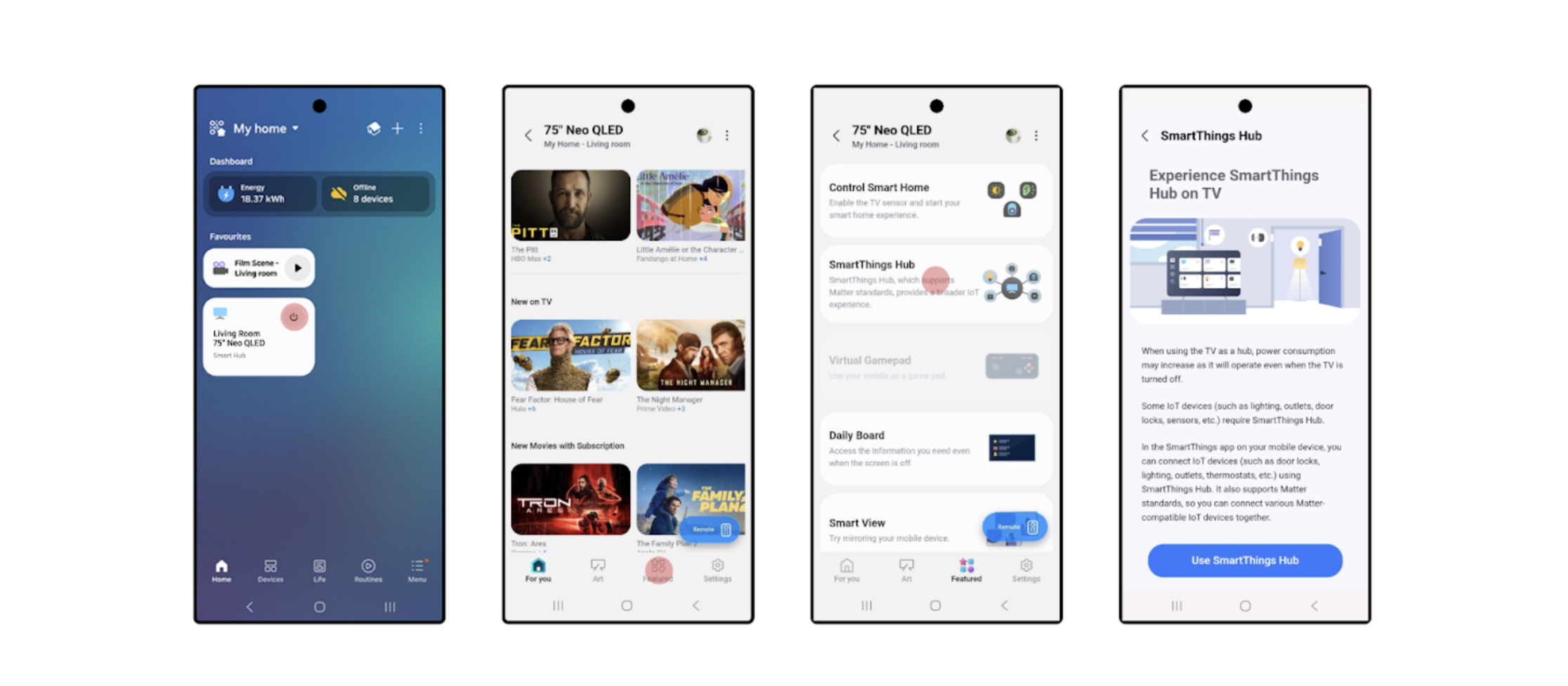
Step 3: Find Your TV

  • Tap Devices in the app. 
  • Select your TV from the list.

Step 4: Open Hub Settings

  • Tap the Featured icon at the bottom
  • SmartThings Hub shows up on the next screen 

Step 5: Activate the Hub

  • Follow the on-screen prompts to turn the hub On.
  • Wait while SmartThings connects to your TV and completes setup.
  • Once finished, your TV is officially activated as a SmartThings Hub.

Activate the Hub Using Your TV

You can also turn on the hub directly from your TV using the built-in SmartThings app.

Step 1: Turn on Your TV

  • Make sure your Samsung TV is powered on and connected to Wi-Fi.

Step 2: Open the SmartThings App on Your TV

  • Press the Home button on your remote.
  • Scroll over to Connected Devices
  • Navigate to and open the SmartThings app.

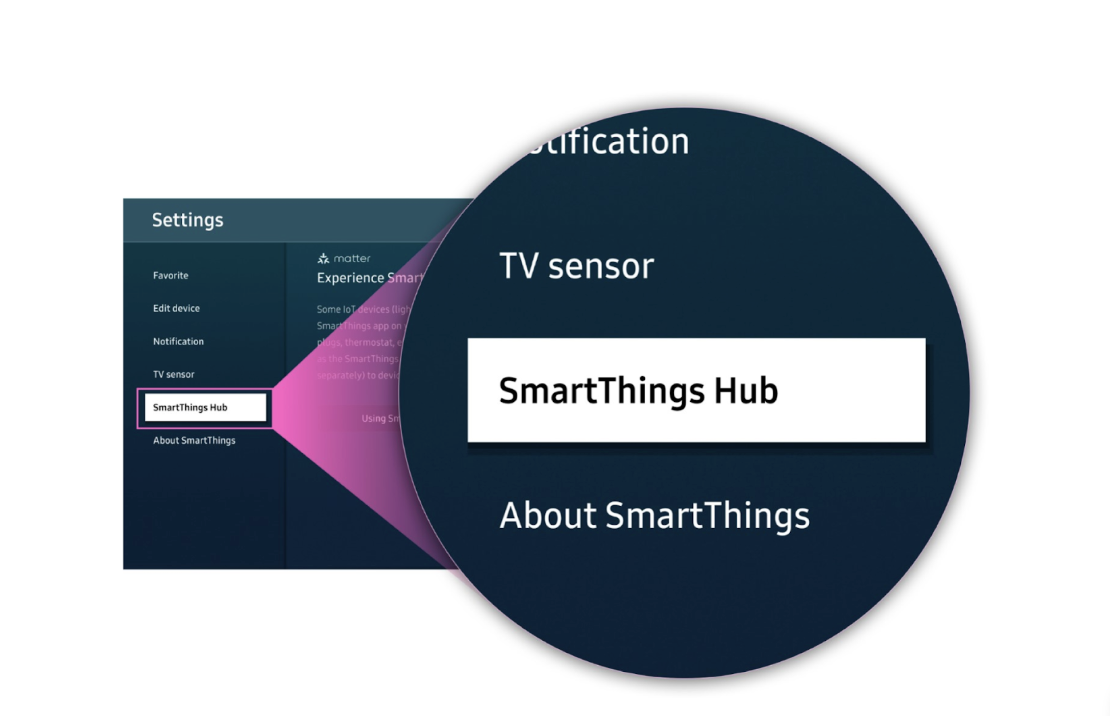
Step 3: Access Settings

  • Select the Settings icon (cog wheel) in the SmartThings app. This may also be featured already on the home page.
  • Scroll down and choose SmartThings Hub.

Step 4: Activate the Hub

  • Toggle SmartThings Hub to On.
  • The Hub is now active!

Step 5: Add Devices

Once your Hub is activated:

  • In the SmartThings app, tap + Add device.
  • Scan for Matter or other supported devices.
  • Import them into SmartThings.

That’s It!

Your Samsung TV is now a fully functioning SmartThings Hub. From here, you can control smart lights, plugs, sensors, and more, all without additional hardware. 

With the Hub activated, your TV becomes more than just a screen; it’s now the command center for your connected home. Whether you’re dimming lights for movie night, automating your thermostat when you leave home, or linking new Matter devices as they hit the market, SmartThings makes it seamless. 

Need devices to start building out your smart home? Shop them now at https://www.samsung.com/us/smartthings/all-smartthings/