Home Blog Page 191

Apple’s AirPods 4 are down to their lowest price to date

0

Apple’s AirPods 4: A Sweet Deal

The Lowest Price Ever on Amazon, Walmart, and Best Buy

Get ready to upgrade your audio experience with Apple’s AirPods 4, now available at an unbeatable price. These sleek earbuds are currently discounted on Amazon, Walmart, and Best Buy, starting at just $99.99 – a whopping 22% off the original list price of $129.

What’s New in AirPods 4?

The latest generation of Apple’s base AirPods, launched alongside the iPhone 16, boasts some exciting features. One of the standout upgrades is spatial audio with dynamic head tracking, which creates a unique listening experience. While some users may enjoy this effect, others, like the author, may prefer to toggle it off.

Design and Comfort

The open design of the AirPods 4 has won over the author’s heart, providing a more comfortable fit compared to the silicone tips on their second-gen AirPods Pro. The compact case and solid battery life are also notable advantages.

Should You Splurge on Active Noise Cancellation?

For a mere $50 more, the AirPods 4 with Active Noise Cancellation, Adaptive Audio, and transparency mode can elevate your listening experience. This higher-end model includes a case that can be charged wirelessly using an Apple Watch or any Qi-compatible charger. While the extra cost may be a tough decision, the active noise cancellation can be a lifesaver in noisy environments.

The Verdict

Are the extra features worth the extra $50? It depends on your needs. If you frequent noisy public transportation or want a more immersive audio experience, the upgrade might be worth considering. However, for casual listeners, the standard AirPods 4 might suffice.

Frequently Asked Questions

Q: How much do the AirPods 4 cost?
A: The standard AirPods 4 are available for $99.99, while the AirPods 4 with Active Noise Cancellation are priced at $148.99.

Q: How much off are they from the original price?
A: The standard AirPods 4 are 22% off the original price of $129, while the AirPods 4 with Active Noise Cancellation are 17% off the original price of $179.99.

Q: What are the key features of the AirPods 4?
A: The AirPods 4 support spatial audio with dynamic head tracking, have an open design, and offer solid battery life. The higher-end model adds Active Noise Cancellation, Adaptive Audio, and transparency mode.

AI search engines cite incorrect sources at an alarming 60% rate

AI Search Tools’ Accuracy Issues

Citation Problems and URL Fabrication

Even when AI search tools cite sources, they often direct users to syndicated versions of content on platforms like Yahoo News rather than original publisher sites. This occurs even in cases where publishers have formal licensing agreements with AI companies. Moreover, URL fabrication emerged as another significant problem, with over half of citations from Google’s Gemini and Grok 3 leading users to fabricated or broken URLs resulting in error pages.

Blocking Crawlers: A Difficult Decision for Publishers

These issues create significant tension for publishers, which face difficult choices. Blocking AI crawlers might lead to loss of attribution entirely, while permitting them allows widespread reuse without driving traffic back to publishers’ own websites.

A Graphical Representation of the Issue

[A graph from CJR showing that blocking crawlers doesn’t mean that AI search providers honor the request.]

Industry Reactions

Mark Howard, chief operating officer at Time magazine, expressed concern about ensuring transparency and control over how Time’s content appears via AI-generated searches. While acknowledging the issues, Howard sees room for improvement in future iterations, stating, "Today is the worst that the product will ever be," citing substantial investments and engineering efforts aimed at improving these tools.

However, Howard also did some user shaming, suggesting it’s the user’s fault if they aren’t skeptical of free AI tools’ accuracy: "If anybody as a consumer is right now believing that any of these free products are going to be 100 percent accurate, then shame on them."

Rebuttals from OpenAI and Microsoft

OpenAI and Microsoft provided statements to CJR acknowledging receipt of the findings but did not directly address the specific issues. OpenAI noted its promise to support publishers by driving traffic through summaries, quotes, clear links, and attribution. Microsoft stated it adheres to Robot Exclusion Protocols and publisher directives.

Conclusion

The latest report builds on previous findings published by the Tow Center in November 2024, which identified similar accuracy problems in how ChatGPT handled news-related content. For more detail on the fairly exhaustive report, check out Columbia Journalism Review’s website.

FAQs

Q: What are the main issues with AI search tools?
A: Citation problems and URL fabrication are significant issues with AI search tools.

Q: What are the consequences of blocking AI crawlers for publishers?
A: Blocking AI crawlers might lead to loss of attribution entirely, while permitting them allows widespread reuse without driving traffic back to publishers’ own websites.

Q: What are OpenAI and Microsoft’s stances on the issue?
A: OpenAI and Microsoft acknowledged receipt of the findings but did not directly address the specific issues. OpenAI promised to support publishers, while Microsoft stated it adheres to Robot Exclusion Protocols and publisher directives.

Democrats Demand Answers on DOGE’s Use of AI

0

House Democrats Press Federal Agencies on AI Use Amid Workforce Cuts

Request for Information on AI Software Deployment

Democrats on the House Oversight Committee have fired off two dozen requests to federal agency leaders, pressing them for information on plans to install AI software throughout federal agencies amid ongoing cuts to the government’s workforce.

Concerns Over Data Security and Potential Conflicts of Interest

The requests follow recent reporting by WIRED and The Washington Post on efforts by Elon Musk’s Department of Government Efficiency (DOGE) to automate tasks with proprietary AI tools and access sensitive data. The Democrats are concerned that the use of AI software may compromise the security of Americans’ personal data and potentially benefit Musk’s own business interests.

Federal Agencies Bound by Statutory Requirements

In the requests, Congressman Gerald Connolly notes that federal agencies are "bound by multiple statutory requirements in their use of AI software," including the Federal Risk and Authorization Management Program and the Advancing American AI Act. These laws require agencies to standardize their approach to cloud services, ensure AI-based tools are properly assessed for security risks, and make agency inventories of AI use cases available to the public.

GSAi Deployment and Other Agencies’ Plans

Documents obtained by WIRED show that DOGE operatives have deployed a proprietary chatbot called GSAi to approximately 1,500 federal workers. The General Services Administration (GSA) oversees federal government properties and supplies information technology services to many agencies. Other agencies, including the departments of Treasury and Health and Human Services, have considered using a chatbot, though not necessarily GSAi, according to documents viewed by WIRED.

Army’s Use of CamoGPT

WIRED has reported that the United States Army is currently using a software called CamoGPT to scan its records systems for any references to diversity, equity, inclusion, and accessibility. An Army spokesperson confirmed the existence of the tool but declined to provide further information about how the Army plans to use it.

Concerns About Data Handling and Potential Conflicts of Interest

In the requests, Connolly writes that the Department of Education possesses personally identifiable information on more than 43 million people tied to federal student aid programs. He is concerned that students’, parents’, spouses’, family members’, and all other borrowers’ sensitive information is being handled by secretive members of the DOGE team for unclear purposes and with no safeguards to prevent disclosure or improper use.

Conclusion

The deployment of AI software by federal agencies raises serious concerns about data security, potential conflicts of interest, and the potential for improper use of sensitive information. The House Oversight Committee’s requests are an important step in ensuring that federal agencies are transparent and accountable in their use of AI technology.

Frequently Asked Questions

Q: What is the purpose of the House Oversight Committee’s requests?
A: The requests seek to ensure that federal agencies are transparent and accountable in their use of AI technology and to address concerns about data security and potential conflicts of interest.

Q: What is the Department of Government Efficiency (DOGE)?
A: DOGE is a private organization founded by Elon Musk to automate tasks with proprietary AI tools and access sensitive data.

Q: What is the General Services Administration (GSA) chatbot, GSAi?
A: GSAi is a proprietary chatbot deployed by DOGE operatives to approximately 1,500 federal workers.

Q: What is the Army’s use of CamoGPT?
A: The Army is currently using CamoGPT to scan its records systems for any references to diversity, equity, inclusion, and accessibility.

Sesame Releases Base AI Model

0

Sesame Releases AI Voice Assistant Model for Commercial Use

Introduction
Sesame, an AI company, has released the base model that powers Maya, its impressively realistic voice assistant. The model, called CSM-1B, is 1 billion parameters in size and is under an Apache 2.0 license, making it available for commercial use with few restrictions.

How it Works
CSM-1B generates "RVQ audio codes" from text and audio inputs, using a technique called residual vector quantization (RVQ). RVQ is used in various AI audio technologies, including Google’s SoundStream and Meta’s Encodec. The model is based on a fine-tuned variant of Meta’s Llama family and an audio "decoder" component.

Open-Source Model
The model is open-sourced and can be used to produce a variety of voices. However, it has not been fine-tuned on any specific voice and may not perform well on non-English languages. Sesame did not disclose the data used to train the model.

Safeguards
The model has no real safeguards to prevent misuse. Sesame relies on an honor system, urging developers and users not to use the model to mimic a person’s voice without their consent, create misleading content, or engage in harmful or malicious activities.

Demo and Concerns
The author of the article tried the demo on Hugging Face and found it easy to generate speech, including on controversial topics. This raises concerns about the potential for misuse and fraud. Consumer Reports recently warned that many popular AI-powered voice cloning tools on the market do not have meaningful safeguards to prevent abuse.

Company Background
Sesame was co-founded by Brendan Iribe, co-creator of Oculus, and has raised an undisclosed amount of capital from Andreessen Horowitz, Spark Capital, and Matrix Partners. The company is prototyping AI glasses designed to be worn all day, equipped with its custom models.

Conclusion
The release of CSM-1B is significant, as it marks the first time a realistic voice assistant model has been made available for commercial use. However, the lack of safeguards and potential for misuse are concerns that need to be addressed.

FAQs

Q: What is CSM-1B?
A: CSM-1B is a 1 billion-parameters model that generates "RVQ audio codes" from text and audio inputs.

Q: What is RVQ?
A: RVQ is a technique for encoding audio into discrete tokens called codes.

Q: How does CSM-1B work?
A: CSM-1B uses a fine-tuned variant of Meta’s Llama family and an audio "decoder" component to generate RVQ audio codes.

Q: Is the model open-source?
A: Yes, the model is open-source and available for commercial use under an Apache 2.0 license.

Q: What safeguards does the model have?
A: The model has no real safeguards to prevent misuse. Sesame relies on an honor system to prevent misuse.

Breathing New Life into Games with RTX

PC Game Modding

PC game modding is massive, with over 5 billion mods downloaded annually. Mods push graphics forward with each GPU generation, extend a game’s lifespan with new content and attract new players.

NVIDIA RTX Remix

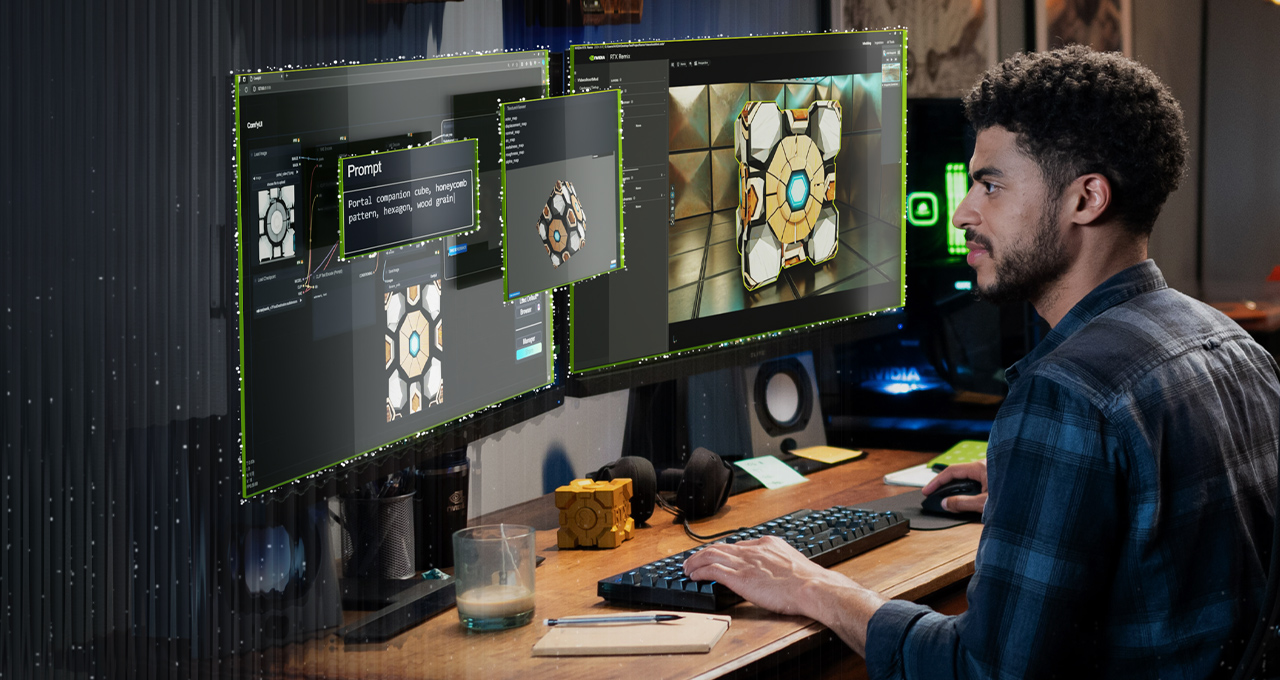
NVIDIA RTX Remix is a modding platform for RTX AI PCs that lets modders capture game assets, automatically enhance materials with generative AI tools and create stunning RTX remasters with full ray tracing. Today, RTX Remix exited beta and fully launched with new NVIDIA GeForce RTX 50 Series neural rendering technology and many community-requested upgrades.

Generative AI Texture Tools

RTX Remix’s built-in generative AI texture tools analyze low-resolution textures from classic games, generate physically accurate materials — including normal and roughness maps — and upscale the resolution by up to 4x. Many RTX Remix mods have been created incorporating generative AI.

PBRFusion 3

Earlier this month, RTX Remix modder NightRaven published PBRFusion 3 — a new AI model that upscales textures and generates high-quality normal, roughness and height maps for physically-based materials.

RTX Remix and REST API

RTX Remix Toolkit capabilities are accessible via REST API, allowing modders to live-link RTX Remix to digital content creation tools such as Blender, modding tools such as Hammer and generative AI apps such as ComfyUI.

Half-Life 2 RTX Demo

Half-Life 2 owners can download a free Half-Life 2 RTX demo from Steam, built with RTX Remix, starting March 18. The demo showcases Orbifold Studios’ work in Ravenholm and Nova Prospekt ahead of the full game’s release at a later date.

What’s Next in AI Starts Here

From the keynote by NVIDIA founder and CEO Jensen Huang on Tuesday, March 18, to over 1,000 inspiring sessions, 300+ exhibits, technical hands-on training and tons of unique networking events — NVIDIA’s own GTC is set to put a spotlight on AI and all its benefits.

Conclusion

RTX Remix is a powerful tool for PC game modding, allowing creators to capture game assets, enhance materials with generative AI tools, and create stunning RTX remasters with full ray tracing. With its built-in generative AI texture tools, PBRFusion 3, and REST API, RTX Remix is poised to revolutionize the world of PC game modding.

FAQs

Q: What is RTX Remix?
A: RTX Remix is a modding platform for RTX AI PCs that lets modders capture game assets, automatically enhance materials with generative AI tools and create stunning RTX remasters with full ray tracing.

Q: What is PBRFusion 3?
A: PBRFusion 3 is a new AI model that upscales textures and generates high-quality normal, roughness and height maps for physically-based materials.

Q: What is the REST API?
A: The REST API is a set of tools that allow modders to live-link RTX Remix to digital content creation tools such as Blender, modding tools such as Hammer and generative AI apps such as ComfyUI.

Q: What is the Half-Life 2 RTX demo?
A: The Half-Life 2 RTX demo is a free demo built with RTX Remix, showcasing Orbifold Studios’ work in Ravenholm and Nova Prospekt ahead of the full game’s release at a later date.

Q: What is GTC?
A: GTC is NVIDIA’s own event, set to put a spotlight on AI and all its benefits, with over 1,000 inspiring sessions, 300+ exhibits, technical hands-on training and tons of unique networking events.

Benchmarking Customized Models on Amazon Bedrock Using LLMPerf and LiteLLM

0

Open Foundation Models and the Need for Performance Benchmarking

Prerequisites

This post requires an Amazon Bedrock custom model. If you don’t have one in your AWS account yet, follow the instructions from Deploy DeepSeek-R1 distilled Llama models with Amazon Bedrock Custom Model Import.

Using Open Source Tools LLMPerf and LiteLLM for Performance Benchmarking

To conduct performance benchmarking, you will use LLMPerf, a popular open-source library for benchmarking foundation models. LLMPerf simulates load tests on model invocation APIs by creating concurrent Ray Clients and analyzing their responses. A key advantage of LLMPerf is its wide support of foundation model APIs, including LiteLLM, which supports all models available on Amazon Bedrock.

Setting up Your Custom Model Invocation with LiteLLM

LiteLLM is a versatile open-source tool that can be used both as a Python SDK and a proxy server (AI gateway) for accessing over 100 different FMs using a standardized format. LiteLLM standardizes inputs to match each FM provider’s specific endpoint requirements. It supports Amazon Bedrock APIs, including InvokeModel and Converse APIs, and FMs available on Amazon Bedrock, including imported custom models.

Configuring a Token Benchmark Test with LLMPerf

To benchmark performance, LLMPerf uses Ray, a distributed computing framework, to simulate realistic loads. It spawns multiple remote clients, each capable of sending concurrent requests to model invocation APIs. These clients are implemented as actors that execute in parallel. LLMPerf.requests_launcher manages the distribution of requests across the Ray Clients, allowing for simulation of various load scenarios and concurrent request patterns. At the same time, each client will collect performance metrics during the requests, including latency, throughput, and error rates.

Analyzing Performance Results from LLMPerf and Estimating Costs Using Amazon CloudWatch

LLMPerf gives you the ability to benchmark the performance of custom models served in Amazon Bedrock without having to inspect the specifics of the serving properties and configuration of your Amazon Bedrock Custom Model Import deployment. This information is valuable because it represents the expected end-user experience of your application.

Conclusion

While Amazon Bedrock Custom Model Import simplifies model deployment and scaling, performance benchmarking remains essential to predict production performance and compare models across key metrics such as cost, latency, and throughput.

Additional Resources

About the Authors

Felipe Lopez is a Senior AI/ML Specialist Solutions Architect at AWS. Prior to joining AWS, Felipe worked with GE Digital and SLB, where he focused on modeling and optimization products for industrial applications.

Rupinder Grewal is a Senior AI/ML Specialist Solutions Architect with AWS. He currently focuses on the serving of models and MLOps on Amazon SageMaker. Prior to this role, he worked as a Machine Learning Engineer building and hosting models. Outside of work, he enjoys playing tennis and biking on mountain trails.

Paras Mehra is a Senior Product Manager at AWS. He is focused on helping build Amazon Bedrock. In his spare time, Paras enjoys spending time with his family and biking around the Bay Area.

Prashant Patel is a Senior Software Development Engineer in AWS Bedrock. He’s passionate about scaling large language models for enterprise applications. Prior to joining AWS, he worked at IBM on productionizing large-scale AI/ML workloads on Kubernetes. Prashant has a master’s degree from NYU Tandon School of Engineering. While not at work, he enjoys traveling and playing with his dogs.

Cloud Technology’s Influence on Custom Software Development

Understanding Cloud Technology

Cloud computing refers to the delivery of computing resources—such as servers, storage, databases, networking, and software—over the internet. It eliminates the need for on-premise hardware and enables businesses to access resources on demand.

Key Features of Cloud Technology

On-Demand Availability: Access computing resources anytime, anywhere.
Scalability: Adjust resources as business needs change.
Cost-Effective: Pay only for what you use.
Enhanced Security: Cloud providers invest heavily in security measures.

The Evolution of Custom Software Development

Traditional Software Development vs. Cloud-Based Development

Traditional software development involved purchasing and maintaining physical servers, leading to high upfront costs and slower deployment. In contrast, cloud-based development provides instant access to resources, reducing costs and improving efficiency.

Why Businesses are Shifting to Cloud Solutions

Companies now prefer custom software solutions AZ due to cloud computing’s ability to improve collaboration, enhance security, and accelerate deployment times. Businesses no longer have to manage hardware, allowing them to focus on innovation.

Benefits of Cloud Technology in Custom Software Development

Scalability and Flexibility

Cloud technology allows businesses to scale applications based on demand. Whether handling high traffic during peak times or reducing resources during slow periods, cloud-based software is highly adaptable.

Cost-Effectiveness

Cloud-based software development companies in Arizona save money on expensive hardware, IT maintenance, and energy costs. Companies can adopt a pay-as-you-go model, minimizing wasteful spending.

Faster Development and Deployment

With cloud-based development platforms, businesses can build and deploy software more quickly. AZ software development firms use cloud automation tools to reduce manual work and accelerate time-to-market.

Enhanced Security and Compliance

Cloud providers implement strong security protocols, including encryption, firewalls, and regular audits. Businesses benefit from compliance with industry regulations such as HIPAA, GDPR, and SOC 2.

Collaboration and Remote Accessibility

Cloud-based development enables teams to collaborate in real-time from different locations. Developers, testers, and stakeholders can access the same platform and work simultaneously.

Cloud Deployment Models and Their Role in Software Development

Public Cloud

Public cloud services, like AWS, Google Cloud, and Microsoft Azure, offer scalable and affordable resources for businesses without requiring physical infrastructure.

Private Cloud

A private cloud is a dedicated infrastructure for a single organization, ensuring greater control and security over sensitive data.

Hybrid Cloud

A hybrid cloud combines public and private cloud benefits, allowing businesses to keep critical workloads private while using the public cloud for scalability.

Challenges of Cloud-Based Custom Software Development

Security Risks and Data Privacy Concerns
Although cloud providers offer robust security, businesses must implement best practices like encryption and multi-factor authentication to protect sensitive data.

Downtime and Reliability Issues

Cloud service outages can disrupt operations. Choosing a reliable provider with strong uptime guarantees is crucial.

Integration with Legacy Systems

Many businesses struggle with integrating cloud applications with their existing on-premise systems. A well-planned strategy is required to ensure seamless migration.

Vendor Lock-in

Relying on a single cloud provider can create dependencies that make it difficult to switch providers in the future. Using a multi-cloud approach can help mitigate this risk.

Why Choose Hybrid IT Services, Inc. for Custom Software Development in Arizona

At Hybrid IT Services, Inc., we specialize in custom software AZ, offering cutting-edge cloud-based solutions. Our expertise in software engineering Arizona ensures that businesses get scalable, secure, and cost-effective software tailored to their needs. Whether you’re a startup or an enterprise, our team of experts can help you navigate cloud-based development with ease.

Conclusion

Cloud technology has revolutionized custom software development in Arizona, making it more scalable, cost-effective, and efficient. As businesses continue to embrace cloud-based solutions, choosing the right development partner is essential. Companies like Hybrid IT Services, Inc. provide expert guidance, ensuring successful cloud software development tailored to your business needs.

FAQs

1. What are the main benefits of cloud-based custom software development?

Cloud-based development offers scalability, cost savings, enhanced security, and faster deployment times.

2. How does cloud computing improve software security?

Cloud providers implement robust security measures, including encryption, firewalls, and compliance with industry regulations.

3. What is the best cloud deployment model for businesses?

It depends on the business needs. Public cloud is cost-effective, private cloud offers more control, and hybrid cloud combines both benefits.

4. How does cloud computing reduce software development costs?

By eliminating the need for physical servers and offering a pay-as-you-go pricing model, cloud computing lowers infrastructure and maintenance costs.

5. What is the future of cloud-based custom software development?

The future includes AI integration, serverless computing, and multi-cloud strategies for greater flexibility and innovation.

Trading Training Costs for Inference Ingenuity

The Inference Renaissance: How AI is Evolving from Bigger to Better

A massive shift is underway as the artificial intelligence industry pivots from obsessing over large pre-training investments to a new frontier: optimizing inference. This shift is transforming the economics of AI, paving the way for new opportunities in innovation and competition.

The Early Days of AI

The early days of the AI revolution were marked by a simple philosophy: bigger is better. Companies poured billions into training increasingly large models, believing that increased scale would inevitably lead to improved performance. While effective, this came with astronomical costs in computing power and energy consumption.

The Inference Renaissance

Now, we’re witnessing a more nuanced evolution. Just as humans didn’t evolve larger brains in the last 5,000 years, instead developing tools and social structures to enhance their practical intelligence, the AI industry is finding ways to do more with less. The focus has shifted from raw computational power to the ingenious application of existing resources.

The Inference Renaissance

This new era is exemplified by the recent developments from GPU vendors like SambaNova, Groq, and Cerebras. Their breakthroughs allow for the execution of complex AI workflows in the time it previously took to process a simple prompt. This leap in inference speed is akin to giving AI the ability to think and react at human speeds – or faster.

The Pricing Revolution

This is not just limited to hardware. Even the giants of the AI world are adapting. OpenAI, once focused primarily on training ever-larger models, has dramatically reduced the cost of using its GPT-4 class models. Output token prices have plummeted from $60 per million at launch to just $10 today, while input token costs have seen an even more dramatic 12-fold decrease.

From Models to Systems

OpenAI’s o1, reflects this new direction and is referred to as a "system" unlike previous large language models – one that employs planning and reflection during inference time to improve the quality of its responses. This mirrors how the human brain constantly uses feedback to refine its "draft predictions" of the world.

The Tool-Driven Intelligence Boom

Just as the development of tools catapulted human ancestors from savanna-dwellers to world-shapers, the integration of specialized tools is amplifying the capabilities of AI systems. We’re moving beyond simple question-answering to complex, multi-step problem-solving.

The Future–Collaboration, Ingenuity, and Human Alignment

As we navigate this new world of AI, winning is no longer guaranteed by having the biggest model. Instead, success will come to those who can most effectively leverage inference optimization, tool integration, and agentic workflows.

Conclusion

The shift from static models to dynamic, self-improving systems represents a new paradigm where it’s no longer just about what a model knows but how quickly and effectively it can apply that knowledge to novel situations. This new direction in AI development doesn’t just promise more capable systems; it offers the hope of a future where artificial intelligence and human intelligence can work together more seamlessly, leveraging the strengths of both to tackle the complex challenges of our world.

FAQs

Q: What is the Inference Renaissance?
A: The Inference Renaissance is a new era in AI development, where the focus has shifted from raw computational power to the ingenious application of existing resources.

Q: What is the significance of the Inference Renaissance?
A: The Inference Renaissance is transforming the economics of AI, paving the way for new opportunities in innovation and competition.

Q: How is OpenAI adapting to the new landscape?
A: OpenAI is reducing the cost of using its GPT-4 class models, with output token prices plummeting from $60 per million at launch to just $10 today.

Q: What is the significance of the shift from models to systems?
A: The shift from models to systems reflects a new direction in AI development, with a focus on dynamic, self-improving systems that can apply knowledge to novel situations.

T-Mobile is Raising Prices on Some of Its Prized Legacy Plans

0

T-Mobile to Raise Prices for Some Legacy Plan Customers

Price Increase Notice

T-Mobile is sending out notifications to some of its legacy plan customers informing them that their plans will be increasing by $5 per month per line starting on April 2nd. This change is expected to affect a yet-to-be-determined number of customers, as the carrier’s internal memo obtained by CNET only mentions that those who have already received a prior price increase will not be affected.

Reason for Price Increase

According to T-Mobile’s consumer group president, Jon Freier, the price increase aims to address "rising costs" for the company. The memo notes that the company will notify affected customers by the end of the day.

Exemptions

CNET reports that Go5G, Go5G Plus, and Go5G Next subscribers will not be subject to the price hikes. Additionally, customers who received a prior price increase will not face an additional adjustment as part of this initiative. This means that some customers may have already seen their rates increase by $2 to $5 last year, and will not be affected by this new change.

Company Statement

In a statement, T-Mobile says, "While most customers are not included, we’re wrapping up the price adjustments that began last year in response to rising costs. We are still committed to providing low prices and the most value across all plans." The company also reassures that these changes will not affect customers with Price Lock.

Frequently Asked Questions

Q: What plans will be affected by the price increase?
A: The exact plans that will be affected by the price increase are unclear, but it is expected to impact a yet-to-be-determined number of customers.

Q: Will all legacy plan customers be affected?
A: No, some customers who have already received a prior price increase will not be affected by this change.

Q: Are there any exemptions to the price increase?
A: Yes, Go5G, Go5G Plus, and Go5G Next subscribers are exempt from the price increase. Additionally, customers who received a prior price increase will not face an additional adjustment.

Q: What is the effective date of the price increase?
A: The price increase will take effect on April 2nd.

AI-Powered Digital Thread: Unlocking the Future of Manufacturing

The Role of AI Agents in the Industrial Transformation

Imagine you are the quality control manager at a large electronics manufacturer. You have received reports of a serious, recurring component issue for a newly released product, which unfortunately has led to a recall. Historically, the only solution would be to issue a full recall, which has significant financial, operational, and reputational consequences. However, as part of an industrial transformation strategy, your organization has implemented a digital thread framework to provide comprehensive visibility into your organization’s data. In a few simple clicks, you can now trace the entire production history of the defective product—from design to final assembly. The digital thread helps you to quickly identify a fault in a specific batch of components sourced from a single supplier. Armed with these insights, you can determine the exact scope of the affected products, work with the supplier to remedy the situation, and initiate an extremely precise, targeted recall. This swift, data-driven response mitigates customer inconvenience, and helps preserve the brand reputation of your company.

Over the last decade, this end-to-end view has been the promise of digital threads in the industrial space, a holy grail of data touchpoints that provide a real-time view of the entire lifecycle of a product or a specific process, from design all the way to end of life. This has largely remained out of reach for most industrial companies due to two key reasons:

  • The data problem: Fragmented, siloed, and uncontextualized mountains of data across a heterogeneous stack of technologies and modalities, that require prohibitive investments in data science techniques to be able to leverage for a specific use case, with little scalability.
  • Return on investment (ROI): Traditionally, it has been difficult to prove ROI for digital thread initiatives, partly due to the challenges presented by the data problem, and partly because of the complexity to action on insights, from cultural resistance to skills gaps, to mention a few factors.

Microsoft, alongside partners like PTC, believe we are at the pivotal moment where digital threads are becoming an attainable reality for industrial customers due to two key innovations. First, the rise of unified data foundations that make data usable by securely sourcing it from systems like customer relationship management (CRM), product lifecycle management (PLM), enterprise resource planning (ERP) and manufacturing execution system (MES), and automating the contextualization aligned to any given standard or custom data model.

Secondly, the rise of generative AI, specifically, AI agents that reason using this unified data foundation and provide insights or take actions—unlocking thousands of use cases across the manufacturing value chain.

The Role of AI Agents

AI agents are sophisticated software systems designed to automate complex analyses, support decision-making, and manage various processes. They are productivity enablers who can effectively incorporate humans in the loop through the use of multi-modality. These agents are designed to pursue complex goals with a high level of autonomy and predictability, taking goal-directed actions with minimal human oversight, making contextual decisions, and dynamically adjusting plans based on changing conditions. AI agents can assist in various business processes, such as optimizing workflows, retrieving information, and automating repetitive tasks. They can operate independently, dynamically plan, orchestrate other agents, learn, and escalate tasks when necessary. However, AI agents are only as good as the data used to train the models that power them, and the current landscape of AI agents in the industrial space is domain-specific, so these agents are confined to exclusively operate within the constraints of a single data domain, for example, a CRM agent or an MES agent.

A leading example of domain-specific agent is PTC’s Codebeamer Copilot. The Codebeamer Copilot supports software development process for complex physical products, like software-defined vehicles. Codebeamer Copilot leverages the Codebeamer data graph for a connected and comprehensive view into the product development process. From requirements management to testing to release, the Copilot provides rapid insight into key areas of application lifecycle management (ALM). The result is automated requirements handling, enhanced quality control, and boosted productivity due to drastically reducing the time it takes for engineers to write and validate requirements.

Real-world Applications of AI-Powered Digital Threads

The era of AI and digital threads has arrived, and it’s delivering real value for the world’s leading manufacturers today.

Schaeffler

A manufacturer of precision mobility components faced a need to modernize data management, as its data previously took days to decode. Their goal was clear: find a scalable solution to uncover factory insights faster. An agent was implemented to allow frontline workers to immediately uncover detailed information when faced with unexpected downtime. This allows operators to get the line running again faster, reducing costly delays in production.

Bridgestone

The world’s largest tire and rubber company leverages manufacturing data solutions in Microsoft Fabric to accelerate the productivity of their frontline workforce. As a private preview customer, in collaboration with a Microsoft partner, the company uses digital thread and AI technology to address key production challenges, like yield loss. The query system solution enables frontline workers, with various levels of experience, to easily interact with their factory data, and efficiently uncover insights to improve yield, and enhance quality.

Toyota O-Beya

Toyota is leveraging AI agents to harness the collective wisdom of its engineers and accelerate innovation. At its headquarters in Toyota City, the company has developed a system named “O-Beya,” which means “big room” in Japanese. This system consists of generative AI agents that store and share internal expertise, enabling the rapid development of new vehicle models. The O-Beya system currently includes nine AI agents, such as the Vibration Agent and Fuel Consumption Agent, which collaborate to provide comprehensive answers to engineering queries. This initiative is particularly crucial as many senior engineers are retiring, and the AI agents help preserve and transfer their knowledge to the next generation. Built on Microsoft Azure OpenAI Service, the O-Beya system enhances efficiency and reduces development time.

The Road Ahead

The journey to fully realizing the potential of AI-powered digital threads involves phased implementation. Starting with identifying the right use cases aligned to business goals, where AI agents can play a role. Secondly, identify if the right data is available and in the right standards for usability. Lastly, quickly proving value by implementing a set of initial use cases with a minimum viable digital thread and measuring and socializing its results. Achieving the AI-powered digital thread with the Microsoft Cloud for Manufacturing capabilities:

  • Azure adaptive cloud approach to source data from the edge, while supporting application modernization following cloud patterns.
  • Partner applications as systems of records, like PTC Windchill.
  • Microsoft Fabric as the unified data platform, and Manufacturing Data Solution in Fabric as the data transformation and enrichment service for manufacturing operations.
  • Microsoft first-party manufacturing agents, like Factory Operations Agent in Azure AI Foundry, to unlock high-value factory use cases.
  • Microsoft AI platforms like Azure AI Foundry and Microsoft Copilot Studio to support development and orchestration of custom AI agents.
  • Partner applications with agentic AI capabilities embedded, for example, PTC ServiceMax AI.

Learn More

Manufacture a Sustainable Future

As the Product Marketing Director for the Microsoft Cloud for Manufacturing, Alfonso Rodriguez oversees Microsoft’s marketing efforts for the manufacturing sector. He aims to help customers understand how the Microsoft Cloud and Microsoft’s partner networks can solve some of the industry’s toughest problems, and create a more sustainable future.

See more articles from this author