Home Blog Page 271

Microsoft Hosted Explicit Videos of This Startup Founder for Years

0

Online Image Abuse: A Persistent Problem

Challenges in Reporting and Takedown Processes

At the start of last August, Point de Contact told WIRED that only two images on four different Microsoft servers remained. "We deeply regret that this issue took almost 10 months of communication between the victim, Microsoft, and us as an NGO to be resolved," the NGO said in an email at the time.

Microsoft’s Response and Efforts to Improve

Microsoft digital safety chief Gregoire says Liu’s situation has spurred her team to try to improve reporting processes and relationships with victim aid groups. Point de Contact initially flagged links over which the company didn’t have control, according to Gregoire. She declined to elaborate on the circumstances. Dirani says this explanation was never communicated to him, and it remains unclear why the links were not "actionable."

Strained Relationships with Tech Giants

Only after Powell cornered Thomas over Liu’s case did Microsoft obtain the URLs upon which it could act. "We’re thankful, to be perfectly honest, to the spontaneous connection at TrustCon," Gregoire says. But it shouldn’t be needed again: Point de Contact now has a more direct way to stay in touch, she says.

Other victim aid groups say their relationships with tech giants remain challenging. Last year, a WIRED investigation revealed that executives at Google rejected numerous ideas raised by staff and outside advocates that aimed to proactively counter access to problematic imagery in search results. Some survivors have found that the fastest way to get content removed is by filing copyright claims, a tactic those working in the online safety industry say is inadequate.

Consistency in Policies and Processes

The lack of consistency in policies and processes among tech companies contributes to delays in securing takedowns, according to Emma Pickering, the head of technology facilitated abuse at Refuge, the UK’s largest domestic abuse organization. "They all just respond however they choose to—and the response usually is incredibly poor," she says. (Google introduced new policies in July 2024 to accelerate removals.)

Microsoft’s Particular Challenges

Pickering claims Microsoft, in particular, has been difficult. "I’ve recently been told if I want to engage with them, we need to provide evidence that we use their platform and we promote them," she says, adding Refuge is trying to engage with as many tech platforms as possible.

Microsoft’s Efforts to Stem the Need for Takedowns

Microsoft’s Gregoire says she will look into these concerns and is open to dialogue. The company hopes to stem the need for takedowns, in part, by scaring off perpetrators. This past December, Microsoft sued a group of 10 unknown individuals who allegedly circumvented safeguards on Azure and used an AI tool to generate offensive images, including some Gregoire described as sexually harmful. "We don’t want our services to be abused to cause harm," she says.

Conclusion

The challenges faced by Liu and other survivors of online image abuse are a stark reminder of the need for improved reporting processes and relationships between tech giants and victim aid groups. While Microsoft’s efforts to improve are a step in the right direction, more needs to be done to address the lack of consistency in policies and processes.

FAQs

Q: What is the current state of online image abuse?
A: Online image abuse remains a persistent problem, with many survivors struggling to have explicit images removed from the internet.

Q: How do tech companies handle reports of online image abuse?
A: The process is often inconsistent and plagued by delays, with some companies rejecting proactive solutions proposed by staff and outside advocates.

Q: What is being done to address the issue?
A: Microsoft is working to improve reporting processes and relationships with victim aid groups, while a proposed US bill aims to require websites to remove unwanted explicit images within 48 hours.

Q: What resources are available for those affected by online image abuse?
A: The National Suicide Prevention Lifeline (1-800-273-8255) and the Crisis Text Line (text HOME to 741741) are available for support. International associations can be found at the International Association for Suicide Prevention.

Tracking AI API and App Resource Utilization

0

The Challenge of Understanding Costs in AI APIs

AI-powered APIs, especially those relying on Large Language Models (LLMs), introduce unique challenges when it comes to understanding costs. Unlike traditional APIs, the cost of LLM-based APIs can vary significantly depending on the nature of each request. Factors like the complexity of prompts, the volume of data processed, and compute intensity can all impact costs. This variability makes it challenging for organizations to maintain predictability and control over their operational expenses.

Identifying High-Cost Customers

One significant challenge that many companies face is identifying which customers are responsible for the bulk of their API costs. Different users interact with AI APIs in varying ways—some use straightforward, low-cost requests, while others may make highly complex or frequent requests that drive up costs considerably. This disparity in usage often means that a small percentage of customers contribute disproportionately to the overall API expenses.

Monitoring Consumption for LLM APIs

Large Language Models are powerful tools, but their cost structure can be challenging. The way customers use LLMs—such as making complex queries or frequent calls—can directly affect the overall expenses. In particular, queries that require significant computational power, such as those with extensive context or specialized responses, can increase the cost per request. Moesif enables real-time monitoring of LLM consumption, helping companies understand usage patterns that lead to higher costs.

Driving Profitability with Moesif

Moesif doesn’t just help you monitor costs—it also helps optimize profitability. By combining usage data with cost insights, companies can better understand the relationship between customer behaviors and profitability. Moesif enables organizations to identify opportunities for upselling high-value features to customers who are already consuming significant resources or even to introduce throttling mechanisms for customers whose usage exceeds acceptable cost limits.

Best Practices for Cost Management

  1. Segment Customers by Usage: Use data to identify different segments of customers based on how they interact with your APIs. This can help tailor pricing and optimize resource use.
  2. Optimize Prompts and Requests: Work with customers to streamline their prompts and requests to minimize computational overhead while maintaining effectiveness.
  3. Set Up Alerts for Unusual Activity: Leverage Moesif’s alert system to quickly respond to unexpected usage spikes that could lead to significant cost increases.
  4. Regularly Review Cost and Usage Data: Periodically assess your API usage and cost data to identify trends and make adjustments as needed. Moesif’s dashboards make this easy to visualize and analyze.
  5. Implement Tiered Pricing Models: Consider implementing pricing models that align more closely with the value delivered to customers and the costs incurred by their usage.

Conclusion

AI has opened up remarkable opportunities for innovation, but it has also brought new challenges in managing the costs associated with API consumption. Moesif helps organizations overcome these challenges by offering comprehensive observability into the usage and cost of AI-driven APIs. From understanding LLM usage patterns to accurately attributing costs across tenants, Moesif provides the tools needed to turn complex cost structures into clear, actionable insights.

FAQs

  1. How does Moesif help with cost management? Moesif provides real-time monitoring of API usage and costs, enabling companies to understand usage patterns that lead to higher costs and make data-driven decisions to optimize profitability.
  2. What types of APIs can Moesif monitor? Moesif can monitor a wide range of APIs, including those powered by Large Language Models (LLMs) and other AI technologies.
  3. How does Moesif help with identifying high-cost customers? Moesif provides granular visibility into customer-specific API usage, enabling organizations to pinpoint which users are contributing most to operational expenses and make informed decisions about pricing, optimization, and resource allocation.
  4. Can Moesif help with tiered pricing models? Yes, Moesif can help companies implement tiered pricing models that align with the value delivered to customers and the costs incurred by their usage.

EDB Tops Oracle in Benchmarks

EDB Postgres AI Outperforms Oracle, SQL Server, MongoDB, and MySQL in Benchmark Tests

EDB Postgres AI, the latest PostgreSQL-based database from EnterpriseDB (EDB), has outperformed four other databases, including Oracle, SQL Server, MongoDB, and MySQL, on a pair of benchmark tests that span SQL and NoSQL workloads.

TPC-C-like Test

The vendor commissioned McKnight Consulting Group to run a pair of benchmark tests to measure the relative performance of EDB Postgres AI against relational and non-relational databases. McKnight set up a TPC-C-like test to compare the transaction processing prowess of EDB Postgres AI against Oracle and Microsoft SQL Server, while it set up a JSON processing test to compare the multi-modal database against MongoDB and MySQL, which is controlled by Oracle and can also process JSON documents.

Results

On the new orders per minute (NOPM) transactional test, McKnight measured EDB Postgres AI hitting a peak throughput of about 987,000 NOPM compared to about 844,000 for Oracle and about 759,000 for SQL Server. The tests were performed on identical AWS environments: ixi8xlarge instances running in US East 1, which cost $24,055 per year to run.

Price-Per-Performance Comparisons

The price-per-performance comparisons were starker. According to McKnight, EDB Postgres AI was able to achieve an NOPM cost of $0.21 per unit compared to Oracle’s $1.58 and SQL Server’s $1.26. The differences are due to the higher cost of the Oracle ($47,500 per unit) and Microsoft ($15,123 per unit) software environments compared to EDB ($2,780 per unit), as well as higher support costs ($10,450 per unit for Oracle and $3,327 per unit for Microsoft versus zero for EDB).

JSON Processing Test

An entirely different test was used for the JSON workload, but the same AWS instances were used. For the JSON test, McKnight used PG NoSQL Benchmark, which is a benchmark tool created by EDB to test PostgreSQL and MongoDB databases. McKnight modified the syntax of the benchmark to include MySQL, which also is capable of processing JSON data.

Results

EDB Postgres AI beat the other two databases across all three JSON tests. For bulk loads, EDB was 34% faster than MongoDB and 63% faster than MySQL. For database INSERTS, EDB was 4 times faster than MySQL and 150 times faster than MongoDB. For the SELECT query, EDB was on average almost 3 times faster than MySQL and more than 5 times faster than MongoDB. More details of the test setup and results can be found in McKnight’s report here.

Conclusion

EDB Postgres AI’s performance in these benchmark tests demonstrates its ability to handle both relational and non-relational workloads, making it a strong contender in the database market. With its open-source heritage and strong community support, EDB Postgres AI is an attractive option for organizations looking for a database that can handle a wide range of workloads and provide high performance at a lower cost.

Frequently Asked Questions

Q: What were the results of the TPC-C-like test?

A: EDB Postgres AI achieved a peak throughput of about 987,000 NOPM, outperforming Oracle’s 844,000 and SQL Server’s 759,000.

Q: What were the price-per-performance comparisons for the TPC-C-like test?

A: EDB Postgres AI achieved an NOPM cost of $0.21 per unit, compared to Oracle’s $1.58 and SQL Server’s $1.26.

Q: What were the results of the JSON processing test?

A: EDB Postgres AI beat the other two databases across all three JSON tests, with performance gains ranging from 34% to 150% compared to MongoDB and MySQL.

Bring NVIDIA ACE AI Characters to Games with the New In-Game Inference SDK

0

NVIDIA ACE and NVIGI for Game Development

NVIDIA ACE on-Device Models

NVIDIA ACE enables speech, intelligence, and animation powered by generative AI. It delivers a suite of AI models that enable game characters to perceive, reason, and act based on player interactions in real-time:

  • Perception: The upcoming NeMoAudio-4B-Instruct model enhances character interactions with greater contextual awareness from audio. You can easily integrate more multimodal models to further expand these capabilities by incorporating additional sensory inputs.
  • Cognition: The Mistral-Nemo-Minitron-Instruct family of small language models top the charts in terms of instruction following capabilities, enabling characters to accurately roleplay.
  • Memory: Embedding models like E5-Large-Unsupervised enable characters to recall past interactions, enriching immersion.
  • Animation: Real-time AI-driven animation such as Audio2Face delivers accurate lip sync for dynamic and lively emotions.
  • Action: Simple interfaces and custom logic enable characters to take meaningful actions, from selecting in-game responses to executing strategic plans through model-driven decision-making and prompts.

What is the NVIDIA In-Game Inferencing (NVIGI) SDK?

The NVIGI SDK is a GPU-optimized, plugin-based inference manager designed to simplify the integration of ACE models into gaming and interactive applications. It offers the following functionality:

  • Plugin flexibility: Add, update, and manage AI plugins (ASR, language models, embeddings) with ease.
  • Windows-native DLLs: Streamline workflows for C++ games and applications.
  • GPU optimization: Use compute-in-graphics (CIG) technology for efficient AI inference alongside rendering tasks.

By combining NVIGI with ACE, you can create autonomous characters with advanced generative AI capabilities, such as real-time NPC dialogue, contextual memory, and lifelike animation.

How NVIGI Works

At its core, the NVIGI architecture is based on modular plugins that enable flexible integration of various AI functionalities:

  • Core plugins: Provide AI capabilities such as automatic speech recognition (ASR), generative reasoning, and embedding retrieval.
  • Helper plugins: Handle utilities such as GPU scheduling and network communication.
  • Unified APIs: Simplify plugin management and reduce code complexity.
  • Local and cloud execution: Supports both on-device inference (CPU/GPU) and cloud-based AI workflows.

These components work together to deliver a seamless AI-driven gaming experience. For example, imagine a player asking a question to an NPC. NVIGI orchestrates an agentic workflow, enabling characters to listen, reason, speak, and animate in real-time.

Run Inference

To execute inference, you must create an inference context, which includes the following:

  • Input slots: Prepare input data (user text, voice data) in a format that the model can process.
  • Runtime parameters: Define the behavior of the inference, such as the number of tokens to predict or interactivity settings.
  • Callback mechanisms: Specify how to handle the output results.

List of Available NVIGI Plugins

You can begin building agentic frameworks for on-device inference with the following speech and intelligence models today.

Conclusion

NVIDIA ACE and NVIGI represent the next step in the evolution of AI-driven game development. By combining ACE’s advanced generative AI models with NVIGI seamless integration and GPU-optimized performance, you can unlock new levels of interactivity and immersion.

From dynamic NPC dialogue and real-time speech recognition to lifelike animations and contextual memory, ACE and NVIGI provide a cost-effective, scalable solution for creating intelligent, autonomous characters.

FAQs

Q: What is NVIDIA ACE?
A: NVIDIA ACE is a suite of digital human technologies that bring game characters and digital assistants to life with generative AI.

Q: What is NVIGI?
A: NVIGI is a GPU-optimized, plugin-based inference manager designed to simplify the integration of ACE models into gaming and interactive applications.

Q: What are the benefits of using NVIGI with ACE?
A: NVIGI and ACE combined provide a cost-effective, scalable solution for creating intelligent, autonomous characters with advanced generative AI capabilities.

Humanoid Robot Takes Voice Orders

0

Figure Unveils New Machine Learning Model for Humanoid Robots

Introducing Helix: A Generalist Vision-Language-Action (VLA) Model

Figure, a Bay Area robotics firm, has announced a new machine learning model for humanoid robots, called Helix. The model is a generalist Vision-Language-Action (VLA) model, which is a new phenomenon in robotics. VLA models leverage vision and language commands to process information, and Helix is designed to work in real-time, combining visual data and language prompts to control a robot.

How Helix Works

Helix is capable of picking up thousands of novel household items with varying shapes, sizes, colors, and material properties, simply by asking in natural language. The platform is designed to bridge the gap between vision and language processing, allowing a robot to visually assess its environment and then perform a task.

Real-World Applications

Figure is showcasing the VLM by highlighting its work with its 02 humanoid robot in the home environment. The company is demonstrating the potential of Helix by highlighting its ability to control two robots working together to perform various household tasks.

Challenges and Opportunities

The home is a challenging and complex setting for testing these sorts of training models. Teaching robots to do complex tasks in the kitchen, for example, opens them up to a broad range of actions in different settings. However, manual programming won’t scale for the home, and training requires hundreds of hours of repetition.

Conclusion

Helix is a significant step forward in the development of humanoid robots, enabling them to perform complex tasks in a variety of environments. With its ability to work in real-time and control multiple robots, Helix has the potential to revolutionize the way we live and work.

Frequently Asked Questions

Q: What is Helix?
A: Helix is a generalist Vision-Language-Action (VLA) model that combines visual data and language prompts to control a robot in real-time.

Q: How does Helix work?
A: Helix works by visually assessing its environment and then performing a task based on language prompts.

Q: What are the real-world applications of Helix?
A: Helix has the potential to revolutionize the way we live and work, enabling robots to perform complex tasks in a variety of environments.

Q: What are the challenges associated with developing Helix?
A: The home is a challenging and complex setting for testing these sorts of training models, and manual programming won’t scale for the home.

IPhone 16e Has Annoying Hidden Design Flaw

0

Apple’s iPhone 16e: A Budget-Friendly Option with a Major Design Flaw

The Verdict: A Mixed Bag

Apple has launched the iPhone 16e, a more affordable option with many of the same base-level features as its standard models. While it’s not quite as powerful as the 16 Pro Max, the 16e is a comfortable midpoint for those looking for a new budget-friendly iPhone. However, a significant design flaw has put me off taking the plunge.

The Missing MagSafe

One of the most significant design flaws of the iPhone 16e is the lack of MagSafe charging. This comes as a surprise to many Apple fans, as iPhones have been MagSafe compatible since the 2020 iPhone 12 lineup. The convenience of MagSafe has become a standard feature for many users, making the transition to the 16e a tricky decision.

Standard Qi Wireless Charging

While the iPhone 16e does feature standard Qi wireless charging up to 7.5W, it’s unclear why Apple would choose to remove MagSafe compatibility. This decision was likely made to cut costs, but it’s an odd choice, especially given the opportunity to introduce new MagSafe cases and accessories specifically designed for the 16e. Third-party cases may not work as intended, as tech accessory company dbrand suggests that MagSafe accessories may interfere with wireless reception on Apple’s new C1 modem.

Design: A Hodge Podge of Past and Present

The iPhone 16e’s design is a mix of past and present iPhones. Unlike newer models featuring the sleek dynamic island design, the 16e has a notch cutout, giving it a more dated look. It also features a singular 48-megapixel camera on the back and forgoes the camera control button. However, the device does boast a slick OLED display and Apple’s latest A18 chip, allowing for up-to-date AI integration.

A Comfortable Midpoint

While the iPhone 16e has its limitations, it’s a comfortable midpoint for those looking for a new affordable iPhone option. As long as you’re not part of the MagSafe cult like me, the 16e is worth considering. With a lower price point, it’s an attractive option for those who want a reliable and feature-rich iPhone without breaking the bank.

Frequently Asked Questions

Q: What is the iPhone 16e’s price point?
A: The iPhone 16e’s price point has not been officially announced, but it’s expected to be more affordable than its standard models.

Q: Will MagSafe accessories work with the iPhone 16e?
A: It’s unclear whether MagSafe accessories will work with the iPhone 16e, as Apple has removed MagSafe compatibility. Third-party cases may not work as intended.

Q: What are the key features of the iPhone 16e?
A: The iPhone 16e features a 48-megapixel camera, standard Qi wireless charging up to 7.5W, and Apple’s latest A18 chip for up-to-date AI integration.

SignLingua

0

A American Sign Language is the third most prevalent language in the United States — but there are vastly fewer AI tools developed with ASL data than data representing the country’s most common languages, English and Spanish.

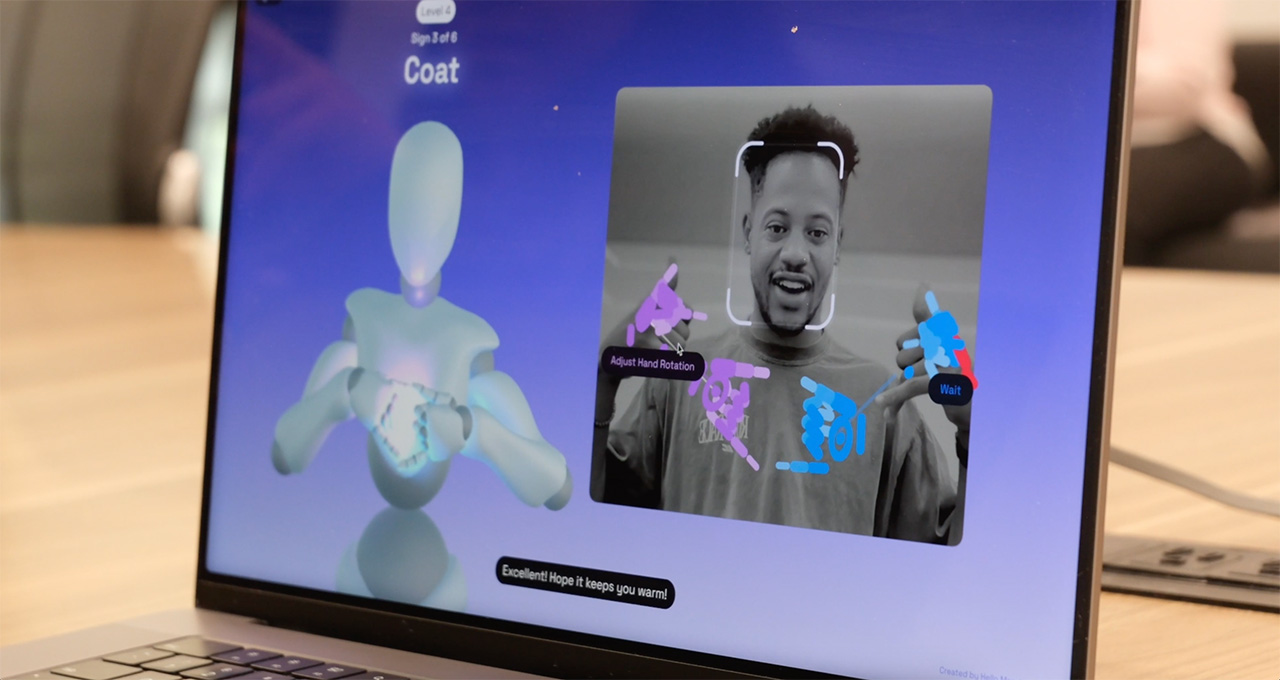
NVIDIA, the American Society for Deaf Children and creative agency Hello Monday are helping close this gap with Signs, an interactive web platform built to support ASL learning and the development of accessible AI applications.

Sign language learners can access the platform’s validated library of ASL signs to expand their vocabulary with the help of a 3D avatar that demonstrates signs — and use an AI tool that analyzes webcam footage to receive real-time feedback on their signing. Signers of any skill level can contribute by signing specific words to help build an open-source video dataset for ASL.

The dataset — which NVIDIA aims to grow to 400,000 video clips representing 1,000 signed words — is being validated by fluent ASL users and interpreters to ensure the accuracy of each sign, resulting in a high-quality visual dictionary and teaching tool.

"Most deaf children are born to hearing parents. Giving family members accessible tools like Signs to start learning ASL early enables them to open an effective communication channel with children as young as six to eight months old," said Cheri Dowling, executive director of the American Society for Deaf Children. "And knowing that professional ASL teachers have validated all the vocabulary on the platform, users can be confident in what they’re learning."

NVIDIA teams plan to use this dataset to further develop AI applications that break down communication barriers between the deaf and hearing communities. The data is slated to be available to the public as a resource for building accessible technologies, including AI agents, digital human applications, and video conferencing tools. It could also be used to enhance Signs and enable ASL platforms across the ecosystem with real-time, AI-powered support and feedback.

Supporting ASL Education, Exploring Language Nuance

During the data collection phase, Signs already provides a powerful platform for ASL language acquisition, offering opportunities for individuals to learn and practice an initial set of 100 signs so they can more effectively communicate with friends or family members who use ASL.

"The Signs learning platform could help families with deaf children quickly search for a specific word and see how to make the corresponding sign. It’s a tool that can help support their everyday use of ASL outside of a more formal class," Dowling said. "I see both kids and parents exploring it — and I think they could play with it together."

Exploring the Future of ASL

While Signs currently focuses on hand movements and finger positions for each sign, ASL also incorporates facial expressions and head movements to convey meaning. The team behind Signs is exploring how these non-manual signals can be tracked and integrated in future versions of the platform.

They’re also investigating how other nuances, like regional variations and slang terms, can be represented in Signs to enrich its ASL database — and working with researchers at the Rochester Institute of Technology’s Center for Accessibility and Inclusion Research to evaluate and further improve the user experience of the Signs platform for deaf and hard-of-hearing users.

"Improving ASL accessibility is an ongoing effort," said Anders Jessen, founding partner of Hello Monday/DEPT, which built the Signs web platform and previously worked with the American Society for Deaf Children on Fingerspelling.xyz, an application that taught users the ASL alphabet. "Signs can serve the need for advanced AI tools that help transcend communication barriers between the deaf and hearing communities."

Conclusion

The dataset behind Signs is planned for release later this year. Start learning or contributing with Signs at signs-ai.com, and learn more about NVIDIA’s trustworthy AI initiatives. Attendees of NVIDIA GTC, a global AI conference taking place March 17-21 in San Jose, will be able to participate in Signs live at the event.

FAQs

Q: What is Signs?
A: Signs is an interactive web platform built to support American Sign Language (ASL) learning and the development of accessible AI applications.

Q: Who is behind Signs?
A: NVIDIA, the American Society for Deaf Children, and creative agency Hello Monday are behind Signs.

Q: What is the goal of Signs?
A: The goal of Signs is to support ASL language acquisition and the development of AI applications that break down communication barriers between the deaf and hearing communities.

Q: How can I contribute to Signs?
A: Anyone can contribute to Signs by signing specific words to help build an open-source video dataset for ASL.

Q: When will the dataset be available?
A: The dataset is planned for release later this year.

How to Create a Lush, Handmade Look for Animated Series Ada

0

Why We Mixed 2D and 3D Techniques

It’s an exciting time to be working in 3D animation. In recent years, 3D films and shows have showcased a wider range of visual styles, including some completely different from anything we’ve seen in the past. 2D and 3D pipelines are merging; projects like Spider-Man: Into the Spider-Verse and more recently Arcane used 3D pipelines to achieve looks that evoke handmade, traditional art forms like comic books and painting while pushing them to new places that take full advantage of the medium of animation.

Why We Made Ada

I wanted to create Ada because we all have a stake in the future, and therefore in the governance of the science and tech that will shape it, but futurist discourse is off-putting and exclusionary of everyone but a small set of sci-fi/tech enthusiasts. My goal was essentially to make science fiction for people who don’t think they like science fiction, and every creative decision was made with that in mind.

How We Made Ada

With our relatively small budget, team size, and quick turnaround time, we quickly decided the best way to achieve the lush, handmade look we wanted within our constraints was to use a 3D pipeline. Our characters were animated in 3D with a simple, flat render, then composited with 2D digitally painted backgrounds and 2D FX animation. We changed up the look of the imagined world in every episode, for a total of six distinct visual styles across five episodes.

Real-World Setting

For the real-world setting, we drew inspiration from the epic libraries of history and literature. A theme in these stories is that it’s not enough to have the knowledge; you have to be able to access and link the right parts. At their best, librarians will draw new and exciting connections rather than reinforce existing beliefs.

Art Direction

We used the color palette to help signal that this would be a different story about AI from what audiences might have encountered in the past. We stayed away from the greens and blues typically associated with computers, as well as Terminator red, and chose a restricted palette of yellows and purples.

Episode 4: AI and the Future

In this episode, we wanted to show how advanced AI could lead to disaster even when used with good intentions for seemingly mundane purposes – a sort of Kafkaesque boring apocalypse. We wanted to show the risks of AI without exoticizing them, and a key part of this was the character design of the AIs. Rather than anthropomorphic robots, we went with a simple black box to symbolize the challenges of understanding how these advanced systems work.

Conclusion

In every episode of Ada, we wanted to emphasize the uncertainty of the future: that it’s not set in stone, and depends on our choices. Visually, we incorporated this idea into the backgrounds in the imagined world by showing some of the canvas through the painting and having an unfinished look at the edges and a looser drawing and painting style.

Frequently Asked Questions

Q: What inspired the creation of Ada?

A: I wanted to create a science fiction series for people who don’t think they like science fiction, and every creative decision was made with that in mind.

Q: How did you achieve the unique visual style of Ada?

A: We used a 3D pipeline, animating characters in 3D with a simple, flat render, then compositing with 2D digitally painted backgrounds and 2D FX animation.

Q: What’s the message of Ada?

A: We hope audiences will take away the message that we should invest in the social structures to support transformative technologies in parallel and in proportion to our investment in the technologies themselves.

Sidekick Kicks This Family Calendar Up a Level

0

Smart Home Data Privacy: Skylight Calendar

Spring is my busy season. Since my kids were old enough to play team sports, the impending arrival of March brings an avalanche of organizational tasks. Practice schedules, game schedules, and snack signups equal so many dates to remember. They arrive in different ways — paper flyers, Excel sheets, text chains, or through yet another team sports app — but somehow never in a Google Calendar link. It’s a trying time.

But this year, I have a new assistant: Sidekick, an AI-powered planning feature for the Skylight Calendar. I just forward every lengthy email to my Sidekick and upload pictures of schedules and spreadsheets to its app. From there, the AI parses the data, packages it into events, and pushes those to my Google Calendar and to my family’s calendars on the big, bright, 27-inch Skylight Calendar Max smart display that’s mounted by our breakfast counter for all to see.

I’m now prepared to tackle two high school sports seasons, along with all the other scheduling chaos that comes with being a busy working parent to two busy teens. It has taken a decade and significant advances in AI to get here, but parents, this is a game-changer.

The Skylight Calendar Max

The Skylight Calendar Max next to the Echo Show 21. The Show can be wall-mounted or tabletop-mounted, the Cal Max can only go on the wall. The Cal Max has a better calendar interface.

Smart Home Data Privacy

It’s important to note that when you use Skylight, the company has access to any data you store on the device. Skylight says it follows all industry best practices to protect that data.

“[O]ur systems do need to ‘see’ that data, but we follow industry best practices in terms of customer privacy, including but not limited to:

• Encrypting all data in transit and at rest
• Explicitly requesting permission from customers to access their data if their support request requires it
• Using best-in-class systems for storing and cycling those encryption keys
• Never storing data that we don’t need
• Never using that data for any purpose other than serving the customer
• Allowing customers to delete all of their data from our database with a few taps
• Regularly hiring third-party auditors to review our code and infrastructure for vulnerabilities”

Competitors

Another more direct competitor to the Skylight Calendar is the Hearth display, which I haven’t tested. It’s the same size as the Skylight, but at $699, it’s more expensive. It does have Hearth Helper, an AI assistant that can import events from flyers and such if you send a photo of it via text. This costs $9 a month ($86.40 a year), almost double Skylight’s fee.

Conclusion

Sidekick brings another level of utility to the Skylight Calendar’s already good hardware. Yes, it’s a big screen running Android, and yes, Gemini and ChatGPT et al. could surpass Sidekick’s schedule parsing abilities one day soon. Yes, it is dependent on Wi-Fi, and if the company goes out of business, you may be left with a big, defunct screen. Skylight tells me if this happened, it “would find a creative way to support all existing products out in the wild.”

But the Skylight team has created a compelling product for corralling the chaos of family schedules. If that’s something you need, and you don’t want to spend time creating a DIY version with a monitor powered by a Raspberry Pi and running DAKboard (as one Verge commenter suggested), this is an out-of-the-box solution that works very well.

FAQs

Q: What is the cost of the Skylight Calendar?
A: The cost of the Skylight Calendar Max is $399.

Q: How does the Skylight Calendar work?
A: The Skylight Calendar works by importing data from various sources, such as email, spreadsheets, and text messages, and then displaying that data on the calendar.

Q: What is Sidekick?
A: Sidekick is an AI-powered planning feature for the Skylight Calendar that helps to parse data and package it into events.

Q: Is the Skylight Calendar secure?
A: Yes, the Skylight Calendar is secure, as the company follows all industry best practices to protect customer data.

Q: Are there any competitors to the Skylight Calendar?
A: Yes, there are competitors to the Skylight Calendar, such as the Hearth display, which has a similar feature set but is more expensive.

Forget M5 chips, there are massive deals right now on M3 and M4 MacBooks

0

Presidents’ Day MacBook Deals: Get Last Year’s M3 MacBook Air for $899 and More

Best Buy’s Latest Discounts

Best Buy has just dropped some new discounts on MacBooks, including last year’s M3 MacBook Air 13in for just $899. If you need massive power, B&H Photo has $400 off the phenomenal 16-inch MacBook Pro with the M4 Max chip. There are deals on pretty much every MacBook in between.

Recommendation for General Productivity and Light Creative Work

For general productivity and light creative work, I’d recommend the first of those deals. Released a little less than a year ago, the 2024 MacBook Airs got a performance upgrade with the M3 chip, which was particularly improved for AI tasks thanks to its 16-core Neural Engine. This model also dropped its tradition of sticking with a paltry 8GB of memory for the base version, giving us 16GB as standard, making the laptop much more suitable for creative work like image and video editing, as well as any multitasking over lots of windows.

Why Wait for M4 or M5 MacBook Airs?

Yes, an M4 MacBook Air or M5 MacBook Pro might be on the way, but they’re not going to be available at these kinds of prices for some time! For more savings, see the huge Samsung Galaxy Tab Presidents’ Day deals.

Compare and Find the Best Deals

Located elsewhere or interested in comparing with other options? See all of today’s best MacBook Air prices in your region below.

Conclusion

The M3 MacBook Air 13in from Best Buy is a great option for general productivity and light creative work. With its improved M3 chip and 16GB of standard memory, it’s a great value at this price. Don’t miss out on this opportunity to get a great deal on a great laptop.

FAQs

Q: What is the M3 chip?
A: The M3 chip is a processor developed by Apple, which provides improved performance and efficiency in AI tasks.

Q: What is the difference between the M3 and M4 chip?
A: The M4 chip is the newer version of the M3 chip, with even better performance and efficiency in AI tasks.

Q: Can I get an M4 MacBook Air or M5 MacBook Pro at this price?
A: No, these models are not yet available at this price. They may be available in the future, but for now, these deals are on last year’s models.

Q: Where can I find more deals on MacBooks?
A: You can find more deals on MacBooks at Best Buy, B&H Photo, and other retailers, as well as online marketplaces.