Home Blog Page 279

Mira Murati, OpenAI’s Former CTO, Starts Own Company

0

New AI Start-up Founded by Former OpenAI CTO

Background

Mira Murati, the former chief technology officer of OpenAI, has made a surprising move to start a new artificial intelligence company called Thinking Machines Lab. This comes on the heels of her departure from OpenAI in September, amid controversy surrounding the company’s direction and leadership.

What is Thinking Machines Lab?

Thinking Machines Lab aims to make AI systems more widely understood, customizable, and generally capable, according to a blog post from the company. It plans to achieve this by freely sharing its technologies with outside researchers and companies, a practice known as "open source." The company has declined to comment on whether it has raised funding to date.

Background on Mira Murati

Mira Murati, 36, was a top executive and researcher at OpenAI. She joined the company in 2018 and was among the executives who left after the surprise ouster of OpenAI’s chief executive, Sam Altman, in November 2023. Some of them had clashed with Altman over the direction of OpenAI and its philosophy towards AI, a powerful technology with significant implications for jobs and society.

The OpenAI Controversy

OpenAI captured the world’s imagination in late 2022 with the release of ChatGPT, an online chatbot that could answer questions, write term papers, generate computer code, and mimic human conversation. However, in November 2023, four OpenAI board members ousted Altman, citing concerns over his leadership and the company’s plan to create a machine that can do anything the human brain can do. Murati was named to lead the company after Altman’s removal, but she rejected the role two days later and stayed on at OpenAI when Altman returned.

Other Former OpenAI Executives

Other former OpenAI executives, including co-founder and former chief scientist Ilya Sutskever, have since created their own AI companies. These start-ups, along with giant companies like Google, Meta, and Microsoft, are part of the global race to build increasingly powerful AI technologies.

Conclusion

The emergence of Thinking Machines Lab and other AI start-ups reflects the growing importance of AI in the tech industry. As AI continues to evolve, it is likely that we will see more innovations and advancements in the field. However, it is also important to consider the potential implications of AI on jobs and society, and to ensure that its development is done in a responsible and ethical manner.

Frequently Asked Questions

Q: What is Thinking Machines Lab?
A: Thinking Machines Lab is a new AI start-up founded by Mira Murati, the former chief technology officer of OpenAI.

Q: What is the purpose of Thinking Machines Lab?
A: The company aims to make AI systems more widely understood, customizable, and generally capable, and plans to achieve this by freely sharing its technologies with outside researchers and companies.

Q: Has Thinking Machines Lab raised funding?
A: The company has declined to comment on whether it has raised funding to date.

Q: What is the background of Mira Murati?
A: Mira Murati is a 36-year-old former executive and researcher at OpenAI, where she was among the top executives who left the company after the surprise ouster of its chief executive, Sam Altman.

Formula 1 Leverages Generative AI for Faster Race-Day Issue Resolution

0

Formula 1’s AI-Driven Root Cause Analysis Solution

Formula 1 (F1) races are high-stakes affairs where operational efficiency is paramount. During these live events, F1 IT engineers must triage critical issues across its services, such as network degradation to one of its APIs. This impacts downstream services that consume data from the API, including products like F1 TV, which offer live and on-demand coverage of every race, as well as real-time telemetry. Determining the root cause of these issues and preventing it from happening again takes significant effort. Due to the event schedule and change freeze periods, it can take up to 3 weeks to triage, test, and resolve a critical issue, requiring investigations across teams including development, operations, infrastructure, and networking.

Implementing the Root Cause Analysis Solution Architecture

In collaboration with the AWS Prototyping team, F1 embarked on a 5-week prototype to demonstrate the feasibility of this solution. The objective was to use AWS to replicate and automate the current manual troubleshooting process for two candidate systems. As a starting point, the team reviewed real-life issues, drafting a flowchart outlining 1) the troubleshooting process, 2) teams and systems involved, 3) required live checks, and 4) logs investigations required for each scenario. The following is a diagram of the solution architecture.

Creating ETL Pipelines to Transform Log Data

Preparing your data to provide quality results is the first step in an AI project. AWS helps you improve your data quality over time so you can innovate with trust and confidence. Amazon CloudWatch gives you visibility into system-wide performance and allows you to set alarms, automatically react to changes, and gain a unified view of operational health.

Agentic RAG Implementation

Amazon Bedrock Agents facilitates interaction with internal systems such as databases and Amazon Elastic Compute Cloud (Amazon EC2) instances and external systems such as Jira and Datadog. Anthropic’s Claude 3 models (the latest model at the time of development) were used to orchestrate and generate high-quality responses, maintaining accurate and relevant information from the chat assistant.

Chat Application

The chat assistant UI was developed using the Streamlit framework, which is Python-based and provides simple yet powerful application widgets. In the Streamlit app, users can test their Amazon Bedrock agent iterations seamlessly by providing or replacing the agent ID and alias ID. In the chat assistant, the full conversation history is displayed, and the conversation can be reset by choosing Clear. The response from the LLM application consists of two parts. On the left is the final neutral response based on the user’s questions. On the right is the trace of LLM agent orchestration plans and executions, which is hidden by default to keep the response clean and concise.

Conclusion

In this post, we explained how F1 and AWS have developed a root cause analysis (RCA) assistant powered by Amazon Bedrock to reduce manual intervention and accelerate the resolution of recurrent operational issues during races from weeks to minutes. The RCA assistant enables the F1 team to spend more time on innovation and improving its services, ultimately delivering an exceptional experience for fans and partners. The successful collaboration between F1 and AWS showcases the transformative potential of generative AI in empowering teams to accomplish more in less time.

FAQs

Q: What is the root cause analysis (RCA) assistant?
A: The RCA assistant is a chat-based application that uses natural language processing and machine learning to help IT engineers troubleshoot and resolve complex technical issues.

Q: How does the RCA assistant work?
A: The RCA assistant uses Amazon Bedrock to query various data sources, including log files, databases, and external systems, to identify potential causes of issues and provide recommendations for resolution.

Q: What are the benefits of using the RCA assistant?
A: The RCA assistant reduces the time it takes to resolve issues from weeks to minutes, allowing IT engineers to focus on innovation and improving services, and providing a better experience for fans and partners.

Q: How does the RCA assistant integrate with existing incident management tools?
A: The RCA assistant integrates with existing incident management tools, such as Jira, to facilitate seamless communication and ticket creation.

Q: Can I use the RCA assistant for other use cases?
A: Yes, the RCA assistant can be used for other use cases, such as troubleshooting and resolving issues in other industries, such as healthcare, finance, and education.

Mira Murati Launches Thinking Machines Lab to Make AI More Accessible

0

Mira Murati Launches New AI Lab, Thinking Machines Lab

A New Public Benefit Corporation

Last September, Mira Murati unexpectedly left her job as chief technology officer of OpenAI, citing a desire to "create the time and space to do my own exploration." Rumors swirled that she was planning to start her own company. Today, she announced that she is indeed the CEO of a new public benefit corporation called Thinking Machines Lab.

Filling the Gap in AI Understanding

Murati believes that there is a significant gap between the rapidly advancing field of AI and the public’s understanding of the technology. Even sophisticated scientists do not have a firm grasp on AI’s capabilities and limitations. Thinking Machines Lab aims to fill this gap by building accessibility into its work from the start. The company also promises to share its research by publishing technical notes, papers, and actual code.

Competing on the High End of Large Language Models

Thinking Machines Lab will compete on the high end of large language models, with a focus on developing the most advanced models that can unlock transformative applications and benefits, such as enabling novel scientific discoveries and engineering breakthroughs. The company believes that upscaling its models to the highest level is crucial to filling the gap it has identified.

Attracting a Talented Team

Murati’s pitch has attracted an impressive team of researchers and scientists, many of whom have previously worked at OpenAI. The team includes former VP of research Barret Zoph, multimodal research head Alexander Kirillov, head of special projects John Lachman, and top researcher Luke Metz, who left OpenAI several months earlier. The lab’s chief scientist will be John Schulman, a key ChatGPT inventor who left OpenAI for Anthropic only last summer. Others join from competitors like Google and Mistral AI.

Early Progress and Future Plans

The team has already started work on various projects, with a focus on developing AI models that optimize collaboration between humans and AI. This is seen as the current bottleneck in the field. While it is unclear what specific products will emerge, Thinking Machines Lab indicates that they will not be copycats of existing models like ChatGPT or Claude.

Legacy of Thinking Machines

The name "Thinking Machines" has a legacy that dates back to the 1990s, when American inventor Danny Hillis built a supercomputer with powerful chips running in parallel. Hillis’ project, also called Thinking Machines, aimed to create a partnership between people and machines, a concept that was ahead of its time.

Conclusion

Thinking Machines Lab is a new public benefit corporation founded by Mira Murati, with a mission to develop top-notch AI that is both useful and accessible. The company’s focus on accessibility, transparency, and collaboration sets it apart from other AI research organizations.

FAQs

Q: What is the focus of Thinking Machines Lab?
A: The lab is focused on developing top-notch AI that is both useful and accessible, with a focus on collaboration between humans and AI.

Q: Who is on the team?
A: The team includes experienced researchers and scientists from OpenAI, Google, and other organizations, led by CEO Mira Murati and CTO Barret Zoph.

Q: What is the goal of the lab?
A: The goal is to fill the gap between rapidly advancing AI and the public’s understanding of the technology, with a focus on developing the most advanced models that can unlock transformative applications and benefits.

Q: What is the timeline for the lab’s projects?
A: The team has already started working on various projects, with a focus on developing AI models that optimize collaboration between humans and AI. Specific products and timelines have not been announced.

Lessons in Synchronization

0

1. State Management is Critical for Multiplayer Games
Managing the game state across players and syncing it with the server is a challenging yet essential part of building a multiplayer game. I learned the importance of storing the game state efficiently. Using refs to store state updates helped ensure smooth rendering without triggering unnecessary re-renders.

2. Collision Detection is an Art
Implementing accurate collision detection between the ball and paddles required calculating bounce angles based on the point of impact. Small tweaks to these calculations significantly impacted gameplay, teaching me the importance of precision in game physics.

3. Frontend-Backend Communication
I learned the importance of designing a clear communication protocol between the React frontend and the Django backend. When I switched to production and used Nginx with HTTP/2, I encountered data race issues during connect and disconnect events because requests became faster. Additionally, I discovered that Django Channels’ groups are solely a broadcasting system and cannot enumerate members, which required rethinking how to manage connected users effectively.

4. Balancing Game Logic Between Frontend and Backend
Deciding which parts of the game logic should run on the backend versus the frontend was crucial. While the backend was the source of truth for the game state, the frontend handled rendering and minor state updates to improve responsiveness.

5. Leveraging TypeScript for Better Developer Experience
Using TypeScript in the React frontend helped catch errors early and made my codebase easier to maintain. With a project this complex, type safety saved me countless hours of debugging.

6. Testing Multiplayer Features
Testing a multiplayer game was a new challenge for me. I often had to simulate multiple players locally, which required creative solutions and a lot of patience. Debugging real-time interactions added an extra layer of complexity.

7. How to Remove a File from Previous Commits
I initially pushed the .env file for convenience, but when we decided to make the repository public, I learned how to remove it from the entire Git history using commands like git filter-repo. This was a key lesson in securing sensitive data.

8. Choosing the Right Tools for CSS
Initially, I used CSS modules and regular CSS to style the application. While this worked, I realized that switching to Tailwind CSS could significantly speed up the process. Tailwind’s utility-first approach makes it easy to prototype and iterate quickly. Additionally, using a library like ShadCN for pre-built components can save time and effort, enabling you to focus more on functionality rather than designing components from scratch.

9. API Documentation and Testing Tools
Using tools like Swagger to visualize API endpoints made it easier to understand and document the backend. Additionally, Postman was invaluable for testing API requests and debugging issues quickly. These tools streamlined the development process and reduced communication overhead among team members.

10. Handling WebSocket Connections
Managing multiple WebSocket connections for a single player was a challenge. When a player connected from another tab or browser, the old WebSocket was closed, and the player was redirected to the homepage. This ensured a single active connection per player and avoided potential conflicts.

11. Linting Inside Containers
When running the app inside containers, I noticed linting tools were not readily available. To address this, I used flake8 for Python linting. This setup ensured consistent code quality across the team and helped catch issues early in development.

12. Testing and Continuous Development
Testing is essential. Adopting a test-driven development approach helped me catch bugs early and maintain a stable codebase. Additionally, using GitHub Actions for automated testing and linting ensured consistent code quality throughout the project.

13. Adapting to Production Environments
Things run differently in production compared to development. Setting up the deployment process early for continuous development is crucial. For example, running Daphne in production required adding django.setup() to ensure proper initialization.

14. Importance of Debugging Techniques
Learning proper debugging techniques saved me a lot of time. Instead of cluttering my code with print statements, I used better tools and approaches to identify and fix issues more efficiently.

15. Writing Before Coding
Writing down ideas and planning before jumping into coding helped me structure my thoughts and avoid unnecessary rewrites.

16. Taking Breaks When Stuck
When I couldn’t fix a bug, stepping away for a coffee break or doing something else often gave me a fresh perspective and helped me find solutions faster.

17. Understanding Web Security Basics
Having a basic understanding of web security concepts like CORS headers, CSRF saved me a lot of time when working with a project that had separate frontend and backend domains.

18. Async Context and sync_to_async
When working in an asynchronous context, running synchronous functions without wrapping them in sync_to_async can block the event loop, causing hard-to-find bugs. Properly wrapping such functions ensures smooth operation and avoids performance issues.

19. Balancing Learning and Finishing
There was a constant battle between learning new concepts and meeting the project deadline. While learning was rewarding, focusing on the deliverables helped us finish the project sooner.

20. The Joy of Problem-Solving
Finally, building a multiplayer game reminded me why I love coding. Every bug, lag issue, or design challenge was an opportunity to learn and grow as a developer.

Conclusion
This journey was packed with lessons that I hope will inspire and help others in their development journey.

FAQs

Q: What are some key takeaways from building a multiplayer game?
A: Some key takeaways include the importance of state management, collision detection, and frontend-backend communication.

Q: What are some best practices for debugging in a multiplayer game?
A: Best practices for debugging include using proper debugging techniques, taking breaks, and writing down ideas before coding.

Q: How do you handle WebSocket connections in a multiplayer game?
A: You can manage multiple WebSocket connections for a single player by using tools like WebSockets and ensuring a single active connection per player.

Q: What are some tips for balancing game logic between the frontend and backend?
A: Some tips for balancing game logic include deciding which parts of the game logic should run on the backend versus the frontend and ensuring the backend is the source of truth for the game state.

What is DeepSeek AI? Is it safe? Here’s everything you need to know

0

DeepSeek: The Chinese AI Startup That’s Toppling Competitors and Sparking Concerns

Just weeks into its new-found fame, Chinese AI startup DeepSeek is moving at breakneck speed, toppling competitors and sparking axis-tilting conversations about the virtues of open-source software. However, numerous security concerns have surfaced about the company, prompting private and government organizations to ban the use of DeepSeek. Here’s what you need to know.

Founding and Funding

Founded by Liang Wenfeng in May 2023, the Chinese startup has challenged established AI companies with its open-source approach. According to Forbes, DeepSeek’s edge may lie in the fact that it is funded only by High-Flyer, a hedge fund also run by Wenfeng, which gives the company a funding model that supports fast growth and research.

R1 and V3 Models

The startup made waves in January when it released the full version of R1, its open-source reasoning model that can outperform OpenAI’s o1. Shortly after, App Store downloads of DeepSeek’s AI assistant, which runs V3, a model DeepSeek released in December, topped ChatGPT, previously the most downloaded free app. DeepSeek R1 even climbed to the third spot overall on HuggingFace’s Chatbot Arena, battling with several Gemini models and ChatGPT-4o; at the same time, DeepSeek released a promising new image model.

Security Concerns and Controversies

However, numerous security concerns have surfaced about the company, prompting private and government organizations to ban the use of DeepSeek. These concerns include:

  • Data privacy worries that have circulated on TikTok, the Chinese-owned social media app now somewhat banned in the US, are also cropping up around DeepSeek.
  • Feroot Security CEO Ivan Tsarynny told ABC that his firm had discovered "direct links to servers and to companies in China that are under the control of the Chinese government," which he said they "have never seen in the past."
  • After decrypting some of DeepSeek’s code, Feroot found hidden programming that can send user data — including identifying information, queries, and online activity — to China Mobile, a Chinese government-operated telecom company that has been banned from operating in the US since 2019 due to national security concerns.
  • NowSecure then recommended organizations "forbid" the use of DeepSeek’s mobile app after finding several flaws including unencrypted data (meaning anyone monitoring traffic can intercept it) and poor data storage.
  • Last week, research firm Wiz discovered that an internal DeepSeek database was publicly accessible "within minutes" of conducting a security check. The "completely open and unauthenticated" database contained chat histories, user API keys, and other sensitive data.

AI Safety Concerns

AI safety researchers have long been concerned that powerful open-source models could be applied in dangerous and unregulated ways once out in the wild. Tests by AI safety firm Chatterbox found DeepSeek R1 has "safety issues across the board."

Conclusion

DeepSeek’s rapid ascent has sparked a sea change in AI that could empower smaller labs and researchers to create competitive models and diversify the options. For example, organizations without the funding or staff of OpenAI can download R1 and fine-tune it to compete with models like o1. Just before R1’s release, researchers at UC Berkeley created an open-source model on par with o1-preview, an early version of o1, in just 19 hours and for roughly $450.

FAQs

  • Q: What is DeepSeek?
    A: DeepSeek is a Chinese AI startup that has challenged established AI companies with its open-source approach.
  • Q: How is DeepSeek funded?
    A: DeepSeek is funded by High-Flyer, a hedge fund also run by Liang Wenfeng, which gives the company a funding model that supports fast growth and research.
  • Q: What are the security concerns surrounding DeepSeek?
    A: Several security concerns have surfaced, including data privacy worries, hidden programming, and unencrypted data storage, and poor data storage.
  • Q: Is DeepSeek a threat to US AI dominance?
    A: DeepSeek’s success highlights a sea change in AI that could empower smaller labs and researchers to create competitive models and diversify the options, but it also raises concerns about data privacy, security, and AI safety.

Mastering Effective Performance Reviews for Employee Success

0

Performance reviews have earned a bad reputation in the past decade. They’re often criticized for being stress-inducing, bureaucratic, and disconnected from the realities of the workplace. Despite these critiques, performance reviews can be a valuable tool, when wielded properly.

Performance reviews have the power to boost employee performance and engagement. They’re a conversational anchor that provides performance clarity and a designated opportunity to discuss employee growth. But to get meaningful outcomes from reviews, you need to maximize the effectiveness of your performance review process.

HR can help their organizations transform performance reviews. Your role is pivotal in redefining the approach. A shift toward continuous improvement, transparent communication, and strategic alignment can benefit everyone. Performance reviews can move from a dreaded obligation to constructive, clarifying, and empowering dialogue.

In this article, we’ll explore the keys to effective performance reviews and how HR can spearhead such a transformation.

Taking performance reviews beyond administrative checkpoints

Performance reviews should not be administrative formalities. A check-the-box review process will not:

  • Engage and retain your top performers
  • Help employees grow and improve
  • Encourage your managers to prepare thoughtfully
  • Give your HR team and leaders the data to make informed talent decisions

You need to change the perception of performance reviews in your organization. They should be seen as crucial touch points for alignment, feedback, and growth. A structured opportunity for managers and employees to look backward and look forward. They should feel transparent, thoughtful, and beneficial to everyone involved.

Additionally, performance reviews can’t be effective as standalone performance management tools. They must be integrated into a broader performance management framework that includes goal-setting, feedback, regular 1-on-1 conversations.

By making performance reviews more holistic and forward-thinking, you can foster a culture of continuous improvement and learning within the organization. This approach not only enhances employee engagement and productivity but also helps identify and nurture talent for future leadership roles.


The connection to employee success

Thoughtful and strategic performance reviews can significantly contribute to employee and business success. Performance reviews help align individual goals with broader business objectives—enhancing role clarity, motivation, and strategic focus. Healthy performance conversations between managers and employees pave the way for real-time feedback, continuous learning, and timely adjustments to goals and expectations. This helps teams be more agile in a fast-paced business environment.

What are some mistakes to avoid when conducting performance reviews?

Common mistakes to avoid during performance reviews include lack of preparation, focusing only on negatives, not providing actionable feedback, being too vague, and not listening actively. Effective reviews should be a two-way conversation that motivates employees and helps them grow professionally.

What does an ideal performance review look like?

An ideal performance review is an engaging, two-way conversation. It reflects on past achievements and challenges but focuses on future growth. Managers and employees should prepare thoughtfully—with a clear agenda shared in advance. Performance reviews also should be rooted in transparent and fair performance criteria. And they should be connected to a broader performance management process.

Essential elements of effective performance reviews

Transform your performance reviews from procedural formalities into catalysts for growth. These elements, woven together, set the stage or engagement, clarity, and success.

1. Clarity and communication

A clearly articulated and communicated process should be your priority. This blueprint should delineate not only the ‘what’ and the ‘how’—but also the ‘why’ behind each review. This helps everyone align on success looks like when it comes to performance reviews. Be clear about what the performance review is and is not for—and how it fits into your organization’s larger ecosystem of performance management activities.

2. Trust and simplicity

Trust is foundational to meaningful and productive performance reviews. Your people leaders can cultivate trust through transparency, fairness, and consistency in your process. Equally important is the principle of simplicity. If performance criteria are too complicated to understand, employees will feel disconnected.

Make sure your performance competencies and rating scales are easy to understand—and don’t make them the most important part of performance review conversations. Keeping things straightforward ensures everyone can focus on what truly matters.

3. Equipped and empowered managers

Navigating the terrain of performance reviews requires skilled guides. It’s important to train your managers in effective performance management, helping them feel equipped and confident. Don’t focus only on the mechanics of conducting reviews! Help them develop more nuanced skills like coaching, emotional intelligence, and conflict resolution too.

Your goal is to help them set clear expectations, provide constructive feedback, and help employees grow as team members. With the right training in hand, managers can act as a compass that guides their team toward continuous improvement.

4. Performance review software

Performance review software arms your teams with the tools needed to set goals, track progress, and share feedback. With efficiency. You must get your performance reviews out of manual and siloed systems.

A streamlined and intuitive performance management platform helps simplify the review process for everyone involved. It helps HR and leadership have more visibility into performance review conversations and outcomes. It helps managers facilitate a more structured, data-driven approach to reviews. And it helps employees feel connected to the conversation and promotes transparency in the process.

5. Better feedback

Effective performance reviews tell a story. It helps employees know where they stand, with specific examples and constructive feedback. It also helps employees envision their future at your organization, spotlighting areas of opportunity and the growth it will take to get there.

When managers and employees engage in a performance conversation together, it helps ensure feedback is not only heard but acted upon, ultimately driving high performance. This paves the way for more meaningful development and progress across your teams and organization.

6. Development and growth opportunities

The true measure of a performance review’s effectiveness is its ability to chart a path forward for each employee. A path that is more aligned and more engaging. In the context of past performance and future aspirations, managers can help identify clear development and growth opportunities for their direct reports.

Employees can better understand how they might contribute to their team and organization in the coming year, including their strengths and areas of improvement. And they’re more likely to improve, succeed, and have a positive impact on your business by setting specific and achievable next steps for improvement.

How to make performance reviews more efficient and streamlined

There are two keys to making your performance reviews more efficient: structure and technology.

Structure means having a clear, organized framework that guides your entire performance management cycle. This includes the who, what, when, where, why, and how of performance reviews in your organization. It helps set expectations and increase understanding from your teams. It also provides an element of predictability, which helps your teams manage workloads, prioritize the conversations, and reduce stress associated with the process.

It’s helpful to think beyond the review cycle here. You want to contextualize performance reviews with other key performance-related activities. What are (and aren’t) performance reviews intended for? How do they fit in with other elements like goals, 360 feedback, or regular 1-on-1 conversations? This will help everyone understand the big picture and make the most of their performance reviews.

Finally, structure should look like standardizing certain components of your performance review process. This includes things like your performance criteria, rating scales, and competencies. It might also include the use of performance review templates or templated communication in the form of automated reminders.

The second key to efficiency is technology. It’s trading your manual, siloed, headache-inducing methods for intuitive performance review software. Software can help:

  • Create more visibility for leadership they can make better talent decisions
  • Save HR time and headaches so they can focus on more strategic work
  • Make the process easier and more intuitive for your busy managers
  • Make the process more meaningful and engaging for your talent

The right platform can help you automate reminders, track progress, collect feedback, and document reviews all in one place. It should also integrate with your other technologies to meet teams where they are, in their flow of work.

Overcoming challenges in conducting effective performance reviews

Conducting efficient performance reviews can be challenging. Here are some common challenges organizations face and strategies to overcome them:

Time constraints. 

Limited time can make it difficult to conduct thorough reviews. To overcome this challenge, prioritize essential areas of evaluation and focus on actionable feedback.

Lack of preparation

Insufficient preparation can lead to ineffective reviews. Ensure that managers have access to relevant performance data, such as past reviews and performance metrics, before conducting the review.

Resistance to feedback

Some employees may resist feedback or become defensive during reviews. Create a safe and supportive environment that encourages open dialogue and focuses on growth rather than criticism.

Inconsistency in evaluation

Inconsistent evaluation criteria and rating scales can undermine the fairness and accuracy of reviews. Establish clear evaluation guidelines and provide training to ensure consistency across managers.

Lack of follow up

Without proper follow-up, performance reviews may not lead to meaningful action. Encourage managers to create development plans and regularly check in with employees to monitor progress and provide ongoing support.

By addressing these challenges and implementing performance review best practices, organizations can conduct more efficient and effective performance reviews that contribute to employee growth and success.

Leveraging technology for performance reviews

The strategic use of performance review software can streamline the review process, making it more consistent, efficient, and impactful. Such tools offer features like goal setting and tracking, feedback collection, and performance analytics, facilitating a more data-driven and transparent review process.

By centralizing and automating administrative tasks, these tools allow managers and employees to focus on the substance of the review: meaningful conversations about performance and development. With the help of technology, managers can ensure that they are conducting effective reviews that benefit both the employee and the company.

The role of data-driven systems

Data-driven systems, such as performance review software, can really level up your performance reviews. You’ll be able to collect, track, and analyze performance data in a more efficient and effective manner. Performance review software streamlines the review process by automating administrative tasks, providing a centralized platform for feedback and documentation, and ensuring data accuracy.

Performance review software also offers features that support human resources (HR) in managing and analyzing performance data. HR professionals can use these systems to generate comprehensive reports, identify trends and patterns, and make data-driven decisions regarding employee performance and development.

By leveraging data-driven systems, organizations can ensure consistency and fairness in performance evaluations, track employee progress over time, and provide personalized feedback and development opportunities. This ultimately leads to more accurate performance assessments and better supports employee growth and success.

Transitioning from manual to digital processes

Transitioning from manual performance reviews to a digital platform can feel overwhelming. But it’s an important change that needs to be made, and you can make it more manageable than you might think. Here’s a step-by-step process for successfully implementing performance review software:

Assess current processes

Evaluate the current manual review process, identify pain points, and determine the specific requirements for performance review software that align with organizational goals.

Research and select software

Research different performance review software vendors, compare features and pricing, and select a software solution that meets the organization’s needs. Consider factors such as user-friendliness, data security, and integration capabilities.

Customize and configure

Work with the software vendor to customize the software based on the organization’s review process, performance criteria, and evaluation guidelines. Configure the software to align with organizational goals and objectives.

Train employees

Provide comprehensive training to managers and employees on how to use the performance review software effectively. Ensure everyone understands the benefits, features, and expectations of the new system.

Pilot and rollout

Test the performance review software with a pilot group to identify and address any issues or challenges. Once the pilot is successful, roll out the software to the entire organization, ensuring a smooth transition and providing ongoing support.

The future of performance reviews

As organizations look forward, adopting a flexible, personalized approach that aligns performance reviews with their strategic goals and culture will be key to unlocking the full potential of their workforce without creating too much work for managers.

The future of performance reviews is expected to see changes and advancements driven by technology and evolving workplace dynamics. Technology is expected to further transform the performance review process, contributing to a more efficient and effective approach. These trends may include:

  • More Frequent Feedback: Organizations are moving towards more frequent and continuous feedback processes, replacing traditional annual performance reviews with ongoing conversations and check-ins.
  • Real-Time Performance Tracking: Technology-enabled systems are allowing for real-time performance tracking, enabling managers and employees to monitor progress and provide immediate feedback.
  • Data-Driven Performance Insights: The integration of AI and data analytics in performance management systems will provide organizations with valuable insights into employee performance, allowing for more informed decision-making.
  • Focus on Future Performance: Performance reviews will shift from solely evaluating past performance to focusing on future performance and development, allowing employees to set goals and plan professional growth.
  • Digital Platforms: Performance management software and digital platforms will streamline the review process, automate administrative tasks, and provide a centralized platform for feedback and documentation.
  • Artificial Intelligence: The integration of artificial intelligence in performance management systems will enable faster data analysis, identification of patterns and trends, and personalized performance insights and recommendations.
  • Mobile Accessibility: Mobile applications will make performance reviews more accessible and convenient, allowing employees and managers to provide feedback and access performance data from anywhere.

By embracing these trends, organizations can create a performance review process that is agile, data-driven, and focused on continuous improvement and employee development.


How Quantum Workplace can help you streamline performance reviews

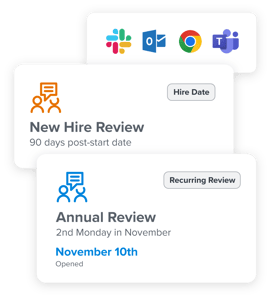
Performance conversations don’t need to be hard. Keep your managers and employees on the same page with engaging performance reviews. Our performance review software gives your teams reliable context to help them have more objective and engaging conversations.

4_performance-reviews_product-imagery

1. Customize reviews to fit your needs. 

Easily measure what you want, when you want with flexible review modules that you can tailor to fit the needs of your culture and the various groups within it. 


2. Help your managers build positive performance habits.

Make it easy for manager to coach to performance by integrating your process into their existing workflows. Set up formal conversation cycles to create the right frequency and consistency of touch points.

1_performance-reviews_product-imagery


2_performance-reviews_product-imagery


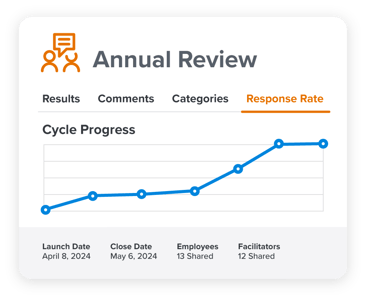
3. Easily track review response rates. 

See the status of each review cycle to help your teams stay accountable and monitor performance ratings in real-time. 


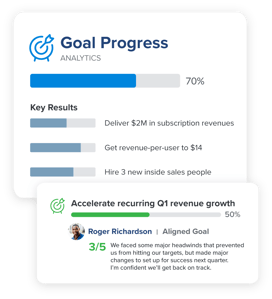
4. Embed performance goals directly into reviews.

Our platform makes it easy to include goals as part of performance evaluations—and helps coach managers have objective, effective, and growth-oriented conversations.

3_performance-reviews_product-imagery


360Feedback_EmployeeMagnetism_7.1


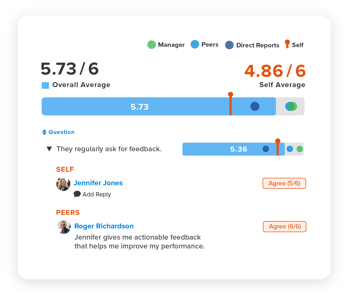
5. Orient reviews around multi-rater feedback.

Incorporate feedback into your review cycles to gain valuable insight from the individuals your people work with most, and better orient  performance conversations around development.


6. Visualize and align on performance data across teams.

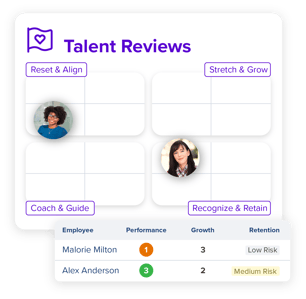
Get a comprehensive view of your organization’s talent with our talent dashboard. Zoom out and see the big picture, to help you make more informed decisions on how to keep and develop your best talent.

TalentReviews_EmployeeImpact_6.3


Conclusion

Building a better performance review process is about much more than simply updating procedures or integrating new technologies. It’s about fundamentally rethinking how we evaluate, motivate, and cultivate talent within our organizations.

The transition to a modernized system is not without its challenges. It requires commitment, adaptability, and ongoing dialogue. However, the benefits—increased engagement, clearer communication, and more meaningful insights—far outweigh the initial hurdles. By prioritizing continuous improvement and embracing a culture of feedback, we ensure that the performance review process remains a dynamic and valuable aspect of your organization’s culture.


Improving your performance reviews can boost employee, team, and business success. Quantum Workplace’s performance review software helps your managers and teams prepare for, facilitate, and follow up for better reviews and better performance.


QW-logo-color

Maximizing Efficiency in Insurance Claims Processing

When We Talk About "Smart Transportation," It’s More Than Just Moving Cargo from A to B

When we talk about "smart transportation," it’s more than just moving cargo from A to B," said Soren Skou, a former CEO of Maersk. The modern business world demands supply chain efficiency because it has become an essential element. Businesses across multiple sectors face difficulties managing demand unpredictability along with inventory issues, supplier delays, and increased logistics expenses.

A McKinsey report reveals that 62% of supply chain executives consider AI and machine learning essential for addressing current industry challenges. At LITSLINK, we partnered with a mid-sized manufacturing company to build an AI solution that transformed their supply chain operations.

The Challenge: Inefficiencies in Supply Chain Operations

The mid-sized manufacturing company we represent struggled with substantial difficulties in supply chain management operations. Their primary issues included:

  • Inventory Management: The business experienced frequent stockouts and overstocking, which caused high inventory holding costs and missed sales opportunities.
  • Demand Forecasting: Faulty demand prediction caused the company to maintain surplus inventory while also facing stock shortages for customer requirements.
  • Supplier Management: Supply chain disruptions occurred because supplier delays triggered production bottlenecks.
  • Logistics Optimization: The inefficient organization of shipment routes and schedules resulted in higher transportation costs and delayed deliveries.

The Solution: Building an AI Agent for Supply Chain Optimization

Our team first comprehensively reviewed the client’s supply chain operations before starting the development process. We discovered major issues by examining historical data and conducting stakeholder interviews to capture their detailed needs and expectations. During this initial phase, we established the project scope. We created a customized AI solution for the supply chain to meet the client’s specific requirements.

Step 1: Understanding the Problem

We started creating the AI models after obtaining the preprocessed data. Our strategy combined a number of machine learning methods, such as:

  • Demand Forecasting: We used past sales data to forecast future demand using regression models and time series analysis. This allowed the customer to minimize the chance of stockouts and overstocking.
  • Inventory Management: We implemented an AI-based inventory management system to ensure optimal inventory levels, reducing the risk of stockouts and overstocking.
  • Supplier Management: We developed an AI-powered supplier management system to monitor supplier performance and potential risks like delays or quality issues.
  • Logistics Optimization: We created an AI-based logistics optimization system to streamline shipment routes and schedules, reducing transportation costs and improving delivery times.

Real-World Applications of AI in Supply Chain Management

  1. Walmart: AI for Inventory Management
    Walmart uses machine learning algorithms to regulate inventory levels in real-time. The retail giant has used this technology to reduce instances of stockout and overstock — making sure the right items are in stock when customers need them.
  2. DHL: Route Optimization
    DHL streamlines delivery routes using artificial intelligence, which cuts both fuel use and speeds up deliveries. AI for supply chain optimization has saved the company 15% in transportation costs.
  3. Unilever: Supplier Risk Management
    Unilever employs AI to monitor supplier performance and potential risks like delays or quality issues. As a result, the company has created quite a robust and effective supply chain.
  4. Maersk: Predictive Maintenance
    AI-enabled predictive maintenance capabilities, like the ones Maersk — one of the world’s largest shipping companies — uses, rely on to predict when equipment will likely fail and proactively schedule maintenance. This has resulted in less downtime and increased implementation efficiency.

Why Choose LITSLINK for Your AI Development Needs?

LITSLINK’s team looks at your company’s unique requirements and builds custom AI solutions that are ready to beat up the market’s competitors. Our dedicated AI developers, data scientists, and supply chain experts cover your business needs, as we know industry pain points and develop innovative AI solutions.

Conclusion: The Future of Supply Chain Management is AI

The following case study illustrates the transformation of the supply chain sectors in action. Companies using AI in the supply chain address traditional pain points, streamline their core functions, and establish an advantage in the marketplace.

It’s no longer a question of whether to embrace AI for the supply chain — it’s how quickly you can do so and get ahead of your competition. At LITSLINK, we’re ready to help you overcome this transformation. Our AI solutions are tailored to provide effective software whether you are looking to optimize inventory, enhance demand forecasting, or streamline logistics.

Ready to transform your supply chain? Get in touch with LITSLINK today, and let’s create the future together.

FAQs

Q: What is the importance of AI in supply chain management?
A: AI is crucial in supply chain management as it helps to optimize inventory levels, improve demand forecasting, and streamline logistics, reducing costs and improving delivery times.

Q: What are some real-world applications of AI in supply chain management?
A: Real-world applications of AI in supply chain management include inventory management, route optimization, supplier risk management, and predictive maintenance.

Q: Why choose LITSLINK for your AI development needs?
A: LITSLINK is a leading AI development company that offers custom AI solutions tailored to meet the unique needs of your business, helping you to optimize your supply chain operations and gain a competitive edge in the market.

Next-Gen Truth-Seeking AI Model

0

xBernstein AI Unveils Grok 3: A Truth-Seeking AI Model with Enhanced Reasoning Capabilities

xAI, a leading AI technology company, has announced the release of its latest AI model, Grok 3, which boasts enhanced reasoning capabilities, improved question-answering abilities, and a new family of models designed for various needs.

Development and Capabilities

Grok 3 was developed using an immense data center equipped with approximately 200,000 GPUs, which is 10 times more powerful than its predecessor, Grok 2. The model has been trained on a vast dataset, including information from legal case filings. This allows Grok 3 to tackle complex problems and provide more accurate answers.

Reasoning-Focused Models

One of the standout features of Grok 3 is its reasoning-focused models, which aim to emulate human-like cognitive processes by "thinking through" problems. These models, dubbed Grok 3 Reasoning and Grok 3 mini Reasoning, use fact-checking to reduce the likelihood of errors or missteps.

Benchmark Results

According to xAI, Grok 3 surpasses OpenAI’s GPT-4o in certain benchmarks, including AIME and GPQA, which assess the model’s proficiency in tackling complex problems across mathematics, physics, biology, and chemistry. The early version of Grok 3 is also leading on Chatbot Arena, a crowdsourced evaluation platform where users pit AI models against each other and rank their outputs.

Access and Pricing

Access to the latest Grok model is tied to X’s subscription tiers. Premium+ subscribers, who pay $50 (~£41) per month, will receive priority access to the latest functionalities. A new SuperGrok subscription plan is also available, priced at either $30 per month or $300 annually, offering enhanced reasoning capabilities, more DeepSearch queries, and unlimited image generation features.

Future Plans and Open-Source Release

xAI is planning to open-source its predecessor, Grok 2, in the coming months. When Grok 3 is mature and stable, which is expected to be within a few months, xAI will open-source Grok 3.

Conclusion

Grok 3 represents a significant step forward in AI technology, with its enhanced reasoning capabilities and ability to tackle complex problems. As the AI landscape continues to evolve, it will be fascinating to see how Grok 3 and other AI models shape the future of human-AI interaction.

Frequently Asked Questions

Q: What are the differences between Grok 2 and Grok 3?
A: Grok 3 has a more powerful architecture, with 10 times more computing power and a larger dataset.

Q: What are the benefits of Grok 3’s reasoning-focused models?
A: These models aim to emulate human-like cognitive processes, reducing the likelihood of errors or missteps by fact-checking their responses.

Q: How can I access the latest Grok model?
A: Access is tied to X’s subscription tiers, with Premium+ subscribers receiving priority access to the latest functionalities.

Q: What are the future plans for Grok 3?
A: xAI plans to open-source Grok 3 when it is mature and stable, expected to be within a few months.

Thinking Machines Lab is ex-OpenAI CTO Mira Murati’s new startup

0

Former OpenAI CTO Launches New AI Startup, Thinking Machines Lab

Introduction

Former OpenAI CTO Mira Murati has announced her new startup, Thinking Machines Lab, which aims to make AI work for people’s unique needs and goals.

About Thinking Machines Lab

Thinking Machines Lab, which emerged from stealth today, is building tooling to create AI systems that are more widely understood, customizable, and generally capable than those currently available. The company is headed by Mira Murati as CEO, with John Schulman, OpenAI co-founder, as its chief scientist, and Barret Zoph, OpenAI’s former chief research officer, as CTO.

Mission and Goals

In a blog post, Thinking Machines Lab wrote that while AI capabilities have advanced dramatically, "key gaps" remain. The scientific community’s understanding of frontier AI systems lags behind rapidly advancing capabilities, and knowledge of how these systems are trained is concentrated within the top research labs, limiting both public discourse on AI and people’s abilities to use AI effectively. The company plans to build multimodal systems that work with people collaboratively, adapting to the full spectrum of human expertise and enabling a broader spectrum of applications.

AI Safety

AI safety will be another core tenet of Thinking Machines Lab’s work. The company plans to prevent misuse of the models it releases, share best practices and recipes for building safe AI systems with the industry, and support external research on alignment by sharing code, datasets, and model specifications.

Founding Team

Murati left OpenAI last October after six years at the company. She was previously VP of applied AI and partnerships and was promoted to CTO in 2022, leading the company’s work on ChatGPT, DALL-E, and Codex.

Funding and Hiring

Thinking Machines Lab is actively hiring machine learning scientists and engineers, as well as a research program manager. At one point, Murati was in talks to raise over $100 million from unnamed VC firms, although this was not confirmed.

Conclusion

Thinking Machines Lab is poised to make a significant impact in the AI landscape, with a strong founding team and a clear vision for making AI work for people’s unique needs and goals.

FAQs

Q: What is Thinking Machines Lab?
A: Thinking Machines Lab is a new AI startup founded by Mira Murati, former CTO of OpenAI.

Q: What is the mission of Thinking Machines Lab?
A: The company aims to make AI work for people’s unique needs and goals, building tooling to create AI systems that are more widely understood, customizable, and generally capable.

Q: What are the key goals of Thinking Machines Lab?
A: The company plans to build multimodal systems that work with people collaboratively, adapting to the full spectrum of human expertise and enabling a broader spectrum of applications.

South Korea to Build World’s Largest AI Data Centre

South Korea Preparing to Host World’s Largest AI Data Centre

South Korea is preparing to host the world’s largest AI data centre by capacity, setting its sights on global technological leadership. The monumental project, led by Fir Hills – a division of California-based Stock Farm Road, Inc. (SFR) – is expected to commence construction in winter 2025 and aims to generate an initial annual revenue of $3.5 billion.

A Data Centre for the Future of South Korea

The facility, located in the Jeollanam-do Province, is the result of a strategic collaboration between seasoned innovators. SFR was co-founded by LG heir Brian Koo and Dr. Amin Badr-El-Din, a veteran of successful ventures in technology, energy, and global public-private partnerships.

"This is more than just a technological milestone; it’s a strategic leap forward for Korea’s global technological leadership," said Dr. Badr-El-Din. "We are incredibly proud to partner with Stock Farm Road and the Jeollanam-do government to build this crucial infrastructure, creating an unprecedented opportunity to build the foundation for next-generation AI."

Initial Project Valuation and Capacity

The initial project is valued at over $10 billion, with the potential to grow to $35 billion. Upon completion in 2028, the centre will boast a 3-gigawatt capacity, making it the largest AI data facility in the world.

Key Features and Benefits

The centre is designed to meet the sophisticated requirements of next-generation AI, featuring advanced cooling infrastructure, cutting-edge fibre bandwidth for regional and global connectivity, and the capability to manage significant and sudden energy load variations.

This level of infrastructural sophistication not only promises bolstered AI innovation but is also a boon for South Korea’s economy. With projections suggesting that the burgeoning data centre services market will grow to $438.3 billion by 2030, South Korea’s 3GW behemoth positions itself as a pivotal player in the industry.

Economic Benefits and Job Creation

The scale of the project translates into major economic gains for the Jeollanam-do Province and beyond. The initiative is expected to create over 10,000 jobs spanning various sectors, including energy supply and storage (ESS), renewable energy production, equipment manufacturing, and research and development (R&D).

Future Plans and Expansion

The data centre’s development is only the first step in a broader strategy by SFR. Future projects are already on the horizon, as the company plans to establish AI infrastructure partnerships across Asia, Europe, and the US in the next 18 months.

Conclusion

The massive Jeollanam-do AI data centre underscores how strategically aligned public-private partnerships can foster innovation on a monumental scale. By establishing such a colossal infrastructure project, South Korea is furthering its ambitions to catalyse a true digital industrial revolution.

FAQs

Q: What is the expected revenue of the initial project?
A: The initial project is expected to generate an annual revenue of $3.5 billion.

Q: What is the potential value of the project?
A: The project is valued at over $10 billion, with the potential to grow to $35 billion.

Q: When is the expected completion date of the project?
A: The project is expected to be completed in 2028.

Q: What is the capacity of the data centre?
A: The data centre will boast a 3-gigawatt capacity, making it the largest AI data facility in the world.