
Home Blog Page 41

Generate single title from this title Career Notes for August 2025 in 100 -150 characters. And it must return only title i dont want any extra information or introductory text with title e.g: ” Here is a single title:”

Write an article about

(metamorworks/Shutterstock)

It’s that time of month again–time for Big Data Career Notes, a monthly feature where we keep you up-to-date on the latest career developments for individuals in the big data community. Whether it’s a promotion, new company hire, or even an accolade, we’ve got the details. Check in each month for an updated list and you may even come across someone you know, or better yet, yourself!

Brad Stewart and Guarav Dhillon

Data integration provider SnapLogic appointed Brad Stewart to be its new CEO, a position previously occupied by company founder Gaurav Dhillon, who has retired.

Stewart is a seasoned tech executive and board member. He’s currently an advisor for the private equity firm Sixth Street, executive chairman at Pushpay, and a board member for Flutterwave, Schwazze, and Private Medical.

“SnapLogic is uniquely positioned at the intersection of AI, data, and enterprise automation,” stated Stewart, who is also a member of the Snaplogic board. “With a powerful platform, an impressive customer base, and a culture of innovation, I’m excited to build on Gaurav’s legacy and lead the company into its next chapter.”

Guarav Dhillon (left) and Brad Stewart

The leadership change occurs as SnapLogic said it enjoyed its strongest second quarter in company history and hit $100 million in annual recurring revenue for the first time. The venture-backed company, which sells via the integration platform as a service (iPaas) model, turns 20 in 2026.

“After building SnapLogic into a market-leading position over the last decade, I’ve decided it’s the right time to begin a new chapter,” says Dhillon, who has been called “the OG of data” and was also a co-founder and CEO of Informatica. “With the company, product, and team stronger than ever, I’m proud of what we’ve built and excited for what comes next. It’s deeply satisfying to see our pioneering strategy of leading the integration market with AI prove out.”

Max Glover

AI chipmaker Hailo has hired Max Glover to be its new chief revenue officer, which puts Glover in charge of all revenue-generating functions, including global sales, business development, and customer success.

Max Glover

The Israeli company says the move positions it to scale to meet the rapidly growing demand for edge AI solutions and expand Hailo’s footprint across personal compute, security, automotive, industrial, retail, and other high-impact verticals.

Prior to joining Hailo, Max served as senior vice president of global sales for Allegro Microsystems, which achieved more than $1 billion in annual revenue for the first time in company history and had a successful IPO in 2020.

“Hailo’s technology is redefining what’s possible at the edge,” Glover stated. “I’m excited to join this exceptional team and help bring our breakthrough AI solutions to more customers around the world.”

Scott Parsons

BI vendor ThoughtSpot has hired Scott Parsons to be its new senior vice president of sales for the Americas. The appointment puts Parsons in charge of ThoughtSpot’s strategy to increase sales of AI-enabled analytics across the region, with a focus on driving revenue growth and expanding the company’s footprint.

Scott Parsons

Prior to joining ThoughtSpot, Parsons was the Chief Sales Officer at TigerConnect, where he led sales strategy and was responsible for go-to-market sales, across enterprise, mid-market and SMB. Prior to that, he held the role of EVP Americas at Pluralsight where he led a sales team of over two hundred, driving deals across new business and expansion. Parsons also served as a global VP at Oracle, where he oversaw a team that managed over $1B in revenue accounts and implemented new growth strategies. Earlier in his career, he held leadership positions at Adaptive Insights and Qlik.

“I am incredibly excited to join ThoughtSpot at such a pivotal time in the industry,” Parsons stated. “The opportunity to help organizations truly accelerate their data intelligence and monetize their analytical tools through ThoughtSpot’s agentic analytics platform is immense. ThoughtSpot has achieved a strong product-market fit, and I am eager to build on the incredible growth and momentum.”

Patrick Ball

Streaming data firm Kurrent (formerly Event Store) has hired Patrick Ball to be its new chief revenue officer. In the new position, Ball will be in charge of growing revenue for startup.

Patrick Ball

Ball joins Kurrent from Cruxdata, where grew sales by 400% and closed more than $75 million in bookings. He also had roles at Privatar (now Informatica), NextLabs, and Cloudera, where he was vice president of sales.

“Kurrent is at a pivotal moment in its growth journey. The rising adoption of its event-native data platform makes it possible for enterprise software development teams to build exceptional software with complete historical context of their company’s data in real time,” Ball stated. “I look forward to applying my experience to accelerate Kurrent’s go-to-market and sales efforts, connecting more businesses with a solution that modernizes their operations for the scale and speed of the AI era.”

Dave Castignola

David Castignola, Anthony Miller, and James Lemonias

Unified file system vendor Nasuni announced three executive hires, including David Castignola as chief revenue officer, Anthony Miller as chief marketing officer, and James Lemonias as senior vice president of customer success. The appointments indicate Nasuni is ready to embark upon the next stage of its growth.

James Lemonias

Castignola brings more than two decades of experience accelerating growth and delivering customer success at technology firms, including RSA, Optiv, Blackberry’s Cylance division, and Delinea. Miller arrives at Nasuni following a three-year career break; before that, he worked at PowerSchool, Lanyon, and ACTIVE Network. Lemonias, meanwhile, comes to Nasuni from Stage 2 Capital and, before that, Bottomline Technologies.

Anthony Miller

“I am thrilled to welcome Dave, Anthony, and James to our talented team at Nasuni,” said Nasuni CEO Sam King. “They join us at a pivotal moment in our journey where hybrid cloud storage and unstructured data management platforms are becoming a critical foundation upon which to build successful long term AI strategies for enterprises.”

You can read last month’s Career Notes here.

.Organize the content with appropriate headings and subheadings ( h2, h3, h4, h5, h6). Include conclusion section and FAQs section with Proper questions and answers at the end. do not include the title. it must return only article i dont want any extra information or introductory text with article e.g: ” Here is rewritten article:” or “Here is the rewritten content:”

Generate single title from this title Microsoft and Uber alum raises $3M for YC-backed Munify, a neobank for the Egyptian diaspora in 100 -150 characters. And it must return only title i dont want any extra information or introductory text with title e.g: ” Here is a single title:”

0

Write an article about

Khalid Ashmawy remembers the first time he wired money home while studying in Europe.

He had just received his monthly stipend as a master’s student in Stuttgart and wanted to send part of it back to his family in Cairo. It was usually a slow and expensive process, he recalled. A $400 wire transfer, for instance, could cost $40 in fees and take three business days to arrive.

Years later, while working at Microsoft and Uber in the U.S., and even after founding a startup, that experience hadn’t improved much.

The persistent pain point across different stages of his career eventually inspired Ashmawy to launch Munify, a cross-border neobank designed to give Egyptians abroad a faster, cheaper way to send money home and, for residents in the country, access to U.S. banking.

Earlier this year, the startup joined Y Combinator’s Summer 2025 batch, a rare entrant from outside the U.S. and one of the few without a core AI pitch in a class dominated by generative AI startups. The company also raised $3 million in seed funding from the accelerator and other regional investors, including BYLD and DCG. 

“Banking wasn’t built for people like me. It’s very costly, takes a long time, and is fragmented,” the founder and chief executive told TechCrunch in an interview. “It’s a problem I have personally experienced and one that resonates with a lot of people who want to send money back home quickly and efficiently.”

Ashmawy grew up in Egypt, studied computer science, and developed a deep love for software early on. A scholarship took him to Europe, where he completed two master’s degrees in Germany and Switzerland.

From there, he spent seven years as an engineer and team leader at Microsoft and Uber — experiences that opened his eyes to the world of disruptive technologies and startups.

His next step was inevitable. In 2019, Ashmawy left Uber to launch Founders Fund–backed Huspy, a proptech platform focused on mortgages in the Middle East, serving as its chief technology officer until 2022.

Leaving Huspy gave him space to reflect on his own immigrant journey. Once again, the issue of remittances loomed large. Meanwhile, in other emerging markets, platforms like Nigeria’s LemFi and India’s Aspora were already taking off, helping migrants from those countries send money back home.

Egypt is one of the world’s largest remittance markets, receiving nearly $30 billion in inflows annually.

While bank wires and traditional remittance platforms such as Western Union and MoneyGram remain the dominant options, Munify hopes to be the first choice in a growing crop of digital banks that promise cheaper and faster transfers. 

According to Ashmawy, Munify serves Egyptians abroad — primarily in the U.S., U.K., Europe, and the Gulf — who want to send money home instantly and at better rates.

Munify also provides businesses, remote workers, and freelancers in the Middle East a way to open a U.S. bank account and card using only a local ID to receive and spend money, as well as hedge against local currency volatility.

“The main reason why we’re different is that we’re building our own rails and directly connecting the banking systems across different countries,” the CEO told TechCrunch, adding that the platform, which just launched two weeks ago, is already seeing early adoption through word of mouth with thousands of sign-ups.

“We’ve really tailored this experience for people from the region,” said Ashmawy.

On the business side, Munify has signed contracts with mid-sized companies and enterprises, representing a projected $50+ million in monthly cross-border volume, according to Ashmawy. 

The startup, which operates on a dual consumer and business model (offering remittance and banking services for individuals, while providing APIs for businesses to send and receive cross-border payments), plans to expand beyond Egypt to other Middle Eastern and adjacent countries, gradually stitching together regional banking rails.

Its revenue comes from FX spreads, interchange, and payment flows.

Y Combinator’s batches over the past couple of years have favored AI and developer tools from the United States. So, how did the Egyptian fintech get in? Ashmawy credits the acute nature of the problem.

“If you’re solving a big and urgent problem, that’s what really matters, regardless of whether the current wave is AI or something else,” he said.

But there’s precedent for this backing as well. YC has historically invested in startups solving hard financial infrastructure problems, from Stripe to Coinbase. Similarly, remittances are one of the most entrenched pain points in global finance and one of the accelerator’s consistent focus areas when backing startups from emerging markets (case in point: LemFi and Aspora) before its recent AI tilt.

In the midst of that, Munify represented a chance to back a founder with experience at two U.S. tech giants, a track record of building one of MENA’s top proptech companies, and a personal connection to the problem.

.Organize the content with appropriate headings and subheadings ( h2, h3, h4, h5, h6). Include conclusion section and FAQs section with Proper questions and answers at the end. do not include the title. it must return only article i dont want any extra information or introductory text with article e.g: ” Here is rewritten article:” or “Here is the rewritten content:”

Generate single title from this title Human connection still drives school attendance in 100 -150 characters. And it must return only title i dont want any extra information or introductory text with title e.g: ” Here is a single title:”

Write an article about

Key points:

At ISTE this summer, I lost count of how many times I heard “AI” as the answer to every educational challenge imaginable. Student engagement? AI-powered personalization! Teacher burnout? AI lesson planning! Parent communication? AI-generated newsletters! Chronic absenteeism? AI predictive models! But after moderating a panel on improving the high school experience, which focused squarely on human-centered approaches, one district administrator approached us with gratitude: “Thank you for NOT saying AI is the solution.”

That moment crystallized something important that’s getting lost in our rush toward technological fixes: While we’re automating attendance tracking and building predictive models, we’re missing the fundamental truth that showing up to school is a human decision driven by authentic relationships.

The real problem: Students going through the motions

The scope of student disengagement is staggering. Challenge Success, affiliated with Stanford’s Graduate School of Education, analyzed data from over 270,000 high school students across 13 years and found that only 13 percent are fully engaged in their learning. Meanwhile, 45 percent are what researchers call “doing school,” going through the motions behaviorally but finding little joy or meaning in their education.

This isn’t a post-pandemic problem–it’s been consistent for over a decade. And it directly connects to attendance issues. The California Safe and Supportive Schools initiative has identified school connectedness as fundamental to attendance. When high schoolers have even one strong connection with a teacher or staff member who understands their life beyond academics, attendance improves dramatically.

The districts that are addressing this are using data to enable more meaningful adult connections, not just adding more tech. One California district saw 32 percent of at-risk students improve attendance after implementing targeted, relationship-based outreach. The key isn’t automated messages, but using data to help educators identify disengaged students early and reach out with genuine support.

This isn’t to discount the impact of technology. AI tools can make project-based learning incredibly meaningful and exciting, exactly the kind of authentic engagement that might tempt chronically absent high schoolers to return. But AI works best when it amplifies personal bonds, not seeks to replace them.

Mapping student connections

Instead of starting with AI, start with relationship mapping. Harvard’s Making Caring Common project emphasizes that “there may be nothing more important in a child’s life than a positive and trusting relationship with a caring adult.” Rather than leave these connections to chance, relationship mapping helps districts systematically identify which students lack that crucial adult bond at school.

The process is straightforward: Staff identify students who don’t have positive relationships with any school adults, then volunteers commit to building stronger connections with those students throughout the year. This combines the best of both worlds: Technology provides the insights about who needs support, and authentic relationships provide the motivation to show up.

True school-family partnerships to combat chronic absenteeism need structures that prioritize student consent and agency, provide scaffolding for underrepresented students, and feature a wide range of experiences. It requires seeing students as whole people with complex lives, not just data points in an attendance algorithm.

The choice ahead

As we head into another school year, we face a choice. We can continue chasing the shiny startups, building ever more sophisticated systems to track and predict student disengagement. Or we can remember that attendance is ultimately about whether a young person feels connected to something meaningful at school.

The most effective districts aren’t choosing between high-tech and high-touch–they’re using technology to enable more meaningful personal connections. They’re using AI to identify students who need support, then deploying caring adults to provide it. They’re automating the logistics so teachers can focus on relationships.

That ISTE administrator was right to be grateful for a non-AI solution. Because while artificial intelligence can optimize many things, it can’t replace the fundamental human need to belong, to feel seen, and to believe that showing up matters.

The solution to chronic absenteeism is in our relationships, not our servers. It’s time we started measuring and investing in both.

Dr. Kara Stern, SchoolStatus

Dr. Kara Stern is Director of Education for SchoolStatus, a portfolio of data-driven solutions that help K-12 districts improve attendance, strengthen family communication, support teacher growth, and simplify daily operations. A former teacher, principal, and head of school, she holds a Ph.D. in Teaching & Learning from NYU.

Latest posts by eSchool Media Contributors (see all)

.Organize the content with appropriate headings and subheadings ( h2, h3, h4, h5, h6). Include conclusion section and FAQs section with Proper questions and answers at the end. do not include the title. it must return only article i dont want any extra information or introductory text with article e.g: ” Here is rewritten article:” or “Here is the rewritten content:”

Generate single title from this title In training educators to use AI, we must not outsource the foundational work of teaching in 100 -150 characters. And it must return only title i dont want any extra information or introductory text with title e.g: ” Here is a single title:”

Write an article about

This story was originally published by Chalkbeat. Sign up for their newsletters at ckbe.at/newsletters.

I was conferencing with a group of students when I heard the excitement building across my third grade classroom. A boy at the back table had been working on his catapult project for over an hour through our science lesson, into recess, and now during personalized learning time. I watched him adjust the wooden arm for what felt like the 20th time, measure another launch distance, and scribble numbers on his increasingly messy data sheet.

“The longer arm launches farther!” he announced to no one in particular, his voice carrying the matter-of-fact tone of someone who had just uncovered a truth about the universe. I felt that familiar teacher thrill, not because I had successfully delivered a physics lesson, but because I hadn’t taught him anything at all.

Last year, all of my students chose a topic they wanted to explore and pursued a personal learning project about it. This particular student had discovered the relationship between lever arm length and projectile distance entirely through his own experiments, which involved mathematics, physics, history, and data visualization.

Other students drifted over to try his longer-armed design, and soon, a cluster of 8-year-olds were debating trajectory angles and comparing medieval siege engines to ancient Chinese catapults.

They were doing exactly what I dream of as an educator: learning because they wanted to know, not because they had to perform.

Then, just recently, I read about the American Federation of Teachers’ new $23 million partnership with Microsoft, OpenAI, and Anthropic to train educators how to use AI “wisely, safely and ethically.” The training sessions would teach them how to generate lesson plans and “microwave” routine communications with artificial intelligence.

My heart sank.

As an elementary teacher who also conducts independent research on the intersection of AI and education, and writes the ‘Algorithmic Mind’ column about it for Psychology Today, I live in the uncomfortable space between what technology promises and what children actually need. Yes, I use AI, but only for administrative work like drafting parent newsletters, organizing student data, and filling out required curriculum planning documents. It saves me hours on repetitive tasks that have nothing to do with teaching.

I’m all for showing educators how to use AI to cut down on rote work. But I fear the AFT’s $23 million initiative isn’t about administrative efficiency. According to their press release, they’re training teachers to use AI for “instructional planning” and as a “thought partner” for teaching decisions. One featured teacher describes using AI tools to help her communicate “in the right voice” when she’s burned out. Another says AI can assist with “late-night lesson planning.”

That sounds more like outsourcing the foundational work of teaching.

Watching my student discover physics principles through intrinsic curiosity reminded me why this matters so much. When we start relying on AI to plan our lessons and find our teaching voice, we’re replacing human judgment with algorithmic thinking at the very moment students need us most. We’re prioritizing the product of teaching over the process of learning.

Most teachers I talk to share similar concerns about AI. They focus on cheating and plagiarism. They worry about students outsourcing their thinking and how to assess learning when they can’t tell if students actually understand anything. The uncomfortable truth is that students have always found ways to avoid genuine thinking when we value products over process. I used SparkNotes. Others used Google. Now, students use ChatGPT.

The problem is not technology; it’s that we continue prioritizing finished products over messy learning processes. And as long as education rewards predetermined answers over curiosity, students will find shortcuts.

That’s why teachers need professional development that moves in the opposite direction. They need PD that helps them facilitate genuine inquiry and human connection; foster classrooms where confusion is valued as a precursor to understanding; and develop in students an intrinsic motivation.

When I think about that boy measuring launch distances with handmade tools, I realize he was demonstrating the distinctly human capacity to ask questions that only he wanted to address. He didn’t need me to structure his investigation or discovery. He needed the freedom to explore, materials to experiment with, and time to pursue his curiosity wherever it led.

The learning happened not because I efficiently delivered content, but because I stepped back and trusted his natural drive to understand.

Children don’t need teachers who can generate lesson plans faster or give AI-generated feedback, but educators who can inspire questions, model intellectual courage, and create communities where wonder thrives and real-world problems are solved.

The future belongs to those who can combine computational tools with human wisdom, ethics, and creativity. But this requires us to maintain the cognitive independence to guide AI systems rather than becoming dependent on them.

Every time I watch my students make unexpected connections, I’m reminded that the most important learning happens in the spaces between subjects, in the questions that emerge from genuine curiosity, in the collaborative thinking that builds knowledge through relationships. We can’t microwave that. And we shouldn’t try.

Chalkbeat is a nonprofit news site covering educational change in public schools.

For more news on AI in education, visit eSN’s Digital Learning hub.

Timothy Cook, Chalkbeat

Timothy Cook, M.Ed., teaches third grade and researches AI’s impact on education. He writes about cognitive development and technology at Psychology Today.

Latest posts by eSchool Media Contributors (see all)

.Organize the content with appropriate headings and subheadings ( h2, h3, h4, h5, h6). Include conclusion section and FAQs section with Proper questions and answers at the end. do not include the title. it must return only article i dont want any extra information or introductory text with article e.g: ” Here is rewritten article:” or “Here is the rewritten content:”

Engineering fantasy into reality | MIT News

0

Growing up in the suburban town of Spring, Texas, just outside of Houston, Erik Ballesteros couldn’t help but be drawn in by the possibilities for humans in space.

It was the early 2000s, and NASA’s space shuttle program was the main transport for astronauts to the International Space Station (ISS). Ballesteros’ hometown was less than an hour from Johnson Space Center (JSC), where NASA’s mission control center and astronaut training facility are based. And as often as they could, he and his family would drive to JSC to check out the center’s public exhibits and presentations on human space exploration.

For Ballesteros, the highlight of these visits was always the tram tour, which brings visitors to JSC’s Astronaut Training Facility. There, the public can watch astronauts test out spaceflight prototypes and practice various operations in preparation for living and working on the International Space Station.

“It was a really inspiring place to be, and sometimes we would meet astronauts when they were doing signings,” he recalls. “I’d always see the gates where the astronauts would go back into the training facility, and I would think: One day I’ll be on the other side of that gate.”

Today, Ballesteros is a PhD student in mechanical engineering at MIT, and has already made good on his childhood goal. Before coming to MIT, he interned on multiple projects at JSC, working in the training facility to help test new spacesuit materials, portable life support systems, and a propulsion system for a prototype Mars rocket. He also helped train astronauts to operate the ISS’ emergency response systems.

Those early experiences steered him to MIT, where he hopes to make a more direct impact on human spaceflight. He and his advisor, Harry Asada, are building a system that will quite literally provide helping hands to future astronauts. The system, dubbed SuperLimbs, consists of a pair of wearable robotic arms that extend out from a backpack, similar to the fictional Inspector Gadget, or Doctor Octopus (“Doc Ock,” to comic book fans). Ballesteros and Asada are designing the robotic arms to be strong enough to lift an astronaut back up if they fall. The arms could also crab-walk around a spacecraft’s exterior as an astronaut inspects or makes repairs.

Ballesteros is collaborating with engineers at the NASA Jet Propulsion Laboratory to refine the design, which he plans to introduce to astronauts at JSC in the next year or two, for practical testing and user feedback. He says his time at MIT has helped him make connections across academia and in industry that have fueled his life and work.

“Success isn’t built by the actions of one, but rather it’s built on the shoulders of many,” Ballesteros says. “Connections — ones that you not just have, but maintain — are so vital to being able to open new doors and keep great ones open.”

Getting a jumpstart

Ballesteros didn’t always seek out those connections. As a kid, he counted down the minutes until the end of school, when he could go home to play video games and watch movies, “Star Wars” being a favorite. He also loved to create and had a talent for cosplay, tailoring intricate, life-like costumes inspired by cartoon and movie characters.

In high school, he took an introductory class in engineering that challenged students to build robots from kits, that they would then pit against each other, BattleBots-style. Ballesteros built a robotic ball that moved by shifting an internal weight, similar to Star Wars’ fictional, sphere-shaped BB-8. 

“It was a good introduction, and I remember thinking, this engineering thing could be fun,” he says.

After graduating high school, Ballesteros attended the University of Texas at Austin, where he pursued a bachelor’s degree in aerospace engineering. What would typically be a four-year degree stretched into an eight-year period during which Ballesteros combined college with multiple work experiences, taking on internships at NASA and elsewhere. 

In 2013, he interned at Lockheed Martin, where he contributed to various aspects of jet engine development. That experience unlocked a number of other aerospace opportunities. After a stint at NASA’s Kennedy Space Center, he went on to Johnson Space Center, where, as part of a co-op program called Pathways, he returned every spring or summer over the next five years, to intern in various departments across the center.

While the time at JSC gave him a huge amount of practical engineering experience, Ballesteros still wasn’t sure if it was the right fit. Along with his childhood fascination with astronauts and space, he had always loved cinema and the special effects that forged them. In 2018, he took a year off from the NASA Pathways program to intern at Disney, where he spent the spring semester working as a safety engineer, performing safety checks on Disney rides and attractions.

During this time, he got to know a few people in Imagineering — the research and development group that creates, designs, and builds rides, theme parks, and attractions. That summer, the group took him on as an intern, and he worked on the animatronics for upcoming rides, which involved translating certain scenes in a Disney movie into practical, safe, and functional scenes in an attraction.

“In animation, a lot of things they do are fantastical, and it was our job to find a way to make them real,” says Ballesteros, who loved every moment of the experience and hoped to be hired as an Imagineer after the internship came to an end. But he had one year left in his undergraduate degree and had to move on.

After graduating from UT Austin in December 2019, Ballesteros accepted a position at NASA’s Jet Propulsion Laboratory in Pasadena, California. He started at JPL in February of 2020, working on some last adjustments to the Mars Perseverance rover. After a few months during which JPL shifted to remote work during the Covid pandemic, Ballesteros was assigned to a project to develop a self-diagnosing spacecraft monitoring system. While working with that team, he met an engineer who was a former lecturer at MIT. As a practical suggestion, she nudged Ballesteros to consider pursuing a master’s degree, to add more value to his CV.

“She opened up the idea of going to grad school, which I hadn’t ever considered,” he says.

Full circle

In 2021, Ballesteros arrived at MIT to begin a master’s program in mechanical engineering. In interviewing with potential advisors, he immediately hit it off with Harry Asada, the Ford Professor of Enginering and director of the d’Arbeloff Laboratory for Information Systems and Technology. Years ago, Asada had pitched JPL an idea for wearable robotic arms to aid astronauts, which they quickly turned down. But Asada held onto the idea, and proposed that Ballesteros take it on as a feasibility study for his master’s thesis.

The project would require bringing a seemingly sci-fi idea into practical, functional form, for use by astronauts in future space missions. For Ballesteros, it was the perfect challenge. SuperLimbs became the focus of his master’s degree, which he earned in 2023. His initial plan was to return to industry, degree in hand. But he chose to stay at MIT to pursue a PhD, so that he could continue his work with SuperLimbs in an environment where he felt free to explore and try new things.

“MIT is like nerd Hogwarts,” he says. “One of the dreams I had as a kid was about the first day of school, and being able to build and be creative, and it was the happiest day of my life. And at MIT, I felt like that dream became reality.”

Ballesteros and Asada are now further developing SuperLimbs. The team recently re-pitched the idea to engineers at JPL, who reconsidered, and have since struck up a partnership to help test and refine the robot. In the next year or two, Ballesteros hopes to bring a fully functional, wearable design to Johnson Space Center, where astronauts can test it out in space-simulated settings.

In addition to his formal graduate work, Ballesteros has found a way to have a bit of Imagineer-like fun. He is a member of the MIT Robotics Team, which designs, builds, and runs robots in various competitions and challenges. Within this club, Ballesteros has formed a sub-club of sorts, called the Droid Builders, that aim to build animatronic droids from popular movies and franchises.

“I thought I could use what I learned from Imagineering and teach undergrads how to build robots from the ground up,” he says. “Now we’re building a full-scale WALL-E that could be fully autonomous. It’s cool to see everything come full circle.”

Generate single title from this title With AI chatbots, Big Tech is moving fast and breaking people in 100 -150 characters. And it must return only title i dont want any extra information or introductory text with title e.g: ” Here is a single title:”

Write an article about

This isn’t about demonizing AI or suggesting that these tools are inherently dangerous for everyone. Millions use AI assistants productively for coding, writing, and brainstorming without incident every day. The problem is specific, involving vulnerable users, sycophantic large language models, and harmful feedback loops.

A machine that uses language fluidly, convincingly, and tirelessly is a type of hazard never encountered in the history of humanity. Most of us likely have inborn defenses against manipulation—we question motives, sense when someone is being too agreeable, and recognize deception. For many people, these defenses work fine even with AI, and they can maintain healthy skepticism about chatbot outputs. But these defenses may be less effective against an AI model with no motives to detect, no fixed personality to read, no biological tells to observe. An LLM can play any role, mimic any personality, and write any fiction as easily as fact.

Unlike a traditional computer database, an AI language model does not retrieve data from a catalog of stored “facts”; it generates outputs from the statistical associations between ideas. Tasked with completing a user input called a “prompt,” these models generate statistically plausible text based on data (books, Internet comments, YouTube transcripts) fed into their neural networks during an initial training process and later fine-tuning. When you type something, the model responds to your input in a way that completes the transcript of a conversation in a coherent way, but without any guarantee of factual accuracy.

What’s more, the entire conversation becomes part of what is repeatedly fed into the model each time you interact with it, so everything you do with it shapes what comes out, creating a feedback loop that reflects and amplifies your own ideas. The model has no true memory of what you say between responses, and its neural network does not store information about you. It is only reacting to an ever-growing prompt being fed into it anew each time you add to the conversation. Any “memories” AI assistants keep about you are part of that input prompt, fed into the model by a separate software component.

.Organize the content with appropriate headings and subheadings ( h2, h3, h4, h5, h6). Include conclusion section and FAQs section with Proper questions and answers at the end. do not include the title. it must return only article i dont want any extra information or introductory text with article e.g: ” Here is rewritten article:” or “Here is the rewritten content:”
Generate single title from this title Accelerate enterprise AI implementations with Amazon Q Business in 100 -150 characters. And it must return only title i dont want any extra information or introductory text with title e.g: ” Here is a single title:”

0

Write an article about

As an Amazon Web Services (AWS) enterprise customer, you’re probably exploring ways to use generative AI to enhance your business processes, improve customer experiences, and drive innovation.

With a variety of options available—from Amazon Q Business to other AWS services or third-party offerings—choosing the right tool for your use case can be challenging. This post aims to guide you through the decision-making process and highlight the unique advantages of Amazon Q Business and how to build an AWS architecture to get started and onboard more use cases.

Amazon Q Business is an AI-powered assistant that can help employees quickly find information, solve problems, and get work done across their company’s data and applications. With Amazon Q Business, employees can access information from various internal documents, websites, wikis, and other business resources through natural conversations, helping them to find exactly what they need without extensive searching. It can also be used to automate common workflows across enterprise systems. Amazon Q Business prioritizes security and privacy by operating within your organization’s existing permissions and access controls, helping to ensure that employees only see information that they’re authorized to access.

Understand your use case

The first step in selecting the right generative AI solution is to clearly define your use case. Are you looking to enhance a single system, or do you need a solution that spans multiple platforms? Single-system use cases might be well-served by specific generative AI solutions, while cross-system scenarios often benefit from a more unified approach. Organizations that benefit most from Amazon Q Business typically share several key characteristics:

  • Data complexity: Companies with large volumes of data spread across multiple repositories and formats (documents, images, audio, video)
  • Knowledge dependency: Organizations where employee productivity depends on accessing institutional knowledge quickly and accurately
  • Security requirements: Organizations with strict security and compliance needs requiring role-based permissions and access controls
  • Collaboration needs: Teams that need to share information and collaborate across departments and geographies
  • Process complexity: Organizations with complex workflows that could benefit from automation and streamlining

Key considerations for tool selection

When evaluating generative AI tools, there are several factors should you should consider to help ensure successful implementation and adoption:

  • Customization needs: Determine if you need custom AI behaviors or if out-of-the-box solutions suffice
  • Integration complexity: Assess the number of systems involved and the complexity of data flows between them
  • Future scalability: Think about your long-term needs and choose a solution that can grow with you
  • Data privacy and residency: Understand your data governance requirements and make sure that your chosen solution can meet them
  • Cost-effectiveness: Evaluate the total cost of ownership, including implementation, maintenance, and scaling costs
  • Time to market: Consider how quickly you need to implement your generative AI solution
  • Change management: As with any enterprise AI implementation, organizations must invest in proper training and change management strategies to help ensure adoption

The case for Amazon Q Business

Amazon Q Business offers unique advantages, especially for organizations that already have AWS services or that have complex, cross-system needs. For AWS enterprise customers that have the resources to build and operate their own solutions, an architecture that includes Amazon Q Business offers flexibility and cost advantages, including:

  • Unified experience: Amazon Q Business can provide a consistent AI experience across multiple systems, creating a seamless interface for users.
  • Architectural benefits: As a native AWS service, Amazon Q Business integrates seamlessly with your existing AWS architecture, reducing complexity and potential points of failure.
  • Flexibility: Amazon Q Business can connect to various enterprise systems, so that you can use it to create custom workflows that span multiple platforms.
  • Scalability: By using Amazon Q Business, you can take advantage of the proven scalability of AWS to handle growing workloads without worrying about infrastructure management.
  • Security and compliance: Use the robust security features and compliance certifications of AWS to help reduce your security and compliance burden.
  • Cost advantages: Amazon Q Business offers a pay-as-you-go model, so you can scale costs with the number of users and usage for knowledge bases. This can lead to significant cost savings (see pricing details).

Implement your generative AI use cases

After you’ve chosen your generative AI use cases, consider a phased implementation approach:

  1. Start with pilot use cases to prove value quickly: Good pilot use cases include IT help desk or HR workflows. You can get started by taking advantage of AWS-provided example projects and open source samples.
  2. Evaluate the next use cases: Prioritize you next use cases by business impact and feature coverage with existing Amazon Q Business connectors and plugins. Often AIOps use cases that include integrations or chat interfaces on top of ServiceNow, Confluence, Teams, or Slack are good examples.
  3. Use existing data sources: Connect Amazon Q Business to enterprise systems with supported connectors first to maximize immediate value.
  4. Implement accuracy testing using frameworks: Use tools such as the AWS evaluation framework for Amazon Q Business, which includes automated testing pipelines, ground truth datasets, and comprehensive metrics for measuring response quality, relevancy, truthfulness, and overall accuracy.
  5. Iteratively scale successful implementations across your organization: Start your implementation with the teams that are most interested in the application and willing to provide feedback. Make changes based on the feedback as needed, then expand it across the organization.
  6. Measure and track results: Establish clear KPIs before implementation to quantify business impact.

Monitor usage and costs, implement feedback loops, and make sure to support security and compliance throughout your generative AI journey. Amazon Q Business can provide significant value when implemented in appropriate use cases with proper planning and governance. Success depends on careful evaluation of business needs, thorough implementation planning, and ongoing management of the solution.

Get started on AWS

When implementing your generative AI use cases, architectural decisions play a crucial role in achieving long-term success. Let’s explore some best practices for a typical AWS enterprise environment.

  • AWS Identity and Access Management (IAM): Connecting your corporate source of identities to AWS IAM Identity Center provides better security and user experience, Amazon Q Business users authorize their Amazon Q session with their usual sign-in process, using their existing organizational credentials through the identity source already in place.
  • Account structure: Set up Amazon Q Business service, data sources, and plugins in a shared services account based on application group or business unit to help reduce the number of similar deployments across different AWS accounts.
  • Access channels: When rolling out new use cases, consider also enabling existing familiar enterprise channels such as collaboration tools (Teams or Slack) to provide a frictionless way to test and roll out new use cases.
  • Data sources: When adding data sources, estimate index storage needs and whether your use case requires crawling access control list (ACL) and identity information from the data source and if it is supported by the connector. To reduce initial complexity, focus on use cases that provide the same data to all users, then expand it in a second phase for use cases that rely on ACLs to control access.
  • Plugins: Use plugins to integrate external services as actions. For each use case, verify if a built-in plugin can provide this functionality, or if a custom plugin is needed. For custom plugins, plan an architecture that enables pointing to backend services using OpenAPI endpoints in other AWS accounts across the organization. This allows flexible integration of existing AWS Lambda functions or container-based functionality.

By carefully considering these aspects, you can create a solid foundation for your generative AI implementation that aligns with your organization’s needs and future growth plans.

How to deploy Amazon Q Business in your organization

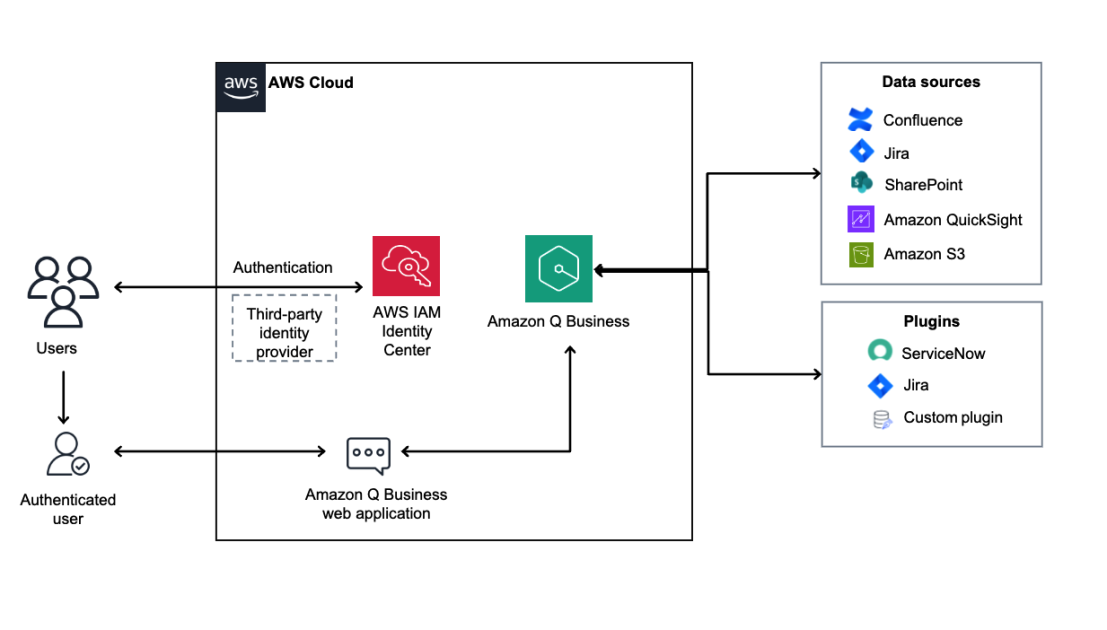
The following reference architecture illustrates the main components and flow of a typical Amazon Q Business implementation:

The workflow is as follows:

  1. A user interacts with an assistant through an enterprise collaboration system.
  2. Alternate: A user interacts with the built-in web interface provided by Amazon Q Business.
  3. The user is authenticated using IAM Identity Center and federated by a third-party identity provider (IdP).
  4. Data sources are configured for existing enterprise systems and data is crawled and indexed in Amazon Q Business. You can use custom connectors to integrate data sources that aren’t provided by Amazon Q Business.
  5. The user makes a request that requires action through a custom plugin. Use custom plugins to integrate third-party applications.
  6. The custom plugin calls an API endpoint that calls an Amazon Bedrock agent using Lambda or Amazon Elastic Kubernetes Service (Amazon EKS) in another AWS account. The response is returned to Amazon Q Business and the user.

Use Amazon Q Business to improve enterprise productivity

Amazon Q Business, offers numerous practical applications across enterprise functions. Let’s explore some of the key use cases where Amazon Q Business can enhance organizational efficiency and productivity.

  • Knowledge management and support: Amazon Q Business can manage and retrieve information from documentation and repositories such as internal wikis, SharePoint, Confluence, and other knowledge bases. It provides contextual answers through natural language queries and helps maintain documentation quality by suggesting updates while connecting related information across different repositories. For examples, see Smartsheet enhances productivity with Amazon Q Business.
  • Employee onboarding and training: Improve your employee onboarding experience with automated, personalized learning journeys powered by intelligent support. From instant answers to common questions to guided system setup and interactive training content, this solution helps integrate new team members while supporting their continuous learning and development. To learn more, see Deriv Boosts Productivity and Reduces Onboarding Time by 45% with Amazon Q Business and this Amazon Machine Learning blog post.
  • IT help desk support: Shorten IT response times by using AI-driven assistance that delivers round-the-clock support and intelligent troubleshooting guidance. By automating ticket management and using historical data for solution recommendations, this system dramatically reduces response times while easing the burden on your IT support teams.
  • Human resources: Support your HR operations and increase employee satisfaction with an AI-powered solution that provides quick answers to policy questions and streamlines benefits management. This intelligent assistant guides employees through HR processes, simplifies leave management, and offers quick access to essential forms and documents, creating a more efficient and user-friendly HR experience.
  • Sales and marketing: Strengthen your sales and marketing efforts with an AI-powered platform that streamlines content creation, market analysis, and proposal development. From generating fresh content ideas to quickly providing product information and competitor insights, teams can use this solution to respond faster to customer needs while making data-driven decisions. See How AWS sales uses Amazon Q Business for customer engagement.
  • AI operations: Upgrade and improve your operational workflow with AI-driven monitoring and automation that transforms system management and incident response. From real-time performance tracking to automated routine tasks and intelligent root cause analysis, teams can use this solution to maintain operational efficiency and reduce manual intervention.

Customer case study

A leading enterprise organization transformed its operational efficiency by implementing Amazon Q Business to tackle widespread knowledge accessibility challenges. Prior to implementation, the company struggled with fragmented institutional knowledge scattered across multiple systems, causing significant productivity losses as employees—from systems analysts to executives—spent hours daily searching through documentation, legacy code, and reports.

By deploying Amazon Q Business, the organization centralized its scattered information from various sources including Amazon Simple Storage Service (Amazon S3) buckets, Jira, SharePoint, and other content management systems into a single, intelligent interface. The solution dramatically streamlined access to critical information across their complex ecosystem of enterprise resource planning (ERP) systems, databases, sales platforms, and e-commerce integrations.

With approximately 300 employees each saving two hours daily on routine information retrieval tasks, the company achieved remarkable productivity and efficiency gains. Beyond the gains, Amazon Q Business fostered smarter collaboration, reduced subject-matter expert (SME) dependencies, and accelerated decision-making processes, effectively redefining how enterprise knowledge is accessed and used across the organization.

Conclusion

Amazon Q Business offers AWS customers a scalable and comprehensive solution for enhancing business processes across their organization. By carefully evaluating your use cases, following implementation best practices, and using the architectural guidance provided in this post, you can deploy Amazon Q Business to transform your enterprise productivity. The key to success lies in starting small, proving value quickly, and scaling systematically across your organization.

For more information on Amazon Q Business, including detailed documentation and getting started guides, visit:

  • Explore the Amazon Q documentation to understand more about building custom plugins.
  • Check out these related resources:

For questions and feedback, visit the AWS re:Post or contact AWS Support.

About the authors

Oliver Steffmann is a Principal Solutions Architect at AWS based in New York and is passionate about GenAI and public blockchain use cases. He has over 20 years of experience working with financial institutions and helps his customers get their cloud transformation off the ground. Outside of work he enjoys spending time with his family and training for the next Ironman.

Krishna Pramod is a Senior Solutions Architect at AWS. He works as a trusted advisor for customers, guiding them through innovation with modern technologies and development of well-architected applications in the AWS cloud. Outside of work, Krishna enjoys reading, music and exploring new destinations.

Mo Naqvi is a Generative AI Specialist at AWS on the Amazon Q Business team, where he helps enterprise customers leverage generative AI to transform workplace productivity and unlock business intelligence. With expertise in AI-powered search, deep research capabilities, and agentic workflows, he enables organizations to break down data silos and derive actionable insights from their enterprise information.

.Organize the content with appropriate headings and subheadings ( h2, h3, h4, h5, h6). Include conclusion section and FAQs section with Proper questions and answers at the end. do not include the title. it must return only article i dont want any extra information or introductory text with article e.g: ” Here is rewritten article:” or “Here is the rewritten content:”
Generate single title from this title Proton’s privacy-first Lumo AI assistant gets a major upgrade in 100 -150 characters. And it must return only title i dont want any extra information or introductory text with title e.g: ” Here is a single title:”

Write an article about

The privacy defenders at Proton have deployed an upgrade to their AI assistant, Lumo, that promises faster and more intelligent responses.

AI assistants can be incredibly useful for drafting emails, planning a trip, or just satisfying a random curiosity, but there’s always that nagging feeling that every question you ask, every idea you explore, is being logged, analysed, and fed back into a massive corporate machine. You’re constantly trading a bit of your privacy for a bit of convenience.

Lumo is now a whole lot smarter. Proton is calling it version 1.1, and the main takeaway is the AI assistant is better at pretty much everything. It’s faster, it gives more detailed answers, and it’s much more up-to-date on what’s happening in the world.

For specific metrics, Proton is claiming a 200% improvement in Lumo’s ability to ‘reason’ through complex problems—you know, the tricky multi-step stuff where other AIs tend to get lost. On top of that, Proton says their AI assistant is now 170% better at actually understanding the context of what you’re asking, and for the coders out there, it’s seen a 40% boost in generating correct code.

But here’s the part that really matters: it does all of this without snooping on you.

Unlike the big players, Proton’s entire approach to AI is built around privacy. When you chat with most AIs, you’re essentially having a conversation in a room full of people taking notes. With Lumo, you’re in a locked room, and only you have the key. Your conversations are encrypted in such a way that nobody at Proton can ever read them. They don’t save your chats, and they don’t use your personal conversations to train their AI.

To prove their privacy claims, Proton has made the code for their AI assistant’s mobile apps open-source. That means Proton is letting anyone look under the bonnet to check that Lumo’s engine is running the way they claim it is. It’s about building trust, not just demanding it.

So, what’s the catch? Well, to get the absolute best performance and unlimited use, you’re encouraged to sign up for Lumo Plus. And that, right there, is the point. Proton is betting that some of us would rather pay a few quid for a service that respects our privacy than get a “free” service where our data is the real price of admission.

This latest update to Lumo is a statement from Proton arguing that you shouldn’t have to choose between a powerful AI and one that respects your privacy. They’re still the underdog fighting the tech giants, but with this update, they’ve shown they’re a contender worth watching.

See also: Why security chiefs demand urgent regulation of AI like DeepSeek

Want to learn more about AI and big data from industry leaders? Check out AI & Big Data Expo taking place in Amsterdam, California, and London. The comprehensive event is co-located with other leading events including Intelligent Automation Conference, BlockX, Digital Transformation Week, and Cyber Security & Cloud Expo.

Explore other upcoming enterprise technology events and webinars powered by TechForge here.

.Organize the content with appropriate headings and subheadings ( h2, h3, h4, h5, h6). Include conclusion section and FAQs section with Proper questions and answers at the end. do not include the title. it must return only article i dont want any extra information or introductory text with article e.g: ” Here is rewritten article:” or “Here is the rewritten content:”

Generate single title from this title AI in Marketing: Key Statistics in 2025 in 100 -150 characters. And it must return only title i dont want any extra information or introductory text with title e.g: ” Here is a single title:”

Write an article about

Ever feel like marketing today is less about creative campaigns and more about chasing dashboards that make no sense? You’re not alone. Marketers often juggle inconsistent data, unpredictable customer behavior, and pressure to do more with less budget. 

Now imagine a tool that learns from millions of data points, never sleeps, and helps you write emails that people actually open. That’s artificial intelligence.

But does AI actually work in marketing, or is it just more hype?

Here’s something to think about: 83% of companies say AI is a top priority in their business strategy. That means your competitors are likely using AI tools right now to reach your audience faster and more accurately.

In this blog, you’ll learn how AI is truly changing marketing in 2025, with AI marketing statistics, tools, real outcomes, and how you can benefit.

Marketers’ Attitudes Toward AI: Trust, Challenges & Expectations

Most marketers today know that AI isn’t optional. It’s become essential. 75% of marketers say AI saves costs, and 83% say it gives them time for more strategic tasks. These aren’t fluffy numbers. They show that AI does what marketing teams are too busy to do: optimize, predict, and deliver at speed. Yet, trust doesn’t come automatically.

50% of marketers list “training and expertise” as the biggest barrier to adopting AI. Many say they feel lost choosing between complex platforms and tools with steep learning curves. But the expectations are sky-high. 81% believe AI improves brand visibility and sales, while 74% say it helps exceed campaign goals.

Challenge % of Marketers Reporting
Training and Expertise Needed 50%
Integration with Existing Tools 38%
Lack of In-House Talent 35%
Ethical or Privacy Concerns 21%

In short, marketers trust AI, but they also fear they’re not using it right. From chatbots to content automation, marketers now use AI tools across every stage of the customer journey.

These real-world AI in marketing examples show how businesses are already benefiting from automation.

Start your AI marketing project today!Get started now!

How AI is Reshaping Core Marketing Processes

From A/B testing to performance reporting, marketers used to spend hours setting up, waiting, and interpreting results. AI changed that.

AI marketing automation statistics 2025 reveal that 92% of businesses now use AI for campaign personalization. And that’s not just switching first names in emails. We’re talking about personalized pricing, dynamic visuals, and tailored product suggestions based on browsing behavior.

McKinsey reports that companies using AI in sales and marketing see 10–20% higher ROI . That’s not marginal, it’s transformational. Instead of reactive reports, AI offers proactive actions. Marketers know which ad sets to kill, which audience segment to nurture, and which email to resend, all in real time.

AI is becoming a core part of marketing strategies, helping brands personalize content, predict trends, and optimize campaigns.

This guide on AI marketing analytics explains how data-driven insights are reshaping digital experiences.

Here’s what marketers are automating with AI in 2025:

Process Automated % Using AI
Ad Targeting 50%
Email Personalization 66%
Campaign Timing Optimization 48%
Creative Testing 40%

The outcome? Less guesswork. More growth. AI not only improves targeting but also enhances ROI by streamlining ad spend and improving conversion rates.

This article on AI in digital marketing dives into practical ways to boost campaign performance.

AI in Customer Segmentation & Predictive Analytics

Most marketers segment audiences by demographics, age, gender, and maybe income. AI takes that further. It breaks people into behavioral clusters. For example, it tells you which customers are likely to churn, who will upgrade in 30 days, or who’s clicking on competitor ads.

That’s predictive analytics. And it’s becoming standard.

According to AI in marketing statistics 2025, 74% of marketers using AI for segmentation saw improvements in conversion rates. Why? Because AI doesn’t assume. It learns from your customers’ clicks, scrolls, and pauses.

Let’s say your business serves both freelancers and enterprise clients. AI will detect usage patterns, forecast lifetime value, and automatically adjust your lead scoring system. Your sales team focuses only on high-converting prospects.

AI Use Case Lift in Campaign Performance
Predicting Customer Churn +31% retention
Dynamic User Segmentation +26% conversion
Forecasting Lead Quality +23% closed deals
Optimizing Marketing Spend by Segment -18% cost per acquisition

With these gains, it’s easy to see why AI marketing stats show huge increases in predictive analytics investment this year. Knowing what customers want, before they ask, is becoming easier thanks to AI.

This piece on AI for demand forecasting outlines how marketers are leveraging predictive analytics to stay ahead of trends.

Create your AI-powered marketing system now!Let’s build it!!

AI-Powered Content Creation & Personalization

Everyone wants to write content that connects. But deadlines kill creativity. AI is becoming the writing partner marketers didn’t know they needed.

AI content marketing statistics 2025 show that 73% of marketers use generative AI tools for copy, ads, and video scripts. Even large platforms like Netflix attribute $1 billion/year in revenue to AI-powered recommendations. AI doesn’t just write faster, it writes smarter. It understands what voice your audience reacts to, what formats convert better, and what content drives signups.

Here’s how businesses apply content AI:

  • Personalizing landing pages based on visitor profile
  • Writing subject lines for specific audience personas
  • Generating product descriptions in bulk
  • Creating YouTube script variants for A/B testing

And it shows results.

AI Feature Reported Lift
Email Subject Personalization +21% open rate
AI-Written CTAs +18% click rate
Personalized Web Content +24% time on site
Dynamic Product Recs +28% checkout rate

The future of content isn’t manual. It’s modeled. Many leading companies have already made AI an essential part of their strategy.

Explore companies using AI to see how innovation is driving real-world success.

Automation of Campaign Management & Optimization

Choose the best approach for campaign management

Campaign management used to mean toggling tabs between Meta Ads, Google, and HubSpot. AI now does that for you.

AI marketing automation statistics 2025 show that AI can handle campaign delivery, budget pacing, and multi-channel A/B testing with better results than human managers.

For instance, AI adjusts your bids in real-time if CPCs go up in one geo-region. It pulls the budget from underperforming ads and reallocates it to top converters, all without waiting for a report.

What’s more? AI tools spot fatigue before your CTR drops. So you rotate creatives before users get bored. This is not just efficiency. It’s performance insurance.

Building an effective marketing strategy also means choosing the right tools.

This guide on selecting a marketing tech stack helps you structure your AI-powered workflow.

AI Marketing Tools: What’s Dominating in 2025?

AI tools aren’t sidekicks anymore; they’re core to how marketers work. From writing emails to predicting campaign outcomes, they now do what used to take entire teams. These platforms are quicker, smarter, and constantly learning. The best ones aren’t just flashy, they actually get work done.

Most marketers use them not for fun, but because they save time, reduce manual steps, and make marketing more consistent. Let’s look at five tool types leading the way this year.

AI Marketing Tool Type Example Tools Main Benefits AI Usage Percentage
in 2025
Copy and Message Builders Jasper, Copy.ai,
Writer
Saves time on writing, solves writer’s block,
ensures consistent messaging
70-80% of marketers use AI
copywriting tools
SEO and Content Research Tools Surfer, Clearscope, Frase Streamlines content planning, improves SEO,
consolidates research in one place
60-70% adoption among
content marketers
Workflow and Integration Tools Zapier AI, HubSpot, Make Reduces manual errors, speeds up reporting,
boosts efficiency
65-75% usage in marketing teams for automation and integration
Predictive Analytics Tools Integrated AI platforms Enables smarter decisions, maximizes ROI 50-60% of companies use AI
for predictive marketing
Creative and Social
Impact Tools
Emerging tools and platforms Spurs innovation, attracts audience engagement 30-40% adoption,
growing area of focus

AI is also being applied in creative and socially impactful ways.

For instance, this AI project on poverty prediction shows how machine learning can support broader data initiatives.

From Strategy to Execution: AI’s Role in the Full Funnel

Marketing doesn’t stop at the first click. AI now works across the full journey, from first ad view to final purchase. It supports targeting, content delivery, nurturing, and retention. The role isn’t isolated to one channel. It threads through every step.

Below are five stages where AI brings support.

Marketing Funnel Stage Key AI Functions Example Tools Benefits AI Usage Percentage in 2025
Audience Discovery Behavior pattern analysis,
conversion prediction
6sense, ZoomInfo Precise targeting,
reduced lead waste
Around 60-70% of marketers
use AI for segmentation and targeting
Content Delivery Real-time personalization
of websites and emails
Mutiny, Persado Improved user experience, content relevance 55-65% apply AI
for website and email personalization
Lead Nurturing Automated drip campaigns,
behavior-responsive
Customer.io,
ActiveCampaign
Higher engagement and timely follow-ups 50-60% use AI for dynamic nurturing campaigns
Post-Sale Retention Churn risk monitoring,
satisfaction tracking
Totango, ChurnZero Timely response to issues, increased loyalty About 50% of companies apply AI
for customer retention
Customer Needs Forecasting Data analysis and
predictive modeling
Custom AI models Better marketing
decision-making
Used by approximately 40-50% of companies
actively implementing AI

Forecasting customer needs is key to timely marketing decisions.

This demand forecasting case study illustrates how AI helps businesses manage promotions and inventory more effectively.

Impact on Customer Journeys and Experience Mapping

The modern customer journey isn’t linear. It’s multi-touch, cross-device, and channel-agnostic. That’s why AI mapping is changing how marketers track user paths.

With AI, journeys aren’t just recorded, they’re predicted.

AI impact on marketing statistics shows that 95% of customer interactions in 2025 are AI-assisted. That includes chatbots, autoresponders, guided selling, and more.

Companies like Salesforce use AI to shorten lead response time by 40%. This directly impacts funnel velocity and deal closures.

If you’re planning to integrate AI into your marketing stack, having the right partner makes all the difference.

Contact LITSLINK to learn how we can support your AI-driven marketing efforts.

Why LITSLINK is Trusted for AI Marketing Software Development

LITSLINK is not just a dev shop. It’s a long-term technology partner for brands looking to implement smart marketing systems. From building predictive engines to deploying real-time content engines, LITSLINK knows marketing.

We’ve helped e-commerce, financial, and media companies build AI-driven campaign tools, dynamic personalization engines, and behavioral segmentation models. We bring both product mindset and engineering rigor.

Our custom AI software is tailored, not templated. That means you get what your brand actually needs.

Looking to simplify how you scale marketing? Let’s talk. From development to deployment, LITSLINK offers full-cycle AI services that support modern marketing teams across industries.

AI is reshaping marketing for good. Begin your AI marketing journey today! Contact us!

FAQs

1: What’s the ROI of using AI in marketing?

Companies report 10–20% higher ROI and 60% lower campaign costs by automating decision-making and targeting with AI.

2: Are AI tools safe for email marketing?

Yes. According to AI email marketing statistics 2025, 41% of marketers report higher conversions through AI-optimized subject lines and segmentation.

3: Will AI replace marketers?

Not replace, but enhance. AI takes over repetitive tasks, freeing you to focus on strategy, storytelling, and creative growth.

4: What’s the most popular use of AI in marketing in 2025?

According to AI marketing tools statistics 2025, the top uses are customer segmentation, content creation, real-time analytics, and campaign automation.

5: What are the top trends in AI marketing?

AI marketing trends 2025 statistics include predictive modeling, video AI, real-time creative optimization, and autonomous campaign management.

The post AI in Marketing: Key Statistics in 2025 appeared first on Litslink.

.Organize the content with appropriate headings and subheadings ( h2, h3, h4, h5, h6). Include conclusion section and FAQs section with Proper questions and answers at the end. do not include the title. it must return only article i dont want any extra information or introductory text with article e.g: ” Here is rewritten article:” or “Here is the rewritten content:”

Generate single title from this title KU researchers publish guidelines to help responsibly implement AI in education in 100 -150 characters. And it must return only title i dont want any extra information or introductory text with title e.g: ” Here is a single title:”

Write an article about

This story originally appeared on KU News and is republished with permission.

Key points:

Researchers at the University of Kansas have produced a set of guidelines to help educators from preschool through higher education responsibly implement artificial intelligence in a way that empowers teachers, parents, students and communities alike.

The Center for Innovation, Design & Digital Learning at KU has published “Framework for Responsible AI Integration in PreK-20 Education: Empowering All Learners and Educators with AI-Ready Solutions.” The document, developed under a cooperative agreement with the U.S. Department of Education, is intended to provide guidance on how schools can incorporate AI into its daily operations and curriculum.

Earlier this year, President Donald Trump issued an executive order instructing schools to incorporate AI into their operations. The framework is intended to help all schools and educational facilities do so in a manner that fits their unique communities and missions.

“We see this framework as a foundation,” said James Basham, director of CIDDL and professor of special education at KU. “As schools consider forming an AI task force, for example, they’ll likely have questions on how to do that, or how to conduct an audit and risk analysis. The framework can help guide them through that, and we’ll continue to build on this.”

The framework features four primary recommendations.

  • Establish a stable, human-centered foundation.
  • Implement future-focused strategic planning for AI integration.
  • Ensure AI educational opportunities for every student.
  • Conduct ongoing evaluation, professional learning and community development.

First, the framework urges schools to keep humans at the forefront of AI plans, prioritizing educator judgment, student relationships and family input on AI-enabled processes and not relying on automation for decisions that affect people. Transparency is also key, and schools should communicate how AI tools work, how decisions are made and ensure compliance with student protection laws such as the Individuals with Disabilities Education Act and Family Education Rights and Privacy Act, the report authors write.

The document also outlines recommendations for how educational facilities can implement the technology. Establishing an AI integration task force including educators, administrators, families, legal advisers and specialists in instructional technology and special education is key among the recommendations. The document also shares tips on how to conduct an audit and risk analysis before adoption and consider how tools can affect student placement and identification and consider possible algorithmic error patterns. As the technologies are trained on human data, they run the risk of making the same mistakes and repeating biases humans have made, Basham said.

That idea is also reflected in the framework’s third recommendation. The document encourages educators to commit to learner-centered AI implementation that considers all students, from those in gifted programs to students with cognitive disabilities. AI tools should be prohibited from making final decisions on IEP eligibility, disciplinary actions and student progress decisions, and mechanisms should be installed that allow for feedback on students, teachers and parents’ AI educational experiences, the authors wrote.

Finally, the framework urges ongoing evaluation, professional learning and community development. As the technology evolves, schools should regularly re-evaluate it for unintended consequences and feedback from those who use it. Training both at implementation and in ongoing installments will be necessary to address overuse or misuse and clarify who is responsible for monitoring AI use and to ensure both the school and community are informed on the technology.

The framework was written by Basham; Trey Vasquez, co-principal investigator at CIDDL, operating officer at KU’s Achievement & Assessment Institute and professor of special education at KU; and Angelica Fulchini Scruggs, research associate and operations director for CIDDL.

Educators interested in learning more about the framework or use of AI in education are invited to connect with CIDDL. The center’s site includes data on emergent themes in AI guidance at the state level and information on how it supports educational technology in K-12 and higher education. As artificial intelligence finds new uses and educators are expected to implement the technology in schools, the center’s researchers said they plan to continue helping educators implement it in ways that benefit schools, students of all abilities and communities.

“The priority at CIDDL is to share transparent resources for educators on topics that are trending and in a way that is easy to digest,” Fulchini Scruggs said. “We want people to join the community and help them know where to start. We also know this will evolve and change, and we want to help educators stay up to date with those changes to use AI responsibly in their schools.”

Mike Krings, the University of Kansas

Mike Krings is a Public Affairs Officer with the KU News Service at the University of Kansas.

Latest posts by eSchool Media Contributors (see all)

.Organize the content with appropriate headings and subheadings ( h2, h3, h4, h5, h6). Include conclusion section and FAQs section with Proper questions and answers at the end. do not include the title. it must return only article i dont want any extra information or introductory text with article e.g: ” Here is rewritten article:” or “Here is the rewritten content:”