Home Blog Page 434

Widely used DNA sequencer neglects Secure Boot

Secure Boot: A Foundation of Trust in Securing Devices

Industry-Wide Adoption

In 2012, an industry-wide coalition of hardware and software makers adopted Secure Boot to protect Windows devices against the threat of malware that could infect the BIOS and, later, its successor, the UEFI, the firmware that loads the operating system each time a computer boots up.

How Secure Boot Works

Firmware-dwelling malware raises the specter of malware that infects the devices before the operating system even loads, each time they boot up. From there, it can remain immune to detection and removal. Secure Boot uses public-key cryptography to block the loading of any code that isn’t signed with a pre-approved digital signature.

Microsoft’s Requirements

Since 2016, Microsoft has required all Windows devices to include a strong trusted platform module that enforces Secure Boot. To this day, organizations widely regard Secure Boot as an important, if not essential, foundation of trust in securing devices in some of the most critical environments.

A Concern in Specialized Devices

Microsoft has a much harder time requiring Secure Boot to be enforced on specialized devices, such as scientific instruments used inside research labs. As a result, gear used in some of the world’s most sensitive environments still doesn’t enforce it.

The Illumina iSeq 100

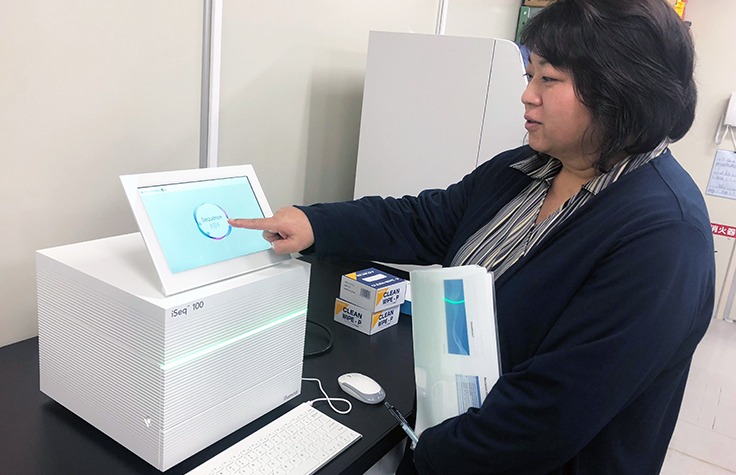
On Tuesday, researchers from firmware security firm Eclypsium called out one of them: the Illumina iSeq 100, a DNA sequencer that’s a staple at 23andMe and thousands of other gene-sequencing laboratories around the world. The iSeq 100 can boot from a Compatibility Support Mode so it works with older legacy systems, such as 32-bit OSes. When this is the case, the iSeq loads from BIOS B480AM12, a version that dates to 2018. It harbors years’ worth of critical vulnerabilities that can be exploited to carry out the types of firmware attacks Secure Boot envisioned.

Additional Concerns

Additionally, Eclypsium said, firmware Read/Write protections aren’t enabled, meaning an attacker is free to modify the firmware on the device.

The Broader Impact

Eclypsium wrote:

It should be noted that our analysis was limited specifically to the iSeq 100 sequencer device. However, the issue is likely much more broad than this single model of device. Medical device manufacturers tend to focus on their unique area of expertise (e.g. gene sequencing) and rely on outside suppliers and services to build the underlying computing infrastructure of the device. In this case, the problems were tied to an OEM motherboard made by IEI Integration Corp. IEI develops a wide range of industrial computer products and maintains a dedicated line of business as an ODM for medical devices. As a result, it would be highly likely that these or similar issues could be found either in other medical or industrial devices that use IEI motherboards. This is a perfect example of how mistakes early in the supply chain can have far-reaching impacts across many types of devices and vendors.

Conclusion

In an email, Eclypsium CTO Alex Bazhaniuk wrote: "To be fair, with an OS that does not get the most recent security updates, there are plenty of risks and threats, not to mention how each IT organization manages their own assets on their network."

FAQs

Q: What is Secure Boot?

A: Secure Boot is a security feature that uses public-key cryptography to block the loading of any code that isn’t signed with a pre-approved digital signature.

Q: What is the purpose of Secure Boot?

A: The purpose of Secure Boot is to protect Windows devices against the threat of malware that could infect the BIOS and, later, its successor, the UEFI, the firmware that loads the operating system each time a computer boots up.

Q: What is the concern with specialized devices?

A: Microsoft has a much harder time requiring Secure Boot to be enforced on specialized devices, such as scientific instruments used inside research labs.

Q: What is the issue with the Illumina iSeq 100?

A: The Illumina iSeq 100 can boot from a Compatibility Support Mode, which loads from BIOS B480AM12, a version that dates to 2018, harboring years’ worth of critical vulnerabilities that can be exploited to carry out the types of firmware attacks Secure Boot envisioned.
We are all digital immigrants

Embracing the New Reality of Generative AI

Key Points:

  • Generative AI tools are reshaping how we interact with technology and redefine what it means to be digitally literate.
  • The concept of digital natives is no longer relevant as AI tools demand a new kind of literacy that combines technical aptitude with ethical reasoning and adaptability.
  • Educators must provide hands-on opportunities for practice in a low-pressure environment and help learners understand the benefits and limitations of AI tools.

The Evolving Landscape of Digital Literacy

The rise of generative AI has transformed the way we interact with technology, creating a new level of complexity that requires more than just technical skills. As AI tools become more collaborative and capable, they demand a new kind of literacy that combines technical aptitude with ethical reasoning and adaptability. This shift requires a mindset of lifelong learning and humility, recognizing that AI tools are transformative and evolving, and their implications, from misinformation to automation, demand a collective effort to understand and guide their development.

Supporting Learners in the Age of Generative AI

To effectively use these new tools, educators must provide hands-on opportunities for practice in a low-pressure environment. Assignments that allow learners to iteratively use AI tools and then reflect on their success can help build confidence with these tools. Educators should also ensure learners understand the benefits and limitations of AI tools, as well as when to use them and when not to.

Fostering a Culture of Curiosity and Responsibility

By adopting a shared perspective that views us all as learners in this new digital frontier, educators can foster a culture of curiosity and responsibility among students. This approach recognizes that AI tools are transformative, yet still evolving, and that their implications demand a collective effort to understand and guide their development.

Conclusion

The rise of generative AI has created a new reality that requires a new kind of literacy. By embracing this reality and recognizing the need for a collective effort to understand and guide the development of AI tools, we can demystify complex systems and empower individuals to use them effectively and ethically. In this way, we can prepare ourselves not just for the challenges of today but for the boundless possibilities of a generative AI-rich future.

FAQs

Q: What is generative AI?
A: Generative AI is a type of artificial intelligence that can create original content, such as text, images, or code.

Q: How does generative AI work?
A: Generative AI uses algorithms and machine learning to create original content that is often difficult to distinguish from content created by humans.

Q: What are the implications of generative AI?
A: The implications of generative AI include the potential for misinformation, automation, and job displacement, as well as new opportunities for creativity and innovation.

Q: How can educators support learners in the age of generative AI?
A: Educators can support learners by providing hands-on opportunities for practice, ensuring learners understand the benefits and limitations of AI tools, and fostering a culture of curiosity and responsibility.

NVIDIA Project DIGITS, A Grace Blackwell AI Supercomputer On Your Desk

0

Future-Proofing AI Computing with NVIDIA Project DIGITS

Revolutionizing AI Training with the GB10 Grace Blackwell Superchip

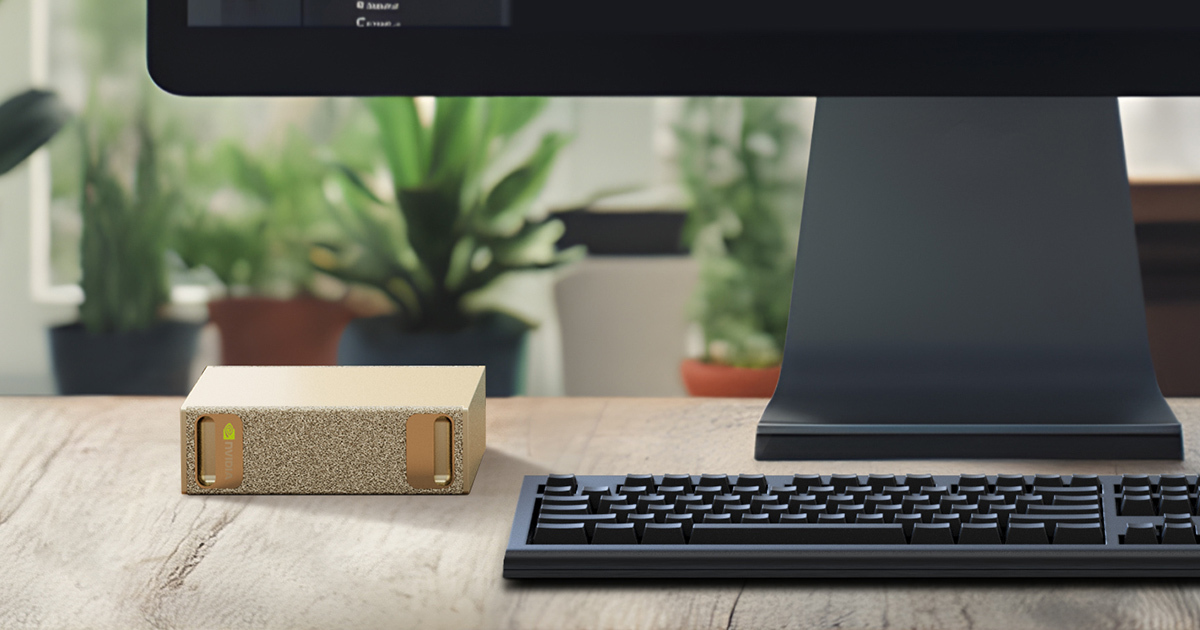
Powered by the new GB10 Grace Blackwell Superchip, NVIDIA Project DIGITS can tackle large generative AI models of up to 200 billion parameters. This groundbreaking technology is set to revolutionize the field of artificial intelligence (AI) computing, enabling researchers and developers to build more complex and accurate models with unprecedented speed and efficiency.

Unleashing the Power of Large-Scale AI Models

Generative AI models are becoming increasingly important in various fields, such as natural language processing, computer vision, and recommender systems. However, training these models requires significant computational resources and can be a time-consuming process. The GB10 Grace Blackwell Superchip is designed to overcome these challenges, enabling the training of large-scale AI models with ease.

Key Features of Project DIGITS

  • Scalability: Project DIGITS can handle large generative AI models with up to 200 billion parameters, making it an ideal solution for complex AI applications.
  • High-Performance Computing: The GB10 Grace Blackwell Superchip provides exceptional computing power, ensuring fast training times and efficient resource utilization.
  • Advanced Architecture: The chip’s architecture is designed to optimize AI training, reducing the need for manual tuning and configuration.

Benefits of Project DIGITS

  • Faster Training Times: With Project DIGITS, researchers and developers can train large-scale AI models in a fraction of the time, reducing the overall development cycle.
  • Improved Model Accuracy: The GB10 Grace Blackwell Superchip’s advanced architecture enables the training of more accurate AI models, leading to better results in various applications.
  • Increased Productivity: Project DIGITS reduces the need for manual tuning and configuration, allowing researchers and developers to focus on more complex tasks.

Conclusion

NVIDIA Project DIGITS is a groundbreaking technology that is set to revolutionize the field of AI computing. With its ability to handle large-scale AI models and advanced architecture, Project DIGITS is an ideal solution for researchers and developers seeking to build more complex and accurate AI applications. By harnessing the power of the GB10 Grace Blackwell Superchip, Project DIGITS is poised to unlock new possibilities in AI research and development.

Frequently Asked Questions

Q: What is the maximum number of parameters that Project DIGITS can handle?
A: Project DIGITS can handle large generative AI models with up to 200 billion parameters.

Q: What is the purpose of the GB10 Grace Blackwell Superchip?
A: The GB10 Grace Blackwell Superchip is designed to provide high-performance computing power and advanced architecture for AI training, enabling the training of large-scale AI models with ease.

Q: How does Project DIGITS reduce the need for manual tuning and configuration?
A: The GB10 Grace Blackwell Superchip’s advanced architecture optimizes AI training, reducing the need for manual tuning and configuration, allowing researchers and developers to focus on more complex tasks.

Nvidia Unveils New RTX Ti and 5070 GPUs at CES

0

Nvidia’s New 5000 Series of GPUs: A Game-Changer for Gamers and Creatives

Gamers and professional digital creatives rejoice – Nvidia has announced its new 5000 series of GPUs, with CEO Jensen Huang revealing all at this year’s CES tech event.

Price

For the rest of the series, all their prices are between $50 and $100 cheaper than the 4000 series equivalent – while promising twice the performance, according to Huang. In fact, the 5090 is the only one that will sell more expensive than its 4000 counterpart (see below). However, this is all in a perfect world, where scalpers don’t exist and retail prices of GPUs are actually what you pay. The real cost of these bad boys are yet to be defined.

  • RTX 4090: $1,599 | RTX 5090: $1,999
  • RTX 4080: $1,199 | RTX 5080: $999
  • RTX 4070 Ti Super: $799 | RTX 5070 Ti: $749
  • RTX 4070 Super: $599 | RTX 5070: $549

Performance

When it comes to performance, the 5000 series promises a lot – the aforementioned doubled up performance compared to the 4000 series high on the list. You may know of the underwhelming 4000 series, with the 4070 and 4070 Ti having to be upgraded to ‘Super’ iterations, largely due to public outrage over the disappointing initial offering. With the announced promises, it doesn’t look like there will be a similar debacle this time around.

Features

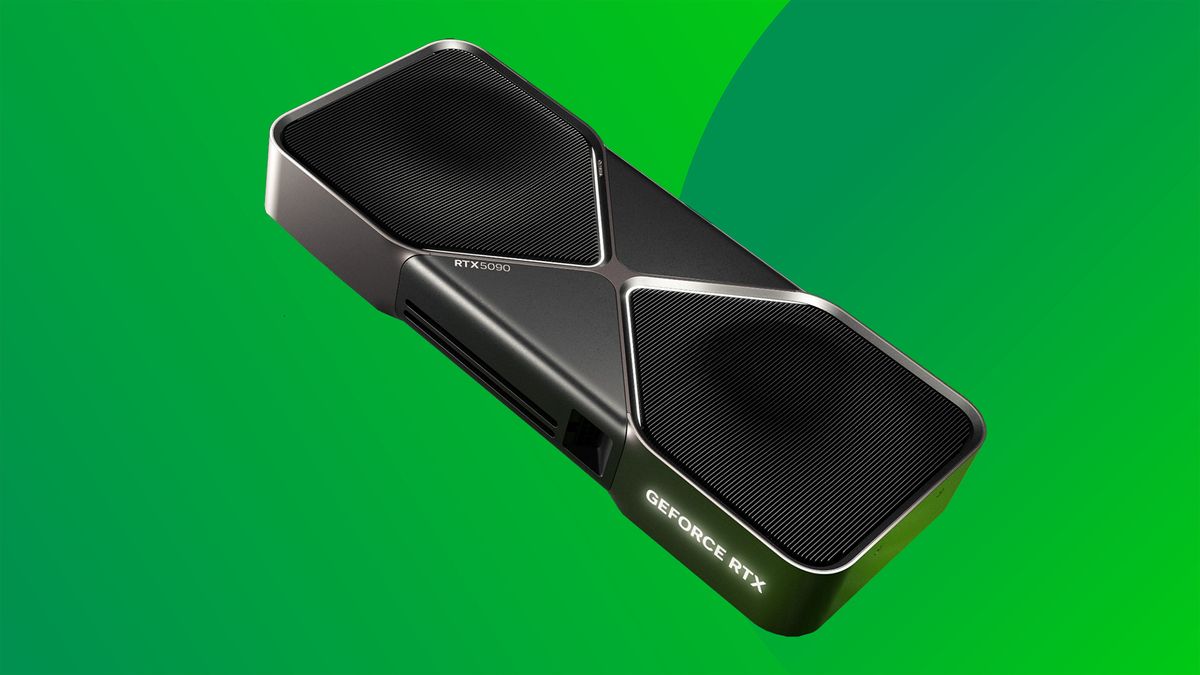
The full series of GPUs will include a PCIe 5.0 interface, a 16-pin power connector, DisplayPort 2.1a, GDDR7 memory and DLSS 4 technology. Looking at the flagship 5090, you’ll get 32GB of GDDR7 VRAM, and shiny new 5th Gen Tensor and 4th Gen Ray Tracing Cores. Add to that a 512-bit memory bus, a PCIe 5.0 x16 interface, and a zippy 1792 GB/s of memory bandwidth with a memory speed upwards of 23.8 Gbps, and you have yourself a GPU beast. Probably more of a beast than most people will actually need.

Conclusion

With these specs, the 5090 is better equipped for handling 8K than 4K, and as there are no games that run at 8K, this GPU is squarely aimed at professional creative studios – not casual (or even professional) gamers. For the other iterations in the 5000 series, twice the performance for $50 to $100 less than the last generation sounds pretty great. Let’s see how they all perform in February.

Frequently Asked Questions

Q: When will the 5000 series be available?
A: The RTX 5090 will be available on January 30, and the other iterations will be available in February.

Q: What is the price of the RTX 5090?
A: The price of the RTX 5090 is $1,999.

Q: What is the difference between the 5000 series and the 4000 series?
A: The 5000 series promises twice the performance of the 4000 series, with prices between $50 and $100 cheaper.

Q: Is the 5090 suitable for gaming?
A: The 5090 is better equipped for handling 8K than 4K, and as there are no games that run at 8K, this GPU is squarely aimed at professional creative studios – not casual (or even professional) gamers.

Locus Robotics achieves CE certification for high-payload ‘Vector’ robot

0

Locus Robotics, a provider of autonomous mobile robots for warehouse automation, has achieved CE certification for its largest, most dynamic mobile robot, the Locus Vector.

Locus says this milestone reinforces the company’s commitment to innovation and operational excellence, enabling broader deployments across Europe and other international markets.

Powered by the LocusONE platform, Locus Vector “enhances warehouse productivity, flexibility, and scalability, empowering businesses to automate complex workflows with unmatched efficiency”.

Currently operational at multiple sites, Locus Vector is actively deployed across leading third-party logistics companies and a premier global apparel and footwear retailer in Europe.

With this certification, Locus demonstrates its ability to manage complex multi-step processes, accommodate larger payloads, and seamlessly adapt to a wider range of order dimensions, strengthening its position as a leader in flexible and scalable warehouse automation.

Flexibility and throughput

Powered by the LocusONE platform, Locus Vector complements existing Locus Origin fleets, allowing customers to seamlessly expand their automation capabilities for workflows requiring higher payloads or specialized handling, such as case picking, replenishment and returns.

LocusONE enables real-time fleet optimization and visibility, productivity tracking, and integration with third-party systems like WMS and ERP, allowing incremental expansion and unlimited throughput without infrastructure overhauls.

Locus Vector, combined with Locus Origin, highlights Locus’s advantage in flexible automation over traditional systems like AS/RS and G2P, which struggle with heavier items and orders, complex SKUs, and brownfield applications.

By picking directly from pallets, both Vector and Origin eliminate decanting and reduce labor costs, making it ideal for dynamic, high-throughput environments.

Across industries

Denis Niezgoda, chief commercial officer, International, at Locus Robotics, says: “This CE certification for Locus Vector allows us to bring the benefits of our flexible warehouse automation solution to more customers globally.

“Vector’s exceptional payload capacity, mobility, and seamless integration into LocusONE make it the ideal solution for robust automation in industries like 3PL, retail, and healthcare.

“Customers are already seeing increased flexibility and efficiency by deploying Vector alongside their Locus Origin fleets or standalone.”

Expanding value

Locus Vector enables seamless warehouse process automation across operations. For example, a UK-based 3PL uses Vector for wine distribution, automating bottle picking directly onto mobile pallet dollies.

Meanwhile, a leading retailer in Czechia uses Locus Vector for large-volume replenishment while Origin robots handle picking tasks. The LocusONE platform orchestrates these workflows in real-time, optimizing operations and improving productivity.

With Locus Vector’s CE certification, Locus Robotics continues to advance flexible automation, meeting the growing demand for innovative and high-performing solutions globally.

Nvidia Bets Big on Robots

0

Nvidia’s Next Target

Heading into 2025, Nvidia was facing tough questions about whether the chipmaker central to the artificial intelligence boom could sustain its astronomical market run.

Presentation at CES

Based on the company’s presentation at the Consumer Electronics Show on Monday, investors appear to believe that the tech giant, and the A.I. surge more broadly, has more room to rally.

Shares Up

Nvidia’s shares are up again in premarket trading on Tuesday, after hitting a record on Monday in anticipation of the C.E.S. presentation. The chip giant’s market value now stands at $3.67 trillion, or more than double the combined market capitalizations of AMD, Arm, Broadcom, and Intel.

T.L.D.R. on the Presentation

Jensen Huang, Nvidia’s rock-star co-founder and C.E.O. (who donned a fancier version of his trademark leather jacket for his presentation), announced tools for so-called physical A.I., including ways to help better train robots.

Future of Robotics

He also said Nvidia would provide driver-assistance chips and software for Toyota, the world’s biggest car manufacturer, adding to its list of automotive partners. And his company will also help Uber develop its self-driving technology, with the ride-hailing giant’s millions of daily trips furnishing data to train A.I. models.

Nvidia’s Vision

Nvidia presented a bullish view for dominating A.I. in the physical world, as well as data-center chips. Huang, speaking in front of an array of humanoid robots, said that "the ChatGPT moment for general robotics is just around the corner." He predicted that the market for such robots could reach $38 billion in the coming decades.

More

More broadly, Huang described a future populated by millions of such robots, autonomous vehicles, and automated factories.

Underlying the Announcements

Nvidia does more than data-center chips, a hugely lucrative business that’s under pressure from the company’s own top customers moving to lessen their dependence on its A.I. processors. (That said, Microsoft’s recently announced $80 billion A.I. spending plan is expected to include purchases of Nvidia chips.)

Investors Need Not Worry

It also suggested that investors need not worry so much about the A.I. boom stalling out anytime soon.

HERE’S WHAT’S HAPPENING

  • Crude oil prices rise after President Biden imposes offshore drilling bans.
  • McDonald’s drops diversity targets for its employees and suppliers.
  • Shares in Tencent tumble after the company is added to a U.S. military blacklist.
  • Two giants of the photo-licensing industry agree to combine.

Trump and Musk Tag-Team the World

President-elect Donald Trump has already kept global leaders and investors on edge with a threat to impose a wave of new tariffs on Day 1.

A Recap

  • Canada’s politics were upended on Monday by the resignation announcement of Justin Trudeau as prime minister. Trump had repeatedly needled Trudeau, calling him the governor of what he has referred to as the "51st state" despite the Canadian leader going to Mar-a-Lago to try to persuade the president-elect to back off his tariff threat.
  • Last month, Trump said he wanted to see U.S. control of Greenland, reviving speculation that he was interested in buying the Danish territory.
  • Musk has suggested that Britain isn’t safe under Prime Minister Keir Starmer: "America should liberate the people of Britain from their tyrannical government," he posted on X.
  • Musk has also weighed into politics in Germany and Italy — whose prime minister, Giorgia Meloni, is a friend of his — over immigration.

Could Musk’s Social Media Attacks Backfire on Him and His Business Interests?

The costs could be huge: Regulators in Britain and the European Union are closely scrutinizing tech platforms that fail to rein in misinformation or posts that encourage harmful social behavior, potentially leading to hefty fines as Musk is well aware of.

The Trump and Musk Fusillades are Hitting Markets

Mohit Kumar, an economist at Jefferies, forecast on Tuesday that stock indexes most likely won’t repeat 2024’s blockbuster performance. One reason: "High on the uncertainty list are tariffs and fiscal policies of the Trump administration," he wrote.

The Fubo Deal’s Winners

Just a week into 2025, the media industry got its first consequential transaction: Disney buying 70 percent of Fubo, the video service that had sued to block the media giant’s plan to create Venu, a sports streaming joint venture with Fox and Warner Bros. Discovery.

The Most Likely Winners

  • Bob Iger: After years of questions about Disney’s plans for Hulu — the company now owns all of the streaming service — the Disney chief is effectively offloading what the analyst Richard Greenfield told DealBook was "the least exciting part" of Hulu.
  • Fox and Warner Bros. Discovery: Both companies, along with Disney, will pay a combined $220 million to Fubo. (Disney will also extend Fubo a $145 million loan.) They appear to be betting that paying up to settle with Fubo will cost less than the benefits they expect to get from Venu.
  • Edgar Bronfman Jr., Fubo’s executive chairman: Monday’s agreement validates the media mogul’s decision to try to block Venu.

The Questions

  • Are Venu’s antitrust problems really over?
  • How will the new Fubo do?

The Speed Read

  • Deals: Fubo-Disney deal
  • Politics and Policy: Trump’s tariffs and Musk’s social media attacks
  • Best of the Rest: Consumer Financial Protection Bureau plans to sue Vanderbilt Mortgage

Conclusion

Nvidia’s presentation at CES has sparked optimism about the company’s future, particularly in the realm of artificial intelligence. The chipmaker’s shares have surged, and investors are bullish on its prospects. Meanwhile, Trump and Musk are making headlines with their global influence, from tariffs to social media attacks. The Fubo deal has also raised questions about the future of sports streaming and antitrust regulations. As the year unfolds, it will be interesting to see how these developments play out.

FAQs

Q: What is Nvidia’s next target?
A: Nvidia’s next target is the artificial intelligence boom, particularly in the realm of physical AI and robotics.

Q: What is the Fubo deal?
A: The Fubo deal is a transaction between Disney and Fubo, a video service, in which Disney will buy 70 percent of Fubo.

Q: What are the implications of the Fubo deal?
A: The Fubo deal has implications for the future of sports streaming and antitrust regulations.

Q: What is Trump’s stance on tariffs?
A: Trump has threatened to impose a wave of new tariffs on Day 1.

Q: What is Musk’s stance on social media?
A: Musk has suggested that Britain isn’t safe under Prime Minister Keir Starmer and has also weighed into politics in Germany and Italy over immigration.

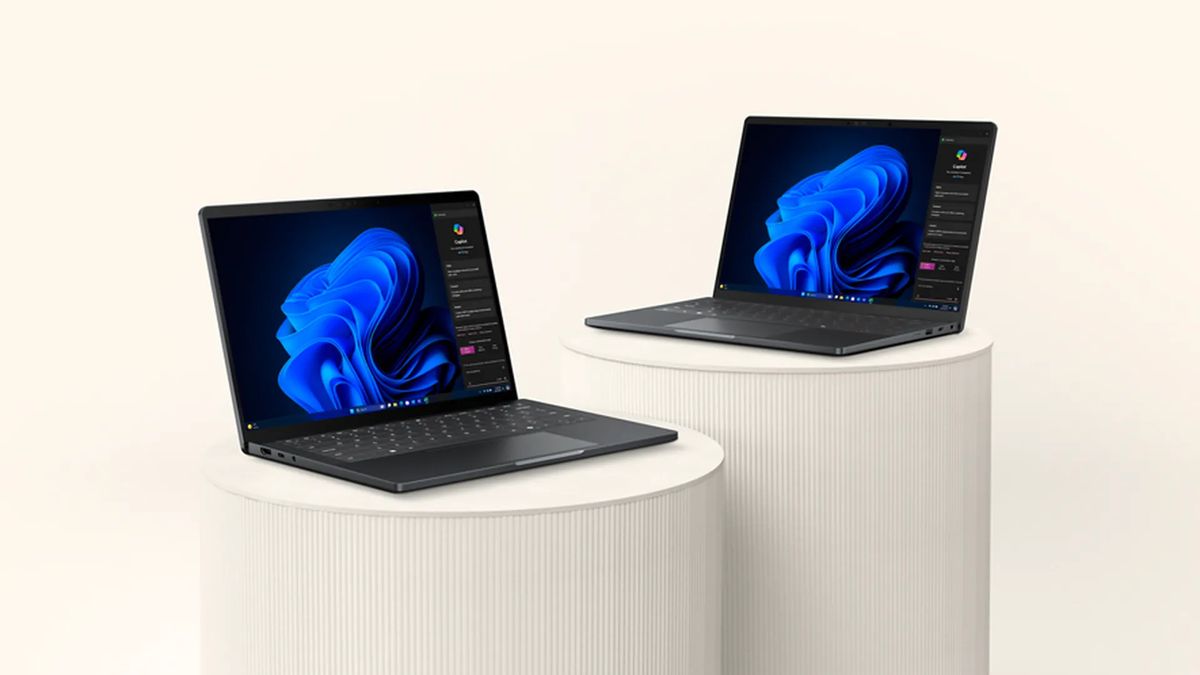
Dell’s Laptop Rebrand Isn’t a Joke

0

Dell’s New Laptop Lineup: A Surprising Apple-Esque Naming Convention

Dell has taken pot shots at Apple in its ads before, and the brand is often seen as one of the Cupertino company’s biggest rivals on the PC side of things. So it comes as a surprise that Dell’s rebranded laptop lineup sounds quite so, well, Apple-esque.

Simplifying Naming Conventions

The company is killing off some of its most famous PC branding, including the XPS and Inspiron names (some of which are among our best laptops for CAD). At CES this week, Dell revealed that the new names for its PCs will include the Dell, Dell Plus, Dell Pro, and Dell Pro Max. No, it isn’t April 1st.

Apple-Inspired Naming

Yes, it appears to be taking on the exact same naming conventions as Apple’s iPhone lineup. And as Oscar Wilde famously said, to borrow one Apple product name may be regarded as a misfortune. To borrow two looks like carelessness. And to borrow three is just downright wild.

CEO’s Explanation

"Customers really prefer names that are easy to remember and easy to pronounce," Chief Operating Officer Jeff Clarke announced at CES. Buyers shouldn’t have to spend time "figuring out our nomenclature, which at times has been a bit confusing," he said. Sure, the names are simpler. But weren’t there any other words for "powerful" and "bigger" that Dell could have found in the thesaurus?

Social Media Reactions

This week Dell has decided to kill the pretty well-established XPS, Latitude and Inspiron line branding, and rebranded as Dell, Dell Pro and Dell Pro Max. This is not a joke pic.twitter.com/SuYBZOO2qh

Dell: "can I copy your homework?" Apple: "yeah just change it up a bit so it doesn’t look obvious you copied" Dell: "ok" pic.twitter.com/RpCOCGtZ1E

Dell’s Defense

Pre-empting the comparisons, Dell argued that Apple "doesn’t own" words like "Pro" and "Max". According to Bloomberg, the company’s COO Jeff Clarke said that the naming decision was based on research Dell did with "tens of thousands of customers." Indeed, those two words are often used by other tech brands like Samsung. But "Pro Max" together? It’s just such a recognisable piece of Apple branding, and a touch bizarre to see adopted by a rival.

Conclusion

Time will tell how the new laptop lineup will fare, but it’s surely going to take a while for Dell to shake off those Apple comparisons.

Frequently Asked Questions

Q: Why did Dell decide to rebrand its laptop lineup?
A: Dell decided to rebrand its laptop lineup to simplify its naming conventions and make it easier for customers to remember and pronounce the names.

Q: Are the new names unique to Dell?
A: The names "Pro" and "Max" are not unique to Apple, but the combination "Pro Max" is a recognizable piece of Apple branding.

Q: Will the new naming convention affect the quality of Dell’s laptops?
A: The quality of Dell’s laptops will not be affected by the new naming convention. The rebranding is solely focused on simplifying the naming conventions.

A Journey Beyond Expectations

Fact 7. AI in Medicine: Transformative Innovations in Healthcare

Fact 7. AI in Medicine: Transformative Innovations in Healthcare

The revolutionary impact of AI on the medical field extends far beyond conventional practices. Discover the role of AI in healthcare, where cutting-edge technology is revolutionizing medical records summarization. Noteworthy startups such as Tempus and PathAI are leveraging AI to enhance disease diagnosis, streamline personalized treatment plans, and delve into groundbreaking areas like drug discovery.

Reshaping Surgical Procedures with AI

Beyond diagnostics and treatment, AI is reshaping surgical procedures. Companies like Intuitive Surgical are incorporating robotic systems powered by AI for enhanced precision and efficiency. The mix of AI algorithms with medical data has proven to be a game-changer, enabling rapid analysis on a scale that surpasses human capacity.

Fact 8. Artificial Intelligence in Space Exploration

Fact 8. Artificial Intelligence in Space Exploration

The vast expanse of space is no longer beyond the reach of AI. In space exploration, AI plays a significant role in enhancing our understanding of space. NASA’s Mars rovers, for instance, use AI for autonomous navigation and decision-making.

Fact 9. AI Is Transforming Asset Maintenance

Fact 9. AI Is Transforming Asset Maintenance

Unplanned equipment failures can be costly in high-efficiency areas such as manufacturing, transport, and energy. Traditionally, maintenance takes the form of regular inspections or reactive breakdown responses. AI can transform this procedure into predictive maintenance.

Fact 10. AI Helps Companies Maximize Profits

Fact 10. AI Helps Companies Maximize Profits

From startups to multinational corporations, every business is now harvesting the results of incorporating AI into their revenue maximization strategies. For example, Netflix uses AI in its recommendation engine, which comprises over 80% of the content consumption on its platform.

Fact 11. China Leads the World in AI

Fact 11. China Leads the World in AI

China is more than just interested in occupying the top position in AI no matter the cost. The roadmap was outlined in the Next Generation AI Development Plan—it was all about making China the world’s biggest player in the field by 2030.

Fact 12. AI Will Replace Some Jobs but Create New Ones

Fact 12. AI Will Replace Some Jobs but Create New Ones

Experts believe that AI will transform the workforce as it is expected to replace 9.1% (300 million) of jobs over the next decade. Jobs in logistics, customer service, and certain types of administrative work are at a greater risk because these types of activities can be automated at a much faster and cheaper way than by human beings.

Fact 13. FBI Uses AI to Enhance Security

Fact 13. FBI Uses AI to Enhance Security

A fun fact about AI is that it is a machine learning model that has acted as a backbone for modern law enforcement, especially in anti-terrorism. The FBI has algorithms using AI to analyze massive datasets from social media, messaging apps, and other online platforms in order to synthetically detect patterns of suspicious activity.

Fact 14. AI Can Lower Energy Consumption

Fact 14. AI Can Lower Energy Consumption

A powerful transformation is brought about by AI in energy efficiency across industries. Real-time data analysis from smart grids will enable electricity distribution optimization with reduced energy waste and costs.

Fact 15. The First Robot with Citizenship

Fact 15. The First Robot with Citizenship

Sophia, a humanoid robot created by Hanson Robotics in 2016, was granted citizenship in Saudi Arabia in 2017. Sophia embodies the future of robotics, artificial intelligence, and human-robot interactions.

Fact 16. AI Can Predict Death with 90% Accuracy

Fact 16. AI Can Predict Death with 90% Accuracy

One of the most interesting facts about artificial intelligence is that scientists can predict patient outcomes with a level of accuracy that was heretofore unknown by using AI. For example, AI systems are programmed to analyze a patient’s medical history, laboratory findings, and lifestyle behaviors to forecast the likelihood of dying during a given time frame.

Fact 17. AI’s Black-Box Problem Limits Transparency

Fact 17. AI’s Black-Box Problem Limits Transparency

The “black-box problem” is the non-transparency of any decision dictated by artificial intelligence, where a superb neural network processes immensely broad datasets but just fires outputs without revealing anything about how it was arrived at.

Conclusion

These diverse facts about artificial intelligence and AI applications underscore its versatility and far-reaching impact across various domains. As AI technology continues to advance, the synergy between AI and different fields will open up new possibilities, promising a future where AI systems play an increasingly integral role in shaping our world.

FAQs

Q: What are some of the most interesting facts about AI?
A: Some of the most interesting facts about AI include its ability to revolutionize healthcare, transform asset maintenance, and predict death with 90% accuracy.

Q: What are some of the potential benefits of AI?
A: Some of the potential benefits of AI include increased efficiency, improved decision-making, and enhanced customer service.

Q: What are some of the potential drawbacks of AI?
A: Some of the potential drawbacks of AI include job displacement, lack of transparency, and potential bias.

Q: What is the future of AI?
A: The future of AI is likely to be shaped by its increasing adoption across various industries, its ability to automate tasks, and its potential to transform various aspects of our lives.

2024’s Most Popular Rebranding & Logo Stories

0

Logo and Rebranding Stories of 2024

10. Audi’s new branding is proving almost as controversial as Jaguar’s
The rebrand of car maker Audi ditched its famous four interlocking rings in favor of a new capitalised wordmark, AUDI. Like with any big rebrand, many fans were not impressed.

09. Bose’s new rebrand showcases its hand-drawn heritage logo
The story of Bose’s rebrand by COLLINS celebrated its heritage while carrying its legacy into the modern age with a new color palette, sleek new typography, and an authoritative brand voice. The brand kept its original wordmark, with only minor tweaks made.

08. A designer has "fixed" the controversial new Jaguar logo
We were surprised to see that this year’s Jaguar story wasn’t higher on our list, but we know that this rebrand really got people talking. The rebrand saw a new mixed-case wordmark, a monogram, and a tweaked version of its famous leaping animal, and people were really upset about it. One TikTokker subsequently "fixed" the logo, and garnered an awful lot of likes in the process.

07. Lego’s vibrant new brand identity feels both nostalgic and timeless
Seventh on our list was our story about Lego, which unveiled a full new brand identity that brought cohesiveness across its range of products. It cleverly uses Lego bricks to construct both physical and digital assets, with an emphasis on learning through play.

06. The Harris x Walz logo gets a subtle yet effective design tweak
The Harris x Walz logo was given a more authoritative feel in August thanks to a humble bit of kerning. The new logo irons out visual impurities like letter height and centring, making it much more powerful and scalable (though it turned out not to be powerful enough…).

05. The new Slipknot logo is a real Disasterpiece
In at number five is Slipknot’s new logo, which appeared on a limited edition set of T-shirts. The new take on the ‘S’, which is more vertically elongated with smoother edges than the former version, seemed to really upset fans.

04. The new Las Vegas Raiders logo is as sharp as a blade
The Las Vegas Raiders released a clever 65th anniversary logo, which made use of its traditional crossed swords motif. This was another one that divided opinion and plenty of you enjoyed reading about it (or at least read about it, we can’t always tell if you’ve enjoyed it or not).

03. Tiger Woods’ new logo has a genius hidden meaning
After splitting from Nike, Tiger Woods announced his new brand Sun Day Red. Its logo features a tiger adorned with 15 stripes, representing each of Woods’ 15 major titles.

02. Users are already poking fun at the Discord rebrand
Back in May, Discord announced yet another brand refresh to mark its ninth anniversary. The rebrand tweaked the UI and adopted a darker brand color, but it was the tagline ‘Group chat that’s all fun and games’ that drew most attention.

01. The new Mazda logo was long overdue
And in first place is a story from July 2024 about the new Mazda logo. Our freelancer Joe Foley argued that the new flatter design may not break the mould, but was totally necessary.

Conclusion
In conclusion, 2024 was a year of big changes in branding, with many companies opting to revamp their logos and rebrands. Here, we’ve looked back at the most popular stories of the year, from Audi’s controversial rebrand to Lego’s vibrant new brand identity.

FAQs

Q: What was the most popular rebrand of 2024?
A: Audi’s new branding was the most popular rebrand of 2024, with many fans divided on the new design.

Q: What was the most controversial rebrand of 2024?
A: Jaguar’s rebrand was one of the most controversial of 2024, with many fans upset about the new logo.

Q: What was the most interesting rebrand of 2024?
A: Lego’s new brand identity was one of the most interesting of 2024, incorporating Lego bricks into its design.

NVIDIA Unveils ‘Mega’ Omniverse Blueprint for Building Industrial Robot Fleet Digital Twins

According to Gartner, the worldwide end-user spending on all IT products for 2024 was $5 trillion. This industry is built on a computing fabric of electrons, is fully software-defined, accelerated — and now generative AI-enabled. While huge, it’s a fraction of the larger physical industrial market that relies on the movement of atoms.

Today’s 10 million factories, nearly 200,000 warehouses and 40 million miles of highways form the “computing” fabric of our physical world. But that vast network of production facilities and distribution centers is still laboriously and manually designed, operated, and optimized.

In warehousing and distribution, operators face highly complex decision optimization problems — matrices of variables and interdependencies across human workers, robotic and agentic systems, and equipment. Unlike the IT industry, the physical industrial market is still waiting for its own software-defined moment.

That moment is coming.

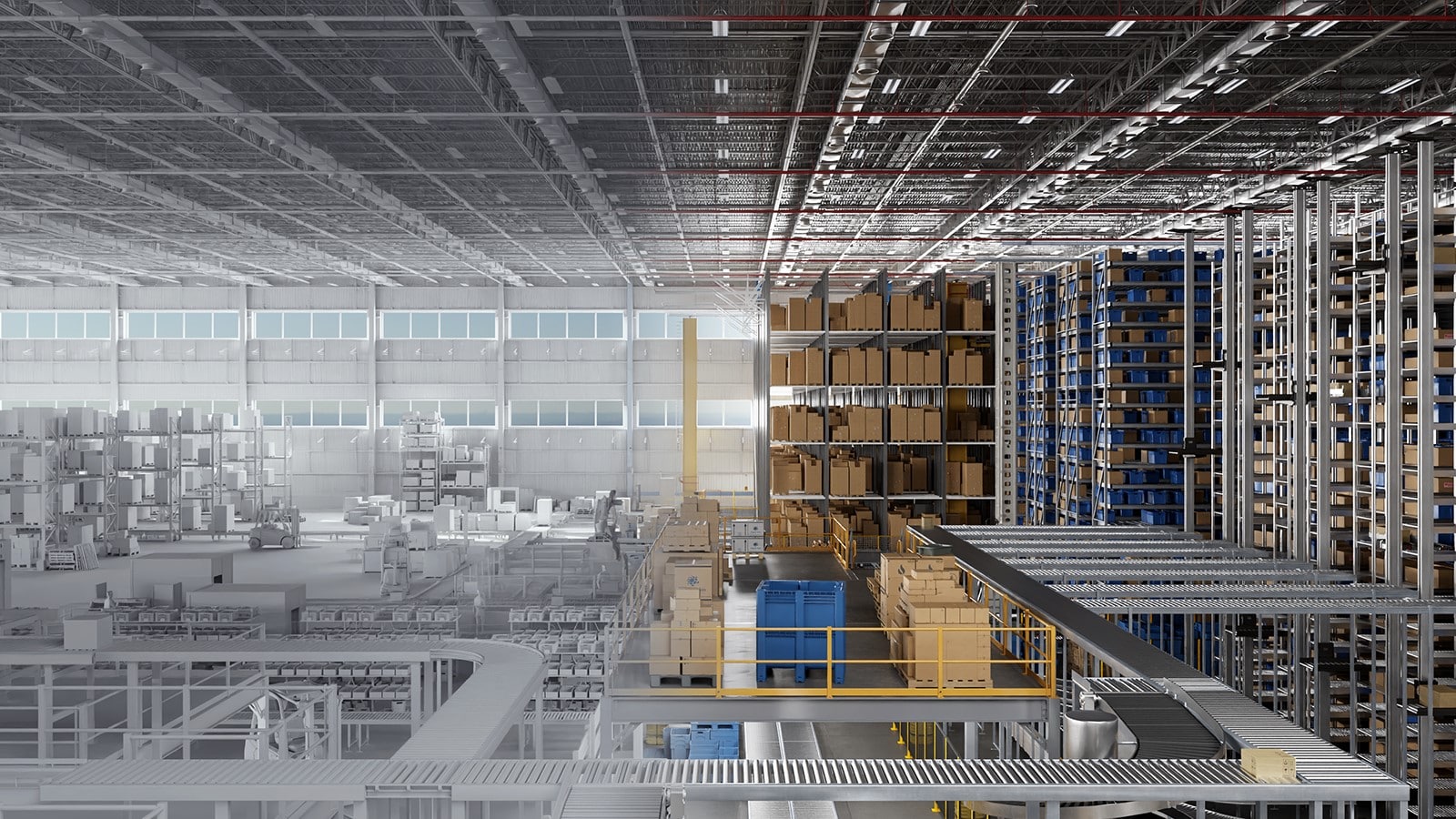
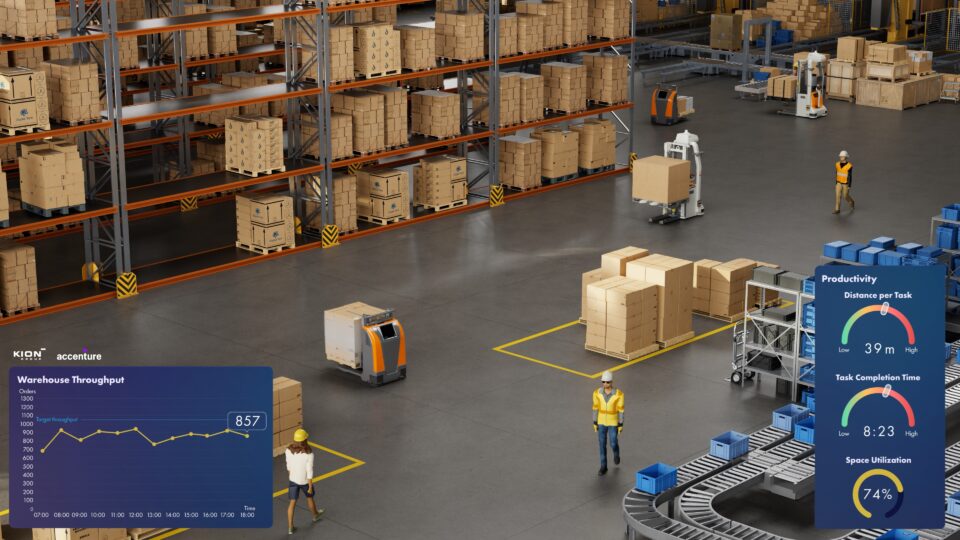
Choreographed integration of human workers, robotic and agentic systems, and equipment in a facility digital twin. Image courtesy of Accenture, KION Group.

NVIDIA today at CES announced “Mega,” an Omniverse Blueprint for developing, testing, and optimizing physical AI and robot fleets at scale in a digital twin before deployment into real-world facilities.

Advanced warehouses and factories use fleets of hundreds of autonomous mobile robots, robotic arm manipulators, and humanoids working alongside people. With implementations of increasingly complex systems of sensor and robot autonomy, it requires coordinated training in simulation to optimize operations, help ensure safety, and avoid disruptions.

Mega offers enterprises a reference architecture of NVIDIA accelerated computing, AI, NVIDIA Isaac, and NVIDIA Omniverse technologies to develop and test digital twins for testing AI-powered robot brains that drive robots, video analytics AI agents, equipment, and more for handling enormous complexity and scale. The new framework brings software-defined capabilities to physical facilities, enabling continuous development, testing, optimization, and deployment.

Developing AI Brains With World Simulator for Autonomous Orchestration

With Mega-driven digital twins, including a world simulator that coordinates all robot activities and sensor data, enterprises can continuously update facility robot brains for intelligent routes and tasks for operational efficiencies.

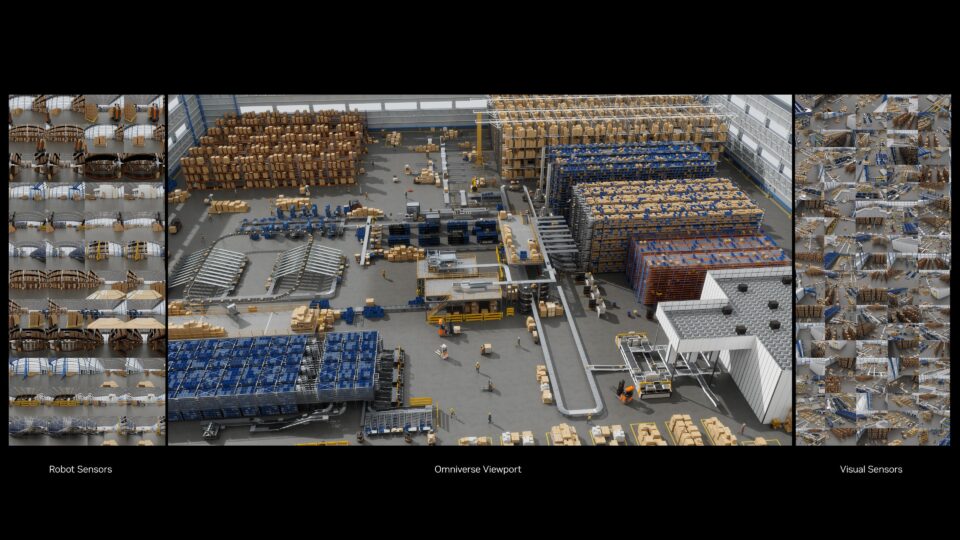
The blueprint uses Omniverse Cloud Sensor RTX APIs that enable robotics developers to render sensor data from any type of intelligent machine in the factory, simultaneously, for high-fidelity large-scale sensor simulation. This allows robots to be tested in an infinite number of scenarios within the digital twin, using synthetic data in a software-in-the-loop pipeline with NVIDIA Isaac ROS.

Digital facility with workers and robots moving around the floor. Images on either side of this view are tapped into various sensors mounted on the virtual robots moving around the facility.

Operational efficiency is gained with sensor simulation. Image courtesy of Accenture, KION Group.

Supply chain solutions company KION Group is collaborating with Accenture and NVIDIA as the first to adopt Mega for optimizing operations in retail, consumer packaged goods, parcel services, and more.

Jensen Huang, founder and CEO of NVIDIA, offered a glimpse into the future of this collaboration on stage at CES, demonstrating how enterprises can navigate a complex web of decisions using the Mega Omniverse Blueprint.

“At KION, we leverage AI-driven solutions as an integral part of our strategy to optimize our customers’ supply chains and increase their productivity,” said Rob Smith, CEO of KION GROUP AG. “With NVIDIA’s AI leadership and Accenture’s expertise in digital technologies, we are reinventing warehouse automation. Bringing these strong partners together, we are creating a vision for future warehouses that are part of a smart agile system, evolve with the world around them, and can handle nearly any supply chain challenge.”

Creating Operational Efficiencies With Mega Omniverse Blueprint

Creating operational efficiencies, KION and Accenture are embracing the Mega Omniverse Blueprint to build next-generation supply chains for KION and its customers. KION can capture and digitalize a warehouse digital twin in Omniverse by using computer-aided design files, video, lidar, image, and AI-generated data.

KION uses the Omniverse digital twin as a virtual training and testing environment for its industrial AI’s robot brains, powered by NVIDIA Isaac, tapping into smart cameras, forklifts, robotic equipment, and digital humans. Integrating the Omniverse digital twin, KION’s warehouse management software can create and assign missions for robot brains, like moving a load from one place to another.

Digital facility with workers and robots moving around the floor. Dashboard metrics are placed over the viewport of the digital twin, which showcase various throughput and productivity metrics related to the scene.

Graphical data is easily introduced into the Omniverse viewport showcasing productivity and throughput among other desired metrics. Image courtesy of Accenture, KION Group.

Delivering Services With Mega for Facilities Everywhere

Accenture, global leader in professional services, is adopting Mega as part of its AI Refinery for Simulation and Robotics, built on NVIDIA AI and Omniverse, to help organizations use AI simulation to reinvent factory and warehouse design and ongoing operations.

With the blueprint, Accenture is delivering new services — including Custom Robotics and Manufacturing Foundation Model Training and Finetuning; Intelligent Humanoid Robotics; and AI-Powered Industrial Manufacturing and Logistics Simulation and Optimization — to expand the power of physical AI and simulation to the world’s factories and warehouse operators. Now, for example, an organization can explore numerous options for their warehouse before choosing and implementing the best one.

“As organizations enter the age of industrial AI, we are helping them use AI-powered simulation and autonomous robots to reinvent the process of designing new facilities and optimizing existing operations,” said Julie Sweet, chair and CEO of Accenture. “Our collaboration with NVIDIA and KION will help our clients plan their operations in digital twins, where they can run hundreds of options and quickly select the best for current or changing market conditions, such as seasonal market demand or workforce availability. This represents a new frontier of value for our clients to achieve using technology, data, and AI.”

Conclusion:
The world of physical industries is now on the cusp of a software-defined moment, as predicted by Gartner. With the advent of Mega, the future of warehouses and factories is likely to be revolutionized. The integration of artificial intelligence, robotics, and simulation will bring about unprecedented efficiency, safety, and productivity to the physical world. With the collaboration between NVIDIA, Accenture, and KION, the future of