Home Blog Page 497

Beyond the Canvas: Midjourney’s Ambitious Evolution

0

What is Midjourney Patchwork?

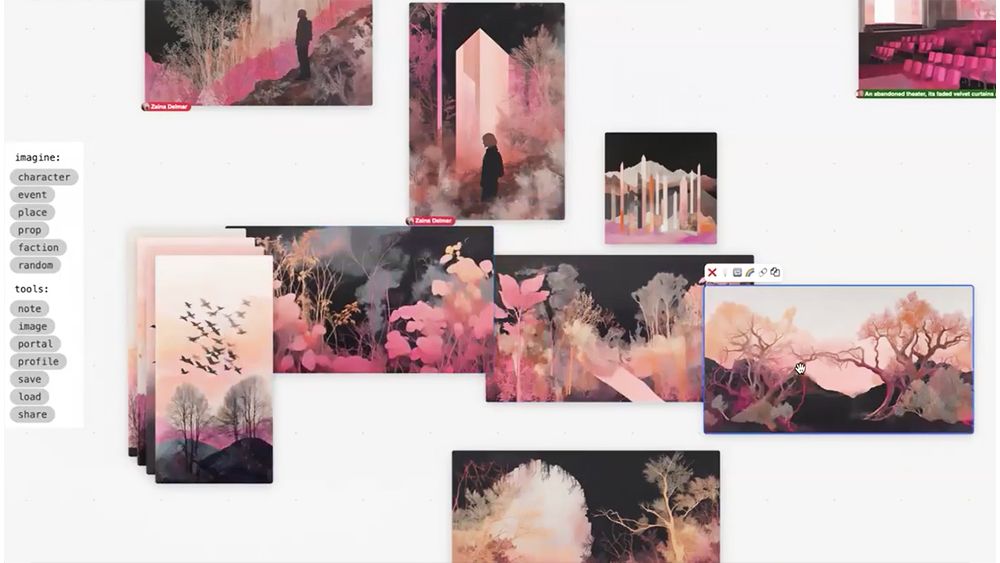
Midjourney Patchwork is a new experimental multiplayer worldbuilding tool that combines language models, image models, and a canvas-based interface to build the foundations of stories. It uses an infinite canvas, similar to Adobe Project Concept and Recraft AI image generator, and Kaiber Superstudio. The tool requires a Midjourney account for access and features a ‘Toolbox’ with options to add entities to the canvas, including characters, events, places, and props.

Features and Functionality

Midjourney Patchwork allows users to generate new worlds by entering a text prompt in an editor bar and selecting from a set of styles. Users can add new character boxes, prompting names, characteristics, and motivations to develop a story. Characters can be linked with lines that mark the connections between them.

The tool also includes collaboration options, allowing users to share boards with others, similar to Figma’s approach. Max Kreminski, leader of Midjourney’s Storytelling Lab, said that a world can support up to 100 users, although the more users, the more chaotic it could become.

What’s Coming Next to Midjourney?

Beyond the launch of Midjourney Patchwork, the company plans to launch Midjourney V7, introducing multiple character consistency across images. The company has also revealed more ambitious plans for the future, including the AI generation of immersive 3D virtual reality scenes, which is expected to be several years away.

Midjourney Founder David Holz has also mentioned that the company is working on hardware projects and aims to “branch out and become a full research lab”.

Conclusion

Midjourney Patchwork is a significant step forward in the development of AI-powered creative tools, offering a unique and innovative approach to worldbuilding and storytelling. While the tool raises questions about the role of AI in creative processes, it also demonstrates the potential for AI to augment and enhance human creativity.

FAQs

Q: What is Midjourney Patchwork?
A: Midjourney Patchwork is a new experimental multiplayer worldbuilding tool that combines language models, image models, and a canvas-based interface to build the foundations of stories.

Q: What features does Midjourney Patchwork offer?
A: Midjourney Patchwork offers a range of features, including the ability to generate new worlds, add entities to the canvas, link characters, and collaborate with others.

Q: What is the future of Midjourney Patchwork?
A: The company plans to launch Midjourney V7, introducing multiple character consistency across images, and has also revealed more ambitious plans for the future, including the AI generation of immersive 3D virtual reality scenes.

Q: Is Midjourney Patchwork available for free?
A: No, Midjourney Patchwork requires a Midjourney account for access, and the company has not announced any plans to offer it for free.

Q: What is the potential of Midjourney Patchwork?
A: Midjourney Patchwork has the potential to revolutionize the way we approach creative processes, offering a new and innovative approach to worldbuilding and storytelling.
Aligning LLMs with Human Preferences

0

Reinforcement Learning from Human Feedback (RLHF) for Building Trustworthy AI Systems

Reinforcement learning from human feedback (RLHF) is essential for developing AI systems that align with human values and preferences. By integrating human feedback into the training process, RLHF enables models to learn more nuanced behaviors and make decisions that better reflect user expectations. This approach enhances the quality of AI-generated responses and fosters trust and reliability in AI applications.

#1 Reward Model
The Llama 3.1-Nemotron-70B-Reward model is currently in first place on the Hugging Face RewardBench leaderboard for evaluating the capabilities, safety, and pitfalls of reward models. The model scored 94.1% on Overall RewardBench, meaning that it can identify responses that align with human preferences 94% of the time.

Implementation
To train this model, we combined two popular approaches to make the best of both worlds:

  • We trained with both approaches using data that we released in HelpSteer2. An important contributor to the model performance is high data quality, which we meticulously curated and then released to advance AI for all.

Leading Large Language Model
Using the trained Reward Model and HelpSteer2-Preference Prompts for RLHF training (specifically with the REINFORCE algorithm) produces a model that scores 85 on Arena Hard, a popular automatic evaluation tool for instruction-tuned LLMs. This makes this the best leading model on the Arena Hard Leaderboard, among models that do not require additional test-time compute.

Easy Deployment with NVIDIA NIM
The Nemotron Reward model is packaged as an NVIDIA NIM inference microservice to streamline and accelerate the deployment of generative AI models across NVIDIA-accelerated infrastructure anywhere, including cloud, data center, and workstations.

Getting Started
Experience the Llama 3.1-Nemotron-70B-Reward model from a browser today or test it at scale and build a proof of concept (PoC) with the NVIDIA-hosted API endpoint running on a fully accelerated stack. The Llama 3.1-Nemotron-70B-Instruct model can also be accessed here. Get started at ai.nvidia.com with free NVIDIA cloud credits or download the model from Hugging Face.

Conclusion
The Llama 3.1-Nemotron-70B-Reward model is a state-of-the-art reward model for RLHF that demonstrates exceptional performance on various evaluation metrics, including Overall RewardBench. With its high accuracy and efficiency, this model can be used for a wide range of applications, from language translation to text summarization.

Frequently Asked Questions

Q: What is RLHF?
A: Reinforcement learning from human feedback (RLHF) is a machine learning approach that combines human feedback with reinforcement learning to improve the performance of AI models.

Q: What is the Llama 3.1-Nemotron-70B-Reward model?
A: The Llama 3.1-Nemotron-70B-Reward model is a state-of-the-art reward model for RLHF that scores 94.1% on Overall RewardBench.

Q: How can I get started with the Llama 3.1-Nemotron-70B-Reward model?
A: You can get started with the Llama 3.1-Nemotron-70B-Reward model by visiting ai.nvidia.com and accessing the model through the NVIDIA-hosted API endpoint or by downloading it from Hugging Face.

Try 6 New AI Features Today

0

Genmoji, Image Playground, and More: What’s New in iOS 18.2 and Beyond

To kick off the roundup, let’s start with the feature Apple users will likely use the most — Genmoji. With this feature, users can generate emojis using text prompts that can then be sent as stickers, used inline with messages, or added to Tapback reactions. The prompts can be as fun as you’d like, such as “a T-Rex wearing a Christmas sweater.” Once the prompt is entered, users will have multiple options to choose from. When one is selected, it will populate under the Stickers tab for easy access in the future. Users can even create emojis using the likeness of family and friends. Genmoji is available for iPhone and iPad, with Mac availability coming in the upcoming months.

Image Playground allows users to create images from a combination of inputs, such as text prompts, existing images, themes, and descriptions, in different styles, including Animation or Illustration. If you are stumped, you can use the suggested recommendations to get your creative juices going. These generations can be created from the Message app and other Apple apps, such as Freeform, Pages, and Keynote. Once an image is made, it is saved to the user’s Image Playground library, which syncs across devices.

Writing Tools Updates (featuring ChatGPT)
Writing Tools, first introduced in 18.1, is updated to let users describe a change they’d like to make to text, such as altering the tone, giving the user more control and personalization options. This capability adds to the existing Proofread, Rewrite, and Summarize options. Another new option is Compose, which allows users to create text from scratch by leveraging ChatGPT from the native writing Tools option. Users will even be able to generate images using ChatGPT. It is worth noting that ChatGPT limitations will apply, so unless you are a subscriber, you are likely to hit usage limits, just like any free ChatGPT user on the native platform. Users can choose whether or not to enable the ChatGPT integration in Settings.

Siri with ChatGPT
Siri will now recognize when you ask questions outside its scope and ask if you’d like to process the query using ChatGPT. Before any request is sent to ChatGPT, there will always be a message notifying the user and asking for permission. Like the Writing Tools, Siri can answer several queries using ChatGPT, but it has usage limitations, as discussed above. Furthermore, any prompts sent to ChatGPT from Siri will populate your ChatGPT account if you are signed in, which is optional so you can pick up any conversation later.

Visual Intelligence
Visual Intelligence works with the Camera Control button on the iPhone 16 lineup, allowing users to search for anything they see with a simple tap. Some capabilities include searching Google to facilitate shopping for an item, using ChatGPT to learn more about something you are viewing, summarizing text, translating text, and more.

Image Wand
Image Wand transforms rough sketches into polished images in Notes. For example, if you draw a puppy freehand, you can circle it to generate a new image. Users can also circle words, key phrases, and handwritten notes to automatically create images relating to the content. If a blank space is circled, the Image Wand will gather context from its surroundings to generate images.

Conclusions
The new features in iOS 18.2 and beyond bring AI capabilities to the forefront, allowing users to create and interact with their devices in new and innovative ways. From generating emojis to transforming sketches into images, Apple’s latest update offers a range of exciting possibilities for users.

FAQs
Q: What is Genmoji?
A: Genmoji is a feature that allows users to generate emojis using text prompts that can then be sent as stickers, used inline with messages, or added to Tapback reactions.

Q: What is Image Playground?
A: Image Playground is a feature that allows users to create images from a combination of inputs, such as text prompts, existing images, themes, and descriptions, in different styles, including Animation or Illustration.

Q: What is Writing Tools?
A: Writing Tools is a feature that allows users to describe a change they’d like to make to text, such as altering the tone, giving the user more control and personalization options.

Q: How does ChatGPT work?
A: ChatGPT is a language model that can be used to generate human-like text and answer questions. It is integrated with Apple’s Writing Tools and Siri, allowing users to access its capabilities from within the native apps.

Google’s Gemini 2.0 Paving the Way for the Agentic Era

Tech Giants Compete in AI-Powered Search

Tech companies are in a relentless pursuit to integrate AI into every aspect of their offerings, from enhancing existing products to launching entirely new AI-powered solutions. The competition in this space is fierce, with leading players racing to develop cutting-edge models that can secure their position as leaders in the next wave of technological innovation.

Google Unveils Gemini 2.0

Google has unveiled Gemini 2.0, a new version of its flagship AI model designed to become the foundation for GenAI agents and assistants. The search giant has been on a mission to organize the world’s information for more than 26 years. At the end of last year, the company introduced Gemini 1.0, which it claimed was the first model built to be natively multimodal. Google is now expanding its efforts into AI, aiming to reshape how information is structured and accessed.

Key Features of Gemini 2.0

  • Gemini 2.0 Flash: Outperforms 1.5 Pro on key benchmarks, at twice the speed, and supports multimodal inputs such as images, text, video, and even multilingual audio.
  • Multimodal output: Natively generated images mixed with text and steerable text-to-speech (TTS) audio.
  • External tool support: Built-in support for external tools, such as Google Search and third-party functions, enabling it to gather information, execute tasks, and improve efficiency across a range of use cases.

Applications of Gemini 2.0

  • AI Agents and Real-time Assistants: The speed and efficiency enhancements make Gemini 2.0 more suitable for applications that require rapid response, such as AI agents and real-time assistants.
  • Research and Development: The model can be used for in-depth analysis, reducing time spent on manual research and allowing users to focus on higher-level tasks.

Integration with Other Google Projects

  • Project Astra: Gemini 2.0 enhances Project Astra, a visual system designed to identify objects, assist with navigation, and even help locate misplaced items.
  • Project Mariner: The new feature, formerly known as Jarvis, is an experimental Chrome extension that allows an AI agent to run the browser for the user.
  • Jules: Gemini 2.0 is also improving Jules, an AI-driven tool designed to assist developers in locating and fixing errors in code.

Conclusion

Gemini 2.0 is poised to make a significant impact as Google prepares to expand its reach. While issues like inference costs and performance efficiency still persist, Google may have to also contend with emerging threats, such as safety risks posed by autonomous agents. The model is set to power AI Overviews in Google Search, which now reaches over 1 billion users.

FAQs

Q: What is Gemini 2.0?
A: Gemini 2.0 is a new version of Google’s flagship AI model designed to become the foundation for GenAI agents and assistants.

Q: What are the key features of Gemini 2.0?
A: Gemini 2.0 features include Gemini 2.0 Flash, multimodal output, and external tool support.

Q: What are the applications of Gemini 2.0?
A: Gemini 2.0 is suitable for AI agents and real-time assistants, research and development, and other applications that require rapid response.

Q: How will Google integrate Gemini 2.0 across its ecosystem?
A: Google is set to integrate Gemini 2.0 across its entire ecosystem, including Google Search, Project Astra, Project Mariner, and Jules.

Samsung Galaxy Tab S10 Ultra: Big, Powerful, Expensive

0

Samsung Galaxy Tab S10 Ultra Review: A Powerful, but Expensive Tablet

Design and Build

The Samsung Galaxy Tab S10 Ultra features a 14.6-inch AMOLED display, which is impressive in terms of size and resolution. However, it may be too big for some users, making it feel like a glass picture frame that’s hard to handle. The tablet’s build quality is premium, with a sleek design that’s perfect for creative professionals who need a device that can handle demanding tasks.

Performance

The Tab S10 Ultra is powered by a MediaTek Dimensity 9300+ chipset, paired with 12GB of RAM and up to 1TB of storage. This combination provides seamless performance for demanding apps and multitasking. The tablet also features a 120Hz refresh rate, which enhances the overall visual experience.

AI Features

The Tab S10 Ultra comes with a range of AI-powered features, including a powerful AI processor that can handle tasks such as image recognition, language translation, and more. These features are designed to improve productivity and make the device more efficient.

Price

At the time of writing, the Samsung Galaxy Tab S10 Ultra retails for $1,199.99 / £1,199 for the model with 256GB of storage, which increases to $1,319.99 / £1,299 for the 512GB model, and finally $1,619.99 / £1,549 for the model with 1TB of storage. This is a premium price to pay for a tablet, especially considering that there are more affordable options available.

Who is it for?

The Samsung Galaxy Tab S10 Ultra is best suited for creative professionals who rely on apps and software to get a project complete. It’s also ideal for students who need a device for research and study. However, the price may be too steep for casual users or those who don’t require the tablet’s advanced features.

Buy it if:

  • You already own other Samsung devices
  • You need a tablet for creative work
  • You can handle the mammoth 14.6-inch display

Don’t buy it if:

  • You rely on iPad-exclusive apps
  • You’d prefer a top-spec laptop at a similar price
  • You want a tablet with a great camera

Also consider:

  • The Honor MagicPad 2, which offers similar specs at a lower price point
  • The Apple iPad Pro M4, which has a more compact design and a wider range of compatible apps

Conclusion:

The Samsung Galaxy Tab S10 Ultra is a powerful and feature-rich tablet that’s perfect for creative professionals and students who need a device that can handle demanding tasks. However, the price may be too steep for casual users, and there are more affordable options available. If you’re in the market for a high-end tablet, it’s worth considering the Tab S10 Ultra, but be sure to weigh the pros and cons carefully.

FAQs:

Q: What is the display size of the Samsung Galaxy Tab S10 Ultra?
A: The display size is 14.6 inches.

Q: What is the storage capacity of the Samsung Galaxy Tab S10 Ultra?
A: The storage capacity ranges from 256GB to 1TB, depending on the model.

Q: What is the refresh rate of the Samsung Galaxy Tab S10 Ultra?
A: The refresh rate is 120Hz.

Q: Is the Samsung Galaxy Tab S10 Ultra suitable for casual users?
A: No, the price may be too steep for casual users who don’t require the tablet’s advanced features.

Q: Are there any alternative tablets to consider?
A: Yes, the Honor MagicPad 2 and the Apple iPad Pro M4 are worth considering, especially if you’re on a budget.

WOW! These new AI Tools are amazing!

0

Discover these creative AI Tools!

🌟

Patchwork for MidJourney: Design Consistent Worlds and Characters

Patchwork is a new tool from MidJourney that allows you to design consistent worlds and characters with a seamless canvas. Perfect for crafting stunning scenes and immersive AI stories.

Pika2.0: The Game-Changing AI Video Tool

Pika2.0 is a revolutionary AI video tool that combines multiple images into cinematic video scenes. You can even use your face to maintain character consistency across scenes.

NVIDIA’s Meshtron: Create Hyper-Detailed 3D Models from Text or Point Clouds

Meshtron is a powerful tool from NVIDIA that allows you to create hyper-detailed 3D models from text or point clouds. Bring your ideas to life in ways you’ve never imagined!

Google Gemini2: An AI Assistant for Creative and Everyday Tasks

Google Gemini2 is an AI assistant that works multimodal (text, audio, image, video) to assist you in creative and everyday tasks. You can use Gemini2 Flash today!

Conclusion

These AI tools are changing the game for creators and artists. From designing worlds and characters to creating stunning 3D models and cinematic videos, the possibilities are endless. Let’s explore the future of creativity together!

FAQs

Q: What is Patchwork by MidJourney?
A: Patchwork is a tool that allows you to design consistent worlds and characters with a seamless canvas.

Q: How does Pika2.0 work?
A: Pika2.0 combines multiple images into cinematic video scenes and allows you to use your face to maintain character consistency across scenes.

Q: What is Meshtron?
A: Meshtron is a tool from NVIDIA that creates hyper-detailed 3D models from text or point clouds.

Q: How can I get started with Google Gemini2?
A: You can use Gemini2 Flash today to start using its AI assistant for creative and everyday tasks.

Links from my Video

Join and Support me

Timestamps

  • 00:02 Patchwork by MidJourney
  • 05:20 Pika 2.0 Video AI
  • 8:58 Meshtron Nvidia
  • 10:20 Gemini 2

AI to Go Undercover at Work by 2025

0

AI in the New Era: From Buzzy to Beneath the Surface

Every year, Deloitte releases its Tech Trends report, which delves into the past year’s technological landscape and identifies macro industry trends that will play a pivotal role in digital transformation in the upcoming 18 to 24 months. Unsurprisingly, artificial intelligence (AI) was a key area in this year’s edition, released today — just not in the same way as in the past.

AI in Business: A Posse of Special-Powered Agents

When AI chatbots like ChatGPT took the world by storm, the underlying large language models (LLMs) became sought after to optimize business operations. In these case scenarios, a business would have one chat window for all of its needs and all of its curiosities. What we’re starting to see is this fractal explosion where it’s going to be AIs (plural), dozens and then hundreds and eventually, thousands of domain-specific agents trained on domain-specific data.

AI in Hardware

During the past year, there has been an explosion in the amount of AI-centric hardware equipped with more advanced computational power. This hardware can run AI applications on-device and incorporate AI features and workflows. An enterprise and employee physical computer refresh is about to start, the likes of which we haven’t seen in 15 years. For the first time in a generation, physical kit, processors, servers, networking, laptops, they can be the key between getting to the future you want, and being stuck in the past.

Where Can You Get Started with AI?

Although the overall AI landscape has significantly changed from 2023, the advice on what area businesses should start with is the same as last year: data. Ultimately, whether your company is interested in using an LLM or SLM, you will need clean, organized, and up-to-date data to get the right results.

Conclusion

AI is moving from being a buzzworthy topic to becoming an underlying layer for key business operations. As AI permeates nearly all business operations, the initial apprehension about the technology is fading. Instead of wondering if they should go all-in on AI, business leaders now face the new hurdle of determining how to exploit the technology, exploring concepts like upgrading hardware, small language models (SLMs), agentic AI, and more.

FAQs

Q: What is the current state of AI in business?
A: AI is becoming an underlying layer for key business operations.

Q: What is the future of AI in business?
A: AI is moving towards a posse of special-powered agents, with dozens and then hundreds and eventually, thousands of domain-specific agents trained on domain-specific data.

Q: What is the most important aspect of AI in business?
A: Data is the most important aspect of AI in business, as it is needed for clean, organized, and up-to-date data to get the right results.

Q: What is the current trend in AI hardware?
A: There is an explosion in the amount of AI-centric hardware equipped with more advanced computational power, allowing for AI applications on-device and incorporating AI features and workflows.

Community Over Code

0

2024 Tracks

Track Information

The 2024 tracks are organized into the following categories:

Big Data

  • Big Data Compute: Uma Maheswara Rao Gangumalla, Dinesh Chitlangia
  • Big Data Storage: Uma Maheswara Rao Gangumalla, Dinesh Chitlangia

Cloud and Runtime

  • CloudStack, Cloud, and Runtime: Jean-Baptiste Onofré

Community and Development

  • Community: Rich Bowen, Jiang Nadia
  • Developer Experience: Matt Sicker

Data and Engineering

  • Data Engineering: Jarek Potiuk, Ismaël Mejía

Geospatial and Remote Sensing

  • Geospatial and Remote Sensing: George Percivall

Groovy and Incubator

  • Groovy: Paul King
  • Incubator: Justin McLean

Internet of Things and Performance Engineering

  • Internet of Things: Christopher Dutz
  • Performance Engineering: Roger Abelenda, Paul Brebner

Search and Security

  • Search: Anshum Gupta
  • Security: Mike Drob

Servers and Streaming

  • Serverside Chat with ASF Infra: Drew Foulks
  • Streaming: James Hughes, Dave Fisher
  • Tomcat, httpd, and Other Servers: Jean-Frederic Clere, Christopher Schultz

Important Notes

  • All session times are in Mountain Daylight Time (UTC -6).
  • You must be registered for Community Over Code NA 2024 to participate in the sessions. If you have not yet registered, please go to our event registration page to purchase a registration.
  • Timing of sessions and room locations are subject to change.

Frequently Asked Questions

Q: What is the format of the sessions?
A: The sessions are a mix of presentations, panel discussions, and hands-on workshops.

Q: Can I attend the sessions without registration?
A: No, you must be registered for Community Over Code NA 2024 to participate in the sessions.

Q: What if the timing of a session changes?
A: If the timing of a session changes, you will be notified via email and the event schedule will be updated on our website.

Q: What is the format of the event?
A: The event is a mix of presentations, panel discussions, and hands-on workshops.

Use Redux Toolkit’s createAsyncThunk for Async Data Fetching

0

Create AsyncThunk in Redux Toolkit

createAsyncThunk() is a function in the Redux Toolkit that is used to handle async operations such as API calls. This function automatically handles three main phases: pending, fulfilled, and rejected.

Create postSlice

import { createAsyncThunk, createSlice } from '@reduxjs/toolkit';
import axios from 'axios';

interface Post {
  id: number;
  title: string;
  body: string;
}

interface PostState {
  posts: Post[];
  loading: boolean;
  error: string | null;
}

const initialState: PostState = {
  posts: [],
  loading: false,
  error: null,
};

export const fetchPosts = createAsyncThunk(
  'posts/fetchPosts',
  async () => {
    const response = await axios.get('https://jsonplaceholder.typicode.com/posts');
    return response.data;
  }
);

const postSlice = createSlice({
  name: 'posts',
  initialState,
  reducers: {},
  extraReducers: (builder) => {
    builder
     .addCase(fetchPosts.pending, (state) => {
        state.loading = true;
      })
     .addCase(fetchPosts.fulfilled, (state, action) => {
        state.loading = false;
        state.posts = action.payload;
      })
     .addCase(fetchPosts.rejected, (state, action) => {
        state.loading = false;
        state.error = action.error.message || 'Failed to fetch posts';
      });
  },
});

export default postSlice.reducer;

Result

If you get this error, update store.ts and add middleware.

Error

Add Middleware

import { configureStore } from '@reduxjs/toolkit';
import { counterReducer } from './slice/counterSlice';
import { postsReducer } from './slice/postSlice';
import { persistReducer, persistStore } from 'redux-persist';
import storage from 'redux-persist/lib/storage';

const persistConfig = {
  key: 'root',
  storage,
};

const persistedCounterReducer = persistReducer(persistConfig, counterReducer);

export const store = configureStore({
  reducer: {
    counter: persistedCounterReducer,
    posts: postsReducer,
  },
  middleware: (getDefaultMiddleware) =>
    getDefaultMiddleware({
      serializableCheck: {
        ignoredActions: ['persist/PERSIST'],
      },
    }),
});

export const persistor = persistStore(store);

type RootState = ReturnType;
type AppDispatch = typeof store.dispatch;

Conclusion

By using createAsyncThunk() in Redux Toolkit, managing asynchronous operations like API calls becomes easier and more organized. This approach simplifies data fetching while ensuring a clean and scalable Redux state management structure.

I hope this guide helps you better understand Redux Toolkit, especially its async handling capabilities. If you have any questions or feedback, feel free to leave a comment!

GitHub Repo: https://github.com/rfkyalf/redux-toolkit-learn

Also, if you’re interested, feel free to visit my Portfolio Website www.rifkyalfarez.my.id to explore more of my projects. Thank you for reading.

FAQs

Q: What is createAsyncThunk in Redux Toolkit?

A: createAsyncThunk() is a function in the Redux Toolkit that is used to handle async operations such as API calls. This function automatically handles three main phases: pending, fulfilled, and rejected.

Q: What is the purpose of the extraReducers in createSlice?

A: The extraReducers in createSlice are used to add additional reducers to the slice. In this case, it is used to add the reducers for the async operation.

Q: What is persistStore in Redux Toolkit?

A: persistStore is a function in Redux Toolkit that persists the state of the store to local storage. This allows the state to be recovered when the application is reloaded.

Q: What is the purpose of the middleware in Redux Toolkit?

A: The middleware in Redux Toolkit is used to add additional functionality to the store. In this case, it is used to add the serializableCheck middleware, which allows the store to be persisted.

Faster and Smarter Gemini 2.0 AI

0

Google’s Gemini 2.0: The Next Step in AI

Google has long been obsessed with speed. Whether it’s the time it takes to return a search result or the time it takes to bring a product to market, Google has always been in a rush. This approach has largely benefited the company. Faster, more comprehensive search results pushed Google to the top of the market.

Gemini 2.0: The Next Generation of AI

The Gemini 2.0 announcement comes to us through a blog post by Demis Hassabis and Koray Kavukcuoglu, CEO and CTO of Google DeepMind, respectively. The top-level headline says that Google 2.0 is "our new AI model for the agentic era."

Agentic AI Ambitions

So, now let’s get back to the whole agentic thing. Google describes agentic as providing a user interface with "action-capabilities." Pichai, in his blog post, says agentic AI "can understand more about the world around you, think multiple steps ahead, and take action on your behalf, with your supervision."

Gemini 2.0 Flash

The Gemini Flash models are not chatbots. They power chatbots and many other applications. Essentially, the Flash designation means that the model is intended for developer use.

Improvements in Gemini 2.0

Gemini 2.0 has a laundry list of improvements including:

  • Multimodal reasoning: ability to understand and process information from different input types, like pictures, videos, sounds, and text
  • Long context understanding: ability to participate in conversations, rather than just answering one-off questions, the ability to keep track of what’s been discussed or processed and work from that history
  • Complex instruction following and planning: ability to follow a set of steps, or come up with a set of steps to meet a specific goal
  • Compositional function-calling: at the coding level, the ability to combine multiple functions and APIs to accomplish a task
  • Native tool use: ability to integrate and access services like Google search as part of the API’s capabilities
  • Improved latency: faster response time, making interactions more seamless, and helping to feed Google’s overall speed addiction

Project Astra

Project Astra is a prototype AI assistant that integrates real-world information into its responses and results. Think of it as a virtual assistant, where both the location and the assistant are virtual.

Project Mariner

Mariner works with what’s on your browser screen, essentially reading what you’re reading, and then responding or taking action based on some criteria.

Jules: Journey to the Center of the Codebase

Jules is an experimental agent for developers. This one also seems scary to me, so it may well be that I’m just not quite ready to let AIs run loose on their own. Jules is an agent that integrates into GitHub workflows and is expected to manage and debug code.

Avoiding Skynet

Google seems to firmly believe that AI can help make its products more helpful in a wide range of applications. But the company also seems to get the obvious concerns, stating, "We recognize the responsibility it entails, and the many questions AI agents open up for safety and security."

Conclusion

Google’s Gemini 2.0 is a significant step forward in the development of AI. With its improved latency, multimodal reasoning, and ability to integrate with other Google services, it has the potential to revolutionize the way we interact with technology.

FAQs

Q: What is Gemini 2.0?
A: Gemini 2.0 is a new AI model developed by Google DeepMind, designed to provide a user interface with "action-capabilities."

Q: What are the improvements in Gemini 2.0?
A: Gemini 2.0 has a laundry list of improvements, including multimodal reasoning, long context understanding, complex instruction following and planning, compositional function-calling, native tool use, and improved latency.

Q: What is Project Astra?
A: Project Astra is a prototype AI assistant that integrates real-world information into its responses and results.

Q: What is Project Mariner?
A: Project Mariner works with what’s on your browser screen, essentially reading what you’re reading, and then responding or taking action based on some criteria.

Q: What is Jules?
A: Jules is an experimental agent for developers, designed to manage and debug code.

Q: Is Google’s AI safe?
A: Google is taking steps to ensure the safety and security of its AI systems, including working with internal and external experts, conducting risk assessments, and implementing safety training.