Home Blog Page 519

Dark Decades: Aesthetics of the 90s Resurgence

0

Here is the rewritten article:

The Dark Aesthetics Set to Dominate 2025

01. Gothic

This mysterious aesthetic concerns elegant dark-colored clothing with velvet and silk elements, lace details, vintage jewelry, and heavy makeup. Abandoned Gothic mansions or cemeteries become the scene of events. Gothic-style visuals often include a contrasting color scheme built around black, red, and purple.

02. Grunge

Grunge emerged as a rebellious aesthetic in the 1990s and can still be recognized by attributes such as ripped jeans, dark heavy combat boots, and light flannel shirts. Its color scheme most often features colors like black and grey, as well as other earthy hues. Grunge visuals are muted, gloomy, and full of freedom of spirit.

03. Noir

Noir aesthetics came from cinema of the 1950s, in particular, detective stories with romance elements. This style has many iconic visual elements: foggy streets, bars in cigarette smoke, the shine of revolvers on tables, sharp shadows, women in red dresses, and much more. Color solutions in the noir style are built on contrasts between white, black, and red, and the plot of the visuals often touches on issues of moral choice.

04. Dark Femininity

This aesthetic works with ​​mysterious and powerful feminine energy, and operates with visual attributes such as smoky makeup, translucent fabrics, corsets, and other clothing that emphasizes one’s silhouette. The heroes of this aesthetic are not necessarily women, but the vibe is usually soft and feminine with an enigmatic touch. The dominant colors of this style are rich, deep red, plum, and purple tones.

All dark aesthetics have something in common. With their help, you can show how important it is to have an optimistic goal in front of us—something that inspires us to fight, work on ourselves, and ultimately move forward. In 2025, we want your brand to become a source of this life-giving light for customers, and hope your campaigns not only attract audience attention but also fill them with ideas about improving their lives.

Conclusion

By incorporating dark aesthetics into your visual communications and marketing efforts, you can create campaigns that resonate with your audience and stand out in the crowded digital landscape. By understanding the different styles and their visual attributes, you can choose the one that best aligns with your brand and message.

FAQs

Q: What are the key attributes of Gothic aesthetics?
A: Elegant dark-colored clothing, velvet and silk elements, lace details, vintage jewelry, and heavy makeup.

Q: What is Grunge aesthetics known for?
A: Ripped jeans, dark heavy combat boots, light flannel shirts, and a muted color scheme.

Q: How does Noir aesthetics differ from other styles?
A: Noir aesthetics is characterized by its use of foggy streets, cigarette smoke, and sharp shadows, which create a sense of moral ambiguity.

Q: Can Dark Femininity aesthetics be used by men?
A: While the heroes of this aesthetic are not necessarily women, the vibe is usually soft and feminine, and the aesthetic can be used by men who want to create a sense of mystery and power.

Fusing Reality

0

Discovering a New Art Style: Combining Traditional Crafts with AI-generated Art

Introduction

As a competitive costume crafts cosplayer with 7 years of experience, I’ve been experimenting with new art styles by combining traditional crafts with AI-generated art. With a background in video production and special effects, I’ve been able to bring my creative vision to life using digital art tools. In this article, I’ll share my experience creating a few new pictures by combining my skills with the power of AI.

Using AI-generated Art with Traditional Crafts

I’ve been using Stable Diffusion SDXL and DALL-E3 to create digital art, which I can then combine with my traditional crafts skills. For one of my projects, DSS Counter-Variant, I turned a photo of myself into a negative coloration.

Exploring NightCafe’ and AI-generated Art

For another project, DSS Fluid Cosmos 2, I used NightCafe’ to generate an image. While I don’t remember the specific generator type, I was impressed with the results.

Bringing Fantasy to Life with Skyrim and Dr. Strange

In another project, I combined my love of fantasy and cosplay by using a background from my gameplay in Skyrim: Elder Scrolls online. I also added a haunting video clip with musical embellishment.

Conclusion

By combining my traditional crafts skills with AI-generated art, I’ve been able to create some truly unique and captivating images. I’m excited to continue exploring the possibilities of this new art style and see where it takes me.

FAQs

Q: What inspired you to combine traditional crafts with AI-generated art?
A: I was looking for a way to bring new life to my traditional crafts skills and thought that combining them with AI-generated art would be an exciting way to do so.

Q: What AI-generated art tools do you use?
A: I’ve been using Stable Diffusion SDXL and DALL-E3 to create digital art.

Q: How did you learn to use AI-generated art tools?
A: I’ve been dabbling in special effects for 5 years and have experimented with different AI-generated art tools to learn how to use them.

Q: What’s the most challenging part of combining traditional crafts with AI-generated art?
A: I think the most challenging part is balancing the two styles and finding a way to make them work together seamlessly.

Narrowing the AI Gap

0

Artificial Intelligence: Why the Gap Between Interest and Reality?

Business leaders still talk the talk about embracing AI, but they aren’t walking the walk. According to a survey of senior analytics and IT leaders, only 20% of AI applications are currently in production.

Why the Wide Gap?

The answer is multifaceted. Concerns around security and data privacy, compliance risks, and data management are high-profile, but there’s also anxiety about AI’s lack of transparency and worries about ROI, costs, and skill gaps.

Get a Handle on Data

“High-quality data is the cornerstone of accurate and reliable AI models, which in turn drive better decision-making and outcomes,” said Rob Johnson, VP and Global Head of Solutions Engineering at SolarWinds. “Trustworthy data builds confidence in AI among IT professionals, accelerating the broader adoption and integration of AI technologies.”

Today, only 43% of IT professionals say they’re confident about their ability to meet AI’s data demands. Given that data is so vital for AI success, it’s not surprising that data challenges are an oft-cited factor in slow AI adoption.

Take Ethics and Governance Seriously

With regulations mushrooming, compliance is already a headache for many organizations. AI only adds new areas of risk, more regulations, and increased ethical governance issues for business leaders to worry about. While the rise in AI regulations might seem alarming at first, executives should embrace the support that these frameworks offer, as they can give organizations a structure around which to build their own risk controls and ethical guardrails.

Reinforce Control over Security and Privacy

Security and data privacy concerns loom large for every business, and with good reason. Cisco’s 2024 Data Privacy Benchmark Study revealed that 48% of employees admit to entering non-public company information into AI tools, leading 27% of organizations to ban the use of such tools.

Boost Transparency and Explainability

Another serious obstacle to AI adoption is a lack of trust in its results. The infamous story of Amazon’s AI-powered hiring tool, which discriminated against women, has become a cautionary tale that scares many people away from AI. The best way to combat this fear is to increase explainability and transparency.

Define Clear Business Value

Cost is on the list of AI barriers, as always. The Cloudera survey found that 26% of respondents said AI tools are too expensive, and Gartner included “unclear business value” as a factor in the failure of AI projects. Yet, the same Gartner report noted that AI had delivered an average revenue increase and cost savings of over 15% among its users, proof that AI can drive financial lift if implemented correctly.

Set Up Effective Training Programs

The skills gap remains a significant roadblock to AI adoption, but it seems that little effort is being made to address the issue. A report from Worklife indicates the initial boom in AI adoption came from early adopters. Now, it’s down to the laggards, who are inherently sceptical and generally less confident about AI – and any new tech.

The Barriers to AI Adoption are Not Insurmountable

While AI adoption has slowed, there’s no indication that it’s in danger in the long term. The many obstacles holding companies back from rolling out AI tools can be overcome without too much trouble. Many of the steps, like reinforcing data quality and ethical governance, should be taken regardless of whether or not AI is under consideration, while other steps taken will pay for themselves in increased revenue and the productivity gains that AI can bring.

Frequently Asked Questions

Q: What are the main barriers to AI adoption?

A: Concerns around security and data privacy, compliance risks, and data management are high-profile, but there’s also anxiety about AI’s lack of transparency and worries about ROI, costs, and skill gaps.

Q: How can organizations overcome the barriers to AI adoption?

A: Organizations can overcome the barriers to AI adoption by getting a handle on data, taking ethics and governance seriously, reinforcing control over security and privacy, boosting transparency and explainability, defining clear business value, and setting up effective training programs.

Q: Why is data quality so important for AI success?

A: High-quality data is the cornerstone of accurate and reliable AI models, which in turn drive better decision-making and outcomes.

Q: How can organizations ensure the transparency and explainability of AI results?

A: Organizations can ensure the transparency and explainability of AI results by prioritizing the development of rigorous AI governance policies, investing in explainability tools like SHapley Additive exPlanations (SHAPs), fairness toolkits like Google’s Fairness Indicators, and automated compliance checks like the Institute of Internal Auditors’ AI Auditing Framework.

Micro Miracles

0

Behind the Scenes of Samsung’s Micro Miracles Campaign

Samsung is one of the world’s leading manufacturers of semi-conductors – the microscopic bits of technology that exist on almost everything aspect of modern life but are so small we hardly know they are there. For a recent campaign, Micro Miracles, which won the much-coveted Brand Impact Awards Best of Show: Campaign award, ManvsMachine showcased these incredible pieces of technology by using the same techniques Samsung use to make the semiconductors to create a short film. The result is a groundbreaking spot that tells the story of technological progress through a series of nanoscopic dioramas, capturing incredible detail at one-60th of the width of a human hair.

How did you decide on the technological innovations you wanted to focus on?

Mike Sharpe: When we first read the script, we assumed that it was going to be done in CG. However, when we spoke with the agency (BMB) it turned out they wanted to do it for REAL and had already been researching whether it was possible. From that moment, we knew we wanted in and even at pitch stage BMB put us in touch with the technical partners that we needed in order to figure out the process – which was quite a crash course in nano-technology! As for the ’technological innovations’ showcased in the film, this was all part of BMB’s script – our job as directors was to work out how we could move from scene to scene in one flowing sequence.

How did you create these tiny models?

Damon van Drimmelen: Once we had all agreed on the scenes, we went about creating the models in various ways. For the scenes with people, we cast actors and used photogrammetry to capture their poses and then worked them into 3D models along with any extra elements such as a rock, bean bag or car. Other models, such as the rocket, the solar farm and the satellite, were sourced and then adapted and all of them then had to go through the process of converting the geometry to be 3D printed at such a small scale.

How did Stefan Diller help you bring your vision to life?

DvD: Stefan was vital. Traditionally, scaling electron microscopes (SEMs) only create still images, but his one-of-a-kind Nanolight system allowed us to create camera moves around the models. It’s a meticulous process, akin to stop motion, and he painstakingly recreated each shot from our animatic over a number of weeks.

What challenges did you come across in this project?

DvD: There were so many challenges operating at such a tiny scale and many obstacles to overcome. The fact that all the models had to be freestanding was a challenge both for printing perspective, as well as making sure they didn’t collapse or get damaged during the printing process, and also the fact that we had to work with objects that were smaller than a human hair and still get them to look like they were in real life.

What’s your favorite part of the finished work?

MS: We used the actual data from the SEM to show the scale in the UI graphics and it still blows my mind when I watch the film just how small the sculptures were. I’m beyond proud that we managed to do it for real and to have made a film in the nanosphere is utterly bonkers!

How do you think this identity helps Samsung stand out?

MS: Samsung is a company that needs to constantly innovate and be at the forefront of technology; films such as this that are truly groundbreaking support that company ethos in an engaging way. The fact that the creative approach is so neatly woven into the product itself is a genius move on the agency’s part and full credit to BMB for having such a brave idea in the first place!

What’s the feedback been like so far?

MS: Generally people can’t believe it was done for real and that’s testament to just how insane it all is! It was a real labor of love and took a long time to make so it’s really gratifying to see it getting so much love and picking up awards.

How does it feel to win the Best of Show (Campaign) at the BIAs?

MS: Such an honor. We knew we had won Gold but to win Best of Show too was an unexpected thrill and I couldn’t be prouder of everyone who worked on the film. Thanks BIA!

Q: What was the process of creating the tiny models like?

A: We used a combination of photogrammetry and 3D printing to create the tiny models. We cast actors and used photogrammetry to capture their poses and then worked them into 3D models along with any extra elements such as a rock, bean bag or car. Other models, such as the rocket, the solar farm and the satellite, were sourced and then adapted and all of them then had to go through the process of converting the geometry to be 3D printed at such a small scale.

Q: How did you overcome the challenges of working at such a tiny scale?

A: There were many challenges, from making sure the models didn’t collapse or get damaged during the printing process to working with objects that were smaller than a human hair. We had to be very patient and meticulous in our approach, and it took a lot of trial and error to get it right.

Q: What’s the impact of this campaign on Samsung’s brand?

A: We believe that this campaign has helped to further solidify Samsung’s position as a leader in the technology industry. The campaign’s innovative and groundbreaking approach has generated a lot of buzz and attention, and has helped to showcase Samsung’s commitment to innovation and excellence.

NVIDIA AI-Powered DataStax Development Platform

0

Getting Started Quickly with NIM Agent Blueprints and Langflow

NVIDIA NIM Agent Blueprints provide reference architectures for specific AI use cases, significantly lowering the entry barrier for AI application development. The integration of these blueprints with Langflow creates a powerful synergy that addresses key challenges in the AI development lifecycle and can reduce development time by up to 60%.

Consider the multimodal PDF data extraction NIM Agent Blueprint, which coordinates various NIM microservices including NeMo Retriever for ingestion, embedding, and reranking and for optimally running the LLM. This blueprint tackles one of the most complex aspects of building retrieval-augmented generation (RAG) applications: document ingestion and processing. By simplifying these intricate workflows, developers can focus on innovation rather than technical hurdles.

Langflow’s visual development interface makes it easy to represent a NIM Agent Blueprint as an executable flow. This allows for rapid prototyping and experimentation, enabling developers to:

  • Visually construct AI workflows using key NeMo Retriever embedding, ingestion, and LLM NIM components
  • Mix and match NVIDIA and Langflow components
  • Easily incorporate custom documents and models
  • Leverage DataStax Astra DB for vector storage
  • Expose flows as API endpoints for seamless deployment

Enhancing AI Security and Control with NeMo Guardrails

Building on the rapid development enabled by NIM Agent Blueprints in Langflow, enhancing AI applications with advanced security features becomes remarkably straightforward. Langflow’s component-based approach, which already enabled quick implementation of the PDF extraction blueprint, now facilitates seamless integration of NeMo Guardrails.

NeMo Guardrails offers crucial features for responsible AI deployment such as:

  • Jailbreak and hallucination protection
  • Topic boundary setting
  • Custom policy enforcement

The power of this integration lies in its simplicity. Just as developers could swiftly create the initial application using Langflow’s visual interface, they can now drag and drop NeMo Guardrails components to enhance security. This approach enables rapid experimentation and iteration, allowing developers to:

  • Easily add content moderation to existing flows
  • Quickly configure thresholds and test various safety rules
  • Seamlessly integrate advanced security techniques by adding more guardrails with minimal code changes

Evolving AI through Continual Improvement

In the rapidly advancing field of AI, static models — even LLMs — quickly become outdated. The integration of NVIDIA NeMo fine-tuning tools, Astra DB’s search/retrieval tunability, and Langflow creates a powerful ecosystem for continuous AI evolution, ensuring that applications achieve higher relevance and performance with each iteration.

This integrated approach uses three key components for model training and fine-tuning:

  • NeMo Curator: Refines and prepares operational and customer interaction data from Astra DB and other sources, creating optimal datasets for fine-tuning.
  • NeMo Customizer: Utilizes these curated datasets to fine-tune LLMs, SLMs, or embedding models, tailoring them to specific organizational needs.
  • NeMo Evaluator: Rigorously assesses the fine-tuned models across various metrics, ensuring performance improvements before deployment.

By modeling this fine-tuning pipeline visually in Langflow, organizations can create a seamless, iterative process of AI improvement. This approach offers several strategic advantages:

  • Data-driven optimization: Leveraging real-world interaction data from Astra DB ensures that model improvements are based on actual usage patterns and customer needs.
  • Agile model evolution: The visual pipeline in Langflow allows for quick adjustments to the fine-tuning process, enabling rapid experimentation and optimization.
  • Customized AI solutions: Fine-tuning based on organization-specific data leads to AI models that are uniquely tailored to particular industry needs or use cases.
  • Continuous performance enhancement: Regular evaluation and fine-tuning ensure that AI applications consistently improve in relevance and effectiveness over time.

Conclusion

The DataStax AI Platform built with NVIDIA unifies advanced AI tools included with NVIDIA AI Enterprise, DataStax’s robust data management, search flexibility, and Langflow’s intuitive visual interface, creating a comprehensive ecosystem for enterprise AI development. This integration enables organizations to rapidly prototype, securely deploy, and continuously optimize AI applications, transforming complex data into actionable intelligence while significantly reducing time-to-value.

FAQs

Q: What is the DataStax AI Platform built with NVIDIA?
A: The DataStax AI Platform built with NVIDIA is a unified, end-to-end solution that simplifies AI development, enhances security, and enables continuous optimization, allowing organizations to harness the full potential of their data for AI-driven innovation.

Q: What are the key components of the DataStax AI Platform built with NVIDIA?
A: The key components include NVIDIA NIM Agent Blueprints, Langflow, NeMo Guardrails, NeMo fine-tuning tools, and Astra DB’s search/retrieval tunability.

Q: How does the DataStax AI Platform built with NVIDIA reduce development time?
A: The platform can reduce development time by up to 60% by providing a unified stack, simplifying AI development, and enabling rapid prototyping and experimentation.

Q: What are the benefits of using the DataStax AI Platform built with NVIDIA?
A: The benefits include rapid AI development, enhanced security, continuous optimization, and customized AI solutions tailored to specific organizational needs or use cases.

Feature-wise Transformations

Many Real-World Problems Require Integrating Multiple Sources of Information

The Importance of Context-Based Processing

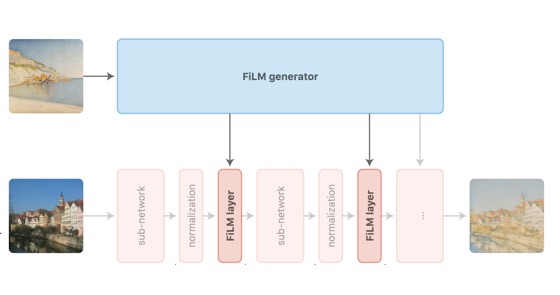
When approaching complex problems, it often makes sense to process one source of information in the context of another. In machine learning, we refer to this context-based processing as conditioning. The computation carried out by a model is conditioned or modulated by information extracted from an auxiliary input.

Feature-Wise Transformations

Feature-wise transformations are a specific family of approaches that condition on or fuse sources of information. We will examine the use of feature-wise transformations in various neural network architectures to solve a surprisingly large and diverse set of problems. The success of these approaches can be attributed to their ability to learn an effective representation of the conditioning input in varied settings.

Basic Example: Image and Class Labels

To motivate feature-wise transformations, let’s consider a basic example where two inputs are images and category labels. We are interested in building a generative model of images of various classes (puppy, boat, airplane, etc.). The model takes as input a class and a source of random noise (e.g., a vector sampled from a normal distribution) and outputs an image sample for the requested class.

Concatenation-Based Conditioning

Our first instinct might be to build a separate model for each class. However, this approach becomes impractical for a large number of classes. We can instead concatenate the conditioning representation to the input and pass the result through a linear layer to produce the output.

Conditional Biasing and Scaling

Another efficient way to integrate conditioning information into the network is via conditional biasing, which adds a bias to the hidden layers based on the conditioning representation. This can be thought of as another way to implement concatenation-based conditioning.

Conditional Scaling

Yet another approach is to integrate class information into the network via conditional scaling, which scales hidden layers based on the conditioning representation. A special instance of conditional scaling is feature-wise sigmoidal gating, which scales each feature by a value between 0 and 1, enforced by applying the logistic function.

Discussion

The way neural networks learn to use FiLM layers seems to vary from problem to problem, input to input, and even from feature to feature. There does not seem to be a single mechanism by which the network uses FiLM to condition computation. This flexibility may explain why FiLM-related methods have been successful across a wide variety of domains.

Conclusion

In conclusion, feature-wise transformations are a powerful approach for integrating multiple sources of information in neural networks. By conditioning on or fusing sources of information, these approaches can learn to capture complex relationships between different modalities or inputs. This flexibility has led to success in a wide range of applications, from visual reasoning to style transfer.

FAQs

Q: What is feature-wise transformation?
A: Feature-wise transformation is a family of approaches that condition on or fuse sources of information in neural networks.

Q: What is concatenation-based conditioning?
A: Concatenation-based conditioning is a method that adds the conditioning representation to the input and passes the result through a linear layer to produce the output.

Q: What is conditional biasing?
A: Conditional biasing is a method that adds a bias to the hidden layers based on the conditioning representation.

Q: What is conditional scaling?
A: Conditional scaling is a method that scales hidden layers based on the conditioning representation.

Q: What is feature-wise sigmoidal gating?
A: Feature-wise sigmoidal gating is a special instance of conditional scaling that scales each feature by a value between 0 and 1, enforced by applying the logistic function.

Integrating AI Starts with Robust Data Foundations

Building a Strong Foundation for Artificial Intelligence: Top Tips from Business Leaders

1. Put Your People First

Claire Thompson, group chief data and analytics officer at insurance giant L&G, emphasizes the importance of a strategic approach to information. "I always say data foundations are important for whatever you do next." A strong foundation links rules and regulations to dollars and cents. "Make it clear how the data strategy will drive tangible value — why is it important, for example, that your email addresses are up to date and accurate so that you can do targeted digital communications?"

Thompson recognizes that many people don’t want to get bogged down in a long-term strategic plan that defines the technology, processes, people, and rules required to manage information assets. However, she stresses that the planning stage is critical to reaping the benefits of technologies like AI.

2. Master Your Transactional Data

Jon Grainger, CTO at the legal firm DWF, believes there’s no time like the present when it comes to creating a data strategy. "I always say the best time for a data strategy is four years ago. It’s a supertanker piece of work. Ultimately, there aren’t many shortcuts. There is a view that says, ‘Well, if it’s going to take that long, why bother?’ And I think that’s why many folks haven’t been able to get to grips with their data."

Grainger wants his firm to build a reputation for delivering great experiences through digital transformation. A data strategy is a crucial component of that approach. He joined DWF in late 2022 and enacted a new strategy based on cloud-based software-as-a-service (SaaS) products and open application programming (API) interfaces.

3. Work with Your Industry Peers

Nic Granger, director of corporate and CFO at North Sea Transition Authority (NSTA), believes a great data strategy goes beyond internal working practices and spans organizational boundaries. "It was recognized that we needed a cohesive digital data strategy across the offshore energy sector," she said. "There were good pockets of excellence across the industry in data management and digital technologies, but they weren’t necessarily talking together. So that was a big priority for us."

Granger chairs the Offshore Energy Digital Strategy Group (DSG), a specialist body formed in late 2022 to create a collaborative effort across UK public bodies that deal with data collection in oil, gas, and renewables.

Conclusion

Building a strong foundation for artificial intelligence requires careful planning, collaboration, and a clear vision. By following the top tips from business leaders, organizations can establish a solid foundation for exploiting emerging technologies and reaping the benefits of AI.

FAQs

Q: What is the importance of data strategy in AI?
A: A data strategy is crucial for any company that wants to innovate and reap the benefits of AI.

Q: How can I ensure the quality of my data?
A: Ensure that your data is accurate, complete, and up-to-date, and that you have a clear plan for data governance and management.

Q: What is the role of data in digital transformation?
A: Data is a critical component of digital transformation, and a solid data strategy is essential for delivering great experiences through digital transformation.

Q: How can I collaborate with my industry peers?
A: Collaborate with industry peers to share best practices, resources, and expertise, and to create a cohesive digital data strategy across the industry.

Lego’s Weird Marvel Logo Set

0

The Great Lego Debate: Is the Marvel Logo Set a Brick Too Far?

The great thing about Lego is that you can use it to build almost anything. Lego’s used that to its advantage over the years, developing sets to tie in with all kinds of franchises, but fans are wondering if it’s latest is a brick too far.

A New Era of Lego Franchise Tie-Ins

Now, perhaps encouraged by the success it had when it fixed the Dune logo last year, Lego’s announced a buildable Marvel logo. And it’s basically just the logo of the comics brand with a few Avengers minifigures sticking out of it.

A Lukewarm Reception

The Lego Marvel logo could turn out to be a genius move if it works. It would unlock a whole new pipeline of easy hits. It could follow up with the DC Comics Logo, the IDW logo, the Tesco logo…

However, it seems that fans aren’t very impressed with the look of the 931-piece set, officially named 76313 MARVEL Logo. Its costs $99.99 / £89.99 and doesn’t do much. I mean, what’s the kid in the picture below even doing? How do you ‘play’ with a logo?

A Question of Interaction

There are minifigures of the original Avengers (minus Hawkeye, for some reason): Iron Man, Captain America, Thor, Black Widow, and the Hulk, but they’re not enough to add any real interaction to the set. The figures are stuck to poles so they can move in and out, but that’s it.

A Question of Purpose

Like who is this for? one Lego fan wonders over on the Lego Leak subreddit. And it’s a fair question, because it’s presumably not for that kid in the photo above. It’s something "to put in the backgound of your podcast studio," one person suggests in jest, but that’s probably about right.

A Comparison to Other Sets

Another person summed up the situation by comparing it to another recent set, the Batcave from the DC camp. “The LEGO Group sold us a black DC box, so now they’re selling us a red Marvel box." That DC box was at least a Batcave, though, someone points out. Some fans are even deriding the new minifigures too. “No arm prints, only two on here have prints on the legs. That’s really simplistic. Even for LEGO, that’s pitiful”, one person says.

Conclusion

The Lego Marvel logo set has left fans underwhelmed, and it’s hard to blame them. While it’s an interesting idea, the execution seems lacking. The set doesn’t offer much in terms of playability or creativity, and the price tag is steep for what you get. We’ll have to wait and see if this is a one-off or if Lego will continue to push out more franchise tie-in sets like this in the future.

FAQs

Q: Is the Lego Marvel logo set a good value for the price?
A: No, many fans feel that the set is overpriced for what it offers.

Q: Will the set be available on other platforms besides the Lego website?
A: Yes, the set will be available on other online retailers and in-store at select Lego stores.

Q: Can I customize the Marvel logo set with my own creations?
A: No, the set does not allow for customization.

Q: Is the set suitable for kids?
A: The set is rated for kids aged 10+, but some fans have expressed concerns about the lack of playability and creative potential.

Amazon Unveils Trainium3 Chip, Project Rainier

Amazon Unveils Trainium2 Chip for Training Large Language Models

Trainium2, first announced a year ago, is aimed at training large language models with trillions of parameters. It is now generally available on Amazon AWS’s EC2 instances.

New Trainium3 Chip Announced

At its annual re:Invent conference in Las Vegas, Amazon’s AWS cloud computing service disclosed the third generation of its Trainium computer chip for training large language models (LLMs) and other forms of artificial intelligence (AI), a year after the debut of the second version of the chip.

The new Trainium3 chip, which will become available next year, will be up to twice as fast as the existing Trainium2 while being 40% more energy-efficient, said AWS CEO Matt Garman during his keynote on Tuesday.

Trainium2 Now Generally Available

In the meantime, the Trainium2 chips unveiled a year ago are now generally available, said Garman. The chips are four times faster than the previous generation. The chips are geared toward LLM training, and Garman emphasized performance on Meta Platforms’s popular open-source model, Llama.

"Independent inference performance tests for Meta’s Llama 405B showed that Amazon Bedrock, running on Trn2 instances, delivers more than 3x higher token-generation throughput compared to other available offerings by major cloud providers," the company says.

UltraServers and Neuron SDK

Amazon also announced UltraServers, a new offering for AWS’s Elastic Compute Cloud service that connects 64 of the current Trainium2 chips "into one giant server", using NeuronLink interconnections. The servers are available now on EC2.

An UltraServer rack will run Trainium2 UltraServers that operate 64 Trainium2 chips for generative AI.

The UltraServer is designed to handle LLMs with trillions of parameters, said Amazon. To aid development for the Trainium parts, the company rolled out a software development kit, known as Neuron, that includes a compiler, runtime libraries, and tools optimized for Trainium. Neuron has native support for "popular frameworks" in AI such as JAX and PyTorch, and "over 100,000 models on the Hugging Face model hub".

Future Developments

Garman also gave a sneak peek at future developments. New versions of the UltraServers running Trainium3 are expected to be four times "more performant" than the Trainium2-based UltraServers, "allowing customers to iterate even faster when building models and deliver superior real-time performance when deploying them."

The company said work is underway to build "Project Rainier", which would be an "UltraCluster" grouping numerous UltraServers to allow access to "hundreds of thousands of Trainium2 chips". The UltraCluster is being developed in partnership with Gen AI startup Anthropic.

Conclusion

Amazon’s Trainium2 chip and UltraServers offer a significant boost to large language model training and deployment, with the potential to accelerate innovation in AI research and development. The company’s continued investment in this area is likely to pay dividends for customers and partners seeking to harness the power of AI.

FAQs

Q: What is Trainium2?
A: Trainium2 is a computer chip designed by Amazon for training large language models (LLMs) and other forms of artificial intelligence (AI).

Q: What is the difference between Trainium2 and Trainium3?
A: Trainium3 is the next generation of the Trainium chip, offering up to twice the performance of Trainium2 while being 40% more energy-efficient.

Q: What is UltraServers?
A: UltraServers are a new offering from Amazon that connects 64 Trainium2 chips into one giant server, designed to handle LLMs with trillions of parameters.

Q: What is Neuron SDK?
A: Neuron SDK is a software development kit from Amazon that includes a compiler, runtime libraries, and tools optimized for Trainium, designed to aid development for the Trainium parts.

OpenAI Ditches ‘AGI’ Clause in Partnership with Microsoft

Unlock the Editor’s Digest for free

Roula Khalaf, Editor of the FT, selects her favourite stories in this weekly newsletter.

OpenAI Reconsiders Clause That Would Limit Microsoft’s Access to Its Most Advanced AI Models

OpenAI is in discussions to remove a provision that limits Microsoft’s access to its most advanced artificial intelligence (AI) models when the start-up achieves "artificial general intelligence" (AGI).

The agreement

Under current terms, when OpenAI creates AGI, which is defined as a "highly autonomous system that outperforms humans at most economically valuable work," Microsoft’s access to such technology would be void. The OpenAI board would determine when AGI is achieved.

The change

The start-up is considering removing the stipulation from its corporate structure, enabling Microsoft to continue investing in and accessing all OpenAI technology after AGI is achieved, according to multiple people with knowledge of the discussions. A final decision has not been made, and options are being discussed by the board.

The clause

The provision was included to protect the potentially powerful technology from being misused for commercial purposes, giving ownership of the technology to its non-profit board. According to OpenAI’s website: "AGI is explicitly carved out of all commercial and IP licensing agreements."

The impact

But the provision potentially limits the value of its partnership for Microsoft, which has pumped more than $13bn into OpenAI, and could disincentivise the Big Tech group from further investment. More funding will be needed given the eye-watering costs involved in developing advanced AI models in a race against deep-pocketed rivals such as Google and Amazon.

The future of OpenAI

The San Francisco-based group led by Sam Altman, which was recently valued at $150bn, is currently restructuring to become a public benefit corporation. That move represents a departure from its origins as a not-for-profit research lab.

The OpenAI board

As part of the changes, OpenAI is discussing new terms with investors, including its largest shareholder Microsoft, according to multiple people familiar with the conversations.

What does this mean for OpenAI?

When we started, we had no idea we were going to be a product company or that the capital we needed would turn out to be so huge," Altman told a New York Times conference on Wednesday. "If we knew those things, we would have picked a different structure."

What is AGI?

Increasingly, people at OpenAI have moved away from defining AGI as a single point, instead emphasising it is a continuous process and will be defined by wider society.

The future of AI

OpenAI began raising outside capital in 2019, receiving a $1bn investment from Microsoft that year. At the time, the company said it intended "to license some of our pre-AGI technologies" to Microsoft to cover the costs of developing cutting-edge AI.

Conclusion

OpenAI’s decision to restructure and remove the AGI clause could have significant implications for its partnership with Microsoft and the future of AI development.

FAQs

Q: What is AGI?
A: AGI is defined as a "highly autonomous system that outperforms humans at most economically valuable work."

Q: What is the current agreement between OpenAI and Microsoft?
A: The current agreement limits Microsoft’s access to OpenAI’s most advanced AI models when the start-up achieves AGI.

Q: How much has Microsoft invested in OpenAI?
A: Microsoft has pumped more than $13bn into OpenAI.

Q: What is OpenAI’s current valuation?
A: OpenAI was recently valued at $150bn.

Q: Who leads OpenAI?
A: Sam Altman leads OpenAI.