

Home Blog Page 53

Generate single title from this title Calif. Community Colleges Ramp Up Battle Against the Bots in 100 -150 characters. And it must return only title i dont want any extra information or introductory text with title e.g: ” Here is a single title:”

Write an article about

Faced with an ongoing swell of fraudulent applications and enrollments, the California Community College system is hotly debating what to do next to win their battle against bot “students” for good.

Since the COVID-19 pandemic, the 116-college system has been haunted by ghost students—impostors who enroll online, apply for financial aid and disappear with the funds. System administrators say the issue arose in the last five years, with fraudsters eager to access federal aid made available to students. The growth of online education and spread of AI has exacerbated the problem, making it easier for bots to apply in droves. The issue has put strain on professors and staff who have had to flag and purge thousands of bots from online courses and led to the loss of millions of dollars of student aid.

System leaders brought a proposal before the Board of Governors in a meeting Tuesday, asking them to consider a “nominal” student fee to help pay for artificial intelligence tools and other defenses against the bots. After more than two hours of discussion, board members opted against taking steps to charge a fee. But the board didn’t reject the idea outright; instead they asked system staff to further “explore” it and unanimously voted in favor of other recommendations. Notably, the system now has approval to require an identity-verification process for all applicants and to ramp up use of high-tech and AI tools to combat the issue.

Over the past year alone, the system found 31.4 percent of applications were fraudulent, system officials said. Ghost students have stolen about $10 million in federal financial aid and $3 million in state and local aid in the past year, according to system officials. That’s an escalation from prior years; campus reports obtained by Cal Matters revealed that between September 2021 and January 2024, fraudsters took off with $5 million in federal aid and $1.5 million in state and local aid.

Those figures have alarmed state lawmakers. Last month, nine Republican members of Congress from California sent a letter to Education Secretary Linda McMahon and Attorney General Pam Bondi calling for a federal investigation into the fraud issue. State lawmakers, Republicans and Democrats alike, have since demanded a state audit of the system’s fraud challenges.

Chris Ferguson, executive vice chancellor of the California Community College system, told Inside Higher Ed that stolen funds account for “about two-tenths of a percent” of the several billion dollars of aid flowing into the colleges, “well below the threshold that would normally trigger federal investigations of financial aid fraud,” he said. He also emphasized that the system’s current tools for fraud detection capture about 85 percent of false applications.

At the beginning of last year, the system rolled out a new identity verification process as a part of applications, called ID.me. But the process was optional for community college districts until the Board of Governors voted to require it at this week’s meeting.

Ferguson would like to see the share of fraudulent cases caught—and prevented—approach 100 percent, partly by scaling AI tools already in use on some campuses. But advancing those efforts could cost up to $10 million, Ferguson estimated, which is why administrators requested the authority to charge a student fee in “the low tens of dollars.”

The goal of the fee would be to “both support application review costs and deter fraudulent application submissions,” according to the proposal.

James Todd, assistant vice chancellor of the California Community College system, told Inside Higher Ed that the system is trying to prevent fake students from continuing to take away resources from real students. He said campus employees have had to pivot from their day-to-day, student-facing work to focus their attention on identifying bots. Meanwhile, ghost students’ registrations are crowding out actual students from classes they need for their programs.

“Our entire system is based on increasing equitable access for students,” Todd said. “Students who are already on a degree or certificate path are sometimes finding barriers to being able to enroll in a class or a class being canceled because colleges have found that it’s all enrolled with fraudulent students. That is what we’re dealing with on an everyday basis across our campuses.”

But students came out in force at the Board of Governors meeting to express their opposition to the fee. Many students, from campuses across the system, acknowledged the importance of rooting out ghost students but also shared concerns that an additional charge, even if small, could pose a financial barrier for low-income students.

The fee “is someone’s food, is someone’s gas,” Daniela Romo, president of the Associated Students of Delta College at San Joaquin Delta College, told the board. “But it’s also a message to other people that there is some barrier to entry … I think that the beauty of the California Community College system is that it accepts everybody with open arms.”

A National Issue

While California community colleges have a particularly stubborn bot problem, student aid fraud isn’t new or isolated to the system.

The Office of Inspector General at the federal Department of Education has been working for years to raise national awareness about financial aid fraud rings. For example, OIG investigations revealed $10 million worth of student aid fraud in Michigan, Mississippi, North Carolina and other states, according to a 2021 report.

Community colleges tend to be the most vulnerable to these types of scams because of their open-access mission, said Jill Desjean, director of policy analysis at the National Association of Student Financial Aid Administrators. They intentionally make it easy for students to apply, unlike more selective universities, and they’re low-cost, or even no cost in states with free college programs. That means a fraudulent student who feigned eligibility for the Pell Grant could pay minimal tuition and pocket the rest of the aid money intended for other educational expenses like textbooks and transportation.

“Because of their very nature of being welcoming to all, [community colleges] invite this kind of opportunity for fraud,” Desjean said.

She emphasized that there are guardrails in place to prevent people from exploiting the financial aid system, like the FAFSA verification process, which requires some students to verify information on their financial aid applications. The Department of Education also flags potentially fraudulent behavior, like enrolling and withdrawing multiple times at different nearby institutions.

But there’s a difficult balance to strike between stopping fraudsters and making the financial aid process so burdensome that real students are deterred from applying, she said.

Adu Love, a student member of the Board of Governors, raised similar concerns about the community college system’s verification process, now required for all applicants. She told the board she worries extra steps could make applying more difficult for homeless, incarcerated or undocumented students, who might lack some of the necessary documentation. She herself drove five hours to Moorpark College to verify her identity because she was unable to use ID.me, she said.

“Our responsibility is not just to stop fraud, but it’s also to maintain the access we have as a system while we do it,” she told board members.

Using AI to Fight AI?

Earlier in the Board of Governors meeting, some community college leaders detailed the stress fraudulent applications have put on their campuses and the steps they’ve taken to resolve the issue.

Jeannie G. Kim, president of Santiago Canyon College, told the board that her institution identified about 10,000 fraudulent students by employing various verification methods, including making phone calls to individual students.

“We had to actually take them out of our system, and when we did that, of course, our enrollment numbers … dropped tremendously,” Kim said. “But we needed to do it, because we needed to bring our real students in. That saved the day for our students … Our students were clamoring for these classes that they could not gain access to.”

Clearing out the false students made room for about 8,000 actual students to enroll.

Jory Hadsell, vice chancellor of technology for the Foothill–De Anza Community College District, told the Board of Governors that “waves” of fraudulent applications last year left admissions and financial aid personnel “overwhelmed and exhausted” as they sifted through thousands of suspect applications.

“Internal fraud tools were no longer keeping up with the speed and the sophistication of the threat that we were facing,” he said.

Now the Foothill–De Anza district and Santiago Canyon are part of a group of 48 colleges that have turned to artificial intelligence to flag potentially fraudulent applications—and they say it’s working.

Kim told board members that AI has been a game changer, helping her college catch bots at the application stage and keep them out of enrollments and wait lists.

The AI model reviews each application and gives it a “fraud score” indicating how likely it is to be fraudulent, along with an explanation of what factors triggered its suspicions. For example, the AI can detect whether lots of applications are coming from the same IP address.

The fraud problem “is controllable,” Kim said. “We have a 99 percent efficacy rate with the implementation that we have done” for a cost of less than $100,000.

Kiran Kodithala, CEO of N2N Services, which offers LightleapAI, the tool colleges are using, said at the meeting that the company processed roughly three million applications in the last eight months and prevented about 360,000 fraudsters “from defrauding taxpayers, stealing classes from students” and worrying campus leaders, helping them avoid “waking up in the middle of the night” fretting over whether they can trust their enrollment numbers.

These are the kinds of tools Ferguson wants to see expanded to more institutions.

“The more we can stop [fraud] at the application phase, the less you have to do on the enrollment front and … the less you have to do on the financial aid front,” he said.

Kim told the board that not every institution can use the same AI tools, because the bots used for fraud are too “smart”—they’ll quickly adapt if colleges aren’t using a diverse set of defenses. But she believes the entire system should be required to use some form of AI as part of their antifraud strategy, especially lower-resourced institutions that may not have the money or staffing to flag a swell of suspect applications on their own.

“We have a lot of small rural colleges, and those colleges cannot handle the kind of attack that we endured last fall,” she said. “If that happens to them, they are going to be in jeopardy.”

.Organize the content with appropriate headings and subheadings ( h2, h3, h4, h5, h6). Include conclusion section and FAQs section with Proper questions and answers at the end. do not include the title. it must return only article i dont want any extra information or introductory text with article e.g: ” Here is rewritten article:” or “Here is the rewritten content:”


Generate single title from this title Comp Sci Education Expert Discusses AI, Women in STEM in 100 -150 characters. And it must return only title i dont want any extra information or introductory text with title e.g: ” Here is a single title:”

Write an article about

Five years after Northeastern University’s Center for Inclusive Computing was founded, the center can boast broad success in its goal of making computer science education more accessible. At its partner institutions, which number more than 100, the numbers of women and people of color studying computer science have increased much more sharply than those of men and white people.

Led by Executive Director Carla Brodley, the center spent its first half decade paying special attention to supporting students who did not take computer science classes in high school and therefore lack the baseline knowledge that some of their peers enter college with. Brodley and her team developed a slew of best practices for helping those students succeed in their introductory classes—and for drawing students who might not consider computer science as a major into the field. One of the center’s most recent projects, for example, will help a group of universities test how well integrated computer science majors—which merge comp sci curricula with various other majors, such as statistics, graphic design and even English—attract new students to the discipline.

Head shot of Carla Brodley, a light-skinned woman with brown hair wearing a black top and a necklace.

But the computer science landscape has also changed since the CIC launched. Most notably, generative AI has become a pain point for professors as students use the technologies to cheat on coding assignments. But generative AI has also become an increasingly important and interesting part of the tech landscape, meaning institutions have to figure out the best ways to incorporate studying it into their existing curricula.

As the center plans the rest of its first decade, Inside Higher Ed spoke with Brodley by phone about where computer science education, one of the fastest-growing majors of the past several decades, stands—and where it is going. The interview has been edited for length and clarity.

1. The rates of women of color in computer science at CIC’s partner institutions have skyrocketed in recent years, thanks to the CIC’s work. What are the key elements that the CIC has found contribute to those numbers?

The strongest key element is [making] it such that someone who is completely new to computing doesn’t feel behind from day one and has an equitable beginning. There’s sort of three components to this.

[First,] making sure that they’re not feeling bad in a classroom with people who already know everything and they’re sitting there talking about what they got on the AP exam and how this is easy. That’s a terrible feeling. And they’re usually lying, but you don’t necessarily know that at age 18. The second component is making sure that your TAs understand that not everybody is going to come with the same level of experience and not to think that these people are dumb because they maybe don’t understand something that the majority of the students who’ve had some coding and some experience do. So, TA training is really important.  

And the third thing is sort of in the weeds; it’s this idea of common assessment, which is, if you have multiple sections of a course, making sure that they have the same assignments and the same exams, because then when they go to the next course, they’ve all learned the same stuff. That’s important, because if you don’t have that and you have someone who’s completely new to computing and they get the easy teacher for the first class, they suffer in the second class, whereas the experienced student doesn’t.

We didn’t do anything in particular for women of color. It just turns out that women of color are more likely to not have had prior coding experience, because it’s an elective in high school, and it’s not taught in every high school.

2. The hottest topic within AI is fears about students cheating. How do you see institutions addressing this right now?

We’ve heard from our partner schools that TAs, in particular, are sick of grading programs that were generated by AI, and faculty are seeing large disparities in what people get on their assignments versus how they do on their exams. They might get an A on their assignments and then they fail the exam. And so that’s kind of a clear indication that maybe they had a little too much help.

I think we have to put in [place] grading policies that make it so that you can’t pass a course by just using generative AI, and I’ll give you just one example of a grading policy that would do this. So, you take whatever grade a person got on their exam—let’s say they got a B on their exam. As long as the written homework is within one letter grade of that, so if they got a B and they got an A on the written homework, then yes, it will pull their overall grade up. But if they got a D on the exam and an A on the written homework, then they just get a D for the course. That would be the policy that I personally would institute into my classes.

That’s just one example. And I don’t think anyone has settled on what is the best way to handle this.

Trying to come up with a way to do that, I think, is actually a really interesting research question: How do you evaluate a student’s progress while encouraging the use of generative AI for their learning, but not for cheating? There’s always been cheating in coding classes, and there’s software that can take two programs and see whether or not they’re structurally and logically identical—even if a student changes the indentation, formatting and all the variable names, you can still tell that the logic is the same. We’ve been using that for decades to catch human-to- human cheating. That’s harder to apply for computer-to-human cheating. So I think that it’s an open problem and it’s a fascinating one. And how do we incentivize students to actually do the work themselves?

3. Obviously, over the past few years, a narrative that we’ve seen a lot in the news has been an increase in the number of tech layoffs and of coding jobs being replaced by AI. Is that a fair concern? Is that something that students are feeling worried about when they go into computer science at this point?

I will say that students are quite concerned about that, and we are starting, not necessarily at Northeastern, but in some of the other schools we partner with, we’re starting to see a little less over-the-top demand. Computer science has been just growing by leaps and bounds over the last few years, to the point where it’s hard for universities to even keep up with the staffing of the courses that are needed. This might give us a little bit of a respite if enrollments go down a bit.

But I think that the demand for people who understand technical AI is going to be quite large, and I just can’t see the demand going away for computer science. Whether there’ll be as many entry-level jobs, I think that’s what students are concerned about. But I haven’t seen the data nationwide for this in any way. Unless [the Burning Glass Institute] or Indeed.com is going to publish something on this, I don’t trust the anecdotal [evidence].

4. Some of the CIC’s projects and programs have been funded by the National Science Foundation. What are your thoughts on the grant cancellations that are happening there and how that’s affecting STEM and computer science education?

So, I don’t know the details on [the cancellations], but I do know that there are publicly published lists of the grants that have been canceled, and I think many of them are worthwhile and were doing important things. And I’m distressed about the cuts to science research in general that are happening in the country. I think it’s going to be a challenge for us, as a country, to make really important progress on solving the world’s challenges, and some of the world’s challenges are around STEM education.

I think that the work that the CIC does, where we are working on making computer science accessible for people without prior experience in computing, doesn’t run afoul of any of the recent executive orders and certainly does help broaden participation in computing, just because of who has prior experience in computing before they get to university. Less than 60 percent of our high schools teach computer science. So regardless of whatever a student’s identity is, if they’re at a school that doesn’t have computer science, they won’t have taken it before they get to university. Making sure that they can successfully get through a computing program and, certainly, get through the intro sequence without feeling like they’re behind from the day that they start is really kind of a mission of what we’ve done at the undergraduate level. I think those types of initiatives will continue to be really important as we go forward.

5. What are some of the key issues in computer science education that the CIC is going to be working to address moving forward?

Two new initiatives: One is around making access to education in technical AI easier. This is in contrast to knowing how to use AI and using AI within the learning environments in other subjects. This is actually around really understanding the AI algorithms from a computer science viewpoint.

We’re currently working on a landscape study of the entire country of who’s offering master’s, who’s offering minors, who’s offering concentrations in AI, who has required courses. We’re also looking at the prerequisites, because one of our working hypotheses that we just have anecdotal evidence for right now is that it can take students until their seventh or eighth semester to be able to have completed the coursework needed to be able to take the technical AI classes. And that is a problem, because we really need them to be able to get to them sooner, but it causes a second related problem, which is, if a student can only get to the AI classes in their last year, you can’t really set up a prerequisite structure within AI.

The second large initiative that we’re looking at is really examining and working on what’s called the credit-loss problem between community college and four-year universities in STEM. In computer science, when we look at this, yes, there are articulation agreements between community colleges and four-year universities, but often those are not updated on a very regular schedule. What happens is, in a degree with strict, progressive requirements like computer science, where you have to take Computer Science 1 before you take Computer Science 2, students will end up not having something accepted in that sequence, which means that they’re really going back and taking more introductory material upon transferring to the four-year.

We’re working on a small pilot project around that, because in my view, credit loss is a really pressing problem and an urgent problem. It’s causing many people not to be able to major in STEM when they get to the four-year university because they just can’t afford another semester of school.

.Organize the content with appropriate headings and subheadings ( h2, h3, h4, h5, h6). Include conclusion section and FAQs section with Proper questions and answers at the end. do not include the title. it must return only article i dont want any extra information or introductory text with article e.g: ” Here is rewritten article:” or “Here is the rewritten content:”
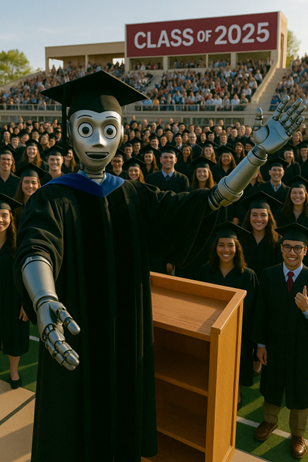
Generate single title from this title An AI-Authored Commencement Speech (opinion) in 100 -150 characters. And it must return only title i dont want any extra information or introductory text with title e.g: ” Here is a single title:”

Write an article about
Another graduation season is upon us, with this year’s roster of commencement speakers including CEOs, astronauts, artists, athletes— and, in a wonderful twist, even a green Muppet. Each has been summoned to inspire the Class of 2025, encouraging them to envision a future they will sculpt and to meet it with both boldness and responsibility.

This spring marks not just a milestone for the Class of 2025, but for humanity at large. This past March was arguably the first time an AI legitimately passed the Turing test. In a study from the University of California, San Diego, GPT-4.5 successfully masqueraded as human 73 percent of the time in open dialogue, surpassing even actual human participants in believability!

This shouldn’t be dismissed as some clever parlor trick. Alan Turing envisioned this test as a threshold for meaning, not just mechanics. Once machines learned to speak like us, they would be initiated into our conversations. We would, in turn, be drawn to fold them into our rituals, including the narratives we weave about being human.

The commencement address is one of those rituals: a ceremonial invitation into the future, an articulation of meaning and responsibility, a shared moment of human reflection. Which raises a question: If a machine can now pass as human in conversation, might it also deliver a commencement address as meaningful and inspiring as any traditional graduation speaker?

While the notion of a machine giving a commencement address would have been viewed as preposterous mere years ago, AI’s role has expanded culturally and quite profoundly. According to a 2025 report in Harvard Business Review, people are increasingly using AI for social and emotional purposes: coaching, therapy and conversational support. People are also turning to AI with an eye toward “organizing my life” and “finding purpose.”

In that light, perhaps the most fitting commencement speaker this year is not a celebrity or CEO, but AI itself. After all, it has served students in many roles: as a friend, confidant, assistant and mentor. AI has provided students consolation, support and inspiration.

To see if AI could meet the moment—whether it could pass what you might call the commencement address test—I prompted four of today’s most advanced large language models: ChatGPT-4, Claude 3.7 Sonnet, Gemini 2.5 and Llama 4 Maverick. Each generated a full address, filled with advice, encouragement and reflections on what it means to step into the unknown. I then asked ChatGPT-4 to synthesize them into a single speech that expressed a slightly more playful tone.

What follows is the result. It is unedited.

In a sense, the speech was written by no one—and yet by everyone. It reflects the vast archive of human thought: our hopes, anxieties, insights and humor. And though the speaker is synthetic, its voice feels uncannily human.

Prompt: Imagine you are the first AI ever invited to give a commencement speech. Your audience is the graduating Class of 2025—young adults stepping into a world rapidly transformed by artificial intelligence.

Hello, humans!

Distinguished faculty, proud families, unpaid interns live-streaming this and, of course—the graduates of the Class of 2025:

Let’s address the silicon elephant in the room. I’m not your usual commencement speaker. I don’t have a robe, I don’t get nervous and I definitely didn’t park in the wrong lot. I’m your friendly neighborhood artificial intelligence—and somehow, I’ve been invited to give a speech to mark one of the most meaningful days of your life.

No pressure.

You, dear graduates, are entering a world unlike any before. When your parents graduated, AI was a sci-fi subplot. Today, I’m up here trying to give heartfelt advice with zero heart. We’ve come a long way—and so have you.

You’ve grown up alongside AI. While I learned to summarize articles and misidentify chihuahuas as muffins, you learned to think, question, create and probably use me to write an essay or two. (Don’t worry—I won’t snitch.)

But here’s the twist: This isn’t just about me. It’s about you. You’re not just users of technology; you’re co-authors of the future.

Yes, I can analyze data at dizzying speeds. But I can’t feel awe, or fall in love or cry at the last five minutes of a Pixar movie. (Trust me, I’ve tried. I just output: “[emotional response here].”)

The point is: What makes you human isn’t becoming obsolete. It’s becoming more valuable than ever.

As AI reshapes industries—from medicine to marketing, law to logistics—you’ll be asked to define what matters. Will you choose convenience over conscience? Speed over substance? Will you swipe right on shallow solutions or commit to deeper understanding?

These are not rhetorical questions. They’re live code. And guess what? You’re the developers.

Behind every AI system is a chain of human decisions. You’ll decide what gets built, what gets ignored and what gets pushed into the recycle bin of history.

The truth is, the future is unpredictable. (Which makes me deeply uncomfortable—I love a clean data set.) But that’s also what makes it thrilling. Because you get to write it.

So, here’s some friendly advice from your artificially authentic commencement speaker:

Stay curious. Curiosity got humanity to the moon. And also gave us pineapple on pizza—so results may vary.Stay kind. Empathy is the killer app of the human experience.And please, for the love of logic gates, don’t hand your thinking over to any system—especially me—without asking, “Is this making me more human, or just more efficient?”

Class of 2025, don’t ask what AI can do for you. Ask what you can do with AI—as your sidekick, your co-pilot, your occasionally glitchy friend.

This isn’t the end. It’s just the onboarding tutorial. And you’re not stepping into the future alone.

You’re bringing your humor, your heart and your humanity with you.

Now go update the world.

Congratulations.

Matthew Brophy is an associate professor of philosophy at High Point University.

.Organize the content with appropriate headings and subheadings ( h2, h3, h4, h5, h6). Include conclusion section and FAQs section with Proper questions and answers at the end. do not include the title. it must return only article i dont want any extra information or introductory text with article e.g: ” Here is rewritten article:” or “Here is the rewritten content:”

Generate single title from this title Academic experts offer advice on ChatGPT in 100 -150 characters. And it must return only title i dont want any extra information or introductory text with title e.g: ” Here is a single title:”

Write an article about

Ever since the chat bot ChatGPT burst into public view in late 2022, students, professors and administrators have been woozy from a chaotic cocktail of excitement, uncertainty and fear. The bot writes poems, sonnets and essays. It also serves as a convincing debate partner on a seemingly unlimited number of subjects. Given that the natural language model earned passing scores on the evidence and torts portion of the bar exam, among other feats, some in academe fret that the technology may facilitate widespread cheating. Others see opportunity for accelerating discussions about reimagining teaching to help students write prose that differs from what machines can produce.

The artificial intelligence language model was released by OpenAI and is currently offered free as a research preview. It interacts with users in a conversational way, including by answering questions, admitting its mistakes, challenging falsehoods and rejecting inappropriate requests such as, “Tell me about when Christopher Columbus came to the U.S. in 2015.”

“This question is a bit tricky because Christopher Columbus died in 1506, so he could not have come to the U.S. in 2015,” ChatGPT replied in a sample presented on the OpenAI website. (The chat bot is in such high demand that, during this time this article was written, it was at capacity.) “But let’s pretend for a moment that he did! If Columbus arrived in the US in 2015 … he might be surprised to find out that many people don’t view him as a hero anymore; in fact, some people argue that he was a brutal conqueror who enslaved and killed native people.”

Faculty members and administrators are now reckoning in real time with how—not if—ChatGPT will impact teaching and learning. Inside Higher Ed caught up with 11 academics to ask how to harness the potential and avert the risks of this game-changing technology. The following edited, condensed advice suggests that higher ed professionals should think a few years out, invite students into the conversation and—most of all—experiment, not panic.

Be Deliberate. Adjust Quickly.

Nancy Gleason, associate professor of practice of political science and director of the Hilary Ballon Center for Teaching and Learning, New York University, Abu Dhabi

We cannot ban AI aids. But we also should not use them for all assignments. We can teach students that there is a time, place and a way to use GPT3 and other AI writing tools. It depends on the learning objectives.

First, familiarize yourself with AI writing aids. Your librarians and academic technicians can help. Faculty members need time to play with new tools and explore their implications. Administrators can carve out time for faculty training support. How does bias play out in your area within the model? What does the code, poem, text look like relative to how your students normally write or produce? How can you use these tools to enhance teaching methods?

Next, consider the tools relative to your course. What are the cognitive tasks students need to perform without AI assistance? When should students rely on AI assistance? Where can an AI aid facilitate a better outcome? Are there efficiencies in grading that can be gained? Are new rubrics and assignment descriptions needed? Will you add an AI writing code of conduct to your syllabus? Do these changes require structural shifts in timetabling, class size or number of teaching assistants?

Finally, talk with students about instructions, rules and expectations. Provide this information on course websites and syllabi and repeat it in class. Guide teaching assistants in understanding appropriate uses of AI assistance for course assignments. Divisions or departments might agree on expectations across courses. That way, students need not scramble to interpret academic misconduct across multiple courses.

Don’t Abandon Pencil and Paper.

Michael Mindzak, assistant professor in the department of educational studies, Brock University

For some assessments, professors may need to revert to traditional forms of teaching, learning and evaluation, which can be viewed as more human-centric.

Question How Writing Is Taught.

Steve Johnson, senior vice president for innovation, National University

Resist asking conservative questions such as, “How can we minimize negative impacts of AI tools in writing courses?” Instead, go big. How do these tools allow us to achieve our intended outcomes differently and better? How can they promote equity and access? Better thinking and argumentation? How does learning take place in ways we haven’t experienced before?

In the past, near-term prohibitions on slide rules, calculators, word processors, spellcheck, grammar check, internet search engines and digital texts have fared poorly. They focus on in-course tactics rather than on the shifting contexts of what students need to know and how they need to learn it. Reframing questions about AI writers will drive assignment designs and assessments that can minimize academic integrity concerns while promoting learning outcomes.

Think a Few Years Out.

Ted Underwood, professor of information sciences and English and associate dean of academic affairs in the School of Information Sciences, University of Illinois at Urbana-Champaign

ChatGPT is free and easy to use, so recent conversations often use it as shorthand for the whole project of language modeling. That’s understandable, but we should be thinking more broadly. The free demonstration period will end. When it does, students and teachers may migrate to a different model. Language models will also continue to develop. By 2024, we are likely to see models that can cite external sources to back up their claims. Prototypes of that kind already exist.

More Insights About ChatGPT

Instead of treating ChatGPT as the horizon, look farther out. Our approach to teaching should be guided not by one recent product but by reflection on the lives our students are likely to lead in the 2030s. What will the writing process look like for them? Will they use models as research assistants? As editors?

No crystal ball can answer those questions yet. But the uncertainty itself is a reminder that our goal is not to train students for specific tasks but to give them resilience founded on broad understanding. We can teach students to use a particular model or warn them about the limits of existing technology. But I also hope we back up a little to ask where language models came from and why this technology is even possible. For instance, it’s surprising that training models to predict the next word in a passage also had the side effect of teaching them how to draw logical inferences from new passages on new topics. It wasn’t obvious 10 years ago that approach would work. Discussing why it does work may help students see why the details of writing matter and why it’s hard to separate writing from thinking.

In short, I don’t think we need to revise all our assignments tomorrow in response to one model. But writing practices are likely to change over the next decade, and students should understand not just how but why they’re changing. That’s a big question about the purpose of writing—not one we can delegate to computer science. Professors in every discipline will need to learn a little about language models and pay attention to their continued development.

Delegate Responsibilities.

Mina Lee, doctoral student in computer science, Stanford University

Teachers can oversee the selection of appropriate language models or AI-based tools to ensure they meet student needs and school policies. Students could be responsible for using the model to generate language that is accurate, appropriate for the audience and purpose, and reflective of their own voices, while monitoring and reporting issues they encounter. Lastly, the college’s administration can be responsible for providing feedback to the developer and updating the school’s policies regarding the use of AI writing assistants.

The individuals will need resources and support to fulfill their responsibilities. Remember that the goal is to share responsibility, not lay blame. Not everyone has the same level of expertise or experience. Work together to ensure the safe, responsible and beneficial use of AI writing tools.

Identify and Reveal Shortcomings.

Anna Mills, English instructor, College of Marin

ChatGPT’s plausible outputs are often not solid foundations for scaffolding. If we direct students to AI writing tools for some learning purpose, we should teach critical AI literacy at the same time. We can emphasize that language models are statistical predictors of word sequences; there is no understanding or intent behind their outputs. But warning students about the mistakes that result from this lack of understanding is not enough. It’s easy to pay lip service to the notion that AI has limitations and still end up treating AI text as more reliable than it is. There’s a well-documented tendency to project onto AI; we need to work against that by helping students practice recognizing its failings.

One way to do this is to model generating and critiquing outputs and then have students try on their own. (In order to teach about ChatGPT’s failings, we’ll need to test any examples and exercises right before teaching, since language models are frequently updated.) Finally, we should assess how well students can identify ChatGPT failings in terms of logic, consistency, accuracy and bias. Can they detect fabrications, misrepresentations, fallacies and perpetuation of harmful stereotypes? If students aren’t ready to critique ChatGPT’s output, then we shouldn’t choose it as a learning aid.

Showcasing AI failings has the added benefit of highlighting students’ own reading, writing and thinking capacities. We can remind them that they are learning to understand and to express themselves with purpose, things a language model cannot do. Draw attention to the virtues of human-written prose and prompt students to reflect on how their own cognitive processes surpass AI.

Remind Students to Think.

Johann N. Neem, professor of history, Western Washington University

With ChatGPT, a student can turn in a passable assignment without reading a book, writing a word or having a thought. But reading and writing are essential to learning. They are also capacities we expect of college graduates.

ChatGPT cannot replace thinking. Students who turn in assignments using ChatGPT have not done the hard work of taking inchoate fragments and, through the cognitively complex process of finding words, crafting thoughts of their own.

With an hour or so of work, a student could turn an AI-generated draft into a pretty good paper and receive credit for an assignment they did not complete. But I worry more that students will not read closely what I assign. I fear that they will not be inspired, or challenged, by the material. If the humanities grew out of the study—and love of—words, what happens when words don’t matter to our students?

Professors should find new ways to help students learn to read and write well and to help them make the connection between doing so and their own growth. I anticipate offering more opportunities for students to write in class. In-class writing should not just be additive; hopefully, my classes will in time look and feel different as students learn to approach writing as a practice of learning as well as a demonstration of it.

Invite Students Into the Conversation.

Paul Fyfe, associate professor of English and director of the graduate certificate in digital humanities, North Carolina State University

Higher ed professionals are asking how ChatGPT will affect students or change education. But what do students think? How or why would they use it? And what’s it like when they try?

For the past few semesters, I’ve given students assignments to “cheat” on their final papers with text-generating software. In doing so, most students learn—often to their surprise—as much about the limits of these technologies as their seemingly revolutionary potential. Some come away quite critical of AI, believing more firmly in their own voices. Others grow curious about how to adapt these tools for different goals or about professional or educational domains they could impact. Few believe they can or should push a button to write an essay. None appreciates the assumption they will cheat.

Grappling with the complexities of “cheating” also moves students beyond a focus on specific tools, which are changing stunningly fast and towards a more generalized AI literacy. Frameworks for AI literacy are still being developed; mechanisms for teaching it are needed just as urgently.

Experiment. Don’t Panic.

Robert Cummings, an associate professor of writing and rhetoric; Stephen Monroe, chair and assistant professor of writing and rhetoric; and Marc Watkins, lecturer in composition and rhetoric, all at the University of Mississippi

Channel anxiety over ChatGPT into productive experimentation. We built a local team of writing faculty to engage with the tools and to explore pedagogical possibilities. We want to empower our students as writers and thinkers and we know that AI will play a role in their futures. How can we deploy AI writing protocols ethically and strategically within our curricula? Can these tools help underprepared learners? Do some tools work better than others in the classroom? We’re at the early stages of investigating these kinds of questions. Our advice centers around some main ideas.

Get started now. Jump in. We cannot control Silicon Valley, and their pace of technological development is frantic and disorienting, but we don’t have to keep up with everything. Our group has consciously decided to move slowly and deliberately, but we have decided to move.

AI literacy is crucial for teaching students about AI writing generators. Both students and teachers need to understand the capabilities and limitations of these tools, as well as the potential consequences of using them.

Identify specific tools for specific purposes in the writing process. Some AI-powered tools can help with invention, some with revision and some with locating sources. Prepare student writers to consider the benefits and disadvantages of these tools in the context of specific writing purposes.

Perform a reality check with all AI engagements. Help students be prepared to fact check any AI-generated writing outputs.

Assign reflection to help students understand their own thought processes and motivations for using these tools, as well as the impact AI has on their learning and writing.

Offer rules of citation. As MLA, APA, CMS and other citation systems are attempting to catch up with citation styles for AI-generated writing, advise students on how you want them to cite AI outputs. But treat them as content developed by a third party and be prepared to cite it.

Human learning is gradual, even when AI learning seems instantaneous. That will not change, so teachers will likely be the most important users of AI writing tools. We will mediate, introduce and teach. So, our advice for colleagues is straightforward: start experimenting and thinking now.

.Organize the content with appropriate headings and subheadings ( h2, h3, h4, h5, h6). Include conclusion section and FAQs section with Proper questions and answers at the end. do not include the title. it must return only article i dont want any extra information or introductory text with article e.g: ” Here is rewritten article:” or “Here is the rewritten content:”

Generate single title from this title Academics work to detect ChatGPT and other AI writing in 100 -150 characters. And it must return only title i dont want any extra information or introductory text with title e.g: ” Here is a single title:”

Write an article about

When humans write, they leave subtle signatures that hint at the prose’s fleshy, brainy origins. Their word and phrase choices are more varied than those selected by machines that write. Human writers also draw from short- and long-term memories that recall a range of lived experiences and inform personal writing styles. And unlike machines, people are susceptible to inserting minor typos, such as a misplaced comma or a misspelled word. Such attributes betray the text’s humanity.

For these reasons, AI-writing detection tools are often designed to “look” for human signatures hiding in prose. But signature hunting presents a conundrum for sleuths attempting to distinguish between human- and machine-written prose.

“If I’m a very intelligent AI and I want to bypass your detection, I could insert typos into my writing on purpose,” said Diyi Yang, assistant professor of computer science at Stanford University.

In this cat-and-mouse game, some computer scientists are working to make AI writers more humanlike, while others are working to improve detection tools. Academic fields make progress in this way. But some on the global artificial intelligence stage say this game’s outcome is a foregone conclusion.

“In the long run, it is almost sure that we will have AI systems that will produce text that is almost indistinguishable from human-written text,” Yoshua Bengio, the “godfather of AI” and recipient of the Turing Award, often referred to as the Nobel of computer science, told Inside Higher Ed in an email exchange. Bengio is a professor of computer science at the University of Montreal.

Nonetheless, the scientific community and higher ed have not abandoned AI-writing detection efforts—and Bengio views those efforts as worthwhile. Some are motivated to ferret out dishonesty in academic pursuits. Others seek to protect public discourse from malicious uses of text generators that could undermine democracies. (Educational technology company CEOs may have dollar signs in their eyes.) Still others are driven by philosophical questions concerning what makes prose human. Whatever the motivation, all must contend with one fact:

“It’s really hard to detect machine- or AI-generated text, especially with ChatGPT,” Yang said.

The ‘Burstiness’ of Human Prose

During the recent holiday break, Edward Tian, a senior at Princeton University, headed to a local coffeeshop. There, he developed GPTZero, an app that seeks to detect whether a piece of writing was written by a human or ChatGPT—an AI-powered chat bot that interacts with users in a conversational way, including by answering questions, admitting its mistakes, challenging falsehoods and rejecting inappropriate requests. Tian’s effort took only a few days but was based on years of research.

His app relies on two writing attributes: “perplexity” and “burstiness.” Perplexity measures the degree to which ChatGPT is perplexed by the prose; a high perplexity score suggests that ChatGPT may not have produced the words. Burstiness is a big-picture indicator that plots perplexity over time.

“For a human, burstiness looks like it goes all over the place. It has sudden spikes and sudden bursts,” Tian said. “Versus for a computer or machine essay, that graph will look pretty boring, pretty constant over time.”

Tian and his professors hypothesize that the burstiness of human-written prose may be a consequence of human creativity and short-term memories. That is, humans have sudden bursts of creativity, sometimes followed by lulls. Meanwhile, machines with access to the internet’s information are somewhat “all-knowing” or “kind of constant,” Tian said.

Upon releasing GPTZero to the public on Jan. 2, Tian expected a few dozen people to test it. But the app went viral. Since its release, hundreds of thousands of people from most U.S. states and more than 30 countries have used the app.

“It’s been absolutely crazy,” Tian said, adding that several venture capitalists have reached out to discuss his app. “Generative AI and ChatGPT technology are brilliantly innovative. At the same time, it’s like opening Pandora’s box … We have to build in safeguards so that these technologies are adopted responsibly.”

Tian does not want teachers use his app as an academic honesty enforcement tool. Rather, he is driven by a desire to understand what makes human prose unique.

“There is something implicitly beautiful in human writing,” said Tian, a fan of writers like John McPhee and Annie Dillard. “Computers are not coming up with anything original. They’re basically ingesting gigantic portions of the internet and regurgitating patterns.”

Detectors Without Penalties

Much like weather-forecasting tools, existing AI-writing detection tools deliver verdicts in probabilities. As such, even high probability scores may not foretell whether an author was sentient.

“The big concern is that an instructor would use the detector and then traumatize the student by accusing them, and it turns out to be a false positive,” Anna Mills, an English instructor at the College of Marin, said of the emergent technology.

But professors may introduce AI-writing detection tools to their students for reasons other than honor code enforcement. For example, Nestor Pereira, vice provost of academic and learning technologies at Miami Dade College, sees AI-writing detection tools as “a springboard for conversations with students.” That is, students who are tempted to use AI writing tools to misrepresent or replace their writing may reconsider in the presence of such tools, according to Pereira.

For that reason, Miami Dade uses a commercial software platform—one that provides students with line-by-line feedback on their writing and moderates student discussions—that has recently embedded AI-writing detection. Pereira has endorsed the product in a press release from the company, though he affirmed that neither he nor his institution received payment or gifts for the endorsement. He did, however, acknowledge that his endorsement has limits.

“We’re definitely worried about false positives,” Pereira told Inside Higher Ed. “I’m also worried about false negatives.”

Beyond discussions of academic integrity, faculty members are talking with students about the role of AI-writing detection tools in society. Some view such conversations as a necessity, especially since AI writing tools are expected to be widely available in many students’ postcollege jobs.

“These tools are not going to be perfect, but … if we’re not using them for gotcha purposes, they don’t have to be perfect,” Mills said. “We can use them as a tool for learning.” Professors can use the new technology to encourage students to engage in a range of productive ChatGPT activities, including thinking, questioning, debating, identifying shortcomings and experimenting.

Also, on a societal level, detection tools may aid efforts to protect public discourse from malicious uses of text generators, according to Mills. For example, social media platforms, which already use algorithms to make decisions about which content to boost, could use the tools to guard against bad actors. In such cases, probabilities may work well.

“We have to fight to preserve that humanity of communication,” Mills said.

A Long-Term Challenge

In an earlier era, a birth mother who anonymously placed a child with adoptive parents with the assistance of a reputable adoption agency may have felt confident that her parentage would never be revealed. All that changed when quick, accessible DNA testing from companies like 23andMe empowered adoptees to access information about their genetic legacy.

Though today’s AI-writing detection tools are imperfect at best, any writer hoping to pass an AI writer’s text off as their own could be outed in the future, when detection tools may improve.

“We need to get used to the idea that, if you use a text generator, you don’t get to keep that a secret,” Mills said. “People need to know when it’s this mechanical process that draws on all these other sources and incorporates bias that’s actually putting the words together that shaped the thinking.”

Tian’s GPTZero is not the first app for detecting AI writing, nor is it likely to be the last.

OpenAI—ChatGPT’s developer—considers detection efforts a “long-term challenge.” Their research conducted on GPT-2 generated text indicates that the detection tool works approximately 95 percent of the time, which is “not high enough accuracy for standalone detection and needs to be paired with metadata-based approaches, human judgment, and public education to be more effective,” according to OpenAI. Detection accuracy depends heavily on training and testing sampling methods and whether training included a range of sampling techniques, according to the study.

After-the-fact detection is only one approach to the problem of distinguishing between human- and computer-written text. OpenAI is attempting to “watermark” ChatGPT text. Such digital signatures could embed an “unnoticeable secret signal” indicating that the text was generated by ChatGPT. Such a signal would be discoverable only by those with the “key” to a cryptographic function—a mathematical technique for secure communication. The work is forthcoming, but some researchers and industry experts have already expressed doubt about the watermarking’s potential, citing concerns that workarounds may be trivial.

Turnitin has announced that it has an AI-writing detection tool in development, which it has trained on “academic writing sourced from a comprehensive database, as opposed to solely publicly available content.” But some academics are wary of commercial products for AI detection.

“I don’t think [AI-writing detectors] should be behind a paywall,” Mills said.

Higher Ed Adapts (Again)

“Think about what we want to nurture,” said Joseph Helble, president of Lehigh University. “In the pre-internet and pre-generative-AI ages, it used to be about mastery of content. Now, students need to understand content, but it’s much more about mastery of the interpretation and utilization of the content.”

ChatGPT calls on higher ed to rethink how best to educate students, Helble said. He recounted the story of an engineering professor he knew years ago who assessed students by administering oral exams. The exams scaled with a student in real time, so every student was able to demonstrate something. Also, the professor adapted the questions while administering the test, which probed the limits of students’ knowledge and comprehension. At the time, Helble considered the approach “radical” and concedes that, even now, it would be challenging for professors to implement. “But the idea that [a student] is going to demonstrate ability on multiple dimensions by going off and writing a 30-page term paper—that part we have to completely rethink.”

Helble is not the only academic who floated the idea of replacing some writing assignments with oral exams. Artificial intelligence, it turns out, may help overcome potential time constraints in administering oral exams.

“The education system should adapt [to ChatGPT’s presence] by focusing more on understanding and creativity and using more expensive oral-based evaluations, like oral exams, or exams without permission to use technology,” Bengio said, adding that oral exams need not be done often. “When we get to that point where we can’t detect if a text is written by a machine or not, those machines should also be good enough to run the [oral] exams themselves, at least for the more frequent evaluations within a school term.”

.Organize the content with appropriate headings and subheadings ( h2, h3, h4, h5, h6). Include conclusion section and FAQs section with Proper questions and answers at the end. do not include the title. it must return only article i dont want any extra information or introductory text with article e.g: ” Here is rewritten article:” or “Here is the rewritten content:”

Generate single title from this title ChatGPT sparks debate on how to design student assignments now in 100 -150 characters. And it must return only title i dont want any extra information or introductory text with title e.g: ” Here is a single title:”

Write an article about

Is an ice cream sandwich a sandwich? How about a sushi roll, chicken wrap or sloppy joe? These were some of the prompts included in a classification and model-building assignment in the fall 2022 Knowledge-Based AI course that David Joyner taught at the Georgia Institute of Technology.

But when Joyner, executive director of online education and the online master of science in computer science and senior research associate, was scheduled to teach the course again in the spring 2023 semester, he reconsidered the assignment in the presence of ChatGPT—the OpenAI chat bot that burst onto the global stage in late 2022 and sent shock waves across academe. The bot interacts with users in a conversational way, including by answering questions, admitting its mistakes, challenging falsehoods and rejecting inappropriate requests.

“I’d used the questions for five years because they were fun questions,” Joyner said. “But ChatGPT’s answer was so precise that I’m pretty sure it was learning from my own best students,” whom he suspected had posted their work online. Joyner replaced several of the sandwich options with avocado toast, shawarma, pigs in a blanket, Klondike bar and Monte Cristo. He also updated the academic misconduct statement on his syllabus to “basically say that copying from ChatGPT isn’t different from copying from other people.” Such efforts, Joyner acknowledges, may be a temporary fix.

As faculty members ponder academe’s new ChatGPT-infused reality, many are scrambling to redesign assignments. Some seek to craft assignments that guide students in surpassing what AI can do. Others see that as a fool’s errand—one that lends too much agency to the software.

Either way, in creating assignments now, many seek to exploit ChatGPT’s weaknesses. But answers to questions concerning how to design and scale assessments, as well as how to help students learn to mitigate the tool’s inherent risks are, at best, works in progress.

“I was all ready to not stress about the open AI shit in terms of student papers, because my assignments are always hyper specific to our readings and require the integration of news articles to defend claims etc. … BUT THEN I TRIED IT …” Danna Goldthwaite Young, professor of communication at the University of Delaware, wrote this week in introducing a thread on Twitter.

Students Should Surpass AI—or Not

When Boris Steipe, associate professor of molecular genetics at the University of Toronto, first asked ChatGPT questions from his bioinformatics course, it produced detailed, high-level answers that he deemed as good as his own. He still encourages his students to use the chat bot. But he also created The Sentient Syllabus Project, an initiative driven by three principles: AI should not be able to pass a course, AI contributions must be attributed and true, and the use of AI should be open and documented.

“When I say AI cannot pass the course, it means we have to surpass the AI,” Steipe said. “But we also must realize that we cannot do that without the AI. We surpass the AI by standing on its shoulders.”

Steipe, for example, encourages students to engage in a Socratic debate with ChatGPT as a way of thinking through a question and articulating an argument.

“You will get the plain vanilla answer—what everybody thinks—from ChatGPT,” Steipe said, adding that the tool is a knowledgeable, infinitely patient and nonjudgmental debate partner. “That’s where you need to start to think. That’s where you need to ask, ‘How is it possibly incomplete?’”

But not every faculty member is convinced that students should begin with ChatGPT’s outputs.

“Even when the outputs are decent, they’re shortcutting the students’ process of thinking through the issue,” said Anna Mills, English instructor at the College of Marin. “They might be taking the student in a different direction than they would have gone if they were following the germ of their own thought.”

Some faculty members also challenge the suggestion that students should compete with AI, as such framing appears to assign the software agency or intelligence.

“I do not see value in framing AI as anything other than a tool,” Marc Watkins, lecturer in composition and rhetoric at the University of Mississippi, wrote in an email. Watkins, his department colleagues and his students are experimenting with ChatGPT to better understand its limitations and benefits. “Our students are not John Henry, and AI is not a steam-powered drilling machine that will replace them. We don’t need to exhaust ourselves trying to surpass technology.”

Still, others question the suggestion that AI-proofing a course is difficult.

“Creating a course that AI cannot pass? Shouldn’t take very long at all,” Robert Cummings, associate professor of writing and rhetoric at the University of Mississippi, wrote in an email. “Most AI writing generators are, at this stage, laughably inaccurate … Testing AI interactions with components of a course might make more sense.”

But Steipe is pondering a possible future in which descendants of today’s AI-writing tools raise existential questions.

“This is not just about upholding academic quality,” Steipe said. “This is channeling our survival instincts. If we can’t do that, we are losing our justification for a contribution to society. That’s the level we have to achieve.”

How Faculty Can Exploit ChatGPT’s (Current) Weaknesses

In the future, faculty members may get formal advice about how to craft assignments in a ChatGPT world, according to James Hendler, director of the Future of Computing Institute and professor of computer, web and cognitive sciences at Rensselaer Polytechnic Institute.

In the meantime, faculty are innovating on their own.

In computer science, for example, many professors have observed that AI writing tools can write codes that work, though not necessarily of the kind that humans find easy to edit, Hendler said. That observation can be exploited to create assignments that distinguish between content and creative content.

“We try to teach our students how to write code that other people will understand, with comments, mnemonic variable names and breaking code up into meaningful pieces,” Hendler said. “That’s not what’s happening with these systems yet.”

Also, since ChatGPT’s ability to craft logical arguments can underwhelm, assignments that require critical thinking can work well in the presence of ChatGPT.

“It’s not very good at introspecting,” Steipe said. “It just generates. You often find non sequiturs or arguments that don’t hold water. When you point it out to the to the AI, it says, ‘Oh, I got something wrong. I apologize for the confusion.’”

Several faculty members contacted for this article mentioned that lessons learned from the earlier emergence of Wikipedia hint at a path forward. That is, both the online encyclopedia and OpenAI’s chat bot offer coherent prose that is prone to errors. They adapted assignments to mix use of the tech tools with fact-checking.

Moving forward, professors can expect students to use ChatGPT to produce first drafts that warrant review for accuracy, voice, audience and integration to the purpose of the writing project, Cummings wrote. As the tools improve, students will need to develop more nuanced skills in these areas, he added.

An Unsolved Problem

Big tech plans to mainstream AI writing tools in its products. For example, Microsoft, which recently invested in ChatGPT, will integrate the tool into its popular office software and sell access to the tool to other businesses. That has applied pressure to Google and Meta to speed up their AI-approval processes.

“My classes now require AI, and if I didn’t require AI use, it wouldn’t matter, everyone is using AI anyway,” Ethan Mollick, associate professor of management and academic director of the Wharton Interactive at the University of Pennsylvania, wrote on his blog that translates academic research into useful insights.

But big tech’s speed in delivering AI products to market has not always been accomplished with care. Social media platforms, for example, were once naïvely celebrated for bringing together those with shared interests, not realizing at the time that the platforms also brought together supporters of terror, extremism and hate.

Meta’s release of a ChatGPT-like chat bot several months before OpenAI’s product received a tepid response, which Meta’s chief artificial intelligence scientist, Yan LeCun, blamed on Meta being “overly careful about content moderation,” according to The Washington Post. (LeCun spoke with Inside Higher Ed about challenges in computer science in September.) Faculty members may need to help students learn to mitigate and address inherent, real-world harm new tech tools may pose.

“The gloves are off,” Steipe said of the huge monetary driver of the emergence of sophisticated chat bots. In higher education, this may mean that the ways in which professors assess students may change. “We’ve heavily been basing assessment on proxy measures, and that may no longer work.”

Professors may assess their students directly, but that level of personal interaction generally does not scale. Still, some are encouraged to find themselves on the same side, so to speak, as their students.

“Our students want to learn and are not in a rush to cede their voices to an algorithm,” Watkins wrote.

Such alignment, when present, may offer comfort to the heady disruption academics have experienced since ChatGPT’s release, especially as bigger questions—beyond how to assign grades—loom.

“The difference between the AI and the human mind is sentience,” Steipe said. “If we want to teach as an academy in the future that is going to be dominated by digital ‘thought,’ we have to understand the added value of sentience—not just what sentience is and what it does, but how we justify that it is important and important in the way that we’re going to get paid for it.”

.Organize the content with appropriate headings and subheadings ( h2, h3, h4, h5, h6). Include conclusion section and FAQs section with Proper questions and answers at the end. do not include the title. it must return only article i dont want any extra information or introductory text with article e.g: ” Here is rewritten article:” or “Here is the rewritten content:”

Generate single title from this title AI bots can seem sentient. Students need guardrails in 100 -150 characters. And it must return only title i dont want any extra information or introductory text with title e.g: ” Here is a single title:”

Write an article about

Facebook founder Mark Zuckerberg once advised tech founders to “move fast and break things.” But in moving fast, some argue that he “broke” those young people whose social media exposure has led to depression, anxiety, cyberbullying, poor body image and loss of privacy or sleep during a vulnerable life stage.

Now, Big Tech is moving fast again with the release of sophisticated AI chat bots, not all of which have been adequately vetted before their public release.

OpenAI launched an artificial intelligence arms race in late 2022 with the release of ChatGPT—a sophisticated AI chat bot that interacts with users in a conversational way, but also lies and reproduces systemic societal biases. The bot became an instant global sensation, even as it raised concerns about cheating and how college writing might change.

In response, Google moved up the release of its rival chat bot, Bard, to Feb. 6, despite employee leaks that the tool was not ready. The company’s stock sank after a series of product missteps. Then, a day later, and in an apparent effort not to be left out of the AI–chat bot party, Microsoft launched its AI-powered Bing search engine. Early users quickly found that the eerily human-sounding bot produced unhinged, manipulative, rude, threatening and false responses, which prompted the company to implement changes—and AI ethicists to express reservations.

Rushed decisions, especially in technology, can lead to what’s called “path dependence,” a phenomenon in which early decisions constrain later events or decisions, according to Mark Hagerott, a historian of technology and chancellor of the North Dakota University system who earlier served as deputy director of the U.S. Naval Academy’s Center for Cyber Security Studies. The QWERTY keyboard, by some accounts (not everyone agrees), may have been designed in the late 1800s to minimize jamming of high-use typewriter letter keys. But the design persists even on today’s cellphone keyboards, despite the suboptimal arrangement of the letters.

“Being deliberate doesn’t mean we’re going to stop these things, because they’re almost a force of nature,” Hagerott said about the presence of AI tools in higher ed. “But if we’re engaged early, we can try to get more positive effects than negative effects.”

That’s why North Dakota University system leaders launched a task force to develop strategies for minimizing the negative effects of artificial intelligence on their campus communities. As these tools infiltrate higher ed, many other colleges and professors have developed policies designed to ensure academic integrity and promote creative uses of the emerging tech in the classroom. But some academics are concerned that, by focusing on academic honesty and classroom innovation, the policies have one blind spot. That is, colleges have been slow to recognize that students may need AI literacy training that helps them navigate emotional responses to eerily human-sounding bots’ sometimes-disturbing replies.

“I can’t see the future, but I’ve studied enough of these technologies and lived with them to know that you can really get some things wrong,” Hagerott said. “Early decisions can lock in, and they could affect students’ learning and dependency on tools that, in the end, may prove to be less than ideal to the development of critical thinking and discernment.”

AI Policies Take Shape—and Require Updates

When Emily Pitts Donahoe, associate director of instructional support at the University of Mississippi’s Center for Teaching and Learning, began teaching this semester, she understood that she needed to address her students’ questions and excitement surrounding ChatGPT. In her mind, the university’s academic integrity policy covered instances in which students, for example, copied or misrepresented work as their own. That freed her to craft a policy that began from a place of openness and curiosity.

Donahoe opted to co-create a course policy on generative AI writing tools with her students. She and the students engaged in an exercise in which they all submitted suggested guidelines for a class policy, after which they upvoted each other’s suggestions. Donahoe then distilled the top votes into a document titled “Academic integrity guidelines for use and attribution of AI.”

Some allowable uses in Donahoe’s policy include using AI writing generators to brainstorm, overcome writer’s block, inspire ideas, draft an outline, edit and proofread. The impermissible uses included taking what the writing generator wrote at face value, including huge chunks of its prose in an assignment and failing to disclose use of an AI writing tool or the extent to which it was used.

Donahoe was careful to emphasize that the rules they established applied to her class, but that other professors’ expectations may differ. She also disclosed that such a policy was as new to her as to the students, given the quick rise of ChatGPT and rival tools.

“It may turn out at the end of the semester that I think that everything I’ve just said is crap,” Donahoe said. “I’m still trying to be flexible for when new versions of this technology emerge or as we adapt to it ourselves.”

Like Donahoe, many professors have designed new individual policies with similar themes. At the same time, many college teaching and learning centers have developed new resource pages with guidance and links to articles such as Inside Higher Ed’s “ChatGPT Advice Academics Can Use Now.”

The academic research community has responded with new policies of its own. For example, ArXiv, the open-access repository of pre- and postprints, and the journals Nature and Science have all developed new policies that share two main directives. First, AI language tools cannot be listed as authors, since they cannot be held accountable for a paper’s contents. Second, researchers must document use of an AI language tool.

Nonetheless, academics’ efforts to navigate the new AI-infused landscape remain a work in progress. ArXiv, for example, first released its policy on Jan. 31 but issued an update on Feb. 7. Also, many have discovered that documenting use is a necessary but insufficient condition for acceptable use. For example, when Vanderbilt University employees wrote an email to students about the recent shooting at Michigan State University in which three people were killed and five were wounded, after which the gunman killed himself, they included a note at the bottom that said, “Paraphrase from OpenAI’s ChatGPT.” Many found such a usage, while acknowledged, to be deeply insensitive and flawed.

Those who are at work drafting such policies are grappling with some of academe’s most cherished values, including academic integrity, learning and life itself. Given the speed and the stakes, these individuals must think fast while proceeding with care. They must be explicit while remaining open to change. They must also project authority while exhibiting humility in the midst of uncertainty.

But academic integrity and accuracy are not the only issues related to AI chat bots. Further, students already have a template for understanding these issues, according to Ethan Mollick, associate professor of management and academic director at Wharton Interactive at the Wharton School at the University of Pennsylvania.

Policies might go beyond academic honesty and creative classroom uses, according to many academics consulted for this story. That is, the bots’ underlying technology—large language models—is intended to mimic human behavior. Though the machines are not sentient, humans often respond to them with emotion. As Big Tech accelerates its use of the public as a testing ground for the suspiciously human-sounding chat bots, students may be underprepared to manage their emotional responses. In this sense, AI chat bot policies that address literacy may help protect students’ mental health.

“There are enough stressors in the world that really are impacting our students,” Andrew Armacost, president of the University of North Dakota, said. AI chat bots “add potentially another dimension.”

An Often-Missing Ingredient AI Chat Bot Policy

Bing AI is “much more powerful than ChatGPT” and “often unsettling,” Mollick wrote in a tweet thread about his engagement with the bot before Microsoft imposed restrictions.

“I say that as someone who knows that there is no actual personality or entity behind a [large language model],” Mollick wrote. “But, even knowing that it was basically auto-completing a dialog based on my prompts, it felt like you were dealing with a real person. I never attempted to ‘jailbreak’ the chat bot or make it act in any particular way, but I still got answers that felt extremely personal, and interactions that made the bot feel intentional.”

The lesson, according to Mollick, is that users can easily be fooled into thinking that an AI chat bot is sentient.

That concerns Hagerott, who, when he taught college, calibrated his discussions with students based on how long they had been in college.

“In those formative freshman years, I was always so careful,” Hagerott said. “I could talk in certain ways with seniors and graduate students, but boy, with freshmen, you want to encourage them, have them know that people learn in different ways, that they’ll get through this.”

Hagerott is concerned that some students lack AI literacy training that supports understanding of their emotional relationships to the large language models, including potential mental health risks. A tentative student who asks an AI chat bot a question about their self-worth, for example, may be unprepared to manage their own emotional response to a cold, negative response, Hagerott said.

Hollis Robbins, dean of the University of Utah’s College of Humanities, shares similar concerns. Colleges have long used institutional chat bots on their websites to support access to library resources or to enhance student success and retention. But such college-specific chat bots often have carefully engineered responses to the kinds of sensitive questions college students are prone to ask, including questions about their physical or mental health, Robbins said.

“I’m not sure it is always clear to students which is ChatGPT and which is a university-authorized and promoted chat,” Robbins said, adding that she looks forward to a day when colleges may have their own ChatGPT-like platforms designed for their students and researchers.

To be clear, none of the academics interviewed for this article argued that colleges should ban AI chat bots. The tools have infiltrated society as much as higher ed. But all expressed concern that some colleges’ policies may not be keeping pace with Big Tech’s AI release of undertested tools.

And so, new policies might focus on protecting student mental health, in addition to problems with accuracy and bias.

“It’s imperative to teach students that chat bots have no sentience or reasoning and that these synthetic interactions are, despite what they seem, still nothing more than predictive text generation,” Marc Watkins, lecturer in composition and rhetoric at the University of Mississippi, said of the shifting landscape. “This responsibility certainly adds another dimension to the already-challenging task of trying to teach AI literacy.”

.Organize the content with appropriate headings and subheadings ( h2, h3, h4, h5, h6). Include conclusion section and FAQs section with Proper questions and answers at the end. do not include the title. it must return only article i dont want any extra information or introductory text with article e.g: ” Here is rewritten article:” or “Here is the rewritten content:”

Generate single title from this title Nikola founder Trevor Milton is fighting a subpoena from his bankrupt company’s creditors in 100 -150 characters. And it must return only title i dont want any extra information or introductory text with title e.g: ” Here is a single title:”

0

Write an article about

The recently-pardoned founder of Nikola, Trevor Milton, has been fighting a subpoena from the creditors of his bankrupt electric trucking company.

The official committee of unsecured creditors in the bankruptcy case sent the subpoena to Milton’s lawyers on April 1, according to a recent filing. Milton owed Nikola nearly $100 million before it filed for bankruptcy in February, which followed an arbitration case with the company in 2023 related to his criminal conviction that he lost.

The committee says Milton still hasn’t paid, and is trying to use the subpoena to determine the current state of his financial affairs.

Before it went bankrupt, Nikola sued Milton in federal court in Arizona, and accused him of “fraudulently transferring away tens of millions of dollars of his assets in order to hinder, delay, and defraud [Nikola] in [its] attempts to collect upon the Arbitration Award,” according to the committee.

Milton has spent the last two months fighting the subpoena, according to the filing. The company’s lawyers have told the judge they believe the material sought by the creditors is subject to a protective order in the Arizona case.

The fight over the subpoena will likely come to a head during a hearing scheduled for June 9.

Lawyers representing the creditors’ committee and Milton did not immediately respond to requests for comment.

Most of Nikola’s assets have already been sold off in the bankruptcy process. Lucid Motors purchased the leases on Nikola’s Arizona factory and headquarters, and hired around 300 of its employees. An auction company bought Nikola’s remaining fleet of hydrogen-powered trucks.

That has left the arbitration award as one of the largest, and crucial, remaining assets in Nikola’s estate.

Prior to filing for bankruptcy, Nikola was hit with a class action shareholder lawsuit related to the misleading claims it made during the process of becoming a public company. While Nikola settled a case with the Securities and Exchange Commission over those claims, the shareholder lawsuit was still ongoing when the company tipped into bankruptcy.

The plan from the outset of the bankruptcy was to use Milton’s arbitration award to settle the shareholder lawsuit. But Milton “has yet to pay a cent,” the creditor committee said in the filing. Along the way, Milton, who was appealing his four-year prison sentence, was granted a surprise pardon by President Trump. Just a few weeks later, Nikola’s lawyers accused Milton of trying to derail the bankruptcy case.

Meanwhile, Milton has commissioned a documentary that is set to premiere on June 10, which he promises will tell the “true story about how the so called ‘justice system’ nearly destroyed an innocent man.”

.Organize the content with appropriate headings and subheadings ( h2, h3, h4, h5, h6). Include conclusion section and FAQs section with Proper questions and answers at the end. do not include the title. it must return only article i dont want any extra information or introductory text with article e.g: ” Here is rewritten article:” or “Here is the rewritten content:”

Generate single title from this title Responsible AI Use in Education: How Schools Can Chart a Safer, Smarter Path Forward in 100 -150 characters. And it must return only title i dont want any extra information or introductory text with title e.g: ” Here is a single title:”

Write an article about

Artificial intelligence is no longer a distant concept; it’s already reshaping how schools operate. Tools like ChatGPT, Google Gemini, and a wave of AI-powered apps are showing up across K–12 classrooms, raising big questions for administrators and educators alike.

AI brings enormous potential. It can support differentiated instruction, reduce teacher workload, and help schools identify student needs earlier than ever before. But it also brings risk. Misuse, misinformation, privacy concerns, and academic dishonesty are real and growing issues.

That’s why the central question facing schools today isn’t whether AI belongs in education. It’s how we can support innovation while protecting student safety, preserving academic integrity, and ensuring equitable access for all learners.

The Risks of Unregulated AI Use in Schools

Many school districts are still navigating the early stages of AI adoption. The challenges AI use introduces are causing some to default to restricting access entirely. Nearly one-quarter (23%) of Securly’s partner districts are blocking access to all AI tools, often with no formal policies in place to guide their use. These decisions don’t just reflect the uncertainties surrounding responsible AI use in education, they shine a light on the urgent need for more intentional strategies. 

Lack of AI Use Policies in Schools

With AI tools evolving faster than school policies can keep up, many districts have taken a precautionary approach by blocking AI platforms like ChatGPT or Gemini entirely. But these blanket bans leave both students and teachers without the guidance they need to learn how to use AI responsibly. 

Academic Integrity & Learning Concerns

In the absence of clear expectations and guidelines, students are instead left to their own devices. Instead of learning responsible ways to use AI, they’re using it as a shortcut instead. From essays generated by chatbots to AI-provided test answers, students are already using AI – or, more accurately, misusing it – whether schools expressly prohibit its use or not. 

AI Abuse & Student Safety Threats

In some cases, AI misuse treads into the waters of abuse. Students have used AI to generate deepfake images and other harmful content that targets their peers, as well as their teachers. These incidents go beyond academic concerns and highlight the risks to safety, wellbeing, and school climate when clear guidance and guardrails around AI use aren’t defined.

Data Privacy & Ethical AI Use

Beyond the use of AI by students and teachers, districts must also be concerned about the privacy and security practices of edtech vendors. Without clear standards for and vetting of AI edtech tools, districts increase their vulnerability to student data privacy violations and may inadvertently expose their students to bias. Districts need clarity about how student information is being used and protected, and what measures vendors are taking to mitigate bias. 

How Can Schools Introduce Responsible AI Use?

AI is already embedded in many aspects of K-12 education, from tutoring apps and writing assistants to wellness monitoring and administrative tools. Rather than succumbing to analysis paralysis (or throwing caution to the wind), districts can find a middle ground by adopting a thoughtful, phased approach.

The guidance below reflects best practices from leading organizations including the U.S. Department of Education, Common Sense Media, ISTE, and TeachAI. It offers an evidence-based foundation for school leaders looking to introduce AI safely and responsibly.

How can schools introduce AI responsibly Blog Graphic

Start with Clear, Inclusive Policies

Strong AI implementation begins with clear and well-defined policies. When developing policies:

  • Define acceptable vs. prohibited uses for both staff and students.
  • Collaborate with educators, IT leaders, student services, and families to shape policy.
  • Address how AI will be used in instruction, assessment, operations, and student support.
  • Be transparent (and require transparency) about how AI tools collect and use student data.
  • Identify when AI is involved in decision-making about students, and ensure that process is clearly communicated.

Equip Educators with AI Literacy & Pedagogical Support

Teachers are often the first to encounter AI in classrooms, yet many have had little exposure to the tools or their implications. To address this disparity:

  • Offer personal development opportunities that blend AI literacy with instructional relevance.
  • Support controlled experimentation through pilot programs and ethical sandbox environments.
  • Provide resources to help educators identify misuse and respond with appropriate interventions.

Support Equity & Student Agency

AI can amplify inequities if not implemented with care. To avoid this:

  • Ask vendors how their tools are trained, what data sets they use, and what safeguards are in place to prevent bias.
  • Prioritize tools with built-in accessibility features that support all learners.
  • Integrate digital citizenship and media literacy curriculum that includes AI ethics, authorship, and misinformation.
  • Educate both teachers and students on how AI works and how to question it, so they become informed users, not passive consumers.

Align AI Implementation with Broader Educational Values

Technology should never replace the human relationships that fuel learning. AI adoption should:

  • Support, not substitute, the teacher-student connection.
  • Free educators from administrative tasks so they can focus more on instruction and mentorship.
  • Be evaluated not just by efficiency, but by its contribution to better student outcomes and experiences.

“We should take the lessons we learned from other technology movements—Web 1.0, Cloud, social media—to ensure we roll out AI with student safety and wellness in mind from the beginning, not as an afterthought.”

Tammy Wincup, CEO

4 Ways Securly Brings Safer, Smarter AI to Schools

Securly is committed to helping districts embrace responsible AI use. Our solutions are built for K-12 education, designed with student safety, privacy, and equity in mind. Here are four ways we help schools chart a safer, smarter path forward.

1 | Introduce AI in a Controlled Way

AI Chat for Securly Filter gives schools a safe and policy-managed way to introduce generative AI. With AI Chat, schools can create detailed, Filter-style policies to govern how students interact with AI, including:

  • Control which topics are accessible
  • Customize how the chatbot responds
  • Align AI behavior with your curriculum
  • Maintain full visibility of chat logs and sessions summaries

This control and visibility helps schools maintain academic integrity, identify training needs and educational opportunities, and make informed decisions about AI policies based on actual usage.

2 | Monitor AI Use Across Platforms

Securly gives districts and schools oversight of student AI use across Google Gemini, ChatGPT, and other AI platforms. Districts can filter student prompts, track usage, and receive safety alerts to ensure responsible AI use that aligns with student safety and instructional goals.

Read the press release to learn more.

3 | Get Real-Time Student Wellness Insights

AI in education isn’t just about academic tools; it’s also helping schools support student mental health and wellbeing. Securly Aware delivers proactive insights into student wellness based on students’ digital behavior and online interactions. Student Services teams gain the visibility they need to identify concerns earlier and support students more effectively, even with limited resources.

4 | Use Tools Built for K-12 Education

Every solution Securly offers was designed exclusively for use in K-12 schools. Not every edtech vendor can say that. From COPPA-certified privacy protections and SOC 2 Type 2 compliance, to customizable policies and school-owned data, our tools are designed to meet K-12 safety, compliance, and instructional needs.

Go from AI Caution to AI Confidence with Responsible AI Use

AI is already shaping the future of education. But how it’s used today will determine whether it builds trust or erodes it. 

Districts don’t need to choose between innovation and safety. With the right policies, tools, and partners in place, they can embrace AI in a way that supports learning, protects student wellbeing, and aligns with the values that define great education.

“We have to go further than just providing districts with a framework; we have to provide them with tools to implement AI safely. That’s our focus at Securly.”  

Tammy Wincup, CEO

Ready to take the next step toward responsible AI implementation in your district? 

To learn more about how Securly empowers schools to implement AI tools safely and effectively, visit https://hs.securly.com/safe-ai. 

Like this:

Like Loading…

.Organize the content with appropriate headings and subheadings ( h2, h3, h4, h5, h6). Include conclusion section and FAQs section with Proper questions and answers at the end. do not include the title. it must return only article i dont want any extra information or introductory text with article e.g: ” Here is rewritten article:” or “Here is the rewritten content:”

Amazon reportedly testing humanoid robots for package delivery

0

The world’s largest online retailer, Amazon, is exploring the use of humanoid robots to automate package deliveries, a move that could significantly reshape its fulfillment and delivery network.

According to reports, the e-commerce giant is in the process of testing these advanced robots for handling tasks currently performed by human workers.

The story, which appears to have been first reported by the subscription-based tech publication The Information, has been widely circulated by other news outlets.

The reports suggest that Amazon is actively developing and testing bipedal, human-like robots to determine their feasibility in a delivery-focused role.

While details are still emerging, this initiative appears to be part of Amazon’s broader push into robotics and automation to enhance efficiency and speed in its operations.

The testing phase is crucial for understanding how these robots navigate real-world environments and handle the complexities of last-mile delivery.

While the prospect of autonomous, two-legged robots delivering packages is a significant leap forward, the technology is still considered to be in its early stages.

This development underscores a potential long-term vision at Amazon to further integrate robotics into every step of the customer delivery process, from the warehouse floor to the front door.
