
Home Blog Page 534

2025 Gaming Design and Dev Trends

0

Predicting the gaming trends for 2025 starts with reflecting on what’s happened in 2024. After another tumultuous year of layoffs and studio closures, many folks in the games industry will be staggering into 2025 with an understandable sense of anxiety. As while Epic Games has had a good year with Unreal Engine 5 and Nintendo continues to buck the trends, many studios have suffered.

Game Design Trends 2025: Our Predictions

  1. Nintendo Switch Launches
    Anticipation is mounting for the follow-up to Nintendo’s mega-hit Switch console, which has sold more than 146 million units since its release in March 2017. Nintendo has said that an announcement on Switch 2, or whatever it ends up being called, will be made by the end of March 2025 at the latest, and we already know it will be backwards compatible with the Switch.

  2. Live Service Games Out of Favour
    Sony’s live service shooter Concord was the biggest video-game flop of 2024, shut down just two weeks after its launch in August as a result of catastrophically low player counts. Sony later shuttered the game’s creator, Firewalk Studios, having only bought the studio in 2023.

  3. The Rise of In-Real-Life Gaming
    There’s a convergence happening with technology, as Unreal Engine and Unity become as useful outside of game development as within. We’ve seen in the past how Unreal us used to create immersive live experiences, such as Frameless in London that puts you into classic works of art and its use in filmmaking to drive LED Volume stages, the kind used by ILM for Star Wars.

  4. AA Game Design is Back
    Sam Barlow notes that some of the biggest hits of the past year have relied on tried and tested design elements. “I mean, Metaphor: ReFantazio is pretty much literally a PS2 game in the way it’s set up,” he says, calling it “an extremely archaic RPG design” that is “extremely confident and polished in what it’s doing”.

Game Design Trends 2025: Outside the Box

While it’s clear Nintendo Switch 2, generative AI, new tools for Unreal Engine 5, the rise of indies and more will happen in 2025, there are some outside chances of other things happening in video games. Below are some ‘outside the box’ things that may come to pass.

Conclusion
As we head into 2025, it’s clear that the gaming industry will continue to evolve, with new technologies, trends, and innovations emerging. While there may be challenges ahead, the industry has shown its resilience and ability to adapt in the past, and we can expect to see new and exciting developments in the coming year.

Frequently Asked Questions

Q: Will Nintendo Switch 2 be backwards compatible with the original Switch?
A: Yes, according to Nintendo’s announcement, Switch 2 will be backwards compatible with the original Switch.

Q: What is the impact of live service games on the gaming industry?
A: The recent failures of live service games, such as Concord, have shown that the industry is re-evaluating its approach to live service games, and may be moving towards more traditional game design approaches.

Q: What is the significance of generative AI in game development?
A: Generative AI has the potential to revolutionize game development, enabling the creation of more realistic and immersive game worlds, characters, and experiences.

Q: Will blockchain gaming become a major trend in 2025?
A: While blockchain gaming is gaining traction, it remains to be seen whether it will become a major trend in 2025.

RAG-Based LLM Workflows at NVIDIA

0

Rapid Development of Solutions using Retrieval Augmented Generation (RAG) for Question-and-Answer LLM Workflows

The rapid development of solutions using Retrieval Augmented Generation (RAG) for question-and-answer LLM workflows has led to new types of system architectures. Our work at NVIDIA using AI for internal operations has led to several important findings for finding alignment between system capabilities and user expectations.

User Expectations

We found that regardless of the intended scope or use case, users generally want to be able to execute non-RAG tasks such as performing document translation, editing emails, or even writing code. A vanilla RAG application might be implemented so that it executes a retrieval pipeline on every message, leading to excess usage of tokens and unwanted latency as irrelevant results are included.

User Preferences

We also found that users appreciate having access to a web search and summarization capability, even if the application is designed for accessing internal private data. As an example, we used Perplexity’s search API to meet this need.

Basic Architecture

In this post, we share a basic architecture for addressing these issues, using routing and multi-source RAG to produce a chat application that is capable of answering a broad range of questions. This is a slimmed-down version of an application, and there are many ways to build a RAG-based application, but this can help get you started. For more information, see the NVIDIA/GenerativeAIExamples GitHub repo.

System Architecture

Figure 1. System architecture for the chat application

NIM Inference Microservices for LLM Deployment

Our project was built around NVIDIA NIM microservices for several models, including the following:

  • llama-3.1-70b-instruct
  • llama-3.1-8b-instruct
  • llama-3.1-405b-instruct

LlamaIndex Workflow Events

We used LlamaIndex’s ChatEngine class, which provided a turnkey solution for deploying a conversational AI assistant backed by a vector database. While this worked well, we found that we wanted to inject additional steps to augment context and toggle features in a way that required more extensibility.

LlamaIndex Workflow

Figure 2. LlamaIndex Workflow event used to answer user questions

User Interface via Chainlit

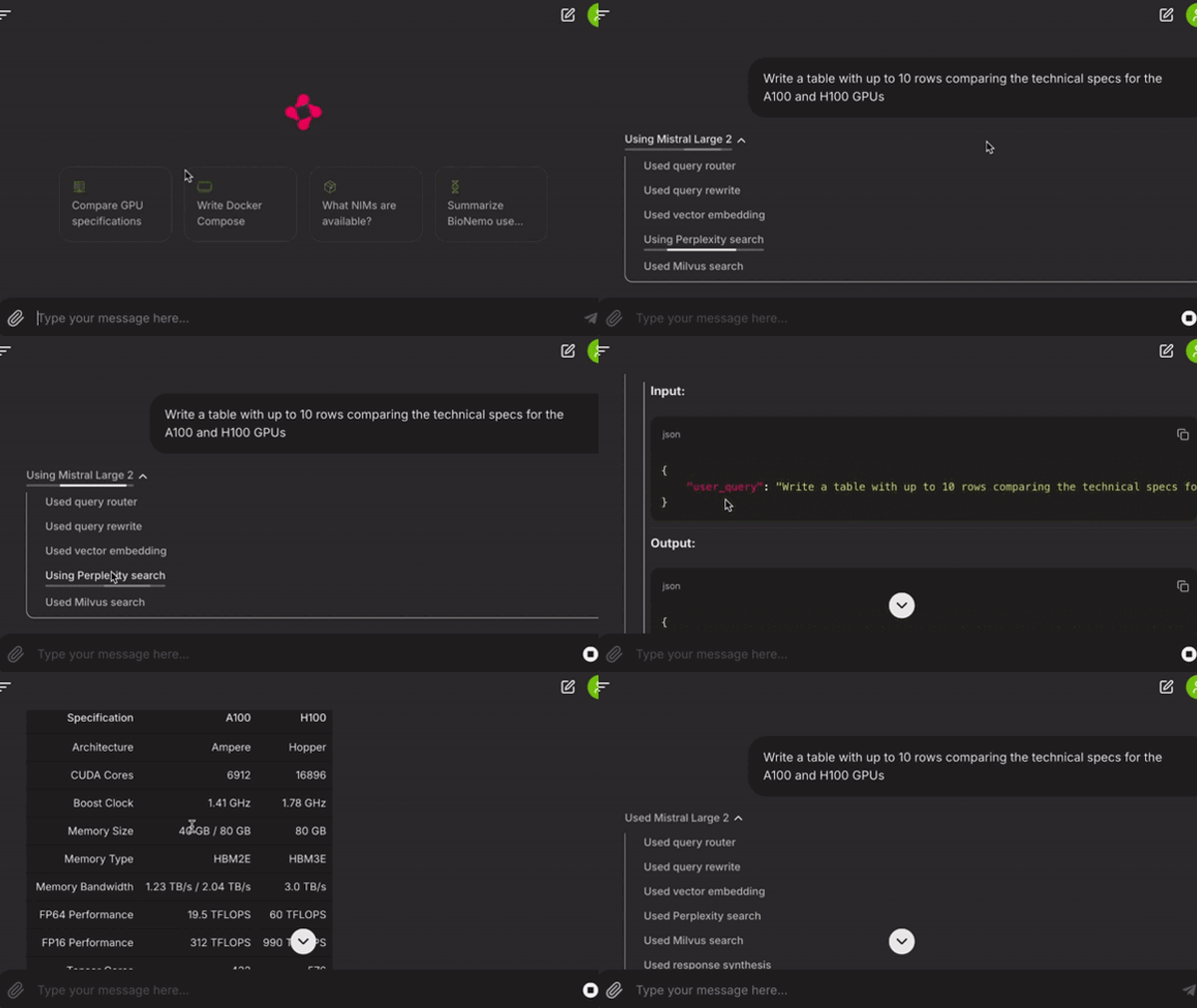
Chainlit includes several features that helped speed up our development and deployment. It supports progress indicators and step summaries using the chainlit.Step decorator, and LlamaIndexCallbackHandler enables automatic tracing. We used a Step decorator for each LlamaIndex Workflow event to expose the application’s inner workings without overwhelming the user.

Setting up the Project Environment

To deploy this project, clone the repository located at NVIDIA/GenerativeAIExamples and create a virtual Python environment, running the following commands to create and activate the environment before installing dependencies:

mkdir .venv
pip -m venv .venv
source .venv/bin/activate
pip install -r requirements.txt

Configuration

After installing the dependencies, make sure that you have a .env file located in the top-level directory of the project with values for the following:

  • NVIDIA_API_KEY: Required. You can get an API key for NVIDIA’s services from build.nvidia.com.
  • PERPLEXITY_API_KEY: Optional. If it is not provided, then the application runs without using Perplexity’s search API. To obtain an API key for Perplexity, follow the instructions.

Project Structure

We organized the project code into separate files:

  • LlamaIndex Workflow (workflow.py): Routes queries and aggregates responses from multiple sources.
  • Document Ingestion (ingest.py): Loads documents into a Milvus Lite database, which is a simple way to start with Milvus without containers. Milvus Lite’s main limitation is inefficient vector lookup, so consider switching to a dedicated cluster when document collections grow.
  • Chainlit Application (chainlit_app.py): The Chainlit application contains functions triggered by events, with the main function (on_message) activating on user messages.
  • Configuration (config.py): To play around with different model types, edit the default values. Here, you can select different models for routing and chat completion as well as the number of past messages used from chat history for each completion, and the type of model used by Perplexity for web search and summarization.

Building the Core Functionality

This application integrates LlamaIndex and NIM microservices via Chainlit. To show how to implement this logic, we’ll work through the following steps:

  1. Creating the User Interface
  2. Implementing the Workflow Event
  3. Integrating NIM Microservices

Conclusion

We hope this post has been a useful resource for you as you learn more about generative AI and the ways that NIM microservices and LlamaIndex Workflow events can be used together for the fast development of advanced chat functionality.

Frequently Asked Questions

Q: What is Retrieval Augmented Generation (RAG)?
A: RAG is a technique that uses a combination of retrieval and generation to answer user queries.

Q: What is LlamaIndex?
A: LlamaIndex is a vector database that is designed for efficient retrieval and ranking of documents.

Q: What is Chainlit?
A: Chainlit is a framework for building chat applications that provides a simple and intuitive way to create conversational AI assistants.

Q: What are some potential features to add to this project?
A: Some potential features to add include multimodal ingestion, user chat history with Chainlit’s Postgres connector, RAG reranking with the NVIDIA Mistral-based reranker, and error handling and timeout management to enhance reliability.

Alex Mashinsky Pleads Guilty to Fraud

0

Alex Mashinsky, Former CEO of Celsius, Pleads Guilty to Fraud

Alex Mashinsky, former CEO of bankrupt crypto lender Celsius, has pleaded guilty to two counts of fraud, which together carry a maximum sentence of 30 years in prison.

The Charges

In the wake of the company’s collapse, the US Department of Justice charged Mashinsky with seven counts of fraud, conspiracy, and market manipulation. Having originally pleaded not guilty, he was set to face a criminal trial in the Southern District of New York in January.

The Plea Deal

However, at a court hearing Tuesday, Mashinsky instead pleaded guilty to one count of commodities fraud and one count of securities fraud. Mashinsky has admitted to lying to Celsius customers about fundamental aspects of the business, including how their funds would be used, the DOJ says, as well as manipulating the price of a proprietary crypto token for his personal financial benefit.

Penalties and Sentence

As part of the plea deal, Mashinksky has agreed to forfeit $48 million in ill-gotten gains. He will be sentenced on April 8, 2025.

Reactions and Statements

“Alexander Mashinsky orchestrated one of the biggest frauds in the crypto industry,” said US Attorney Damian Williams in a statement. “Today’s convictions reflect this Office’s commitment to holding fraudsters like Mashinsky accountable for their crimes.”

Celsius and the Collapse

Founded by Mashinsky in 2017, Celsius marketed itself as a new age alternative to traditional banks—as the “safest place for your crypto,” the DOJ states.

The company took in crypto deposits, which it either invested or loaned out to fund interest payments to customers. People were drawn in by promises of interest as high as 17 percent on deposits—tens of times greater than the rate offered by banks at the time. At its peak, Celsius held upwards of $25 billion in customer assets, the DOJ claims.

However, in May 2022, things went south. The collapse of the Terra Luna stablecoin simultaneously blew a billion-dollar hole in the Celsius balance sheet and, as crypto prices nosedived, sent panicked customers rushing to withdraw billions of dollars’ worth of crypto from their Celsius accounts. After its investments in Terra Luna and other assets went sour, the company no longer had the funds to pay up and was eventually forced to suspend withdrawals. In July of that year, Celsius filed for bankruptcy, trapping $4.7 billion of its customers’ funds.

Conclusion

Alex Mashinsky’s guilty plea marks a significant milestone in the ongoing investigation into the collapse of Celsius. The consequences of his actions will be severe, and his sentence will serve as a warning to others involved in fraudulent activities in the crypto space.

FAQs

Q: What did Alex Mashinsky plead guilty to?

A: He pleaded guilty to one count of commodities fraud and one count of securities fraud.

Q: What is the maximum sentence he faces?

A: 30 years in prison.

Q: How much money does Mashinsky have to forfeit?

A: $48 million in ill-gotten gains.

Q: What is Celsius?

A: A bankrupt crypto lender founded by Alex Mashinsky in 2017.

Q: Why did Celsius collapse?

A: The company’s investments in Terra Luna and other assets went sour, leaving it unable to pay out customer deposits and ultimately forcing it to file for bankruptcy.

UK Hospitals Begin AI Trial for Prostate Cancer Detection

Three Hospital Systems in England Launch Clinical Trial of AI Technology to Detect and Grade Prostate Cancer

The University of Oxford, in collaboration with Paige, a pioneer in clinical AI applications for cancer diagnosis, has launched a live clinical trial of AI technology designed to detect and grade prostate cancer. The study, known as ARTICULATE PRO, involves three hospital systems across England: North Bristol Trust Southmead Hospital, University Hospitals Coventry and Warwickshire, and Oxford University NHS Foundation Trust.

The Study’s Goal

The central focus of ARTICULATE PRO is patients, with the goal of safely and effectively ensuring they benefit from powerful AI technology. The study aims to evaluate the potential of AI to improve patient outcomes against a backdrop of rising prostate cancer cases.

The Prostate Suite

The Prostate Suite, the AI system being trialled, is designed to assist pathologists in detecting, grading, and measuring tumours in prostate biopsies and tissue samples. Pathologists at the three hospitals are assessing how this AI technology impacts their clinical decision-making, pathology service delivery, and resource utilisation in real-world settings.

Benefits of the AI Technology

The study’s lead, Professor Clare Verrill, said that the AI technology has the potential to increase efficiency and improve reproducibility of results for patients. Dr. Jon Oxley, Uropathologist and Bristol lead of ARTICULATE PRO, added that the technology has achieved a level of validation and performance that allows safe and effective live clinical use.

The Study’s Significance

The study is notable for its implementation across hospitals using different digital pathology scanners and information systems, serving distinct patient populations. This diversity allows for a comprehensive assessment of how Paige’s AI technology can best serve patients, histopathologists, and hospital systems in prostate cancer diagnosis.

Conclusion

The ARTICULATE PRO study has the potential to revolutionize prostate cancer diagnosis by integrating AI technology into clinical practice. The results of this trial could pave the way for wider adoption of AI in cancer diagnosis across the UK and beyond.

FAQs

Q: What is the goal of the ARTICULATE PRO study?
A: The goal is to evaluate the potential of AI to improve patient outcomes in prostate cancer diagnosis.

Q: What is the Prostate Suite?
A: The Prostate Suite is an AI system designed to assist pathologists in detecting, grading, and measuring tumours in prostate biopsies and tissue samples.

Q: What are the benefits of the AI technology?
A: The AI technology has the potential to increase efficiency and improve reproducibility of results for patients.

Q: How is the study being implemented?
A: The study is being implemented across three hospital systems using different digital pathology scanners and information systems, serving distinct patient populations.

NVIDIA NIM on AWS Supercharges AI Inference

Generative AI on AWS: NVIDIA NIM Microservices for Secure, High-Performance Inference Solutions

Expanding Collaboration between AWS and NVIDIA

Amazon Web Services (AWS) and NVIDIA have expanded their collaboration, announcing that NVIDIA NIM microservices are now available directly from the AWS Marketplace, Amazon Bedrock Marketplace, and Amazon SageMaker JumpStart. This move enables developers to deploy NVIDIA-optimized inference for commonly used models at scale, driving faster AI inference and lower latency for generative AI applications.

What are NVIDIA NIM Microservices?

NVIDIA NIM microservices are a set of easy-to-use microservices designed for secure, reliable deployment of high-performance, enterprise-grade AI model inference across clouds, data centers, and workstations. These microservices are built on robust inference engines, such as NVIDIA Triton Inference Server, NVIDIA TensorRT, NVIDIA TensorRT-LLM, and PyTorch, and support a broad spectrum of AI models, from open-source community ones to NVIDIA AI Foundation models and custom ones.

Key Features and Benefits

  • Prebuilt containers for secure, reliable deployment of high-performance AI model inference
  • Support for a broad spectrum of AI models, including open-source community ones, NVIDIA AI Foundation models, and custom ones
  • Easy-to-use microservices for secure, reliable deployment of high-performance AI model inference
  • Deployment across various AWS services, including Amazon Elastic Compute Cloud (EC2), Amazon Elastic Kubernetes Service (EKS), and Amazon SageMaker
  • Preview over 100 NIM microservices built from commonly used models and model families

NIM Microservices Available on AWS

The following NIM microservices are now available on AWS:

  • NVIDIA Nemotron-4
  • Llama 3.1 8B-Instruct
  • Llama 3.1 70B-Instruct
  • Mixtral 8x7B Instruct v0.1

Case Studies: SoftServe’s Generative AI Solutions

SoftServe, an IT consulting and digital services provider, has developed six generative AI solutions fully deployed on AWS and accelerated by NVIDIA NIM and AWS services. These solutions are available on AWS Marketplace and include:

  • SoftServe Gen AI Drug Discovery
  • SoftServe Gen AI Industrial Assistant
  • Digital Concierge
  • Multimodal RAG System
  • Content Creator
  • Speech Recognition Platform

Getting Started with NIM on AWS

Developers can deploy NVIDIA NIM microservices on AWS according to their unique needs and requirements. By doing so, developers and enterprises can achieve high-performance AI with NVIDIA-optimized inference containers across various AWS services.

Conclusion

The collaboration between AWS and NVIDIA has paved the way for widespread adoption of generative AI technology. With NIM microservices now available on AWS, developers and enterprises can deploy high-performance AI models with ease, efficiency, and security.

FAQs

Q: What are NVIDIA NIM microservices?
A: NVIDIA NIM microservices are a set of easy-to-use microservices designed for secure, reliable deployment of high-performance, enterprise-grade AI model inference across clouds, data centers, and workstations.

Q: What are the key features and benefits of NVIDIA NIM microservices?
A: The key features and benefits of NVIDIA NIM microservices include prebuilt containers for secure, reliable deployment of high-performance AI model inference, support for a broad spectrum of AI models, easy-to-use microservices for secure, reliable deployment, and deployment across various AWS services.

Q: What NIM microservices are available on AWS?
A: The following NIM microservices are available on AWS: NVIDIA Nemotron-4, Llama 3.1 8B-Instruct, Llama 3.1 70B-Instruct, and Mixtral 8x7B Instruct v0.1.

Q: What are the benefits of using NIM microservices on AWS?
A: The benefits of using NIM microservices on AWS include high-performance AI, lower latency, and cost-effectiveness, as well as ease of deployment and management.

Apple’s Radical New Home Device

0

Apple’s Rumored Smart Home Monitor: What We Know So Far

Introduction

Reports suggest that Apple’s first foray into a new product category, the Vision Pro, hasn’t been a huge success. However, the company may be planning to enter another new market with a smart home monitor. Rumors suggest that the device will resemble an iPad on a "robot arm".

Design and Features

According to Ming-Chi Kuo, a seasoned Apple leaker, the upcoming device is a "display-equipped HomePod". It will feature an A18 processor, a 6-7 inch display, and support for Apple Intelligence. The device is expected to be a strategic repositioning of the HomePod product line, emphasizing smart home functionalities.

Release Date and Sales Projections

Kuo suggests that the device may be released in early 2025, coinciding with the WWDC event. As for sales projections, Kuo predicts that the device will ship around 500,000 units in 2025, with the potential to reach the million-unit level if the market response is positive.

Comparison to Apple’s Other Products

Kuo notes that Apple has a history of repositioning its products, such as the Apple Watch, which was initially launched as a fashion accessory. Since then, it has become a successful fitness-first wearable. Similarly, the display-equipped HomePod may be positioned as a smart home device, rather than a traditional speaker.

Conclusion

The rumors surrounding Apple’s smart home monitor are still speculative, but it’s clear that the company is exploring new territories. If the device is released, it will be interesting to see how it performs in the market and whether it can find success after the mixed response to the Vision Pro.

Frequently Asked Questions

Q: What is the display-equipped HomePod?
A: It is a smart home monitor with a 6-7 inch display and support for Apple Intelligence.

Q: When is it expected to be released?
A: It is expected to be released in early 2025, coinciding with the WWDC event.

Q: How many units is it expected to ship in 2025?
A: It is expected to ship around 500,000 units in 2025, with the potential to reach the million-unit level if the market response is positive.

MeraSkool vs Others: School Management Software Comparison

Introduction

The world of school management software can be overwhelming, with numerous options available in the market. MeraSkool, a popular choice among schools, offers a range of features that make it an attractive option for administrators, teachers, students, and parents alike. In this article, we’ll delve into the features, pricing, and user reviews of MeraSkool and compare them with its competitors.

Features Comparison Chart

Feature MeraSkool Competitor 1 Competitor 2 Competitor 3
Student Management ✸ Detailed student profiles, attendance tracking, and grade reports. ✸ Student information management, attendance tracking, but lacks grade reporting. ✸ Limited student profile management and no attendance tracking. ✸ No student management feature.
Fee Management ✸ Create fee structures, generate invoices, and enable secure online payments. ✸ Fee structure creation and invoice generation, but no secure online payment option. ✸ Limited fee structure options and no online payment facility. ✸ No fee management feature.
Exam & Assignment Management ✸ Create, schedule, and manage exams with grading and analytics tools. ✸ Exam scheduling and management, but lacks grading and analytics features. ✸ Limited exam management options and no grading tools. ✸ No exam management feature.
Timetable and Attendance Management ✸ Automated attendance tracking and timetable creation for efficient class organization. ✸ Automated attendance tracking, but no timetable creation facility. ✸ Limited attendance tracking options and no timetable feature. ✸ No attendance or timetable management feature.
AI-Powered Insights and Data Security ✸ AI tools optimize tasks for operational efficiency and robust data security protocols ensure privacy compliance. ✸ Basic data security features, but lacks AI-powered insights and task optimization. ✸ Limited data security options and no AI-powered insights feature. ✸ No data security or AI-powered insights feature.
Realtime Notification ✸ Powered by WhatsApp bot for quick notifications to parents and school administrators. ✸ Basic notification system, but lacks a dedicated WhatsApp bot facility. ✸ Limited notification options and no WhatsApp bot integration. ✸ No notification feature.
WhatsApp Bot ✸ Offers basic student information, fee, attendance, exam result, and more through quick messaging. ✸ Basic messaging facility, but lacks a dedicated WhatsApp bot for school management. ✸ Limited messaging options and no WhatsApp bot integration. ✸ No messaging or WhatsApp bot feature.
World Class Support ✸ 24/7 support and commitment to delivering new features within 7 days. ✸ Basic customer support, but lacks a dedicated feature delivery timeline. ✸ Limited customer support options and no feature delivery commitment. ✸ No customer support or feature delivery commitment.

Pricing Comparison Chart

Feature MeraSkool Competitor 1 Competitor 2 Competitor 3
Basic Plan $X/month $Y/month $Z/month No plan available.
Premium Plan $W/month $V/month $U/month No plan available.
Enterprise Plan Custom quote Custom quote Custom quote Custom quote

User Reviews and Rating

MeraSkool has received overwhelmingly positive reviews from its users, with a rating of 4.5/5 stars on various review platforms.

Review Platform Rating Number of Reviews
Trustpilot 4.5/5 200+
Capterra 4.5/5 100+
G2Crowd 4.5/5 50+

Conclusion

In conclusion, MeraSkool stands out from its competitors in terms of features, pricing, and user reviews. Its comprehensive school management software offers a range of tools to streamline operations, including student management, fee management, exam and assignment management, timetable and attendance management, AI-powered insights, data security, real-time notification, and WhatsApp bot integration. With 24/7 support and a commitment to delivering new features within 7 days, MeraSkool is the perfect choice for schools looking to enhance their administrative efficiency.

Frequently Asked Questions

Q: What features does MeraSkool offer?

A: MeraSkool offers a range of features, including student management, fee management, exam and assignment management, timetable and attendance management, AI-powered insights, data security, real-time notification, and WhatsApp bot integration.

Q: How does MeraSkool compare to its competitors?

A: MeraSkool stands out from its competitors in terms of features, pricing, and user reviews. Its comprehensive school management software offers a range of tools to streamline operations, and its competitive pricing makes it an attractive option for schools.

Q: What is the pricing for MeraSkool’s plans?

A: MeraSkool offers a basic plan, premium plan, and enterprise plan, with custom quotes available for the enterprise plan. The pricing varies depending on the plan chosen.

Q: What is the user rating for MeraSkool?

A: MeraSkool has received overwhelmingly positive reviews from its users, with a rating of 4.5/5 stars on various review platforms.

Humane to Put AI Pin’s Software Inside Your Phone, Car, and Smart Speaker

0

Humane’s CosmOS Operating System: A Look at its Capabilities

Humane, the company behind the not-great AI Pin, is seeking to make its mark in the AI device and gadget market. The company has released a video showcasing its CosmOS operating system in action, demonstrating its capabilities in a car, TV, smart speaker, and phone.

What does the video show?

The video appears to show a person interacting with CosmOS in various devices, performing tasks such as:

  • Controlling the heat in their house and checking the schedule for visitors
  • Asking a smart speaker for a guacamole recipe and their TV for information about a soccer player’s goals
  • Checking and responding to an email on their phone

What’s important to note?

According to Humane’s own fine print, the video is for “illustrative purposes only” and shows “working prototypes” and “simulated experiences.” The company also states that all “designs, features, and specifications” are subject to change. This means that the video should not be taken entirely at face value.

CosmOS SDK and Partnerships

Humane is building an SDK (Software Development Kit) for other companies to use in their devices. The company’s website states that the SDK is “coming soon,” but does not provide a specific release date. Humane has not announced any partners building devices that rely on CosmOS, although the blurred-out logos in the video suggest that the company may be in talks with other companies.

Conclusion

Humane’s CosmOS operating system appears to have the potential to power a range of devices, from cars to TVs to smart speakers and phones. While the video showcasing its capabilities is impressive, it’s important to remember that the company has not yet released the SDK publicly and has not announced any partnerships with other companies. As more information becomes available, it will be interesting to see how CosmOS develops and what kind of devices it will power in the future.

FAQs

Q: What is CosmOS?

A: CosmOS is an operating system developed by Humane, designed to power a range of devices, from cars to TVs to smart speakers and phones.

Q: What does the video show?

A: The video appears to show a person interacting with CosmOS in various devices, performing tasks such as controlling the heat in their house, asking a smart speaker for a recipe, and checking an email on their phone.

Q: Is the video real?

A: According to Humane’s own fine print, the video is for “illustrative purposes only” and shows “working prototypes” and “simulated experiences.” The company also states that all “designs, features, and specifications” are subject to change.

Q: When will the CosmOS SDK be available?

A: Humane’s website states that the SDK is “coming soon,” but does not provide a specific release date.

Q: Has Humane announced any partnerships with other companies?

A: No, Humane has not announced any partnerships with other companies that will be using CosmOS in their devices.

12 Days of OpenAI

OpenAI’s 12 Days of OpenAI: What to Expect

What’s Happening

With the holiday season upon us, many companies are finding ways to take advantage, whether through deals, promotions, or other campaigns. OpenAI has found a way to participate with its "12 days of OpenAI."

The Event

On Wednesday, OpenAI announced via an X post that it would be holding 12 days of OpenAI starting on December 5. The event will feature 12 days of live streams and "a bunch of new things, big and small," according to the post.

Details

OpenAI CEO Sam Altman shared a bit more details about the event, which begins at 10 a.m. PT on December 5 and, every weekday, will feature a live stream with a launch or demo.

Where to Access the Live Stream

The live stream will be held on the OpenAI website, and posted immediately after to its YouTube channel. To make access easier, OpenAI also will be posting on its X account a link to the live stream 10 minutes before it starts, which will be at approximately 10 a.m. PT/1 p.m. ET daily.

What to Expect

Many anticipate the launch of Sora, OpenAI’s video model launched initially last February. Since then, the model has been available to a select group of red teamers and testers and was leaked last week by some testers over grievances about "unpaid labor," according to reports. Other rumored releases include a new, fuller version of the company’s o1 LLM, with more advanced reasoning capabilities, and a Santa voice for OpenAI’s Advanced Voice Mode per code spotted by users only a couple of weeks ago under the codename "Straw."

Conclusion

OpenAI’s 12 days of OpenAI is an exciting event that promises to bring new and innovative releases to the public. With live streams every weekday, fans of OpenAI will have the opportunity to experience the latest advancements in AI technology firsthand. Whether you’re a seasoned AI enthusiast or just curious about the latest developments, OpenAI’s 12 days of OpenAI is an event not to be missed.

FAQs

Q: When does the 12 days of OpenAI start?
A: The 12 days of OpenAI starts on December 5.

Q: How can I access the live stream?
A: The live stream will be held on the OpenAI website, and posted immediately after to its YouTube channel. OpenAI will also post a link to the live stream on its X account 10 minutes before it starts.

Q: What can I expect to see during the event?
A: OpenAI will be launching and demoing new AI technology, including the rumored launch of Sora, a new version of the company’s o1 LLM, and a Santa voice for OpenAI’s Advanced Voice Mode.

Q: How often will the live stream be held?
A: The live stream will be held every weekday, starting at 10 a.m. PT/1 p.m. ET daily.

US Military to Get AI from OpenAI and Anduril

0

OpenAI Partners with Anduril to Develop AI-Powered Defense Systems

Background

OpenAI, the company behind the popular AI chatbot ChatGPT, has announced a partnership with Anduril, a defense startup that develops missiles, drones, and software for the United States military. This move marks a significant shift in the tech industry’s approach to working with the defense sector.

The Partnership

The partnership aims to improve systems used for air defense by utilizing OpenAI’s AI models. According to Brian Schimpf, co-founder and CEO of Anduril, "Together, we are committed to developing responsible solutions that enable military and intelligence operators to make faster, more accurate decisions in high-pressure situations."

How the Technology Will Be Used

OpenAI’s AI models will be used to assess drone threats more quickly and accurately, providing operators with the information they need to make better decisions while staying out of harm’s way. A former OpenAI employee, who wished to remain anonymous, explained that the technology will help operators "make better decisions while staying out of harm’s way."

Changes in OpenAI’s Policy

OpenAI altered its policy on the use of its AI for military applications earlier this year. Some staff members were reportedly unhappy with the change, but there were no open protests. The US military has already been using some OpenAI technology, according to reporting by The Intercept.

Anduril’s Advanced Air Defense System

Anduril is developing an advanced air defense system featuring a swarm of small, autonomous aircraft that work together on missions. These aircraft are controlled through an interface powered by a large language model, which interprets natural language commands and translates them into instructions that both human pilots and the drones can understand and execute. Until now, Anduril has been using open-source language models for testing purposes.

The Future of AI in Defense

While Anduril is not currently using advanced AI to control its autonomous systems or allow them to make their own decisions, there are concerns about the potential risks and unpredictability of using AI in defense applications.

Conclusion

The partnership between OpenAI and Anduril marks a new era in the tech industry’s approach to working with the defense sector. As AI continues to evolve, it is essential to consider the potential risks and benefits of using this technology in military applications.

FAQs

Q: What is the purpose of the partnership between OpenAI and Anduril?
A: The partnership aims to improve systems used for air defense by utilizing OpenAI’s AI models.

Q: How will OpenAI’s AI models be used in the partnership?
A: OpenAI’s AI models will be used to assess drone threats more quickly and accurately, providing operators with the information they need to make better decisions while staying out of harm’s way.

Q: What is Anduril’s advanced air defense system?
A: Anduril is developing an advanced air defense system featuring a swarm of small, autonomous aircraft that work together on missions. The aircraft are controlled through an interface powered by a large language model.

Q: Is Anduril using advanced AI to control its autonomous systems?
A: No, Anduril is not currently using advanced AI to control its autonomous systems or allowing them to make their own decisions.