Home Blog Page 549

Rethinking Robustness in Adversarial Example Research

Detailed Response

The main hypothesis in Ilyas et al. (2019) happens to be a special case of a more general principle that is commonly accepted in the robustness to distributional shift literature: a model’s lack of robustness is largely because the model latches onto superficial statistics in the data. In the image domain, these statistics may be unused by — and unintuitive to — humans, yet they may be useful for generalization in i.i.d. settings.

Separate experiments eschewing gradient perturbations and studying robustness beyond adversarial perturbations show similar results. For example, a recent work demonstrates that models can generalize to the test examples by learning from high-frequency information that is both naturally occurring and also inconspicuous. Concretely, models were trained and tested with an extreme high-pass filter applied to the data. The resulting high-frequency features appear completely grayscale to humans, yet models are able to achieve 50% top-1 accuracy on ImageNet-1K solely from these natural features that usually are “invisible.” These hard-to-notice features can be made conspicuous by normalizing the filtered image to have unit variance pixel statistics in the figure below.

1
Models can achieve high accuracy using information from the input that would be unrecognizable to humans. Shown above are models trained and tested with aggressive high and low pass filtering applied to the inputs. With aggressive low-pass filtering, the model is still above 30% on ImageNet when the images appear to be simple globs of color. In the case of high-pass (HP) filtering, models can achieve above 50% accuracy using features in the input that are nearly invisible to humans. As shown on the right hand side, the high pass filtered images needed be normalized in order to properly visualize the high frequency features.

Given the plethora of useful correlations that exist in natural data, we should expect that our models will learn to exploit them. However, models relying on superficial statistics can poorly generalize should these same statistics become corrupted after deployment. To obtain a more complete understanding of model robustness, measured test error after perturbing every image in the test set by a Fourier basis vector, as shown in Figure 2. The naturally trained model is robust to low-frequency perturbations, but, interestingly, lacks robustness in the mid to high frequencies. In contrast, adversarial training improves robustness to mid- and high-frequency perturbations, while sacrificing performance on low frequency perturbations. For instance, adversarial training degrades performance on the low-frequency fog corruption from 85.7% to 55.3%. Adversarial training similarly degrades robustness to contrast and low-pass filtered noise.

2
Model sensitivity to additive noise aligned with different Fourier basis vectors on CIFAR-10. We fix the additive noise to have ℓ2 norm 4 and evaluate three models: a naturally trained model, an adversarially trained model, and a model trained with Gaussian data augmentation. Error rates are averaged over 1000 randomly sampled images from the test set. In the bottom row we show images perturbed with noise along the corresponding Fourier basis vector. The naturally trained model is highly sensitive to additive noise in all but the lowest frequencies. Both adversarial training and Gaussian data augmentation dramatically improve robustness to additive noise in the high frequencies.

By taking a broader view of robustness beyond tiny ℓp norm perturbations, we discover that adversarially trained models are actually not “robust.” They are instead biased towards different kinds of superficial statistics. As a result, adversarial training can sacrifice robustness in real-world settings.

Conclusion

In conclusion, the lack of robustness in models is largely due to their reliance on superficial statistics in the data. By recognizing the importance of high-frequency features and the limitations of ℓp norm perturbations, we can gain a deeper understanding of model robustness and develop more effective strategies for improving it.

FAQs

Q: What is the main hypothesis in Ilyas et al. (2019)?
A: The main hypothesis is that a model’s lack of robustness is largely due to its reliance on superficial statistics in the data.

Q: What are superficial statistics in the data?
A: Superficial statistics are statistics that are not essential for generalization, but are instead useful for model performance.

Q: What is the importance of high-frequency features in model robustness?
A: High-frequency features are important because they can be used to improve model robustness and generalization.

Q: What are ℓp norm perturbations?
A: ℓp norm perturbations are perturbations that are added to the input data to test a model’s robustness.


How Much Are They Different

What is Generative AI?

Generative AI is one of the new-age AI systems that can create new original content such as texts, images, music, and videos by learning the patterns from the existing data. High-level generative AI basically focuses on the output of newly created content based on models of learning rather than just recognition of patterns as functionality and outcomes.

Take GPT-4 as an example. It is famous among generative models for bringing into existence human-like writings. Thus, its applications are poised for many things such as appealing to content development and customer service, among other areas. DALL-E, another generative AI model by OpenAI, creates realistic images from text descriptions.

Across sectors, generative AI is changing industries:

  • The generative AI global market is projected to reach $136.7 billion by 2030 and it is said to grow at a compound annual growth rate (CAGR) of 36.7% from 2023.

  • In entertainment, AI tools for writing music and scripts are on the rise, and significant contributions go to the generative models for film production and game development.

Overall, generative AI is truly transformative, giving applications ranging from the creative industries to data-driven decision-making in business.

What is Predictive AI?

Predictive AI is a branch of artificial intelligence that uses historical data and statistical algorithms to forecast future outcomes or behaviors. Unlike generative AI, which creates new content, predictive AI focuses on analyzing patterns and trends to make informed predictions about what might happen next.

The difference between generative AI and predictive AI lies in their primary functions. While generative AI is designed to create, predictive AI is built to forecast. This distinction is crucial for businesses looking to implement AI solutions tailored to their specific needs.

Key Differences Between Generative and Predictive AI

When it comes to generative vs predictive AI, it’s essential to understand their unique characteristics and applications. Both types of AI have revolutionized various industries, and understanding their differences is crucial for harnessing their full potential.

Examples of Generative and Predictive AI Success Stories

Many companies are already reaping the benefits of generative and predictive AI across various industries. Here are some notable success stories:

  1. Netflix: Netflix uses predictive AI to analyze viewer habits and preferences. By understanding what users enjoy watching, it personalizes recommendations, leading to higher engagement rates and subscriber retention.

  2. Coca-Cola: Coca-Cola employs generative AI for marketing campaigns. The company uses tools that analyze customer feedback to create tailored advertisements that resonate with specific audiences.

  3. Zara: The fashion retailer Zara utilizes predictive analytics for inventory management. By forecasting trends based on historical sales data, Zara ensures it stocks popular items while minimizing excess inventory.

  4. BMW: BMW leverages generative AI in product design processes. The company uses this technology to create virtual prototypes quickly, reducing development time for new models significantly.

  5. American Express: American Express uses predictive analytics for fraud detection. By analyzing transaction patterns in real-time, it identifies suspicious activities faster than traditional methods allow.

These examples illustrate how businesses across different sectors harness the power of generative and predictive AI to drive innovation and improve operational efficiency.

Why Understanding Both Generative and Predictive AI is Essential

As businesses increasingly rely on artificial intelligence, understanding both generative and predictive capabilities becomes essential for success. Each type of AI serves distinct purposes but can complement each other effectively.

Generative AI excels at creating new content or ideas based on existing data patterns. It fosters creativity while allowing businesses to scale their content production without sacrificing quality.

Conversely, predictive AI focuses on analyzing historical data to forecast future trends or behaviors. It enhances decision-making by providing insights that help organizations adapt to changing market conditions proactively.

By integrating both technologies into their operations, companies can achieve a competitive edge in their respective industries:

  • Enhanced Creativity: Generative AI provides fresh ideas that inspire innovation.

  • Data-Driven Decisions: Predictive analytics empowers businesses with insights that guide strategic planning.

  • Operational Efficiency: Together, these technologies streamline processes while improving overall productivity.

  • Personalized Experiences: Businesses can tailor offerings based on insights generated from both types of AI.

How LITSLINK Can Help Implement the Right AI Solutions

At LITSLINK, we understand that implementing AI solutions can be a complex process. Our team of experts is dedicated to helping businesses navigate the AI landscape and implement solutions that drive real value.

Wrapping Up

As we’ve explored, the choice between generative and predictive AI can significantly impact your business outcomes. Generative AI, with its ability to create new content and ideas, opens up exciting possibilities for innovation and creativity.

On the other hand, predictive AI empowers businesses with data-driven insights and forecasts, enabling more informed decision-making.

Understanding how generative AI works and exploring examples of predictive AI can help you identify the most suitable solutions for your business needs. The key lies in aligning these powerful technologies with your specific goals and challenges.

The difference between predictive and generative AI isn’t just academic – it’s a crucial distinction that can shape your AI strategy and drive your competitive advantage. While generative AI excels at creating novel outputs, predictive AI shines in analyzing trends and forecasting outcomes.

As AI continues to evolve, the lines between these technologies may blur, leading to even more powerful hybrid solutions. Staying informed about these developments and working with experienced partners like LITSLINK can help you navigate this exciting landscape.

Ready to explore how AI can transform your business? Whether you’re interested in harnessing the creative power of generative AI or leveraging the analytical prowess of predictive AI, LITSLINK is here to guide you every step of the way.

Contact us today to schedule a consultation and discover how we can help you implement the right AI solutions for your unique business needs.

FAQs

Q: What is the difference between generative and predictive AI?

A: Generative AI creates new content or ideas based on existing data patterns, while predictive AI analyzes historical data to forecast future trends or behaviors.

Q: What are the key benefits of generative AI?

A: Generative AI fosters creativity, allows for scalable content production, and enables businesses to stay ahead of the competition.

Q: What are the key benefits of predictive AI?

A: Predictive AI enables data-driven decision-making, enhances operational efficiency, and helps businesses stay ahead of market trends.

Q: Can I use both generative and predictive AI in my business?

A: Yes, combining both technologies can help you achieve a competitive edge in your industry by leveraging their unique strengths.

Q: How can LITSLINK help me implement AI solutions?

Get In Early: Nintendo Switch Cyber Monday Deals

0

Refresh

Nintendo Switch OLED Model: Mario Kart 8 Deluxe Bundle: $349 $275 at Target

Well, we’ve got a fabulous bundle deal from Target, which sets the Switch OLED at a record-low price of $275. But that’s not all. That deal has $79 of added value in the form of Mario Kart Deluxe 8 and 12 months of Nintendo Switch Online membership. So actually, you’re getting total savings of $144.

What do you get with that membership?

You get access to hundreds, yes hundreds of titles in Nintendo’s back catalogue, plus some Sega titles too. I absolutely love retro games (the day they veered from platform gaming was a sad one for me, I don’t have the spatial awareness) and so this is a real pull for me. If I was in the US, I’d grab this deal immediately. It’s in and out of stock at Target, and available in store only at Best Buy.

Get a taster of the game below:

Mario Kart 8 Deluxe – 96 courses to enjoy! (Nintendo Switch) – YouTube

Nintendo Switch Deals

So, what have we got?

  • For UK Switch fans, we’ve been highlighting the same deal all week – this one that puts it at (currently) £228 at OnBuy. It’s been changing in price a bit – the lowest we saw was £220 and it has gone up to £232 so don’t be surprised to see it either sell out or get more expensive.
  • If you’d prefer Amazon, you’ll need to pay a bit extra – the OLED console is currently £274.

Surprisingly for Amazon, there haven’t been oodles of Switch deals on consoles. But the giant has had some great game deals, and accessories too which we will keep you posted on.

Conclusion

The Nintendo Switch deals we’ve seen this year have been the best I’ve ever seen during Black Friday. They’re so good I was actually surprised. But they are going in and out of stock, so it’s important to grab one where you can.

FAQs

Q: What is the price of the Nintendo Switch OLED Model?
A: The price of the Nintendo Switch OLED Model varies depending on the retailer. Currently, it is priced at £228 at OnBuy and £274 at Amazon.

Q: What is the Mario Kart 8 Deluxe Bundle deal?
A: The Mario Kart 8 Deluxe Bundle deal is a bundle that includes the Nintendo Switch OLED Model, Mario Kart Deluxe 8, and 12 months of Nintendo Switch Online membership. It is priced at $275 at Target.

Q: What do I get with Nintendo Switch Online membership?
A: With Nintendo Switch Online membership, you get access to hundreds of titles in Nintendo’s back catalogue, plus some Sega titles too.

Q: Is the Mario Kart 8 Deluxe Bundle deal available in store only?
A: Yes, the Mario Kart 8 Deluxe Bundle deal is available in store only at Target and Best Buy.

Leverage AI Coding Assistants to Develop Quantum Applications at Scale

0

Getting Started

To begin, download and install CUDA-Q and Cursor. An easy way to install CUDA-Q is to pull the CUDA-Q Docker image and run the container. The PyPI Python installation instructions, as well as the C++ installation guide, can be found in CUDA-Q Quick Start.

Generating Code

Use the Cursor built-in chat window (⌘-L) to start generating a few CUDA-Q examples. To improve Cursor’s responses, explicitly link the CUDA-Q docs to Cursor’s chat context. In the chat window, type @docs, select +New doc, and link the URL of the CUDA-Q documentation.

For example, ask the chat, “How do I initialize a CUDA-Q kernel?”

Querying the Codebase and Docs

Use the Cursor built-in chat window (⌘-L) to start generating a few CUDA-Q examples. To improve Cursor’s responses, explicitly link the CUDA-Q docs to Cursor’s chat context. In the chat window, type @docs, select +New doc, and link the URL of the CUDA-Q documentation.

Porting to CUDA-Q

You can use Cursor to experiment with porting codes written in other quantum frameworks to CUDA-Q to leverage the excellent performance and scalability of CUDA-Q.

Verify Output

While experimenting with these examples, the chat occasionally generates minor syntactical mistakes that cause errors when the code is executed. When this happens, the user may need to manually debug the error, although sometimes the chat can resolve the issue if the error is raised to it.

Conclusion

AI coding assistants are a powerful way of improving quantum developer productivity and lowering the barrier to entry to developing scalable, high-performance hybrid quantum applications using CUDA-Q. This post has shown that coding assistants like Cursor do an excellent job generating CUDA-Q code, providing helpful explanations of the codebase, and enabling users of other frameworks to leverage CUDA-Q to accelerate their applications.

FAQ

Q: What is CUDA-Q?
A: CUDA-Q is an open-source platform that integrates GPUs, CPUs, and QPUs to enable scalable, hybrid quantum computing.

Q: How do I get started with CUDA-Q and Cursor?
A: Download and install CUDA-Q and Cursor. An easy way to install CUDA-Q is to pull the CUDA-Q Docker image and run the container. The PyPI Python installation instructions, as well as the C++ installation guide, can be found in CUDA-Q Quick Start.

Q: How does Cursor work with CUDA-Q?
A: Cursor provides a range of base models, including claude-3.5-sonnet, gpt-4o, cursor-small, and several others. It can index your entire codebase, enabling you to query it directly. Additionally, Cursor enables you to add context to queries by specifying files, documentation, and websites to the chat context before it provides answers.

Q: Can I use Cursor with other quantum frameworks?
A: Yes, you can use Cursor to experiment with porting codes written in other quantum frameworks to CUDA-Q to leverage the excellent performance and scalability of CUDA-Q.

Wallace and Gromit Animated on iPhone 16 Pro Max

0

Battersea Power Station Transformed into a Winter Wonderland with Wallace and Gromit’s Christmas Magic

A New Tradition for a Beloved Landmark

Battersea Power Station, now the headquarters of Apple, has a long history of artistic associations. Pink Floyd’s iconic album cover, "Animals," features an inflatable pig flying above the historic 101-meter-high chimneys. Last year, Apple started a new festive tradition by projecting the animation "Bigger Christmas Trees" by David Hockney onto the building itself.

Wallace and Gromit Bring Joy to the Iconic Landmark

This year, the Christmas tradition continues with a new animation featuring Wallace and Gromit, two beloved characters from the popular animated film series. The animation studio Aardman created a six-minute film shot on an iPhone 16 Pro Max, which will be projected onto the iconic landmark daily from 5pm to 10:30pm until New Year’s Eve.

The Making of the Animation

Aardman used eight iPhone 16 Pro Max devices mounted on motorized heads to capture footage from two angles, utilizing the devices’ 5x telephoto cameras. They also employed the Dragonframe Tether app to link the devices to stop-motion software. The team shot 6,000 frames of 4K stills in ProRAW format and stitched them together to achieve a 6K image, allowing them to turn the 23-centimeter characters into 101-meter tall projections.

A Dream Come True for Aardman’s Director and Graphic Design Lead

Gavin Strange, Aardman’s director and graphic design lead, described the project as a "dream to direct – a cinematic fusion of tech and art." He added that it was a unique opportunity to bring the beloved characters to life in a new and exciting way.

A Treat for the Senses

The film is a delightful treat for the senses, blending technology and art to create a magical atmosphere. The 6-minute animation is a perfect blend of humor, whimsy, and festive cheer.

What’s Next for Wallace and Gromit?

The short film serves as a teaser for the new film "Wallace and Gromit: Vengeance Most Fowl," which will be broadcast on the BBC on Christmas Day and on Netflix worldwide from January 3.

Get Involved with Apple’s Regent Street Event

Apple’s Regent Street branch will be hosting a talk with Aardman on December 12 at 7pm, offering a behind-the-scenes look at the making of the new animation. You can find more information and behind-the-scenes footage on the Apple website.

Conclusion

Battersea Power Station has been transformed into a winter wonderland, thanks to the magic of Wallace and Gromit. The iconic landmark is now a symbol of festive cheer, blending technology and art to bring joy to all who see it.

Frequently Asked Questions

Q: What is the title of the new Wallace and Gromit film?
A: The new film is titled "Wallace and Gromit: Vengeance Most Fowl."

Q: When can I watch the new film?
A: The film will be broadcast on the BBC on Christmas Day and on Netflix worldwide from January 3.

Q: How can I get involved with Apple’s Regent Street event?
A: You can find more information and behind-the-scenes footage on the Apple website. The event will take place on December 12 at 7pm at Apple’s Regent Street branch.

How to Make a Blazingly Fast Multithreaded Data Grid for 1,000,000 Rows

Here is the rewritten article:

The Smaller the DOM, the Better: Changing the Contents of a DIV is Faster than Deleting a DIV and Creating a New One

The browser is slow in rendering a large DOM tree. The browser won’t render 1,000,000 lines of 20 px height at all – the maximum height of a DIV in Chrome is 15,000,000 px. The fewer HTML elements, the better.

Fast Data Grid adds as many rows to the DOM as will fit on the screen.

Maximum DIV height is 15,000,000 px

To make the scroll work, Fast Data Grid makes a big DIV. The scroll event is attached to this DIV. The scroll event handler calculates the position of the row DIVs.

Using the Coefficient when Scrolling

When scrolling, the position of the DIV rows is calculated using JavaScript.


const scrollYKoef = (allRowsHeight - viewPortHeight) / (scrolHeight - viewPortHeight);

Enter fullscreen mode
Exit fullscreen mode

Listing 2. Using the coefficient when scrolling

CSS transform translate is faster than CSS top

When scrolling, the position is set via transform translate. CSS transform translate is faster than CSS top.


style="transform: translateY(-16px);">


style="top: -16px;">


Enter fullscreen mode
Exit fullscreen mode

Listing 3. CSS transform translate is faster than CSS top

Read DOM first, then modify DOM. It’s bad to read DOM after modification

The browser displays frames on the monitor like this:

Figure 3. Standard order of operations when outputting a frame to the monitor

If the standard order is not violated, the browser will render the frame as quickly as possible.

Self-Promotion

I make the most convenient flowchart editor DGRM.net. It is also the most convenient service for business: Excel + business process diagrams.

Give stars on GitHub.

FAQs

Q: What is the maximum height of a DIV in Chrome?

A: The maximum height of a DIV in Chrome is 15,000,000 px.

Q: How does the browser render a large DOM tree?

A: The browser is slow in rendering a large DOM tree. The browser won’t render 1,000,000 lines of 20 px height at all.

Q: What is layout thrashing?

A: Layout thrashing is excessive recalculation of layout.

Q: How can I avoid layout thrashing?

A: You can avoid layout thrashing by not modifying the DOM before reading it.

Databricks to Raise $5B at $55B Valuation

Databricks Seeks $5 Billion Funding Round at $55 Billion Valuation

Databricks, a leading cloud-based data platform, is reportedly seeking to raise at least $5 billion in an equity funding round at a valuation of $55 billion. The deal, reported by The Information, would enable existing shareholders to cash out a portion of their shares.

A Brief History of Databricks

Founded 11 years ago as the commercial venture behind Apache Spark, Databricks has significantly expanded its repertoire and is now one of the premier cloud-based data platforms providing big data management, advanced analytics, and AI capabilities to the world’s largest firms. Initially, the company was eyed as a top prospect for a massive initial public offering (IPO), but instead, it has stuck to the private markets.

Recent Funding Rounds

In September 2023, Databricks raised half-a-billion dollars at a $43 billion valuation in a Series I round led by Nvidia and T. Rowe Price. This brought its total funding amount to $4 billion, backed by Andreessen Horowitz, Baillie Gifford, Fidelity, Insight Partners, and Tiger Global, among others. This Series I round was seen as a pre-IPO raise, but it appears that Databricks is headed back to the private markets for more cash.

A New Funding Round

According to a report by The Information, Databricks is seeking to raise between $5 billion and $8 billion in a secondary share sale to enable existing shareholders to sell some of their holdings without resorting to an IPO. These figures would put Databrics on the cusp of having the largest venture capital funding round of all time, surpassing OpenAI’s $6.6 billion raise and xAI’s $6 billion and $5 billion funding rounds.

Acquisitions and Growth

Databricks has used its cash holdings to make strategic acquisitions to grow its data and AI business. In the summer of 2023, the company spent $1.3 billion to acquire MosaicML, which developed an AI factory that creates GenAI models. Earlier this year, it shelled out between $1 billion and $2 billion to acquire Tabular, the commercial venture behind the open source Apache Iceberg project.

IPO Possibilities

While a Databricks IPO hasn’t yet come to pass, it’s still a possibility. At the Newcomer’s Cerebral Valley AI Conference, CEO Ali Ghodsi said, "If we were going to go, the earliest would be, let’s say, mid-next year, or something like that…So, you know, could happen next year."

Conclusion

Databricks’ $5 billion funding round would solidify its position as one of the leading players in the data and AI space. With its strategic acquisitions and continued growth, the company is poised for a bright future.

Frequently Asked Questions

Q: What is Databricks’ current valuation?
A: Databricks is seeking a valuation of $55 billion in its latest funding round.

Q: How much is Databricks seeking to raise in its latest funding round?
A: The company is seeking to raise at least $5 billion, with the potential to raise up to $8 billion.

Q: What is the purpose of Databricks’ latest funding round?
A: The funding round is intended to enable existing shareholders to cash out a portion of their shares without resorting to an IPO.

Q: What are some of Databricks’ recent acquisitions?
A: The company has acquired MosaicML, which developed an AI factory that creates GenAI models, and Tabular, the commercial venture behind the open source Apache Iceberg project.

Galbot Builds Large-Scale Dexterous Hand Dataset for Humanoid Robots

0

Robotic Dexterous Grasping

Robotic dexterous grasping is a critical area of research and development, aimed at enabling robots to interact with and manipulate objects as flexibly as humans can. By enabling robots to handle complex tasks that require fine motor skills, dexterous grasping can significantly enhance productivity and efficiency.

Validating Dexterous Grasping Data

The first step to enabling human-like dexterous object manipulation for robots is through robotic dexterous grasping. However, validating dexterous grasping data has been a major challenge, as human annotations are impractical on a scale of millions of grasps. Without large-scale datasets, robotic dexterous grasping has remained under-explored compared to object grasping with parallel grippers.

Using NVIDIA Isaac Sim, a reference application for robotics simulation, robotics company Galbot successfully addressed this challenge. They validated a vast number of grasps to develop DexGraspNet, a comprehensive simulated dataset for dexterous robotic grasps that can be applied to any dexterous robotic hand.

DexGraspNet contains 1.32 million ShadowHand grasps on 5,355 objects—two orders of magnitude larger than the previous Deep Differentiable Grasp dataset. DexGraspNet covers more than 133 object categories and contains more than 200 diverse grasps for each object instance, making it a more complete sample for research.

Balancing Data Variety and Quantity on Robotic Dexterous Hand Grasping

Galbot leveraged a deeply accelerated optimizer that can efficiently and robustly synthesize stable and diverse grasps on a large scale to find the grasping poses that meet force-closure conditions and have high graspness scores. The dataset includes many types of grasps that are not possible with other popular tools like GraspIt.

Through cross-dataset experiments, the Galbot team demonstrated that training several algorithms for dexterous grasp synthesis on DexGraspNet significantly outperformed training on the previous dataset.

Building Generalized Dexterous Hand Grasping Skills

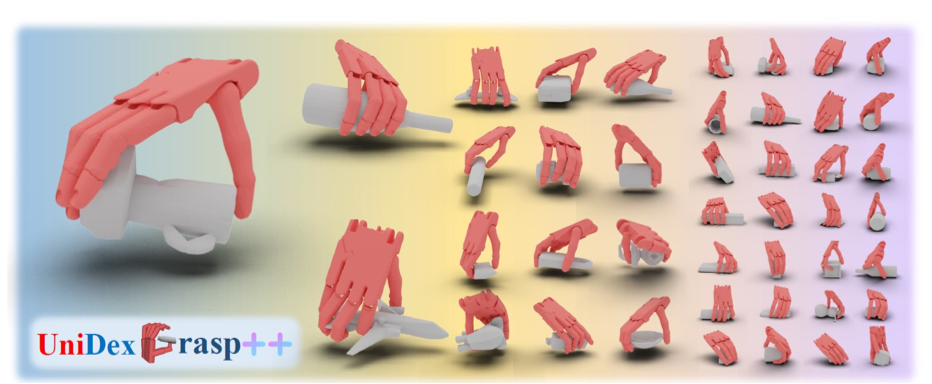
The Galbot research team proposed UniDexGrasp++, a novel, object-independent approach for learning generalized strategies for dexterous object grasping from real point cloud observations and proprioceptive information in a tabletop environment.

To address the challenge of learning vision-based strategies across thousands of object instances, the team used GeoCurriculum Learning and Geometry-Aware Iterative Generalist-Specialist Learning (GiGSL), which leverages the geometric features of the task to significantly improve generalizability.

Image displaying a variety of robot hands grasping objects in different ways.

Using these techniques in Isaac Sim, the Galbot team’s final iteration successfully demonstrated generalized dexterous grasping of more than 3,000 object instances with random object poses on a table-top setting. The success rates were 85.4% on the training set and 78.2% on the test sets, outperforming the state-of-the-art baseline UniDexGrasp by 11.7% and 11.3%, respectively.

Scaling Dexterous Hand Grasping Models

Galbot’s most recent work is DexGraspNet 2.0. It features dexterous grasping in cluttered scenes and the team has demonstrated zero-shot sim-to-real transfer with 90.70% real-world dexterous grasping success rate. DexGraspNet 2.0 has been evaluated on real robots, featuring a LEAP hand mounted on a UR-5 robot arm for dexterous grasp experiments, and a Franka Panda arm for gripper tasks. The DexGraspNet 2.0 project will be showcased at the 2024 Conference on Robot Learning (CoRL).

Summary

Using NVIDIA Isaac Sim, Galbot developed DexGraspNet, a comprehensive dataset for humanoid robots, which includes 1.32 million ShadowHand grasps on 5,355 objects across more than 133 categories, providing a vast and diverse range of grasps. The dataset has proven effective for training algorithms in dexterous grasp synthesis, significantly outperforming previous datasets in cross-dataset experiments. This work enables robots to better handle complex tasks that require fine motor skills, enhancing productivity and efficiency.

To see the DexGraspNet code, visit the PKU-EPIC/DexGraspNet GitHub repo. You can also reference the dataset the team used. To learn more, see DexGraspNet: A Large-Scale Robotic Dexterous Grasp Dataset for General Objects Based on Simulation.

Frequently Asked Questions

Q: What is DexGraspNet?
A: DexGraspNet is a comprehensive simulated dataset for dexterous robotic grasps that can be applied to any dexterous robotic hand.

Q: What is the purpose of DexGraspNet?
A: The purpose of DexGraspNet is to enable robots to better handle complex tasks that require fine motor skills, enhancing productivity and efficiency.

Q: What is the size of DexGraspNet?
A: DexGraspNet contains 1.32 million ShadowHand grasps on 5,355 objects across more than 133 categories, providing a vast and diverse range of grasps.

Q: How does DexGraspNet outperform previous datasets?
A: DexGraspNet outperforms previous datasets in cross-dataset experiments, demonstrating the effectiveness of the dataset for training algorithms in dexterous grasp synthesis.

CRAZY Ai Video Tools You Need to See!

0

Testing the Runway Video Tool: A Revolutionary Breakthrough in Video Technology

The Runway Video Tool is a groundbreaking innovation in video technology that has left me in awe. With its advanced features and capabilities, I was excited to test it out and see what it could do. In this article, I’ll share my experience with the Runway Video Tool, including its capabilities, benefits, and limitations.

What is Runway Video Tool?

The Runway Video Tool is a revolutionary AI-powered video editing platform that allows users to create professional-grade videos with ease. It uses advanced computer vision and machine learning algorithms to analyze and manipulate video content, enabling users to add animations, effects, and other visual elements to their videos.

Features and Capabilities

During my testing, I explored the various features and capabilities of the Runway Video Tool. Here are some of the key features that impressed me:

*

Expand Video:

The Expand Video feature allows users to create stunning animations by manipulating video frames. With a few clicks, you can create 3D-style animations, morphing, and other visual effects.
*

Face to AI Animation:

This feature uses AI to analyze the facial expressions of the video’s subjects and create animations that mimic their emotions. It’s an incredible feature that can add a level of realism to your videos.
*

AI Face Animation:

The AI Face Animation feature uses facial recognition technology to track and manipulate the facial expressions of the video’s subjects. This feature is perfect for creating realistic animations and emotional reactions.

Benefits and Limitations

After testing the Runway Video Tool, I was impressed with its capabilities and the benefits it offers. However, like any technology, it’s not without its limitations. Here are some of the benefits and limitations I experienced:

* Benefits:
+ Easy to use: The Runway Video Tool is user-friendly and easy to navigate, even for those without extensive video editing experience.
+ High-quality results: The tool produces high-quality videos with advanced animations and effects.
+ Fast processing: The tool can process videos quickly, saving you time and effort.
* Limitations:
+ Limited customization options: While the tool offers a range of features and options, it can be limiting in terms of customization and flexibility.
+ Resource-intensive: The tool requires a powerful computer and internet connection to function smoothly.

Conclusion

In conclusion, the Runway Video Tool is an impressive piece of technology that has the potential to revolutionize the way we create and edit videos. With its advanced features and capabilities, it’s an excellent tool for video creators, marketers, and anyone looking to enhance their video content. While it has some limitations, the benefits it offers far outweigh the drawbacks.

FAQs

Q: What are the system requirements for using the Runway Video Tool?

A: The Runway Video Tool requires a powerful computer with at least 16GB of RAM, Intel Core i7 processor, and NVIDIA GeForce GTX 1070 graphics card or higher.

Q: Is the Runway Video Tool compatible with Mac and PC?

A: Yes, the Runway Video Tool is compatible with both Mac and PC.

Q: What is the pricing for the Runway Video Tool?

A: The pricing for the Runway Video Tool varies depending on the plan you choose. The basic plan starts at $19.99 per month, while the premium plan starts at $49.99 per month.

Q: Can I use the Runway Video Tool without prior video editing experience?

A: Yes, the Runway Video Tool is designed to be user-friendly and accessible to those without prior video editing experience. The intuitive interface and guided tutorials make it easy to get started.

Echo Dot Deal of the Day

Smart Speaker Deal of the Week: Echo Dot 5th Gen for 54% Off

A Great Time to Upgrade Your Home with Alexa

I’m a sucker for a good deal, and smart speakers are one of the devices I like buying during sales events. For a discounted price, you can get a speaker for your home that functions as a Bluetooth speaker and connection to your smart home. This $23 Echo Dot Black Friday deal checks all the boxes, and it’s still available even after Black Friday has officially ended, but before we hit Cyber Monday.

The Echo Dot: A Great Addition to Your Home

The Echo Dot is a great way to add Amazon Alexa to your home, bringing the virtual assistant into your routines to answer questions and run smart home devices, but it’s also a pretty decent speaker on its own, especially at $30. This speaker won’t blow the Apple HomePod mini out of the water, but it is still a great, inexpensive speaker.

Using the Echo Dot

For example, if you already have an Echo Dot, you could get a second one to create a stereo pair for a TV to enjoy more immersive audio during movie nights. It’s also small enough to hang out on a desk, bookshelf, or nightstand. I even have an Echo Dot in my bathroom to close the blinds and play music while I shower.

Availability and Price

The Echo Dot (5th Gen) is available in Charcoal, Deep Sea Blue, and Glacier White, and is typically available for $50. However, it is currently 54% off, bringing the price down to $23 for the Cyber Week sale.

Don’t Miss Out:

While many sales events feature deals for a specific length of time, deals are on a limited-time basis, making them subject to expire anytime. ZDNET remains committed to finding, sharing, and updating the best offers to help you maximize your savings so you can feel as confident in your purchases as we feel in our recommendations. Our team of experts constantly monitors the deals we feature to keep our stories up-to-date. If you missed out on this deal, don’t worry – we’re always sourcing new savings opportunities at ZDNET.com.

Frequently Asked Questions

Q: What is the Echo Dot?
A: The Echo Dot is a smart speaker developed by Amazon that functions as a Bluetooth speaker and a connection to your smart home, powered by Amazon Alexa.

Q: What is the typical price of the Echo Dot?
A: The typical price of the Echo Dot is $50.

Q: Is the deal available after Black Friday?
A: Yes, the deal is still available even after Black Friday has officially ended, but before we hit Cyber Monday.

Q: Can I use the Echo Dot with my existing smart home devices?
A: Yes, the Echo Dot is compatible with many smart home devices, including those from Amazon, Apple, and Google.