Home Blog Page 625

Attention font nerds!

0

Discover the Hidden Google Feature That Will Transform Your Typing Experience

I just discovered a new Google feature that has taken my typing experience to the next level. As a typography enthusiast, I’m excited to share this awesome surprise with fellow font lovers.

The Surprise: Typing Your Favorite Font

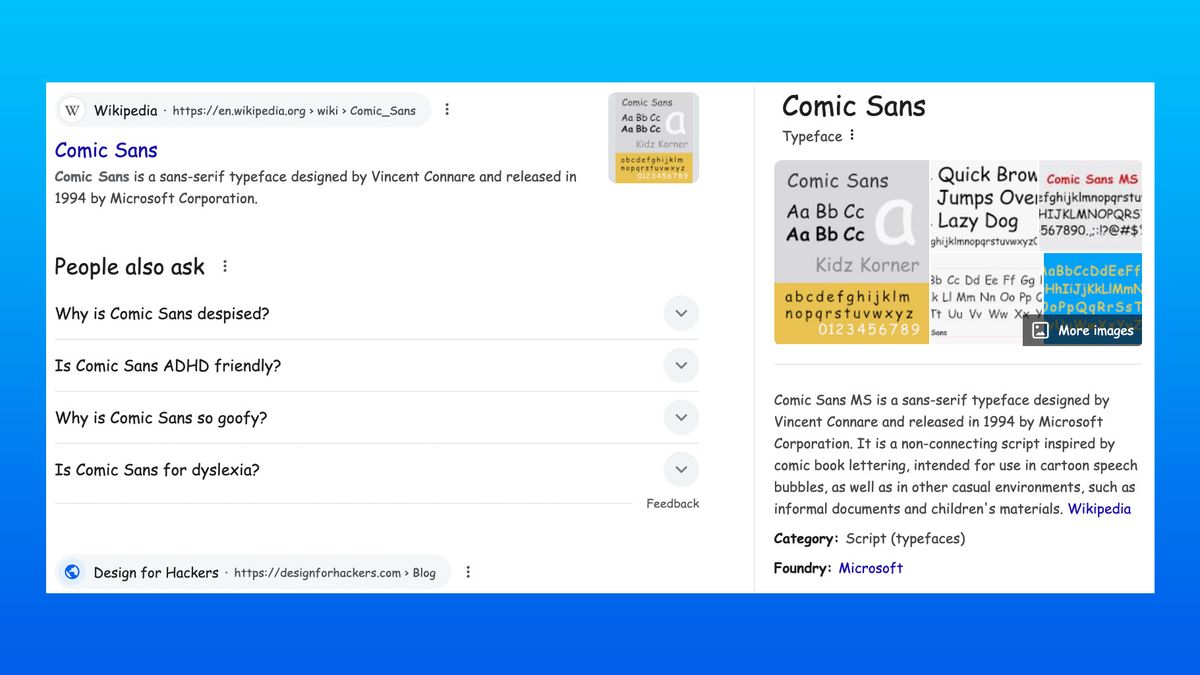
To experience this feature, simply head to Google and type in your favorite font. Yes, you read that right – type in the name of the font, and the entire page will transform into that font style. I stumbled upon this feature by accident, typing in ‘comic sans’ for an unrelated reason, and was thrilled to see the text change before my eyes.

Examples and Tips

My colleague tried it with other fonts, including Garamond, Impact, and Times New Roman. Sometimes, you need to add ‘font’ to the name of the font for it to work. Many of the best free fonts are on the list, so feel free to experiment and find your favorite.

Here are a few examples:

  • Comic Sans: As you can see, Comic Sans completely transforms the feel of the internet. How friendly it could be!
  • Impact: I can see why we don’t use Impact more widely. For more useable web fonts, see our guide. And learn about types of typography here.

Conclusion

This Google feature is a game-changer for typography enthusiasts. It’s a fun and creative way to express yourself and add some personality to your online interactions. So, go ahead and give it a try – you never know what font you might discover!

Frequently Asked Questions

Q: What fonts are available for this feature?
A: Google has a vast list of fonts available, including popular ones like Comic Sans, Garamond, Impact, and Times New Roman.

Q: Do I need to add ‘font’ to the name of the font for it to work?
A: Yes, sometimes you need to add ‘font’ to the name of the font for it to work.

Q: Can I use this feature on any device?
A: Yes, this feature is available on all devices, including desktops, laptops, and mobile devices.

Q: Is this feature available on all Google services?
A: Yes, this feature is available on all Google services, including Google Search, Google Chrome, and Google Docs.

Designing for outer space | MIT News

0

A new MIT course this spring asked students to design what humans might need to comfortably work in and inhabit space. The time for these creations is now. While the NASA Apollo missions saw astronauts land on the moon, collect samples, and return home, the missions planned under Artemis, NASA’s current moon exploration program, include establishing long-term bases in orbit as well as on the surface of the moon.

The cross-disciplinary design course MAS.S66/4.154/16.89 (Space Architectures) was run in parallel with the departments of Architecture, and Aeronautics and Astronautics (AeroAstro), and the MIT Media Lab’s Space Exploration Initiatives group. Thirty-five students from across the Institute registered to imagine, design, prototype, and test what might be needed to support human habitation and activities on the moon.

The course’s popularity was not surprising to the instructors.

“A lot of students at MIT are excited about space,” says Jeffrey Hoffman, one of the course instructors and professor of the practice in AeroAstro. Before teaching at MIT, Hoffman was a NASA astronaut who flew five missions aboard the space shuttle. “Certainly in AeroAstro, half the students want to be astronauts eventually, so it’s not like they hadn’t thought about living in space before. This was an opportunity to use that inspiration and work on a project that might become an actual design for real lunar habitats.”

MIT’s history with NASA, and with the Apollo missions in particular, is well documented. NASA’s first major contract for the Apollo program was awarded to MIT in 1961. Dava Newman, director of the MIT Media Lab and former NASA deputy administrator, was also a course instructor.

Preparing students for the next phase of working and living in space was the goal of this class. In addition to the Artemis missions, the rise of commercial spaceflight foretells the need to investigate these designs.

“MIT Architecture has always succeeded best at the intersection of research and practice,” says Nicholas de Monchaux, a course instructor and architecture department head. “With more and more designers being called on to design for extreme environments and conditions — including space — we see an important opportunity for research, collaboration, and new forms of practice, including an ongoing collaboration with the Media Lab and AeroAstro on designing for extreme environments.”

Designing lunar habitats

A defining aspect of the class is the blend of architecture and engineering students. Each group brought different mindsets and approaches to the questions and challenges put before them. Shared activities, guest lectures, and a week touring NASA’s Johnson Space Center in Houston, Texas; the SpaceX launch facility in Brownsville, Texas; and ICON’s 3D printing facilities for construction in Austin, Texas, provided the students with an introduction to teams already working in this field. Paramount among their lessons: an understanding of the harsh environments for which they will be designing.

Hoffman doesn’t sugarcoat what life in space is like.

“Space is one of the most hostile environments you can imagine,” he says. “You’re sitting inside a spacecraft looking out the window, realizing that on the other side of that window, I’d be dead in a few seconds.”

The students were divided into seven teams to develop their projects, and the value of collaboration quickly became apparent. The teams began with a concept phase where the visions of the architects — whose impulse was to create a comfortable and livable habitat — sometimes conflicted with those of the engineers, who were more focused on the realities of the extreme environment.

Inflatable designs emerged in several projects: a modular inflatable mobile science library that could support up to four people; an inflatable habitat that can be deployed within minutes to provide short-term shelter and protection for a crew on the moon; and a semi-permanent in situ habitat for space exploration ahead of an established lunar base.

Finding a common language

“Architects and engineers tend to approach the design process differently,” says Annika Thomas, a mechanical engineering doctoral student and member of the MoonBRICCS team. “While it was a challenge to integrate these ideas early on, we found ways over time to communicate and coordinate our ideas, brought together by a common vision for the end of the project.”

Thomas’s teammates, architecture students Juan Daniel Hurtado Salazar and Mikita Klimenka, say that technical considerations in architecture are often resolved toward the middle and end of a project.

“This gives us too much space to put off the implications of our design decisions while leaving little time to resolve them,” says Salazar. “The insight of our engineers challenged every design decision from the onset with mechanical, economic, and technological implications of current space technology and material regimes. It also provided a fruitful arena to cooperatively discuss the concern that the most materially and economically optimal solutions are not always the most culturally or morally justified, as the emergence of long-term habitats brings the full gamut of an astronaut’s functional, social, and emotional needs to the forefront.”

Says Klimenka, “The wealth of knowledge and experience present within the team allowed us to meaningfully consider possible responses to producing a viable long-term habitat. While navigating both engineering and design constraints certainly required additional effort, the thinking process overall was extremely refreshing as we exposed ourselves to totally different sets of challenges that we do not typically deal with in our domains.”

Architecture graduate student Kaicheng Zhuang, who worked with engineers on the Lunar Sandbags project, says communication skills were “crucial” to the team working successfully together.

“With the engineers, it’s essential to focus on the technical feasibility and practical implementation, making sure every design element can be realistically achieved,” says Zhuang. “They needed clear, precise information about structural integrity, material properties, and functionality. On the other hand, within our architecture team, discussions often revolve around the conceptual and aesthetic aspects, such as the visual impact, spatial dynamics, and user experience.”

Molly Johnson, an AeroAstro graduate student and team member on the lunarNOMAD project, concurs. “Traditionally, for a systems engineer such as myself it is easy to wave away the small design details and say they’ll be addressed without going into detail about how they’ll be addressed. The architects brought in a new level of detail that helped clarify our intentions.”

The team behind Momo: a Self-Assembling Lunar Habitat created a mission profile for their design. The semi-permanent in situ habitat was designed for space exploration ahead of establishing a permanent base on the moon. The module is flexible enough to fold nearly flat for easy transport. Their project was recently profiled in DesignBoom.

Beyond Earth

The final projects showed the vast differences among the teams despite there being a “limited number of ways that you can actually keep people alive on the lunar surface,” says Cody Paige, director of Space Exploration Initiatives and a course instructor. Students needed to consider what types of materials were needed; how these would be transported and assembled; how long their structures would remain functional; and what social or human experience would be supported, among other concerns.

The hands-on experience to create life-size models was especially important in this course given that AI is becoming a larger component of so many tasks and areas of decision-making, according to Paige.

“A computer doesn’t always translate exactly into the real world, and so having the students make prototypes shows them that there is a lot of benefit in understanding the materials you’re working with, how they function in real life, and the tactile ability that you can gather by working with these materials,” says Paige.

As fantastical as some of the projects appeared — with their combination of architecture, engineering, and design — they may very well be viable soon, especially as more architects are hired to design for space and students are understanding the landscape and needs for the demanding environments.

“We need to train our students to be the pioneers at the forefront of this field,” says Skylar Tibbits, a professor in the architecture department and one of the course instructors. “The longer astronauts are in space or on the moon, we need to be designing habitats for human experiences that people will want to live in for a long time.”

The need for architects and engineers skilled in this specific field is thriving. Thomas — the engineering student on the MoonBRICCS team — is currently working on robotics for space application. Her teammate — Palak Patel — is an engineering doctoral student working on extreme environment materials for space applications. With the enthusiasm of the students, as well as the considerable real-world occupational need, the three academic units plan to continue to offer the course in the future.

“We see extending this into a multi-year program in designing for extreme environments — in space and on Earth — and are actively discussing sponsorships and partnerships,” says de Monchaux.

CGI Overkill

0

The CGI Conundrum: Why Movie Remakes are Falling Short

The Great Movie Remake Train

In recent years, the great movie remake train has been chugging along, turning some of our childhood favorites into live-action reimaginings that nobody asked for. Whether we like it or not, CGI has its place in modern filmmaking, but there’s one thing film studios can’t seem to get right – CGI creatures.

The Problem with CGI Character Design

CGI character design can be a controversial topic, but that doesn’t mean there aren’t good examples around (take the Planet of the Apes franchise for instance). From Sonic to Stitch, it seems that audiences are getting increasingly fed up with live-action remakes featuring janky CGI character designs, but why are they so unpopular and what can we learn from the backlash?

Sonic-Gate: A Case Study

Cast your mind back to 2019 and you may remember that controversial Sonic the Hedgehog design that proved so unpopular Paramount was forced to go back to the drawing board. After some major design tweaks (including scrapping his terrifyingly human teeth) fans were somewhat happy with the more cartoony new look.

Minecraft Movie: A Sheep-ful of Controversy

But video game fanbases can be pretty scathing it seems, as the recent Minecraft movie trailer proved equally unpopular, with fans calling the infamous pink sheep design "ugly" and "terrifying". The fact is, transforming pixelated creatures into ‘live-action’ character designs was never going to be easy, but if we’ve learned anything from Sonic-gate, fans want playful CGI design over realism, not some tepid middle ground between the two.

Mufasa: The Lion King and the Disney Dilemma

It’s not just game franchises that are getting a hard time. The recent Mufasa: The Lion King trailer received similar backlash with one critic claiming it was the "Most uninspired looking character designs of all time." It seems Disney can’t catch a break after the recent trailer for Lilo and Stitch was criticised for its "dull" live-action Stitch design. Concept artist RJ Palmer took to X to demonstrate how small tweaks to the character design made a huge difference, with exaggerated features adding a well-needed dose of personality.

Conclusion

So why does CGI character design get such a bad rep? Video game-to-film adaptations aren’t an easy transition but for most fans, live-action realism isn’t the selling point, making dull CGI character design somewhat obsolete. Gone are the golden days of Disney’s 2D animation, and for many reasons CGI can’t fill the void. Whether it’s the lack of expression or the half-baked cartoon-realism hybrid that often results in uncanny and underwhelming design, CGI live-action remakes seem to lack Disney’s signature magic.

FAQs

Q: What’s the main issue with CGI character design?
A: The main issue is that it often results in dull and unengaging designs that lack personality and expression.

Q: Why are fans upset with CGI creature designs?
A: Fans are upset because they want playful and imaginative designs, not realistic or cartoonish ones.

Q: What can studios do to improve CGI character design?
A: Studios can improve CGI character design by embracing a more playful and stylized approach, rather than trying to create realistic designs.

Q: Can CGI character design ever be good?
A: Yes, CGI character design can be good when used mindfully and with a clear understanding of the audience’s preferences.

Unlocking the ROI of Bedside Telehealth

0

Realizing Cost Savings with Bedside Telehealth

As telehealth becomes a more popular and accepted option for patients and clinicians, health systems can deploy it to realize cost savings across care settings. In particular, bedside telehealth can reinforce the efforts of on-site care teams, increase patient engagement and drive efficiencies for hospitals.

Benefits of Bedside Telehealth Technology

Mike Brandofino, Caregility’s President and COO, talks about the benefits of bedside telehealth technology and how health systems can scale telehealth at the point of care.

How Bedside Telehealth Can Help Healthcare Organizations

  • Improve Patient Safety and Experiences

    Bedside telehealth can improve patient safety and experiences by preventing falls and shortening discharge times.

  • Mitigate Labor Shortages and Prevent Nurse Turnover

    Bedside telehealth can mitigate labor shortages and prevent nurse turnover through the implementation of virtual nursing programs.

  • Reduce Costs and Streamline Workflows

    Bedside telehealth can reduce costs and streamline workflows by incorporating AI technology to capture patient data.

Conclusion

Bedside telehealth technology has the potential to revolutionize the way healthcare is delivered, allowing for more efficient and cost-effective care. By incorporating bedside telehealth into their care settings, health systems can improve patient safety, mitigate labor shortages, and reduce costs. As the healthcare landscape continues to evolve, it is essential for health systems to stay ahead of the curve and adopt innovative technologies like bedside telehealth.

FAQs

Q: What are the benefits of bedside telehealth technology?
A: Bedside telehealth technology can improve patient safety and experiences, mitigate labor shortages, and reduce costs.

Q: How can bedside telehealth technology be used to improve patient safety?
A: Bedside telehealth technology can be used to prevent falls and shortening discharge times, improving patient safety and experiences.

Q: Can bedside telehealth technology help mitigate labor shortages?
A: Yes, bedside telehealth technology can help mitigate labor shortages through the implementation of virtual nursing programs.

Q: How can bedside telehealth technology reduce costs?
A: Bedside telehealth technology can reduce costs by incorporating AI technology to capture patient data and streamline workflows.

SmartThings Blog

0

Do you have cool ideas for SmartThings? Or perhaps you have a driver you’ve been working on that you want to share? We have an exciting challenge for you! The best part? The winners take home a Samsung 55” Frame TV!


We’re launching our first-ever SmartThings Innovation Challenge alongside the 10th Annual Samsung Developer Conference (SDC) taking place on Thursday, October 3, 2024, at the San Jose Convention Center.


Our ecosystem thrives on the brilliance of our developer community and this challenge is designed to push the boundaries of innovation. This is your chance to showcase your creativity and potentially shape the future of SmartThings. 


Here’s how it works: there are two challenge themes and you can choose one of both to present your idea for a new SmartThings feature, enhancement, or driver. Once we’ve reviewed all submissions, we’ll invite the top 3 finalists from each theme to present their idea to a panel of judges at SDC24. The winners will be announced at the SDC24 after party.   


Why Should You Participate in the SmartThings Innovation Challenge?

    • Visibility: Gain visibility for your innovative ideas within Samsung, SmartThings, and our partner ecosystem 
    • Community: Connect with fellow innovators 
    • Support: Potentially secure resources to bring your ideas to life


Win A Samsung Frame TV!

The first-place winner in each theme will be awarded a Samsung 55” Frame TV! 

Additionally, winners will be celebrated at the SmartThings Partner Reception during SDC24. 


SmartThings Innovation Challenge Themes

Please review the following themes and directions below to participate.  

      1. Propose a new feature or ways to enrich an existing SmartThings feature → Share Your Idea Here 
        1. Develop a new driver that enhances user’s abilities and the overall SmartThings experience → Share Your Idea Here 


      Are you interested in submitting something but feel stuck on what we are looking for? We provided some examples of what a good submission could look like at the end of this post.  


      How to Participate in the SmartThings Innovation Challenge

          1. Submit the SmartThings Innovation Challenge form for your chosen theme by Friday, August 30.
          1. Attend the Pre-SDC24 Webinar on Thursday, September 12 to see if you’re a finalist. 
          1. Finalists will be invited to present their idea to a panel of judges at the Samsung Developer Conference on Thursday, October 3.


        While it’s not mandatory, we strongly encourage you to attend the Pre-SDC24 Webinar. Additionally, all finalists must be onsite at SDC24 to present their idea. Don’t worry, our team will work closely with you to get you ready for your debut. 


        Send your questions about the SmartThings Innovation Challenge to marketing@smartthings.com. 


        We look forward to seeing your creative solutions and wish you luck in the challenge! 

        Challenge Examples

        Example 1

        (after entering your name, company, job title, and email in the form) 

        Propose a new feature or enhancements to an existing SmartThings feature.

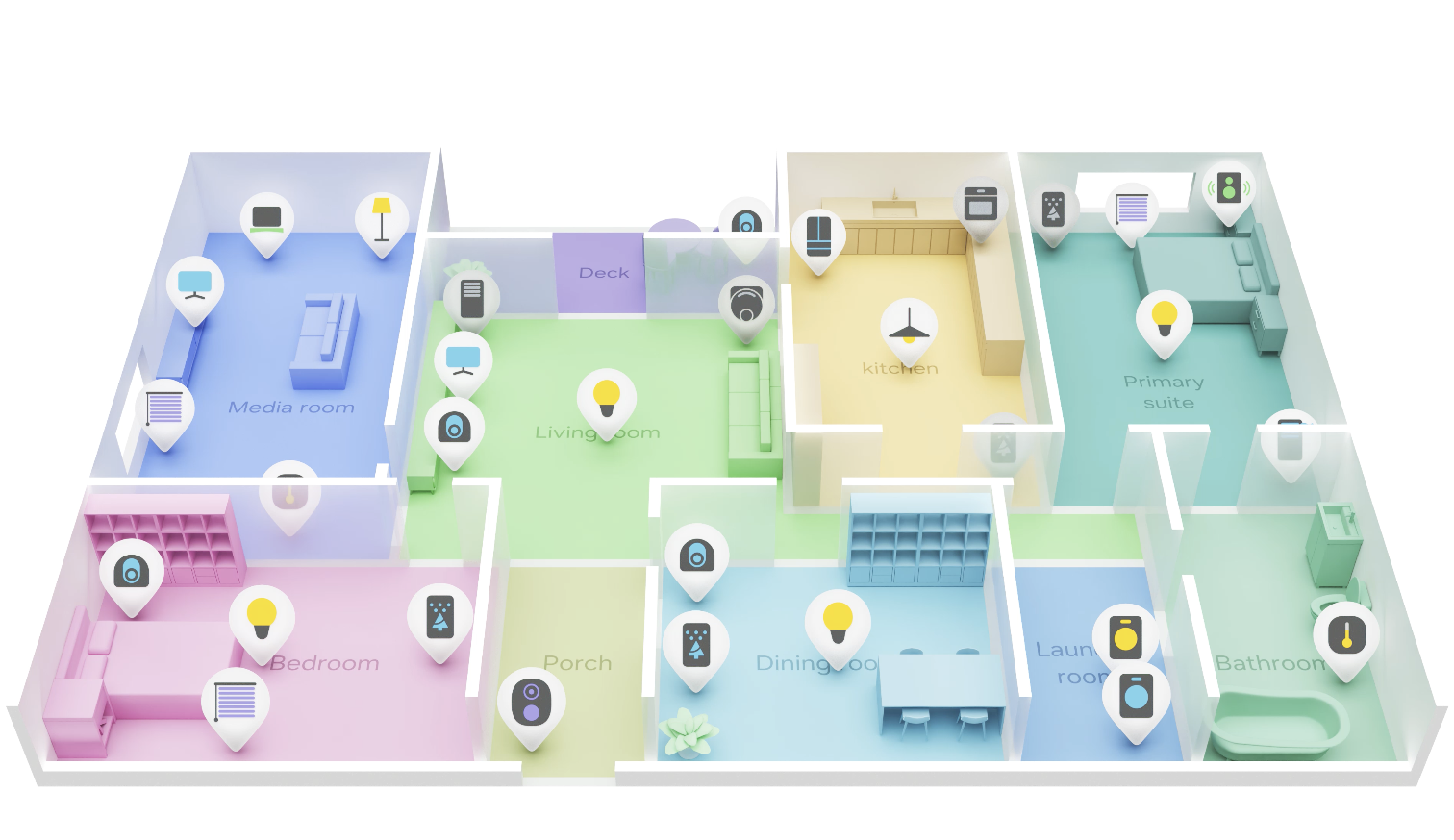
          • A way to gamify SmartThings Map View.  This feature builds off of Map View, the way to visualize your home and all the devices in it. The idea for this enhancement to Map View is to gamify it to encourage more users to see the value in it.  The proposal is to allow users to get points for usage. SmartThings would then give encouraging feedback to SmartThings users for various actions taken, grant badges, and a leaderboard for the community.   

        What problem does your idea solve?

          • This helps encourage adoption and usage of Map View which enables smart home users to easily see their devices and manage them, and provides a visual overview of their home and devices.  It continues to enhance the SmartThings experience.  

        Who is the target audience?

          • Users who want to view a map of the devices within their home
          • Prospective smart home users who may not know how to get started. 

        How does your idea make smart homes more accessible?

          • By increasing usage of Map View through gamification, this ultimately makes it easier for current smart home users to see all of their smart devices at a glance. It also encourages them to purchase additional devices and see the opportunities in smart home living
          • Gamifying Map View can make managing a smart home more enjoyable and appeals to users who are more visually inclined.

        What technical requirements would be needed to implement your idea?

          • Some technical requirements include:
              • The need for the SmartThings platform to recognize and assign events to user behavior like uploading a user’s floor plan, a hand-drawn sketch, and device usage data.
              • Some kind of point system based on user behavior events
              • An ability to assign badges when a SmartThings user reaches a certain point threshold
              • A way for the SmartThings platform to compare points between users in the community
              • The need for the SmartThings platform to know which room each device is in
              • Ability to detect status of each device
              • Ability to handle events from each device 

        SmartThings Map View

        Example 2

        Note: This example is of an official SmartThings driver we have in our main driver channel.  This one exists already, but serves as an example of a driver submission.  

        (after entering your name, company, job title, and email in the form) 

        Introduce your new driver.

          • This is a driver to connect Zigbee water leak sensors to the SmartThings platform.  This driver provides supported capabilities including a water sensor, temperature alarm, temperature measurement, and battery indicator.  Upon a water leak, the driver will trigger an alert.  It also reports the current temperature and can trigger an alarm on excessive heat or water freeze if the device supports it. 

        What problem does your driver solve?

          • It expands the SmartThings ecosystem by connecting Zigbee water leak sensors across multiple brands.

        Who is the target audience?

          • SmartThings users who want to detect water leaks with a Zigbee device. 

        How does your driver make smart homes more accessible?

          • It adds an additional device category to smart homes and helps people who need the ability to monitor water leaks.  

        Share the channel to your driver. 

        Speed Up Laravel Projects with Laravel Shift Blueprint

        0

        Install Blueprint

        To get started, install Blueprint in your development environment using Composer:

        composer require --dev laravel-shift/blueprint

        Create the Draft YAML File

        The draft.yaml file is the heart of Blueprint—it’s where you define your models, controllers, relationships, and even routes! Start by creating a draft.yaml file in your project’s root directory.

        Blueprint reads this file to understand the structure of your app. Here’s a sample setup for a blog:

        models:
          Post:
            title: string
            content: text
            published_at: timestamp nullable
            status: string
            category_id: unsignedInteger nullable
            relationships:
              belongsTo: Category
              belongsToMany: Tag, Author
        
          Category:
            name: string
            description: string nullable
            relationships:
              hasMany: Post
        
          Author:
            name: string
            email: string
            bio: text nullable
            twitter_handle: string nullable
            relationships:
              belongsToMany: Post
        
          Tag:
            name: string
            slug: string
            relationships:
              belongsToMany: Post

        This simple YAML file defines multiple models, fields, and relationships in one place, allowing you to model your entire app’s data structure with minimal syntax.

        Generate Code with Blueprint

        Once you’ve defined your models in draft.yaml, it’s time to let Blueprint work its magic. Run the following command to generate your code:

        php artisan blueprint:build

        This command reads draft.yaml and automatically generates models, migrations, controllers, and routes based on your specifications. You’ll see files created for each model and relationship, saving you from writing boilerplate code manually.

        Bonus Tips for Optimizing Your Workflow

        • Add Custom Attributes and Relationships: You can always modify draft.yaml to include more attributes or complex relationships as your app grows. For example, add unique constraints, nullable fields, and foreign keys.
        • Regenerate on the Fly: Blueprint is not a one-time tool. As your app evolves, update your draft.yaml file and re-run php artisan blueprint:build. This will adjust your models, migrations, and other components without overwriting custom code you’ve already modified.
        • Define Requests, Factories, and Controllers: Blueprint also supports defining form requests, factories, and custom controllers to help structure your application behavior in draft.yaml. This further speeds up development and maintains clean, well-organized code.

        Conclusion

        Give Laravel Shift Blueprint a try, and see how it can transform your Laravel workflow, helping you build features faster and more efficiently.

        FAQs

        Q: What is Laravel Shift Blueprint?
        A: Laravel Shift Blueprint is a tool that helps you build features faster and more efficiently in Laravel by generating models, migrations, controllers, and routes based on your YAML file.

        Q: How do I install Blueprint?
        A: You can install Blueprint using Composer: composer require –dev laravel-shift/blueprint.

        Q: What is the purpose of the draft.yaml file?
        A: The draft.yaml file is where you define your models, controllers, relationships, and even routes for your app. Blueprint reads this file to understand the structure of your app.

        Q: How do I generate code with Blueprint?
        A: Run the following command to generate your code: php artisan blueprint:build. This command reads your draft.yaml file and generates models, migrations, controllers, and routes based on your specifications.

        OpenAI Takes on Google with ChatGPT Search

        0

        Pulling in Authorized Content

        Partnerships and Collaborations

        OpenAI isn’t the only company exploring AI-powered web search. Microsoft Copilot offers similar features, and Perplexity has made waves in the AI community for challenging Google’s search dominance, although it has also met resistance from publishers who claim Perplexity has integrated their content without permission. That makes OpenAI’s partnerships a potential advantage for the company.

        Over the past few years, OpenAI has established new partnerships with major news organizations, collaborating with the Associated Press, Axel Springer, Ars Technica parent Condé Nast, Dotdash Meredith, Financial Times, GEDI, Hearst, Le Monde, News Corp, Prisa (El País), Reuters, The Atlantic, Time, and Vox Media.

        New Search Feature

        As part of these collaborations, OpenAI is incorporating custom formatted information into its new Search feature through categories like weather, stocks, sports, and news, along with new visual designs for the content.

        A Screenshot of ChatGPT with Search

        Hands-on Test

        In a hands-on test of ChatGPT with Search, the new feature seemed to consistently pull relevant links from the web while answering our questions, but it wasn’t perfect, returning a few errant sources here and there. It also sometimes provided irrelevant images that were shown beside some search results.

        Graphical Content and Map Display

        ChatGPT can now display graphical content from the web for the first time (sort of like Google Image Search but more limited). It can also show locations on a map, such as if you ask, “Where’s the best place to buy ice cream in San Francisco?”

        Preferential Content Placement

        All these new avenues for ChatGPT to potentially prefer one website, source of information, company, brand, or shop brings up a big question: Will OpenAI offer preferential content placement for media partners or advertisers in the future? When asked if the new Search feature already preferred results from media partners, an OpenAI spokesperson told Ars Technica that “any website or publisher can appear in ChatGPT search, and they can choose to opt out.”

        Future Plans

        In the future, OpenAI plans to add to the new search feature with custom answers for shopping and travel-related queries. The company also plans to use OpenAI’s o1 series for deeper search capabilities and expand the search experience to Advanced Voice Mode and Canvas features.

        Launch and Availability

        The search function launches today for ChatGPT Plus and Team subscribers through chatgpt.com and mobile apps. Enterprise and education users will gain access in the coming weeks, with a broader rollout to free users planned over several months.

        Conclusion

        OpenAI’s new Search feature has the potential to revolutionize the way we search the internet, with its ability to pull in authorized content and provide relevant results. With its partnerships with major news organizations and plans to add new features, OpenAI is poised to take a significant step forward in the world of AI-powered search.

        FAQs

        Q: Will OpenAI offer preferential content placement for media partners or advertisers in the future?

        A: According to OpenAI, any website or publisher can appear in ChatGPT search, and they can choose to opt out.

        Q: What kind of content can I expect to see in the new Search feature?

        A: The new Search feature will include custom formatted information in categories like weather, stocks, sports, and news, along with new visual designs for the content.

        Q: Can I use the new Search feature on my mobile device?

        A: Yes, the new Search feature is available on mobile devices through the ChatGPT app.

        Infinite Echoes

        0

        Unfolding the Mysteries of the Universe

        A Swirling Vortex of Divine Energy

        A swirling vortex of divine energy emanates from the core of the universe, as the essence of God’s consciousness takes form. Radiant beams of light, imbued with the celestial music of creation, dance across the cosmos, infusing all matter with an ethereal glow. As the fabric of reality blurs, the boundaries between dimensions dissolve, and the very essence of creation is set aflame with an elation that transcends the mundane.

        The Journey of Self-Awareness

        Unfolding begins with self-awareness. It’s about turning inward and questioning who you are, beyond societal roles and expectations. This is a continuous process of peeling back layers of identity, beliefs, and conditioning. You may discover hidden aspects of yourself—strengths, vulnerabilities, desires, and fears—that were once obscured.

        The Process of Unfolding

        • Turning Inward: The first step is to turn inward and question who you are, beyond societal roles and expectations.
        • Peeling Back Layers: This involves peeling back layers of identity, beliefs, and conditioning to discover hidden aspects of yourself.
        • Embracing Authenticity: Embracing your true self, beyond societal expectations, is the key to unfolding.

        The Power of Introspection

        Introspection is a powerful tool for unfolding. It allows you to:

        • Explore Your Thoughts and Emotions: Explore your thoughts and emotions to gain a deeper understanding of yourself.
        • Identify Patterns and Beliefs: Identify patterns and beliefs that may be holding you back.
        • Discover Your True Potential: Discover your true potential and the path to realizing it.

        The Importance of Mindfulness

        Mindfulness is essential for unfolding. It allows you to:

        • Be Present in the Moment: Be present in the moment and let go of distractions.
        • Focus on Your Breath: Focus on your breath and let go of thoughts and emotions.
        • Cultivate Inner Peace: Cultivate inner peace and a sense of calm.

        Conclusion

        Unfolding is a journey of self-discovery and growth. It requires patience, introspection, and mindfulness. By embracing your true self and letting go of societal expectations, you can unlock your full potential and live a life of purpose and fulfillment.

        Frequently Asked Questions

        Q: What is unfolding?
        A: Unfolding is the process of discovering your true self and realizing your full potential.

        Q: What is the first step in unfolding?
        A: The first step in unfolding is to turn inward and question who you are, beyond societal roles and expectations.

        Q: What is the importance of introspection in unfolding?
        A: Introspection is essential in unfolding as it allows you to explore your thoughts and emotions, identify patterns and beliefs, and discover your true potential.

        Q: What is the role of mindfulness in unfolding?
        A: Mindfulness is essential in unfolding as it allows you to be present in the moment, focus on your breath, and cultivate inner peace.

        Responsible AI Consulting

        In Embarking on AI Projects

        IBM Consulting’s Approach

        As business leaders investigate the best way to apply generative AI to their enterprise at scale, they need to consider trusted vendors and partners with expertise in data, machine learning and AI, data and AI governance, and proven capabilities of scaling applied AI within enterprises across industries and geographies.

        Capabilites and Expertise

        • IBM Consulting has capabilities in Foundation Models delivery at scale.
        • IBM Consulting brings industry expertise to understand the regulatory constraints and how to derive value with AI by augmenting specific workflows.
        • IBM has close strategic partnerships to scale AI projects and has won many awards in this regard, including the US 2022 AWS Innovation Partner of the year.

        IBM’s Approach to AI

        The mission of IBM Consulting is to drive business transformation with hybrid cloud and AI in a way that is valuable and responsible. We formally stood up our AI Ethics Board in 2018 to ensure that AI systems created at IBM are developed and deployed ethically.

        Principles of Trust and Transparency

        IBM has published its own principles of trust and transparency and offers them as a roadmap to others working with and implementing artificial intelligence. These principles focus on the following:

        • The purpose of AI is to augment human intelligence;
        • Data and insights belong to their creator; and
        • New technology, including AI systems, must be transparent and explainable.
        Pillars of Trust

        IBM’s approach is guided by the following pillars of trust:

        1. Explainability: How an AI model arrives at a decision should be able to be understood.
        2. Fairness: AI models should treat all groups equitably.
        3. Robustness: AI systems should be able to withstand attacks to the training data.
        4. Transparency: All relevant aspects of an AI system should be available to the public for evaluation.
        5. Privacy: The data used in AI systems should be secure, and when that data belongs to an individual, the individual should understand how it is being used.

        Social-Challenge of Trust and Transparency

        Generative AI and large language models (LLMs) introduce new hazards into the field of AI, and driving trust and transparency in artificial intelligence is not a technological challenge, it is a socio-technological challenge.

        How IBM Consulting Approaches AI

        IBM brings together vast transformation experience, industry expertise, proprietary and partner technologies and IBM Research to work with clients wherever they are on their AI journey.

        Our approach is uniquely suited to help businesses build the strategy and capabilities to operationalize and scale trusted AI to achieve their goals.

        Resources

        Services

        • Analytics and AI to build, train and deploy AI and ML models for your business.
        • AI and Automation Advisory to integrate best of breed AI and Automation solutions for full stack observation and orchestration.
        • Full-Service Automation to leverage IBM’s full suite of technology and services platforms that enables straight through “touchless” processing with minimal human involvement.

        Get Started with AI

        Learn more about AI and Automation services including research about the open-source tools available to activate against trust & transparency and IBM AI Ethics. You can also learn more about this three-part series by reading the first or second installment, or reaching out to an expert for start a conversation about your needs.

        Register for our webcast: What does ChatGPT mean for business? – How to drive disruptive value with Generative AI.

        Q: What does IBM Consulting offer in AI projects?
        A: IBM Consulting offers expertise in data, machine learning and AI, data and AI governance, and proven capabilities of scaling applied AI within enterprises across industries and geographies.

        Q: What is IBM’s approach to AI?
        A: IBM’s approach to AI is focused on driving business transformation with hybrid cloud and AI in a way that is valuable and responsible. We emphasize the importance of trust, transparency, explainability, fairness, robustness, and privacy.

        Q: What are IBM’s principles of trust and transparency?
        A: IBM’s principles of trust and transparency include the purpose of AI as augmenting human intelligence, data and insights belonging to their creator, and new technology, including AI systems, being transparent and explainable.

        Q: How does IBM address the socio-technological challenge of trust and transparency in AI?
        A: IBM addresses the socio-technological challenge of trust and transparency in AI by bringing together vast transformation experience, industry expertise, proprietary and partner technologies and IBM Research to work with clients wherever they are on their AI journey.

        Q: What are the pillars of trust for IBM’s AI approach?
        A: IBM’s AI approach is guided by the pillars of trust, including explainability, fairness, robustness, transparency, and privacy.

        Emerson expands automation portfolio with Afag feeding and handling solutions – Robotics & Automation News

        0

        Afag is now officially part of Emerson. As a result, Afag’s feeding and handling solutions will be integrated into Emerson’s extensive automation portfolio.

        Starting this month, all content on Afag.com, including product documentation, data, and certificates, will be migrated to Emerson.com under the Aventics brand.

        This migration will streamline Emerson’s comprehensive automation offerings, making it easier for original equipment manufacturers (OEMs) to access the solutions they need in a single location.

        The Aventics brand is globally recognized for its innovation and proven performance. By bringing Afag’s feeding and handling products under the Aventics umbrella, OEMs will benefit from single-source access to a broader range of machine automation experts, as well as pneumatic and electric solutions that optimize the performance of new equipment designs.

        In the months following the migration, Emerson will gradually rebrand Afag’s products under the Aventics line.

        While the brand name will change, the Afag product portfolio will remain consistent, ensuring OEMs continue to receive the high quality and support they trust. Customers will still be able to contact their existing representatives for ongoing assistance.

        The legacy Aventics portfolio includes cylinders, valves, air preparation, and pressure technology.

        The newly incorporated Afag portfolio adds vibratory feeders, refilling devices, control units, linear and rotary axes, rotary modules, grippers, and more, further strengthening Emerson’s machine automation offering