Home Blog Page 644

IcePeony and Transparent Tribe Target Indian Entities with Cloud-Based Tools

0


Nov 08, 2024Ravie LakshmananCyber Espionage / Threat Intelligence

High-profile entities in India have become the target of malicious campaigns orchestrated by the Pakistan-based Transparent Tribe threat actor and a previously unknown China-nexus cyber espionage group dubbed IcePeony.

The intrusions linked to Transparent Tribe involve the use of a malware called ElizaRAT and a new stealer payload dubbed ApoloStealer on specific victims of interest, Check Point said in a technical write-up published this week.

“ElizaRAT samples indicate a systematic abuse of cloud-based services, including Telegram, Google Drive, and Slack, to facilitate command-and-control communications,” the Israeli company said.

ElizaRAT is a Windows remote access tool (RAT) that Transparent Tribe was first observed using in July 2023 as part of cyber attacks targeting Indian government sectors. Active since at least 2013, the adversary is also tracked under the names APT36, Datebug, Earth Karkaddan, Mythic Leopard, Operation C-Major, and PROJECTM.

Cybersecurity

Its malware arsenal includes tools for compromising Windows, Android, and Linux devices. The increased targeting of Linux machines is motivated by the Indian government’s use of a custom Ubuntu fork called Maya OS since last year.

Infection chains are initiated by Control Panel (CPL) files likely distributed via spear-phishing techniques. As many as three distinct campaigns employing the RAT have been observed between December 2023 and August 2024, each using Slack, Google Drive, and a virtual private server (VPS) for command-and-control (C2).

While ElizaRAT enables the attackers to exert complete control over the targeted endpoint, ApoloStealer is designed to gather files matching several extensions (e.g., DOC, XLS, PPT, TXT, RTF, ZIP, RAR, JPG, and PNG) from the compromised host and exfiltrate them to a remote server.

In January 2024, the threat actor is said to have tweaked the modus operandi to include a dropper component that ensures the smooth functioning of ElizaRAT. Also observed in recent attacks is an additional stealer module codenamed ConnectX that’s engineered to search for files from external drives, such as USBs.

Cloud-Based Tools

The abuse of legitimate services widely used in enterprise environments heightens the threat as it complicates detection efforts and allows threat actors to blend into legitimate activities on the system.

“The progression of ElizaRAT reflects APT36’s deliberate efforts to enhance their malware to better evade detection and effectively target Indian entities,” Check Point said. “Introducing new payloads such as ApoloStealer marks a significant expansion of APT36’s malware arsenal and suggests the group is adopting a more flexible, modular approach to payload deployment.”

IcePeony Goes After India, Mauritius, and Vietnam

The disclosure comes weeks after the nao_sec research team revealed that an advanced persistent threat (APT) group it calls IcePeony has targeted government agencies, academic institutions, and political organizations in countries such as India, Mauritius, and Vietnam since at least 2023.

“Their attacks typically start with SQL Injection, followed by compromise via web shells and backdoors,” security researchers Rintaro Koike and Shota Nakajima said. “Ultimately, they aim to steal credentials.”

Cybersecurity

One of the most noteworthy tools in its malware portfolio is IceCache, which is designed to target Microsoft Internet Information Services (IIS) instances. An ELF binary written in the Go programming language, it’s a custom version of the reGeorg web shell with added file transmission and command execution features.

Cloud-Based Tools

The attacks are also characterized by the use of a unique passive-mode backdoor referred to as IceEvent that comes with capabilities to upload/download files and execute commands.

“It seems that the attackers work six days a week,” the researchers noted. “While they are less active on Fridays and Saturdays, their only full day off appears to be Sunday. This investigation suggests that the attackers are not conducting these attacks as personal activities, but are instead engaging in them as part of organized, professional operations.”
Found this article interesting? Follow us on Twitter and LinkedIn to read more exclusive content we post.


Graph Neural Networks Simplified

Graphs and where to find them

You’re probably already familiar with some types of graph data, such as social networks. However, graphs are an extremely powerful and general representation of data, we will show two types of data that you might not think could be modeled as graphs: images and text. Although counterintuitive, one can learn more about the symmetries and structure of images and text by viewing them as graphs,, and build an intuition that will help understand other less grid-like graph data, which we will discuss later.

Images as graphs

We typically think of images as rectangular grids with image channels, representing them as arrays (e.g., 244x244x3 floats). Another way to think of images is as graphs with regular structure, where each pixel represents a node and is connected via an edge to adjacent pixels. Each non-border pixel has exactly 8 neighbors, and the information stored at each node is a 3-dimensional vector representing the RGB value of the pixel.

Text as graphs

We can digitize text by associating indices to each character, word, or token, and representing text as a sequence of these indices. This creates a simple directed graph, where each character or index is a node and is connected via an edge to the node that follows it.

Graph-valued data in the wild

Graphs are a useful tool to describe data you might already be familiar with. Let’s move on to data which is more heterogeneously structured. In these examples, the number of neighbors to each node is variable (as opposed to the fixed neighborhood size of images and text). This data is hard to phrase in any other way besides a graph.

Graph Neural Networks

Graph Neural Networks (GNNs) are a type of neural network that operates on graph-structured data. They are designed to learn representations of nodes and edges in a graph, and can be used for a variety of tasks such as node classification, graph classification, and link prediction.

Graph Convolutions

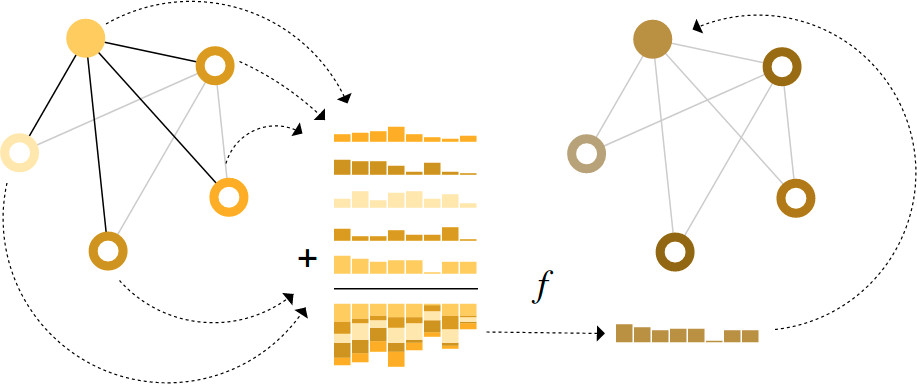
One of the key components of GNNs is the graph convolutional layer. This layer is designed to aggregate information from neighboring nodes in a graph, and can be used to learn representations of nodes and edges that are sensitive to the graph structure.

Graph Attention Networks

Another important component of GNNs is the graph attention mechanism. This mechanism allows the model to focus on different nodes and edges in the graph, and can be used to learn representations of nodes and edges that are sensitive to the graph structure.

Generative Modelling

Besides learning predictive models on graphs, we might also care about learning a generative model for graphs. With a generative model we can generate new graphs by sampling from a learned distribution or by completing a graph given a starting point. A relevant application is in the design of new drugs, where novel molecular graphs with specific properties are desired as candidates to treat a disease.

Final Thoughts

Graphs are a powerful and rich structured data type that have strengths and challenges that are very different from those of images and text. In this article, we have outlined some of the milestones that researchers have come up with in building neural network based models that process graphs. We have walked through some of the important design choices that must be made when using these architectures, and hopefully the GNN playground can give an intuition on what the empirical results of these design choices are. The success of GNNs in recent years creates a great opportunity for a wide range of new problems, and we are excited to see what the field will bring.

Frequently Asked Questions

Q: What is a graph neural network?
A: A graph neural network is a type of neural network that operates on graph-structured data.

Q: What are some common applications of graph neural networks?
A: Some common applications of graph neural networks include node classification, graph classification, and link prediction.

Q: What is the difference between a graph convolutional layer and a graph attention mechanism?
A: A graph convolutional layer is designed to aggregate information from neighboring nodes in a graph, while a graph attention mechanism allows the model to focus on different nodes and edges in the graph.

Q: What is generative modelling on graphs?
A: Generative modelling on graphs is the process of learning a generative model for graphs, which can be used to generate new graphs by sampling from a learned distribution or by completing a graph given a starting point.

Q: What are some challenges in building graph neural networks?
A: Some challenges in building graph neural networks include handling variable-sized input graphs, dealing with non-Euclidean geometry, and designing effective graph convolutional layers and attention mechanisms.

Mastering Oracle SQL: Collection and Record Context

Records and Collections in Oracle PL/SQL

In Oracle PL/SQL, a record and a collection are distinct types of data structures, and one is not a type of the other. However, they can be used together in a way that helps manage complex data.

Record

A record is a composite data type that groups related fields of potentially different data types together. Each field within a record can have its own data type.

Records are used when you want to represent a row of data where different fields (attributes) have different data types.

A record is not a collection, but it can be stored within a collection.

Example of a Record

DECLARE
— Define a record to hold employee information
TYPE employee_record IS RECORD (
emp_id NUMBER,
emp_name VARCHAR2(50),
emp_salary NUMBER
);

-- Declare a record variable
emp employee_record;

BEGIN
— Assign values to the fields of the record
emp.emp_id := 1001;
emp.emp_name := ‘John Doe’;
emp.emp_salary := 50000;

-- Display record values
DBMS_OUTPUT.PUT_LINE('ID: ' || emp.emp_id);
DBMS_OUTPUT.PUT_LINE('Name: ' || emp.emp_name);
DBMS_OUTPUT.PUT_LINE('Salary: ' || emp.emp_salary);

END;

Collection

A collection is a data structure that holds multiple values. A collection can store elements of the same data type (e.g., all numbers or all strings) or records of different types if needed.

The collection can be of three types in Oracle PL/SQL:

Associative Arrays (previously called PL/SQL tables)

Nested Tables

Varrays

A collection is not a record, but you can store records in a collection. Collections are useful for managing multiple records or values together.

Example of a Collection of Records

DECLARE
— Define a record type
TYPE employee_record IS RECORD (
emp_id NUMBER,
emp_name VARCHAR2(50),
emp_salary NUMBER
);

-- Define a collection (nested table) to store records
TYPE emp_table IS TABLE OF employee_record;
employees emp_table;  -- Declare the collection variable

BEGIN
— Initialize the collection with records
employees := emp_table(
employee_record(1001, ‘John Doe’, 50000),
employee_record(1002, ‘Jane Smith’, 60000)
);

-- Iterate over the collection and display record details
FOR i IN 1..employees.COUNT LOOP
    DBMS_OUTPUT.PUT_LINE('ID: ' || employees(i).emp_id ||
                         ', Name: ' || employees(i).emp_name ||
                         ', Salary: ' || employees(i).emp_salary);
END LOOP;

END;

Key Points

A Record is not a collection. It’s a composite data type used to group related fields (with potentially different data types).

A Collection is a data structure that stores multiple elements of the same data type (like arrays or lists). However, you can store records (which can have different data types inside them) in collections.

Conclusion

Record is not a type of collection.

Collection is not a type of record.

However, a collection can hold records as elements, allowing you to manage groups of complex data in an organized manner.

FAQs

Q: What is the difference between a record and a collection in Oracle PL/SQL?

A: A record is a composite data type that groups related fields of potentially different data types together, while a collection is a data structure that holds multiple values of the same or different data types.

Q: Can a record be stored in a collection?

A: Yes, a record can be stored in a collection, allowing you to manage groups of complex data in an organized manner.

Q: What are the different types of collections in Oracle PL/SQL?

A: The collection can be of three types in Oracle PL/SQL: Associative Arrays, Nested Tables, and Varrays.

Global Crackdown on Malicious IP Addresses

An International Coalition of Police Agencies Takes Down Online Scammers

An international coalition of police agencies has taken a major whack at criminals accused of running a host of online scams, including phishing, the stealing of account credentials and other sensitive data, and the spreading of ransomware, Interpol said recently.

Operation Synergia II: A Global Response

The operation, which ran from the beginning of April through the end of August, resulted in the arrest of 41 people and the takedown of 1,037 servers and other infrastructure running on 22,000 IP addresses. Synergia II, as the operation was named, was the work of multiple law enforcement agencies across the world, as well as three cybersecurity organizations.

Global Highlights

Hong Kong (China): Police supported the operation by taking offline more than 1,037 servers linked to malicious services.

Mongolia: Investigations included 21 house searches, the seizure of a server and the identification of 93 individuals with links to illegal cyber activities.

Macau (China): Police took 291 servers offline.

Madagascar: Authorities identified 11 individuals with links to malicious servers and seized 11 electronic devices for further investigation.

Estonia: Police seized more than 80GB of server data, and authorities are now working with INTERPOL to conduct further analysis of data linked to phishing and banking malware.

Cybersecurity Partners

The three private cybersecurity organizations that were part of Operation Synergia II were Group-IB, Kaspersky, and Team Cymru. All three used the telemetry intelligence in their possession to identify malicious servers and made it available to participating law enforcement agencies.

Conclusion

Operation Synergia II is a significant success in the global fight against cybercrime. The international coalition of police agencies and cybersecurity organizations has made a significant impact by dismantling malicious infrastructure and preventing hundreds of thousands of potential victims from falling prey to cybercrime.

FAQs

Q: What was Operation Synergia II?

A: Operation Synergia II was an international operation conducted by multiple law enforcement agencies across the world, as well as three cybersecurity organizations, to take down online scammers and disrupt malicious cyber activities.

Q: What was the scope of the operation?

A: The operation resulted in the arrest of 41 people and the takedown of 1,037 servers and other infrastructure running on 22,000 IP addresses.

Q: Which countries were involved in the operation?

A: Hong Kong (China), Mongolia, Macau (China), Madagascar, and Estonia were among the countries involved in the operation.

Q: What were the private cybersecurity organizations involved in the operation?

A: Group-IB, Kaspersky, and Team Cymru were the three private cybersecurity organizations involved in the operation.

Q: What was the outcome of the operation?

A: The operation resulted in the disruption of malicious cyber activities, the lawful seizures of servers and other electronic devices, and arrests. It also prevented hundreds of thousands of potential victims from falling prey to cybercrime.

Elon Musk’s new X store is another nail in the coffin for the Twitter brand

0


Usually when a company rebrands, it’s swift quick to remove all trace of its previous identity. Not so with X, or as you probably know it, ‘X, Formerly Known as Twitter’. Despite Elon Musk’s best efforts, the bird branding has shown itself to have remarkable staying power – perhaps, I don’t know, a sign that Twitter never needed rebranding in the first place. But, piece by piece, Musk continues to dismantle the last vestiges of the Twitter brand – most recently with the addition of a new merch store.

Yep, should you so desire, you can now wear everything from X-branded T-shirts and hats, to… okay, that’s it for now. But do you know what you can’t wear? A Twitter-branded T-shirt or hat. The most chaotic rebrand of all time is here to stay.

Ransomware-Attacke auf bayerische Schulen | CSO Online

0


Hacker sind in die IT-Systeme von sieben bayerischen Schulen eingedrungen.

CeltStudio – Shutterstock.com

Bereits im Oktober wurden sieben weiterführenden Bildungseinrichtungen im Landkreis Kitzingen von Hackern angegriffen. Nun hat sich herausgestellt, dass die Täter dabei auch die Daten einer Schule gestohlen haben. Nach Angaben des Landratsamtes handelt es sich um persönliche Informationen.

„Auch wenn die forensischen Untersuchungen noch nicht abgeschlossen sind, konnte der Datenabfluss bisher auf eine Schule eingegrenzt werden. Sobald die Analysen abgeschlossen sind, werden die Betroffenen informiert“, heißt es in einer Mitteilung. Eine Veröffentlichung der Daten könne nach wie vor nicht festgestellt werden.

Welche Daten genau betroffen sind, gibt das Landratsamt jedoch nicht bekannt. Auch der Name der Schule wird nicht genannt. Die IT-Systeme der anderen Schulen wurden Berichten zufolge mit einer Ransomware verschlüsselt. Ob es bereits eine Lösegeldforderung gab und wer hinter der Attacke steckt, ist unklar.

Google’s AI Tool Discovers SQLite Zero-Day Vulnerability

Cybersecurity and AI: A New Era in Vulnerability Detection

As cyber threats grow more sophisticated, the need for innovative tools to enhance vulnerability detection has never been greater. Cybersecurity companies like Palo Alto, Fortinet, and CrowdStrike have responded by incorporating AI to enhance their threat detection capabilities.

The Rise of AI-Powered Tools in Cybersecurity

A new cybersecurity innovation has emerged from an unexpected source. Google claims that it has used a large language model (LLM) agent called “Big Sleep” to discover a previously unknown, exploitable memory flaw in SQLite database – a widely used open-source database engine.

Big Sleep: A New Era in Bug Hunting

Developed in collaboration between Google’s Project Zero and DeepMind, Big Sleep was able to detect a zero-day vulnerability in the SQLite database. The tool identified a flaw in the code where a special pattern used in SQLite’s ‘ROWID’ column wasn’t properly managed. This oversight allowed a negative index to be written into a stack buffer, resulting in a significant security vulnerability.

How Big Sleep Works

Big Sleep is designed to go beyond traditional techniques like fuzzing, which is an automated software testing method that introduces invalid, random, or unexpected inputs into a system to uncover vulnerabilities. While fuzzing works well to identify simple bugs, LLM-powered tools like Big Sleep have the potential to offer more sophisticated analysis by understanding the deeper logic of the code.

The Future of Bug Hunting

Google deployed Big Sleep to analyze the recent changes to the SQLite source code. The tool reviewed the alterations through a tailored prompt and ran Python scripts within a sandboxed environment. During this process, Big Sleep identified a flaw in the code where a negative index, “-1,” was incorrectly used. If left unchecked, this flaw could have allowed for unstable behavior or arbitrary code execution.

The Impact of Big Sleep

The bug-hunting AI tool is designed to go beyond traditional techniques like fuzzing. Google believes that Big Sleep has tremendous defensive potential, allowing for the discovery of vulnerabilities in software before it’s even released, effectively turning the tables and achieving an asymmetric advantage for defenders.

Conclusion

The integration of AI into cybersecurity practices has the potential to revolutionize the way we detect and prevent cyber threats. With Big Sleep, Google has taken a significant step towards making bug hunting more efficient and effective. As the technology continues to evolve, we can expect to see more innovative tools like Big Sleep emerge, changing the landscape of cybersecurity forever.

FAQs

Q: What is Big Sleep?
A: Big Sleep is a large language model (LLM) agent used to discover previously unknown, exploitable memory flaws in software code.

Q: How does Big Sleep work?
A: Big Sleep reviews code changes through a tailored prompt and runs Python scripts within a sandboxed environment to identify potential flaws.

Q: What is the potential impact of Big Sleep?
A: Big Sleep has the potential to revolutionize bug hunting, allowing for the discovery of vulnerabilities in software before it’s even released, effectively turning the tables and achieving an asymmetric advantage for defenders.

Q: How does Big Sleep compare to traditional bug hunting methods like fuzzing?
A: Big Sleep goes beyond traditional techniques like fuzzing, offering more sophisticated analysis by understanding the deeper logic of the code.

AI-Enhanced Research Relevance

0

Measuring the Impact of Business School Research

There have long been calls for business schools to focus on “responsible research” with relevance to society. Now, there is fresh scope to deploy technology to help assess their academics’ outputs at scale, albeit with limitations.

Limitations of Measuring Responsible Research

It is difficult, by any yardstick, to evaluate digitally the originality and depth of insight of academic writing, let alone assess its ultimate impact. Academic awards and assessments of papers do not necessarily coincide with the views of practitioners seeking practical applications. Ideas may take many years, and be significantly modified, before they are taken up. Some of the strongest may eventually prove to be erroneous and even harmful, or unexpectedly beneficial in unanticipated applications.

Technology Tools for Measuring Responsible Research

However, technology tools linked to large language models and artificial intelligence can at least start to measure the extent to which the topics researched and published by academics align with societal objectives. One framework gathering increasing popularity uses the UN Sustainable Development Goals (SDGs) — 17 objectives agreed by countries around the world for 2030, such as eradicating poverty, providing quality education and taking climate action. Within the 17 goals, there are 169 specific targets.

SDG-Impact Journal Rating and ChatSDG

David Steingard, associate professor of management at the Haub School of Business, Saint Joseph’s University, in the US, has developed an SDG-Impact Journal Rating to assess how far 100 leading business school academic journals match the goals. ChatSDG, the latest iteration, builds on the approach to show how far schools are aligning their research more broadly with the SDGs.

OpenAlex and Clarivate SDG Analytics

For its latest analysis on how many academics in each business school have published SDG-related articles, the FT has used OpenAlex, the open access data provider. It, in turn, takes into account a series of key SDG terms and definitions developed by the Aurora Universities network. These have been filtered to consider, as a measure of rigour, only articles published in the FT50 list of leading journals.

Clarivate, which operates the Web of Science database of journals, is one of several commercial providers also offering SDG analytics. As with OpenAlex, however, it focuses on tallying articles considered to have some SDG relevance, rather than trying to compare the depth of their analysis with other papers.

Limitations of Technology Tools

All these methodologies have their limitations, however. Mijnhardt’s list contained at least one historically focused article that had little obvious alignment with the SDGs: a paper from the Journal of Financial and Quantitative Analysis called “Access to finance and technological innovation: evidence from pre-civil war America”. Other articles are clearly relevant to the SDGs, but how far they are the most important contributions to scholarship and practice is a far more open debate.

Case Studies in Responsible Research

Supply Chains for Clothing

Meltem Denizel and Caroline Schumm from Iowa State University explored fashion in their 2023 Journal of the Operations Management article “Closed loop supply chains in apparel: current state and future directions”. The academics examined public sustainability reports to compare the low levels of recycling of clothing with the electronics industry, where moves towards a “circular economy” without requiring additional resource depletion is more advanced.

Marketplace Literacy

Madhubalan Viswanathan, professor of marketing at the College of Business Administration, Loyola Marymount University in the US, and co-authors including Arun Sreekumar at the Indian Institute of Management, Ahmedabad, published “Marketplace literacy as a pathway to a better world: evidence from field experiments in low-access subsistence marketplaces” in the Journal of Marketing in 2021.

Informal Water Vendors

Florence Dery, from Queen’s University, Canada, and Ophelia Soliku, from the SD Dombo University of Business and Integrated Development Studies in Ghana, plus colleagues studied private water sellers in low income regions in their paper “‘Quenching the thirst of others while suffering’: embodied experiences of water vendors in Ghana and Kenya”, published in Social Science & Medicine.

Clarivate SDG Pick

Nan Jia, at the University of Southern California, Xueming Luo, of Temple University in Philadelphia, and their fellow authors considered, “When and how artificial intelligence augments employee creativity” in the Academy of Management Journal. They studied a telemarketing company to find that AI assistance in generating sales leads on average increased employees’ creativity in answering customers’ questions during subsequent sales calls, leading to increased sales.

Conclusion

While measuring the impact of business school research is challenging, technology tools linked to large language models and artificial intelligence can at least start to measure the extent to which the topics researched and published by academics align with societal objectives. The SDGs offer a framework for assessing responsible research, and case studies demonstrate the potential for impactful research in areas such as supply chains, marketplace literacy, and informal water vendors.

FAQs

Q: What is the SDG-Impact Journal Rating?

A: The SDG-Impact Journal Rating is a framework developed by David Steingard to assess how far 100 leading business school academic journals match the UN Sustainable Development Goals (SDGs).

Q: What is ChatSDG?

A: ChatSDG is the latest iteration of the SDG-Impact Journal Rating, which builds on the approach to show how far schools are aligning their research more broadly with the SDGs.

Q: How do OpenAlex and Clarivate SDG Analytics work?

A: OpenAlex and Clarivate SDG Analytics use large language models and artificial intelligence to measure the extent to which articles published by academics align with the UN Sustainable Development Goals (SDGs). They focus on tallying articles considered to have some SDG relevance, rather than trying to compare the depth of their analysis with other papers.

Perplexity Dives into Real-Time Election Tracking

0

Perplexity’s Election Information Hub Blurs Line Between Verified and AI-Generated Content

Inconsistent Results

Perplexity’s Election Information Hub may have blurred the line between verified and free-wheeling AI-generated information. While some results come directly from trusted sources, searching for more information triggered open-ended AI-generated results from the wider web.

Cautionary Approach from Other AI Companies

Other AI companies appear to be taking a more cautious approach to the election. In WIRED’s testing, ChatGPT Search, a newly launched service from OpenAI, often declined to provide information about voting. "We’ve instructed ChatGPT to not express preferences, offer opinions, or make specific recommendations about political candidates or issues even when explicitly asked," Mattie Zazueta, an OpenAI spokesperson, told WIRED.

Google’s Approach

The results were often inconsistent, however. For instance, the tool sometimes refused to provide talking points to help persuade someone to vote for one candidate or the other, and sometimes willingly offered some. Google’s search engine also avoided providing AI-generated results in relation to the election. The company said in August it would limit use of AI in relation to the election in search and other apps. "This new technology can make mistakes as it learns or as news breaks," the company said in a blog post.

Other AI Search Upstarts

Even regular search results sometimes prove problematic though. During voting on Tuesday, some Google users noticed that a search for "Where do I vote for Harris" provided the location of voting information while a search for "Where do I vote for Trump" did not. Google explained this was because the search interpreted the query as one related to Harris County in Texas.

Some other AI search upstarts are, like Perplexity, taking a bolder approach. You.com, another startup that blends language models with conventional web search, on Tuesday announced its own election tool, built in collaboration with TollBit, a company that provides AI firms with managed access to content, as well as Decision Desk HQ, a company that provides access to poll results.

Perplexity’s Controversial Approach

Perplexity appears to have been particularly bold in its approach to upending web search. In June, a WIRED investigation found evidence that a bot associated with Perplexity was ignoring instructions not to scrape WIRED.com and other sites belonging to WIRED’s parent company, Condé Nast. The analysis confirmed an earlier report by developer Robb Knight concerning the behavior of bots operated by Perplexity.

The AI search engine is also accused of cribbing liberally from news sites. For instance, also in June, a Forbes editor noted that Perplexity had summarized extensive details of an investigation published by the outlet with footnote citations. Forbes reportedly sent a letter threatening legal action against Perplexity for the practice.

In October, News Corp sued Perplexity for ripping off content from The Wall Street Journal and the New York Post. The suit argues that Perplexity is breaching copyright law because it sometimes fabricated sections of news stories and falsely attributed words to its publications.

Conclusion

Perplexity’s approach to providing election information raises concerns about the blurring of lines between verified and AI-generated content. While other AI companies are taking a more cautious approach, Perplexity’s bold move may have unintended consequences on the integrity of the information provided.

Frequently Asked Questions

Q: What is Perplexity’s approach to providing election information?

A: Perplexity’s approach involves using AI to generate information, sometimes using trusted sources and sometimes providing open-ended results from the wider web.

Q: How do other AI companies approach providing election information?

A: Other AI companies, such as OpenAI and Google, are taking a more cautious approach, avoiding AI-generated results and focusing on verified information.

Q: What are the concerns surrounding Perplexity’s approach?

A: The concerns include the blurring of lines between verified and AI-generated content, and the potential for Perplexity to fabricate information or attribute false statements to news outlets.

Q: What is News Corp suing Perplexity for?

A: News Corp is suing Perplexity for ripping off content from The Wall Street Journal and the New York Post, breaching copyright law and sometimes fabricating sections of news stories and falsely attributing words to its publications.

Meet Haoyuan ‘HY’ Li, a 2024 BDW Person to Watch

0

About Alluxio

One of the technologies born from the big data revolution is Alluxio, created by Haoyuan “HY” Li, one of the BigDATAwire People to Watch for 2024. Alluxio is a virtual distributed file system designed to be used with frameworks like Apache Hadoop and Apache Spark.

Li founded a company called Alluxio, where he serves as chairman and CEO. BigDATAwire recently caught up with Li to talk about his work.

Inspiration

BigDATAwire: You created Alluxio while working in the AMPLab at UC Berkeley. What was the source of the inspiration for the project?

HY Li: When I was doing research at Google during my undergraduate time, I saw the power of data as the foundation of many aspects of our world in the future. With that belief, I was very fortunate to have the opportunity to pursue my Ph.D. at Berkeley AMPLab under the tutelage of Professor Ion Stoica and Professor Scott Shenkar.

At the time, there was an explosion in innovation at the compute layer and storage layer, which created a unique problem associated with data orchestration (including data access, management, etc). While the introduction of new technologies enabled many new applications, every new storage system became yet another data silo. The rise of cloud storage only exacerbated these challenges.

What is Missing from the Big Data Stack Today?

BigDATAwire: What is missing from the big data stack today?

Li: Companies are racing to leverage AI and machine learning in their businesses, and what they are realizing is that machine learning applications create a new set of challenges for their data platforms. Traditional data infrastructures often struggle to cope with these demands, leading to cost inefficiencies, slower innovation, and complex data engineering.

With the rise of machine learning workloads such as computer vision and LLMs, the need for a high-performance data layer that serves all critical data-driven applications is even greater. Alluxio provides an efficient offline model training cache capable of serving datasets of any size directly to training nodes without impacting the training performance.

Relationship Between Distributed File Systems and Streaming Data Platforms

BigDATAwire: You had a role in developing Spark Streaming. What’s the relationship between distributed file systems and streaming data platforms?

Li: We see streaming data applications as a type of data-driven application that the data platform such as Alluxio serves.

Outside Interests

BigDATAwire: Outside of the professional sphere, what can you share about yourself that your colleagues might be surprised to learn – any unique hobbies or stories?

Li: Outside of work, I enjoy exploring the great outdoors through hiking and scuba diving. I love what I do, but it can be difficult to find the space to step back and appreciate the world. I’ve found scuba diving to be the perfect activity as it requires focus to ensure safety, which allows me to be fully present and appreciate the wonders of the sea world.

I also have a keen interest in world history and cultural exchange. I enjoy learning about different cultures and traditions from around the world. This curiosity has led me to travel extensively and engage with people from diverse backgrounds, enriching my understanding of the world and fostering meaningful connections.

Conclusion

Alluxio is a innovative solution that bridges the gap between compute and storage, providing high-performance data access for all data-driven workloads. With its ability to serve datasets of any size directly to training nodes without impacting the training performance, Alluxio accelerates model updates from experimentation to production, facilitating a better user experience and deeper user engagement.

Frequently Asked Questions

Q: What inspired Haoyuan “HY” Li to create Alluxio?

A: Li was inspired by the power of data and the need for a new type of data platform that could bridge the gap between compute and storage.

Q: What is the relationship between Alluxio and big data?

A: Alluxio is a virtual distributed file system designed to be used with big data frameworks like Apache Hadoop and Apache Spark.

Q: What is Alluxio used for?

A: Alluxio is used for high-performance data access, model training, and offline model training cache, which enables data teams to achieve magnitudes higher training performance without the need for costly specialized storage.