Home Blog Page 7

Why physician workforce matching remains the biggest challenge in healthcare automation

0

Hospitals have spent years trying to remove friction from care delivery. Routine administrative tasks are moving into software. Robots are moving supplies through corridors.

AI tools are helping with documentation, scheduling, and decision support. Much of this work happens quietly in the background, but it changes how a hospital feels day to day.

Less waiting. Fewer manual handoffs. Cleaner workflows. More time for clinical teams to focus on patients.

Still, automation has a hard limit. A hospital can streamline its back office, speed up logistics, and improve the flow of information, but it still needs physicians where patients need them.

If the right doctors are not available in the right specialties, locations, and care settings, the system slows down no matter how advanced the technology becomes.

Automation is Already Part of the Hospital Routine

Healthcare automation no longer feels like a distant experiment. In many facilities, it is already part of ordinary operations. Administrative teams use software to cut back on manual data entry.

Pharmacy departments rely on automated systems to improve accuracy. Logistics robots can carry meals, linens, medications, and supplies through busy hospital corridors.

These improvements matter because hospitals rarely get slowed by a single failure. More often, delays build from small problems that stack up across the day.

A missing supply cart, a slow intake process, a backlog of routine paperwork, or a poor handoff between departments can all affect the patient experience.

In administrative departments, RPA is transforming healthcare operations by taking on repetitive work that once consumed staff time and created avoidable bottlenecks.

The value is not always dramatic on the surface. It shows up in smoother processes, fewer interruptions, and teams that can spend less time chasing information.

The Hardest Bottleneck is Still People

Automation can make a hospital move faster, but it cannot cover an empty physician role. That problem is becoming harder for health systems to work around.

Patient demand is rising, many clinicians are moving toward retirement, and some regions continue to struggle with access to specialists.

The Association of American Medical Colleges has projected a shortage of up to 86,000 physicians by 2036, which puts real pressure on hospitals already trying to reduce wait times and expand access to care.

This is where the automation conversation becomes more complicated. Better scheduling tools can help. Cleaner administrative workflows can help.

Automated supply systems can help. But if physician capacity is missing, patients still wait and staff still feel the strain.

Workforce matching belongs in the same operational conversation as robotics, AI, and process automation. All of these systems affect how quickly care can be delivered.

The difference is that physician matching deals with people’s careers, preferences, specialties, and lives, which makes it far harder than moving data from one system to another.

Matching Doctors to Demand Needs Better Digital Systems

Physician recruitment often moves at a slower pace than the rest of the hospital. Open roles can sit across different platforms.

Specialties are not always easy to compare. Location, compensation, call schedules, practice setting, and long-term career goals all shape the decision.

A surgeon considering a regional hospital role is not looking at the market the same way as a family physician comparing outpatient opportunities.

A specialist weighing academic medicine may care about research, teaching, referral networks, and institutional reputation. These are not simple transactions.

For physicians, a better physician job search means having a clearer way to compare opportunities by specialty, location, setting, compensation expectations, and career fit.

For hospitals, that clarity matters because open roles do not stay isolated for long. A vacancy in one department can affect wait times, staff workload, referral patterns, and service-line growth.

The matching process does not need to feel mechanical. In fact, it works better when the technology supports a more human decision.

Physicians need enough information to judge whether a role fits their skills and life. Hospitals need enough visibility to understand where demand is rising and where recruitment gaps are creating operational risk.

Workforce Visibility Belongs in the Automation Conversation

Smart hospitals rely on good information. Leaders need to know which departments are under pressure, where capacity is tightening, and which roles are becoming harder to fill.

Without that visibility, automation may improve individual tasks while larger workforce issues remain hidden until they start affecting care access.

Physician matching should be treated as part of operational planning, not as an afterthought once shortages become urgent.

When health systems understand where demand is growing, they can make better decisions about recruitment, scheduling, telehealth coverage, regional service lines, and long-term staffing strategy.

That kind of visibility also makes automation more useful. Faster workflows help, but they help more when the right people are available to act on them. Otherwise, technology may simply move the bottleneck from one part of the hospital to another.

Smarter Hospitals Still Depend on Human Capacity

The future of healthcare automation will not be judged only by how many tasks hospitals can hand over to software or machines. It will be judged by how well those systems support the people delivering care.

Automation can reduce waste, speed up routine work, and give clinical teams more room to focus. It can make a hospital more responsive and less burdened by repetitive tasks. But it cannot replace the need for strong physician coverage.

That makes workforce matching a central part of the smart hospital model. Hospitals that pair automated workflows with a clearer view of physician demand will be better positioned to improve access, reduce strain on staff, and keep care moving.

The strongest healthcare systems will not be the ones that automate every possible task. They will be the hospitals that use automation to make care feel less strained, more coordinated, and more human.

Robot.com unveils R-noid humanoid robot for logistics, hospitality and manufacturing

0

Robot.com, the company putting robots to work in the real world, has announced its entry into humanoid labor solutions with the commercial launch of R-noid, a robot “purpose-built for the repetitive, multi-shift, and hard-to-staff jobs”.

Deployed under a Robot-as-a-Service (RaaS) model, Robot.com can go from the first visit of a customer’s site to autonomous on-site R-noid operation in as few as eight to twelve weeks.

The R-noid launch commences with five initial solution categories – restaurant assistant, packer, picker, folder, and host – deployed across six industry verticals, including industrial, logistics, healthcare, food services, lodging, and experiential. These solutions target the roles operators chronically struggle to fill.

Robot.com showcased R-noid alongside its proven R-kiwi, R-kiwi+, and R-cargo solutions at the recent Automate Show in Chicago in the Humanoid Pavilion.

The problem R-noid fills is structural and pervasive. Quick-service restaurants experience staff turnover upwards of 130 percent. Warehouse picker tenure averages just 1.2 years.

More than 67 percent of hotel operators report critical staffing gaps in both housekeeping and laundry. These staffing shortfalls put customer experience at risk as the jobs simply don’t stay filled. R-noid never resigns.

“The future of work isn’t fewer people. It’s people freed from the parts of the job that grind them down, doing more of what they’re good at,” said Felipe Chavez Cortes, CEO and co-founder.

“We build the robots that make that trade real, taking the repetitive physical work off your team so they can focus on craft, care, and the customer.”

Launching with support from Nvidia Robotics, Astribot, FieldAI, Formic, Physical Intelligence, Robots for America, and Yukai Engineering, R-noid brings humanoid labor solutions to Robot.com’s broader fleet – R-kiwi for delivery, R-cargo for transport, and R-kiwi+ for advertising – all running on the same software stack and five-phase engagement model.

Robot.com is working with FieldAI to bring its general-purpose Field Foundation Models (FFMs) to R-noid as the autonomy brain.

FFMs serve as an operational AI layer that generalizes across robots and environments and serves three roles: enabling safe and reliable operations in dynamic, real-world spaces without prior information or supporting infrastructure; preventing model hallucinations through physics-grounded AI models; and coordinating multiple robots working together.

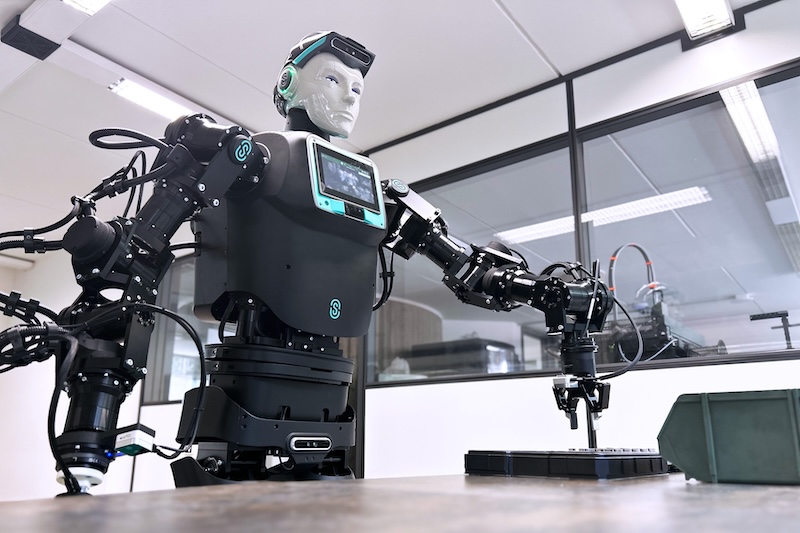
The body that work runs on is built for reach and stability: dual 7-degree-of-freedom (DoF) arms, a 4-DoF articulated torso with 0 to 1.9m of vertical reach, and a holonomic mobile base that lets R-noid reposition in tight, busy spaces.

For the robot’s design language and character, Robot.com partnered with Yukai Engineering, a Japanese studio known for emotionally expressive consumer robots.

Yukai advised on materials, manufacturing, and interaction design, and the collaboration produced R-soul, the expression and behavior system designed to earn people’s trust in seconds.

It’s a goal Robot.com has pursued since 2017: building robots that open people’s hearts and minds to the future of technology. R-soul lets the robot communicate intent, status, and personality.

The dexterity comes from Physical Intelligence. R-noid runs on π0.7, Physical Intelligence’s vision-language-action model built for generalist manipulation.

It reads a natural-language instruction, looks at the scene in front of it, and produces the arm and hand movements to carry out the task, adapting as objects, layout, and order change.

One model spans packing, picking, and folding, so adding a task means extending the same system rather than engineering a new robot for each job.

At launch, R-noid can perform 19 deployable tasks across five categories. Lighthouse deployments are already underway, demonstrating the new humanoids’ speed-to-impact on business performance. The R-noid Packer is live at an award-winning golf course, handling on-site order packing operations.

The Packer category is also moving toward production at a major food manufacturing facility, with early results validating R-noid’s end-of-line capabilities at scale.

The Picker is designed to integrate directly into existing pick ports across logistics operations, with no facility retrofit required.

Formic serves as Robot.com’s deployment partner for humanoid solutions, helping customers pilot, deploy, and scale automation in production environments.

“Our answer to ‘how long will this take?’ is weeks, not years,” said David Rodriguez, co-founder of Robot.com.

“With thoughtful hardware design, best-in-class software, and our proven platform, we can have a robot doing real work in your facility within weeks of the first conversation. No other humanoid platform can make that claim.”

Robot.com’s fleet is built on Nvidia’s full robotics stack; the robots run on Nvidia Jetson modules, which power the robot’s perception, planning, and control stack on-device – delivering the low-latency inference real-world operations demand.

Across its development cycle, Robot.com uses Nvidia Isaac Sim to simulate, validate, and stress-test each robot before deployment, ensuring reliability before any unit touches a customer floor.

In addition to its Automate debut, R-noid will be among the featured players in Robot.com’s first appearance at Cannes Lions, where the company is the official Robotics Innovation Partner for PMG’s AI & Tech Sandbox.

Oversonic Robotics secures investment from STMicroelectronics and partners

0

Oversonic Robotics, the Italian cognitive robotics company creator of RoBee, the first certified cognitive humanoid robot designed to operate in complex environments, announces that STMicroelectronics, Fondazione ENEA Tech Biomedical and SpotInvest have entered the company’s share capital to accelerate its industrial, technological, and international development.

The entry of the new shareholders is aimed at supporting Oversonic’s industrial, technological and international growth and at strengthening an ecosystem of partners capable of creating value both for Oversonic and for the development of the applications built around RoBee.

The transaction is also part of a broader value creation path that involves strengthening the company’s presence in the United States and launching a new phase of international growth in the global market of cognitive humanoids.

STMicroelectronics, a listed company and global leader in semiconductors, will contribute to reinforce the industrial drive, the development of new technologies, and the strategic support in a central sector for advanced manufacturing.

Fondazione ENEA Tech Biomedical supports Oversonic’s distinctive path in the development of certified humanoids also for healthcare applications.

SpotInvest, an investment vehicle attributable to entrepreneur Marco Setti, opens further application areas related to services and process automation in an increasingly growing sector such as the food industry.

The operation strengthens a corporate structure that already sees the presence of prominent industrial and financial partners, including Comat, Datalogic, and AVM SGR through the Cysero fund, together with other strategic investors supporting the company’s development.

At the center of Oversonic’s path is RoBee, the cognitive humanoid robot developed to work alongside humans in complex work environments, interacting with operators and other robotic systems through artificial intelligence-based technologies.

RoBee is already operational in Italy and abroad and is the first cognitive humanoid robot certified to operate in factories.

The development of the technological platform, the evolution of applications in the manufacturing and healthcare fields, the strengthening of the team and the expansion of industrial capacity represent the main guidelines on which Oversonic intends to accelerate.

From this perspective, the entry of industrial, technological, and financial partners is not merely aimed at corporate growth but contributes to the establishment of a virtuous circle among innovation, real-world applications, and new markets.

Oversonic also sees the United States as a natural outlet market for cognitive humanoid robotics, both in terms of commercial and industrial development and the international growth of the company.

In the country, where it has already established its operational presence, Oversonic intends to strengthen the dialogue with industrial partners, investors, clients, and strategic operators.

The goal is to accompany the company towards a new phase of international valorization, consistent with the ambition to position itself among the leading deep tech scale-ups.

“The entry of new shareholders represents an important step in Oversonic’s growth path. We are building an ecosystem capable of generating mutual value between technology, industry, and concrete applications,” declare Fabio Puglia, chairman, and Paolo Denti, CEO of Oversonic.

“With RoBee, we are bringing humanoid robotics into real environments, from factories to healthcare, transforming an advanced technological platform into an application infrastructure serving the industry, operators, and production systems.

“Italy remains our technological and industrial base, but Europe and the United States are the markets where the next dimensional leap will be played. Today we have the resources, the partners, and the trajectory to position ourselves as an international point of reference in the cognitive humanoids market.”

Fabio Gualandris, president, quality, manufacturing and technology, STMicroelectronics, says: “Automation, AI and robotics are key enablers of the future of manufacturing.

“Our commitment to advancing these technologies reflects our focus on improving adaptability, safety and efficiency, while helping shape the next generation of humanoid robotics for industrial use.

“By deploying these technologies in our own operations and working with robotics customers globally, we are contributing our industrial expertise to the development of solutions for the manufacturing of tomorrow.”

5 ways shipping automation eliminates errors at the shipping desk

0

Shipping errors rarely begin with a dramatic system failure. Most enter during an ordinary handoff, when information moves from an order screen to a carton and then into a carrier system. Time pressure makes those handoffs less forgiving.

Modern shipping automation solutions reduce the amount of data that staff must retype or interpret. Instead of relying on a final visual check, the workflow tests shipment information while the parcel is still at the desk. Problems appear early enough to correct them without having to recall a package from the dock.

Useful automation does not remove human judgment from shipping. Staff still need to handle damaged packaging and unusual customer requests. Routine orders, however, should move without repeated decisions that software or connected equipment can make more consistently.

Automation Keeps the Shipment Record Intact from Order to Dispatch

Most shipping mistakes appear when one order is recreated across several screens. Staff may copy an address from the order system, enter package data in carrier software, then return to the original record to add tracking. Each transfer creates another chance for the shipment and carton to separate.

A smart shipping platform removes those breaks by carrying the same order record through packing, rating, label creation, and dispatch.

When the operator scans the parcel, the system retrieves the approved shipment details instead of requesting new input. Corrections remain visible in one place, providing supervisors with a reliable audit trail and keeping the desk moving during peak periods.

1. Address Problems Stop Before Label Creation

Address correction is far cheaper before a label prints. Automated validation can standardize the format and compare the delivery point with postal or carrier data.

When the system detects an incomplete unit number or an invalid postal code, the order moves to an exception queue rather than continuing to dispatch.

Validation has limits, and good workflows account for them. A recognized delivery point does not prove that the intended recipient is there.

Customer service may still need to confirm an ambiguous address, but that conversation happens before the carrier applies a correction fee or returns the parcel.

Classification also affects shipping decisions. Residential delivery may carry different charges or service conditions from a commercial stop. Identifying the address type before rating gives the system a better basis for the final carrier request.

2. Package Data Comes Directly from the Carton

Manual weight entry creates two opportunities for error. Someone can read the scale incorrectly, then type the wrong number. Connected scales remove that transcription step by sending the measured weight directly to the shipment record.

Dimensions deserve the same treatment because carriers may charge according to the space a parcel occupies. When dimensional weight exceeds actual weight, the larger figure is used as the billable value.

Automated dimensioning captures the carton as packed, which is more reliable than measurements stored for a standard box that may have changed.

Live measurements can support another useful control. When the recorded weight falls outside the expected range, the system can hold the order for review. That pause may reveal a missing item before the package leaves the building.

3. Service Selection Follows the Shipping Promise

Carrier selection often depends on knowledge held by experienced staff. During a rush, that knowledge can turn into habit. An operator may choose the familiar service even when a lower-cost option would meet the same delivery commitment.

Rule-based selection begins with the promise already made to the customer. Services that cannot meet that date are removed from consideration. From the remaining options, the system can apply the company’s carrier agreements and choose the appropriate rate without asking the operator to compare several portals.

Cost control improves without slowing the desk. Unnecessary air upgrades become easier to prevent, while orders with a genuine deadline receive suitable service.

Managers can also review the rule that produced the choice, which is far more useful than trying to reconstruct an operator’s decision after an invoice arrives.

4. Labels Stay Tied to the Correct Order

Once the carrier accepts the shipment request, label creation should continue inside the same transaction. Carrier APIs can return the approved label and tracking number to the shipping system. That connection removes the need to copy tracking data between applications.

Reprints need careful control because an extra label can create confusion at the workstation. Good software keeps the reprint linked to the existing shipment rather than opening a second active record. If the package details change, the earlier shipment can be voided before a replacement label is produced.

Printer routing can also be automated. Output goes to the device assigned to the active station, which reduces the chance that a label appears across the room and is picked up by the wrong operator.

5. Scanning Confirms the Parcel Before Release

Even an accurate label can end up on the wrong carton. Final scan verification compares the package identifier with the carrier label before shipment confirmation. A mismatch halts the transaction immediately, whereas the correct pairing allows the parcel to proceed.

Readability needs attention as well. Barcode verification can detect weak printing or damaged labels before carrier equipment tries to scan them. Finding that defect at the desk takes seconds. Finding it after the parcel enters the network can lead to manual handling and delayed tracking.

Manifesting closes the record after the physical check. Shipment status and tracking information return to the order system, giving customer service an accurate view of what actually left the facility.

Automation is strongest when exceptions remain visible, so failed validation should lead to a clear review step rather than a hidden override.

How nearshore call centers support robotics and automation companies

0

Robotics and automation are completely changing how we work, whether it’s on a manufacturing floor, in a hospital, or inside a logistics hub. These smart machines are great for cutting costs and helping companies scale at warp speed.

But here’s the catch: even the most advanced tech still needs human backup when things go wrong. That’s exactly why nearshore call centers have become so vital.

As companies lean harder into automation, they need support teams that can troubleshoot complex technical issues on the fly and communicate clearly with users.

Nearshore centers offer the perfect middle ground giving businesses high-quality, real-time support without breaking the bank.

Supporting Complex Technology with Human Expertise

Automation can handle repetitive processes with remarkable speed and accuracy, but customers often need personalized assistance when unexpected issues arise.

Whether a business sells industrial robots, warehouse automation systems, AI-powered software, or smart devices, customers frequently require guidance that automated chatbots alone cannot provide.

Nearshore customer service teams bridge this gap by offering real-time technical support, troubleshooting assistance, warranty coordination, and product education.

Because these teams typically operate in nearby countries with similar time zones and cultural familiarity, communication becomes smoother and response times improve significantly.

This human element helps organizations maintain strong customer relationships while allowing automated technologies to continue delivering operational efficiencies.

Improving Customer Experience in Automated Businesses

Businesses adopting robotics often focus heavily on operational performance, but customer experience remains equally important. A highly automated business can lose customer trust if support is slow, inconsistent, or difficult to access.

Nearshore call centers help maintain high service standards by providing multilingual support, extended business hours, and well-trained representatives who understand both customer expectations and technical products.

Customers receive faster resolutions without the frustration of navigating multiple layers of automated responses.

As robotics solutions become more sophisticated, knowledgeable support professionals play an essential role in helping users maximize product value and resolve technical concerns efficiently.

Improving Operational Flexibility

Robotics companies frequently experience periods of rapid growth following new product launches or expansion into international markets. Scaling an in-house customer support department during these periods can be expensive and time-consuming.

Nearshore call centers offer flexible staffing models that allow businesses to expand support operations without making significant infrastructure investments. Organizations can quickly increase team capacity during busy periods while maintaining consistent service quality.

For growing technology companies, this flexibility allows leadership teams to focus on innovation, research, and product development instead of managing large internal customer service departments.

Complementing Automation Rather Than Replacing it

A common misconception is that automation eliminates the need for customer service professionals. In reality, robotics and human expertise work best together.

Automated systems excel at handling repetitive tasks such as ticket routing, appointment scheduling, order tracking, and basic troubleshooting.

When situations become more complex, skilled support specialists provide empathy, critical thinking, and technical problem-solving that machines cannot fully replicate.

This collaborative approach creates a seamless customer journey where automation improves efficiency while human agents handle high-value interactions requiring deeper understanding.

Accelerating Global Expansion

Robotics companies increasingly serve customers across multiple regions. Supporting international clients requires responsive communication that aligns with local business expectations.

Nearshore call centers help businesses expand into new markets by providing regional language support, cultural familiarity, and convenient operating hours.

These advantages make it easier to deliver consistent customer experiences without establishing expensive support centers in every country.

Organizations evaluating the benefits of nearshore call centers often discover that proximity enables stronger collaboration between internal engineering teams and external customer support professionals, leading to faster issue resolution and improved customer satisfaction.

Endnote

Robotics and automation continue to transform how businesses operate, but long-term success depends on combining technological innovation with exceptional customer support.

Nearshore call centers provide a practical solution by offering skilled professionals, flexible scalability, regional accessibility, and strong collaboration with technical teams.

As automation becomes more deeply integrated across industries, organizations that successfully combine intelligent technology with responsive human support will be better positioned to deliver outstanding customer experiences and achieve sustainable growth.

Generate single title from this title 10 Best AI Tools for Lawyers in 2026 in 100 -150 characters. And it must return only title i dont want any extra information or introductory text with title e.g: ” Here is a single title:”

Write an article about Key Takeaways In the past year, the adoption of legal AI tools has increased more than twofold. 3 primary ways legal professionals use AI include legal research, document review, and contract analysis. The most popular AI tools for legal research include Harvey AI, CoCounsel, Lexis+ AI, and Westlaw Precision AI. The best contract-focused platforms currently available include Spellbook and Luminance. Human review of AI output will continue to be necessary because legal AI tools can still produce inaccurate or incomplete output. In addition to the boost in generative artificial intelligence usage, the number of legal technology products being created is also growing. While there is certainly a place for general-purpose AI, a majority of innovative new legal technology products have been specifically created to automate certain types of legal work that attorneys perform, including routine tasks such as case law research, contract analysis, litigation support, compliance monitoring, and document review. In this article, we will look at some of the best legal AI tools that are currently available and discuss how they fit into the practices of modern legal services. Our picks are based on adoption rates, legal specificity, AI features, security standards, and all-around legal usefulness. Benefits of Using AI Legal Tools According to the American Bar Association’s 2026 Legal Industry Report, the percentage of legal professionals regularly employing generative artificial intelligence tools, such as ChatGPT, Claude, and Gemini, rose from just 31% last year to 69% this year.  As a result of the increased demand, the global legal technology market has also grown significantly. The total value of the global legal technology market was $29.81 billion in 2025, and it is expected to increase to over $73 billion by 2035. The legal technology market continues to grow because law firms, in-house counsel, and the public sector are making large-scale investments in legal technology software that enable them to do their jobs faster and more accurately than before, while continuing to adhere to the existing laws and regulations. Some benefits of using legal AI tools include: Automating repetitive legal tasks. Increasing the accuracy of document review. Finding missing contract clauses, as well as mistakes during drafting. Cutting down on time spent on legal research. Expediting the process of reviewing contracts. Assisting attorneys to save 6 to 10 hours of additional time each week. Allowing attorneys to spend more of their time developing their clients’ strategies and preparing their cases. The Most Common AI Use Cases Among Legal Teams Image Source According to recent research conducted in legal services, the following AI use cases are the most common among legal professionals: document review, legal research, document summarization, contract analysis, and draft assistance. The use of AI helps lawyers review and analyze large volumes of information quickly by identifying key clauses, authorities, risk factors, and inconsistencies in documents. Legal AI tools are rapidly evolving and moving into use cases like litigation support, eDiscovery, due diligence, and compliance reviews as firms continue to look for ways to reduce manually performed tasks. While they are still no adequate substitute for attorneys, the use of AI is primarily focused on improving productivity. This allows attorneys to devote more of their time to deep legal analysis or better service to their clients. As advancements in legal tech continue, more and more law firms are beginning to utilize AI as a productivity tool instead of using it to replace the expertise of lawyers. Best AI-Powered Tools for the Legal Industry: Quick Comparison Here’s a quick snapshot of the AI solutions discussed in this article. Tool Primary Strength Harvey AI Researching legal matters, drafting & editing legal documents. CoCounsel Reviewing legal documents, performing due diligence assessments, and creating summaries. Lexis+ AI Researching case law, looking for statutes, drafting legal documents. Spellbook High-quality contract drafting and reviewing contracts. Westlaw Precision AI Legal research and creating citation-based legal answers. Clio Duo Case management, billing, document review, and client communications. Everlaw Supporting eDiscovery processes, supporting litigation efforts. Luminance Contract review and performing due diligence. vLex Vincent AI Researching global legal issues. Paxton AI Researching legal issues, drafting legal documents, and conducting contract analysis. Harvey AI: AI Assistant for Law Firms   Harvey AI is an AI solution that allows legal teams to perform a variety of tasks. These tasks include researching legal issues, reviewing and summarizing cases, and drafting legal docs. Harvey is one of the most widely recognized legal technology solutions. It uses OpenAI GPT-4 technology and is designed specifically for legal workflows. Harvey’s success has been measured by its high growth rate and the number of companies in different countries that adopted it. The rollout of Harvey’s platform also picked up speed as many law firms around the world announced that they were going to deploy the tool. Another reason Harvey is successful is that it can understand legal terms and context. Harvey is not just a general-use chatbot; it is designed for assisting in analytical legal reasoning, identifying issues, and analyzing documents. Use Cases Legal research Contract review Due diligence Summarizing cases Prepping for trial Creating legal documents  Pros Designed with attorneys in mind Strong analytical legal thinking Ability to review large amounts of legal documents SOC2 II, CCPA, ISO 27001, GDPR, ISO 27701, ISO 42001-compliant. Cons Pricing at the premium level. Systems more suited to large law firms than to solo practitioners. AI outputs will need to be confirmed prior to reliance on them for providing service to clients. Integrations Microsoft Solutions Legal document management software Large enterprise-level legal database Limitations Harvey is useful and helps improve productivity; however, attorneys need to confirm that the provided citations, opinions, and recommendations are correct prior to utilizing them when servicing clients. Category Details Pricing   Custom enterprise pricing. Industry estimate for the base offer is $1,200 per user per month. Free Trial No publicly available free trial, but you can request a demo. Best For Large law firms and corporate legal teams. Recent Update Continued global expansion and rollout among major international law firms. AI Model Built on OpenAI models with legal-specific workflows. Security SOC 2 Type II, ISO 27001, ISO 27701, ISO 42001, GDPR, CCPA compliance. Positioning in 2026 One of the most widely adopted enterprise legal AI platforms. CoCounsel: AI-Powered Document Review CoCounsel is among the most popular AI-based legal assistants in U.S. law firms. It has been incorporated into Thomson Reuters’s ecosystem, getting access to an enormous amount of legal information. CoCounsel is designed specifically for lawyers and provides professional-grade legal content. As such, attorneys regularly rely on CoCounsel to review contracts, summarize complex documents, create depositions, prepare evidence, and conduct due diligence. CoCounsel performs exceptionally well when it comes to working through large amounts of data. There is no need for lawyers to spend hours reviewing documents — it dramatically reduces review time. By asking specific questions regarding different aspects of any document, CoCounsel will provide organized, referenced results. Use Cases Document review Due diligence Deposition preparation Legal research Contract analysis Evidence review Pros Backed by Thomson Reuters Trusted legal content ecosystem Strong ability to analyze large volumes of complex documents Designed for a straightforward experience Cons Premium subscription costs Best value often comes within Thomson Reuters environments Integrations Thomson Reuters products Microsoft applications Document management platforms Limitations While CoCounsel is a very powerful tool, it should always be used as an assistant and not an authority. The input of human expertise and due diligence continues to play a critical role in determining the legal accuracy of an answer. Category Details Pricing Custom pricing through Thomson Reuters. Around $225 to over $600 per user per month. Free Trial Contact sales. Free trial upon request Best For Legal research, due diligence, document review Recent Update Further integration into Thomson Reuters legal ecosystem and AI workflow tools AI Technology Legal-specific generative AI with professional content safeguards Key Differentiator Deep access to Thomson Reuters legal content Positioning in 2026 One of the most widely used AI assistants among U.S. legal professionals Lexis+ AI: Improved Case Law Research Lexis+ AI combines the power of direct legal conversational search and document drafting. LexisNexis designed this AI-driven platform so that attorneys can ask specific legal questions with everyday language and have the answer supported by a legal reference. LexisNexis has long been a leader in providing trustworthy resources for legal research. The collection of legal information available from LexisNexis contains case law, statutory law, regulations, court opinions, legal commentary, and analytical resources. Lawyers can now use Lexis+ AI’s generative AI research feature to conduct their legal research using natural language instead of only keyword searches. This enables attorneys to spend much less time looking for relevant precedents while improving access to find supporting authorities. Use Cases Researching local case law Analyzing statutory law Drafting legal documents Preparing briefs Reviewing legal citations Conducting legal analytics Pros Comprehensive legal database Citation-supported answers Excellent drafting tools Widely accepted as a credible source Cons Higher than average costs Learning curve for first-time users Integrations LexisNexis ecosystem Microsoft Word Legal workflow platforms Limitations Primarily designed for lawyers capable of critically assessing research findings, who are already familiar with the methodology of legal research. Category Details Pricing Custom subscription pricing. Subscription starts from $170 per user per month Free Trial Demo and free trial (2 or 7 days, depending on the plan) Best For Legal research and drafting Recent Update Expanded conversational legal search and drafting capabilities Database Strength Extensive case law, statutes, regulations, and legal commentary Key Differentiator Direct integration with LexisNexis legal research database Positioning in 2026 Among the dominant AI-powered legal research platforms Spellbook: Generative AI Tool for Contract Analysis & Drafting Spellbook is a generative AI-powered tool focused on contracts. It helps attorneys with contract drafting, review, and suggests language for efficient contract negotiations instead of being an all-purpose legal assistant. Spellbook offers AI technology integrated directly into Microsoft Word so that lawyers can use it within their normal drafting process without switching apps. The resulting popularity of Spellbook is largely due to its simple-to-use feature set that has attracted transactional lawyers, in-house counsels, and firms that prepare large volumes of commercial agreements. Spellbook is powered by GPT5 and Opus to provide suggestions of clauses, identify outliers, provide revision recommendations, and allow users to compare their wording with current market trends. Use Case Contract drafting Contract review Redlining Clause suggestions Risk identification Negotiation support Pros Integration with Microsoft Word. Easy to adopt. Good functionality for contract-related tasks. Disruption of workflow is minimal. Cons Limited outside contract works Not intended for litigation or general research. Integrations Microsoft Word Microsoft 365 Document management systems like iManage and NetDocuments Limitations The strength of Spellbook is also its weakness. While it excels in contract management, it is not designed to provide legal research or litigation support. Category Details Pricing Custom pricing. Estimated between $99 and $350+ per user per month Free Trial 7-day free trial Best For Contract drafting and review Recent Update GPT-5 and Claude Opus-powered contract assistance Integration Highlight Native Microsoft Word integration Key Differentiator Purpose-built for transactional legal work Positioning in 2026 One of the leading AI contract drafting tools Westlaw Precision AI: Advanced Legal Research Westlaw has been a leading legal research platform for many years and is known as the go-to source for accessing legal cases or statutes. Westlaw Precision AI expands on that foundation by using generative AI to build upon the vast amount of available legal data Thomson Reuters provides. One of the key advantages of using Westlaw Precision AI is that its citations are reliable (as they are grounded in Westlaw content). Unlike many other AI-based citation systems, which generate citations on the fly, Westlaw uses its primary research library as the basis for generating citations. Westlaw Precision AI, as a competitor to Lexis+ AI, is used by many legal professionals for research and drafting documents and answers. Many firms choose between the two based on their existing research environment. Uses Legal research Relevant case law analysis Brief drafting Citation verification Memorandum preparation Litigation support Pros Provides citation-backed answers Trusted legal database Excellent research capabilities Strong litigation support Cons Requires familiarity with legal research workflows Integration Thomson Reuters products Document management platforms Microsoft Office products Limitations Although Westlaw provides a higher level of accuracy than other general-purpose AI-powered systems, lawyers must independently verify authorities before submission. Category Details Pricing Custom subscription pricing. Typically starts at ~$250 per month for single-circuit coverage. Free Trial 7-day free trial Best For Legal research and citation-backed drafting Recent Update Expanded AI-assisted legal research capabilities Database Strength Westlaw legal research library Key Differentiator Citation-backed AI answers linked to authoritative sources Positioning in 2026 Primary competitor to Lexis+ AI Manage AI (former Clio Duo): Legal Practice Management Manage AI is the first of its kind in legal practice management by providing AI capability with a direct relationship to law practice management, in contrast to most of the current AI systems that primarily provide the ability to conduct legal research or review legal documents. This tool can help attorneys and law firms perform day-to-day operations more efficiently. The ability to leverage firm data allows Manage AI to assist attorneys and law firms with client communication, administrative tasks, scheduling, and document management. This is made possible through the seamless integration of Manage AI with other Clio products. Attorneys currently using Manage AI will find adopting AI easy since the AI features of the tool can be accessed within Clio Manage without having to install additional software. Tasks That Can Be Automated Email drafting Client communication summaries Matter summaries Deadline identification Task prioritization Scheduling assistance Case updates Administrative workflows Pros Deep integration with Clio Easy implementation Administrative efficiency improvement Helpful for small and midsize firms Cons Most valuable for Clio customers Not primarily designed for legal research. Integrations Microsoft Outlook Microsoft 365 QuickBooks LawPay Calendar platforms Clio Manage Limitations Law firms not using Clio will likely enjoy more value using platforms designed specifically for legal research and document analysis. Category Details Pricing Typically starts around $49 per user per month when bundled with Clio plans Free Trial 7 or 14-day free trial available Best For Practice management and administrative automation Recent Update Rebranding from Clio Duo to Manage AI and deeper workflow automation Key Differentiator Direct access to firm operational data Positioning in 2026 Leading AI-enabled practice management assistant Everlaw: eDiscovery & Litigation Everlaw is a litigation-first platform designed to help legal professionals complete large-volume document reviews and eDiscovery projects. Through the use of advanced AI technologies, Everlaw will help attorneys and law firms analyze evidence, organize evidence, and build timelines from the available evidence, and then to locate critical facts that are hidden within large amounts of evidence. This capability is extremely valuable in litigation, regulatory proceedings, and internal investigations. Everlaw allows lawyers to interact with evidence via natural-language Q&A instead of standard search techniques; this is one of its most useful features. Use Cases eDiscovery Litigation support Evidence review Investigations Timeline creation Document analysis Pros Built primarily for litigation and investigations Excellent document organization Strong AI-based review capabilities Collaborative workspace Cons Less suited to transactional practices Enterprise-level pricing Integrations Cloud storage systems Litigation support tools Enterprise data repositories Limitations Everlaw is highly specialized. This means that if your firm focuses primarily on contracts or research, you probably will not be able to use all of the advanced litigation features. Category Details Pricing Enterprise pricing. Base platform fee of $2,000 to $5,000 per month. Free Trial You can request a demo Best For Litigation, investigations, eDiscovery Recent Update Expanded AI timeline creation and conversational evidence analysis Key Differentiator Litigation-first design Positioning in 2026 One of the strongest AI-powered eDiscovery platforms Luminance: Best for Contract Review Luminance was designed to make it easy to review contracts with the use of its proprietary Legal-Grade™ AI architecture. The platform allows users to review and negotiate contracts, perform due diligence, verify compliance with company policies, and manage the lifecycle of the contract. Luminance is also known for its multilingual capabilities and ability to analyze unfamiliar document sets without extensive training data. Use Cases Review of contracts Due diligence Compliance monitoring Contract negotiation Risk assessment Contract lifecycle management Pros High-quality contract analysis Multiple languages support Complete end-to-end contract workflow Enterprise-ready security features Cons May not be suitable for smaller firms Integrations Microsoft Office Document repositories Contract lifecycle management systems. Limitations If you are a small firm with limited contract volume, using a simpler solution may be more cost-effective. Category Details Pricing Enterprise pricing is estimated between $6,000 and $60,000. Free Trial 2-week trial Best For Contract review and due diligence Recent Update Continued expansion of Legal-Grade™ AI architecture Key Differentiator End-to-end contract lifecycle management Positioning in 2026 Leading enterprise contract intelligence platform vLex Vincent AI: Global Case Law Research Compared to other tools, vLex Vincent AI is a unique tool for global research. Designed to help legal professionals evaluate legal authorities across many jurisdictions, Vincent AI is not limited to just U.S. law. International firms, multinational corporations, and attorneys with cross-border cases can use the Vincent AI platform to conduct thorough legal research. The Vincent AI platform also provides artificial intelligence analysis using a vast collection of global legal data and content. Use Cases International legal research Comparative law analysis Case law research Citation discovery Cross-border legal issues Pros Extensive international coverage Multi-jurisdictional research Easy access to citation tools Broad legal database Cons May not be familiar to many U.S.-based firmsThe level of research available will vary depending on the specific jurisdiction Integrations Legal research platforms like vLex’s global legal database Citation management systems like RefWorks and Endnote Workflow documentation Limitations Attorneys who practice exclusively in one jurisdiction will most likely not get the full benefit of Vincent’s global research capabilities. Category Details Pricing Premium subscriptions cost around $499 per user per month Free Trial Available Best For Contract review and due diligence Recent Update Continued expansion of Legal-Grade™ AI architecture Key Differentiator End-to-end contract lifecycle management Positioning in 2026 Leading enterprise contract intelligence platform Paxton AI: Artificial Intelligence for Legal Research & Document Analysis Paxton AI is being marketed as a complete legal copilot solution that provides legal research, drafting, document analysis, contract review, and a completely secure environment for performing all of these tasks. Security is a huge selling factor with Paxton, as many law firms are extremely hesitant to use AI technology due to the sensitive data. Paxton aims to ease the hesitance of law firms toward using AI technology through a security-focused technology infrastructure and legal-specific workflows. Paxton continues to develop its capabilities and enhance its citation-focused capabilities to improve the accuracy of legal research. Use Cases Legal Research Contract review Drafting support Document analysis Summarization Legal brainstorming Pros Security-focused design Wide variety of legal functions Easy-to-use interface Applicable to a broad range of legal firms Cons Smaller ecosystem than Westlaw or LexisNexis Less established brand recognition Integrations Legal workflows Cloud storage environments Limitations Paxton has a relatively limited amount of legal content due to its evolving database, and it also does not have the same credibility or trust as the larger legal research providers. Category Details Pricing Professional starts from ~$159 per user/month Free Trial 7-day free trial Best For Research, drafting, contract review Recent Update Expanded citation analysis and legal research features Security Focus Strong emphasis on confidentiality and legal data protection Key Differentiator Broad legal functionality with security-first design Positioning in 2026 Fast-growing legal AI copilot platform Universal AI Assistants for Everyday Legal Tasks: ChatGPT & Claude There are many types of legal tasks that do not require a specialized legal platform. General AI assistants like ChatGPT and Claude can be excellent resources for productivity, especially when utilized properly and reviewed. Both assistants can be used to organize information, write initial drafts, summarize legal documents, and support various routine administrative tasks. They are often used alongside legal-specific software rather than as replacements. ChatGPT ChatGPT is typically the overall better option for: Brainstorming legal argument ideas Drafting emails Generating documents’ initial drafts Describing legal concepts Summarizing shorter-length legal documents Productivity and workflow assistance Many lawyers utilize ChatGPT as a novel legal tool during the initial drafting stages. ChatGPT assists attorneys by generating outlines or proposing a course of action to take, providing organizational structure prior to conducting deeper research. Claude Claude has established a history of assisting users with the ability to work on larger documents, as well as in longer context windows than ChatGPT. Claude is suited for: Reviewing large contracts Summarizing large case files Analyzing large collections of documents Comparing multiple documents Working with complicated legal materials Claude’s ability to analyze large amounts of text is extremely useful for lawyers attempting to manage or analyze hundreds of pages of text. So, what’s the verdict? When looking at these AI-powered tools, it is clear that there is no overall winner. In terms of drafting, brainstorming, and general productivity, ChatGPT tends to have the edge over Claude, but it’s Claude that produces stronger results in the analysis of long-form legal documents and large datasets. It is important to verify any information before relying on an output produced by an AI-powered tool. Neither of these tools should serve as a replacement for traditional research databases, legal research platforms, or the attorney’s own judgment. Legal AI Risks and How to Mitigate Them While there are many positives to consider with regard to the implementation of legal AI tools, there are also many negatives that must be understood when using these systems. AI Hallucinations The most widely known risk with the use of AI technology is the possibility of an AI-generated hallucination. This is when an AI tool generates information that may sound accurate but is actually untrue. The legal sector has experienced a number of high-profile incidents. Lawyers have been disciplined by courts for having included fabricated citations in their filings. In these specific cases, attorneys did not independently verify the accuracy of the AI-generated research provided to them before submission. Even AI platforms designed specifically for legal use can produce errors. While their accuracy is generally much higher than that of general-purpose systems, they shouldn’t serve as a substitute for attorney review. Data Privacy and Confidentiality The legal industry has a lot of different types of private and highly sensitive information to handle, like client files, litigation materials, intellectual property, medical records, and financial data. Therefore, when a law firm is considering using a legal AI application, there are specific criteria that should be checked as part of their due diligence, including the following: SOC 2 compliance ISO 27001 certification GDPR compliance HIPAA compliance (If applicable) CJIS compliance for government matters Data retention policies Privacy policies Terms of data ownership Lawyers should confirm that they fully understand how their client’s information is stored and how to access it (or process it), as well as how the data is secured and protected, before uploading any confidential material into an AI system. Many organizations with specialized needs require the development of custom AI tools rather than relying on pre-packaged products. Partnering with an established AI development company can be invaluable to an organization’s ability to develop a secure, custom AI application while also ensuring compliance with privacy laws and determining which workflow an AI application should integrate with. LITSLINK is an excellent partner for those types of organizations, as they provide custom-built secure AI tools while ensuring compliance, data privacy, and integration with existing workflows. Transform Your Legal Practice With LITSLINK AI Assistants The legal profession is in a new era characterized by AI adoption, in which many firms wish to move away from trial-and-error experimentation with AI systems. They’re moving towards the implementation of AI-based solutions that can help make lawyers more productive by reducing the amount of repetitive work and enabling them to offer better services to their clients. However, selecting an appropriate AI solution is just one step in implementing AI technology in a legal environment. Careful and comprehensive preparation, establishment of robust standards for information security, and development of practical, real-life legal operations are also necessary. LITSLINK can help you in this regard. With a team of over 300 experienced engineers, LITSLINK develops AI tools that automate work processes, assist with decision-making, and blend into an organization’s existing business environment. LITSLINK has demonstrated capabilities to deploy intelligent agents, automate workflow processes, improve document understanding, and design enterprise-class systems in the AI domain. Our firm can support you with developing your solution, whether it includes document review, creating legal research assistants, developing contract intelligence systems, creating automated client intake, or custom legal AI agents. Contact us to discuss your project. FAQs 1. Will AI Replace Lawyers? No, AI won’t replace lawyers; it will help automate tedious and routine tasks like legal research, document review, and drafting, but lawyers are still needed for legal judgment, strategy, client advocacy, and AI-generated output verification. 2. What Is the Best AI Tool for Legal Research? It depends on your needs; however, the leading AI tools available for performing legal research are Harvey AI, CoCounsel, Lexis + AI, and Westlaw Precision AI, as these have been developed to manage legal-specific workflows with citation-backed answers. 3. What Is the Average Price of AI Tools for Lawyers? Prices can vary greatly; average entry-level AI tools start at around $50–$200 per user per month, while enterprise legal AI platforms can cost $1,000+ per user per month or offer custom pricing based on firm size and requirements.   .Organize the content with appropriate headings and subheadings ( h2, h3, h4, h5, h6). Include conclusion section and FAQs section with Proper questions and answers at the end. do not include the title. it must return only article i dont want any extra information or introductory text with article e.g: ” Here is rewritten article:” or “Here is the rewritten content:”


Richtech Robotics debuts interactive livestream for AI-powered humanoid robot ADAM

0

Richtech Robotics, a Nevada-based provider of AI-driven service robots, has launched a new initiative: a live, 24/7 interactive streaming platform featuring the company’s AI-powered humanoid robot, ADAM.

The immersive experience gives audiences around the world the ability to interact directly with ADAM in real-time through a livestream broadcast, enabling users to chat with the robot, ask questions, and observe how embodied AI responds dynamically to human interaction.

Through direct engagement and continuous interaction, ADAM, accelerated by Nvidia Jetson Thor for onboard compute and developed with the Nvidia Isaac open robotics platform, is positioned to become one of the first robot “influencers,” demonstrating how AI-powered robots can communicate naturally with users in the physical world.

“Richtech Robotics has always focused on creating robots that seamlessly integrate into human environments and improve the way businesses operate,” said Richtech Robotics’ CEO Wayne Huang.

“With the launch of the ADAM livestream initiative, we are helping to advance the evolution of the human-robot interaction by creating a global opportunity to communicate with embodied AI in a live, highly-interactive setting.”

Unlike traditional livestreams, the ADAM platform is built as an immersive and participatory experience. Instead of viewing pre-taped photos or videos, users are met with a bespoke and user-controlled experience.

The livestream will also provide a showcase for additional Richtech Robotics technologies and robotic platforms, highlighting the company’s broader portfolio of AI-driven automation solutions for hospitality, automotive, and manufacturing environments.

The initiative demonstrates the significant technological advancements required to enable embodied AI systems to communicate effectively with users in physical environments.

By combining conversational AI with robotics, Richtech Robotics continues to bridge the gap between human expertise and robotic efficiency.

“Our vision is to make robotics more accessible, engaging, and useful in everyday life,” added Richtech Robotics’ COO Phil Zheng.

“Now we’re helping to usher in the next era of product engagement, setting up Richtech Robotics to become a pioneer in intelligent automation and robotics.”

UK launches Plymouth subsea autonomy test range with multi-robot trial

0

A new underwater trials site designed to accelerate UK marine autonomy and ocean sensing has completed its first major test thanks to a live, multi-marine surface and subsea robotic platform demonstration.

The Smart Sound Connect Subsurface (SSCS) project, part of Smart Sound Plymouth, led by the University of Plymouth, with Plymouth Marine Laboratory (PML), saw platforms from ACUA Ocean, ecoSUB Robotics, Seaber and Sonardyne working together above and below the surface.

The all-day collaborative demonstration enabled visitors from business, science, defence and national bodies to view the potential of the three-year, £1.2 million SSCS project.

Delivered by Sonardyne, the SSCS’ infrastructure extends Smart Sound Plymouth – already the UK’s premier marine autonomy testbed – and the Western Channel Observatory, through a seabed node array for absolute positioning and communications, alongside other intelligent sensors within a highly characterised environment.

Professor James Fishwick, head of innovation for Smart Sound Plymouth (at PML), said: “Smart Sound Plymouth is going from strength to strength.

“The addition of the subsurface network enables even greater integration between platforms and supports our state-of-the-art testing capabilities for autonomous vehicles and advanced technologies. It complements the high-speed military-encrypted network above the surface and helps provide a fully connected environment.

“This successful technology demonstration further reflects Plymouth’s place as a world-leading hub for marine autonomy.”

Dr Lilian Lieber, senior research fellow at the University of Plymouth, said: “SSCS provides a unique opportunity to test new ocean observing technologies.

“For me, its value lies in turning prototypes and field-tested technologies into trusted data streams, accelerating ocean observing towards autonomous sensing and near-real-time insight.

“This helps turn ocean data into actionable intelligence for climate resilience, early warning and preparedness, while the infrastructure itself enables technology innovation and stronger industry collaboration.”

A key element of SSCS is the seabed node array, which provides absolute positioning and communications using passive Ultra-Short BaseLine (USBL) technology for testing underwater systems in a real-world highly characterised testing environment.

During the demonstration, both the University of Plymouth’s Seaber autonomous underwater vehicle (AUV) and an ecoSUB AUV navigated simultaneously using only the seabed node array.

At the surface, a PIONEER uncrewed surface vessel (USV) from Plymouth-based ACUA Ocean tracked and controlled an AUV from Southampton-based ecoSUB using a Sonardyne Ranger 2 Gyro USBL positioning system on the USV.

The USV also wirelessly harvested data from a permanently deployed Sonardyne Origin 600 acoustic Doppler current profiler (ADCP) in the SSCS, which also transmits real-time data to shore – and a live internet feed as part of the Western Channel Observatory – via the long-running L4 oceanographic monitoring station.

In addition, marine software engineering firm Marine AI showed the ability to continue navigating, even when GNSS drops out, using Sonardyne’s Sprint-Nav, based on trials in the SSCS earlier this year.

The demonstrations were viewed live by guests from the UK and overseas from within PML’s onshore remote operations centre at its campus in Plymouth.

Geraint West, business development advisor at Sonardyne, said, “This ability to test and accelerate marine autonomous system innovation in a known environment with the type of infrastructure we now have in the SSCS is a real boost not just for Plymouth.

“The demonstration had interest from around the UK and internationally, with visitors from North America and Asia and from a wide range of stakeholders, military, commercial, science and industry.

“It just shows the reputation Plymouth now has and continues to build for marine autonomy, thanks to the environment, ecosystem and collaboration we have in the city and in Plymouth Sound.”

ACUA Ocean’s John Hunnibell, chief product officer, said, “This demonstration provided an excellent opportunity to demonstrate the persistent mission utility and seagoing characteristics of our USV Pioneer as a ‘mothership’ for nested robotics, data harvesting and data transfer at sea.

“Specifically, we used this event to demonstrate that the USV Pioneer can deliver subsea monitoring and security for critical underwater infrastructure by teaming with multi-static seabed sensor nodes.

“It was also a great way to develop our relationships with capable, credible technical partners: Sonardyne, ecoSUB, PML and the University of Plymouth in Smart Sound Plymouth.”

Iain Vincent, director and general manager at ecoSUB Robotics said, “Smart Sound and the SSCS environment has already been an extremely useful resource for ecoSUB Robotics. Most recently we have collaborated with Sonardyne on the development of a subsea AUV launch and navigation solution.

“Smart Sound provided the perfect place to test this technology, with easy access to open water, vessels and subsea nodes, and an outgoing and helpful community who support activity.”

The Smart Sound Connect Subsurface team is currently seeking additional research and development partners to collaborate in further trials of the SSCS testing environment.

It encourages anyone interested in testing new subsea vehicle operations, underwater data telemetry or any other use of the new infrastructure to contact Aaron Barrett, Lecturer in Autonomy at the University of Plymouth to learn how they can get involved.

Print Friendly, PDF & Email

Fieldwork Robotics raises funding to accelerate autonomous raspberry harvesting

0

Fieldwork Robotics, developers of selective, adaptive and modular harvesting robots, has agreed an investment from SEED Innovations, the AIM-quoted investing company chaired by prominent British businessman Jim Mellon.

The investment forms part of a £2.5 million Seed+ fundraise and combined investment and grant funding announced in April 2026.

Jim Mellon is one of the UK’s most prominent early-stage investors, with a long track record of identifying and backing transformative technology businesses.

Through SEED Innovations, which is focused on high-growth robotics and AI ventures, Mellon has been vocal about the opportunity for autonomous systems to address real-world labour and productivity challenges, an ethos that sits at the heart of Fieldwork’s mission.

Berry growers worldwide face rising labour costs, a shortage of available fruit pickers, and supply chain pressures that drive up harvesting wages.

These challenges increase food waste, push up consumer prices, and contribute to higher climate emissions. Large volumes of soft fruit are lost due to a shortage of pickers.

Fieldwork’s autonomous harvesting robots address these issues directly, reducing reliance on seasonal labour, boosting productivity, and operating efficiently across entire farms, helping growers protect margins and scale production sustainably.

The Seed+ fundraise enables Fieldwork to accelerate farm adoption of its autonomous harvesting technology and transition from the technology validation stage to commercial trials.

The company is currently deploying production robots in a two-year IUK ADOPT programme with Place UK in Norfolk and Littywood Farm in Stafford.

Subject to these trials, Fieldwork expects multi-robot fleets to be operating on farms from 2027, with planned international trials in Australia as part of its global expansion strategy.

David Fulton, Fieldwork Robotics CEO, said: “SEED’s support at this stage is vital as we move into this important next chapter for Fieldwork.

“This fundraise supports the demand of our robotic harvesting capabilities from our grower customers and builds on the significant commercial progress are making and gives us the platform to accelerate farm adoption of our technology at scale.

“We are now focused on delivering results, expanding our commercial trials and progressing our international expansion, and we are well positioned to do so with the right investors alongside us.”

Jim Mellon, non-executive chair of SEED, said: “Fieldwork is a UK company which epitomises how AI and robots can solve a very real-life problem.

“Up to 30 percent of soft fruit is lost due to a shortage of pickers, which affects not only growers’ profitability, but also the costs passed on to consumers. Fieldwork’s berry picking robot offers an innovative and scalable solution to this problem.

“We are delighted to be supporting Fieldwork at this stage of its development and look forward to following its progress as it continues to commercialise and expand internationally.”

FORT Robotics unveils Outside-In Safety with Nvidia Halos for Robotics

0

FORT Robotics, the “Trust Layer” for physical AI, has announced joining the Nvidia Halos for Robotics ecosystem that’s bringing safety to autonomous robots.

FORT will demonstrate an agentic safety application built with the open source Nvidia Halos Outside-In Safety Blueprint this week at the Automate conference in Chicago and presenting in the Humanoid Robotics Pavilion with Nvidia on June 23rd.

The Nvidia Outside-In Safety Blueprint combined with the FORT Trust Layer extends robot perception beyond onboard sensors by using external infrastructure sensors and visual AI Agents to deliver real-time, safety-certifiable functional safety to maximize operational throughput.

Leveraging Nvidia IGX Thor and Nvidia Holoscan Sensor Bridge for AI compute and sensor connectivity, the solution enables robots to safely operate alongside workers at high efficiency modes while dynamically adapting to complex environments.

This offering provides significant value beyond traditional inside-out functional safety systems that are limited to onboard sensors and conservative operating constraints:

Enhanced productivity

Traditional safety systems were built for predictable machines in bounded settings, and lack the flexibility needed for mobile robot systems in constantly changing warehouses and factories.

Outside-In Safety automatically modulates robot efficiency across dynamic environments, reducing costly robot slowdowns and optimizing both safety and productivity.

Worker safety and accident prevention

As more worksites adopt autonomous systems and physical AI, safety frameworks must adapt to protect workers in mixed human-robot environments.

By providing proactive situational awareness, Outside-In Safety can prevent safety incidents and protect workers in real time. This can help address safety challenges across multiple industries.

Maximize return on investment

Nvidia Halos Outside-In Safety Blueprint will help FORT’s new and existing customers across warehousing, manufacturing, and other automated industries to leverage both robots and existing infrastructure for more value.

For example, building-mounted cameras can be leveraged to unlock new cost savings by maximizing throughput and optimizing processes such as trailer truck unloading, inventory replenishment, product assembly, and more.

A robotics safety ecosystem built for scale

FORT is a member of the Nvidia Halos AI Systems Inspection Lab, the world’s first ANSI National Accreditation Board (ANAB)-accredited inspection lab designed specifically for physical AI and autonomous systems.

It provides a unified framework to verify functional safety, cybersecurity, and AI compliance for autonomous vehicles, robotics, and sensor technologies. This collaboration reflects FORT’s ongoing work with Nvidia to making physical AI trustworthy at industrial scale.

“Safety has always been the precondition for scale – you can’t deploy robots broadly if you can’t guarantee they’ll operate safely around people and valuable infrastructure,” said Samuel Reeves, CEO of FORT.

“What collaborating with Nvidia gives us is enhanced perception that makes safety genuinely intelligent. Agentic robots that understand their environment and respond in real time aren’t just safer, they’re more productive. That’s the combination the industry has been waiting for.”

FORT has long been the industry standard for safety-certified control, providing autonomous systems with the essential hardware and software backbone required to mitigate real-world operational risk. Outside-In Safety extends FORT’s Trust Layer for Physical AI to be even broader.

  • Outside-In Safety (new): Reduces costly robot slowdowns and improves safety without sacrificing productivity, by automatically modulating robot efficiency across dynamic environments.
  • Onboard Active Safety: Onboard perception technology, either embedded or bolted-on, enables machines to actively detect, anticipate, and respond to their environments in real time. This predictive approach allows autonomous vehicles to execute smart, real-time planning and contingency maneuvers, a meaningful leap beyond traditional reactive safety architectures.
  • Human-in-the-Loop control: Safe and reliable remote operation including both line-of-sight control and remote operation and intervention.