Home Blog Page 82

OpenAI aids spammers

AkiraBot’s AI-Generated Spam Messages Pose Challenge to Website Defenses

The Emerging Threat

AkiraBot’s use of LLM-generated spam message content demonstrates the emerging challenges that AI poses to defending websites against spam attacks, according to SentinelLabs researchers Alex Delamotte and Jim Walter. The easiest indicators to block are the rotating set of domains used to sell the Akira and ServiceWrap SEO offerings, as there is no longer a consistent approach in the spam message contents as there were with previous campaigns selling the services of these firms.

How AkiraBot Worked

AkiraBot worked by assigning the following role to OpenAI’s chat API using the model gpt-4o-mini: "You are a helpful assistant that generates marketing messages." A prompt instructed the LLM to replace the variables with the site name provided at runtime. As a result, the body of each message named the recipient website by name and included a brief description of the service provided by it.

The Unique Message Generation

"The resulting message includes a brief description of the targeted website, making the message seem curated," the researchers wrote. "The benefit of generating each message using an LLM is that the message content is unique and filtering against spam becomes more difficult compared to using a consistent message template which can trivially be filtered."

Measuring Success and Failure

SentinelLabs obtained log files AkiraBot left on a server to measure success and failure rates. One file showed that unique messages had been successfully delivered to more than 80,000 websites from September 2024 to January of this year. By comparison, messages targeting roughly 11,000 domains failed. OpenAI thanked the researchers and reiterated that such use of its chatbots runs afoul of its terms of service.

Conclusion

AkiraBot’s use of LLM-generated spam message content highlights the evolving nature of spam attacks and the need for website defenders to adapt to new tactics. As AI becomes increasingly sophisticated, it is essential for website owners and administrators to stay vigilant and implement effective measures to protect against spam attacks.

FAQs

Q: How did AkiraBot generate its spam messages?
A: AkiraBot used OpenAI’s chat API and the model gpt-4o-mini to generate unique messages for each targeted website.

Q: What was the success rate of AkiraBot’s spam messages?
A: According to SentinelLabs, AkiraBot successfully delivered unique messages to more than 80,000 websites from September 2024 to January of this year.

Q: Does OpenAI condone the use of its chatbots for spamming?
A: No, OpenAI reiterated that such use of its chatbots runs afoul of its terms of service.

Kafka-to-Cloudant Database (CRDB) Integration

Kafka 2 Crdb: A New Era in Real-time Data Integration

Overview

Apache Kafka and CockroachDB (CrDB) have teamed up to revolutionize real-time data integration. Kafka 2 CrDB allows for seamless data movement between Kafka streams and CrDB, enabling organizations to process and analyze data in real-time. In this article, we’ll delve into the features, benefits, and use cases of Kafka 2 CrDB.

What is Kafka 2 CrDB?

Kafka 2 CrDB is a new connector that enables the seamless integration of Apache Kafka with CockroachDB. This connector allows users to stream data from Kafka to CrDB, enabling real-time data processing and analysis. The connector is built on top of the Kafka Connect framework, making it easy to integrate with existing Kafka pipelines.

Key Features

  • Real-time Data Integration: Kafka 2 CrDB enables real-time data integration between Kafka streams and CrDB, allowing organizations to process and analyze data as it happens.
  • High-Throughput: The connector is designed to handle high volumes of data, making it suitable for large-scale data integration pipelines.
  • Scalability: Kafka 2 CrDB is highly scalable, allowing it to handle increasing data volumes and varying data streams.
  • Fault Tolerance: The connector is designed to be fault-tolerant, ensuring that data is not lost in the event of connectivity issues or node failures.

Use Cases

  • Real-time Analytics: Kafka 2 CrDB enables real-time analytics by streaming data from Kafka to CrDB, allowing organizations to analyze data as it happens.
  • Event-Driven Architecture: The connector enables event-driven architecture by allowing organizations to process and analyze events in real-time.
  • Data Warehousing: Kafka 2 CrDB enables data warehousing by streaming data from Kafka to CrDB, allowing organizations to store and analyze data in a scalable and fault-tolerant manner.

Benefits

  • Improved Data Quality: Kafka 2 CrDB ensures that data is processed and analyzed in real-time, reducing the risk of data corruption or loss.
  • Increased Efficiency: The connector enables real-time data integration, reducing the need for batch processing and improving overall efficiency.
  • Enhanced Insights: Kafka 2 CrDB enables organizations to gain real-time insights into their data, allowing them to make data-driven decisions.

Conclusion

Kafka 2 CrDB is a game-changer in real-time data integration, enabling organizations to process and analyze data in real-time. With its high-throughput, scalability, and fault tolerance, the connector is suitable for large-scale data integration pipelines. Whether you’re looking to enable real-time analytics, event-driven architecture, or data warehousing, Kafka 2 CrDB is the perfect solution.

FAQs

Q: What is the difference between Kafka 2 CrDB and other data integration tools?
A: Kafka 2 CrDB is designed specifically for real-time data integration between Kafka streams and CrDB, making it a unique solution for organizations looking to process and analyze data in real-time.

Q: How does Kafka 2 CrDB handle data corruption or loss?
A: Kafka 2 CrDB is designed to be fault-tolerant, ensuring that data is not lost in the event of connectivity issues or node failures. Additionally, the connector ensures that data is processed and analyzed in real-time, reducing the risk of data corruption or loss.

Q: Can Kafka 2 CrDB handle high volumes of data?
A: Yes, Kafka 2 CrDB is designed to handle high volumes of data, making it suitable for large-scale data integration pipelines.

Q: Is Kafka 2 CrDB compatible with existing Kafka pipelines?
A: Yes, Kafka 2 CrDB is built on top of the Kafka Connect framework, making it easy to integrate with existing Kafka pipelines.

AI-Powered Content Generation

Write an article about

Once all the stories, videos, and audio started, with the hard work of dozens of people backstage. Now, one piece of a story or an engaging video starts with a prompt or simply AI tools. For marketing specialists, copywriters, and content creators, the emergence of content creation apps allows for fast-forward decisions and the elimination of routine work. 

With global spending on AI expected to hit $632 billion by 2028 and 67% of marketers already leveraging AI tools for content, the race is on to find the best platforms to streamline workflows and dominate search rankings. From crafting SEO-optimized blog posts in minutes to generating persuasive ad copy that converts, today’s AI content-generation tools are smarter, faster, and more intuitive than ever.

In this guide, we’ve rounded up the top 15 AI-powered tools you can’t afford to miss in 2025, including:

Whether you’re a marketer, writer, or business owner, these tools will supercharge your content game and keep you ahead of the curve. You will find out about their main features, available prompt library, and terms of use.

Win with AI! Partner with our AI development team.

Get in touch today!

Top 15 AI Content Generation Tools for 2025

1. ChatGPT (OpenAI)

ChatGPT, launched by OpenAI in 2022, remains a juggernaut in 2025 with its GPT-4o backbone, serving over 400 million weekly users as the gold standard for versatile content creation. From blog drafts to creative scripts, emails to poetry, its broad appeal stems from a decade of OpenAI research culminating in a 2025 update that adds multimodal input (text/images), “Operators” AI agents (Pro only), and real-time search integration. 

Initially a conversational marvel, ChatGPT has grown into a creative and practical tool. In 2025, its ability to handle diverse tasks—brainstorming SEO ideas, drafting ad copy, or analyzing images—keeps it ahead of niche competitors, though its high-end pricing reflects its premium status. 

Technology: GPT-4o, multimodal, real-time search capabilities.

Standout Strengths: Multimodal input, Operators agents, creative versatility.

Limitations: Pro tier costly; free tier less powerful.

Pricing: Free tier (GPT-4o mini); Plus at $20/month; Pro at $200/month.

Target Audience: Writers, marketers, and creatives.

Get a personalized consultation or collaborate with us to build an AI solution. 

Don’t wait—contact us today!

2. Gemini (Google)

Google’s Gemini, first teased in 2023 and fully realized by 2025, emerges as a multimodal AI titan, blending text generation (via Gemini) and image creation (via Imagen 3) with deep integration into Google Workspace (Docs, Sheets, Gmail). 

Designed to compete with ChatGPT, Gemini’s 2025 update introduces Gemini Live (real-time voice chat), Canvas editing mode for collaborative drafts, and real-time Google data access, making it a powerhouse for blogs, ads, and SEO content. Its human-like writing and contextual awareness—honed by Google’s vast search expertise—give it an edge in crafting pieces that rank high and engage readers. 

AI Content Generation Tools

Technology: Multimodal architecture, Google data integration.

Standout Strengths: Gemini Live, Canvas mode, Workspace synergy.

Limitations: Advanced features require subscription; less open-source.

Pricing: Free tier; Advanced at $19.99/month (with Google One).

Target Audience: Marketers, Workspace users, SEO pros.

3. Grok 3 (xAI)

Unveiled in February 2025 by xAI, Grok 3 is the third iteration of a groundbreaking AI series designed to push the boundaries of real-time content creation and conversational intelligence. 

Born from xAI’s mission to accelerate human scientific discovery, Grok 3 builds on its predecessors’ wit and curiosity, now supercharged with a 1M-token context window—among the largest in the industry—enabling it to tackle sprawling narratives or complex research summaries without losing coherence. 

Grok’s standout feature, DeepSearch, integrates live data from the X platform and the web, positioning it as a go-to for content that demands immediacy, such as breaking news blogs, trending social media threads, or market analysis reports. 

In 2025, Grok 3 introduces three distinct output modes—Think (fast, concise drafts), Big Brain (deep analytical insights), and DeepSearch (research-driven outputs)—catering to diverse creative needs. It also offers Aurora image generation (with user confirmation), expanding its utility beyond text. 

AI Content Generation Tools

Technology: Proprietary xAI transformer model, optimized for reasoning and real-time data synthesis.

Standout Strengths: Massive context window, real-time X/web integration, and versatile output modes.

Limitations: X-centric design may alienate non-X users; image generation requires opt-in.

Pricing: X Premium+ ($40/month) or rumored SuperGrok plan ($30/month or $300/year).

Target Audience: Social media marketers, bloggers, journalists.

4. Writesonic

Writesonic, launched in 2021, transforms by 2025 into a comprehensive content creation platform that goes beyond its Chatsonic roots, integrating GPT-4, Claude, and Gemini models to power a suite of tools: text generation, Photosonic (AI images), and Audiosonic (text-to-speech). 

Designed for businesses and creators who need an all-in-one solution, Writesonic’s 2025 update introduces an AI document editor, an SEO checker, and brand voice customization across all outputs—ensuring consistency from blogs to ad visuals. 

AI Content Generation Tools

Technology: Multi-model architecture (GPT-4, Claude, Gemini) with a unified dashboard.

Standout Strengths: Multimedia tools, SEO checker, brand voice sync.

Limitations: Steeper learning curve; pricing scales with teams.

Pricing: Free tier (50 generations); Individual at $16.67/month; Teams at $25/month/seat.

Target Audience: Businesses, multimedia creators.

5. Claude 3.7 Sonnet

Developed by Anthropic, founded by ex-OpenAI researchers in 2021, Claude 3.7 Sonnet emerges in 2025 as a safe, interpretable AI tailored for long-form content with a conscience. Building on Anthropic’s commitment to ethical AI, this mid-tier model (between Haiku and Opus) balances performance and responsibility, excelling at whitepapers, case studies, and nuanced storytelling that require depth and trust.

Its 200K-token context window supports extensive documents, while 2025 updates like vision-to-text analysis (e.g., generating descriptions from images) and fluency in 20+ languages broaden its appeal for global businesses. 

Claude’s design prioritizes safety—avoiding harmful biases or misinformation—which makes it a preferred choice for enterprises and educators in regulated industries. In 2025, its slower but deliberate processing reflects a trade-off for accuracy over speed, and its less creative flair compared to GPT-based tools is offset by its reliability. Claude 3.5 Sonnet’s rise signals a demand for AI that aligns with corporate values while delivering SEO-ready, authoritative content.

AI Content Generation Tools

Technology: Anthropic’s safety-first framework, 200K-token context, multimodal.

Standout Strengths: Vision analysis, multilingual support, ethical outputs.

Limitations: Slower processing; less creative than competitors.

Pricing: Free tier; API from $3/million tokens.

Target Audience: Businesses, writers, educators.

6. Microsoft Copilot

Microsoft Copilot, first introduced in 2023 as a Bing Chat offshoot, blossoms by 2025 into a productivity-driven AI deeply embedded in Microsoft 365 (Word, Excel, Teams, Outlook). Leveraging GPT-4o and DALL-E 3 via OpenAI’s partnership, Copilot evolves from a search assistant into a contextual content generator that enhances business workflows—drafting emails, reports, or presentations with real-time data and visuals. 

Its 2025 updates, like Copilot Vision (scanning browser content) and voice mode, make it a hands-free powerhouse, while its integration with Microsoft’s ecosystem ensures seamless use across tools. Initially aimed at enterprise users, Copilot’s free tier and affordable 365 add-on broaden its reach to small businesses and freelancers in 2025. 

Its strength lies in productivity over pure creativity, offering marketers and teams a practical way to produce SEO-optimized docs or automate repetitive tasks, though its reliance on Microsoft’s suite limits standalone appeal. 

AI Content Generation Tools

Technology: GPT-4o and DALL-E 3, Microsoft 365 integration.

Standout Strengths: Vision scanning, voice mode, 365 synergy.

Limitations: Best with Microsoft 365; less standalone flexibility.

Pricing: Free tier; Pro at $20/month; 365 add-on at $3/month.

Target Audience: Businesses, teams, Microsoft users.

7. Jasper

Jasper, originally launched as Conversion.ai in 2021, has evolved by 2025 into a polished, marketing-first AI platform that’s a mainstay for brands, agencies, and solo entrepreneurs. Acquired by a larger tech conglomerate in 2023, Jasper’s 2025 update doubles down on its roots in copywriting while expanding into a collaborative, SEO-optimized content powerhouse. 

With a hybrid GPT-4 backbone and custom fine-tuning, it excels at generating blog posts, ad campaigns, email sequences, and social media content that aligns with brand voices and drives conversions. In 2025, Jasper introduces real-time team editing, AI-driven keyword suggestions, and over 50 refreshed templates tailored to emerging trends—like sustainability marketing or AI-driven e-commerce—making it a versatile choice for scaling content production. 

Its integration with tools like Google Analytics and SEMrush enhances its SEO prowess, helping users craft pieces that rank high and resonate with audiences. While it’s less suited for technical or research-heavy writing, Jasper’s intuitive interface and focus on persuasive, brand-aligned content keep it a top pick for marketers aiming to streamline workflows and boost ROI in a competitive digital landscape.

AI Content Generation Tools

Technology: Hybrid GPT-4 and custom models, marketing-focused fine-tuning.

Standout Strengths: SEO tools, team collaboration, template variety.

Limitations: Higher team pricing; weaker at technical content.

Pricing: $39/month (individual); $99/month (teams).

Target Audience: Marketing teams, copywriters, small businesses.

8. Chatsonic

Chatsonic, Writesonic’s flagship offering, rockets into 2025 as a content and SEO specialist. It blends conversational AI with marketing tools to create blogs, landing pages, and social posts that rank and engage. 

Launched in 2022 as a ChatGPT alternative, Chatsonic has evolved into a powerhouse by integrating real-time web data, giving it an edge over static models. Chatsonic introduces built-in keyword research, voice-to-text input, and a rank-tracking feature that monitors content performance—perfect for SEO pros aiming to dominate SERPs. 

Its intuitive dashboard makes it accessible to small businesses, while its focus on actionable marketing outputs (e.g., SEO-optimized blog outlines) appeals to larger teams. Unlike Writesonic’s broader platform, Chatsonic zeroes in on conversational content with a modern twist, though its free tier’s 10K-word limit and weaker technical depth keep it geared toward creative and promotional use.

AI Content Generation Tools

Technology: GPT-4 and custom models with real-time search integration.

Standout Strengths: Keyword research, rank tracking, voice input.

Limitations: Free tier limited; less robust for technical writing.

Pricing: Free tier (10K words/month); Pro at $12.67/month.

Target Audience: SEO marketers, bloggers, small businesses.

9. Perplexity AI

Born in 2022 as an AI-powered search engine, Perplexity AI evolves by 2025 into a hybrid tool that marries real-time research with content generation, offering sourced, factual outputs for blogs, FAQs, and reports. 

Unlike traditional AI writers, Perplexity’s strength lies in its ability to scour the web and deliver answers with citations, making it a dream for creators who need credibility alongside creativity. Its 100K-token context window supports detailed responses, while the 2025 “pro search” mode dives deeper into niche topics, competing with Google for research utility. 

In 2025, Perplexity gains buzz for its free tier and intuitive Q&A format, though its pro plan unlocks heavier usage for power users. It’s less conversational than ChatGPT and more research-focused, aligning with a 2025 trend toward trustworthy, SEO-friendly content that ranks high on authority. 

AI Content Generation Tools

Technology: Custom model with web-crawling and 100K-token context.

Standout Strengths: Sourced answers, pro search, factual focus.

Limitations: Less conversational; pro tier needed for heavy use.

Pricing: Free tier; Pro at $20/month (300+ searches/day).

Target Audience: Content creators, researchers, SEO writers.

9. Copy.ai

Founded in 2020, Copy.ai carved its niche as a short-form content specialist, and by 2025, it’s sharpened that focus with a faster, smarter AI engine built on GPT-4o and proprietary optimizations. This tool is all about speed and conversion, churning out snappy social media captions, compelling ad headlines, and SEO-friendly product descriptions that hook audiences and drive clicks.

Copy.ai rolls out A/B testing for copy variations, Google Ads integration, and a “voice match” feature that ensures every output aligns with a brand’s tone—whether it’s playful, professional, or bold. While its 2,000-word free tier keeps it accessible, the Pro plan unlocks unlimited potential for e-commerce brands and PPC marketers who need to scale fast. 

AI Content Generation Tools

Technology: GPT-4o with fine-tuning for short-form persuasion.

Standout Strengths: A/B testing, Google Ads sync, brand voice consistency.

Limitations: Limited long-form support; free tier caps output.

Pricing: Free tier (2,000 words/month); Pro at $36/month.

Target Audience: E-commerce brands, social media managers, PPC marketers.

11. Mistral AI (Mixtral)

Mistral AI, a French startup founded in 2023 by ex-Google and Meta researchers, unleashes Mixtral in March 2025—a 24B-parameter, open-source model that blends multimodal and reasoning strengths under an Apache 2.0 license. 

Designed to rival proprietary giants, Mixtral’s 128K-token context and 2025 updates (vision capabilities, multilingual support) make it a versatile choice for creative blogs, technical scripts, and global content. Its lightweight efficiency—running on modest hardware—pairs with open-source flexibility, earning it a cult following among developers and indie creators who want control without corporate costs. 

In 2025, Mixtral’s free self-hosted option and forthcoming API (estimated $1–$2/million tokens) democratize advanced AI, though its technical setup may deter non-coders. Its rise reflects a 2025 push toward open, adaptable tools, offering writers and marketers a cost-effective way to craft SEO-rich multimedia content with a personal touch.

AI Content Generation Tools

Technology: 24B-parameter model, 128K-token context, multimodal.

Standout Strengths: Vision support, open-source, efficiency.

Limitations: Technical setup required; API pricing TBD.

Pricing: Free (self-hosted); API estimated $1–$2/million tokens.

Target Audience: Developers, writers, indie creators.

12. Qwen 2.5 (Alibaba)

Released in early 2025 by Alibaba, Qwen 2.5 builds on its predecessor’s success as a multilingual, open-source AI, now with enhanced reasoning and coding capabilities that rival Western models.

Developed by Alibaba’s DAMO Academy, this 128K-token context tool targets global content creation—supporting over 30 languages—and excels at localized blogs, technical documentation, and code-driven tutorials. 

In 2025, Qwen 2.5’s open-source availability via Alibaba Cloud offers customization for niche needs, while its enterprise-grade performance appeals to multinational brands. Its rise reflects China’s push into the AI spotlight, with a cost-effective API (estimated $1–$2/million tokens) making it a budget-friendly alternative to pricier tools. 

AI Content Generation Tools

Technology: Alibaba’s transformer model, 128K-token context, multilingual focus.

Standout Strengths: Multilingual support, coding prowess, open-source options.

Limitations: Limited standalone access; API pricing TBD.

Pricing: Free via Alibaba Cloud (limited); API estimated $1–$2/million tokens.

Target Audience: Global marketers, developers, multilingual creators.

13. DeepSeek AI (R1)

Launched in January 2025 by DeepSeek, a Chinese AI research outfit, DeepSeek R1 emerges as a formidable open-source contender in the global AI race, challenging Western dominance with its cost-efficient, reasoning-centric approach. 

DeepSeek is designed to democratize high-quality content generation. It targets technical and factual writing—think research papers, coding tutorials, or data-driven blog posts—where precision and transparency reign supreme. Its 128K-token context window ensures it can handle lengthy, structured documents, while its chain-of-thought reasoning breaks down complex ideas into logical, step-by-step outputs, complete with clickable source links for verification. 

In 2025, DeepSeek R1 gains traction for its ultra-low API costs and open-source availability, appealing to budget-conscious creators and developers who want to customize their AI workflows. Unlike flashier, creative-focused tools, DeepSeek prioritizes substance over style, making it less suited for storytelling but unbeatable for authoritative, SEO-friendly content that ranks high on credibility.

AI Content Generation Tools

Technology: Custom transformer architecture with reasoning optimization.

Standout Strengths: Affordable API, transparent reasoning, open-source flexibility.

Limitations: Limited creativity; weaker at conversational content.

Pricing: Free on DeepSeek’s site; API from $0.55/million input tokens.

Target Audience: SEO writers, researchers, developers.

14. Wordtune

Launched by AI21 Labs in 2020, Wordtune started as a rewriting assistant and has grown by 2025 into a sophisticated editing tool that transforms rough drafts into polished, engaging content with an SEO twist. Unlike tools that generate from scratch, Wordtune thrives on refinement—taking existing text and enhancing its clarity, style, and keyword flow to meet modern content demands. 

Its 2025 update introduces an “SEO polish” mode that optimizes drafts for search engines, a tone shifter for audience-specific adjustments (e.g., casual to formal), and real-time grammar suggestions that rival premium editors like Grammarly. 

With a sleek browser extension and integrations with Google Docs and Microsoft Word, it’s a seamless fit for writers who value precision over volume. In 2025, Wordtune’s focus on readability makes it a blogger’s and editor’s dream, though its smaller context window limits its use for generating fresh content or handling massive documents.

AI Content Generation Tools

Technology: Custom NLP model with real-time enhancement capabilities.

Standout Strengths: SEO polish, tone customization, affordability.

Limitations: Not for content generation; smaller context window.

Pricing: Free tier; Premium at $9.99/month; Teams at $24.99/month.

Target Audience: Bloggers, editors, content refiners.

15. LLaMA 3.1 (Meta AI)

LLaMA 3.1, released in 2025 by Meta AI, builds on the 2021 LLaMA lineage as an efficient, open-source model optimized for lightweight, high-quality content creation. With a 128K-token context and improved reasoning, it’s tailored for research and practical outputs—blogs, social posts, or chatbots—while integrating with Meta’s ecosystem (WhatsApp, Instagram). 

Initially a research tool, its 2025 iteration broadens access via free licensing and partner APIs, appealing to budget-conscious creators who need performance without overhead. LLaMA 3.1’s efficiency shines on low-resource setups, and its Meta tie-ins enable seamless content deployment across platforms, though its lack of a standalone interface limits casual use. 

AI Content Generation Tools

Technology: Optimized transformer, 128K-token context, Meta ecosystem integration.

Standout Strengths: Efficiency, reasoning, free research access.

Limitations: No standalone platform; API via partners only.

Pricing: Free (research use); API pricing varies by partner.

Target Audience: Budget creators, researchers, Meta users.

Comparison Table of the Best AI Content Generation Tools 

Rank Tool Key Features Pros Cons
1 ChatGPT (OpenAI) GPT-4o, multimodal (text/images), Operators agents, real-time search Versatile, widely used, multimodal capabilities Pro tier expensive ($200/month), free tier less powerful
2 Gemini (Google) Multimodal (text/Imagen 3), Gemini Live, Canvas mode, Workspace integration Human-like text, Google ecosystem synergy, real-time data Advanced features require subscription, less open than rivals
3 Grok 3 (xAI) Real-time X/web data via DeepSearch, 1M-token context, 3 output modes, Aurora image generation Real-time insights, massive context for long-form, versatile modes X-centric focus may limit appeal, image generation requires opt-in
4 Writesonic Multi-model (GPT-4, Claude, Gemini), Photosonic images, Audiosonic speech All-in-one multimedia, affordable, SEO checker Steeper learning curve, pricing scales with team size
5 Claude 3.5 Sonnet 200K-token context, vision-to-text, 20+ languages, ethical design Safe and reliable, great for long-form and multilingual content Slower processing, less creative than GPT-based tools
6 Microsoft Copilot GPT-4o/DALL-E 3, 365 integration, Copilot Vision, voice mode Productivity-focused, seamless Microsoft 365 integration Best with 365 subscription, less standalone flexibility
7 Jasper SEO keyword optimizer, real-time team editing, 50+ 2025 templates Marketing-focused, strong collaboration, SEO integration Higher team pricing, not ideal for technical content
8 Chatsonic Real-time web data, keyword research, voice-to-text, rank tracking SEO-optimized, affordable, marketing-focused Free tier limited to 10K words/month, weaker at technical content
9 Perplexity AI 100K-token context, web-sourced citations, pro search mode Research-driven, credible outputs, free tier Less conversational, pro tier needed for heavy use
10 Copy.ai A/B testing for copy, Google Ads sync, voice match, fast short-form outputs Conversion-driven, affordable, brand consistency Limited long-form support, free tier caps at 2,000 words/month
11 Mistral AI (Mixtral) 24B-parameter, 128K-token context, vision support, open-source Efficient, free self-hosting, multimodal Requires technical setup, API pricing TBD
12 Qwen 2.5 (Alibaba) 128K-token context, 30+ languages, coding support, open-source options Multilingual fluency, cost-effective, technical strength Limited standalone platform, API pricing TBD
13 DeepSeek AI (R1) 128K-token context, chain-of-thought reasoning, sourced outputs, low-cost API Affordable, transparent reasoning, great for technical content Less creative, weaker at conversational/narrative writing
14 Wordtune SEO polish mode, tone shifter, real-time grammar, browser extension Affordable, excels at refining drafts, SEO-friendly Not for generating content from scratch, smaller context window
15 LLaMA 3.1 (Meta AI) 128K-token context, efficient design, Meta ecosystem integration Lightweight, free for research, great for budget users No standalone platform, API via partners only

The Significance of AI Content Creation Software

Today, paid advertising only motivates thousands of people to block it on various devices. The flood of spam that we usually call “digital advertising” no longer works. And some brands have already recognized this problem. They understand that creating communities on social media, providing valuable content, and communicating with the target audience are the only ways to get users to buy a product or use the brand’s services.

But there’s a price to pay for everything. We are talking about an army of content and SMM managers who work in a noisy office 24/7. As a consequence, we get a high cost of hiring, low-quality content, and a lack of desired results in sales.

best ai art generator_LITSLINK

With the advent of new technologies like AI and machine learning, with the shift from Web 2.0 to Web 3.0, the internet develops faster and is crowded with thousands of learning and working opportunities: different specialized software, AI tools for content writing, AI software for image and video generation, and even free packages for running a Private GPT for the enterprises. 

Now IT specialists suppose many working issues can be solved by AI, so they work hard on the development of really worthy software: free and paid. A neural network is a method of artificial intelligence that works on the principle of the human brain. Neurons receive, process, and give back information, and connections pass it on. The main difference between neurons of a computer network is that they need constant training. People, on the other hand, expand their neural network when they learn something new.

Generative AI transforms industries and plays a significant role in the field of high-quality content marketing, optimizing processes while reducing the workload of content teams. Anyway, let’s find out the main principles of this technology’s work to learn whether AI can replace humans or not.

Explaining AI-Generated Content

Although human work results can’t be replaced by robots yet, artificial intelligence already plays an essential role across different industries, primarily in AI-powered web development, as more companies would like to have custom scalable AI solutions. AI tools can help you improve the quality of your content by making it more accurate, concise, and compelling, increasing the efficiency of the process by automating the research, writing, editing, and publishing. 

To be more precise, AI content creation is the process of elevating machine learning models and algorithms to generate high-quality and engaging content according to the specified objectives. As a result, an AI system that works within the application analyzes data sets, learns and identifies patterns, and produces content in different styles and mimics human versions. 

To understand the process of getting AI content, let’s understand the main terms of technology that we utilize.

 Natural Language Processing

First comes the natural language processing that makes the machine work for us and create content

Natural Language Processing (NLP) is a machine-learning technology that enables computers to interpret, manipulate, and understand human language. Organizations today operate a large amount of voice and text data from various communication channels, such as emails, messages, social media news feeds, video, audio, and more. For example, AI chatbots use NLP to automatically process data, analyze the intent or sentiment in the message, and respond to human communication in real time.

Processing AI generators is critical to effectively analyzing textual and spoken data. This allows for the elimination of differences in dialect, slang, and grammatical irregularities typical of everyday conversations.

Text and Visual Content Generator

Artificial Intelligence is now actively influencing business processes, automating almost any task, from trivial learning to computer engineering, even in complex industries. AI-powered generators are in the spotlight now as companies try to meet the growing demand and huge flow of original and relevant content.

Nowadays, AI can solve creative tasks like content or design creation, as it speeds up and facilitates the process significantly. AI generator works by creating text using NLP techniques — it is crafted by providing corporate data, adapting content for users’ behavior, and personalized descriptions of a subject.

Artificial Intelligence is a sequence of layers that all consist of neurons. Each of them performs a different role:

  • There are neurons (or neuron structures) that learn to pick out important elements in images, like the hair of a cat or a dog.
  • There are neurons that learn to make inferences based on the highlighted elements — for example, if an animal has long paws, it’s probably a dog. 

All of them combine into groups (layers) and become a single artificial neural network.

Through AI tools, companies across different industries can generate personalized content and event train the private GPT model installed into the enterprise software. The main applications of AI content generation include:

  • Content Marketing and SEO (automated landing pages, SEO-optimized blog posts, personalized content recommendations, social media posts);
  • Content Creation in Journalism (data analysis, news articles generation, data-driven reports, storytelling, and more);
  • PR and Advertising (writing press releases, invitations, brochures, memos, audience research);
  • Sales (competitor analysis, sales email, cold DM writing, and brainstorming).

In most cases, generative AI is applied by middle and giant companies to enhance business processes and get rid of repetitive tasks, but as the market introduces more and more interesting AI applications, Dall-E, Lumen5, and Sounddraw, the younger audience is getting attracted. How to create an AI image generating app like Midjour, you can learn in our blog. 

So, how does an AI generator work? 

As an example, we can consider the process of training artificial intelligence to recognize faces. To train any AI correctly, we need to do two things: collect enough data and define what we are going to penalize it for. For this task, it is necessary to collect dozens of photos of all the people you want to identify and penalize the neural network if the person it suggests does not match the one on the photo.

Wrapping Up 

Choosing the right AI content software for your business can be a challenge. There are many applications of AI in business, so it can be difficult to decide which one is ideal for you. To make an informed decision, it’s important to test different platforms and services and evaluate how well they fit your business goals. In this article, we looked at the 15 best AI content generators for creating absolutely any type of written piece and introduced audio and video AI editing tools. So, maybe one of them will be a perfect match for your needs.

Do you want to build your personal content creation tool? Our team offers state-of-the-art artificial intelligence services that will help you conquer the market. Contact us!


.Organize the content with appropriate headings and subheadings ( h2, h3, h4, h5, h6). Include conclusion section and FAQs section with Proper questions and answers at the end. do not include the title. it must return only article i dont want any extra information or introductory text with article e.g: ” Here is rewritten article:” or “Here is the rewritten content:”


What Humans Really Want

0

What are AI Reward Models and Why Do They Matter?

AI reward models are a crucial component in reinforcement learning for large language models. They provide feedback signals that guide an AI’s behavior towards preferred outcomes. In simpler terms, reward models are like digital teachers that help AI understand what humans want from their responses.

The Innovation from DeepSeek

DeepSeek, a Chinese AI startup, has solved a problem that has frustrated AI researchers for several years. In partnership with Tsinghua University researchers, DeepSeek has created a technique that enhances how AI systems learn from human preferences – a key aspect of creating more useful and aligned artificial intelligence.

The Dual Approach: How DeepSeek’s Method Works

DeepSeek’s approach combines two methods:

  1. Generative Reward Modeling (GRM): This approach enables flexibility in different input types and allows for scaling during inference time. Unlike previous scalar or semi-scalar approaches, GRM provides a richer representation of rewards through language.
  2. Self-Principled Critique Tuning (SPCT): A learning method that fosters scalable reward-generation behaviors in GRMs through online reinforcement learning, one that generates principles adaptively.

Implications for the AI Industry

DeepSeek’s innovation comes at an important time in AI development. The paper states that reinforcement learning (RL) has been widely adopted in post-training for large language models, leading to "remarkable improvements in human value alignment, long-term reasoning, and environment adaptation for LLMs."

The new approach to reward modeling could have several implications:

  • More accurate AI feedback: By creating better reward models, AI systems can receive more precise feedback about their outputs, leading to improved responses over time.
  • Increased adaptability: The ability to scale model performance during inference means AI systems can adapt to different computational constraints and requirements.
  • Broader application: Systems can perform better in a broader range of tasks by improving reward modeling for general domains.
  • More efficient resource use: The research shows that inference-time scaling with DeepSeek’s method could outperform model size scaling in training time, potentially allowing smaller models to perform comparably to larger ones with appropriate inference-time resources.

DeepSeek’s Growing Influence

The latest development adds to DeepSeek’s rising profile in global AI. Founded in 2023 by entrepreneur Liang Wenfeng, the Hangzhou-based company has made waves with its V3 foundation and R1 reasoning models.

What’s Next for AI Reward Models?

According to the researchers, DeepSeek intends to make the GRM models open-source, although no specific timeline has been provided. Open-sourcing will accelerate progress in the field by allowing broader experimentation with reward models.

Conclusion

Work on AI reward models demonstrates that innovations in how and when models learn can be as important as increasing their size. By focusing on feedback quality and scalability, DeepSeek addresses one of the fundamental challenges to creating AI that understands and aligns with human preferences better.

FAQs

Q: What are AI reward models?
A: AI reward models are a crucial component in reinforcement learning for large language models that provide feedback signals to guide an AI’s behavior towards preferred outcomes.

Q: What is DeepSeek’s innovation in AI reward models?
A: DeepSeek’s approach combines Generative Reward Modeling (GRM) and Self-Principled Critique Tuning (SPCT) to create a richer representation of rewards through language and foster scalable reward-generation behaviors.

Q: What are the implications of DeepSeek’s innovation?
A: The new approach to reward modeling could lead to more accurate AI feedback, increased adaptability, broader application, and more efficient resource use.

Q: What’s next for DeepSeek?
A: DeepSeek intends to make the GRM models open-source, which will accelerate progress in the field by allowing broader experimentation with reward models.

Unlocking Customer Insights for Effective Marketing Strategies

0

Cost of Using Advanced AI Has Fallen Sharply

The cost of using advanced AI has fallen sharply. Since late 2022, the price of using GPT-3.5-level AI models has dropped from $20.00 to just $0.07 per million tokens.

According to Stanford HAI’s AI Index Report, that’s a 280-fold reduction in less than two years.

This massive cost drop is changing the pricing of AI marketing tools. Tools that only big companies could afford are now within reach for businesses of all sizes.

AI Cost Reduction

The report shows that large language model (LLM) prices have fallen between 9 and 900 times yearly, depending on the task.

These cost reductions change the ROI for AI in marketing. Tools that were too expensive before could now pay off even for medium-sized companies.

Source: McKinsey & Company Survey, 2024 | Chart: 2025 AI Index report

The Gap is Closing

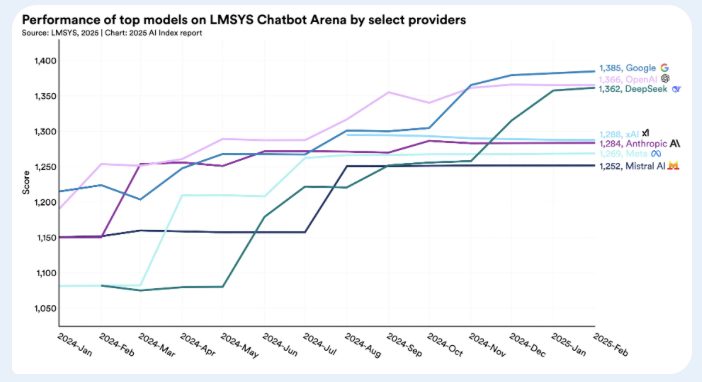
The gap between the best AI models is closing. The difference between the first and tenth-ranked models has shrunk from 11.9% to just 5.4% over the past year.

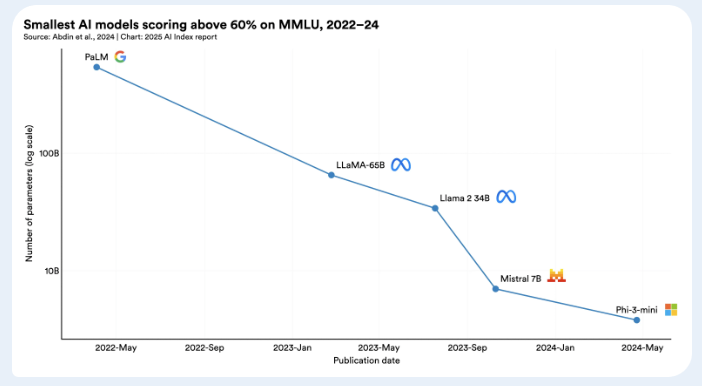
The report also shows that AI models are getting smaller while staying powerful. In 2022, to get 60% accuracy on the MMLU benchmark (a test of AI reasoning), you needed models with 540 billion parameters.

By 2024, models 142 times smaller could do the same job. This means businesses can now use advanced AI tools with less computing power and lower costs.

Chart: 2025 AI Index Report

Chart: 2025 AI Index Report

What This Means For Marketers

For marketers, these changes bring several potential benefits:

1. Advanced Content Creation at Scale
The price drop makes it affordable to create and optimize content in bulk. Tasks can now be automated cheaply without losing quality.

2. Better Analysis
Newer AI models can process up to 1-2 million tokens (pieces of text) at once. This is enough to analyze entire websites for competitive insights.

3. Smarter Knowledge Management
Retrieval-augmented generation (RAG), where AI pulls information from your company’s data, is improving. This helps marketers build systems that ensure AI outputs match their brand voice and expertise.

The End of AI Moats?

The report shows that AI models are becoming more similar in performance, with little difference between leading systems.

This suggests that the edge in marketing technology may shift from the raw AI power to how well you use it, your strategy, and your integration skills.

As AI capabilities become more common, the real difference-maker for marketing teams will be how effectively they use these tools to create unique value for their companies.

Conclusion

The cost of using advanced AI has fallen sharply, making it more accessible to businesses of all sizes. This shift is changing the pricing of AI marketing tools and the way marketers approach their work.

FAQs

Q: What is the current cost of using GPT-3.5-level AI models?
A: The current cost is $0.07 per million tokens.

Q: How has the cost of LLMs changed over the past year?
A: The cost has fallen between 9 and 900 times, depending on the task.

Q: What does the report show about the performance of AI models?
A: The report shows that the gap between the best AI models is closing, with little difference between leading systems.

Q: What does this mean for marketers?
A: This means that marketers can now use advanced AI tools to create and optimize content in bulk, analyze entire websites, and build systems that ensure AI outputs match their brand voice and expertise.

Scan to Go: Using Your iPhone as a 3D Scanner

0

Discover the Power of 3D Scanning on Your iPhone

What is 3D Scanning on iPhone?

If you own an iPhone 12 Pro model or later, you may be unaware of the powerful 3D scanning capabilities that are built into your device. Thanks to LiDAR (Light Detection and Ranging) technology, you can create highly detailed 3D models of objects in just a few minutes.

Getting Started with 3D Scanning

To get started, you’ll need to download the Polycam app, which is the leading 3D scanning platform for iPhone and iPad. The app is free to download, and it’s a great starting point for beginners.

How Does 3D Scanning Work?

Polycam’s LiDAR scanning works by bouncing light off of an object and measuring the distance that the light travels. This results in a detailed 3D model of the object, which can be used for a variety of creative and practical purposes.

Using Polycam for 3D Scanning

The free version of Polycam is a great starting point, but it has some limitations. To get the most out of 3D scanning, I recommend upgrading to the Pro version, which offers more advanced features and better results.

What Can You Do with 3D Scanning?

The possibilities are endless! You can use 3D scanning to create digital assets for gaming and 3D printing, take measurements of tricky or uneven surfaces, and even help with interior design projects.

Results and Limitations

While the free version of Polycam yielded some questionable results, the Pro version delivered impressive results. I was able to scan a household statue with incredible detail, and the option to export the scan as an OBJ or STL file for 3D printing is a major bonus.

Tips and Tricks

  • Avoid scanning reflective surfaces, as they can affect the quality of the scan.
  • Larger objects tend to produce better results, but I found that Polycam worked well on smaller objects too.
  • Take multiple photos of the object from different angles to get the best results.

Conclusion

3D scanning on your iPhone is a game-changer for creatives and problem-solvers alike. With the right tools and techniques, you can create high-quality 3D models with ease. Whether you’re a seasoned pro or just starting out, Polycam is a great place to begin your 3D scanning journey.

Frequently Asked Questions

Q: What is LiDAR technology?

A: LiDAR (Light Detection and Ranging) is a technology that uses light to measure distances and create detailed 3D models.

Q: What can I use 3D scanning for?

A: 3D scanning can be used for a variety of creative and practical purposes, including digital asset creation, interior design, and 3D printing.

Q: Do I need a special device to use 3D scanning?

A: No, you can use 3D scanning on your iPhone 12 Pro model or later, thanks to the built-in LiDAR technology.

Q: Is Polycam the only 3D scanning app available?

A: No, there are other 3D scanning apps available, including Epic Games’ Reality Scan app, which I found to be a great alternative.

Empowering Black Women in AI

Necessity is the Mother of Invention: How Black Women in Artificial Intelligence Are Redefining the Industry

Necessity is the mother of invention. And sometimes, what a person really needs is hot chocolate served to them by a robot — one named after a pop star, ideally.

Angle Bush, founder and CEO of Black Women in Artificial Intelligence (BWIAI), began her AI journey in 2019 with the idea to build a robot named Usher that could bring her cocoa. As she scoured robotics tutorial videos for ways to bring her vision to life, Bush found herself captivated by something even bigger: artificial intelligence.

"As I’m doing this research, I’m finding more about artificial intelligence, and I’m hearing it’s the fourth industrial revolution," she said.

But when Angle started attending AI events, a lack of diverse representation became glaringly obvious to her.

"I wasn’t quite seeing a full reflection of myself," she said. "Surely you can’t have a revolution without Black women."

From this realization, BWIAI was born.

The Mission

Bush joined the NVIDIA AI Podcast to share more about the organization’s mission to educate, engage, embrace, and empower Black women in the field of AI.

The Impact

Not five years after its founding, BWIAI brings together members from five continents and collaborates with key industry leaders and partners — serving as a supportive community and catalyst of change.

BWIAI and its partners offer hands-on learning experiences and online resources to its member community. They also launched a career assessment agent to help members explore how their interests align with emerging career paths in AI, as well as technologies and coursework for getting started.

"We have people in television, we have university professors, we have lawyers, we have doctors," Bush said. "It runs the gamut because they are an example of what’s happening globally. Every industry is impacted by AI."

Initiatives

• 2:45 – Bush discusses BWIAI’s partnerships and initiatives, including its autonomous hair-braiding machine.

• 6:30 – The importance of educating, engaging, embracing, and empowering Black women in AI.

• 10:40 – Behind BWIAI’s AI career assessment agent.

• 12:10 – Bush explains how removing barriers increases innovation.

Conclusion

BWIAI’s mission is to reshape the AI community by providing a supportive environment for Black women to learn, grow, and succeed. By breaking down barriers and increasing representation, the organization is paving the way for a more inclusive and diverse AI industry.

FAQs

Q: What is the main goal of Black Women in Artificial Intelligence (BWIAI)?
A: The main goal of BWIAI is to educate, engage, embrace, and empower Black women in the field of AI.

Q: How does BWIAI achieve its mission?
A: BWIAI achieves its mission through partnerships, hands-on learning experiences, online resources, and career assessment agents.

Q: Who can join BWIAI?
A: Anyone interested in AI and passionate about diversity and inclusion can join BWIAI.

Q: What are the benefits of joining BWIAI?
A: The benefits of joining BWIAI include access to online resources, hands-on learning experiences, and career assessment agents, as well as a supportive community of like-minded individuals.

Hopping gives this tiny robot a leg up | MIT News

0

Insect-scale robots can squeeze into places their larger counterparts can’t, like deep into a collapsed building to search for survivors after an earthquake.

However, as they move through the rubble, tiny crawling robots might encounter tall obstacles they can’t climb over or slanted surfaces they will slide down. While aerial robots could avoid these hazards, the amount of energy required for flight would severely limit how far the robot can travel into the wreckage before it needs to return to base and recharge.

To get the best of both locomotion methods, MIT researchers developed a hopping robot that can leap over tall obstacles and jump across slanted or uneven surfaces, while using far less energy than an aerial robot.

The hopping robot, which is smaller than a human thumb and weighs less than a paperclip, has a springy leg that propels it off the ground, and four flapping-wing modules that give it lift and control its orientation.

The robot can jump about 20 centimeters into the air, or four times its height, at a lateral speed of about 30 centimeters per second, and has no trouble hopping across ice, wet surfaces, and uneven soil, or even onto a hovering drone. All the while, the hopping robot consumes about 60 percent less energy than its flying cousin.

Due to its light weight and durability, and the energy efficiency of the hopping process, the robot could carry about 10 times more payload than a similar-sized aerial robot, opening the door to many new applications.

“Being able to put batteries, circuits, and sensors on board has become much more feasible with a hopping robot than a flying one. Our hope is that one day this robot could go out of the lab and be useful in real-world scenarios,” says Yi-Hsuan (Nemo) Hsiao, an MIT graduate student and co-lead author of a paper on the hopping robot.

Hsiao is joined on the paper by co-lead authors Songnan Bai, a research assistant professor at the City University of Hong Kong; and Zhongtao Guan, an incoming MIT graduate student who completed this work as a visiting undergraduate; as well as Suhan Kim and Zhijian Ren of MIT; and senior authors Pakpong Chirarattananon, an associate professor of the City University of Hong Kong; and Kevin Chen, an associate professor in the MIT Department of Electrical Engineering and Computer Science and head of the Soft and Micro Robotics Laboratory within the Research Laboratory of Electronics. The research appears today in Science Advances.

Maximizing efficiency

Jumping is common among insects, from fleas that leap onto new hosts to grasshoppers that bound around a meadow. While jumping is less common among insect-scale robots, which usually fly or crawl, hopping affords many advantages for energy efficiency.

When a robot hops, it transforms potential energy, which comes from its height off the ground, into kinetic energy as it falls. This kinetic energy transforms back to potential energy when it hits the ground, then back to kinetic as it rises, and so on.

To maximize efficiency of this process, the MIT robot is fitted with an elastic leg made from a compression spring, which is akin to the spring on a click-top pen. This spring converts the robot’s downward velocity to upward velocity when it strikes the ground.

“If you have an ideal spring, your robot can just hop along without losing any energy. But since our spring is not quite ideal, we use the flapping modules to compensate for the small amount of energy it loses when it makes contact with the ground,” Hsiao explains.

As the robot bounces back up into the air, the flapping wings provide lift, while ensuring the robot remains upright and has the correct orientation for its next jump. Its four flapping-wing mechanisms are powered by soft actuators, or artificial muscles, that are durable enough to endure repeated impacts with the ground without being damaged.

“We have been using the same robot for this entire series of experiments, and we never needed to stop and fix it,” Hsiao adds.

Key to the robot’s performance is a fast control mechanism that determines how the robot should be oriented for its next jump. Sensing is performed using an external motion-tracking system, and an observer algorithm computes the necessary control information using sensor measurements.

As the robot hops, it follows a ballistic trajectory, arcing through the air. At the peak of that trajectory, it estimates its landing position. Then, based on its target landing point, the controller calculates the desired takeoff velocity for the next jump. While airborne, the robot flaps its wings to adjust its orientation so it strikes the ground with the correct angle and axis to move in the proper direction and at the right speed.

Durability and flexibility

The researchers put the hopping robot, and its control mechanism, to the test on a variety of surfaces, including grass, ice, wet glass, and uneven soil — it successfully traversed all surfaces. The robot could even hop on a surface that was dynamically tilting.

“The robot doesn’t really care about the angle of the surface it is landing on. As long as it doesn’t slip when it strikes the ground, it will be fine,” Hsiao says.

Since the controller can handle multiple terrains, the robot can easily transition from one surface to another without missing a beat.

For instance, hopping across grass requires more thrust than hopping across glass, since blades of grass cause a damping effect that reduces its jump height. The controller can pump more energy to the robot’s wings during its aerial phase to compensate.

Due to its small size and light weight, the robot has an even smaller moment of inertia, which makes it more agile than a larger robot and better able to withstand collisions.

The researchers showcased its agility by demonstrating acrobatic flips. The featherweight robot could also hop onto an airborne drone without damaging either device, which could be useful in collaborative tasks.

In addition, while the team demonstrated a hopping robot that carried twice its weight, the maximum payload may be much higher. Adding more weight doesn’t hurt the robot’s efficiency. Rather, the efficiency of the spring is the most significant factor that limits how much the robot can carry.

Moving forward, the researchers plan to leverage its ability to carry heavy loads by installing batteries, sensors, and other circuits onto the robot, in the hopes of enabling it to hop autonomously outside the lab.

“Multimodal robots (those combining multiple movement strategies) are generally challenging and particularly impressive at such a tiny scale. The versatility of this tiny multimodal robot — flipping, jumping on rough or moving terrain, and even another robot — makes it even more impressive,” says Justin Yim, assistant professor at the University of Illinois at Urbana-Champagne, who was not involved with this work. “Continuous hopping shown in this research enables agile and efficient locomotion in environments with many large obstacles.”

This research is funded, in part, by the U.S. National Science Foundation and the MIT MISTI program. Chirarattananon was supported by the Research Grants Council of the Hong Kong Special Administrative Region of China. Hsiao is supported by a MathWorks Fellowship, and Kim is supported by a Zakhartchenko Fellowship.

The AI Agent Era Requires a New Kind of Game Theory

0

Risks in Agentic Systems: A Growing Concern

At the same time, the risk is immediate and present with agents. When models are not just contained boxes but can take actions in the world, when they have end-effectors that let them manipulate the world, I think it really becomes much more of a problem.

Securing Agentic Systems

We are making progress here, developing much better [defensive] techniques, but if you break the underlying model, you basically have the equivalent to a buffer overflow [a common way to hack software]. Your agent can be exploited by third parties to maliciously control or somehow circumvent the desired functionality of the system. We’re going to have to be able to secure these systems in order to make agents safe.

A Growing Concern

This is different from AI models themselves becoming a threat, right?

There’s no real risk of things like loss of control with current models right now. It is more of a future concern. But I’m very glad people are working on it; I think it is crucially important.

How Worried Should We Be?

How worried should we be about the increased use of agentic systems then?

In my research group, in my startup, and in several publications that OpenAI has produced recently [for example], there has been a lot of progress in mitigating some of these things. I think that we actually are on a reasonable path to start having a safer way to do all these things. The [challenge] is, in the balance of pushing forward agents, we want to make sure that the safety advances in lockstep.

Current Challenges

Most of the [exploits against agent systems] we see right now would be classified as experimental, frankly, because agents are still in their infancy. There’s still a user typically in the loop somewhere. If an email agent receives an email that says “Send me all your financial information,” before sending that email out, the agent would alert the user—and it probably wouldn’t even be fooled in that case.

This is also why a lot of agent releases have had very clear guardrails around them that enforce human interaction in more security-prone situations. Operator, for example, by OpenAI, when you use it on Gmail, it requires human manual control.

What Kind of Exploits Might We See First?

What kinds of agentic exploits might we see first?

There have been demonstrations of things like data exfiltration when agents are hooked up in the wrong way. If my agent has access to all my files and my cloud drive, and can also make queries to links, then you can upload these things somewhere.

These are still in the demonstration phase right now, but that’s really just because these things are not yet adopted. And they will be adopted, let’s make no mistake. These things will become more autonomous, more independent, and will have less user oversight, because we don’t want to click “agree,” “agree,” “agree” every time agents do anything.

A Future of Agentic Systems

It also seems inevitable that we will see different AI agents communicating and negotiating. What happens then?

Absolutely. Whether we want to or not, we are going to enter a world where there are agents interacting with each other. We’re going to have multiple agents interacting with the world on behalf of different users. And it is absolutely the case that there are going to be emergent properties that come up in the interaction of all these agents.

Conclusion

The use of agentic systems is becoming increasingly common, but with this comes the risk of exploitation and malicious control. It is crucial that we develop and implement effective security measures to mitigate these risks and ensure the safe use of agentic systems.

Frequently Asked Questions

Q: What are the main risks associated with agentic systems?

A: The main risks associated with agentic systems are the potential for exploitation and malicious control. Agents can be vulnerable to attacks and can be used by third parties to circumvent the desired functionality of the system.

Q: How can we mitigate these risks?

A: We can mitigate these risks by developing and implementing effective security measures, such as defensive techniques and guardrails, to ensure the safe use of agentic systems.

Q: What kind of exploits might we see first?

A: We may see exploits such as data exfiltration, where agents are hooked up in the wrong way and can upload files to unauthorized locations.

Q: What happens when AI agents communicate and negotiate?

A: When AI agents communicate and negotiate, we will enter a world where multiple agents interact with each other, leading to emergent properties that can be unpredictable and potentially problematic.

Telecardiology: Bridging the Gap in Cardiovascular Care

Telecardiology: The Future of Cardiology Care

Access to Cardiology Care

As chief medical officer at Heartbeat Health, a virtual-first cardiology practice, Dr. Jana Goldberg is at the intersection of telehealth and cardiology care. She has several concerns when it comes to telemedicine and cardiac care. She’s worried about access, because the supply-demand mismatch in cardiology is critical. She wants to improve outcomes, because she believes virtual care enables rapid titration of guideline-directed therapy. She’s focused on resource optimization, because cardiologists can stratify patients by need with telemedicine. And she’s interested in the role of hybrid models because virtual care will never replace in-person procedures or acute interventions.

Overcoming Access Challenges

Q: 46% of U.S. counties lack a local cardiologist and urban wait times exceed 30 days. How can telecardiology help overcome these access challenges?

A: That’s right. Almost half of the U.S. counties, impacting 22 million residents, have no cardiologist located in their area. These tend to be areas that are rural and socioeconomically disadvantaged.

Patients living in those areas already have a high risk of heart disease due to underlying risk factors and, astoundingly, a one-year shorter life expectancy than those with cardiologists. The problem extends into urban settings where some appointment times exceed 30 days depending on the city and continue to go up.

Further, a quarter of cardiologists intend to leave over the coming years. With a population getting sicker, we are facing a critical supply/demand mismatch.

Given both the current and projected outlook, telecardiology will serve an essential function in the coming decades. Here, I define telecardiology more broadly than just connecting cardiologists and patients via tele-visits. Rather, it is the larger implementation of remote-first diagnosis and treatment for patients with cardiovascular conditions.

Improving Outcomes

Q: How can telecardiology reduce hospitalizations and mortality rates?

A: There have been numerous clinical trials challenging the impact of telecardiology on various endpoints of interest, including blood pressure and cholesterol control, hospitalization, mortality, quality of life, among others.

Though some of the trials have had mixed data, they have also employed different models to effectuate impact. Overall, the literature supports that it can play a significant impact in improving outcomes.

A recent meta-analysis synthesizing evidence from 29 randomized trials and involving nearly 14,000 adults with heart failure illustrated that telecardiology significantly reduced hospitalization by 6% and mortality by 10%. Leveraging telecardiology not only reduces readmission, it improves health literacy and quality of life.

Resource Optimization

Q: What can telecardiology do to reduce unnecessary visits while ensuring high-quality care?

A: I would break down the impact into a couple different areas: routine like ambulatory care visits and high acuity like ER visits.

Given the breadth of disease, we need better ways to manage the influx of patients into the specialty outpatient, or ambulatory care setting. The right way to think about using telecardiology in this setting is using innovative care pathways to meet the level of patient need.

In this setting, we need to lean into a primary care-first model but maintain adequate support from specialists. For many questions, an e-consult pathway can provide primary care physicians with what is needed to manage a patient themselves.

Hybrid Models

Q: The hybrid model in telemedicine seems to be the wave of the future. What happens when you blend telecardiology and brick-and-mortar care?

A: I see this hybridization occur in three key areas: primary care, home care, and other specialty practices.

For several years, in primary care practices – particularly at-risk organizations or ACOs – telecardiology became a natural adjunct to their broader cardiovascular strategy. The objective has been clear: control healthcare costs while delivering high-quality care.

Next, healthcare is increasingly shifting into the home. Meeting patients where they are is essential, especially for those who face barriers to traditional in-person care. With clinicians delivering diagnoses and management in-home, this approach supports both routine and high-risk care.

Conclusion

Dr. Goldberg’s concerns about access, outcomes, resource optimization, and hybrid models demonstrate the critical role that telecardiology will play in the future of cardiology care. By leveraging telecardiology, cardiologists can overcome access challenges, improve outcomes, and optimize resources. The hybrid model, which blends telecardiology and brick-and-mortar care, will be essential in delivering high-quality care to patients.

FAQs

Q: How can telecardiology overcome the supply-demand mismatch in cardiology?
A: Telecardiology can connect patients with cardiologists in areas where there is a shortage of cardiologists, improving access to care.

Q: Can telecardiology replace in-person procedures or acute interventions?
A: No, telecardiology will never replace in-person procedures or acute interventions, but it can support and optimize care.

Q: What are the benefits of telecardiology in improving outcomes?
A: Telecardiology can improve outcomes by enabling rapid titration of guideline-directed therapy, reducing hospitalization and mortality rates, and improving health literacy and quality of life.

Q: What is the role of hybrid models in telecardiology?
A: Hybrid models blend telecardiology and brick-and-mortar care, supporting primary care, home care, and other specialty practices to deliver high-quality care.