
This publish is a part of an ongoing collection on governing the machine studying (ML) lifecycle at scale. To begin from the start, check with Governing the ML lifecycle at scale, Half 1: A framework for architecting ML workloads utilizing Amazon SageMaker.
A multi-account technique is crucial not just for enhancing governance but additionally for enhancing safety and management over the assets that assist your group’s enterprise. This strategy allows varied groups inside your group to experiment, innovate, and combine extra quickly whereas holding the manufacturing setting safe and accessible to your clients. Nevertheless, as a result of a number of groups would possibly use your ML platform within the cloud, monitoring massive ML workloads throughout a scaling multi-account setting presents challenges in organising and monitoring telemetry information that’s scattered throughout a number of accounts. On this publish, we dive into organising observability in a multi-account setting with Amazon SageMaker.
Amazon SageMaker Mannequin Monitor permits you to routinely monitor ML fashions in manufacturing, and alerts you when information and mannequin high quality points seem. SageMaker Mannequin Monitor emits per-feature metrics to Amazon CloudWatch, which you should use to arrange dashboards and alerts. You need to use cross-account observability in CloudWatch to go looking, analyze, and correlate cross-account telemetry information saved in CloudWatch reminiscent of metrics, logs, and traces from one centralized account. Now you can arrange a central observability AWS account and join your different accounts as sources. Then you possibly can search, audit, and analyze logs throughout your functions to drill down into operational points in a matter of seconds. You’ll be able to uncover and visualize operational and mannequin metrics from many accounts in a single place and create alarms that consider metrics belonging to different accounts.
AWS CloudTrail can be important for sustaining safety and compliance in your AWS setting by offering a complete log of all API calls and actions taken throughout your AWS account, enabling you to trace adjustments, monitor consumer actions, and detect suspicious conduct. This publish additionally dives into how one can centralize CloudTrail logging so that you’ve visibility into consumer actions inside your entire SageMaker environments.
Resolution overview
Clients usually wrestle with monitoring their ML workloads throughout a number of AWS accounts, as a result of every account manages its personal metrics, leading to information silos and restricted visibility. ML fashions throughout totally different accounts want real-time monitoring for efficiency and drift detection, with key metrics like accuracy, CPU utilization, and AUC scores tracked to take care of mannequin reliability.
To resolve this, we implement an answer that makes use of SageMaker Mannequin Monitor and CloudWatch cross-account observability. This strategy allows centralized monitoring and governance, permitting your ML crew to achieve complete insights into logs and efficiency metrics throughout all accounts. With this unified view, your crew can successfully monitor and handle their ML workloads, enhancing operational effectivity.
Implementing the answer consists of the next steps:
- Deploy the mannequin and arrange SageMaker Mannequin Monitor.
- Allow CloudWatch cross-account observability.
- Consolidate metrics throughout supply accounts and construct unified dashboards.
- Configure centralized logging to API calls throughout a number of accounts utilizing CloudTrail.
The next structure diagram showcases the centralized observability answer in a multi-account setup. We deploy ML fashions throughout two AWS environments, manufacturing and check, which function our supply accounts. We use SageMaker Mannequin Monitor to evaluate these fashions’ efficiency. Moreover, we improve centralized administration and oversight through the use of cross-account observability in CloudWatch to mixture metrics from the ML workloads in these supply accounts into the observability account.
Deploy the mannequin and arrange SageMaker Mannequin Monitor
We deploy an XGBoost classifier mannequin, educated on publicly accessible banking advertising and marketing information, to determine potential clients more likely to subscribe to time period deposits. This mannequin is deployed in each manufacturing and check supply accounts, the place its real-time efficiency is regularly validated in opposition to baseline metrics utilizing SageMaker Mannequin Monitor to detect deviations in mannequin efficiency. Moreover, we use CloudWatch to centralize and share the info and efficiency metrics of those ML workloads within the observability account, offering a complete view throughout totally different accounts. Yow will discover the complete supply code for this publish within the accompanying GitHub repo.
Step one is to deploy the mannequin to an SageMaker endpoint with information seize enabled:
endpoint_name = f"BankMarketingTarget-endpoint-{datetime.utcnow():%Y-%m-%d-%HpercentM}"
print("EndpointName =", endpoint_name)

data_capture_config = DataCaptureConfig(
enable_capture=True, sampling_percentage=100, destination_s3_uri=s3_capture_upload_path)

mannequin.deploy(
initial_instance_count=1,
instance_type="ml.m4.xlarge",
endpoint_name=endpoint_name,
data_capture_config=data_capture_config,)
For real-time mannequin efficiency analysis, it’s important to ascertain a baseline. This baseline is created by invoking the endpoint with validation information. We use SageMaker Mannequin Monitor to carry out baseline evaluation, compute efficiency metrics, and suggest high quality constraints for efficient real-time efficiency analysis.
Subsequent, we outline the mannequin high quality monitoring object and run the mannequin high quality monitoring baseline job. The mannequin monitor routinely generates baseline statistics and constraints primarily based on the offered validation information. The monitoring job evaluates the mannequin’s predictions in opposition to floor fact labels to verify the mannequin maintains its efficiency over time.
Along with the generated baseline, SageMaker Mannequin Monitor requires two further inputs: predictions from the deployed mannequin endpoint and floor fact information offered by the model-consuming utility. As a result of information seize is enabled on the endpoint, we first generate site visitors to verify prediction information is captured. When itemizing the info seize recordsdata saved, you need to anticipate to see varied recordsdata from totally different time intervals, organized primarily based on the hour through which the invocation occurred. When viewing the contents of a single file, you’ll discover the next particulars. The inferenceId attribute is ready as a part of the invoke_endpoint name. When ingesting floor fact labels and merging them with predictions for efficiency metrics, SageMaker Mannequin Monitor makes use of inferenceId, which is included in captured information data. It’s used to merge these captured data with floor fact data, ensuring the inferenceId in each datasets matches. If inferenceId is absent, it makes use of the eventId from captured information to correlate with the bottom fact document.
SageMaker Mannequin Monitor ingests floor fact information collected periodically and merges it with prediction information to calculate efficiency metrics. This monitoring course of makes use of baseline constraints from the preliminary setup to constantly assess the mannequin’s efficiency. By enabling enable_cloudwatch_metrics=True, SageMaker Mannequin Monitor makes use of CloudWatch to watch the standard and efficiency of our ML fashions, thereby emitting these efficiency metrics to CloudWatch for complete monitoring.
Every time the mannequin high quality monitoring job runs, it begins with a merge job that mixes two datasets: the inference information captured on the endpoint and the bottom fact information offered by the appliance. That is adopted by a monitoring job that assesses the info for insights into mannequin efficiency utilizing the baseline setup.
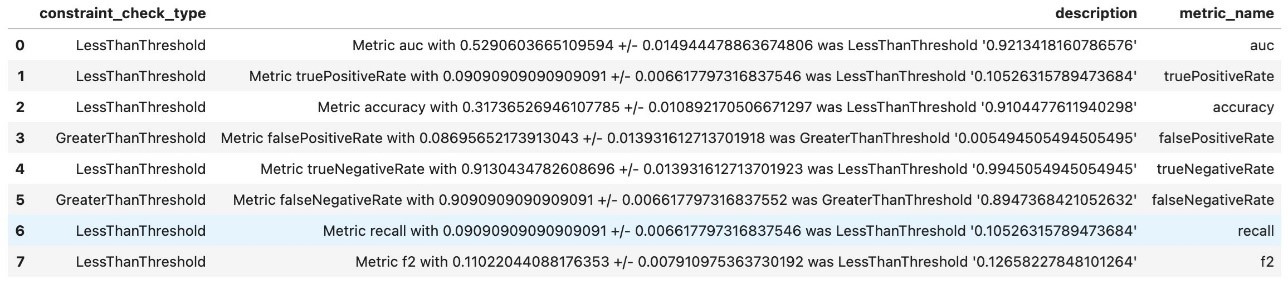
Verify for deviations from the baseline constraints to successfully set acceptable thresholds in your monitoring course of. As you possibly can see within the following the screenshot, varied metrics reminiscent of AUC, accuracy, recall, and F2 rating are carefully monitored, every topic to particular threshold checks like LessThanThreshold or GreaterThanThreshold. By actively monitoring these metrics, you possibly can detect important deviations and make knowledgeable selections promptly, ensuring your ML fashions carry out optimally inside established parameters.
Allow CloudWatch cross-account observability
With CloudWatch built-in into SageMaker Mannequin Monitor to trace the metrics of ML workloads working within the supply accounts (manufacturing and check), the following step entails enabling CloudWatch cross-account observability. CloudWatch cross-account observability permits you to monitor and troubleshoot functions spanning a number of AWS accounts inside an AWS Area. This function allows seamless looking out, visualization, and evaluation of metrics, logs, traces, and Software Insights throughout linked accounts, eliminating account boundaries. You need to use this function to consolidate CloudWatch metrics from these supply accounts into the observability account.
To attain this centralized governance and monitoring, we set up two forms of accounts:
- Observability account – This central AWS account aggregates and interacts with ML workload metrics from the supply accounts
- Supply accounts (manufacturing and check) – These particular person AWS accounts share their ML workload metrics and logging assets with the central observability account, enabling centralized oversight and evaluation
Configure the observability account
Full the next steps to configure the observability account:
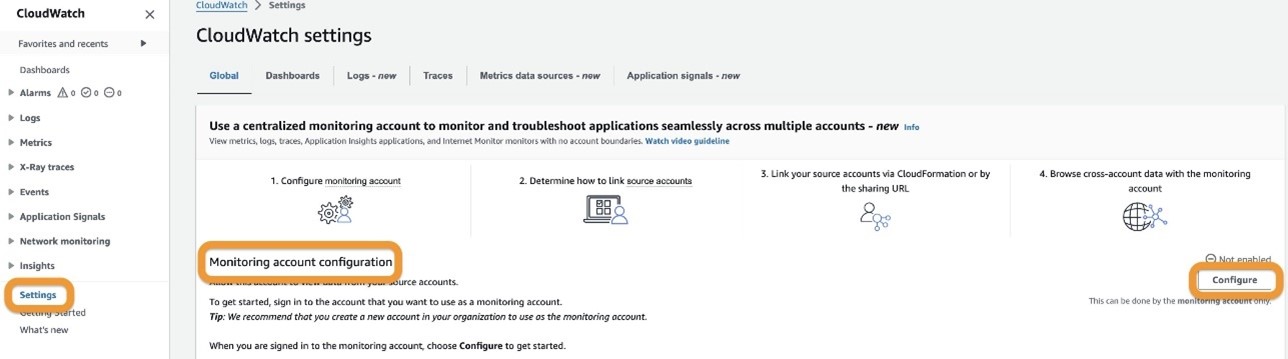
- On the CloudWatch console of the observability account, select Settings within the navigation pane.
- Within the Monitoring account configuration part, select Configure.
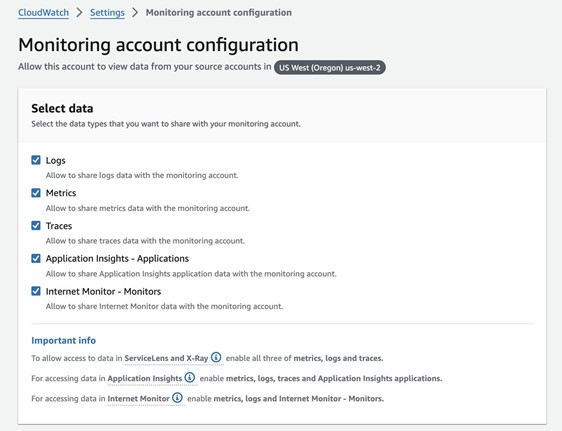
- Choose which telemetry information will be shared with the observability account.
- Underneath Record supply accounts, enter the supply accounts that can share information with the observability account.
To hyperlink the supply accounts, you should use account IDs, group IDs, or group paths. You need to use a company ID to incorporate all accounts inside the group, or a company path can goal all accounts inside a particular division or enterprise unit. On this case, as a result of we’ve two supply accounts to hyperlink, we enter the account IDs of these two accounts.
- Select Configure.
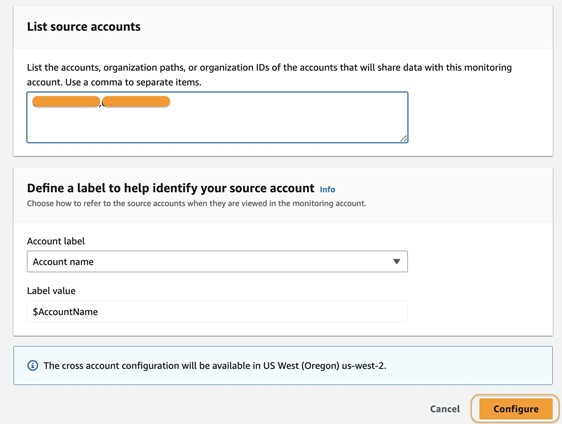
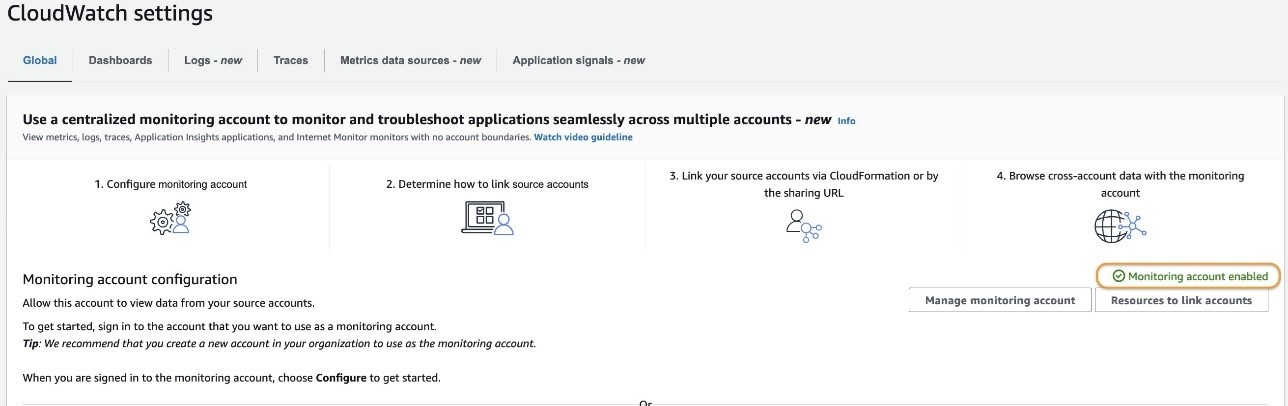
After the setup is full, the message “Monitoring account enabled” seems within the CloudWatch settings.
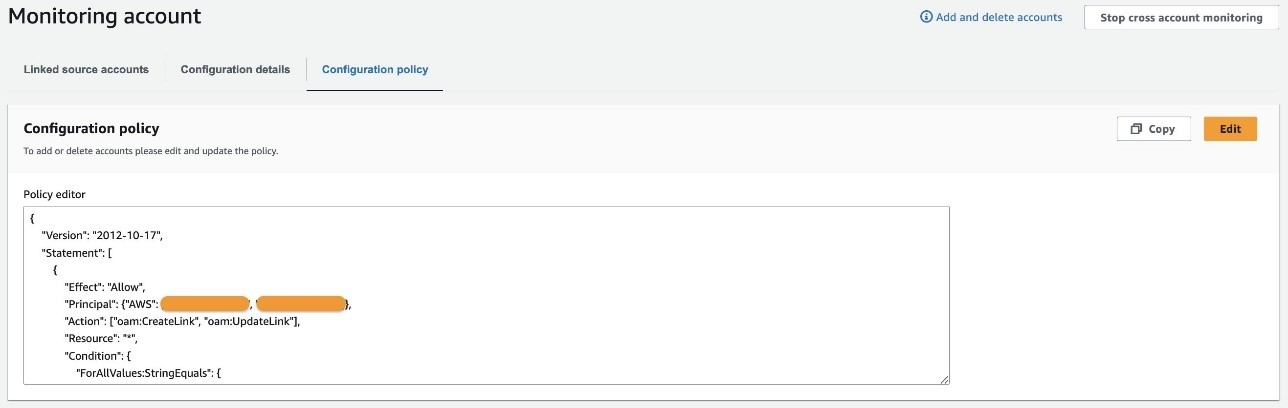
Moreover, your supply accounts are listed on the Configuration coverage tab.
Hyperlink supply accounts
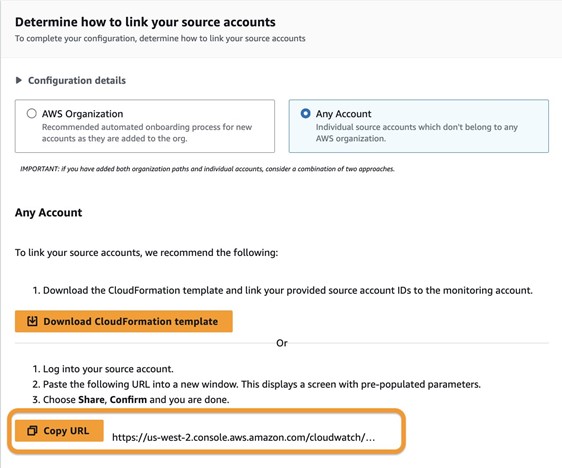
Now that the observability account has been enabled with supply accounts, you possibly can hyperlink these supply accounts inside an AWS group. You’ll be able to select from two strategies:
- For organizations utilizing AWS CloudFormation, you possibly can obtain a CloudFormation template and deploy it in a CloudFormation delegated administration account. This technique facilitates the majority addition of supply accounts.
- For linking particular person accounts, two choices can be found:
- Obtain a CloudFormation template that may be deployed straight inside every supply account.
- Copy a offered URL, which simplifies the setup course of utilizing the AWS Administration Console.
Full the next steps to make use of the offered URL:
- Copy the URL and open it in a brand new browser window the place you’re logged in because the supply account.
- Configure the telemetry information you need to share. This may embrace logs, metrics, traces, Software Insights, or Web Monitor.
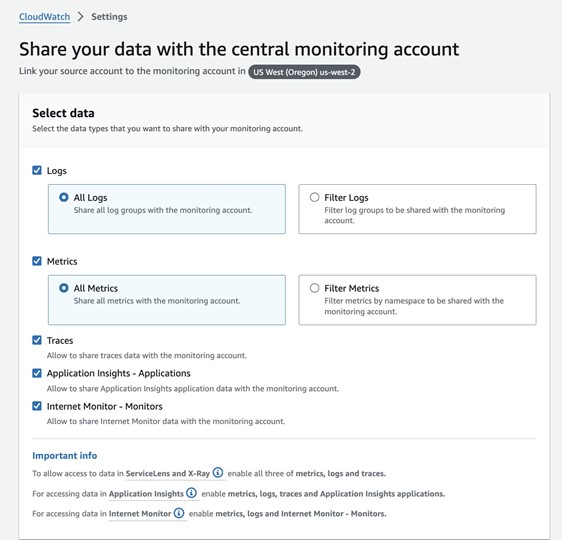
Throughout this course of, you’ll discover that the Amazon Useful resource Identify (ARN) of the observability account configuration is routinely stuffed in. This comfort is because of copying and pasting the URL offered within the earlier step. If, nonetheless, you select to not use the URL, you possibly can manually enter the ARN. Copy the ARN from the observability account settings and enter it into the designated area within the supply account configuration web page.
- Outline the label that identifies your supply accounts. This label is essential for organizing and distinguishing your accounts inside the monitoring system.
- Select Hyperlink to finalize the connection between your supply accounts and the observability account.
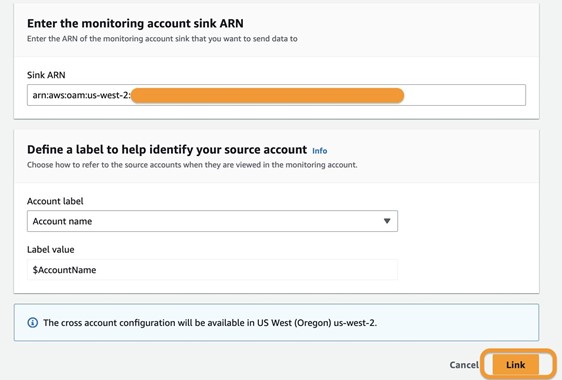
- Repeat these steps for each supply accounts.
It’s best to see these accounts listed on the Linked supply accounts tab inside the observability account CloudWatch settings configuration.
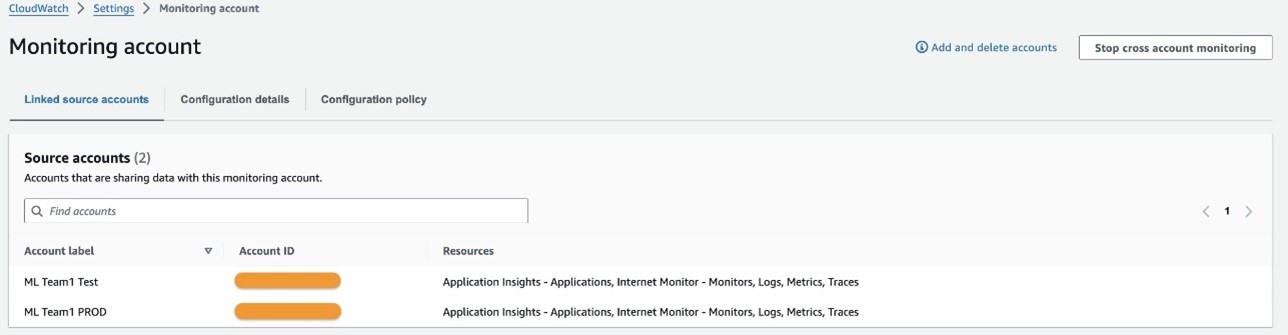
Consolidate metrics throughout supply accounts and construct unified dashboards
Within the observability account, you possibly can entry and monitor detailed metrics associated to your ML workloads and endpoints deployed throughout the supply accounts. This centralized view permits you to observe quite a lot of metrics, together with these from SageMaker endpoints and processing jobs, all inside a single interface.
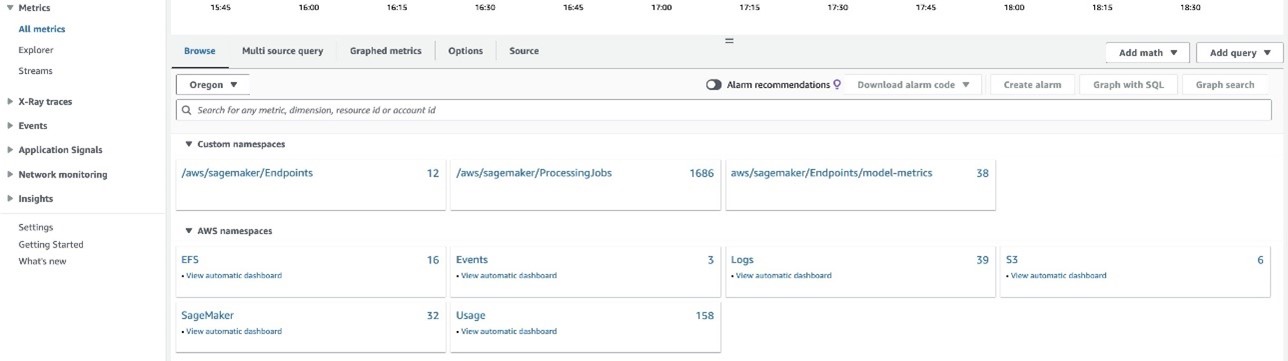
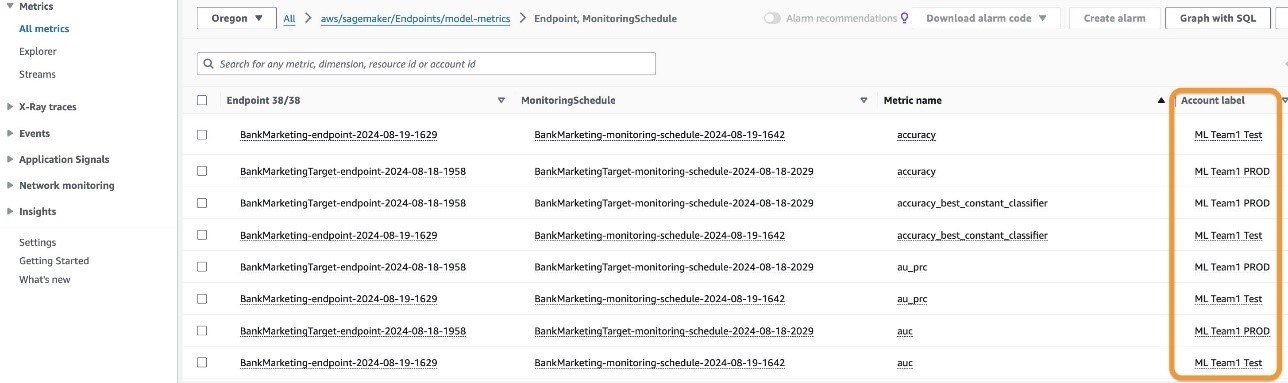
The next screenshot shows CloudWatch mannequin metrics for endpoints in your supply accounts. Since you linked the manufacturing and check supply accounts utilizing the label because the account identify, CloudWatch categorizes metrics by account label, successfully distinguishing between the manufacturing and check environments. It organizes key particulars into columns, together with account labels, metric names, endpoints, and efficiency metrics like accuracy and AUC, all captured by scheduled monitoring jobs. These metrics provide priceless insights into the efficiency of your fashions throughout these environments.
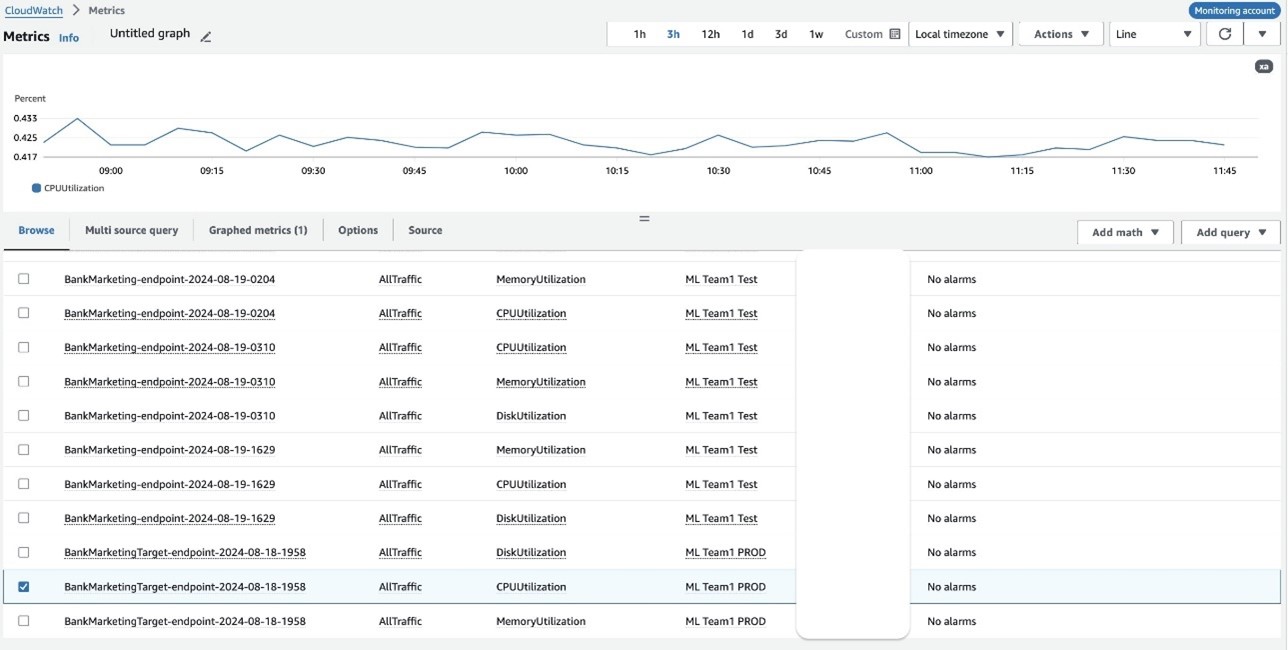
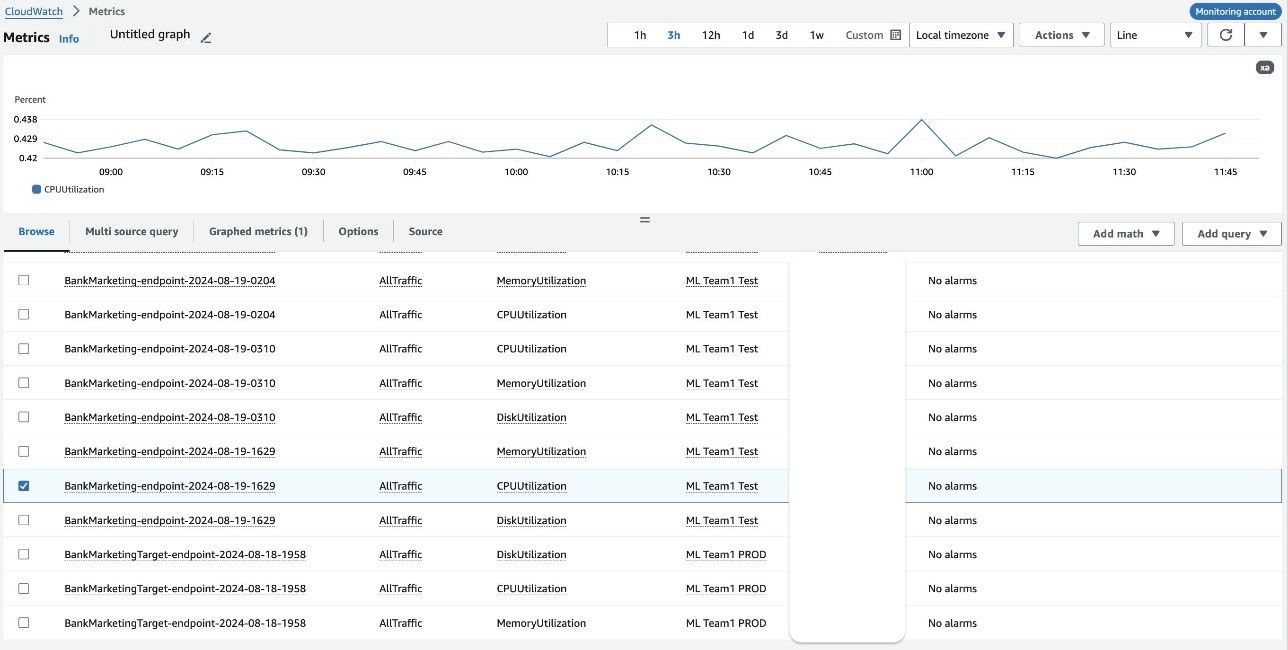
The observability account permits you to monitor key metrics of ML workloads and endpoints. The next screenshots show CPU utilization metrics related to the BankMarketingTarget mannequin and BankMarketing mannequin endpoints you deployed within the supply accounts. This view offers detailed insights into vital efficiency indicators, together with:
- CPU utilization
- Reminiscence utilization
- Disk utilization
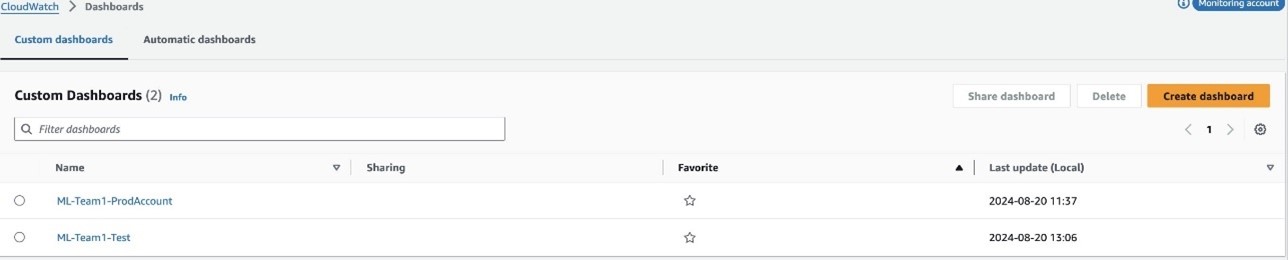
Moreover, you possibly can create dashboards that supply a consolidated view of key metrics associated to your ML workloads working throughout the linked supply accounts. These centralized dashboards are pivotal for overseeing the efficiency, reliability, and high quality of your ML fashions on a big scale.
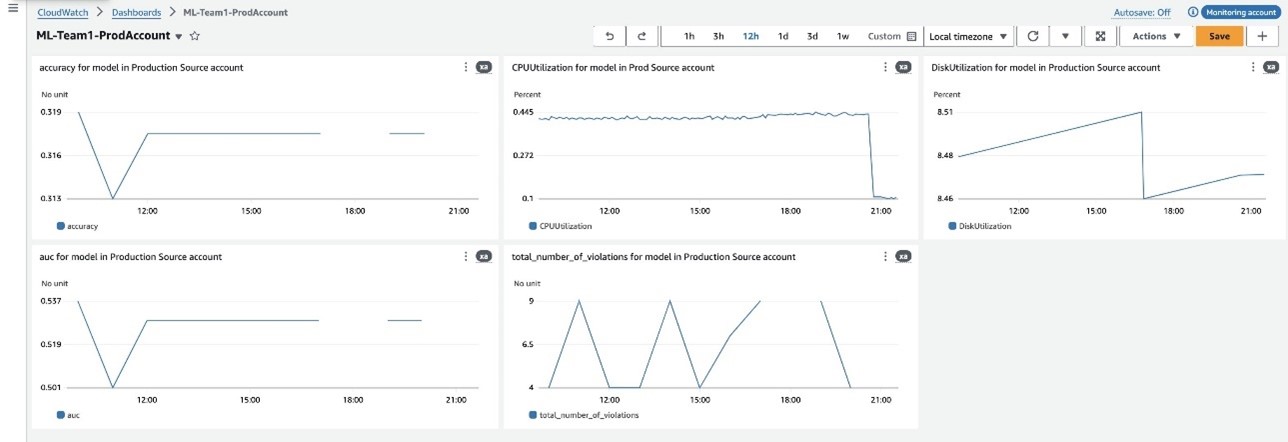
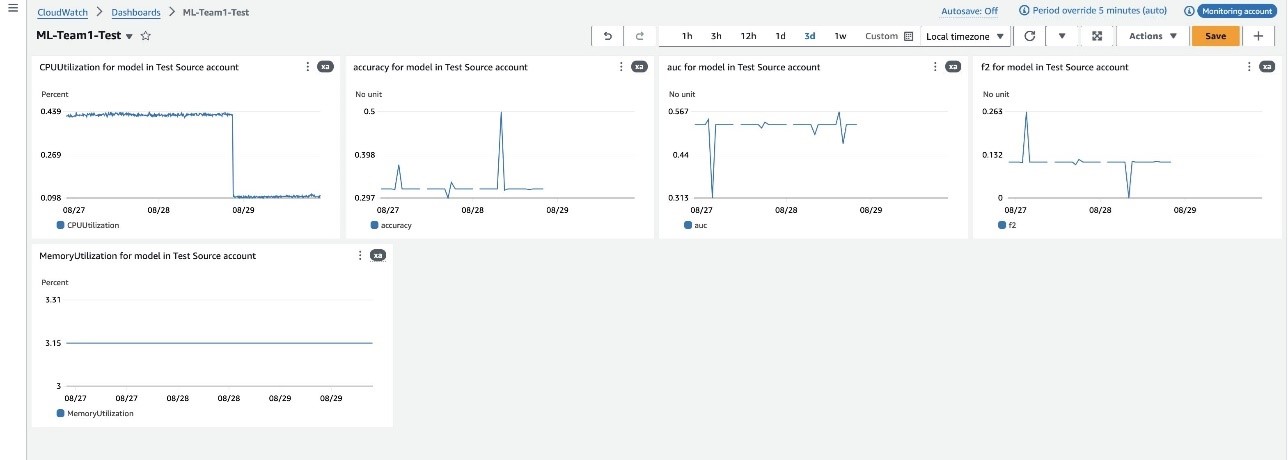
Let’s take a look at a consolidated view of the ML workload metrics working in our manufacturing and check supply accounts. This dashboard offers us with fast entry to vital data:
- AUC scores – Indicating mannequin efficiency, giving insights into the trade-off between true positives and false positives
- Accuracy charges – Displaying prediction correctness, which helps in assessing the general reliability of the mannequin
- F2 scores – Providing a stability between precision and recall, notably priceless when false negatives are extra vital to reduce
- Whole variety of violations – Highlighting any breaches in predefined thresholds or constraints, ensuring the mannequin adheres to anticipated conduct
- CPU utilization ranges – Serving to you handle useful resource allocation by monitoring the processing energy utilized by the ML workloads
- Disk utilization percentages – Offering environment friendly storage administration by holding observe of how a lot disk area is being consumed
This following screenshots present CloudWatch dashboards for the fashions deployed in our manufacturing and check supply accounts. We observe metrics for accuracy, AUC, CPU and disk utilization, and violation counts, offering insights into mannequin efficiency and useful resource utilization.
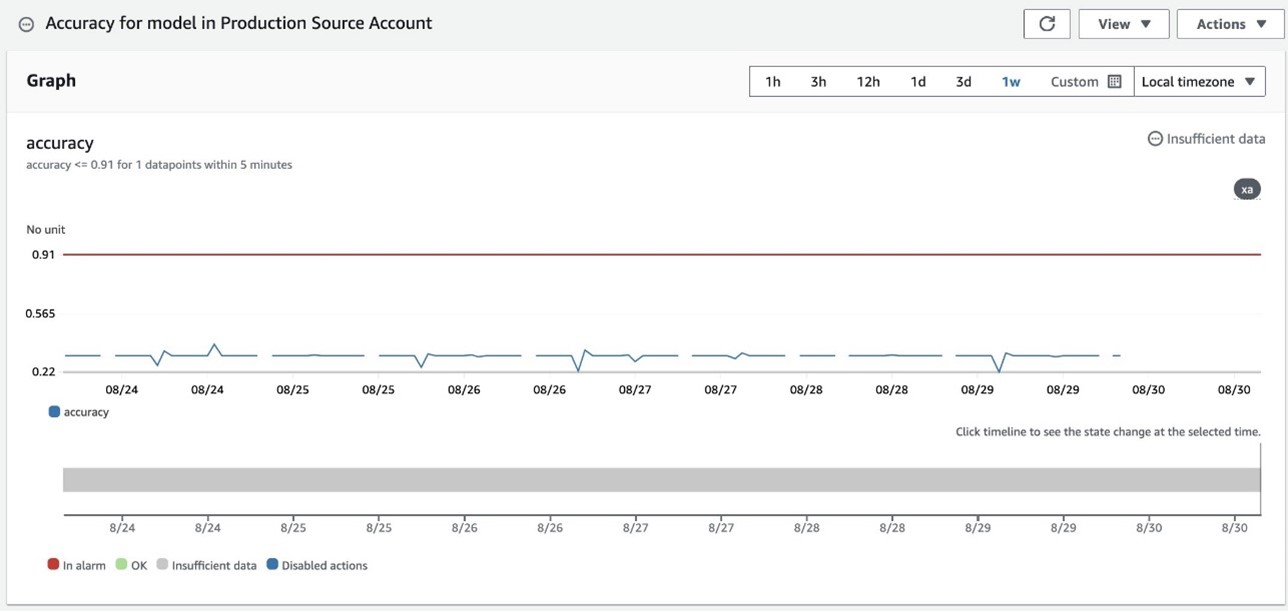
You’ll be able to configure CloudWatch alarms to proactively monitor and obtain notifications on vital ML workload metrics out of your supply accounts. The next screenshot reveals an alarm configured to trace the accuracy of our financial institution advertising and marketing prediction mannequin within the manufacturing account. This alarm is ready to set off if the mannequin’s accuracy falls beneath a specified threshold, so any important degradation in efficiency is promptly detected and addressed. By utilizing such alarms, you possibly can keep excessive requirements of mannequin efficiency and rapidly reply to potential points inside your ML infrastructure.
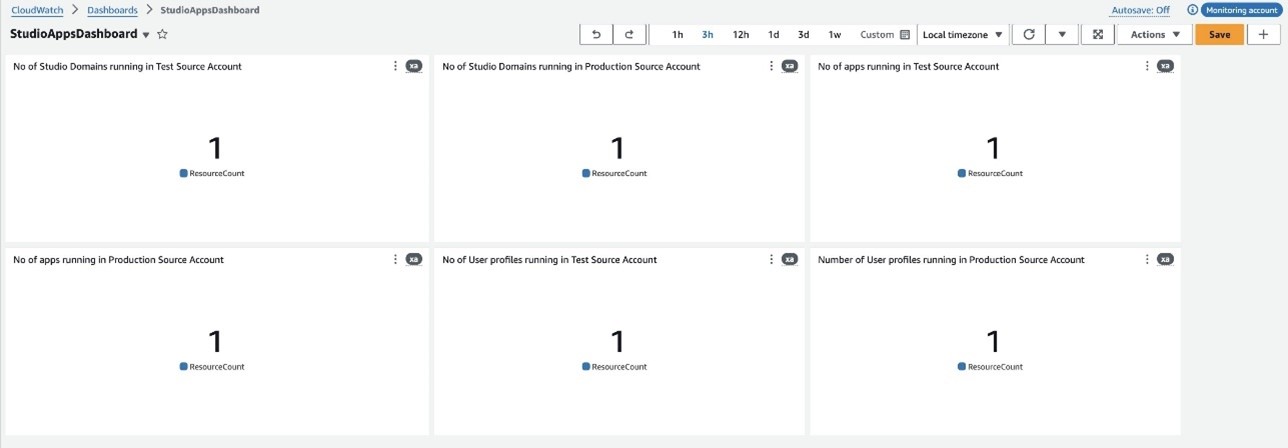
It’s also possible to create a complete CloudWatch dashboard for monitoring varied points of Amazon SageMaker Studio, together with the variety of domains, apps, and consumer profiles throughout totally different AWS accounts. The next screenshot illustrates a dashboard that centralizes key metrics from the manufacturing and check supply accounts.
Configure centralized logging of API calls throughout a number of accounts with CloudTrail
If AWS Management Tower has been configured to routinely create an organization-wide path, every account will ship a replica of its CloudTrail occasion path to a centralized Amazon Easy Storage Service (Amazon S3) bucket. This bucket is often created within the log archive account and is configured with restricted entry, the place it serves as a single supply of fact for safety personnel. If you wish to arrange a separate account to permit the ML admin crew to have entry, you possibly can configure replication from the log archive account. You’ll be able to create the vacation spot bucket within the observability account.
After you create the bucket for replicated logs, you possibly can configure Amazon S3 replication by defining the supply and vacation spot bucket, and attaching the required AWS Id and Entry Administration (IAM) permissions. Then you definitely replace the vacation spot bucket coverage to permit replication.
Full the next steps:
- Create an S3 bucket within the observability account.
- Log in to the log archive account.
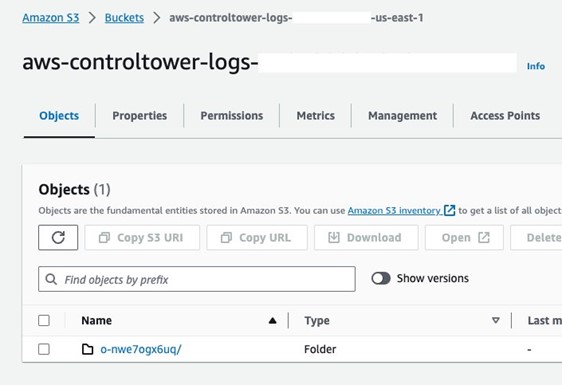
- On the Amazon S3 console, open the Management Tower logs bucket, which may have the
format aws-controltower-logs-{ACCOUNT-ID}-{REGION}.
It’s best to see an current key that corresponds to your group ID. The path logs are saved below /{ORG-ID}/AWSLogs/{ACCOUNT-ID}/CloudTrail/{REGION}/YYYY/MM/DD.
- On the Administration tab, select Create replication rule.
- For Replication rule identify, enter a reputation, reminiscent of
replicate-ml-workloads-to-observability. - Underneath Supply bucket, choose Restrict the scope of the rule utilizing a number of filters, and enter a path the corresponds to the account you need to allow querying in opposition to.
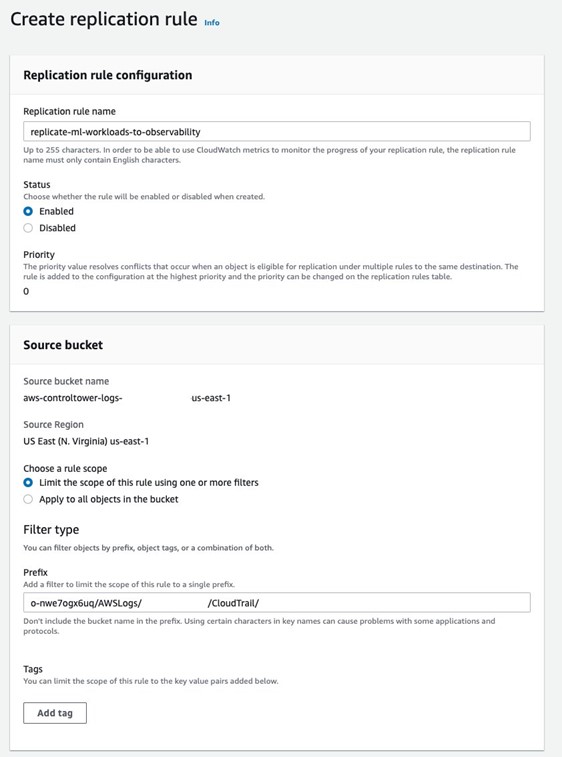
- Choose Specify a bucket in one other account and enter the observability account ID and the bucket identify.
- Choose Change object possession to vacation spot bucket proprietor.
- For IAM position, select Create new position.
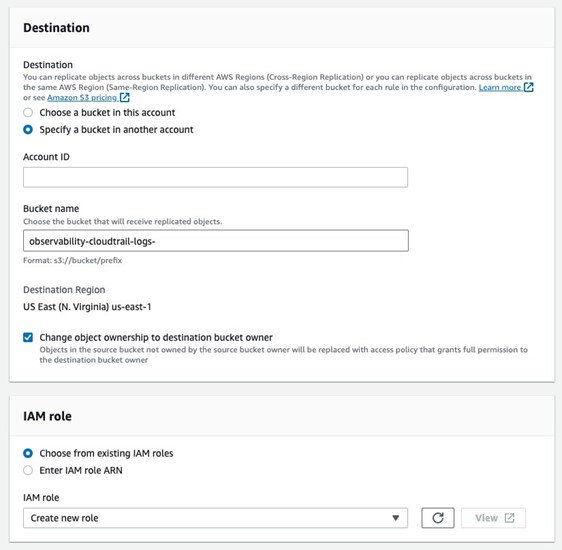
After you set the cross-account replication, the logs being saved within the S3 bucket within the log archive account might be replicated within the observability account. Now you can use Amazon Athena to question and analyze the info being saved in Amazon S3. Should you don’t have Management Tower configured, it’s important to manually configure CloudTrail in every account to jot down to the S3 bucket within the centralized observability account for evaluation. In case your group has extra stringent safety and compliance necessities, you possibly can configure replication of simply the SageMaker logs from the log archive account to the bucket within the observability account by integrating Amazon S3 Occasion Notifications with AWS Lambda features.
The next is a pattern question run in opposition to the logs saved within the observability account bucket and the related end in Athena:
SELECT useridentity.arn, useridentity.sessioncontext.sourceidentity, requestparametersFROM observability_replicated_logs
WHERE eventname="CreateEndpoint"
AND eventsource="sagemaker.amazonaws.com"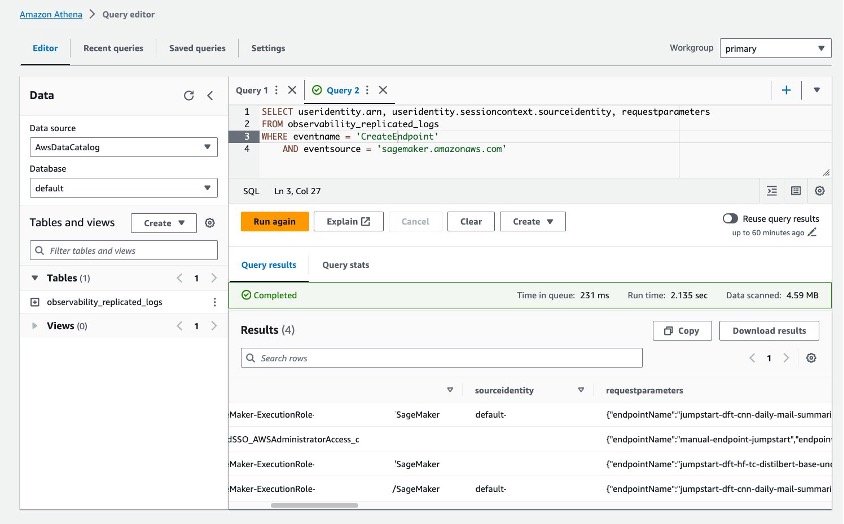
Conclusion
Centralized observability in a multi-account setup empowers organizations to handle ML workloads at scale. By integrating SageMaker Mannequin Monitor with cross-account observability in CloudWatch, you possibly can construct a strong framework for real-time monitoring and governance throughout a number of environments.
This structure not solely offers steady oversight of mannequin efficiency, but additionally considerably enhances your skill to rapidly determine and resolve potential points, thereby enhancing governance and safety all through our ML ecosystem.
On this publish, we outlined the important steps for implementing centralized observability inside your AWS setting, from organising SageMaker Mannequin Monitor to utilizing cross-account options in CloudWatch. We additionally demonstrated centralizing CloudTrail logs by replicating them from the log archive account and querying them utilizing Athena to get insights into consumer exercise inside SageMaker environments throughout the group.
As you implement this answer, do not forget that reaching optimum observability is an ongoing course of. Regularly refining and increasing your monitoring capabilities is essential to creating certain your ML fashions stay dependable, environment friendly, and aligned with enterprise aims. As ML practices evolve, mixing cutting-edge know-how with sound governance ideas is essential. Run the code your self utilizing the next pocket book or check out the observability module within the following workshop.
In regards to the Authors
 Abhishek Doppalapudi is a Options Architect at Amazon Net Providers (AWS), the place he assists startups in constructing and scaling their merchandise utilizing AWS providers. Presently, he’s targeted on serving to AWS clients undertake Generative AI options. In his free time, Abhishek enjoys taking part in soccer, watching Premier League matches, and studying.
 Venu Kanamatareddy is a Startup Options Architect at AWS. He brings 16 years of in depth IT expertise working with each Fortune 100 corporations and startups. Presently, Venu helps information and help Machine Studying and Synthetic Intelligence-based startups to innovate, scale, and succeed.
 Vivek Gangasani is a Senior GenAI Specialist Options Architect at AWS. He helps rising GenAI corporations construct progressive options utilizing AWS providers and accelerated compute. Presently, he’s targeted on growing methods for fine-tuning and optimizing the inference efficiency of Massive Language Fashions. In his free time, Vivek enjoys mountain climbing, watching films and making an attempt totally different cuisines.
 Ram Vittal is a Principal ML Options Architect at AWS. He has over 3 many years of expertise architecting and constructing distributed, hybrid, and cloud functions. He’s enthusiastic about constructing safe, scalable, dependable AI/ML and massive information options to assist enterprise clients with their cloud adoption and optimization journey to enhance their enterprise outcomes. In his spare time, he rides motorbike and walks together with his three-year outdated sheep-a-doodle!


