
I spend a lot of time sitting with the tensions HR leaders are navigating right now. Not just reading about them—actually talking to HR teams, digging into data, and trying to understand what’s making this moment so uniquely challenging. And what I keep coming back to is this: the organizations feeling stuck aren’t lacking effort or intention. They’re caught in a structural pull—where solving for the business can feel like it comes at the expense of the employee, and vice versa.
The business needs speed. Employees need clarity.
The business needs future-ready talent. Employees want growth that actually means something.
The business needs sustained performance. Employees want to feel like their contributions register.
HR sits in the middle of all of it—and the instinct is to optimize for one at the expense of the other. That’s why so many strategies stall.
“What if we stopped trying to resolve these tensions and started building the conditions where both sides become possible?”
That’s the better question. And it’s not a reframe—it’s a different job entirely.
What does a thriving team actually look like?
Here’s how we define it: a thriving team has strong performance and strong connection—not one or the other. Teams that perform without connection are straining. Teams that connect without performing are drifting. Neither holds for long.
At Quantum Workplace, we think about thriving across four conditions: Aligned, Empowered, Growing, and Valued. Each one maps to a real tension HR leaders are already managing. And for each one, there’s a diagnostic question that, if you can answer it honestly, changes what you do next.
The 4 questions HR needs to answer
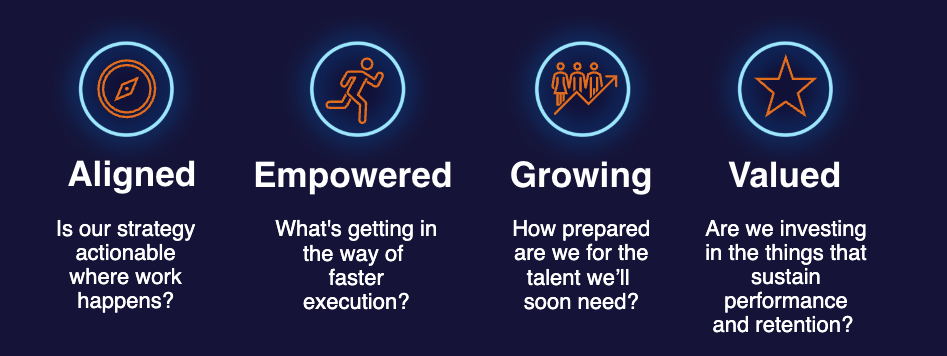
1. Aligned — Is our strategy actionable where work happens?
The tension: Organizations need speed; employees need clarity.
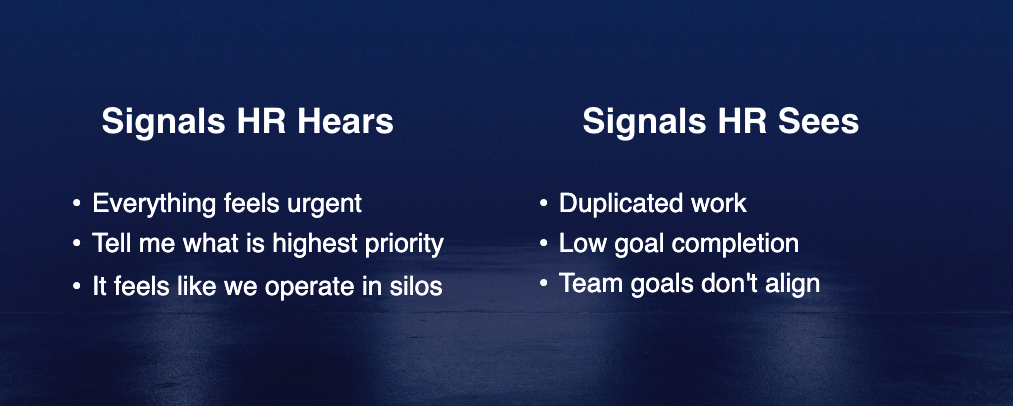
When I talk to HR leaders about alignment, they almost always nod at the same things. “Everything feels urgent.” “We operate in silos.” “Tell me what’s highest priority.” On the data side, you see duplicated work, low goal completion, team goals that just don’t connect.
The diagnostic question I always push people toward isn’t “do employees know the strategy?” It’s whether clarity differs by performance level. When solid performers lack clarity, that’s a coaching opportunity—managers can close that gap. But when your top performers are unclear too? That’s an org-wide problem, and no amount of manager coaching will fix it on its own.
The second question goes deeper: do teams actually feel accountable for the strategy, or does it feel handed down to them? That distinction matters enormously. Response patterns from a survey question are designed to reveal where employees are genuinely aligned versus where they’ve quietly disconnected. And those same responses can segment other outcomes—engagement scores, turnover risk—so you’re not just naming the gap, you’re understanding what it costs you.
What action looks like:
- Strengthen how strategy shows up in the day-to-day work
- Equip managers to translate strategy into clear goals and expectations— alignment needs to be a manager capability, not just a communication exercise
- Audit and remove competing or non-aligned priorities that undermine alignment and speed
2. Empowered — What’s getting in the way of faster execution?
The tension: Organizations need faster execution; employees need fewer barriers.
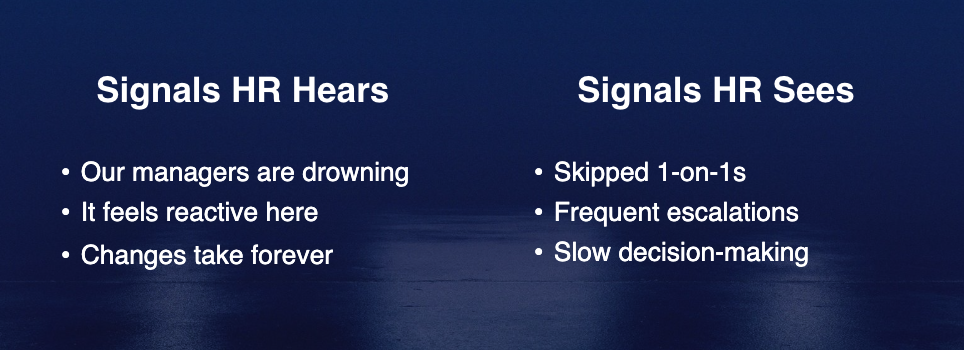
The signals here are pretty consistent: managers are drowning, things feel reactive, changes take forever. Skipped 1-on-1s. Frequent escalations. Decisions that should take a day taking a week.
One of the most interesting things I’ve seen in our data is what happens when you connect business KPIs—like on-time delivery—to employee feedback. The barriers become visible in ways that are genuinely surprising. In one case, having the right materials and equipment wasn’t what differentiated on-time delivery. AI adoption was. That’s the kind of specific, counterintuitive signal that only surfaces when you connect data across systems.
But here’s the thing I think gets missed most often: the manager experience gap. Look at this data from one organization and let it sink in:
|
Metric |
Managers |
Non-Managers |
Gap |
|
If I contribute to the org’s success, I know I will be recognized. |
57% |
87% |
-30% |
|
I clearly understand how my performance is measured. |
57% |
83% |
-26% |
|
I know how I fit into the organization’s future plans. |
50% |
73% |
-23% |
|
I have opportunities to learn new skills that will help me succeed. |
57% |
80% |
-23% |
|
It would take a lot to get me to leave this organization. |
71% |
87% |
-16% |
Managers are scoring 23 to 30 percentage points lower than non-managers on recognition, performance clarity, and knowing how they fit into the organization’s future. Managers can’t empower others when they don’t feel empowered themselves. This is a structural problem, not a personality one.
What action looks like:
- Identify and remove the highest-friction barriers to execution—not everything, but what actually slows teams most
- Clarify what decisions managers have authority to make and equip them to make effective ones
- Streamline decision-making by clarifying ownership, reducing approval chains, and trusting teams
3. Growing — How prepared are we for the talent we’ll soon need?
The tension: Organizations need future-ready talent; employees want meaningful growth.
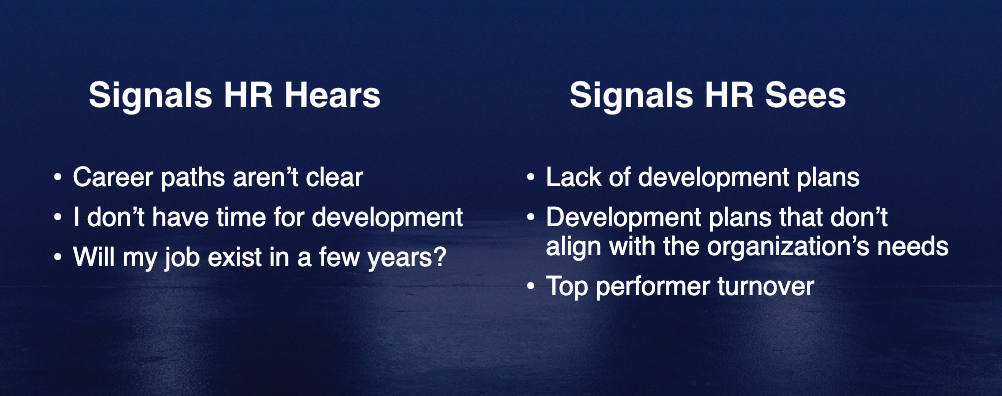
Career paths aren’t clear. There’s no time for development. And increasingly, I’m hearing employees ask a question that HR can’t afford to ignore: “Will my job even exist in a few years?”
The diagnostic question I find most useful here isn’t “do we have development plans?” It’s whether those plans are active and connected to employees’ day-to-day experience. An employee with a documented growth plan that nobody looks at isn’t growing. An employee with a stretch project that builds the skills the business needs in two years? That’s a different story entirely.
Succession planning data adds another layer. When you connect candidate status to survey feedback, you can see whether you’re intentionally developing the talent most critical to your future—or just assuming it’s happening. You can also flip it: the feedback from a candidate’s team tells you how effectively they’re actually leading.
“Shift growth from a periodic process to an everyday experience embedded in work — using projects, challenges, and real priorities as the primary vehicle.”
What action looks like:
- Shift growth from a periodic process to something embedded in everyday work
- Align individual development to the skills the organization will actually need next—not just the comfortable ones
- Invest in top talent through stretch opportunities, not just formal programs that check a box
4. Valued — Are we reinforcing what matters most?
The tension: Organizations need sustained performance; employees want to feel valued.
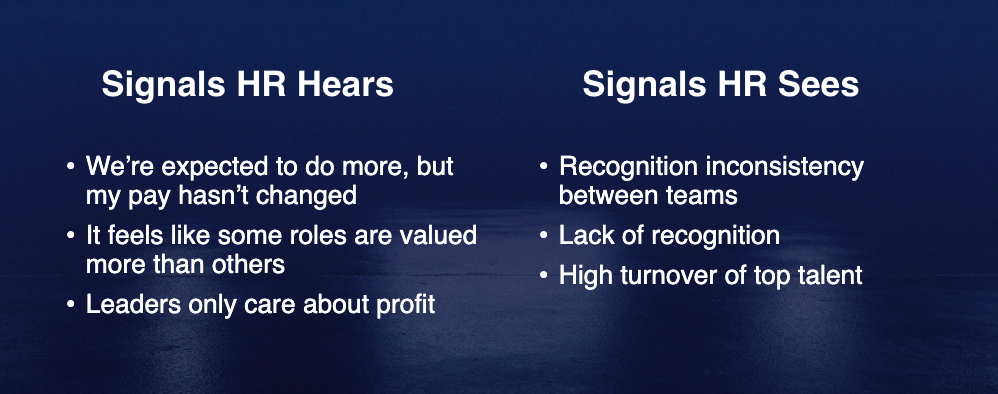
“We’re expected to do more, but my pay hasn’t changed.” “It feels like some roles matter more than others.” “Leaders only care about profit.” I hear these a lot. And on the data side, you see recognition that varies wildly between teams — and high turnover of the people you most wanted to keep.
The diagnostic question that reframes this conversation is about ROI. If your turnover is being driven by employees not feeling valued, recognition becomes a financial conversation, not just a culture one. When you can connect retention risk directly to recognition data, you can show exactly what lack of feeling valued is costing the organization.
The other thing worth mentioning: feeling valued isn’t only a top-performer problem. Solid contributors—often the largest population in any organization—need to feel their impact matters too. Recognition programs designed only for stars miss most of the workforce. When you connect talent reviews or performance ratings to employee feedback, you start to see those patterns clearly.
What action looks like:
- Pair everyday recognition of meaningful behaviors and outcomes with milestone moments—you need both, not one or the other
- Individualize recognition, even when the rewards are modest
- Make recognition easy and embedded in the flow of work, not a separate system people have to remember to use
- Design recognition as a signal—to reveal high-impact contributions and show where development is actually happening
HR doesn’t have to choose sides
Each of these four tensions looks different on the surface. But they share the same structure: what the business needs and what employees need are pulling in opposite directions, and HR is caught in the middle.
The instinct is to pick a side. The better move—the one I believe in—is to build the conditions where both become possible. Teams that are aligned, empowered, growing, and valued aren’t a compromise. They’re what sustainable business performance actually looks like.
“HR’s role isn’t to personally solve every tension. It’s to help the organization ask and answer smarter questions.”
That’s what the right talent platform makes possible. Quantum Workplace connects insights across engagement, performance, development, and recognition into a single, connected view—so every leader has the clarity and confidence to act on what matters most. Not just HR. Every manager, at every level, in every team.
The questions I’ve outlined here are a starting point. The data to answer them already exists in your organization. We help you connect it.



