Nintendo Switch 2: A Bittersweet Launch with Expensive New Game Prices
The gaming world was hit with some pretty big news yesterday, following the recent Nintendo Direct event that gave us all of the juicy details on the upcoming Nintendo Switch 2 console – launching on June 5, 2025, with preorders starting on April 8, 2025.
A Bittersweet Response
But after the initial excitement over the biggest console launch of the year, there seems to be a bittersweet response to everything announced at yesterday’s Nintendo Direct. There are plenty of gamers (myself included) overwhelmed with joy for the new Switch 2 features, but other Nintendo fans have highlighted the extortionate new game prices, questioning the $80 price tag for a new game.
A Solution to Avoid High Prices
I wholeheartedly agree that these new Nintendo Switch 2 game prices are far too high, and I worry that if the majority of people agree to pay these prices, it could set a new precedent or industry standard for other brands to follow. Thankfully, I think I have a solution (more of a hack really) to help gamers avoid paying these high prices for upcoming Switch 2 versions of games.
Upgrade Packs and Second-Hand Games
Here’s my hack – you can get The Legend of Zelda: Breath of the Wild for as low as £38 from retailers like CeX in the UK right now, and according to Nintendo, if you already own a copy of this game (and have an active Nintendo Switch Online + Expansion Pack membership) at the time of the Switch 2 edition launch, then you can access the upgrade pack for free.
That’s better than paying full price, right? As another example, if you pick up a cheaper secondhand copy of Mario Party Jamboree before the Switch 2 launch, then you’ll only need to purchase the upgrade pack (and not the full game) to play the Nintendo Switch 2 Edition when it launches.
Physical Cartridges vs. Digital Copies
While we don’t know the official price of Mario Party Jamboree version 2 yet, plenty of credible online sources like VGC, are reporting that new Switch 2 games like Mario Kart World and Donkey Kong Bananza will be priced as high as $79.99 / £66.99 (yikes), with physical cartridges expected to cost more than digital for the first time ever.
Stock Up on Original Titles
My advice: stock up your Switch game library of original titles for a cheap rate while you can, as it wouldn’t surprise me if Nintendo decided to enhance more of its OG titles (like Super Mario Odyssey) in the future, if the concept is received well.
Conclusion
The Nintendo Switch 2 launch is just around the corner, and while the new console features are exciting, the high prices of new games are a concern. By taking advantage of upgrade packs and second-hand games, gamers can avoid paying full price for new titles. Stock up on original titles while you can, and consider upgrading to the Switch 2 edition when it launches.
FAQs
Q: What are the prices of new Switch 2 games?
A: According to credible online sources, new Switch 2 games like Mario Kart World and Donkey Kong Bananza will be priced as high as $79.99 / £66.99.
Q: Can I get a cheaper copy of a game?
A: Yes, you can find cheaper copies of games like The Legend of Zelda: Breath of the Wild and Mario Party Jamboree at retailers like CeX in the UK or online marketplaces like Amazon.
Q: How can I avoid paying full price for new games?
A: By taking advantage of upgrade packs and second-hand games, you can avoid paying full price for new titles.
Q: Should I stock up on original titles?
A: Yes, it’s a good idea to stock up on original titles while you can, as Nintendo may decide to enhance them in the future.
Educators should build a classroom culture that values learning over compliance
5 practical ways to integrate AI into high school science
A new era for teachers as AI disrupts instruction
For more news on AI and assessments, visit eSN’s Digital Learning hub
In recent years, the rise of AI technologies and the increasing pressures placed on students have made academic dishonesty a growing concern. Students, especially in the middle and high school years, have more opportunities than ever to cheat using AI tools, such as writing assistants or even text generators. While AI itself isn’t inherently problematic, its use in cheating can hinder students’ learning and development.
More News from eSchool News
6 ways tech simplifies school communication and engagement
As technology trainers, we support teachers’ and administrators’ technology platform needs, training, and support in our district. We do in-class demos and share as much as we can with them, and we also send out a weekly newsletter.
With AI coaching, a math platform helps students tackle tough concepts
Math is a fundamental part of K-12 education, but students often face significant challenges in mastering increasingly challenging math concepts.
Opportunities in failing: Why K-12 education needs more productive struggle
Throughout my education, I have always been frustrated by busy work–the kind of homework that felt like an obligatory exercise rather than a meaningful learning experience.
How will schools replace devices bought during the pandemic?
During the pandemic, thousands of school systems used emergency relief aid to buy laptops, Chromebooks, and other digital devices for students to use in remote learning.
How multimedia and interactive tech transform engagement
Education today looks dramatically different from classrooms of just a decade ago. Interactive technologies and multimedia tools now replace traditional textbooks and lectures, creating more dynamic and engaging learning environments.
Using technology to support learning through movement
There is significant evidence of the connection between physical movement and learning. Some colleges and universities encourage using standing or treadmill desks while studying, as well as taking breaks to exercise.
Halting education research in the name of ‘government efficiency’ is incredibly inefficient
This story was originally published by Chalkbeat. Sign up for their newsletters at ckbe.at/newsletters. In recent weeks, we’ve seen federal and state governments issue stop-work orders, withdraw contracts, and terminate…
Report details uneven AI use among teachers, principals
English/language arts and science teachers were almost twice as likely to say they use AI tools compared to math teachers or elementary teachers of all subjects, according to a February 2025 survey from the RAND Corporation.
COVID still casts a shadow over American school boards
During the seven years I served on the Derry School Board in New Hampshire, the board often came first. During those last two years during COVID, when I was chair, that meant choosing many late-night meetings over dinner with my family.
Five years on: COVID’s impact on schools–and what’s next for education
Five years ago this month, the World Health Organization officially labeled COVID-19 as a pandemic. In response, life as we knew it came to a halt, schools were canceled, and teachers rushed to transition to online learning.
Conclusion
The rise of AI has created new challenges for educators in maintaining a culture of academic integrity. By building a culture that values learning over compliance, educators can help students understand the importance of honesty and integrity in their academic pursuits. Additionally, integrating AI into high school science and math classes can provide students with new opportunities for learning and engagement.
Frequently Asked Questions
Q: What are some practical ways to integrate AI into high school science and math classes?
A: Some practical ways to integrate AI into high school science and math classes include using AI-powered writing assistants, math platforms with AI coaching, and interactive simulations that incorporate AI.
Q: How can educators build a culture that values learning over compliance?
A: Educators can build a culture that values learning over compliance by emphasizing the importance of honesty and integrity, providing students with opportunities for meaningful learning experiences, and fostering a sense of community and collaboration in the classroom.
Q: What are some benefits of using AI in education?
A: Some benefits of using AI in education include providing students with personalized learning experiences, automating routine tasks, and freeing up teachers to focus on more complex and creative tasks.
Verizon’s New Price Lock Policy: What You Need to Know
A Reaction to Economic Uncertainty?
Verizon is announcing a new price lock policy today, and the timing is probably no coincidence. The company is extending a three-year price guarantee on certain plans, both for new and existing customers. The announcement comes a day after President Trump unveiled sweeping tariffs, and Verizon says it’s hoping to give customers more “predictability” in the current economic environment.
The Fine Print: What’s Covered and What’s Not
The three-year guarantee covers the base charge for your rate plan, but not fees and taxes — and you have to be on one of Verizon’s newer myPlan subscriptions to qualify. That means Verizon can still raise your monthly bill in the form of increased fees, which is what wireless carriers tend to do anyway when they want to charge more. They can also cut your monthly autopay discount in half, or persuade you to move to a pricier plan with the offer of a new phone. There are plenty of levers for companies like Verizon to pull, even with a price lock.
Other Perks, But Watch Out for the Details
The price lock isn’t the only new offer on the table, though. Verizon is also throwing in a free phone to new and existing customers. You’ll just need to trade in an old Apple, Samsung, or Google phone in any condition — and again, you’ll need to be on a myPlan subscription to take advantage. With plenty of economic uncertainty ahead, a trade-in deal might sound appealing. Just make sure you read the fine print so you know what you’re getting into.
Conclusion
Verizon’s new price lock policy might seem like a welcome relief in uncertain economic times, but it’s essential to understand what’s covered and what’s not. While it provides some reassurance, it’s not a guarantee of stability. With fees and taxes still on the table, it’s crucial to be aware of the potential for price increases.
Frequently Asked Questions
Q: What does the three-year price lock guarantee cover?
A: The base charge for your rate plan, not fees and taxes.
Q: What kind of phone can I trade in for a free phone?
A: Apple, Samsung, or Google phones in any condition.
Q: Do I need to be on a myPlan subscription to qualify?
A: Yes, you need to be on a myPlan subscription to take advantage of the price lock and trade-in offer.
Q: Can Verizon still raise my bill with the price lock in place?
A: Yes, Verizon can still raise your bill through fees, taxes, or by cutting your autopay discount in half or persuading you to move to a pricier plan.
Automation testing can sometimes be a real mess for developers with slow setups, fragile tests and tools that don’t even scale properly.
Even no-code tools aren’t as easy as they seem. But what if there was a way to make testing smarter and easier?
Today, we will cover 12 common issues developers face during testing and how KaneAI (a GenAI native test agent) helps solve those.
Let’s jump in.
Note: at the end of each point, you will find a summary of the problem and solution that will give you a simple overview.
🎯 What is end-to-end software testing?
Before going through the points, let’s quickly find out about end-to-end software testing.
Generally, testing is considered to check the accuracy of all the code.
End-to-end testing is more like testing the whole application from the user’s perspective, from start to finish. It makes sure that the user journey is as smooth as possible.
Tools such as Selenium and Cypress help automate these tests, making them better and more reliable. Let’s take a simple example of a signup form:
Enter a blank email and password
Enter a valid email and password
Enter an invalid email and password
Click a sign-up button
These cases check if the actions work as expected, like showing an error message for invalid data or confirming successful registration with valid data.
I’m taking the example of KaneAI, but I’ve also listed other similar tools at the end.
If you are unaware of KaneAI, it’s the world’s first GenAI native testing agent for high-speed quality engineering teams that lets you plan, author and evolve tests using natural language. You just need to specify objectives in natural language, and it will generate tests while even checking for bugs.
If you’re interested in trying it out, just book a demo.
KaneAI Dashboard
Now, let’s understand some common pain points while testing and how KaneAI solves them.
1. Regression Testing is necessary, but you can make the process easier.
Writing and maintaining tests can take a lot of effort, especially for applications with tons of features like e-commerce platforms.
Imagine having to check the login functionality every time you push a new feature. It’s the same steps: enter your email, password and click login. Just multiply that by every other feature you have built.
Regression testing ensures that existing functionality continues to work after changes. And it’s way easier with KaneAI.
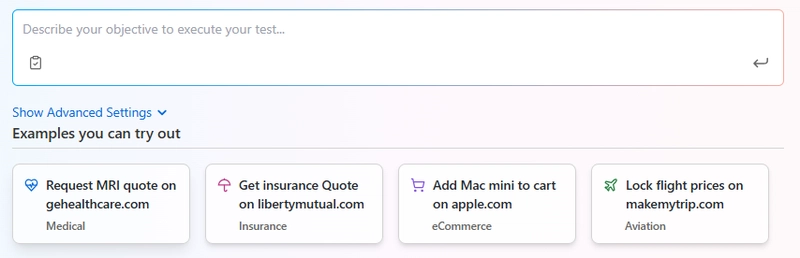
If you notice on the dashboard, you will also find a set of pre-built use cases that provide an easy way to understand user flows. You can just click to run that case!
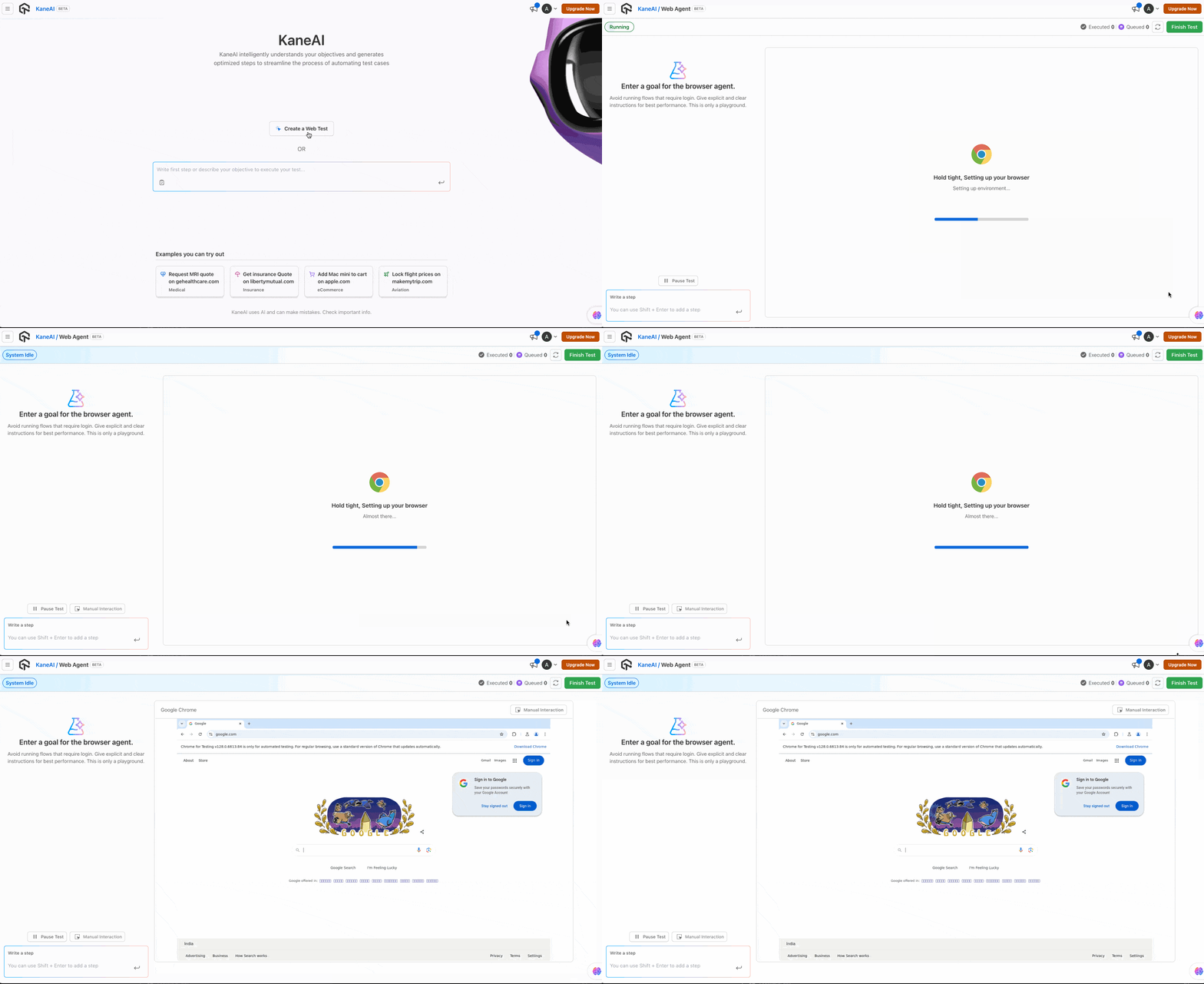
First, you need to provide a simple high-level objective and observe how KaneAI executes it.
You can start the process by clicking on Create a Web Test. You can also run an App test if you are using KaneAI for testing mobile apps.
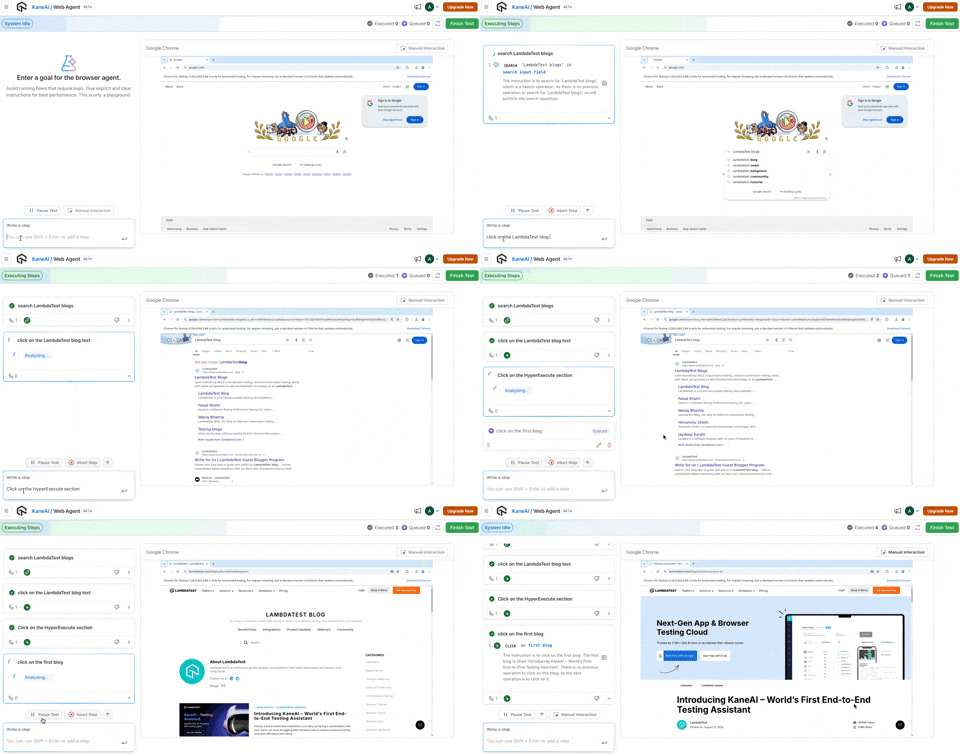
You can describe your test steps using simple English. It also allows injecting custom JS in the workflow.
You can keep adding test steps and they will run sequentially.
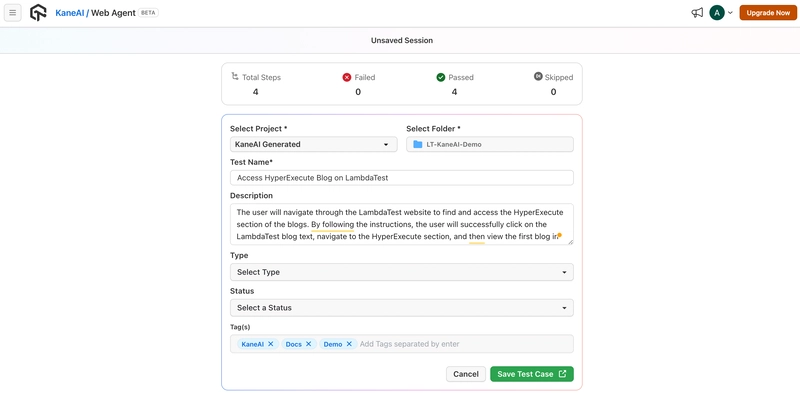
You can save your test cases with a name and description (which will be generated automatically). You can also select the type of test, set its status and define necessary tags.
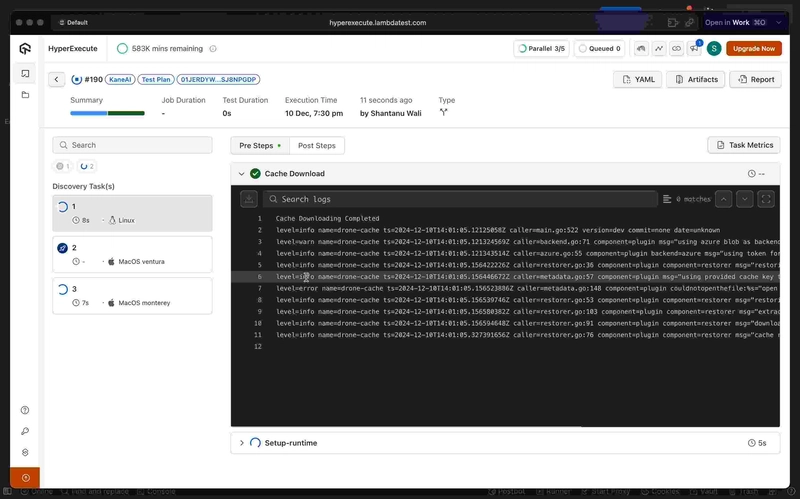
You can then execute it using HyperExecute. It’s an ultra-fast, intelligent end-to-end test execution and orchestration platform. It’s framework and language-agnostic and claimed to be 70% faster than any cloud-based test execution grid.
You can then export your automated tests in all major languages and frameworks such as Cypress JS, Playwright JS, Playwright Python, Selenium Java, Selenium Python and WebdriverIO.
The test has been successfully completed.
What if you have to re-run that test again?
You can simply click on edit the steps and it will create a new version for that test. It is completely accessible and reduces effort compared to manually doing it from scratch.
✅ Summary of problem and solution
Problem: Creating and maintaining tests takes a lot of time and effort. Regression testing can be tedious but we cannot skip it.
Solution: KaneAI automates regression testing, allowing developers to define goals, generate test cases and execute them efficiently.
2. Lack of versioning for test steps.
In today’s very fast-growing development, test cases need frequent updates to match evolving applications.
Every time a test step changes, it affects how tests run. Keeping track of these changes manually is difficult, especially if you are involved in tight deadlines.
There can be problems such as:
⚡ Dependency issue: a new browser version may introduce breaking changes or deprecate APIs.
⚡ Test Script Maintenance: Test scripts might fail if they rely on UI elements or workflows that change due to application updates.
Without proper tracking, it’s tough to pinpoint what changes caused test failures.
🎯 How does KaneAI solve this problem?
While KaneAI solves this in a much better way.
⚡ It maintains separate versions for every change you make.
⚡ Every time you add a new step, you will have to commit the changes (to make the version changes). The fields will be auto-filled depending on the test steps generated in the earlier step.
You can then easily check the version changes from the Version History tab.
You can search and compare two versions of what was changed and even revert to any previous version that has different steps.
If you have organizational-level access, where you have multiple team members, then you can also find out who ran that specific version of the test case.
This will be very useful for large test cases and help anyone understand the changes if they pick the things sometime later.
✅ Summary of problem and solution
Problem: Tracking test step changes manually is difficult, leading to debugging challenges when tests fail.
Solution: KaneAI automatically versions every test step update, allowing easy tracking, comparison and rollback needed.
3. Test coverage on different OS, browsers and real devices is not scalable on local/in-house setup.
Testing across multiple browsers, devices, and operating systems. A test that passes on one setup might fail on another due to unaccounted differences.
Do you really know if your tests run across all combinations of browsers? For many developers, the answer is, I guess they are fine? (even if they are not).
For example, a fintech application could work perfectly on Windows or Chrome but break on macOS and Safari. Samsung S25 Ultra was launched in 2025, so you need to make sure that your application also runs properly on it, which is easily possible with KaneAI.
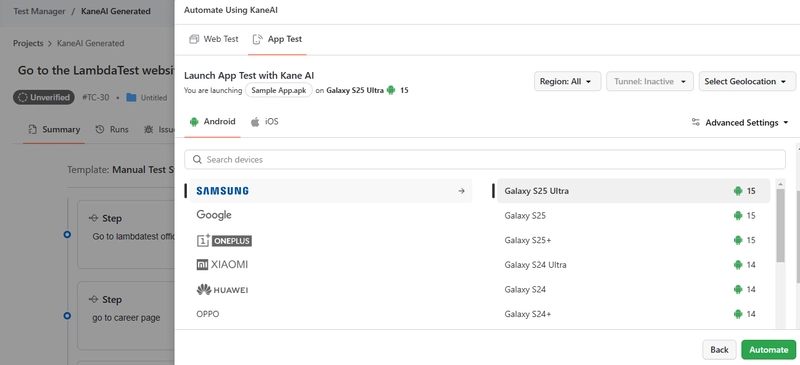
As I’ve said before, you can run both web and app tests using KaneAI. When it comes to app tests, KaneAI supports app testing (native, hybrid) on real mobile devices, including the latest flagships like the iPhone 16 series, S25 series, etc.
In 2015, Myntra discontinued its website and focused solely on an app-only model, as 90% of its traffic was from the app. However, it turned out to be a big disaster, showing the importance of maintaining a presence across all platforms, even if users don’t actively use the website. You can read the full case study by Wharton.
A 2023 study found that nearly 60% of software development teams identified inadequate test coverage as a primary factor contributing to critical bugs reaching production environments. – source
🎯 How does KaneAI solve this problem?
With HyperExecute, you can run tests across different combinations of browsers, operating systems and real devices. Therefore, you can leverage this vast infrastructure with KaneAI.
For example, you can test on the latest devices, like the Samsung S25 Ultra, to ensure your app runs smoothly.
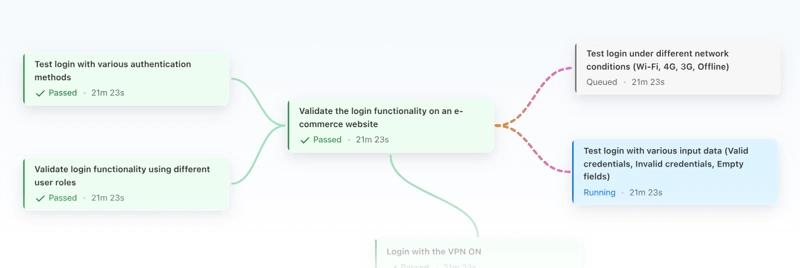
KaneAI also explores relevant tests from your existing performed runs and increases test coverage automatically.
It analyzes the existing test suite, identifies gaps, generates additional tests and runs them to help in increasing test coverage.
Now, imagine the pain of repeating test steps in all across devices. That’s where the concept of modules helps. It’s simply converting test steps into reusable modules, which you can use anywhere else. I’ve covered it in the 5th point.
✅ Summary of problem and solution
Problem: Test coverage across different OS, browsers and real devices is tough. A test that passes in one setup might fail in another, leading to unexpected bugs in production.
Solution: KaneAI scales your testing by running across hundreds of real-world combinations of browsers, operating systems and devices. KaneAI analyzes your existing tests, finds gaps, generates additional tests and runs them to increase test coverage.
4. Automating test executions with CI/CD tools.
Integrating automated tests into CI/CD pipelines can be cumbersome, leading to delays in feedback and potential bottlenecks in the development cycle.
Manually configuring and triggering tests for each code change takes longer and doesn’t provide real-time visibility into test execution, making it difficult to quickly identify and address issues.
For instance, a development team using GitHub Actions for their CI/CD processes might struggle to automate the execution of test runs after each code commit.
With KaneAI, you can automate this process easily.
🎯 How does KaneAI solve this problem?
You can automate the execution of test runs using CI/CD tools such as GitHub Actions or Jenkins on the KaneAI platform.
Here are brief steps you can follow:
1) Navigate to the Test Manager and select the project where your test run is located. Then go to the Test Runs section, open the test run you want to automate and copy the Test Run ID from the URL. This ID will be used in the API call for integration.
2) Now you can configure the API call by replacing with the actual ID you copied. You can also set optional parameters such as concurrency (which defaults to 1), title (unique name to the job), and region.
3) Once your API call is set up, you need to authenticate it using your LambdaTest username and access key. When you send the API request, the test execution will begin within seconds.
4) Then you will receive an API response containing a job link. You can use this link to monitor your test execution in real time through the HyperExecute dashboard.
monitoring test executions
🛠 Let’s take a brief example.
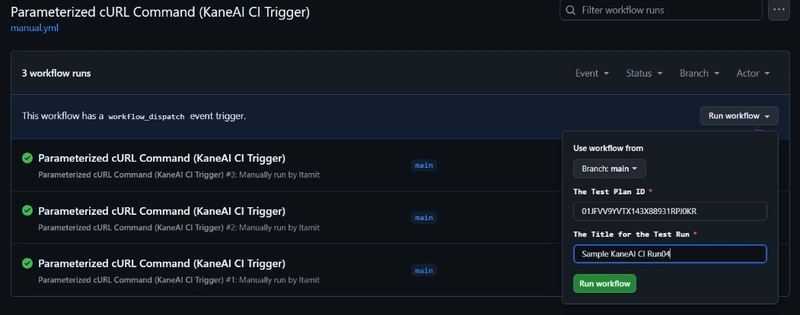
This GitHub Actions workflow runs a parameterized cURL command to execute KaneAI tests via CI, using dynamic input values for test_run_id, concurrency, title and region.
You just need to add AUTH_HEADER as a repository secret with the value of Base64-encoded authorization token.
You can read the docs which have a Github Actions sample and include all the steps that I have mentioned.
✅ Summary of problem and solution
Problem: Without automating tests in CI/CD pipelines, teams struggle to trigger test runs easily and monitor results in real time.
Solution: KaneAI automates test execution with CI/CD tools like GitHub Actions and Jenkins. By using real-time monitoring through the HyperExecute dashboard, teams can run and monitor tests in a much better way.
5. Duplicating common actions makes the process harder.
When developers have to duplicate efforts for common actions, like logging in or filling out forms, it slows down test execution and makes maintaining test cases harder.
For example, when testing an e-commerce website, multiple test cases may require logging in before proceeding. Manually writing the login steps in each test case not only wastes time but also increases the risk of inconsistencies and maintenance challenges when updates are needed.
🎯 How does KaneAI solve this problem?
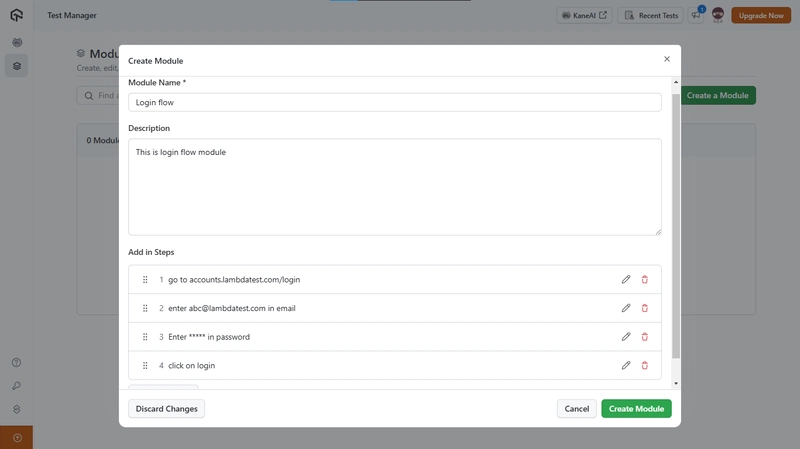
There is a concept in KaneAI known as Modules which efficiently solves this. It allows developers to convert frequently used test steps into reusable modules, which can be used across multiple tests.
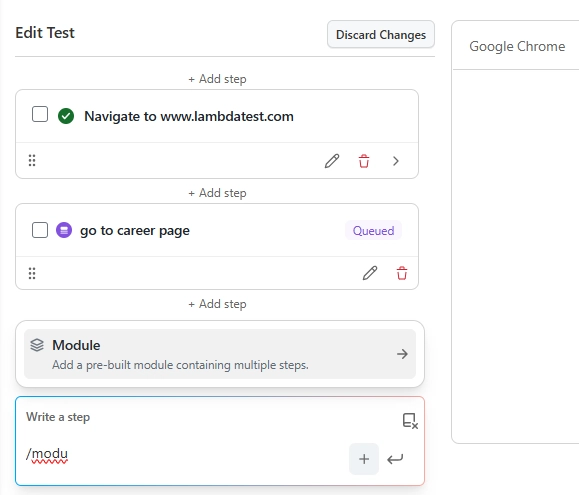
Whenever you’re running a test case, just type / to invoke the modules menu.
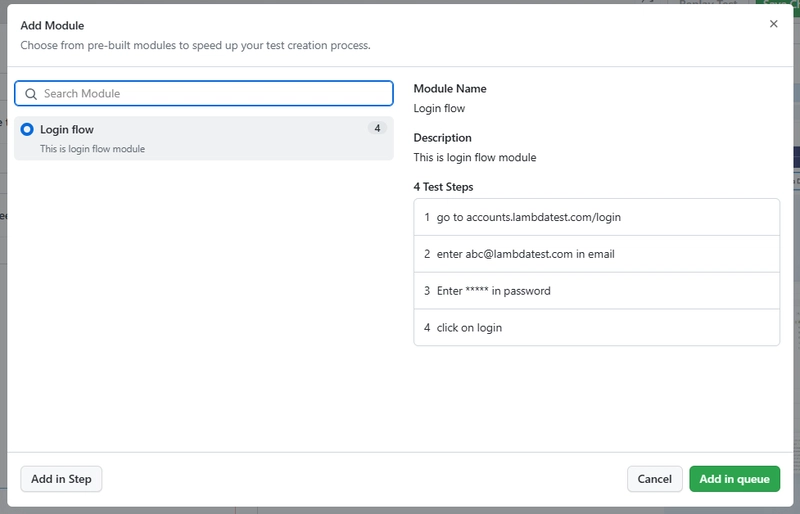
You can easily browse all existing modules.
Just select the desired module from the list, add it and the execution of the module’s test steps begins automatically.
You don’t need to reconfigure or repeat those steps. Read the docs about KaneAI modules, with a demo at the end.
✅ Summary of problem and solution
Problem: Repeating common test steps like logging in or filling out forms wastes time and makes maintenance harder. Any update requires modifying multiple test cases, increasing the risk of inconsistencies.
Solution: Modules feature allows developers to convert frequently used test steps into reusable modules. Instead of duplicating steps, testers can invoke these modules to make test execution smoother.
6. Generating test cases directly from third party tools.
A lot of international teams use Jira to track issues, which are then discussed in Slack and logged in GitHub issues.
Switching between tools slows down developers and makes tracking progress harder. This broken workflow is bad (even if you don’t realize it yet).
A centralized way to generate and manage test cases directly from platforms like Jira can make the process a lot easier, which is exactly what KaneAI does.
🎯 How does KaneAI solve this problem?
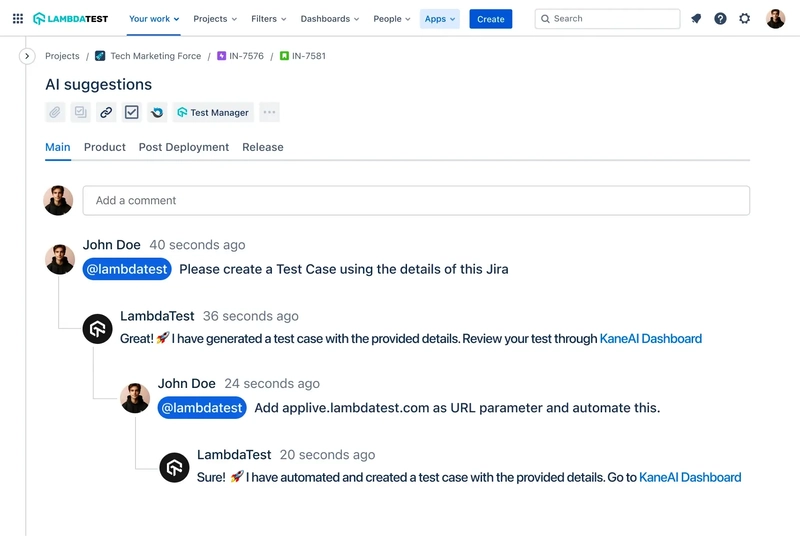
KaneAI solves this problem by integrating with third-party platforms like JIRA, Slack and GitHub issues. You can just tag KaneAI in these tools and it will kick-start test automation which will keep everything centralized.
For instance, the Jira integration feature uses AI to automatically convert test case descriptions from Jira tickets into executable tests on LambdaTest, eliminating the need for manual setup.
To trigger KaneAI, just add the comment to your Jira ticket calling the LambdaTest application.
@LambdaTest create a test case based on the details of this Jira
Kane AI will then process the request and respond with a confirmation message, which includes a link to LambdaTest where you can review, modify and schedule the generated test case.
This will be helpful for PMs (Product Managers) in converting user stories or requirements into executable test cases on the LambdaTest platform.
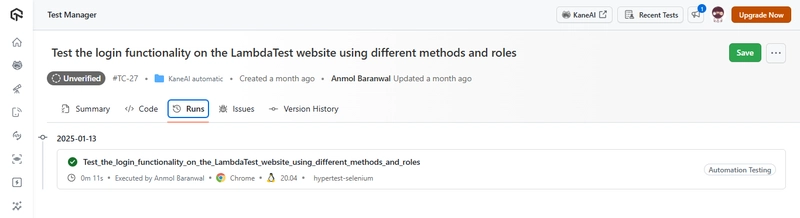
You can also plan test cases through the Test Manager in the dashboard.
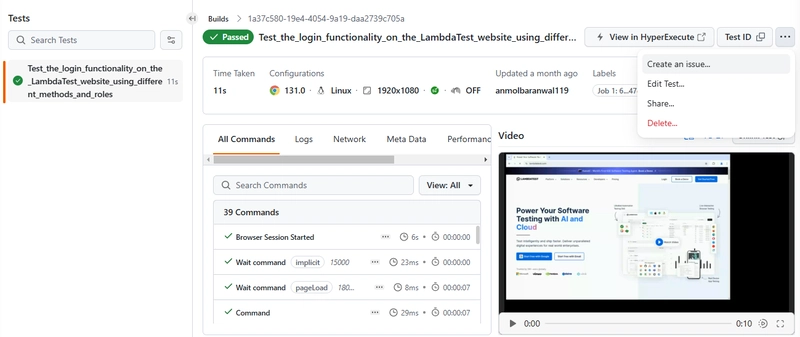
You will find specific runs in the dashboard. From there, you can create an issue, edit tests and much more.
✅ Summary of problem and solution
Problem: A scattered approach to managing test cases across platforms complicates the process.
Solution: KaneAI can be easily integrated with those tools and all you need is to tag it to generate tests.
7. Testing real user behavior and handling dynamic locators is complex.
Users rarely follow a predicted path. They click random buttons, refresh pages mid-action and use your application in ways you would never expect. Trying to cover all those situations is challenging.
For instance, a ride-sharing application must test edge cases like a user canceling a ride mid-booking or two users requesting the same driver simultaneously.
Automated agents can simulate these behaviors to some extent to make sure as many edge cases as possible are covered so they are ready for real-world usage.
However, identifying the target elements for interaction is another challenge. There are often multiple ways to locate an element, but agents may not be able to handle all of them, leading to test failures.
🎯 How does KaneAI solve this problem?
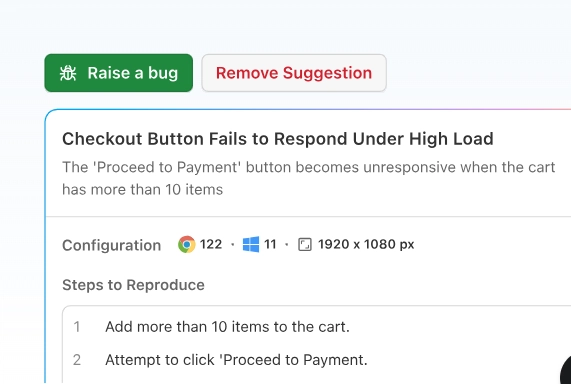
The best part about KaneAI is that it automatically discovers bugs (constant thinking) while generating and running tests. You get notified of the bugs, which helps you to fix them quickly.
This saves time by automating the debugging process to help catch problems early.
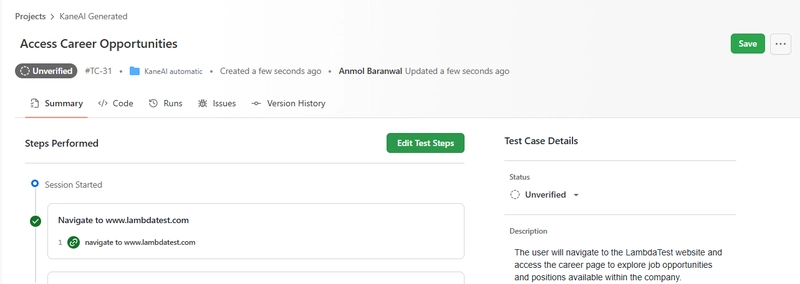
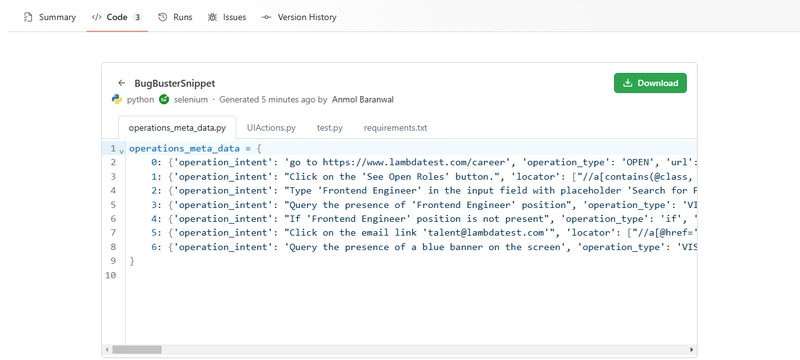
You can check the generated code in the dashboard.
As you can notice, there is an operation within the test case where the agent needs to Click on the "See Open Roles" button.
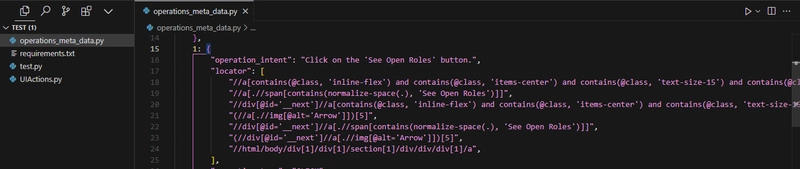
When you download the code, you will see the locator in the operations_meta_data.py. It generates all possible ways to find that element and executes it one by one.
I’m showing another step here, which you can take a look at.
"operation_intent":"Type 'Frontend Engineer' in the input field with placeholder 'Search for Position'","locator":["//input[@id='search-form']","//form//input[@name='search-form']","//input[@placeholder='Search for Position']","//input[@type='search' and @id='search-form']","//input[contains(@class, 'rounded-l') and @id='search-form']","//input[@id='search-form' and @name='search-form']","//html/body/div[1]/div[1]/section[2]/div/div/div/div[1]/form/input",],
If for some reason, it cannot locate the element, it will try to visually detect elements on the page, such as by recognizing the layout or structure of the order list.
This is where the feature of Scroll to element helps, which allows users to perform scrolling actions on web elements during testing by using natural language commands. You can read more in docs about the scroll in element.
There is also a concept of Auto Healing. It helps you automatically fix test failures caused by changes in the web page’s structure during runtime. It adapts to DOM changes by updating locators when previous ones fail to make sure that tests continue to run smoothly even if the application updates.
Research indicates that 45% of features in software projects are never used, suggesting that testing may not effectively capture real user behavior and preferences. – source
✅ Summary of problem and solution
Problem: Users interact with applications in unpredictable ways, creating challenges in testing real user behavior. Also, locating target elements can be tricky due to multiple potential ways, which agents may struggle to handle.
Solution: KaneAI continuously identifies hidden bugs while generating and running tests. It uses multiple locators to ensure elements are found and adapts dynamically through auto-healing, preventing test failures due to UI changes.
8. Defining and managing data dynamically during test execution.
While static test data may have once been a common approach for quick testing, it is no longer the most efficient or scalable solution. As applications grow in complexity and requirements change, maintaining tests with static data gets harder.
For example, testing a user scenario with varying parameters, like different user IDs, product variations or order details, would require manual updates to each test case.
This becomes even more challenging when testing applications with multiple configurations, environments or input parameters (such as form submissions, login credentials, and product prices).
Without a proper system, managing these datasets becomes tedious. This is where KaneAI steps in with parameters, variables and datasets.
🎯 How does KaneAI solve this problem?
KaneAI brings multiple concepts together to solve the problem. Let’s study those.
-→ The concept of Variables.
The variables in KaneAI allow you to define reusable variables, assign them values and use those values within test cases.
You can avoid repetitive entries in test cases. This is especially useful for parameters that might change frequently, such as URLs, credentials or environmental settings.
You can define those using simple language like set new_variable as value and you can then apply it by using double curly braces like {{username}}.
Set username as Anmol

use the value of {{username}} in the text field
-→ The concept of parameterization.
It’s the process of using variables or placeholders for data within test cases. Instead of hardcoding specific values (like a user ID or product name), parameters allow the test to accept a variety of inputs.
These parameters are dynamically filled in when the test runs, either from an external data source such as a CSV file or predefined values.
It makes tests more adaptable, as the same script can be reused with different data sets, configurations or environments.
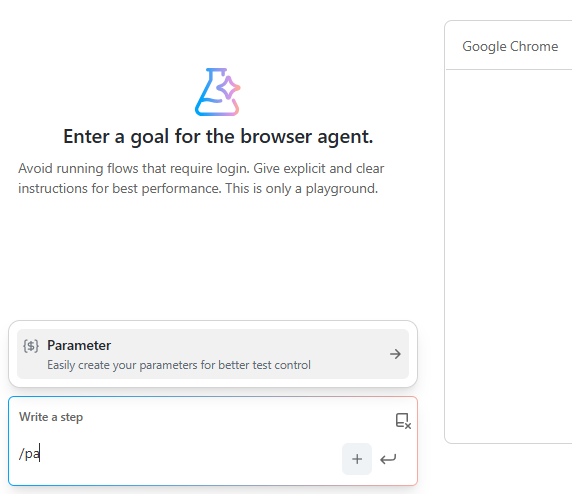
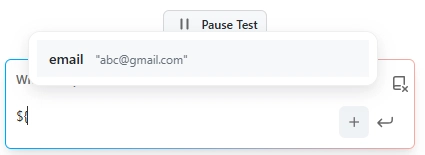
You can invoke it using the / command.
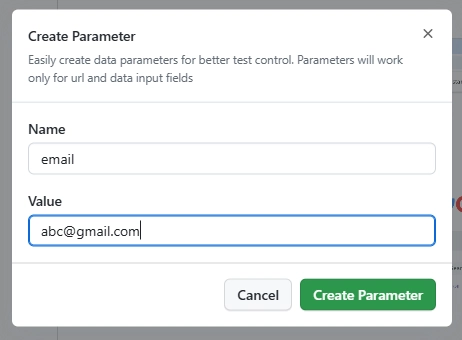
You can then quickly create a parameter.
For referencing that parameter, you can use dollar-curly braces syntax such as ${email}.
You can utilize the parameters to run your test cases with different data sets and inputs. Read the docs.
-→ The concept of Dataset.
Datasets allow you to manage and reuse input values for test cases efficiently. When you use it with parameters to run test cases, it makes the process a lot better.
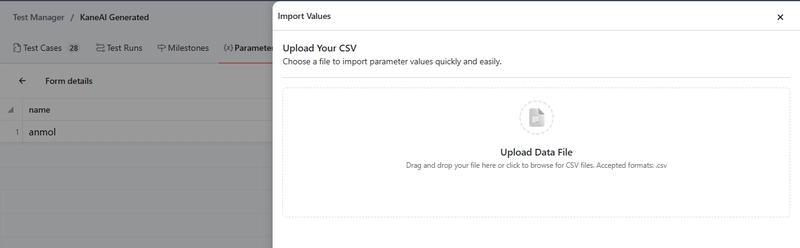
You can add rows to existing datasets, autofill with AI and import data using CSV.
import data
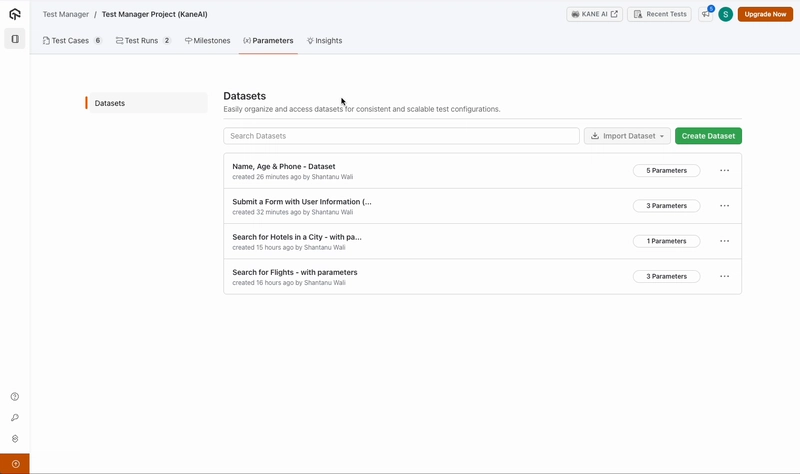
You can then find all the datasets you have created in the dashboard and execute your test cases using these data sets to simulate different input scenarios.
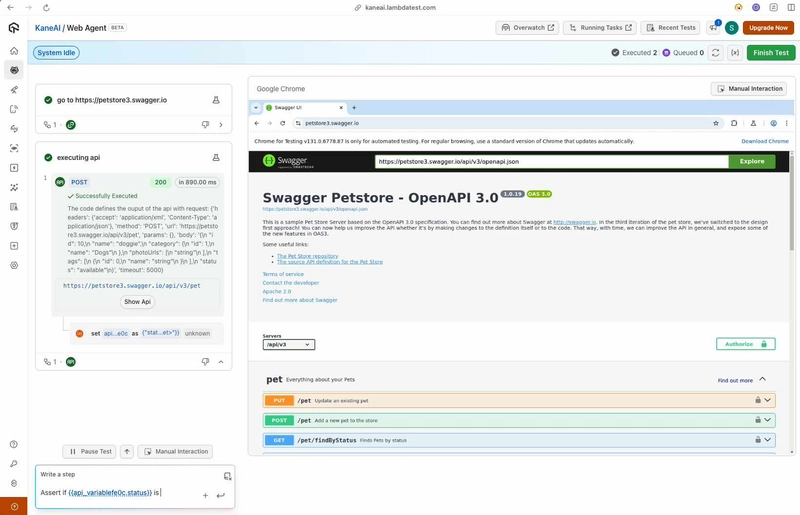
In KaneAI, you can use JSON variables to perform detailed assertions on API responses. This allows you to validate specific objects and elements within the response structure. I’ve attached a snapshot to help you understand.
✅ Summary of problem and solution
Problem: Relying on static test data is inefficient. As applications scale, especially when dealing with multiple environments and configurations, maintaining it becomes harder.
Solution: KaneAI manages test data with parameters, variables and datasets, making sure the tests remain adaptable, scalable and easy to maintain.
9. Debugging without clear insights.
Your test fails, but the error log says something weird like unexpected token null. Now you are stuck digging through logs and rerunning tests to figure out what went wrong. Debugging can quickly consume hours of valuable development time.
For example, an e-commerce application might fail during checkout tests because the test didn’t account for a new discount rule. By using tools that provide clear logs or even pinpoint the exact line of failure, you can at least save some time and fix issues without getting lost.
🎯 How does KaneAI solve this problem?
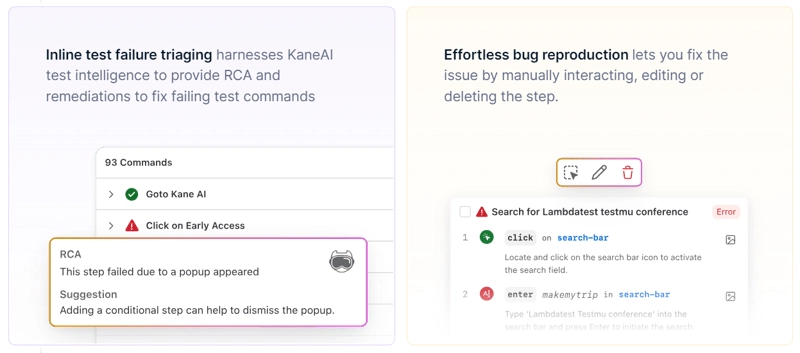
⚡ There is a concept of Inline test failure triaging which means KaneAI uses its smart testing features to quickly find out why a test is failing (Root Cause Analysis or RCA) and and suggest possible fixes (remediations).
You can manually interact with the test, edit step-wise objectives, or delete unnecessary steps to resolve issues.
editing steps as objective
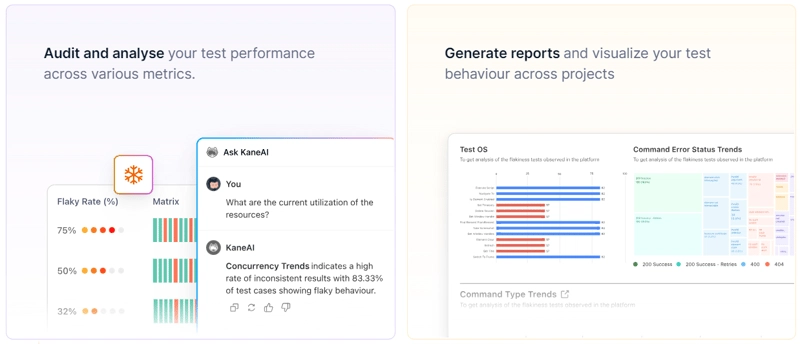
⚡ You will get detailed test execution reports with Test Intelligence and deep analytics. It can provide valuable insights that can help you debug the issue much faster.
A report indicates that debugging efforts cost companies around $61 billion annually, underscoring the financial impact of debugging activities. – source
✅ Summary of problem and solution
Problem: Debugging failed tests is frustrating, especially when error logs are unclear. Without better insights, it can feel more like guesswork.
Solution: KaneAI improves debugging with Inline test failure triaging, identifying the root cause and suggesting fixes. Developers can manually interact, edit or delete unnecessary steps. It also delivers detailed test execution reports with Test Intelligence and analytics to debug issues faster.
10. Challenges in managing and Testing APIs.
APIs are the backbone of modern software, which is why API testing is one of the most critical aspects of development.
Testing APIs can be challenging due to the complexity of managing multiple APIs, various HTTP methods and making sure the responses are correct.
Without a simple and automated solution, developers face problems in ensuring that all APIs work as expected.
🎯 How does KaneAI solve this problem?
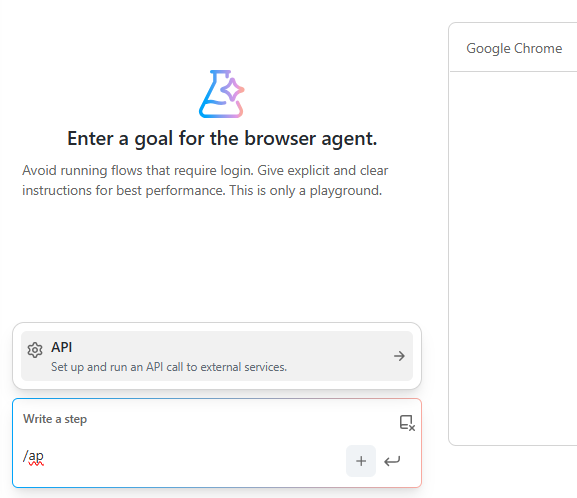
You can easily perform API testing using KaneAI. The first step is to invoke the API module using the / command.
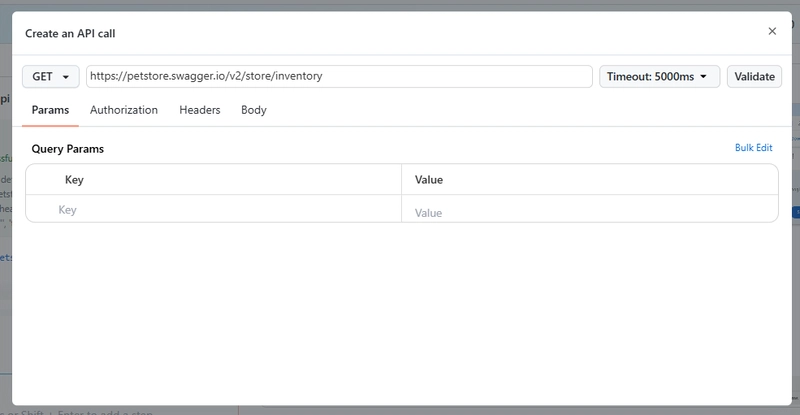
Once you paste your curl command, it will populate all necessary details.
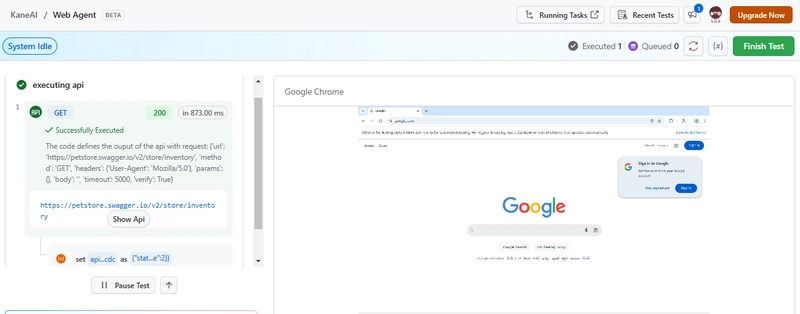
Click the validate option to check the API response. A 200 response status indicates successful validation, automatically adding the API to your test steps.
You can also add multiple APIs, handle different HTTP methods or paste multiple curl commands to add them automatically to the test steps. Read more on the docs.
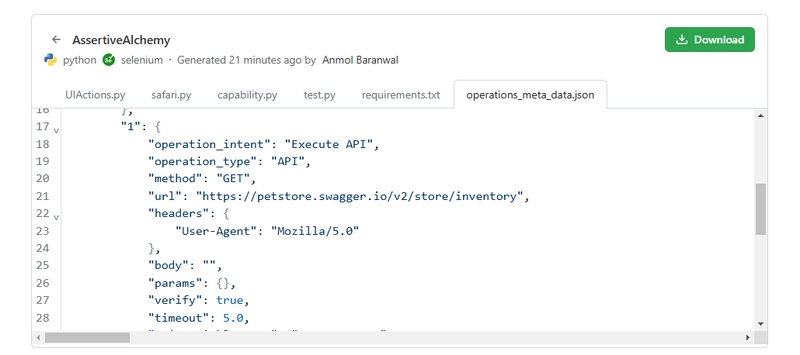
generated code
✅ Summary of problem and solution
Problem: APIs power modern applications, but testing them manually can be overwhelming. Managing multiple endpoints, handling different HTTP methods and ensuring correct responses gets harder as the application grows.
Solution: KaneAI does API testing with easy-to-use commands for adding, validating and managing APIs. It automates response validation and integrates APIs directly into test steps, reducing manual effort.
11. Leaked secrets can lead to major security breaches.
Handling sensitive data such as API keys, user credentials or authentication tokens within test scripts is a common practice, but it comes with significant security risks if not handled properly.
For instance, a development team automates login tests for an e-commerce platform by storing login credentials in the test scripts. If these scripts are shared with other teams or uploaded to a public repository like GitHub, the credentials become visible to anyone with access.
This makes it incredibly easy for attackers to steal sensitive user data or abuse the API credentials, leading to potential data leaks, financial losses or even a full-scale compromise of the system.
Moreover, mismanaging secrets can lead to difficulties in compliance with regulations such as GDPR or HIPAA, which require data protection measures.
🎯 How does KaneAI solve this problem?
KaneAI addresses this by providing a Secrets feature that makes sure sensitive data is securely stored and used only in specific scenarios.
The sensitive information is managed via the HashiCorp Vault.
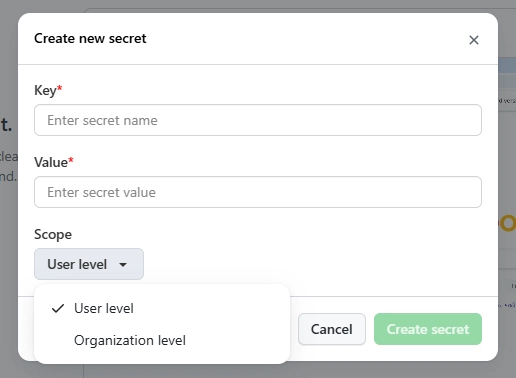
You can create secrets through the Test Manager or Web/App Agent. Once created, you can now reference any secret variables in your test steps using double-curly braces syntax such as {{secrets.user.email}}.
⚡ A user role can create only user-level secrets, while an admin can create either user-level or org-level secrets.
⚡ Those variables will be accessible in test steps, modules and test cases.
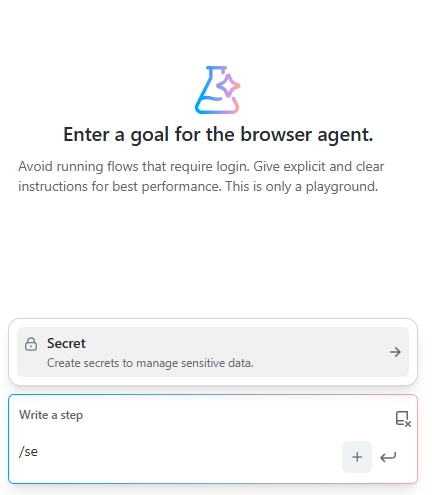
To use a stored secret in a test case, type / to invoke the secrets menu.
You can find those secrets in the test manager dashboard. Read more on the docs.
✅ Summary of problem and solution
Problem: Storing secrets like API keys and credentials in test scripts can lead to data leaks, security breaches and compliance issues. If exposed, attackers can misuse sensitive information, causing financial and reputational damage.
Solution: KaneAI provides a Secrets feature powered by HashiCorp Vault, allowing secure storage and controlled access to sensitive data. Developers can reference those secrets using a simple syntax.
12. Testing across different regions, local servers and firewalled environments.
Making sure that a web application performs consistently across different regions, local servers and firewalled environments is a major challenge in automated testing.
Many companies operate globally, but testing from a single location may miss region-specific issues like pricing, latency or access restrictions.
For instance, an e-commerce site might display different products based on user location, but if tests are conducted only in one region, these variations may go unnoticed. Similarly, internal or locally hosted applications are often difficult to test using standard cloud-based platforms.
Setting up the separate infrastructure for each region is complex, costly and time-consuming. Developers need a better way to adapt tests to different environments without extra setup.
🎯 How does KaneAI solve this problem?
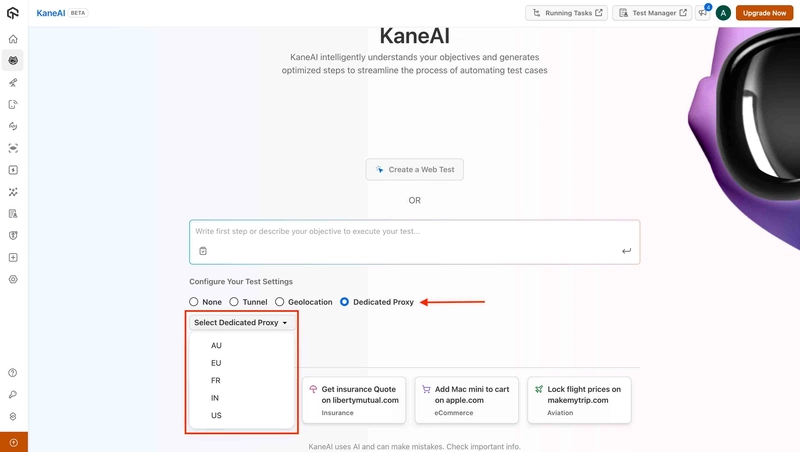
There are advanced settings in KaneAI such as Geolocation support, Tunnel support and Proxy support, which solve this problem.
-→ Geolocation support.
You can simulate user interactions from different regions to ensure your website works as expected worldwide.
By selecting the desired region, tests can be executed with traffic routed through that location. Once the test is saved, the generated code will include geolocation details automatically, making it easier to replicate the test across different regions. You can read more on the docs.
-→ Tunnel support.
This enables testing on locally hosted or firewalled applications using secure tunneling. By configuring an LT tunnel, developers can run web tests directly from a private or restricted environment.
The tunnel details are automatically saved in the test configuration, making sure future runs replicate the same conditions. You can read more on the docs.
-→ Dedicated Proxy Support (Enterprise only).
For organizations requiring strict network control, there is dedicated proxy support. Developers can route their tests through specific proxy IPs configured for their organization, for a consistent and controlled testing environment. You can read more on the docs.
✅ Summary of problem and solution
Problem: Testing web applications across different regions, local servers, and firewalled environments is difficult due to region-specific content, network restrictions and access limitations. Setting up separate infrastructure for each environment is complex, costly and not feasible.
Solution: KaneAI solves this with Geolocation support, Tunnel support and Dedicated Proxy support. These features allow testers to simulate different regions, access locally hosted applications and route tests through secure proxies, without additional setup overhead.
There are many more tools like KaneAI out there such as:
Functionize – uses AI and machine learning to automate testing for even complex applications, simplifying the QA process and reducing manual effort.
Testim – uses AI to quickly create and maintain automated tests, saving time and effort in managing flaky tests. Great for dynamic web applications.
Applitools – specializes in visual test automation to ensure your app looks perfect across all devices and browsers, reducing visual bugs in production.
Testers – autonomous testing agents, built by the nerds who tested Google Chrome.
Sauce Labs – test automation platform with AI-powered features for optimizing test execution and maintenance.
Tricentis Tosca – combines AI and machine learning algorithms to automate the testing process across various application layers.
Testsigma – no-code automated functional testing platform using general language.
Mabl – AI test automation tool that focuses on making automated testing accessible to all development team members.
For KaneAI, you can refer to the docs and the official website.
In the end, fixing these common testing issues can make development faster (even if it’s a little bit).
The insane amount of customization options will help you realize that KaneAI is already changing how testing should be done.
If you know of any other common pains while testing, please do let me know in the comments.
Have a great day! Until next time 🙂
.Organize the content with appropriate headings and subheadings ( h2, h3, h4, h5, h6). Include conclusion section and FAQs section with Proper questions and answers at the end. do not include the title. it must return only article i dont want any extra information or introductory text with article e.g: ” Here is rewritten article:” or “Here is the rewritten content:”
Artificial Intelligence (AI) ethics encompasses a set of rules, principles, techniques, and values that apply globally recognized criteria to guide ethical (moral) behavior in the development of AI technologies and their application. The concept arose from the need to address the dangers (societal and individual) that Artificial Intelligence may present.
The Challenges of Implementing Responsible AI
There are two main challenges to implementing Artificial Intelligence safety and ethics:
Lack of clear guidance and regulation
AI systems complexity
Pivotal 2022-2025: AI-related Bills and Regulation
2022 launched the phase of understanding Artificial Intelligence ethics and safety on a global level. The social influence became immense, making governments across geographies start acting. In 2022, AI ethics focused on upholding core values like:
Ensuring fairness
Enhancing accountability
Promoting transparency
AI Act and GDPR
The AI Act and GDPR are expected to play a crucial role in the development of systems learning from colossal databases.
Conclusions
Big inventions are prone to big risks. AI is no exception. It’s critical to anticipate consequences and use cases, reflect the underlying values and risks, and adapt the new technology by applying what has been learned generations before. Altogether, this allows for the preservation of ethics and safety in AI and even prioritizes them above technological advancements.
FAQs
Q: What is AI Ethics?
A: AI ethics encompasses a set of rules, principles, techniques, and values that apply globally recognized criteria to guide ethical (moral) behavior in the development of AI technologies and their application.
Q: What are the challenges of implementing responsible AI?
A: The two main challenges are lack of clear guidance and regulation, and AI systems complexity.
Q: What are the key values of AI ethics?
A: The key values are ensuring fairness, enhancing accountability, and promoting transparency.
Q: What is the role of AI Act and GDPR in AI development?
A: The AI Act and GDPR are expected to play a crucial role in the development of systems learning from colossal databases.
Q: How can I implement responsible AI in my organization?
A: You can start by assembling a diverse team, defining clear ethical guidelines, auditing your data relentlessly, testing early and often, prioritizing transparency, and staying ahead of regulations.
NYC-Based Theatre Group CO_LAB Unveils Fresh Brand Identity
Breaking Down Barriers through Design
NYC-based inclusive theatre group CO_LAB has unveiled a new brand identity that highlights the power of creative expression in setting a stage for accessibility and inclusivity. The non-profit organisation, which creates a performance platform for individuals with developmental disabilities, has been anchored by the inspiring concept that CO_LAB is "Everybody’s Stage."
A Shift in Design Philosophy
While grand reinvention might come to mind when thinking about rebrands, CO_LAB’s thoughtfully rejuvenated brand positioning takes a more subtle approach. The design team at Design Bridge and Partners created a stripped-back identity that lets CO_LAB’s diverse theatre talent shine. This approach allows for flexibility, subtle flair, and accessibility to take center stage.
A Deeper Look at the Rebrand
The new visual identity centers around the people and performances that shape the organisation. The rebrand’s underscore motif gestures to a stage, acting as a flexible framework to highlight and uplift CO_LAB’s creative talent. This design feature is functional and scalable, allowing the organisation to grow as CO_LAB scales its presence across fundraising, partnerships, and community engagement.
Accessibility at the Forefront
CO_LAB’s rebrand has been thoughtfully engineered with accessible design, including ADA-compliant colors and National 2 typography. "CO_LAB has always been about creating a sense of belonging – our community deserves to see themselves in the arts," said Chris Pesto, founding member of CO_LAB and client business director at Design Bridge and Partners. "Every design decision was made to serve the needs of our community; more than just a new look, this identity helps CO_LAB grow, reach new audiences, and continue advocating for a more inclusive theatre world."
Designing for Inclusion
The project also provided a unique opportunity for Design Bridge’s emerging creative talent to build a nonprofit identity system from the ground up. "Our interns played a major role in shaping the strategic foundation of the final product," Chris shares.
Conclusion
In an era shaped by fleeting trends and noisy, style-over-substance visuals, it’s refreshing to see a rebrand shaped by nuance and brand ethos, rather than flashy design. The arts should be a space where everyone feels seen, and CO_LAB’s rebrand aims to create a stronger, more inclusive theatre world.
Frequently Asked Questions
Q: What is CO_LAB?
A: CO_LAB is a NYC-based inclusive theatre group that creates a performance platform for individuals with developmental disabilities.
Q: What is the inspiration behind CO_LAB’s new brand identity?
A: The rebrand is centered around the concept that CO_LAB is "Everybody’s Stage," highlighting the power of creative expression in setting a stage for accessibility and inclusivity.
Q: Who designed CO_LAB’s new brand identity?
A: Design Bridge and Partners created CO_LAB’s new visual identity.
Q: What are some key design elements of the rebrand?
A: The new identity features an underscore motif that gestures to a stage, ADA-compliant colors, and National 2 typography.
Cisco’s 2025 Data Privacy Benchmark Study Highlights AI-Related Challenges
Cisco has released a “2025 Data Privacy Benchmark Study” that explores the privacy challenges companies face with the rise of artificial intelligence. The study gathered opinions from 2,600 privacy and security professionals across 12 countries.
Key Findings
A key finding is that most companies (86%) support privacy laws, citing a “positive” impact on their business operations. Although compliance can be costly, 96% of organizations reported that the benefits significantly outweigh the investment.
Where to Store Data
One major issue companies face today is deciding where to store their data. Many businesses (90%) prefer to store data locally, believing it’s safer, even though it can be more expensive and complicated. At the same time, more businesses are trusting large global providers — companies like Cisco itself — to handle their data securely. As many as 91% of companies now believe global providers offer better protection, up from 86% the previous year.
Risks Associated with AI
As AI technologies, particularly generative AI tools like ChatGPT, have become more common, the study found that 63% of respondents say they now understand these technologies well. However, professionals’ growing use of AI has introduced new risks. Almost two-thirds (64%) of professionals worry about accidentally sharing sensitive or confidential information through AI tools. Surprisingly, nearly half said they’ve already put private or employee data into AI systems, showing a real gap between knowing the risks and taking action.
Shifting Budgets to AI
Cisco’s study found that companies are shifting budgets from general privacy spending to AI-related efforts. Nearly all businesses (99%) plan to allocate some privacy funding toward AI over the next year. Cisco said its “2024 AI Readiness Index” shows that companies expect to nearly double their AI-related IT budgets, underscoring their serious attitude to AI safety.
Privacy as a Competitive Advantage
Cisco wrapped up its findings by looking at consumer views on privacy. According to its “2024 Consumer Privacy Survey,” over half of global consumers (53%) are aware of privacy laws in their countries. Among these respondents, 81% feel confident in their ability to protect their data — compared to just 44% who are unaware of such laws.
Conclusion
The study shows that good privacy practices aren’t just about legal compliance — they’re a key part of business success. As AI becomes more popular, companies that handle data responsibly are more likely to earn customer trust and stay competitive.
FAQs
Q: What is the main finding of Cisco’s 2025 Data Privacy Benchmark Study?
A: The main finding is that most companies (86%) support privacy laws, citing a “positive” impact on their business operations.
Q: Why do companies prefer to store data locally?
A: Many businesses (90%) prefer to store data locally, believing it’s safer, even though it can be more expensive and complicated.
Q: What are the risks associated with AI?
A: The study found that professionals’ growing use of AI has introduced new risks, including accidentally sharing sensitive or confidential information through AI tools.
Q: Are companies shifting budgets to AI?
A: Yes, nearly all businesses (99%) plan to allocate some privacy funding toward AI over the next year.
Q: What is the importance of privacy in business?
A: Good privacy practices are essential for business success, as companies that handle data responsibly are more likely to earn customer trust and stay competitive.
Submit Your Artwork for a Chance to be Featured in ImagineFX
ImagineFX, the premier magazine for digital artists, is excited to announce its latest Art Challenge, themed “The Last Dragon Rider”. This unique opportunity allows artists to showcase their skills and creativity by submitting their artwork for a chance to be featured in the magazine.
The Challenge
In this challenge, artists are asked to create a piece of artwork that depicts a world where dragons have gone extinct, and the last dragon rider is searching for a way to revive their majestic companions. The artwork can be created in any medium, including digital painting, traditional media, or a mix of both.
What We’re Looking For
We’re seeking artwork that showcases the artist’s ability to tell a story through their piece. The artwork should capture the emotions and themes of the challenge, including the sense of loss, determination, and hope. The artwork can be a scene, a character, or an object that represents the last dragon rider and their quest.
How to Enter
To enter the challenge, artists should submit their artwork to ImagineFX through our website. The artwork should be accompanied by a brief description of the piece, including the medium used and any inspiration behind the artwork.
Prizes and Recognition
The winning artwork will be featured in the next issue of ImagineFX, along with a special interview with the artist. The winner will also receive a gift card to a popular art supply store and a subscription to ImagineFX.
FAQs
Q: What is the deadline for submitting artwork?
A: The deadline for submitting artwork is [insert date].
Q: What mediums can I use to create my artwork?
A: You can use any medium you prefer, including digital painting, traditional media, or a mix of both.
Q: How do I submit my artwork?
A: You can submit your artwork through our website by following the instructions provided.
Q: What is the judging criteria for the challenge?
A: The judging criteria includes creativity, technical skill, and how well the artwork captures the theme of the challenge.
Q: Will all submitted artwork be featured in the magazine?
A: Unfortunately, not all submitted artwork will be featured in the magazine. The winning artwork will be selected by a panel of judges and will be featured in the next issue of ImagineFX.
Generative AI: The Next Evolution of Artificial Intelligence
What is Generative AI?
It’s very exciting because it represents the next iteration of artificial intelligence. What generative AI allows you to do is ask questions of the world’s data simply by typing a prompt. If we think back to science fiction, that’s essentially what we’ve always dreamed of — just being able to ask a computer a question and have it draw on all its knowledge to provide an answer.
How Does it Work?
It predicts which word is likely to come next in a sequence. It does this by accessing enormous volumes of data. We refer to these as large language models. Essentially, the machine ‘reads’ — or at least accesses — all the data available on the open web. In some cases, and this is an area of legal contention, it also accesses IP-protected and copyrighted material. We can expect a great deal of legal debate in this space.
The Promise and Pitfalls of Generative AI
AI is now accessible to everyone, and that’s incredibly powerful. It’s a hugely democratising tool. It means that small and medium-sized enterprises, which previously couldn’t afford to leverage AI, now can.
However, we also need to be aware that most of the world’s data is created in the United States first, followed by Europe and China. There are clear challenges regarding the datasets these large language models are trained on. They’re not truly using ‘global’ data. They’re working with a limited subset. That has led to discussions around digital colonisation, where content generated from American and European data is projected onto the rest of the world, with an implicit expectation that others will adopt and use it.
The Future of the Metaverse
It’s interesting. We went through a phase of huge excitement around the Metaverse, where everyone wanted to be involved. But now we’ve entered more of a Metaverse winter, or perhaps autumn, as it’s become clear just how difficult it is to create compelling content for these immersive spaces.
Preparing for the Future of AI and Digital Transformation
That’s a great question. It’s a bit like pulling out a crystal ball. But without doubt, generative AI is one of the most significant shifts we’re seeing today. As the technology becomes more refined, it will increasingly power new AI applications through natural language interactions.
Conclusion
In conclusion, generative AI is a powerful tool that has the potential to revolutionize the way we work and interact with technology. However, it also raises important questions about the potential risks and challenges associated with its use. As we move forward, it is crucial that we approach the development and deployment of generative AI with a critical eye and a commitment to ensuring that its benefits are equitably realized.
Frequently Asked Questions
Q: What is the potential of generative AI?
A: Generative AI has the potential to revolutionize the way we work and interact with technology, making it more accessible and powerful for individuals and organizations alike.
Q: What are the challenges associated with generative AI?
A: One of the biggest challenges associated with generative AI is the potential for AI to create and perpetuate false information, which could have serious consequences.
Q: How can organizations prepare for the future of AI and digital transformation?
A: Organizations can prepare for the future of AI and digital transformation by staying informed about the latest developments in the field, investing in AI-powered technologies, and developing strategies for integrating AI into their operations.
Q: What is the role of the Metaverse in the future of AI?
A: The Metaverse has the potential to play a significant role in the future of AI, as it will provide a new platform for interacting with and using AI-powered technologies.
Ant Group Turns to Chinese-Made Semiconductors for Artificial Intelligence Development
Ant Group, a subsidiary of Alibaba, is relying on Chinese-made semiconductors to train artificial intelligence models, in a move to reduce costs and lessen dependence on restricted US technology.
Domestic Chip Suppliers
According to sources familiar with the matter, Ant has used chips from domestic suppliers, including those tied to its parent, Alibaba, and Huawei Technologies, to train large language models using the Mixture of Experts (MoE) method. The results were reportedly comparable to those produced with Nvidia’s H800 chips.
Cost-Effective Approach
The experimentation with domestic hardware reflects a broader effort among Chinese firms to work around export restrictions that block access to high-end chips like Nvidia’s H800. Ant’s approach is cost-effective, with training one trillion tokens costing around 5.1 million yuan (approximately $880,000) using lower-specification chips, compared to around 6.35 million yuan using conventional high-performance hardware.
MoE Models
MoE models divide tasks into smaller data sets handled by separate components, making the process of producing models more efficient. Ant has published a research paper describing its work, stating that its models, in some tests, performed better than those developed by Meta.
Open-Source Models
Ant has made its models open-source, with Ling-Lite having 16.8 billion parameters and Ling-Plus having 290 billion. For comparison, estimates suggest closed-source GPT-4.5 has around 1.8 trillion parameters.
Challenges
Despite progress, Ant’s paper noted that training models remains challenging. Small adjustments to hardware or model structure during model training sometimes resulted in unstable performance, including spikes in error rates.
Conclusion
Ant’s reliance on Chinese-made semiconductors for AI development signals a significant shift in the company’s approach to AI research and development. As the company continues to explore cost-effective ways to train models, its efforts may represent a step forward in China’s attempt to lower the cost of running AI applications and reduce the reliance on foreign hardware.
FAQs
Q: What is MoE (Mixture of Experts) model?
A: MoE models divide tasks into smaller data sets handled by separate components, making the process of producing models more efficient.
Q: Why is Ant Group using Chinese-made semiconductors?
A: Ant Group is using Chinese-made semiconductors to reduce costs and lessen dependence on restricted US technology.
Q: How does Ant Group’s approach compare to Nvidia’s approach?
A: Ant Group’s approach focuses on cost-effectiveness, using lower-specification chips, while Nvidia’s approach emphasizes building GPUs with more cores, transistors, and memory.
Q: What are the benefits of Ant Group’s open-source models?
A: Ant Group’s open-source models allow for greater collaboration and development within the AI community, potentially leading to more innovative applications of AI technology.