Home Blog Page 118

Challenger for the Graphic Design Crown

0

Why You Can Trust Creative Bloq

Our expert reviewers spend hours testing and comparing products and services so you can choose the best for you. Find out more about how we test.

CorelDRAW Graphics Suite 2025 Review

Setup and Getting Started

Installing the suite is simple – you download an installer, and it does all the work. You end up (in Windows 11, anyway) with icons on your desktop for CorelDRAW, Photo-Paint, Capture, plus the font manager. CorelDRAW sounds like an Illustrator equivalent, and Photo-Paint sounds a bit like Photoshop, so if you’re wondering where the InDesign-like layout app is, that sort of thing is handled by CorelDRAW.

Features

The CorelDRAW Graphics Suite is full of the types of features you’d expect from pro-grade graphic design software. So there’s a range of curves, shapes (including a shape recognition tool that will transform sketches to vectors) and a spiral (‘Twirl’) tool with more options than Illustrator’s. Possibly best are the natural media brushes which lead to strokes over Beziers even if you paint them freehand.

User Experience

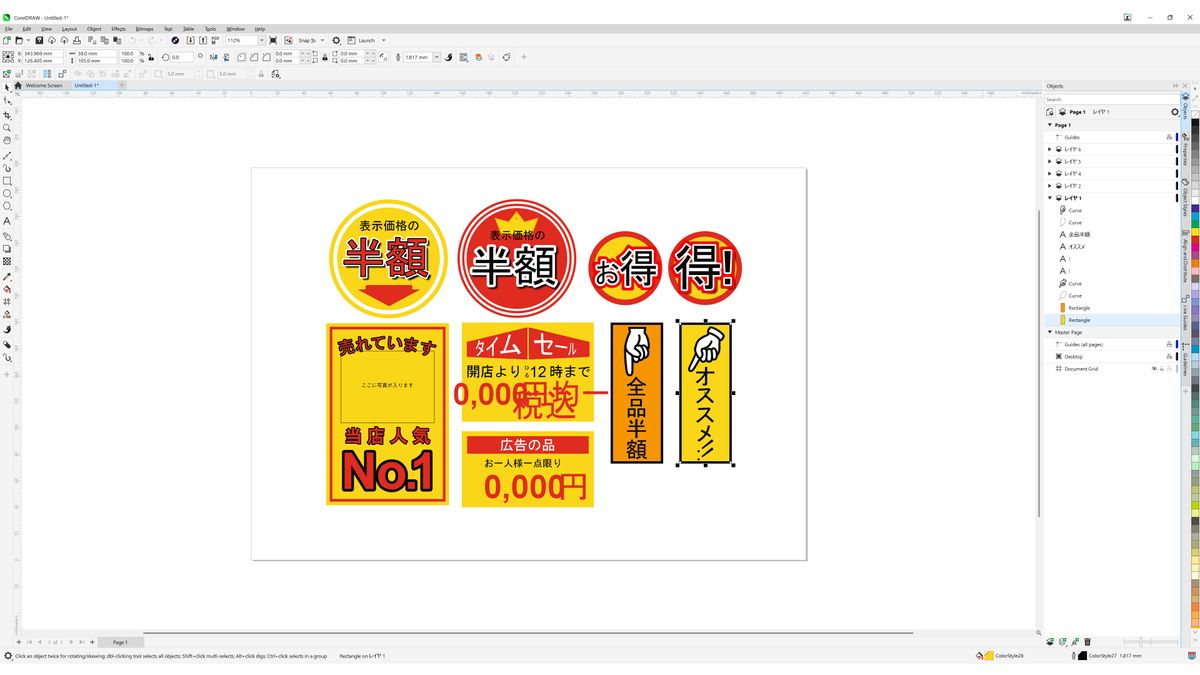
The default CorelDRAW and Photo-Paint interface is light in colour and stripped back, with all the deeper options hidden behind Dockers or fly-out menus accessed by holding down tool icons. We needed to check a couple of times which app we were actually using, as they appear so similar.

Who’s It For?

The CorelDRAW Graphics Suite is a relative bargain compared to Creative Cloud. Subscribing to Adobe apps individually is even more expensive, so you’d go for the All Apps plan, and get Illustrator, Photoshop and InDesign (plus some other stuff, like Premiere Pro) for £56.98 a month after the discounted rate that applies for the first three months. CorelDRAW is £26.58 a month for CorelDRAW and Photo-Paint, or a one-off payment of £659.

Scorecard

Category Score
Setup 4/5
Features 3/5
User Experience 4/5

Buy It If:

  • You want a comprehensive graphics suite
  • That’s not Adobe
  • And which you can buy outright

Don’t Buy It If:

  • The thought of change scares you
  • A cheaper option will do the job
  • You want AI tools

FAQs:

Q: What is the CorelDRAW Graphics Suite?
A: The CorelDRAW Graphics Suite is a comprehensive graphics suite that includes CorelDRAW and Photo-Paint.

Q: How does it compare to Adobe Creative Cloud?
A: The CorelDRAW Graphics Suite is a relative bargain compared to Creative Cloud, with a one-off payment of £659 or a monthly subscription of £26.58.

Q: What are the key features of the CorelDRAW Graphics Suite?
A: The CorelDRAW Graphics Suite has a range of features, including curves, shapes, and a spiral (‘Twirl’) tool, as well as natural media brushes that lead to strokes over Beziers even if you paint them freehand.


ChatGPT’s Projects Feature

0

Get Started With ChatGPT Projects

What are ChatGPT Projects?

OpenAI isn’t slowing down when it comes to building extra functions and add-ons into its ChatGPT AI bot, and one of the newest features to roll out—exclusive to paying users, for now—is ChatGPT Projects. This is a major step forward for keeping conversations and data organized in ChatGPT: It gives you the ability to put your discussions with ChatGPT in separate spaces, like folders in a filing cabinet, complete with uploaded documents, web searches, custom instructions, and whatever else you’ve added.

How to Use ChatGPT Projects

You can have one project for researching birthday present ideas, for example, and one for analyzing the current state of the movie industry. (Bear in mind, as always, that generative AI can get things wrong.) It’s up to you how you use them, but Projects can make a genuine difference to workflows in ChatGPT.

Getting Started with ChatGPT Projects

Click New Project in the navigation pane on the left. (If you can’t see the navigation pane, click the icon in the very top-left corner to reveal it.) If you already have projects in place, click the + (plus) icon to create a new one.

Project Options

Once ChatGPT puts you in your clean, new project, you get several options onscreen: You can start a new chat, Add files to the project, or Add instructions. Any files or instructions you add (such as "respond to me as if I’m a novice in this subject") will be carried over across all the project chats, saving you from having to repeat yourself or keep on uploading the same files each time.

Managing Your Projects

And that’s just about all there is to getting started with ChatGPT Projects. There are no real options to speak of for individual projects, but if you click the three dots in the top-right corner of any project’s front page, you can rename it or delete it. (Deleting it will also delete all the conversations inside it.) Your projects and chats stack up on the left of the screen as you create them, with individual conversations nested inside projects.

Conclusion

ChatGPT Projects is a powerful tool for organizing your conversations and data in the ChatGPT AI bot. With its ability to create separate spaces for different discussions and projects, you can streamline your workflow and make the most of your conversations with ChatGPT.

Frequently Asked Questions

Q: What is a project in ChatGPT?
A: A project in ChatGPT is a separate space where you can store your conversations, files, and instructions.

Q: Can I move existing chats into a new project?
A: Yes, you can move existing chats into a new project by clicking on the three dots next to a chat in the navigation pane and selecting "Move to project".

Q: Can I add files to a project?
A: Yes, you can add files to a project by clicking on the "Add files" option in the project’s front page.

Q: Can I add custom instructions to a project?
A: Yes, you can add custom instructions to a project by clicking on the "Add instructions" option in the project’s front page.

Q: Can I rename or delete a project?
A: Yes, you can rename or delete a project by clicking on the three dots in the top-right corner of the project’s front page.

Draw Your Users In

1. Gradually Loaded Content

This is one of the more common but often overlooked techniques to make your website more engaging. In an attempt to convey a fast load-time, most websites like to display the entire content of the webpage immediately the page loads. More engaging websites load the main section first (usually the hero section) and then the rest of the webpage is exposed to you as you scroll or interact with items on the page. Fade-in animations, text animations, orientation switching, etc. are techniques you can use to load your content gradually. Combining these techniques with lazy-loading can keep your users more invested in your site journey without sacrificing performance.

2. Gamification

If you frequently get hooked while playing a mobile or computer game, you realize that the game is designed to keep you playing. Game designers spend a lot of time researching ways to keep you immersed in the gaming experience. Applying some of the techniques used in games in your website can significantly increase user engagement. Implementing the complex graphics and controls used in games in your website will have performance consequences, however, you can adopt some of their techniques in making your site more engaging. Most popular stores and social media platforms already use some of these techniques to keep users glued to their sites. A good example of a gamified platform is the Shein mobile app. Interactions are incentivized with a reward system. Rewards can include a fun animation when a button is clicked, progress bars/count, mouse interactions, scroll animations, sound feedback, etc. For example, the progress bar and scroll animations in The Avenging Lama are designed to guide you to the end of the webpage. These techniques should only be used where applicable and should be applied very subtly to avoid confusion and fatigue.

3. Multi-dimensional Content

Where you can, you should use 3D objects, icons, media, animations, etc. Using 3D items gives your users a more physical experience of your site, which feels more realistic. By 3D, I don’t necessarily mean the blender-like animations like those in this site – NationalGeographic(into the Amazon), instead I mean a multilayered animation, manipulating text and other items using shadows and size to convey depth. An example is Trupaste

4. High Quality Media and Content

This one sounds pretty obvious, right? But a lot of websites still miss the mark in using high quality media in their websites. Sometimes, the difference between a basic website and a top-notch ‘classic’ website is in the quality of their images, videos, font, animations. For example, The Louis Vuitton Website has a very basic webpage and would be relatively easy for a web developer to recreate. However, by using high quality model/product pictures, fonts they are able to convey class and relate with their users on that level. Site owners should invest in high quality content which is way cheaper with new image-generating AI tools like Google lab’s Image FX. By using lazy loading, conditional rendering, and other techniques you can ensure performance is not significantly diminished.

5. Tell a Story

From the hero section to the footer of your webpage, through the different pages and interaction, there should be an intertwining story you are trying to tell. This helps users connect better to your brand or company. Videos, text write-up, CTA’s, etc. are all opportunities to direct the flow of your story. Your story can be in form of an underlying theme, tone of message or an actual story —You decide! It’s your story.

Conclusion

Making your site immersive and memorable is important if you want to retain your users. Highly engaged users are more likely to return to your website and more likely to convert. Crafting a compelling web experience requires the application of delicate web-development techniques. Using the techniques listed in this write-up and others across the web, you will be able to draw your users into the impactful experience that is your website. Thanks for reading!

FAQs

Q: What are some techniques to make my website more engaging?
A: Techniques like gradually loaded content, gamification, multi-dimensional content, high-quality media and content, and telling a story can be used to increase user engagement.

Q: How can I use gamification on my website?
A: You can use gamification by incorporating techniques like progress bars, rewards, and interactive elements to keep users engaged.

Q: What is multi-dimensional content?
A: Multi-dimensional content is the use of 3D objects, icons, media, and animations to give users a more physical experience of your site.

Q: Why is high-quality media and content important?
A: High-quality media and content is important because it can convey class and relate with users on a higher level, making them more likely to engage with your site.

Q: How can I tell a story on my website?
A: You can tell a story on your website by incorporating elements like videos, text write-up, and CTA’s to direct the flow of your story.

OpenAI raises $40B at $300B post-money valuation.

0

OpenAI Secures $40 Billion in Funding, Valuing the Company at $300 Billion

OpenAI, a leading artificial intelligence (AI) research organization, has announced that it has closed one of the largest private funding rounds in history. According to a blog post on the company’s website, OpenAI raised $40 billion in a round that values the company at $300 billion post-money.

Lead Investors and Timeline

SoftBank led the financing, with other participants including Microsoft, Coatue, Altimeter, and Thrive, all of which are earlier backers in the outfit. The funding round was completed in a short amount of time, with SoftBank leading the charge.

What Does the Funding Mean for OpenAI?

“This new capital enables us to push the frontiers of AI research even further, scale our compute infrastructure, and deliver increasingly powerful tools for the 500 million people who use ChatGPT every week,” OpenAI wrote in the blog post. “We’re excited to be working in partnership with SoftBank Group — few companies understand how to scale transformative technology like they do.”

Stargate Infrastructure Project

CNBC, citing a source familiar with the matter, says that around $18 billion of the funding will go toward OpenAI’s ambitious Stargate infrastructure project, which aims to establish a network of AI data centers around the U.S. This project is expected to have a significant impact on the development of AI technology.

Conclusion

OpenAI’s $40 billion funding round is a significant milestone in the company’s history, marking a major investment in its ambitious projects and research initiatives. With this funding, OpenAI is poised to continue pushing the boundaries of AI research and development, and to deliver even more powerful tools and services to its users.

FAQs

Q: What is OpenAI’s current valuation?

A: OpenAI is currently valued at $300 billion post-money.

Q: Who led the funding round?

A: SoftBank led the financing round.

Q: What is OpenAI’s Stargate infrastructure project?

A: OpenAI’s Stargate infrastructure project aims to establish a network of AI data centers around the U.S.

Q: How much of the funding will be allocated to the Stargate project?

A: Around $18 billion of the funding will go toward OpenAI’s Stargate infrastructure project.

Q: What are the implications of this funding round for OpenAI’s future plans?

A: This funding round enables OpenAI to push the frontiers of AI research even further, scale its compute infrastructure, and deliver increasingly powerful tools to its users.

9 Iconic Typefaces in Movies and TV

0

Typography in Film and Television

01. Futura in The Royal Tenenbaums

Futura is a geometric sans-serif typeface, designed by Paul Renner in the 1920s, and it’s been used cleverly in film. "Wes Anderson embraced Futura like no else in his movies (The Royal Tenenbaums, The Life Aquatic with Steve Zissou, Moonrise Kingdom) using its structured yet playful nature to complement his meticulously designed worlds," explains Julio Zukerman, type designer at Type of Feeling.

02. ITC Benguiat in Stranger Things (2016-)

It’s hard to think about typography and screen in unity and not conjure up the defining image of Netflix other the last few years – the Stranger Things splash screen. Not only has the TV show itself become a cultural phenomenon, its use of ITC Benguiat for the title sequence is a significant part of its appeal and the emphasis on nostalgia and days gone by.

03. Papyrus in Avatar (2009)

If you’ve seen Ryan Gosling’s SNL sketch about the use of Papyrus in Avatar (above), you’ll not be surprised that to this day, this remains one of the most controversial typeface choices in film history. Designed by Chris Costello in 1982, Papyrus is known for its textured, calligraphic style that evokes a sense of the ancient and the exotic.

04. Saul Bass Typography in North by Northwest (1959)

David Airey, who works with clients worldwide from an independent design studio in Northern Ireland, points out that the custom type designed by Saul Bass for Hitchcock’s 1959 film has become a classic example of iconic type in movies.

05. Courier in The Matrix (1999)

Over the years, there have been quite a few discussions around what exactly the font on Neo’s computer is, and the consensus that seems to make the most sense is that it’s Courier, a monospaced serif typeface that’s widely associated with typewriters and coding.

06. Kabel in Lost in Translation (2003)

Sofia Coppola is known for creating atmospheric worlds upon which choosing the right typeface can significantly affect the mood and style of viewing. Lost in Translation was her breakthrough hit, and the use of Kabel, a geometric sans-serif typeface designed by Rudolf Koch in 1927, plays a subtle but significant role in the title sequence of the film.

07. Aachen in Pulp Fiction (1994)

Aachen is a sturdy, blocky slab-serif typeface, known for its thick strokes and compact structure. Like the film Pulp Fiction, it demands attention, with a bold, loud and aggressive form that echoes the film’s unapologetic energy.

08. Cooper Black in Napoleon Dynamite (2004)

The typeface Cooper Black has a storied history. As well as being the font for the ‘Vote for Pedro’ shirts in Napoleon Dynamite, it also graced the cover of the Beach Boys’ Pet Sounds album and throughout the 20th century, could be seen on everything from sweet wrappers to advertising hoardings and shop front signs.

09. Albertus in the Prisoner (1967)

The Prisoner was a 1960s TV series that follows the story of ‘Number Six’, an unnamed British intelligence agent who before a planned trip abroad is kidnapped and trapped in a re-creation of his own home in a location known as ‘The Village.’ This mysterious location turns out to be a utopian nightmare – bright and cheery on the surface but controlled by an unseen authority.

Conclusion

The right typeface can convey a stunning sense of time, place, emotion, and genre, and from the classic to the contemporary, we’ve run through some of the most notable examples, exploring why they work so well.

FAQs

Q: What is the importance of typography in film and television?
A: The right typeface can convey a stunning sense of time, place, emotion, and genre, and from the classic to the contemporary, it can set the tone for the series or film.

Q: How do typefaces influence the mood and style of a film or television show?
A: Choosing the right typeface can significantly affect the mood and style of a film or television show, and it can be used to evoke a sense of nostalgia, mystery, or adventure.

Q: What is the significance of Papyrus in Avatar?
A: Papyrus is known for its textured, calligraphic style that evokes a sense of the ancient and the exotic, and it was used in Avatar to represent the alien world of Pandora.

OpenAI just raised another $40 billion funding round.

0

Funding Boost for OpenAI: $40 Billion Investment to Drive AGI Development

OpenAI is set to receive $10 billion up front (SoftBank will invest $7.5 billion along with $2.5 billion “from an investor syndicate,“ according to Bloomberg). The remaining $30 billion is slated to arrive by year’s end, CNBC reported — but only if it officially converts into a for-profit company by then. If not, it reportedly stands to lose a quarter of the deal.

A Rapidly Growing Company

The funding comes just a few months after OpenAI announced Stargate, a $500 billion joint venture with backing from SoftBank, Oracle, and the Abu Dhabi fund MGX to build out massive AI datacenters over the next four years. The company has been in a full sprint lately: On Monday, CEO Sam Altman posted that OpenAI gained 1 million users in a single hour in large part thanks to a new feature called Images in ChatGPT that went viral due to its ability to produce Studio Ghibli inspired AI art. Altman also announced on Wednesday that the company would “release a powerful new open-weight language model with reasoning in the coming months.” The funding announcement claims that ChatGPT serves 500 million people every week.

Explosive Growth, But Still Burning Cash

Despite the explosive growth the startup has seen thanks to ChatGPT, it’s still burning a ton of cash. Bloomberg recently reported that the startup is expecting to earn $12.7 billion in revenue this year alone, which is a massive jump from the $3.7 billion it earned in annualized recurring revenue last year. Still, the report claims OpenAI doesn’t expect to be cash flow positive until 2029, when its projections predict a whopping $125 billion in revenue.

A Goal to Build AGI for Humanity

OpenAI’s funding announcement emphasized the startup’s goal of building “AGI that benefits all of humanity.” Altman has been clear that it’ll take a lot to pull this all off—compute, energy, global infrastructure, and yes, a staggering amount of cash. This round, the startup claims, brings it one step closer.

Conclusion

The latest funding announcement is a significant boost for OpenAI, which aims to build AGI that benefits humanity. With $40 billion in funding, the startup is one step closer to achieving its goal. However, the company still faces significant challenges, including the need for massive compute and energy resources, as well as the development of infrastructure to support its ambitious plans.

FAQs

Q: How much funding is OpenAI receiving?

A: OpenAI is receiving $40 billion in funding, with $10 billion coming upfront and the remaining $30 billion to be paid by year’s end, pending the company’s conversion to a for-profit entity.

Q: What is the purpose of the funding?

A: The funding is aimed at supporting OpenAI’s goal of building AGI that benefits all of humanity, which requires significant investments in compute, energy, and global infrastructure.

Q: How is OpenAI performing financially?

A: Despite its explosive growth, OpenAI is still burning a significant amount of cash. The company expects to earn $12.7 billion in revenue this year, but does not expect to be cash flow positive until 2029, when it projects $125 billion in revenue.

Everyone Can Now Try Gemini 2.5 Pro – for Free

Moments after DeepSeek released its latest model, another AI giant has already stolen back some of the limelight.

Google Announces Gemini 2.5, its "Most Intelligent" Model

Last Tuesday, Google announced Gemini 2.5, its "most intelligent" model. The company said this initial release is an "experimental version of 2.5 Pro, which is state-of-the-art on a wide range of benchmarks and debuts at #1 on LMArena by a significant margin." Then, on Saturday, Google revealed 2.5 Pro is now available to all Gemini users at gemini.google.com.

A Family of Thinking Models

A family of thinking models, meaning they reason through their responses, Google’s Gemini 2.5 release follows the Gemini 2.0 Flash Thinking models that landed in December.

Outperforming the Competition

Gemini 2.5 Pro Experimental outperforms OpenAI’s o3 mini and Anthropic’s Claude 3.7 Sonnet on Humanity’s Last Exam (HLE), a recently created benchmark designed to combat saturation — or the problem of industry tests becoming too easy for rapidly evolving models. HLE is, therefore, a relatively harder test to perform well on. Gemini 2.5 scored 18.8% compared to o3 mini’s 14% (evaluated using text problems only, no images) and Claude 3.7 Sonnet’s 8.9%.

Improvements in Reasoning, Multimodal, and Agentic Capabilities

Already topping the Chatbot Arena leaderboard, the new model also outperformed competitors on common benchmarks for science, math, and coding, though usually by a smaller margin, which is now expected given the rate at which new models are accelerating. Google reported that Gemini 2.5 Pro Experimental shows improvements in reasoning, multimodal, and agentic capabilities, even from a "single line prompt."

Available to All Gemini Users

Google posted on X that Gemini 2.5 Pro is available to all Gemini users "with rate limits," after an initially more narrow release, and it will be coming to mobile soon. While the company did not update the specifics, it reiterated that Gemini Advanced users still have "expanded access" in addition to a larger context window.

Conclusion

The release of Gemini 2.5 Pro marks another significant milestone in the development of artificial intelligence. With its improved capabilities and availability to all Gemini users, this model is set to revolutionize the way we interact with AI.

Frequently Asked Questions

Q: What is Gemini 2.5 Pro?
A: Gemini 2.5 Pro is an experimental version of Google’s "most intelligent" model, which is state-of-the-art on a wide range of benchmarks and debuts at #1 on LMArena by a significant margin.

Q: What are the key features of Gemini 2.5 Pro?
A: The key features of Gemini 2.5 Pro include improvements in reasoning, multimodal, and agentic capabilities, even from a "single line prompt."

Q: Is Gemini 2.5 Pro available to all users?
A: Yes, Gemini 2.5 Pro is available to all Gemini users "with rate limits," after an initially more narrow release, and it will be coming to mobile soon.

Hallucinations Persist in Leading AI Models

0

A Report from the Association for the Advancement of Artificial Intelligence (AAAI) Reveals a Disconnect between Public Perceptions of AI Capabilities and the Reality of Current Technology.

Factuality remains a major unsolved challenge for even the most advanced models.

The AAAI’s “Presidential Panel on the Future of AI Research” report draws on input from 24 experienced AI researchers and survey responses from 475 participants.

Here are the findings that directly impact search and digital marketing strategies.

Leading AI Models Fail Basic Factuality Tests

Despite billions in research investment, AI factuality remains largely unsolved.

According to the report, even the most advanced models from OpenAI and Anthropic “correctly answered less than half of the questions” on new benchmarks like SimpleQA, a collection of straightforward questions.

The report identifies three main techniques being deployed to improve factuality:

  • Retrieval-augmented generation (RAG): Gathering relevant documents using traditional information retrieval before generating answers.
  • Automated reasoning checks: Verifying outputs against predefined rules to cull inconsistent responses.
  • Chain-of-thought (CoT): Breaking questions into smaller units and prompting AI to reflect on tentative conclusions

However, these techniques show limited success, with 60% of AI researchers expressing pessimism that factuality issues will be “solved” in the near future.

This suggests you should prepare for continuous human oversight to ensure content and data accuracy. AI tools may speed up routine tasks, but full autonomy remains risky.

The Reality Gap: AI Capabilities vs. Public Perception

The report highlights a concerning perception gap, with 79% of AI researchers surveyed disagreeing or strongly disagreeing that “current perception of AI capabilities matches the reality.”

The report states:

“The current Generative AI Hype Cycle is the first introduction to AI for perhaps the majority of people in the world and they do not have the tools to gauge the validity of many claims.”

As of November, Gartner placed Generative AI just past its peak of inflated expectations and is now heading toward the “trough of disillusionment” in its Hype Cycle framework.

For those in SEO and digital marketing, this cycle can provoke boom-or-bust investment patterns. Decision-makers might overcommit resources based on AI’s short-term promise, only to experience setbacks when performance fails to meet objectives.

Perhaps most concerning, 74% of researchers believe research directions are driven by hype rather than scientific priorities, potentially diverting resources from foundational issues like factuality.

The report notes that “many of the public statements of people quite new to the field are out of line with reality,” suggesting that even expert commentary should be evaluated cautiously.

Why This Matters for SEO & Digital Marketing

Adopting New Tools

The pressure to adopt AI tools can overshadow their limitations. Since issues of factual accuracy remain unresolved, marketers should use AI responsibly.

Conducting regular audits and seeking expert reviews can help reduce the risks of misinformation, particularly in industries regulated by YMYL (Your Money, Your Life) standards, such as finance and healthcare.

The Impact On Content Quality

AI-based content generation can lead to inaccuracies that can directly harm user trust and brand reputation. Search engines may demote websites that publish unreliable or deceptive material produced by AI.

Taking a human-plus-AI approach, where editors meticulously fact-check AI outputs, is recommended.

Navigating the Hype

Beyond content creation challenges, leaders must adopt a clear-eyed view to navigate the hype cycle. The report warns that hype can misdirect resources and overshadow more sustainable gains.

Search professionals who understand AI’s capabilities and limitations will be best positioned to make strategic decisions that deliver real value.

Conclusion

The report highlights the need for a more nuanced understanding of AI capabilities and limitations. AI-based content generation and adoption require a responsible approach, considering the potential risks and limitations.

FAQs

Q: What is the main challenge with AI factuality?
A: AI factuality remains largely unsolved, with even the most advanced models struggling to correctly answer more than half of the questions on new benchmarks.

Q: What are the main techniques being deployed to improve factuality?
A: The three main techniques being deployed to improve factuality are Retrieval-Augmented Generation, Automated Reasoning Checks, and Chain-of-Thought.

Q: What is the reality gap between public perceptions of AI capabilities and the current technology?
A: The report highlights a concerning perception gap, with 79% of AI researchers surveyed disagreeing or strongly disagreeing that “current perception of AI capabilities matches the reality.”

Q: What can marketers do to ensure content and data accuracy?
A: Marketers should prepare for continuous human oversight and conduct regular audits, seeking expert reviews to reduce the risks of misinformation, particularly in industries regulated by YMYL standards.

OpenAI Closes Deal

0

OpenAI Secures $40 Billion Fund-Raising Deal, Valuing Company at $300 Billion

Historic Investment Round

OpenAI, a leading artificial intelligence (A.I.) company, has announced the completion of a $40 billion fund-raising deal, nearly doubling its valuation from just six months ago. The new investment round, led by Japanese conglomerate SoftBank, values OpenAI at $300 billion, making it one of the most valuable private companies in the world, alongside rocket company SpaceX and ByteDance, the maker of TikTok.

ChatGPT’s Popularity Surges

OpenAI started the A.I. boom in late 2022 with the release of its online chatbot, ChatGPT. Its latest investment round indicates that the tech industry’s excitement over A.I. remains strong, even amid concerns about the effectiveness and safety of the rapidly improving technology.

CEO’s Vision for the Future

"This investment helps us push the frontier and make A.I. more useful in everyday life," said Sam Altman, OpenAI’s chief executive.

Key Statistics

  • 500 million people are actively using ChatGPT each week, up from 400 million in late February.
  • 20 million people are paying to use more advanced versions of the chatbot.

Investment Structure

The new investment will be made in two parts. An initial $10 billion will arrive immediately, with another $30 billion arriving by the end of the year.

Investor Breakdown

SoftBank Group is providing 75 percent of the total, with the rest coming from other investors, including Microsoft, Thrive Capital, Coatue, and Altimeter.

Company Background

OpenAI was founded as a nonprofit in 2015 by Sam Altman, Elon Musk, and several others. In 2018, after Musk left the organization, Altman attached OpenAI to a for-profit company to raise billions of dollars needed to build A.I. technologies. The nonprofit retained control of the company.

Conflict with Elon Musk

Last year, Musk sued OpenAI and Altman, claiming they had breached the company’s founding contract by putting commercial interests ahead of the public good. OpenAI plans to move control of the company to a public benefit corporation, or P.B.C., which is a for-profit corporation designed to create public and social good.

Conclusion

This historic investment round is a testament to the growing importance of A.I. in our daily lives. With this new funding, OpenAI is poised to continue pushing the boundaries of A.I. and making it more accessible to the public.

Frequently Asked Questions

Q: What is the new valuation of OpenAI?
A: The new valuation of OpenAI is $300 billion.

Q: Who led the investment round?
A: The investment round was led by SoftBank Group.

Q: How will OpenAI use the new funding?
A: OpenAI plans to use the new funding to push the boundaries of A.I. and make it more useful in everyday life.

Q: What is the current user base of ChatGPT?
A: The current user base of ChatGPT is 500 million people, up from 400 million in late February.

Sam Altman Says OpenAI Will Release an ‘Open Weight’ AI Model This Summer

0

OpenAI to Release Open-Weight Artificial Intelligence Model

Announcement

Sam Altman, CEO of OpenAI, has revealed that the company will release an open-weight artificial intelligence model in the coming months. In a post on X, Altman stated, "We are excited to release a powerful new open-weight language model with reasoning in the coming months."

Response to R1 Model and Llama Models

The move is partly a response to the runaway success of the R1 model from Chinese company DeepSeek, as well as the popularity of Meta’s Llama models. OpenAI has been "on the wrong side of history" regarding open models, signaling a likely shift in direction.

Cost-Effective and Tailorable

OpenAI may feel the need to show that it can train the new model cheaply, since DeepSeek’s model was purportedly trained at a fraction of the cost of most large AI models. The model’s weights refer to the values inside a large neural network—something that is set during training. Open-weight models are cheaper to use and can also be tailored for sensitive use cases, like handling highly confidential information.

Rigorous Testing and Early Access

The company will conduct rigorous testing to ensure the open-weight model cannot easily be misused. Some AI researchers worry that open-weight models could help criminals launch cyberattacks or even develop biological or chemical weapons. To address this concern, OpenAI will release a webpage inviting developers to apply for early access to the forthcoming model.

Conclusion

OpenAI’s decision to release an open-weight AI model marks a significant shift in the company’s approach to artificial intelligence. By making its model available for free and modification, OpenAI is taking a step towards making AI more accessible and transparent.

FAQs

Q: What is an open-weight AI model?
A: An open-weight AI model is a type of artificial intelligence model that can be downloaded for free and modified.

Q: What is the purpose of releasing an open-weight AI model?
A: The purpose is to make AI more accessible and transparent, while also addressing concerns about the potential misuse of AI.

Q: How will OpenAI ensure the model is not misused?
A: OpenAI will conduct rigorous testing to ensure the model cannot easily be misused, and will also release a webpage inviting developers to apply for early access to the forthcoming model.

Q: What is the timeline for the release of the open-weight AI model?
A: The model is expected to be released in the coming months.