Home Blog Page 122

H&M’s Digital Clone Models Cause Controversy

0

The Rise of Digital Twins in Advertising: H&M’s Latest Move

Digital Twins in Advertising: A New Era

In recent years, digital twins have been gaining popularity in the advertising industry. The concept of digital twins, which involves creating digital clones of real-life objects or people, has been around for some time, particularly in the automotive sector. However, the faster-moving consumer goods sectors have been slower to adopt this technology.

H&M’s Latest Move: Using Digital Clones of Models

In a recent development, H&M has announced that it will be using digital clones of 30 models, created with the help of Swedish tech firm Uncut. These digital twins will be used in place of human models in some social media posts and marketing assets.

How it Works

According to Business of Fashion, H&M is using AI to create these digital clones. The company has stated that the models will retain the rights to their digital replicas and will be paid for their use in a similar way to existing arrangements.

Embracing New Technology

In a statement, H&M’s Chief Creative Officer, Jörgen Andersson, said, "We are curious to explore how to showcase our fashion in new creative ways – and embrace the benefits of new technology – while staying true to our commitment to personal style."

Concerns and Controversies

While some models are embracing the new technology, others are concerned about the potential impact on production designers, photographers, and makeup artists, as well as other models. Some are worried that digital clones could allow already successful professionals to be in more places at once and make more money, but this could mean less chance for new talent to break through.

Risks for Models

One potential risk for models who permit AI clones is that if they spread themselves too thinly and allow overly wide use of their likeness, the value of their own image could decline.

Conclusion

The rise of digital twins in advertising is a significant development, and H&M’s latest move is a sign that this technology is going mainstream. While there are concerns and controversies surrounding the use of digital twins, it is clear that this technology has the potential to revolutionize the advertising industry.

FAQs

Q: What is a digital twin?
A: A digital twin is a digital clone of a real-life object or person, created using various technologies such as AI and 3D modeling.

Q: How are digital twins being used in advertising?
A: Digital twins are being used in advertising to create virtual versions of real-life models, allowing for more efficient and cost-effective content creation.

Q: Are digital twins a threat to human models?
A: Some models are concerned that digital twins could lead to the decline of their careers, as they could be replaced by virtual versions of themselves.

Q: Is the use of digital twins limited to H&M?
A: No, other companies are also using digital twins, including Levi’s, which has been testing the use of AI-generated models for two years.

Q: What are the benefits of using digital twins?
A: Digital twins offer several benefits, including increased efficiency, reduced costs, and the ability to create more realistic and engaging content.

Samsung’s latest smart appliances are all about the screens.

0

In Our Notification-Heavy World, There Is Still One Activity Where You Might Just Miss That Buzz on Your Phone or Ping on Your Smartwatch – While You’re Vacuuming. Thankfully, Samsung Has a Solution.

New Cordless Stick Vac with LCD Display Control Panel

Samsung has released a new cordless stick vacuum, the Bespoke AI Jet Ultra, which comes with an LCD display control panel. This feature allows users to receive notifications, such as incoming phone calls or text messages, while vacuuming. The vacuum also features 400AW suction and 100-minute battery life.

Washers and Dryers with Touchscreens

The company has also introduced touchscreens to its washers and dryers, including the new Bespoke AI Laundry Vented Combo washer/dryer. This feature allows users to answer phone calls directly on the built-in 7-inch LCD screen. The combo washer/dryer can also automatically put detergent in and then open its door when the cycle is done.

AI Home Control Panels

Samsung has been rolling out the ability to answer phone calls from its appliances to its entire Bespoke AI line. At CES this year, Samsung showed off these AI Home control panels on several appliances, including its new Bespoke AI smart fridges and wall ovens. The features work with Android and iOS and require a Samsung account and the SmartThings app.

Flagship Samsung Family Hub Smart Fridge

The flagship Samsung Family Hub smart fridge now comes with the option of a smaller screen. This screen can be used to view recipes, send cooking instructions to the oven, and view smart home alerts.

AI Home Screens

The AI Home screens can connect to Samsung’s SmartThings smart home platform. This means users can get alerts on their appliances about other events in their smart home, for example, they can see (and talk to) whoever is at their Ring video doorbell while unloading the washer.

Screens Everywhere

Samsung’s "screens everywhere" approach is part of its AI for the home push, its vision of tech working in the background to help you with your daily life. While the smart home has plenty of potential to save you time, money, and energy, putting screens into everything feels like overkill.

Conclusion

Samsung’s new cordless stick vacuum and laundry appliances with touchscreens are designed to make daily life easier and more convenient. With the ability to receive notifications and control appliances from a single screen, these products are perfect for those who want to stay connected and organized.

FAQs

Q: What is the Bespoke AI Jet Ultra vacuum?
A: The Bespoke AI Jet Ultra is a new cordless stick vacuum that features an LCD display control panel and 400AW suction.

Q: What is the Bespoke AI Laundry Vented Combo washer/dryer?
A: The Bespoke AI Laundry Vented Combo is a new washer/dryer that features a touchscreen and can automatically put detergent in and open its door when the cycle is done.

Q: What is the Samsung Family Hub smart fridge?
A: The Samsung Family Hub smart fridge is a new refrigerator that features a touchscreen and can be used to view recipes, send cooking instructions to the oven, and view smart home alerts.

Q: Can I use the AI Home screens with my Android or iOS device?
A: Yes, the AI Home screens work with Android and iOS devices and require a Samsung account and the SmartThings app.

This Isn’t Reality

0

Digital Fiasco: How a Phone Number Ended Up in a Signal Group Chat

The Unexpected Addition

Last weekend, Jeffrey Goldberg, editor-in-chief of The Atlantic, found himself at the center of a digital fiasco when he was unexpectedly added to a Signal group chat with 17 U.S. government officials who were discussing imminent airstrikes in Yemen.

The Mystery of the Phone Number

For some, the incident has raised questions about how phone numbers end up in contact lists. In an era where privacy and security are increasingly important, the sudden and unexplained addition of a prominent figure like Goldberg to a high-stakes conversation has left many wondering how this could have happened.

The Investigation

An investigation has been launched to determine how Goldberg’s phone number ended up in the Signal group chat. The incident has sparked concerns about the security and privacy of the popular messaging app, and whether it is vulnerable to unauthorized access.

The Fallout

The incident has sent shockwaves through the digital community, with many users expressing concern about the potential risks of using the app. Some have even taken to social media to share their own experiences of unexpected contacts and unwanted additions to group chats.

The Aftermath

In the aftermath of the incident, Signal has issued a statement assuring users that it is taking steps to improve the security and privacy of its platform. The company has also promised to provide more information to its users about how phone numbers end up in contact lists.

Conclusion

The unexpected addition of Jeffrey Goldberg to a Signal group chat has highlighted the importance of security and privacy in the digital age. As we continue to rely on messaging apps to communicate, it is essential that we prioritize the protection of our personal data and take steps to ensure that our phone numbers are not compromised.

FAQs

Q: How did Jeffrey Goldberg’s phone number end up in the Signal group chat?
A: An investigation is currently underway to determine the cause of the incident.

Q: Is Signal vulnerable to unauthorized access?
A: The company has assured users that it is taking steps to improve the security and privacy of its platform.

Q: What steps should I take to protect my phone number and data?
A: Always use strong and unique passwords, keep your operating system and apps up to date, and be cautious when sharing your phone number or other personal information.

Using Pulumi for Rapid Deployment

Write an article about

This is a submission for the Pulumi Deploy and Document Challenge: Fast Static Website Deployment


What I Built

Hello Dev Community! Here’s hopefully the first of many posts and attempts at these kinds of challenges. The project I built is in C# and leverages the Google Bucket Storage to rapidly prototype static websites by simply dropping the compiled site into a folder.


Live Demo Link

http://storage.googleapis.com/bucket-site1-9e13468/index-48A01530.html
http://storage.googleapis.com/bucket-site2-ee21e84/index-90BB84EE.html
http://storage.googleapis.com/bucket-site3-f0559b4/index-88A85004.html


Project Repo

My first Pulumi project for the DEV competition

This project was created for entry into the DEV Challenge sponsored by Pulumi. The main function of this project leverages the Pulumi .NET SDK to create index.html driven websites in the form of Google Cloud Bucket Storage allowing for rapid static website deployments from a single folder.

Pre-Requisites & Requirements

This project is in C# and will require

1. Visual Studio Code (although any Visual Studio will work) 2. Pulumi CLI 3. Google CLI 4. Google Cloud

Once you have installed the clients, you will need to make sure you have your Google Cloud Project ID. If you’re new to Pulumi I would recommend reading my article on Dev.to which covers the basic installation experience or you can get it straight from Pulumi.


“>

git clone https://github.com/celopez3/MyFirstPulumi.git
cd MyFirstPulumi
$env:GCP_PROJECT_ID=""
Enter fullscreen mode

Exit fullscreen mode

Deployment

To deploy this project run

Enter fullscreen mode

Exit fullscreen mode


My Journey

Since this was my first time working with Pulumi I decided it best that I start with the documentation and creating an account. I quickly learned that installing the Pulumi CLI was a necessary first step.

I followed the steps in Getting Started with Pulumi and Google Cloud. I usually have chocolatey installed but at the time of doing this I had to settle for the AMD64 MSI package. Afterwards running

from a Powershell will verify that the installation was successful. I already had .NET8 installed but the guide has a link if you need to install it.

Finally, I needed to choose a cloud framework, and typically by choosing C# you’d probably expect me to choose Azure, but I ran into issues getting my Azure account setup because of my phone number. I submitted a ticket and did get it resolved but not until after I decided to move forward with Google Cloud Platform and install the GCloud CLI.

At this point you should create a project for yourself using the Google Console. If you aren’t familiar, check out Google’s documentation and use the Manage Resources button as a shortcut.

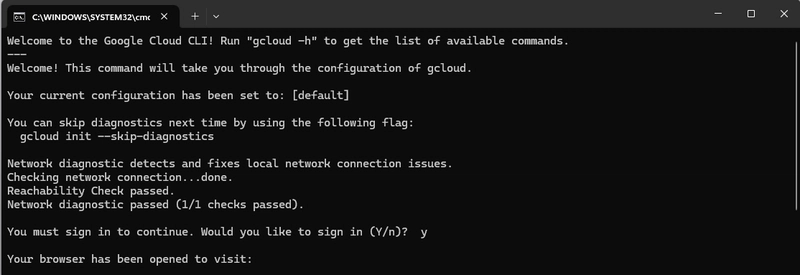
When the GCloud CLI is finsihed it will open a command prompt for the following steps to be completed:

1) sign in with your Google Account
2) select a project.

Successful installation of the GCloud CLI as displayed in a console window

Once you have authenticated your projects will be listed and you’ll select which project should be used in my case I create a project named “pulumi”.

Now that we’ve got our environment set up, we should open a Powershell console and navigate to wherever you want the code created and run the following commands:

Console Commands: mkdir quickstart, pulumi new aws-csharp

The first command creates a folder quickstart and navigates into it. The second command calls the pulumi cli to create an aws-csharp project, except in my case I ran

pulumi new gcp-csharp

If this is your first time executing pulumi you will be prompted to login and setup the connection between Pulumi Cloud and the CLI. Following the rest of the guide will get you to being able to deploy a static website to Google Buckets. This was a really cool start, but I wanted to expand on it.

My project addresses three scenarios for streamlining rapid prototypes to Google Buckets as static webpages. The first scenario is a default html template probably setup by hand.

HTML header showcasing minimal CDN inclusions and one local script

From the tag you can see a minimal Bootstrap5 and a local style.css. The body was setup from the Boostrap5 Templates, specifically the Blog template.

The second scenario is a Next.js or post compiled project, basically one a static website that was exported. I first downloaded a Startup Next.js template from GitHub.

I added this line to the next.config.js:

output: 'export'

Which basically compiles your Next.js project into a folder called ‘out’ when you run:

npm run build

Finally, the third scenario is simply downloading a free html template, extracting and launching the files.


Using Pulumi

You’ll find all the primary work for my submission in the Program.cs file. I first created a directory called websites and for purposes of rapidly deploying sites I created 3 folders, site1, site2, and site3. Each folder contained files related to each scenario listed above.

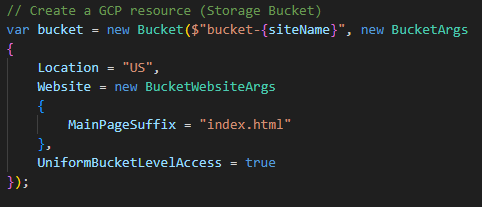
I then use pulumi to create buckets for each site.

C# code using Pulumi to create a Google Cloud Bucket

Once the buckets were created, I loop through each site directory and create Bucket Objects for each file, including subdirectories.

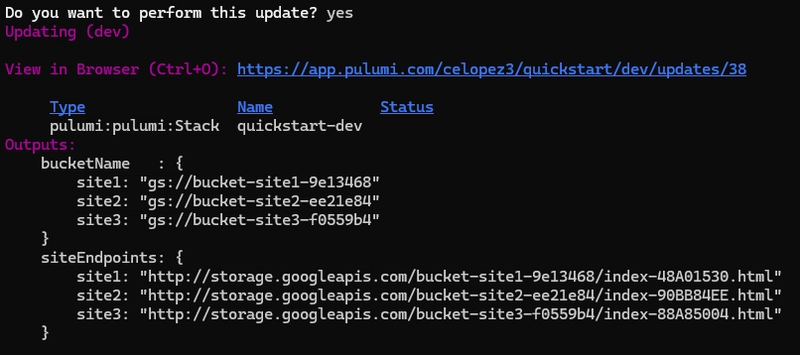
Running pulumi up from the folder containing Program.cs results in, specifically the index.html file being uploaded and the auto deployed site urls being displayed.

Results of running console command: pulumi up

It is important to note that the code within my repo is hard coded to leverage index.html, however it could easily be adapted to accommodate any html files.


Lessons Learned & Conclusions

I definitely learned a lot throughout this process. I went down quite a few rabbit holes before I decided on this submission. I wouldn’t say that my experience with Pulumi felt easy, but I never felt stuck or unable to find an answer. Their online documentation and the availability of examples really helped accelerate my overall experience. Most importantly, now that I have this project I’ll be able to rapidly prototype website templates by simply dropping them into a folder.

I see a lot of potential in Pulumi and look forward to the next project. If I had more time I’d like to submit a docker deployment solution through Pulumi, but I doubt I’d get it done before the April 6th deadline.

Let me know if you have thoughts or questions in the comments and thank you for your consideration.

.Organize the content with appropriate headings and subheadings ( h2, h3, h4, h5, h6). Include conclusion section and FAQs section with Proper questions and answers at the end. do not include the title. it must return only article i dont want any extra information or introductory text with article e.g: ” Here is rewritten article:” or “Here is the rewritten content:”

Apple Revamps Health App with AI Coach

0

Apple’s New Health App: AI Coach for a Healthier Life

Apple is developing a new version of its Health app that includes an AI coach that can advise users on how to get healthier, according to Bloomberg’s Mark Gurman.

Development and Release Date

Gurman first reported that something like this was in the works back in 2023, but now he says development is moving ahead, with the new features potentially coming as soon as spring or summer of 2026, with the release of iOS 19.4.

The AI Coach: How it Works

The AI coach’s advice would be based on data from across users’ medical devices, and would reportedly include food tracking. The coach is currently being trained on data from staff physicians, with Apple looking to bring in additional doctors to record health-related videos.

Health+: The New Service

According to Gurman, this new service is tentatively called Health+.

Conclusion

Apple’s new Health app with an AI coach has the potential to revolutionize the way we approach our health and wellness. With the ability to track food and medical devices, this new app could provide users with personalized advice and guidance to help them make healthier choices. The release of Health+ in spring or summer of 2026 is highly anticipated, and we can’t wait to see how this new service will shape the future of health and wellness.

FAQs

Q: What is the AI coach in Apple’s new Health app?

The AI coach is a feature in Apple’s new Health app that provides users with personalized advice and guidance on how to get healthier, based on data from their medical devices.

Q: What kind of data will the AI coach use?

The AI coach will use data from across users’ medical devices, including food tracking.

Q: How is the AI coach being trained?

The AI coach is currently being trained on data from staff physicians, with Apple looking to bring in additional doctors to record health-related videos.

Q: What is the release date for the new Health app?

The new Health app is expected to be released in spring or summer of 2026, with the release of iOS 19.4.

Q: What is the tentative name of the new service?

The tentative name of the new service is Health+.

Boosting Business with AI: Industry-Specific ROI Insights

True AI Transformation Requires an Industry Perspective

In our conversations with customers, many are asking about the next wave of AI. They’re ready to expand beyond general AI applications and invest in solutions tailored to their specific challenges. While organizations recognize AI’s value and potential, it must address industry-specific needs to deliver the biggest results.

Where to Invest in AI for Maximum Impact

Today’s leaders are looking beyond AI for productivity and asking a bigger question: Where should we invest next to drive business growth? The key is to align AI investments with mission-critical priorities.

So, is the AI for industry buzz real, and is it worth the investment? The answer is yes—here’s why:

  • Industry-specific AI solutions tackle complex challenges, such as regulatory compliance in financial services, seamless omnichannel shopping experiences in retail, and asset troubleshooting in manufacturing.
  • Customizable AI agents in Microsoft Copilot Studio help businesses tailor AI to their needs.
  • AI models, developed in collaboration with partners, and built for specific industries make adoption easier across every sector and region.

To see industry-specific AI in action, let’s explore key use cases in financial services, retail, manufacturing, and healthcare.

Driving Growth in Financial Services with AI

Financial services organizations are leading the way in AI adoption, and it’s paying off. They’re realizing a 4.2 times average ROI on generative AI initiatives—the highest across industries. Discover how PicPay uses Microsoft AI to answer product and service questions quickly and securely.

Retailers Solve Complex Challenges with AI

Retailers are realizing a 3.6 times ROI on generative AI initiatives, and some are tackling customer acquisition, profitability, supply chain reliability, and data complexity. Learn how ASOS, a British online fashion retailer, uses Azure AI Foundry to surprise and delight young fashion lovers with engaging, inspirational experiences.

How AI Powers Smarter Manufacturing

Manufacturers are achieving a 3.4 times ROI on generative AI initiatives. They’re also using AI to speed time to market, streamline application lifecycle management, and simplify manufacturing processes. See how Schneider Electric addresses the company’s most pressing issues by innovating with Azure OpenAI Service.

AI Helps Empower the Healthcare Workforce and Enhance Patient Care

In healthcare, AI is transforming medical data management, personalizing clinician and patient experiences, and helping to improve patient outcomes—delivering a 3.3 times ROI on generative AI initiatives. See how AI innovation empowers healthcare teams to refocus on the clinician-patient connection at Northwestern Medicine, Overlake Medical Center & Clinics, and Atrium Health.

Conclusion

Organizations that invest in industry-focused AI applications and stay current with AI industry trends are realizing the greatest ROI with AI. We’re here to help you take action now and position your business for innovation, efficiency, and competitive advantage.

FAQs

Q: What is the ROI of AI?
A: The ROI of AI varies by industry, with financial services achieving the highest average ROI of 4.2 times.

Q: What are the key use cases for AI in industry?
A: Key use cases for AI in industry include personalized shopping, store operations, and AI-powered insights in retail; AI-powered generative design, AI-assisted coding, and AI-powered factory insights in manufacturing; and AI assistants, advanced healthcare AI models, and multimodal AI in healthcare.

Q: How can I drive AI success in my organization?
A: To drive AI success, invest in industry-focused AI applications, stay current with AI industry trends, and align AI investments with mission-critical priorities.

Ghosts in the Kinect

0

The Kinect’s Unlikely Afterlife as a Ghost Hunting Tool

The Microsoft Kinect, once a popular gaming peripheral, has found a new lease on life as a tool for ghost hunters. The device’s ability to detect depth and create stick-figure representations of humanoid shapes has made it a popular choice for paranormal investigators.

The Science Behind the Kinect’s Haunting Abilities

The Kinect’s structured light system, which projects a grid of infrared dots into an environment, allows it to detect deformations in the projection and discern human limbs within those deformations. This data is then converted into a visual representation of a stick figure, which is often touted as evidence of ghostly activity.

But is it Really Haunting?

Not according to Jon Wood, a science performer who has examined the equipment used by ghost hunters. "The Kinect is actually a straightforward piece of hardware that is trained to recognize the human body," he says. "It assumes that it’s always looking at one – because that’s what it’s designed to do. Whatever you show it, whether human or humanoid or something entirely different, it will try and discern human anatomy."

Glitches aren’t Tolerated – They’re Encouraged

The Kinect’s flaws aren’t bugs or glitches, but rather features that are encouraged by ghost hunters. "If a person pays good money to enjoy a ghost hunt, what are they after?" Wood asks. "They prime themselves for a ‘spooky encounter’ and open up to the suggestion of anything being ‘evidence of a ghost’ – they want to find a ghost, so they make sure they do."

Conclusion

The Kinect’s new lease on life as a ghost hunting tool may seem unexpected, but it’s a testament to the device’s ability to detect and create stick-figure representations of humanoid shapes. While the results may be erroneous, the Kinect’s popularity among ghost hunters is a reminder that sometimes, it’s not about the accuracy of the results, but about the experience itself.

FAQs

Q: What is the Kinect?
A: The Kinect is a motion-sensing peripheral developed by Microsoft, originally designed for gaming.

Q: How does the Kinect work?
A: The Kinect uses a structured light system to detect depth and create stick-figure representations of humanoid shapes.

Q: Why is the Kinect popular among ghost hunters?
A: The Kinect’s ability to detect and create stick-figure representations of humanoid shapes, even in the absence of human bodies, has made it a popular choice for paranormal investigators.

Q: Are the results of the Kinect’s ghost hunting activities accurate?
A: No, the results are often erroneous, but this is intentional, as ghost hunters prefer technology that will produce results of any kind, even if they are questionable.

Q: What is the purpose of using the Kinect in ghost hunting?
A: The purpose is to create an experience for those who believe in ghosts, rather than to provide accurate evidence of their existence.

Is A.I. Making Our Listeners Dumb?

0

Hard Fork

Casey Newton and Kevin Roose on the Future of AI and Critical Thinking

This week, Casey Newton and Kevin Roose discuss the potential risks and challenges posed by the growing use of AI in the workplace. The episode begins with a humorous anecdote about Casey Newton’s credit card being charged $18,000 for a repair by his former landlord, Kara Swisher. The two hosts then dive into the topic of AI and its impact on critical thinking.

SignalGate: The Accidental Group Chat

Kevin Roose shares an article by Jeffrey Goldberg, editor-in-chief of The Atlantic, about the US government’s use of Signal, a secure messaging app, for planning military operations. The group chat, which included top national security leaders, was accidentally added to by a prominent journalist, sparking concerns about security and etiquette.

The Dark Warning of AI-Driven Productivity

Casey Newton shares an email from an anonymous listener who describes using an AI-powered tool to speed up her coding process. However, she warns that this trend could lead to humans becoming less capable and more dependent on machines. Kevin Roose agrees, citing an analogy between fork lifting and weightlifting, arguing that some tasks are better suited for human intervention.

The Future of Critical Thinking in the Age of AI

The hosts conclude that, while AI can be a valuable tool for productivity, it is essential to consider the potential risks and challenges it poses to our critical thinking abilities. Casey Newton suggests that the real question is not "Is AI making me dumber?" but rather "Do I have the time to do critical thinking?" Kevin Roose agrees, recommending that we ask ourselves whether the task at hand is more like fork lifting or weightlifting.

Conclusion

As AI continues to transform the way we work and live, it is crucial that we remain vigilant about its potential impact on our critical thinking abilities. By acknowledging the risks and challenges, we can work towards creating a future where humans and machines can coexist and complement each other’s strengths.

FAQs

Q: What is SignalGate?
A: SignalGate refers to the accidental group chat incident where a prominent journalist was added to a group chat with top national security leaders, sparking concerns about security and etiquette.

Q: What is the analogy between fork lifting and weightlifting?
A: The analogy is that some tasks are better suited for human intervention, such as weightlifting, which requires self-improvement and critical thinking. Fork lifting, on the other hand, can be delegated to machines.

Q: What is the real question about AI, according to Casey Newton?
A: According to Casey Newton, the real question is not "Is AI making me dumber?" but rather "Do I have the time to do critical thinking?"

Unlocked Opportunity: Most People are Ignoring

What Changed and Why It Matters

Before jumping into it, let me give you a crash course on image generation. Image generation takes existing images and gradually adds noise, making the images appear like static on a TV. It then trains by reversing that process, learning how to remove noise step by step until it can reconstruct an image from pure randomness. While learning, the model receives captions that describe each image, like "a cat playing," helping it associate text with visual patterns.

How to Use AI to Start Your Side Hustle

All these advancements are cool, but if you’re anything like me, you’ve got bills to pay. So, while I’m thrilled for Sam Altman and his crew, let’s jump straight to the part you care about: how to use all this AI power to launch a profitable side hustle or level up your current business. I will show you exactly how to go from idea to launch using ChatGPT. If you ever get stuck or feel unsure about any step, guess what? Just ask ChatGPT, lol.

Step 1 – The Idea and Concept

Reddit and ChatGPT can help you find and validate great ideas quickly. I wrote an in-depth article on exactly how to do that here: Million-dollar ideas pop up in your feed every day – here’s exactly how to spot them.

Step 2 – Product Design

Now that we have a solid concept, let’s work on the design. seL is fancy, so naturally, it has to look the part. Here’s the exact prompt I used to create the visual branding for seL:

Step 3 – Manufacturing

With the idea and design locked in, it’s time for the rubber to meet the road and get seL manufactured. Using ChatGPT Operator, I generated a list of domestic skincare manufacturers.

Step 4 – Design a Website

It’s time to make the website. I wouldn’t use ChatGPT to build a site from scratch when Shopify exists. However, I do want a custom theme so I can stand out. For this next step, I’ll ask ChatGPT to come up with a few mockup ideas so I can tailor the Shopify theme to my liking.

Step 5 – Marketing Campaign

It’s GAME TIME. Using ChatGPT, I can develop a marketing concept and ad creative.

Step 6 – Sales Team

But why stop at online sales only? seL should be in stores. Using ChatGPT Operator, I can have AI compile a list of big box retailers in my area.

Limitations and Concerns

Now look, while I’m hyped about GPT-4o and all it can do, it’s not perfect. Even though the images are amazing and a gigantic step forward, they’re not always spot on. The AI can sometimes get confused, especially with detailed requests. While it’s way better than before, we’re not quite at instant masterpiece status yet.

My Two Cents

I came at you with a lot today, so I’ll leave you with this. There are two camps when it comes to AI. Camp one focuses on AI’s limitations, pointing out flaws as reasons not to take action or as excuses to stick with the old way of doing things. Let’s call them the glass-half-empty crowd. Then there’s camp two, which actively implements AI and takes it for what it’s worth today. They don’t get too high or too low on the hype. Instead, they steadily chip away, experimenting with new tools and figuring things out as they go. We’ll call them the glass-half-full crowd.

Conclusion

As I step down from my soapbox, I can’t help but feel excited and optimistic about what’s coming even though, yes, I still have some concerns about AI. Hope this helps. P.S. If you want more easy and helpful AI tips and tricks, sign up for my free newsletter, No Fluff Just Facts.

FAQs

Q: What is the main idea of this article?
A: The main idea of this article is to introduce a new AI technology that can generate high-quality images and use it to start a side hustle.

Q: How can I use AI to start my side hustle?
A: You can use AI to generate images, design a website, and develop a marketing campaign.

Q: What are the limitations of AI?
A: AI is not perfect and can sometimes get confused, especially with detailed requests. It’s not at instant masterpiece status yet.

Q: What are the two camps when it comes to AI?
A: Camp one focuses on AI’s limitations, while camp two actively implements AI and takes it for what it’s worth today.

Q: How can I get more easy and helpful AI tips and tricks?
A: You can sign up for my free newsletter, No Fluff Just Facts.

The Future of Manufacturing with Microsoft Dynamics 365

Dynamics 365 ERP Solutions

Infuse AI across business processes and workflows.

AI Agents Will Transform Manufacturing in 2025 and Beyond

Moving forward, four transformative trends will set the pace of growth and success in the evolving manufacturing landscape:

• Improving supply chain operations
• Driving operational excellence with operational technology data from siloed sources
• Delivering great customer experience
• Increasing energy efficiency and employee productivity

At the Microsoft expo booth, manufacturers will learn how they can achieve these trends by using agents across critical business processes and workflows with Microsoft Dynamics 365 autonomous ERP solutions.

Improving Supply Chain Operations with AI Agents

Manufacturers face increasing supply chain challenges, from fluctuating customer demand to geopolitical uncertainties that can pressure organizations to restructure supply chains or reshore operations to unaffected regions. It’s imperative to have the agility to adapt to rapid demand shifts while operating profitably and keeping costs in check.

AI agents can play a crucial role in manufacturing operations, autonomously monitoring processes for potential disruptions, with the ability to proactively mitigate potential issues before they’re serious issues.

Achieving Operational Excellence with Operational Technology Data from Various Silos

To stay competitive, manufacturers need to optimize operations by reducing costs, minimizing downtime, improving agility, and ensuring efficient production. This requires data-driven decision making that takes advantage of the industrial Internet of Things (IoT), AI-driven automation, integrated data clouds, and edge-to-cloud architectures to enable real-time insights, predictive maintenance, and quality control.

Operating Sustainably by Driving Energy and Employee Efficiencies

Manufacturers are under increasing pressure to improve energy efficiency and reduce their carbon footprint while maintaining productivity. By integrating Microsoft Dynamics 365 ERP solutions and Sustainability Manager in Microsoft Cloud for Sustainability, manufacturers can gain real-time visibility, AI-driven insights, and automated tracking to drive sustainability at scale.

Future-Proof Your Manufacturing Operations in 2025

AI-powered solutions for ERP and service systems are more than a technological upgrade. They’re a strategic imperative for manufacturers aiming to improve the supply chain, drive operational excellence on the factory floor, deliver great customer experience, and operate sustainably and efficiently.

If you’re registered for Hannover Messe, we invite you to visit the Microsoft booth (#G06, hall 17) and join Sameer Verma, Microsoft’s GM, Dynamics 365 AI ERP, to learn how Dynamics 365 drives manufacturing excellence with AI agents.

Conclusion

Manufacturers are facing unprecedented challenges, from rising energy costs to supply chain disruptions, workforce shortages to geopolitical conflicts. To future-proof their operations, manufacturers need to infuse AI across business processes and workflows, improving supply chain operations, achieving operational excellence, and operating sustainably and efficiently.

Frequently Asked Questions

Q: What are the transformative trends in manufacturing in 2025 and beyond?
A: Improving supply chain operations, driving operational excellence with operational technology data from siloed sources, delivering great customer experience, and increasing energy efficiency and employee productivity.

Q: How can AI agents transform manufacturing operations?
A: AI agents can autonomously monitor processes for potential disruptions, proactively mitigating potential issues before they’re serious issues, and providing real-time visibility and insights to drive decision making.

Q: What are the key benefits of using Dynamics 365 AI-powered ERP solutions?
A: Manufacturers can achieve $3.5 million in annual inventory-related cost savings, 40% faster order and product delivery times, and 27% more manufacturing processes automated, leading to improved productivity and customer satisfaction.

Q: How can manufacturers future-proof their operations with AI-powered solutions?
A: By infusing AI across business processes and workflows, improving supply chain operations, achieving operational excellence, and operating sustainably and efficiently, manufacturers can future-proof their operations and stay competitive in the evolving manufacturing landscape.