Home Blog Page 137

Brand’s Fall from Iconic to Infamy

0

From Iconic to Anathema: The Fall of Tesla’s Brand Image

A Shift in Perception

Remember when Tesla was known as a disruptive and innovative outsider? Blending luxury and tech, it challenged a staid automobile industry and changed how we saw electric cars. Some even saw it as a company that would save the planet from the climate crisis. It’s now a perfect example of how quickly a brand can go from iconic to anathema.

The Rise of Negative Press

Tesla can’t complain about a lack of exposure. It’s still in the news every day, even if it’s not selling many cars. The problem is that with the Cybertruck design disaster and CEO Elon Musk taking time off to meddle in politics, the stories have turned drastically negative. Viral anti-Tesla adverts show just how far the brand has fallen, and they could be hard for it to recover from.

The Power of Guerrilla Marketing

The campaign group Everyone Hates Elon may not have the most imaginative name, but it’s caught the moment with its anti-Tesla ads in the UK. And it takes advantage of every opportunity that Elon gives them. The group has mounted a guerrilla marketing campaign that includes ads on public transport and at bus stops in London. The sharp copy shows that British free speech is alive and kicking.

Authenticity and Spontaneity are Key

The anti-Tesla posters show the power of genuine guerrilla marketing – and also why such tactics are so hard for corporate brands to co-opt. It works when it’s authentic, spontaneous, and expresses public feeling. The group has even created physical products like an anti-fascist air freshener for Tesla cars.

A Rebranding Needed?

With sales plummeting and Tesla’s detractors now running stronger campaigns than the brand itself, it might need to rethink its approach. It will require a very creative campaign to undo the damage at this point. It might even need a complete rebrand – it could start by dropping the Tesla logo with its unfortunate resemblance.

Conclusion

Tesla’s fall from grace serves as a cautionary tale for any brand that fails to adapt to changing public sentiment. As the company struggles to recover, it’s clear that a simple return to its innovative roots won’t be enough. A complete rebranding effort may be necessary to restore the brand’s reputation.

FAQs

Q: What is the Everyone Hates Elon campaign group?
A: A UK-based campaign group that has mounted a guerrilla marketing campaign against Tesla.

Q: What is the purpose of the anti-Tesla ads?
A: To express public sentiment and criticize Tesla’s actions and products.

Q: Is the Everyone Hates Elon campaign funded by a single person or entity?
A: The group’s funding is unclear, with some speculating that it may be the work of a few individuals with a crowd-funding initiative.

Q: How has Tesla responded to the negative publicity?
A: Tesla has not made an official statement regarding the campaign, but its increased advertising efforts on social media platforms may be seen as a response to the backlash.

ChatGPT’s new AI image feature is delayed for free users

0

Delayed Rollout of ChatGPT’s Image Features

Surprising Demand Leads to Delay

OpenAI CEO Sam Altman announced on Wednesday that the rollout of ChatGPT’s viral new AI image features to free users would be delayed, citing significantly higher demand than the company expected.

Higher Demand Than Expected

"Images in ChatGPT are wayyyy more popular than we expected (and we had pretty high expectations)," Altman said in a post on X on Wednesday.

Limited Rollout to Paid Subscribers

On Tuesday, the company announced the launch of GPT-4o’s native image generation, which lets users upload and modify images, saying it would soon come to all tiers of ChatGPT. As of Wednesday, OpenAI has only rolled out the feature to subscribers to ChatGPT Pro, Plus, and Teams.

Capacity Issues

In recent months, OpenAI has faced similar hiccups around product launches, repeatedly blaming a lack of compute capacity. Shortly after launching Sora in December, OpenAI disabled signups. Perhaps, the company’s planned $500 billion Stargate data center project will help with those capacity constraints.

Conclusion

The delay in the rollout of ChatGPT’s image features is a testament to the immense popularity of the technology. While it may be frustrating for some users, it is a sign that the company’s efforts to make AI more accessible are bearing fruit. As OpenAI works to address the demand, it will be interesting to see how the company balances its desire to innovate with the need to scale its infrastructure to meet the needs of its users.

FAQs

Q: Why is the rollout of ChatGPT’s image features delayed?
A: The rollout is delayed due to significantly higher demand than expected.

Q: Who can currently access the image features?
A: Only subscribers to ChatGPT Pro, Plus, and Teams can currently access the image features.

Q: What is the reason for the delay?
A: The delay is due to a lack of compute capacity, which is being addressed through the company’s planned $500 billion Stargate data center project.

I’d Buy Now: Top Amazon Spring Sale Deals

When is Amazon’s Spring Sale 2025?

The Amazon Big Spring Sale is happening from March 25 through March 31.

Are deals really better during Amazon sales?

While there are no guarantees that the prices you see are the lowest ever, Amazon — and the various retailers and sellers it works with — tends to keep promotions as competitive as possible. That’s why you can expect discounts that match all-time-lows — or at least somewhere near them.

How did we choose these Spring Sale deals?

While it’s always helpful when products are discounted significantly (we usually cover ones that are at least 20% off), ZDNET experts also prioritize promotions on products we’ve personally tested and can vouch for. Since the products you purchase are considerable investments, we ensure that our recommendations are grounded by thorough research, testing, and value. We also source reviews from actual customers, whether through Best Buy and Amazon testimonials (with hands-on images) or online forums like Reddit.

What are the best Amazon Spring Sale 2025 deals?

ZDNET’s experts are searching through Amazon’s Spring Sale deals to find the best discounts by category. These are the best deals so far:

Best deals by category:

You can also find the best Amazon Spring Sale deals by price:

Best deals from other retailers this week:

Looking for the next best product? Get expert reviews and editor favorites with ZDNET Recommends.

Conclusion

In conclusion, the Amazon Spring Sale is a great opportunity to snag deals on a wide range of products. By prioritizing discounts on products we’ve personally tested and vouch for, and sourcing reviews from actual customers, we ensure that our recommendations are grounded in thorough research, testing, and value.

FAQs

Q: When does the Amazon Spring Sale start and end?

A: The Amazon Big Spring Sale starts on March 25 and ends on March 31.

Q: Are the deals really better during Amazon sales?

A: While there are no guarantees, Amazon and its partners tend to keep promotions competitive, so you can expect discounts that match all-time-lows or near them.

Q: How do you choose the best deals?

A: We prioritize products that are at least 20% off, and also consider products we’ve personally tested and can vouch for. We also source reviews from actual customers.

Q: Can I find other deals outside of Amazon?

A: Yes, you can find deals from other retailers this week through our best deals section.

Image Processing with AWS Textract

Prerequisites

Before you begin, ensure you have the following:

  • An AWS account with appropriate permissions.
  • An S3 bucket containing newspaper images.
  • An IAM role with permissions for Amazon Textract, S3, and AWS Lambda (optional for automation).
  • The AWS CLI or SDK (Boto3 for Python) installed.

Step 1: Upload Newspaper Images to S3

Navigate to the AWS S3 Console.

Create or select an existing bucket.

Upload the newspaper images you want to process.

Step 2: Create an IAM Role for Textract

Go to the AWS IAM Console.

Create a new role with the following permissions:

{
  "Effect": "Allow",
  "Action": [
    "textract:StartDocumentTextDetection",
    "textract:GetDocumentTextDetection",
    "s3:GetObject",
    "s3:PutObject"
  ],
  "Resource": "*"
}

Step 3: Start a Textract Batch Processing Job

Using the AWS CLI, start the text extraction job:

aws textract start-document-text-detection \
  --document-location "S3Object={Bucket=,Name=}" \
  --notification-channel "RoleArn=,SNSTopicArn="

Step 4: Retrieve the Extracted Text

Once the job is completed, retrieve the results:

aws textract get-document-text-detection --job-id 

Step 5: Store and Process Extracted Text

Once you extract the text, you can:

  • Store it in an S3 bucket.
  • Process it with AWS Lambda and DynamoDB.
  • Perform text analysis using Amazon Comprehend.

Conclusion

Using Amazon Textract, you can efficiently extract text from newspaper images stored in S3 via batch processing. This enables large-scale document processing, automation, and text analytics in AWS.

FAQs

Q: What is Amazon Textract?

A: Amazon Textract is a service that automatically extracts text and data from scanned documents, including newspaper images, and returns it in a structured format.

Q: What are the prerequisites for using Amazon Textract?

A: The prerequisites for using Amazon Textract include an AWS account with appropriate permissions, an S3 bucket containing newspaper images, an IAM role with permissions for Amazon Textract, S3, and AWS Lambda, and the AWS CLI or SDK (Boto3 for Python) installed.

Q: How do I start a Textract batch processing job?

A: You can start a Textract batch processing job using the AWS CLI with the `start-document-text-detection` command.

Q: How do I retrieve the extracted text?

A: You can retrieve the extracted text by using the `get-document-text-detection` command with the job ID.

New Benchmark for Real-Time Analytics Released

Real-Time Analytics: A New Benchmark for Evaluating Performance

Real-time analytics pushes the limits on data that distributed hardware and software can deliver. To adequately measure the relative performance of real-time analytics databases, Timescale today released a real-time analytics benchmark dubbed RTABench.

The Need for a New Benchmark

Traditional column-store databases are not designed to handle the high-concurrency, low-latency, and real-time updates required by modern applications. Timescale’s flagship offering, TimescaleDB, is a modified version of Postgres that treats time-series data as a first-class data type. The company has been adopted in gaming and other consumer-facing applications that are exposed to fast-changing data and require low-latency responses to many concurrent users.

The Problem with ClickBench

Timescale notes that ClickHouse launched ClickBench, a real-time analytics benchmark. Several dozen databases have taken the test since it launched in 2022, with the Umbra database currently holding the number one position. TimescaleDB shows five entries in the ClickBench results, where it sits in the bottom 25%.

However, Timescale was not entirely happy with ClickBench. The company says that the way ClickBench evaluates databases – by "using a single table of clickstream data, representative of workloads like web analytics, BI, and log aggregation" – is not conducive to a fair hearing on the full breadth of real-time analytic workloads.

Introducing RTABench

So Timescale developed its own benchmark to better address the real-world workloads that it sees real-time analytics being asked to run. What makes RTABench different is how it handles behind-the-scenes data tasks in real-time analytics databases, such as joins, filters, and pre-aggregations.

Key Features of RTABench

  • Joins: database joins are important to bring together tables storing disparate data, such as event data and metadata. "You need fast joins on fresh data to retrieve related records from multiple tables," the company writes in the blog.
  • Filtering and indexing: filtering and indexing are other common database techniques to avoid the dreaded full-table scans. "Databases built for real-time applications must excel at indexing, partitioning, and fast lookups – not just bulk aggregations over large datasets," Timescale writes.
  • Pre-aggregations: pre-aggregations are another common way to speed up the inevitable queries that will come down the pike. "Existing benchmarks like ClickBench do not benchmark pre-aggregation," Timescale writes, "but many real-time applications depend on it for sub-second response times."

How RTABench Works

To develop RTABench, Timescale started with the open source ClickBench framework and then modified it with different data and queries. It also created RTABench to work on normalized data (i.e. data straight from the database), as opposed to working on denormalized data, as ClickBench has done.

The Results

The database that Timescale created for the benchmark contains 171 million order events, about 1,100 customers, more than 9,250 products, and about 10 million historical orders. Timescale then created 40 queries that are designed to test how the database handles common tasks, such as counting the number of departed shipments per day from a specific terminal, finding the last recorded status of a given order, or showing the total revenue generated by each customer in the last 30 days.

Conclusion

RTABench is a new benchmark that evaluates databases using query patterns that mirror real-world application workloads – something missing from existing benchmarks. Unlike ClickBench and other benchmarks, RTABench closely reflects the actual needs of real-time analytics applications, measuring key factors such as joins, selective filtering, and pre-aggregations.

FAQs

Q: What is RTABench?
A: RTABench is a new benchmark that evaluates databases using query patterns that mirror real-world application workloads.

Q: Why did Timescale develop RTABench?
A: Timescale developed RTABench to better address the real-world workloads that it sees real-time analytics being asked to run.

Q: What are the key features of RTABench?
A: The key features of RTABench include joins, filtering and indexing, and pre-aggregations.

Q: How does RTABench work?
A: RTABench works by using the open source ClickBench framework and modifying it with different data and queries. It also creates RTABench to work on normalized data, as opposed to working on denormalized data.

Q: What are the results of RTABench?
A: The results of RTABench include the performance of several databases, including TimescaleDB, ClickHouse, MongoDB, Postgres, and MySQL.

Tomorrow.io Transforms Global Weather Resilience with NVIDIA AI

0

Overcoming Challenges in Weather Forecasting

Despite notable progress in meteorology over the past few years, a few key barriers have hindered forecasting effectiveness:

  • Gaps in observational data: Many regions lack continuous, high-fidelity weather measurements, limiting the accuracy of AI models and creating blind spots in severe weather detection.
  • Computational inefficiencies: Traditional forecasting models update on fixed cycles, making them too slow for fast-onset events. Even a 30-minute lag can result in significant economic and operational fallout.
  • Synthetic data dependency: AI-driven forecasting has relied heavily on training models with synthetic historical data at relatively coarse resolutions, weakening both the training process and the model’s predictive power.
  • Limited real-time insights: Forecast data can take hours to process and often lacks operational insight, hindering decisions that rely on immediate, action-oriented intelligence and preventing systematic workflows.

Tomorrow.io’s Approach

Tomorrow.io is tackling these challenges with a four-pronged approach:

  • Expanding data access: Tomorrow.io continues to deploy more satellites, closing the coverage gap globally for near real-time weather observation.
  • Enhancing model efficiency: Deploying unique architectures with NVIDIA Earth-2 AI models to increase model run frequency, reducing time from overpass to insight, and expanding uncertainty predictions for risk management support.
  • Leveraging real data: Training on both existing observational networks and the Tomorrow Constellation observational data instead of synthetic datasets, pioneering the next generation of AI models driven by observation.
  • Delivering business insights: Supported by applications of NVIDIA Earth-2 generative AI, the Tomorrow Resilience Platform delivers contextualized business insights, empowering systematic workflows across 20+ industries based on an acute understanding of the customers’ operations and sensitivities.

Space-Based Observations with Tomorrow.io Satellites

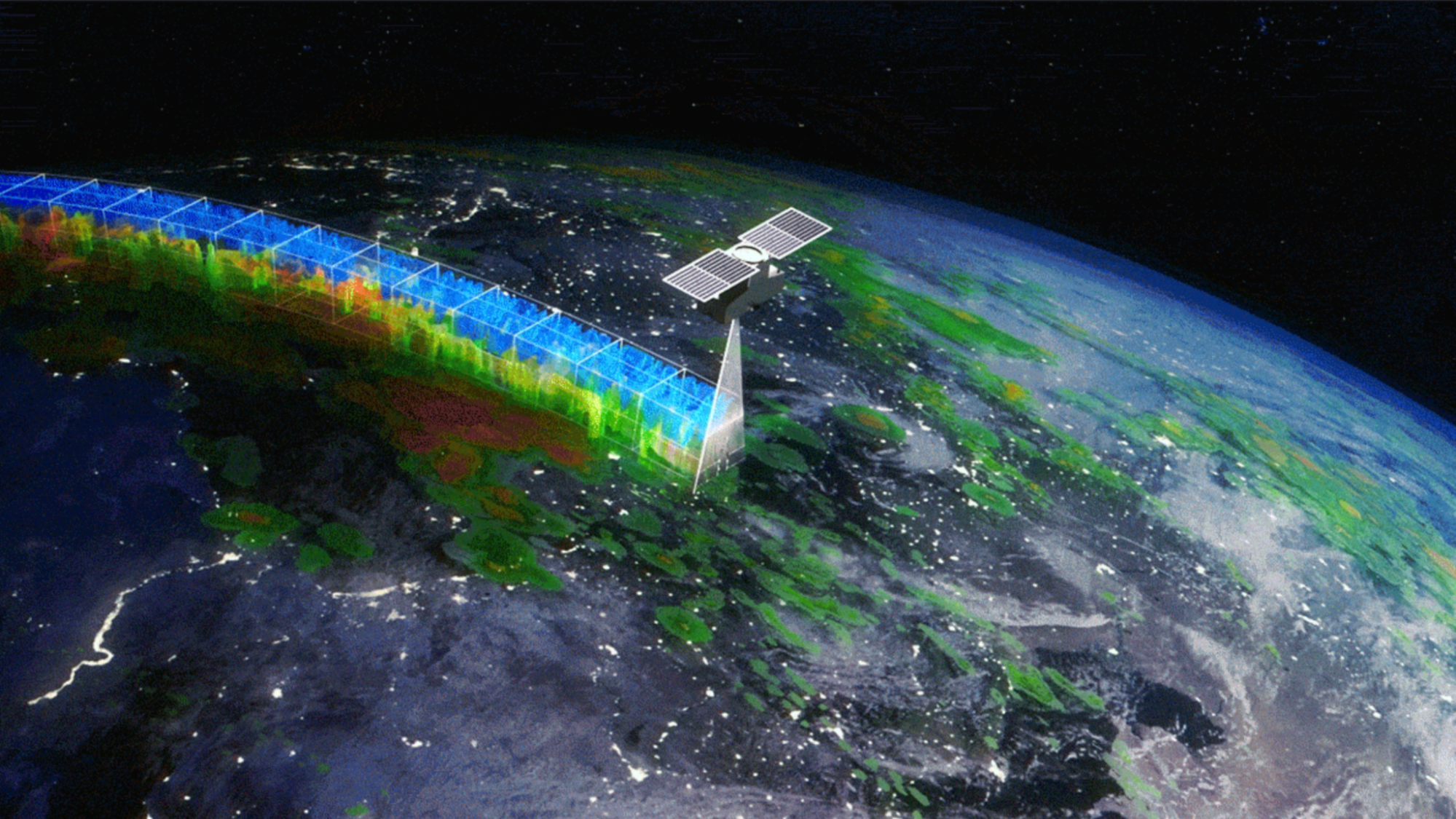
Tomorrow.io has been building out its proprietary constellation of weather satellites specifically engineered to fill observational gaps and deliver near-real-time insights to data-starved regions around the world.

  • Tomorrow.io satellites produce near-continuous atmospheric data, capturing parameters crucial for both real-time forecasting and longer-term climate analysis.
  • This global coverage provides a comprehensive picture of the global atmosphere and its weather systems – even in areas where ground-based instrumentation is scarce.
  • Beyond raw data aggregation, Tomorrow.io applies generative AI techniques to translate complex atmospheric patterns into impact-based guidance.
  • For industries like transportation, energy, emergency management, and financial services, these tailored insights reduce guesswork and automate decision-making.
  • By merging operational data (for example, flight schedules, logistics routes) with live weather feeds, Tomorrow.io’s platform pinpoints the when, where, and how of potential disruptions.
  • The Tomorrow.io data pipeline feeds directly into NVIDIA Earth-2 AI services, enabling rapid use of satellite observations when they are most fresh and drastically reducing the time from satellite overpass to actionable insight.

Accelerating AI-Powered Forecasting with NVIDIA AI Frameworks

NVIDIA underpins Tomorrow.io’s real-time weather intelligence with high-performance computing and state-of-the-art AI frameworks. These technologies, optimized for massive parallelism, unlock crucial capabilities such as generative AI super-resolution.

Scaling Global Weather Intelligence

Looking forward, this work is set to expand in both capability and scope in the following ways:

StormCast Deployment and Satellite Enhancement

  • A specialized severe weather model designed by NVIDIA, which provides kilometer-scale forecasting, is set to be deployed by the Tomorrow.io team. It will be focused on rapidly intensifying storms and emergencies.
  • Tomorrow.io will enhance this model with the Tomorrow Constellation and the efficient NVIDIA Earth-2 AI stack, ensuring near-real-time updates while scaling globally.

Satellite-Enriched Models on Earth-2

  • Tomorrow.io’s proprietary satellite data will feed into the Earth-2 platform, creating a powerful near-real-time digital twin of the planet. This integration enables training, inference, and reinforcement of next-generation models, all driven by live atmospheric observations rather than solely synthetic datasets.
  • The Tomorrow.io team is enhancing various open-source models with the Tomorrow Constellation, making them available to solution providers on the Earth-2 platform as well as the Tomorrow Resilience Platform.

Global Expansion and Opening New Markets

  • The Tomorrow.io Constellation and global capabilities create new datasets in widely underserved regions, ensuring that critical, life-saving forecasts become available when and where they’re needed most.
  • This expanded data access – both for historical analysis and forecasting – unlocks new market opportunities across finance, energy, supply chain, aviation, and beyond.
  • This approach fosters disaster preparedness and economic resilience on a larger, more inclusive scale.

New Techniques for the Next Generation of AI Forecast Models

  • Harnessing deep learning against the data created by the Tomorrow Constellation – rather than synthetic observations used by most AI models – vastly improves predictive performance. Training on actual conditions preserves storm system structures, avoids data abstraction losses, and enables continuous model training, inference, and reinforcement.
  • Reducing reliance on synthetic data allows for more authentic performance gains and breakthroughs in predictive accuracy.

Tomorrow.io and NVIDIA Earth-2

Tomorrow.io offers multiple AI services, datasets, and solutions on Earth-2 to streamline the integration of real-time weather intelligence into diverse applications. This lowers the barriers to entry, drives industry innovation, and accelerates new solutions at a time they are needed most.

Summary

As the global landscape faces amplified climate risks, Tomorrow.io is charting a new frontier in weather and climate resilience, intelligence, and infrastructure.

Conclusion

Tomorrow.io and NVIDIA are charting a new era in climate-tech innovation – one that not only anticipates extreme weather but also empowers communities and industries to thrive amidst it. By bridging data gaps and accelerating AI capabilities, they embody a data-driven future that meets the scale and urgency of the world’s most pressing weather and climate challenges.

FAQs

What is Tomorrow.io’s approach to overcoming challenges in weather forecasting?

Tomorrow.io tackles these challenges with a four-pronged approach, including expanding data access, enhancing model efficiency, leveraging real data, and delivering business insights.

What is Tomorrow.io’s satellite-based approach to weather forecasting?

Tomorrow.io has built a proprietary constellation of weather satellites to fill observational gaps and deliver near-real-time insights to data-starved regions around the world.

How does Tomorrow.io’s approach to AI-powered forecasting compare to traditional approaches?

Tomorrow.io’s approach leverages the power of NVIDIA Earth-2 AI frameworks to accelerate AI-driven forecasting, enabling real-time insights and predictive accuracy not possible with traditional approaches.

What are the benefits of Tomorrow.io’s real-time weather intelligence?

Tomorrow.io’s real-time weather intelligence provides contextualized insights, enabling businesses to reduce guesswork and automate decision-making, and individuals to stay ahead of the curve when it comes to weather-related disruptions.

What is the future of weather forecasting with Tomorrow.io and NVIDIA Earth-2?

Tomorrow.io and NVIDIA Earth-2 are pushing the boundaries of innovation, expanding global coverage, and opening new markets, fostering disaster preparedness, and driving economic resilience on a larger scale.

NASA just casually dropped the coolest optical illusion we’ve seen

0

Optical Illusions in Space: A Celestial Treasure Trove

NASA’s Hubble Telescope Captures Unbelievable Phenomena

Believe it or not, we’ve seen a few optical illusions in space over the year. Well, we haven’t seen them – the Hubble telescope has. NASA has been sharing photographs depicting unusual phenomena among the stars for a while now, but today’s example might be the most impressive yet.

A Galaxy and a Star: An Illusion of Proximity

In a post titled ‘Hubble Sees a Spiral and a Star’ on its website, NASA describes how the photo features a sparkling spiral galaxy paired with a prominent star, both in the constellation Virgo. But since the star is in an entirely different galaxy, their proximity is an illusion. Like all the best optical illusions, it’s a bit of a head-scratcher.

The Image: A Combination of Data from Two Instruments

The image combines data from two of Hubble’s instruments: the Advanced Camera for Surveys, installed in 2002 and still in operation today, and the older Wide Field and Planetary Camera 2, which was in use from 1993 to 2009. The data used here were taken more than 20 years apart for two different observing programs – a real testament to Hubble’s long scientific lifetime!

A Celestial Treasure Trove of Illusions

From a galaxy that looks like a penguin to these breathtaking full moons, it turns out the world of outer space is a celestial treasure trove of illusions. Need convincing? Check out these 4 reality-defying optical illusions in space.

Conclusion

The Hubble telescope has been capturing the wonders of the universe for decades, and its latest discovery is a testament to its ability to continue producing groundbreaking research. As we continue to explore the mysteries of space, we may uncover even more optical illusions that will leave us in awe.

Frequently Asked Questions

Q: What is an optical illusion?
A: An optical illusion is a visual phenomenon where our brain perceives something that is not actually there or misinterprets what we see.

Q: What is the Hubble Space Telescope?
A: The Hubble Space Telescope is a space-based observatory that has been in operation since 1990, capturing stunning images of the universe and conducting groundbreaking research in astrophysics.

Q: How does the Hubble Space Telescope work?
A: The Hubble Space Telescope uses a combination of instruments and cameras to capture images and collect data about the universe. It orbits the Earth at an altitude of 350 miles, above the distortion caused by the atmosphere.

Q: What is the significance of the image featured in this article?
A: The image features a galaxy and a star that appear close together, but are actually in different galaxies, making it an illusion of proximity. This image showcases the Hubble Space Telescope’s ability to capture complex and fascinating phenomena in the universe.

Robinhood Launches Cash-At-Doorstep Bank Accounts

0

Robinhood Expands Financial Services with New Banking and Wealth Management Platforms

New Bank Account and Wealth Management Options

Robinhood, a financial services company, is expanding its offerings by introducing a new banking platform called Robinhood Banking. The platform will allow users to access checking and savings accounts, as well as send and receive money through the Robinhood Credit Card app. Additionally, users will be able to have physical cash "delivered on-demand right to their doorstep," although the company has not provided many details on how this will work.

Banking Features and Benefits

Robinhood Banking promises a 4% annual percentage yield (APY) and FDIC insurance of up to $2.5 million on accounts. The company notes that since it’s not an FDIC-insured bank, it’s offering "pass-through" insurance provided by FDIC member Coastal Community Bank. Pass-through insurance involves insuring people’s funds by holding them "at an FDIC-insured bank through a third party," according to the FDIC.

Wealth Management Options

The company is also launching a new wealth management platform called Robinhood Strategies. This platform will offer access to a mix of single stocks and exchange-traded funds (ETFs), which "are actively managed to provide access to more opportunities." The funds have a 0.25% annual management fee, with a yearly cap of $250 for Robinhood Gold members.

Robinhood Strategies

Robinhood Strategies is available to Robinhood Gold members today, but it’s coming to all customers next month. Robinhood Gold is the company’s $5 per month (or $50 per year) subscription program that offers features like margin investing and larger instant deposits.

AI-Powered Investment Tool

Later this year, Robinhood plans to launch an AI-powered investment tool called Cortex for Gold subscribers. This tool will provide analyses and insights about the current market, such as why a particular stock is going up or down, as well as which stocks to consider trading.

Conclusion

Robinhood’s expansion into banking and wealth management marks a significant shift in the company’s focus from simple investing to a comprehensive financial services platform. With its new offerings, users will be able to manage their finances, invest, and access banking services all in one place.

FAQs

Q: What are the benefits of Robinhood Banking?
A: Robinhood Banking offers a 4% annual percentage yield (APY) and FDIC insurance of up to $2.5 million on accounts.

Q: How does pass-through insurance work?
A: Pass-through insurance involves insuring people’s funds by holding them "at an FDIC-insured bank through a third party," according to the FDIC.

Q: What is Robinhood Strategies?
A: Robinhood Strategies is a new wealth management platform that offers access to a mix of single stocks and exchange-traded funds (ETFs).

Q: Is Robinhood Strategies available to all customers?
A: No, Robinhood Strategies is currently available to Robinhood Gold members, but it’s coming to all customers next month.

Q: What is Cortex?
A: Cortex is an AI-powered investment tool that provides analyses and insights about the current market, such as why a particular stock is going up or down, as well as which stocks to consider trading.

You Can Access Free Gemini Gems on Android and iOS now

Google’s Gemini Gems Now Available for Free Users on Android and iOS

After first announcing Gems last fall, Google is now making the feature available to all users. If you’re not familiar, Gemini Gems gives you your own customized AI assistant. You can choose from one of Google’s pre-made options, or you can create one with your own instructions.

What sets this apart from using Gemini the regular way is that you can set instructions that only apply when you use that Gem. It’s a great tool if you use Gemini in different ways at different times — for example, if you want help writing social media posts, blog posts, and formal reports for the same company.

Which Gems are Available?

The Gems already available include:

  • A learning coach that helps you break down complex topics, making them easier to understand.
  • A brainstormer to give you easy inspiration — from fresh ideas for a themed party to the perfect gift for an upcoming birthday.
  • A career guide to help you unlock your career potential with detailed plans to refine your skills and achieve your career goals.
  • A writing editor to elevate your writing through clear, constructive feedback on everything from grammar to structure.
  • A coding partner that levels up your coding skills and can help you build projects and learn as you go.
  • A chess champ that lets you play chess with a language model (this one is still in experimental mode).

How to Access and Use Gems

To use Gems, head to the Gemini web app and look for the small gem icon on the left side. You’ll see the existing options and a plus sign to create your own. If you choose the latter, you can give your Gem a name, create instructions, and add up to 10 files for reference.

You can use Gems on Android and iOS, but you can only create them on the web app. To access Gems on a mobile app, tap your account photo in the top right corner and look for "Gem manager."

Conclusion

Gemini Gems is a powerful tool that can help you streamline your workflow and increase productivity. With its customizable AI assistant, you can tailor your Gemini experience to fit your specific needs. Whether you’re a student, a professional, or simply someone looking to improve their skills, Gemini Gems is definitely worth exploring.

FAQs

Q: How do I access Gemini Gems?
A: Head to the Gemini web app and look for the small gem icon on the left side.

Q: Can I use Gems on Android and iOS?
A: Yes, but you can only create Gems on the web app. To access Gems on a mobile app, tap your account photo in the top right corner and look for "Gem manager."

Q: How many files can I add to my Gem?
A: Up to 10 files for reference.

Q: Can I create a Gem with my own instructions?
A: Yes, you can give your Gem a name and create instructions.

Q: What is the difference between using Gemini Gems and regular Gemini?
A: With Gems, you can set instructions that only apply when you use that Gem.

How AI Chatbots Reason

0

What Does It Mean When an A.I. System Reasons?

Reasoning just means that the chatbot spends some additional time working on a problem. "Reasoning is when the system does extra work after the question is asked," said Dan Klein, a professor of computer science at the University of California, Berkeley, and chief technology officer of Scaled Cognition, an A.I. start-up. It may break a problem into individual steps or try to solve it through trial and error.

Can You Be More Specific?

In some cases, a reasoning system will refine its approach to a question, repeatedly trying to improve the method it has chosen. Other times, it may try several different ways of approaching a problem before settling on one of them. Or it may go back and check some work it did a few seconds before, just to see if it was correct. "Basically, the system tries whatever it can to answer your question," said Klein.

What Kind of Questions Require an A.I. System to Reason?

It can potentially reason about anything. But reasoning is most effective when you ask questions involving math, science, and computer programming.

How is a Reasoning Chatbot Different from Earlier Chatbots?

You could ask earlier chatbots to show you how they had reached a particular answer or to check their own work. Because the original ChatGPT had learned from text on the internet, where people showed how they had gotten to an answer or checked their own work, it could do this kind of self-reflection, too. But a reasoning system goes further. It can do these kinds of things without being asked. And it can do them in more extensive and complex ways.

Why is A.I. Reasoning Important Now?

Companies like OpenAI believe this is the best way to improve their chatbots. For years, these companies relied on a simple concept: The more internet data they pumped into their chatbots, the better those systems performed. But in 2024, they used up almost all of the text on the internet. That meant they needed a new way of improving their chatbots. So they started building reasoning systems.

How Do You Build a Reasoning System?

Last year, companies like OpenAI began to lean heavily on a technique called reinforcement learning. Through this process — which can extend over months — an A.I. system can learn behavior through extensive trial and error. By working through thousands of math problems, for instance, it can learn which methods lead to the right answer and which do not.

Does Reinforcement Learning Work?

It works pretty well in certain areas, like math, science, and computer programming. These are areas where companies can clearly define the good behavior and the bad. Math problems have definitive answers. Reinforcement learning doesn’t work as well in areas like creative writing, philosophy, and ethics, where the distinction between good and bad is harder to pin down.

Are Reinforcement Learning and Reasoning Systems the Same Thing?

No. Reinforcement learning is the method that companies use to build reasoning systems. It is the training stage that ultimately allows chatbots to reason.

Do These Reasoning Systems Still Make Mistakes?

Absolutely. Everything a chatbot does is based on probabilities. It chooses a path that is most like the data it learned from — whether that data came from the internet or was generated through reinforcement learning. Sometimes it chooses an option that is wrong or does not make sense.

Is This a Path to a Machine that Matches Human Intelligence?

A.I. experts are split on this question. These methods are still relatively new, and researchers are still trying to understand their limits. In the A.I. field, new methods often progress very quickly at first, before slowing down.

Conclusion

A.I. systems that can reason are a significant step forward in the development of chatbots. By building reasoning systems, companies like OpenAI and others are creating chatbots that can think more like humans. While these systems are not yet perfect, they are getting closer to mimicking human intelligence.

Frequently Asked Questions

Q: What is reasoning in A.I. systems?
A: Reasoning means that the chatbot spends some additional time working on a problem, breaking it down into individual steps or trying to solve it through trial and error.

Q: What kind of questions require an A.I. system to reason?
A: It can potentially reason about anything, but reasoning is most effective when you ask questions involving math, science, and computer programming.

Q: How is a reasoning chatbot different from earlier chatbots?
A: Reasoning chatbots can do things like show how they reached a particular answer or check their own work without being asked, and can do these things in more extensive and complex ways.

Q: Why is A.I. reasoning important now?
A: Companies like OpenAI believe this is the best way to improve their chatbots, as they need a new way of improving their chatbots after using up almost all of the text on the internet.