
Home Blog Page 16

SmartThings Blog

0

Lighting moves in real time with music through SmartThings Music Sync, creating a seamless, in-the-moment experience from the first beat to the last.

Lighting shapes the entire experience of a space, influencing how it looks, feels, and functions from the moment you walk in. With SmartThings expanding its partnership with Nanoleaf, your lights don’t just turn on and off, they respond to what you’re doing, what you’re listening to, and the kind of moment you want to create.

Whether you’re starting your day, hosting friends, or putting on your favorite playlist, your lighting becomes part of the experience. SmartThings Music Sync connects your lighting directly to your music, so your lights move in real time with what you’re playing. The result is a more seamless, in-sync experience that feels intentional from the first beat – right from your Galaxy device.

Turn Your Space Into a Living Visualizer

Nanoleaf is known for bold, colorful lighting and animated scenes, but with SmartThings Music Sync, that experience becomes more intentional and immersive.

Instead of reacting to sound in the room, SmartThings connects directly to your music source from your Galaxy device, so your Nanoleaf lights move in sync with what you’re actually playing. Every beat, drop, and transition feels precise. No guesswork. No delays.

Whether you’re gaming, watching, or listening, your lighting keeps up in real time, bringing a new level of energy to every moment and turning your space into a living, breathing visualizer.

Elevate Your Gaming Experience

Gaming is all about immersion and lighting can take it even further.

With SmartThings Music Sync and Nanoleaf, your space responds in real time as you play. Background music, in-game soundtracks, and audio cues are reflected through dynamic lighting that shifts with the intensity of the moment.

Exploring a new world? Your lighting sets the tone.
In the middle of a fast-paced match? Colors pulse with the action.
Winding down post-game? Your space transitions with you.

It adds another layer to the experience, one that pulls you deeper into what you see, hear, and feel. 

A Full Experience, Not Just Lighting

Lighting is just one part of the moment. With SmartThings, your Nanoleaf setup can work alongside other devices to create a more complete experience. Start a routine and your lights, music, and speakers can respond together.That means your space doesn’t just change, it comes together.

Start a playlist and your environment responds instantly. No switching between apps. No extra steps. Just a setup that works the way you expect it to.

Choose the Mood, Everything Follows

SmartThings makes it easy to build routines that fit your day.

From your Galaxy device, you can set up automations like:

  • Lights gradually brightening in the morning
  • A wind-down routine with softer tones at night
  • A party setup that activates music sync and dynamic scenes
  • Lights turning off when you leave

Once it’s set, everything runs in the background, so your space is always ready when you are.
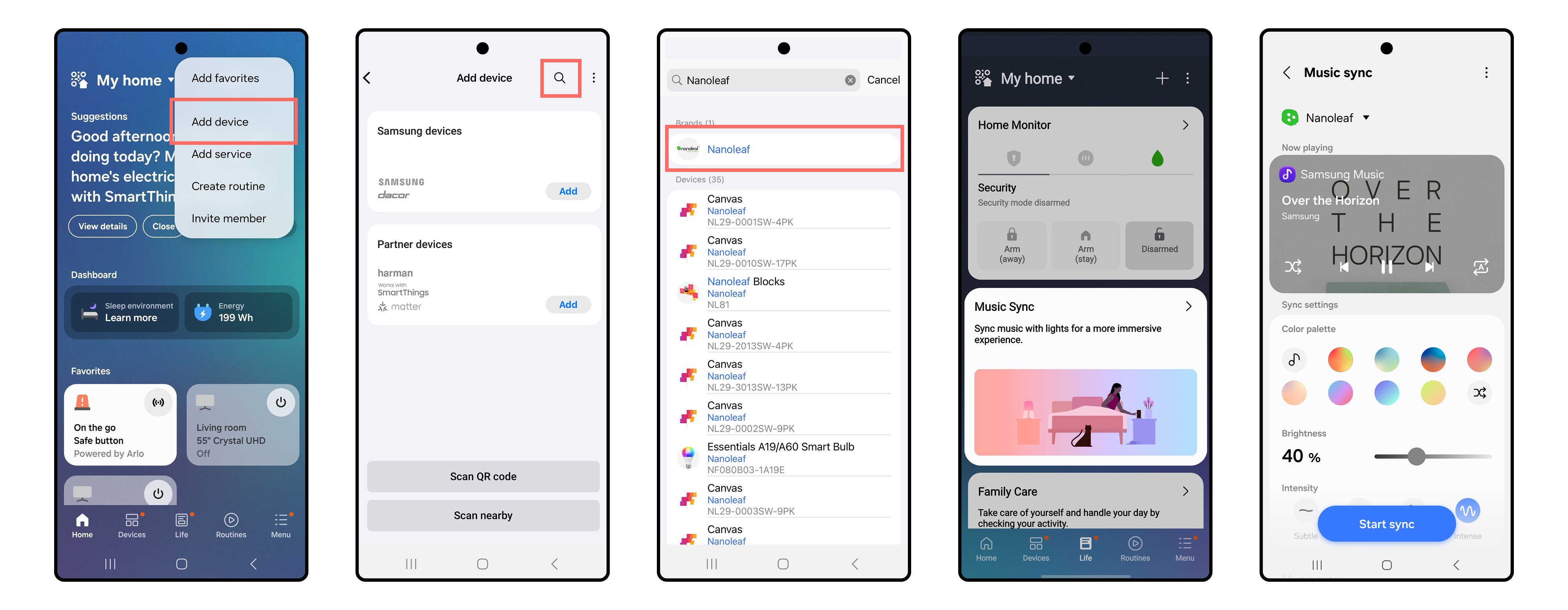
SmartThings Music Sync and Nanoleaf Setup Screens

Easy to Get Started

Adding Nanoleaf to SmartThings only takes a few steps:

  1. First, make sure you have a hub available
  2. Open the SmartThings app on your Galaxy device
  3. Tap the “+” icon and select “Add device”
  4. Search for  Nanoleaf and select your device
  5. Follow the prompts to connect

From there, you can group your lights, create automations, and start building routines right away. 

After setting up your routines, go to the Life tab within the SmartThings app. Select Music Sync and follow the prompts to complete the sync with your Nanoleaf devices.

A Space That Feels Just Right

Your space should adapt to you, not the other way around. With Nanoleaf and SmartThings, lighting becomes something more personal. It shifts with your mood, keeps up with your music, and helps create moments that feel effortless. Bring your space to life today and visit partners.smartthings.com/partners/nanoleaf to learn more.


Generate single title from this title 3 ways students can use AI tools to improve their literacy skills in 100 -150 characters. And it must return only title i dont want any extra information or introductory text with title e.g: ” Here is a single title:”

Write an article about

Key points:

Some might worry that the introduction of AI tools in the English classroom will simply lead to more cheating and even worse literacy rates, leaving students unprepared for college and careers that demand strong writing and communication skills.

While there are scary aspects of students using AI in school, there are many more benefits, tipping the scale toward learning to use AI appropriately rather than banning it.

The following three use cases are designed to improve students’ literacy skills through the use of AI, which can be helpful for English teachers as well as in other content areas where literacy is a focus.

Thought partner for ideas

Most people still use ChatGPT and other AI tools like they would use Google. However, these tools are much more robust in that they can fill specific roles teachers and peers have traditionally played in classrooms. Much of a student’s schooling is spent learning ways to formulate and polish ideas, but AI can offer a researched and responsive thought partner for students as they consider complex ideas. Rather than having AI write an essay, the tools can offer support in a more complex fashion than just searching the internet. This means that we can create far more rigorous assignments without a ton more lesson planning and delivery.

For example, students might be tasked with writing an essay based on a scientific argument they learned about in class. Using AI, they can generate several justifications and rebuttals to support their claims. AI can provide considerations for the debate that students can then use to write their rationale to support one side of an argument or another. Perplexity, for example, will provide students with links to the available resources, which students will have to determine as credible or not–another very important skill when using the internet for information.

Editing and structural support

As with many skills, using models can be helpful to see what excellence looks like to be able to replicate certain aspects of the model and alter others. The same can be said for students having access to an editor while they shape ideas. We all love when students arrive at a clever notion or personal breakthrough, but even more powerful than that is when they are able to articulate their ideas to others and engage in deep reflection. AI can be used as a tool in the classroom to support students by giving them feedback and guidance on how well they’re communicating what they are learning.

This approach requires coaching from educators on how to help students leverage a tool rather than simply request an output. Students can take what they’re writing and ask AI tools to critique it for clarity and consistency in both language and structure. To some, this may sound like a version of “cheating,” but we would compare it to the use of a calculator in a mathematics classroom. To ignore AI as a tool of the future only hinders students by encouraging them to use AI in undesirable ways, missing out on the opportunity to develop AI-aligned skills that can be used in both academics and professional settings.

Voice to text and more

One of the most significant ways AI-powered tools support literacy is to lower the barrier between a student’s thoughts and their ability to express themselves. For many of our most struggling and diverse learners, the challenge of expression is not a lack of thoughtful ideas but the difficulty in putting those ideas into words. Voice-to-text tools powered by AI can create new entry points for reading and writing by allowing students to speak their ideas aloud and see them transformed into text that can then be molded and shaped more easily. This capability frees students to focus on developing their thinking without being hampered by spelling, handwriting, or keyboarding skills.

Transcription supported by AI is just the beginning; tools now extend beyond simple dictation features. This means that students can have an active thought partner who provides vocabulary suggestions, pronunciation guidance, and real-time feedback. For example, a student working on a science project might dictate the experimental design and procedure and use AI for help refining technical terms, highlighting words that could be clarified for an audience, or even suggesting synonyms that better match the intended tone. These tools amplify the student’s voice and make them more clear to their intended audience.

AI tools are especially powerful for diverse learners. English language learners can hear back their spoken words pronounced clearly, practice fluency, and receive feedback on their accuracy with a clear and consistent personalized AI tool. Students with learning differences, such as those with dyslexia, can leverage dictation as a way to capture and convey ideas without the anxiety of spelling and writing obstacles. This allows students to focus on concepts, themes, and ideas in one setting and then focusing on strengthening other literacy skills in another. This helps students experience creative expression without boundaries that too often prevent them from doing either task well–thinking or communication.

Conclusion

There are clearly questions raised about where to draw lines around when and how students should use AI tools; however, the reality is that the tools are here and students are using them. As educators, we have to act fast to intervene and coach students on effective and acceptable uses of AI that enhance learning, and we must seize the moment. The first step, though, is to provide teachers with time to experiment and engage with AI on their own so that they can identify the ways in which these technologies can best support learning in their classroom.

Dr. T.J. Vari, MaiaLearning & Thomas O’Brien, Winward Academy

Dr. T.J. Vari is the Senior Director of Product Strategy at MaiaLearning, with a focus on postsecondary planning for students worldwide. Dr. Vari is a former deputy superintendent, middle school assistant principal and principal, and high school English teacher. He’s the cofounder of TheSchoolHouse302, a leadership development firm, and the coauthor of seven books on educational leadership, which are the basis for his speaking engagements, coaching, and leadership development institutes.
Thomas O’Brien is the Vice President of Success & Engagement at Winward Academy, where he supports hundreds of schools, districts, and after-school programs across the country in achieving their college and career readiness goals. Prior to joining Winward Academy, Mr. O’Brien served as a nationally recognized high school principal and award-winning math teacher, leading innovative efforts to improve student achievement and access. He writes a blog about math instruction, education technology, and school leadership. His forthcoming book will be released this summer.

Latest posts by eSchool Media Contributors (see all)

.Organize the content with appropriate headings and subheadings ( h2, h3, h4, h5, h6). Include conclusion section and FAQs section with Proper questions and answers at the end. do not include the title. it must return only article i dont want any extra information or introductory text with article e.g: ” Here is rewritten article:” or “Here is the rewritten content:”

Tackling the housing shortage with robotic microfactories | MIT News

0

A national housing shortage is straining finances and communities across the United States. In Massachusetts, at least 222,000 homes will have to be built in the next 10 years to meet the population’s needs. At the same time, there are numerous challenges in traditional construction. There’s a shortage of skilled construction workers. Most projects involve multiple contractors and subcontractors, adding complexity and lag time. And the construction process, as well as the buildings themselves, can be a major source of emissions that contribute to climate change.

Reframe Systems, co-founded by Vikas Enti SM ’20, uses robotics, software, and high-performance materials to address these problems. Founded in 2022, the company deploys microfactories that bring housing fabrication and production closer to the regions where the homes are needed. The first homes designed and manufactured in Reframe’s first microfactory have been fully built in Arlington and Somerville, Massachusetts. 

Enti’s experiences in MIT System Design and Management (SDM) shaped the company from its start. “Learning how to navigate the system and finding the optimal value for each stakeholder has been a key part of the business strategy,” he says, “and that’s rooted in what I learned at SDM.”

Better tools for system-level problems

Enti applied to SDM’s master of science in engineering and management while he was working at Kiva Systems, overseeing its acquisition by Amazon and transformation into Amazon Robotics. He found that the SDM program’s fundamentals of systems engineering, system architecture, and project management provided him with the tools he needed to address system-level problems in his work.

While he was at MIT, Enti also served as an associate director for the MIT $100K Entrepreneurship Competition, which offers students and researchers mentorship, feedback, and potential funding for their startup ideas. He realized that “there isn’t a single formula for how businesses start, or how long it takes to get them started,” he says, which helped shape his plans to start his own business.

Enti took a leave of absence from MIT to oversee the expansion of Amazon Robotics in Europe. He returned and completed his degree in 2020, writing his thesis on developing technology that could mitigate falls for elderly people. This instinct to use his education for a good cause resurfaced when his daughters were born. He wanted his future business to address a real-world problem and have a social impact, while also reducing carbon emissions.

Growing housing, shrinking emissions

Enti concluded that housing, with immediate real-world impact and a significant share of global carbon emissions, was the right problem to work on. He reached out to his colleagues Aaron Small and Felipe Polido from Amazon Robotics to share his idea for advanced, low-cost factories that could be deployed quickly and close to where they were needed. The two joined him as co-founders.

Currently, the microfactory in Andover, Massachusetts, produces structural panels, with robotics completing wall and ceiling framing and people completing the rest of the work, including wiring and plumbing. Eventually, Reframe hopes to automate more of the building process through further use of robotics. The modular construction process allows for reduced waste and disruption on the eventual home site. And the finished homes are designed to be energy-efficient and ready for solar panel installation. The company is set to start work soon on a group of homes in Devens, Massachusetts.

In addition to the Andover location, Reframe is setting up in southern California to help rebuild homes that were destroyed in the area’s January 2025 wildfires. The company’s software-assisted design process and the adjustability of the microfactories allows them to meet local zoning and building codes and align with the local architectural aesthetic. This means that in Somerville, Reframe’s completed buildings look like modernized versions of the neighboring three-story buildings, known locally as “triple-deckers.” On the other side of the country, Reframe’s design offerings include Spanish-style and craftsman homes.

“Housing is a complex systems problem,” Enti says, explaining the impact SDM has had on his work at Reframe. The methods and tools taught in the integrated core class EM.412 (Foundations of System Design and Management) help him tackle systems-level problems and take the needs of multiple stakeholders into account. The Reframe team used technology roadmapping as they devised their overall business plan, inspired by the work of Olivier de Weck, associate head of the MIT Department of Aeronautics and Astronautics. And lectures on project management from Bryan Moser, SDM’s academic director, remain relevant. 

“Embracing the fact that this is a systems problem, and learning how to navigate the system and the stakeholders to make sure we’re finding the optimal value, has been a key part of the business strategy,” Enti says.

Reframe Systems is set to continue learning through iteration as they plan to expand their network of microfactories. The company remains committed to the core vision of sustainably meeting the country’s need for more housing. “I’m grateful we get to do this,” Enti says. “Once you strip away all the robotics, the advanced algorithms, and the factories, these are high-quality, healthy homes that families get to live in and grow.” 

Generate single title from this title Data Science • AI • Advanced Analytics in 100 -150 characters. And it must return only title i dont want any extra information or introductory text with title e.g: ” Here is a single title:”

Write an article about

Forbes recently released its 2026 AI 50 list that showcases the most influential and fast-growing AI startups right now. If you look at this year’s list, you would notice that the focus is no longer just on building the most powerful models. Many of the companies making headway are solving for deployment, data access, and cost. In other words, the shift is moving away from raw model performance and dominance toward independence and how AI actually runs in real-world environments. That raises a bigger question: where is the real value in AI actually moving now. 

The list is based on factors like technical strength, growth, and market impact, with input from both AI experts and investors. The judging panel includes names like Joy Buolamwini, Sarah Guo, and Matt Murphy. This year also adds a new “Brink” list for earlier-stage startups, reflecting how quickly new players are emerging. Many of the companies on the main list are only a few years old but already valued in the billions, which shows how fast the AI market is moving.

The Value is Moving Beyond Model Builders

Let’s have no doubt that the model companies are still leading. OpenAI, Anthropic, and Mistral AI continue to push capability forward. That part has not changed.

However, there are key changes if you look at the rest of the list. Companies like Perplexity, Cursor, and Harvey are there for a different reason. They are not building models. They are building products on top of them.

(vectorfusionart/Shutterstock)

There is also some continuity from last year. Perplexity was already on the 2025 AI 50 list, while Cursor and Harvey represent a newer wave that has caught the wind more recently and is showing up more prominently this year. 

Perplexity built an AI-first search product that combines retrieval with generated answers. Cursor built a coding environment where AI assists directly inside the workflow, helping write and edit code in context. Harvey focused on legal work, applying AI to contracts, case law, and firm-specific data.

These companies are not competing on model performance. They are solving specific problems using models as one part of a larger system. This is why this year’s list is not just a model list anymore. It is a mix. Some build the models, others shape how those models are used. That is where more of the value is starting to show up.

Infrastructure and Data Are Becoming Central

Another thing you notice in the 2026 list is the presence of companies that are not primarily focused on building foundation models. Names like Databricks, Crusoe, and SambaNova Systems are included because they handle the systems around AI rather than the models themselves.

Each of them operates at a different layer. Databricks is best known for its data platform – where enterprises store, process, and prepare data, and increasingly build and run AI workloads on top of it. 

(innni/Shutterstock)

Crusoe is building data center capacity and cloud infrastructure aimed at large-scale AI compute. It focuses on how and where models run. SambaNova develops specialized hardware and integrated systems designed to run AI workloads efficiently, often packaged as full-stack solutions rather than standalone chips.

These roles overlap, but the pattern stays the same. None of these companies are trying to win by having the smartest model. They are focused on data access, compute availability, and how AI systems are deployed in practice.

That is why they sit on the same list as model labs. AI does not operate in isolation. It depends on data pipelines, infrastructure, and execution environments. The companies that control those layers are in a strong position – especially as AI moves deeper into production use.

Less Dependence on Big AI

One of the clearest signals from the list is the focus on reducing reliance on a small number of dominant AI platforms. This is not just a theme called out by Forbes. It shows up in how many of the companies are being built.

More of them are not tied to a single model or provider – they are instead building their own layers around AI. That includes proprietary data, tighter workflow integration, and systems designed for specific use cases. The goal is not just access to AI, but more control over how it is used.

(elenabsl/Shutterstock)

This connects directly to another theme in the list, which is efficiency over size. Companies are not chasing the largest models. They are focused on cost, performance, and how systems behave in real conditions. That changes how products are designed and where effort is spent.

The number of new entrants reinforces this direction. With 20 newcomers, many are focused on specific problems rather than general models. That points to a market expanding beyond a small group of dominant players. The list suggests a broader ecosystem. Large model providers still matter, but more companies are building ways to operate with greater independence.

If you want to read more stories like this and stay ahead of the curve in data and AI, subscribe to BigDataWire and follow us on LinkedIn. We deliver the insights, reporting, and breakthroughs that define the next era of technology.

.Organize the content with appropriate headings and subheadings ( h2, h3, h4, h5, h6). Include conclusion section and FAQs section with Proper questions and answers at the end. do not include the title. it must return only article i dont want any extra information or introductory text with article e.g: ” Here is rewritten article:” or “Here is the rewritten content:”

the ‘Friend Yet Foe’ Paradox

0

Discussions about Artificial Intelligence (AI) and its impact on work are now virtually inescapable. Of course, debates about how new technologies will change or reduce work, or replace workers, are hardly new. Warnings of robots and machines taking our jobs have been sounded since the Industrial Revolution. And yet, amid the maelstrom of hype on AI, some things have already changed, higher education being one example. Research has revealed students to be early adopters of large language model chatbots such as ChatGPT, Google Gemini and Claude. The question is not whether students are using AI, but how.

In light of this, academia is currently wrestling with the issue of whether to prevent or embrace the use of AI in teaching and assessment. A key question is whether students’ use of AI can prepare them for their future careers, or if instead it is preventing them from learning key skills required for the workplace. We explored this point in our research via interviews and focus groups with over 50 students. We draw on the idea of a ‘friend yet foe’ paradox to argue that students see AI as both a useful learning tool while simultaneously being sceptical of its ability to produce high-quality and reliable outputs. In some cases, students felt AI could undermine their learning, but used it nonetheless.

Various reasons were put forward for how AI can act as a ‘friend’. For example, students prepare for seminars by answering questions with AI-generated talking points for the assigned readings, or they write essays by summarising literature, finding references or building on AI-generated structures. Students often suggested that using AI in these ways made them more efficient in completing their work.

One student told us that “[AI] can help inspire your thinking or provide fresh perspectives to stimulate your own ideas”. AI is thus becoming a learning assistant akin to having a personal tutor available 24 hours a day. AI can help students directly and immediately with their work and is capable of a number of tasks which are often time consuming and intellectually challenging. In many cases, these tasks involve deep reading, argument construction, synthesis and the integration of evidence in large volume. AI provides a shortcut by skipping aspects of this process to produce an output.

However, students also hint at the idea that AI can also be a ‘foe’. We find clear evidence of their lack of trust in the technology. They question its reliability in using sources that meet academic rigour, and recognise the risk of its producing hallucinated references. Moreover, students also highlight AI’s limitations in meeting specific assignment requirements, identifying that although it is largely effective at producing generic outputs, these outputs are ‘shallow’, ‘general’, ‘not innovative’ and even ‘not usable’.

Because of this scepticism, all of the students we spoke to use AI in specific ways to help them write, but in ways that constitute the augmentation rather than the replacement of their work, incorporating significant human oversight of the process. For example, one student told us “I never let AI write large parts of my paper. I only use it in the early stages for suggestions”. Others highlighted how they would use AI to provide feedback, or even mark their work, although they noted these marks were not commensurate with the ones they were ultimately awarded.

Where AI really becomes a foe is in relation to the learning process. We find that students’ criticism is largely centred on AI’s outputs rather than on how using AI could undermine skill and knowledge development. In fact, many seem to prioritise perceived efficiency over learning. As one student put it, “I don’t think information searching skills are that important relatively. If there’s a more efficient way, why would I insist on doing it the hard way?”. However, a small proportion of students acknowledge their potential loss in skipping the ‘old-fashioned’ way of learning: “Students from the past, who didn’t have AI and had to go to the library and search through books themselves, […] probably absorbed more of the knowledge deeply.”

Given the importance of developing knowledge and skills for future employment, it is concerning that students might be overlooking this in favour of taking shortcuts to produce outputs that they themselves question. So why do students still use AI? They believe AI has become a ubiquitous tool in the workplace and that they will be expected to be familiar with it because AI is ‘required’ or ‘unavoidable’. However, in chasing efficiency, students are potentially denying themselves the opportunity to develop higher-order capacities such as cognitive, critical and creative thinking that are essential in the workplace but are accumulated through deliberate training. Instead, they train themselves by ‘asking the right questions’ of AI.

It is of course worrying for educators if students are so focused on outputs that they overlook the development of their own knowledge and skills. But this should be equally worrying for employers: even prompt engineers will need to think critically and have subject knowledge to get the most out of AI. It is evident that AI is here to stay, and we must find ways to ensure that students understand that technology cannot replace their own thinking and skills development. One approach is to emphasise the human qualities that AI cannot replace, such as empathy, emotional intelligence, critical thinking and interpersonal skills. If students understand that these skills are required in order to complement – or make effective use of – AI, it might still be possible to accentuate the importance of the learning process while allowing them to develop the AI skills they feel they need for their future careers.

Xiaoting Luo is a Lecturer in Strategy and International Business Management at the University of Bristol Business School.

Christopher Pesterfield is a Lecturer in Management at the University of Bristol Business School.

Image credit: Igor Omilaev via Unsplash

Assetisation, LinkedIn, and the Future of Work

0

LinkedIn has become inescapable. With over 800 million users, the platform has moved well beyond its origins as a recruitment tool to become a space where professional worth is performed, measured and publicly displayed. We are all familiar with the genre: the humble post about a career milestone, the team photo with a heartfelt caption, the carefully worded reflection on ‘lessons learned’. The style is so recognisable that ‘LinkedIn’ has become a shorthand for a particular brand of performative professionalism that even football managers are now mocked for embodying. But behind the parodies lies something worth taking seriously. Over the past decade, a growing industry of career coaches, recruitment consultants and personal branding experts has converged on a single injunction: your professional self must be cultivated, displayed and continuously optimised. What is less often acknowledged is what this injunction entails: that employees are increasingly being asked to treat themselves as assets.

Assetisation – the process through which things are transformed into assets capable of generating future returns – has gained traction in political economy as a concept describing new modes of capital accumulation, described as the supply-side mechanism of financialisation. Research has shown how this logic reshapes domains as diverse as land, data and natural resources, but the assetisation of workers themselves – not just their labour, but their identities, their visibility and their reputational capital – has yet to be fully examined.

Selling yourself: How LinkedIn turns professionals’ online selves into assets

Across a growing number of firms, employees’ LinkedIn profiles are no longer treated as private matters. Employees are provided with corporate banners and professional headshots taken at the office, given ‘best practices’ for writing their headlines and job descriptions, included in internal communication channels where they are regularly invited to like and share their company’s and managers’ posts, and in some cases formally trained to use the platform. The message is consistent: your online presence is a professional responsibility. What emerges from these practices is a process of assetisation applied to the self, where the employee’s online persona is gradually reframed as an asset expected to generate value for both the company and the employee.

This process works, first, through the instrumentalisation of the professional online self. LinkedIn profiles are recast as technical artefacts to be optimised for algorithmic performance. Employees learn to treat their profiles not as reflections of who they are, but as instruments designed to maximise discoverability and reach. Keywords are inserted strategically into job descriptions, skills are endorsed for their effect on rankings rather than as genuine attestations of competence, and network connections are expanded not for relational value but for algorithmic amplification. The profile ceases to function as a form of self-expression and becomes a piece of infrastructure to be engineered – a first, necessary condition for its transformation into an asset.

It works, second, through what might be called organisational capture. Once profiles have been instrumentalised, they are aligned with the employing organisation’s brand. Employees are encouraged to adopt corporate banners, reference the company prominently in their headlines and post content that makes the organisation visible to their networks. When dozens of employees display the same visual identity, each individual profile operates as a node in a distributed corporate communication network. The firm extracts reputational rent from employees’ personal digital spaces without formally owning them. Employees become, in effect, unpaid brand ambassadors.

What holds these two mechanisms together is a promissory logic of self-investment. Employees are not simply instructed to comply; they are invited to understand these practices as investments in their own professional future. A well-optimised profile, the reasoning goes, will pay off in professional exposure, peer recognition and new career prospects. Posting regularly is thus framed as self-enhancement rather than as labour performed for the organisation. This promissory framing is what distinguishes assetisation from more conventional forms of managerial prescription. It echoes what Foucault described as a form of power that works not by imposing rules from above but by shaping how individuals govern themselves.

Scholars of financialisation have observed a similar dynamic: when employees come to see themselves as investors in their own human capital, organisational discipline no longer needs to be enforced – it is embraced. On LinkedIn, employees who cultivate their online presence are simultaneously building what they perceive as their own asset and feeding the organisation’s reputational apparatus. The power of assetisation lies in this double bind: self-discipline appears as self-interest, and compliance becomes indistinguishable from personal investment.

Crucially, the digital architecture of LinkedIn reinforces this process through durability. Unlike face-to-face performances of professionalism, the artefacts placed on employees’ profiles, such as corporate banners, standardised photographs or sycophantic posts, persist independently of their ongoing actions. Even when employees stop posting, their curated profiles continue to circulate unchanged, projecting the company-approved version of the employee well beyond the moment of active engagement. Every ordinary interaction on the platform, a like, a comment, a shared article, automatically reactivates this curated identity, as the platform attaches the user’s corporate affiliation and curated profile to every interaction. The platform ensures that the asset-like quality of the online self is maintained with every click, regardless of intention.

Implications for the future of work

This creates two implications for the future of work. First, assetisation extends value extraction beyond labour into the self. When organisations encourage employees to optimise their LinkedIn presence, what is being put to work is no longer just their skills or their time – it is their image, their identity, their personal networks and reputation. These are dimensions of the self that have traditionally sat outside the employment relationship, yet they are now enrolled as sources of organisational rent. The employee who displays a corporate banner, posts about a team event or endorses a colleague’s skills is generating reputational value for the firm through aspects of themselves that no contract formally governs. If the scope of what organisations can extract value from now extends to who workers are and how they appear, then assetisation does not merely reshape workplace discipline – it redefines what counts as a productive contribution in the first place.

Second, assetisation expands the reach of legitimate organisational surveillance.

Once employees’ online selves are treated as assets, the organisation acquires what appears to be a natural interest in monitoring and managing them. LinkedIn training programmes make this dynamic visible: trainers track who has adopted a corporate banner, who posts regularly, who has completed the weekly challenge. But because this monitoring is couched in the vocabulary of personal development and career strategy, it does not register as surveillance. Employees who disengage are not disciplined in any formal sense; they are simply reminded that they are neglecting an investment in themselves. The disciplinary gaze is reframed as care, and resistance becomes legible only as self-neglect.

The LinkedIn case is just one entry point, but it reveals the logic with particular clarity: organisations now seek to capitalise on who their employees are, how they appear and the networks they inhabit, moving beyond the mere exploitation of their workforce. What we are witnessing is an extension of the domain of value extraction from what workers do, to who they are. Next time you are told to ‘invest in your personal brand’, it may be worth asking: whose portfolio are you really building?

Paul Richard is a PhD candidate at Université Paris Dauphine – PSL. His research examines how employees construct, rewrite and negotiate their digital identities through social media, and how these practices intersect with organisational control and the assetisation of the self.

Image credit: Zulfugar Karimov via Unsplash

Assetisation and the reconfiguration of work

0

We tend to think of workers as valuable because of what they do – the goods they produce, the services they provide. But what happens when workers are valued instead for what they are worth on a balance sheet, or for how much value they can add to an organisation’s assets?

In recent years, ‘assetisation’ – the process by which people, things and capabilities are turned into income-generating assets – has gained traction in the social sciences as a way of describing a new logic of capital accumulation. Rather than making money by selling goods or services, this logic focuses on transforming resources into assets that generate continuous financial returns: through rent, speculation or capitalised future earnings. Research on platform economies, land and natural resources has shown how this financial logic restructures ownership and governance to create new forms of rent extraction. Studies of professionals, content creators and gig workers further illustrate how individuals increasingly engage in self-assetisation, strategically managing their skills, visibility and networks as income-generating assets.

Two major consequences stand out. First, assetisation restructures employment relations, reconfigures workplace discipline and reshapes professional identities. Second, assetisation pushes financial risk downwards onto workers and intermediaries, making labour bear the costs that asset-based logics generate but that organisations do not formally absorb. To explore this, I draw on fieldwork conducted with health professionals in elite football, using this case to develop three propositions for scholars and those concerned with the futures of work in financialised workplaces.

In professional football, the assetisation of players’ bodies does not occur spontaneously. It is enacted through the daily work of health professionals – physiotherapists, sports physicians and performance staff – whose role has been progressively reshaped by the financial logic governing the industry. My findings show that these practitioners have become key intermediaries in the process through which athletes’ bodies are transformed into financially valorised assets.

My first finding concerns the function of health and performance data. Metrics such as Global Positioning System outputs, biomarkers and injury-recovery timelines serve not only as clinical instruments but as valuation devices: they translate bodily conditions into numbers that stand in for a player’s financial worth. This helps overcome the problem of putting a price on something as complex and variable as a human body. Yet, as my interviewees consistently noted, these metrics remain subject to interpretation. The apparent objectivity of measurement conceals a practical judgement that health professionals are increasingly expected to make in financial terms, not merely medical ones – a pressure that can sit uneasily with their clinical ethics.

My second finding concerns where health professionals are positioned within the broader process of asset valuation. Far from being confined to treatment and prevention, these practitioners are called upon at two critical commercial moments: during recruitment, when clubs assess a prospective player’s physical condition as part of their  financial valuation; and during transfer negotiations, when health status directly affects market price. Fitness assessments and medical certifications become tools of financial appraisal as much as medical evaluation.

A third dynamic extends beyond the club itself. Several practitioners described working through private centres that agents use to improve the physical – and therefore financial – profile of players they represent. Health professionals thus become part of a wider investment logic, helping to increase an athlete’s value as an asset managed across multiple actors. This outsourcing of physical valuation further draws the body into financial circuits, blurring the line between medical care and asset management.

From this case, I draw three propositions for understanding what assetisation does to labour.

First, assetisation introduces a distinct mode of workplace discipline – one that operates not only on the workers being assetised, but on those tasked with managing the process itself. Health professionals illustrate this most sharply: no longer simply clinicians, they are brokers expected to translate bodily signals into financially readable assessments, calibrate recovery timelines against contractual obligations, and certify readiness in ways that serve financial valuations as much as medical judgement. The discipline they experience arrives not as direct pressure but as a role quietly redefined – to care for the body is increasingly to manage an asset. Assetisation is insidious precisely because it does not announce itself, dressing organisational demands in the language of professionalisation and data-driven practice. Ethical friction, when it surfaces, tends to be experienced as a personal tension rather than a structural problem.

Second, assetisation is a mechanism for shifting risk as much as extracting value. Health professionals who accelerate a player’s return from injury against their medical judgement, or certify fitness under commercial pressure, absorb risks that the asset-based logic creates but that the organisation does not formally carry. Labour – including that of intermediaries like health professionals – becomes the primary casualty of asset-driven decision making, a point that existing assetisation studies have largely overlooked.

Third, and most fundamentally, assetisation dissolves the boundary between the person and the productive resource. When an athlete’s injury is framed primarily as a depreciation of an asset, the distinction between who the worker is and what the organisation extracts value from becomes difficult to sustain. If bodies are simultaneously personal attributes and organisational assets, the boundaries of the employment relationship are themselves in question – stretching organisational control into dimensions of the self, health and physical integrity that were previously considered outside the scope of work.

The football pitch may seem like an unlikely place to develop a theory of modern work. But the dynamics uncovered here – bodies valued as balance-sheet entries, professionals enrolled as brokers of the organisation assets’ financial worth, risk redistributed onto those least able to refuse it – are not peculiar to sport. They are visible wherever asset-based logics have taken hold, for example, in universities where researchers are managed as reputational assets whose visibility and citation counts shape the organisation’s market position. What the football case allows us to see with unusual clarity is the human infrastructure that assetisation requires –workers who do not simply have their labour extracted, but who are recruited into extracting it from others, and who absorb the ethical costs of doing so. For the labour movement, this matters. Traditional frameworks of exploitation focus on the wage relation: who captures the surplus produced by labour. Assetisation asks a different question: who bears the risk, and who carries the contradictions, when work is reorganised around the logic of asset management.

Pau López-Gaitán is a PhD candidate at the University of Bristol Business School. His research examines how financialisation reshapes organisations, labour relations and forms of resistance from within. He uses the football industry as a laboratory to trace how financial logics alter the conditions of work and collective life.

 Image credit: maks_d via Unsplash

Amazon workers in Coventry helped make this happen

0

The Employment Rights Act is a significant step forward in improving the right of workers to have their trade union recognised by their employer. It not only creates new opportunities to collectively defend pay and conditions, but tackles some of the tactics used by unscrupulous employers to union bust workers’ attempts to build a union in their workplace.

This is vital at a time when many people’s working lives are becoming increasingly precarious. The campaign by Amazon Coventry workers, supported by the GMB Union, provided an important test case that informed this legislation. In 2024, the union narrowly lost a ballot of the workforce that would have forced Amazon to recognise the union. That application for recognition revealed fundamental problems with the legislation that we were able to document. This document, informed by the voices of Amazon workers, helped persuade politicians of the changes that were needed.

The GMB Union first applied for statutory recognition at Amazon’s BHX4 Coventry warehouse in 2023. At that time, the union believed that more than 50 per cent of workers in the warehouse were GMB members, meeting the key test for statutory recognition. Amazon then recruited more than 1,300 additional workers, diluting the union membership below the required 50 per cent, before a count was taken by the Central Arbitration Committee (CAC), which oversees applications for statutory recognition. Employers will no longer be able to do this, because the Employment Rights Act mandates that anybody employed after the date of the application for recognition must not be included in the count of the workforce.

The ballot for recognition in 2024 gave the union rights to access the workplace in order to speak to workers, but Amazon was able to drag out the process for agreeing the terms of that access for 142 days, during which time it ran a relentless campaign to persuade workers to vote against recognition, drafting in 30 managers from other warehouses to help persuade workers, and spreading rumours that recognition could lead the warehouse to close, or could delay a pay rise by years. These threats carried very serious consequences because many of the workers were migrants with family members relying on the money they sent back home. Amazon also provided workers with a QR code that opened a worker’s personal email with a prepopulated message to the union resigning their membership. These and other measures were the subject of a complaint to the CAC, but the complaint was ruled inadmissible because it was made more than 48 hours after the ballot closed. All of this has now changed, with a set timescale for the terms of access to be agreed, new powers for the CAC to enforce the terms of access, and an extended deadline for complaints about employer conduct. All of these sensible measures create a more level playing field.

At the time of the 2024 application for recognition, there was a confusing collection of goalposts that a union was expected to meet. To apply for recognition, the union had to demonstrate both that at least 10 per cent of workers in the bargaining unit were members of the union, and that at least 50 per cent were likely to support recognition. And to win the ballot for recognition required both a majority vote and at least 40 per cent of workers in the bargaining unit voting for recognition. This has now been simplified to 10 per cent of workers needing to be in the union to apply for recognition, and recognition to be decided by a simple majority vote.

In 2024, voting could only take place by a postal or workplace ballot. Many Amazon workers were living in houses of multiple occupation, which made the prospect of even receiving a letter challenging. This was exacerbated by many workers not being familiar with the UK postal system. Leading workers within the GMB branch therefore opted for a workplace ballot, but this carried its own challenges, with the risk that some workers may have felt intimidated in an environment drenched in Amazon propaganda urging workers to vote against recognition. These problems are now being addressed through proposals to allow secure electronic balloting.

It’s unlikely that many of these legislative changes would have happened without the determined struggle of the Amazon Coventry workers, as their stories were frequently referred to by politicians to demonstrate the human cost of the previous rules. The majority of Amazon Coventry workers were from migrant or refugee backgrounds, coming from all over the world and speaking many languages, but they united in a struggle that, through the Employment Rights Act has benefitted all workers in the UK. They have demonstrated that working people can play a powerful role in driving positive changes to the law. Now it will be up to workers across the UK to decide what they will do with these increased rights, and whether they will use them to build their own powerful trade unions in every workplace.

Stuart Richards is Regional Secretary for TUC Midlands.

Tom Vickers is an Associate Professor at Nottingham Trent University.

Image credit: Olivier Rouge via Unsplash

Futures of Work ~ How Big Tech threatens European capitalism and what Europe and unions can do about it

0

Since the early 21st century, several European countries have gone through extensive liberalisation of their labour markets by undertaking structural reforms. This injection of liberal market elements has featured a misplaced conviction in the merits of labour market flexibility. The liberalisation trend was reproduced in other institutional spheres by an increased importance placed on shareholder value and led to extensive corporate and household financialisation, which in turn intensified the rise of contingent work across advanced industrialised countries. The dual processes of liberalisation and financialisation culminated in the eruption of a mortgage-led financial crisis in the US, which was transmuted – through the spurious role of credit rating agencies – into a sovereign debt crisis in Europe.

Despite this important turning point, few lessons have been learned. The post-crisis period, characterised by the strange non-death of neoliberalism, was not followed by rebalancing or stabilisation. Instead, a new long wave in the evolution of capitalism unveiled an acceleration of digitalisation and disruption of the labour and product market spheres enabled by innovations made by Big Tech and startups. While on the surface, digitalisation seems to be reflecting recent technological advances and disruptive innovations, the driver of this change has been the shareholder value imperative in disguise. In the technological ‘arms race’, Europe is frequently depicted as a laggard, having to rely on American or even Chinese technology companies.

But Europe never lacked innovative capabilities per se. Any failure was likely due to a heavy reliance on US technology that crowded out European technology, or a futile effort to emulate the US model. Nokia has been a case in point. US credit rating agencies downgraded Nokia for its perceived lack of innovative capabilities, leading to a self-fulfilling prophecy that eventually sealed its exit from the smartphone market. The technological innovation of Apple’s iPhone enabled app-based business models, hijacked by greedy startups to create shareholder value by constructing new platform labour markets in traditional economic sectors, e.g. accommodation (Airbnb) and transportation (Uber).

Yet the quality of jobs in Europe is not only threatened by the aggressive expansion of the platform economy. In parallel, Big Tech companies have exported their anti-union model to Europe, disrespecting workers’ rights with a slow erosion of the central pillars of the European social model. Amazon’s warehouse conditions, intrusive algorithmic management and anti-union strategies have been notorious. As the UNI Europa Regional Secretary, Oliver Roethig, stated: “In Germany, Amazon still refuses to collectively bargain with the ver.di trade union despite repeated demands. European competitiveness shouldn’t mean that union-busting and tax avoiding multinationals like Amazon have a competitive advantage over decent European employers that sign collective agreements and pay their taxes.” The same pattern of abuse of power and contempt of workers’ rights is observed elsewhere in Europe. Google workers in Sweden and their union Unionen took the company to court over its failure to involve the union in restructuring plans. In Ireland, workers for Meta’s contractor Covalen – which provides outsourced AI content-moderation services for Meta – went on strike over redundancies, severance pay and union busting.

These labour disputes run in parallel to the European Commission’s investigation of Meta, Apple and Google for potential abuses of their dominant position and anti-competitive practices. This contrasts sharply with the US model of ‘Wild-Wild-West’ capitalism. As the case of Google shows, American antitrust authorities allowed Google to abuse its power in the search engine market to colonise and monopolise even more digital markets. Despite US authorities paying lip service to free markets and competition, the political climate favours keeping Big Tech out of reach of any regulatory intervention, and monopolisation has been deemed acceptable.

The wave of digitalisation in capitalism did not only affect the product markets and the platform economy. In addition, it has enabled the adoption of intrusive algorithmic management and artificial intelligence across many different economic sectors. There has been some pushback. In countries like Spain, the platform economy has been regulated to avert a race to the bottom in working conditions. Trade unions in Luxembourg banks managed to respond to the digitalisation of service work by relying on their traditional power resources of social dialogue. In Germany, the works councils in ICT companies managed to shape the use of AI technologies in areas such as performance monitoring and workforce analytics, but faced more challenges in restructuring decisions.

This suggests that national-level responses are insufficient to avert the threat to European capitalism of Big Tech. The President of the European Commission, Ursula von der Leyen, announced in her 2025 State of the Union address that the Commission would propose a Quality Jobs Act in 2026 to update European rules protecting workers while supporting productivity and competitiveness in the context of algorithmic management and AI at work. The plan for a Quality Jobs Act is a welcome development; however, European policy makers and social partners need to ensure that this does not turn out to be another missed opportunity, since competitiveness will not come from emulating the US model.

The ETUC (European Trade Union Confederation) called the Commission to bring forward binding legislation and to include a dedicated EU Directive on AI and algorithmic systems in the workplace. This should enhance the power resources of unions and help them avert the threat to European capitalism. In the European social model, regulation in labour markets has always gone hand in hand with regulation in product markets and in industrial policy. Any EU-level initiatives should not only be focused on job quality as an isolated matter. Antitrust regulation and a national champions policy to limit its technological dependence on the US or China is paramount. In the broader environment of geopolitical volatility, an activist industrial and competition policy should be part and parcel of efforts to upgrade job quality in Europe.

Andreas Kornelakis is a Reader (Associate Professor) at King’s Business School, King’s College London. His research interests are in the areas of digitalisation, employment relations, HRM and comparative management. His work has appeared in the British Journal of Industrial Relations, Human Resource Management, Work, Employment and Society and other outlets.

Image credit: Shunya Koide via Unsplash

Futures of Work ~ Bricolage

0

As an editorial team, we usually aim to develop thematic issues of Futures of Work within the overarching meta-theme of work. Organising themes can be satisfying for several reasons. They reveal similarities, connections or shared underlying ideas across different texts or artefacts. Themes can be identified in films, books, music, parties and any number of other things, including, of course, academic work. We have had a pretty good run of achieving coherent themes, but sometimes things don’t exactly go according to plan. The person who showed interest in guest editing no longer has capacity; lists of ideas and contacts not already drawn upon shrink; marking deadlines approach; article revision or review deadlines press down; and programme reviews or departmental restructuring place unusual strain on all of the above. The result for our April issue? A bricolage of articles brought together with less coherence than we might usually like.

Of course, we could argue that trying to aim for a themed issue each time is unnecessary and only results in placing self-imposed restrictions upon ourselves. We are, as a result, hoisted with our own petard. After all, special issues in academic journals are the exception rather than the norm. Sometimes one might wonder if you have ended up in the wrong room at an academic conference, only to check the schedule and realise that, yes, this talk really has been put in this session. Perhaps you scratch your head, but accept it and enjoy the presentation anyway. Maybe themes don’t really matter.

While we don’t have a cohering theme for the issue, we do have some subthemes. Two articles address the importance of unions for protecting workers in large technology companies. In the first, Andreas Kornelakis argues that Big Tech companies have exported their anti-union model across Europe, with profits maximised at the expense of working conditions. Andreas contends that the response must transcend the national level, because it is only a united Europe that can push back against the power of Big Tech. Stuart Richards and Tom Vickers also address Big Tech, but this time by exploring how workers at Amazon’s BHX4 Coventry warehouse attempted to achieve union recognition but ultimately failed due to Amazon’s aggressive anti-union tactics. However, the fight did lead to some legislative changes that will benefit workers more generally, highlighting how individual battles can influence legal changes that have the potential for wider impact.

Financialisation is our second subtheme. Specifically, two articles tackle the assetisation of workers. Pau López-Gaitán argues that football players’ bodies have been turned into assets, facilitated by the work of health professionals. Various forms of data are used to measure health and performance, which translate bodily conditions into financial worth. Similarly, Paul Richard investigates how LinkedIn is used to turn workers into assets for their employers. We all recognise the ‘performative professionalism’ of humble bragging and the sycophantic posts about how incredible one’s employer is, turning employees into unpaid brand ambassadors. Both authors ask the question of who is benefiting from this form of assetisation.

Finally, Xiaoting Luo and Christopher Pesterfield’s article analyses how international postgraduate students at a business school are using artificial intelligence (AI). They argue that students see AI as both friend and foe, because it is both a personal tutor available 24/7, but is also not trusted by students to produce accurate and reliable outputs. Despite this, students continue to use AI because they feel it is required for the workplace, even if this might undermine their ability to develop important knowledge and skills that employers look for.

In sum, our bricolage is comprised of articles on unions and Big Tech, assetisation and AI. In some ways, this bricolage is indicative of the breadth of concerns that are currently at play for the future of work. And while we might have suggested above that themes do not really matter, we already have plans for them in forthcoming issues. In other words, we reserve the right to argue for or against the importance of themes, depending on our workloads and luck with putting them together.

Image credit: Gnider Tam via Unsplash