Home Blog Page 15

Generate single title from this title When AI means something different in every classroom in 100 -150 characters. And it must return only title i dont want any extra information or introductory text with title e.g: ” Here is a single title:”

Write an article about

Key points:

Walk into one classroom and AI doesn’t exist.

Walk into another and it’s doing half the work.

Walk into a third and it’s not allowed at all.

Students notice that.

They might not have the vocabulary for it yet, especially in elementary school, but they feel the shift. They know when something is “AI,” even if they can’t fully explain why. They also know when expectations change depending on the room they’re in. One teacher ignores it, another models it, another shuts it down. The result isn’t clarity. It’s confusion.

This is where we are right now.

In many schools, AI is being handled through individual teacher decisions rather than a shared structure. That makes sense in the short term. Teachers are responding in real time, trying to protect their classrooms, their expectations, and their students. But over time, that flexibility creates inconsistency. Students are left to figure out what is acceptable, what is not, and when the rules apply.

The issue is not whether AI should be used or not used.

The issue is that, without a clear baseline, students are learning different versions of the same reality.

In my classroom, I teach bilingual second grade during the day and adult English learners at night. I see how quickly students adapt to expectations when those expectations are clear and consistent. I also see how quickly things fall apart when they are not. That’s not a technology issue. That’s a systems issue.

AI didn’t create this problem. It exposed it.

Most conversations about AI in education focus on access, tools, or engagement. Those matter, but they miss something more fundamental. In a classroom where answers are easy to generate, the scarce resource is no longer information. It is ownership.

Do students still understand what they are doing?

Can they explain their thinking?

Do they recognize when something sounds right but is actually wrong?

Those are the questions that matter now.

If AI is introduced without structure, it can easily become a shortcut. Students learn that it gives answers quickly, and without guidance, that becomes the goal. But when it is used intentionally, it can do the opposite. It can make thinking more visible. It can push students to clarify, explain, and refine their ideas.

The difference is not the tool. It is the system around it.

That system does not have to be rigid. In fact, it should not be. Teachers need flexibility to decide what works for their students, their content, and their classroom environment. But flexibility without a baseline creates uncertainty. Students should not have to guess the rules every time they enter a new room.

A clear district or school-level policy can establish that baseline. It can answer simple but important questions: When is AI allowed? For what purpose? What does responsible use look like? From there, teachers can build guidelines that reflect their classroom needs.

That balance matters.

Without a policy, everything feels optional.

Without flexibility, everything feels forced.

Students need both.

This conversation also needs to start earlier than many people think. AI is often framed as a middle or high school issue, but the habits that shape how students use tools are built much sooner. In elementary classrooms, we are already teaching students how to think, how to question, and how to take ownership of their learning. AI fits into that work whether we name it or not.

In my classroom, we operate with a simple idea: Our class is a family. Students carry responsibility, not just for their work, but for how they think, how they participate, and how they support each other. The classroom runs as a system. I monitor it, guide it, and adjust it, but the students are active participants in it.

AI does not replace that.

If anything, it makes it more important.

Because when answers are easy to generate, understanding becomes something you have to protect.

The goal is not to avoid AI or to fully embrace it without question.

The goal is to guide it.

Right now, many schools are trying to stay flexible. That instinct makes sense. But too much flexibility without a clear structure leaves students and teachers navigating different expectations with no shared understanding.

AI is already in our classrooms.

The question is not whether we will use it.

The question is whether we will give it a place that makes sense.

Alex Luciano, Bilingual Second Grade Teacher, Central Islip, NY

Alex Luciano is a bilingual second grade teacher in Central Islip, NY, and an adult ESL instructor. His work focuses on building classroom systems that support multilingual learners while integrating AI in ways that preserve student thinking and teacher voice.

Latest posts by eSchool Media Contributors (see all)

.Organize the content with appropriate headings and subheadings ( h2, h3, h4, h5, h6). Include conclusion section and FAQs section with Proper questions and answers at the end. do not include the title. it must return only article i dont want any extra information or introductory text with article e.g: ” Here is rewritten article:” or “Here is the rewritten content:”

It took 40 years for technology to catch up to this zipper design | MIT News

0

In 1985, the Innovative Design Fund placed an ad in Scientific American offering up to $10,000 to support clever prototypes for clothing, home decor, and textiles. William Freeman PhD ’92, then an electrical engineer at Polaroid and now an MIT professor, saw it and submitted a novel idea: a three-sided zipper. Instead of fastening pants, it’d be like a switch that seamlessly flips chairs, tents, and purses between soft and rigid states, making them easier to pack and put together.

Freeman’s blueprint was much like a regular zipper, except triangular. On each side, he nailed a belt to connect narrow wooden “teeth” together. A slider wrapping around the device could be moved up to fasten the three strips into place, straightening them into a triangular tube. His proposal was rejected, but Freeman patented his prototype and stored it in his garage in the hopes it might come in handy one day.

Nearly 40 years later, MIT Computer Science and Artificial Intelligence Laboratory (CSAIL) researchers wanted to revive the project to create items with “tunable stiffness.” Prior attempts to adjust that weren’t easily reversible or required manual assembly, so CSAIL built an automated design tool and adaptable fastener called the “Y-zipper.” The scientists’ software program helps users customize three-sided zippers, which it then builds on its own in a 3D printer using plastics. These devices can be attached or embedded into camping equipment, medical gear, robots, and art installations for more convenient assembly.

“A regular zipper is great for closing up flat objects, like a jacket, but Freeman ideated something more dynamic. Using current fabrication technology, his mechanism can transform more complex items,” says MIT postdoc and CSAIL researcher Jiaji Li, who is a lead author on an open-access paper presenting the project. “We’ve developed a process that builds objects you can rapidly shift from flexible to rigid, and you can be confident they’ll work in the real world.”

Why zippers?

Users can customize how the fasteners look when they’re zipped up in CSAIL’s software program; they can select the length of each strip, as well as the direction and angle at which they’ll bend. They can also choose from one of four motion “primitives” to select how the zipper will appear when it’s zipped up: straight, bent (similar to an arch), coiled (resembling a spring), or twisted (looks like screws).

The Y-zipper that results will appear to “shape-shift” in the real world. When unzipped, it can look like a squid with three sprawling tentacles, and when you close it up, it becomes a more compact structure (like a rod, for instance). This flexibility could be useful when you’re traveling — take pitching a tent, for example. The process can take up to six minutes to do alone, but with the Y-zipper’s help, it can be done in one minute and 20 seconds. You simply attach each arm to a side of the tent, supporting the structure from the top so that the zipper seemingly pops the canopy into place. 

This seamless transition could also unlock more flexible wearables, often useful in medical scenarios. The team wrapped the Y-zipper around a wrist cast, so that a user could loosen it during the day, and zip it up at night to prevent further injuries. In turn, a seemingly stiff device can be made more comfortable, adjusting to a patient’s needs.

The system can also aid users in crafting technology that moves at the push of a button. One can attach a motor to the Y-zipper after fabrication to automate the zipping process, which helps build things like an adaptive robotic quadruped. The robot could potentially change the size of its legs, tightening up into taller limbs and unzipping when it needs to be lower to the ground. Eventually, such rapid adjustments could help the robot explore the uneven terrain of places like canyons or forests. Actuated Y-zippers can also build dynamic art installations — for example, the team created a long, winding flower that “bloomed” thanks to a static motor zipping up the device.

Mastering the material

While Li and his colleagues saw the creative potential of the Y-zipper, it wasn’t yet clear how durable it would be. Could they sustain daily use?

The team ran a series of stress tests to find out. First, they evaluated the strength and flexibility of polylactic acid (PLA) and thermoplastic polyurethane (TPU), two plastics commonly used in 3D printing. Using a machine that bent the Y-zippers down, they found that PLA could handle heavier loads, while TPU was more pliable.

In another experiment, CSAIL researchers used an actuator to continuously open and close the Y-zipper to see how long it’d take to snap. Some 18,000 cycles of zipping and unzipping later, they finally broke. Y-zipper’s secret to durability, according to 3D simulations: its elastic structure, which helps distribute the stress of heavy loads.

Despite these findings, Li envisions an even more durable three-sided zipper using stronger materials, like metal. They may also make the zippers bigger for larger-scale projects, but that’s not yet possible with their current 3D printing platform.

Jiaji also notes that some applications remain unexplored, like space exploration, wherein Y-zipper’s tentacles could be built into a spacecraft to grab nearby rock samples. Likewise, the zippers could be embedded into structures that can be assembled rapidly, helping relief workers quickly set up shelters or medical tents during natural disasters and rescues.

“Reimagining an everyday zipper to tackle 3D morphological transitions is a brilliant approach to dynamic assembly,” says Zhejiang University assistant professor Guanyun Wang, who wasn’t involved in the paper. “More importantly, it effectively bridges the gap between soft and rigid states, offering a highly scalable and innovative fabrication approach that will greatly benefit the future design of embodied intelligence.”

Li and Freeman wrote the paper with Tianjin University PhD student Xiang Chang and MIT CSAIL colleagues: PhD student Maxine Perroni-Scharf; undergraduate Dingning Cao; recent visiting researchers Mingming Li (Zhejiang University), Jeremy Mrzyglocki (Technical University of Munich), and Takumi Yamamoto (Keio University); and MIT Associate Professor Stefanie Mueller, who is a CSAIL principal investigator and senior author on the work. Their research was supported, in part, by a postdoctoral research fellowship from Zhejiang University and the MIT-GIST Program.

The researchers’ work was presented at the ACM’s ​​Computer-Human Interaction (CHI) conference on Human Factors in Computing Systems in April.

Generate single title from this title Organizing Agents’ memory at scale: Namespace design patterns in AgentCore Memory in 100 -150 characters. And it must return only title i dont want any extra information or introductory text with title e.g: ” Here is a single title:”

0

Write an article about

When building AI agents, developers struggle with organizing memory across sessions, which leads to irrelevant context retrieval and security vulnerabilities. AI agents that remember context across sessions need more than only storage. They need organized, retrievable, and secure memory. In Amazon Bedrock AgentCore Memory, namespaces determine how long-term memory records are organized, retrieved, and who can access them. Getting the namespace design right is essential to building an effective memory system.

In this post, you will learn how to design namespace hierarchies, choose the right retrieval patterns, and implement AWS Identity and Access Management (IAM)-based access control for AgentCore Memory. If you’re new to AgentCore Memory, we recommend reading our introductory blog post first: Amazon Bedrock AgentCore Memory: Building context-aware agents.

What are namespaces?

Namespaces are hierarchical paths that organize long-term memory records within an AgentCore Memory resource. Think of them like directory paths in a file system. They provide logical structure, enable scoped retrieval, and support access control.

When AgentCore Memory extracts long-term memory records from your conversations, each memory record is stored under a namespace. For example, a user’s preferences might live under /actor/customer-123/preferences/, while their session summaries might be stored at /actor/customer-123/session/session-789/summary/. With this structure, you can retrieve memory records at exactly the right level of granularity.

If you’ve worked with partition keys in Amazon DynamoDB or folder structures in Amazon Simple Storage Service (Amazon S3), the mental model transfers well. Just as you think through access patterns before choosing a partition key or designing your S3 folder hierarchy, you should think through your retrieval patterns before designing your namespace structure. Determine:

  • Who needs to access these memories: A single user? All users of an agent?
  • Granularity of retrieval you need: Is it per-session summaries? Cross-session preferences?
  • Isolation boundaries that matter: Should one user’s memories ever be visible to another? Agent-scoped memories?

The main difference from a partition key is that namespaces support hierarchical retrieval in addition to exact match. You can query at each level of the hierarchy, not only at the leaf level. You can use a well-designed namespace to retrieve memories scoped to a single session, a single user across sessions, or a broader grouping, from the same memory resource. Namespaces are logical groupings within the same underlying storage. They provide organizational structure and access control, but long-term memory records across different namespaces co-exist within the same memory resource. Your hierarchy is your primary tool for organizing data for effective retrieval patterns.

Namespace templates and resolution

When creating a memory resource, you define namespace templates using the namespaceTemplate field within each strategy configuration. Templates support three pre-defined variables:

  • {actorId} – resolves to the actor identifier from the events being processed
  • {sessionId} – resolves to the session identifier from the events
  • {memoryStrategyId} – resolves to the strategy identifier

Here’s an example of creating a memory resource with namespace templates:

response = agentcore_client.create_memory(
    name=”CustomerSupportMemory”,
    description=”Memory for customer support agents”,
    eventExpiryDuration=30,
    memoryStrategies=[
        {
            “semanticMemoryStrategy”: {
                “name”: “customer-facts”,
                “namespaceTemplate”: “/actor/{actorId}/facts/”
            }
        },
        {
            “summaryMemoryStrategy”: {
                “name”: “session-summaries”,
                “namespaceTemplate”: “/actor/{actorId}/session/{sessionId}/summary/”
            }
        }
    ]
)

When events arrive for actorId=customer-456 in sessionId=session-789, the resolved namespaces become:

  • /actor/customer-456/facts/
  • /actor/customer-456/session/session-789/summary/

Namespace design per memory strategy

Each memory strategy has different scoping needs, and the namespace design should reflect how that data will be accessed. Below are some common namespace design patterns for different memory strategies.

1. Semantic and user preferences: Actor-scoped

Semantic memory captures facts and knowledge from conversations (for example, “The customer’s company has 500 employees”). User Preference Memory captures choices and styles (for example, “User prefers Python for development work”). Both memory types accumulate over time and are relevant across sessions. A fact learned in January should still be retrievable in March. For these strategies, scope the namespace to the actor:

/actor/{actorId}/facts/
/actor/{actorId}/preferences/

This means the facts and preferences for a given user are consolidated under a single namespace, regardless of which session they were extracted from. The consolidation engine merges related memories within the same namespace. Look at figure 1 for an example of how scoping impacts the consolidation logic.

The following diagram illustrates how actor-scoped semantic and preference memories are organized:

Memory Resource: CustomerSupportMemory

├── /actor/customer-123/
│   ├── facts/
│   │   ├── “Company has 500 employees across Seattle, Austin, Boston”
│   │   ├── “Currently migrating from on-premises to cloud”
│   │   └── “Primary contact is the VP of Engineering”
│   └── preferences/
│       ├── “Prefers email communication over phone”
│       └── “Usually prefers detailed technical explanations”

├── /actor/customer-456/
│   ├── facts/
│   │   ├── “Startup with 20 employees”
│   │   └── “Using serverless architecture”
│   └── preferences/
│       └── “Prefers concise, high-level summaries”

In some use cases, an admin might need to retrieve information across actors while keeping memories organized per actor. For example, a customer support agent might need to look up known issues reported by other customers, or a sales agent might need to find similar customer profiles across its user base. For such cases, structure the namespace with the actor identifier as a child of the memory type rather than as the parent:

/customer-issues/{actorId}/
/sales/{actorId}/

With this inverted structure, you can use namespacePath=”/customer-issues/” to retrieve common issues raised across all customers, while still maintaining a per-actor organization. A query scoped to namespace=”/customer-issues/customer-123/” returns only that actor’s reported issues, preserving isolation when needed.

2. Summary: Session-scoped

Summary memory creates running narratives of conversations, capturing main points and decisions. Instead of feeding an entire conversation history into the large language model’s (LLM) context window, you can retrieve a compact summary that preserves the key information while significantly reducing token usage. Because summaries are inherently tied to a specific conversation, they should include the session identifier:/actor/{actorId}/session/{sessionId}/summary/This scoping means that each session gets its own summary, while still being organized under the actor for cross-session retrieval when needed.

Memory Resource: CustomerSupportMemory

├── /actor/customer-123/
│   ├── session/session-001/summary/
│   │   └── “Customer inquired about enterprise pricing, discussed
│   │        implementation timeline, requested follow-up demo”
│   ├── session/session-002/summary/
│   │   └── “Follow-up on demo scheduling, confirmed Q3 timeline,
│   │        discussed integration requirements with existing CRM”
│   └── session/session-003/summary/
│       └── “Technical deep-dive on API integration, reviewed
│            authentication options, chose OAuth 2.0 approach”

3. Episodic: Session-scoped with reflection hierarchy

Episodic memory captures complete reasoning traces, including the goal, steps taken, outcomes, and reflections. Because each episode represents what happened during a specific interaction, episodes should be scoped to the session, similar to summaries. For example, a flight booking agent might store an episode capturing how it searched for flights, compared options, handled a fare class restriction, and ultimately rebooked the customer on an alternative route. That episode belongs to the session where it occurred. Reflections are cross-episode insights stored at a parent level. They generalize learnings across sessions, for instance “when a fare class restriction blocks a modification, immediately search for alternative flights rather than just explaining the policy.” The namespace for reflections must be a sub-path of the namespace for episodes:

Episodes:    /actor/{actorId}/session/{sessionId}/episodes/
Reflections: /actor/{actorId}/

Retrieval patterns

Retrieval APIs

AgentCore Memory provides three primary retrieval APIs for long-term memory, each suited to different access patterns. Choosing the right one is key to building effective agents.

1. Semantic search with RetrieveMemoryRecords

Use RetrieveMemoryRecords to find memories that are semantically relevant to a query. This is the primary retrieval method during agent interactions, surfacing the most relevant memories based on meaning, rather than exact text matching.

# Retrieve memories relevant to the current user query
memories = agentcore_client.retrieve_memory_records(
    memoryId=”mem-12345abcdef”,
    namespace=”/actor/customer-123/facts/”,
    searchCriteria={
        “searchQuery”: “What cloud migration approach is the customer using?”,
        “topK”: 5
    }
)

The search query can come from two sources:

  • Directly from the user query – Pass the user’s question as-is when it naturally maps to the kind of information stored in memory. For example, if the user asks “What’s my budget?”, that query works well for retrieving preference or fact memories.
  • LLM-generated query – For more complex scenarios, have your agent’s LLM formulate a targeted search query. This is useful when the user’s raw input doesn’t directly map to stored memories. For example, if the user says “Help me plan my next trip,” the LLM might generate a search query like “travel preferences, destination history, budget constraints” to retrieve the most relevant memories. Note that this adds latency.

2. Direct retrieval with ListMemoryRecords

Use ListMemoryRecords when you need to enumerate memories within a specific namespace such as, displaying a user’s stored preferences in a console UI, auditing what memories exist, or performing bulk operations.

# List all memories in a specific namespace
records = agentcore_client.list_memory_records(
    memoryId=”mem-12345abcdef”,
    namespace=”/actor/customer-123/preferences/”
)

3. GetMemoryRecord and DeleteMemoryRecord

When you know the specific memory record ID (for example, from a previous list or retrieve call), use GetMemoryRecord for direct lookup or DeleteMemoryRecord to remove a specific memory:

# Get a specific memory record
record = agentcore_client.get_memory_record(
    memoryId=”mem-12345abcdef”,
    memoryRecordId=”rec-abc123″
)

# Delete a specific memory record
agentcore_client.delete_memory_record(
    memoryId=”mem-12345abcdef”,
    memoryRecordId=”rec-abc123″
)

These are useful for memory management workflows that are used to help users view, correct, or delete specific memories through your application’s UI.

Namespace vs. NamespacePath: Exact match vs. hierarchical retrieval

AgentCore Memory provides two distinct fields for scoping retrieval, and understanding the difference is critical for correct behavior.
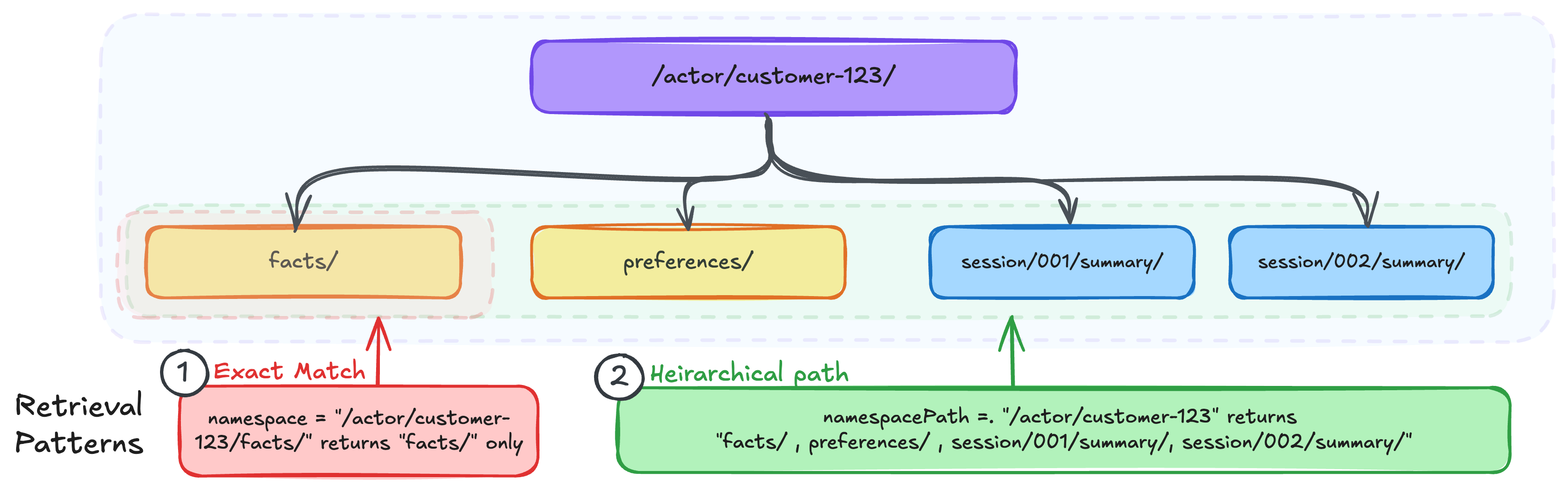
1. namespace — Exact match

The namespace field performs an exact match. It returns only memory records stored at that precise namespace path.

# Returns ONLY records stored at /actor/customer-123/facts/
records = agentcore_client.retrieve_memory_records(
    memoryId=”mem-12345abcdef”,
    namespace=”/actor/customer-123/facts/”,
    searchCriteria={
        “searchQuery”: “cloud migration”,
        “topK”: 5
    }
)

This is the right choice when you know exactly which namespace you want to query and need precise scoping. For example, retrieving only a user’s preferences without pulling in their facts or summaries.

2. namespacePath — Hierarchical retrieval

The namespacePath field performs a hierarchical match, returning the memory records whose namespace falls under the specified path.

# Returns records from
# /actor/customer-123/facts/,
# /actor/customer-123/preferences/,
# /actor/customer-123/session/*/summary/, etc.
records = agentcore_client.retrieve_memory_records(
    memoryId=”mem-12345abcdef”,
    namespacePath=”/actor/customer-123/”,
    searchCriteria={
        “searchQuery”: “cloud migration”,
        “topK”: 5
    }
)

This is useful when you want to search across the user’s memories regardless of type, or when building features like “show me everything we know about this customer.” Note that it’s important that you think through your isolation and retrieval patterns to make sure that tree traversal doesn’t expose unintended data.

When to use which

Scenario API Field Example
1 Retrieve semantically relevant user preferences RetrieveMemoryRecords namespace /actor/customer-123/preferences/
2 Retrieve a specific session summary ListMemoryRecords namespace /actor/customer-123/session/session-001/summary/
3 List all preferences for a user ListMemoryRecords namespace /actor/customer-123/preferences/
4 Search across a user’s memories RetrieveMemoryRecords namespacePath /actor/customer-123/
5 List summaries across sessions for a user ListMemoryRecords namespacePath /actor/customer-123/session/

Writing IAM policies for namespace access control

Namespaces integrate with AWS Identity and Access Management (IAM) through condition keys that restrict which namespaces a principal can include in their Memory API requests.

1. Exact match policies

Use StringEquals with the bedrock-agentcore:namespace condition key to restrict access to a specific namespace:

{
  “Version”: “2012-10-17”,
  “Statement”: [
    {
      “Effect”: “Allow”,
      “Action”: [
        “bedrock-agentcore:RetrieveMemoryRecords”,
        “bedrock-agentcore:ListMemoryRecords”
      ],
      “Resource”: “arn:aws:bedrock-agentcore:us-east-1:123456789012:memory/mem-12345abcdef”,
      “Condition”: {
        “StringEquals”: {
          “bedrock-agentcore:namespace”: “/actor/${aws:PrincipalTag/userId}/preferences/”
        }
      }
    }
  ]
}

This policy makes sure that a user can only retrieve memories from their own preferences namespace, using the userId principal tag (injected) for dynamic scoping.

2. Hierarchical retrieval policies

Use StringLike with the bedrock-agentcore:namespacePath condition key for hierarchical access:

{
  “Version”: “2012-10-17”,
  “Statement”: [
    {
      “Effect”: “Allow”,
      “Action”: [
        “bedrock-agentcore:RetrieveMemoryRecords”,
        “bedrock-agentcore:ListMemoryRecords”
      ],
      “Resource”: “arn:aws:bedrock-agentcore:us-east-1:123456789012:memory/mem-12345abcdef”,
      “Condition”: {
        “StringLike”: {
          “bedrock-agentcore:namespacePath”: “/actor/${aws:PrincipalTag/userId}/*”
        }
      }
    }
  ]
}

With this, a user can perform hierarchical retrieval across their namespaces (facts, preferences, summaries) while helping prevent access to other users’ data.

Conclusion

Namespace design is foundational to building effective memory systems with AgentCore Memory. Much like designing a key schema for a database or a prefix structure in object storage, thinking through your access patterns upfront helps you create a namespace hierarchy that supports precise retrieval, clean isolation between users, and IAM-based access control.The key takeaways:

  • Think through your access patterns and isolation boundaries before coming up with namespace templates
  • Scope semantic and preference memories to the actor (/actor/{actorId}/) for cross-session consolidation
  • Scope summaries to the session (/actor/{actorId}/session/{sessionId}/) since they’re conversation-specific (where needed such as summaries or episodes)
  • Use namespace for exact match when you know the precise path, and namespacePath for hierarchical retrieval when you need to search across a subtree
  • Use leading and trailing slashes in namespace paths to keep them consistent and help prevent prefix collisions
  • Use IAM condition keys (bedrock-agentcore:namespace and bedrock-agentcore:namespacePath) to control what namespaces can be requested

To get started, visit the following resources:

About the authors

Noor Randhawa

Noor Randhawa is the Tech Lead for AgentCore Memory at Amazon Web Services (AWS), building systems that enable developers to create intelligent, context-aware agents powered by Memory. He previously worked across Amazon Retail and AWS EKS, designing highly scalable and distributed platforms.

Akarsha Sehwag

Akarsha Sehwag is a Generative AI Data Scientist with AgentCore Memory team. With over seven years of experience in AI/ML product development, she has delivered enterprise-grade solutions for customers across a wide range of industries. Outside of work, she enjoys learning new things and exploring the outdoors.

Piradeep Kandasamy

Piradeep Kandasamy is a Software Development Manager for AgentCore Memory. Over his career at Amazon, he has built and scaled systems across Amazon Alexa, Amazon ECS, and AWS CloudFormation, bringing deep expertise in distributed systems and large-scale cloud services to his current work on memory infrastructure for AI agents.

.Organize the content with appropriate headings and subheadings ( h2, h3, h4, h5, h6). Include conclusion section and FAQs section with Proper questions and answers at the end. do not include the title. it must return only article i dont want any extra information or introductory text with article e.g: ” Here is rewritten article:” or “Here is the rewritten content:”


Generate single title from this title 5 Use Cases to Boost ROI in 2026 in 100 -150 characters. And it must return only title i dont want any extra information or introductory text with title e.g: ” Here is a single title:”

Write an article about

Key Takeaways: 

  • Global AI primary care market continues to grow, with a forecast to reach $31.97 billion in 2026.
  • Many organizations recognize potential AI tools, yet most struggle to calculate ROI. 20% of businesses can actually see profit.
  • US remains a leader in investing funds in agentic AI development.
  • Multifunctional digital co-pilots, such as DAX or Memora Health, have already proven their efficiency/productivity.
  • Businesses can design an advanced system themselves, but they’ll need to spend time learning the creative processes. As well as planning a strategy for its deployment.


The medical care landscape in 2026 has shifted from pure medical expertise to operational effectiveness, productive data management, and client flow. As operational costs continue to climb, AI agents have emerged in healthcare as the ultimate solution for clinic owners looking to balance financial sustainability with high-quality care. We are discussing sophisticated, autonomous entities capable of reasoning, scheduling, and assisting clinical decision-making.

This tool offers a way out of persistent staff turnover for many medical organization executives. By offloading administrative/bureaucratic burdens, it enables clinicians to prioritize patient treatment and leave work at the office. NVIDIA research shows that 70% of medical institutions and research centers now use AI-driven platforms, while 47% specifically utilize AI  assistants.

Impact of AI on Medicine

In 2026, companies’ executives have no doubt that AI solutions work. According to recent market reports, global medical care AI development sector is projected to reach a valuation of $31.97 billion this year, driven by a pressing need for operational efficiency. Yet most organizations are still trying to figure out how to scale them strategically.

Share of USA AI Medicine Development

AI solutions are forecast to reach 100 billion in the global market by 2032. This technology has become a high-growth vertical for healthcare tech.

In 2025, North America dominated global primary care market, accounting for 54% of revenue

United States remains the leading investor in medical AI sector. Naturally, investing in AI agents in healthcare will become a top priority for USA.

Return on investment (ROI) is another issue for agentic AI in healthcare

AI deployment is bearing fruit. According to a recent Deloitte survey, organizations that integrate digital co-pilots into their daily workflows report increased efficiency/productivity. Though the rest of the picture is more complex. Currently, only 20% of organizations see a profit from their AI initiatives, while 74% expect to see positive results in the near future.

This trend extends beyond the medical care sector. An IBM report shows that 29% of organizations that have deployed AI-driven platforms have measured their ROI; only 25% report positive outcomes. Researchers point to a common pitfall: rushing launch bots at the expense of optimization.

To drive revenue, focus must shift toward a solid strategy and a robust digital ecosystem. Margins with high profit appear once the system itself has been proven efficient.

Need to create a healthcare app?

Contact us now!

Five Use Cases: Agentic AI in Healthcare

Still asking a question: “What can AI agents do in healthcare?” It has proven its efficiency already. There are a significant number of cases in which AI agents are actively used in healthcare industry. Let’s take a closer look at five of them that stand out the most.

1. Memora Health: Intelligent Post-Discharge Support

  • Problem: After a patient leaves a clinic, they lose contact with clinicians until their next appointment. For cancer patients or future mothers, it’s crucial to maintain contact with their doctors constantly.
  • Solution: Memora Health provides a platform that helps doctors stay in touch with their clients after patients are discharged from a hospital.
  • Results: Care team notifications were reduced by almost 40%, with an average NPS > 70 and improved clinical outcomes.
  • Impact for business: Optimizes staff resources and helps avoid costly readmission penalties.

This is a solution our team is ready to develop/implement for every business.

2. California Medical Care Provider & Kore.ai: Advanced Patient Triage

  • Problem: Due to provider expansion, pressure on its managers increased as more people tried to schedule appointments, overloading call center’s lines.
  • Solution: Kore.ai provided an AI-driven platform that eased managers’ workload by handling calls, scheduling appointments. Additionally, service was capable of communicating in multiple languages.
  • Results: 468% ROI since the program’s launch and $3.2 million in revenue due to appointment scheduling.
  • Impact for business: Healthcare providers receive a tool that allows managers to free themselves from being overloaded with calls from users.

If you are looking for a solution to help your business manage client calls, we can design one for you.

3. Tsinghua University: World’s First Virtual Hospital

  • Problem: Hospitals are complex systems that must continually evolve. Yet, an efficient reorganization of work and personnel education might take a long time.
  • Solution: Researchers at Tsinghua University in China created a virtual clinic designed to work as a real one. Here, virtual doctors study/practice new treatment methods so that real doctors can apply them in real life.
  • Results: Within days, virtual clinicians diagnose 10,000 virtual patients. The MedQA datasets achieved an accuracy of 93.06%.
  • Impact for business: Testing of medical protocols in a virtual environment before real-world implementation.

Do you need a virtual hospital test or practice different treatment methods? We can help you design one.

4. Mayo Clinic & Google Cloud: Generative AI for Clinical Search

  • Problem: Every clinic faces a documentation challenge when storing clients’ data.
  • Solution: In 2019, Mayo Clinic signed a 10-year contract with Google Cloud to store users’ information on their servers. As of 2026, this cooperation has officially entered the mass-adoption stage for generative search tools such as Vertex AI Search.
  • Results: Contract allows Mayo Clinic to store 1.2 million patient records and provides access to other Google tools.
  • Impact for business: Extended cloud storage keeps all types of clinical records + additional benefits from adaptive Google tools.

Do you need a cloud service to store records? We have experience in this field and are ready to provide the most relevant solutions!

5. Nuance’s DAX: Ambient Clinical Intelligence

  • Problem: Bureaucracy is a real bottleneck in medical care, making physicians and nurses spend more time on paperwork than with patients.
  • Solution: DAX records doctor-patient notes without inner supervision, loading logical notes right into the EHR.
  • Results: Doctors using DAX report significant time savings and reduced stress.
  • Impact for business: Takes off additional pressure on personnel and reduces burnout risks.

Looking for an AI agent for clinical documentation? We can create it for you.

Want an AI platform?

Contact us!

Benefits of AI Agents in Healthcare

We have examined examples of AI agents that have proven their effectiveness in healthcare and captured the community’s attention. Though what insights can we take away from them? What immediate benefits can AI tools bring to the sector right now?

Potential agentic AI impact in healthcare manifests in following areas:

Area Potential Benefits for a Health Entity
Precision in Diagnosis It’s like giving specialists a second pair of eyes that never gets tired. These tools sift through mountains of lab work; scans spot tiny anomalies humans might miss, leading to treatment plans that actually fit a patient.
Operational Savings Stop paying your talented staff to be “data entry clerks.” By letting AI handle the headache of billing/insurance claims, you slash overhead costs; let your team focus on high-value work.
24/7 User Lifeline A clinic stays “open” for 24 hours. Digital co-pilots keep people on track with their meds; offer immediate mental health support, ensuring no one feels abandoned between appointments.
Burnout Prevention Documentation shouldn’t be a doctor’s full-time job. AI services take over the “paperwork mountain,” giving clinicians their time back and reducing mental fatigue that leads to costly medical errors.
Predictive Foresight Instead of reacting to emergencies, you start preventing them. Analytics platforms analyze data patterns; warn you about potential hospital readmissions before they happen, saving lives/money.
Seamless Workflow No more lost faxes or “missed memos.” AI acts as the digital glue between departments, ensuring that user data flows smoothly from lab specialists without bottlenecks.

How to Build & Implement an AI Agent in Healthcare

Building AI assistants — specifically a multifunctional ecosystem — is a long-term process that can take up to 12 months. Before starting, you must prepare by clearly defining which bots you need, systems they will integrate with, and your budget. While pilot versions can start at $5,000, AI agent use cases we’ve discussed in healthcare often require significant investments, often exceeding $200,000.

Benefits of building a system on your own:

  • Design it without any help
    Today, many platforms exist that help everyone create digital systems without coding knowledge.
  • Tailor assistants to your specific needs
    Client should decide which functions each bot will have/which tasks it should resolve. You can design it however you want.
  • Control your budget
    You’ll be able to see/understand how much money you need to invest to get access to your specific system.

Yet, some serious disadvantages also exist:

  • A time-consuming process
    Before using any platform, you need to study it and understand how it works. Then choose one that fits you the most.
  • No consulting
    You become your own expert, needing to find a solution to every issue that arises. Or find a professional who can help you find solutions.
  • Constant support
    Creating such a system is half the work. Other half is testing/maintenance of this technology.
  • Possible expenditures
    You are not protected from mistakes. First launch might fail, leading to production losses/search for new investments.

If these challenges scare you, then our advice is to get help from professional software developers. Especially those with deep expertise in designing AI agents/implementing them in healthcare applications.

Healthcare

LITSLINK: A Deep Expertise in Creating Medical Solutions

LITSLINK is a company that brings together over 300 software development experts. We have launched projects for fintech, fitness, real estate, and primary care technologies. We provide our clients with any kind of services available on the market at the moment. With AI, AR/VR solutions, blockchain, cloud storage, multifunctional systems. Everything you need, we can do!

Do you want to create top AI agents in healthcare customer service? We have an AI-ready healthcare infrastructure this system would be based on. Are you dreaming of a digital ecosystem that would take over entire documentation process? We have an idea on how to make one. Are you looking for someone who can smoothly deploy new applications into an existing CRM or EHR? We are going to do that.

Here are some of the healthcare solutions we have built:

ShiftRX. A platform for clinicians that allows easy planning of shifts/transferring patients’ data between them.

Helper. A unified system that combines doctors, insurance companies, and patients. It allows planning appointments, booking time slots, making payments through one application.

Dalth. A universal platform that helps to resolve urgent requests in minutes. It allows patients/clinicians to connect through a user-friendly interface.

Looking for more solutions?

Contact us today!

Conclusion

Transition to AI agents is no longer a futuristic “what if?” in healthcare. It is the baseline for staying competitive in 2026. As we’ve seen from the success of pioneers like Mayo Clinic or Memora Health, the shift toward autonomous systems is about the optimization of processes that would lead to efficiency growth and potential cost-cutting. Moreover, it’s about restoring the human element to medicine by removing mechanical, repetitive burdens that lead to clinician burnout/patient frustration.

By integrating intelligent platforms, you are not buying software; you are investing in a scalable, 24/7 workforce that learns/grows with your practice. Whether it’s through predictive analytics or seamless documentation, the goal remains the same: better care at a lower operational price point.

Looking for a reliable partner to help you design your perfect solution? You’ve already found one. We are ready to bring our experience to bear to design the next big thing. Contact us today!

FAQ

Q: Why is the AI in the primary care market growing so rapidly?

A: People value speed. AI agents in healthcare operations streamline workflows/ensure a smooth, intuitive experience.

Q: AI agent vs. chatbot in healthcare. What is better?

A: Virtual agents in medicine are significantly more advanced and sophisticated than standard chatbots. While chatbots are designed for simple customer interactions, assistants are built to solve complex problems. For instance, they can handle documentation and manage patient communications autonomously. Furthermore, an agent ecosystem can “exchange thoughts” to find the most efficient solutions. This is precisely why such a solution is superior.

Q: How do AI agents reduce hospital costs?

A: By taking over critical functions, such as handling patient calls, autonomous bots deliver substantial results. Kore.ai example proves this, having already generated $3.2 million in revenue for providers in California.

Q: What are the best AI agents in healthcare?

A: The best AI solution is the one you designed specifically for your needs. In this case, you can easily manage it.

.Organize the content with appropriate headings and subheadings ( h2, h3, h4, h5, h6). Include conclusion section and FAQs section with Proper questions and answers at the end. do not include the title. it must return only article i dont want any extra information or introductory text with article e.g: ” Here is rewritten article:” or “Here is the rewritten content:”

Generate single title from this title IBM launches AI platform Bob to regulate SDLC costs in 100 -150 characters. And it must return only title i dont want any extra information or introductory text with title e.g: ” Here is a single title:”

Write an article about

To regulate software delivery costs and SDLC governance, IBM is launching Bob, an AI platform built to anchor enterprise engineering.

Accumulated technical debt, hybrid cloud structures, and rigid compliance requirements clash with the raw speed of coding assistants. Without boundaries, they generate unmanaged liabilities rather than functional progress.

Dinesh Nirmal, SVP at IBM Software, explained: “Every business is racing to modernize. But speed without control and transparency is a liability. IBM Bob is how enterprises can move at AI speed without sacrificing the governance and security needs their businesses require.”

Bob is an AI-first development partner engineered to embed directly within the full software development lifecycle. Built on a structured framework, the tool integrates persona-based modes, tool calling, and human-in-the-loop controls to enforce standards while maintaining development momentum.

Upgrading older systems consumes roughly 60-80 percent of an engineering budget, and these projects routinely drag on for months. The problem multiplies because development work gets scattered across disconnected tools, various staff roles, and fragmented project stages. That disjointed setup inherently slows down shipping and bakes risk directly into the pipeline.

Legacy architecture integration poses a severe barrier to modern development. Mainframe systems running decades-old code cannot be updated simply by pasting snippets into a chat interface. The dependencies run deep into the corporate database structure, meaning any automated change requires rigorous mapping before a single line of code is altered.

The agentic nature of IBM’s new offering maps these dependencies before initiating code refactoring, coordinating specialised agents across testing, documentation, and continuous integration pipelines to execute comprehensive modernisation tasks.

APIS IT applied the platform to overhaul government systems burdened by decades of technical debt across mainframe and .NET environments. The deployment generated architecture analysis and documentation 10 times faster, achieving 100 percent accuracy on legacy JCL/PL/I systems.

“Bob migrated our complex .NET services in hours instead of weeks,” according to Veran Pokornić, Solution Architect at APIS IT.

Dynamic task routing for optimal performance

Integrating large language models into enterprise environments rarely goes smoothly. Engineering leaders constantly battle hallucination mitigation when AI attempts to parse undocumented legacy environments. 

The reliance on vector databases to provide retrieval-augmented generation often creates separate data silos that require independent maintenance and governance. When developers write code, the machine must understand the specific internal libraries and proprietary logic of the firm. Without this context, models suggest syntactically correct but functionally useless code, wasting expensive compute cycles.

A primary friction point in scaling engineering automation involves model selection and the associated compute expenditure. Choosing between proprietary and open-source models usually creates engineering distractions. Bob approaches this through dynamic multi-model orchestration, routing tasks based on accuracy requirements, latency tolerances, and operational costs.

The system evaluates the complexity of a given request before assigning it. Simple completions route to lighter, cost-effective models, while demanding architectural reasoning tasks utilise frontier models.

Bob’s underlying engine draws from a pool that includes Anthropic Claude, open-source options from Mistral, and IBM Granite, alongside specialised fine-tuned variants for next-edit prediction and security screening. This pass-through pricing structure offers usage visibility, enabling leaders to align their AI spend with actual production outcomes rather than experimental phases.

Accelerated delivery cycles strain traditional quality assurance and security review processes. Generating lines of code happens in seconds; validating them for compliance takes hours.

Code generated by AI can occasionally bypass standard reviews, creating dangerous compliance blind spots in production. The integration of large language models introduces entirely new attack vectors alongside conventional vulnerabilities, altering the enterprise security profile.

To address this, Bob embeds guardrails directly into the daily developer routine. The platform executes prompt normalisation, sensitive data scanning, and real-time policy enforcement alongside automated red-teaming. Developer transparency is maintained through customisable approval checkpoints, allowing engineering leads to configure manual gates or enable auto-approvals based entirely on task type.

Tracking these automated actions requires deep integration. The BobShell command-line interface generates self-documenting agentic processes in real time. Every automated decision or code modification is traceable from its inception to deployment, satisfying strict enterprise audit requirements.

Quantifying developer productivity

IBM first rolled out the tool internally to a test group of 100 developers back in June 2025. Today, more than 80,000 of the company’s employees use the platform across their global operations.

Surveyed internal users reported a 45 percent average productivity gain across new feature development, security remediation, and modernisation tasks. The IBM Maximo team recorded a 69 percent time savings on complex refactoring tasks, while the Instana division noted an average 70 percent reduction in time spent on specific assignments, saving roughly 10 hours per week.

External clients report similar operational efficiencies. Cloud solutions provider Blue Pearl utilised the platform to compress a standard 30-day Java upgrade into three days, saving more than 160 engineering hours. The company completed work on its BlueApp platform with zero post-deployment defects. 

“Developers need a system that understands the full context of their work and can act on it,” said Neel Sundaresan, GM of Automation & AI at IBM Software. “That’s what we built with Bob. It’s an agentic platform that embeds an AI partner into every role across the SDLC, from the architect sketching a design to the security engineer reviewing code before it ships.”

Buyers can access Bob right now as a SaaS product, which includes a free 30-day trial alongside standard individual and enterprise pricing tiers. Anyone wanting to hear more about Bob will find a good opportunity at this year’s AI & Big Data Expo North America, of which IBM is a key sponsor.

While companies bound by tight data residency or compliance rules will have to wait for the planned on-premises version, IBM guarantees that current watsonx Code Assistant customers will maintain full support while they map out their adoption path to the new system.

See also: Why AI agents need interaction infrastructure

Want to learn more about AI and big data from industry leaders? Check out AI & Big Data Expo taking place in Amsterdam, California, and London. The comprehensive event is part of TechEx and is co-located with other leading technology events including the Cyber Security & Cloud Expo. Click here for more information.

AI News is powered by TechForge Media. Explore other upcoming enterprise technology events and webinars here.

.Organize the content with appropriate headings and subheadings ( h2, h3, h4, h5, h6). Include conclusion section and FAQs section with Proper questions and answers at the end. do not include the title. it must return only article i dont want any extra information or introductory text with article e.g: ” Here is rewritten article:” or “Here is the rewritten content:”
With a swipe of a magnet, microscopic “magno-bots” perform complex maneuvers | MIT News

0

Under a microscope, a bouquet of lollipop-like structures, each smaller than a grain of sand, waves gently in a petri dish of liquid. Suddenly, they snap together, like the jaws of a Venus flytrap, as a scientist waves a small magnet over the dish. What was previously an assemblage of tiny passive structures has transformed instantly into an active robotic gripper.

The lollipop gripper is one demonstration of a new type of soft magnetic hydrogel developed by engineers at MIT and their collaborators at the École Polytechnique Fédérale de Lausanne (EPFL) in Switzerland and the University of Cincinnati. In a study appearing today in the journal Matter, the MIT team reports on a new method to print and fabricate the gel, which can be made into complex, magnetically activated three-dimensional structures.

The new gel could be the basis for soft, microscopic, magnetically responsive robots and materials. Such magno-bots could be used in medicine, for instance to release drugs or grab biopsies when directed by an external magnet.

Making objects move with magnets is nothing new, at least at the macroscale. We can, for example, wave a refrigerator magnet over a pile of paper clips that will trail the magnet in response. And at the microscale, scientists have designed a variety of magnetic “micro-swimmers” — components that are smaller than a millimeter and can be directed remotely by a magnet to squeeze through small spaces. For the most part, these designs work by mixing magnetic particles into a printable resin and pulling the entire swimmer in the direction of an external magnet.

In contrast, the MIT team’s new material can be made into even more complex and deformable structures with micron-scale precision. These features could enable a magnetic millibot to move individual features and perform more complex maneuvers.

“We can now make a soft, intricate 3D architecture with components that can move and deform in complex ways within the same microscopic structure,” says study author Carlos Portela, the Robert N. Noyce Career Development Associate Professor of Mechanical Engineering at MIT. “For soft microscopic robotics, or stimuli-responsive matter, that could be a game-changing capability.”

The study’s MIT co-authors include graduate students Rachel Sun and Andrew Chen, along with Yiming Ji and Daryl Yee of EPFL and Eric Stewart of the University of Cincinnati.

In a flash

At MIT, Portela’s group develops new metamaterials — materials engineered with unique, microscopic architectures that give rise to beyond-normal material properties. Portela has fabricated a variety of such metamaterials, including extremely tough and stretchy architectures and designs that can manipulate sound and withstand violent impacts.

Most recently, he’s expanded his research to “programmable” materials, which can be engineered to change their properties in response to stimuli, such as certain chemicals, light, and electric and magnetic fields.

From the team’s perspective, magnetic stimuli stand out from the rest.

“With a magnetically responsive material, we have control at a distance and the response is instantaneous,” says co-lead author Andrew Chen. “We don’t have to wait for a slow chemical reaction or physical process, and we can manipulate the material without touching it.”

For the new study, the team aimed to create a magnetically responsive metamaterial that can be made into structures smaller than a millimeter. Researchers typically fabricate microstructures by using two-photon lithography — a high-resolution 3D printing technique that flashes a laser into a small pool of resin. With repeated flashes, the laser traces a microscopic pattern into the resin, which solidifies into the same pattern, ultimately creating a tiny, three-dimensional structure, layer by layer.

While 3D resin printing produces intricate microstructures, using the same process to print magnetic structures has been a challenge. Researchers have tried to combine the resin with magnetic nanoparticles before printing the mixture. But magnetic particles are essentially bits of metal that inherently scatter light away or agglomerate and sediment unintentionally. Scientists have found that any magnetic particles in the resin can reduce the laser’s power at a given spot and weaken the resulting structure or prevent its printing altogether.

“Directly 3D printing deformable micron-scale structures with a high fraction of magnetic particles is extremely difficult, often involving a tradeoff between magnetic functionality and structural integrity,” says Sun, a co-lead author on the work.

A printed double-dip

The researchers created a new way to fabricate magnetic microstructures, by combining 3D resin printing with a double-dip process. The researchers first applied conventional resin printing to create a microstructure using a typical polymer gel, with no added magnetic particles. Then they dipped the printed gel into a solution containing iron ions, which the gel can absorb. The iron-soaked structure is then dipped again in a second solution of hydroxide ions. The iron ions in the gel bond with the hydroxide ions, creating iron-oxide nanoparticles that are inherently magnetic.

With this new process, the team can print intricate structures smaller than a millimeter, and add magnetic properties to the structures after printing. What’s more, they are able to control how magnetic a structure’s individual features can be. They found that, by tuning the laser’s power as they print certain features, they can set how cross-linked, or “tight” the gel is when printed. The tighter the gel, the fewer magnetic particles it can form. In this way, the researchers can determine how magnetic each tiny feature can be.

“This provides unprecedented design freedom to print multifunctional structures and materials at the microscale,” Sun says.

As a demonstration, the team fabricated ball-and-stick structures resembling tiny lollipops. The structures were less than a millimeter in height, with balls that were smaller than a grain of sand. The researchers printed the lollipops out of polymer gel and infused each ball with different amounts of magnetic particles, giving them various degrees of magnetism. Under a microscope, they observed that when they passed an ordinary refrigerator magnet over the structures, the lollipops pulled toward the magnet in various degrees, in a configuration that mimicked gripping fingers.

“You could imagine a magnetic architecture like this could act as a small robot that you could guide through the body with an external magnet, and it could latch onto something, for instance to take a biopsy,” Portela says. “That is a vision that others can take from this work.”

The team also fabricated a magnetically responsive, “bistable” switch. They first printed a small millimeter-long rectangle of polymer gel and attached to either side four tiny, oar-like magnetic structures. Each oar measured about 8 microns thick — about the size of a red blood cell. When the team applied a magnet on one end of the rectangle, the oars flipped toward the magnet, pulling the rectangle in the same direction and locking it in that position. When the magnet was applied to the other side, the oars flipped again, pulling the rectangle, like a switch, in the opposite direction.

“We think this is a new kind of bistable mechanism that could be used, for instance, in a microfluidic device, as a magnetic valve to open or shut some flow,” Portela says. “For now, we’ve figured out how to fabricate magnetic complex architectures at the microscale and also spatially tune their properties. That opens up a lot of interesting ideas for soft miniature robots going forward.”

This research was supported, in part, by the National Science Foundation and the MathWorks seed grant program.

Generate single title from this title When AI does the work, who does the learning? in 100 -150 characters. And it must return only title i dont want any extra information or introductory text with title e.g: ” Here is a single title:”

Write an article about

Key points:

AI is rapidly reshaping education, but not always in ways that support learning. A growing number of AI tools promise to “help” students by doing assignments, writing papers, solving problem sets, or even completing exams automatically.

While these tools may appear convenient, they raise an important question: Are they removing barriers to learning, or removing learning itself?

When AI replaces effort, learning pays the price

AI is becoming deeply embedded in academic life. According to Tyton Partners’ Time for Class 2025 report, 30 percent of instructors and 42 percent of students report using generative AI weekly or daily. As AI becomes a routine part of the learning experience, the question is no longer whether it’s being used, but how those tools are shaping the learning process. 

The fast rise of AI that completes coursework for students poses real risks to learners, instructors, and institutions. Widely accessible automation tools, such as Google’s Homework Helper, Companion’s Einstein, Quick Solver AI, or Eduhack.ai can bypass the very effort that learning requires. Learning isn’t meant to be effortless. It is inherently iterative and time-consuming. Progress comes through practice, application, and repetition. That effort is not a flaw in the system; productive struggle is the foundation of how people learn.

When we evaluate AI in education, we should ask a simple question: Does this technology remove barriers to learning, or does it replace the desirable effort that makes learning possible? If the answer is the latter, we risk eroding the educational process itself. When students rely on AI to generate answers rather than work through complex problems, the learning loop breaks down. Without application and repetition, learning simply doesn’t happen.

At the same time, we should acknowledge why students might turn to these tools in the first place. Too often, learning experiences feel passive or disconnected. When courses are engaging, personalized, and interactive, students are far more likely to apply the effort required to learn critically.

AI should support that effort, not replace it. Tools that help learners better understand concepts, provide guidance, or reduce unnecessary friction in the learning process can be incredibly powerful. In fact, the Time for Class report shows that 84 percent of students still prefer human-focused guidance, reinforcing the importance of AI that supports–not replaces–instruction. 

AI’s greatest challenge isn’t technology–it’s privacy and trust

The risks of automated AI tools extend beyond learning outcomes. Data privacy and security are equally critical concerns. We are seeing tremendous innovation in the AI ecosystem and some of it is genuinely transformative. But there are still many unknowns with these emerging solutions. Many newer or less mature vendors lack strong safeguards, and unfortunately some tools are designed to capitalize on students looking for quick workarounds. Students may download applications without fully understanding how their data is being used, stored, or shared without their consent.

Educational institutions have a solemn responsibility to protect learner data, and AI developers must share that responsibility. AI systems should be transparent about how they operate, what data they collect, and how that data is used. Institutions should always know exactly what technology they are deploying and how it interacts with their learning environments.

I’ve always been serious about the protection of learner data and believe it should not be used to train large language models. Protecting student data is not optional–it is foundational to building trust in educational technology.

Look for AI that transforms learning

The goal should not be to avoid AI in education. The goal should be to leverage AI that strengthens learning rather than replaces it. One of the most promising approaches I’ve seen from educators is a shift toward more active learning and assessment. Instead of assignments and tests that reward memorization, active experiences ask learners to analyze, interpret, and apply knowledge in meaningful and engaging ways. This deeper engagement naturally discourages shortcut tools and promotes real understanding.

AI developed with purpose for learning can support this shift. 

When applied thoughtfully, it can help educators transform their lectures or static materials into interactive content that encourages participation and application. For example, AI can convert recorded lectures or slides into dynamic modules where students actively engage with concepts, test their understanding, and apply what they’ve learned–all tied directly to learning outcomes.

AI can also provide learners with on-demand support: answering course questions, guiding them back to relevant materials after quizzes, or helping them explore concepts outside of traditional office hours. Used this way, AI becomes a learning companion, not a substitute.

The AI choices institutions make now will shape learning for generations

Institutions are still working to establish guardrails for AI use. According to the most recent Time for Class report, 45 percent of instructors say preventing cheating is one of their top instructional challenges. As AI tools become more embedded in academic life, thoughtful governance and transparency will be essential to ensure these technologies strengthen learning rather than undermine it.

As institutions evaluate AI solutions, a few principles should guide their decisions.

AI should be learning-led by design and built around robust learning science fundamentals. Technology should reinforce proven teaching practices, not bypass them. AI should help educators work more efficiently while preserving the quality and integrity of course content and aligning to learning outcomes. In short, educators must remain in control.

Human oversight should always be built into AI systems. Educators–not algorithms–should make the final decisions about course content, feedback, and assessments. Keeping people at the center remains a top priority for leaders. Justin Rose, associate vice president, Information Management and Digital Learning at Southeastern University, puts it this way: “Humans working in concert with emerging technologies is always going to be the key recipe for success.”

Transparency and governance are also essential. Institutions should control how AI interacts with their data. They should be able to set permissions, define guardrails, and understand exactly how systems operate. Educational impact must be measurable.

AI should improve outcomes we can observe: stronger engagement, deeper understanding, and meaningful time savings for educators. AI will undoubtedly play a major role in the future of education. The question isn’t whether it will be used, but how it will be used. 

If we design AI systems that shortcut the learning process, we risk undermining the very purpose and value of education. But AI that deepens engagement, makes learning more personal, and supports meaningful effort has the potential to become one of the most powerful tools educators, learners, and institutions alike have ever had. 

The future of AI in education should never be about replacing learning; it should always be about strengthening it.

Christian Pantel, D2L

Christian Pantel is Chief Product Officer at D2L.

Latest posts by eSchool Media Contributors (see all)

.Organize the content with appropriate headings and subheadings ( h2, h3, h4, h5, h6). Include conclusion section and FAQs section with Proper questions and answers at the end. do not include the title. it must return only article i dont want any extra information or introductory text with article e.g: ” Here is rewritten article:” or “Here is the rewritten content:”

Robotically assembled building blocks could make construction more efficient and sustainable | MIT News

0

Robotically assembled building blocks could be a more environmentally friendly method for erecting large-scale structures than some existing construction techniques, according to a new study by MIT researchers.

The team conducted a feasibility study to evaluate the efficiency of constructing a simple building using “voxels,” which are modular 3D subunits that assemble into complex, durable structures.

After studying the performance of multiple voxels, the researchers developed three new designs intended to streamline building construction. They also produced a robotic assembler and a user-friendly interface for generating voxel-based building layouts and feeding instructions to the robots.

Their results indicate this voxel-based robotic assembly system could reduce embodied carbon — all of the carbon emitted during the lifecycle of building materials — by as much as 82 percent, compared with popular techniques like 3D concrete printing, precast modular concrete, and steel framing. The system would also be competitive in terms of cost and construction time. However, the choice of materials used to manufacture the voxels does play a major role in their carbon footprint and cost.

While scalability, durability, long-term robustness, and important considerations like fire resistance remain to be explored before such a system could be widely deployed, the researchers say these initial results highlight the potential of this approach for automated, on-site construction.

“I’m particularly excited about how the robotic assembly of discrete lattices can enable a practical way to apply digital fabrication to the built environment in a way that can let us build much more efficiently and sustainably,” says Miana Smith, a graduate student in the Center for Bits and Atoms (CBA) at MIT and lead author the study.

She is joined on the paper by Paul Richard, a graduate student at École Polytechnique Fédérale de Lausanne in Switzerland and former visiting researcher at MIT; Alfonso Parra Rubio, a CBA graduate student; and senior author Neil Gershenfeld, an MIT professor and the director of the CBA. The research appears in Automation in Construction.

Designing better building blocks

Over the past several years, researchers in the Center for Bits and Atoms have been developing voxels, which are lattice-structured building blocks that can be assembled into objects with high strength and stiffness, like airplane wings, wind turbine blades, and space structures.

“Here, we are taking aerospace principles and applying them to buildings. Why don’t we make buildings as efficiently as we make airplanes?” Gershenfeld says, based on prior work his lab has done on voxel assembly with NASA, Airbus, and Boeing.

To explore the feasibility of voxel-based assembly strategies for buildings, the researchers first evaluated the mechanical performance and sustainability of eight existing voxel designs, including a cuboctahedron made from glass-reinforced nylon and a Kelvin lattice made from steel.

Based on those evaluations, they developed a set of three voxels using a new geometry that could be more easily assembled robotically into a larger structure. The new design, based on a high-strength and high-stiffness octet lattice, mechanically self-aligns into rigid structures.

“The interlocking nature of these voxels means we can get nice mechanical properties without needing to have a lot of connectors in the system, so the construction process can run a lot faster,” Smith says.

To accelerate construction, they designed a robotic assembly system based on inchworm-like robots that crawl across a voxel structure by anchoring and extending their bodies. These Modular Inchworm Lattice Assembler robots, or MILAbots, use grippers on each end to place voxel building blocks and engage the snap-fit connections.

“The robots can assemble the voxels by dropping them into place and then stepping on them to have the pieces interlock. We can do precise maneuvers based on the mechanical relationship between the robots and the voxels,” Smith explains.

The team studied the embodied carbon needed to fabricate their new voxel designs using three materials: plastic, plywood, and steel. Then they evaluated the throughput and cost of using the robotic assembly system to build a simple, one-story building. The researchers compared these estimates with the performance of other construction methods.

Potential environmental benefits

They found that most existing voxels, and especially those made from plastics, performed poorly compared to existing methods in terms of sustainability, but the steel and wood voxels they designed offered significant environmental benefits.

For instance, utilizing their steel voxels would generate only 36 percent of the embodied carbon required for 3D concrete printing and 52 percent of the embodied carbon of precast concrete. The plywood voxels had the lowest carbon footprint, requiring about 17 percent and 24 percent of the embodied carbon needed, respectively.

“There is still a potential viable option for a plastics-based voxel approach, we just have to be a bit more strategic about which types of plastics, infills, and geometries we use,” Smith says.

In addition, projected on-site assembly time for the steel and wood voxel approaches averaged 99 hours, whereas existing construction methods averaged 155 hours.

These speed benefits rely on the distributed nature of voxel-based assembly. While one MILAbot working alone is far slower than existing techniques, with a team of 20 robots working in parallel, the system catches up to or surpasses existing automation methods at a lower cost.

“One benefit of this method is how incremental it is. You can start building, and if it turns out you need a new room, you can just add onto the structure. It is also reversible, so if your use changes, you can dissemble the voxels and change the structure,” Gershenfeld says.

The researchers also developed an interface that enables users to input or hand-design a voxelized structure. The automatic system determines the paths the MILAbots should follow for construction and sends commands to the assemblers.

The next step in this project will be a larger testbed in Bhutan, using the “super fab lab” that CBA helped set up there to replicate the robots to test construction for a planned sustainable city, Gershenfeld says.

Additional areas of future work include studying the stability of voxel structures under lateral loads, improving the design tool to account for the physics of the system, enhancing the MILAbots, and evaluating voxels that have integrated sheeting, insulation, or electrical and plumbing routing.

“Our work helps support why doing this type of distributed robot assembly might be a practical way to bring digital fabrication into building construction,” Smith says.

This work was funded, in part, by the MIT Center for Bits and Atoms Consortia.

Generate single title from this title Federated Learning Without the Refactoring Overhead Using NVIDIA FLARE in 100 -150 characters. And it must return only title i dont want any extra information or introductory text with title e.g: ” Here is a single title:”

0

Write an article about

Federated learning (FL) is no longer a research curiosity—it’s a practical response to a hard constraint: the most valuable data is often the least movable. Regulatory boundaries, data sovereignty rules, and organizational risk tolerance routinely prevent centralized aggregation. Meanwhile, sheer data gravity makes even permitted transfers slow, expensive, and fragile at scale.

The latest version of NVIDIA FLARE addresses this reality with a federated computing runtime that moves the training logic to the data, while raw data stays put. In high-stakes environments, centrally aggregating data is often not possible or practical, so a modern federated platform must treat data isolation, compliance, and privacy-enhancing technologies as first-class requirements.

What has historically slowed adoption isn’t the concept of FL—it’s the developer experience. If the path from “my local script trains” to “my job runs across federated sites” requires deep refactoring, new class hierarchies, or brittle configuration, many projects stall after the pilot.

The FLARE API evolution targets exactly that: eliminating the refactoring overhead by splitting the work into two concrete steps that map cleanly onto how teams actually build and ship ML systems:

  • Step 1 (client API): Turn an existing local training script into a federated client with ~5–6 lines of code, without changing your training loop structure.
  • Step 2 (job recipes): Select the FL workflow and bind it to your client training script, then run the same job across simulation, PoC, and production by swapping only the execution environment.

‘No data copy’ as a system requirement

In regulated or high-sensitivity settings, “just centralize the dataset” is increasingly off the table. A practical federated computing platform needs to support:

  • No data copy: Data stays local, and only model updates (or equivalent signals) move.
  • Compliance posture: Deployment and governance controls that support sovereignty and audit requirements.
  • Privacy-enhancing techniques: Multiple layers of defenses (examples include homomorphic encryption, differential privacy, and confidential computing).

Figure shows a before-and-after comparison of centralized versus federated computing. On the left (“before”), three separate data silos send their data into one centralized database where a model is trained. On the right (“after”), data remains in separate, locked databases at multiple sites while a shared model is coordinated across them, with arrows indicating that only model updates are exchanged rather than copying raw data. The middle shows data silos across different industries, such as finance, healthcare, and the public sector.

Figure 1. Federated computing keeps data in place, enabling collaboration through model updates while supporting compliance and privacy-enhancing protections.

The refactoring cliff: Why FL projects stall

Teams typically hit one of two cliffs after the pilot:

  • The code cliff: Converting working PyTorch/TensorFlow/Lightning training into FL can require invasive restructuring—new abstractions, messaging glue, and framework-specific scaffolding.
  • The lifecycle cliff: Even when simulation works, moving to PoC and production triggers rewrites via job redefinition, reconfiguration, and environment-specific branching.

FLARE flattens both cliffs by standardizing the workflow into two steps: 

  1. Make your script federated (client API)
  2. Execute it as a portable job (job recipe)

The intended experience is explicitly to combine these so you can go from zero to an operational federated job quickly.

Step 1: Convert your local training script into a federated client (client API)

Who it’s for: Practitioners and ML engineers with existing training code who want the smallest possible difference.

The mental model is intentionally simple:

  1. Initialize the client runtime
  2. Loop while the job is running
  3. Receive the current global model
  4. Train locally (your code)
  5. Send updated weights + metrics back

FLARE’s client API is designed for minimal code changes and avoids forcing you into heavy “Executor/Learner” inheritance—use the FLModel structure or simple data exchange to communicate with the runtime.

Example 1a: Convert PyTorch to FLARE

Below is a concrete pattern you can apply to many scripts. The key touchpoints are: flare.init(), flare.receive(), loading model weights, and flare.send() with updated weights and metrics.

We show the local training code on the left and the federated version on the right, highlighting: import, flare.init(), receive(), send().

train.py

# train.py

import torch
import torchvision
import torchvision.transforms as transforms

from model import Net

batch_size = 4
epochs = 1
lr = 0.01
model = Net()
device = torch.device(“cuda:0” if torch.cuda.is_available() else “cpu”)
loss = torch.nn.CrossEntropyLoss()
optimizer = torch.optim.SGD(model.parameters(), lr=lr, momentum=0.9)
transform = transforms.Compose(
[
transforms.ToTensor(),
transforms.Normalize((0.5, 0.5, 0.5), (0.5, 0.5, 0.5)),
]
)

train_dataset = torchvision.datasets.CIFAR10(
root=”/tmp/data/cifar10″, transform=transform, download=True, train=True
)

trainloader = torch.utils.data.DataLoader(
train_dataset, batch_size=batch_size, shuffle=True
)

model.to(device)

for epoch in range(epochs):
running_loss = 0.0

for i, batch in enumerate(trainloader):
images, labels = batch[0].to(device), batch[1].to(device)

optimizer.zero_grad()

predictions = model(images)
cost = loss(predictions, labels)
cost.backward()
optimizer.step()

running_loss += cost.cpu().detach().numpy() / batch_size

if i % 3000 == 2999:
print(
f”Epoch: {epoch + 1}/{epochs}, batch: {i + 1}, Loss: {running_loss / 3000}”
)
running_loss = 0.0

print(
f”Epoch: {epoch + 1}/{epochs}, batch: {i + 1}, Loss: {running_loss / (i + 1)}”
)

print(“Finished Training”)

torch.save(model.state_dict(), “./cifar_net.pth”)

client.py

# client.py

# 1. Import client API
import nvflare.client as flare
import torch
import torchvision
import torchvision.transforms as transforms

from model import Net

batch_size = 4
epochs = 1
lr = 0.01
model = Net()
device = torch.device(“cuda:0” if torch.cuda.is_available() else “cpu”)
loss = torch.nn.CrossEntropyLoss()
optimizer = torch.optim.SGD(model.parameters(), lr=lr, momentum=0.9)
transform = transforms.Compose(
[
transforms.ToTensor(),
transforms.Normalize((0.5, 0.5, 0.5), (0.5, 0.5, 0.5)),
]
)

train_dataset = torchvision.datasets.CIFAR10(
root=”/tmp/data/cifar10″, transform=transform, download=True, train=True
)

trainloader = torch.utils.data.DataLoader(
train_dataset, batch_size=batch_size, shuffle=True
)

# 2. Initialize FLARE
flare.init()

# At each round while FLARE is running
while flare.is_running():
# 3. Receive the global model
input_model = flare.receive()

# 4. Load global model
model.load_state_dict(input_model.params)
model.to(device)

for epoch in range(epochs):
running_loss = 0.0

for i, batch in enumerate(trainloader):
images, labels = batch[0].to(device), batch[1].to(device)

optimizer.zero_grad()

predictions = model(images)
cost = loss(predictions, labels)
cost.backward()
optimizer.step()

running_loss += cost.cpu().detach().numpy() / batch_size

if i % 3000 == 2999:
print(
f”Epoch: {epoch + 1}/{epochs}, batch: {i + 1}, Loss: {running_loss / 3000}”
)
running_loss = 0.0

print(
f”Epoch: {epoch + 1}/{epochs}, batch: {i + 1}, Loss: {running_loss / (i + 1)}”
)

print(“Finished Training”)

torch.save(model.state_dict(), “./cifar_net.pth”)

# 5. Send back the updated model
output_model = flare.FLModel(
params=model.cpu().state_dict(),
meta={“NUM_STEPS_CURRENT_ROUND”: len(trainloader) * epochs},
)
flare.send(output_model)

Example 1b: PyTorch Lightning client The Lightning integration keeps the same

The Lightning integration keeps the same intent—receive global model, train, send updates—but exposes it in a Lightning-friendly way: import the Lightning client adapter and patch the Trainer.

The typical flow is: import, patch, (optional) validate, train as usual.

# lightning_client.py
import pytorch_lightning as pl
from pytorch_lightning import Trainer

import nvflare.client.lightning as flare # Lightning Client API

from model import LitNet
from data import CIFAR10DataModule
def main():
model = LitNet()
dm = CIFAR10DataModule()

trainer = Trainer(max_epochs=1, accelerator=”gpu”, devices=1)

# Patch trainer to participate in FL
flare.patch(trainer)

while flare.is_running():
# Optional: validate current global model (useful for server-side selection flows)
trainer.validate(model, datamodule=dm)

# Train starting from received global model (handled internally after patch)
trainer.fit(model, datamodule=dm)

if __name__ == “__main__”:
main()

The point: Lightning users don’t have to drop into custom federated messaging—they keep the Trainer abstraction and still participate correctly in FL rounds. 

Step 2: Package and execute the federated job anywhere (job recipes)

Who it’s for: Data scientists and applied teams who want a code-first job definition that remains stable across environments.

After step 1, you have a federated client script. Step 2 makes it a federated job you can run repeatedly and move through the lifecycle cleanly.

Job recipes are designed to replace JSON-based job configuration with a Python-based job definition:

  • Code-first: Define complete FL jobs in Python, not complex config files
  • Write once, run anywhere: Same recipe runs in simulator, PoC, or production
  • Speed to deployment: Go from experimentation to deployment without changing code structure

Example 2a: Execute a FedAvg recipe in simulation

The key linkage is that your recipe references the client training script you created in step 1 (e.g., train_script=”client.py”), then you execute it in an environment.

# job.py
from nvflare.app_common.workflows.job import FedAvgRecipe
from nvflare.job_config import SimEnv # exact import path can vary by NVFlare version

from model import SimpleNetwork

def main():
n_clients = 3
num_rounds = 5
batch_size = 32

recipe = FedAvgRecipe(
name=”hello-pt”,
min_clients=n_clients,
num_rounds=num_rounds,
model=SimpleNetwork(),
train_script=”client.py”, # <-- Step A script train_args=f"--batch_size {batch_size} --epochs 1", ) env = SimEnv(num_clients=n_clients, num_threads=n_clients) recipe.execute(env=env) if __name__ == "__main__": main()

This is the “write once” idea in practice: Once the recipe correctly references your client script, the rest becomes an execution concern.

Example 2b: Move from simulation to real-world with an environment swap. 

Job recipes formalize a progressive workflow by swapping the execution environment:

  1. SimEnv (Simulation): Easy development, rapid debugging
  2. PocEnv (Proof-of-Concept): Local runtime, multi-process, realistic testing
  3. ProdEnv (Production): Distributed deployment on secure, scalable infrastructure

Alt text: Figure shows a three-stage JobRecipe pipeline flowing into three execution environments. A box labeled “JobRecipe” at the top splits into three arrows pointing to side-by-side panels: SimEnv (Simulation) for easy development and rapid debugging, PocEnv (Proof-of-Concept) for realistic multi-process testing in a local runtime, and ProdEnv (Production) for secure distributed deployment.

Figure 2. One JobRecipe, multiple execution environments: Debug in SimEnv, validate in PocEnv, and deploy in ProdEnv without rewriting the job definition

Getting started

  • Start with a script you already trust.
  • Step 1: Add the client API handshake (or patch your Lightning Trainer).
  • Step 2: Wrap it in a job recipe and execute first in simulation, then PoC, then production by swapping environments.

FLARE in the News

FLARE is showing up in real deployments—from Eli Lilly TuneLab’s federated learning platform (built by Rhino Federated Computing using NVFlare) to Taiwan MOHW’s national healthcare federated learning initiative, and a Tri-labs (Sandia/LANL/LLNL) federated AI pilot across sensitive datasets.

Going further

Start with a script you already trust. Add the minimal FLARE client handshake (receive → train → send). Then scale from single-node simulation to multi-site deployment when you’re ready.

.Organize the content with appropriate headings and subheadings ( h2, h3, h4, h5, h6). Include conclusion section and FAQs section with Proper questions and answers at the end. do not include the title. it must return only article i dont want any extra information or introductory text with article e.g: ” Here is rewritten article:” or “Here is the rewritten content:”

Generate single title from this title Three ways school districts can build a sustainable AI framework in 100 -150 characters. And it must return only title i dont want any extra information or introductory text with title e.g: ” Here is a single title:”

Write an article about

Key points:

AI is here, and it’s moving fast. For schools, that speed is both an opportunity and a risk: The right tools can transform learning, but the wrong ones can compromise data, equity, and instructional goals. Becoming “AI-ready” isn’t about chasing the newest shiny platform; it requires districts to build intentional systems that guide how AI is evaluated, implemented, and governed.

To move from reactive experimentation to sustainable innovation, school districts should focus on the systems behind the software. By prioritizing collaborative governance, clear problem definition, and strong data infrastructure, districts can ensure AI becomes a catalyst for learning rather than another layer of digital noise.

Here are three ways we can begin building that sustainable path forward:

Establish team-based, cross-functional AI governance

One of the most effective ways districts can prepare for AI adoption is by creating a cross-functional leadership team responsible for AI governance.

AI is evolving faster than traditional policy cycles. Instead of relying on static rules, districts benefit from a dynamic governance group that includes teachers, administrators, IT leaders, parents, and board representation. This team evaluates AI tools before they reach classrooms and ensures every platform aligns with district priorities for student data privacy, equity, and responsible technology use.

A standing governance group also allows districts to respond quickly as new tools emerge. Rather than slowing innovation, strong governance creates clear guardrails that allow districts to experiment safely.

Equally important, these teams build AI literacy inside the district. Members develop a deeper understanding of how AI systems work, how student data flows through platforms, and what warning signs to watch for in new technologies. When districts combine technical understanding with instructional leadership, they can innovate with confidence rather than reaction.

Prioritize purpose over tools

Another critical step toward AI readiness is resisting the urge to chase the shiny new tool before defining the problem. Districts often fall into the trap of “solution-seeking before problem-defining.” This can look like adopting an AI tutoring platform before identifying where students actually need support, or adding a new administrative system that duplicates existing workflows.

AI can be transformative, but only when it is aligned to a clearly articulated need. Before evaluating any tool, district leaders should ask several key questions:

  • What specific problem are we trying to solve?
  • Who is experiencing the challenge?
  • What measurable improvement would success look like?

Intentionality is everything. The best tools are rarely the flashiest; they’re the ones that fit the need, have been vetted carefully, and align with instructional goals. Before students ever log in, schools should do the pre-work by helping staff and learners understand when AI is a substitute for thinking and when it’s a support for deeper learning. Used thoughtfully, AI enhances instruction. Used impulsively, it simply automates confusion.

Smart data, stronger students 

Without a robust data strategy, even the most sophisticated AI platform will either fail to function or, more dangerously, compromise the trust you’ve built with your community. Real AI readiness is built from the “engine room” up, starting with an uncompromising commitment to data privacy and airtight Data Privacy Agreements for every platform in the ecosystem. As leaders, we must move beyond a “check-the-box” mentality toward a proactive data governance plan that maintains a rigorous inventory of where data lives and who has permission to touch it.

Security is only half the challenge, as performance requires precision. For AI to deliver meaningful outcomes, the data flowing through our Student Information Systems must be meticulously “clean” and validated. This necessitates a focus on the often-invisible work of API infrastructure and identity management. Districts benefit from working with partners that specialize in connecting systems securely, maintaining real-time data validation, and simplifying identity management across platforms.

By prioritizing data cleanliness and accessibility, we ensure AI isn’t just generating noise, but is instead providing accurate, actionable insights. Establishing these guardrails early turns data from a liability into a strategic asset that supports, rather than subverts, our educational mission.

Ultimately, getting AI-ready requires mastering our own organizational habits, not algorithms. By building cross-functional teams, defining our problems before seeking solutions, and treating data as a protected strategic asset, these steps will create an environment where technology actually empowers teachers and protects students. AI will continue to evolve at a breakneck pace, but by anchoring our work in these three foundational areas, we can ensure schools remain places where human judgment and student needs always lead the way.

Carl Hooker, Innovation & Digital Learning Leader, Matt Holley, Lubbock-Cooper ISD & Amy Liang, Los Gatos Union School District

Matt Holley is the Director of Emerging Technologies for the Lubbock-Cooper ISD in Lubbock, TX.

Amy Liang is the Director of Technology, Assessment, and Accountability for the Los Gatos Union School District in Los Gatos, CA.
Carl Hooker is an Innovation & Digital Learning Leader and Former District Leader from Austin, TX.

Latest posts by eSchool Media Contributors (see all)

.Organize the content with appropriate headings and subheadings ( h2, h3, h4, h5, h6). Include conclusion section and FAQs section with Proper questions and answers at the end. do not include the title. it must return only article i dont want any extra information or introductory text with article e.g: ” Here is rewritten article:” or “Here is the rewritten content:”