Home Blog Page 161

Anthropic adds web search to its Claude chatbot

AI Chatbots: The Future of Search

AI Chatbots Gaining Ground as Search Tools

With AI chatbots gaining ground as search tools, their ability to scour the internet will become a key factor in determining their success. Finally, Anthropic’s Claude has joined its competitors.

Web Search Capability

On Thursday, the company announced that its chatbot can now search the web. This makes Claude one of the last AI chatbots to add a web search capability, after OpenAI’s ChatGPT Search and Perplexity. Even Google is experimenting with a fully AI-first approach to the future.

Enhanced Search Experience

As with all major chatbots, Claude’s search responses include inline citations so you can double-check sources. Based on recent research, these tools really need a reality check. "Instead of finding search results yourself, Claude processes and delivers relevant sources in a conversational format," Anthropic said in its announcement. "This enhancement expands Claude’s extensive knowledge base with real-time insights, providing answers based on more current information."

Latest Release

The update builds on Claude 3.7 Sonnet, Anthropic’s latest release and most intelligent model, which has a knowledge cutoff of November 2024. While Google (and its traditional interface) still leads in terms of web search market share, AI chatbot search has been steadily growing.

Web Search Availability

Anthropic noted that web search is available today in preview for paid Claude users within the US, with access for free users and other countries "coming soon." To try it, go to your settings, switch the web search toggle to "on," and start chatting with Claude 3.7 Sonnet. It will access the web when needed based on your query.

Conclusion

As AI chatbots continue to evolve, their ability to search the web will become a crucial factor in determining their success. With Claude’s latest update, users can now access real-time search results, providing a more comprehensive and accurate search experience.

FAQs

Q: What is the latest release of Claude?
A: The latest release is Claude 3.7 Sonnet, which has a knowledge cutoff of November 2024.

Q: How do I access web search with Claude?
A: To try it, go to your settings, switch the web search toggle to "on," and start chatting with Claude 3.7 Sonnet. It will access the web when needed based on your query.

Q: When will web search be available for free users and other countries?
A: Web search is currently available in preview for paid Claude users within the US, with access for free users and other countries "coming soon."

Q: How does Claude’s web search work?
A: Claude’s web search works by processing and delivering relevant sources in a conversational format, providing answers based on more current information.

A.I. Action Plans

0

Episode Summary

Podcast Description

"Hard Fork" is a podcast hosted by Kevin Roose and Casey Newton, featuring discussions on the latest tech trends and industry news. In this episode, they weigh in on the Trump administration’s new action plan for artificial intelligence, and explore the implications for the tech industry.

Main Discussion Topics

  • Trump Administration’s AI Plan: Kevin and Casey break down the key points of the administration’s new action plan for artificial intelligence, including its potential impact on the tech industry and the public.
  • A.I. in Job Interviews: A Columbia undergraduate explains why he built a tool that allows coders to use A.I. to cheat on job interviews, raising questions about the ethics of using A.I. in the job search process.
  • Hot Mess Express: The hosts discuss Solana’s anti-woke ad, anxious A.I. algorithms, and Slack spycraft in the world of H.R.

Guest and Additional Reading

  • Guest: (No guest mentioned)
  • Additional Reading: (No additional reading mentioned)

Credits

  • Hosts: Kevin Roose and Casey Newton
  • Producers: Whitney Jones and Rachel Cohn
  • Editor: Matt Collette
  • Engineers: Katie McMurran
  • Music: Dan Powell and Marion Lozano
  • Fact-checking: Ena Alvarado
  • Executive Producer: Jen Poyant
  • Special Thanks: Paula Szuchman, Pui-Wing Tam, Dahlia Haddad, and Jeffrey Miranda

Conclusion

In this episode of "Hard Fork," Kevin and Casey delve into the latest tech news and trends, from the Trump administration’s AI plan to the ethics of using A.I. in job interviews. The hosts also discuss the world of H.R. and the role of A.I. in it. Tune in for more insights and analysis from the world of tech.

FAQs

Q: What is the main topic of this episode?
A: The main topic of this episode is the Trump administration’s new action plan for artificial intelligence and its implications for the tech industry.

Q: Who are the hosts of this podcast?
A: The hosts of this podcast are Kevin Roose and Casey Newton.

Q: What is the name of the tool built by the Columbia undergraduate?
A: The tool is designed to allow coders to use A.I. to cheat on job interviews.

iPhone of Dreams

0

The Future of the iPhone: Could Apple’s Portless Dream Be on the Horizon?

Speculation and Rumors

For years, Apple fans have speculated about Apple’s ultimate vision for the iPhone. The black glass slab hasn’t changed a whole lot over the years, except for getting bigger and losing a few buttons and ports (who can forget Apple describing its decision to remove the headphone jack as ‘courageous’).

New Developments

People have long suspected that Apple would love nothing more than to produce a full wireless iPhone, one without a charging port at all. It was always believed that EU regulations, which strong-armed Apple into adopting USB-C in 2023, wouldn’t let this happen. But according to new reports, this is no longer the case.

EU Regulations and Port Requirements

According to 9to5Mac, a European Commission press officer has confirmed that if a charging port is present, it must be USB-C, but that doesn’t mean that a device needs a charging port at all to be compliant. This leaves Apple free to produce a portless iPhone – and the company has apparently been exploring the idea with the much-rumoured iPhone 17 Air.

The iPhone 17 Air: A Step Towards a "Slimmer, Port-Free Future"

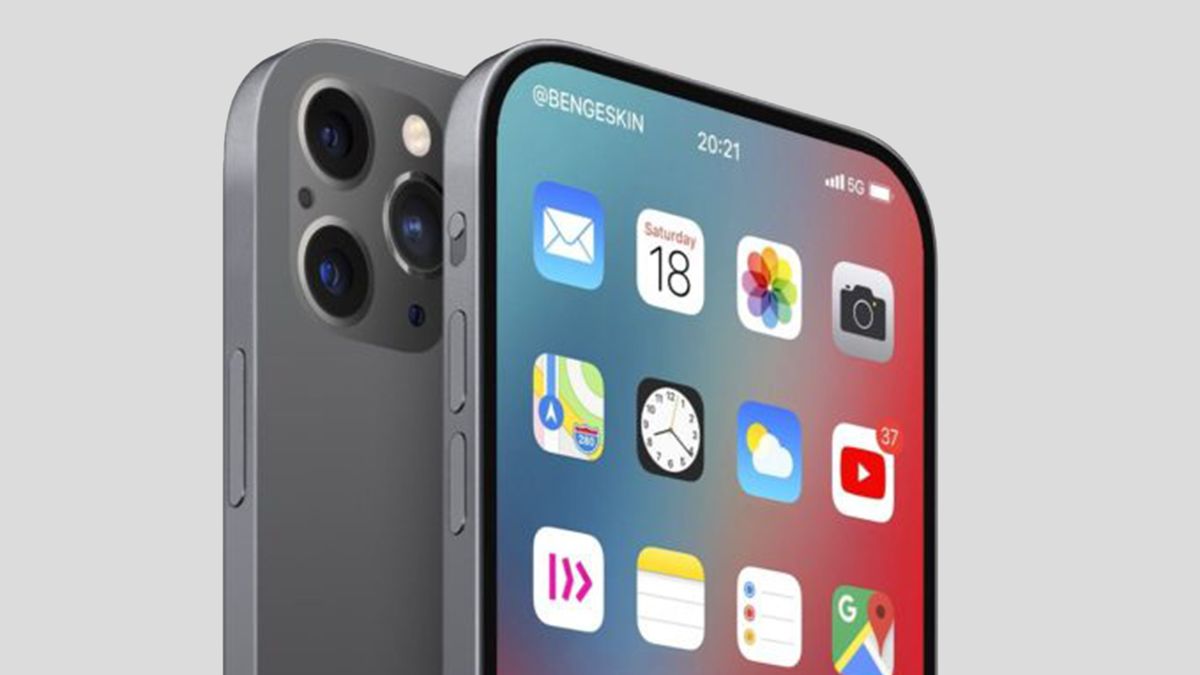
The rumoured iPhone 17 Air (left) could be the first step towards a "slimmer, port-free future". The report does suggest that the iPhone 17 Air will be the first step towards a "slimmer, port-free era". It seems the iPhone Apple has always wanted to make might finally be a possibility.

The Future of Charging: MagSafe

Could MagSafe soon become the only way to charge? The iPhone 17 Air is said to be missing a charging port, and at one point in production, it was also missing a SIM card slot. But, according to Bloomberg, Apple ultimately decided against cutting it just yet. But, the report does suggest that MagSafe could be the future of charging.

Conclusion

The future of the iPhone may be portless, and it seems that Apple is closer than ever to making this a reality. With the iPhone 17 Air, Apple may have found a way to produce a slim, wireless phone that doesn’t need a charging port at all. The possibilities are endless, and we can’t wait to see what the future holds for the iPhone.

FAQs

Q: Will the iPhone 17 Air be the first portless iPhone?
A: Yes, according to reports, the iPhone 17 Air will be the first step towards a "slimmer, port-free era".

Q: Will MagSafe be the only way to charge my iPhone?
A: It’s possible, as the report suggests that MagSafe could be the future of charging.

Q: Will I need to buy a new charger for my iPhone 17 Air?
A: Yes, if you plan to charge your iPhone 17 Air wirelessly, you may need to buy a new MagSafe charger.

The Best AI Prompt Generator

The Challenge of Effective Prompting

Creating the perfect prompt is an art and a science. Too vague, and you get generic results, while too specific in the wrong ways, and the AI might misunderstand your intention. Many of us waste time rewriting prompts several times before getting usable output. That’s where prompt generators come in, and AI Parabellum’s AI Prompt Generator is helping people get the results they want.

Introducing AI Parabellum’s AI Prompt Generator

AI Parabellum’s AI Prompt Generator is genuinely impressive. Unlike other generators that produce basic prompts, it creates structured, professional-grade prompts that get consistent results across different AI platforms. What makes it unique is its approach to prompt architecture. The generator writes prompts with clear separation between system instructions and user requirements. Each prompt includes a section that tells the AI how to behave, and a section that specifies what you actually want. This structured approach can dramatically improve AI responses.

Versatile Content Creation Support

AI Parabellum doesn’t just handle text prompts, but supports multiple content types too:

• Text generation
• Image generation
• Video generation

Its versatility means you can use one tool regardless of whether you’re writing an article, creating marketing visuals, or producing video content.

User-Friendly Features that Make a Difference

AI Parabellum has broken down the prompt creation process into intuitive components. When generating a text prompt, you can specify:

• Topic or subject – what your prompt is about
• Purpose – selected from common use cases
• Additional details – any specific requirements or constraints
• Tone – from formal to casual and everything between
• Output format – paragraphs, lists, essays, etc.
• Length – brief, medium, or detailed output
• Toggles for including examples, citations, and explanations in your generated prompts

Why Better Prompts Matter

Better prompts save time and money. When you’re paying per token or have limited credits on AI platforms, getting the right response the first time is valuable. AI Parabellum’s structured prompt format reduces the back-and-forth typically needed with AI tools. The system/requirement separation also helps maintain consistency. By clearly defining how the AI should approach your request separately from what you’re requesting, you get more predictable results across different sessions and different AI models.

Getting Started

Using AI Parabellum is straightforward. Visit the website, select your content type, fill in the relevant fields, and click "Generate Prompt." In seconds, you’ll have a crafted prompt to copy and paste into your favorite AI tool. The generated prompts work well with ChatGPT, Claude, and other AI platforms, making this a universal solution regardless of which tools you prefer.

Conclusion

If you’re serious about getting better results from AI tools, investing time in better prompts pays dividends. AI Parabellum’s AI Prompt Generator removes the guesswork and flattens the learning curve, allowing anyone to create expert-level prompts that deliver consistent, high-quality outputs.

Frequently Asked Questions

Q: What types of content does AI Parabellum support?
A: AI Parabellum supports text generation, image generation, and video generation.

Q: How do I get started with AI Parabellum?
A: Visit the website, select your content type, fill in the relevant fields, and click "Generate Prompt."

Q: What makes AI Parabellum’s AI Prompt Generator unique?
A: AI Parabellum’s generator writes prompts with clear separation between system instructions and user requirements, resulting in structured, professional-grade prompts that get consistent results across different AI platforms.

Federal Judge Blocks DOGE’s Access to SSA’s Personal Information

0

Federal Judge Blocks DOGE Access to Social Security Administration Data

Order Bars Access to Personal Information of Millions of Americans

A federal judge on Thursday issued an order blocking the Department of Government Efficiency (DOGE) from accessing systems at the Social Security Administration (SSA) that store the personal information of millions of Americans.

Judge’s Ruling

U.S. District Judge Ellen Hollander in Maryland accused DOGE of being "essentially engaged in a fishing expedition" in search of fraud based on "little more than suspicion." Hollander said DOGE "never identified or articulated" a reason why it needs access to the "personal and private data of millions of Americans."

Violations of Federal Privacy Laws and Cybersecurity Risks

The access, as per Hollander, violates several federal privacy laws, and the order warned of cybersecurity risks.

DOGE’s Access and Staffing

Per the filing, DOGE has 10 staffers at SSA, and seven of those had access to personally identifiable information in SSA’s data systems. TechCrunch has identified several, including Akash Bobba and Scott Coulter.

Initial Grant of Access

Hollander said SSA initially granted DOGE access to the systems, which included Social Security numbers, medical records, drivers’ license numbers, tax information, and reams of other personal information.

Conclusion

The order is a significant victory for privacy advocates and a blow to DOGE’s efforts to access sensitive data. The ruling highlights the importance of protecting the personal information of millions of Americans and the need for strict controls on government agencies’ access to sensitive data.

FAQs

Q: What is the Department of Government Efficiency (DOGE)?
A: DOGE is a government agency responsible for improving government efficiency.

Q: Why did DOGE seek access to SSA data?
A: DOGE sought access to SSA data to investigate potential fraud.

Q: What is the judge’s ruling?
A: The judge has blocked DOGE’s access to SSA data, citing violations of federal privacy laws and cybersecurity risks.

Q: How many DOGE staffers have access to SSA data?
A: Seven out of 10 DOGE staffers have access to personally identifiable information in SSA’s data systems.

Learn GIMP for Free

0

GIMP 3.0: The Ultimate Free Alternative to Photoshop?

GIMP has long been our top free pick in our best photo editing software guide, and the recent update will only solidify that choice. GIMP can do almost everything Photoshop can do, it’s that powerful, and any compromises feel well worth it for the fact it’s free. Did I mention it’s free?

A Free Alternative to Photoshop

But learning a new software comes with its challenges, and can feel intimidating. Luckily, the GIMP website has a brilliant help page, with links to user manuals, books and a fantastic tutorials page that is community-led. Hosting tips and tricks for getting started (known as GIMP Quickies) to more in-depth guides, this is the way to get started for free. You can even contribute your own tutorials if you have the skills to offer other learners.

A Wealth of Tutorials and Resources

The GIMP website has an impressive array of tutorials and resources to help you get started. The tutorials page is divided into sections, including:

  • Beginner-centred guides, including using Layer Masks, Basic Colour Curves and there’s also an Asset Folder, which holds plug-ins, brushes, scripts and more.
  • Photo Editing or Painting sections – and then there are sections for Configuration help and Coding tutorials as well.

A Community-Driven Effort

GIMP is totally open source so there’s a community of developers and users contributing to the tutorials. This means that the tutorials are constantly being updated and improved, making it an excellent choice for those looking to learn and grow.

Conclusion

If you’ve been waiting for the time to ditch your pricey subscriptions (perhaps to afford one of the best laptops for photo editing), the launch of GIMP 3.0 combined with this tutorial page could be the perfect opportunity. Not sure yet? See our Photoshop vs GIMP comparison.

FAQs

Q: Is GIMP free?
A: Yes, GIMP is completely free and open-source.

Q: Is GIMP as powerful as Photoshop?
A: GIMP can do almost everything Photoshop can do, making it a powerful alternative.

Q: Is the tutorial page comprehensive?
A: Yes, the GIMP website has a vast array of tutorials and resources to help you get started and improve your skills.

Q: Can I contribute to the tutorials?
A: Yes, you can contribute your own tutorials if you have the skills to offer other learners.

Nvidia Bets Big on Synthetic Data

0

Nvidia Acquires Synthetic Data Firm Gretel for Nine Figures

Acquisition Details

Nvidia has acquired synthetic data firm Gretel for nine figures, according to two sources with direct knowledge of the deal. The acquisition price exceeds Gretel’s most recent valuation of $320 million, although the exact terms of the purchase remain unknown.

Gretel’s Technology and Team

Gretel, founded in 2019 by Alex Watson, John Myers, and Ali Golshan, offers a synthetic data platform and a suite of APIs to developers who want to build generative AI models but lack access to enough training data or have privacy concerns around using real people’s data. The company raised more than $67 million in venture capital funding prior to the acquisition, according to Pitchbook. Gretel’s team of approximately 80 employees will be folded into Nvidia, where its technology will be deployed as part of the chip giant’s growing suite of cloud-based, generative AI services for developers.

Synthetic Data and its Benefits

Unlike human-generated or real-world data, synthetic data is computer-generated and designed to mimic real-world data. Proponents of synthetic data say it makes data generation more scalable, less labor-intensive, and more accessible to smaller or less-resourced AI developers. Additionally, synthetic data provides a higher level of privacy protection, making it an appealing option for healthcare providers, banks, and government agencies.

Nvidia’s Synthetic Data Efforts

Nvidia has been offering synthetic data tools for developers for years. In 2022, it launched Omniverse Replicator, which gives developers the ability to generate custom, physically accurate, synthetic 3D data to train neural networks. Last June, Nvidia began rolling out a family of open AI models that generate synthetic training data for developers to use in building or fine-tuning LLMs. Called Nemotron-4 340B, these mini-models can be used by developers to generate synthetic data for their own LLMs across various industries.

Nvidia’s Chief Executive’s Comments

During his keynote presentation at Nvidia’s annual developer conference this Tuesday, Nvidia co-founder and chief executive Jensen Huang spoke about the challenges the industry faces in rapidly scaling AI in a cost-effective way.

Conclusion

The acquisition of Gretel by Nvidia is a significant step in the company’s efforts to provide developers with the tools and resources they need to build and fine-tune their own AI models. With the addition of Gretel’s technology, Nvidia can further expand its offerings in the synthetic data space, providing a more comprehensive solution for developers and helping to address the data scarcity problem that has been a major challenge for the AI industry.

FAQs

Q: What is synthetic data?
A: Synthetic data is computer-generated data designed to mimic real-world data, making it a more scalable, less labor-intensive, and more accessible option for AI developers.

Q: What are the benefits of synthetic data?
A: Synthetic data provides a higher level of privacy protection, making it an appealing option for healthcare providers, banks, and government agencies. It also makes data generation more scalable, less labor-intensive, and more accessible to smaller or less-resourced AI developers.

Q: What are Nvidia’s synthetic data offerings?
A: Nvidia has been offering synthetic data tools for developers, including Omniverse Replicator and Nemotron-4 340B, which generate custom, physically accurate, synthetic 3D data and synthetic training data for developers to use in building or fine-tuning LLMs, respectively.

Revopoint Miraco Plus 3D Scanner: The Best of the Rest?

0

Why you can trust Creative Bloq

Our expert reviewers spend hours testing and comparing products and services so you can choose the best for you. Find out more about how we test.

Revopoint Miraco Plus Scanner Review: A 3D Scanning Powerhouse

Having given the Revopoint Miraco 4.5 out of 5 stars in 2024, I was excited to see whether the Miraco Plus would be worthy of a coveted 5 stars. With greater accuracy and the ability to scan larger objects, I was certainly hopeful.

Key Specs

Object size: Designed for scanning small to large objects
Single capture: 28 x 53mm at 100 mm
Scanning speed: 20fps
Single-frame accuracy: 0.04mm
Dimensions: 200 x 50 x 110 mm
Weight: 750g
Compatible OS: Windows, macOS

Price

At £1,726 / $1,979, the Miraco Plus will be too expensive for enthusiasts. It’s also £500 / $200 more expensive than the standard Miraco model and only worth paying more if you are scanning larger and more complex objects.

Unboxing

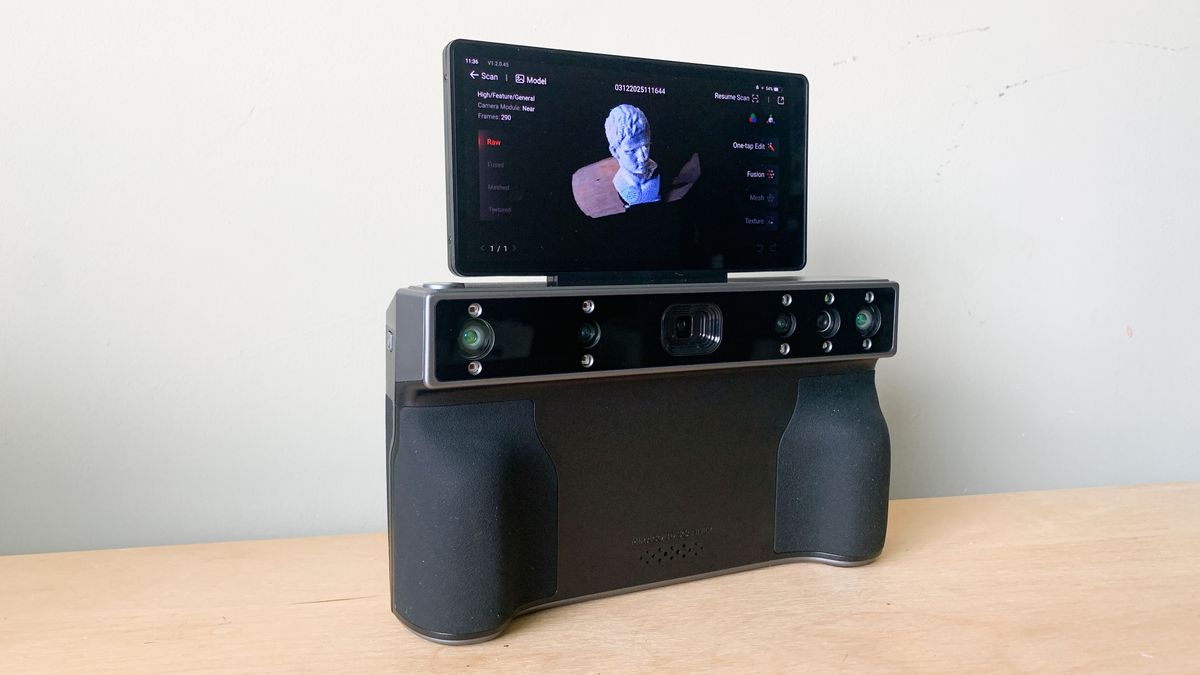
The Revopoint Miraco Plus scanner is almost identical to the original Miraco. The 750g weight makes it super portable and can even be held with only one hand. The scanner is a cross between a traditional DSLR, minus the lens, and a smartphone device. It’s larger than a smartphone but the size means you can grip it with two hands for a much more stable scanning experience.

Performance

The scanner offers a variety of different settings that users can adjust before performing a scan. The first is to choose between the far and near modes. The former is ideal for scanning large objects such as cars and people whereas the latter is best for small objects or detailed areas on objects. I found that choosing the right one did indeed make a difference in the end result of the scan.

There is then the choice to scan using either the continuous or single shot mode. Most of the time I was able to capture the results I needed using the 20fps continuous mode but where I needed to capture more details and clearer textures, the single shot mode was far better. This was particularly noticeable in the crevices of objects and when viewing the resulting textures that were generated from the scan. When using this single-shot mode, all I’d recommend is making sure that you have a significant overlap between the frames otherwise I found that the scan can become a little patchy and inaccurate. Revopoint recommends at least 50% overlap.

Who’s it for?

The Revopoint Miraco Plus is aimed at professionals and very serious hobbyists. The inclusion of photogrammetric metrology capabilities makes it perfect for creatives wanting to scan large objects. It is equally adept at capturing small/medium objects which makes it a one-stop solution for those who don’t want to own different scanners for different-sized objects.

Conclusion

The Revopoint Miraco Plus is a powerful 3D scanner that offers exceptional accuracy and flexibility. With its photogrammetric metrology kit, it’s perfect for scanning large objects and is ideal for professionals and serious hobbyists. However, it’s not suitable for those on a budget or looking for a quick and easy solution to 3D scanning.

FAQs

  • What is the Revopoint Miraco Plus used for?
  • It’s used for scanning small, medium, and large objects.

  • Is the Revopoint Miraco Plus suitable for professionals and serious hobbyists?
  • Yes, it’s designed for professionals and very serious hobbyists who need high accuracy and flexibility.

  • Is the Revopoint Miraco Plus expensive?
  • Yes, it’s priced at £1,726 / $1,979, making it too expensive for enthusiasts.

  • What are the key features of the Revopoint Miraco Plus?
  • It has a 6-inch 2K backlit AMOLED touch-sensitive screen, 20fps scanning speed, 0.04mm single-frame accuracy, and is compatible with Windows and macOS.

NVIDIA Accelerates Quantum Research with New Center

As Quantum Computers Develop, AI Supercomputers Will Integrate for Accelerated Solutions

Quantum computing innovators like Quantinuum, QuEra, and Quantum Machines, along with academic partners from the Harvard Quantum Initiative and the Engineering Quantum Systems group at the MIT Center for Quantum Engineering, will work on projects with NVIDIA at the center to explore how AI supercomputing can accelerate the path toward quantum computing.

Protecting Qubits with AI Supercomputing

Qubit interactions are a double-edged sword. While qubits must interact with their surroundings to be controlled and measured, these same interactions are also a source of noise – unwanted disturbances that affect the accuracy of quantum calculations. Quantum algorithms can only work if the resulting noise is kept in check.

Developing Applications for Accelerated Quantum Supercomputers

The majority of useful quantum algorithms draw equally from classical and quantum computing resources, ultimately requiring an accelerated quantum supercomputer that unifies both kinds of hardware.

QPU Integration

Integrating quantum hardware with AI supercomputing is one of the major remaining hurdles on the path to running useful quantum hardware.

Conclusion

The NVIDIA Accelerated Quantum Research Center (NVAQC) is a powerful tool that will be instrumental in ushering in the next generation of research across the entire quantum ecosystem. The center will house a supercomputer with 576 NVIDIA Blackwell GPUs dedicated to quantum computing research, enabling large-scale simulations of quantum algorithms and hardware, tight integration of quantum processors, and both training and deployment of AI models for quantum.

Frequently Asked Questions

Q: What is the NVIDIA Accelerated Quantum Research Center (NVAQC)?
A: The NVAQC is a research center dedicated to accelerating the development of quantum computing through the integration of quantum processing units (QPUs) with AI supercomputers.

Q: What is the purpose of the NVAQC?
A: The NVAQC is designed to explore the integration of quantum computing with AI supercomputing and to develop new applications and technologies that can benefit from this integration.

Q: What are some of the key challenges that the NVAQC will address?
A: The NVAQC will address several key challenges, including protecting qubits from noise, developing new applications for accelerated quantum supercomputers, and integrating quantum hardware with AI supercomputing.

Q: Who will be involved in the NVAQC?
A: The NVAQC will involve a number of organizations, including NVIDIA, Quantinuum, QuEra, and Quantum Machines, as well as academic partners from the Harvard Quantum Initiative and the Engineering Quantum Systems group at the MIT Center for Quantum Engineering.

Love Neel? Here’s how DNEG nailed the perfectly lovable, endearingly anxious look for Star Wars: Skeleton Crew

0

Creating Neel, the Elephantine Protagonist of Star Wars: Skeleton Crew

Combining Digital and Practical Character Work

In keeping with the grand tradition of Star Wars visual effects production work over nearly fifty years, Star Wars: Skeleton Crew combines digital and practical character and creature work. It’s meant one breakout star in particular – Neel – has connected with audiences.

Traditional Puppetry and CG Animation

For Chris McLaughlin, Visual Effects Supervisor at DNEG, creating Neel with a blend of traditional puppetry and CG animation felt like a return to the film series roots. "For the puppets and the very traditional style of animation that we were producing, we always had pretty good reference," says Chris McLaughlin. "The two main animated characters that we worked on were Neel and the security droids. In a lot of cases, the security droids shot on set were completely practical, being performed as a full-sized puppet. For our CG versions of the security droids, we used that reference for the walking cycle and animation style."

Head Replacements and Animation

A standout protagonist in Skeleton Crew is the elephantine character Neel, who is one of the four young heroes. DNEG had a significant level of creative input in finessing Neel’s character’s expressivity. Chris recalls that, "We did quite a few head replacements for Neel. Not because showrunners were unhappy with the animatronic head, which was key and the heart of the performance, but because in some cases Kacie Borrowman (playing Neel on set) couldn’t see completely clearly through that head. And so, in situations where he has to run down the ramp of a spaceship, or where his vision is impeded and his safety could be at risk, we’d take the head off and replace it with animation."

Refining Neel’s Expressivity

"We made sure that our animation rig and our asset exactly matched the capabilities of the animatronic head. We didn’t want it to look overworked and we did a little bit of simulation on the ears and on the trunk to give it that natural kind of gravity. Neel has a complex coloring to his skin, too: it’s a combination of pink and blue. I’m pleased with the shots where we replaced Neel’s head. They were a challenge!"

Further refinements that DNEG worked on for Neel allowed Chris and his team to bring more personality to the character. "[We could] do a lot with Neel’s brows and with his soft, gentle blinking. He’s quite a worrisome character so you can do a lot with the movement around his eyes and brow," reflects Chris, adding: "You can read a lot of that there."

Conclusion

DNEG’s work on creating Neel showcases the importance of combining traditional puppetry and CG animation to bring a beloved character to life. By using a blend of practical and digital techniques, the team was able to create a character that has captured the hearts of audiences everywhere.

FAQs

Q: What was the approach taken to create Neel, the elephantine protagonist of Star Wars: Skeleton Crew?
A: DNEG combined traditional puppetry and CG animation to create Neel.

Q: How did DNEG approach the creation of the security droids in the show?
A: DNEG used a combination of practical and CG techniques, using reference from the walk cycle and animation style of the puppets.

Q: What were some of the challenges faced in creating Neel’s character?
A: The team had to overcome challenges such as replacing Neel’s head with animation, ensuring the animation rig and asset matched the capabilities of the animatronic head, and refining Neel’s expressivity.