Home Blog Page 160

Retro Visual Design Wins Me Over

0

Why you can trust Creative Bloq

Atomfall: details

Atomfall has been touted as the British Fallout, and it’s true that it has a similar irradiated, retro-technological vibe to Fallout. But the resemblance ends there. It would be much more accurate to describe it as a deliciously unholy mash-up of Stalker, The Wicker Man, and The Quatermass Experiment.

Atomfall walks an original path

One striking area in which Atomfall innovates lies in the way its story is constructed – to be precise in its lack of structure. It eschews cut-scenes almost entirely, preferring to let the story emerge as you explore its three main open-world areas – Casterfell Woods, occupied by Druids who bring strong Wicker Man energy; Skethermore, patrolled by the military, complete with 50s-style battle-robots and automatic turrets; and Slatten Dale, full of outlaws who often rock Clockwork Orange-style outfits.

Kitsch visual design

Cute period touches abound: vacuum-tube machines provided storage for extraneous kit I had collected, for extraction when I needed it, and red telephone boxes offered dialogue with a mysterious voice who may or may not actually have been helping me. Finding the best kit – and some crucial objects without which I wouldn’t have been able to progress – often involved some decent puzzle-solving.

Conclusion

Atomfall presents a fun, satisfying, and surprisingly coherent whole, with its emergent nature adding a bizarre sense of believability to a situation which is very much in the realms of fantasy. On top of that sits the sheer – at times satirically explored – Britishness of proceedings. Atomfall offers gameplay that evolves cleverly and seemingly organically, which can be tackled in a number of different ways. Nostalgia has rarely felt so fresh and original.

Frequently Asked Questions

Q: What is Atomfall?
A: Atomfall is a post-apocalyptic survival game set in a 1950s England.

Q: What is the game’s storyline like?
A: The game’s storyline is constructed in an innovative way, with no cut-scenes and an open-world design.

Q: What is the gameplay like?
A: The gameplay is a mix of survival mechanics, melee combat, and exploration, with a focus on exploration and discovery.

Q: Is the game’s setting unique?
A: Yes, the game’s setting is a 1950s England after a nuclear disaster, which is a unique twist on the traditional post-apocalyptic setting.


Scaling Up: Four Challenges to Enterprise-Scale Generative AI

The Road to Enterprise-Scale Adoption of Generative AI: Challenges and Considerations

The road to enterprise-scale adoption of generative AI remains arduous as businesses struggle to harness its potential. While those who have moved forward with generative AI have reported improved business outcomes, with 15.8% revenue increase, 15.2% cost savings, and 22.6% productivity improvement on average, according to a Gartner survey, the reality is that 80% of AI projects in organizations fail, as noted by Rand Corporation. Additionally, Gartner’s survey found that only 30% of AI projects move past the pilot stage.

Four Key Challenges

While some companies may have the resources and expertise to build their own generative AI solutions from scratch, many underestimate the complexity of in-house development and the opportunity costs involved. The following four key challenges can thwart internal generative AI projects:

1. Safeguarding Sensitive Data

Access control lists (ACLs) – a set of rules that determine which users or systems can access a resource – play a vital role in protecting sensitive data. However, incorporating ACLs into retrieval augmented generation (RAG) applications presents a significant challenge. RAG, an AI framework that improves the output of large language models (LLMs) by enhancing prompts with corporate knowledge or other external data, heavily relies on vector search to retrieve relevant information. Unlike traditional search systems, adding ACLs to vector search dramatically increases computational complexity, often resulting in performance slowdowns.

2. Ensuring Regulatory and Corporate Compliance

In highly regulated industries like financial services and manufacturing, adherence to both regulatory and corporate policies is mandatory. This applies not only to human employees but also to their generative AI counterparts, who are playing an increasing role in both front-end and back-end operations. To mitigate legal and operational risks, generative AI systems must be equipped with AI guardrails that ensure ethical and compliant outputs, while also maintaining alignment with brand voice and regulatory requirements, such as ensuring compliance with FINRA regulations in the financial space.

3. Maintaining Strong Enterprise Security

In-house generative AI solutions often encounter significant security challenges, such as protecting sensitive data, meeting information security standards, and ensuring security during enterprise systems integration. Addressing these issues requires specialized expertise in generative AI security, which many organizations new to the technology do not possess, raising the potential for data leaks, security breaches, and compliance concerns.

4. Expanding Across Use Cases

Building a generative AI application for a single use case is relatively simple, but scaling it to support additional use cases often requires starting from square one each time. This leads to escalating development and maintenance costs that can stretch internal resources thin.

Conclusion

The issue with in-house generative AI projects is that often companies fail to see the complexities involved in data preparation, infrastructure, security, and maintenance. Scaling AI solutions requires significant infrastructure and resources, which can be costly and complex. Most organizations that run small pilots on a couple of thousand documents haven’t thought through what it takes to bring that up to scale: from the infrastructure to the types of embedding models and their cost-precision ratios.

FAQs

Q: What are the four key challenges in implementing generative AI in an organization?
A: The four key challenges are safeguarding sensitive data, ensuring regulatory and corporate compliance, maintaining strong enterprise security, and expanding across use cases.

Q: What is the success rate of AI projects in organizations?
A: According to Gartner, only 30% of AI projects move past the pilot stage, and 80% of AI projects in organizations fail.

Q: What are the benefits of using a pre-built generative AI platform?
A: A pre-built platform can provide scalability, security, and compliance, reducing the need for internal resources and expertise, and enabling organizations to focus on their core business.

Full Steam Ahead: NVIDIA-Certified Enterprise Storage for AI Factory Deployment

Building Blocks for a New Class of Enterprise Infrastructure

AI deployments thrive on speed, data, and scale. That’s why NVIDIA is expanding NVIDIA-Certified Systems to include enterprise storage certification — for streamlined AI factory deployments in the enterprise with accelerated computing, networking, software, and storage.

As Enterprises Build AI Factories, Access to High-Quality Data is Imperative

The new NVIDIA-Certified Storage program announced today at the NVIDIA GTC global AI conference validates that enterprise storage systems meet stringent performance and scalability data requirements for AI and high-performance computing workloads.

Leading Enterprise Data Platform and Storage Providers Are Already Onboard

Leading enterprise data platform and storage providers are already onboard, ensuring businesses have trusted options from day one. These include DDN, Dell Technologies, Hewlett Packard Enterprise, Hitachi Vantara, IBM, NetApp, Nutanix, Pure Storage, VAST Data, and WEKA.

Building Blocks for a New Class of Enterprise Infrastructure

At GTC, NVIDIA also announced the NVIDIA AI Data Platform, a customizable reference design to build a new class of enterprise infrastructure for demanding agentic AI workloads.

NVIDIA-Certified Storage: A Prerequisite for Partners

The NVIDIA-Certified Storage designation is a prerequisite for partners developing agentic AI infrastructure solutions built on the NVIDIA AI Data Platform. Each of these NVIDIA-Certified Storage partners will deliver customized AI data platforms, in collaboration with NVIDIA, that can harness enterprise data to reason and respond to complex queries.

NVIDIA-Certified: More Than Four Years of Delivering Optimal Performance and Scalability

NVIDIA-Certified was created more than four years ago as the industry’s first certification program dedicated to tuning and optimizing AI systems to ensure optimal performance, manageability, and scalability. Each NVIDIA-Certified system is rigorously tested and validated to deliver enterprise-grade AI performance.

Solutions Based on NVIDIA Enterprise RAs

Solutions based on NVIDIA Enterprise RAs are available from the world’s leading systems providers to reduce the time, cost, and complexity of enterprise AI deployments. Enterprise RAs are now available for a wide range of NVIDIA Hopper and NVIDIA Blackwell platforms, including NVIDIA HGX B200 systems and the new NVIDIA RTX PRO 6000 Blackwell Server Edition GPU.

Conclusion

The expansion of NVIDIA-Certified Systems to include enterprise storage certification is a significant milestone in the journey to build AI factories that can harness the power of data. With the proliferation of AI and the increasing need for high-quality data, this certification program will help enterprises build AI factories that can process massive amounts of data, train models faster, and drive more accurate, reliable AI outcomes.

Frequently Asked Questions

Q: What is the NVIDIA-Certified Storage program?
A: The NVIDIA-Certified Storage program is a certification program that validates that enterprise storage systems meet stringent performance and scalability data requirements for AI and high-performance computing workloads.

Q: Who are the leading enterprise data platform and storage providers participating in the program?
A: The leading enterprise data platform and storage providers participating in the program include DDN, Dell Technologies, Hewlett Packard Enterprise, Hitachi Vantara, IBM, NetApp, Nutanix, Pure Storage, VAST Data, and WEKA.

Q: What is the NVIDIA AI Data Platform?
A: The NVIDIA AI Data Platform is a customizable reference design to build a new class of enterprise infrastructure for demanding agentic AI workloads.

Q: What is the NVIDIA-Certified designation?
A: The NVIDIA-Certified designation is a prerequisite for partners developing agentic AI infrastructure solutions built on the NVIDIA AI Data Platform.

Anthropic’s AI Assistant Claude Learns to Search the Web

Anthropic’s AI Assistant Claude Learns to Search the Web

New Feature Enhances Claude’s Capabilities

Anthropic has announced that its AI assistant Claude can now search the web, providing users with more up-to-date and relevant responses. This integration of web search functionality allows Claude to access the latest information and expand its knowledge base beyond its initial training data.

Transparency and Fact-Checking

A key feature of this update is the emphasis on transparency and fact-checking. When Claude incorporates information from the web into its responses, it provides direct citations so users can easily fact-check sources.

Streamlined Information-Gathering Process

Claude aims to streamline the information-gathering process for users. Instead of requiring users to manually sift through search engine results, Claude processes and delivers relevant sources in a conversational format.

New Use Cases for Claude

This enhancement is expected to unlock a multitude of new use cases for Claude across various industries. Some potential applications include:

Industry-Specific Use Cases

  • Sales Teams: Can now transform account planning and drive higher win rates through informed conversations with prospects by analyzing industry trends to learn key initiatives and pain points.
  • Financial Analysts: Can assess current market data, earnings reports, and industry trends to make better investment decisions and inform financial model assumptions.
  • Researchers: Can build stronger grant proposals and literature reviews by searching across primary sources on the web, spotting emerging trends and identifying gaps in the current literature.
  • Shoppers: Can compare product features, prices, and reviews across multiple sources to make more informed purchase decisions.

Availability and Activation

The initial rollout is limited to paid users in the US, but support for users on the free plan and more countries is coming soon. To activate the web search feature, users simply need to toggle on web search in their profile settings and start a conversation with Claude.

Conclusion

This update aims to make Claude a more powerful and versatile tool for a wide range of tasks. By providing access to real-time information and ensuring transparency through citations, Anthropic is addressing key challenges and further solidifying Claude’s position as a leading AI assistant.

Frequently Asked Questions

Q: What is the current availability of the web search feature?
A: The initial rollout is limited to paid users in the US, but support for users on the free plan and more countries is coming soon.

Q: How do I activate the web search feature?
A: To activate the web search feature, users simply need to toggle on web search in their profile settings and start a conversation with Claude.

Q: What are some potential use cases for the web search feature?
A: The web search feature can be used in a variety of industries and applications, including sales, finance, research, and shopping.

SVT Robotics unveils new cloud-based portal for SoftBot platform

0

SVT Robotics, a software provider that empowers companies to integrate, monitor and scale automation, has launched its new cloud-based portal for the SoftBot Platform, providing IT and operations teams with a central control hub for monitoring and managing automation across multiple sites.

A.K. Schultz, CEO of SVT Robotics, says: “As automation adoption continues to grow, companies need a centralized way to monitor and troubleshoot their technology.

“These new SoftBot Platform advancements provide real-time monitoring across diverse facilities, instant alerts on system issues, and faster resolution – all from a single, unified interface.

“This level of transparency and control allows businesses to reduce downtime and dependency on limited IT resources and ultimately unlock new levels of automation scalability.”

SVT’s new cloud-based portal provides a centralized monitoring toolset, where operational and IT users gain real-time visibility into critical issues and early warning signs before they escalate. To ensure teams can respond instantly to errors, the portal offers unified engine management and alerts, streamlining oversight across all deployments.

When combined with the enhanced troubleshooting capabilities, the process of diagnosing and resolving issues is simplified and accelerated.

Nick Leonard, SVP of product, says: “Managing automation at scale has historically been complex, but the new SoftBot Platform portal makes it significantly easier.

“Enhanced troubleshooting tools like workflow tracking and execution logs accelerate issue resolution, while role-based access control simplifies user management as teams scale. Together, these advancements help IT and operations teams manage their automation with greater efficiency.”

Mastering Speed and Realism in Archviz with 3ds Max and Corona

0

Architectural Visualization: The Art of Bringing Designs to Life

Architectural visualization stands at the crossover of artistry and technical precision, offering architects a powerful tool to bring their designs to life long before real-world construction begins. The best CAD laptops can help you get the results you need, as can the best 3D software, but more than ever an artist’s eye is needed to ensure the project looks as good as you, and the client, want.

01. Light up the Sky

In my opinion, the most effective and optimised approach for exterior lighting is Corona Sky. This method is fully physical and based on real-world principles, which ensures highly realistic and accurate lighting results. It’s crucial to be familiar with the parameters of this map to get the best outcomes. I use the PRG Clear Sky system, as it delivers the best results for me. Always set the Intensity to 1 and avoid changing it. If the lighting is too dim or too bright, adjust the camera settings to control the light intensity rather than altering this parameter.

10. Create a Brick Wall Material

Setting up a brick material is one of the more challenging aspects for any visualization, as bricks often look flat like wallpaper, which fails to convey sufficient realism. The first key is using high-quality Texture maps, with the Quixel Megascans library offering exceptional quality textures. For Normal map textures, it’s essential to use a Corona Normal map as an intermediary. Make sure to enable the ‘Add gamma to input’ option for proper functionality.

Additional Tips and Tricks

  • Use Corona Mixture map to introduce a touch of randomness and prevent any repetition in the brick texture.
  • Connect Texture Map M to both the Top layer and Base layer within the Corona Mixture Texmap node, then apply a dirt texture to the Mix amount and make sure the Mix Operation field is set to Mix mode.
  • Use a Corona Color Correct map to adjust the saturation of your brick texture, reducing it to a minimum to have more control over its color.
  • The most crucial aspect of the brick material is using the Displace map and Corona Displacement modifier. I strongly recommend using this modifier and enabling the ‘Get from material’ option. You can also control the height of the bricks by adjusting the Max Level field, though I’d suggest keeping the Min Level unchanged.

Conclusion

Architectural visualization requires a deep understanding of the technical aspects of 3D modeling and rendering, as well as a keen eye for artistry and design. By combining these skills, architects can create stunning visualizations that bring their designs to life and help clients visualize the final product.

Frequently Asked Questions

Q: What is the most effective approach for exterior lighting in architectural visualization?
A: Corona Sky is the most effective and optimised approach for exterior lighting, as it is fully physical and based on real-world principles, ensuring highly realistic and accurate lighting results.

Q: How do I set up a realistic brick material in my visualization?
A: Use high-quality Texture maps, such as those from the Quixel Megascans library, and enable the ‘Add gamma to input’ option for proper functionality. Also, use a Corona Normal map as an intermediary and adjust the saturation of the brick texture using a Corona Color Correct map.

Q: What is the most crucial aspect of setting up a brick material?
A: The most crucial aspect is using the Displace map and Corona Displacement modifier, as it allows for more realistic and detailed rendering of the brick texture.

Adapting to an Era of Artificial Intelligence

Key points:

Reimagining Learning with AI: A Path to Empowerment

The CoSN 2025 Conference is gearing up to tackle the topic of AI in education, focusing on human leadership in an AI world. The conference will feature keynotes, panels, and workshops that will explore the promises and perils of leveraging AI in education.

Keynote Speakers:

  • Ken Shelton, an independent consultant, speaker, advisor, and strategist, will open the conference on Monday, March 31, with a keynote on "Reimagining Learning with AI: A Path to Empowerment."
  • On Tuesday, April 1, a panel discussion, "Leadership, Not Bystanders," will feature Lindsay E. Jones, CEO of CAST, Lindsay Kruse, CEO of All Means All, and Rachell Johnson, director of assistant technology at SCATP, moderated by Sarah Radcliffe, director of Future Ready Learning in the School District of Altoona.
  • The closing keynote on Wednesday, April 2, "Beyond the Algorithm—Building Trust, Access, and Purpose in AI-Enhanced Education," will feature Richard Culatta of ISTE + ASCD, Victor Lee of the Graduate School of Education at Stanford University, Pati Ruiz, EdD, of Digital Promise, and Kris J. Hagel of the Peninsula School District.

Workshops:

  • Student data privacy
  • Generative AI implementation
  • Education leadership in the digital age
  • AI and leadership
  • Organizational change management for digital transformation

Spotlight Sessions:

  • Cybersecurity and physical security
  • Tackling cell phones in classrooms
  • Top edtech trends in 2025
  • Edtech and AI quality indicators
  • FERPA

Target Audiences:

Chief Technology Officers

  • Learn proven strategies for getting the dollars you need to build the infrastructure for today and tomorrow
  • Connect with your peers and build your community of practice
  • Discover how to stretch scarce resources to make the greatest impact on teaching and learning

Instructional Technology Directors

  • Hear about new tools and models for engaging students and personalizing instruction
  • Strategize about how to bridge the gap between the technical and instructional silos
  • Improve your leadership skills and how to scale technology beyond islands of innovation

Superintendents, District Teams, and Education Service Agencies

  • Hear from thought leaders on how to create a vision for digital conversion and continuously improving innovative culture in your district
  • Learn tips for breaking down the silos and leveraging technology to enable a 21st-century school system
  • Share creative and strategic solutions about how to create robust learning environments at school and at home

Industry, Government, and Nonprofit Representatives

  • Understand what is keeping school system technology leaders up at night
  • Share information on emerging tools and services for learning
  • Learn about better strategies and models for implementing, maintaining, and evaluating technology for learning

Conclusion:

The CoSN 2025 Conference is the perfect opportunity for education leaders to come together and discuss the impact of AI on education. With a focus on human leadership in an AI world, attendees will gain valuable insights and strategies for maximizing the benefits of AI while minimizing its risks.

Frequently Asked Questions:

Q: What is the theme of the CoSN 2025 Conference?
A: The theme is "Human Leadership in an AI World."

Q: Who are the keynote speakers?
A: Ken Shelton, Lindsay E. Jones, Lindsay Kruse, Rachell Johnson, Richard Culatta, Victor Lee, Pati Ruiz, and Kris J. Hagel will be speaking at the conference.

Q: What are the workshop topics?
A: The workshop topics include student data privacy, generative AI implementation, education leadership in the digital age, AI and leadership, and organizational change management for digital transformation, among others.

Q: Who are the target audiences for the conference?
A: The target audiences include Chief Technology Officers, Instructional Technology Directors, Superintendents, District Teams, and Education Service Agencies, as well as Industry, Government, and Nonprofit Representatives.

Trump’s Confusing Crusade Against Big Tech

0

The Trump Administration’s Dilemma with Big Tech

Confusion Abounds as the White House Woos and Woes Big Tech

President Trump’s views on TikTok have undergone a dramatic shift. From wanting to ban the app to trying to save it, the administration’s stance has been shrouded in uncertainty. Meanwhile, the Trump administration continues to push for regulation of Big Tech, while also courting their CEOs and firing some regulators. This has led to a lack of clarity on what exactly the White House wants to achieve.

Confusion at the Top

The Trump administration’s plans for Big Tech are still unclear, with no concrete details emerging. OpenAI and Google are trying to convince the White House to adopt their vision for AI, but it appears no one knows where they stand. This uncertainty has led to a "concepts of a plan" situation, with no clear direction or strategy in place.

Tech News Roundup

Before delving into the world of policy, The Vergecast team discussed some other notable tech news. Apple is still reeling from the fallout of the Siri-sucks-gate scandal, which has led to an executive shakeup within the company. Smartwatches are back in the spotlight, with Pebble’s return sparking a debate about how Apple works with watches. Google and Huawei have both launched new phones, and Nvidia remains at the forefront of the AI industry.

Policy Talk

Lauren Feiner from The Verge joined the show to discuss the latest developments on the TikTok ban and the state of Broadband Equity, A. She shed light on the administration’s plans to regulate Big Tech, including their efforts to woo CEOs and fire regulators.

Conclusion

The Trump administration’s approach to Big Tech is marked by confusion and uncertainty. While they initially wanted to ban TikTok, they are now trying to save it. The lack of clear direction and strategy has led to a "concepts of a plan" situation, with no concrete details emerging. As the administration continues to push for regulation, it remains to be seen what they will ultimately achieve.

FAQs

Q: What is the Trump administration’s stance on TikTok?
A: The administration’s stance on TikTok has shifted from wanting to ban it to trying to save it. The exact details of their plan are still unclear.

Q: What is the goal of the Trump administration’s Big Tech regulation efforts?
A: The goal of the Trump administration’s Big Tech regulation efforts is still unclear, with no concrete details emerging.

Q: What is the significance of the Siri-sucks-gate scandal?
A: The Siri-sucks-gate scandal has led to an executive shakeup within Apple, marking a significant development in the company’s efforts to address the controversy.

Reinventing the Mundane in a Sci-Fi World

0

Anthony Brault’s 3D Art: Blending Sci-Fi and Mundanity

Inspiration from the Ordinary

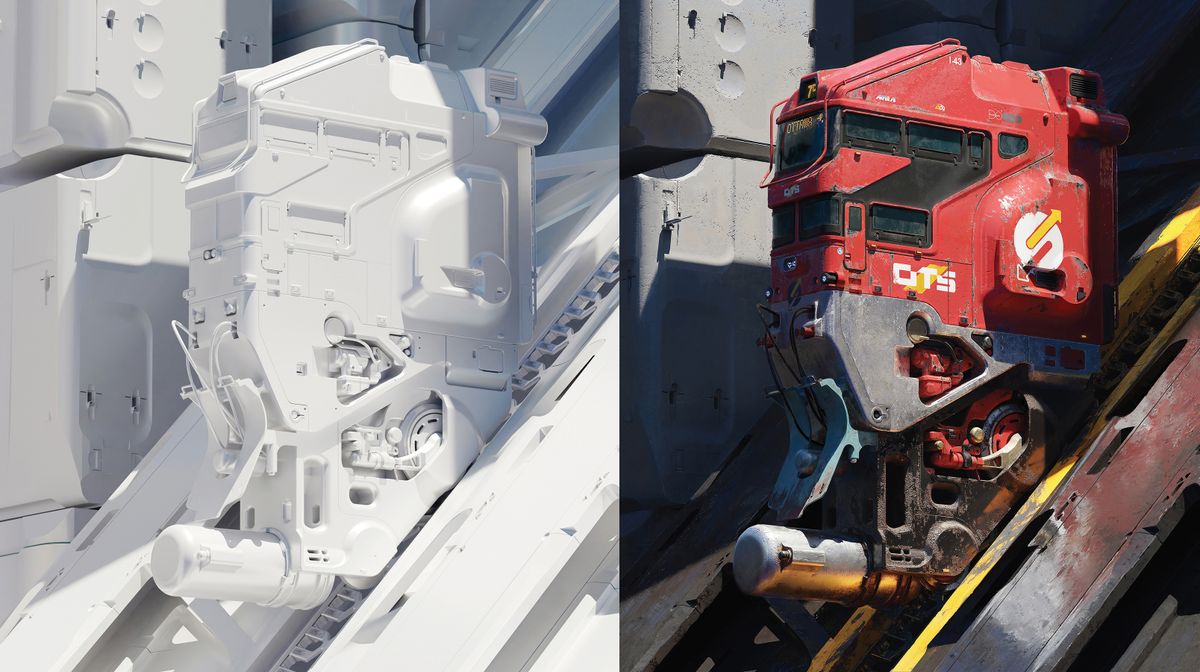
Anthony Brault, a concept artist from Ottawa, Canada, has created a stunning piece of art that defies the ordinary. His project, "Funicular," is a personal endeavor that explores the intersection of science fiction and everyday life. In this article, we’ll delve into the making of this fascinating piece and learn more about the software and techniques used to bring it to life.

Modeling and Rendering

Anthony modeled the majority of the funicular using Plasticity, a software that allows for endless experimentation with Booleans and bevels. He then added textures in Substance 3D Painter and rendered the model in Blender using Cycles.

The Concept Behind the Art

In his own words, Anthony explains, "For this project, I wanted to try to blend sci-fi elements with ordinary, mundane aspects of life today. So I drew inspiration from perhaps one of the most boring experiences of all; waiting for the bus in Ottawa, my hometown. A lot of life is made up of these unremarkable moments, so I feel like there’s something very relatable about them."

The Result

The end result is a striking piece of art that seamlessly combines futuristic elements with the mundane. The funicular, a type of cable-lifted transportation, is rendered in stunning detail, with intricate textures and lighting that bring the scene to life.

Conclusion

Anthony’s "Funicular" is a testament to the power of art to transform the ordinary into the extraordinary. By blending sci-fi and reality, he has created a piece that is both thought-provoking and visually stunning.

FAQs

Q: What software did Anthony use to create the art?
A: Anthony used Plasticity, Substance 3D Painter, and Blender.

Q: What is the inspiration behind the art?
A: The inspiration comes from the experience of waiting for the bus in Ottawa, which Anthony finds relatable and mundane.

Q: What is the meaning of the art?
A: The art blends sci-fi elements with everyday life, reflecting the idea that even ordinary moments can be transformed and elevated by art.

Q: Where can I see more of Anthony’s work?
A: You can find more of Anthony’s art on his ArtStation page.

Locus Robotics launches business intelligence platform for warehouse automation

0

Locus Robotics, the global leader in mobile warehouse automation, announces LocusINTELLIGENCE, a powerful, groundbreaking, AI-driven business intelligence software layer within the LocusONE platform.

Designed to provide real-time decision-making, continuous optimization, and deep operational insights, LocusINTELLIGENCE enables fulfillment operations to achieve unmatched flexibility, throughput, and efficiency.

Locus will showcase a range of next-generation AI advancements developed through LocusLABS, the dedicated R&D division of Locus Robotics, at LogiMAT in Germany and ProMat in the United States.

Rick Faulk, CEO of Locus Robotics, says: “At Locus Robotics, we are not just deploying robots – we’re delivering intelligence.

“Our investment in AI, software, and next-generation automation technologies sets us apart as the leader in warehouse efficiency and fulfillment innovation.

“Through LocusINTELLIGENCE and LocusLABS, we are continuously developing solutions that allow our customers to maximize throughput, scale with confidence, and adapt to the evolving logistics landscape.”

LocusINTELLIGENCE: The AI powerhouse driving LocusONE

LocusINTELLIGENCE is the advanced AI and analytics engine that powers the LocusONE platform, leverages machine learning, predictive analytics, and real-time operational data, LocusINTELLIGENCE continuously adapts and optimizes fulfillment operations at scale.

  • AI-Powered Decision-Making – Dynamically manages task allocation, workflow optimization, and multi-robot coordination to efficiently align fulfillment priorities with real-time demand.
  • Scalable & Adaptive Performance – Enables LocusONE to seamlessly adjust to fluctuating order volumes, seasonal spikes, and labor constraints, ensuring warehouses always operate at peak efficiency.
  • Real-Time Operational Insights – Gives operators deep visibility into throughput, worker performance, and predictive maintenance, enabling proactive, data-driven decisions.
  • Seamless WMS & ERP Integration – Works natively within existing warehouse management systems, allowing for rapid deployment and immediate productivity gains.

Through LocusINTELLIGENCE, LocusONE delivers an even more powerful, AI-enhanced orchestration platform, providing warehouses with an intelligent automation ecosystem that continuously learns, adapts, and improves.

LocusLABS: Driving AI-powered innovation in the warehouse

LocusLABS, the dedicated R&D division of Locus Robotics, is at the forefront of AI innovation, continuously advancing warehouse automation capabilities. At LogiMAT and ProMat 2025, Locus will unveil several AI-driven breakthroughs, including:

  • AI Object Detection & Avoidance – Advanced perception AI enables Locus robots to intelligently recognize and react to warehouse assets, ensuring seamless, real-time navigation and workflow optimization.
  • System-Directed Labor Optimization – AI-driven optimization engine that intelligently directs associates to the next best task, increasing productivity and fulfillment speed.
  • AI-Powered Simulation & Workflow Optimization – Adding the ability to test and refine warehouse layouts, workflows, and robotic interactions before implementation.
  • RFID-Based Inventory Accuracy – Integrating RFID technology to deliver greater accuracy for next-level real-time order validation and inventory tracking.
  • Large-Item & Non-Conveyable Automation – Flexible large-item conveyance, picking, and putaway, enabling automation beyond traditional, fixed conveyor-based workflows.
  • Humanoid Collaboration with Reflex Robotics –Locus and Reflex Robotics are exploring the potential for humanoids to augment existing warehouse automation workflows such as induction, putaway and more. A demo of the two automation solutions collaborating with each other will be shown at ProMat.