Home Blog Page 20

Wristband enables wearers to control a robotic hand with their own movements | MIT News

0

The next time you’re scrolling your phone, take a moment to appreciate the feat: The seemingly mundane act is possible thanks to the coordination of 34 muscles, 27 joints, and over 100 tendons and ligaments in your hand. Indeed, our hands are the most nimble parts of our bodies. Mimicking their many nuanced gestures has been a longstanding challenge in robotics and virtual reality.

Now, MIT engineers have designed an ultrasound wristband that precisely tracks a wearer’s hand movements in real-time. The wristband produces ultrasound images of the wrist’s muscles, tendons, and ligaments as the hand moves, and is paired with an artificial intelligence algorithm that continuously translates the images into the corresponding positions of the five fingers and palm.

The researchers can train the wristband to learn a wearer’s hand motions, which the device can communicate in real-time to a robot or a virtual environment.

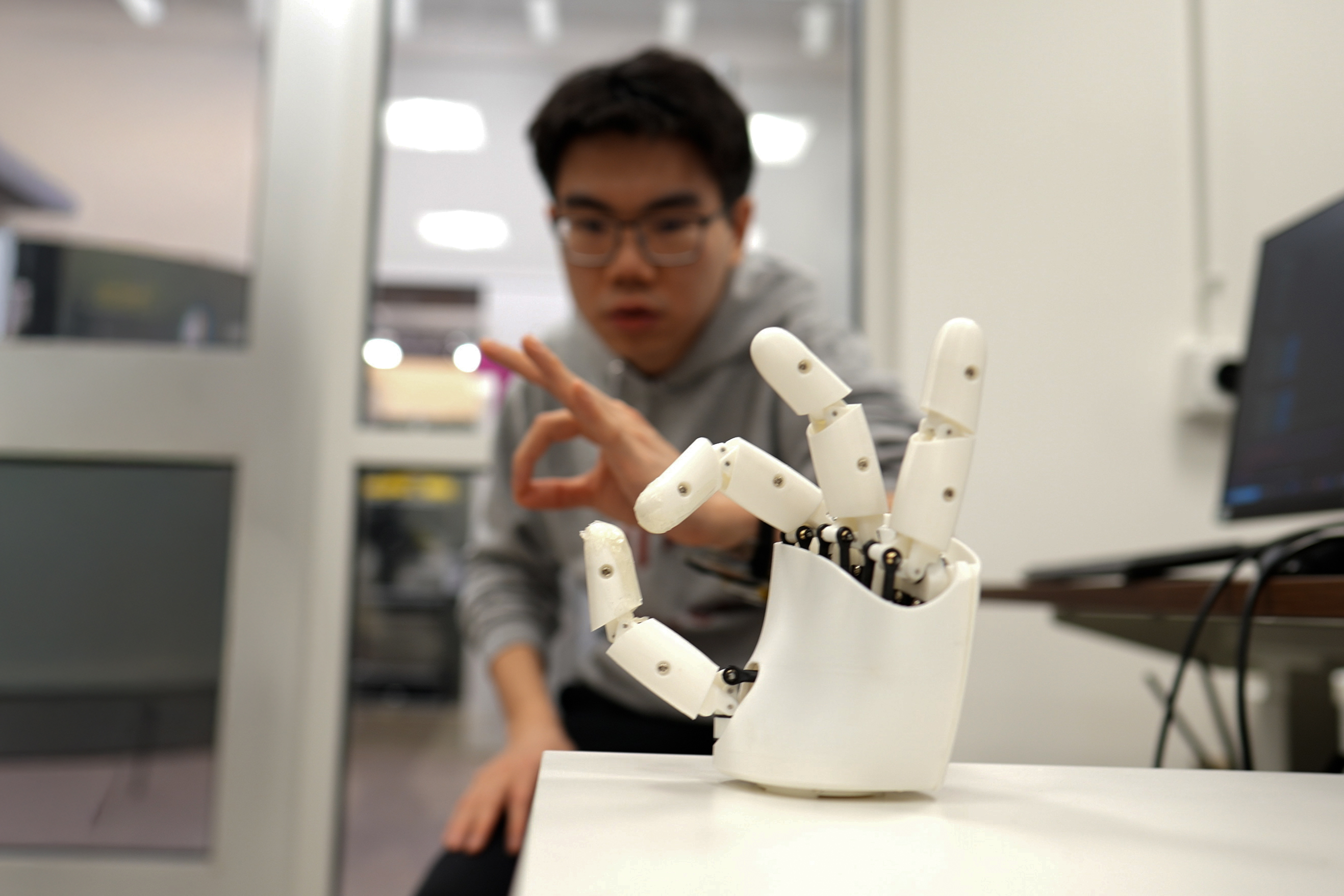
In demonstrations, the team has shown that a person wearing the wristband can wirelessly control a robotic hand. As the person gestures or points, the robot does the same. In a sort of wireless marionette interaction, the wearer can manipulate the robot to play a simple tune on the piano and shoot a small basketball into a desktop hoop. With the same wristband, a wearer can also manipulate objects on a computer screen, for instance pinching their fingers together to enlarge and minimize a virtual object.

The team is using the wristband to gather hand motion data from many more users with different hand sizes, finger shapes, and gestures. They envision building a large dataset of hand motions that can be plumbed, for instance, to train humanoid robots in dexterity tasks, such as performing certain surgical procedures. The ultrasound band could also be used to grasp, manipulate, and interact with objects in video games, design applications, or other virtual settings.

“We think this work has immediate impact in potentially replacing hand tracking techniques with wearable ultrasound bands in virtual and augmented reality,” says Xuanhe Zhao, the Uncas and Helen Whitaker Professor of Mechanical Engineering at MIT. “It could also provide huge amounts of training data for dexterous humanoid robots.”

Zhao, Gengxi Lu, and their colleagues present the wristband’s new design in a paper appearing today in Nature Electronics. Their MIT co-authors are former postdocs Xiaoyu Chen, Shucong Li, and Bolei Deng; graduate students SeongHyeon Kim and Dian Li; postdocs Shu Wang and Runze Li; and Anantha Chandrakasan, MIT provost and the Vannevar Bush Professor of Electrical Engineering and Computer Science. Other co-authors are graduate students Yushun Zheng and Junhang Zhang, Baoqiang Liu, Chen Gong, and Professor Qifa Zhou from the University of Southern California.

Seeing strings

There are currently a number of approaches to capturing and mimicking human hand dexterity in robots. Some approaches use cameras to record a person’s hand movements as they manipulate objects or perform tasks. Others involve having a person wear a glove with sensors, which records the person’s hand movements and transmits the data to a receiving robot. But erecting a complex camera system for different applications is impractical and prone to visual obstacles. And sensor-laden gloves could limit a person’s natural hand motions and sensations.

A third approach uses the electrical signals from muscles in the wrist or forearm that scientists then correlate with specific hand movements. Researchers have made significant advances in this approach, however these signals are easily affected by noise in the environment. They are also not sensitive enough to distinguish subtle changes in movements. For instance, they may discern whether a thumb and index finger are pinched together or pulled apart, but not much of the in-between path.

Zhao’s team wondered whether ultrasound imaging might capture more dexterous and continuous hand movements. His group has been developing various forms of ultrasound stickers — miniaturized versions of the transducers used in doctor’s offices that are paired with hydrogel material that can safely stick to skin.

In their new study, the team incorporated the ultrasound sticker design into a wearable wristband to continuously image the muscles and tendons in the wrist.

“The tendons and muscles in your wrist are like strings pulling on puppets, which are your fingers,” Lu says. “So the idea is: Each time you take a picture of the state of the strings, you’ll know the state of the hand.”

Mapping manipulation

The team designed a wristband with an ultrasound sticker that is the size of a smartwatch, and added onboard electronics that are about as small as a cellphone. They attached the wristband to a volunteer’s wrist and confirmed that the device produced clear and continuous images of the wrist as the volunteer moved their fingers in various gestures.

The challenge then was to relate the black and white ultrasound images of the wrist to specific positions of the hand. As it turns out, the fingers and thumb are capable of 22 degrees of freedom, or different ways of extending or angling. The researchers found that they could identify specific regions in their ultrasound images of the wrist that correlate to each of these 22 degrees of freedom. For instance, changes in one region relate to thumb extension, while changes in another region correlate with movements of the index finger.

To establish these connections, a volunteer wearing the wristband would move their hand in various positions while the researchers recorded the gestures with multiple cameras surrounding the volunteer. By matching changes in certain regions of the ultrasound images with hand positions recorded by the cameras, the team could label wrist image regions with the corresponding degree of freedom in the hand. But to do this translation continuously, and in real-time, would be an impossible task for humans.

So, the team turned to artificial intelligence. They used an AI algorithm that can be trained to recognize image patterns and correlate them with specific labels and, in this case, the hand’s various degrees of freedom. The researchers trained the algorithm with ultrasound images that they meticulously labeled, annotating the image regions associated with a specific degree of freedom. They tested the algorithm on a new set of ultrasound images and found it correctly predicted the corresponding hand gestures.

Once the researchers successfully paired the AI algorithm with the wristband, they tested the device on more volunteers. For the new study, eight volunteers with different hand and wrist sizes wore the wristband while they formed various hand gestures and grasps, including making the signs for all 26 letters in American Sign Language. They also held objects such as a tennis ball, a plastic bottle, a pair of scissors, and a pencil. In each case, the wristband precisely tracked and predicted the position of the hand.

To demonstrate potential applications, the team developed a simple computer program that they wirelessly paired with the wristband. As a wearer went through the motions of pinching and grasping, the gestures corresponded to zooming in and out on an object on the computer screen, and virtually moving and manipulating it in a smooth and continuous fashion.

The researchers also tested the wristband as a wireless controller of a simple commercial robotic hand. While wearing the wristband, a volunteer went through the motions of playing a keyboard. The robot in turn mimicked the motions in real-time to play a simple tune on a piano. The same robot was also able to mimic a person’s finger taps to play a desktop basketball game.

Zhao is planning to further miniaturize the wristband’s hardware, as well as train the AI software on many more gestures and movements from volunteers with wider ranging hand sizes and shapes. Ultimately, the team is building toward a wearable hand tracker that can be worn by anyone, to wirelessly manipulate humanoid robots or virtual objects with high dexterity.

“We believe this is the most advanced way to track dexterous hand motion, through wearable imaging of the wrist,” Zhao says. “We think these wearable ultrasound bands can provide intuitive and versatile controls for virtual reality and robotic hands.”

This research was supported, in part, by MIT, the U.S. National Institutes of Health, the U.S. National Science Foundation, the U.S. Department of Defense, and Singapore National Research Foundation through the Singapore-MIT Alliance for Research and Technology.

Lasers, robots, action: MIT workshop explores Raman spectroscopy | MIT News

0

Could a three-hour workshop on an advanced materials analysis technique turn someone into a detective — or perhaps an art restorer?

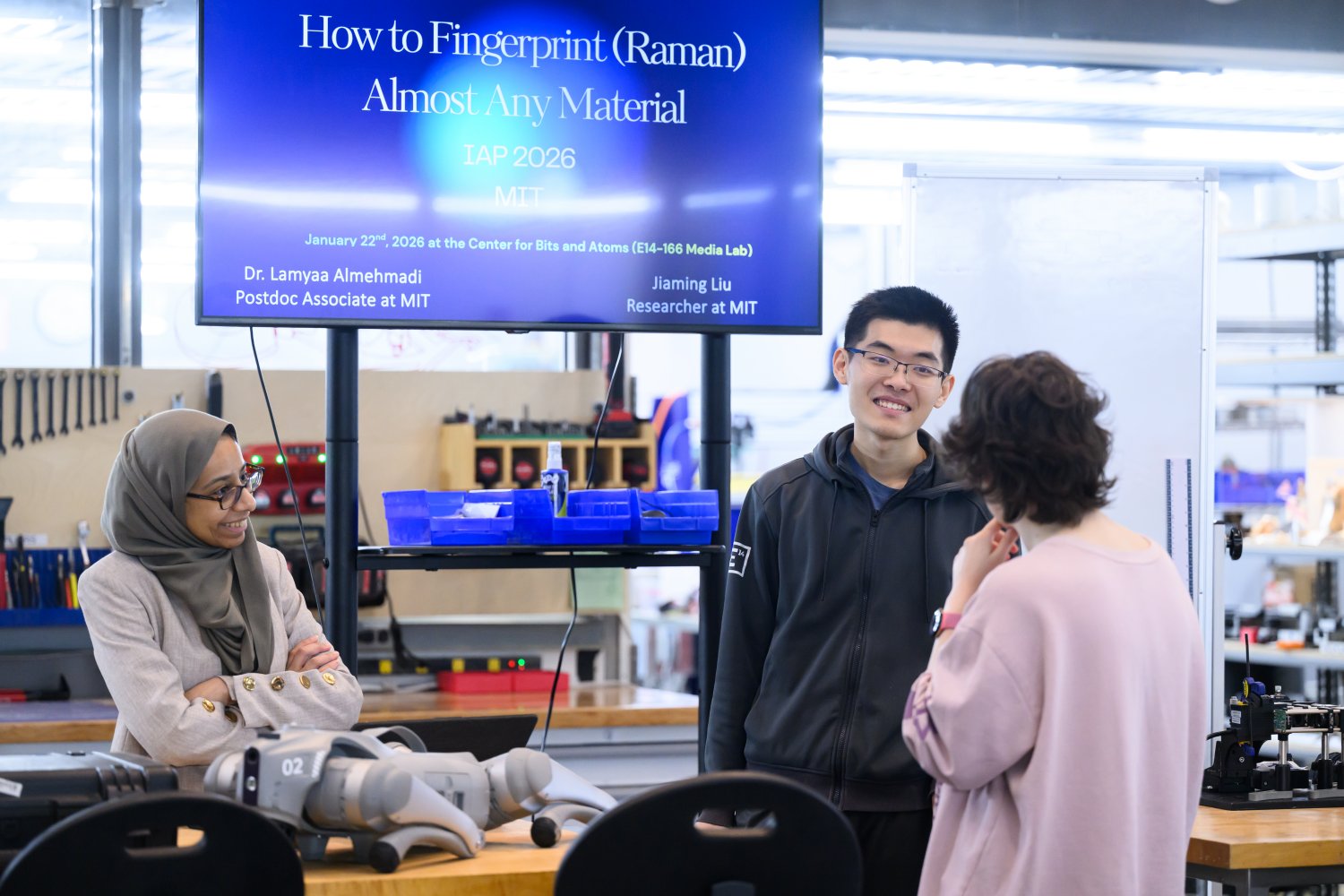
At MIT’s Center for Bits and Atoms in late January, about a dozen students explored that possibility during an Independent Activities Period (IAP) workshop on Raman spectroscopy, a technique that uses laser light to “fingerprint” materials. The session even featured a robotic dog equipped with sensing equipment, demonstrating how chemical analysis can be done remotely.

The workshop, led by MIT postdoc Lamyaa Almehmadi in collaboration with the CBA, introduced participants to a powerful technique now used by law enforcement and first responders to identify narcotics and explosives, by gemologists to authenticate precious stones, and pharmaceutical companies to verify raw materials and ensure product quality. CBA graduate researcher Jiaming Liu co-hosted, delivering lectures, demonstrating Raman equipment, and contributing to the curriculum and hands-on demonstrations.

“It can open up new possibilities for innovation across many fields,” said Almehmadi, an analytical chemist in the Department of Materials Science and Engineering (DMSE). After attendees learned the fundamentals, she encouraged them to think creatively about new applications: “My hope is to inspire all of you to think about doing something with Raman spectroscopy that no one has done before.”

Fingerprinting materials

Participants brought items to class to analyze using handheld devices, which fire laser light and measure how it bounces back. The resulting pattern behaves like a molecular fingerprint, identifying the materials in the item — whether it’s a paper clip, a piece of tree bark, or a mixing bowl.

Workshop attendee Sarah Ciriello, an administrative assistant at DMSE who brought a stone she found at the beach, was taken aback by the results. The Raman device suggested a 39 percent probability that the sample contained concrete-like material, with the remaining readings matching synthetic compounds — blurring the line between natural and manufactured materials.

“It’s man-made — I was surprised,” Ciriello said.

Developed in 1928 by Indian scientist C.V. Raman, who later won the Nobel Prize in Physics, Raman spectroscopy was groundbreaking because it used visible light to probe materials without destroying them, a major advantage over other techniques at the time, such as chromatography or mass spectrometry. But for decades, the Raman signal — the light scattered back from a sample — was weak, and the instruments were big and bulky, limiting its practical use.

Advances in lasers, computing power, and miniaturized optics have transformed Raman spectroscopy into a portable tool. Today’s handheld devices can instantly compare a sample’s molecular fingerprint against vast digital libraries, allowing users to identify thousands of materials in seconds. Because it doesn’t destroy the sample, Raman is especially useful in fields that require preserving materials — such as law enforcement, where evidence must remain intact, and art restoration.

Almehmadi’s own research focuses on advancing Raman spectroscopy by developing highly sensitive, semiconductor-based sensors that make portable chemical analysis possible, with applications ranging from medical diagnostics to forensic and environmental monitoring.

“Raman can be used to analyze any material,” Almehmadi says. “That’s why I decided to introduce it to students from diverse backgrounds.”

IAP classes are open to students and staff across MIT, and the Raman workshop reflected that range — from administrative staff to graduate and undergraduate students and postdocs in departments and labs including DMSE, the Department of Mechanical Engineering, the Media Lab, and the Broad Institute.

Walking the robot dog

A crowd-pleasing element in the workshop was the integration of a robot dog that belongs to the MIT Computer Science and Artificial Intelligence Laboratory (CSAIL). The demonstration highlighted how Raman technology can be used in dangerous environments, such as crime scenes or toxic industrial sites.

The handheld device was secured to the robot using tape, and Almehmadi showed how she could navigate the dog to a plastic bag filled with a white powder — baking soda.

But in a real-world scenario, “How can we know if it is baking soda or not?” she says. “So we just shined the light, and then the instrument told us what it was.”

Participants used a Wi-Fi app on their phones to view the results and a small remote controller to operate the robotic dog themselves.

“I loved the robot dog,” Ciriello says. “I was able to control it a bit, but it was challenging because the gauge was really sensitive.”

Michael Kitcher, a postdoc in DMSE, also praises the robot demonstration.

“Given that we just duct taped the device onto the dog — it was cool to see it actually worked,” he says.

Looking ahead

Kitcher, who researches magnetic materials for electronic applications, joined the workshop to learn more about Raman spectroscopy, which he had read about but never used. He was impressed by its versatility — in addition to the beach stone and baking soda, the device identified materials in a contact lens, cosmetics, and even a diamond.

Although it struggled to analyze a piece of chocolate he brought — other signals from the chocolate interfered — Kitcher sees strong potential for his own research. One area he’s interested in is unconventional magnetic materials, such as altermagnets, with unusual magnetic behavior that researchers hope to better understand and control for more energy-efficient electronics.

“Over the last couple of years, people have been trying to get a better sense of why these materials behave the way they do — how we can control this unconventional magnetic order,” he says. Raman spectroscopy can probe the vibrations of atoms in a material, helping researchers detect patterns in the crystal structure that underlie unusual magnetic behaviors. By understanding these vibrations, scientists could unlock material design rules that enable ultra-fast, low-energy computing.

Hands-on workshops like this — that inspire innovative future applications — Almehmadi says, are at the heart of an MIT education.

“I’ve always learned best by doing,” she says. “Lectures and reading are important, but real understanding comes from hands-on experience.”

Generate single title from this title How To Use AI To Streamline Time (And Money) Consuming SEO Tasks in 100 -150 characters. And it must return only title i dont want any extra information or introductory text with title e.g: ” Here is a single title:”

0

Write an article about

SEO, like most organic and non-advertising or paid channels in digital marketing, is labor-intensive. Yes, there are software suites, analytics platforms, research tools, and a number of other things that help in the tech stack.

We all have our favorites, and no one is (or should) be doing SEO like I was in 2008 (despite my desire sometimes to just do something manually where I can see the inputs and outputs and have more control, but I digress).

In the midst of constant noise about new platforms, new ranking factors, ways to become visible in AI, and everything else, it can be hard at times to keep going with the tasks that still require a human at some level. Whether it is gaining efficiency, scaling efforts, doing more with less, or a combination of these, I’m sharing human-involved ways to streamline time-consuming tasks so you can gain time (and maybe money).

1. Generating Meta Descriptions, Page Titles, Alt Text

I could have started with something more high-level or strategic, but I’m getting this one out of the way right now.

The basic blocking and tackling of ensuring you have unique, helpful, and topically relevant meta descriptions, page titles, and image alt text can be a huge investment of time on a large website or across sites if you own tactical SEO for multiple sites or clients.

While there are ways to semantically have these tags auto-generated by a database or CMS, we know that, in a lot of cases, there’s still a manual process or intervention to audit and ensure that the tags are written to best practices and strategic positioning.

Also, I know that there’s plenty of discussion or debate on whether there’s even value in creating titles and meta descriptions. I’m not going there. But I will say that, if you have any areas where you need to create them and they are on your tasks list, you can spend a lot of hours and the cost of those hours (or outsourced resources) for a minimal return.

Leverage tools based on what you’re already paying for or what tech ecosystem you’re in, like Screaming Frog + OpenAI API + a WordPress plugin, which can save thousands of dollars and many dozens of hours.

Putting It Into Action

Steps for generating alt text at scale:

  1. Get your OpenAI API key:
    • In your OpenAI dashboard at platform.openai.com, go to API keys.
    • Create a new secret key and name it something you’ll remember, like Screaming Frog.
    • Make sure you have credits in your account (a few dollars can go a long way).
  2. Set up your Screaming Frog crawl:
    • Set up your OpenAI configuration by going to Configuration > API Access > AI. Enter your API Key into the field. Press Connect.
    • Set up a prompt to generate alt text by going to the Prompt Configuration tab. Click Add from Library > System > Generate alt text for images.
    • Set up your crawl configuration and don’t forget to go to Spider > Rendering and change the rendering mode from Text Only to JavaScript. Then, go to Extraction and, under HTML, check Store HTML and Store Rendered HTML.
    • Run a test crawl on one URL to ensure the output works for you. Tweak the prompt if you’d like.
  3. Run the crawl.
  4. Export to a CSV.
  5. Format the file with two columns: image URL, alt text.
  6. Add this plugin to the site: https://wordpress.org/plugins/alt-text-updater/.
  7. Upload the file.
  8. Crawl your site and do manual checks to test that images have alt text.
  9. Deactivate and uninstall the plugin.

2. Structuring Content Outlines

This might be one of the most common things we do when starting SEO or in periodic content organization, expansion projects, or ongoing content creation. With content being what I call the “fuel” of SEO (and also visibility in AI search), it is still as important as ever to organize it well and present it in a way that makes sense to site visitors and the machines that are also learning it.

While you might not be able to automate this out of the box or in a single prompt in your favorite LLM, you can definitely speed up the process and gain some insights into connections you might not make on content themes on your own (my favorite bonus).

Whether you’re working on a single article, a longer-term content calendar, reorganizing evergreen content, or other content-specific tasks, mastering the art of prompt creation, coaching the AI agent, ensuring the output is good, and using project folders (with brand style guides) in ChatGPT can ensure the quality and speed the more you produce.

Putting It Into Action

Example Prompt

You are an expert SEO who specializes in content writing for [industry]. Your task is to create an outline for an article for [topic]. The article outline should cover the following subtopics: 

[subtopic 1], 

[subtopic 2], 

[subtopic 3]. 

The article should target the following keywords: 

Attached are the HTML files of pages currently ranking well in Google search results to use as guidance. Review the HTML files and generate a content outline. 

3. Creating Project Briefs

Going a little higher level into organizing the work we do, connecting desired outcomes to strategies and ultimately to tactics, project briefs are something you might not do every day.

I like to think about SEO in projects or sprints as a way to break up the big nature of ongoing and long-term work that requires short-term progress and tactics. Regardless of how you organize the work, you likely have a lot of varying documentation and information. Whether in sheets, documents, decks, or other sources, you have information that you can feed together into your LLM of choice to have AI organize and sort out.

Whether you’re doing this formally to produce a report deliverable or informally to help your team or yourself organize the minutiae of SEO information, I can point to examples of my team using Gemini to read through a bunch of documents, including meeting notes, personal notes, transcripts, AI transcripts, agendas, competitor lists, research, emails, and more.

This can be helpful for a number of uses, including putting together a document that can be helpful for personal reference, team reference, onboarding, and articulation of the overall knowledge base for stakeholders.

Putting It Into Action

Example Prompt

You are an experienced Senior Marketing Strategist and you’re onboarding your team for [describe project]. Your task is to create a comprehensive project brief for [name of campaign or project].

Ensure the project brief takes into account the following project details:

Objective: [what is the overarching goal of the project]

Target audience: [overview of the demographics]

Key messaging: [provide details about campaign messaging]

Channels: [what channels will be incorporated into the campaign/project]

For the deliverable, the output should include the following:

Project Overview: Include a 1-2 sentence summary of the project

Success Metrics: [provide KPIs]

Budget: [provide financials]

Timeline: [provide deadlines and milestones]

Generate the project brief as a professional, internal-facing document.

Classifying Keywords

Prompt for using the AI function in Google Sheets to classify keywords by search intent, segment, branded/non-branded, etc.

=ai(“Act as an SEO Specialist. Classify the following Keyword into exactly one of these Categories: [Informational, Navigational, Commercial, Transactional].

Rules:

Informational: User is looking for an answer or guide.

Commercial: User is researching products/services before buying.

Transactional: User has high intent to buy/convert now.

Navigational: User is looking for a specific website/brand.

Keyword: [Cell Reference, e.g., A2]

Result: Return only the category name with no extra text or punctuation

4. Segmenting Keywords

In SEO today, we’re not focused necessarily on granular keywords. However, they are still important in our research and strategy planning, along with more tactical work in guiding content topic building and creation.

When you do your research and have your list of keywords from any source, you can utilize the Google Sheets AI function to categorize them by topic, pillar, branded/non-branded, localized or not, search intent, etc.

You can also run keywords through an LLM and have it categorize them, export the output, import that back into your spreadsheet, and align it to the data using a VLOOKUP function (a recommendation, as my team thinks the Google Sheet AI function isn’t where we want it to be yet).

While the method I noted also might feel manual and not where we want it to be eventually, with better AI and tooling, it is still much better than doing things manually. I encourage you to use your own spreadsheet logic or “regular expression” (regex) to categorize as much as you can efficiently before going to AI, especially if your dataset is extensive.

5. Documenting Competitor Outlines

While I have to admit that I like to visually check out competitor websites for my first impression and a quick, informal sophistication check, automating this is a huge time-saver.

For example, Gemini is really good at outlining the content structure of a webpage, so my team likes to feed three or four competitor URLs that are ranking well or have high visibility for a topic that we’re building a strategy for, and it can give us an outline of each page. That includes messaging, targeting, and providing baseline content blocks that each page has that we can use when we do content development on our side.

Disclaimer: Just like in the olden days, don’t copy directly and don’t steal. Verify that what you’re getting back out of the tool you’re using isn’t ripping someone off. That’s on us to validate.

Putting It Into Action

Example Prompt

You’re an expert SEO strategist and you’re conducting a competitive content analysis of your client’s page against pages currently outranking it in Google for the search term . The client is a [describe client and industry]. The page is [describe purpose of the page and topic].

I’ve attached the HTML files of the client’s page, as well as the HTML files for the competitor pages. Your tasks are to provide me:

An outline for each page of the content blocks present in the HTML

An overview of the messaging, tone, voice

A list of outgoing internal links in the content

Content gaps between the client’s page and the competitors

6. Conducting SERP Analysis

We can’t waste impressions and any visibility we get by showing up on the wrong topics. SEO now is about quality, and we can’t miss the mark on search intent.

An example that is a big time-saver is to build your seed keyword list using Ahrefs and then export the keyword list with SERP data. Then, feed that spreadsheet into Gemini and have it provide a breakdown of organic competitors per keyword, intent of ranking organic pages per keyword, etc. This example is a good way to save time from having to review hundreds and hundreds of rows. My team usually filters out AI Overviews and ad placement data to condense it a bit.

This type of work has been helpful in figuring out informational versus commercial intent SERPs at scale so that we’re targeting the right keywords with the right content. It has also been helpful in understanding the level of competition within a topic, so we know what to avoid and what long-tail keywords may represent realistic opportunities.

I will emphasize, though, that it is important to note that the SERPs aren’t 100% accurate, and localization and personalization will change the SERPs that users see. But it’s helpful in comparing keywords against each other. We also do SERP reviews manually to confirm findings. Again, validate as a human what you’re getting from tools.

In Closing

There’s a lot of power in what you can reclaim in time and dollars, leveraging automation, deeper tools use, and the power of AI for SEO. And, you probably detected a theme where, in pretty much everything you do, there have to be solid inputs in order to get useful outputs, which also require human validation and experience to trust.

Regardless of where you are with automation, the goal of being able to do more with less, scale tasks, and not do manual tasks that might have low return on investment is a great way to determine where you should consider doing more with tech and less manual work.

More Resources:

Featured Image: ArtEternal/Shutterstock

.Organize the content with appropriate headings and subheadings ( h2, h3, h4, h5, h6). Include conclusion section and FAQs section with Proper questions and answers at the end. do not include the title. it must return only article i dont want any extra information or introductory text with article e.g: ” Here is rewritten article:” or “Here is the rewritten content:”

Generate single title from this title Apocalyptic Short Circuit (Red Edition) in 100 -150 characters. And it must return only title i dont want any extra information or introductory text with title e.g: ” Here is a single title:”

0

Write an article about

Apocalyptic Short Circuit (Red Edition)

After the great solar storm of 2046, all electronic circuits were melted, billions of electronic devices, computers and mobile phones were left to their fate and abandoned, dumped in the wasteland. Some components have become sacred artifacts in altarpieces and similar religious objects. The sky is colored red due to the impact of solar particles on the atmosphere.

Start Slideshow

Loading…

The post Apocalyptic Short Circuit (Red Edition) appeared first on AI-ARTS.

.Organize the content with appropriate headings and subheadings ( h2, h3, h4, h5, h6). Include conclusion section and FAQs section with Proper questions and answers at the end. do not include the title. it must return only article i dont want any extra information or introductory text with article e.g: ” Here is rewritten article:” or “Here is the rewritten content:”

Generate single title from this title Visa prepares payment systems for AI agent-initiated transactions in 100 -150 characters. And it must return only title i dont want any extra information or introductory text with title e.g: ” Here is a single title:”

Write an article about

Payments rely on a simple model: a person decides to buy something, and a bank or card network processes the transaction. That model is starting to change as Visa tests how AI agents can initiate payments. New work in the banking sector suggests that, in some cases, software agents may soon take on that role.

A recent example comes from Visa, which is rolling out its “Agentic Ready” programme in Europe to test how financial systems handle AI-initiated transactions. The effort involves collaboration with banks, including Commerzbank and DZ Bank. The aim is to prepare existing payment infrastructure for a scenario where software agents can search for products and make decisions, then complete purchases on behalf of users.

According to information published by Visa and reported by The Paypers, the programme focuses on enabling secure transactions where AI systems act as the initiating party. Instead of a customer confirming a purchase, an AI agent could carry out the task after being given a goal or set of rules.

How transactions begin

Payment systems are built around human identity and intent. A card transaction today depends on verifying that a person has authorised a purchase. If AI agents begin to initiate transactions, banks will need new ways to confirm identity and intent at the system level. That includes deciding how an agent proves it is acting on behalf of a user, and how much autonomy it should have.

In Visa’s model, software agents could handle routine or repeat purchases with limited human input, based on user-defined rules. A system could, for example, monitor supply levels and compare prices, then complete a transaction when certain conditions are met. Reporting from Die Welt and Investing.com says the company sees this as similar in scale to the early change toward online payments, when banks had to adapt to a new type of transaction flow.

Control and compliance

Banks involved in early trials are testing how these ideas work in practice. Commerzbank and DZ Bank are exploring how AI agents can be integrated into existing systems without breaking compliance rules. This includes checks related to fraud, audit trails, and customer consent. These areas are tightly regulated, which means any change to how transactions are initiated must still meet oversight standards.

A RepRisk report found that banks are already dealing with more frequent and costly issues linked to AI. The report states that these incidents can lead to multi-million-dollar losses.

Visa’s work is focused on infrastructure not consumer-facing tools. It’s working on how payment networks should behave when the “customer” is a piece of software. That includes defining how agents are authenticated and how transactions are approved. It also covers how disputes are handled if something goes wrong.

AI and enterprise purchasing

In large organisations, procurement often involves multiple approval steps. AI agents could compress that process by handling routine purchases in set limits. This could reduce manual work, but it also means companies need clear rules about what agents are allowed to do. Without that, the risk of errors or misuse increases.

Large institutions are investing in AI to automate back-office work and reduce costs. Some are also reorganising teams to focus more on data and AI strategy. Regulators are paying closer attention to how AI is used in decision-making, especially in areas like credit and fraud detection.

Taken together, these developments suggest that payments could become one of the first areas where AI agents could act with greater autonomy. Banks will still need to set rules, monitor activity, and handle exceptions. But the day-to-day act of initiating a transaction may, in some cases, require less direct human input.

Visa’s current phase is focused on testing and system design. As AI systems take on more responsibility, financial infrastructure will need to adapt to a new type of user, one that does not hold a card but can still make a purchase.

(Photo by CardMapr.nl)

See also: Goldman Sachs sees AI investment change to data centres

Want to learn more about AI and big data from industry leaders? Check outAI & Big Data Expo taking place in Amsterdam, California, and London. The comprehensive event is part of TechEx and is co-located with other leading technology events, click here for more information.

AI News is powered by TechForge Media. Explore other upcoming enterprise technology events and webinars here.

.Organize the content with appropriate headings and subheadings ( h2, h3, h4, h5, h6). Include conclusion section and FAQs section with Proper questions and answers at the end. do not include the title. it must return only article i dont want any extra information or introductory text with article e.g: ” Here is rewritten article:” or “Here is the rewritten content:”

Generate single title from this title Building the right foundation for better decisions in 100 -150 characters. And it must return only title i dont want any extra information or introductory text with title e.g: ” Here is a single title:”

Write an article about

Key points:

Data has become one of the most important strategic assets in education. Yet across institutions, publishers, and edtech companies, it often remains fragmented, inconsistently governed, and difficult to use with confidence.

The challenge is rarely a lack of dashboards or reports. Most organizations already have plenty of data. The real issue is that the data behind those dashboards is often disconnected, inconsistently defined, and not structured to support better decisions.

That problem shows up differently across the market.

For institutions, student information, learning activity, advising, assessment, and operational data often live in separate systems. That makes it difficult to build a reliable picture of student progress, risk, retention, and support needs.

For publishers, content metadata, standards alignment, usage data, and product decisions are frequently managed in disconnected workflows. As a result, it becomes harder to understand content performance, standards coverage, and where future investment should go.

For edtech companies, product telemetry, implementation health, customer success signals, and outcomes data do not always come together in a usable way. That slows decision-making, weakens insight, and makes proof of impact harder.

Data strategy vs. data intelligence

This is where it is important to distinguish between data strategy and data intelligence.

A data strategy defines what data matters, how it should be governed, and what business outcomes it should support. Data intelligence is what makes that strategy operational. It is the ability to connect, trust, interpret, monitor, and act on data across the enterprise.

In my experience, most organizations do not have a reporting problem first. They have a trust, interoperability, and workflow problem that eventually shows up as a reporting problem.

What I consider first

When I help organizations think through data strategy and intelligence, I do not start with tools. I start with purpose. I usually begin with five questions:

1. What decisions need to improve?
Is the priority student success, standards alignment, product performance, customer retention, operational planning, or AI readiness?

2. Where does the truth live today?
How many versions of that truth exist across teams and systems?

3. Can the data move cleanly?
Without strong integration and interoperability, insight remains fragmented.

4. Can people trust the data?
Definitions, lineage, ownership, refresh cycles, and quality all matter.

5. What value should this create?
Better interventions, stronger planning, lower reporting friction, faster decisions, or more confident use of AI?

Unless those answers are clear, the work can become technically active but strategically unfocused.

What effective data management requires

In practice, effective data management in education requires a connected model.

Organizations need:

  • A unified data foundation that brings together learning, operational, content, assessment, commercial, and support data in a governed way.
  • Reliable integration through APIs, pipelines, feeds, and automation.
  • Metadata and discoverability so teams know what data exists, what it means, who owns it, and whether it can support a decision.
  • Interoperability so data does not remain trapped in isolated systems.
  • Governance and access control to create trust, accountability, and responsible use.
  • Data quality monitoring so stale feeds, drift, and inconsistencies do not erode confidence.
  • An analytics and AI access layer that makes trusted data usable through dashboards, search, models, and governed assistants.

The workflow I come back to often is straightforward:

Capture → Ingest → Standardize → Govern → Catalog → Monitor → Analyze → Act

That is what turns data from a backend asset into an enterprise capability.

What the right data ecosystem looks like

I do not believe tools are the strategy. But I do believe the right tools can make strategy executable. In practice, I have benefited from:

  • Power BI/Tableau for executive and operational visualization
  • Databricks/Snowflake/cloud data platforms for unified data environments
  • Azure/AWS data services for scalable storage, pipelines, and analytics
  • Miro/Jira/Confluence for planning, workflow design, and stakeholder alignment
  • Make/API-based integrations/automation tools for workflow orchestration
  • AI copilots/LLM-based assistants for discovery, metadata support, synthesis, and analysis acceleration
  • EduDataHub from Magic for strengthening unified data workflows, governance, and actionable intelligence

What has helped me most is not any one tool in isolation. It is the ability to connect these tools into a workflow that supports capture, integration, governance, analysis, and action.

The organizations that will lead the next phase of education transformation will not simply be the ones with more data. They will be the ones that make data more usable, more trusted, and more actionable across the enterprise.

For institutions, that means better decisions around student success and operations. For publishers, it means more intelligent and measurable content ecosystems. For edtech companies, it means products and services that are more interoperable, insight-rich, and capable of providing value.

Modernization only matters if it improves decisions.

Education does not need more disconnected dashboards. It needs systems that make trusted data usable. That is where real transformation begins.

Rishi Raj Gera, Magic EdTech

Rishi Raj Gera is Chief Solutions Officer at Magic EdTech and brings over two decades of experience in designing digital learning systems that sit at the intersection of accessibility, personalization, and emerging technology. His work is driven by a consistent focus on building educational systems that adapt to individual learner needs while maintaining ethical boundaries and equity in design. Rishi continues to advocate for learning environments that are as human-aware as they are data-smart, especially in a time when technology is shaping how students engage with knowledge and one another.

Latest posts by eSchool Media Contributors (see all)

.Organize the content with appropriate headings and subheadings ( h2, h3, h4, h5, h6). Include conclusion section and FAQs section with Proper questions and answers at the end. do not include the title. it must return only article i dont want any extra information or introductory text with article e.g: ” Here is rewritten article:” or “Here is the rewritten content:”

Generative AI improves a wireless vision system that sees through obstructions | MIT News

0

MIT researchers have spent more than a decade studying techniques that enable robots to find and manipulate hidden objects by “seeing” through obstacles. Their methods utilize surface-penetrating wireless signals that reflect off concealed items.

Now, the researchers are leveraging generative artificial intelligence models to overcome a longstanding bottleneck that limited the precision of prior approaches. The result is a new method that produces more accurate shape reconstructions, which could improve a robot’s ability to reliably grasp and manipulate objects that are blocked from view.

This new technique builds a partial reconstruction of a hidden object from reflected wireless signals and fills in the missing parts of its shape using a specially trained generative AI model.

The researchers also introduced an expanded system that uses generative AI to accurately reconstruct an entire room, including all the furniture. The system utilizes wireless signals sent from one stationary radar, which reflect off humans moving in the space.  

This overcomes one key challenge of many existing methods, which require a wireless sensor to be mounted on a mobile robot to scan the environment. And unlike some popular camera-based techniques, their method preserves the privacy of people in the environment.

These innovations could enable warehouse robots to verify packed items before shipping, eliminating waste from product returns. They could also allow smart home robots to understand someone’s location in a room, improving the safety and efficiency of human-robot interaction.

“What we’ve done now is develop generative AI models that help us understand wireless reflections. This opens up a lot of interesting new applications, but technically it is also a qualitative leap in capabilities, from being able to fill in gaps we were not able to see before to being able to interpret reflections and reconstruct entire scenes,” says Fadel Adib, associate professor in the Department of Electrical Engineering and Computer Science, director of the Signal Kinetics group in the MIT Media Lab, and senior author of two papers on these techniques. “We are using AI to finally unlock wireless vision.”

Adib is joined on the first paper by lead author and research assistant Laura Dodds; as well as research assistants Maisy Lam, Waleed Akbar, and Yibo Cheng; and on the second paper by lead author and former postdoc Kaichen Zhou; Dodds; and research assistant Sayed Saad Afzal. Both papers will be presented at the IEEE Conference on Computer Vision and Pattern Recognition.

Surmounting specularity

The Adib Group previously demonstrated the use of millimeter wave (mmWave) signals to create accurate reconstructions of 3D objects that are hidden from view, like a lost wallet buried under a pile.

These waves, which are the same type of signals used in Wi-Fi, can pass through common obstructions like drywall, plastic, and cardboard, and reflect off hidden objects.

But mmWaves usually reflect in a specular manner, which means a wave reflects in a single direction after striking a surface. So large portions of the surface will reflect signals away from the mmWave sensor, making those areas effectively invisible.

“When we want to reconstruct an object, we are only able to see the top surface and we can’t see any of the bottom or sides,” Dodds explains.

The researchers previously used principles from physics to interpret reflected signals, but this limits the accuracy of the reconstructed 3D shape.

In the new papers, they overcame that limitation by using a generative AI model to fill in parts that are missing from a partial reconstruction.

“But the challenge then becomes: How do you train these models to fill in these gaps?” Adib says.

Usually, researchers use extremely large datasets to train a generative AI model, which is one reason models like Claude and Llama exhibit such impressive performance. But no mmWave datasets are large enough for training.

Instead, the researchers adapted the images in large computer vision datasets to mimic the properties in mmWave reflections.

“We were simulating the property of specularity and the noise we get from these reflections so we can apply existing datasets to our domain. It would have taken years for us to collect enough new data to do this,” Lam says.

The researchers embed the physics of mmWave reflections directly into these adapted data, creating a synthetic dataset they use to teach a generative AI model to perform plausible shape reconstructions.

The complete system, called Wave-Former, proposes a set of potential object surfaces based on mmWave reflections, feeds them to the generative AI model to complete the shape, and then refines the surfaces until it achieves a full reconstruction.

Wave-Former was able to generate faithful reconstructions of about 70 everyday objects, such as cans, boxes, utensils, and fruit, boosting accuracy by nearly 20 percent over state-of-the-art baselines. The objects were hidden behind or under cardboard, wood, drywall, plastic, and fabric.

Seeing “ghosts”

The team used this same approach to build an expanded system that fully reconstructs entire indoor scenes by leveraging mmWave reflections off humans moving in a room.

Human motion generates multipath reflections. Some mmWaves reflect off the human, then reflect again off a wall or object, and then arrive back at the sensor, Dodds explains.

These secondary reflections create so-called “ghost signals,” which are reflected copies of the original signal that change location as a human moves. These ghost signals are usually discarded as noise, but they also hold information about the layout of the room.

“By analyzing how these reflections change over time, we can start to get a coarse understanding of the environment around us. But trying to directly interpret these signals is going to be limited in accuracy and resolution.” Dodds says.

They used a similar training method to teach a generative AI model to interpret those coarse scene reconstructions and understand the behavior of multipath mmWave reflections. This model fills in the gaps, refining the initial reconstruction until it completes the scene.

They tested their scene reconstruction system, called RISE, using more than 100 human trajectories captured by a single mmWave radar. On average, RISE generated reconstructions that were about twice as precise than existing techniques.

In the future, the researchers want to improve the granularity and detail in their reconstructions. They also want to build large foundation models for wireless signals, like the foundation models GPT, Claude, and Gemini for language and vision, which could open new applications.

This work is supported, in part, by the National Science Foundation (NSF), the MIT Media Lab, and Amazon.

Generate single title from this title Why methodology matters more than content in 100 -150 characters. And it must return only title i dont want any extra information or introductory text with title e.g: ” Here is a single title:”

Write an article about

Key points:

Last year, a third-grade teacher in São Paulo told me she had “finally found the perfect AI tool.” It generated colorful worksheets in seconds. Vocabulary lists, reading comprehension questions, even a quiz. She was thrilled until she tried to use them. The worksheets tested recall. Every one of them. No scaffolding, no collaborative structure, no entry point for students who needed more time with the concept. The AI had produced content. It had not produced a learning experience.

This gap shows up everywhere. Search “best AI tools for teaching” and you’ll find dozens of roundups comparing features: which tool generates quizzes fastest, which offers the widest template library, which has the friendliest interface. These are useful data points. But they miss the question that determines whether students actually learn: Does the tool understand how learning works?

Content is easy; structure is hard

Any large language model can generate a lesson plan about photosynthesis. Vocabulary terms, discussion prompts, a worksheet, an assessment. What it cannot do on its own is sequence those elements based on cognitive load theory, build in retrieval practice intervals that strengthen long-term memory, or design collaborative structures where students teach each other. These are methodology decisions. They require pedagogical architecture, not content generation.

The research behind this claim is not new. Freeman et al.’s 2014 meta-analysis of 225 studies found that students in traditional lecture settings were 1.5 times more likely to fail than those in active learning environments. Bloom’s 1984 “two sigma” research demonstrated that students receiving mastery-based instruction with feedback performed two standard deviations above conventionally taught peers. The evidence for structured methodology over content delivery alone is decades old and thoroughly replicated. Yet most AI tools for teaching treat lesson structure as an afterthought.

What the gap looks like in practice

I spent 15 years training teachers in active learning across Brazil. In that time, I watched the same pattern repeat with every technology wave. Teachers adopt a tool with genuine enthusiasm. They generate materials. Then they notice the materials don’t quite work. The “project-based learning” lesson turns out to be a research assignment ending in a poster. The “Socratic seminar” is a list of open-ended questions with no scaffolding for students who freeze when asked to speak in front of peers. The methodology label is present. The methodology is absent.

AI has accelerated this. A teacher can now produce a “differentiated, inquiry-based lesson” in 30 seconds. But if the tool doesn’t know what inquiry-based instruction actually requires (a driving question, student-generated hypotheses, structured investigation, evidence-based conclusions), the output is a worksheet with the word “inquiry” in the header.

Five questions to ask before adopting an AI teaching tool

When evaluating AI tools for teaching, methodology should be a first-order criterion. These five questions shift the evaluation from surface features to structural depth:

1. Does the tool apply a pedagogical approach, or treat all content as interchangeable? A methodology-aware tool structures a PBL lesson differently from a direct instruction sequence. If every output follows the same template regardless of the selected method, the labels are cosmetic.

2. Can the tool explain why it sequenced activities in a particular order? Lesson structure should reflect principles like cognitive load management and retrieval practice spacing. If the sequencing can’t be articulated, it’s arbitrary.

3. Does the output include facilitation guidance for the teacher? Materials that assume a teacher will know how to run a Socratic seminar or manage group protocols without support set everyone up for frustration. Look for embedded teacher guidance alongside student-facing materials.

4. How does the tool handle assessment? Methodology-aligned assessment means formative checkpoints distributed throughout a lesson, tied to specific learning objectives. If assessment only appears at the end as a summative quiz, the tool is testing recall, not tracking understanding.

5. Does the tool address the social and emotional dimensions of learning? Group work requires norms. Discussion requires psychological safety. Project-based learning demands collaboration skills that many students haven’t been explicitly taught. A tool that generates collaborative activities without addressing how to build a collaborative environment is handing teachers half a lesson.

What comes next

The AI tools landscape will keep growing. New platforms will launch weekly. Roundup articles will compare them on speed, price, and feature count. That comparison has value, but it is incomplete.

The tools that will actually shift outcomes for students are the ones built on pedagogical foundations. Teachers deserve AI tools for teaching that know the difference between a worksheet and a learning experience. The methodology layer is where that difference lives.

Adriana Perusin, Flip Education

Adriana Perusin is an education program designer with over 15 years of experience training teachers in active learning and social-emotional learning. She founded IASEA, a Brazilian education institute where she designed professional development programs reaching over 1,000 public school teachers across five states. She is co-founder of Flip Education.

Latest posts by eSchool Media Contributors (see all)

.Organize the content with appropriate headings and subheadings ( h2, h3, h4, h5, h6). Include conclusion section and FAQs section with Proper questions and answers at the end. do not include the title. it must return only article i dont want any extra information or introductory text with article e.g: ” Here is rewritten article:” or “Here is the rewritten content:”

MIT-IBM Watson AI Lab seed to signal: Amplifying early-career faculty impact | MIT News

0

The early years of faculty members’ careers are a formative and exciting time in which to establish a firm footing that helps determine the trajectory of researchers’ studies. This includes building a research team, which demands innovative ideas and direction, creative collaborators, and reliable resources. 

For a group of MIT faculty working with and on artificial intelligence, early engagement with the MIT-IBM Watson AI Lab through projects has played an important role helping to promote ambitious lines of inquiry and shaping prolific research groups.

Building momentum

“The MIT-IBM Watson AI Lab has been hugely important for my success, especially when I was starting out,” says Jacob Andreas — associate professor in the Department of Electrical Engineering and Computer Science (EECS), a member of the MIT Computer Science and Artificial Intelligence Laboratory (CSAIL), and a researcher with the MIT-IBM Watson AI Lab — who studies natural language processing (NLP). Shortly after joining MIT, Andreas jump-started his first major project through the MIT-IBM Watson AI Lab, working on language representation and structured data augmentation methods for low-resource languages. “It really was the thing that let me launch my lab and start recruiting students.” 

Andreas notes that this occurred during a “pivotal moment” when the field of NLP was undergoing significant shifts to understand language models — a task that required significantly more compute, which was available through the MIT-IBM Watson AI Lab. “I feel like the kind of the work that we did under that [first] project, and in collaboration with all of our people on the IBM side, was pretty helpful in figuring out just how to navigate that transition.” Further, the Andreas group was able to pursue multi-year projects on pre-training, reinforcement learning, and calibration for trustworthy responses, thanks to the computing resources and expertise within the MIT-IBM community.

For several other faculty members, timely participation with the MIT-IBM Watson AI Lab proved to be highly advantageous as well. “Having both intellectual support and also being able to leverage some of the computational resources that are within MIT-IBM, that’s been completely transformative and incredibly important for my research program,” says Yoon Kim — associate professor in EECS, CSAIL, and a researcher with the MIT-IBM Watson AI Lab — who has also seen his research field alter trajectory. Before joining MIT, Kim met his future collaborators during an MIT-IBM postdoctoral position, where he pursued neuro-symbolic model development; now, Kim’s team develops methods to improve large language model (LLM) capabilities and efficiency. 

One factor he points to that led to his group’s success is a seamless research process with intellectual partners. This has allowed his MIT-IBM team to apply for a project, experiment at scale, identify bottlenecks, validate techniques, and adapt as necessary to develop cutting-edge methods for potential inclusion in real-world applications. “This is an impetus for new ideas, and that’s, I think, what’s unique about this relationship,” says Kim.

Merging expertise

The nature of the MIT-IBM Watson AI Lab is that it not only brings together researchers in the AI realm to accelerate research, but also blends work across disciplines. Lab researcher and MIT associate professor in EECS and CSAIL Justin Solomon describes his research group as growing up with the lab, and the collaboration as being “crucial … from its beginning until now.” Solomon’s research team focuses on theoretically oriented, geometric problems as they pertain to computer graphics, vision, and machine learning. 

Solomon credits the MIT-IBM collaboration with expanding his skill set as well as applications of his group’s work — a sentiment that’s also shared by lab researchers Chuchu Fan, an associate professor of aeronautics and astronautics and a member of the Laboratory for Information and Decision Systems, and Faez Ahmed, associate professor of mechanical engineering. “They [IBM] are able to translate some of these really messy problems from engineering into the sort of mathematical assets that our team can work on, and close the loop,” says Solomon. This, for Solomon, includes fusing distinct AI models that were trained on different datasets for separate tasks. “I think these are all really exciting spaces,” he says.

“I think these early-career projects [with the MIT-IBM Watson AI Lab] largely shaped my own research agenda,” says Fan, whose research intersects robotics, control theory, and safety-critical systems. Like Kim, Solomon, and Andreas, Fan and Ahmed began projects through the collaboration the first year they were able to at MIT. Constraints and optimization govern the problems that Fan and Ahmed address, and so require deep domain knowledge outside of AI. 

Working with the MIT-IBM Watson AI Lab enabled Fan’s group to combine formal methods with natural language processing, which she says, allowed the team to go from developing autoregressive task and motion planning for robots to creating LLM-based agents for travel planning, decision-making, and verification. “That work was the first exploration of using an LLM to translate any free-form natural language into some specification that robot can understand, can execute. That’s something that I’m very proud of, and very difficult at the time,” says Fan. Further, through joint investigation, her team has been able to improve LLM reasoning­ — work that “would be impossible without the IBM support,” she says.   

Through the lab, Faez Ahmed’s collaboration facilitated the development of machine-learning methods to accelerate discovery and design within complex mechanical systems. Their Linkages work, for instance, employs “generative optimization” to solve engineering problems in a way that is both data-driven and has precision; more recently, they’re applying multi-modal data and LLMs to computer-aided design. Ahmed states that AI is frequently applied to problems that are already solvable, but could benefit from increased speed or efficiency; however, challenges — like mechanical linkages that were deemed “almost unsolvable” — are now within reach. “I do think that is definitely the hallmark [of our MIT-IBM team],” says Ahmed, praising the achievements of his MIT-IBM group, which is co-lead by Akash Srivastava and Dan Gutfreund of IBM.

What began as initial collaborations for each MIT faculty member has evolved into a lasting intellectual relationship, where both parties are “excited about the science,” and “student-driven,” Ahmed adds. Taken together, the experiences of Jacob Andreas, Yoon Kim, Justin Solomon, Chuchu Fan, and Faez Ahmed speak to the impact that a durable, hands-on, academia-industry relationship can have on establishing research groups and ambitious scientific exploration.

Generate single title from this title Top 5 US AI as a Service Companies: List for 2026 in 100 -150 characters. And it must return only title i dont want any extra information or introductory text with title e.g: ” Here is a single title:”

Write an article about

In 2026, AI as a Service companies continue to experience exponential growth. With its cost-effectiveness, scalability, and on-demand option, AIaaS has become the new normal across a wide range of industries. Teams do not question whether Artificial Intelligence should be included in their plans. Now, the main questions are who will build it and how much control the business should keep.

Rather than managing AI infrastructure themselves, companies prefer to partner with a tech vendor who supports and maintains AI software.

In this article, we will explain what AIaaS is, why businesses choose and use it, how to select the right AI vendor, and more. Let’s start with our top list.


AI as a Service Providers List: Our Top 5 Picks


1. LITSLINK

LITSLINK is a comprehensive tech vendor helping companies streamline their operations with AI systems and solutions. The company begins engagements with careful planning, including impact estimates and value mapping. Developers then design a program that works with existing operations, connects to data sources, and delivers measurable output. 

LITSLINK also provides post-production maintenance, support, and system updates. It works across sectors like retail, logistics, finance, and others; and emphasizes clear communication to keep stakeholders informed throughout the process.

Core Specialization

  • Custom machine learning systems;
  • Natural language processing for automation;
  • Predictive analytics and forecasting;
  • AI integration with existing platforms.

Litslink also provides early-stage estimation tools to help teams assess cost and impact before starting.

Pros Cons
Strong focus on measurable outcomes Higher cost than basic vendors
Deep customization Requires clear business goals
Cross-industry experience Project timelines may extend with frequent iteration cycles
Full lifecycle support


Best suited for
Mid-sized and enterprise-level companies that want AI tied to performance metrics rather than internal experimentation.


2. Intellectsoft

Intellectsoft provides AI solutions for small and medium businesses, fast-growing startups, and Fortune 500-level enterprises. Their AI projects start with a review of the current software environment. The company is skilled in data and predictive modeling, as well as in meeting security and governance rules.  

Intellectsoft handles ongoing support and deployment. Clients value the company’s experience with internal approvals and its focus on linking AI to long-term business goals.

Core Specialization

  • AI planning and advisory;
  • Predictive analytics;
  • Custom development;
  • Integration with existing enterprise software.

Security and governance are central to their delivery approach.

Pros Cons
Strong enterprise governance Longer delivery timelines
Experience with regulated industries Less flexible for small projects
Large-scale system integration Higher engagement costs
Long-term system support


Best suited for
Enterprises with complex architecture and strict compliance needs.


3. Simform

Simform approaches AI as an engineering challenge. The company spends substantial time understanding data readiness, quality, and flows before AI products are built. Simform’s work spans ETL (Extract, Transform, Load) pipeline, analytics platforms, and production monitoring. 

In many engagements, the early focus is on infrastructure hygiene. This attention to fundamentals reduces surprises when models go live. Simform builds tools to explain performance metrics and operational behavior to internal teams, making long-term upkeep more predictable.

Core Specialization

  • Machine learning engineering;
  • Digital infrastructure design;
  • Analytics platforms;
  • AI deployment and monitoring.

Simform’s engineering-first mindset results in systems designed to run continuously with minimal downtime.

Pros Cons
Strong engineering discipline Limited business consulting
Reliable production systems Requires internal product clarity
Solid digital infrastructure Less emphasis on rapid pilots
Long-term maintainability


Best suited for
Technology-driven companies are integrating AI into products or platforms.


4. Scopic

Scopic focuses on delivering results fast. Product owner breaks projects into small, testable steps so clients can see progress early. The company offers services such as LLMs, AI, ML, agent and chatbot development, consultancy, and more. Scopic values flexibility and regular feedback, which helps move features from prototype to production stage faster. This approach works well for organizations that need results but cannot wait months for a full AI product.

Core Specialization

  • AI-powered automation;
  • Custom software with AI components;
  • Cross-platform integration;
  • Ongoing updates and refinement.

Their delivery model supports faster turnaround than many enterprise-focused firms.

Pros Cons
Fast execution Less suited for complex governance
Flexible engagement Limited deep research work
Cost-efficient delivery Best with a defined scope
Iterative improvement


Best suited for
Mid-market organizations that need AI features shipped quickly.


5. Orases

Orases builds AI solutions with clear performance metrics in mind. Projects start with questions such as how much a solution should reduce cost or improve accuracy. Engineers then align AI development with those targets. Throughout the engagement, Orases keeps measurement front and center, reviewing results against agreed objectives. 

This focus helps clients justify the effort internally and see value early. Services include predictive models, decision tools, and automation programs that support internal teams. The company also maintains AI products over time, adjusting to new data patterns. Many clients appreciate Orases’s straightforward reporting and structured approach to performance tracking.

Core Specialization

  • Custom AI tied to KPIs;
  • Predictive analytics;
  • Decision-support systems;
  • Long-term performance tuning.

Their projects emphasize clarity on what success looks like.

Pros Cons
Clear outcome focus Smaller AI research footprint
Practical implementations Limited support for experimental AI
Strong alignment with business teams Moderate scalability
Ongoing optimization


Best suited for
Organizations that want AI justified through measurable commercial value.


AI as a Service Companies List Compared

Here’s a super-brief summary table: 

Company Focus Best For
LITSLINK Business-driven AI solutions Outcome-focused transformation
Intellectsoft Enterprise AI delivery Regulated, complex environments
Simform Engineering-first AI Product and platform teams
Scopic Fast AI implementation Rapid feature delivery
Orases KPI-driven AI Measurable ROI projects


What is AI as a Service?

AI as a Service refers to the delivery of AI tools and frameworks via the cloud. Much like SaaS platforms provide hosted software that users can access without installing anything on their own servers, AI providers allow businesses to tap into ready-to-use AI capabilities — from natural language processing and image recognition to predictive analytics and chatbot frameworks. 

Most AI  work fits into three categories:

  • Cloud-based AI APIs for text, images, forecasting, and recommendations;
  • Custom AI software built around a company’s data and workflows;
  • Hybrid setups that combine pre-built models with custom logic.

The provider manages compute, retraining, and deployment. The business measures results.

This setup reduces risk. It shortens timelines. It avoids long-term hiring commitments.

Estimate the budget for your business project with our AI development cost calculator

Calculate now

Why Businesses Choose AIaaS Instead of Internal AI Teams

The appeal of AIaaS is simple: speed, scale, and affordability. Before the emergence of AI providers, deploying AI within a business typically meant hiring data scientists, engineers, and machine learning experts — a costly and time-consuming process. Infrastructure needed to be built and maintained, and models had to be developed, tested, and continually refined.

For many small to mid-sized enterprises,  this is simply out of reach.

The main reasons businesses choose AIaaS companies:

  • Lower upfront cost. No need to hire tech specialists or build infrastructure from scratch.
  • Faster delivery. Providers reuse proven approaches and workflows.
  • Access to experience. Developers and managers who have seen multiple failures tend to avoid repeating them.
  • Flexible scaling. Compute and model capacity adjust as demand changes.
  • Focus on core work. Leadership spends time on strategic decisions instead of software upkeep.

For most organizations, AI is a tool. Not a product. AIaaS reflects that reality.


How to Evaluate AI as a Service Providers

Choosing a provider defines the eventual success of a project. We included the following key points to evaluate::

  • Technical ability. Engineers and managers should show experience with real production environments. Not just research.
  • Industry understanding. Data rules differ across healthcare, finance, retail, manufacturing, and other industries.
  • Customization level. Some projects need fast deployment. Others need deep integration.
  • Data handling. Security, compliance, and ownership must be clear from day one.
  • Ongoing support. AI products require updates. Providers should plan for that.

The best providers explain tradeoffs instead of overselling capabilities.


How Businesses Use AI as a Service Companies

Artificial Intelligence has become a go-to solution for many industries. Starting from healthcare, recruiting, real estate, retail, and e-commerce, ending up with agriculture, logistics, banking, FinTech, and more.

On-demand AI programs improve operational efficiency, deliver a better customer experience, and reduce costs, thereby increasing revenue. Here are several specific examples of how Artificial Intelligence impacts marketers.

Customer Support

It’s been a while since AI chatbots significantly enhanced customer support. Now, it reached the next level with AI agents. An AI agent is a technology that can plan, use tools, take actions, and keep going until the job is done. For example, you say, “Book me a hotel.” A chatbot gives advice, but an agent can actually search, compare, and book. Agents have three superpowers. Memory: They remember context. Tools: They call APIs and apps. Planning: They break tasks into steps because this is the shift from AI that generates text to AI that runs workflows.

Sentiment analysis tools monitor tone, language, and behavior patterns during conversations. When frustration, urgency, or risk signals appear, the system routes the case to a human agent. This prevents escalation from happening too late.

Support divisions benefit in several ways:

  • Lower ticket volume for human agents;
  • Faster response times for customers;
  • Better prioritization of high-risk cases;
  • Clearer context when a human steps in.

AI vendors often tune this technology using historical conversations and real outcomes, not generic templates. This improves accuracy and keeps responses aligned with company policy.


Forecasting and Planning

AI can enhance organizations’ supply chain management. Unlike traditional forecasting methods, which rely solely on historical data (i.e., past sales revenue), AI-based programs use machine learning algorithms. They process multiple information sources concurrently. ML algorithms capture the essential relationships and dependencies among variables. 

Feature Impact
Safety stock optimization Reduces excess inventory while maintaining service levels.
Multi-echelon optimization Balances inventory across the entire network (warehouses, hubs, and stores) simultaneously.
Lead time prediction AI predicts supplier delays due to port congestion or geopolitical shifts, allowing for early pivots.
Working capital Freeing up cash tied in overstocked “dust-gathering” inventory for other strategic investments.


Image and Video Analysis

Computer vision is no longer limited to research labs. They are embedded in production lines, clinics, field operations, and more.

In manufacturing, cameras inspect products in real time. The program flags defects, deviations, or wear patterns that are hard to spot manually. This way, manufacturers improve quality control without slowing production.

In healthcare, where the timing and quality of medical examinations can have irreversible consequences for patients, image computer vision plays a crucial role.

Benefit  Impact
Diagnostic speed Reduces interpretation time for critical scans.
Accuracy Minimizes “fatigue-based errors” during long night shifts for radiologists.
Staffing Solutions Addresses the global shortage of radiologists by automating routine, high-volume screenings (like chest X-rays).
Predictive Care Analyzes “vitals + video” to predict inpatient deterioration before it becomes a crisis.


In logistics and industrial environments, AI vendors shift standard surveillance footage to real-time, intelligent monitoring, compliance checks, and equipment tracking.


Content and Personalization

Generative AI supports content creation across marketing, sales, product divisions, and other units.

This technology greatly enhances the process of drafting emails, product descriptions, help center articles, internal documentation, and other content assets. Personalization systems are designed to deliver content that addresses the specific users’ pain points and needs. To perform accordingly, GenAI analyzes user data, including their behavior, preferences, and context. This way, marketers create tailored product recommendations, onboarding flows, and targeted messaging.

Get the winning edge with a reliable AIaaS provider. Let’s discuss your project.

Contact us

How to Select the Right AIaaS Partner

Choosing among AIaaS companies requires discipline. Most failed projects share the same cause. Stakeholders did not define success clearly.
A structured selection process reduces that risk.

  • Define a Single Goal
    Start with one problem. Cost reduction. Faster response times. Better forecasting accuracy. Avoid broad goals that cannot be measured.
    Clear goals shape AI software design and evaluation.
  • Start With a Limited Pilot
    Pilot projects test assumptions in real conditions. They expose information gaps, integration issues, and user behavior early. A good pilot is small, focused, and time-bound
  • Measure Output Against Expectations
    Success metrics should be defined before development starts. Accuracy, response time, cost impact, or workload reduction should be tracked from day one.
  • Confirm Data and Model Ownership
    Ownership rules must be clear. This includes training data, models, outputs, and derivative work. Ambiguity here creates long-term risk.
  • Plan for Updates and Retraining
    AI products change over time. Providers add, configure, or delete features; change interfaces, etc. At this point, the tech vendor should provide its customers with updates and guidance.
  • Consider Leading Countries in AI Development
    It’s not mandatory, as every region has noteworthy tech providers. That said, the odds of finding a seasoned AI vendor in leading AI development countries are higher. 


AI Inference and Deployment Trends

Interest in top AI inference providers continues to grow for one reason. Inference now drives most AI-related costs.

Training models is expensive, but inference runs constantly. Every prediction, response, or recommendation consumes compute resources. As usage scales, costs follow.

Providers that manage inference efficiency help control long-term spend. This includes:

  • Model compression
  • Hardware-aware deployment
  • Load balancing
  • Usage monitoring

Deployment strategy now matters as much as model quality. Marketers look for providers who can explain how inference costs will behave at scale.

This has become a key factor in selecting an Artificial Intelligence provider, especially for customer-facing systems with high traffic. This is the way to get into the top AI inference as a service provider in the US.


Final Thoughts

AI as a Service companies in 2026 remain in demand, and there are no signs to stop. It is part of how marketers compete today. For most projects, partnering with a decent tech vendor is the fastest path from idea to results.

The companies listed here represent different approaches. Some focus on enterprise scale. Others prioritize speed. Others align tightly with performance metrics.

The right choice depends on goals, data maturity, and risk tolerance. AI works best when treated as infrastructure, not a side project. All in all, the key to success is to choose the right tech provider. 

If you are at the stage of choosing a new reliable AIaaS partner, LITSLINK is the way to go. Our solid background includes dozens of case studies for different industries. We offer both ready-made and customizable AI solutions to address specific business needs. 

Looking for a decent AI solutions provider? We can help you out.

Contact us now! .Organize the content with appropriate headings and subheadings ( h2, h3, h4, h5, h6). Include conclusion section and FAQs section with Proper questions and answers at the end. do not include the title. it must return only article i dont want any extra information or introductory text with article e.g: ” Here is rewritten article:” or “Here is the rewritten content:”