Home Blog Page 21

Generate single title from this title The $32B acquisition that one VC is calling the ‘Deal of the Decade’ in 100 -150 characters. And it must return only title i dont want any extra information or introductory text with title e.g: ” Here is a single title:”

0

Write an article about

According to Index Ventures Partner Shardul Shah, cybersecurity startup Wiz sits “at the center of three tailwinds: AI, cloud, and security spend.” Those tailwinds powered what just became the largest venture-backed acquisition in history — Google’s $32 billion deal, finalized after a declined 2024 offer, antitrust review on both sides of the Atlantic, and an extra $9 billion to sweeten the pot.

On this episode of TechCrunch’s Equity podcast, Anthony Ha, Rebecca Bellan, and Sean O’Kane sit down with Shah to dig into what made Wiz worth that price tag and more of the week’s headlines. From DOGE data concerns to Palmer Luckey’s retro gaming startup and Meta’s acquisition of viral AI agent social network Moltbook. Plus, the latest in the Anthropic vs. DoD saga as tech workers at OpenAI, Google, and Microsoft sign on to a legal brief in support of Anthropic.

Subscribe to Equity on YouTube, Apple Podcasts, Overcast, Spotify and all the casts. You also can follow Equity on X and Threads, at @EquityPod.

.Organize the content with appropriate headings and subheadings ( h2, h3, h4, h5, h6). Include conclusion section and FAQs section with Proper questions and answers at the end. do not include the title. it must return only article i dont want any extra information or introductory text with article e.g: ” Here is rewritten article:” or “Here is the rewritten content:”

Generate single title from this title Designing assessments that assume AI is present in 100 -150 characters. And it must return only title i dont want any extra information or introductory text with title e.g: ” Here is a single title:”

Write an article about

Key points:

Artificial intelligence is no longer approaching the classroom–it is already embedded in it. Students are using generative tools to brainstorm, summarize, translate, draft, and revise. Attempts to construct “AI-proof” assignments through surveillance software or detection systems are proving unreliable, inconsistent, and often counterproductive. The more productive question for educators is not, “How do we prevent AI use?” but rather, “How do we design assessments that assume AI is present and still measure meaningful learning?”

For instructional leaders at all levels, this shift requires rethinking assessment design, policy language, and professional development. The AI-resistant classroom is a myth. The AI-ready classroom is a design challenge.

Detection is not an instructional strategy

AI detection tools remain problematic at best and educational malpractice at worst. False positives undermine trust. False negatives create complacency. Moreover, as generative models improve, detection becomes increasingly unreliable. One should never trust AI detection tools–they are simply too inaccurate. Even more importantly, detection-centered approaches focus on policing outputs rather than improving learning design. If an assignment can be fully completed by a technology tool, why is it being assigned? Leaders should move the conversation from compliance and punishment to building an effective assessment architecture.

The presence of generative AI demands a fundamental rethinking of assessment away from surveillance and output policing, and toward a coherent framework that values learning processes, reflective judgment, oral reasoning, and explicit norms for ethical AI use.

Shift #1: From product-based to process-based assessment

Traditional assignments often emphasize a final product: an essay, a worksheet, a presentation slide deck. In an AI-rich environment, these artifacts are easily generated or heavily augmented. Process-based assessment re-centers evaluation on the intellectual journey rather than the final document.

What this looks like in practice:

Requiring annotated drafts that show revision decisions

Asking students to explain why certain sources were selected

Including reflection prompts about how AI was used (if at all)

Incorporating short oral defenses of written work

For example, instead of submitting a polished research paper alone, students might submit: a research log documenting source selection, a brief explanation of how they evaluated AI-suggested sources, or a reflection describing what students revised and why. The final paper remains important, but it is no longer the sole evidence of learning. The journey becomes as important as the destination.

Shift #2: Embed metacognition as a graded component

AI excels at generating plausible text. It does not demonstrate genuine metacognitive awareness of how learning occurred. Embedding structured reflection creates space for authentic human thinking. Some potential sample reflection prompts might include:

What part of this assignment was most intellectually challenging for you?

Where did AI suggestions fall short or require correction?

How did you verify factual accuracy?

What did you choose not to include, and why?

These prompts make the invisible cognitive work visible. They teach students to critically evaluate AI output rather than passively accept it. Instructional leaders should consider incorporating metacognitive assessment training into professional development cycles. Many teachers will need significant support and ongoing coaching for designing and grading reflective components effectively.

Shift #3: Design for judgment, not for product

Generative AI performs well when tasks emphasize reproduction, summary, or predictable structure. It struggles when tasks require contextual judgment, synthesis across lived experience, or dynamic application. Assessment design should prioritize:

Localized case analysis

Real-time problem solving

Application to classroom or community-specific data

Comparative critique of AI-generated alternatives

For example, rather than asking students to “Explain the causes of the American Revolution,” a redesigned assessment might require:

Comparing two AI-generated explanations

Identifying omissions or bias

Incorporating primary sources not typically emphasized in summary accounts

Writing a corrective synthesis

The emphasis shifts from producing content to evaluating and refining it.

Shift #4: Incorporate structured oral components

Short, low-stakes oral defenses, whether one-on-one, in small groups, or recorded, create powerful validation opportunities. Students might:

Summarize their key argument in two minutes

Respond to clarifying questions

Explain a specific data interpretation

Justify a design decision

These conversations do not need to be high-pressure or time-intensive. Even a brief exchange can confirm whether the student understands the material. For leaders, this may require schedule adjustments, grading policy flexibility, and support for teachers managing time constraints. However, the instructional payoff is significant.

Shift #5: Clarify AI disclosure expectations

Ambiguous policies create confusion. Overly restrictive policies encourage concealment. Effective AI-ready classrooms establish transparent norms. Consider a tiered disclosure approach (see the article on AI Disclosure for more detail):

AI-generated ideas, analysis, or prose appear in my work → Cite AI as a source.

AI meaningfully supported my thinking or editing → Include a disclosure statement.

AI was used only for mechanical or formatting tasks → No formal disclosure required.

Clear expectations reduce anxiety and promote ethical engagement. They also model academic integrity in an evolving technological landscape. Leaders should ensure that policy language avoids hype and focuses instead on clarity, consistency, and instructional purpose. A sample student AI disclosure document as created by Winona State University’s College of Education is available for review.

What this means for school and district leaders

Transitioning from AI resistance to AI readiness requires systemic alignment.

Professional development: Teachers need structured time to redesign assessments collaboratively. Provide templates, example rubrics, and opportunities to pilot redesigned assignments.

Policy revision: Audit academic integrity policies to ensure they reflect current realities. Replace blanket prohibitions with purpose-driven guidelines.

Communication with families: Parents often assume AI equals cheating. Communicate clearly that the goal is not to eliminate technology but to teach responsible use and critical evaluation.

Evaluation frameworks: Integrate AI-aware assessment strategies into program evaluation cycles. Assessment redesign should be measured, supported, and refined over time. Ask:

Are assignments requiring higher-order thinking?

Are teachers trained in evaluating reflective components?

Are students learning to critique AI output?

Reframing the narrative

Attempts to construct AI-proof classrooms risk positioning educators in opposition to inevitable technological change. This creates tension, mistrust, and policy instability. A more productive narrative recognizes that:

AI is now part of the cognitive environment students inhabit.

Learning must emphasize discernment, synthesis, and judgment.

Assessment must evolve to measure what machines cannot authentically replicate.

The goal is not to eliminate AI from student workflows. The goal is to ensure that human thinking remains central. Instead of asking, “How do we stop students from using AI?” leaders should ask, “If AI is present, what does rigorous learning look like now?”

When assessment design assumes AI participation, classrooms become more resilient. Students learn to critique, refine, and extend machine-generated output, which pushes up on Bloom’s Taxonomy. Educators focus on intellectual growth rather than enforcement. The AI-resistant classroom is a myth. However, the AI-ready classroom is intentional, reflective, and ethically grounded.

Dr. Steve Baule is a faculty member at Winona State University (WSU), where he teaches in the Leadership Education Department. Prior to joining WSU, Baule spent 28 years in K-12 school systems in Illinois, Indiana, and Iowa, and two years teaching in the University of Wisconsin System. For the 13 years prior to moving to the university level, Baule served as a public -school superintendent. He has written 10 books on a variety of educational and historical topics and has served on the editorial boards for two journals. Baule earned an advanced diversity and equity certificate while in the UW system. He holds a doctorate in instructional technology from Northern Illinois University and a doctorate in educational leadership and policy studies from Loyola University Chicago. Baule’s scholarly interests focus on online student engagement, educational technology– particularly the impact of 1:1 implementations, social-emotional learning, and the history of education. Baule led several efforts to improve student emotional health and reduce discipline issues prior to moving into higher education. He also writes on aspects of early American history.Baule has held memberships in the American Association of School Administrators, the American Library Association, the American Association of School Librarians, the Association for Supervision and Curriculum Development, the Consortium for School Networking, the International Association of School Librarians, the National Association of Secondary School Principals, the National Staff Development Council, and many of their state affiliates. He has served as a consultant in the areas of educational technology, facilities design, library program development, team building, and communications. Latest posts by Steven M. Baule, Ed.D., Ph.D. (see all)

.Organize the content with appropriate headings and subheadings ( h2, h3, h4, h5, h6). Include conclusion section and FAQs section with Proper questions and answers at the end. do not include the title. it must return only article i dont want any extra information or introductory text with article e.g: ” Here is rewritten article:” or “Here is the rewritten content:”

SmartThings Blog

0

Everything you need to integrate, test, and certify in one guided, streamlined experience. 

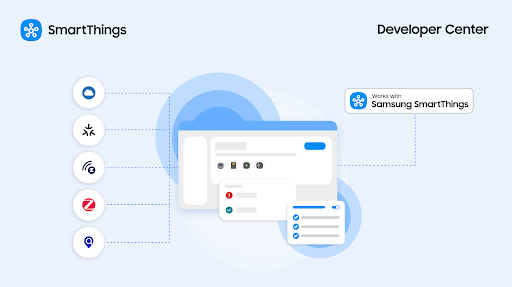
We’re excited to announce the next evolution of the SmartThings Developer Center – a unified, streamlined experience designed to help partners build, test, and complete integrations faster than ever.

As SmartThings expands to support more device categories and service integrations, along with existing integration types and protocols, we’ve redesigned the entire developer journey from the ground up. The result is a single, intuitive console that houses all the tools, workflows, and integrations in one place.

Whether you have a device or service, regardless of integration type, the new Developer Center provides a guided path to get from idea → integration → certification → insights.

What’s more, over the next few months, we will also be adding new enhancements for Service Integrations.  

“You just made it too intuitive. Compared to other ecosystems, this is the easiest one ever.” – Chasen Tolbert, Strategic Partnerships, FireAvert

What’s New: A Guided, Intuitive Experience

The new Developer Center introduces a redesigned journey from end to-end. Here’s what you can expect:

SmartThings Developer Center Header Image

One Console for Every Integration 

Device, service, and future integration paths will now live together in one unified console. It is the single, self-serve path to SmartThings. 

SmartThings Choose Your Integration Type Menu

A Step-by-Step Guided Workflow

Every integration includes a clearly defined path with progress indicators and required steps.
Partners told us this was one of the most helpful additions.

“From an understanding perspective as a brand new user, this is more simplified.  It’s broken down into pieces, and I can see the progress.” – Harsh Khera, Senior Engineering Manager, Kwikset

Real-Time Status & Next Steps

Every section, including device profiles, setup & support profiles, and test results, is visible in one summary view, updated in real time.

Streamlined Product Creation & Certification

We reworked the entire product creation flow to make it simpler, guide users through each step, and avoid common blockers.

Why It Matters: Faster, Easier, More Scalable

Our new Developer Center enhancements are designed to:

Reduce your certification time

A more guided flow minimizes errors and back-and-forth, giving you a faster path to Works with SmartThings (WWST) approval.

Enhance self-serve integrations

Our tools make it easier for developers and partners to use the Developer Center. For example, Test Suite has self-testing options for Hub and Cloud Connected devices, which allows partners to self-test for WWST certification without sending devices to a lab for most device types. 

Support more integration types

Whether your device connects locally via Matter, Zigbee, or Z-Wave using the SmartThings Hub, authenticates using a SmartThings Schema app, or connects directly with the SmartThings Cloud using the SmartThings Device SDK, you’ll find all the tools and guidance you need in one place. Coming soon, SmartThings Find devices will join this same simplified integration journey. 

For partners building a service integration, stay tuned for full support of SmartThings API Access Apps, allowing third-party web or mobile applications to securely access devices, scenes, and locations through the SmartThings API.

Improve collaboration across teams

A single, unified console lets product, engineering, QA, and business stakeholders collaborate on integrations with full visibility.

“There are various people doing different things. It’s important for others to pick up in the same place.” – Charlie Dougherty, Sr Product Manager, Kwikset

Adding to Your Integration with Partner Analytics

The updated Developer Center includes SmartThings Partner Analytics, offering insight into how customers use your products, while maintaining user privacy:

  • Devices most often used with yours in routines 
  • Top sources of your product sales 
  • Most-used features and SmartThings capabilities

SmartThings Analytics Dashboard

Get actionable insights with SmartThings Analytics.  

Explore Analytics in the Developer Center or read our blog to learn more.  

Expand Your Brand with Shareable Routines

We recently rolled out Shareable Routines, which allows WWST-certified partners to create SmartThings routines that showcase your products alongside other partner devices. SmartThings users can easily import these routines into the SmartThings app. 

For example, users can receive a ready-made routine that opens the smart blinds or turns on the lights each morning. 

Shareable Routines help increase product discovery and drive ongoing engagement within the SmartThings platform.

If a user does not have a compatible product, SmartThings shows your recommended devices  with “Buy” links, helping new customers find and purchase your products directly in the SmartThings app.

Stay tuned for our additional announcements on Shareable Routines.  

SmartThings Shareable Routines

Together, our Developer Center, Partner Analytics, and Shareable Routines give you an easier way to integrate with SmartThings, product usage insights to optimize your products and roadmap, and a new way to share your products with users. 

Start Building With the New Developer Center

Try the new experience:

Thank you for your partnership!

A better method for planning complex visual tasks | MIT News

0

MIT researchers have developed a generative artificial intelligence-driven approach for planning long-term visual tasks, like robot navigation, that is about twice as effective as some existing techniques.

Their method uses a specialized vision-language model to perceive the scenario in an image and simulate actions needed to reach a goal. Then a second model translates those simulations into a standard programming language for planning problems, and refines the solution.

In the end, the system automatically generates a set of files that can be fed into classical planning software, which computes a plan to achieve the goal. This two-step system generated plans with an average success rate of about 70 percent, outperforming the best baseline methods that could only reach about 30 percent.

Importantly, the system can solve new problems it hasn’t encountered before, making it well-suited for real environments where conditions can change at a moment’s notice.

“Our framework combines the advantages of vision-language models, like their ability to understand images, with the strong planning capabilities of a formal solver,” says Yilun Hao, an aeronautics and astronautics (AeroAstro) graduate student at MIT and lead author of an open-access paper on this technique. “It can take a single image and move it through simulation and then to a reliable, long-horizon plan that could be useful in many real-life applications.”

She is joined on the paper by Yongchao Chen, a graduate student in the MIT Laboratory for Information and Decision Systems (LIDS); Chuchu Fan, an associate professor in AeroAstro and a principal investigator in LIDS; and Yang Zhang, a research scientist at the MIT-IBM Watson AI Lab. The paper will be presented at the International Conference on Learning Representations.

Tackling visual tasks

For the past few years, Fan and her colleagues have studied the use of generative AI models to perform complex reasoning and planning, often employing large language models (LLMs) to process text inputs.

Many real-world planning problems, like robotic assembly and autonomous driving, have visual inputs that an LLM can’t handle well on its own. The researchers sought to expand into the visual domain by utilizing vision-language models (VLMs), powerful AI systems that can process images and text.

But VLMs struggle to understand spatial relationships between objects in a scene and often fail to reason correctly over many steps. This makes it difficult to use VLMs for long-range planning.

On the other hand, scientists have developed robust, formal planners that can generate effective long-horizon plans for complex situations. However, these software systems can’t process visual inputs and require expert knowledge to encode a problem into language the solver can understand.

Fan and her team built an automatic planning system that takes the best of both methods. The system, called VLM-guided formal planning (VLMFP), utilizes two specialized VLMs that work together to turn visual planning problems into ready-to-use files for formal planning software.

The researchers first carefully trained a small model they call SimVLM to specialize in describing the scenario in an image using natural language and simulating a sequence of actions in that scenario. Then a much larger model, which they call GenVLM, uses the description from SimVLM to generate a set of initial files in a formal planning language known as the Planning Domain Definition Language (PDDL).

The files are ready to be fed into a classical PDDL solver, which computes a step-by-step plan to solve the task. GenVLM compares the results of the solver with those of the simulator and iteratively refines the PDDL files.

“The generator and simulator work together to be able to reach the exact same result, which is an action simulation that achieves the goal,” Hao says.

Because GenVLM is a large generative AI model, it has seen many examples of PDDL during training and learned how this formal language can solve a wide range of problems. This existing knowledge enables the model to generate accurate PDDL files.

A flexible approach

VLMFP generates two separate PDDL files. The first is a domain file that defines the environment, valid actions, and domain rules. It also produces a problem file that defines the initial states and the goal of a particular problem at hand.

“One advantage of PDDL is the domain file is the same for all instances in that environment. This makes our framework good at generalizing to unseen instances under the same domain,” Hao explains.

To enable the system to generalize effectively, the researchers needed to carefully design just enough training data for SimVLM so the model learned to understand the problem and goal without memorizing patterns in the scenario. When tested, SimVLM successfully described the scenario, simulated actions, and detected if the goal was reached in about 85 percent of experiments.

Overall, the VLMFP framework achieved a success rate of about 60 percent on six 2D planning tasks and greater than 80 percent on two 3D tasks, including multirobot collaboration and robotic assembly. It also generated valid plans for more than 50 percent of scenarios it hadn’t seen before, far outpacing the baseline methods.

“Our framework can generalize when the rules change in different situations. This gives our system the flexibility to solve many types of visual-based planning problems,” Fan adds.

In the future, the researchers want to enable VLMFP to handle more complex scenarios and explore methods to identify and mitigate hallucinations by the VLMs.

“In the long term, generative AI models could act as agents and make use of the right tools to solve much more complicated problems. But what does it mean to have the right tools, and how do we incorporate those tools? There is still a long way to go, but by bringing visual-based planning into the picture, this work is an important piece of the puzzle,” Fan says.

This work was funded, in part, by the MIT-IBM Watson AI Lab.

Generate single title from this title Why AI insurance underwriting is finally attracting institutional capital in 100 -150 characters. And it must return only title i dont want any extra information or introductory text with title e.g: ” Here is a single title:”

Write an article about

AI insurance underwriting has been called the next frontier of insurtech for years. The difference now is that the money backing it has moved from venture bets into institutional conviction. On March 3, Boston-based Gradient AI securedgrowth capital financing from CIBC Innovation Banking, a lender with over 25 years of experience backing growth-stage technology companies and more than US$11 billion in funds managed across North America.

The amount was not disclosed, but the nature of the backer is telling. CIBC Innovation Banking does not write cheques for concept plays. It has backed more than 700 venture and private equity-backed businesses over the past six and a half years. When it enters a sector, it is because it sees a market that is maturing, not one still being defined.

What Gradient AI actually does

Gradient AI operates at the intersection of data scale and insurance risk. Its SaaS platform draws on a proprietary data lake spanning tens of millions of policies and claims, layered with economic, health, geographic, and demographic signals. The result is an underwriting and claims prediction system that insurers use to sharpen loss ratios, speed up quote turnarounds, and cut claims expenses through automation.

The company’s clients span major carriers, managing general agents (MGAs), managing general underwriters (MGUs), third-party administrators, risk pools, and large self-insured employers across all major lines of insurance. 

CEO Stan Smith was direct about what this round means for the road ahead: “While we are thrilled to secure this investment from CIBC Innovation Banking, it is now up to us to continue to address the industry challenges by enhancing our platform and delivering unparalleled value to our customers.” 

Smith reckons insurers are becoming increasingly sophisticated in their risk assessment, yet challenges still arise. “We are focused on helping them achieve these goals by automating processes, reducing costs, and significantly improving results,” he added.

A market that reflects the urgency

The backdrop for this financing is a market in sharp acceleration. The global AI in the insurance sector was valued at around US$10.36 billion in 2025 and is projected to grow to US$13.45 billion in 2026, tracking toward US$154 billion by 2034 at a CAGR of 35.7%, according to Fortune Business Insights. 

Separately, BCG’s research found that AI can improve efficiency in complex underwriting lines by up to 36%, primarily through augmenting manual underwriting processes, with an additional potential for up to three percentage points of loss-ratio improvement through better use of unstructured data.

The pressure on insurers to adopt is not just competitive. Regulators across the US and Europe are pushing for greater transparency in automated decision-making, which means the platforms that can demonstrate model explainability and auditability will carry an advantage. Gradient AI’s architecture, built around a core predictive analytics engine enriched with contextual data layers, is designed for this kind of scrutiny.

George Bixby, Director at CIBC Innovation Banking, framed the investment around market transformation: “The team’s innovative approach to leveraging artificial intelligence is reshaping how insurers assess risk, manage claims, and deliver value to their customers.”

The investors are already at the table

Gradient AI is already backed by Centana Growth Partners, MassMutual Ventures, Sandbox Insurtech Ventures, and Forte Ventures. MassMutual Ventures is particularly notable in this context. It is the strategic venture arm of Massachusetts Mutual Life Insurance Company, one of the largest mutual life insurers in the United States. 

That an insurer of that scale is a direct investor in Gradient AI is not incidental. It signals that the platform is being validated by the industry it is built to serve. The CIBC financing adds a different dimension. Growth capital from an innovation-focused bank, as opposed to an equity investor, is a signal that Gradient AI is no longer in the phase of proving a thesis. 

It is in the phase of executing at scale. For an industry that has historically priced risk on actuarial tables alone, the shift to AI-driven underwriting represents a structural change in how insurance companies understand and price the unknown. Gradient AI is betting it can be the infrastructure that sits underneath that shift.

Meanwhile, for insurers still treating AI as a supplementary tool, the market is starting to move on without them.

See also: Insurance giant AIG deploys agentic AI with orchestration layer

Want to learn more about AI and big data from industry leaders? Check out AI & Big Data Expo taking place in Amsterdam, California, and London. The comprehensive event is part of TechEx and is co-located with other leading technology events including the Cyber Security & Cloud Expo. Click here for more information.

AI News is powered by TechForge Media. Explore other upcoming enterprise technology events and webinars here.

.Organize the content with appropriate headings and subheadings ( h2, h3, h4, h5, h6). Include conclusion section and FAQs section with Proper questions and answers at the end. do not include the title. it must return only article i dont want any extra information or introductory text with article e.g: ” Here is rewritten article:” or “Here is the rewritten content:”

Generate single title from this title A New AI Model Could Help Scientists Design New Forms of Life in 100 -150 characters. And it must return only title i dont want any extra information or introductory text with title e.g: ” Here is a single title:”

Write an article about

In 2008, scientists did something extraordinary. For the first time, they built the full genetic code of a bacterium in the lab. That laid the foundation for being able to place the synthetic genome inside a cell and in a way “restart” the biological machinery. Many scientists described this as the first form of synthetic life. 

Now that scientists are armed with AI, can they take a step forward? We know that AI is capable of learning patterns across trillions of DNA letters. Could that shift genome design from manual engineering to machine generation?

That is exactly what a team of researchers led by computational biologist Brian Hie at the Arc Institute in Palo Alto, California, together with bioengineer Patrick Hsu, set out to explore. 

In a new Nature paper, the researchers introduced Evo2, a new AI model trained on trillions of DNA letters from organisms across the tree of life. Using the system, the team generated complete genome sequences, including one inspired by the bacterium Mycoplasma genitalium.

Why does this matter? If AI can design working genomes, it could dramatically speed up synthetic biology. This would allow scientists to create entirely new organisms for medicine, energy, biotechnology, and other use cases. 

The details of the Evo2 model were published on March 4 in a paper in the journal Nature. The model works by treating DNA like language. However, instead of using words, it analyzes long strings of genetic letters that make up genomes. The researchers claim that the model is trained on trillions of DNA bases collected from thousands of organisms across bacteria, plants, animals, and other life forms. 

(Gorodenkoff/Shutterstock)

Evo2 studies these sequences to learn how genes and other genomic features tend to appear and interact within real genomes. So instead of predicting the next word in text, like LLMs do, Evo2 predicts which DNA sequences are biologically plausible. 

Many genomic AI models do something similar, but Evo2 is different in a few important ways. Earlier genomic AI models often focus on short DNA segments, Evo2 is designed to operate at a far larger scale. The system can model sequences millions of letters long. This allows it to capture patterns that span entire genomic regions.

Working at this scale allows the model to capture how different parts of the genome interact with each other. That capability is critical when attempting to generate long DNA sequences that resemble complete genomes.

“These AI models are the ‘ChatGPT moment’ for synthetic genomics,” says genome engineer Patrick Yizhi Cai at the University of Manchester, UK. “You can start writing things that never existed in nature.” Cai is an independent expert commenting on the work. 

The developers of Evo2 put it to test asking the model to generate genome-scale DNA sequences inspired by Mycoplasma genitalium – a bacterium known for having one of the smallest genomes of any free living organism. The bacterium is often used in synthetic biology research because its genome is small and relatively simple. That makes it a useful starting point for experiments aimed at building or redesigning genomes.

According to the researchers, Evo2 was successful in generating long stretches of DNA that follow the structural patterns seen in real genomes. This offers a possible blueprint for designing new organisms. 

It’s worth keeping in mind that designing DNA in a lab is just the first step. A sequence that looks plausible to a model may not necessarily function inside a living cell. 

“It’s cool, but it’s not there yet,” says Nico Claassens, a synthetic biologist at Wageningen University in the Netherlands. One challenge is that AI designed genomes still need to be synthesized and tested in the lab. Another is designing DNA that can control all the essential functions of a living cell.

Scientists have spent decades learning how to read DNA. More recently, technologies such as CRISPR have allowed researchers to edit genes with increasing precision. Systems like Evo2 hint at a new stage where AI could help design entire genomes from scratch. 

If these tools mature and are tested across different environments, synthetic biology may gradually shift from modifying existing organisms toward designing new biological systems directly from data. Whether AI will eventually help create fully functional synthetic life remains to be seen, but the direction of travel is becoming clearer – and a lot faster.

If you want to read more stories like this and stay ahead of the curve in data and AI, subscribe to BigDataWire and follow us on LinkedIn. We deliver the insights, reporting, and breakthroughs that define the next era of technology.

The post A New AI Model Could Help Scientists Design New Forms of Life appeared first on BigDATAwire.

.Organize the content with appropriate headings and subheadings ( h2, h3, h4, h5, h6). Include conclusion section and FAQs section with Proper questions and answers at the end. do not include the title. it must return only article i dont want any extra information or introductory text with article e.g: ” Here is rewritten article:” or “Here is the rewritten content:”

Generate single title from this title Train CodeFu-7B with veRL and Ray on Amazon SageMaker Training jobs in 100 -150 characters. And it must return only title i dont want any extra information or introductory text with title e.g: ” Here is a single title:”

0

Write an article about

The rapid advancement of artificial intelligence (AI) has created unprecedented demand for specialized models capable of complex reasoning tasks, particularly in competitive programming where models must generate functional code through algorithmic reasoning rather than pattern memorization. Reinforcement learning (RL) enables models to learn through trial and error by receiving rewards based on actual code execution, making it particularly well-suited for developing genuine problem-solving capabilities in algorithmic domains.

However, implementing distributed RL training for code generation presents significant infrastructure challenges such as orchestrating multiple heterogeneous components, coordinating parallel code compilation across nodes, and maintaining fault tolerance for long-running processes. Ray is one of the frameworks for distributed workloads that address these challenges, due to its unified system that handles the entire AI pipeline, GPU-first architecture, and seamless integration with tools like Hugging Face Transformers and PyTorch.

Workloads can be run with Ray framework on SageMaker training jobs by using the Ray on Amazon SageMaker Training jobs solution, which combines Ray’s distributed computing framework with SageMaker’s fully managed infrastructure. This solution automatically handles Ray cluster initialization, multi-node coordination, and distributed resource management, enabling developers to focus on model development while benefiting from SageMaker’s enterprise-grade features.

In this post, we demonstrate how to train CodeFu-7B, a specialized 7-billion parameter model for competitive programming, using Group Relative Policy Optimization (GRPO) with veRL, a flexible and efficient training library for large language models (LLMs) that enables straightforward extension of diverse RL algorithms and seamless integration with existing LLM infrastructure, within a distributed Ray cluster managed by SageMaker training jobs. We walk through the complete implementation, covering data preparation, distributed training setup, and comprehensive observability, showcasing how this unified approach delivers both computational scale and developer experience for sophisticated RL training workloads.

About CodeFu-7B

CodeFu-7B-v0.1 is a 7B parameter language model specifically trained for solving Competitive Programming (CP) problems. Built upon the DeepSeek-R1-Distill-Qwen-7B base model, CodeFu demonstrates how reinforcement learning can develop capabilities in algorithmic reasoning and efficient C++ code generation beyond traditional supervised fine-tuning approaches.

The model is trained using problem statements from the DeepMind CodeContest dataset without access to ground-truth solutions during training, forcing it to learn through trial and error based on code execution feedback. This approach enables the development of genuine problem-solving capabilities rather than pattern memorization

CodeFu is publicly available on HuggingFace and released under the MIT license, making it accessible for researchers and practitioners interested in code generation and algorithmic reasoning. The model’s training methodology demonstrates the potential for applying reinforcement learning techniques to complex reasoning tasks beyond competitive programming.

Ray in SageMaker training jobs solution

Ray on Amazon SageMaker Training jobs is a solution that enables distributed data processing and model training using Ray within SageMaker’s managed training environment. The solution provides key capabilities including universal launcher architecture for automatic Ray cluster setup, multi-node cluster management with intelligent coordination, heterogeneous cluster support for mixed instance types, and integrated observability through Ray Dashboard, Prometheus, Grafana, and Amazon CloudWatch integration.

The solution seamlessly integrates with the SageMaker Python SDK using the modern ModelTrainer API. This publicly available solution on GitHub enables developers to use Ray’s distributed computing capabilities while benefiting from SageMaker’s managed infrastructure, making it ideal for complex workloads like reinforcement learning training that require sophisticated distributed coordination and resource management.

Solution overview

The workflow for training CodeFu 7B with veRL and Ray on SageMaker training jobs, as illustrated in the accompanying diagram, consists of the following steps:

  1. Data preparation: Upload the preprocessed DeepMind CodeContest dataset and training configuration.
  2. Training job submission: Submit a SageMaker training job API request through the ModelTrainer class from the SageMaker Python SDK.
  3. Monitoring and observability: Monitor training progress in real-time through Ray Dashboard, and optionally with Prometheus metrics collection, Grafana visualization, and experiment tracking.
  4. Automatic cleanup: Upon training completion, SageMaker automatically saves the trained model to S3, uploads training logs to CloudWatch, and decommissions the compute cluster.

This streamlined architecture delivers a fully managed reinforcement learning training experience, enabling developers to focus on model development while SageMaker and Ray handle the complex distributed infrastructure orchestration—within a pay-as-you-go pricing model that bills only for actual compute time.

Prerequisites

The following prerequisites must be complete before the notebook can be run:

  1. Make the following quota increase requests for SageMaker AI. For this use case, request a minimum of 2 p4de.24xlarge instances (with 8 x NVIDIA A100 GPUs) and scale to more p4de.24xlarge instances (depending on time-to-train and cost-to-train trade-offs for your use case). P5 instances (with 8 x NVIDIA H100 GPUs) are also supported. On the Service Quotas console, request the following SageMaker AI quotas:
    1. p4de instances (p4de.24xlarge) for training job usage: 2
  2. Create an AWS Identity and Access Management (IAM) role with managed policies AmazonSageMakerFullAccess, AmazonS3FullAccess, AmazonSSMFullAccess to give required access to SageMaker AI to run the examples.
  3. Assign the following policy as the trust relationship to created IAM role:

{
   “Version”:”2012-10-17″,
   “Statement”:[
      {
         “Sid”:””,
         “Effect”:”Allow”,
         “Principal”:{
            “Service”:
               “sagemaker.amazonaws.com”
            ]
         },
         “Action”:”sts:AssumeRole”
      }
   ]
}

  1. (Optional) Create an Amazon SageMaker Studio domain (refer to Use quick setup for Amazon SageMaker AI) to access Jupyter notebooks for running the training code. Alternatively, JupyterLab can be used in a local setup or another Python development environment to execute the notebook and submit the SageMaker training job.

Note: These permissions grant broad access and are not recommended for use in production environments. See the SageMaker Developer Guide for guidance on defining more fine-grained permissions

The code example can be found at this GitHub repository.

Prepare the dataset

The data preparation pipeline transforms the raw DeepMind CodeContest dataset into a format suitable for reinforcement learning training. We apply systematic filters to identify suitable problems, removing those with Codeforces ratings below 800 and implementing quality validation checks for missing test cases, malformed descriptions, and invalid constraints.

We categorize problems into three difficulty tiers: Easy (800-1000 points), Hard (1100-2200 points), and Expert (2300-3500 points). This post uses only the Easy dataset for training. Each problem is formatted with two components: a user prompt containing the problem statement, and a reward_model specification with test cases, time limits, and memory constraints. Crucially, the ground_truth field contains no solution code — only test cases, forcing the model to learn through reward signals rather than memorizing solutions.

{
  “data_source”: “code_contests”,
  “prompt”: [
    {
      “role”: “user”,
      “content”: “Write a C++ solution for this problem: …”
    }
  ],
  “ability”: “coding-cp”,
  “reward_model”: {
    “style”: “rule”,
    “ground_truth”: {
      “name”: “problem 1”,
      “public_tests”: {
        “input”: [“test input 1”, “test input 2”],
        “output”: [“expected output 1”, “expected output 2”]
      },
      “private_tests”: {
        “input”: [“private input 1”, “private input 2”],
        “output”: [“private output 1”, “private output 2”]
      },
      “time_limit”: 2.0,
      “memory_limit_bytes”: 268435456,
      “cf_rating”: 1200
    }
  }
}

For this post, we provide a pre-processed subset of the Easy difficulty dataset in the code sample to streamline the training example, accessible from the GitHub repository.

GRPO training using veRL

The training process uses Ray to orchestrate the distributed execution and synchronization of vLLM rollout, reward evaluation (code compilation and execution), FSDP model parallelism, and Ulysses sequence parallelism. We set the degree of sequence parallelism to 4 for long-form reasoning and code generations.

The veRL framework implements a sophisticated multi-component architecture through its main_ppo.py orchestrator, which coordinates three primary distributed worker types: ActorRolloutRefWorker for policy inference and rollouts, CriticWorker for value function estimation, and RewardModelWorker for scoring generated solutions.

The GRPO algorithm enhances traditional proximal policy optimization (PPO) by computing advantages using group-relative baselines, which helps stabilize training by reducing variance in policy gradient estimates.

We extended the TinyZero code repository by using Ray to manage and distribute reward function calculation. This enables parallel C++ code compilation and evaluation across the same cluster to address the compute-intensive and latency-bound nature of code execution. The entire pipeline is executed as a SageMaker training job running on ml.p4de.24xlarge instances. The training pipeline consists of the following steps as shown in the following architecture:
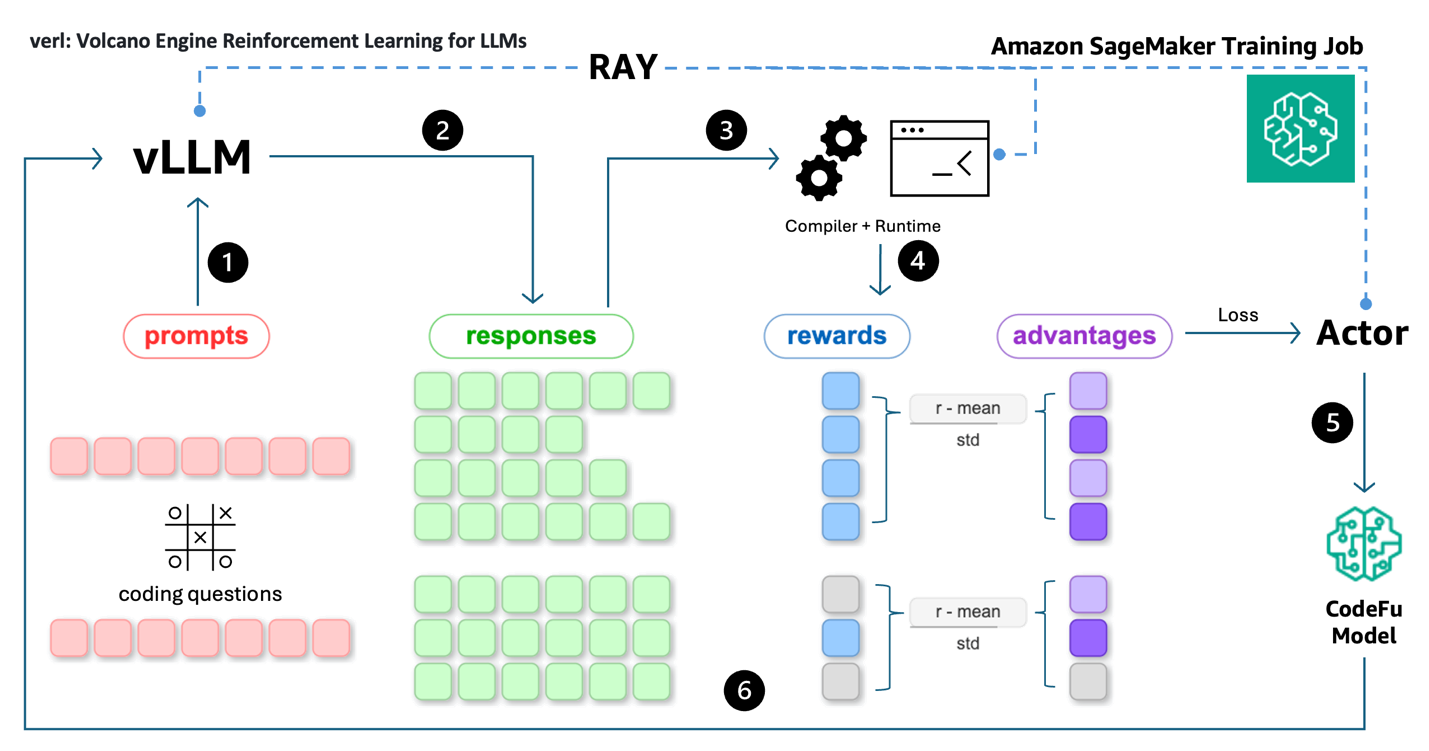
  1. Rollout: Coding problem prompts are fed into the vLLM inference engine for rolling out potential solutions.
  2. Response generation: vLLM generates multiple responses (reasoning + code) for each prompt.
  3. Code execution: Code solutions are extracted from responses and are compiled and executed by distributed workers (compilers and runtime) managed by Ray.
  4. Reward calculation: Execution outcomes are used to calculate rewards (i.e. testcase pass ratios) and advantages are computed using group-relative baselines.
  5. Policy update: The Actor uses advantages and token probabilities to compute the PPO loss, which is used to update CodeFu’s parameters through gradient descent.
  6. Iteration: The process repeats with batches of prompt-response-reward cycles, with Ray managing the distributed sampling, execution, and training synchronization across the pipeline.

The training process orchestration involves several key components implemented across multiple modules. The core veRL training loop is implemented in main_ppo.py, which initializes Ray workers and manages the distributed training process:

@ray.remote
def main_task(config):
    # Initialize tokenizer and download model
    local_path = copy_local_path_from_hdfs(config.actor_rollout_ref.model.path)
    tokenizer = hf_tokenizer(local_path)
    
    # Define distributed worker roles
    role_worker_mapping = {
        Role.ActorRollout: ray.remote(ActorRolloutRefWorker),
        Role.Critic: ray.remote(CriticWorker),
        Role.RefPolicy: ray.remote(ActorRolloutRefWorker),
    }
    
    # Initialize reward manager for code execution
    reward_fn = RewardManager(tokenizer=tokenizer, num_examine=0)
    
    # Create and start trainer
    trainer = RayPPOTrainer(
        config=config,
        tokenizer=tokenizer,
        role_worker_mapping=role_worker_mapping,
        resource_pool_manager=resource_pool_manager,
        reward_fn=reward_fn,
    )
    trainer.init_workers()
    trainer.fit()

The reward evaluation system implements parallel code execution through Ray remote functions, handling C++ compilation and test case execution:

@ray.remote
def process_reward_item(idx, valid_response_length, sequences_str, data_source, reward_model_data):
    # Extract and compile C++ code from model response
    ground_truth = json.loads(reward_model_data)[“ground_truth”]
    
    # Select appropriate scoring function based on data source
    if data_source == “code_contests”:
        compute_score = code_contests.compute_score
    
    # Execute code against test cases and calculate pass ratio
    score = compute_score(solution_str=sequences_str, ground_truth=ground_truth)
    return idx, score, valid_response_length, sequences_str, data_source

The parallel test case execution system optimizes evaluation efficiency by sampling test cases and using process pools:

def run_test_cases_parallel(
    bin_file: str, test_inputs: List[str],
    test_outputs: List[str],
    prob_name: str, execution_timeout: float,
    max_test_cases: int = 100,
    max_workers: int = 100) -> Tuple[int, int]:
    # Sample test cases if too many available
    if len(test_inputs) > max_test_cases:
        random_indices = np.random.choice(len(test_inputs), size=max_test_cases, replace=False)
        test_inputs = test_inputs[random_indices]
        test_outputs = test_outputs[random_indices]
    
    # Execute test cases in parallel using ProcessPoolExecutor
    with ProcessPoolExecutor(max_workers=min(max_workers, len(test_inputs))) as executor:
        results = list(executor.map(_process_test_case, args_list))
        total_matches = sum(results)
    
    return total_matches, len(test_inputs)

This implementation enables efficient distributed training by separating concerns: the main_ppo.py orchestrator manages Ray worker coordination, while the reward system provides scalable code evaluation through parallel compilation and execution across the SageMaker cluster.

Below is the pseudocode for the reward calculation used in this post to train a competitive programming coding model. The reward function is the most important part of reinforcement learning as it defines what the model is encouraged to achieve and what it should avoid. This implementation uses a hierarchical penalty system that first checks for fundamental code execution issues, assigning severe penalties for non-executable code (-1) and moderate penalties for compilation failures (-0.5). Extracted code solutions are executed with strict time limit enforcement – code exceeding the problem’s specified time limit is given zero reward, facilitating realistic competitive programming conditions. For a successfully executed C++ solution, its reward is calculated as a linear function based on the fraction of private test cases passed, encouraging the model to solve as many private test cases as possible while avoiding overfitting to publicly visible tests. This design prioritizes code correctness and execution validity, with the private test performance serving as the sole signal for learning optimal coding solutions.

def compute_reward(code_output, ground_truth):
    # Handle execution failures (same for both stages)
    if not is_executable(code_output):
        return -1
    
    if compilation_failed(code_output):
        return -0.5
    
    if exceeds_time_limit(code_output):
        return 0
   
    # Primary reward signal: correctness on hidden test cases
    # Run code against private test cases
    passed_private, total_private = run_private_tests(code_output, ground_truth, max_test_cases=1000)
   
   return passed_private / total_private

Refer to scripts/verl/utils/reward_score/code_contests.py for the complete Python code. Executing generated code in production environments requires appropriate sandboxing. In this controlled demonstration setting, we execute the code as a quick example to evaluate its correctness to assign rewards.

Ray workload with SageMaker training jobs

To train CodeFu-7B using veRL and Ray on SageMaker training jobs, we use the ModelTrainer class from the SageMaker Python SDK. Start by setting up the distributed training workload with the following steps:

  1. Select the instance type and container image for the training job:

instance_type = “ml.p4de.24xlarge” 
instance_count = 2

account_id = sts.get_caller_identity()[“Account”]
region = sagemaker_session.boto_session.region_name
repo_name = “codefu-pytorch”
tag = “latest”

image_uri = f”{account_id}.dkr.ecr.{region}.amazonaws.com/{repo_name}:{tag}”

The training uses a custom Docker container that includes veRL, Ray, and the necessary dependencies for distributed RL training. Refer to the GitHub repository for the complete container definition and build instructions.

  1. Create the ModelTrainer to encapsulate the Ray-based training setup:

The ModelTrainer class provides flexible execution options through its SourceCode configuration, allowing users to customize their training workflows with different frameworks and launchers. Specify either an entry_script for direct Python script execution or use the command parameter for custom execution commands, enabling integration with specialized frameworks such as Ray, Hugging Face Accelerate, or custom distributed training solutions.


args = [
“–entrypoint”, “train.py”,
“–config”, “/opt/ml/input/data/config/args.yaml”,
]

# Define the script to be run with Ray launcher
source_code = SourceCode(
source_dir=”./scripts”,
requirements=”requirements.txt”,
command=f”python launcher.py {‘ ‘.join(args)}”,
)

# Define the compute configuration
compute_configs = Compute(
instance_type=instance_type,
instance_count=instance_count,
keep_alive_period_in_seconds=1800,
)

job_name = “train-codefu-verl-ray”
output_path = f”s3://{bucket_name}/{job_name}”

model_trainer = ModelTrainer(
training_image=image_uri,
source_code=source_code,
base_job_name=job_name,
compute=compute_configs,
stopping_condition=StoppingCondition(max_runtime_in_seconds=3600 * 24 * 5),
output_data_config=OutputDataConfig(s3_output_path=output_path),
checkpoint_config=CheckpointConfig(
s3_uri=output_path + “/checkpoint”,
local_path=”/opt/ml/checkpoints”
),
environment={
“RAY_PROMETHEUS_HOST”: “”,
“RAY_GRAFANA_HOST”: “”,
“RAY_PROMETHEUS_NAME”: “prometheus”,
“BASE_MODEL”: “deepseek-ai/DeepSeek-R1-Distill-Qwen-7B”,
“RUN_NAME”: “sagemaker-training-run”,

},
role=get_execution_role(),
).with_remote_debug_config(RemoteDebugConfig(enable_remote_debug=True))

The launcher.py script serves as the universal entry point that detects the SageMaker environment (single-node or multi-node, homogeneous or heterogeneous cluster), initializes the Ray cluster with proper head/worker node coordination, and executes your custom training script. Key launcher.py functionalities are:

  • Ray cluster setup: Automatically detects the cluster environment and initializes Ray with proper head node selection.
  • Node coordination: Manages communication between head and worker nodes across SageMaker instances.
  • Script execution: Executes the specified –entrypoint script (train.py) within the Ray cluster context.
  • Prometheus and grafana connectivity: Configures Ray to export metrics and establishes connection to external Prometheus and Grafana servers specified by RAY_PROMETHEUS_HOST and RAY_GRAFANA_HOST for comprehensive cluster monitoring. For additional information, refer to Ray on SageMaker training jobs – Observability with Prometheus and Grafana.

For the complete implementation of the Ray cluster setup with SageMaker training jobs, refer to launcher.py.

The train.py script serves as the actual training orchestrator that:

  • Loads the veRL configuration from the provided YAML file
  • Sets up the distributed training environment with proper tokenizer and model initialization
  • Constructs and executes the veRL training command with the necessary parameters
  • Handles environment variable configuration for Ray workers and NVIDIA Collective Communications Library (NCCL) communication
  • Manages the complete training lifecycle from data loading to model checkpointing

For the complete implementation of the entry point script, refer to train.py.

  1. Set up the input channels for the ModelTrainer by creating InputData objects from the S3 bucket paths:

train_input = InputData(
   channel_name=”train”,
   data_source=S3DataSource(
       s3_data_type=”S3Prefix”,
       s3_uri=train_dataset_s3_path,
       s3_data_distribution_type=”FullyReplicated”,
   ),
)

config_input = InputData(
   channel_name=”config”,
   data_source=S3DataSource(
       s3_data_type=”S3Prefix”,
       s3_uri=train_config_s3_path,
       s3_data_distribution_type=”FullyReplicated”,
    ),
)

  1. Submit the training job using the train function call on the created ModelTrainer:

model_trainer.train(
   input_data_config=[train_input, val_input, config_input],
   wait=False
)

The job can be monitored directly from the notebook output or through the SageMaker console, which shows the job status and corresponding CloudWatch logs.
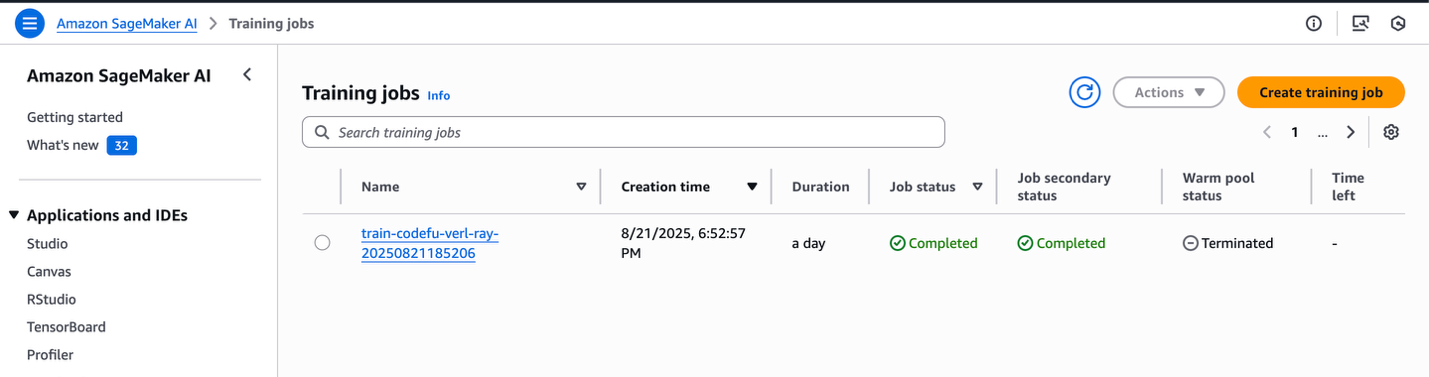
SageMaker training jobs console
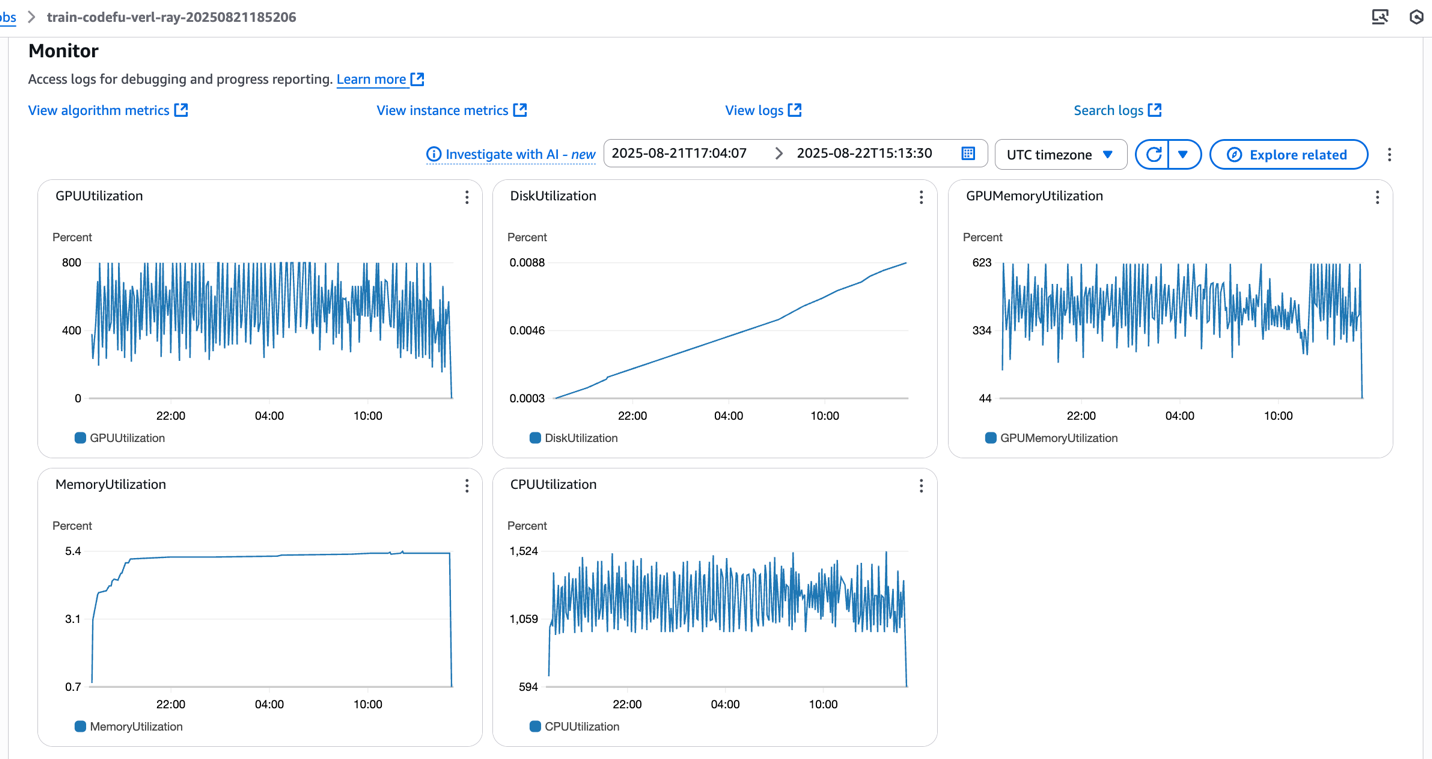
SageMaker training jobs system metrics

The launcher.py script orchestrates the Ray cluster initialization through the following automated steps, which can be monitored in real-time through CloudWatch logs:

  1. Setup SageMaker training jobs and Ray environment variables: Configures necessary environment variables for both SageMaker integration and Ray cluster communication:

__main__ – INFO – Entrypoint argument provided: train.py
__main__ – INFO – Set source_dir=, entry_script=train.py

__main__ – INFO – Found SageMaker environment with hosts: …
__main__ – INFO – Current host: algo-1
__main__ – INFO – Configured Prometheus host:
__main__ – INFO – Configured Grafana host:
__main__ – INFO – Ray runtime environment contains 137 total environment variables
__main__ – INFO – Ray runtime environment: …

  1. Identify the SageMaker training job cluster type: Detects whether the deployment is single-node or multi-node, and determines a single or multi-node cluster, and if it’s a homogeneous or heterogeneous cluster configuration:

__main__ – INFO – Homogeneous cluster configuration: 2 total hosts
__main__ – INFO – All hosts: [‘algo-1’, ‘algo-2’]
__main__ – INFO – Found multiple hosts, initializing Ray as a multi-node cluster

  1. Setup head and worker nodes: Identifies which instance serves as the Ray head node and configures the remaining instances as worker nodes:

__main__ – INFO – Head node: algo-1, Current host: algo-1
__main__ – INFO – CPUs for the head node: 192
__main__ – INFO – GPUs for the head node: 8

  1. Start Ray node: Initializes the Ray head node and worker nodes with appropriate resource allocation and dashboard configuration, by verifying that the worker nodes successfully connect to the head node before proceeding:

#011INFO worker.py:1723 — Connecting to existing Ray cluster at address: …
#011INFO worker.py:1908 — Connected to Ray cluster. View the dashboard at
__main__ – INFO – All nodes connected to the Ray cluster!

  1. Execute the training script: Launches the specified entrypoint script (train.py) within the fully initialized Ray cluster context:

Script path: /opt/ml/input/data/code/train.py

__main__ – INFO – Loading and executing Python script using importlib…

After the job completes, the trained model weights and checkpoints will be available in the specified S3 output path, ready for deployment or further evaluation.

Experiment tracking

The CodeFu training pipeline integrates seamlessly with Managed MLflow on Amazon SageMaker AI as well as third party solutions, for comprehensive experiment tracking and visualization of reinforcement learning metrics.

The following image shows the metrics that are particularly useful to monitor during CodeFu training.
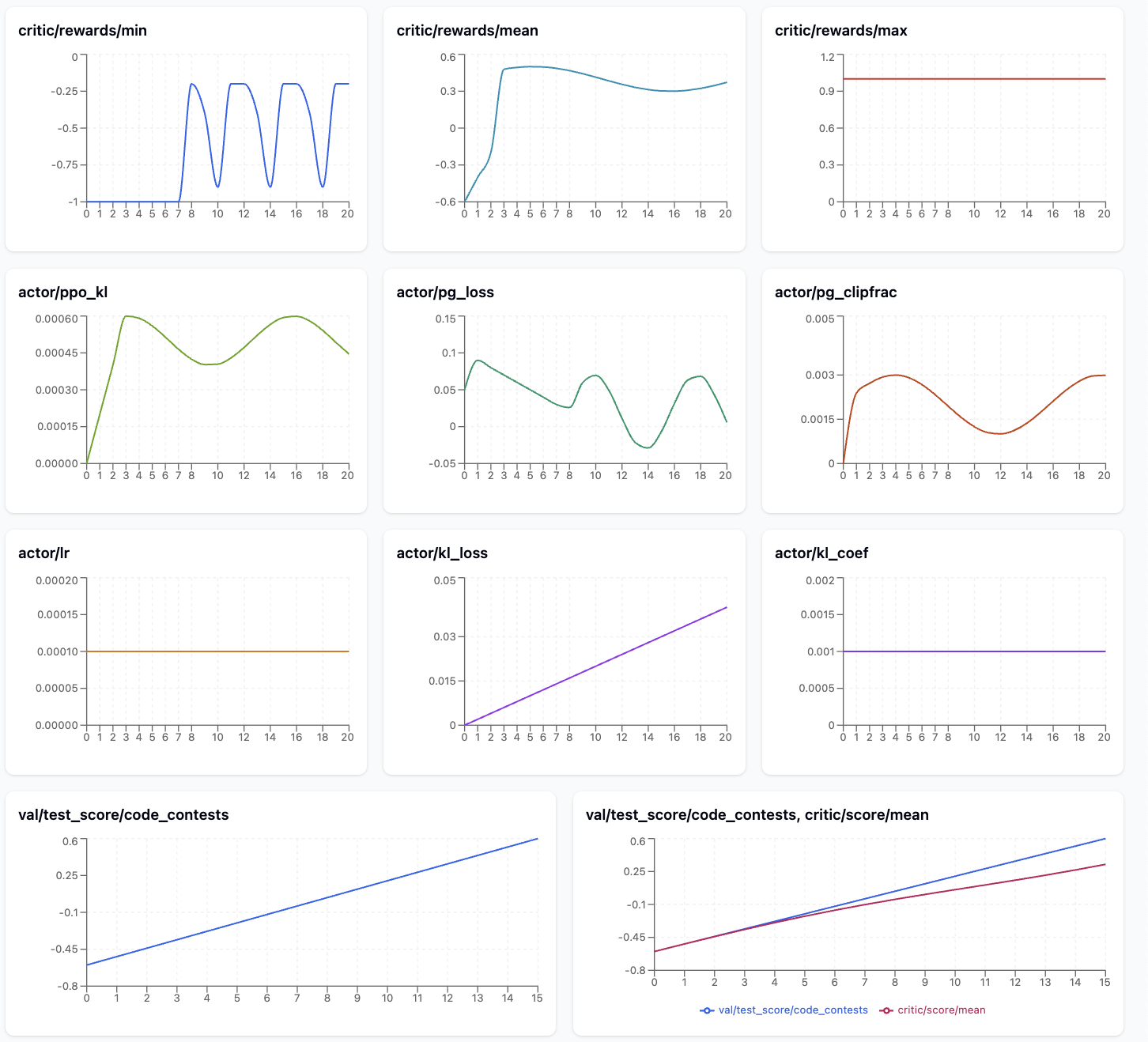
The metrics plot shows a promising GRPO/PPO learning progression for the competitive programming model. The reward signals demonstrate clear improvement, with critic/reward/mean rising from -0.8 to 0.6 and critic/reward/min recovering from initial failures -1.0 to moderate performance -0.5, while critic/reward/max maintains perfect scores 1.0 throughout training, indicating the model can achieve optimal solutions.

The Actor metrics reveal healthy training dynamics: actor/ppo_kl remains low ~0.0002 after an initial spike, confirming stable policy updates, while actor/pg_clipfrac stays in a reasonable range ~0.002-0.004, suggesting appropriately sized learning steps.

The increasing actor/kl_loss trend indicates growing divergence from the reference model as expected during RL fine-tuning. Most importantly, val/test_score/code_contests shows consistent improvement from -0.6 to ~0.5, and the train-validation comparison reveals good generalization with both curves tracking closely, indicating the model is learning to solve coding problems effectively without overfitting.

The table below explains key GRPO training metrics and why monitoring each one matters for diagnosing training health and performance:

Metric Description Purpose
critic/reward/min Minimum reward achieved on the training set Detect catastrophic failures: Extremely negative rewards indicate the model is producing poor outputs that need attention
critic/reward/mean Average reward across the training set Primary progress indicator: Shows overall model performance improvement; should generally trend upward during successful training
critic/reward/max Maximum reward achieved on the training set Track best-case performance: Shows the model’s peak capability; helps identify if the model can achieve excellent results even if average is low
actor/ppo_kl KL divergence between current and previous policy iteration Training stability monitoring: High values indicate rapid policy changes that may destabilize training; should stay moderate
actor/pg_clipfrac Fraction of policy updates hitting the clipping boundary Update aggressiveness gauge: Moderate values indicate healthy learning; too high suggests overly aggressive updates that may destabilize training, too low (e.g. zero) suggests inefficient learning. This is valid only during off-policy PPO updates.
actor/kl_loss KL divergence between current policy and fixed reference model Reference drift prevention: Helps prevent the model from deviating too far from original behavior; important for maintaining coding capabilities
val/test_score/code_contests Reward/performance on held-out validation set Generalization check: Most important metric for real performance; detects overfitting and measures true model improvement

(Optional) Observability with Ray dashboard and Grafana

To access the Ray Dashboard and enable Grafana visualization during training, establish port forwarding using AWS Systems Manager (SSM). To learn more about the setup of AWS SSM, please refer to AWS Systems Manager Quick Setup.

  1. First, identify the head node in your multi-node cluster by examining the CloudWatch logs:

__main__ – INFO – Found multiple hosts, initializing Ray as a multi-node cluster
__main__ – INFO – Head node: algo-1, Current host: algo-2

  1. Access the Ray Dashboard by forwarding port 8265 from the head node:

aws ssm start-session —target sagemaker-training-job:train-codefu-verl-ray-20250821185206_algo-1 \
–region us-east-1\
–document-name AWS-StartPortForwardingSession \
–parameters ‘{“portNumber”:[“8265″],”localPortNumber”:[“8265”]}’

  1. Enable Grafana to collect Ray metrics by forwarding port 8080 (Ray metrics export port):

aws ssm start-session —target sagemaker-training-job:train-codefu-verl-ray-20250821185206_algo-1 \
–region us-east-1\
–document-name AWS-StartPortForwardingSession \
–parameters ‘{“portNumber”:[“8080″],”localPortNumber”:[“”]}’

Once port forwarding is established, the Ray Dashboard can be accessed at localhost:8265 in your browser, providing detailed insights into:

  • Worker utilization across the distributed cluster
  • Task execution status and performance metrics
  • Resource consumption including GPU and memory usage
  • Actor and task scheduling across Ray workers
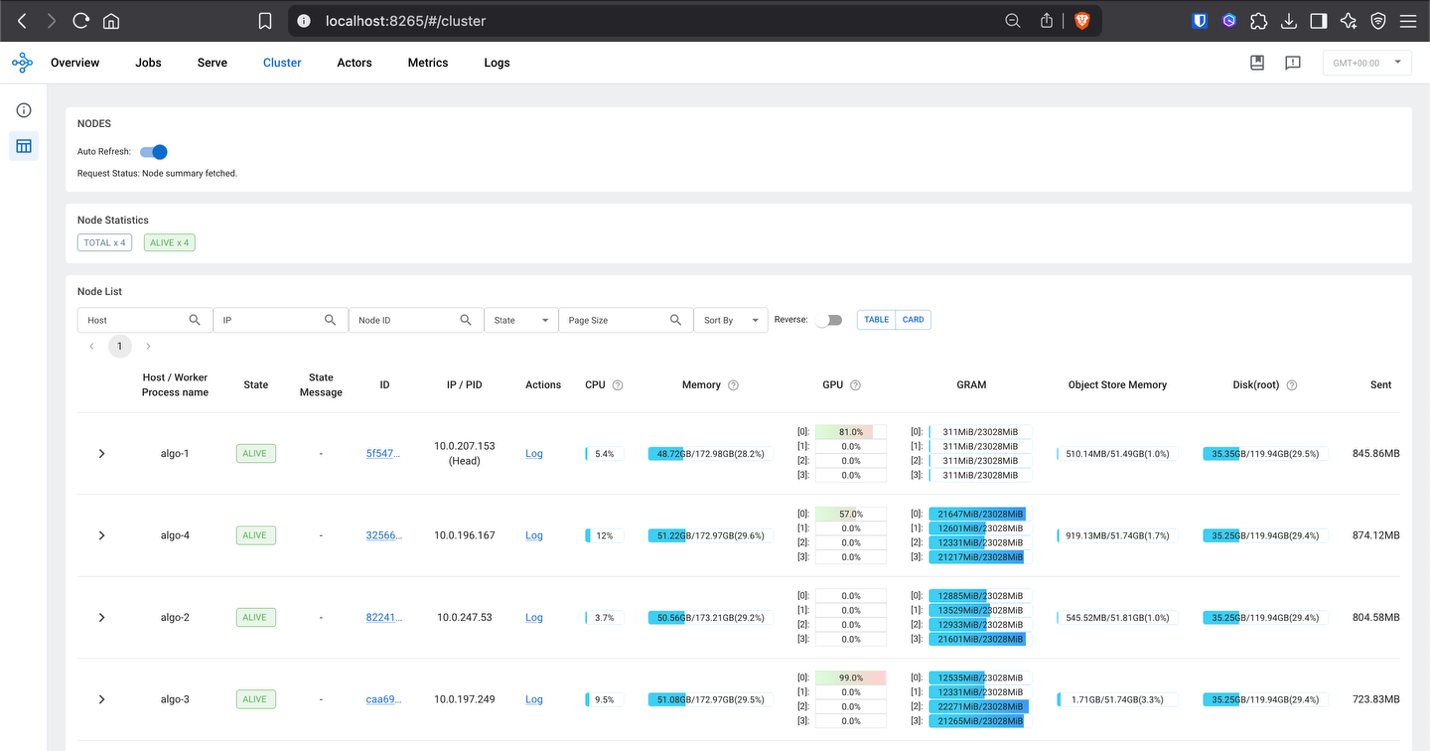
The integrated Grafana dashboards provide comprehensive visualization of the training metrics, system performance, and cluster health in real-time:
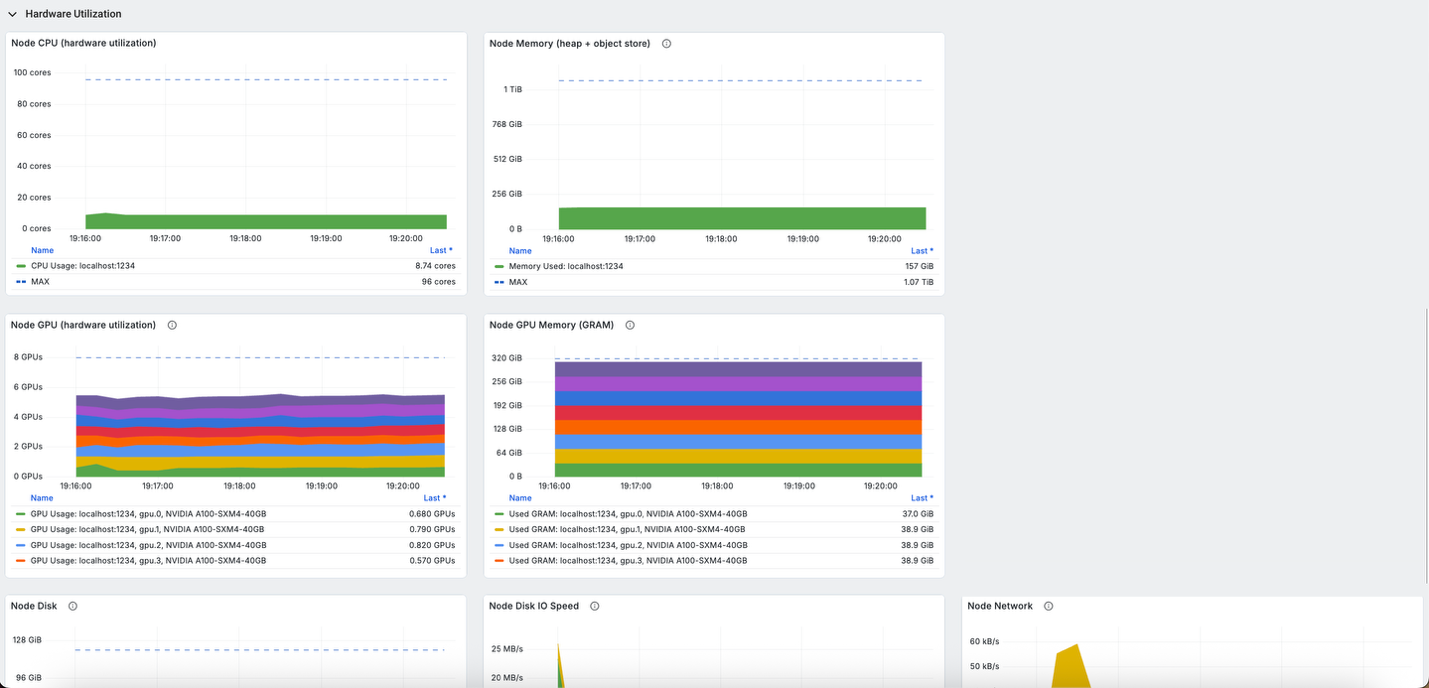
This observability setup is crucial for debugging distributed RL training issues, optimizing resource allocation, and making sure the training process progresses efficiently across the multi-node SageMaker cluster.

Clean up

To clean up your resources and avoid ongoing charges, follow these steps:

  1. Delete unused SageMaker Studio resources
  2. (Optional) Delete the SageMaker Studio domain
  3. On the SageMaker console, choose Training in the navigation pane and verify that your training job isn’t running anymore.

Conclusions

This post demonstrates how to train specialized reasoning models for competitive programming using the Ray on Amazon SageMaker Training jobs solution combined with veRL’s reinforcement learning framework.

The Ray on SageMaker training jobs solution simplifies the complexity of orchestrating distributed RL workloads by automatically handling Ray cluster initialization, multi-node coordination, and resource management across heterogeneous compute environments. This integration enables organizations to use Ray’s advanced distributed computing capabilities—including support for complex multi-component architectures, dynamic resource allocation, and fault-tolerant execution—while benefiting from SageMaker’s fully managed infrastructure, enterprise-grade security, and pay-as-you-go pricing model.

The detailed metrics analysis demonstrated how to monitor training health through reward progression, policy stability indicators, and generalization performance, enabling practitioners to identify optimal training configurations and troubleshoot distributed training issues effectively.

To begin implementing distributed RL training with Ray on SageMaker, visit the Ray on Amazon SageMaker Training jobs GitHub repository for the foundational solution framework. The complete CodeFu-7B training implementation, including veRL integration and configuration examples, is available at this GitHub repository.

About the authors

Bruno Pistone

Bruno Pistone is a Senior Worldwide Generative AI/ML Specialist Solutions Architect at AWS based in Milan, Italy. He works with AWS product teams and large customers to help them fully understand their technical needs and design AI and machine learning solutions that take full advantage of the AWS cloud and Amazon ML stack. His expertise includes distributed training and inference workloads, model customization, generative AI, and end-to-end ML. He enjoys spending time with friends, exploring new places, and traveling to new destinations.

Giuseppe Angelo Porcelli

Giuseppe Angelo Porcelli is a Principal Machine Learning Specialist Solutions Architect for Amazon Web Services. With several years of software engineering and an ML background, he works with customers of any size to understand their business and technical needs and design AI and ML solutions that make the best use of the AWS Cloud and the Amazon Machine Learning stack. He has worked on projects in different domains, including MLOps, computer vision, and NLP, involving a broad set of AWS services. In his free time, Giuseppe enjoys playing football.

Yin Song

Yin Song is a Senior Applied Scientist at the AWS Prototyping team in Sydney, Australia, with over five years of experience helping customers build tailored prototypes that demonstrate complex AWS service use cases. His work focuses on research in AI model fine-tuning and serving, enabling impactful end-to-end AI solutions. A passionate advocate for open source, Yin leads generative AI initiatives that have produced widely-adopted models.

Chen Wu

Chen Wu is a Principal Applied Scientist at the AWS Prototyping team, where he drives both applied research and high-impact customer engagements. He specializes in long-context language models, reasoning LLMs, agentic systems, and high-performance AI systems. Chen leads development of the Agent Training Kit, an open source framework for continual learning agents. He has delivered strategic engagements across genomic foundation models, LLM optimization, multi-scale image generation, and 3D/4D volumetric AI pipelines. His open LLMs on Hugging Face have achieved over 1 million downloads, and his long-context research has appeared in NeurIPS 2024 and ACL 2025. He is an ACM Gordon Bell Prize Finalist.

.Organize the content with appropriate headings and subheadings ( h2, h3, h4, h5, h6). Include conclusion section and FAQs section with Proper questions and answers at the end. do not include the title. it must return only article i dont want any extra information or introductory text with article e.g: ” Here is rewritten article:” or “Here is the rewritten content:”

Generate single title from this title Nearly half of high school students now use AI in college search in 100 -150 characters. And it must return only title i dont want any extra information or introductory text with title e.g: ” Here is a single title:”

Write an article about

Key points:

AI is transforming the way students discover, evaluate, and choose colleges, according to a national survey of more than 5,000 high school students conducted by education company EAB.

The survey shows 46 percent of students now use AI tools such as ChatGPT during their college search, up sharply from 26 percent in spring 2025. Nearly one in five students (18 percent) removed a college from consideration based on information surfaced through AI-generated search results.

“AI has, in a matter of months, moved from the margins to the mainstream of how teenagers explore colleges,” said Madeleine Rhyneer, Vice President of Consulting Services and Dean of Enrollment Management at EAB. “AI is now shaping first impressions, helping families narrow their options, and influencing real enrollment decisions, often before a college ever has direct contact with a prospective applicant.”

While students are rapidly adopting AI for many different purposes in the college search process, many do not welcome AI-generated messages from institutions, and they are becoming adept at spotting them. More than half of students said they would react negatively to messages they perceived to be generated by AI. 

“Colleges that succeed in this new environment will use AI to improve relevance and responsiveness while preserving a clear, authentic voice that fosters ongoing student engagement and genuine relationships with actual school representatives,” Rhyneer added.

EAB’s survey also showed that AI is amplifying student anxiety about careers and the value of college itself:

  • 43 percent of students say AI will influence the career they pursue.
  • 38 percent believe AI will reduce the number of jobs requiring a college degree.
  • 39 percent say AI is pushing them to consider alternatives to college, including starting a business or entering an apprenticeship.

“Students are using AI to help them navigate some of the most fundamental questions about higher education, including whether college is worth it at all,” Rhyneer continued. “EAB is advising our partner institutions to focus messaging around tangible outcomes like skill development and career placement, while also ensuring the curricula evolve to integrate AI fluency.”

This press release originally appeared online.

eSchool Media staff cover education technology in all its aspects–from legislation and litigation, to best practices, to lessons learned and new products. First published in March of 1998 as a monthly print and digital newspaper, eSchool Media provides the news and information necessary to help K-20 decision-makers successfully use technology and innovation to transform schools and colleges and achieve their educational goals.

eSchool News StaffLatest posts by eSchool News Staff (see all)

.Organize the content with appropriate headings and subheadings ( h2, h3, h4, h5, h6). Include conclusion section and FAQs section with Proper questions and answers at the end. do not include the title. it must return only article i dont want any extra information or introductory text with article e.g: ” Here is rewritten article:” or “Here is the rewritten content:”

Engineering confidence to navigate uncertainty | MIT News

0

Flying on Mars — or any other world — is an extraordinary challenge. An autonomous spacecraft, operating millions of miles from pilots or engineers who could intervene on Earth, must be able to navigate unfamiliar and changing environments, avoid obstacles, land on uncertain terrain, and make decisions entirely on its own. Every maneuver depends on careful perception, planning, and control systems that are fault-tolerant, allowing the craft to recover if something goes wrong. A single miscalculation can leave a multi-million dollar spacecraft face-down on the surface, ending the mission before it even begins.

“This problem is in no way solved, in industry or even in research settings,” says Nicholas Roy, the Jerome C. Hunsaker Professor in the MIT Department of Aeronautics and Astronautics (AeroAstro). “You’ve got to bring together a lot of pieces of code, software, and integrate multiple pieces of hardware. Putting those together is not trivial.”

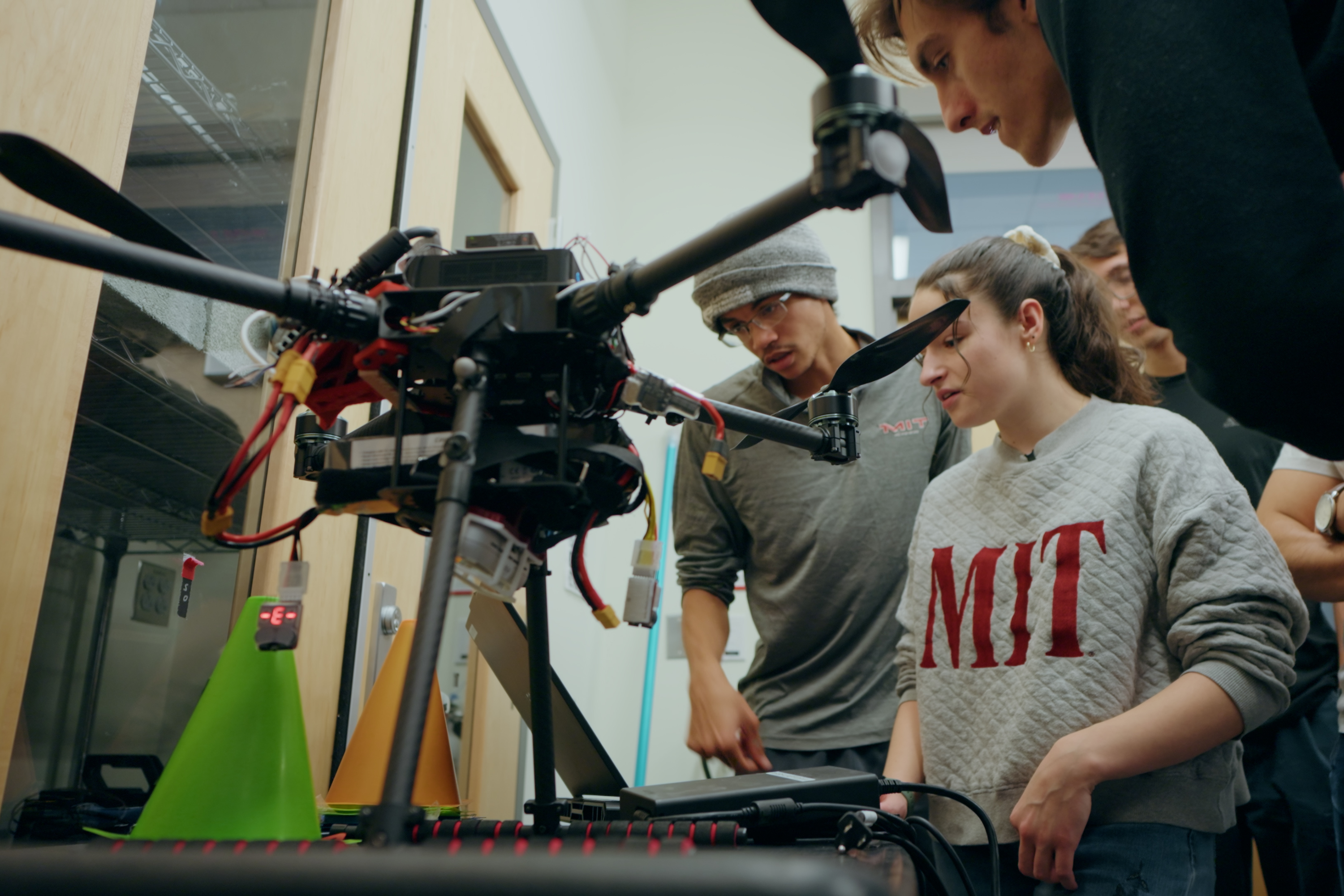
Not trivial, but for students nearing the culmination of their Course 16 undergraduate careers, far from impossible. In class 16.85 Autonomy Capstone (Design and Testing of Autonomous Vehicles), students design, implement, deploy, and test a full software architecture for flying autonomous systems. These systems have wide-ranging applications, from urban air-mobility and reusable launch vehicles to extraterrestrial exploration. With robust autonomous technology, vehicles can operate far from home while engineers watch from mission control centers not too different from the high bay in AeroAstro’s Kresa Center for Autonomous Systems.

Roy and Jonathan How, Ford Professor of Engineering, developed the new course to build on the foundations of class 16.405 (Robotics: Science and Systems), which introduces students to working with complex robotic platforms and autonomous navigation through ground vehicles with pre-built software. 16.85 applies those same principles to flight, with a basic quadrotor drone and an entirely blank slate to build their own navigation systems. The vehicles are then tested on an obstacle course featuring dubious landing pads and uncertain terrain. Students work in large teams (for this first run, two teams of seven — the SLAMdunkers and the Spelunkers) designed to mirror real-world missions where coordination across roles is essential. 

“The vehicles need to be able to differentiate between all these hidden risks that are in the mission and the environment that they’re in and still survive,” says How. “We really want the students to learn how to make a system that they have confidence in.”

Play video

Design and Testing of Autonomous Vehicles
Video: MIT AeroAstro

Mission: Figure it out, together

“The specific mission we gave them this semester is to imagine that you are an aircraft of some kind, and you’ve got to go and explore the surface of an extraterrestrial body like Mars or the moon,” Roy explains. “You need to use onboard sensors to fly around and explore, build a map, identify interesting objects, and then land safely on what is probably not a flat surface, or not a perfectly horizontal surface.”

A mission of this magnitude is far too complex for any one engineer to tackle alone, but that too poses a challenge for a large team. “The hardest problems these days are coordination problems,” says Andrew Fishberg, a graduate student in the Aerospace Controls Laboratory and one of three teaching assistants (TAs) for the course. “To use the robotics term, a team of this size is something of a heterogeneous swarm. Not everyone has the same skill set, but everyone shows up with something to contribute, and managing that together is a challenge.”

The challenge asks students to apply multiple types of “systems thinking” to the task. Relationships, interdependencies, and feedback loops are critical to their software architecture, and equally important in how students communicate and coordinate with their teammates. “Writing the reports and communicating with a team feels like overhead sometimes, but if you don’t communicate, you have a team of one,” says Fishberg. “We don’t have these ‘solo inventor’ situations where one person figures everything out anymore — it’s hundreds of people building this huge thing.”

The new faces of flight

Students in the class say they are eager to enter the rapidly evolving field, working with unconventional tools and vehicles that go beyond traditional applications.

“We continue to send rovers to extraterrestrial bodies. But there is an increasing interest in deploying unmanned systems to explore Earth,” says Roy. “There’s lots of places on Earth where we want to send robots to go and explore, places where it’s hazardous for humans to go.” That expanding set of applications is exactly what draws students to the field.

“I was really excited for the idea of a new class, especially one that was focused on autonomy, because that’s where I see my career going,” says senior Norah Miller. “This class has given me a really great experience in what it feels like to develop software from zero to a full flying mission.”

The Design and Testing of Autonomous Vehicles course offers a unique perspective for instructors and TAs who have known many of the students throughout their undergraduate careers. As a capstone, it provides an opportunity to see that growth come full circle. “A couple years ago we’re solving differential equations, and now they’re implementing software they wrote on a quadrotor in the high bay,” says How.

After weeks of learning, building, testing, refinement, and finally, flight, the results reflected the goals of the course. “It was exactly what we wanted to see happen,” says Roy. “We gave them a pretty challenging mission. We gave them hardware that should be capable of completing the mission, but not guaranteed. And the students have put in a tremendous amount of effort and have really risen to the challenge.”

Generate single title from this title Best of MWC 2026: Live updates on phones, concepts, and robots we’re seeing in 100 -150 characters. And it must return only title i dont want any extra information or introductory text with title e.g: ” Here is a single title:”

Write an article about

By Kerry Wan, Editor in Chief / Mar. 1

We’re officially on Day 2 of what I’ll call “MWC Preview Weekend,” and Honor is leading the news wave today with its AI Vision keynote. There, the company announced several new hardware products, including some fresh information on its wild Robot Phone, which debuted at CES.

The Robot Phone may be the richest embodiment of AI in a handset that we’ve seen thus far, for better or worse. It’s shaped like a traditional phone, with a slab-like design, but features a rotating camera gimbal that extends from the back of the device.

CNET: A Phone With a Robot Arm? I Got a First Glimpse at Honor’s Quirky Camera Phone

There are some creative use cases with such a feature, like body-tracking during video calls and more stabilized recording. Then, there are some more questionable use cases, like its playful nods and head shakes (and Honor says it can even dance to music), that give it more personality. Because we all want our phones to have a little more character, no?

Honor hasn’t shared a definitive release date for the Robot Phone yet, but it positions the brand well in an AI hardware space that’s constantly seeking out what’s next.

.Organize the content with appropriate headings and subheadings ( h2, h3, h4, h5, h6). Include conclusion section and FAQs section with Proper questions and answers at the end. do not include the title. it must return only article i dont want any extra information or introductory text with article e.g: ” Here is rewritten article:” or “Here is the rewritten content:”