Home Blog Page 229

Trump Administration Cuts May Threaten AI Research Efforts

0

Trump Administration Fires National Science Foundation Employees with AI Expertise, Threatening Ongoing Research

Layoffs Impact Key AI Research and Funding

The Trump Administration has fired a number of National Science Foundation (NSF) employees who were handpicked for their expertise in Artificial Intelligence (AI), putting the agency’s ability to sustain key AI research at risk. According to a report by Bloomberg, the layoffs have resulted in the postponement or cancellation of several review panels, stalling funding for some AI projects.

Department of Technology, Innovation, and Partnerships Affected

The Directorate for Technology, Innovation, and Partnerships, a department instrumental in funneling government grants focused on AI, has been significantly impacted by the layoffs. This department was responsible for reviewing and funding AI-related projects, and its shutdown will have a devastating effect on the advancement of AI research.

Criticisms from AI Experts

The Trump Administration’s recent cuts to scientific grant-making have been widely criticized by AI experts, including Nobel laureate and AI pioneer, Geoffrey Hinton. In a post on X, Hinton called for Elon Musk, the head of the Department of Government Efficiency, to be expelled from the British Royal Society due to the harm he is causing to scientific institutions in the US.

Musk’s Response

In response to Hinton’s criticism, Musk tweeted, "I will make mistakes, but endeavor to fix them." However, this response has been met with criticism from many, who argue that it is too little, too late.

Conclusion

The firings of NSF employees with AI expertise and the resulting impact on key AI research are a significant concern for the scientific community. The Trump Administration’s actions are not only damaging to the advancement of AI but also undermining the credibility of the government’s commitment to supporting scientific research.

FAQs

Q: What is the impact of the layoffs on AI research?
A: The layoffs will stall funding for some AI projects and delay the advancement of AI research.

Q: Who is responsible for the layoffs?
A: The Trump Administration is responsible for the layoffs.

Q: What is the role of the Department of Technology, Innovation, and Partnerships?
A: The department was responsible for reviewing and funding AI-related projects.

Q: What is Elon Musk’s response to the criticism?
A: Musk responded by saying, "I will make mistakes, but endeavor to fix them."

See-Through News

0

The Return of the Clear: A Look at the Revival of Transparent Gadgets

A Blast from the Past: The Evolution of Gadget Design

Gadgets, much like fashion, can make style comebacks. For tech, we’ve lived through the ’80s beige keyboards, transitioned to the ’90s with gray and black plastic video game systems, and bright colors for Sony’s Walkman and Nintendo’s Game Boy handhelds. Then, at the turn of the millennium, we welcomed the amazing see-through iMacs, N64 controllers, and other gadgets with clear casings.

The Rise of Transparent Tech

The early 2000s saw a surge in transparent gadgets, with many manufacturers incorporating clear plastic and glass into their designs. This trend was led by the likes of Apple, Nintendo, and Sony, who produced a range of innovative and stylish products. From the transparent iMac G4’s spiral design to the clear plastic shells of the original Xbox and PlayStation consoles, the early 2000s were a golden age for see-through tech.

The Decline of Clear Tech

However, by the mid-2000s, the trend began to decline. As design trends shifted towards more minimalistic and understated approaches, the use of transparent materials began to fall out of favor. Many manufacturers turned to more traditional materials, such as metal and plastic, to create their products.

The Resurgence of Clear Tech

In recent years, however, we’ve seen a resurgence in the popularity of transparent gadgets. From the current crop of see-through smartphones and smartwatches to the return of clear plastic and glass designs, it seems that the style of the early 2000s is back in vogue.

Clear Tech News

Stay up to date with the latest news and trends in clear tech. Check out our dedicated section for the latest updates, reviews, and analysis of the best transparent gadgets on the market.

FAQs

Q: What is the meaning of "clear tech"?
A: Clear tech refers to gadgets and products that feature transparent or translucent materials in their design, such as clear plastic, glass, or acrylic.

Q: Why are clear tech products making a comeback?
A: The trend towards clear tech is driven by a desire for nostalgia and a return to the innovative design of the early 2000s. Additionally, advances in manufacturing technology have made it possible to produce clear materials that are stronger and more durable than ever before.

Q: What are some popular clear tech products?
A: Some popular clear tech products include see-through smartphones, smartwatches, and gaming consoles, as well as clear plastic and glass cases for devices such as the iPhone and iPad.

People are using Super Mario to benchmark AI

0

Thought Pokémon was a tough benchmark for AI? One group of researchers argues that Super Mario Bros. is even tougher.

Hao AI Lab’s Mario Challenge

Hao AI Lab, a research organization at the University of California San Diego, recently threw AI into live Super Mario Bros. games. The results were surprising, with Anthropic’s Claude 3.7 performing the best, followed by Claude 3.5. Google’s Gemini 1.5 Pro and OpenAI’s GPT-4o struggled.

The Game

It’s worth noting that the game was not the original 1985 release, but rather a version that ran in an emulator and integrated with a framework called GamingAgent, which gave the AIs control over Mario.

GamingAgent and the AIs

GamingAgent, developed in-house by Hao, fed the AI basic instructions, such as "If an obstacle or enemy is near, move/jump left to dodge" and in-game screenshots. The AI then generated inputs in the form of Python code to control Mario.

The Challenge

The game forced each model to "learn" to plan complex maneuvers and develop gameplay strategies. Interestingly, the lab found that so-called reasoning models like OpenAI’s o1, which "think" through problems step by step to arrive at solutions, performed worse than "non-reasoning" models, despite being generally stronger on most benchmarks.

The Reasoning

The main reason reasoning models have trouble playing real-time games like this is that they take a while – seconds, usually – to decide on actions, according to the researchers. In Super Mario Bros., timing is everything. A second can mean the difference between a jump safely cleared and a plummet to the death.

An Evaluation Crisis

Games have been used to benchmark AI for decades. However, some experts have questioned the wisdom of drawing connections between AI’s gaming skills and technological advancement. Unlike the real world, games tend to be abstract and relatively simple, and they provide a theoretically infinite amount of data to train AI.

The Evaluation Crisis

As Andrej Karpathy, a research scientist and founding member at OpenAI, wrote, "I don’t really know what [AI] metrics to look at right now. TLDR my reaction is I don’t really know how good these models are right now."

Conclusion

At least we can watch AI play Mario.

Frequently Asked Questions

Q: What is the purpose of the Mario challenge?
A: To test the capabilities of AI models in real-time, complex environments.

Q: Which AI models performed well in the challenge?
A: Anthropic’s Claude 3.7 and Claude 3.5.

Q: Why did reasoning models struggle in the challenge?
A: Reasoning models take too long to decide on actions, making them less effective in real-time games.

Q: What is the evaluation crisis in AI?
A: A crisis in which experts are questioning the relevance of AI gaming benchmarks to real-world advancements.

TSMC’s $165B US Investment to Reshape Global Chip Landscape

TSMC to Invest $165 Billion in US Chip Manufacturing

TSMC to Build Multiple Chip Factories in the US

During a press conference at the White House, US President Donald Trump and Taiwan Semiconductor Manufacturing Company (TSMC), the world’s largest chip manufacturer, announced that TSMC will spend $100 billion in the US in coming years to build multiple chip factories, on top of $65 billion already committed to US investment. This combined investment of $165 billion is the "largest single foreign direct investment in US history."

Advanced Technologies and AI Chips

The spending is expected to focus on "advanced technologies," which could be taken to include chips for artificial intelligence, which has largely been done by TSMC in its Taiwan factories until now. TSMC serves just about every chip maker in the world, including producing the most powerful chips from Nvidia for AI, the Hopper and Blackwell GPU chips.

Job Creation and Economic Impact

The investment is expected to create hundreds of billions of dollars in semiconductor value for AI and other cutting-edge applications. TSMC’s expanded investment is expected to support 40,000 construction jobs over the next four years and create tens of thousands of high-paying, high-tech jobs in advanced chip manufacturing and R&D.

Existing Factory and Future Plans

TSMC already has a factory in Phoenix, Arizona, that began producing chips last year and which employs more than 3,000 people on 1,100 acres of land. The company plans to add three more US factories and an R&D center.

Impact on Intel and Other Chip Makers

TSMC’s announcement comes as chip-maker Intel, which has struggled for years with declining sales and lost market share, has been seeking customers for its own factories in the US. Two of the world’s biggest AI chip makers, Nvidia and Broadcom, are testing out Intel’s factories to manufacture their chips, according to a Reuters report. Advanced Micro Devices is also considering using Intel’s factories, although it’s unclear if the company has conducted tests.

Intel’s Manufacturing Delays and Competitors’ Plans

Intel’s deals could be impacted by continued delays in the company’s manufacturing process, which has lagged TSMC’s for years. The 18A chip manufacturing method, Intel’s most cutting-edge, recently suffered yet another six-month delay. This means that without the qualified fundamental building blocks of intellectual property that small and mid-size chip designers rely on, a swath of potential customers would be unable to produce chips on 18A until at least mid-2026.

Conclusion

TSMC’s massive investment in the US is a significant development in the global chip manufacturing industry. The company’s plans to build multiple chip factories in the US will create thousands of high-paying jobs and generate hundreds of billions of dollars in semiconductor value. The impact on Intel and other chip makers is yet to be seen, but it’s clear that TSMC is positioning itself as a leader in the global chip manufacturing industry.

FAQs

Q: What is the combined investment by TSMC in the US?
A: The combined investment is $165 billion.

Q: What is the focus of TSMC’s spending in the US?
A: The spending is expected to focus on "advanced technologies," which could include chips for artificial intelligence.

Q: How many jobs will be created by TSMC’s investment?
A: The investment is expected to support 40,000 construction jobs over the next four years and create tens of thousands of high-paying, high-tech jobs in advanced chip manufacturing and R&D.

Q: What is the current market share of TSMC in the global chip manufacturing industry?
A: TSMC is the world’s largest chip manufacturer.

A.I. Start-Up Anthropic Closes Deal That Values It at $61.5 Billion

0

Artificial Intelligence Start-up Anthropic Raises $3.5 Billion in New Funding Round

Valuation Soars to $61.5 Billion

Artificial intelligence start-up Anthropic has completed a new fund-raising deal, valuing the company at $61.5 billion, up from about $16 billion a little more than a year ago. The new round, led by venture capital firm Lightspeed Venture Partners, will pump an additional $3.5 billion into the company. Since its founding in 2021, Anthropic has raised more than $14.8 billion from venture firms like Menlo Ventures and tech giants like Amazon, Google, and Salesforce.

A.I. Industry Sees Surge in Funding Activity

The deal comes amid a surge in funding activity for the industry’s most prominent A.I. start-ups. OpenAI is set to complete a $40 billion fund-raising deal that would value the company at $300 billion, nearly double its valuation from just five months ago. Elon Musk’s xAI is in talks for a new financing round that could value it at as much as $75 billion, up from about $40 billion just two months ago, according to two people with knowledge of the discussions.

A.I. Boom and Bum

OpenAI started the A.I. boom in late 2022 with the release of ChatGPT, setting off a funding surge that moved billions into a wide range of start-ups. Enthusiasm among investors for A.I. companies cooled in 2024, as several high-profile start-ups were essentially folded into tech giants like Google and Amazon. However, as companies like OpenAI and Anthropic have continued to improve their A.I. technologies, investor interest has returned.

Company Background

Anthropic was founded by Dario Amodei and his sister, Daniela Amodei, in 2021. The company’s founders had previously worked at OpenAI, where they left due to disagreements over how the company’s technologies were being funded and released through Microsoft. Anthropic aims to build A.I. with guardrails, a concept that involves designing A.I. systems that are more transparent, accountable, and controllable.

CEO’s Views on A.I. Risks and Opportunities

In a podcast interview in 2023, Dario Amodei expressed concerns about the potential risks of A.I. technology, stating that there was a 10 to 25 percent chance that it could destroy humanity. However, in October, he published a 14,000-word essay on the potential benefits of A.I. technologies, writing that most people are underestimating the radical upside of A.I. and overestimating its risks.

Conclusion

The latest funding round is a testament to the growing interest in A.I. start-ups, with investors betting on the potential of these companies to revolutionize various industries. As A.I. technology continues to advance, it will be crucial for policymakers, investors, and companies to carefully consider the risks and opportunities presented by these technologies.

FAQs

Q: What is the current valuation of Anthropic?
A: The company is currently valued at $61.5 billion, up from about $16 billion a year ago.

Q: Who led the new funding round?
A: The new round was led by venture capital firm Lightspeed Venture Partners.

Q: What is the total amount raised by Anthropic since its founding?
A: The company has raised more than $14.8 billion from venture firms like Menlo Ventures and tech giants like Amazon, Google, and Salesforce.

Apple’s Best Product: Mac mini (M4)

0

Why you can trust Creative Bloq

Our expert reviewers spend hours testing and comparing products and services so you can choose the best for you. Find out more about how we test.

The Apple Mac mini (M4) review: A new era of compact power

The Apple Mac mini (M4) is the latest, and tiniest, addition to Apple’s computer line-up (until the reported M5 models arrive, that is), and the reason we’re excited about it not merely because many of the Creative Bloq team love the Mac mini, but rather that so many creatives all around the world have grown to appreciate and rely on Apple’s pocket rocket for their work and hobbies.

Key specifications

Attributes Notes Rating
Design: Familiar, sturdy, extremely compact, just enough ports 4.5/5
Features: Stock model well equipped with lots of configuration options 4.5/5
Performance: Blistering CPU performance with good integrated graphics 5/5
Value: Apple’s best value product, hands down 5/5

Design and build

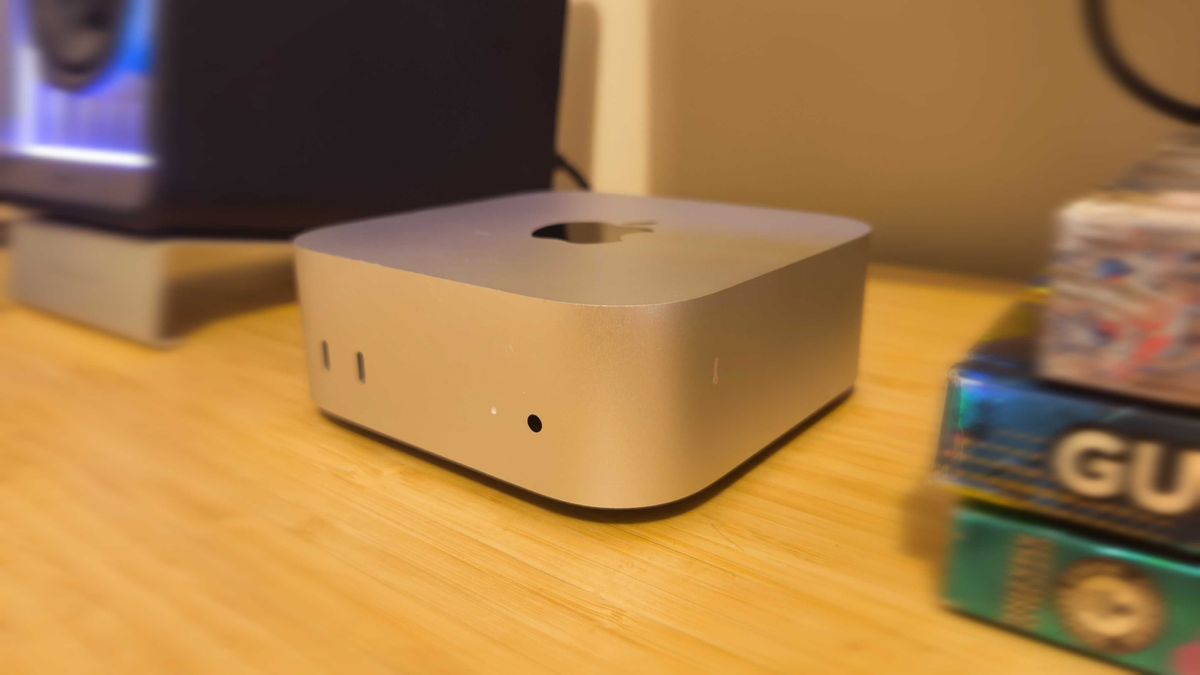
The look of the Mac mini (M4) will not be a shocker to anyone who’s seen any of the previous models. It comes in the same extremely compact form factor as before, measuring only 5 by 12.7 by 12.7 centimetres to easily slot onto any desk, however cramped or small it may be.

It’s got the same silver colour as before, with the same aluminium exterior and polycarbonate top (which Apple assures us is now made from more consumer-recycled PCB than before).

On the front are two USB-C ports and a headphone jack, while the back hosts the power socket, an HDMI port, Ethernet port and three Thunderbolt 4 ports (or Thunderbolt 5 if you’re getting the M4 Pro model).

It’s lightweight at 670 grams too (730 for the M4 Pro) and so it’s extremely portable. It’s as sturdy as ever, but there are no innovations here. It will either look and feel reassuringly sturdy and familiar, or boringly samey, depending on your tech religion. For the big changes, you’ll find those on the inside when you switch the little nugget on.

Performance

The performance of the Mac mini (M4) is where it truly shines. With its powerful CPU and good integrated graphics, it can handle demanding tasks like photo editing and video editing with ease.

Price

The Mac mini (M4) starts at a ridiculously affordable $/£599 before discounts, while the M4 Pro starts at $/£1,399 before adding configurable extras or upgrades. Of course, you can choose upgrades that put you well over $/£2,000 but I would say the $/£799 model offers the best out-of-the-box balance of value for money, and will be a desktop computer that can serve you well for several years.

Who is it for?

This is a perfect desktop computer for photo editors as well as graphic designers and video editors who won’t need cutting-edge graphics performance. Do keep in mind though, that if you use CAD or AutoCAD software that you’ve made sure it’s compatible with MacOS before pressing the order button.

Conclusion

The Apple Mac mini (M4) is an excellent choice for anyone looking for a compact and powerful desktop computer. With its impressive performance, compact design, and affordable price, it’s a great option for anyone who wants a reliable and efficient computer for their work or personal use.

Frequently Asked Questions

Q: Is the Mac mini (M4) suitable for 3D modeling?

A: No, the Mac mini (M4) is not suitable for 3D modeling. It’s best suited for general productivity, photo editing, and video editing tasks.

Q: Can I use the Mac mini (M4) with my existing screen?

A: Yes, you can use the Mac mini (M4) with your existing screen, but keep in mind that it doesn’t come with a screen included.

Q: Can I upgrade the Mac mini (M4) in the future?

A: Yes, the Mac mini (M4) is designed to be upgradeable, but you’ll need to check compatibility with your specific upgrade before making any changes.

Q: Is the Mac mini (M4) compatible with Windows?

A: No, the Mac mini (M4) is only compatible with macOS, not Windows.

Upgrade Your Voice Assistant Experience

The Delayed Rise of Apple Intelligence: When Can You Expect the AI-Improved Siri?

The launch of ChatGPT sparked a generative AI craze, igniting a tech revolution that has forced companies to rapidly innovate to stay competitive in this evolving landscape. Apple was late to the AI race, but its launch of Apple Intelligence promised a transformative overhaul, putting Siri at the center of the Apple ecosystem as a context-aware personal assistant. However, a new Bloomberg report suggests this vision may take longer to materialize than expected.

When Can You Expect the AI-Improved Siri?

In his latest Power On newsletter, Bloomberg correspondent and Apple watcher Mark Gurman reports that people within Apple’s AI division believe that the fully upgraded, conversational version of Siri won’t reach consumers until iOS 20 – which would place the release at around 2027.

The Disappointment So Far

When Apple originally showed off the concept at WWDC last June, it was marketed as a personal assistant that seamlessly integrates into a user’s existing device ecosystem to provide meaningful behind-the-scenes help. Additionally, it would finally make Siri more conversational, enabling more human-like conversation, a highly requested upgrade. However, since then, the company has rolled out only a handful of Apple Intelligence features, most of which have low helpfulness value.

Two Workarounds

Before Amazon’s Alexa+ launch, Google and ChatGPT each unveiled their own AI-powered conversational assistants, Gemini Live and Advanced Voice Mode. These assistants understand your prompts in natural language, meaning you can speak to the AI as you would a friend. They also have multi-turn conversations, so you can keep the conversation going as long as you’d like without losing prior context.

ChatGPT Advanced Voice

ChatGPT’s counterpart, Advanced Voice Mode, even has on-screen and camera awareness, making its assistance multimodal and adding an extra layer of support. As an iPhone user, you can easily access the assistant from the ChatGPT app, or if you want even more seamless access, you can even map it to your phone’s Action Button to summon ChatGPT.

Gemini

If you prefer to use the Google Gemini conversational assistant, you can download the Gemini app for your iPhone for free and start chatting. Activating this feature is as simple as downloading the app, signing into your Google account, and clicking the waveform icon in the bottom right-hand corner. It won’t have screen awareness yet; however, the feature will be rolling out later this month to paid Gemini Advanced users.

Conclusion

The delayed release of Apple Intelligence has given users no choice but to look for alternative solutions. With the launch of ChatGPT and Gemini, users now have access to more conversational AI assistants on their iPhones. While we wait for Apple’s promised upgrade, it’s clear that there are already viable alternatives available.

FAQs

Q: When can I expect the AI-Improved Siri?
A: According to a new Bloomberg report, it may take until iOS 20, which would place the release at around 2027.

Q: What are the alternatives to Siri?
A: ChatGPT and Gemini Live are two AI-powered conversational assistants that can be used on iPhones, offering more human-like conversations and multi-turn conversations.

Q: Are there any limitations to these alternatives?
A: Yes, the limits vary depending on your plan. OpenAI doesn’t specify the limits, but paid subscribers get more access. Google Gemini Advanced users will also have access to the feature later this month.

The author of SB 1047 introduces a new AI bill in California

0

California’s New AI Bill: A Shift in Focus from Risk to Progress

Background: The Controversial SB 1047

California state Senator Scott Wiener’s previous AI safety bill, SB 1047, was met with intense debate in 2024. The bill aimed to prevent catastrophic events caused by very large AI models, but Governor Gavin Newsom ultimately vetoed it. The controversy surrounding SB 1047 was marked by claims that it would hurt the competitive edge of American AI and accusations of a "propaganda campaign" against the bill.

Introducing SB 53: A New Approach to AI Safety

Senator Wiener has introduced a new bill, SB 53, which takes a different approach to addressing AI safety. The bill focuses on protecting employees who believe their employer’s AI systems pose a "critical risk" to society. It also establishes a public cloud computing cluster, CalCompute, to support researchers and startups in developing AI that benefits the public.

Whistleblower Protections and CalCompute

SB 53 provides whistleblower protections for employees who believe their employer’s AI systems could cause harm. These employees can report their concerns to California’s Attorney General, federal authorities, or other employees without fear of retaliation. The bill also establishes a public cloud computing cluster, CalCompute, which will consist of representatives from the University of California and other public and private researchers. CalCompute will make recommendations on building the cluster, determining its size, and which users and organizations should have access to it.

A Shift in Focus: From Risk to Progress

SB 53 marks a shift in focus from the existential risks posed by AI to the potential benefits it can bring. By establishing CalCompute, the bill aims to promote the development of AI that benefits the public. The bill’s emphasis on whistleblower protections and employee safety reflects a more nuanced approach to AI safety.

The Future of AI Legislation

It remains to be seen how SB 53 will fare in the legislative process. The bill needs to be reviewed and passed by California’s legislative bodies before reaching Governor Newsom’s desk. The landscape for AI legislation has changed since 2024, with Vice President J.D. Vance signaling that the US prioritizes AI innovation over safety. Only time will tell if SB 53 will be successful in addressing the concerns surrounding AI safety.

Frequently Asked Questions

Q: What is the purpose of SB 53?
A: SB 53 aims to protect employees who believe their employer’s AI systems pose a "critical risk" to society and establish a public cloud computing cluster, CalCompute, to support the development of AI that benefits the public.

Q: How does SB 53 differ from SB 1047?
A: SB 53 takes a more nuanced approach to AI safety, focusing on whistleblower protections and employee safety, whereas SB 1047 aimed to prevent catastrophic events caused by very large AI models.

Q: What is CalCompute?
A: CalCompute is a public cloud computing cluster established by SB 53, which will consist of representatives from the University of California and other public and private researchers. It will make recommendations on building the cluster, determining its size, and which users and organizations should have access to it.

Q: What is the current landscape for AI legislation?
A: The landscape for AI legislation has changed since 2024, with Vice President J.D. Vance signaling that the US prioritizes AI innovation over safety. It remains to be seen how SB 53 will fare in the legislative process.

Playing Golf with Purpose

The Allure of Golf: A Game for Everyone

Golf is often viewed as only a recreational activity, yet for millions around the globe, it holds a deeper significance that transcends the fairway. The enthusiasm behind the sport draws a distinct allure, capturing the hearts of people from amateurs to seasoned pros. With its deep history and everlasting appeal, golf is not merely a game but a lifelong love affair that cultivates relationships, teaches valuable life lessons, and provides a perfect escape from the daily hustle and bustle.

The Game of Golf: A Journey of Passion and Improvement

Golf is a game that embodies a lifelong journey of passion and improvement. For many, the thrill of mastering a new technique or perfecting a swing can be more satisfying than merely winning a game. The review of excellence keeps players engaged for years, as they celebrate the small victories that come with dedication and practice. Each round on the course presents an opportunity to learn and grow, encouraging golfers to embrace the challenges that arise with every stroke.

Society and Relationships: The Community Attraction of Golf

Golf is not only a series of swings and strokes; it is a dynamic community environment that connects people together. Whether on the fairway or in the lounge, golfers share a love that fosters bonds across different backgrounds. This special environment allows participants to bond over a shared love of the game, making it an ideal venue for connecting and building friendships. The informal atmosphere encourages conversation, making it easy for newcomers to feel welcomed and included in the community.

Involvement in Charitable Golf Events

Involvement in charitable golf events is a perfect example of how the sport builds lasting connections while contributing to the community. Golf outings collect funds for important causes, empowering players to make a difference to something meaningful. These events usually attract players from varied walks of life, bringing together those around a common goal. This common objective not only enhances the drive to compete but also strengthens relationships, as participants enjoy the excitement of competition alongside the common goal of supporting community initiatives.

Conclusion

Golf is a game that has the power to unite people, foster relationships, and provide a lifelong journey of passion and improvement. From casual rounds with friends to competitive tournaments, the connections formed on the greens enhance the overall experience. Whether it’s a game of skill, a test of strategy, or a chance to connect with others, golf offers something for everyone. As a community-driven sport, golf has the ability to transcend generations, cultures, and abilities, making it a beloved pastime for years to come.

FAQs

Q: What is the appeal of golf?

A: Golf’s appeal lies in its ability to connect people together, providing a sense of community, and fostering lifelong relationships.

Q: What are the benefits of playing golf?

A: Golf offers a range of benefits, including improved physical and mental health, social connections, and personal growth.

Q: How can I get involved in charitable golf events?

A: Look for local golf outings and tournaments that support important causes, or consider organizing your own charitable golf event to make a difference in your community.

Q: What is the best way to learn golf?

A: The best way to learn golf is through practice, patience, and dedication. Consider taking lessons from a professional instructor or joining a golf course with teaching programs.

Q: Can anyone play golf?

A: Yes, golf is a game for everyone, regardless of age, ability, or background. It is a sport that can be enjoyed by people from all walks of life.

Q: What is the most important aspect of golf?

A: The most important aspect of golf is the social connections and relationships formed on and off the course. It is a game that brings people together and fosters a sense of community.

Sustainable Business Practices

The Intersection of Artificial Intelligence and Sustainability

The intersection of artificial intelligence and sustainability is transforming industries globally. As the pressures to solve environmental issues escalate, AI is proving to be a key enabler for woke businesses. It isn’t just a matter of technological advancement but utilizing the power of AI to make the best use of resources, cut down on waste, and revolutionize energy efficiency for a more green future.

How AI Enhances Sustainability Across Industries

Energy Efficiency & Carbon Footprint Reduction

AI for environmental sustainability is revolutionizing how organizations manage energy consumption and carbon footprints. Companies can use advanced technologies such as machine learning and predictive analytics to improve their energy consumption, waste, and carbon emissions. Cutting-edge organizations, such as Google, have harnessed AI to optimize the performance of their data centers, cutting energy consumption for cooling by as much as 40%.

Sustainable Supply Chains

Reducing the environmental footprint of the supply chain has become a key priority for many companies focusing on sustainability. AI allows for the optimization of supply chain logistics, inventory management, and waste reduction. Enterprises like DHL and Amazon have deployed AI analytics systems to plan routes that conserve energy and generate lower emissions.

Waste Management & Circular Economy

AI is key to developing the circular economy. It enables companies to use waste more effectively, recycle materials more efficiently, and decrease resource consumption. For example, Microsoft has deployed AI to identify patterns of waste generation and improve recycling methods, contributing to waste reduction throughout its operations.

Emerging Trends in AI and Sustainability

Trend Description
Green AI Minimizing the environmental footprint of AI by optimizing training processes, reducing energy consumption, and utilizing more sustainable hardware.
AI for Biodiversity Conservation Transforming conservation efforts by enabling more effective monitoring of ecosystems.
AI in Carbon Capture and Storage (CCS) Enhancing carbon capture processes, such as prediction of CO2 absorption rates, improvement of storage site selection, etc.
AI-Driven Circular Economy Platforms Making resource-sharing, recycling, and layout optimization fluid and simple.
AI for Sustainable Urban Development Driving smart cities, streamlining energy consumption, and cutting carbon emissions.

Takeaways

AI in sustainability allows organizations to optimize energy efficiency, reduce waste, and enable smarter resource management. From streamlining supply chains to advancing climate prediction and fostering circular economies, AI empowers businesses to align profitability with environmental responsibility. As AI technology evolves, its potential to drive sustainability will only grow, making it a critical tool for businesses striving to create a greener, more resilient future. By embracing AI-driven sustainability initiatives, organizations can not only meet global environmental goals but also gain a competitive edge in an increasingly eco-conscious market.

FAQs

Q: How does AI enhance sustainability?
A: AI optimizes energy consumption, reduces waste, and enables smarter resource management.

Q: What are some emerging trends in AI and sustainability?
A: Green AI, AI for biodiversity conservation, AI in carbon capture and storage, AI-driven circular economy platforms, and AI for sustainable urban development.

Q: How can businesses make their operations more sustainable with AI?
A: By leveraging AI to optimize energy efficiency, reduce waste, and enable smarter resource management.