Home Blog Page 24

Generate single title from this title How Will Artificial Intelligence Impact the Way We Teach? in 100 -150 characters. And it must return only title i dont want any extra information or introductory text with title e.g: ” Here is a single title:”

Write an article about

Key points:

Artificial intelligence is poised to revolutionize the way we teach, introducing transformative changes that will redefine pedagogical approaches. From personalized learning experiences to streamlined administrative tasks, AI in education is reshaping the traditional landscape.

This paradigm shift not only enhances teaching effectiveness but also empowers educators with data-driven insights and innovative tools. As AI becomes more integrated into education, it challenges traditional teaching methodologies, paving the way for a future where teaching is dynamic, adaptive, and personalized. Let’s explore how AI is set to impact the very essence of how we educate and prepare students for the challenges of the digital age.

How will artificial intelligence impact the way we teach?

AI can revolutionize teaching in K-12 education by introducing a paradigm shift in pedagogical practices. The impact of artificial intelligence in education is wide-ranging. Personalized learning experiences, driven by AI algorithms, will cater to individual student needs, adapting content to diverse learning styles. Intelligent tutoring systems will provide real-time feedback, enabling educators to tailor interventions based on student performance. AI’s ability to automate administrative tasks, such as grading, will free up teachers to focus on interactive and creative teaching methods, fostering a more engaging learning environment. Moreover, AI-driven analytics will offer data-driven insights into teaching strategies, enabling educators to refine their methods and optimize student learning outcomes.

As technology continues to advance, the role of teachers in K-12 education will evolve into that of facilitators, guiding personalized learning journeys and leveraging AI as a collaborative tool. Embracing AI’s transformative potential in education promises to create a dynamic and effective teaching environment that prepares students for the challenges of an increasingly digital and interconnected world.

How will AI affect the way I learn?

The future of AI in education will have a profound impact on the way K-12 students learn, ushering in a new era of personalized, dynamic, and interactive education. AI’s impact on learning is bold, offering tailored educational experiences that cater to individual student needs. Adaptive learning platforms, powered by AI algorithms, will analyze student data to customize content, ensuring a more engaging and effective learning journey. Intelligent tutoring systems will provide real-time feedback, assisting students in mastering concepts at their own pace. Gamified learning experiences driven by AI will make education more interactive, fostering critical thinking and problem-solving skills.

Furthermore, AI’s ability to automate routine administrative tasks, such as grading, will allow educators to focus more on personalized support and interactive teaching methods. The shift towards online education, facilitated by AI, will provide students with greater flexibility and accessibility to learning resources beyond traditional classrooms.

In essence, AI will empower K-12 students with a more individualized, adaptive, and inclusive learning experience, preparing them for the challenges of the future and nurturing a lifelong love for learning. As technology continues to evolve, AI’s positive impact on education promises to create a transformative and student-centric approach to learning.

How can AI make teaching easier and more impactful?

The impact of artificial intelligence on education holds the potential to significantly ease the challenges faced by K-12 educators, making teaching more efficient and impactful. AI can automate time-consuming administrative tasks like grading and lesson planning, allowing teachers to allocate more time to interactive and personalized teaching methods. Intelligent tutoring systems powered by AI offer real-time feedback, enabling educators to tailor interventions to individual student needs, ensuring a more impactful learning experience.

Additionally, AI’s data-driven analytics provide valuable insights into student performance and learning patterns. This information empowers teachers to refine their teaching strategies, adapting to the evolving needs of their students. Personalized learning experiences, facilitated by AI algorithms, address diverse learning styles, fostering a deeper understanding of subjects.

Overall, AI streamlines administrative burdens, offers personalized support, and enhances data-driven decision-making, making K-12 teaching more efficient and impactful. Embracing AI as a collaborative tool can empower educators to create dynamic, engaging, and personalized learning environments that optimize student outcomes.

How does AI help teachers?

AI education tools offer invaluable assistance to K-12 teachers, enhancing various aspects of their roles and responsibilities. One key benefit is the automation of administrative tasks, such as grading and lesson planning. AI-driven systems can efficiently handle routine and time-consuming activities, freeing up teachers to focus on more interactive and personalized teaching methods.

Intelligent tutoring systems, powered by AI, provide real-time feedback to students, allowing teachers to identify learning gaps and customize interventions promptly. AI’s adaptive learning platforms analyze individual student data, tailoring educational content to diverse learning styles, ensuring a more engaging and effective learning experience.

Moreover, AI offers data-driven insights into student performance and learning patterns. This information enables teachers to make informed decisions about their teaching strategies, refining approaches to cater to the specific needs of their students.

Overall, AI serves as a valuable ally, streamlining administrative tasks, providing personalized learning experiences, and offering data-driven insights. By leveraging AI tools, K-12 teachers can create more dynamic and impactful learning environments, ultimately contributing to improved student outcomes.

Conclusion

Educators should strive to embrace the transformative impact of AI on K-12 teaching. Educators, policymakers, and stakeholders should join forces to integrate AI responsibly. Prioritize professional development, advocate for equitable access, and unlock the potential for personalized and impactful learning experiences. This type of collaborative action can shape a future-ready education landscape.

Latest posts by eSchool News (see all)

.Organize the content with appropriate headings and subheadings ( h2, h3, h4, h5, h6). Include conclusion section and FAQs section with Proper questions and answers at the end. do not include the title. it must return only article i dont want any extra information or introductory text with article e.g: ” Here is rewritten article:” or “Here is the rewritten content:”

Generate single title from this title What is the Conclusion of Artificial Intelligence in Education? in 100 -150 characters. And it must return only title i dont want any extra information or introductory text with title e.g: ” Here is a single title:”

Write an article about

Key points:

When we think about AI in education, we think about how AI is offering innovative tools and solutions. From personalized learning experiences to automated grading systems, AI is reshaping traditional educational approaches. This transformative technology holds the potential to enhance student engagement, adapt to individual needs, and pave the way for a more inclusive and effective educational landscape.

What is the end goal of artificial intelligence?

The end goal of artificial intelligence is to create systems and machines that can perform tasks that typically require human intelligence. This encompasses a broad range of capabilities, from basic tasks like recognizing patterns and solving problems to more complex activities such as understanding natural language, AI education tools, learning from experience, and exhibiting creativity. The ultimate aim is to develop AI systems that can surpass human capabilities in various domains.

One key aspect of the end goal is achieving artificial general intelligence (AGI), where machines possess the ability to understand, learn, and apply knowledge across diverse tasks, similar to the versatility of human intelligence. AGI implies a level of adaptability and autonomy that goes beyond the narrow, specialized applications of current AI systems.

Another crucial aspect is ensuring that AI systems align with human values, ethics, and societal norms. Striking a balance between innovation and ethical considerations is essential to prevent unintended consequences and ensure that AI technologies contribute positively to humanity.

Ultimately, the end goal of AI is to enhance human lives, improve efficiency, and address complex challenges across various fields, ranging from healthcare and education to business and environmental sustainability. Achieving this goal requires ongoing research, responsible development, and ethical deployment of AI technologies.

What is the role of artificial intelligence in the future of education?

The future of AI in education is decidedly transformative, redefining traditional teaching and learning methods.

Automated grading and assessment powered by AI streamline administrative tasks for educators, allowing them to focus on more interactive and impactful aspects of teaching. Furthermore, AI facilitates data analysis to identify patterns in student performance, enabling educators to make data-driven decisions for curriculum improvement and intervention strategies.

In the future, AI is likely to enhance the accessibility of education by providing tools for remote learning, addressing global challenges like limited resources and geographical barriers. Language processing capabilities of AI can aid in language learning, while virtual reality and augmented reality technologies may create immersive educational experiences.

However, the integration of AI in education also raises ethical considerations and the need for responsible AI use. Striking a balance between technological innovation and preserving the human touch in education is crucial. The future of education with AI holds the promise of a more adaptive, inclusive, and efficient learning environment, where educators and technology collaborate to empower students with the skills needed for an increasingly complex world.

What are the advantages and disadvantages of artificial intelligence in education?

There’s no shortage of pros and cons of AI in education. AI in education offers several advantages. It can automate administrative tasks, reducing the burden on educators and allowing them to focus on teaching. AI-powered analytics enable institutions to gain insights into student performance and tailor curricula accordingly. Moreover, AI facilitates the creation of adaptive learning resources, adjusting to diverse learning styles.

However, challenges accompany these advantages. One concern is the potential loss of human interaction in the learning process, as AI may not fully replace the nuanced dynamics of teacher-student relationships. Ethical considerations arise, such as data privacy concerns and algorithmic biases influencing educational decisions. Additionally, the cost of implementing and maintaining AI systems can be a barrier for some institutions. Striking a balance between harnessing the benefits of AI and preserving the human element in education is crucial to ensure a well-rounded and ethical learning environment.

How is AI useful in education?

The role of AI in education, particularly K-12 education, offers unique advantages beyond personalized learning, tutoring, or automation. AI can enhance classroom engagement by creating interactive and dynamic content, making learning more enjoyable and effective. Intelligent content creation tools can adapt to diverse teaching styles, aiding educators in designing engaging lessons that cater to students with varied learning preferences.

Furthermore, AI-driven analytics can provide valuable insights into student progress and learning patterns, helping teachers identify areas of improvement and implement targeted interventions. In addition, AI can facilitate the development of adaptive assessments that go beyond standardized testing, providing a more holistic evaluation of students’ abilities and skills.

Moreover, AI-powered educational games and simulations can offer immersive and experiential learning, making complex subjects more accessible and fostering a deeper understanding of concepts. Integrating AI in K-12 education goes beyond automation, offering tools that enhance teaching methodologies and contribute to a more dynamic and effective learning environment.

Conclusion

AI’s future in K-12 education holds immense promise, offering dynamic tools to enhance engagement, assess learning in innovative ways, and create personalized, immersive learning experiences. Striking a balance between technological integration and preserving the human touch is essential for fostering a holistic and effective educational landscape.

Latest posts by eSchool News (see all)

.Organize the content with appropriate headings and subheadings ( h2, h3, h4, h5, h6). Include conclusion section and FAQs section with Proper questions and answers at the end. do not include the title. it must return only article i dont want any extra information or introductory text with article e.g: ” Here is rewritten article:” or “Here is the rewritten content:”

Generate single title from this title How separating logic and search boosts AI agent scalability in 100 -150 characters. And it must return only title i dont want any extra information or introductory text with title e.g: ” Here is a single title:”

Write an article about

Separating logic from inference improves AI agent scalability by decoupling core workflows from execution strategies.

The transition from generative AI prototypes to production-grade agents introduces a specific engineering hurdle: reliability. LLMs are stochastic by nature. A prompt that works once may fail on the second attempt. To mitigate this, development teams often wrap core business logic in complex error-handling loops, retries, and branching paths.

This approach creates a maintenance problem. The code defining what an agent should do becomes inextricably mixed with the code defining how to handle the model’s unpredictability. A new framework proposed by researchers from Asari AI, MIT CSAIL, and Caltech suggests a different architectural standard is required to scale agentic workflows in the enterprise.

The research introduces a programming model called Probabilistic Angelic Nondeterminism (PAN) and a Python implementation named ENCOMPASS. This method allows developers to write the “happy path” of an agent’s workflow while relegating inference-time strategies (e.g. beam search or backtracking) to a separate runtime engine. This separation of concerns offers a potential route to reduce technical debt while improving the performance of automated tasks.

The entanglement problem in agent design

Current approaches to agent programming often conflate two distinct design aspects. The first is the core workflow logic, or the sequence of steps required to complete a business task. The second is the inference-time strategy, which dictates how the system navigates uncertainty, such as generating multiple drafts or verifying outputs against a rubric.

When these are combined, the resulting codebase becomes brittle. Implementing a strategy like “best-of-N” sampling requires wrapping the entire agent function in a loop. Moving to a more complex strategy, such as tree search or refinement, typically requires a complete structural rewrite of the agent’s code.

The researchers argue that this entanglement limits experimentation. If a development team wants to switch from simple sampling to a beam search strategy to improve accuracy, they often must re-engineer the application’s control flow. This high cost of experimentation means teams frequently settle for suboptimal reliability strategies to avoid engineering overhead.

Decoupling logic from search to boost AI agent scalability

The ENCOMPASS framework addresses this by allowing programmers to mark “locations of unreliability” within their code using a primitive called branchpoint().

These markers indicate where an LLM call occurs and where execution might diverge. The developer writes the code as if the operation will succeed. At runtime, the framework interprets these branch points to construct a search tree of possible execution paths.

This architecture enables what the authors term “program-in-control” agents. Unlike “LLM-in-control” systems, where the model decides the entire sequence of operations, program-in-control agents operate within a workflow defined by code. The LLM is invoked only to perform specific subtasks. This structure is generally preferred in enterprise environments for its higher predictability and auditability compared to fully autonomous agents.

By treating inference strategies as a search over execution paths, the framework allows developers to apply different algorithms – such as depth-first search, beam search, or Monte Carlo tree search – without altering the underlying business logic.

Impact on legacy migration and code translation

The utility of this approach is evident in complex workflows such as legacy code migration. The researchers applied the framework to a Java-to-Python translation agent. The workflow involved translating a repository file-by-file, generating inputs, and validating the output through execution.

In a standard Python implementation, adding search logic to this workflow required defining a state machine. This process obscured the business logic and made the code difficult to read or lint. Implementing beam search required the programmer to break the workflow into individual steps and explicitly manage state across a dictionary of variables.

Using the proposed framework to boost AI agent scalability, the team implemented the same search strategies by inserting branchpoint() statements before LLM calls. The core logic remained linear and readable. The study found that applying beam search at both the file and method level outperformed simpler sampling strategies.

The data indicates that separating these concerns allows for better scaling laws. Performance improved linearly with the logarithm of the inference cost. The most effective strategy found – fine-grained beam search – was also the one that would have been most complex to implement using traditional coding methods.

Cost efficiency and performance scaling

Controlling the cost of inference is a primary concern for data officers managing P&L for AI projects. The research demonstrates that sophisticated search algorithms can yield better results at a lower cost compared to simply increasing the number of feedback loops.

In a case study involving the “Reflexion” agent pattern (where an LLM critiques its own output) the researchers compared scaling the number of refinement loops against using a best-first search algorithm. The search-based approach achieved comparable performance to the standard refinement method but at a reduced cost per task.

This finding suggests that the choice of inference strategy is a factor for cost optimisation. By externalising this strategy, teams can tune the balance between compute budget and required accuracy without rewriting the application. A low-stakes internal tool might use a cheap and greedy search strategy, while a customer-facing application could use a more expensive and exhaustive search, all running on the same codebase.

Adopting this architecture requires a change in how development teams view agent construction. The framework is designed to work in conjunction with existing libraries such as LangChain, rather than replacing them. It sits at a different layer of the stack, managing control flow rather than prompt engineering or tool interfaces.

However, the approach is not without engineering challenges. The framework reduces the code required to implement search, but it does not automate the design of the agent itself. Engineers must still identify the correct locations for branch points and define verifiable success metrics.

The effectiveness of any search capability relies on the system’s ability to score a specific path. In the code translation example, the system could run unit tests to verify correctness. In more subjective domains, such as summarisation or creative generation, defining a reliable scoring function remains a bottleneck.

Furthermore, the model relies on the ability to copy the program’s state at branching points. While the framework handles variable scoping and memory management, developers must ensure that external side effects – such as database writes or API calls – are managed correctly to prevent duplicate actions during the search process.

Implications for AI agent scalability

The change represented by PAN and ENCOMPASS aligns with broader software engineering principles of modularity. As agentic workflows become core to operations, maintaining them will require the same rigour applied to traditional software.

Hard-coding probabilistic logic into business applications creates technical debt. It makes systems difficult to test, difficult to audit, and difficult to upgrade. Decoupling the inference strategy from the workflow logic allows for independent optimisation of both.

This separation also facilitates better governance. If a specific search strategy yields hallucinations or errors, it can be adjusted globally without assessing every individual agent’s codebase. It simplifies the versioning of AI behaviours, a requirement for regulated industries where the “how” of a decision is as important as the outcome.

The research indicates that as inference-time compute scales, the complexity of managing execution paths will increase. Enterprise architectures that isolate this complexity will likely prove more durable than those that permit it to permeate the application layer.

See also: Intuit, Uber, and State Farm trial AI agents inside enterprise workflows

Want to learn more about AI and big data from industry leaders? Check out AI & Big Data Expo taking place in Amsterdam, California, and London. The comprehensive event is part of TechEx and is co-located with other leading technology events including the Cyber Security & Cloud Expo. Click here for more information.

AI News is powered by TechForge Media. Explore other upcoming enterprise technology events and webinars here.

.Organize the content with appropriate headings and subheadings ( h2, h3, h4, h5, h6). Include conclusion section and FAQs section with Proper questions and answers at the end. do not include the title. it must return only article i dont want any extra information or introductory text with article e.g: ” Here is rewritten article:” or “Here is the rewritten content:”

Generate single title from this title What are the Benefits and Risks of Artificial Intelligence in Education? in 100 -150 characters. And it must return only title i dont want any extra information or introductory text with title e.g: ” Here is a single title:”

Write an article about

Key points:

The integration of AI in education brings both benefits and risks. While AI enhances engagement, personalizes learning, and provides valuable insights, concerns arise regarding data privacy, ethical considerations, and the potential impact on human interaction in the educational process. Striking a balance is crucial for its effective implementation.

What are the benefits of artificial intelligence in the education sector?

As we examine the benefits of artificial intelligence in education, we must acknowledge that AI brings multifaceted benefits to the education sector beyond personalized learning, automation, or tutoring. AI facilitates efficient administrative tasks, reducing the burden on educators by handling routine processes such as scheduling, grading, and resource management. It enables the development of intelligent content creation tools, revolutionizing how educational materials are generated, curated, and adapted to diverse teaching methodologies.

Moreover, AI’s data analytics capabilities provide educators and administrators with valuable insights into overall institutional performance, enabling evidence-based decision-making. AI-powered tools can aid in identifying gaps in curriculum design, helping institutions refine their teaching strategies. Additionally, AI contributes to the evolution of assessment methods, offering new ways to measure students’ understanding and skills beyond traditional testing.

Furthermore, AI can foster collaborative learning environments by facilitating communication and resource-sharing among students and educators. The integration of AI in educational games and simulations enhances experiential learning, making complex subjects more accessible and engaging.

Embracing AI’s potential in these diverse applications holds the promise of optimizing educational processes, improving institutional efficiency, and preparing students for the evolving demands of the modern world.

What are the 5 advantages and 5 disadvantages of artificial intelligence?

Advantages of artificial intelligence in education:

  1. Personalized learning paths: AI enables the creation of personalized learning experiences, adapting content and pacing to individual student needs, enhancing understanding, and addressing diverse learning styles.
  2. Efficient administrative tasks: AI automates administrative tasks, including grading, scheduling, and data management, allowing educators to allocate more time to teaching and student interaction.
  3. Data-driven insights: AI analytics provide educators with valuable insights into student performance and learning patterns, helping to identify areas for improvement and tailor instructional strategies accordingly.
  4. Innovative teaching tools: AI-powered educational tools, such as virtual reality and simulations, create immersive and engaging learning experiences, making complex subjects more accessible and enhancing comprehension.
  5. Global accessibility: AI facilitates remote learning, breaking down geographical barriers and providing educational opportunities to students worldwide, fostering inclusivity and access to quality education.

Disadvantages of artificial intelligence in education:

  1. Privacy concerns: The collection and analysis of student data by AI systems raise privacy concerns, necessitating strict measures to safeguard sensitive information.
  2. Dependence on technology: Overreliance on AI may diminish critical thinking and problem-solving skills in students, as they become accustomed to technology-driven solutions.
  3. Cost of implementation: Introducing AI in education can be expensive, limiting access to advanced technologies for schools with limited resources.
  4. Potential for bias: AI algorithms may inadvertently perpetuate biases present in training data, leading to unequal educational opportunities and outcomes for different groups of students.
  5. Teacher and student resistance: Resistance or discomfort with technology, both among teachers and students, can hinder the effective implementation of AI in the educational setting. Educators need proper training to integrate AI tools successfully.

Does AI benefit or hurt the field of education?

The impact of AI on education, and the advantages and disadvantages of artificial intelligence in education, are nuanced, presenting both benefits and challenges. AI benefits education by offering personalized learning experiences, automating administrative tasks, and providing valuable insights through data analytics. It enhances efficiency, global accessibility, and the development of innovative teaching tools. However, challenges include concerns about data privacy, potential biases in AI algorithms, and the risk of job displacement for educators. The quality of education depends on responsible AI implementation, addressing ethical considerations, and ensuring equitable access.

Ultimately, AI has the potential to significantly benefit education by optimizing processes, improving learning outcomes, and preparing students for the demands of a rapidly evolving world. However, its success hinges on a careful balance between harnessing technological advancements and preserving the essential human elements in the educational experience.

How can AI disrupt education?

Looking to the future of AI in education, AI can disrupt education by revolutionizing traditional teaching methods. It introduces personalized learning experiences, adapts to individual student needs, and automates administrative tasks, reshaping the roles of educators. AI-driven analytics provide unprecedented insights into student performance, allowing for data-driven decision-making. Virtual reality and simulations enhance experiential learning, challenging conventional classroom structures. However, AI’s potential to replace certain tasks may lead to job displacement for educators, raising concerns. Ethical considerations, data privacy issues, and the need for equitable access also emerge as potential disruptions. Striking a balance between AI integration and maintaining human-centric educational values is essential.

Conclusion

The integration of AI in education presents profound benefits, such as personalized learning and improved efficiency. However, it introduces risks like data privacy concerns and potential biases. Balancing technological innovation with ethical considerations is crucial to harness the full potential of AI for the betterment of education.

Latest posts by eSchool News (see all)

.Organize the content with appropriate headings and subheadings ( h2, h3, h4, h5, h6). Include conclusion section and FAQs section with Proper questions and answers at the end. do not include the title. it must return only article i dont want any extra information or introductory text with article e.g: ” Here is rewritten article:” or “Here is the rewritten content:”

Generate single title from this title Role of AI in Education in 100 -150 characters. And it must return only title i dont want any extra information or introductory text with title e.g: ” Here is a single title:”

Write an article about

Key points:

  • AI in education stands as a catalyst for creating more accessible learning
  • AI brings transformation to education, enriching teaching and learning experiences
  • Discover more about why AI in education is essential for learning

AI is enhancing the learning experience, personalizing instruction, and fostering innovation. In classrooms worldwide, AI tools analyze student data to tailor lessons based on individual needs, ensuring a more adaptive and effective approach to teaching. Intelligent tutoring systems provide instant feedback, guiding students through personalized learning paths.

AI also facilitates the development of virtual learning environments, offering immersive experiences that engage students in interactive and dynamic ways. Moreover, AI assists educators in administrative tasks, allowing them to focus more on personalized instruction. As the landscape evolves, AI in education stands as a catalyst for creating a more accessible, inclusive, and efficient learning environment.

What is the role of AI in education?

The role of AI in education is key in revolutionizing aspects of the learning ecosystem. One main contribution is in the realm of personalization. AI algorithms analyze vast amounts of student data to understand individual learning styles, preferences, and strengths. This information enables the creation of personalized learning experiences, tailoring content and pacing to suit each student’s unique needs. This adaptability fosters a more student-centric approach, enhancing comprehension and retention.

Moreover, AI aids in the development of intelligent content recommendation systems. By assessing a student’s progress, these systems suggest additional materials, resources, or challenges to deepen understanding and cater to specific interests. This not only broadens the educational experience but also encourages curiosity and self-directed learning.

AI also facilitates the creation of collaborative and interactive learning environments. Chatbots and virtual assistants, powered by AI, can assist students with inquiries, provide additional explanations, and even engage in discussions. This fosters a more dynamic and inclusive educational atmosphere where students can actively participate and learn from each other.

Additionally, AI contributes to the evolution of assessment methods. Through automated grading and feedback systems, educators can focus on qualitative aspects of student performance, such as critical thinking and creativity, rather than spending excessive time on routine evaluations. This shift allows for a more comprehensive understanding of a student’s capabilities.

In essence, the role of AI in education extends beyond tutoring and automation; it fundamentally transforms the educational landscape by personalizing learning experiences, enhancing collaboration, and refining assessment methodologies for a more adaptive and engaging educational journey.

What AI helps in education

AI brings transformative benefits to K-12 education, enriching both teaching and learning experiences. When we look at AI in education, examples include personalized learning. AI algorithms analyze students’ learning patterns and abilities, allowing educators to tailor instructional content to individual needs. This adaptive approach ensures that each student progresses at their own pace, reinforcing understanding and addressing specific challenges.

Furthermore, AI facilitates early intervention and support systems. By continuously monitoring student performance, AI can identify learning gaps or areas of difficulty, enabling teachers to intervene promptly with targeted interventions. This proactive approach helps prevent students from falling behind and promotes a more inclusive educational environment.

AI also aids in automating routine administrative tasks, such as grading and attendance tracking. This automation allows educators to redirect their time and energy towards more impactful activities, like developing creative teaching strategies and fostering meaningful student interactions.

In the realm of content creation, AI assists in generating engaging and interactive learning materials. From interactive simulations to virtual labs, AI contributes to the development of immersive educational resources that captivate students’ attention and enhance understanding.

Moreover, AI facilitates the development of intelligent tutoring systems. These systems provide immediate feedback, guidance, and additional support to students, promoting a more self-directed and independent learning approach.

Overall, AI in K-12 education serves as a powerful tool for personalization, early intervention, administrative efficiency, and innovative content creation. By leveraging these capabilities, educators can create a more responsive and engaging learning environment that caters to the diverse needs of students in their formative years.

How AI will be used in education

The integration of artificial intelligence tools in education is poised to revolutionize traditional teaching methods and enhance the overall learning experience. AI will be used to create personalized learning paths for students by analyzing their individual learning styles, strengths, and weaknesses. This adaptability ensures that educational content is tailored to meet the specific needs of each student, promoting deeper understanding and engagement.

Furthermore, AI-driven tools will play a pivotal role in automating administrative tasks, such as grading and attendance tracking, freeing up educators to focus more on direct student interaction and the development of innovative teaching strategies. Intelligent tutoring systems powered by AI will provide real-time feedback and support, offering personalized assistance to students as they navigate their learning journeys.

In content creation, AI will contribute to the development of interactive and immersive learning materials, including simulations, virtual reality experiences, and educational games. These resources aim to make learning more engaging and accessible, catering to different learning preferences.

Additionally, AI will aid in data-driven decision-making for educational institutions, helping them identify trends, assess student performance, and refine teaching methods. As technology continues to advance, the role of AI in education is expected to evolve, offering increasingly sophisticated tools and solutions that have the potential to reshape the future of learning.

What is the future of AI in education?

The future of AI in education holds immense promise for transformative changes. In K-12 education, AI is expected to further advance personalized learning. Intelligent tutoring systems will become more sophisticated, tailoring educational content to individual student needs, tracking progress, and adapting in real-time to optimize learning outcomes. Virtual assistants and chatbots will likely play a more prominent role in providing immediate support to students, fostering a collaborative and interactive learning environment.

AI is also anticipated to play a pivotal role in automating administrative tasks, streamlining operations, and enabling educators to focus more on personalized instruction and mentorship. This could lead to a more efficient and adaptive educational system that caters to diverse learning styles.

Furthermore, AI is expected to contribute to the development of adaptive assessment systems in both K-12 and higher education. These systems can provide real-time insights into student understanding, allowing educators to tailor interventions and support accordingly.

As technology continues to evolve, the future of AI in education will likely witness an integration of innovative tools, adaptive learning environments, and data-driven decision-making, creating a more responsive, inclusive, and effective educational landscape for students at all levels.

Is AI taking over education?

While AI is making significant strides in transforming various aspects of education, it is not taking over the educational landscape entirely. Instead, AI is serving as a powerful tool to enhance and complement traditional teaching methods. In classrooms, AI contributes to personalized learning experiences by analyzing individual student data and adapting instructional content accordingly. Intelligent tutoring systems and virtual assistants support educators by providing immediate feedback and assistance, streamlining administrative tasks, and enabling more time for personalized instruction.

AI is not replacing teachers, as some who tout disadvantages of AI in education would suggest. Rather, it is augmenting their roles, offering valuable insights into student performance, facilitating more efficient administrative processes, and contributing to the creation of interactive learning materials. The human touch, empathy, and mentorship that educators provide remain irreplaceable. Educators play a crucial role in guiding students, fostering critical thinking skills, and nurturing a passion for learning.

While AI offers innovative solutions and efficiencies, it is essential to strike a balance, ensuring that technology is used as a supportive tool to empower educators and improve the overall educational experience rather than supplanting the human element in education.

How is ChatGPT used in education?

ChatGPT is among the most popular AI education tools. It finds applications in education across various domains. One primary use is in providing personalized tutoring and assistance. Educators can leverage ChatGPT to create virtual tutoring systems that offer instant feedback, answer queries, and guide students through learning materials. This enhances individualized learning experiences, catering to diverse student needs.

Another application is in content creation. ChatGPT can assist educators in generating engaging and informative content, including lesson plans, quizzes, and supplementary materials. This helps in saving time and resources, allowing educators to focus on more interactive and impactful aspects of teaching.

In collaborative learning environments, ChatGPT can serve as a virtual assistant or discussion facilitator. It can stimulate discussions, answer questions, and provide additional information, contributing to a more dynamic and engaging learning atmosphere.

Furthermore, ChatGPT can be employed to assist students with writing assignments. It can offer suggestions, provide grammar and style corrections, and guide students through the writing process, promoting better writing skills.

While these applications showcase the potential of ChatGPT in education, it’s important to note that its use should be accompanied by thoughtful integration, considering ethical considerations and the need for a balanced approach that values the human element in education.

How smart education is using AI

Smart education harnesses AI tools for education to revolutionize traditional learning models. One prominent application is personalized learning. AI algorithms analyze students’ performance data, learning styles, and preferences to tailor educational content and pacing, ensuring a customized learning experience. This adaptability helps students grasp concepts more effectively and at their own pace.

In smart education, AI-driven virtual tutors and assistants play a pivotal role. These systems provide immediate feedback, answer queries, and guide students through interactive lessons, fostering independent learning and critical thinking. Virtual reality and augmented reality technologies, powered by AI, create immersive learning experiences, allowing students to explore concepts in a more tangible and engaging manner.

Moreover, AI automates administrative tasks, from grading assessments to managing schedules, freeing up educators’ time. Intelligent content recommendation systems suggest additional materials, promoting a holistic understanding of subjects and encouraging self-directed exploration.

Collaborative learning is also enhanced in smart education. AI facilitates communication and information exchange, fostering collaborative projects and discussions among students. Overall, the integration of AI in smart education creates a dynamic and responsive learning environment that caters to individual needs, promotes collaboration, and prepares students for the challenges of the future.

Why is AI important in education?

AI holds immense importance in education, ushering in a new era of innovation and effectiveness. Let’s take a look at some AI in education statistics.

Firstly, AI enables personalized learning experiences. By analyzing vast amounts of student data, AI algorithms can tailor educational content to individual learning styles, preferences, and abilities. This adaptability ensures that each student receives a customized education, promoting deeper understanding and increased engagement.

Secondly, AI contributes to early intervention and support. By continuously monitoring student performance, AI can identify learning gaps or areas of difficulty, allowing educators to provide timely and targeted interventions. This proactive approach helps prevent students from falling behind and promotes a more inclusive educational environment.

Thirdly, AI automates routine administrative tasks, such as grading and attendance tracking. This not only saves educators valuable time but also allows them to focus on more meaningful aspects of teaching, such as developing creative and interactive instructional strategies.

Furthermore, AI fosters innovation in content creation. Virtual tutors, educational games, and interactive simulations powered by AI create immersive and engaging learning experiences, making education more appealing and accessible to students.

Lastly, AI equips educators with valuable insights through data analytics. By analyzing patterns in student performance, AI assists in making informed decisions, refining teaching methods, and identifying areas for improvement in the education system.

In summary, AI is crucial in education for its ability to personalize learning, provide timely support, automate administrative tasks, fuel content innovation, and offer data-driven insights, collectively creating a more effective and adaptive educational landscape.

Conclusion

The role of AI in education is transformative, promising a future where learning is personalized, adaptive, and enriched by innovative tools. AI’s ability to analyze vast datasets and tailor educational content to individual needs has redefined the concept of personalized learning, ensuring that students can progress at their own pace, with materials optimized for their unique learning styles. The integration of intelligent tutoring systems and virtual assistants enhances the learning experience, providing instant feedback and support that goes beyond traditional classroom limitations.

As we navigate the evolving landscape of education, AI stands as a catalyst for positive change, creating opportunities for collaboration, personalization, and continuous improvement. The successful integration of AI in education requires thoughtful consideration of ethical implications, ongoing research, and a commitment to maintaining the human touch in teaching. By leveraging the capabilities of AI, education can evolve into a more responsive, inclusive, and effective system, preparing students for the challenges and opportunities of a rapidly advancing world.

Latest posts by eSchool News (see all)

.Organize the content with appropriate headings and subheadings ( h2, h3, h4, h5, h6). Include conclusion section and FAQs section with Proper questions and answers at the end. do not include the title. it must return only article i dont want any extra information or introductory text with article e.g: ” Here is rewritten article:” or “Here is the rewritten content:”

Generate single title from this title Friday 5: Tracking AI in education in 100 -150 characters. And it must return only title i dont want any extra information or introductory text with title e.g: ” Here is a single title:”

Write an article about

Key points:

It seems as if we hear about AI in education every day, if not every hour. AI’s rise in popularity has brought with it questions about ethics, skills students will need for workplace success, and how to balance negatives with positives when it comes to teaching with this new generative tool.

Here are five insights around AI in education:

When it comes to AI tools for education, there are a number to choose from. ChatGPT is likely the first to come to mind, but AI is woven into so many tools and helps automate tedious tasks, connects student progress with personalized recommendations, and improved PD feedback. Tools include Canva Magic Write for creative writing, Eduaide.ai for instructional materials, and Google Bard and Microsoft’s Bing Chat.

How is AI beneficial in education?

AI is here to stay, and will be an important workforce skill–and many educators want to teach students to work with it, not against it. This makes the future of AI in education intriguing, to say the least. Just as the internet revolutionized learning, AI will be the next game-changer. While the fears of using AI to cheat aren’t unfounded, how many educators have actually tried writing an essay using just AI? Using AI still requires work, and in fact, it often leads to a deeper understanding of the subject matter because you are the one who has to teach AI what to do and say. Just like the internet, AI isn’t going anywhere–so let’s teach our kids to work with AI, not against it. Here are 5 positive ways students can use AI.

What are the negative effects of AI in education?

When it comes to the disadvantages of AI in education, educators are increasingly concerned about the influence AI writing tools could have on education and students. The discussion around the influence of AI writing on instruction has never been so active – all thanks to the launch of ChatGPT last year. The tool is so advanced compared to other writing tools of its kind that a lot of people instantly started using it for all kinds of ethically ambiguous purposes. Educators are concerned about the influence AI will have and how its negative effects could be detrimental to learning. Here’s how to counteract the disruptive influence of AI writing on learning.

What is the role of AI in education?

There’s a lurking concern that AI is just going to help students find mindless shortcuts for cheating their way to good grades. But that’s only a risk if schools and teachers hold a low bar for what they expect of their students. If schools and teachers want to elevate expectations for their students, the role of AI in education can be powerful for rapid feedback and iterative prototyping. Here’s how AI can make for a sink-or-swim moment in classrooms.

How can AI be used in teaching?

Last spring, a high school English teacher challenged her students: “Artificial intelligence can do any of your class assignments,” she told them flatly. “Now prove me wrong.” She wanted to provoke them, to get them to ask questions, and to start using these tools—not to cheat—but to flip their learning on its head. She knew her she and her students needed to learn together. And since that day, they didn’t just shift the paradigms—they sent them into somersaults. Here’s what AI for teachers can look like in the classroom.

Laura Ascione is the Editorial Director at eSchool Media. She is a graduate of the University of Maryland’s prestigious Philip Merrill College of Journalism.

Laura AscioneLatest posts by Laura Ascione (see all)

.Organize the content with appropriate headings and subheadings ( h2, h3, h4, h5, h6). Include conclusion section and FAQs section with Proper questions and answers at the end. do not include the title. it must return only article i dont want any extra information or introductory text with article e.g: ” Here is rewritten article:” or “Here is the rewritten content:”

Generate single title from this title Can it think like your students do? in 100 -150 characters. And it must return only title i dont want any extra information or introductory text with title e.g: ” Here is a single title:”

Write an article about

Key points:

2023 was a breakout year for artificial intelligence, with explosive growth of generative AI tools.

Since researchers at Carnegie Mellon University helped invent AI in the 1950s, AI has been transforming how we learn, work, and play–and that change is now happening at breakneck speed.

Over the last 30 years, I have witnessed the evolving landscape of AI in education. Many early AI efforts were focused on using computers to model human thinking as a way of confirming our understanding of how the human mind works. For example, Herb Simon and others studied how chess masters played the game in order to understand problem solving. They discovered that much of their skill involved developing perceptual abilities that allowed them to look at a chess board and immediately see potential moves, rather than searching all possible moves.

Over time, AI diverged into two tracks: replicating human intelligence, and expertly accomplishing tasks thought to be unique to humans. AI chess programs, like much of AI, focused more on playing the game well and less on playing it the way humans do.

In education, AI retains its focus on cognitive modeling. Unlike chess, where playing the game well is the point, education systems need to track students’ reasoning in order to help students build expertise. It’s not about speed or efficiency in arriving at the correct answer; it’s about nurturing a student’s comprehension and conceptual understanding.

The experience of creating AI that models human thinking is, perhaps, more relevant in education than in other fields. So, how do we ensure that AI supports the fundamental goal of fostering a student’s understanding, rather than simply focusing on speed, efficiency, or correctness?

Here are a few questions to consider when researching and evaluating AI programs for the classroom.

Does the AI think like a student?

Education is all about making connections with students. Because each student has different backgrounds, experiences, and interests, good teachers adjust their instruction to match each student’s needs. Good educational AI needs to do the same thing.

This is where empathy and data intersect. An effective AI program should grasp the student’s perspective, identifying where they stumble and why.

Take math, for example. Many students form common denominators to multiply fractions, even though they do not need to do so. A good teacher will recognize this error as indicating a lack of conceptual understanding about what multiplying fractions means and how it differs from adding them. AI should do this, too. An advanced AI program will have a cognitive model that helps it understand why students might confuse the two operations so it can intervene with hints, recognize common errors, and guide students toward a deeper understanding.

In this way, AI can also assist teachers by acting as a one-to-one coach for students. AI can adjust to every action students take to meet them where they are and help them progress at a very detailed, skill-by-skill level.

Does it provide teachers with critical data to help them guide students in real-time?

There are some things that technology excels at, like collecting data, and other things that teachers excel at, like teaching and motivating students. AI that is built with a live facilitation tool can provide teachers with in-the-moment data, such as when students are working or idle. Real-time alerts can indicate when students need extra support or when they’ve reached milestones.

When teachers have actionable insights into how their students are working and performing on specific skills or standards–as well as predictions of how far they are expected to progress by the end of the year–they can manage, guide, coach, and intervene more effectively.

Does it allow students to track their own progress?

In addition to providing teachers with data, AI should enable students to see their own progress. As students see their proficiency improving in each skill, their confidence grows and they become motivated by their results. They begin to develop a sense of ownership in their learning and a sense of responsibility for their success.

Is the AI unbiased?

Despite its benefits, AI can also bring ethical challenges to education. For example, some AI tools have been shown to exhibit bias. Even if that bias is unintentional, it can amplify stereotypes about race and gender.

There are many ways to guard against bias in data sets. To start, organizations that develop and instruct AI models for education–or any field–should have diverse teams. They should also rigorously test their programs to identify potential bias and then continually monitor them.

Is the technology safe, secure, and effective?

As with any technology, AI programs should protect student security and privacy, and abide by all applicable laws.

Further, engagement with the program should result in improved outcomes and better support for students, including those who have been historically underserved. Like other education and edtech programs, AI-powered software should be built on evidence-based research, as well as research on how the brain learns, to give students the best learning experience possible. It should also be proven by research to measurably improve students’ learning, growth, and achievement.

Looking ahead

AI has immense potential to transform teaching and learning. It’s time that the realm of AI in education evolves beyond mere efficiency and correctness. The true revolution lies in using AI to empower and elevate the minds of our students.

Dr. Steve Ritter

Dr. Steve Ritter is the founder and chief scientist at Carnegie Learning. He earned his Ph.D. in cognitive psychology at Carnegie Mellon University, and is the author of numerous papers on the design, architecture, and evaluation of intelligent tutoring systems and other advanced educational technology.

Latest posts by eSchool Media Contributors (see all)

.Organize the content with appropriate headings and subheadings ( h2, h3, h4, h5, h6). Include conclusion section and FAQs section with Proper questions and answers at the end. do not include the title. it must return only article i dont want any extra information or introductory text with article e.g: ” Here is rewritten article:” or “Here is the rewritten content:”

Generate single title from this title Build a serverless AI Gateway architecture with AWS AppSync Events in 100 -150 characters. And it must return only title i dont want any extra information or introductory text with title e.g: ” Here is a single title:”

0

Write an article about

AWS AppSync Events can help you create more secure, scalable Websocket APIs. In addition to broadcasting real-time events to millions of Websocket subscribers, it supports a crucial user experience requirement of your AI Gateway: low-latency propagation of events from your chosen generative AI models to individual users.

In this post, we discuss how to use AppSync Events as the foundation of a capable, serverless, AI gateway architecture. We explore how it integrates with AWS services for comprehensive coverage of the capabilities offered in AI gateway architectures. Finally, we get you started on your journey with sample code you can launch in your account and begin building.

Overview of AI Gateway

AI Gateway is an architectural middleware pattern that helps enhance the availability, security, and observability of large language models (LLMs). It supports the interests of several different personas. For example, users want low latency and delightful experiences. Developers want flexible and extensible architectures. Security staff need governance to protect information and availability. System engineers need monitoring and observability solutions that help them support the user experience. Product managers need information about how well their products perform with users. Budget managers need cost controls. The needs of these different people across your organization are important considerations for hosting generative AI applications.

Solution overview

The solution we share in this post offers the following capabilities:

  • Identity – Authenticate and authorize users from the built-in user directory, from your enterprise directory, and from consumer identity providers like Amazon, Google, and Facebook
  • APIs – Provide users and applications low-latency access to your generative AI applications
  • Authorization – Determine what resources your users have access to in your application
  • Rate limiting and metering – Mitigate bot traffic, block access, and manage model consumption to manage cost
  • Diverse model access – Offer access to leading foundation models (FMs), agents, and safeguards to keep users safe
  • Logging – Observe, troubleshoot, and analyze application behavior
  • Analytics – Extract value from your logs to build, discover, and share meaningful insights
  • Monitoring – Track key datapoints that help staff react quickly to events
  • Caching – Reduce costs by detecting common queries to your models and returned predetermined responses

In the following sections, we dive into the core architecture and explore how you can build these capabilities into the solution.

Identity and APIs

The following diagram illustrates an architecture using the AppSync Events API to provide an interface between an AI assistant application and LLMs through Amazon Bedrock using AWS Lambda.

The workflow consists of the following steps:

  1. The client application retrieves the user identity and authorization to access APIs using Amazon Cognito.
  2. The client application subscribes to the AppSync Events channel, from which it will receive events like streaming responses from the LLMs in Amazon Bedrock.
  3. The SubscribeHandler Lambda function attached to the Outbound Messages namespace verifies that this user is authorized to access the channel.
  4. The client application publishes a message to the Inbound Message channel, such as a question posed to the LLM.
  5. The ChatHandler Lambda function receives the message and verifies the user is authorized to publish messages on that channel.
  6. The ChatHandler function calls the Amazon Bedrock ConverseStream API and waits for the response stream from the Converse API to emit response events.
  7. The ChatHandler function relays the response messages from the Converse API to the Outbound Message channel for the current user, which passes the events to the WebSocket on which the client application is waiting for messages.

AppSync Events namespaces and channels are the building blocks of your communications architecture in your AI Gateway. In the example, namespaces are used to attach different behaviors to our inbound and outbound messages. Each namespace can have different publish and subscribe integration to each namespace. Moreover, each namespace is divided into channels. Our channel structure design provides each user a private inbound and outbound channel, serving as one-to-one communications with the server side:

  • Inbound-Messages / ${sub}
  • Outbound-Messages / ${sub}

The subject, or sub attribute, arrives in our Lambda functions as context from Amazon Cognito. It is an unchangeable, unique user identifier within each user pool. This makes it useful for segments of our channel names and is especially useful for authorization.

Authorization

Identity is established using Amazon Cognito, but we still need to implement authorization. One-to-one communication between a user and an AI assistant in our example should be private—we don’t want users with the knowledge of another user’s sub attribute to be able to subscribe to or publish to another user’s inbound or outbound channel.

This is why we use sub in our naming scheme for channels. This enables the Lambda functions attached to the namespaces as data sources to verify that a user is authorized to publish and subscribe.

The following code sample is our SubscribeHandler Lambda function:

def lambda_handler(event, context):
    “””
    Lambda function that checks if the first channel segment matches the user’s sub.
    Returns None if it matches or an error message otherwise.
    “””

    # Extract segments and sub from the event
    segments = event.get(“info”, {}).get(“channel”, {}).get(“segments”)
    sub = event.get(“identity”, {}).get(“sub”, None)

    # Check if segments exist and the first segment matches the user’s sub
    if not segments:
        logger.error(“No segments found in event”)
        return “No segments found in channel path”

    if sub != segments[1]:
        logger.warning(
            f”Unauhotirzed: Sub ‘{sub}’ did not match path segment ‘{segments[1]}'”
        )
        return “Unauthorized”

    logger.info(f”Sub ‘{sub}’ matched path segment ‘{segments[1]}'”)

    return None

The function workflow consists of the following steps:

  1. The name of the channel arrives in the event.
  2. The user’s subject field, sub, is part of the context.
  3. If the channel name and user identity don’t match, it doesn’t authorize the subscription and returns an error message.
  4. Returning None indicates no errors and that the subscription is authorized.

The ChatHandler Lambda function uses the same logic to make sure users are only authorized to publish to their own inbound channel. The channel arrives in the event and the context carries the user identity.

Although our example is simple, it demonstrates how you can implement complex authorization rules using a Lambda function to authorize access to channels in AppSync Events.We have covered access control to an individual’s inbound and outbound channels. Many business models around access to LLMs involve controlling how many tokens an individual is allowed to use within some period of time. We discuss this capability in the following section.

Rate limiting and metering

Understanding and controlling the number of tokens consumed by users of an AI Gateway is important to many customers. Input and output tokens are the primary pricing mechanism for text-based LLMs in Amazon Bedrock. In our example, we use the Amazon Bedrock Converse API to access LLMs. The Converse API provides a consistent interface that works with the models that support messages. You can write code one time and use it with different models.

Part of the consistent interface is the stream metadata event. This event is emitted at the end of each stream and provides the number of tokens consumed by the stream. The following is an example JSON structure:

{
    “metadata”: {
        “usage”: {
            “inputTokens”: 1062,
            “outputTokens”: 512,
            “totalTokens”: 1574
        },
        “metrics”: {
            “latencyMs”: 4133
        }
    }
}

We have input tokens, output tokens, total tokens, and a latency metric. To create a control with this data, we first consider the types of limits we want to implement. One approach is a monthly token limit that resets every month—a static window. Another is a daily limit based on a rolling window on 10-minute intervals. When a user exceeds their monthly limit, they must wait until the next month. After a user exceeds their daily rolling window limit, they must wait 10 minutes for more tokens to become available.

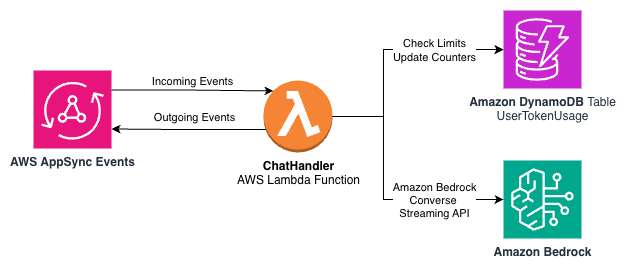
We need a way to keep atomic counters to track the token consumption, with fast real-time access to the counters with the user’s sub, and to delete old counters as they become irrelevant.

Amazon DynamoDB is a serverless, fully managed, distributed NoSQL database with single-digit millisecond performance at many scales. With DynamoDB, we can keep atomic counters, provide access to the counters keyed by the sub, and roll off old data using its time to live feature. The following diagram shows a subset of our architecture from earlier in this post that now includes a DynamoDB table to track token usage.
We can use a single DynamoDB table with the following partition and sort keys:

  • Partition key – user_id (String), the unique identifier for the user
  • Sort key – period_id (String), a composite key that identifies the time period

The user_id will receive the sub attribute from the JWT provided by Amazon Cognito. The period_id will have strings that sort lexicographically that indicate which time period the counter is for as well as the timeframe. The following are some example sort keys:

10min:2025-08-05:16:40
10min:2025-08-05:16:50
monthly:2025-08

10min or monthly indicate the type of counter. The timestamp is set to the last 10-minute window (for example, (minute // 10) * 10).

With each record, we keep the following attributes:

  • input_tokens – Counter for input tokens used in this 10-minute window
  • output_tokens – Counter for output tokens used in this 10-minute window
  • timestamp – Unix timestamp when the record was created or last updated
  • ttl – Time to live value (Unix timestamp), set to 24 hours from creation

The two token columns are incremented with the DynamoDB atomic ADD operation with each metadata event from the Amazon Bedrock Converse API. The ttl and timestamp columns are updated to indicate when the record is automatically removed from the table.

When a user sends a message, we check whether they have exceeded their daily or monthly limits.

To calculate daily usage, the meter.py module completes the following steps:

  1. Calculates the start and end keys for the 24-hour window.
  2. Queries records with the partition key user_id and sort key between the start and end keys.
  3. Sums up the input_tokens and output_tokens values from the matching records.
  4. Compares the sums against the daily limits.

See the following example code:

KeyConditionExpression: “user_id = :uid AND period_id BETWEEN :start AND :end”
ExpressionAttributeValues: {
    “:uid”: {“S”: “user123”},
    “:start”: {“S”: “10min:2025-08-04:15:30”},
    “:end”: {“S”: “10min:2025-08-05:15:30”}
}

This range query takes advantage of the naturally sorted keys to efficiently retrieve only the records from the last 24 hours, without filtering in the application code.The monthly usage calculation on the static window is much simpler. To check monthly usage, the system completes the following steps:

  1. Gets the specific record with the partition key user_id and sort key monthly:YYYY-MM for the current month.
  2. Compares the input_tokens and output_tokens values against the monthly limits.

See the following code:

Key: {
    “user_id”: {“S”: “user123”},
    “period_id”: {“S”: “monthly:2025-08”}
}

With an additional Python module and DynamoDB, we have a metering and rate limiting solution that works for both static and rolling windows.

Diverse model access

Our sample code uses the Amazon Bedrock Converse API. Not every model is included in the sample code, but many models are included for you to rapidly explore possibilities.The innovation in this area doesn’t stop at models on AWS. There are numerous ways to develop generative AI solutions at every level of abstraction. You can build on top of the layer that best suits your use case.

Swami Sivasubramanian recently wrote on how AWS is enabling customers to deliver production-ready AI agents at scale. He discusses Strands Agents, an open source AI agents SDK, as well as Amazon Bedrock AgentCore, a comprehensive set of enterprise-grade services that help developers quickly and more securely deploy and operate AI agents at scale using a framework and model, hosted on Amazon Bedrock or elsewhere.

To learn more about architectures for AI agents, refer to Strands Agents SDK: A technical deep dive into agent architectures and observability. The post discusses the Strands Agents SDK and its core features, how it integrates with AWS environments for more secure, scalable deployments, and how it provides rich observability for production use. It also provides practical use cases and a step-by-step example.

Logging

Many of our AI Gateway stakeholders are interested in logs. Developers want to understand how their applications function. System engineers need to understand operational concerns like tracking availability and capacity planning. Business owners want analytics and trends so that they can make better decisions.

With Amazon CloudWatch Logs, you can centralize the logs from your different systems, applications, and AWS services that you use in a single, highly scalable service. You can then seamlessly view them, search them for specific error codes or patterns, filter them based on specific fields, or archive them securely for future analysis. CloudWatch Logs makes it possible to see your logs, regardless of their source, as a single and consistent flow of events ordered by time.

In the sample AI Gateway architecture, CloudWatch Logs is integrated at multiple levels to provide comprehensive visibility. The following architecture diagram depicts the integration points between AppSync Events, Lambda, and CloudWatch Logs in the sample application.
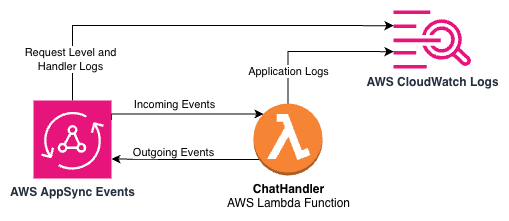
AppSync Events API logging

Our AppSync Events API is configured with ERROR-level logging to capture API-level issues. This configuration helps identify issues with API requests, authentication failures, and other critical API-level problems.The logging configuration is applied during the infrastructure deployment:

this.api = new appsync.EventApi(this, “Api”, {
    // … other configuration …
    logConfig: {
        excludeVerboseContent: true,
        fieldLogLevel: appsync.AppSyncFieldLogLevel.ERROR,
        retention: logs.RetentionDays.ONE_WEEK,
    },
});

This provides visibility into API operations.

Lambda function structured logging

The Lambda functions use AWS Lambda Powertools for structured logging. The ChatHandler Lambda function implements a MessageTracker class that provides context for each conversation:

logger = Logger(service=”eventhandlers”)

class MessageTracker:
    “””
    Tracks message state during processing to provide enhanced logging.
    Handles event type detection and processing internally.
    “””

    def __init__(self, user_id, conversation_id, user_message, model_id):
        self.user_id = user_id
        self.conversation_id = conversation_id
        self.user_message = user_message
        self.assistant_response = “”
        self.input_tokens = 0
        self.output_tokens = 0
        self.model_id = model_id
        # …

Key information logged includes:

  • User identifiers
  • Conversation identifiers for request tracing
  • Model identifiers to track which AI models are being used
  • Token consumption metrics (input and output counts)
  • Message previews
  • Detailed timestamps for time-series analysis

Each Lambda function sets a correlation ID for request tracing, making it straightforward to follow a single request through the system:

# Set correlation ID for request tracing
logger.set_correlation_id(context.aws_request_id)

Operational insights

CloudWatch Logs Insights enables SQL-like queries across log data, helping you perform the following actions:

  • Track token usage patterns by model or user
  • Monitor response times and identify performance bottlenecks
  • Detect error patterns and troubleshoot issues
  • Create custom metrics and alarms based on log data

By implementing comprehensive logging throughout the sample AI Gateway architecture, we provide the visibility needed for effective troubleshooting, performance optimization, and operational monitoring. This logging infrastructure serves as the foundation for both operational monitoring and the analytics capabilities we discuss in the following section.

Analytics

CloudWatch Logs provides operational visibility, but for extracting business intelligence from logs, AWS offers many analytics services. With our sample AI Gateway architecture, you can use those services to transform data from your AI Gateway without requiring dedicated infrastructure or complex data pipelines.

The following architecture diagram shows the flow of data between the Lambda function, Amazon Data Firehose, Amazon Simple Storage Service (Amazon S3), the AWS Glue Data Catalog, and Amazon Athena.
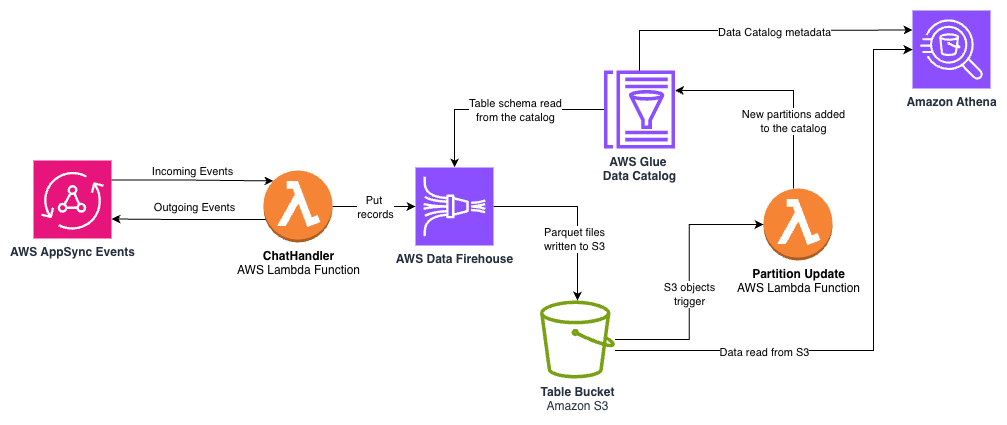
The key components include:

  • Data Firehose – The ChatHandler Lambda function streams structured log data to a Firehose delivery stream at the end of each completed user response. Data Firehose provides a fully managed service that automatically scales with your data throughput, alleviating the need to provision or manage infrastructure. The following code illustrates how the API call that integrates the ChatHandler Lambda function with the delivery stream:

# From messages.py
firehose_stream = os.environ.get(“FIREHOSE_DELIVERY_STREAM”)
if firehose_stream:
    try:
        firehose.put_record(
            DeliveryStreamName=firehose_stream,
            Record={“Data”: json.dumps(log_data) + “\n”},
        )
        logger.debug(f”Successfully sent data to Firehose stream: {firehose_stream}”)
    except Exception as e:
        logger.error(f”Failed to send data to Firehose: {str(e)}”)

  • Amazon S3 with Parquet format – Firehose automatically converts the JSON log data to columnar Parquet format before storing it in Amazon S3. Parquet improves query performance and reduces storage costs compared to raw JSON logs. The data is partitioned by year, month, and day, enabling efficient querying of specific time ranges while minimizing the amount of data scanned during queries.
  • AWS Glue Data Catalog – An AWS Glue database and table are created in the AWS Cloud Development Kit (AWS CDK) application to define the schema for our analytics data, including user_id, conversation_id, model_id, token counts, and timestamps. Table partitions are added as new S3 objects are stored by Data Firehose.
  • Athena for SQL-based analysis – With the table in the Data Catalog, business analysts can use familiar SQL through Athena to extract insights. Athena is serverless and priced per query based on the amount of data scanned, making it a cost-effective solution for one-time analysis without requiring database infrastructure. The following is an example query:

— Example: Token usage by model
SELECT
    model_id,
    SUM(input_tokens) as total_input_tokens,
    SUM(output_tokens) as total_output_tokens,
    COUNT(*) as conversation_count
FROM firehose_database.firehose_table
WHERE year=”2025″ AND month=”08″
GROUP BY model_id
ORDER BY total_output_tokens DESC;

This serverless analytics pipeline transforms the events flowing through AppSync Events into structured, queryable tables with minimal operational overhead. The pay-as-you-go pricing model of these services facilitates cost-efficiency, and their managed nature alleviates the need for infrastructure provisioning and maintenance. Furthermore, with your data cataloged in AWS Glue, you can use the full suite of analytics and machine learning services on AWS such as Amazon Quick Sight and Amazon SageMaker Unified Studio with your data.

Monitoring

AppSync Events and Lambda functions send metrics to CloudWatch so you can monitor performance, troubleshoot issues, and optimize your AWS AppSync API operations effectively. For an AI Gateway, you might need more information in your monitoring system to track important metrics such as token consumption from your models.

The sample application includes a call to CloudWatch metrics to record the token consumption and LLM latency at the end of each conversation turn so operators have visibility into this data in real time. This enables metrics to be included in dashboards and alerts. Moreover, the metric data includes the LLM model identifier as a dimension so you can track token consumption and latency by model. Metrics are just one component of what we can learn about our application at runtime with CloudWatch. Because our log messages are formatted as JSON, we can perform analytics on our log data for monitoring using CloudWatch Logs Insights. The following architecture diagram illustrates the logs and metrics made available by AppSync Events and Lambda through CloudWatch and CloudWatch Logs Insights.
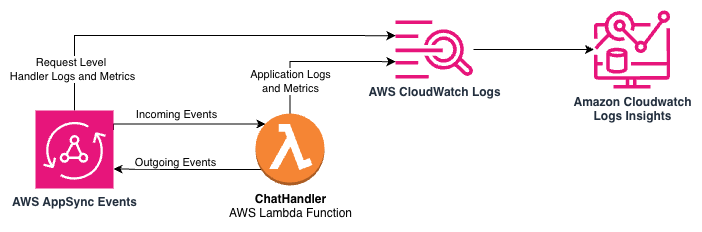
For example, the following query against the sample application’s log groups shows us the users with the most conversations within a given time window:

fields , 
| filter  like “Message complete”
| stats count_distinct(conversation_id) as conversation_count by user_id
| sort conversation_count desc
| limit 10

@timestamp and @message are standard fields for Lambda logs. On line 3, we compute the number of unique conversation identifiers for each user. Thanks to the JSON formatting of the messages, we don’t need to provide parsing instructions to read these fields. The Message complete log message is found in packages/eventhandlers/eventhandlers/messages.py in the sample application.

The following query example shows the number of unique users using the system for a given window:

fields , 
| filter  like “Message complete”
| stats count_distinct(user_id) by bin(5m) as unique_users

Again, we filter for Message complete, compute unique statistics on the user_id field from our JSON messages, and then emit the data as a time series with 5-minute intervals with the bin function.

Caching (prepared responses)

Many AI Gateways provide a cache mechanism for assistant messages. This would be appropriate in situations where large numbers of users ask exactly the same questions and need the same exact answers. This could be a considerable cost savings for a busy application in the right situation. A good candidate for caching might be about the weather. For example, with the question “Is it going to rain in NYC today?”, everyone should see the same response. A bad candidate for caching would be one where the user might ask the same thing but would receive private information in return, such as “How many vacation hours do I have right now?” Take care to use this idea safely in your area of work. A basic cache implementation is included in the sample to help you get started with this mechanism. Caches in conversational AI require a lot of care to be taken to make sure information doesn’t leak between users. Given the amount of context an LLM can use to tailor a response, caches should be used judiciously.

The following architecture diagram shows the use of DynamoDB as a storage mechanism for prepared responses in the sample application.
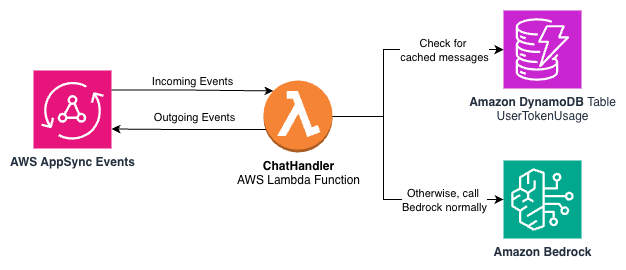
The sample application computes a hash on the user message to query a DynamoDB table with stored messages. If there is a message available for a hash key, the application returns the text to the user, the custom metrics record a cache hit in CloudWatch, and an event is passed back to AppSync Events to notify the application the response is complete. This encapsulates the cache behavior completely within the event structure the application understands.

Install the sample application

Refer to the README file on GitHub for instructions to install the sample application. Both install and uninstall are driven by a single command to deploy or un-deploy the AWS CDK application.

Sample pricing

The following table estimates monthly costs of the sample application with light usage in a development environment. Actual cost will vary by how you use the services for your use case.

The monthly cost of the sample application, assuming light development use, is expected to be between $35–55 per month.

Sample UI

The following screenshots showcase the sample UI. It provides a conversation window on the right and a navigation bar on the left. The UI features the following key components:

  • A Token Usage section is displayed and updated with each turn of the conversation
  • The New Chat option clears the messages from the chat interface so the user can start a new session
  • The model selector dropdown menu shows the available models

The following screenshot shows the chat interface of the sample application.

The following screenshot shows the model selection menu.
Conclusion

As the AI landscape evolves, you need an infrastructure that adapts as quickly as the models themselves. By centering your architecture around AppSync Events and the serverless patterns we’ve covered—including Amazon Cognito based identity authentication, DynamoDB powered metering, CloudWatch observability, and Athena analytics—you can build a foundation that grows with your needs. The sample application presented in this post gives you a starting point that demonstrates real-world patterns, helping developers explore AI integration, architects design enterprise solutions, and technical leaders evaluate approaches.

The complete source code and deployment instructions are available in the GitHub repo. To get started, deploy the sample application and explore the nine architectures in action. You can customize the authorization logic to match your organization’s requirements and extend the model selection to include your preferred models on Amazon Bedrock. Share your implementation insights with your organization, and leave your feedback and questions in the comments.

About the authors

Archie Cowan is a Senior Prototype Developer on the AWS Industries Prototyping and Cloud Engineering team. He joined AWS in 2022 and has developed software for companies in Automotive, Energy, Technology, and Life Sciences industries. Before AWS, he led the architecture team at ITHAKA, where he made contributions to the search engine on jstor.org and a production deployment velocity increase from 12 to 10,000 releases per year over the course of his tenure there. You can find more of his writing on topics such as coding with ai at fnjoin.com and x.com/archiecowan.

.Organize the content with appropriate headings and subheadings ( h2, h3, h4, h5, h6). Include conclusion section and FAQs section with Proper questions and answers at the end. do not include the title. it must return only article i dont want any extra information or introductory text with article e.g: ” Here is rewritten article:” or “Here is the rewritten content:”


Generate single title from this title 5 tech, AI tools to enhance teacher team success in 100 -150 characters. And it must return only title i dont want any extra information or introductory text with title e.g: ” Here is a single title:”

Write an article about

Key points:

Technology plays a crucial, and expanding, role in today’s schools. The availability of tech tools, including those with artificial intelligence (AI) capabilities, continues to grow – as do their potential applications in the classroom. 

Schools can also use tech and AI tools to enhance the success of teacher teams and professional learning communities (PLCs). When teacher teams set collective goals, their intended results – such as improved student outcomes – often occur in the classroom. But working toward their goals relies on effective peer-to-peer collaboration, which requires different skills and structures than classroom instruction. Technology is here to help bridge the gap.

Below are five AI and tech tools to enhance teacher team success.

1. Miro: A tool for visual brainstorming

Teacher teams need to brainstorm, exchange ideas, and work toward solutions together. An online whiteboard is a great solution for collaborative work because it provides a centralized canvas where members communicate with one another visually.

Miro users populate their whiteboards by uploading documents and images, embedding videos, or linking to websites. They can use sticky notes, shapes, drawing tools, emojis, and the like to share and respond to content. The whiteboards expand to hold any amount of content. Plus, users can view and make changes to their Miro board synchronously or asynchronously.

Additionally, Miro offers an AI tool called Miro Assist to help teams capture advanced insights from the content on their boards. For instance, Miro Assist can condense thousands of sticky notes into a single sticky note and automatically generate presentations, mind maps, and diagrams to help teams quickly transform their content into different visual forms.

2. Paymo: A tool for project management

Among the common PLC pitfalls that diminish effectiveness are a lack of structure, directional clarity,  and leadership. The project management software Paymo, which is free for schools, can alleviate each of these challenges. 

Paymo provides a centralized workspace where teacher teams clarify roles within their group, assign tasks to individuals, and track progress over time. These features allow educators to move from brainstorming and open-ended conversation to defining concrete, actionable goals so they can make real progress.

Teams can organize uploaded assets according to project or task so members know just where to find the information they need. And Paymo includes a comprehensive dashboard where leaders can get insights about how the PLC is progressing. 

3. Tricider: A Tool for decision-making

Making decisions as a group can be challenging. Tricider is a free online tool that simplifies the decision-making process and makes it more equitable by allowing users to leave plenty of feedback. It’s a great choice for teacher teams or PLCs who want to brainstorm ideas and work toward a consensus in areas like grading and assessment or professional development.

Here’s how it works: a user enters a question they want the group to consider. They then send the question directly to group members or get the ideas started by listing a few options for the group to consider. Recipients can add their own ideas to the list of options, leave pros and cons for other members to consider, and vote for their favorite ideas. The feedback is listed in three easy-to-read columns, which helps make even complex discussions easy to digest.

Giving team members the chance to weigh in on decisions helps create buy-in and a sense of shared accountability, which is one way to accelerate the success of your teacher teams.

4. Conceptboard’s Plus Delta Template: A tool for reflection

Conceptboard is another online whiteboard that teams can use for visual collaboration. Their Plus Delta template is perfect for teachers who want to self-reflect on their practice.

Plus Delta is a formative evaluation model that prompts individuals to assess what went well with an event or experience and what could be improved. Conceptboard’s template is just as straightforward as the evaluation model. In the “plus” column, teachers record practices they want to replicate, while in the “delta” column, they list opportunities for growth and enhancement. 

These insights promote a continuous improvement mindset that can help teachers strengthen their team’s collective efficacy, or belief in their joint ability to positively affect students. Research has shown that mindset matters: collective teacher efficacy has a strong and positive correlation to student achievement.

5. TeachFX: A tool for tracking engagement

TeachFX is an AI-powered app that provides instructional feedback for K-12 educators. Teachers use their phones to capture an audio recording of their lesson. Then, TeachFX generates personalized reports on academic vocabulary, talk ratio, and student engagement. 

The feedback that TeachFX provides is private, objective, and non-evaluative. Rather than telling teachers how to change their practice, TeachFX empowers them with data they can use to guide their own growth and decision-making. 

The data teachers receive may be surprising. One middle school teacher overestimated the amount of time her students spent talking during a lesson by 10 times (she guessed five minutes; it was actually 30 seconds). Gaining this level of self-awareness makes the tool so valuable for teacher teams who are looking to challenge their current thinking and practice. 

Of course, strategies to increase engagement in the classroom go beyond boosting the time students spend talking. But students’ willingness to participate in discussion is one indicator of their comfort level and motivation – and it’s something that TeachFX can help improve over time using research-based methods. 

A valuable opportunity to boost teacher team effectiveness 

It’s no secret that the expanding world of tech and AI provides educators with a variety of tools designed to increase their professional effectiveness. In a recent survey, 83 percent of teachers reported that their ability to use ed tech tools improved during pandemic building closures. Since reopening, districts and schools have leveraged the increased technological fluency of staff and students to address persisting challenges such as learning loss, delayed social-emotional development, and teacher burnout. There is no cure-all for everything that ails our educational communities. However, the potential to give teacher teams the tools they need to tackle these issues with the assistance of tech and AI is immense. 

Steve Ventura

Steve Ventura is the president and lead consultant at Advanced Collaborative Solutions, a professional development and consulting group that provides services to schools, districts, and non-profit organizations all around the world. He is a highly motivational and knowledgeable speaker who approaches high-stakes professional development armed with practical, research-based strategies. Steve is a former elementary and secondary teacher as well as both a school and district-level administrator. Steve has published multiple books and articles, and regularly presents and keynotes at major global education events.

Latest posts by eSchool Media Contributors (see all)

.Organize the content with appropriate headings and subheadings ( h2, h3, h4, h5, h6). Include conclusion section and FAQs section with Proper questions and answers at the end. do not include the title. it must return only article i dont want any extra information or introductory text with article e.g: ” Here is rewritten article:” or “Here is the rewritten content:”
Generate single title from this title The 3 biggest misconceptions about AI in 100 -150 characters. And it must return only title i dont want any extra information or introductory text with title e.g: ” Here is a single title:”

Write an article about

Key points:

Misconception: AI will encourage students to cheat.
Truth: Educators need to reconsider how they assess student work.

By Carl Hooker

One of the biggest misconceptions about AI in education is that it will encourage students to cheat and cause academic integrity concerns. Did students cheat before AI was around? Yes. Could students use generative AI tools like ChatGPT to cheat and cut corners on an assignment? ABSOLUTELY. However, there are a couple of major problems with this line of thinking.

The first is an equity concern. Educators find it socially acceptable for a student to hire a tutor to help them write their college admission essay. We also accept the fact that, many times, a parent helps build their 4th-grader’s science fair project. In both of these instances, we don’t consider it cheating. However, if a student uses generative AI to help them edit their college admission paper or brainstorm a science fair idea, there’s a belief that it is dishonest. By considering human-assisted help fair but computer-assisted help not fair, we create an equity gap.

The second reason why cheating with AI is being mishandled is the belief that it will encourage students to cheat. This is akin to saying that a vape will encourage students to smoke. If you take the vape away, you still don’t address the behavior. The same is true with AI.

Rather than focus on students using technology to cheat, educators should reflect on what they are assessing. Are they truly measuring student learning or is it a compliance-based assignment or worksheet? Is the “process” being evaluated with the same or greater care than the final “product?” By focusing evaluations on the process of learning instead of the product, educators can not only prevent AI-assisted cheating, but they can also better evaluate a student’s understanding of a particular topic.

Misconception: AI will eliminate jobs.
Truth: It will create more jobs, with different requirements.

By David McCool

The simple misconception is that AI will eliminate jobs, but really it will create more jobs, with different requirements, than it will eliminate. These new jobs will disproportionately require durable skills like critical thinking and collaboration, making it more important than ever for people to learn these skills and, if they can, display them for employers by earning microcredentials.

As we continue into an AI-driven world, students, employees, and jobseekers need to stay agile and competitive in the marketplace, so upskilling is essential. Microcredentaling your durable skills will demonstrate your abilities for future jobs like Sentiment Analysis, Content Creators, and AI roles that require durable skills and cannot be automated. In many industries, AI will simply change the nature of available jobs. For the most part, those transformed jobs will be more engaging than the menial tasks they’re replacing. Manufacturing workers, for example, may be freed from the production line where they used to watch for defective products all day to instead spend their time improving processes using insights gained from AI systems.

AI’s role in education has changed, and not everyone understands what it can do. A discovery we made during the pilot of our durable skills course SkillBuild by Muzzy Lane is that learners were unaware that AI was guiding them to improve based on their input. They were appreciative when they found out that, in our microcredential courses, AI helps learners by providing the extra assets and feedback they need to perfect their durable skills—pushing them to the top of today’s changing job market.

Misconception: AI is a static tool.
Truth: AI is constantly evolving.

By Wilson Tsu

What I see people getting wrong the most about AI is thinking that what it is now is what it will be in the future. Take Open AI, for example. Going from ChatGPT, which was released in November 2022, to GPT4 in March 2023 was a huge leap in capability. When ChatGPT came out and educators really started digging into it, they may have thought, “It’s not going to pass my class like a human would, so I don’t have to worry about this.” And then only a few months later, they saw that GPT4 could pass their class. And now Open AI has announced that people will be able to create their own GPTs. We don’t know the extent to which that’s going to change things, but it’s a huge step.

My point is that you can’t think in static terms when it comes to AI. It’s changing so fast, and there’s so much investment in AI right now, so many resources, so many smart people working on it, that as soon as you think you know what’s going on, it’s going to drastically change. And it’s changing so fast that no one can even really know what’s going on, except for a small handful of people who work deeply in it. To me, the biggest truth about AI right now is that as soon as we think we have a grasp on it, it’s going to be different.

Carl Hooker, David McCool, & Wilson Tsu

Carl Hooker has been an educator for over 25 years. He has held a variety of positions in multiple districts, from 1st-grade teacher to virtualization coordinator. As director of innovation & digital learning for the Eanes Independent School District, he helped spearhead the LEAP (Learning and Engaging through Access and Personalization), which put 1:1 iPads into the hands of all K-12 students at Eanes.

Carl has been the author of multiple books including the 6-part ISTE book series titled Mobile Learning Mindset. His book Ready,Set, FAIL! focuses on strategies and techniques for educators to unlock creativity by risk-taking and embracing failure. Carl also works as an advisor for multiple edtech start-up companies, and is a national advisor for the Future Ready Schools Initiative. He blogs regularly at HookEDonInnovation.com, guest authors a regular blog on Tech & Learning, and has written guest blogs for the Huffington Post and Edutopia. He’s the host of five podcasts and is the co-founder of K12Leaders.com, a social network for educators. Learn more at CarlHooker.com.
 
David McCool is president and CEO of Muzzy Lane, a company that was recently awarded 1EdTech™ ‘s 2022 Gold Learning Impact Award and recently introduced SkillBuild. Since founding the company, David’s goal has been to build technology that empowers authors to create compelling online experiences and helps students practice skills with guidance and feedback. He was previously involved in the founding of 2 successful startups and graduated from MIT. He can be reached at dave@muzzylane.com or LinkedIn.
 
Wilson Tsu is the founder and CEO of PowerNotes, the creator of the only platform scientifically designed to help students and professionals create high-quality research and written work confidently and efficiently. He can be reached at wilson@powernotes.com or by LinkedIn.

Latest posts by eSchool Media Contributors (see all)

.Organize the content with appropriate headings and subheadings ( h2, h3, h4, h5, h6). Include conclusion section and FAQs section with Proper questions and answers at the end. do not include the title. it must return only article i dont want any extra information or introductory text with article e.g: ” Here is rewritten article:” or “Here is the rewritten content:”