Home Blog Page 23

Generate single title from this title Google Offers AI Certificate Free For Eligible U.S. Small Businesses in 100 -150 characters. And it must return only title i dont want any extra information or introductory text with title e.g: ” Here is a single title:”

0

Write an article about

Google has launched the Google AI Professional Certificate, a self-paced program covering data analysis, content creation, research, and vibe coding.

Every participant receives three months of free access to Google AI Pro. Eligible U.S. small businesses can access the entire program at no cost through a separate application (more on eligibility below).

The certificate is available now on Coursera, Google Skills, and Udemy. In the U.S. and Canada, the subscription costs $49 per month.

What The Certificate Covers

The program consists of seven modules, each of which can be completed in about an hour. No prior AI experience is required.

Participants complete more than 20 hands-on activities. These include creating presentations and marketing materials, conducting deep research, building infographics, analyzing data, and building custom apps without writing code.

After completing all seven modules, participants earn a Google certificate they can add to LinkedIn and share with employers.

Free Access For Eligible U.S. Small Businesses

Google is offering the certificate at no cost to eligible U.S. small and medium-sized businesses with 500 or fewer employees. The offer also includes three months of free Google Workspace Business Standard (for new Workspace customers, up to 300 seats).

To qualify, businesses must be registered in the U.S. and submit their Employer Identification Number (EIN) through a dedicated application on Coursera. Coursera said the verification process takes 5-7 business days.

Businesses can also apply at grow.google/small-business. Google said it is working with the U.S. Chamber of Commerce and America’s Small Business Development Centers to distribute the program.

How This Helps

The program builds on Google AI Essentials, which has become the most popular course on Coursera. The AI Professional Certificate goes further, focusing on applied use cases rather than introductory concepts.

The certificate focuses on tools like Gemini, NotebookLM, and Google AI Studio, so the skills are tied to Google’s ecosystem. Google launched a separate Generative AI Leader certification for Google Cloud in May 2025, though that program focused on non-technical business leaders and required a $99 exam fee. The new AI Professional Certificate has no exam fee.

Looking Ahead

The Google AI Professional Certificate is available now on Coursera, Google Skills, and Udemy. Eligible U.S. small businesses can apply for no-cost access at grow.google/small-business.

For professionals already familiar with Google’s AI tools through earlier training programs, this certificate adds structured, employer-recognized credentials to practical skills you may already be developing on your own.

.Organize the content with appropriate headings and subheadings ( h2, h3, h4, h5, h6). Include conclusion section and FAQs section with Proper questions and answers at the end. do not include the title. it must return only article i dont want any extra information or introductory text with article e.g: ” Here is rewritten article:” or “Here is the rewritten content:”

A neural blueprint for human-like intelligence in soft robots | MIT News

0

A new artificial intelligence control system enables soft robotic arms to learn a wide repertoire of motions and tasks once, then adjust to new scenarios on the fly, without needing retraining or sacrificing functionality. 

This breakthrough brings soft robotics closer to human-like adaptability for real-world applications, such as in assistive robotics, rehabilitation robots, and wearable or medical soft robots, by making them more intelligent, versatile, and safe.

The work was led by the Mens, Manus and Machina (M3S) interdisciplinary research group — a play on the Latin MIT motto “mens et manus,” or “mind and hand,” with the addition of “machina” for “machine” — within the Singapore-MIT Alliance for Research and Technology. Co-leading the project are researchers from the National University of Singapore (NUS), alongside collaborators from MIT and Nanyang Technological University in Singapore (NTU Singapore).

Unlike regular robots that move using rigid motors and joints, soft robots are made from flexible materials such as soft rubber and move using special actuators — components that act like artificial muscles to produce physical motion. While their flexibility makes them ideal for delicate or adaptive tasks, controlling soft robots has always been a challenge because their shape changes in unpredictable ways. Real-world environments are often complicated and full of unexpected disturbances, and even small changes in conditions — like a shift in weight, a gust of wind, or a minor hardware fault — can throw off their movements. 

Despite substantial progress in soft robotics, existing approaches often can only achieve one or two of the three capabilities needed for soft robots to operate intelligently in real-world environments: using what they’ve learned from one task to perform a different task, adapting quickly when the situation changes, and guaranteeing that the robot will stay stable and safe while adapting its movements. This lack of adaptability and reliability has been a major barrier to deploying soft robots in real-world applications until now.

In an open-access study titled “A general soft robotic controller inspired by neuronal structural and plastic synapses that adapts to diverse arms, tasks, and perturbations,” published Jan. 6 in Science Advances, the researchers describe how they developed a new AI control system that allows soft robots to adapt across diverse tasks and disturbances. The study takes inspiration from the way the human brain learns and adapts, and was built on extensive research in learning-based robotic control, embodied intelligence, soft robotics, and meta-learning.

The system uses two complementary sets of “synapses” — connections that adjust how the robot moves — working in tandem. The first set, known as “structural synapses”, is trained offline on a variety of foundational movements, such as bending or extending a soft arm smoothly. These form the robot’s built‑in skills and provide a strong, stable foundation. The second set, called “plastic synapses,” continually updates online as the robot operates, fine-tuning the arm’s behavior to respond to what is happening in the moment. A built-in stability measure acts like a safeguard, so even as the robot adjusts during online adaptation, its behavior remains smooth and controlled.

“Soft robots hold immense potential to take on tasks that conventional machines simply cannot, but true adoption requires control systems that are both highly capable and reliably safe. By combining structural learning with real-time adaptiveness, we’ve created a system that can handle the complexity of soft materials in unpredictable environments,” says MIT Professor Daniela Rus, co-lead principal investigator at M3S, director of the MIT Computer Science and Artificial Intelligence Laboratory (CSAIL), and co-corresponding author of the paper. “It’s a step closer to a future where versatile soft robots can operate safely and intelligently alongside people — in clinics, factories, or everyday lives.”

“This new AI control system is one of the first general soft-robot controllers that can achieve all three key aspects needed for soft robots to be used in society and various industries. It can apply what it learned offline across different tasks, adapt instantly to new conditions, and remain stable throughout — all within one control framework,” says Associate Professor Zhiqiang Tang, first author and co-corresponding author of the paper who was a postdoc at M3S and at NUS when he carried out the research and is now an associate professor at Southeast University in China (SEU China).

The system supports multiple task types, enabling soft robotic arms to execute trajectory tracking, object placement, and whole-body shape regulation within one unified approach. The method also generalizes across different soft-arm platforms, demonstrating cross-platform applicability. 

The system was tested and validated on two physical platforms — a cable-driven soft arm and a shape-memory-alloy–actuated soft arm — and delivered impressive results. It achieved a 44–55 percent reduction in tracking error under heavy disturbances; over 92 percent shape accuracy under payload changes, airflow disturbances, and actuator failures; and stable performance even when up to half of the actuators failed. 

“This work redefines what’s possible in soft robotics. We’ve shifted the paradigm from task-specific tuning and capabilities toward a truly generalizable framework with human-like intelligence. It is a breakthrough that opens the door to scalable, intelligent soft machines capable of operating in real-world environments,” says Professor Cecilia Laschi, co-corresponding author and principal investigator at M3S, Provost’s Chair Professor in the NUS Department of Mechanical Engineering at the College of Design and Engineering, and director of the NUS Advanced Robotics Centre.

This breakthrough opens doors for more robust soft robotic systems to develop manufacturing, logistics, inspection, and medical robotics without the need for constant reprogramming — reducing downtime and costs. In health care, assistive and rehabilitation devices can automatically tailor their movements to a patient’s changing strength or posture, while wearable or medical soft robots can respond more sensitively to individual needs, improving safety and patient outcomes.

The researchers plan to extend this technology to robotic systems or components that can operate at higher speeds and more complex environments, with potential applications in assistive robotics, medical devices, and industrial soft manipulators, as well as integration into real-world autonomous systems.

The research conducted at SMART was supported by the National Research Foundation Singapore under its Campus for Research Excellence and Technological Enterprise program.

Generate single title from this title SS&C Blue Prism: On the journey from RPA to agentic automation in 100 -150 characters. And it must return only title i dont want any extra information or introductory text with title e.g: ” Here is a single title:”

Write an article about

For organizations who are still wedded to the rules and structures of robotic process automation (RPA), then considering agentic AI as the next step for automation may be faintly terrifying. SS&C Blue Prism, however, is here to help, taking customers on the journey from RPA to agentic automation at a pace with which they’re comfortable.

Big as it may be, this move is a necessary one. Modern workflows are at a level of complexity that outlines what traditional RPA was designed to do, according to Steven Colquitt, VP Software Engineering, SS&C Blue Prism. Unstructured data comes from various sources resembling non-deterministic real-world interactions. “Inputs can vary, outcomes can shift and decisions depend on context in real-time,” notes Colquitt.

Brian Halpin, Managing Director, Automation, SS&C Blue Prism, gives the example of a credit agreement where you might need to get 30 or 40 answers from it. He uses the word “answers” deliberately as opposed to data points to account for the level of reasoning that a large language model (LLM) performs.

The element of this being a journey continues to resonate, however. “We’re now saying we’re giving an AI agent the outcome that we want, but we’re not giving it the instructions on how to complete,” says Halpin. “We’re not saying, ‘follow step one, two, three, four, five.’ We’re saying, ‘I want this loan reviewed’ or ‘I want this customer onboarded.’

“Ultimately, I think that’s where the market will go,” adds Halpin. “Is it ready for that? No. Why? Because there’s trust, there’s regulations, there’s auditability […] stability, security. We know LLMs are prone to hallucinations, we know they drift, and [if] you change the underlying model, things change and responses get different.

“There’s an awful lot of learning to happen before I think companies go fully autonomous and real agentic workflows [are] driven from that sort of non-deterministic perspective,” says Halpin. “But then, there will be something else, right? There will be another model. So really, it is all a journey right now.”

SS&C Blue Prism has thousands of customers who have automated processes in place, from centers of excellence (CoEs) to running digital workers in their operations, who they’re hoping to upgrade into the “world of AI”, as Halpin puts it. Sometimes it’s about connecting two separate areas.

“It’s been interesting,” Halpin notes. “As I talk to [our] customers, I see a common thread among companies right now where, in a lot of cases, AI has been established as a separate unit in a company. You go over to the process automation team, and they’re maybe not even allowed to use the AI.

“So, it’s about, ‘How do you help them get that capability and blend it into their process efficiency and allow them to get to the next 20%, 30% of automation, in terms of the end-to-end process?’”

As part of this, SS&C Blue Prism is soon to launch new technology which helps organizations build and embed AI agents within workflows, as well as assist with orchestration. Those who attended TechEx Global, on February 4-5 as part of the Intelligent Automation conference, where SS&C Blue Prism participated, got the full story, as well as understanding the company’s ongoing path.

“[SS&C Technologies] are one of the biggest users of RPA in the world,” adds Halpin. “We have over three and a half thousand digital workers deployed [across the SS&C estate]. We’re saving hundreds of millions in run-rate benefit. We’ve about 35 AI agents in production attached to those digital workers doing […] complex tasks, and really, we just want to share that journey.”

Watch the full interview with Brian Halpin below:

Photo by Patrick Tomasso on Unsplash

.Organize the content with appropriate headings and subheadings ( h2, h3, h4, h5, h6). Include conclusion section and FAQs section with Proper questions and answers at the end. do not include the title. it must return only article i dont want any extra information or introductory text with article e.g: ” Here is rewritten article:” or “Here is the rewritten content:”

Generate single title from this title The Difference No One Explains in 100 -150 characters. And it must return only title i dont want any extra information or introductory text with title e.g: ” Here is a single title:”

Write an article about
Chatbot vs conversational AI sounds like a small wording choice, but it decides whether a product feels toy-like or mission-critical. That distinction got flattened by content farms and vendor blogs, so everyone thinks they already understand it. And now, the real meaning has gotten blurred.
We are going to clean that up properly. You will get a clear idea of what chatbots and conversational AI are. You will also learn 8 major differences most people never mention, and why calling them the same thing slows down serious product work.
What Are Chatbots?

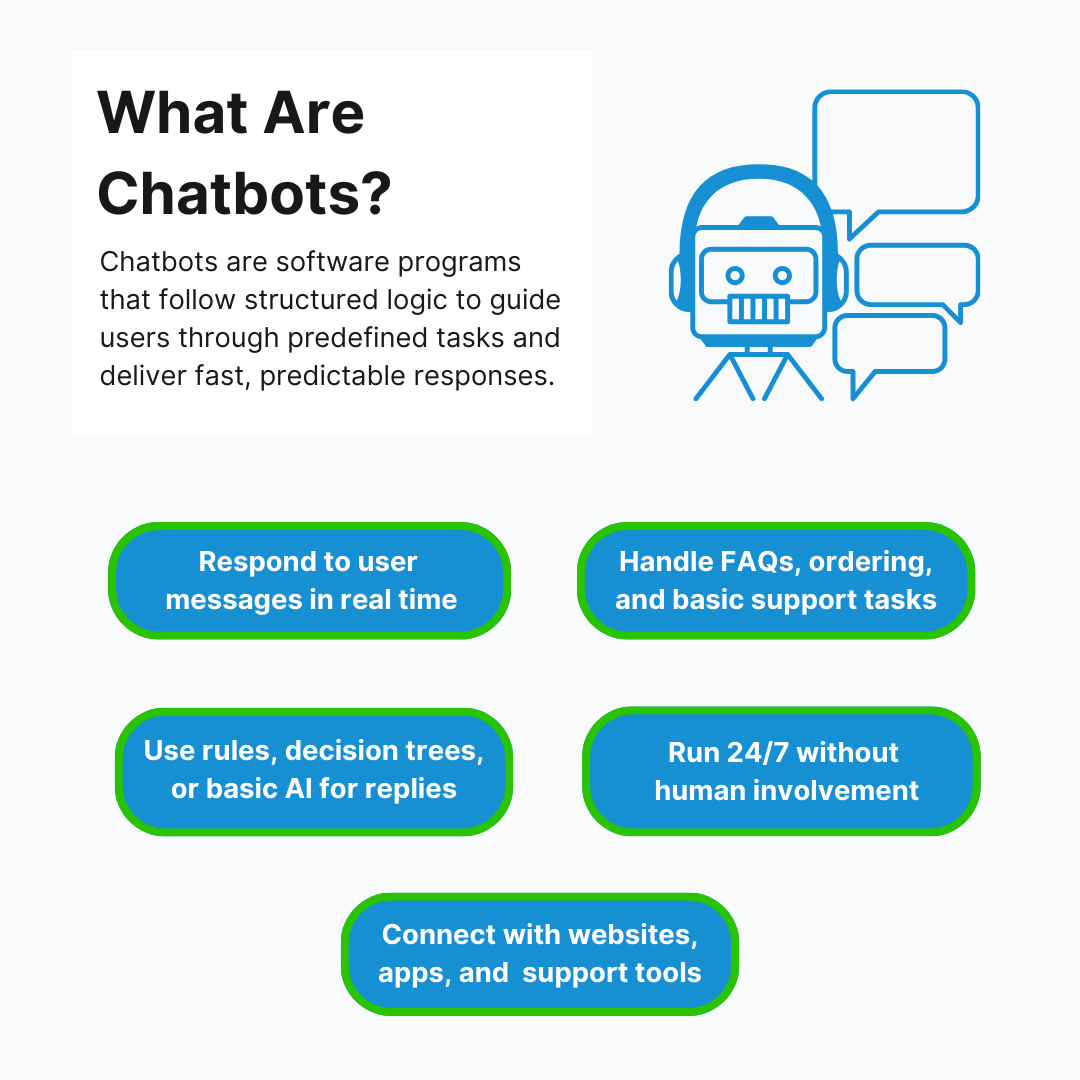
Chatbots are software programs that respond to user messages through predefined rules or scripts. Most chatbots follow structured flows. They look for keywords or button selections and return fixed responses. They work well for predictable and repetitive tasks and interactions where the questions and answers are known in advance.
Key Features:

Respond to user messages in real time
Handle FAQs and simple tasks
Use rules or AI to generate replies
Work 24/7 without human agents
Integrate with websites, apps, and support tools

Chatbots In Modern Business Workflows
Chatbots are being used as transaction assistants. Their real value is not conversation but throughput. They are inside revenue-critical paths and move users from intent to payment with as few decisions or screens as possible. 
Businesses use chatbots to:

Pre-qualify customers before they reach live support.
Replace form-based ordering with guided micro-steps that reduce abandonment.
Enforce input validation in real time – URLs, order quantities, eligibility rules.
Eliminate edge-case handling by narrowing the user’s choices to only what the system supports.

Chatbots work best when the business process is already clean and structured. If the workflow can be written as a decision tree, a chatbot can run it. There is no need for interpretation. There is no need for long memory. The system simply matches intent to a path and completes the task.
SocialPlug uses chatbots exactly this way. Their core workflow revolves around high-volume but low-friction purchases of social media services. Their chatbot doesn’t try to educate users on growth strategy. It doesn’t evaluate content quality. It doesn’t recommend campaigns. Instead, it operates as a structured order intake system:

Captures a video URL and instantly validates format and eligibility.
Presents only the packages that match the region and delivery model.
Confirms quantity and delivery speed before executing the order.

What makes this powerful is not the conversation – it is the control. The chatbot prevents malformed orders and ensures every transaction conforms to backend fulfillment rules. This reduces refund requests and support tickets.
The business benefit is operational:

Lower payment friction.
Higher order accuracy.
Fewer human interventions per sale.

This is the exact lane where chatbots win – systems that need speed and clean execution – not interpretation or guidance.
What Is Conversational AI?

Conversational AI is the technology that lets machines understand human language and respond to it in a natural way. It learns from data to handle open-ended conversations and maintain context across turns. Conversational AI systems use natural language understanding to power chatbots, voice assistants, virtual assistants, and other interactive systems.
Key Features:

Conversational AI In Modern Business Workflows
Conversational AI shows up when the workflow is evaluative. The system is not executing a known process. It is helping someone figure out what process even applies to them. That shifts the entire role of the technology.
Here, conversational AI is used to:

Extract emotional or loosely defined needs.
Convert personal situations into structured decision criteria.
Maintain continuity across long and evolving conversations.

Rather than following a script, conversational AI builds a working model of the user’s situation. It adjusts its responses as new details show up. It can resume and reshape the conversation without restarting.
MedicalAlertBuyersGuide is a strong example of this approach. Their users are not buying casually. They are making high-stakes decisions about safety, health conditions, budgets, and eligibility. And a scripted chatbot would collapse under that complexity.
Their conversational AI works as a decision-mapping system:

Gathers contextual inputs such as age, mobility limitations, living arrangements, and medical history – not in a fixed order, but as they surface naturally.
Dynamically adjusts its line of questioning based on earlier answers.
Remembers prior responses if a user returns later, so the conversation continues.

For example, a user may start by asking about fall detection. Later, they mention their parent uses a walker and has memory issues. The AI reframes the recommendation logic in real time and prioritizes wearability, automatic alerts, caregiver notifications, and battery reliability.
The value here is not speed. It is decision quality:

Users reach solutions that actually match their situation.
Drop-offs decrease because uncertainty gets resolved, not ignored.
Trust increases because the system adapts instead of forcing a funnel.

This is where conversational AI really earns its place – when people don’t even know exactly what they need yet, and the system has to walk with them through the decision instead of just pushing buttons.
Chatbot Vs Conversational AI: 8 Differences Most People Miss

There is more to conversational AI and chatbots than most people realize. Here are 8 key differences that actually change how these systems perform in the real world.
1. Architecture & Technology
Chatbot
Chatbots are basically built like a set of “if-then” instructions. Every possible path has to be thought out and mapped in advance. The tech behind them is simple but rigid:

Keywords and intent matching run almost every interaction.
Responses are prewritten and triggered by exact or close matches.
Flowcharts or decision trees define how conversations move from one step to another.
Any “memory” is manually tracked with variables or flags.
Adding a new feature usually means rewriting multiple flows and testing edge cases.

This makes chatbots predictable and easy to debug – but they break quickly when users say something unexpected. The tech stack is lightweight – basic NLP libraries, logic engines, minimal backend. There is no learning happening on its own.
Conversational AI
Conversational artificial intelligence is in a league of its own. It is built around models and designed to bend and adapt to whatever comes its way:

Uses NLP models, embeddings, and probabilistic intent recognition.
Dialogue state tracking is dynamic, not pre-mapped.
Retrieval layers can pull info from APIs or internal databases on the fly.
The system improves automatically from customer interactions.
Multi-turn memory can reference user preferences and context cues.

The difference is night and day. One is rigid and fixed, the other adapts and grows smarter over time.
🏆 Winner: Conversational AI 🤖
2. Operational Costs & Implementation Effort
Chatbot
AI chatbots are cheap and fast to set up, but effort shows up in design:

You pay for the platform – low to mid-tier subscription.
Most of the work is writing flows and updating rules.
Maintenance is predictable. Scaling means adding more flows – not computing power.
No specialized ML skills are required.

Once deployed, customer service costs stay stable, which helps businesses save $0.70–$0.90 per interaction. You don’t worry about compute-heavy model inference or continuous fine-tuning.
Conversational AI
Implementing conversational AI is easier said than done. And it is expensive to maintain, too, but capable of handling complex conversations:

High compute costs for running models, especially if using LLMs.
Requires data pipelines, vector databases, and embeddings storage.
Teams must have ML engineers and backend developers.
Maintenance is ongoing – model updates, prompt adjustments, drift corrections, safety checks.

It is not just user numbers that matter when scaling. Conversation complexity, session length, API/tool connections – they all count. And the system pays the price as things get complicated.
🏆 Winner: Chatbot 💬
3. Level Of Autonomy
Chatbot
Chatbots are obedient. They do exactly what you have told them to do – nothing more:

Follow the flow without improvising.
Escalate to humans when they hit uncertainty.
Can’t chain multiple actions on their own.
Can’t learn new paths unless manually updated.

Rule-based chatbots are perfect for simple FAQs and basic lead capture. But anything slightly unpredictable makes them stumble.
Conversational AI
Conversational AI agents don’t need you to plan every possible path. It can “think” on its own. You can give it complex instructions, and it figures out how to execute them:

Can plan multi-step actions across systems.
Adjusts responses based on conversation flow or user tone.
Can chain more complex tasks like booking appointments and checking inventories without a hardcoded path.
Learns from new interactions and adapts without direct intervention.

It is like the difference between following a script line by line and actually thinking on your feet.
🏆 Winner: Conversational AI 🤖
4. Understanding Of Context
Chatbot
Chatbots “remember” only what you tell them to. Any jump in the conversation or revisit after days, and they forget everything – unless you have built a separate database and explicitly coded retrieval.

Tracks slots (like user name, order ID, or issue type).
Session flags or flow positions define the current state.
Long conversations usually break unless manually coded to handle exceptions.
Cross-session memory requires explicit database mapping.

They are great for short and predictable interactions, but as soon as things jump around, their contextual understanding can’t keep up.
Conversational AI
Conversational AI handles context like a human would. People can reference old interactions or switch tasks mid-session, and it still delivers human-like interactions intelligently.

Maintains conversation history, even across sessions.
Can understand user intent from indirect phrasing.
Tracks preferences, past interactions, and conversation style.
Handles topic jumps without losing track of context or meaning.

It is capable of simulating human conversations, where users don’t have to repeat themselves.
🏆 Winner: Conversational AI 🤖
5. Response Generation Method

Chatbot
Traditional chatbots rely on predefined scripts and structured templates for responses. They don’t create anything new; every reply is stored in a database or flowchart. The logic is simple – match an intent → pick the closest response → send it.

Responses are strictly prewritten; no new phrasing is generated.
If a user’s input doesn’t match exactly, the bot falls back to generic messages.
Conditional logic can tweak phrasing slightly – “Hello [Name], your order is [Status]”. But that is the limit.
Can’t synthesize information from multiple sources. It can only pull from one predefined content set per intent.

This method works wonders for clear and narrow tasks – like confirming a password or sending a static FAQ. In fact, chatbots can handle 80% of routine inquires like these. But it can’t handle anything outside what you have coded.
Conversational AI
Conversational AI solutions don’t pick from a fixed list. It puts together personalized responses based on intent and context, plus whatever data it can reach.

Can generate answers by combining multiple data sources simultaneously – knowledge bases, databases, prior conversation snippets.
Can reword, summarize, or break down complex answers on the fly.
Adjusts the answer to match the channel or user tone.
Handles follow-up questions or multi-part answers all by itself.

This makes conversational AI technology far more flexible. Customers get exact and situation-specific answers that aren’t just canned messages.
🏆 Winner: Conversational AI 🤖
6. Learning & Adaptation Capability
Chatbot
Chatbots don’t actually learn – they are static until someone updates them. You can track fallback rates or drop-offs, but fixing issues always means developers or conversation designers going in to analyze failures and rewrite flows.

Success metrics (like drop-off rates or unresolved queries) are tracked manually.
Changes in user language or new questions require explicit updates.
No predictive adaptation – behavior remains the same until someone intervenes.
Fixes only happen after things break – not before.

This works fine in stable setups where nothing really changes. But the moment things evolve, it falls behind fast and needs constant maintenance.
Conversational AI
Conversational AI tools learn from human interactions – and it is ongoing. It can pick up on changes in user intent patterns and new topics without anyone having to update it manually.

Naturally adjusts when people start phrasing things differently.
Picks up new vocabulary or slang on its own.
Notices when it keeps getting something wrong and fixes itself.
Reduces the need for human intervention in high-volume environments.

Bottom line – conversational AI gets better the more people use it. Instead of needing constant rewrites, it improves organically.
🏆 Winner: Conversational AI 🤖
7. Integration Across Channels
Chatbot
Chatbots can exist on multiple platforms, but each integration is usually independent. Website, mobile app, messaging platform – every channel needs a separate setup or flow replication.

Channels require different formatting or response handling.
Some platform-specific limitations may force simplified flows.
Cross-channel reporting is separate unless additional engineering is added.
Switching users between channels can break conversations; context is not shared automatically.

This means multi-channel deployments are functional but fragmented. So the experience isn’t truly unified, and you have to repeat updates for every channel.
Conversational AI
Conversational AI integrates channels natively. You set it up once, and it works across all without separate builds for each one.

Single deployment handles multiple channels – web, mobile, voice, social.
Remembers the conversation even when users switch channels.
Adjusts response formatting (like character count or voice output) automatically for each channel.
You get unified analytics and insights for all channels.

The result is consistent. Customers can use different channels, and the system still knows who they are and what they were talking about.
🏆 Winner: Conversational AI 🤖
8. Personalization Depth
Chatbot
Chatbots personalize only what is explicitly programmed. Any data outside the predefined variables can’t influence the conversation.

Can insert static variables – name, account ID, purchase details.
Can’t infer user preferences from behavior automatically.
Custom logic needed for adding deeper personalization (like recommending content or predicting needs).
Customer experience feels repetitive for repeat interactions beyond the basics.

This makes interactions functional but not intelligent. And customers notice the lack of attentiveness – customer engagement drops when repetitive interactions aren’t enhanced.
Conversational AI
Conversational AI bots personalize interactions naturally. It remembers user history and adapts tone and style. It can even anticipate what a user might want next.

Tracks long-term preferences and adapts dynamically.
Adjusts responses for tone or formality based on user behavior.
Predicts and suggests next steps or relevant actions.
Personalization scales across users without additional engineering effort.

The experience is genuinely human because the system treats each user as an individual rather than a template. 
🏆 Winner: Conversational AI 🤖
How To Choose Between Conversational AI Vs Chatbots: 6 Strategies That Save Time & Budget

Picking between chatbots and conversational AI can get confusing if you just go by features or hype. Here are 6 strategies that make the decision easier.
1. Assess Task Complexity Requirements
Start with the work itself – not the technology. Write down the exact actions users expect the system to complete. Pay attention to how often those actions change mid-conversation. Routine tasks that stay fixed from start to finish are meant for a chatbot. Complex customer issues that shift based on inputs or follow-ups demand conversational AI.
Do This: 

Document the top 20 user requests and break each into steps and decision points.
Count how many conditional branches each task has. More than 5 branches point toward Conversational AI.
Identify tasks where you have to get data from multiple systems in one interaction – CRM + billing + product database.

2. Map The Typical Customer Journey
Ignore edge cases for a moment and focus on what happens usually. Track how users enter, progress, pause, and exit interactions. Some journeys move in a straight line. Others bounce around or jump steps entirely.
Chatbots work best when the journey stays in one lane. Conversational AI handles journeys where users change direction without warning. Match the system to how users actually behave – not how the journey looks in slides.
Do This: 

Draw a journey map from first contact to resolution. Include handoffs to human agents.
Mark points where users change topics in the middle of a conversation or return after hours or days.
Identify where users repeat information. These are strong signals that context continuity matters.

3. Test Both Options With Small Pilot Programs
Assumptions cost money. Pilots save it. Rather than debating features, put both systems in front of real users for the same task. Keep scope tight and timelines short. The behavior you see during a pilot settles the debate fast. The goal is not perfection. The goal is exposure – where things break and where support escalations spike.
Do This: 

Pick one high-volume use case – could be order tracking or appointment booking.
Track metrics – task completion rate, average conversation length, human handoff frequency.
Send real-time alerts through a team notification app whenever pilot metrics cross thresholds (like rising handoffs or failed tasks) so issues get flagged instantly instead of days later.

4. Evaluate Integration With Existing Tools & Platforms
Your current stack matters more than features on a vendor’s website. Around 38% of employees already struggle to keep up when new tools roll out, so the last thing you want is another system that makes life harder.
Chatbots integrate through APIs or plugins for single platforms. For conversational AI platforms, you need deeper integration with CRMs and analytics tools. This prevents budget overruns by custom integrations and middleware.
Do This: 

List all systems that the AI assistant must connect to – CRM, ticketing, billing, knowledge base, analytics, marketing tools.
Check whether integrations are native or need custom development.
Estimate the ongoing maintenance you need for integrations when APIs change or tools update.

5. Review Long-Term Scalability Needs
Decisions made for Monday’s break on Tuesday. Look at how usage is expected to grow, not just in volume but in variety. Adding users is one type of scaling. Adding new use cases is another – and the second one is usually harder. Chatbots scale by repetition. Conversational AI chatbots scale by coverage. This distinction matters when expansion is already planned.
Do This: 

Forecast conversation volume growth and new channels you plan to add.
Identify future use cases – proactive outreach, recommendations, automated upselling.
Assess whether your team can maintain training data and rules as things get complex.

6. Factor In Cost Relative To Expected Business Impact
Cheap systems become expensive when they limit outcomes. Expensive systems waste money when they overshoot requirements. You have to decide on business impact – not software pricing. Look at what actually changes – support load, conversion rates, response time, internal workload, customer satisfaction. Then compare the cost against those outcomes.
Do This: 

Add up everything it will cost over 3 years. Don’t forget development and maintenance.
Figure out how much time and money you save by reducing manual support and letting automation handle more.
Map revenue impact from upsells or faster resolution times.

Conclusion
When it comes down to chatbot vs conversational AI, it is not a debate about which is fancier – it is about matching the system to the work you actually need done. So start looking at real workflows. Ignore demos and marketing slides. Go with the system that completes tasks without causing extra work for your team.
At LITSLINK, we design and build chatbots, conversational AI, and broader AI systems so they fit into your existing stack without extra complexity for your team. We handle the full process end-to-end – from strategy and model development to integration and ongoing optimization. Our team of 300+ developers has delivered AI-powered solutions and platforms to more than 80 startups across fintech, healthcare, eCommerce, and education. 
Get in touch with us and let’s talk about what you want to build next.
.Organize the content with appropriate headings and subheadings ( h2, h3, h4, h5, h6). Include conclusion section and FAQs section with Proper questions and answers at the end. do not include the title. it must return only article i dont want any extra information or introductory text with article e.g: ” Here is rewritten article:” or “Here is the rewritten content:”

Generate single title from this title Roku to launch streaming bundles as part of its efforts to continue growing its profitability in 100 -150 characters. And it must return only title i dont want any extra information or introductory text with title e.g: ” Here is a single title:”

0

Write an article about

Roku shared its fourth-quarter earnings for 2025 this week, as well as some exciting plans in the pipeline. The company is rolling out new streaming bundles, expanding its $3 subscription service, Howdy, to more platforms, and partnering with more premium streaming services following the successful addition of HBO Max.

Launching bundles in 2026 is a smart move, as it could attract more viewers looking for enticing deals amid rising subscription prices. Many streaming platforms have been increasing their rates recently, and Roku aims to appeal to cost-conscious consumers. The positive impact of HBO Max on Roku’s premium subscriptions has encouraged the company to continue this strategy by adding more top-tier partners, which is likely to drive growth going forward.

Additionally, Roku launched its ad-free subscription streaming service, Howdy, last year and plans to expand its availability beyond the Roku platform. While specific details remain undisclosed, Roku CEO Anthony Wood stated at CES last month that the goal is to distribute Howdy widely, saying, “We want to distribute it everywhere.”

Other highlights include Roku users streaming 145.6 billion hours of video in 2025, marking a 15% increase from 2024. The company is also nearing the milestone of 100 million streaming households, though it has decided to report this figure less frequently.

Financially, Roku delivered an impressive quarter, posting net income of $80.5 million, a rebound from a $35.5 million loss in the same period last year. Total revenue for Q4 2025 reached $1.4 billion, representing a 16% year-over-year increase.

Looking ahead, Roku is optimistic, projecting total net revenue of $5.5 billion and gross profit of $2.4 billion.

“In 2023, our priority was to rightsize our cost structure and reach adjusted EBITDA breakeven in 2024, and we achieved that goal a full year ahead of schedule,” Wood told investors during the call yesterday afternoon. “Looking ahead to 2026 and beyond, we are confident in our ability to sustain double-digit platform revenue growth while continuing to grow profitability.”

.Organize the content with appropriate headings and subheadings ( h2, h3, h4, h5, h6). Include conclusion section and FAQs section with Proper questions and answers at the end. do not include the title. it must return only article i dont want any extra information or introductory text with article e.g: ” Here is rewritten article:” or “Here is the rewritten content:”
Magnetic mixer improves 3D bioprinting | MIT News

0

3D bioprinting, in which living tissues are printed with cells mixed into soft hydrogels, or “bio-inks,” is widely used in the field of bioengineering for modeling or replacing the tissues in our bodies. The print quality and reproducibility of tissues, however, can face challenges. One of the most significant challenges is created simply by gravity — cells naturally sink to the bottom of the bioink-extruding printer syringe because the cells are heavier than the hydrogel around them.

“This cell settling, which becomes worse during the long print sessions required to print large tissues, leads to clogged nozzles, uneven cell distribution, and inconsistencies between printed tissues,” explains Ritu Raman, the Eugene Bell Career Development Professor of Tissue Engineering and assistant professor of mechanical engineering at MIT. “Existing solutions, such as manually stirring bioinks before loading them into the printer, or using passive mixers, cannot maintain uniformity once printing begins.”

In a study published Feb. 2 in the journal Device, Raman’s team introduces a new approach that aims to solve this core limitation by actively preventing cell sedimentation within bioinks during printing, allowing for more reliable and biologically consistent 3D printed tissues.

“Precise control over the bioink’s physical and biological properties is essential for recreating the structure and function of native tissues,” says Ferdows Afghah, a postdoc in mechanical engineering at MIT and lead author of the study.

“If we can print tissues that more closely mimic those in our bodies, we can use them as models to understand more about human diseases, or to test the safety and efficacy of new therapeutic drugs,” adds Raman. Such models could help researchers move away from techniques like animal testing, which supports recent interest from the U.S. Food and Drug Administration in developing faster, less expensive, and more informative new approaches to establish the safety and efficacy of new treatment paths.

“Eventually, we are working towards regenerative medicine applications such as replacing diseased or injured tissues in our bodies with 3D printed tissues that can help restore healthy function,” says Raman.

MagMix, a magnetically actuated mixer, is composed of two parts: a small magnetic propeller that fits inside the syringes used by bioprinters to deposit bioinks, layer by layer, into 3D tissues, and a permanent magnet attached to a motor that moves up and down near the syringe, controlling the movement of the propeller inside. Together, this compact system can be mounted onto any standard 3D bioprinter, keeping bioinks uniformly mixed during printing without changing the bioink formulation or interfering with the printer’s normal operation. To test the approach, the team used computer simulations to design the optimal mixing propeller geometry and speed and then validated its performance experimentally.

“Across multiple bioink types, MagMix prevented cell settling for more than 45 minutes of continuous printing, reducing clogging and preserving high cell viability,” says Raman. “Importantly, we showed that mixing speeds could be adjusted to balance effective homogenization for different bioinks while inducing minimal stress on the cells. As a proof-of-concept, we demonstrated that MagMix could be used to 3D print cells that could mature into muscle tissues over the course of several days.”

By maintaining uniform cell distribution throughout long or complex print jobs, MagMix enables the fabrication of high-quality tissues with more consistent biological function. Because the device is compact, low-cost, customizable, and easily integrated into existing 3D printers, it offers a broadly accessible solution for laboratories and industries working toward reproducible engineered tissues for applications in human health including disease modeling, drug screening, and regenerative medicine.

This work was supported, in part, by the Safety, Health, and Environmental Discovery Lab (SHED) at MIT, which provides infrastructure and interdisciplinary expertise to help translate biofabrication innovations from lab-scale demonstrations to scalable, reproducible applications.

“At the SHED, we focus on accelerating the translation of innovative methods into practical tools that researchers can reliably adopt,” says Tolga Durak, the SHED’s founding director. “MagMix is a strong example of how the right combination of technical infrastructure and interdisciplinary support can move biofabrication technologies toward scalable, real-world impact.”

The SHED’s involvement reflects a broader vision of strengthening technology pathways that enhance reproducibility and accessibility across engineering and the life sciences by providing equitable access to advanced equipment and fostering cross-disciplinary collaboration.

“As the field advances toward larger-scale and more standardized systems, integrated labs like SHED are essential for building sustainable capacity,” Durak adds. “Our goal is not only to enable discovery, but to ensure that new technologies can be reliably adopted and sustained over time.”

The team is also interested in non-medical applications of engineered tissues, such as using printed muscles to power safer and more efficient “biohybrid” robots.

The researchers believe this work can improve the reliability and scalability of 3D bioprinting, making the potential impacts on the field of 3D bioprinting and on human health significant. Their paper, “Advancing Bioink Homogeneity in Extrusion 3D Bioprinting with Active In Situ Magnetic Mixing,” is available now from the journal Device. 

Generate single title from this title AI in Education in 100 -150 characters. And it must return only title i dont want any extra information or introductory text with title e.g: ” Here is a single title:”

Write an article about

Key points:

  • AI holds much promise for the future of education
  • AI tools can offer personalization and targeted interventions
  • Discover more about what AI in education holds for teaching and learning

Artificial intelligence (AI) is revolutionizing education with innovative approaches to teaching and learning. AI in education is used to enhance personalized learning experiences, streamline administrative tasks, and provide valuable insights into student performance. AI-powered adaptive learning platforms analyze individual student strengths and weaknesses, tailoring educational content to meet specific needs. Intelligent tutoring systems offer real-time feedback and guidance, promoting a more interactive and effective learning environment. AI also assists educators in administrative tasks such as grading, allowing them to focus on personalized instruction.

As technology continues to advance, the integration of AI in education promises to optimize educational outcomes, promote inclusivity, and prepare students for the evolving demands of the digital age.

How is AI used in education?

AI tools for education have revolutionized learning, offering innovative solutions to enhance learning experiences and educational outcomes. One significant application of AI in education is personalized learning. AI algorithms analyze students’ individual strengths, weaknesses, and learning styles to tailor educational content, pacing, and assessments accordingly. This personalized approach not only accommodates diverse learning needs but also maximizes student engagement and understanding.

AI-powered tools also streamline administrative tasks for educators, allowing them to dedicate more time to instruction and student support. Automation of grading, attendance tracking, and data analysis facilitates efficient classroom management. Additionally, AI-driven educational platforms can provide instant feedback to students, aiding in real-time comprehension and skill development.

Virtual tutors and chatbots equipped with natural language processing capabilities offer 24/7 support, addressing queries and reinforcing learning concepts outside traditional classroom hours. Furthermore, AI fosters the creation of immersive and interactive educational experiences through virtual reality and augmented reality applications. These technologies bring subjects to life, making abstract concepts more tangible and promoting deeper understanding.

In conclusion, AI in education empowers both educators and students by individualizing learning experiences, automating administrative tasks, and introducing innovative tools that enrich the overall educational process. As technology continues to evolve, the integration of AI in education holds the promise of creating more adaptive, engaging, and effective learning environments.

What AI helps in education

When it comes to the advantages of AI in education for students, we must examine the technology’s transformative force in K-12 education and its ability to offer innovative solutions to enhance teaching and learning experiences.

In the realm of personalized learning, AI plays a crucial role in tailoring educational content to individual student needs. Adaptive learning platforms leverage AI algorithms to assess students’ strengths and weaknesses, allowing for the customization of lessons to suit their pace and learning style. This individualized approach fosters a more engaging and effective learning environment, catering to diverse student needs.

Intelligent tutoring systems powered by AI provide real-time feedback and support to students. These systems can identify areas where a student may be struggling and offer targeted assistance, promoting self-paced learning and mastery of concepts. This personalized feedback loop enables educators to address specific learning gaps and guide students towards academic success.

Beyond personalized learning, AI contributes to administrative efficiency in K-12 institutions. Automated grading systems powered by AI streamline the time-consuming task of assessing assignments and exams. This allows teachers to redirect their efforts towards more meaningful interactions with students, fostering a more collaborative and supportive educational experience.

AI also plays a role in the early identification of learning disabilities and special needs. By analyzing patterns in student performance, AI systems can help identify potential challenges at an early stage, enabling timely interventions and support services.

Furthermore, AI-driven educational tools often incorporate gamification elements, making learning more engaging and interactive for students. These tools leverage AI to adapt game scenarios based on individual progress, making the learning process not only educational but also enjoyable.

While the integration of AI in K-12 education presents immense opportunities, it is essential to address concerns related to data privacy, equity, and teacher training. As technology continues to evolve, a thoughtful and responsible approach to AI implementation in K-12 education will be crucial to maximizing its benefits for students and educators alike.

What are the opportunities for AI in education?

AI presents myriad opportunities in education, revolutionizing traditional teaching methodologies and creating a more dynamic and personalized learning environment. Let’s look at some AI in education examples.

One significant opportunity lies in the realm of personalized learning. AI algorithms can analyze individual student performance, identifying strengths and weaknesses to tailor educational content accordingly. This adaptive learning approach ensures that students progress at their own pace, fostering a deeper understanding of concepts.

By continuously monitoring and analyzing data, AI systems can identify learning gaps and provide targeted assistance for students, helping educators proactively address challenges.

Additionally, AI-driven tools offer opportunities for skill development beyond academic subjects. Virtual tutors and educational games powered by AI engage students in interactive and immersive learning experiences, enhancing critical thinking and problem-solving skills.

AI streamlines administrative tasks for educators, such as grading and assessment. Automated grading systems allow teachers to focus more on personalized instruction and mentorship, ultimately improving the quality of education.

As technology advances, the integration of AI in education holds the promise of fostering a more inclusive, adaptable, and student-centric learning environment.

Why AI should not be used in education

While the role of AI in education presents exciting opportunities, there are valid concerns and reasons why caution should be exercised in its widespread use. There’s the risk of perpetuating educational inequality. AI systems rely on vast datasets, and if these datasets are biased or incomplete, the algorithms can reinforce existing disparities in educational outcomes. This raises concerns about fairness and equity, as students from underrepresented groups might face further disadvantages.

Another significant concern is the potential loss of the human touch in education. While AI can provide personalized learning experiences, the emotional and social aspects of education may be compromised. Human educators bring empathy, mentorship, and nuanced understanding that AI lacks.

There are privacy issues associated with the collection and analysis of extensive student data. The use of AI in education requires robust safeguards to protect sensitive information, ensuring that student privacy is not compromised.

Lastly, the rapid evolution of technology may outpace regulatory frameworks and ethical guidelines, leading to potential misuse or unintended consequences. It is essential to approach the integration of AI in education with careful consideration, addressing ethical, social, and pedagogical implications to ensure a balanced and responsible implementation.

How is AI positive in education?

While there are concerns, there are benefits of artificial intelligence in education. AI brings a multitude of positive impacts to education, transforming traditional teaching models and enhancing the learning experience. One of the key advantages is the ability to personalize education. AI-powered adaptive learning systems analyze individual student data to understand their strengths and weaknesses. This enables the delivery of tailored content, ensuring that students progress at their own pace and grasp concepts thoroughly. Personalized learning not only accommodates diverse learning styles but also fosters a deeper understanding of subjects.

AI also facilitates early intervention by identifying learning gaps and providing targeted support. This proactive approach enables educators to address challenges promptly, preventing students from falling behind. Intelligent tutoring systems, powered by AI, offer real-time feedback and guidance, contributing to a more interactive and supportive learning environment.

In addition to academic support, AI-driven tools promote the development of critical skills. Educational games and virtual tutors leverage AI to create engaging and interactive learning experiences, fostering problem-solving, creativity, and adaptability.

AI also expands access to education. Online courses, virtual classrooms, and AI-powered educational applications enable learning opportunities beyond traditional boundaries. This is particularly beneficial for remote or underserved communities, offering a more inclusive approach to education.

Overall, AI’s positive impact on education is evident in its ability to personalize learning, provide timely support, enhance administrative efficiency, develop critical skills, and expand educational access. As technology continues to advance, the thoughtful integration of AI has the potential to revolutionize education and better prepare students for the challenges of the future.

What is the potential of AI in education?

The potential of artificial intelligence in education is immense, offering transformative possibilities that can significantly enhance the teaching and learning experience. One key aspect is personalized learning. AI’s ability to analyze individual student data enables the customization of educational content to match students’ unique learning styles and paces. This ensures a more effective and engaging learning process, catering to the diverse needs of students.

AI has the potential to provide real-time feedback and support through intelligent tutoring systems. These systems can identify areas where students may struggle and offer targeted assistance, fostering a more proactive approach to addressing learning gaps.

Administrative efficiency is another area where AI shines in K-12 education. Automated grading systems save teachers time, allowing them to focus on more meaningful interactions with students and the development of innovative teaching strategies.

Overall, the potential of AI in K-12 education lies in its capacity to personalize learning, offer timely support, streamline administrative tasks, and contribute to a more inclusive and equitable educational system. As technology continues to advance, realizing this potential requires careful implementation, addressing ethical considerations and ensuring that AI enhances, rather than replaces, the role of educators in fostering holistic student development.

What are the pros and cons of AI in education?

AI education tools come with both significant advantages and challenges, reflecting a nuanced landscape of opportunities and potential pitfalls.

Pros:

  1. Personalized learning: AI enables the customization of educational content based on individual student needs and learning styles. This personalized approach ensures that students can progress at their own pace, promoting a deeper understanding of concepts.
  2. Efficiency in administrative tasks: Automated grading systems powered by AI streamline time-consuming administrative tasks, allowing educators to focus more on personalized instruction and student engagement.
  3. Early intervention and support: AI can identify learning gaps and provide real-time feedback, enabling timely interventions to support struggling students. This proactive approach enhances the overall learning experience.
  4. Skill development through gamification: AI-driven educational tools often incorporate gamification elements, making learning more engaging and interactive. This fosters the development of critical thinking, problem-solving, and creativity.
  5. Expanded access to education: AI facilitates online learning, virtual classrooms, and educational applications, expanding access to education beyond traditional boundaries. This is particularly beneficial for remote or underserved communities.

Cons:

  1. Bias and inequity: AI systems can inherit biases present in training data, potentially reinforcing existing inequalities in educational outcomes. This raises concerns about fairness and equity in the learning process.
  2. Loss of human touch: The reliance on AI may diminish the personal and emotional aspects of education. Human educators bring empathy, mentorship, and a nuanced understanding that AI lacks.
  3. Privacy concerns: The collection and analysis of extensive student data by AI raise privacy issues. Safeguards must be in place to ensure the secure handling of sensitive information.
  4. Overemphasis on testing: AI’s focus on analytics and assessment may lead to an overemphasis on testing, potentially neglecting other essential aspects of education, such as creativity and social skills.
  5. Technological dependence: Overreliance on AI could result in a dependence that limits critical thinking and problem-solving skills in students, as they may become accustomed to algorithmic guidance.

In navigating the integration of AI in education, careful consideration of these pros and cons is crucial to ensure responsible and ethical implementation that maximizes the benefits while addressing potential challenges.

Is AI taking over education?

The idea of AI taking over education raises complex considerations, involving both the potential benefits and challenges associated with the impact of artificial intelligence on education and in educational settings.

Positive aspects:

  1. Personalized learning: AI has the capacity to revolutionize education by providing personalized learning experiences. Adaptive learning platforms use AI algorithms to analyze individual student data, tailoring educational content to meet specific learning needs and styles.
  2. Efficiency in administrative tasks: Automated grading systems powered by AI streamline administrative tasks, allowing educators to focus more on interactive teaching methods and student engagement.
  3. Global accessibility: AI facilitates online education, making learning accessible to individuals worldwide. Virtual classrooms and AI-driven educational tools provide opportunities for remote or underserved communities to access quality education.
  4. Enhanced student support: AI-powered tutoring systems can offer real-time feedback, helping students with personalized assistance and interventions. This can lead to early identification of learning gaps and more effective support mechanisms.

Challenges and concerns:

  1. Bias and inequity: The use of AI in education relies on data, and if the data used to train AI systems is biased, it may perpetuate existing inequalities in education. This could lead to disparities in learning outcomes among different student groups.
  2. Loss of human element: Concerns arise about the potential loss of the human touch in education. While AI can provide personalized learning experiences, the emotional and social aspects of learning, crucial for holistic development, may be compromised.
  3. Privacy issues: The collection and analysis of vast amounts of student data by AI raise privacy concerns. Safeguards must be in place to protect sensitive information and ensure ethical data handling practices.
  4. Dependency and overemphasis on testing: Overreliance on AI for assessment and analytics may result in a dependency that could limit students’ critical thinking skills. Additionally, there is a risk of an overemphasis on standardized testing, neglecting other important aspects of education.

In conclusion, while AI is not “taking over” education in a dystopian sense, its integration presents a transformative shift. Striking a balance between harnessing the benefits of AI for enhanced learning experiences and addressing the ethical and social considerations is crucial for ensuring that education remains a human-centric and equitable endeavor. The role of educators in guiding this integration and maintaining a holistic approach to education remains paramount.

What is the future impact of AI in education?

The future of AI in education holds great promise for transformative changes. Personalized learning experiences, driven by AI algorithms, will become more sophisticated, catering to individual student needs and preferences. Adaptive learning platforms will continue to evolve, providing real-time feedback and interventions to address learning gaps.

AI’s role in administrative tasks will expand, with automated grading systems becoming more prevalent, freeing up educators to focus on innovative teaching methods and mentorship. Virtual tutors and educational games powered by AI will play a central role in fostering critical thinking and problem-solving skills, contributing to a more dynamic and engaging learning environment.

Furthermore, AI’s potential for early identification of learning challenges and disabilities will lead to more effective support services. As technology continues to advance, the global accessibility of education will increase through online learning platforms and virtual classrooms.

While embracing these advancements, it will be crucial to address concerns related to data privacy, ethical considerations, and the potential for exacerbating educational inequalities.

The future impact of AI in education will hinge on responsible implementation, continuous refinement, and a collaborative effort to ensure that technology enhances, rather than replaces, the human-centric and holistic aspects of education.

What do teachers think about AI in education?

Teachers’ perspectives on AI in K-12 education are diverse, reflecting a range of opinions shaped by experiences, concerns, and expectations. Some educators see AI as a valuable tool that enhances the teaching and learning experience. They appreciate the potential of adaptive learning platforms to personalize education, tailoring content to individual student needs and allowing for more targeted interventions.

However, there are also concerns among teachers. Some worry about the potential loss of the human touch in education. They emphasize the irreplaceable role of educators in fostering social and emotional development, mentorship, and building connections with students. There are concerns that an overreliance on AI may diminish the holistic aspects of education that are crucial for students’ overall growth.

Teachers also express concerns about data privacy and ethical considerations. The collection and analysis of extensive student data by AI systems raise questions about how that information is used, stored, and protected. Ensuring the ethical and responsible use of AI in education becomes a paramount concern for educators.

Additionally, there may be apprehension about the learning curve associated with integrating free AI tools for education into the classroom. Teachers need appropriate training and support to effectively leverage AI, and concerns about the digital divide may arise, particularly in schools with limited resources.

Despite these concerns, many teachers recognize the potential benefits of AI in supporting their work. They see AI as a complementary tool that, when used thoughtfully, can help create a more dynamic, inclusive, and effective learning environment. Collaboration between educators, technology developers, and policymakers becomes crucial to addressing these concerns and ensuring that AI in K-12 education aligns with educational goals while maintaining the essential human element in teaching and learning. The evolving dialogue among teachers about AI reflects the ongoing exploration of how technology can best serve educational objectives while preserving the core values of effective teaching.

Conclusion

The integration of AI in education holds immense potential to revolutionize learning experiences and prepare students for the challenges of the future. As educators, policymakers, parents, and stakeholders in the educational ecosystem, it is our collective responsibility to harness the benefits of AI while addressing the associated challenges.

Educators must embrace AI as a powerful ally in the classroom. Continuous professional development opportunities should be provided to empower teachers with the knowledge and skills needed to effectively integrate AI tools into their teaching practices. Collaborative platforms should be established for educators to share best practices and success stories, fostering a community of learning and innovation.

Policymakers play a crucial role in shaping the landscape of AI in education. Policies should prioritize equitable access to AI-driven resources, ensuring that all students, regardless of their socio-economic background, can benefit from these technologies. Comprehensive frameworks for data privacy, security, and ethical AI use must be established to protect both students and educators.

Parents and guardians are key advocates for responsible AI in education. They should actively engage with schools and policymakers, seeking transparency about how AI is being used, and advocating for ethical practices. Understanding the positive impact AI can have on their child’s learning journey empowers parents to be informed advocates for educational technology.

Stakeholders across industries should invest in collaborative initiatives. Partnerships between technology companies, educational institutions, and nonprofits can drive research and development of AI tools that align with educational goals. Such collaborations can foster the creation of inclusive, innovative, and effective AI solutions tailored to the diverse needs of learners.

Educators should strive to create a collaborative and responsible ecosystem around AI in education. By working together, we can unlock the full potential of AI to enhance teaching, personalize learning, and prepare the next generation for a rapidly evolving world. It is time for a collective commitment to ethical, equitable, and impactful integration of AI in education, ensuring that every student has the opportunity to thrive in the digital age.

Latest posts by eSchool News (see all)

.Organize the content with appropriate headings and subheadings ( h2, h3, h4, h5, h6). Include conclusion section and FAQs section with Proper questions and answers at the end. do not include the title. it must return only article i dont want any extra information or introductory text with article e.g: ” Here is rewritten article:” or “Here is the rewritten content:”

Generate single title from this title Impact of Artificial Intelligence in Education in 100 -150 characters. And it must return only title i dont want any extra information or introductory text with title e.g: ” Here is a single title:”

Write an article about

Key points:

  • AI is a powerful catalyst for enhancing teaching effectiveness in many ways
  • AI augments teaching by offering real-time insights, and fostering PD
  • Discover more about why AI in education is essential for learning

Artificial intelligence is reshaping the landscape of education, ushering in a new era of innovation and transformation. AI technologies are reshaping traditional educational models, offering innovative tools that adapt to individual student needs, streamline administrative tasks, and provide valuable insights through data analytics. From intelligent tutoring systems to immersive virtual reality experiences, AI is transforming how knowledge is imparted and acquired. While the potential benefits are immense, there are also ethical considerations, concerns about data privacy, and challenges associated with equitable access.

This dynamic interplay between technological advancement and educational evolution underscores the significance of understanding and harnessing the impact of AI to create a more adaptive, inclusive, and effective learning environment.

How artificial intelligence in education influences teaching effectiveness

To analyze the benefits of artificial intelligence in education, we must acknowledge that AI is a powerful catalyst for enhancing teaching effectiveness in numerous ways. Firstly, AI enables personalized learning experiences by analyzing individual student data, allowing educators to tailor instruction to diverse learning styles and pace. This adaptability fosters a deeper understanding of subjects among students.

AI supports teachers in administrative tasks, such as grading and assessment, freeing up valuable time. Automated grading systems powered by AI streamline routine tasks, enabling educators to focus on interactive teaching methods, mentorship, and targeted interventions for struggling students.

Intelligent tutoring systems, driven by AI, provide real-time feedback and insights into student performance. This allows teachers to identify learning gaps promptly and address them proactively. AI also offers data-driven analytics, empowering educators with valuable insights into student progress and areas that require attention.

AI contributes to professional development by providing teachers with innovative tools and resources. It facilitates continuous learning and updates on best practices, ensuring educators stay informed about evolving educational methodologies.

In essence, AI augments teaching effectiveness by providing personalized support, automating routine tasks, offering real-time insights, and fostering ongoing professional development. As a collaborative partner, AI empowers educators to create dynamic and engaging learning environments, ultimately benefiting both teachers and students in the educational journey.

How will artificial intelligence impact the way we teach?

AI is poised to revolutionize the way we teach by introducing innovative approaches that enhance educational outcomes. One significant aspect of the impact of artificial intelligence on education is the personalization of learning experiences. AI algorithms analyze individual student data, allowing for tailored content delivery based on students’ unique needs and learning styles. This adaptability ensures a more engaging and effective learning environment.

AI facilitates a shift from a one-size-fits-all approach to personalized learning plans. Intelligent tutoring systems provide real-time feedback, identifying areas where students may struggle and offering targeted assistance. This not only addresses individual learning gaps but also promotes a self-paced and mastery-based approach to education.

Moreover, AI introduces data-driven insights into teaching practices. Educators can leverage analytics to assess student progress, identify effective teaching strategies, and make informed decisions to optimize learning outcomes.

As AI becomes more integrated into education, teachers will transition into roles that emphasize mentorship, creativity, and personalized guidance. The human touch in teaching, coupled with the capabilities of AI, will create a symbiotic relationship, ensuring that education remains a collaborative and enriching experience. Embracing these advancements, educators will become facilitators of personalized learning journeys, preparing students for success in an ever-evolving, technology-driven world.

Does AI benefit or hurt the field of education?

The pros and cons of AI in education are nuanced, with many factors influencing the educational landscape.

Positive aspects:

  1. Personalized learning: AI enables personalized learning experiences, tailoring educational content to individual student needs and learning styles. This adaptability can enhance comprehension and engagement.
  2. Efficiency and time saving: Automated grading systems powered by AI streamline administrative tasks, allowing educators to allocate more time to interactive teaching methods, mentorship, and targeted interventions for students.
  3. Global accessibility: AI facilitates online education, providing access to quality learning resources and courses globally. This inclusivity is particularly beneficial for students in remote or underserved areas.

Negative aspects:

  1. Bias and inequity: If AI algorithms are trained on biased data, they may perpetuate existing inequities in education. This raises concerns about fairness and equitable access to educational opportunities.
  2. Loss of human connection: Critics argue that an overreliance on AI might lead to a diminished human element in education. The emotional and social aspects of learning, crucial for holistic development, may be compromised.
  3. Privacy concerns: The collection and analysis of extensive student data raise privacy issues. Ensuring robust safeguards for the ethical and secure handling of sensitive information is crucial.

The impact of AI on education depends on how it is implemented and integrated. When used responsibly, AI has the potential to enhance personalized learning, streamline administrative tasks, and increase educational accessibility. However, addressing concerns related to bias, privacy, and the potential loss of human connection is essential for ensuring that AI contributes positively to the educational experience.

How AI is shaping the future of education

The impact of artificial intelligence in education is far-reaching, shaping the future of K-12 education by introducing transformative changes that enhance learning experiences, improve efficiency, and foster personalized education:

  1. Personalized learning: AI-powered adaptive learning platforms analyze individual student data to customize educational content, catering to diverse learning styles and paces. This personalization ensures that students receive tailored instruction, promoting a deeper understanding of subjects.
  2. Data-driven insights: AI provides educators with valuable data-driven insights into student performance and learning patterns. This information helps in making informed decisions, refining teaching strategies, and identifying areas that may require additional attention.
  3. Global accessibility: AI facilitates online education, enabling students to access educational resources and courses from anywhere in the world. This inclusivity expands educational opportunities, especially for students in remote or underserved areas.
  4. Preparation for future skills: AI-driven educational tools, including virtual tutors and gamified learning platforms, foster the development of critical thinking, problem-solving, and digital literacy skills, preparing students for the evolving demands of the future workforce.

AI is shaping the future of K-12 education by creating a more personalized, efficient, and globally accessible learning environment. As technology continues to advance, the thoughtful integration of AI holds the potential to optimize educational outcomes, equip students with essential skills, and prepare them for success in an increasingly digital and interconnected world.

How can AI disrupt education?

AI has the potential to disrupt education significantly, challenging traditional paradigms and reshaping the learning landscape. Let’s look at what might accompany the future of AI in education:

  1. Personalized learning revolution: AI can tailor educational content to individual student needs, preferences, and learning styles, challenging the one-size-fits-all model. This disruption fosters a more personalized and adaptive learning environment, addressing diverse learning needs.
  2. Shift in pedagogical approaches: AI-driven intelligent tutoring systems can challenge traditional pedagogical approaches. These systems offer real-time feedback and insights, influencing a move towards student-centric, data-driven teaching methodologies.
  3. Global accessibility and inclusivity: AI facilitates online education, disrupting geographical barriers and expanding access to learning resources globally. This inclusivity challenges traditional notions of education delivery, making quality education accessible beyond traditional classrooms.
  4. Emergence of new educational models: AI’s influence extends to the emergence of new educational models, such as virtual classrooms, adaptive learning platforms, and gamified learning experiences. These innovations disrupt traditional classroom structures and methodologies.
  5. Evolving teacher roles: AI’s introduction may lead to a redefinition of the teacher’s role. Educators may transition from traditional lecturers to facilitators of personalized learning journeys, emphasizing mentorship, creativity, and emotional support.

While these disruptions offer immense potential for positive transformation, they also raise concerns about equity, privacy, and the ethical use of data. Managing these challenges responsibly is crucial to harness the full benefits of AI in education and ensure a positive and inclusive learning future.

How does AI help teachers?

AI serves as a valuable ally for educators, offering a range of tools and capabilities that enhance teaching effectiveness and streamline various aspects of the educational process. Here’s a sample of how AI for teachers can improve instructional approaches:

  1. Personalized learning: AI analyzes individual student data to tailor educational content, addressing diverse learning styles. This personalized approach allows teachers to cater to the unique needs of each student, fostering a deeper understanding of subjects.
  2. Real-time feedback and interventions: Intelligent tutoring systems powered by AI offer real-time feedback on student performance. Teachers can use this data to identify learning gaps promptly, allowing for timely interventions and targeted support.
  3. Professional development: AI provides educators with continuous professional development opportunities. Access to innovative teaching resources, data-driven insights, and collaborative platforms empowers teachers to stay informed about evolving educational methodologies and refine their teaching practices.
  4. Enhanced teaching strategies: AI-driven analytics offer insights into teaching strategies that are most effective for individual students or entire classrooms. This data-driven approach enables teachers to refine their methods, adapting to the evolving needs of their students.
  5. Inclusive education: AI supports inclusive education by providing tools for early identification of learning challenges and offering targeted interventions. This proactive approach ensures that all students, including those with diverse learning needs, receive the support they require.

AI assists teachers by providing personalized learning experiences, automating administrative tasks, offering real-time feedback, facilitating professional development, enhancing teaching strategies, and promoting inclusivity in education. As a collaborative partner, AI contributes to a more dynamic and effective teaching environment, empowering educators to create impactful and personalized learning journeys for their students.

What are the disadvantages of artificial intelligence for children?

AI use in education for children presents potential disadvantages that warrant careful consideration. Among the negative effects of artificial intelligence in education is the risk of reinforcing biases inherent in training data, leading to discriminatory outcomes. Additionally, excessive reliance on AI could compromise the development of critical thinking and creativity by promoting a standardized approach to learning. Privacy issues emerge as AI systems collect and analyze extensive data, raising concerns about the security of children’s information.

Furthermore, the digital divide may exacerbate inequalities, as not all children have equal access to AI-driven educational tools. Striking a balance between the benefits and potential drawbacks of AI in education for children is essential to ensure responsible and equitable implementation.

What is the role of artificial intelligence in teaching and learning?

The role of AI in teaching and learning and of AI tools for education is transformative, reshaping traditional educational paradigms. In teaching, AI acts as a supportive tool, automating administrative tasks like grading, allowing educators to focus on interactive and personalized instruction. AI-driven tutoring systems offer tailored feedback and adapt to individual student needs, enhancing the learning experience. Moreover, AI facilitates the creation of dynamic and engaging educational content, catering to diverse learning styles.

In learning, AI provides personalized pathways, adapting to each student’s pace and preferences. Intelligent content delivery systems utilize data analytics to identify areas of strength and weakness, enabling a targeted approach to skill development. Virtual reality and simulations powered by AI offer immersive learning environments, making complex subjects more accessible and practical.

While AI streamlines educational processes, challenges include ethical concerns, potential biases in algorithms, and the need for responsible AI use. The evolving role of educators involves collaboration with AI tools, emphasizing the human touch in fostering critical thinking and creativity. Overall, AI in teaching and learning holds the promise of a more adaptive, personalized, and inclusive educational experience, preparing students for the complexities of the modern world.

Conclusion

Educators can embrace the transformative power of AI in education by taking collective action to shape a future-ready learning environment.

Educators, policymakers, parents, and stakeholders can unite in fostering responsible AI integration: Prioritize ongoing professional development for educators to harness AI’s potential. Advocate for equitable access to AI-driven resources, ensuring that all students benefit from this technological evolution. Industry leaders can invest in collaborative initiatives to develop innovative AI tools aligned with educational goals. Together, educators and stakeholders can unlock the full potential of AI, creating personalized, inclusive, and impactful learning experiences. A collaborative commitment will shape an education landscape where AI empowers learners, nurtures creativity, and prepares students for the challenges of an evolving world.

Latest posts by eSchool News (see all)

.Organize the content with appropriate headings and subheadings ( h2, h3, h4, h5, h6). Include conclusion section and FAQs section with Proper questions and answers at the end. do not include the title. it must return only article i dont want any extra information or introductory text with article e.g: ” Here is rewritten article:” or “Here is the rewritten content:”

Generate single title from this title Personalized Flights to Intelligent Skies: How Agentic AI will Reshape the Future of Air Travel in 100 -150 characters. And it must return only title i dont want any extra information or introductory text with title e.g: ” Here is a single title:”

Write an article about

The aviation industry is already implementing AI solutions, but it is barely scratching the surface of the value AI can bring, according to Ali Pourshahid, Chief Engineering Officer and Alam Khan, Principal Architect, Solace. The industry is weighed down by diverse and siloed processes, preventing airlines from harnessing the full power of AI, in particular exploiting the undoubted potential of agentic AI. To release the power of agentic AI requires an event-driven integration strategy to connect masses of diverse and disparate data in real-time. Only then will airlines be able to understand the bigger picture and have the tools to transform the way we fly, from the point of customer booking, right down to in-flight emergencies.

Organizations across the aviation ecosystem, from manufacturers to air traffic control and airlines to airports, are already deploying AI. The Airbus Skywise platform leverages AI to analyze vast amounts of data for predictive maintenance and improved operational efficiency. Digital airport traffic management systems (DATMS) use AI to automate air traffic control, minimizing human error and reducing tarmac incidents.

          (K illustrator Photo/Shutterstock)

Airline passengers too are seeing the benefits. Airlines are utilizing AI for customer service, as seen with Air India’s “Maharaja” virtual agent handling numerous customer queries, and Etihad Airways’ upcoming AI-powered flight booking chat application. Stansted Airport in the UK employs AI-powered kiosks to address passenger queries and identify commercial opportunities for onward travel and personalized services.

And use cases are growing. In its 2025 Travel Industry Outlook, Deloitte sees AI increasingly being applied across the travel sector to improve passenger experiences, boost efficiency, and drive revenue. But these many point solutions just touch the surface of the value that AI can bring to the aviation industry.

Sprawling Aviation Tech Stacks Impede Getting the True Value of AI

The aviation industry is, by its very nature, disparate and far-reaching. McKinsey outlines the problem: “The global aviation ecosystem relies on interwoven networks shaped by competing stakeholder priorities…Many of the decision-making processes through which airlines establish route maps, schedules, fleet management, airport staffing levels, and so forth remain impeded by siloed communications and outdated technology and metrics.”

While we can see AI already bringing powerful capabilities to aviation, in order to exploit its full value the industry faces fundamental challenges of managing this heterogeneous ecosystem, complete with its wide spectrum of IT systems. Traditional point-to-point integrations, and hub-and-spoke architectures that rely on all nodes being connected to a central server for data exchange and communication, all struggle to handle the real-time, distributed nature of modern aviation operations.

The Whole Is Greater Than The Parts

These AI systems must be integrated into the complex web of existing aviation infrastructure that spans ground operations, aircraft systems, reservation systems, departure control systems, passenger services, and maintenance operations.

(Nicolas Economou
/Shutterstock)

Here’s where AI and, in particular, agentic AI has the power to take on these complex objectives, make decisions and execute tasks with limited human intervention. But for agentic AI to make sense of the mass of AI-enabled events and data exchanges taking place across this ecosystem, the diverse material to work on needs to be integrated in real-time.

Enter the agent mesh, a solution that presents aviation organizations with a real-time, event-driven approach to IT integration.

Behind Every Agent Mesh Is An Event Mesh

The foundation of any agent mesh is an event mesh, a data distribution layer that enables the seamless flow of information across environments, organizations and locations. Agent mesh extends the idea of event mesh by introducing a network of autonomous AI agents that can reason about and act upon the information flowing through the mesh.

Shutterstock 1850217142Think of it as adding a layer of distributed intelligence to the aviation industry’s digital nervous system. Working together, only the necessary data and events are liberated and orchestrated precisely where they’re needed, enabling autonomous AI agents to make decisions, and take actions either independently or with humans in the loop as needed.

No longer will point solutions have a view limited by siloed data. They will be presented with the bigger picture in real-time through the mesh to deliver much more valuable information for critical decision-making.

The Bigger Picture in Action

These six scenarios are the perfect illustration of how an agent mesh can deliver AI-enabled benefits throughout the travel journey:

  1.   Booking: AI-driven pricing intelligence at scale

In the commercial aviation space, an agent mesh can help companies optimize revenue through real-time market analysis and dynamic pricing using large market models (LMM). With an agent mesh in place, airline systems can process vast amounts of data – competitor pricing, historical booking patterns, real-time demand indicators, and external events – to continuously optimize ticket pricing.

The event-driven nature of the information flow ensures that pricing decisions are instantly pushed across all sales channels to maintain consistency across inventory systems and revenue management rules. When market conditions change, such as a competitor’s pricing adjustment or a sudden surge in demand, the system can instantly respond while considering the broader implications for network-wide revenue optimization.

  1.   At the airport: Dynamically orchestrate the perfect passenger experience

Picture a seamless passenger journey where an agent mesh enables real-time orchestration across all customer touchpoints. When a premium passenger enters the airport, the system immediately recognizes their presence through various sensors and begins orchestrating their experience. The mesh coordinates data from reservation systems, departure control systems (DCS), and check-in systems to create a personalized journey.

For instance, if a flight delay is detected, the system doesn’t just notify the passenger, it proactively coordinates alternatives. The system might automatically adjust the passenger’s lounge access duration, rebook connecting flights, and update ground transportation arrangements, all while keeping the passenger informed through their preferred communication channel using natural language thanks to an LLM.

  1.   Boarding: The voice of safety to automate compliance and streamline pre-flight approvals

Airlines operate in a highly regulated environment, where critical pre-flight checks such as Weight and Balance, Maintenance Release Documentation, and Safety and Security Verifications must be completed to ensure operational safety. Currently, these approvals are often done manually, involving paperwork or digital sign-offs that require human validation, which can delay processes and introduce the potential for errors. Given the tight schedules and high stakes at play, there’s a growing need for a streamlined, secure method to complete these checks efficiently.

An agent mesh can revolutionize these pre-flight processes through Voice-based e-Cert sign-offs. This enables ground and maintenance crews to complete approvals using voice recognition, with AI securely authenticating each individual’s voice. Once verified, these sign-offs are instantly logged into interconnected systems, removing manual bottlenecks and reducing paperwork. Additionally, the agent mesh enables immediate situational awareness across the ecosystem by linking data from maintenance records, operational systems, and load control. AI agents continuously monitor this data, alerting teams to any incomplete tasks or safety concerns, thereby accelerating decision-making, minimizing delays, and enhancing overall efficiency in the airline’s operations.

  1.   Intelligent skies: Optimized, fuel-efficient route checking

Airlines operate on thin profit margins, and with fuel consumption being a major cost driver – often accounting for around 30-35% of operating expenses – optimizing fuel efficiency becomes crucial for profitability. Airlines constantly seek innovative solutions to reduce fuel usage while maintaining operational efficiency.

Weather data from airlines is playing an increasingly important role in forecast models

An agent mesh enables the integration of real-time data from various sources, such as weather conditions, air traffic control updates, and aircraft sensor data. AI agents can analyze this data to adjust flight paths dynamically, reducing fuel burn by avoiding turbulent air or taking more direct routes based on latest conditions.

Furthermore, an agent mesh can synchronize data from ground operations, load control systems and ATC, allowing better load management and takeoff timings, ensuring that aircraft are not idling on the tarmac unnecessarily.

  1.   On arrival: Make baggage handling smarter

Baggage handling requires coordination across multiple systems and stakeholders. An agent mesh can streamline this process into an intelligent, self-optimizing system. The architecture enables real-time analysis of various factors including flight schedules, baggage volumes, gate proximity, and belt occupancy rates.

When a flight arrives early, the agent mesh immediately triggers a cascade of coordinated actions. It automatically redirects baggage handling resources, adjusts belt assignments, and updates staff allocations. The system continuously monitors load distribution to prevent bottlenecks, using predictive analytics to anticipate and prevent potential issues before they occur. Each bag’s status is instantly shared across all relevant systems and stakeholders, creating a transparent and efficient operation.

  1.   Not on the itinerary? Adapt resources to meet any unexpected scenario

Agent mesh enables airports to achieve true situational awareness by integrating real-time data from multiple sources. Consider a scenario where an incoming flight reports a medical emergency. The agent mesh immediately coordinates multiple systems: it alerts medical services, adjusts gate assignments to minimize transit time for emergency services, updates ground handling schedules, and modifies connected flight gate assignments if necessary.

The system continuously processes events from various sources – flight schedules, passenger flow data, security checkpoints, and retail operations – to optimize resource allocation dynamically. When passenger flow increases unexpectedly at security checkpoints, the system can automatically request additional staff, open new lanes, and adjust downstream resources to accommodate the changing situation.

A New Era in Global Aviation

Traditional integration approaches aren’t equipped to handle the fast-paced, distributed needs of modern airline operations. With the advent of AI, it has become even more critical for systems to work seamlessly within this intricate framework, spanning everything from ground operations to aircraft systems, reservations, departures, passenger services, and maintenance.

shutterstock_1226078638An event-driven strategy is essential to link together the vast array of diverse data sources. Only with a real-time integration approach will airlines be able to gain a holistic view and the capabilities needed to revolutionize air travel.

About the authors: 

Ali Pourshahid is the Chief Engineering Officer at Solace, where he leads the engineering teams and is responsible for the delivery and operation of Software and Cloud services. 

Alam Khan is the Principal Architect at Solace. His role is focused on designing scalable, cloud-native and event-driven platforms that enable enterprise transformation and deliver measurable business outcomes. 

If you want to read more stories like this and stay ahead of the curve in data and AI, subscribe to BigDataWire and follow us on LinkedIn. We deliver the insights, reporting, and breakthroughs that define the next era of technology.

The post Personalized Flights to Intelligent Skies: How Agentic AI will Reshape the Future of Air Travel appeared first on BigDATAwire.

.Organize the content with appropriate headings and subheadings ( h2, h3, h4, h5, h6). Include conclusion section and FAQs section with Proper questions and answers at the end. do not include the title. it must return only article i dont want any extra information or introductory text with article e.g: ” Here is rewritten article:” or “Here is the rewritten content:”
Generate single title from this title What is the Impact of AI on Education? in 100 -150 characters. And it must return only title i dont want any extra information or introductory text with title e.g: ” Here is a single title:”

Write an article about

Key points:

The impact of AI in education is profound, revolutionizing teaching and learning. AI’s personalized learning, streamlined administrative tasks, and data-driven insights reshape the educational landscape. Let’s explore how AI transforms classrooms, empowers educators, and prepares students for a future driven by technological advancements.

What is the impact of AI on education?

In looking at the future of AI in education, it’s essential to first address AI’s impact on education. AI’s impact is transformative, introducing innovative changes across various facets of the learning experience. Personalized learning, powered by AI algorithms, tailors educational content to individual student needs, fostering deeper comprehension and engagement. AI streamlines administrative tasks, such as grading, allowing educators to focus on interactive teaching methods and personalized interventions. Intelligent tutoring systems provide real-time feedback, contributing to a more proactive approach to learning. Data-driven insights from AI analytics inform teaching strategies, enabling educators to optimize learning outcomes.

Moreover, AI expands access to education globally through online platforms, virtual classrooms, and AI-driven educational tools. It facilitates inclusive learning environments and prepares students for the demands of a digital future. Still, AI is not without its challenges, which include the potential for bias in algorithms, privacy concerns, and the need for responsible implementation.

The impact of AI on education is revolutionary, offering personalized learning, increased efficiency, real-time feedback, and global accessibility. As technology continues to advance, responsible integration and ongoing collaboration will be essential to harness the full potential of AI in education, ensuring positive outcomes for educators and students alike.

Does AI benefit or hurt the field of education?

The pros and cons of AI in education are varied. On the positive side, AI brings personalized learning experiences, streamlines administrative tasks, and offers valuable insights for educators. It fosters efficiency, adapts to individual student needs, and prepares learners for the future workforce. Challenges include the risk of algorithmic bias, data privacy concerns, and the potential for over-reliance on technology, which might hinder critical thinking. The overall impact depends on responsible implementation, addressing ethical considerations, and ensuring a balanced integration that enhances, rather than hinders, the human-centric aspects of education. Balancing the benefits and challenges is crucial to realizing AI’s positive potential in transforming and enriching the field of education.

What are the benefits and risks of artificial intelligence in education?

AI in K-12 education offers significant benefits but comes with inherent risks that require careful consideration. Let’s look at some positive and negative effects of artificial intelligence in education.

Benefits:

  1. Personalized learning: AI tailors educational content to individual student needs, promoting a more engaging and effective learning experience.
  2. Efficient administrative tasks: Automated grading and administrative systems powered by AI free up time for educators, allowing them to focus on interactive teaching methods.
  3. Early intervention: AI facilitates early identification of learning challenges, enabling timely interventions and personalized support for struggling students.
  4. Global accessibility: AI contributes to online education, expanding access to quality learning resources beyond traditional boundaries.

Risks:

  1. Bias and inequity: AI algorithms may inherit biases present in training data, potentially reinforcing educational inequalities and perpetuating biases.
  2. Loss of human element: Overreliance on AI may compromise the essential human touch in education, impacting the emotional and social aspects crucial for holistic development.
  3. Privacy concerns: The collection and analysis of extensive student data raise privacy issues, necessitating robust safeguards to protect sensitive information.
  4. Technological dependence: Overdependence on AI could lead to a diminishing emphasis on critical thinking skills, creativity, and problem-solving among students.

Balancing these benefits and risks requires a thoughtful, ethical, and responsible approach to the integration of AI in K-12 education, ensuring that technology enhances the learning experience without compromising equity, privacy, or the human element in education.

How can AI disrupt education?

AI can disrupt K-12 education by revolutionizing traditional teaching methods. Personalized learning powered by AI algorithms tailors educational content to individual student needs, challenging the one-size-fits-all approach. Automated administrative tasks, such as grading, free up educators to focus on interactive teaching methods. Intelligent tutoring systems offer real-time feedback, reshaping the learning experience. However, disruption also poses challenges, including potential bias in algorithms and concerns about data privacy. A careful and responsible integration of AI is crucial to harness its transformative potential while addressing associated risks in K-12 education.

Conclusion

Educators, policymakers, parents, and stakeholders should unite to shape a future where AI enhances personalized learning, streamlines administrative tasks, and fosters innovation. Prioritizing professional development for educators, advocating for equitable AI access, and engaging in transparent collaborations are just a few steps to take.

All stakeholders can work together to unlock AI’s full potential, creating a dynamic and inclusive educational landscape that prepares students for the challenges of an evolving world. Collective action can harness the positive impact of AI in education and ensure a brighter future for learners globally.

Latest posts by eSchool News (see all)

.Organize the content with appropriate headings and subheadings ( h2, h3, h4, h5, h6). Include conclusion section and FAQs section with Proper questions and answers at the end. do not include the title. it must return only article i dont want any extra information or introductory text with article e.g: ” Here is rewritten article:” or “Here is the rewritten content:”