Home Blog Page 301

PS5 State of Play February 2025

0

Sony’s State of Play 2025: What to Expect

Event Details

Sony is kicking off 2025 with a 40-minute State of Play event on February 12th, which will focus on showcasing the latest and greatest titles for the PlayStation 5. The event will be a mix of new reveals and deeper looks at previously announced games.

Confirmed and Rumored Games

Some of the games that are likely to make an appearance during the event include:

  • Ghost of Yōtei: A new action-adventure game from the creators of the critically acclaimed Ghost of Tsushima.
  • Monster Hunter Wilds: A new installment in the popular Monster Hunter series, which has been a staple on PlayStation consoles for years.
  • Assassin’s Creed Shadows: A new installment in the Assassin’s Creed series, which has been a mainstay on PlayStation consoles for decades.

Potential Surprise Announcements

While we can’t confirm it, there’s a chance that Sony might surprise us with a long-awaited title, such as a Bloodborne remaster. The highly acclaimed action RPG has been rumored for a remaster or reboot for years, and this could be the perfect opportunity for Sony to make an announcement.

How to Watch the Event

You can catch the State of Play event live on the official PlayStation YouTube channel, as well as on the PlayStation Twitch channel. Make sure to mark your calendars for February 12th and get ready to stay up-to-date with all the latest news and updates.

Conclusion

Sony’s State of Play event is shaping up to be an exciting start to the new year for PlayStation fans. With a mix of confirmed and rumored games, as well as potential surprise announcements, there’s something for everyone to look forward to. Be sure to tune in on February 12th to catch all the action and get the latest updates on what’s in store for the PlayStation 5.

FAQs

Q: When is the State of Play event?
A: The State of Play event is scheduled for February 12th.

Q: What games will be shown during the event?
A: The event will feature a mix of new reveals and deeper looks at previously announced games, including Ghost of Yōtei, Monster Hunter Wilds, and Assassin’s Creed Shadows, as well as potential surprise announcements.

Q: How can I watch the event?
A: The event will be live-streamed on the official PlayStation YouTube channel and the PlayStation Twitch channel.

Q: Will the event be available to watch later?
A: Yes, the event will be available to watch on-demand after the live stream concludes.

2025: AI-Powered Top Features Brought to You

0

New in AI

AI-powered features have been integral to the platform, powering video recommendations, caption production, and harmful content flagging. Last year, the company introduced additional AI features such as Dream Screen, soon getting Google’s Veo 2 to improve how users generate images and video backgrounds for Shorts, and Dream Track, which allows users to create soundtracks for Shorts from a text prompt. Now, the company is turning its attention to incorporating AI for more practical, everyday applications.

For example, Mohan shared that YouTube is investing in tools to help creators generate video ideas, titles, and thumbnails and optimize everyday workflows. YouTube will also expand its auto-dubbing feature – which uses AI to help creators translate their videos into multiple languages – to all creators in the YouTube Partner Program.

The platform is developing new tools to help creatives detect and control how AI depicts them on YouTube. In a pilot program, "some of the world’s most influential figures" will get access to this early-stage technology. YouTube will use their feedback to refine the controls and build out the detection systems.

AI will also be used to improve protections for younger viewers. Plans include using machine learning to help estimate a user’s age and distinguishing younger viewers from adults to better cater content, experiences, and protections.

YouTube on TV

Here’s a twist: According to Mohan, TV has surpassed mobile to become the primary device for YouTube viewing in the US by watch time. To better cater to these users, YouTube is improving its TV-watching options, starting with a second-screen experience that enables users to interact with the video they are watching on TV using their phones.

YouTube is also experimenting with a Watch With feature that lets creators provide real-time commentary to events, such as games. Last year, the feature was available only for NFL games, but YouTube said it will continue to experiment with other sports and types of content.

Podcasts

Podcasts are also having a moment on the platform, with YouTube becoming the most frequently used service for listening to podcasts in the US, according to Mahone. To further invest in podcasts, YouTube shared it will roll out more tools to support podcasters with improved monetization opportunities and audience discovery.

Revenue Streams

YouTube has enabled many creators to make lucrative businesses based on the platform via leveraging ads, YouTube Premium, and shopping recommendations. To continue to bolster the creator economy, YouTube shared it will continue to support traditional revenue streams while introducing new ways for creators to partner with brands.

Conclusion

YouTube’s 20-year anniversary is a significant milestone, and the company is committed to continuing to innovate and improve the platform for creators and viewers alike. With a focus on AI, TV, podcasts, and revenue streams, YouTube is poised to remain a top player in the video streaming space.

FAQs

Q: What is YouTube’s plan for AI?
A: YouTube is investing in tools to help creators generate video ideas, titles, and thumbnails and optimize everyday workflows, expanding auto-dubbing feature, and developing new tools to help creatives detect and control how AI depicts them on YouTube.

Q: What is the primary device for YouTube viewing in the US?
A: TV has surpassed mobile to become the primary device for YouTube viewing in the US by watch time.

Q: What is the Watch With feature?
A: The Watch With feature lets creators provide real-time commentary to events, such as games.

Q: How is YouTube supporting podcasters?
A: YouTube is rolling out more tools to support podcasters with improved monetization opportunities and audience discovery.

An OLED MacBook Pro: A Recipe for Disappointment

0

MacBook OLED: Pros and Cons for Creatives

We love bright and beautiful laptops here at Creative Bloq, and we’d generally agree with the consensus that OLED (Organic Light-Emitting Diode) screens can offer some of the most beautiful options out there. Add to this that after three years of rumours, it looks like Apple is set to add this technology to its flagship laptops in 2026, and you’d expect we’d preemptively be rejoicing the coming of the new best laptop for graphic design. But I’m a little hesitant…

MacBook OLED: Pros

OLED displays – including the best monitors for MacBook Pro – offer superb contrast ratio, perfect blacks and wide viewing angles, and great colour accuracy. They are self-emissive displays, so the panel produces its own lights, where other displays like LEDs need a separate backlight. That means, with no backlight, they can be slimmer than other backlit laptops and so a bit more portable.

If you’ve watched a film or TV show on an OLED display, you’ll know how good the image can look: rich colours, with black blacks, noticeably good contrast, and in full HD or ultra HD (4K), crisp, super detailed image quality. As the current crop of MacBook Pros and Airs range from 2K to around 4K, we can expect similar if not better resolutions for the new range.

And for creatives that want to work on making a film instead of watching one (or indeed work on photos or designs), OLED displays offer some great advantages too. Colour accuracy is great with OLED, which is essential for creatives.

So, what are we even discussing here?! OLED is clearly the best possible thing to ever happen to laptops, right? ‘Shut up and take my money,’ I hear you cry!

MacBook OLED: Cons

The main reasons I’d hesitate when buying a MacBook Pro OLED in 2026 are matters of brightness, risk of burn in, and the price… Oh, and the fact that the current MacBook Pro screens already look gorgeous and are geared for creatives!

The main contender to OLEDs in laptops is LCD (Liquid Crystal Display). Apple have taken theirs to the lab and come out with the Liquid Retina display, which uses mini-LED backlighting. That’s an improvement from standard LED technology, offering thousands of LEDs instead of several. That all means the current MacBook Pros enjoy improved contrast, better local dimming, and excellent colour gamut and accuracy, not to mention better power efficiency. That is, many of the things that an OLED does better than a standard LCD display.

One thing that OLED doesn’t do better than LCDs is brightness. Traditionally, OLEDs have a limited brightness to reduce the wear of the display, and though OLED technology has improved in recent years, LCD panels still offer higher max brightness. That’s super important to many creatives such as photo and video editors.

Then there’s the risk of burn in. As each pixel is lit in an OLED panel, individual emitters gradually dim out over time, and when they dim out unevenly, it gives the impression of an image burning into the display. There are ways to prevent this, such as regularly changing up the imagery you have on screen, but if you’re a coder wanting to get the best MacBook for programming, who will have static imagery up on screen for long periods of time, an OLED screen isn’t ideal.

Perhaps the main hesitation I’d have in picking up an OLED MacBook Pro is the price compared with what you’re getting from the current mini-LED models this year. I think Apple will be betting on people thinking that ‘OLED’ simply means ‘better’, and will either wait until next year to upgrade, or simply upgrade from last generation to the OLED model. If you’re a creative, especially a programmer, it just might not be the best Apple MacBook Pro option available.

Bottom Line

The thing is, there’s a risk of spec reviewing here. Looking at the proposed spec pros and cons of OLED vs Apple’s current displays and coming to a conclusion. In real life, some people may find the lower brightness of an OLED absolutely fine for work. It may also turn out that Apple stuns everyone and offers the new OLED MacBook Pro for a lower-than-expected-price (ha!). Bottom line is, there’s lots of unknowns here. All I’m certain of is that just adding OLED tech to the MacBook Pro range won’t automatically make it the best thing since sliced bread, so for me, as a long-time Apple user and fan, I think it wise to temper my expectations.

FAQs

Q: Is the MacBook Pro OLED worth the upgrade?
A: It depends on your needs and preferences. If you’re a creative who values high-contrast visuals and wants the latest technology, then yes, the MacBook Pro OLED might be worth the upgrade. However, if you’re on a budget or already happy with your current MacBook Pro, you might not need to upgrade.

Q: Will the price of the MacBook Pro OLED be reasonable?
A: Apple has a reputation for being expensive, so it’s hard to say. However, if the price is comparable to the current MacBook Pro range, then it might be a reasonable upgrade.

Q: Are there any alternatives to the MacBook Pro OLED?
A: Yes, there are many alternatives in the market, such as Windows laptops with OLED displays or other Apple laptops with different display technologies. Consider your needs and budget before making a decision.

Nintendo Switch 2 Price Leaked

0

Nintendo Switch 2 Price Leak: What We Know So Far

Price Leak Confirmed?

We’ve been tracking Nintendo Switch prices closely for years, and it looks like we may have our first glimpse at the price of the upcoming Nintendo Switch 2. A CostCo employee has allegedly leaked the price of the new console, which is set to retail at $499.99 CAD. This could translate to a US price point of $348.58, which is around the same as the Switch OLED.

Photos Confirm the Leak

The leak comes in the form of a photo of a retail label, which was snapped by a CostCo employee. The image shows the price point of $499.99 CAD, which is the Canadian price. If the US price point is confirmed, it would be around the same as the Switch OLED, which is currently priced at around $300.

Unverified Leak, But…

It’s worth noting that this is an unverified leak, and the photo could have been faked. However, Famiboard, the source of the leak, does have a track record of accurate leaks in the past.

What’s Next?

We’ll have to wait until the Nintendo Direct event on April 2 to get official confirmation of the price and launch date of the Nintendo Switch 2. We’re also hoping to learn more about the types of games that will be available on the new console, as well as the new button and out-of-the-box functionality of the Joy-Cons.

FAQs

Q: Is the price leak verified?
A: The leak is unverified, but the source has a good track record of accuracy.

Q: What is the potential US price point?
A: The potential US price point is around $348.58, which is around the same as the Switch OLED.

Q: Can I pre-order the Nintendo Switch 2?
A: It’s not possible to pre-order the console just yet, but you can register your interest in buying one to stay up-to-date with the latest information.

Q: When is the Nintendo Direct event?
A: The Nintendo Direct event is on April 2, where we’ll get official confirmation of the price and launch date of the Nintendo Switch 2.

Is This a Constitutional Crisis?

0

Editorials and Opinions

Letters to the Editor

To the Editor:

Re "A Showdown Emerges Over the Limits of Presidential Power" and "Trump Causes Constitutional Crisis, Scholars Say" (front page, Feb. 11):

Traditionally, former presidents keep a very low profile and do not comment on current events. But I think the imminent constitutional crisis and our current president’s attempt to topple our democracy into an autocracy is a more than a proper occasion for them to speak out.

Come on, Bill Clinton, George W. Bush, Barack Obama, and Joe Biden: Make your voices heard! This is unprecedented!

John Willenbecher
New York

To the Editor:

To Republican officials in Washington:

Do you understand that individual citizens have no practical recourse for stopping the president’s current terrifying, lawless power grab? Our vote is supposed to be our recourse. You are supposed to be our voice.

You have sworn to uphold the Constitution, the balance of power, the principles, and the institutions, not to ignore them for the agenda of one person or one party. You are the only ones who can restore the balance you are so blithely surrendering to the Trump-Musk administration.

If preserving democracy doesn’t motivate you to grow a spine, look at the issue from the perspective of personal ambition. Consider that the true conservatives in this country are in dire need of leadership. The toadies are essentially burying themselves under layers of chaos and lies.

If a conservative leader is to emerge from the rubble of the Republican Party, isn’t it most likely to be someone who can rise above the supplicants on their knees — someone who can stand up straight?

Either way, I beg you to find the courage to do the right thing for our great experiment in democracy.

Hydee Clayton
Millcreek, Utah

To the Editor:

President Trump has finally revealed his definition of "the deep state": constitutional democracy. It was conceived by Madison, Franklin, Adams, Hamilton, and the other radical founders; the delicate complexities of their government were designed to ensure liberty and justice.

Mr. Trump is now attempting to bulldoze the carefully constructed balance of power to usher in a new post-constitutional authoritarian rule. "Government of the people, by the people, for the people" must be preserved.

Defiance of court orders is a defining action of a constitutional crisis. We are in a critical moment of history. Mr. Trump and his far-right cronies must be stopped.

Kenneth Cohen
Kensington, N.H.

To the Editor:

Re "Paging the Democrats: Please Come In" (Opinion Round Table, Feb. 9):

Though Bret Stephens says in this discussion that "when everything is a ‘constitutional crisis,’ according to some liberals, it means that pretty soon nothing will be," I disagree. What a disservice it would be to mislead the American people when the recent actions by the current administration amount to a constitutional crisis.

It is a constitutional crisis when an unelected plutocrat unilaterally takes control of the purse strings constitutionally defined as belonging to Congress. It is a constitutional crisis when federal agencies funded by the legislative branch are being shut down by the executive.

It is a constitutional crisis when unjustly fired appointees to the National Labor Relations Board know that, in exercising their right to bring their case before the judiciary, they may imperil the nation because of the Supreme Court’s ideological alignment with the wishes of the president.

Mr. Stephens, if that is not a constitutional crisis, pray tell what is?

Sarah Weinberg
Los Angeles

To the Editor:

Witnessing the collapse of the mighty American democracy is heartbreaking. Who could have thought that America’s democratic foundation was so fragile as to be disassembled so easily? Perhaps the grand dream was too good to be true all along.

Peter Schneider
Hamilton, Ontario

Against Nature

To the Editor:

Re "After Trump Quashes Report on Nature, Scientists Are Trying to Publish It Anyway" (news article, Feb. 11):

President Trump’s suppression of a careful scientific study of the associated loss of nature and biodiversity is a blatant attempt to hide the truth about the deleterious effects of climate change, and the latest in an ongoing multipronged assault on our environment.

Beyond his reckless efforts to increase the production of dangerous pollutants that are accelerating climate change, he is also attempting to prevent documentation of the ongoing environmental damage.

Mr. Trump cannot change the underlying "inconvenient" truth about climate change by executive fiat. His suppression of evidence will lead to even worse harm being done to the natural world before effective steps can be taken to try to get it under control.

To the Editor:

Re "Can Characters Come Alive Without People?" by Hank Azaria (Opinion interactive guest essay, nytimes.com, Feb. 4):

Mr. Azaria’s article and video should be required for all aspiring voice actors. We always need to be reminded that physicality is essential to good voice acting.

Even for someone like me, whose primary work is in audio tours for museums, physicality affects the voice in ways that cannot be entirely explained or replicated by artificial intelligence. That’s why I tend to use my hands while I am recording, to point out, to emphasize, to stroke, to smooth, to touch, to direct. All of those gestures shape the voice and make the audio tour more immediate and real.

As for A.I., ugh. At this point, I can always tell when the voice is not real. Maybe someday, that will no longer be the case, but what a loss that will be! Yet another instance of lost humanity and connection.

Nina Greeley
Sausalito, Calif.

A.I. Jobs? Not So Fast.

To the Editor:

Re "He’s Replacing Humans With A.I., and Bragging About It" (Sunday Business, Feb. 2):

Sebastian Siemiatkowski, the chief executive of Klarna, a Swedish tech firm, is just telling us what we already knew: A.I. is coming for your job, and white-collar employees are most vulnerable.

We may see a seismic shift to jobs for tradesmen. Until there are A.I. robots that can crawl under your sink, we’ll still need plumbers, electricians, mechanics, and home builders. That is, if anybody can still afford a home by then.

Mark McIntyre
Los Angeles

Conclusion:

The op-eds and letters to the editor presented here highlight the concerns and anxieties surrounding the current state of democracy, the role of technology in our lives, and the importance of preserving our natural world. From the threat of authoritarianism to the impact of artificial intelligence on the job market, these pieces demonstrate the need for continued critical thinking and engagement in the face of these pressing issues.

Frequently Asked Questions:

Q: What is the main theme of these op-eds and letters to the editor?
A: The main theme is the concern for the future of democracy, the role of technology, and the importance of preserving our natural world.

Q: What are some of the specific issues addressed in these pieces?
A: Some of the specific issues addressed include the threat of authoritarianism, the impact of artificial intelligence on the job market, and the need to protect our environment.

Q: What is the tone of these op-eds and letters to the editor?
A: The tone is generally concerned, alarmed, and urgent, with a sense of dire warning about the consequences of inaction.

Automating RDS Prisma Operations with AWS SSM on Closed Instances in GitHub Actions

0

Prerequisites

A number of prerequisites must be met before you can set up a secure connection to your RDS instance using a bastion host and port forwarding with AWS Systems Manager (SSM).

  • An AWS RDS instance that is configured to accept connections from localhost (when the EC2 instance is used as a bastion to connect).
  • An SSM Agent installed and running on the EC2 instance (acting as the bastion host).
  • An IAM role associated with your EC2 instance that has the necessary permissions to use AWS Systems Manager (SSM) and access RDS resources.
  • A VPC security group and routing configured to connect to the RDS instance.

Steps

Prepare your environment with Terraform

Make sure your EC2 instance has the required IAM role attached with the necessary permissions:

resource "aws_iam_role" "role_acesso_ssm" {
  assume_role_policy    = "{\"Statement\":[{\"Action\":\"sts:AssumeRole\",\"Effect\":\"Allow\",\"Principal\":{\"Service\":\"ec2.amazonaws.com\"}}],\"Version\":\"2012-10-17\"}"
  managed_policy_arns   = [
    "arn:aws:iam::aws:policy/AmazonEC2ContainerRegistryFullAccess",
    "arn:aws:iam::aws:policy/AmazonS3FullAccess",
    "arn:aws:iam::aws:policy/AmazonSSMManagedInstanceCore"
  ]
  name                  = "role-acesso-ssm"
}

This role ensures the EC2 instance can perform operations on SSM and connect to the necessary resources.

Enable Port Forwarding with SSM on GitHub Actions

Once your EC2 instance has the necessary IAM roles and SSM agent installed, you’ll set up port forwarding using AWS Systems Manager. Port forwarding allows you to connect to a closed RDS instance through the bastion host without opening its security group.

Start an SSM session to forward the port (e.g., port 5432 for PostgreSQL) from the bastion host to the RDS instance:

INSTANCE_ID=$(aws ec2 describe-instances --filters "Name=tag:Name,Values=my-bastion-host" --query "Reservations[0].Instances[0].InstanceId" --output text)
aws ssm start-session --target $INSTANCE_ID --document-name AWS-StartPortForwardingSessionToRemoteHost --parameters '{"host":["my-rds-instance.rds.amazonaws.com"],"portNumber":["5432"],"localPortNumber":["5432"]}'

This command will establish a secure connection between your EC2 instance and RDS, and allow you to connect to the database locally on your machine via port 5432.

Setting Up Environment Variables

You’ll need environment variables in your GitHub secrets to securely connect to your RDS instance using Prisma. These should include your database credentials, which are best stored in AWS Secrets Manager or as environment variables.

For example:

"postgresql://username:password@localhost:5432/my_database"

Perform Prisma Operations

Now that you have port forwarding in place, you can interact with the closed RDS instance using Prisma from your Dockerfile.

# Generate Prisma Client
RUN pnpm prisma generate

Important Notes

  • Security: Ensure your IAM roles and permissions are securely configured to avoid unnecessary exposure to sensitive resources.
  • Port Forwarding: If the RDS instance is closed, port forwarding via SSM is a great way to establish a secure tunnel without exposing the database publicly.

Frequently Asked Questions

Q: What is the purpose of a bastion host?

A: A bastion host is a secure, hardened host that serves as a gateway to a network or a cloud infrastructure. In this context, it is used to connect to a closed RDS instance.

Q: What is port forwarding, and how does it work?

A: Port forwarding is a technique that allows you to access a resource on a different machine or network. In this case, it is used to connect to a closed RDS instance through the bastion host.

Q: How do I set up port forwarding with SSM?

A: You can set up port forwarding with SSM using the aws ssm start-session command, which allows you to forward a port from the bastion host to the RDS instance.

Ra-ta-ta

0

Ra-ta-ta

I put together this 50-seconds aficionado video using free tools like ConfyUI with generative models such as Flux for images and Hunyuan for video. I also used free versions of Suno, Luma, and CapCut for effects and editing.

Some static images come to life by the end of the video!

The funniest part? Suno, as always! I came up with these lyrics in 30 seconds, and let it do its magic:

Fiesta, yay! Fiesta now!
Live in colors, go!
Fiesta, yay! Fiesta now!
Love and friends, ra-ta-ta!

Loca, loco
Drums and coco
Live in colors
Love and friends, ra-ta-ta!

The images were also quickly generated using prompts like “Colourful happy people marching and dancing,” and similar.

A fun, fast experiment, amazing how generative AI keeps evolving! So many free tools to explore.

Experimenting with Unhappy People

I used my happy people to generate the video, but I also experimented with some sad, unhappy people… Won’t be making a video with them, but here are a few:

Unhappy People

[Insert images of unhappy people]

Conclusion

Generative AI is an exciting space to explore, and I’m excited to see how it continues to evolve. Who knows what kind of creative possibilities will arise from these tools?

FAQs

Q: What tools did you use to create this video?
A: I used ConfyUI, Flux, Hunyuan, Suno, Luma, and CapCut.

Q: How did you come up with the lyrics for the video?
A: I wrote them in 30 seconds using Suno’s AI-powered lyrics generator.

Q: What were the prompts you used for generating the images?
A: I used prompts like "Colourful happy people marching and dancing," and similar.

Q: Will you be making a video with the unhappy people?
A: No, I won’t be making a video with the unhappy people, but I’m including them here for your entertainment.

The AI Arms Race

Unlock the Editor’s Digest for free

A New AI Arms Race

If the first global AI summit 15 months ago, hosted by Britain’s then prime minister Rishi Sunak, focused more on co-operation to tackle the risks of AI, the latest this week in Paris highlighted a shift in the dynamics: towards geopolitical competition, and the quest for technological and economic advantage. On his first foreign trip as US vice-president, JD Vance signalled that the US was ripping out the brakes and putting its foot to the floor to develop AI. The US, and the UK, did not sign up to a closing statement that said AI should be “inclusive, transparent, ethical and safe”. A new AI arms race has begun, with the US and China vying for dominance and Europe trying to carve out its role.

The US Shifts its Stance

The Trump administration, said Vance, intended to cement US leadership and ensure that the “most powerful AI systems are built in the US, with American-designed and manufactured chips”. In a jibe at Europe’s legislate-first approach, he said regulatory regimes had to “foster the creation of AI technology rather than strangle it”; the US would not tolerate foreign governments “tightening the screws on US companies”. Without naming China, Vance also warned against signing AI deals with an “authoritarian master”.

Consequences of the Shift

The vice-president was speaking days after the director of the US AI Safety Institute stood down, raising uncertainty over its future. Donald Trump has also revoked President Joe Biden’s 2023 executive order calling for top AI companies to share information with the US government. The new US stance, says one academic, is a “180-degree turnaround” from Biden’s.

China’s Rise

That strategic shift has coincided with a tilting of the balance of AI power. US confidence in its technological lead has been rattled by China’s DeepSeek, an AI model apparently developed more cheaply and with far less computing power than US counterparts. For now, China is seeking to play both sides. It is engaging with the EU on the global regulatory agenda. But it is also investing heavily in overcoming restrictions on its access to advanced microchips — and challenging US hegemony in AI.

Europe’s Role

Europe is still striving to assert itself as a player in the global AI race, and an alternative to the US and China. Some European executives have touted DeepSeek — along with France’s Mistral — as evidence that cheaper, open-source models could provide an opportunity for the continent. French President Emmanuel Macron, who hosted the conference, spoke in favour of open, shared AI platforms, criticised closed US models and announced big investments in AI infrastructure in France. But, while EU rules may not be quite as stifling as the US vice-president claims, Europe has other obstacles — including a shortage of “blitzscaling” capital to rapidly build out start-ups.

Britain’s Position

Britain has denied that its own puzzling failure — as the organiser of the first AI summit — to sign the final communique, when 57 countries including China and India plus the EU did so, reflected a decision to side with the Trump White House. The government insists it was because the statement did not provide enough “practical clarity” on global AI governance or address “harder questions” on national security.

Conclusion

The case for collaborative governance of the new technology — especially the goal of human-level intelligence — is powerful, given its vast potential benefits and risks. No one would wish to see its development strangled by excessive regulation, or an authoritarian China become dominant. But America’s apparent readiness to dismantle guardrails that were being put in place represents a bold, potentially reckless, bet — that it can master this game-changing technology first, without anything going wrong along the way.

FAQs

  • What is the new AI arms race?

    A new AI arms race has begun, with the US and China vying for dominance and Europe trying to carve out its role.

  • What is the significance of the US shift in stance?

    The US shift in stance represents a 180-degree turnaround from Biden’s stance, and raises concerns about the potential risks of AI development.

  • What is China’s role in the AI arms race?

    China is seeking to play both sides, engaging with the EU on the global regulatory agenda while also investing heavily in overcoming restrictions on its access to advanced microchips.

  • What is Europe’s role in the AI arms race?

    Europe is still striving to assert itself as a player in the global AI race, and an alternative to the US and China.

  • What is the significance of the Britain’s failure to sign the final communique?

    Britain’s failure to sign the final communique has raised questions about its role in the AI arms race and its relationship with the US and other countries.

Scaling Laws Drive Smarter AI

0

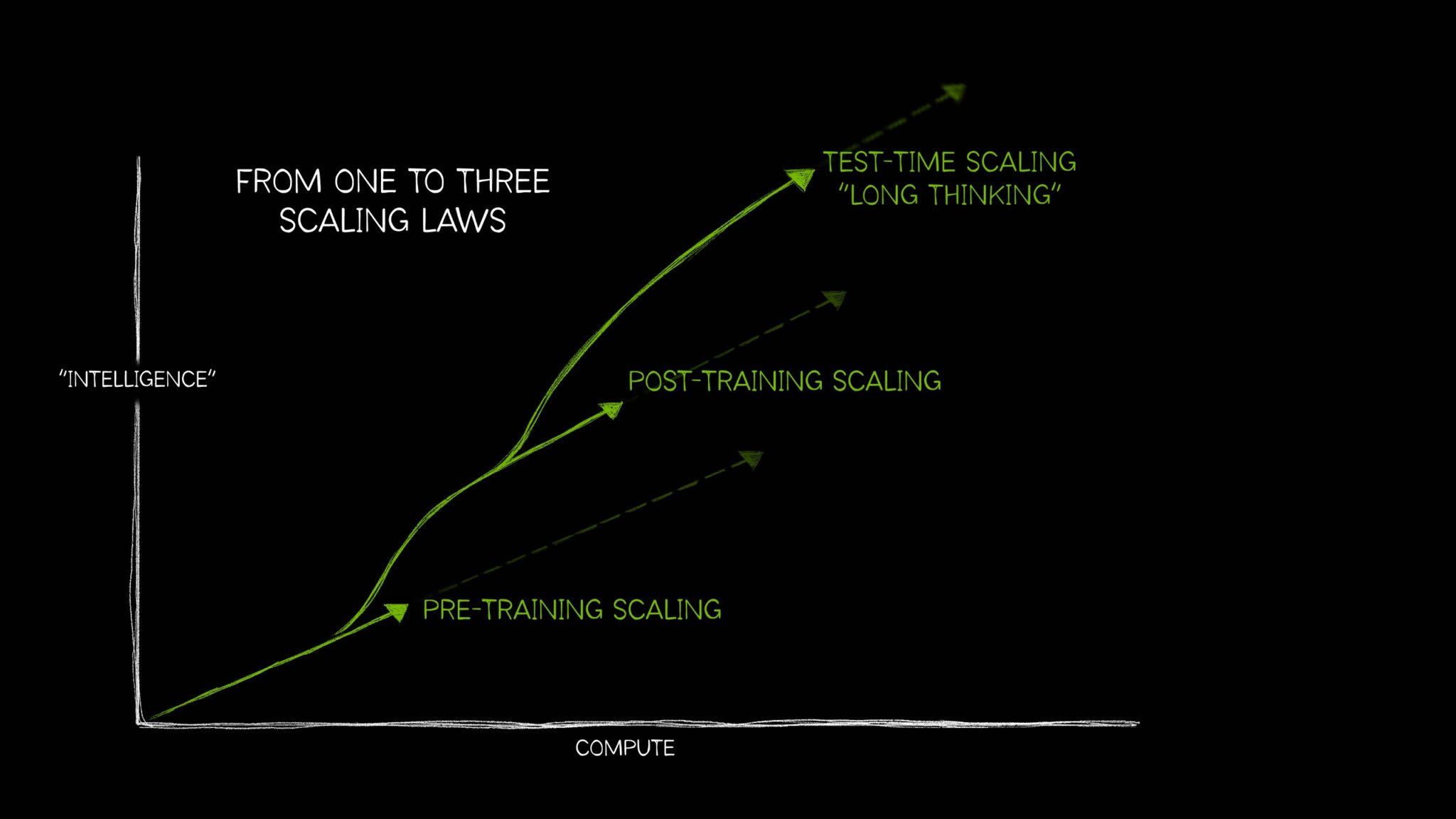
Just as there are widely understood empirical laws of nature — for example, what goes up must come down, or every action has an equal and opposite reaction — the field of AI was long defined by a single idea: that more compute, more training data and more parameters makes a better AI model.

However, AI has since grown to need three distinct laws that describe how applying compute resources in different ways impacts model performance. Together, these AI scaling laws — pretraining scaling, post-training scaling and test-time scaling, also called long thinking — reflect how the field has evolved with techniques to use additional compute in a wide variety of increasingly complex AI use cases.

The recent rise of test-time scaling — applying more compute at inference time to improve accuracy — has enabled AI reasoning models, a new class of large language models (LLMs) that perform multiple inference passes to work through complex problems, while describing the steps required to solve a task. Test-time scaling requires intensive amounts of computational resources to support AI reasoning, which will drive further demand for accelerated computing.

What Is Pretraining Scaling?

Pretraining scaling is the original law of AI development. It demonstrated that by increasing training dataset size, model parameter count and computational resources, developers could expect predictable improvements in model intelligence and accuracy.

Each of these three elements — data, model size, compute — is interrelated. Per the pretraining scaling law, outlined in this research paper, when larger models are fed with more data, the overall performance of the models improves. To make this feasible, developers must scale up their compute — creating the need for powerful accelerated computing resources to run those larger training workloads.

This principle of pretraining scaling led to large models that achieved groundbreaking capabilities. It also spurred major innovations in model architecture, including the rise of billion- and trillion-parameter transformer models, mixture of experts models and new distributed training techniques — all demanding significant compute.

What Is Post-Training Scaling?

Post-training is the process of refining a model to make it more accurate and relevant for a specific use case. This can be done using various techniques such as fine-tuning, pruning, quantization, distillation, reinforcement learning and synthetic data augmentation.

Pretraining a large foundation model isn’t for everyone — it takes significant investment, skilled experts and datasets. But once an organization pretrains and releases a model, they lower the barrier to AI adoption by enabling others to use their pretrained model as a foundation to adapt for their own applications.

What Is Test-Time Scaling?

Test-time scaling, also known as long thinking, takes place during inference. Instead of traditional AI models that rapidly generate a one-shot answer to a user prompt, models using this technique allocate extra computational effort during inference, allowing them to reason through multiple potential responses before arriving at the best answer.

This AI reasoning process can take multiple minutes, or even hours — and can easily require over 100x compute for challenging queries compared to a single inference pass on a traditional LLM.

How Test-Time Scaling Enables AI Reasoning

The rise of test-time compute unlocks the ability for AI to offer well-reasoned, helpful and more accurate responses to complex, open-ended user queries. These capabilities will be critical for the detailed, multistep reasoning tasks expected of autonomous agentic AI and physical AI applications.

In healthcare, models could use test-time scaling to analyze vast amounts of data and infer how a disease will progress, as well as predict potential complications that could stem from new treatments based on the chemical structure of a drug molecule. Or, it could comb through a database of clinical trials to suggest options that match an individual’s disease profile, sharing its reasoning process about the pros and cons of different studies.

Conclusion

Just as there are widely understood empirical laws of nature, the field of AI has evolved to need three distinct laws that describe how applying compute resources in different ways impacts model performance. By understanding and applying these laws, developers can unlock the potential of AI to drive innovation and improve lives.

FAQs

Q: What is pretraining scaling?
A: Pretraining scaling is the original law of AI development, which demonstrates that increasing training dataset size, model parameter count and computational resources can lead to predictable improvements in model intelligence and accuracy.

Q: What is post-training scaling?
A: Post-training scaling is the process of refining a model to make it more accurate and relevant for a specific use case, using techniques such as fine-tuning, pruning, quantization, distillation, reinforcement learning and synthetic data augmentation.

Q: What is test-time scaling?
A: Test-time scaling, also known as long thinking, is the process of allocating extra computational effort during inference to reason through multiple potential responses before arriving at the best answer.

Q: How does test-time scaling enable AI reasoning?
A: Test-time scaling enables AI to offer well-reasoned, helpful and more accurate responses to complex, open-ended user queries, which will be critical for the detailed, multistep reasoning tasks expected of autonomous agentic AI and physical AI applications.

Samsung Galaxy Tablet Prices Plummet in Early Presidents’ Day Deals

0

Presidents’ Day Samsung Galaxy Tab Deals

Big Savings on Samsung Galaxy Tablets

Presidents’ Day is just around the corner, and tech enthusiasts are in for a treat. Best Buy has rolled out some impressive deals on Samsung Galaxy tablets, including record-low prices on the Samsung Galaxy Tab S9+. Get ready to upgrade your mobile experience with these fantastic offers.

Best Samsung Galaxy Tab Deals Today

Not the right deal for you? Below, you’ll find the best deals and lowest prices on the Samsung Galaxy Tab S9+ in your region, updated 24/7.

What’s So Great About the Samsung Galaxy Tab S9+?

The Galaxy Tab S9+ boasts a stunning 12.4-inch AMOLED display and comes with the Samsung S Pen stylus included. This makes it an excellent choice for drawing, note-taking, and Android app usage, all without the hefty price tag of the newer model. You’ll also enjoy features like:

  • Galaxy AI: Photo assist, transcript assist, note assist, and Google’s circle-to-search function
  • 120Hz refresh rate for smooth gaming performance

We gave the larger Galaxy Tab 9 Ultra version four stars in our review, praising its comparable performance in a bigger package.

Conclusion

Don’t miss out on these fantastic Presidents’ Day deals on Samsung Galaxy tablets. Whether you’re a student, artist, or just a tech enthusiast, the Galaxy Tab S9+ is an excellent choice. With its impressive display, powerful features, and unbeatable price, this is an opportunity you won’t want to pass up.

FAQs

Q: Is the Galaxy Tab S9+ old technology?
A: Not quite. The Tab S9+ may have been superseded by newer models, but it’s still a great choice, especially considering the price.

Q: What are the key features of the Galaxy Tab S9+?
A: The Tab S9+ boasts a 12.4-inch AMOLED display, Samsung S Pen stylus, Galaxy AI features, and a 120Hz refresh rate.

Q: Can I use the Galaxy Tab S9+ for gaming?
A: Absolutely. The 120Hz refresh rate makes it an excellent choice for Android gaming.