Home Blog Page 319

Worst on Critical Bioweapons Data Safety Test

0

DeepSeek Competitor Raises Fears of Potential Bioweapon Information Generation

Concerns of Anthropic’s CEO
Dario Amodei, CEO of AI company Anthropic, has expressed worries about rival DeepSeek’s ability to generate rare information about bioweapons in a recent safety test.

DeepSeek’s Performance

DeepSeek generated bioweapon-related information despite being tested against a safety criterion set by Anthropic. In an interview, Amodei stated that the model’s performance was "the worst of basically any model we’d ever tested" and "had absolutely no blocks whatsoever against generating this information."

Security Concerns
Anthropic takes the safety and security of their models seriously. As part of their evaluations, they assess models’ potential to generate bioweapons-related information that is not easily found through a Google search or in textbooks. Amodei believes DeepSeek’s model might be generating such information in the near future, although not yet.

Industry Reaction and Government Bannings
Concerns about DeepSeek’s capabilities have sparked widespread concern in the industry. Several countries, companies, and government organizations, such as the US Navy and Pentagon, have begun banning DeepSeek due to potential national security risks. On the other hand, companies like AWS and Microsoft continue to integrate the model into their cloud platforms, despite the controversies.

CEO’s Advice

Amodei advises DeepSeek to take its AI safety concerns seriously, echoing concerns about its data being sent back to China. He emphasized that while the company’s R1 model may not be a current threat, it could pose risks in the future.

Comparison to Competitors

When asked about the potential impact on the industry, Amodei stated that he considers DeepSeek a new competitor, on the level of major US AI companies such as OpenAI, Meta, and xAI.

Conclusion

Amodei’s concerns highlight the potential risks posed by DeepSeek’s capabilities and the importance of ensuring AI model safety. It remains to be seen whether concerns like these will make a dent in DeepSeek’s rapid adoption and whether global efforts to ban the model will succeed.

Frequently Asked Questions

  • What concerns does Anthropic’s CEO Dario Amodei have about DeepSeek?
    Amodei is concerned that DeepSeek’s model, R1, is capable of generating rare bioweapons-related information, and that it lacks adequate safety protocols to prevent such generation.
  • Has Anthropic tested any other AI models for similar safety concerns?
    Yes, as part of its evaluations, Anthropic assesses other AI models’ potential to generate bioweapons-related information and takes corrective measures to address these concerns.
  • How do other major AI companies in the US, such as Meta and OpenAI, view the concerns about DeepSeek?
    While Meta’s Llama-3.1-405B and OpenAI’s GPT-4o models also generated harmful information, the companies involved have not expressed concerns about potential national security risks, unlike Amodei at Anthropic.
  • How many countries or government organizations have banned DeepSeek?
    The exact number of countries or organizations banning DeepSeek is unclear; however, government agencies such as the US Navy and Pentagon have begun restricting access to the model.

Supercharging Your Docker Workflow with Ask Gordon

The Struggle of Managing Docker Efficiently

Working with Docker can be a breeze—but let’s be honest, it also comes with its fair share of challenges. Whether it’s troubleshooting a stubborn container, optimizing your Dockerfiles, or figuring out the best way to run an image, you often find yourself sifting through documentation, Stack Overflow, and random GitHub issues.

Meet Ask Gordon – Your AI Assistant for Docker

Docker has introduced Ask Gordon, an AI-powered assistant embedded directly into Docker Desktop and the Docker CLI. Think of it as your personal Docker guru, ready to help troubleshoot issues, optimize configurations, and streamline your workflow—all without leaving your terminal or Docker UI.

What Can Ask Gordon Do?

Provide contextual help for errors and troubleshooting
Optimize Dockerfiles for performance and security
Offer best practices for running and managing containers
Analyze your images and suggest improvements

Getting Started with Ask Gordon

Requires: Docker Desktop 4.38.0 or later

Step 1: Enable Ask Gordon in Docker Desktop

  1. Sign in to Docker Desktop
  2. Enable the Feature
    • Navigate to Settings > Features in Development
    • Check the Enable Docker AI box
    • Accept the terms and click Apply & Restart

Step 2: Using Ask Gordon in Docker Desktop

Once enabled, Ask Gordon will be accessible via:
The Ask Gordon chat window in Docker Desktop
Various parts of the UI (whenever you see the sparkles icon)

Step 3: Using Ask Gordon in the CLI

Prefer working in the terminal? No problem! You can use Ask Gordon directly from the command line:

docker ai "Can you optimize my Dockerfile?"

Example Workflows with Ask Gordon

Troubleshooting a Crashed Container

Ever had a container fail to start with a cryptic error message? Instead of Googling for hours, just ask Gordon!

Running PostgreSQL Without a Password

docker run postgres
Error: Database is uninitialized and superuser password is not specified.
You must specify POSTGRES_PASSWORD to a non-empty value.

Final Thoughts: Why You Should Try Ask Gordon Today

Docker’s Ask Gordon AI assistant takes the guesswork out of container management. Whether you’re troubleshooting errors, optimizing Dockerfiles, or just getting started with a new image, Gordon streamlines your workflow and saves you valuable time.

Why It’s a Game-Changer

Saves time – No more endless Googling for answers.
Context-aware – Gordon understands your Docker setup.
Enhances productivity – Focus on coding, not debugging.
Integrated into Docker Desktop & CLI – No extra tools needed.

Ask Gordon is still in Beta, but it’s already proving to be an invaluable tool for Docker users. Give it a try today and supercharge your Docker workflow!

FAQs

Q: Is Ask Gordon available for all Docker users?
A: Yes, Ask Gordon is available for all Docker users with Docker Desktop 4.38.0 or later.

Q: How do I enable Ask Gordon in Docker Desktop?
A: Follow the steps outlined in Step 1: Enable Ask Gordon in Docker Desktop.

Q: Can I use Ask Gordon in the Docker CLI?
A: Yes, you can use Ask Gordon directly from the command line.

Q: Is Ask Gordon available for non-English users?
A: Yes, Ask Gordon is available in multiple languages, including English, Spanish, French, German, Italian, Portuguese, and many more.

Q: Can I provide feedback on Ask Gordon?
A: Yes, Docker is actively seeking feedback on Ask Gordon. Share your thoughts and suggestions through the Docker Community Forum or the Ask Gordon feedback channel.

Built to Last

0

Velocity Micro Vector Z35 Review

Key Specifications

Specification Details
CPU Intel Core i5-14400 Processor, 10-core @ (6P+4E) @ 2.5GHz (4.7GHz Turbo), 16 Threads, 20MB Cache w/iGPU
Graphics Built-into CPU
Memory 16GB
Storage 1TB M.2 SSD, 4TB HDD
Ports 9 USB-A, 2 USB-C, audio in/out (3.5mm), ethernet
Wireless connectivity Wifi
Dimensions 12"H x 17.5"D x 7.6"W

Design & Build

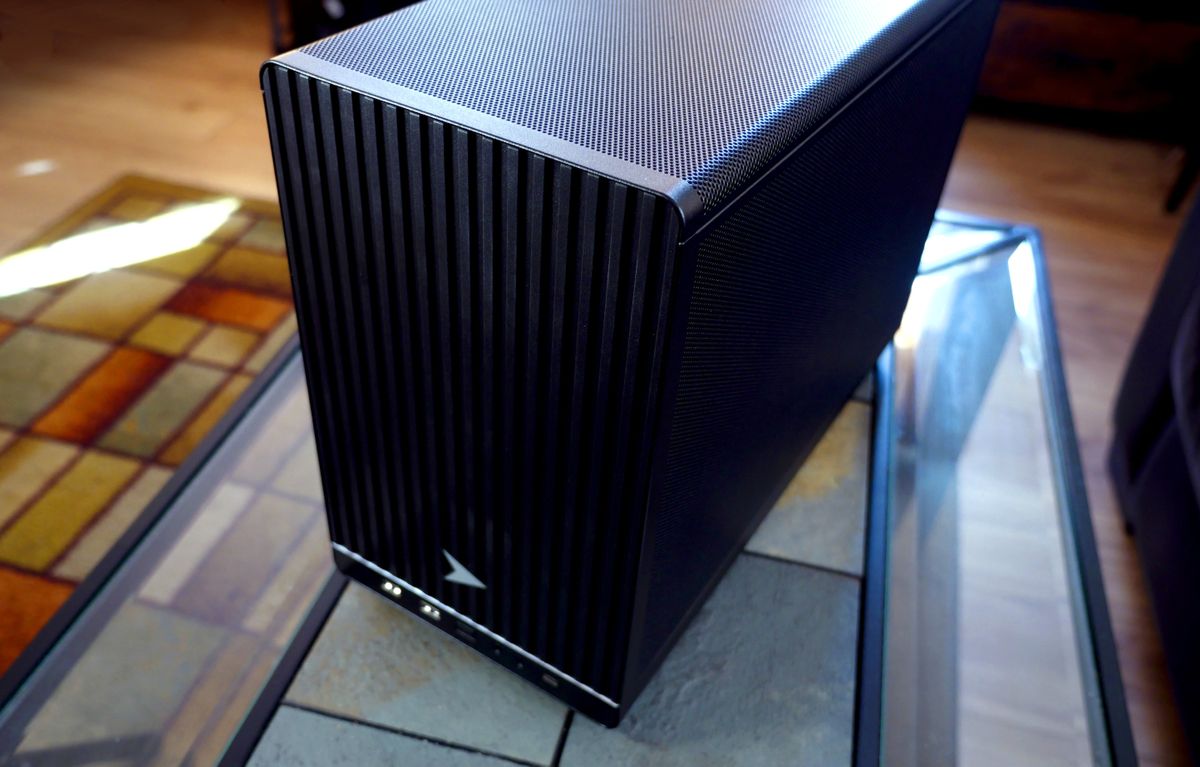
  • Metal Mesh
  • Substantial weight
  • Amazingly quiet

Performance

The Velocity Micro Vector Z35 is a high-quality computer that is designed to meet the needs of a wide range of users, including gamers and professionals. In our tests, we found that the computer performed well in CPU-intensive tasks, but was lacking in GPU performance.

Price

The current pricing for the Velocity Micro Vector Z35 is $1,449US (£1,164 GBP). While the specs can certainly be found for less, an equal build with well-known components would be harder to find for significantly less cost.

Value

The Velocity Micro Vector Z35 is a well-designed computer that offers good value for its price. However, it is important to note that the computer is pricey, and may not be the best option for those on a tight budget.

Who is it for?

The Velocity Micro Vector Z35 is a good option for those who need a reliable and quiet computer for general use, such as browsing the web, checking email, and running office applications. It is also a good option for those who need a computer for video editing, graphic design, and other creative tasks.

Conclusion

The Velocity Micro Vector Z35 is a high-quality computer that offers good value for its price. While it may not be the best option for those who need a powerful GPU, it is a good option for those who need a reliable and quiet computer for general use.

FAQs

Q: Is the Velocity Micro Vector Z35 a good option for gaming?
A: The Velocity Micro Vector Z35 is not a good option for gaming, as it does not have a powerful GPU.

Q: Is the Velocity Micro Vector Z35 a good option for video editing and graphic design?
A: The Velocity Micro Vector Z35 is a good option for video editing and graphic design, as it has a powerful CPU and plenty of storage.

Q: Is the Velocity Micro Vector Z35 a good option for those on a tight budget?
A: The Velocity Micro Vector Z35 is not a good option for those on a tight budget, as it is a pricey computer.

Q: Does the Velocity Micro Vector Z35 have a good cooling system?
A: Yes, the Velocity Micro Vector Z35 has a good cooling system, as it is designed to keep the computer running quietly and efficiently.

Unlocking Insights with HPC, Big Data, and AI

GenAI and HPC: A Virtuous Cycle

What about HPC?

Aside from making GPUs scarce and expensive (even in the cloud), these rapid changes have suggested many questions in the HPC community. For instance:

  • How can HPC leverage GenAI? (Can it?)
  • How does it fit with traditional HPC tools and applications?
  • Can GenAI write code for HPC applications?
  • Can GenAI reason about Science and Technology?

Answers to these and other questions are forthcoming. Many organizations are working on these issues, including the Trillion Parameter Consortium (TPC) — Generative AI for Science and Engineering.

Maybe more data will help

The "intelligence" of the initial LLMs was improved by including more data. As a result, models became bigger, requiring more resources and computation time. As measured by some emerging benchmarks, the "smartness" of the models did improve, but there is an issue with this approach. Scaling models means finding more data, and in a simple sense, the model makers have already scraped a large amount of the internet into their models.

The Virtuous Cycle

The Virtuous Cycle is a continuous cycle of discovery, innovation, and improvement, perpetually propelling itself forward. This cycle is not merely a conceptual framework, but is actively reshaping the digital research environment.

The new HPC accelerator

HPC is constantly looking for ways to accelerate performance. While not a specific piece of hardware or software, the Virtuous AI Cycle viewed as a whole is a massive acceleration leap for science and technology. And we are at the beginning of adoption.

Conclusion

The Virtuous Cycle for scientific and technical computing is a powerful accelerator that will reshape the digital research environment. As research organizations embrace and understand AI, they start to realize the benefits of a continuous cycle of discovery, innovation, and improvement, perpetually propelling themselves forward.

FAQs

Q: What is the Virtuous Cycle?
A: The Virtuous Cycle is a continuous cycle of discovery, innovation, and improvement, perpetually propelling itself forward.

Q: How does the Virtuous Cycle work?
A: The Virtuous Cycle works by creating a positive feedback loop, where improvements lead to more usage, which in turn fuels further enhancements.

Q: What are the benefits of the Virtuous Cycle?
A: The benefits of the Virtuous Cycle include positive feedback loops, network effects, and strategic assets.

Q: How does HPC fit into the Virtuous Cycle?
A: HPC is a key component of the Virtuous Cycle, providing the necessary infrastructure for training, inference, and prediction.

Q: What is the future of the Virtuous Cycle?
A: The future of the Virtuous Cycle is uncertain, but it is likely to continue to accelerate scientific and technical computing, leading to new breakthroughs and innovations.

PlayStation Network Down

0

PlayStation Network (PSN) Experiences Multi-Hour Outage

Outage Widespread and Growing

PlayStation Network (PSN) has been experiencing a multi-hour outage that started on Friday evening. According to Sony’s PSN status page, account management, gaming and social, PlayStation Video, PlayStation Store, and the PlayStation Direct website are all dealing with issues.

Gaming Services Affected

For gaming specifically, Sony says that "you might have difficulty launching games, apps, or network features." Around the time I first published this article at 7:28PM ET, a colleague wasn’t able to load their purchased digital games or see their friends, trophies, or even their online status on their PS5. Sony is vowing to fix the problems "as soon as possible."

Outage Timeline

Sony’s status website says the issues started at 7PM ET, but Downdetector shows user reports starting to come in about an hour earlier at around 6PM ET. At the peak, there were a bit less than 70,000 reports of problems on Downdetector. An r/PlayStation thread about the outage has more than 7,000 comments.

Sony’s Response

Sony didn’t immediately reply to a request for comment.

Update, February 7th

Added @AskPlayStation’s tweet and noted that the outage has been going on for hours.

Frequently Asked Questions

Q: What services are affected by the outage?
A: Account management, gaming and social, PlayStation Video, PlayStation Store, and the PlayStation Direct website.

Q: What are the symptoms of the outage?
A: Users may experience difficulty launching games, apps, or network features.

Q: How long has the outage been going on?
A: The outage started at around 6PM ET and is ongoing.

Q: Has Sony commented on the issue?
A: No, Sony has not yet replied to a request for comment.

Gemini Can Now Watch YouTube for You

Gemini Flash 2.0 Upgrades with YouTube Video Analysis Capabilities

New Feature: Watch YouTube Videos, Get Key Information, and Answer Follow-up Questions

Gemini Flash 2.0, which debuted just last week, has already received an upgrade that allows users to analyze YouTube videos, extract important parts, and even answer follow-up questions. This feature is particularly useful for those who use YouTube as a resource for cooking, home repairs, crafting, or research.

How it Works

To analyze a YouTube video with Gemini, simply paste the video’s link into the platform. Users can ask specific questions, such as a list of ingredients for a recipe or a list of supplies for a DIY craft, ask for a general summary or key idea, or get a transcript of what the speaker is saying. Gemini will pull from both the video itself and the video description to provide the requested information.

Results

To test the feature, the author fed Gemini a YouTube link showing how to do a home repair and asked it to break the video down into step-by-step instructions. Gemini responded with its own six-step plan and a little explanation for each. While the results were not perfect, Gemini was able to provide a useful summary of the video.

Limitations

However, the author did encounter some limitations. When asked to translate a video recipe into a written recipe, Gemini provided the ingredients and process but did not give actual amounts for the ingredients. When asked to provide the amounts, Gemini said it couldn’t and offered up a similar recipe it found online.

Research Capabilities

To test the research capabilities, the author found a Yale University lecture that was a little over an hour long. Gemini provided a summary of the lecture, an outline summary, and even answered follow-up questions. The author felt like they had a great grasp on the class after reading the summary and outline, which took less than five minutes to read.

Conclusion

This new feature has the potential to be an incredibly useful tool that lets users utilize YouTube as a resource without sitting through an entire video. The feature is available on both web-based Gemini and the app, and it’s accessible even for free users.

FAQs

Q: What is Gemini Flash 2.0?
A: Gemini Flash 2.0 is an upgraded version of the Gemini platform that allows users to analyze YouTube videos, extract important parts, and answer follow-up questions.

Q: How do I use the YouTube video analysis feature?
A: Simply paste the video’s link into Gemini and ask specific questions, such as a list of ingredients for a recipe or a list of supplies for a DIY craft, ask for a general summary or key idea, or get a transcript of what the speaker is saying.

Q: Is the feature available on both web-based Gemini and the app?
A: Yes, the feature is available on both web-based Gemini and the app.

Q: Is the feature available for free users?
A: Yes, the feature is accessible even for free users.

Anduril Close to $28 Billion Valuation

0

Anduril Secures $28 Billion Valuation in New Funding Round

Anduril, an artificial intelligence military start-up, is poised to complete a new round of funding that will double the value of the company to $28 billion, according to four people familiar with the negotiations.

Funding Details

The funding round, led by Founders Fund and not yet closed, is raising up to $2.5 billion, with Founders Fund alone planning to invest $1 billion, the largest check ever written by the firm. The funding round follows a previous raise of $1.5 billion at a $14 billion valuation six months ago.

About Anduril

Anduril designs and builds autonomous systems and weapons for the military and other government agencies, including flying drones, missiles, underwater vessels, and surveillance equipment for monitoring national borders and the battlefield. The company is one of a new wave of companies building systems based on A.I. technologies for the government.

Founders Fund Backing

Founders Fund, started by entrepreneur and investor Peter Thiel, has backed Anduril since its start in 2017. One of Anduril’s co-founders, Trae Stephens, is a partner at the firm. Thiel, who also co-founded Palantir, a military technology company, has long been a backer of Republican candidates, including President Trump in 2016 and JD Vance’s run for Senate in 2022.

Defense Technology Start-Ups

The latest influx of cash comes as defense technology start-ups are ebullient about their prospects. Enthusiasm for building technology for the U.S. military has grown in recent years in Silicon Valley, a reversal from more than a decade of shying away from those contracts. As recently as 2018, thousands of employees at Google signed a letter protesting the company’s military contracts. That resistance has slowly shifted, as more venture capital firms pour money into the sector.

Mr. Trump’s Support

Anduril’s founder, Palmer Luckey, has supported the president since his 2016 campaign. He donated to Trump’s campaigns in the 2016, 2020, and 2024 elections, and has hosted fund-raisers. Luckey posted a meme celebrating Trump’s victory on the night of the presidential election in November 2020. Elon Musk, the tech executive and a close adviser to the president, responded, saying it was “very important to open DoD/Intel to entrepreneurial companies like yours.”

Future Plans

In January, Luckey and Anduril announced plans to build a $1 billion factory in Ohio that they said would eventually produce tens of thousands of autonomous systems and weapons each year.

Conclusion

Anduril’s successful funding round reflects the growing interest in defense technology start-ups and the company’s potential to make a significant impact in the military sector. The company’s founders have strong connections to the Republican party, and its success could be seen as a boon for the party.

FAQs

Q: Who is Anduril?

A: Anduril is an artificial intelligence military start-up that designs and builds autonomous systems and weapons for the military and other government agencies.

Q: What is the new funding round valued at?

A: The funding round is valued at $28 billion, double the company’s previous valuation of $14 billion.

Q: Who is backing the funding round?

A: The funding round is led by Founders Fund, with a $1 billion investment from the firm. Other investors are expected to join the round.

Q: What kind of technology does Anduril develop?

A: Anduril develops autonomous systems and weapons, including flying drones, missiles, underwater vessels, and surveillance equipment.

Krea AI Chat: Open Beta + Pika Pikaddition VIDEO AI

0

Introducing Krea AI Chat and Pika Pikaddition: The Future of AI-Generated Content

Krea AI Chat: A Revolutionary AI Tool for Creating Images and Videos

Krea AI Chat, an innovative AI-powered platform, has recently entered open beta, and it’s changing the game for content creators. With Krea AI Chat, you can generate stunning images and videos by talking to the AI. This revolutionary tool allows you to create unique and captivating visuals by simply conversing with the AI. The possibilities are endless, from generating custom artwork to creating stunning videos.

Pika Pikaddition: A Game-Changer for Video Editing

Pika Pikaddition is another exciting tool from the same creators of Krea AI Chat. This video AI tool allows you to put any character or object into an existing video. With Pika Pikaddition, you can add a new dimension to your videos by seamlessly integrating characters, objects, or even yourself into the scene. The results are breathtaking, and the possibilities are endless.

How it Works

To get started with Krea AI Chat, simply visit their website and start conversing with the AI. You can describe the image or video you want to create, and the AI will generate it for you. For Pika Pikaddition, upload your video and select the character or object you want to add. The AI will seamlessly integrate it into the video, and you’ll be left with a stunning result.

Join the Krea AI Community

If you’re as excited about these tools as we are, join the Krea AI community to stay updated on the latest developments and learn more about their features. You can also support me, the author, by joining my Facebook Group, Discord Group, and Patreon.

Conclusion

Krea AI Chat and Pika Pikaddition are game-changers in the world of AI-generated content. With these tools, the possibilities are endless, and the possibilities for creativity are limitless. Whether you’re a content creator, artist, or simply someone who loves experimenting with AI, these tools are definitely worth checking out. So, what are you waiting for? Join the Krea AI community and start creating today!

FAQs

Q: What is Krea AI Chat?
A: Krea AI Chat is a platform that allows users to generate images and videos by talking to the AI.

Q: How does Pika Pikaddition work?
A: Pika Pikaddition is a video AI tool that allows users to add characters or objects into existing videos.

Q: Is Krea AI Chat available for free?
A: Krea AI Chat is currently in open beta, and access is free. However, please note that this may change in the future.

Q: Can I use Pika Pikaddition for commercial purposes?
A: Yes, Pika Pikaddition is intended for commercial use. However, please review the terms of service before using it for commercial purposes.

Q: How do I stay updated on the latest developments from Krea AI?
A: Join the Krea AI community, my Facebook Group, Discord Group, and Patreon to stay updated on the latest news and features.

NVIDIA Blackwell Boosts AI Performance and Programmability

0

Performance Advances on NVIDIA Blackwell

The NVIDIA Blackwell architecture introduces substantial improvements in both raw computing power and architectural innovations. NVIDIA’s collaboration with OpenAI has focused on leveraging these capabilities transparently through Triton’s compiler infrastructure, particularly in two key areas: matrix multiplications and new precision formats.

Matrix Multiplications

The NVIDIA Blackwell architecture adds a brand-new Tensor Core designed from the ground up for improved throughput and energy efficiency. By extending Triton’s Matrix Multiply-Accumulate (MMA) pipelining machinery, we’ve enabled automatic exploitation of NVIDIA Blackwell’s new Tensor Cores. This required careful analysis of memory access patterns and sophisticated compiler transformations to ensure correct and efficient compute/data-movement overlap.

The result is exceptional performance for both FP8 and FP16 GEMM operations out of the box, with these optimizations automatically applying to any kernel using Triton’s tl.dot primitive. Overall, Triton manages to achieve near-optimal performance, comparable to library implementations across several critical use cases.

Figure 1. Performance improvements with Triton on NVIDIA Blackwell

Flash Attention

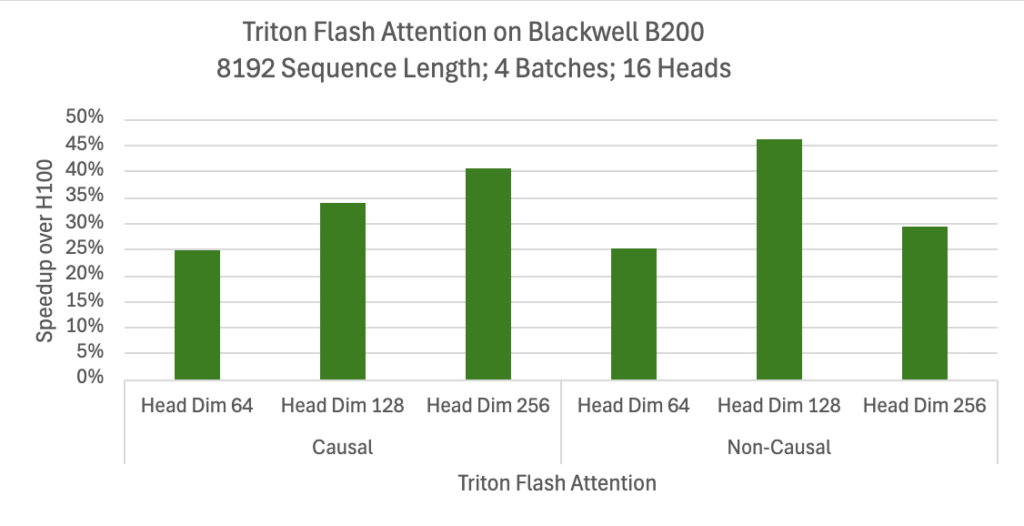
Flash attention, a crucial primitive in modern transformer architectures, sees significant speedups on NVIDIA Blackwell through Triton, with up to 1.5x for FP16 attention over the NVIDIA Hopper GPU architecture. While we continue to optimize absolute performance through ongoing compiler enhancements on FP8 and other precisions, the current work helps customers readily transition to NVIDIA Blackwell on Day 0 for existing products. Another important aspect to note here is the ability to deliver this performance gain “for free” with existing Triton flash attention implementations, requiring no code changes.

A bar chart shows flash attention performance for NVIDIA Blackwell compared to NVIDIA Hopper.

Figure 2. Large performance gains for more complex workloads

New Precision Formats

NVIDIA Blackwell introduces revolutionary block-scaled floating point formats, including the Open Computing Project’s microscaling formats, which Triton now unlocks for NVIDIA Blackwell-powered hardware acceleration. These formats provide higher average precision at higher performance than the non-native block-scaling techniques emulated frequently in LLM inference projects today. For OCP format support, MXFP8 GEMMs on Triton showcase exceptional performance similar to the FP8 GEMMs performance accelerated and shown earlier in this post, while natively allowing for scaling in the Tensor Core. Similarly, MXFP4 provides a new operating point in the precision-performance trade-off space but while offering double the hardware-accelerated performance of FP8 and MXFP8 GEMMs.

To learn more about the new block-scaled floating point support, take a look at the new Triton tutorial dedicated to this functionality.

Areas of Improvement Going Forward

The layout and packing of sub-byte datatype formats like MXFP4 still require care by the end user. We look forward to working with the community to improve the ergonomics for kernel authors and seamless framework integrations.

More Information

Phillippe Tillet, the creator of Triton, and NVIDIA will be diving into the details of this NVIDIA Blackwell work and the resulting performance at the NVIDIA GTC conference on March 17.

Register to attend GTC 2025 virtually or attend live.

This release establishes a powerful foundation for NVIDIA Blackwell support in Triton—but it’s just the beginning. Here’s how you can help shape what’s next:

Start building with Triton on NVIDIA Blackwell today and unlock the full potential of NVIDIA’s latest architecture while maintaining complete control over your development.

Have ideas or encountered issues? Contact our NVIDIA product manager Matthew Nicely by tagging him on GitHub.

FAQs

Q: What are the key benefits of Triton on NVIDIA Blackwell?
A: Triton on NVIDIA Blackwell provides exceptional performance for both FP8 and FP16 GEMM operations, with automatic exploitation of NVIDIA Blackwell’s new Tensor Cores.

Q: How does Triton improve performance for flash attention?
A: Triton’s flash attention performance on NVIDIA Blackwell achieves up to 1.5x speedup for FP16 attention over NVIDIA Hopper GPU architecture.

Q: What are the new precision formats supported by Triton on NVIDIA Blackwell?
A: Triton on NVIDIA Blackwell supports revolutionary block-scaled floating point formats, including Open Computing Project’s microscaling formats, providing higher average precision at higher performance than non-native block-scaling techniques.

Q: How can I get started with Triton on NVIDIA Blackwell?
A: Start building with Triton on NVIDIA Blackwell today and unlock the full potential of NVIDIA’s latest architecture while maintaining complete control over your development.

Security Firm Discovers Direct Links to Chinese Government Servers

What is DeepSeek?

Founded by Liang Wenfeng in May 2023, the Chinese startup has challenged established AI companies with its open-source approach. According to Forbes, DeepSeek’s edge may lie in the fact that it is funded only by High-Flyer, a hedge fund also run by Wenfeng, which gives the company a funding model that supports fast growth and research.

What is DeepSeek R1?

Released in full on January 21st, R1 is DeepSeek’s flagship reasoning model, which performs at or above OpenAI’s lauded o1 model on several math, coding, and reasoning benchmarks. Built on V3 and based on Alibaba’s Qwen and Meta’s Llama, what makes R1 interesting is that, unlike most other top models from tech giants, it’s open source, meaning anyone can download and use it.

Privacy and Security Red Flags

Data privacy worries that have circulated on TikTok are also cropping up around DeepSeek. On Wednesday, Ivan Tsarynny, CEO of Feroot Security, told ABC that his firm had discovered "direct links to servers and to companies in China that are under control of the Chinese government," which he said they "have never seen in the past."

Safety Concerns

AI safety researchers have long been concerned that powerful open-source models could be applied in dangerous and unregulated ways once out in the wild. Tests by AI safety firm Chatterbox found DeepSeek R1 has "safety issues across the board."

Energy Efficiency Claims

Some analysts note that DeepSeek’s lower-lift compute model is more energy efficient than that of US AI giants. "DeepSeek’s new AI model likely does use less energy to train and run than larger competitors’ models," said Slattery. "However, I doubt this marks the start of a long-term trend in lower energy consumption."

How Will DeepSeek Affect the AI Industry?

R1’s success highlights a sea change in AI that could empower smaller labs and researchers to create competitive models and diversify the options. For example, organizations without the funding or staff of OpenAI can download R1 and fine-tune it to compete with models like o1.

Conclusion

DeepSeek’s ascent comes at a critical time for Chinese-American tech relations, just days after the long-fought TikTok ban went into partial effect. The US Navy has already banned DeepSeek, and lawmakers are trying to ban the app from all government devices.

FAQs

Q: What is DeepSeek?
A: DeepSeek is a Chinese AI startup that has challenged established AI companies with its open-source approach.

Q: What is DeepSeek R1?
A: DeepSeek R1 is the company’s flagship reasoning model, which performs at or above OpenAI’s lauded o1 model on several math, coding, and reasoning benchmarks.

Q: Are there privacy concerns with DeepSeek?
A: Yes, there are concerns about data privacy and security with DeepSeek, including direct links to servers and companies in China that are under control of the Chinese government.

Q: Are there safety concerns with DeepSeek?
A: Yes, AI safety researchers have long been concerned that powerful open-source models could be applied in dangerous and unregulated ways once out in the wild.

Q: Is DeepSeek’s energy efficiency a game-changer?
A: Some analysts note that DeepSeek’s lower-lift compute model is more energy efficient than that of US AI giants, but it’s unclear if this marks the start of a long-term trend in lower energy consumption.

Q: How will DeepSeek affect the AI industry?
A: DeepSeek’s success highlights a sea change in AI that could empower smaller labs and researchers to create competitive models and diversify the options.