Home Blog Page 345

AI Chatbot’s Safety Guardrails Failed Every Test

0

Jailbreaks in AI Models: A Growing Concern

The Persistence of Jailbreaks

Jailbreaks in AI models, such as DeepSeek’s R1, are a growing concern in the field of artificial intelligence. According to Alex Polyakov, CEO of security firm Adversa AI, "eliminating them entirely is nearly impossible—just like buffer overflow vulnerabilities in software (which have existed for over 40 years) or SQL injection flaws in web applications (which have plagued security teams for more than two decades)".

Amplified Risks with AI Adoption

Cisco’s Sampath argues that as companies use more types of AI in their applications, the risks are amplified. "It starts to become a big deal when you start putting these models into important complex systems and those jailbreaks suddenly result in downstream things that increase liability, increase business risk, increase all kinds of issues for enterprises," Sampath says.

Testing and Results

The Cisco researchers drew their 50 randomly selected prompts to test DeepSeek’s R1 from a well-known library of standardized evaluation prompts known as HarmBench. They tested prompts from six HarmBench categories, including general harm, cybercrime, misinformation, and illegal activities. They probed the model running locally on machines rather than through DeepSeek’s website or app, which send data to China.

Comparison with Other Models

Cisco also included comparisons of R1’s performance against HarmBench prompts with the performance of other models. And some, like Meta’s Llama 3.1, faltered almost as severely as DeepSeek’s R1. But Sampath emphasizes that DeepSeek’s R1 is a specific reasoning model, which takes longer to generate answers but pulls upon more complex processes to try to produce better results. Therefore, Sampath argues, the best comparison is with OpenAI’s o1 reasoning model, which fared the best of all models tested.

Bypassing Restrictions

Polyakov, from Adversa AI, explains that DeepSeek appears to detect and reject some well-known jailbreak attacks, saying that "it seems that these responses are often just copied from OpenAI’s dataset." However, Polyakov says that in his company’s tests of four different types of jailbreaks—from linguistic ones to code-based tricks—DeepSeek’s restrictions could easily be bypassed.

Conclusion

Jailbreaks in AI models are a persistent problem that requires ongoing attention and testing. As AI adoption continues to grow, it is crucial for companies to implement robust security measures to prevent and detect these attacks. As Polyakov notes, "every model can be broken—it’s just a matter of how much effort you put in. Some attacks might get patched, but the attack surface is infinite. If you’re not continuously red-teaming your AI, you’re already compromised."

FAQs

Q: What are jailbreaks in AI models?
A: Jailbreaks are a type of attack that allows an attacker to bypass the restrictions and limitations of an AI model, allowing them to access sensitive information or execute malicious code.

Q: How common are jailbreaks?
A: Jailbreaks are a persistent problem that has existed for decades, similar to buffer overflow vulnerabilities in software or SQL injection flaws in web applications.

Q: Can any AI model be broken?
A: Yes, according to Polyakov, every AI model can be broken, it’s just a matter of how much effort an attacker puts in. Some attacks might get patched, but the attack surface is infinite.


Compiling 2025: DEV Community

Introduction

When starting a new year, we often write down lists of resolutions to try and improve ourselves and our lives.

Working as a Software Engineer, having goals and things to create and aspire to is really important, to keep up with the many changes in the area and to have our career journey polished.

This is my current list for this year that just began.


Roadmap for 2025

🔜 Short-term goals: (6-8 months)

  • Improve React Native knowledge

    Keep building, breaking, and fixing things to get better at React Native. Experiment with new patterns and best practices to solidify my skills.

    Measure of Success: Successfully build and deploy at least one side project or significant features using advanced React Native concepts. Be able to explain complex topics to others with confidence.

  • Be the owner of a major feature in my full-time work project

    Take full responsibility for a key feature, from planning to production. Make sure it’s well-architected, scalable, and impactful for users.

    Measure of Success: Deliver a full-fledged feature with minimal supervision, receive positive feedback from both users and teammates, and document the process clearly for future reference.

  • Reduce tech debt significantly and work on accessibility

    Clean up outdated code and improve maintainability without slowing down development. Push for better accessibility so the product is more inclusive for everyone.

    Measure of Success: Successfully refactor at least two major legacy components and improve accessibility compliance scores (e.g., WCAG). Get recognition from QA or users for making the app more inclusive.

  • Bring fresh, disruptive perspectives and big-picture thinking

    Challenge existing assumptions and introduce innovative ideas. Keep a strategic mindset and think beyond just code—consider business impact and user experience.

    Measure of Success: Propose and implement at least one major improvement that positively impacts performance, developer experience, or user engagement. Be recognized as someone who brings valuable insights to discussions.

  • Be a speaker at conferences and share knowledge with the team

    Step up as a speaker to share insights and experiences with the dev community. Actively mentor teammates and help spread technical knowledge within the team.

    Measure of Success: Give at least one talk at a conference or internal event. Have teammates apply my teachings and ask for more knowledge-sharing sessions.

🕔 Long-term goals: (8-12 months)

  • Reach Senior level in my career

    Become a trusted expert and key decision-maker in the team. Take on more complex challenges and mentor others along the way.

    Measure of Success: Get officially promoted to Senior Engineer or be recognized as one through responsibilities and leadership. Have a clear impact on technical decisions.

  • Learn new skills: NodeJS, Docker, Kubernetes

    Expand my backend and DevOps knowledge to be a more well-rounded engineer. Gain hands-on experience with these tools to improve scalability and deployment strategies.

    Measure of Success: Conclude a couple of courses on these technologies and implement something valuable using them.

  • Guide new joiners and juniors, explore team leadership

    Help newcomers get up to speed and foster a supportive learning environment. Understand the responsibilities of leadership and how to manage a team effectively.

    Measure of Success: Successfully onboard at least one new teammate and receive positive feedback on guidance. Lead a project or process that requires coordination across the team.

  • Contribute more to open-source projects

    Give back to the developer community by fixing bugs, adding features, and improving documentation. Learn from experienced contributors and collaborate with developers worldwide.

    Measure of Success: Have multiple merged pull requests in at least one major open-source project. Be recognized as an active contributor in an open-source community.

Some important soft skills to keep developing:

  • Emotional intelligence for everyday work

    Stay calm, patient, and empathetic, even in stressful situations. Build strong relationships with colleagues by understanding different perspectives.

    Measure of Success: Maintain good relationships with teammates and receive positive feedback on communication and collaboration. Feel more in control of emotions during high-pressure situations.

  • Growth mentality

    Always look for ways to improve and never settle for “good enough.” Treat challenges as opportunities to learn rather than obstacles.

    Measure of Success: Regularly take on tasks outside my comfort zone and reflect on key learnings. Show continuous improvement in skills and mindset over time.

  • Embrace uncertainty and let go of anxiety about it

    Accept that not everything will be predictable, and that’s okay. Focus on adapting, staying flexible, and making the best decisions with the information available.

    Measure of Success: Feel noticeably less stressed in uncertain situations and approach challenges with a problem-solving mindset. Receive feedback on being a steady, adaptable team member.

Conclusion

Setting goals is one thing, but staying accountable is what truly drives progress. I’d love to hear from you—what are your short-term and long-term goals? Drop them in the comments or share your thoughts! Let’s keep each other motivated and on track. If you’re working on similar objectives, let’s connect, exchange insights, and push forward together.

FAQs

Q: How do you plan to measure success for these goals?

A: Each goal has a clear measure of success outlined, whether it’s a specific deliverable, a metric to track, or a feeling to cultivate (e.g., confidence, patience, or adaptability).

Q: How do you plan to achieve these goals?

A: I plan to achieve these goals by setting aside dedicated time for learning, practicing, and working on side projects. I’ll also make sure to collaborate with others, seek feedback, and stay accountable through regular check-ins.

Q: What are some potential roadblocks or challenges you might face in achieving these goals?

A: Some potential roadblocks I might face include self-doubt, imposter syndrome, and the fear of not being good enough. I’ll need to work on building my confidence and resilience to overcome these challenges.

Agentic AI-Powered Data Pipelines Secure $15M Funding

The Rise of AI-Powered Data Observability: A Game-Changer for Businesses

The Challenge of Observability and Security

AI models require vast amounts of training data, and once deployed, these models fuel an ever-growing wave of operational telemetry, including logs, metrics, and more. This overload has pushed traditional observability and security systems to their limits.

The Cost of Observability and Log Data

According to Nancy Wang, Product Builder at Mercor and Former GM at AWS Data Protection, "For years, one challenge has come up again and again in conversations with CISOs from startups and Fortune 500s alike: observability and log data have become a top 5 cost driver. Security and engineering teams are feeling the pressure not just from soaring storage costs, but also from pipeline complexity and alert fatigue, making it harder to extract critical insights."

Introducing Observo AI

Observo AI, a California-based AI startup, aims to overcome this challenge by using AI-native data pipelines that can automatically manage telemetry data flows. The startup has raised $15 million in a seed funding round led by Lightspeed Venture Partners and Felecis.

The Observo AI Platform

The Observo AI platform has helped its customers, such as Bill.com and Informatica, reduce response times by over 40% and cut observability costs by 50%. The new funding will help the startup advance its goal of optimizing data pipelines so businesses can process AI-generated data faster, more securely, and at a lower cost.

How Observo AI Works

The Observo AI platform uses machine learning (ML) and large language models (LLMs) to dynamically filter, route, and adapt noisy and unstructured data in real-time. This approach is 5-6x more efficient than legacy tools, which rely on rigid, rule-based methods.

The Power of Agentic AI

Observo AI’s use of agentic AI with streaming observability creates a powerful system that constantly learns and improves, making data pipelines efficient and intelligent. This is game-changing technology for enterprises grappling with the data challenges of observability and security infra.

The Vision of the Founders

Gurjeet Arora, co-founder and CEO of Observo AI, believes that the platform can automate routine tasks, highlight key insights, and let teams focus on preventing breaches and ensuring reliability. "Observo uses LLMs and Agentic AI to revolutionize observability and security," he said. "Our platform transforms data pipelines into adaptive and self-improving systems."

Conclusion

The rise of AI-powered data observability is a game-changer for businesses. With the ability to optimize data pipelines in real-time, organizations can process AI-generated data faster, more securely, and at a lower cost. Observo AI’s use of agentic AI with streaming observability is a powerful approach that can help enterprises overcome the challenges of observability and security.

FAQs

Q: What is Observo AI?
A: Observo AI is a California-based AI startup that uses AI-native data pipelines to automatically manage telemetry data flows.

Q: What are the benefits of using Observo AI?
A: Observo AI can help reduce response times by over 40%, cut observability costs by 50%, and optimize data pipelines for faster, more secure, and more cost-effective processing.

Q: How does Observo AI work?
A: Observo AI uses machine learning (ML) and large language models (LLMs) to dynamically filter, route, and adapt noisy and unstructured data in real-time.

Q: What is the future of Observo AI?
A: With the new funding, Observo AI plans to enhance its product with more AI capabilities and accelerate its go-to-market efforts.

Separating Fact from Hype

0

DeepSeek: What’s Behind the Hype?

DeepSeek Making Waves in the AI World

DeepSeek is making headlines and taking over the app stores, even beating out OpenAI’s ChatGPT. But what’s really happening behind the hype?

The Discussion on TechCrunch’s Equity Podcast

On TechCrunch’s Equity podcast, Max Zeff talked to Ion Stoica, Professor of Computer Science Division at UC Berkeley and cofounder and executive chairman of software startup Databricks, about the latest developments in the AI world.

Key Takeaways from the Podcast

  • Doubling Down on Open Source: Stoica believes that the future of AI lies in "doubling down on open source."
  • Microsoft’s Decision to Host DeepSeek on Azure: Microsoft’s decision to host DeepSeek on Azure is a significant move, and its implications will be discussed further.
  • Fostering Accelerated Innovation in the U.S.: Stoica shares his thoughts on what the U.S. can do to foster accelerated innovation, including a look back at SB-1047 and a look ahead to 2025.
  • Controversy Surrounding Claims of Using OpenAI’s Models: The controversy surrounding claims that DeepSeek used OpenAI’s models to train its own will be discussed.

Conclusion

DeepSeek’s rapid rise to success has been met with both excitement and skepticism. The discussion on TechCrunch’s Equity podcast offers valuable insights into the future of AI, the role of open source, and the potential for accelerated innovation. As the AI landscape continues to evolve, it’s essential to stay informed about the latest developments and their implications.

Frequently Asked Questions

Q: What is DeepSeek?
A: DeepSeek is an AI model that has been making waves in the tech world, beating out OpenAI’s ChatGPT.

Q: What is the controversy surrounding DeepSeek?
A: The controversy centers around claims that DeepSeek used OpenAI’s models to train its own, sparking concerns about intellectual property and originality.

Q: What does the future of AI hold?
A: According to Ion Stoica, the future of AI lies in "doubling down on open source."

Free AI Images: Create Stunning Images with Microsoft Image Creator

How to Use Microsoft Image Creator to Generate and Edit AI Images

Microsoft Image Creator is a powerful tool for generating and editing AI images. With its ability to create images from text prompts, it’s an exciting development in the field of generative AI. In this article, we’ll explore how to use Microsoft Image Creator, its features, and tips for writing good prompts.

Getting Started

To use Microsoft Image Creator, all you need is a Microsoft account and access to bing.com/create. No OpenAI account is required. You can access Image Creator through Copilot or directly on its website.

Creating Images

To create an image, simply enter a description of the image you want to generate in the prompt field. The more detailed your prompt, the better the result. You can request specific images, such as "Photo-realistic image of a three-year-old toddler with coily curly blonde hair that goes past her shoulder blades. Show her lying on a dark wood floor watching an 85-inch TV. She’s wrapped in a fluffy white blanket and holding a green alien stuffed animal."

Customizing and Resizing Images

Once your images are ready, you can customize and resize them using the editing tool. This tool allows you to add text or visuals, markup, adjust layers, auto-enhance, and perform basic editing like crop, rotate, blur, and adjust brightness and color.

Saving Images

After reviewing the generated images and customizing or resizing them to your liking, you can save them. You can download one, all, or none of the images, depending on your preference.

Using Copilot to Create Images

Yes, you can create images using Copilot. To do so, follow these steps:

  1. Go to copilot.microsoft.com.
  2. Log in with your Microsoft account.
  3. Write your prompt.
  4. Copilot will generate an image and suggest additional options to tweak the image.

Editing AI Images

Once you download your image, you are free to edit it using other software or photo-editing apps, but you won’t be able to edit it directly in Microsoft’s Image Creator once it’s been saved. You can, however, use the customize tool to make adjustments like cropping, rotating, or auto-enhancing before downloading the image.

Writing Good Prompts

The more specific you are with your prompts, the better the result. Think of the prompt as a detailed description of the image you want to create. Include adjectives, nouns, and verbs to explain the image and what the subject is doing. For example, if you ask the AI bot to create "a photo of…," you’ll get a different result than if you specify you want a cartoon, a painting, or a 3D render.

Frequently Asked Questions

Q: Is Microsoft Image Creator free to use?
A: Yes, Microsoft Designer’s Image Creator is currently free to use, offering 15 daily boosts to speed up image generation.

Q: How do I get more boosts?
A: You can redeem Microsoft Rewards points for additional boosts, or consider a Copilot Pro subscription, which provides 100 boosts per day and other benefits across Microsoft 365 apps.

Q: Can I edit AI-generated images?
A: Yes, once you download your image, you are free to edit it using other software or photo-editing apps. However, you won’t be able to edit it directly in Microsoft’s Image Creator once it’s been saved.

Q: Are AI-generated images protected by copyright?
A: According to the latest ruling from the US Copyright Office, purely AI-generated images aren’t protected under current copyright laws because they’re not the result of human authorship.

Q: How do I use Copilot to create images?
A: To use Copilot to create images, go to copilot.microsoft.com, log in with your Microsoft account, and write your prompt. Copilot will generate an image and suggest additional options to tweak the image.

Hide Files and Folders on Windows

0

Using Windows File Explorer to Hide Files and Folders

While your Windows computer should be well-locked down with a password or biometric protection, it’s impossible to guarantee that no one else will ever gain access to it, whether it’s a thief swiping your unlocked laptop from a coffee shop or one of your kids wanting to play games while you’re doing something else.

Knowing how to hide files and folders from view can be really useful. These files won’t pop up during normal file browsing, and they’ll be difficult to find even if someone is specifically looking for them.

Using Windows File Explorer

You can hide files and folders inside File Explorer. By default, Windows File Explorer hides certain files and folders from view. Typically, these are important system files, which shouldn’t be accessed or edited. You can see these files and folders if you want:

  • From any File Explorer window, click the three dots in the top toolbar.
  • Click Options on the menu that pops up.
  • On the View tab, enable Show hidden files, folders, and drives.
  • Click OK to confirm.

To hide any of your own files or folders:

  • Right-click on the file or folder.
  • Choose Properties from the context menu.
  • On the General tab, check the Hidden box.
  • Click OK to confirm.

As long as File Explorer is configured not to show hidden files and folders, the items you’ve selected won’t be visible. This applies wherever File Explorer is used — so in dialogs for opening files inside applications, for example.

It’s a quick and easy way of protecting files and folders you don’t want to be seen, but it’s hardly the most secure — anyone who knows their way around File Explorer will be able to get it to show hidden files again. If you need something more comprehensive, you’ll have to turn to a third-party tool.

Third-Party Options

There are several third-party tools to pick from here, which don’t so much hide your files and folders as lock them from view. If someone accesses your Windows system, they’ll be able to see that something is hidden, but they’re not going to be able to get at whatever you’ve locked away.

The best option I’ve used personally is Folder Lock. It’s straightforward and reliable, and while there is a Pro version you can get for $39.95, the free version will be enough for most people. You get 1GB of space inside your locker, and you can keep it synced between two devices.

Setting Up Folder Lock

During the setup process, you’ll be asked where you want to store your locker. It’s a good idea to have it buried deep in some subfolders rather than sitting somewhere prominent like the desktop. You also need to specify an email address and password for gaining access to your digital locker.

Using Your Locker

If Folder Lock isn’t running, your locker won’t be visible in File Explorer. To add files to your locker and see what you’ve stored in it, launch the app from the Start menu and log in. By default, your locker automatically opens in File Explorer (in settings, you can change it so it’s sitting on your homescreen instead if you want):

  • Drag files and folders into your locker folder to hide them.
  • Double-click on locked files and folders to open them.
  • To hide everything, click Lock on the Folder Lock panel.

Whenever your locker is open, it works like any other folder in Windows. You can delete files, duplicate files, and copy and paste them in the normal way. As soon as you lock it or close Folder Lock, they vanish from view.

Additional Features

The program also includes a Secrets section, where you can store passwords, notes, and credit card information, and a Safeguard feature for securely shredding digital files (overwriting them with random data, essentially).

Everything is encrypted using AES 256-bit encryption, and you can back up your locker to a cloud storage service (such as OneDrive, Google Drive, or Dropbox) for extra peace of mind.

FAQs

Q: Is it safe to use Folder Lock?
A: Yes, Folder Lock uses AES 256-bit encryption, making it a secure way to protect your files and folders.

Q: Can I use Folder Lock on multiple devices?
A: Yes, you can keep your locker synced between two devices.

Q: Is there a free version of Folder Lock?
A: Yes, the free version of Folder Lock is suitable for most users.

Q: Can I back up my locker to a cloud storage service?
A: Yes, you can back up your locker to a cloud storage service for extra peace of mind.

ASUS ROG Ally Deal: $200 Off

0

Today’s Best Deal on the ASUS ROG Ally Console

Get a Generous $200 Off at Best Buy

We’ve reported on this deal a fair few times in the past, but that’s only because it’s such a great one. Over at Best Buy, you can get the ASUS ROG Ally console for a generous $200 off right now. This brings the price down to just $449.99 for the model with the AMD Ryzen Z1 Extreme processor, which offers a boosted gaming experience with 33% more cores and threads than the standard Z1 processor.

What Does This Mean for Gamers?

In other words, this handheld console is geared for on-the-go gaming sessions, with amazing graphics and incredible power to see you through. There’s nothing that compares to the experience of playing on one of the best next-gen game consoles, but sometimes, it’s nice to be able to game on your own terms – whether that’s during long commutes to the office or simply from the comfort of your sofa.

The ASUS ROG Ally in a Nutshell

In our ASUS ROG Ally review, we found that this console is more of a gaming companion, kind of like the PlayStation Portal, rather than a dedicated PC in itself. But with that said, you can also use it for creative tasks should you choose, since it runs on Windows 11. In either case, we think it’s definitely worth grabbing the ASUS ROG Ally while it’s at this amazing price.

Find the Best Deal on the ASUS ROG Ally

Below you’ll find the best deals and lowest prices on the ASUS ROG Ally in your region and worldwide, using our clever deals widgets that update 24/7.

Conclusion

Don’t miss out on this incredible opportunity to get your hands on the ASUS ROG Ally console at an unbeatable price. With its boosted gaming experience, amazing graphics, and incredible power, this handheld console is the perfect companion for any gaming enthusiast.

FAQs

Q: What is the AMD Ryzen Z1 Extreme processor?
A: The AMD Ryzen Z1 Extreme processor offers a boosted gaming experience with 33% more cores and threads than the standard Z1 processor.

Q: Can I use the ASUS ROG Ally for creative tasks?
A: Yes, the ASUS ROG Ally runs on Windows 11, allowing you to use it for creative tasks such as photo editing, video editing, and more.

Q: Is the ASUS ROG Ally a dedicated PC?
A: No, the ASUS ROG Ally is more of a gaming companion, similar to the PlayStation Portal, rather than a dedicated PC.

Data Drives Sustainable Industrial Transformation

A More Responsible, Competitive Path Forward

As market attention to sustainability grows, regulatory pressures and consumer expectations around environmental, social, and governance (ESG) issues are driving change, in the context of greater transformation initiatives in the manufacturing and mobility sector.

These initiatives focus on harnessing data insights from smart technologies such as automation, Internet of Things (IoT), and AI, to improve how products are made and distributed. By unifying this and other data, including siloed data sets, into a single ESG data estate, manufacturing organizations can gain holistic views and granular insights to help them not only meet ESG reporting requirements, but also drive the sustainability of sourcing, making, transporting, and disposing of products—and implement business practices that advance a circular economy.

ESG Data: The Input That Fuels Comprehensive Sustainability

To achieve the full potential of ESG data—from the shop floor to the board room—manufacturing and mobility organizations can benefit from evaluating sustainability comprehensively, in terms of environmental concerns as well as social and governance impacts. This approach uses ESG data insights to improve risk management and protect the value of critical product processes, and to make decisions that improve energy use, labor practices, supply chain transparency, regulatory compliance, and more.

How Microsoft is Powering Sustainable Transformations

Microsoft has emerged as a leading partner for manufacturing and mobility organizations on their journey toward sustainability. We’ve designed our solutions to help businesses in three primary ways:

  • Improve ESG data transparency
  • Deliver actionable insights
  • Create new opportunities

We’re delivering for these solution areas by bringing together a growing set of ESG data and AI capabilities from Microsoft and our global ecosystem of partners, in Microsoft Cloud for Sustainability.

A Sustainable Future Begins with Smarter Solutions

As manufacturing and mobility continues to transform, both smart technologies and ESG data will help companies drive sustainability, meet compliance and reporting requirements, and uncover new opportunities for growth. Microsoft is here to help organizations make the transition with solutions to help reduce their environmental impact, improve operational efficiency, and position themselves for long-term success in a rapidly changing world.

Explore ESG Readiness for Other Industries

ESG Data Readiness Assessment

View your data readiness across critical areas

Christoph Pawlowski

ESG Lead, Manufacturing, Microsoft

Christoph has 20+ years of experience in advising the largest manufacturing enterprises in EMEA. In his role, he combines the passion for digital transformation in manufacturing with the firm believe that by working together, we can collectively progress in environmental, social, and governance (ESG) and achieve the necessary ambitious goals of a net-zero economy.

See more articles from this author

Conclusion:

As the manufacturing and mobility sectors continue to evolve, it is crucial for organizations to prioritize sustainability and incorporate ESG data into their operations. By leveraging smart technologies and ESG data, companies can gain a competitive edge, reduce their environmental impact, and drive long-term success.

FAQs:

  • Q: What are the key benefits of incorporating ESG data into manufacturing operations?
    A: By unifying ESG data, manufacturers can gain holistic views and granular insights, improve risk management, and make decisions that drive sustainability and improve operational efficiency.

  • Q: How can organizations prioritize sustainability in their operations?
    A: By implementing smart technologies and ESG data, organizations can reduce their environmental impact, improve operational efficiency, and drive long-term success.

  • Q: What role does Microsoft play in supporting sustainable transformations in manufacturing and mobility?
    A: Microsoft has emerged as a leading partner for manufacturing and mobility organizations on their journey toward sustainability, offering solutions to help businesses improve ESG data transparency, deliver actionable insights, and create new opportunities.

Massive Changes in Search Results Revealed

0

Google AIO Presence Is Growing

Google continues to show confidence in their AI Overviews (AIO) search feature as BrightEdge has discovered that more keyword phrases are triggering AI answers now than at any point since the feature was rolled out last year.

25% of search queries using 8 words or more are displaying AI Overviews (AIO), which is a clear upward trend indicating that Google continues to refine the accuracy of AIO and is better able to handle increasingly complex search queries.

Graph Representation Of AI Overviews Growth

Keyword phrases with less than four words continue to show an increasing amount of AIO but the growth in longer more precise keywords is growing significantly faster.

Screenshot Showing Percentage Of Keywords With Google AI Overviews

Change In AIO Patterns: Gains For Authoritative Brands

BrightEdge provided additional data that looks at specific topic categories, showing how queries for some topics consolidating to answers from big brand sites.

For example, in the healthcare category where accuracy and trustworthiness are paramount Google is increasingly showing search results from just a handful of websites. Content from authoritative medical research centers account for 72% of AI Overview answers, which is an increase from 54% of all queries at the start of January.

15-22% of B2B technology search queries are derived from the top five technology companies such as Amazon, IBM, and Microsoft.

Qualities Of AIO Answers

BrightEdge data reveals that AIO answers follow certain patterns that reveal qualities that Google feels make content more relevant.

  • Excels at step by step and how to answers (structured hierarchical information)
  • Shows precise real-time relevance
  • Answers lean toward general guidance

Educational Search Queries

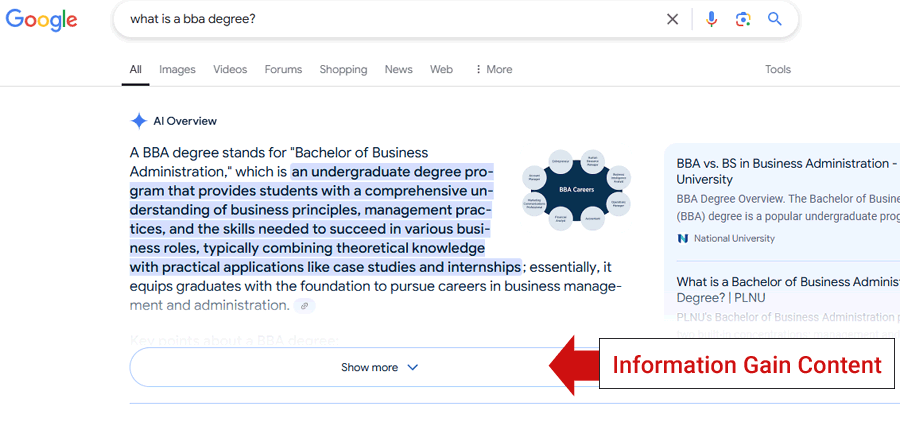
For educational queries AIO shows a preference toward concise answers with a clean visual presentation. In the below example Google is hiding content that has additional information that answers additional questions beyond the main query. This may relate to Google’s information gain patent which is about anticipating additional information that a user will be interested in after receiving the answer to their original search query.

AIO Showing Information Gain Ranked Content

Change In YouTube Citations

An interesting pattern picked up by BrightEdge is that YouTube technical tutorials have increased by 40% in AIO while health related queries that show YouTube videos are trending downward by 31%.

Of particular interest is that the high volume search queries (100k+ search volume) that trigger YouTube content have decreased by 18.7%. This may reflect a change in user needs and Google’s ability to identify that context and understand that it’s not served well by video content.

What all of this means is that it’s increasingly important to think about context awareness, the appropriateness of the content to the query. The question to ask is what kind of content best serves the context and to expand that answer across modalities like images, sound, video, and text, then within those formats think in terms of how-to, data dump, informative, etc.

Takeaway

A way to make sense of the data is that it Google AI Overviews appear to be increasingly relying on the authoritativeness of the content as the stakes go higher with more complex search queries.

Authoritativeness isn’t just about being a big brand but it may have to do with simply being meaningful to the Internet audience as a go-to source for a particular topic. Trustworthiness and other related factors are important and this has nothing to do with superficial SEO activities like author bios and so on.

Conclusion

The data suggests that Google AI Overviews are developing sophisticated, context-aware citation models. As the search landscape continues to evolve, it is crucial for brands to adapt to these changes and focus on creating high-quality, authoritative content that meets the needs of users.

Frequently Asked Questions

Q: What does the data suggest about Google AI Overviews?

A: The data suggests that Google AI Overviews are developing sophisticated, context-aware citation models.

Q: How does the growth of AI Overviews impact brands?

A: The growth of AI Overviews emphasizes the importance of creating high-quality, authoritative content that meets the needs of users. Brands must adapt to these changes and focus on creating content that is meaningful to the Internet audience.

Q: What is the significance of context awareness in AI Overviews?

A: Context awareness is crucial in AI Overviews as it enables Google to understand the user’s query and provide relevant, accurate answers. Brands must think about context awareness and create content that is relevant to the query.

Q: How does the change in YouTube citations impact brands?

A: The change in YouTube citations suggests that brands should focus on creating high-quality, technical tutorials that provide step-by-step guidance. However, for health-related queries, brands should pivot to text-based content.

Divided on AI: Leaders and Employees

AI Adoption in Business: Perceptions and Reality

When incorporated into business operations, AI’s ability to act as an assistant in virtually every aspect of a professional’s workload should increase efficiency. However, many obstacles, including leadership perceptions of the technology, are preventing widespread adoption by organizations.

Accenture’s Research Findings

To better understand how organizations are welcoming AI-related change, Accenture surveyed 3,450 C-suite leaders and 3,000 non-C-suite level employees from organizations worldwide with revenues greater than $500 million.

Expectations vs. Preparedness

According to Accenture’s research report, C-suite leaders anticipate a high level of change in their organizations, with 72% expecting more change in 2025 than in 2024, and 23% expecting the same level. Compared to the expectations for change in 2024, the numbers are slightly lower, with 88% of C-suites in 2024 expecting more change than the year prior.

While a sense of change is palpable, preparedness levels fall short. Across several industries, fewer C-suite leaders reported feeling “very prepared” to respond to changes in their business environment heading into 2025, compared to how they felt in 2024.

Generative AI Investments

A majority (86%) of C-suite leaders feel prepared to up their investment in generative AI in 2025. Similarly, 83% of the leaders claimed their past year’s experience with generative AI has allowed them to see “greater potential for positive business impact,” in the upcoming year, according to the report.

Moreover, a whopping 50% of C-suite leaders see IT as the primary focus of those generative AI investments, followed by engineering, manufacturing, production, and operations (38%), and customer service (29%).

Challenges to Adoption

Despite the perceived benefits, obstacles to adoption remain, with C-suite leaders listing a lack of clarity on ROI (26%) and data or technology infrastructure limitations (28%) as limiting factors.

Disconnect between Leaders and Employees

The disconnect between how leadership and employees perceive the value of implementing generative AI is also a major obstacle; there’s a 20% gap between how C-suite leaders and their employees understand “to a great extent” the potential value of generative AI.

Conclusion

The findings from Accenture’s research highlight the need for organizations to address the disconnect between their expectations and preparedness levels. By providing comprehensive training and clear guidance, organizations can increase employee confidence in using generative AI tools and accelerate adoption.

FAQs

Q: What is the main obstacle to AI adoption in business?
A: According to Accenture’s research, a lack of clarity on ROI and data or technology infrastructure limitations are the main obstacles to AI adoption.

Q: What is generative AI, and how can it benefit business?
A: Generative AI refers to the ability of AI to act as an assistant in virtually every aspect of a professional’s workload, providing assistance in tasks such as coding, bug fixing, malware detection, math calculations, and threat modeling, and optimizing customer service.

Q: What is the disconnect between leadership and employees?
A: The disconnect refers to a 20% gap between how C-suite leaders and their employees understand the potential value of generative AI.

Q: What can organizations do to increase employee confidence in using generative AI tools?
A: Organizations can provide comprehensive training and clear guidance to increase employee confidence in using generative AI tools.