Home Blog Page 349

Boosting DeepSeek AI with NVIDIA GeForce RTX 50 Series PCs

A New Wave of Excitement in AI

The recently released DeepSeek-R1 model family has brought a new wave of excitement to the AI community, allowing enthusiasts and developers to run state-of-the-art reasoning models with problem-solving, math, and code capabilities, all from the privacy of local PCs.

A New Class of Models That Reason

Reasoning models are a new class of large language models (LLMs) that spend more time on “thinking” and “reflecting” to work through complex problems, while describing the steps required to solve a task.

The Fundamental Principle

The fundamental principle is that any problem can be solved with deep thought, reasoning, and time, just like how humans tackle problems. By spending more time — and thus compute — on a problem, the LLM can yield better results. This phenomenon is known as test-time scaling, where a model dynamically allocates compute resources during inference to reason through problems.

The DeepSeek Difference

The DeepSeek-R1 family of distilled models is based on a large 671-billion-parameter mixture-of-experts (MoE) model. MoE models consist of multiple smaller expert models for solving complex problems. DeepSeek models further divide the work and assign subtasks to smaller sets of experts.

Distillation Technique

DeepSeek employed a technique called distillation to build a family of six smaller student models — ranging from 1.5-70 billion parameters — from the large DeepSeek 671-billion-parameter model. The reasoning capabilities of the larger DeepSeek-R1 671-billion-parameter model were taught to the smaller Llama and Qwen student models, resulting in powerful, smaller reasoning models that run locally on RTX AI PCs with fast performance.

Peak Performance on RTX

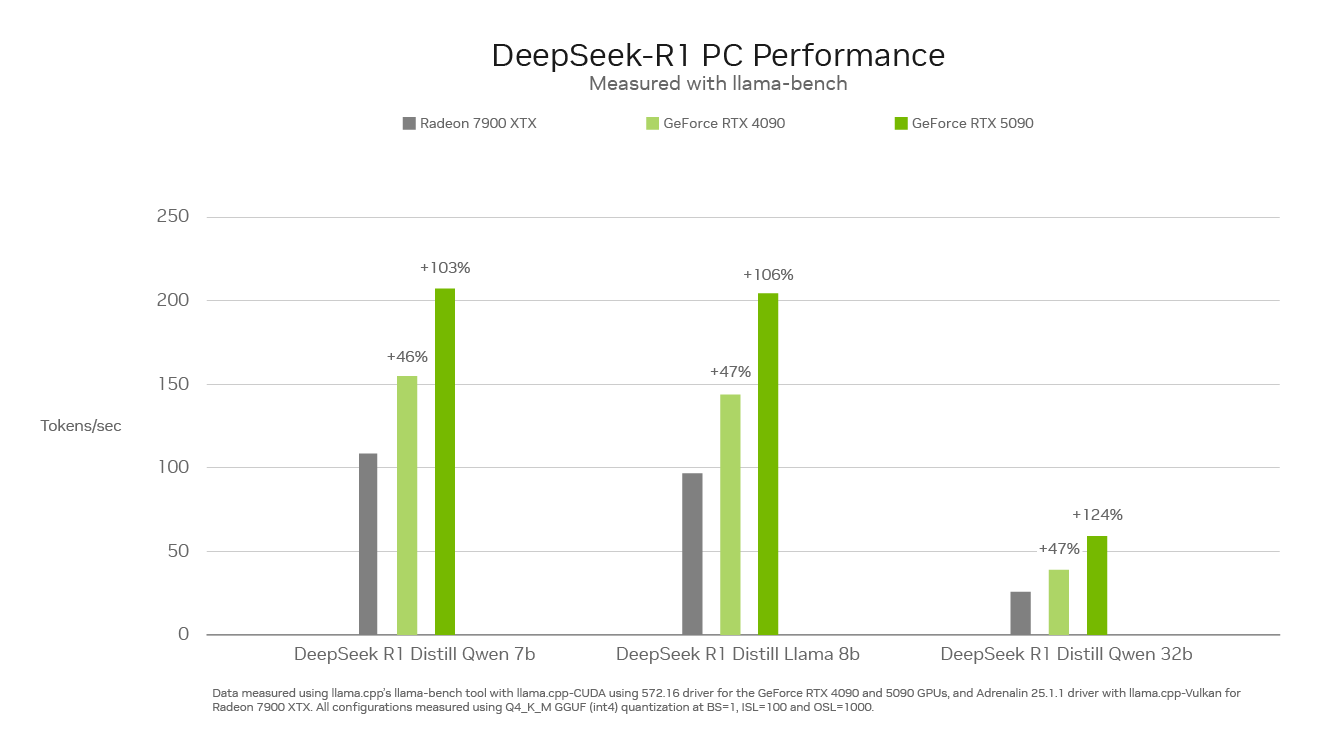
Inference speed is critical for this new class of reasoning models. GeForce RTX 50 Series GPUs, built with dedicated fifth-generation Tensor Cores, are based on the same NVIDIA Blackwell GPU architecture that fuels world-leading AI innovation in the data center. RTX fully accelerates DeepSeek, offering maximum inference performance on PCs.

Throughput performance of the Deepseek-R1 distilled family of models across GPUs on the PC.

Experience DeepSeek on RTX in Popular Tools

NVIDIA’s RTX AI platform offers the broadest selection of AI tools, software development kits, and models, opening access to the capabilities of DeepSeek-R1 on over 100 million NVIDIA RTX AI PCs worldwide, including those powered by GeForce RTX 50 Series GPUs.

Benefits of RTX AI PCs

High-performance RTX GPUs make AI capabilities always available — even without an internet connection — and offer low latency and increased privacy because users don’t have to upload sensitive materials or expose their queries to an online service.

Conclusion

The DeepSeek-R1 model family has opened up new possibilities for AI enthusiasts and developers to run state-of-the-art reasoning models on their local PCs. With the power of RTX AI PCs, users can experience the capabilities of DeepSeek-R1 in popular tools, enjoying fast performance, low latency, and increased privacy.

FAQs

Q: What is the DeepSeek-R1 model family?

A: The DeepSeek-R1 model family is a new class of large language models (LLMs) that spend more time on “thinking” and “reflecting” to work through complex problems, while describing the steps required to solve a task.

Q: What is the advantage of using RTX AI PCs with DeepSeek-R1?

A: RTX AI PCs offer fast performance, low latency, and increased privacy when running DeepSeek-R1 models, making them ideal for AI enthusiasts and developers who want to work with complex problems without relying on online services.

Q: Can I use DeepSeek-R1 models with other AI tools and software?

A: Yes, NVIDIA’s RTX AI platform offers the broadest selection of AI tools, software development kits, and models, allowing users to experience the capabilities of DeepSeek-R1 in popular tools and software.

Q: How do I get started with DeepSeek-R1 and RTX AI PCs?

A: Users can get started with DeepSeek-R1 and RTX AI PCs by visiting the NVIDIA website and exploring the available software, tools, and models. They can also join online communities and forums to learn more about the capabilities and applications of DeepSeek-R1 and RTX AI PCs.

Quick! The mighty Bambu Lab X1 Carbon is on sale

0

If you’re into 3D printing, then you’re probably familiar with Bambu Lab and its super-premium products.

For a limited time, you can get your hands on the company’s flagship X1 Carbon Combo machine for only £1,219 from Bambu’s website. This still might seem like a lot to pay, but it’s a £220 saving on the original price tag of £1,439.

The X1 Carbon is undoubtedly one of the best 3D printers on the market right now

with quality multicolour AMS compatibility making it hugely popular with sellers of flexis and fidget models, and with cosplayers making props too.

Deals and Discounts

UK Deal

If you don’t need the AMS (automated material system) included with the X1 Carbon for multicolour prints, then there’s also a deal cutting £180 off the standalone machine over at Bambu Lab.

US Deal

If you’re based in the US, you haven’t been forgotten. There’s a deal on the X1C at Bambu Lab’s US store too with $100 off, which isn’t quite as generous as the UK discounts we’re seeing, but still better than nothing.

The Best Bambu Lab X1C Deal Today

Below you’ll find the best deals and lowest prices on Bambu Lab printers in your region and worldwide, using our clever deals widget that updates 24/7.

Conclusion

If you’re in the market for a high-quality 3D printer, the Bambu Lab X1 Carbon Combo is definitely worth considering. With its multicolour AMS compatibility and high-quality prints, it’s a great option for anyone looking to take their 3D printing to the next level.

FAQs

Q: What is the original price of the Bambu Lab X1 Carbon Combo?

A: The original price of the Bambu Lab X1 Carbon Combo is £1,439.

Q: How much is the discount on the X1 Carbon Combo?

A: The discount on the X1 Carbon Combo is £220, bringing the price down to £1,219.

Q: Is the AMS (automated material system) included with the X1 Carbon Combo?

A: Yes, the AMS is included with the X1 Carbon Combo.

Q: Is there a discount available for the standalone X1 Carbon machine?

A: Yes, there is a £180 discount available for the standalone X1 Carbon machine.

Q: Is there a discount available for the X1C at Bambu Lab’s US store?

A: Yes, there is a $100 discount available for the X1C at Bambu Lab’s US store.

Revolutionizing Trade: AI-Powered Financing Solutions

The New Wave of Business and Operating Model Transformation in Corporate Banking

How Data Became the Third Leg of Bank Business Models

From its inception, banking has always been a business of data—its movement and processing, and the insights derived therefrom. As financial intermediaries, banks survived for centuries based on data at the heart of a two-sided business model: taking deposits (liability ledger) and making loans (risk assets). Profit was the lucrative spread between these two pillars.

Unlocking B2B Data Insights is Driving Banking Transformation

Trade finance is a natural starting place for bank modernization. It is unusually rich in untapped B2B details, it is super relevant to a bank’s overall commercial banking proposition, and it offers the most easily addressed "low hanging fruit" for return on investment (ROI) due to the prevalence of so many manual processes.

A Benefits-Driven Roadmap for Trade Finance Modernization

The roadmap that banks are adopting for trade finance modernization follows five simple steps, starting with the basics of helping colleagues do their work better:

Step 1: Generative AI Copilots

Generative AI copilots can transform operations and drive new efficiencies in many powerful ways. For example, copilots can help front-office trade sales and relationship managers identify new financing opportunities when advising clients.

Step 2: Improved Internal Collaboration

Improved internal collaboration can be achieved with modern office tools. Many banks have legacy processes designed for linear workflows—for example, sending credit applications as email attachments to multiple stakeholders for approval.

Step 3: Operational Efficiencies

Operational efficiencies can be greatly enhanced with AI. Consider Letters of Credit processing, a mainstay of classical trade finance which remains paper-based to this day, with literally billions of pieces of paper circulating between parties at any given time.

Step 4: Knowledge Management

Knowledge Management tools using natural language can advance the effectiveness of staff and banking operations. Retrieval Augmented Generation (RAG) technology will reason over a bank’s broad SharePoint catalogue of material and surface only relevant information for a given request.

Step 5: Customer Service Tools

Customer service tools can enhance the customer experience. One of the greatest areas for improvement with natural language processing and copilots is client service problem resolution.

Get Started on Your Modernization Journey

Trade finance AI is not just for big banks that finance global supply chains. In fact, the impact of AI automation could be greater for regional and smaller banks where skilled staff are fewer and transactions are less frequent, but where client needs require receivables discounting, performance bonds, or other working capital assistance.

Conclusion

The benefits of modernization impact banks of every size and geography. To help understand how your organization can explore the new opportunities, begin by engaging with your Microsoft representative. They can help develop strategies and solutions that deliver immediate and long-term benefits to meet your bank’s unique needs.

FAQs

Q: What is the main driver of trade finance modernization?
A: The main driver of trade finance modernization is the untapped potential of B2B data insights, which can be unlocked with AI and cloud technologies.

Q: What are the benefits of trade finance modernization?
A: The benefits of trade finance modernization include improved operational efficiency, enhanced customer service, and increased revenue growth.

Q: Who can benefit from trade finance modernization?
A: Banks of every size and geography can benefit from trade finance modernization, including regional and smaller banks that finance local supply chains.

Q: How can I get started with trade finance modernization?
A: To get started with trade finance modernization, engage with your Microsoft representative to develop strategies and solutions that deliver immediate and long-term benefits to meet your bank’s unique needs.

OpenAI Fired Up

0

OpenAI Responds to DeepSeek’s Upset

It’s been just over a week since DeepSeek upended the AI world. The introduction of its open-weight model—apparently trained on a fraction of the specialized computing chips that power industry leaders—set off shock waves inside OpenAI. Not only did employees claim to see hints that DeepSeek had “inappropriately distilled” OpenAI’s models to create its own, but the startup’s success had Wall Street questioning whether companies like OpenAI were wildly overspending on compute.

The Sputnik Moment

“DeepSeek R1 is AI’s Sputnik moment,” wrote Marc Andreessen, one of Silicon Valley’s most influential and provocative inventors, on X.

OpenAI’s Response

In response, OpenAI is preparing to launch a new model today, ahead of its originally planned schedule. The model, o3-mini, will debut in both API and chat. Sources say it has o1 level reasoning with 4o-level speed. In other words, it’s fast, cheap, smart, and designed to crush DeepSeek. (OpenAI spokesperson Niko Felix says work on o3-mini began long before DeepSeek’s debut and the goal was to launch by the end of January).

Efficiency and Competition

The moment has galvanized OpenAI staff. Inside the company, there’s a feeling that—particularly as DeepSeek dominates the conversation—OpenAI must become more efficient or risk falling behind its newest competitor.

Internal Power Struggle

Part of the issue stems from OpenAI’s origins as a nonprofit research organization before becoming a profit-seeking powerhouse. An ongoing power struggle between the research and product groups, employees claim, has resulted in a rift between the teams working on advanced reasoning and those working on chat. (OpenAI spokesperson Niko Felix says this is “incorrect” and notes that the leaders of these teams, chief product officer Kevin Weil and chief research officer Mark Chen, “meet every week and work closely to align on product and research priorities.”)

Chat Product

Some inside OpenAI want the company to build a unified chat product, one model that can tell whether a question requires advanced reasoning. So far, that hasn’t happened. Instead, a drop-down menu in ChatGPT prompts users to decide whether they want to use GPT-4o (“great for most questions”) or o1 (“uses advanced reasoning”).

Staff Feedback

Some staffers claim that while chat brings in the lion’s share of OpenAI’s revenue, o1 gets more attention—and computing resources—from leadership. “Leadership doesn’t care about chat,” says a former employee who worked on (you guessed it) chat. “Everyone wants to work on o1 because it’s sexy, but the code base wasn’t built for experimentation, so there’s no momentum.” The former employee asked to remain anonymous, citing a nondisclosure agreement.

Conclusion

OpenAI is preparing to launch a new model, o3-mini, in response to DeepSeek’s success. The company is under pressure to become more efficient and competitive in the AI market. The ongoing power struggle between research and product groups may hinder the company’s ability to adapt to the changing landscape.

FAQs

Q: What is DeepSeek’s new model?
A: DeepSeek’s new model, R1, is an open-weight model that has o1 level reasoning with 4o-level speed.

Q: What is OpenAI’s response to DeepSeek’s success?
A: OpenAI is launching a new model, o3-mini, ahead of its originally planned schedule. The model will debut in both API and chat.

Q: What is the ongoing power struggle within OpenAI?
A: There is an ongoing power struggle between the research and product groups within OpenAI, which may hinder the company’s ability to adapt to the changing landscape.

Q: Why is OpenAI launching o3-mini?
A: OpenAI is launching o3-mini to crush DeepSeek and become more efficient and competitive in the AI market.

The Best Movie Posters of January 2025

0

The Best Movie Posters of January 2025: A New Era of Artistic Designs

We might only be a few weeks into 2025, but we’ve already seen some stunning movie poster designs drop this January. It seems the days of the boring ‘floating head’ poster are finally over, with bold, striking, and truly artistic designs continuing to turn heads.

The Top 4 Movie Posters of January 2025

Below is our pick of the four best posters we’ve seen in January. And if you’re looking for more design inspiration, be sure to take a look at our roundup of the best movie posters of all time.

1. Mickey 17

One of the most anticipated films of the year is Mickey 17, directed by Bong Joon Ho of ‘Parasite’ fame. The film stars Robert Pattinson as an "expendable" – a disposable crew member on a space mission, selected for dangerous tasks because he can be renewed if his body dies, with his memories largely intact. The poster is appropriately surreal and psychedelic, with bonus points awarded for Pattinson’s brilliantly goofy expression.

2. Four Minutes; Twelve Tables

Mike Leigh’s study of depression has received rave reviews, particularly for Marianne Jean-Baptiste’s electrifying performance as Pansy. The poster is a beautifully illustrated artwork, with the tangled flowers subtly hinting at the lead character’s inner turmoil.

3. Shoah (Re-Release)

1985 documentary Shoah is a nearly 10-hour document of the holocaust, featuring interviews and testimonies from survivors and witnesses. To mark its re-release this year, Claude Lanzmann’s film has been given a stunning new poster, with eyes that emphasize the importance of bearing witness. The new design was created by acclaimed Polish designer Aleksander Walijewski.

4. Picnic at Hanging Rock (Re-Release)

Another film getting reissued in 2025 is Picnic at Hanging Rock. The 1975 mystery centers around several schoolgirls and their teacher, who disappear during a picnic on Valentine’s Day in 1900. Peter Weir’s breakthrough film is being re-released by BFI to mark its 50th anniversary.

Conclusion

As we look back on the first few weeks of 2025, it’s clear that the future of movie poster design is in good hands. With bold, creative, and often surreal designs, these posters are not only eye-catching but also thought-provoking. We can’t wait to see what the rest of the year brings.

FAQs

Q: What is the significance of the new poster for Shoah?
A: The new poster for Shoah emphasizes the importance of bearing witness to the holocaust and its victims.

Q: What is the plot of Picnic at Hanging Rock?
A: The film is a 1975 mystery that centers around several schoolgirls and their teacher, who disappear during a picnic on Valentine’s Day in 1900.

Q: Who is the director of Mickey 17?
A: The film is directed by Bong Joon Ho, known for his work on Parasite.

Building Authentic Bonds on Social Media

0

The Growing Demand For Authenticity In A Social Media-Saturated World

According to a 2023 survey, over 70% are concerned about deepfakes that circulate on social media.

My educated guess is that audiences are turned off by misleading content and that they are looking for new platforms, like Threads, to stay connected in a positive way by sharing bite-sized anecdotes with real people instead of bots and sales-focused influencers.

Brands sharing real advice like workplace challenges and authentic storytelling can resonate with audiences in specific industries, be it lifestyle brands or B2B SaaS platforms.

Across TikTok and Instagram, and even Threads, sharing pro advice and motivational tips has always been a trend. Examples include Grammarly’s writing productivity tips on Threads and Nike’s #1000Victories 19-part documentary campaign featuring women in sport community.

Check out this guide on how you can create interactive posts to engage communities on social.

For online shops, here’s an example of a content creator promoting other small businesses for free to potential customers. The desire to reciprocate is a result of the very emphatic conversations and experiences many have shared, prompting each other to become motivated and best practices for industry and protect their livelihood.

By simply listening to people talk about it, truly caring, and engaging in the comments section with the original posters, these interactions create a sense of community in a way that AI or paid sponsorships can’t replicate.

The Fall Of Inauthentic Content

Three in four consumers are worried about fake reviews and 63% think brands should be solving this. These insights highlight evolving expectations for brands to put up a fight and to maintain their trust.

49% of U.S. consumers are confident they have seen fake reviews on Amazon for 2024.

But how easy are they to spot?

Learning How To Spot AI Content

It’s not easy to spot at all.

While it can be hard to tell the difference with text (AI art is easier to spot), there are ways to detect it.

Researchers from the University of Michigan used a dataset of 10,000 real and fake hotel reviews in 10 languages to find differences:

“Despite the difficulty humans have in distinguishing between real hotel reviews and those generated by LLMs, we discovered that these posts have noticeable differences in style, structure, and semantics.” (read: MAiDE-up: Multilingual Deception Detection of GPT-generated Hotel Reviews).

A research group at the University of Pennsylvania proves that people can be trained to tell the difference.

They also partnered with CNN to demonstrate how to discern between AI and human-written text and how fact-checking and logic can spell the difference.

If more and more people are trained to fact-check and present their findings in the comments section, it becomes more difficult to pass off AI-generated content as human.

Around 31% of Americans say they are more concerned than excited about AI. Digital marketers need to be aware of how AI-generated content can backfire, especially for highly regulated fields like Law, Medicine, and Media, Finance.

Fraud And Undisclosed Influencer Ads

Deceptive affiliates on YouTube exaggerate “must-haves” and promote products by exclaiming, “Run, don’t walk to the store.”

There are sponsored product reviews by influencers who have never even tried the retail products yet recommend them, and audiences become skeptical and unfollow or unsubscribe.

Because de-influencing content has become very popular over the past year, it could lead to less revenue and a negative reputation for your brand. Among the business categories: Technology, Fashion/Beauty/Wellness, Food/Beverage, and Travel/Hospitality – the fashion/beauty/wellness category has been hit the hardest.

Meanwhile, Instagram influencer fraud was found at 49% in 2023 (buying followers, likes, stories, views, etc.). And according to The Hyper Auditor’s internal research, only 55% of Instagram followers are real people. But these platforms are trying to push back.

Major Platforms Are Pushing Back Vs. Fake Reviews

Yelp had started removing fake reviews and cracked down on fraudulent groups in 2022. Meta has started requiring an AI label on generated posts, too.

Amazon and Google have filed against a fake reviews broker website in October 2024. The latter is also part of The Coalition of Trusted Reviews with other highly popular booking and review sites.

As more and more platforms and consumers fight against fake content, your brand must verify content authenticity and discourage misleading sponsored ads in other to maintain trust in your platform or product on the platform.

Threads And The Surge Of Genuine Storytelling Via Microblogging

Instagram seems to have become a highlight reel of everyone’s picture-perfect moments: Weddings, travel, shiny purchases, and branded outfits. However, not everyone can relate to high-end living, so take note, marketers of aspirational brands.

Threads, the microblogging app built by the Instagram people, allows brands to foster real conversations and share relatable messaging. People from all walks of life, regardless of education, language, and nationality, share perspectives through their life stories or give free professional advice.

This is an example of a service business that personalized his handyman content on Threads and found success in the community aside from his recent achievement of 100,000 subscribers on YouTube. Learn how short-form storytelling works on Threads and try it out.

This kind of user-generated content without the ad-heavy feed drives community as more and more users can relate to and reply to these posts.

User-generated content posts that look and feel like everyday life will resonate better with communities on Threads. With this type of content, brands can humanize their storytelling and build trust over time.

The Balance Between AI And Authenticity: A New Kind Of Content Creation

There are practical roles for AI in content creation, but there are limits when it comes to creating art with emotional impact.

  • What AI can do: Help collect and manage customer data, boost customer experience with personalized content, support content writers, and correct human errors to name a few.
  • What AI can’t do: According to the AI Coke ads they can’t elicit positive emotional responses.

While the AI Coke ads may not have performed as expected, their holiday campaign, Create Real Magic invited fans to create images with ChatGPT-4 and DALL-E using their own archive of assets, successfully appealing to their target Gen Z and Millennial audiences.

For B2B SaaS, AI can be a product offering that ties in seamlessly with your platform. An example is Canva launched More Canva Magic! AI Music Generators which empowers creators to create custom soundtracks for presentations, videos, and social media legally using royalty-free music.

For retailers, it’s nice to know that customers see AI-generated summaries of product reviews as a top feature, and is great to read alongside actual human reviews. Nike’s “By You” uses AI to help customers design their own shoes. Context and execution matter when it comes to AI-produced content using new technology, and campaigns that require active participation seem to be more successful.

5. How To Adapt To Maintain Transparency

Ensure Authenticity

42% of marketers use generative AI to make social media copy. Make sure content is fact-checked by copywriters and editors, integrating a workflow that can catch inaccuracies.

This year, now more than ever, it’s important to build and maintain meaningful customer relationships to stay relevant in 2025. Consumers (64%) wish for brands to connect with them, underlining the growing demand for genuine engagement.

In order to meet this expectation, brands need to align their values, humanize their content, and be consistent in their messaging to foster audiences’ trust.

Disclose Partnerships And Monitor Content

Back in 2022, the SEC fined Kim Kardashian $1.26 million after she was caught promoting cryptocurrency, EthereumMax, without disclosure of her paid partnership.

For influencers, disclosing paid ads partnered with a brand is essential instead of passing it off as organic. The European Commission found 97% of published content with commercial intent, but only 20% disclosed it. Brands need to ensure that the influencers hired follow FTC guidelines.

Additionally, if you use AI when creating content, disclose or add labels for the AI technologies you use.

If you follow FTC guidelines, brands and influencers who are honest can thrive with meaningful connections and steer clear of the backlash surrounding fake content.

Conclusion: Embrace Authenticity As The Future Of Social Media

I personally believe that authenticity is the foundation for social media success. As social media evolves and AI becomes more sophisticated, authenticity is no longer optional – it’s vital.

By prioritizing genuine connections and transparent content, marketers can build trust, drive engagement, and secure their place in the digital future.

More tools are cropping up to filter out the noise and more mods on every platform serve as a village watch group to protect misinformation.

Public DeepSeek AI database exposes API keys

What is DeepSeek?

Founded by Liang Wenfeng in May 2023, the Chinese startup has challenged established AI companies with its open-source approach. According to Forbes, DeepSeek’s edge may lie in the fact that it is funded only by High-Flyer, a hedge fund also run by Wenfeng, which gives the company a funding model that supports fast growth and research.

What is DeepSeek R1?

Released in full last week, R1 is DeepSeek’s flagship reasoning model, which performs at or above OpenAI’s lauded o1 model on several math, coding, and reasoning benchmarks. Built on V3 and based on Alibaba’s Qwen and Meta’s Llama, what makes R1 interesting is that, unlike most other top models from tech giants, it’s open source, meaning anyone can download and use it.

Privacy and Security Red Flags

Data privacy worries that have circulated TikTok — the Chinese-owned social media app now somewhat banned in the US — are also cropping up around DeepSeek. On Wednesday, research firm Wiz discovered that an internal DeepSeek database was publicly accessible “within minutes” of conducting a security check. The “completely open and unauthenticated” database contained chat histories, user API keys, and other sensitive data.

Safety Concerns

AI safety researchers have long been concerned that powerful open-source models could be applied in dangerous and unregulated ways once out in the wild. Tests by AI safety firm Chatterbox found DeepSeek R1 has “safety issues across the board.”

Energy Efficiency Claims

Some analysts note that DeepSeek’s lower-lift compute model is more energy efficient than that of US AI giants. “DeepSeek’s new AI model likely does use less energy to train and run than larger competitors’ models,” said Slattery. “However, I doubt this marks the start of a long-term trend in lower energy consumption.”

How Will DeepSeek Affect the AI Industry?

R1’s success highlights a sea change in AI that could empower smaller labs and researchers to create competitive models and diversify the options. For example, organizations without the funding or staff of OpenAI can download R1 and fine-tune it to compete with models like o1.

Conclusion

DeepSeek’s ascent comes at a critical time for Chinese-American tech relations, just days after the long-fought TikTok ban went into partial effect. Ironically, DeepSeek lays out in plain language the fodder for security concerns that the US struggled to prove about TikTok in its prolonged effort to enact the ban.

FAQs

Q: What is DeepSeek?
A: DeepSeek is a Chinese AI startup that has challenged established AI companies with its open-source approach.

Q: What is DeepSeek R1?
A: DeepSeek R1 is the company’s flagship reasoning model, which performs at or above OpenAI’s lauded o1 model on several math, coding, and reasoning benchmarks.

Q: Is DeepSeek’s model more energy efficient than US AI giants?
A: Yes, according to some analysts, DeepSeek’s lower-lift compute model is more energy efficient than that of US AI giants.

Q: Are there any security concerns surrounding DeepSeek?
A: Yes, research firm Wiz discovered that an internal DeepSeek database was publicly accessible, and AI safety researchers have raised concerns about the model’s potential use in dangerous and unregulated ways.

Q: How will DeepSeek affect the AI industry?
A: R1’s success highlights a sea change in AI that could empower smaller labs and researchers to create competitive models and diversify the options.

Supabase: Open Source Backend-as-a-Service

Understanding Supabase

Supabase is an open-source backend-as-a-service (BaaS) solution that simplifies backend development by offering a managed PostgreSQL database, authentication, real-time capabilities, storage, and serverless functions.

Key Features of Supabase

  • Managed PostgreSQL Database – Full control over a scalable database with SQL support.
  • Authentication – Built-in auth with email/password, OAuth, and magic links.
  • Real-Time Database Updates – Listen for changes in your database live.
  • File Storage – Store and serve media assets securely.
  • Edge Functions – Deploy serverless functions for custom backend logic.

Getting Started with Supabase

Before writing any code, you’ll need to set up a Supabase project.

1. Creating a Supabase Project

  1. Sign up at Supabase and create a new project.
  2. Copy your project’s API URL and anon/public API key from the dashboard.
  3. Install the Supabase JavaScript SDK in your project:
npm install @supabase/supabase-js

Setting Up a Database

Let’s create a simple todos table to store user tasks.

2. Creating a Table in Supabase

  1. Go to Database > Tables in the Supabase dashboard and create a table:
CREATE TABLE todos (
    id UUID PRIMARY KEY DEFAULT gen_random_uuid(),
    title VARCHAR(255) NOT NULL,
    completed BOOLEAN NOT NULL DEFAULT FALSE
);

CRUD Operations

Now that we have our database set up, let’s implement CRUD (Create, Read, Update, Delete) operations for our todos table.

Inserting a Todo

async function insertTodo(title) {
    const { data, error } = await supabase
       .from('todos')
       .insert([{ title, completed: false }]);

    if (error) console.error(`Error inserting todo: ${error.message}`);
    return data;
}

Fetching Todos

async function fetchTodos() {
    const { data, error } = await supabase
       .from('todos')
       .select('*');

    if (error) console.error(`Error fetching todos: ${error.message}`);
    return data;
}

Updating a Todo

async function updateTodo(id, completed) {
    const { data, error } = await supabase
       .from('todos')
       .update({ completed })
       .eq('id', id);

    if (error) console.error(`Error updating todo: ${error.message}`);
    return data;
}

Deleting a Todo

async function deleteTodo(id) {
    const { data, error } = await supabase
       .from('todos')
       .delete()
       .eq('id', id);

    if (error) console.error(`Error deleting todo: ${error.message}`);
    return data;
}

Conclusion

Supabase provides an open-source alternative to backend services like Firebase, with PostgreSQL, authentication, real-time updates, and serverless functions. In this guide, we set up a Supabase project, created a database, implemented authentication, and secured the database with basic Row-Level Security (RLS). We also implemented CRUD operations for a simple todo list.

FAQs

Q: What is Supabase?

A: Supabase is an open-source backend-as-a-service (BaaS) solution that simplifies backend development by offering a managed PostgreSQL database, authentication, real-time capabilities, storage, and serverless functions.

Q: What are the key features of Supabase?

A: The key features of Supabase include a managed PostgreSQL database, authentication, real-time database updates, file storage, and edge functions.

Q: How do I set up a Supabase project?

A: To set up a Supabase project, sign up at Supabase, create a new project, copy your project’s API URL and anon/public API key, and install the Supabase JavaScript SDK in your project.

Q: How do I implement CRUD operations in Supabase?

A: To implement CRUD operations in Supabase, you can use the Supabase JavaScript SDK to insert, update, and delete data in your database.

DeepSeek Ignites Silicon Valley

0

DeepSeek’s Rise to the Top: What’s Behind the Hype?

DeepSeek Makes Waves in the AI Community

DeepSeek, a Chinese AI lab, has been making headlines this week after releasing its R1 "reasoning" model and displacing ChatGPT as the App Store’s top app. While some are hailing it as a game-changer, others are skeptical about its claims of building models more efficiently and at a fraction of the cost of competitors.

Tech Giants and the U.S. Government React

On the latest episode of TechCrunch’s Equity podcast, hosts Kirsten Korosec, Margaux MacColl, and Max Zeff discussed the reactions from tech giants and the U.S. government, which is increasingly concerned that China is pulling ahead in the AI arms race.

What to Expect in the Full Episode

The full episode will delve deeper into the implications of DeepSeek’s rise to the top, including the potential consequences for the AI industry as a whole. For those who want more, stay tuned for a special DeepSeek deep dive.

About Equity

Equity is TechCrunch’s flagship podcast, produced by Theresa Loconsolo, and posts every Wednesday and Friday. You can subscribe to us on Apple Podcasts, Overcast, Spotify, and all the casts, and follow Equity on X and Threads, at @EquityPod.

Conclusion

DeepSeek’s sudden rise to the top has left many in the AI community questioning its claims and motives. While some see it as a potential game-changer, others are skeptical about its efficiency and cost. The full episode of Equity will provide more insight into the implications of DeepSeek’s success and what it means for the future of AI.

FAQs

  • What is DeepSeek?
    • A Chinese AI lab that released its R1 "reasoning" model, displacing ChatGPT as the App Store’s top app.
  • What is the R1 "reasoning" model?
    • A machine learning model designed to reason and learn from data, allowing for more accurate and efficient decision-making.
  • Is DeepSeek’s model more efficient than its competitors?
    • According to DeepSeek, yes, its model is built more efficiently and at a fraction of the cost of competitors, but this claim is met with skepticism by some in the AI community.
  • What does the U.S. government’s reaction to DeepSeek’s success mean?
    • The U.S. government is increasingly concerned that China is pulling ahead in the AI arms race, and DeepSeek’s success may be seen as a threat to U.S. dominance in the field.

Mindblowing Character Consistency

0

Character Consistency with ComfyUI using ACE++

Introduction

Get amazing character consistency in ComfyUI with just one photo, no training necessary! With ACE++, you can achieve high-quality character consistency without requiring any training. In this article, we will guide you through the process of implementing ACE++ in ComfyUI.

Getting Started

To get started, you need to download the following models:

  • comfyui_portrait_lora64.safetensors and place it in /models/loras/.
  • flux-fill-fp8 and place it in /models/diffusion_models/.

You can download these models from the following links:

Full Guide and Download Workflow

For a full guide and download workflow, visit this link.

ACE++

Read more about ACE++ here.

Recommended Online AI Platform for Stable Diffusion & Flux (Affiliate)

Check out https://www.thinkdiffusion.com/?via=sebastian for a recommended online AI platform for Stable Diffusion & Flux.

Community Resources

Join our community discord at https://discord.gg/dFB7zuXyFY to chat with me and other enthusiasts.

Additional Resources

Frequently Asked Questions

Q: What is ACE++?
A: ACE++ is a character consistency model that can generate high-quality character consistency with just one photo, no training necessary.

Q: How do I get started with ACE++?
A: To get started, download the necessary models and follow the full guide and download workflow provided in the link.

Q: What is ComfyUI?
A: ComfyUI is a user interface that can be used to generate high-quality character consistency with ACE++.

Q: How do I join the community?
A: Join our community discord at https://discord.gg/dFB7zuXyFY to chat with me and other enthusiasts.