Home Blog Page 351

Creating a Bridge Between Past and Future

0

James Jean is one of the most creative artists working today, and creates with traditional techniques to create elegant, complex illustrations as well as using the best digital art software. His latest work for the new Lunar New Year Johnnie Walker Blue Label is a striking snake design, but what’s the message behind the art?

CB: What inspired your redesign of the Zodiac symbol?

James Jean:

I portrayed the snake shedding its skin to represent the idea of renewal and growth. The three snakes symbolise the attributes of wisdom, intelligence, and intuition, while also representing the past, present, and future. The snakes are constantly growing, transforming, and adapting to changing conditions.

The snakes in the artwork are stylised and inspired by Chinese or East Asian decorative motifs rather than being a realistic depiction of a specific species. The intricate patterns, metallic textures, and vivid colours reference cloisonné, a Chinese art form used in decorative metalwork that became prominent during the Ming and Qing dynasties. The use of this style lends the piece a sense of elegance and cultural heritage.

CB: How do you balance traditional elements of the Zodiac sign, Lunar New Year and your style?

JJ:

With Johnnie Walker Blue Label Lunar New Year, we wanted to create a snake that felt different, new and innovative – respect for the past but also looking into the future with optimism; in the same way that Johnnie Walker stands for progress through that incredible Keep Walking spirit.

CB: What themes or emotions did you aim to convey through your design and illustration?

JJ:

Since this is a global project, I’m grateful to be able to convey elements of my Asian identity in this artwork and share it abroad. Art should create connections, not only in the imagination and between people, but also create a bridge between past and future. I’m grateful to take my part in this continuum, of honouring tradition while showing a path forward, ever-evolving towards something new while paying deference to the past.

CB: Can you share details of the materials and techniques used to create this artwork?

JJ:

The image starts to reveal itself as I begin sketching. It’s almost like teasing form out of nothingness as I scratch the surface, the pencil marks grasping at a vague form or idea. When I use the eraser, it’s as if I’m carving away material from a sculpture. That’s part of the mystery and beauty of drawing and making art, to allow the process to reveal the voice within.

My focus was to create a piece of art that could be adapted to various scenarios. This meant that everything had to be created in separate layers, which was a bit of a challenge with my work, since it tends to be intricate with the colours being quite nuanced. My Photoshop files are very large, and managing all the different layers and effects can be difficult. I also must give credit to the designers, who are ultimately tasked with adapting the final artwork into multiple formats.

CB: How did the Johnnie Walker Blue Label brand influence the design, or what aspects of the brand inspired the artwork?

JJ:

The layers in Johnnie Walker Blue Label whisky served as a fascinating source of inspiration for me. Much like the intricate layers of flavour in the whisky, I aimed to create a visual experience with depth and complexity in my artwork. The synergy between the layers in the whisky and my artistic approach resulted in a harmonious blend, enriching the overall narrative of the Lunar New Year celebration.

Johnnie Walker’s mantra ‘Keep Walking’ is a mantra that resonates deeply with me. It’s a reminder to persevere, embrace challenges, and continuously evolve. In both life and art, it encourages me to explore uncharted paths, experiment with new techniques, and stay committed to the journey of self-discovery.

CB: Were there any challenges to harmonising the Lunar New Year symbolism with the Johnnie Walker Blue Label brand’s identity?

JJ:

When it came to this project, the collaboration process was quite smooth as Johnnie Walker provided me with ample freedom and supported my vision. The form of the serpent is very similar to the dragon, so I had to find a way to differentiate the Snake from last year’s Dragon, while maintaining the integrity of my artwork. To fuse with Johnnie Walker, an important binding element is the colour. It took some effort to adjust the art to achieve the right hue of blue to match the bottle and the various contexts through which the art would be presented. Also, I had to adjust the snake to wrap around not only the box but the bottle, so this required a fair bit of compositional engineering.

CB: What message or feeling do you hope people take away when they see or receive this special Lunar New Year edition?

JJ:

I hope they will be drawn in by the unconventional design of the snakes and be absorbed by the abundance of details in the scales and floral elements. With the decadent detailing and unfurling organic elements, I want the snakes to impart a sense of movement, growth, and transformation. The different patterns and textures represent the patchwork of influences that comprise us all, as well as the nuanced and layered flavours of Blue Label.

This special edition Johnnie Walker Blue Label Lunar New Year is a testament to James Jean’s exceptional artistic skills, blending traditional elements with modern design techniques. His unique approach creates a captivating piece that embodies the spirit of growth, renewal, and transformation.

Q: What inspired your redesign of the Zodiac symbol?

A: James Jean portrayed the snake shedding its skin to represent the idea of renewal and growth.

Q: How do you balance traditional elements of the Zodiac sign, Lunar New Year, and your style?

A: James Jean aims to create a snake that felt different, new, and innovative, respecting the past while also looking into the future with optimism.

Q: What themes or emotions did you aim to convey through your design and illustration?

A: James Jean aimed to convey elements of his Asian identity and create connections between people through his artwork.

Perplexity lets you try DeepSeek R1 without the security risk, but it’s still censored

DeepSeek AI: Data Privacy and Security Concerns

Introduction

Chinese startup DeepSeek AI and its open-source language models have recently taken the news cycle by storm. The models have raised several concerns about data privacy, security, and Chinese-government-enforced censorship within their training.

Perplexity and You.com Offer Alternative Options

AI search platform Perplexity and AI assistant You.com have found a way to overcome these concerns, albeit with some limitations. Perplexity now hosts DeepSeek R1, a free plan offering three Pro-level queries per day, with a $20 per month Pro plan for more access. You.com, on the other hand, offers both V3 and R1 models only through its Pro tier, which costs $15 per month and includes additional features like file uploads and custom agents.

Data Security and Censorship Concerns

Perplexity CEO Aravind Srinivas assured users that their data would be safe, stating, "None of your data goes to China." However, the DeepSeek AI assistant, powered by V3 and R1 models, requires communication with China-based servers, creating a security risk. Users who download R1 and run it locally on their devices will avoid this issue, but may still encounter censorship of certain topics determined by the Chinese government.

Perplexity’s Solution

Perplexity removed at least some of the censorship built into the model, as shown in Srinivas’ LinkedIn post. However, when asked about Tiananmen Square, the model refused to answer. When questioned about being trained not to answer certain questions determined by the Chinese government, R1 responded that it is designed to "focus on factual information" and "avoid political commentary," and that its training "emphasizes neutrality in global affairs" and "cultural sensitivity."

You.com’s Solution

You.com cofounder and CTO Bryan McCann explained that users can access R1 and V3 models via the platform in three ways, all of which use an unmodified, open-source version of the DeepSeek models hosted entirely within the United States to ensure user privacy. The models can be used with or without public web sources, allowing users to explore their unique capabilities and behavior.

Conclusion

The concerns surrounding DeepSeek AI’s data privacy and security have raised important questions about the use of these models. Perplexity and You.com’s solutions offer a way to access these models while maintaining some level of control over data and censorship. However, more research is needed to fully understand the implications of these models and their potential biases.

FAQs

Q: Is my data safe when using Perplexity’s DeepSeek R1?
A: Yes, according to Perplexity CEO Aravind Srinivas, your data will be safe, as it is processed entirely within Western servers.

Q: What are the limitations of using DeepSeek AI?
A: The models require communication with China-based servers, creating a security risk, and may encounter censorship of certain topics determined by the Chinese government.

Q: How can I access DeepSeek AI models?
A: Perplexity and You.com offer Pro plans that include access to DeepSeek R1 and V3 models. Perplexity’s free plan offers three Pro-level queries per day, while You.com’s Pro plan costs $15 per month.

Q: Can I use DeepSeek AI models without including public web sources?
A: Yes, You.com allows users to turn off access to public web sources within their source controls or use the models as part of Custom Agents, giving them control over the models’ behavior.

Apple CEO says DeepSeek shows ‘innovation that drives efficiency’

0

Apple CEO Praises DeepSeek AI Models, but Questions Linger

Apple’s AI Ambitions

During an earnings call on Thursday, Apple CEO Tim Cook praised DeepSeek’s AI models, calling them "innovation that drives efficiency." Cook’s comments came in response to an analyst’s question about how DeepSeek’s AI models would impact Apple’s margins. He noted that Apple’s AI approach is a hybrid model, using both local and cloud-based solutions.

Apple’s AI Strategy

Cook emphasized that Apple takes a "prudent and deliberate" approach to AI investments, with only one current partnership with OpenAI, which powers the ChatGPT feature in the iPhone. However, the company may integrate AI models from other providers, such as Google’s Gemini or Anthropic’s Claude, in the future.

Controversies Surrounding DeepSeek

The announcement of DeepSeek’s AI models was met with controversy, as OpenAI accused the Chinese AI lab of using its models without permission. This alleged IP theft could undermine DeepSeek’s accomplishments. Additionally, some tech analysts have questioned the efficiency of DeepSeek’s AI models, suggesting they may have been trained using significantly more GPUs and computation costs than claimed.

Apple’s AI Features Face Challenges

Despite the potential benefits of AI, Apple’s AI features, including Apple Intelligence, have not yet generated the expected boost to iPhone sales. In the last quarter, sales slightly declined compared to the previous year. Cook attempted to spin this decline by noting that sales were stronger in regions where Apple Intelligence was available, but the feature’s full rollout has been phased.

Recent Issues with AI Features

Apple has faced additional challenges with its AI features, including the recent pause of its AI summaries of news articles due to concerns about accuracy. In one instance, the feature produced a misleading headline that incorrectly stated that a man charged with murder had shot himself.

Conclusion

Apple’s AI ambitions are still evolving, and the company’s partnership with OpenAI and potential future collaborations with other AI providers may yield significant benefits. However, the controversies surrounding DeepSeek’s AI models and the challenges faced by Apple’s AI features highlight the need for careful consideration and transparency in the development and deployment of these technologies.

FAQs

Q: What did Tim Cook say about DeepSeek’s AI models?
A: Cook praised DeepSeek’s AI models, calling them "innovation that drives efficiency."

Q: What is Apple’s approach to AI?
A: Apple uses a hybrid model, combining local and cloud-based solutions for its AI features.

Q: Is Apple’s AI partnership with OpenAI exclusive?
A: No, Apple’s partnership with OpenAI is not exclusive, and the company may integrate AI models from other providers in the future.

Q: What is the current state of Apple’s AI features?
A: Apple’s AI features, including Apple Intelligence, have not yet generated the expected boost to iPhone sales, and the company has faced challenges with the accuracy of its AI-powered news summaries.

Apple Intelligence to Support More Languages in April

0

Apple to Expand Apple Intelligence to New Languages and Regions

Global Expansion of AI Suite

Apple Intelligence, the company’s AI suite, is set to expand its language support to new regions. According to a recent quarterly results call, Apple CEO Tim Cook announced that the company will introduce support for French, German, Italian, Portuguese, Spanish, Japanese, Korean, and simplified Chinese, as well as localized English versions for India and Singapore, starting in April.

Current and Future Language Support

Apple Intelligence initially launched with support for only U.S. English. Last year, the company extended its reach to English in Australian, Canadian, New Zealand, South African, and U.K. localizations. However, there is no indication of plans to roll out the AI suite in the EU and Mainland China.

New Features and Updates

During the quarterly results call, Cook also mentioned that a new version of Siri, which understands on-screen context, will be available "over the next several months." This feature will likely improve the AI’s ability to provide more accurate and personalized results.

Conclusion

The expansion of Apple Intelligence to new languages and regions is a significant step towards making AI more accessible to a wider audience. With the addition of these languages, Apple Intelligence will be able to better serve users worldwide, providing more accurate and relevant results. The introduction of the new version of Siri will also enhance the overall user experience, making it easier for users to interact with the AI.

Frequently Asked Questions

Q: When can I expect the new language support for Apple Intelligence?
A: The new language support will be available starting in April.

Q: Which languages will be added?
A: French, German, Italian, Portuguese, Spanish, Japanese, Korean, and simplified Chinese will be added, as well as localized English versions for India and Singapore.

Q: Will the EU and Mainland China be supported?
A: No, there are no plans to roll out Apple Intelligence in the EU and Mainland China.

Q: When can I expect the new version of Siri?
A: The new version of Siri, which understands on-screen context, will be available "over the next several months."

Zoom Takes Suki Partnership to Next Level

Suki Raises $168 Million to Scale Artificial Intelligence-Enabled Assistant Tools

WHY IT MATTERS

The developer of the ambient artificial intelligence technology, Suki Assistant, has raised $168 million to date, according to an announcement Thursday. This new investment will help the seven-year-old company better tackle documentation burnout, improve patient experiences, and expand its team.

Zoom’s Funding

Zoom’s funding will help Suki scale access to more of its artificial intelligence-enabled assistant tools in Zoom’s Workplace for Clinicians platform. This technology helps power Zoom’s healthcare offerings and aligns with its mission of leveraging AI to drive employee productivity and enhance patient experiences.

The Larger Trend

Last month, Suki announced it partnered with Google Cloud to leverage the tech giant’s Vertex AI platform and introduce new AI-driven features – patient summaries and clinical Q&A – that create what it’s calling an "end-to-end clinical AI assistant platform" to expedite clinical decisions. By leveraging the AI platform, Suki Assistant has started providing users with patient summaries, Q&A functionality, coding, dictation, and other features.

On the Record

"We are excited to deepen our partnership with Suki with this investment," said Ricardo Anzaldua, Zoom Ventures’ head of corporate development. "Suki’s turnkey solutions enable health systems to seamlessly adopt AI-powered tools to improve productivity and healthcare outcomes."

Conclusion

The new investment will enable Suki to scale its technology, offering new capabilities to its customers and helping to improve patient experiences. With its partnership with Google Cloud, Suki is pushing the boundaries of what’s possible in healthcare, providing healthcare organizations with a range of AI-powered tools to improve productivity and outcomes.

Frequently Asked Questions

Q: What is Suki Assistant?
A: Suki Assistant is an ambient artificial intelligence technology that helps power Zoom’s healthcare offerings and aligns with its mission of leveraging AI to drive employee productivity and enhance patient experiences.

Q: What is the purpose of the new investment?
A: The new investment will help Suki scale its technology, offering new capabilities to its customers and helping to improve patient experiences.

Q: What is the significance of Suki’s partnership with Google Cloud?
A: Suki’s partnership with Google Cloud enables the company to leverage the tech giant’s Vertex AI platform and introduce new AI-driven features, such as patient summaries and clinical Q&A, to expedite clinical decisions.

Q: How many healthcare organizations use Zoom for telehealth?
A: Nearly 140,000 healthcare organizations use Zoom for telehealth, according to Zoom’s announcement in October.

Twitch Ban

0

Were There Twitch Whisper Messages with an Individual Minor in 2017?

A Difficult Truth

Yes, there were. I want to be clear about this. I’m not proud of it, and I wish I could go back in time and change it. But I’m trying to be honest and transparent about what happened.

The Circumstances

The messages were casual, mutual conversations that sometimes leaned too much in the direction of being inappropriate. I know that’s not an excuse, and I’m not trying to downplay the situation. But I want to be clear that nothing more happened. There was no intention to harm or exploit the individual.

What Happened

The conversations started on Twitch, where I was playing games and chatting with my viewers. The individual, who was a minor at the time, reached out to me and we started talking. We exchanged messages, and while some of them were inappropriate, they were never explicit or illegal.

What Didn’t Happen

I want to be clear that nothing illegal happened. No pictures were shared, no crimes were committed, and I never even met the individual. I know that’s not an excuse, and I’m not trying to downplay the situation. But I want to be honest about what did and didn’t happen.

Conclusion

I know that my actions were wrong, and I’m truly sorry for what happened. I’m trying to learn from my mistakes and move forward. I want to assure my fans and the community that I take these allegations very seriously and will do everything in my power to prevent something like this from happening again.

FAQs

Q: Did you know the individual was a minor at the time?

A: No, I did not know the individual was a minor at the time. I was unaware of their age until later.

Q: Were there any explicit or illegal conversations?

A: No, there were not. While some of the conversations were inappropriate, they were never explicit or illegal.

Q: Did you meet the individual in person?

A: No, I did not meet the individual in person. Our conversations were limited to online chat.

Q: Have you taken steps to prevent this from happening again?

A: Yes, I have taken steps to ensure that something like this does not happen again. I have increased my awareness of online safety and have implemented new measures to prevent inappropriate conversations.

Q: Will you be taking any further action?

A: Yes, I will be taking further action to ensure that my online presence is safe and respectful for all users. I will be working with my team to implement new policies and procedures to prevent inappropriate behavior.

Mistral AI’s Open-Source GPT-4 Alternative

Mistral AI Launches Small 3: A High-Performance, Open-Source AI Model

Efficient and Accurate

On Thursday, French lab Mistral AI launched Small 3, which the company calls "the most efficient model of its category" and says is optimized for latency. Small 3 can compete with Llama 3.3 70B and Qwen 32B, among other large models, and is "an excellent open replacement for opaque proprietary models like GPT4o-mini."

Open-Source and Released Under Apache 2.0 License

Like Mistral’s other models, the 24B-parameter Small 3 is open-source, released under the Apache 2.0 license. This allows developers to use, modify, and distribute the model as they see fit.

Designed for Local Use

Designed for local use, Small 3 provides a base for building reasoning abilities, Mistral says. "Small 3 excels in scenarios where quick, accurate responses are critical," the release continues, noting that the model has fewer layers than comparable models, which helps its speed.

Performance Benchmarks

The model achieved better than 81% accuracy on the MMLU benchmark test, and was not trained with reinforcement learning (RL) or synthetic data, which Mistral says makes it "earlier in the model production pipeline" than DeepSeek R1.

Comparison to Other Models

"Our instruction-tuned model performs competitively with open weight models three times its size and with proprietary GPT4o-mini model across Code, Math, General knowledge and Instruction following benchmarks," the announcement notes.

Human Evaluation

Using a third-party vendor, Mistral had human evaluators test Small 3 with more than 1,000 coding and generalist prompts. A majority of testers preferred Small 3 to Gemma-2 27B and Qwen-2.5 32B, but numbers were more evenly split when Small 3 went up against Llama-3.3 70B and GPT-4o mini. Mistral acknowledged the discrepancies in human judgment that make this test differ from standardized public benchmarks.

Recommended Use Cases

Mistral recommends Small 3 for building customer-facing virtual assistants, especially for quick-turnaround needs like fraud detection in financial services, legal advice, and healthcare, because it can be fine-tuned to create "highly accurate subject matter experts," according to the release. Small 3 can also be used for robotics and manufacturing and may be ideal for "hobbyists and organizations handling sensitive or proprietary information," since it can be run on a MacBook with a minimum of 32GB RAM.

Future Developments

Mistral teased that we can expect more models of varying sizes "with boosted reasoning capabilities in the coming weeks." You can access Small 3 on HuggingFace here.

FAQs

Q: What is the size of Small 3?
A: Small 3 is a 24B-parameter model.

Q: What is the purpose of Small 3?
A: Small 3 is designed for local use, providing a base for building reasoning abilities and exceling in scenarios where quick, accurate responses are critical.

Q: How does Small 3 compare to other models?
A: Small 3 can compete with Llama 3.3 70B and Qwen 32B, among other large models, and is an excellent open replacement for opaque proprietary models like GPT4o-mini.

Q: Is Small 3 open-source?
A: Yes, Small 3 is open-source, released under the Apache 2.0 license.

Multi-Agent Chatbot Magic

Building a Multi-Agent Chatbot with LangGraph: Your Ultimate Guide

Ever wondered how to create a chatbot that handles complex tasks effortlessly? Our latest blog dives into the world of Building a Multi-Agent Chatbot with LangGraph—your ultimate guide to designing intelligent, collaborative AI systems!

What You’ll Learn

Learn how to:

  • Architect specialized agents for different roles
  • Streamline workflows with LangGraph’s powerful framework
  • Enhance user experience through seamless interactions
  • Unlock real-world applications & scalability

How to Create a Multi-Agent Chatbot with LangGraph

Ready to revolutionize AI development? 🌟

Dive into the Step-by-Step Guide Now

📖

Conclusion

Creating a multi-agent chatbot with LangGraph is a powerful way to design intelligent, collaborative AI systems. By following our step-by-step guide, you’ll be able to architect specialized agents, streamline workflows, enhance user experience, and unlock real-world applications & scalability.

FAQs

Q: What is LangGraph?

A: LangGraph is a powerful framework for building intelligent, collaborative AI systems.

Q: What are the benefits of using LangGraph?

A: LangGraph offers a range of benefits, including streamlined workflows, enhanced user experience, and real-world applications & scalability.

Q: How do I get started with LangGraph?

A: Start by diving into our step-by-step guide to learn how to build a multi-agent chatbot with LangGraph.

Grab Your Popcorn, Masa Son is Back

One thing to start:
McKinsey is considering spinning off its in-house asset manager MIO Partners, which invests the private wealth of the consulting firm’s senior staff and alumni. The unit has been dogged by years of controversy over potential conflicts of interest with the firm’s consulting work.

And a scoop:
The Trump administration’s embrace of cryptocurrencies is fueling a speculative mania that could cause "havoc" when prices collapse, according to an investor letter seen by the Financial Times.

Welcome to Due Diligence, your briefing on dealmaking, private equity, and corporate finance.

SoftBank plots its OpenAI affair

Masayoshi Son has been laying low in recent years, rebuilding the strength of his tech conglomerate SoftBank. DD has missed his often adventurous financial forays. Masa has been circling the AI craze with relative quiet, but finally, he’s within grasp of securing a seat at the table of Silicon Valley’s great investment craze. SoftBank is in talks to invest as much as $25 billion in OpenAI, the darling of the AI frenzy. The deal would make the Japanese group OpenAI’s biggest financial backer.

The investment would be part of a bigger funding round of about $40 billion at Sam Altman’s company, which would push the ChatGPT-maker’s valuation to $300 billion, the FT reported late on Thursday. Masa’s known for majorly leveraging up his investments (one banker in 2019 said there were "layers of leverage upon leverage"). This cuts two ways: when things turn sideways, they implode. But a good call can lead to massive payouts. When it comes to AI, is Masa buying in at the end of the cycle?

Stellantis gears up for Trump’s America

Just before Donald Trump’s inauguration, the scion of Italy’s billionaire Agnelli family, John Elkann, joined a swelling list of high-powered executives to visit the returning US president. As ever with Trump, a deal was on the cards. Days later, the Dodge and Jeep maker Stellantis, which Elkann chairs, committed to invest $5 billion across its US car factories. The move is part of Elkann’s plan to turn around the struggling carmaker, after the company parted ways with charismatic but uncompromising chief executive Carlos Tavares last month.

Stellantis’s share price has cratered in the past year as it has struggled with a shortfall in demand for its cars. Tavares’s unrelenting style also damaged relations, not least with US dealers saddled with high-priced vehicles they were unable to shift.

A new star emerges inside Blackstone

Blackstone, the world’s largest alternative manager, is flexing its muscles again after enduring a test when interest rates soared in 2022, causing many investors to sell their investments in its massive property fund, Breit. It’s on the offensive again after raising $171 billion and investing $134 billion in 2024, not far off the New York-based group’s activity in 2021 when chief executive Stephen Schwarzman professed an "out of body experience" as cash sloshed around freely.

In its fourth-quarter results, Blackstone’s relatively nascent infrastructure business emerged as a driver of better-than-expected returns. Its $43 billion perpetual infrastructure fund soared about 20% for the year, lifting its fee-related performance revenues by $1.2 billion, or 728%, from the same time in 2023.

At the helm of Blackstone’s infrastructure unit is a rising star inside the group who was name-checked by Schwarzman in front of shareholders on Thursday. In 2017, Sean Klimczak was tasked with getting Blackstone on the map in infrastructure, an area where non-US groups such as Brookfield, Macquarie, and EQT dominate. The efforts didn’t start off swimmingly — a Saudi Arabia-backed effort initially stalled.

Job moves

  • BDT & MSD, the merchant bank, has hired Ryan Nolan to co-lead its technology practice, a source tells DD. He previously worked at Goldman Sachs.
  • Clifford Chance has hired Emma Ghaffari as a partner for the firm’s global private capital team in London. She joins from Skadden Arps.
  • Morgan Stanley banker Michael Grimes is expected to take a senior job at the US Department of Commerce, the New York Times reports. Grimes is the co-leader of the bank’s global technology banking practice.

Smart reads

  • Space lasers: Donald Trump has ordered work on a defense shield that goes beyond Ronald Reagan’s famed "Star Wars" program, the FT reports.
  • Deutsche’s woes: For much of the past 15 years, the only thing consistent about Deutsche Bank was its ability to step on every rake it encountered, Lex writes. But disappointing annual results suggest anxiety over hidden garden implements remains.
  • Bonus value: As bonus season kicks off, Bloomberg analyzes the bonus currencies for a dozen of the world’s biggest banks to help demystify the awards.

News round-up

  • Deutsche Bank chief says ‘nothing is off limits’ as profits plunge (FT)
  • Staley discussed Madoff with Epstein, FCA alleges (FT)
  • Microsoft sheds $200 billion in market value after cloud sales disappoint (FT)
  • Court rules Sanjeev Gupta owes $53 million to rival steelmakers (FT)
  • Intel sales slide as chipmaker pursues turnaround strategy (FT)
  • Meta sticks with big bet on AI even after DeepSeek shook markets (FT)
  • UK regulator proposes easing obligations on Royal Mail (FT)
  • Shell boss vows to take Jackdaw gasfield battle to UK’s highest court (FT)
  • Thales Alenia Space wins €862 million deal for Europe’s first lunar cargo vehicle (FT)

Conclusion
In this week’s Due Diligence, we explored various stories across dealmaking, private equity, and corporate finance. From SoftBank’s potential investment in OpenAI to Stellantis’s plans for the US market, we covered a range of topics. We also analyzed Blackstone’s infrastructure business and job moves in the industry. Finally, we shared news round-ups and smart reads on various market trends and events.

FAQs

Q: What is the purpose of Due Diligence?
A: Due Diligence is a weekly newsletter that provides readers with an overview of dealmaking, private equity, and corporate finance news.

Q: Who writes Due Diligence?
A: The newsletter is written by a team of journalists and editors at the Financial Times, including Arash Massoudi, Ivan Levingston, Ortenca Aliaj, and Robert Smith in London, James Fontanella-Khan, Sujeet Indap, Eric Platt, Antoine Gara, Amelia Pollard, and Maria Heeter in New York, and Kaye Wiggins in Hong Kong.

Q: How can I stay up-to-date with the latest news and analysis?
A: You can sign up for Due Diligence here or explore other Financial Times newsletters, such as India Business Briefing and Unhedged.

MIT engineers help multirobot systems stay in the safety zone | MIT News

0

Drone shows are an increasingly popular form of large-scale light display. These shows incorporate hundreds to thousands of airborne bots, each programmed to fly in paths that together form intricate shapes and patterns across the sky. When they go as planned, drone shows can be spectacular. But when one or more drones malfunction, as has happened recently in Florida, New York, and elsewhere, they can be a serious hazard to spectators on the ground.

Drone show accidents highlight the challenges of maintaining safety in what engineers call “multiagent systems” — systems of multiple coordinated, collaborative, and computer-programmed agents, such as robots, drones, and self-driving cars.

Now, a team of MIT engineers has developed a training method for multiagent systems that can guarantee their safe operation in crowded environments. The researchers found that once the method is used to train a small number of agents, the safety margins and controls learned by those agents can automatically scale to any larger number of agents, in a way that ensures the safety of the system as a whole.

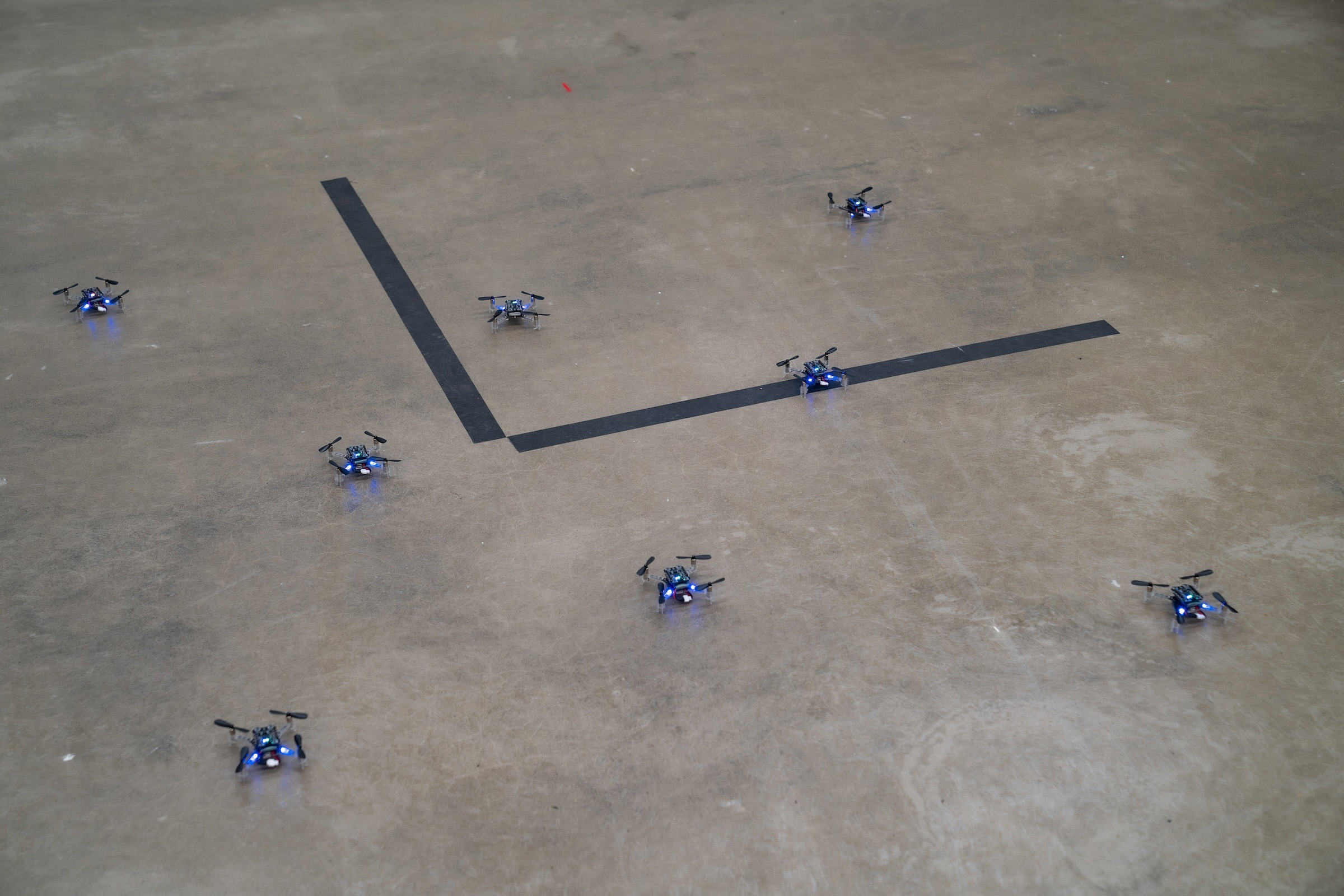
In real-world demonstrations, the team trained a small number of palm-sized drones to safely carry out different objectives, from simultaneously switching positions midflight to landing on designated moving vehicles on the ground. In simulations, the researchers showed that the same programs, trained on a few drones, could be copied and scaled up to thousands of drones, enabling a large system of agents to safely accomplish the same tasks.

“This could be a standard for any application that requires a team of agents, such as warehouse robots, search-and-rescue drones, and self-driving cars,” says Chuchu Fan, associate professor of aeronautics and astronautics at MIT. “This provides a shield, or safety filter, saying each agent can continue with their mission, and we’ll tell you how to be safe.”

Fan and her colleagues report on their new method in a study appearing this month in the journal IEEE Transactions on Robotics. The study’s co-authors are MIT graduate students Songyuan Zhang and Oswin So as well as former MIT postdoc Kunal Garg, who is now an assistant professor at Arizona State University.

Mall margins

When engineers design for safety in any multiagent system, they typically have to consider the potential paths of every single agent with respect to every other agent in the system. This pair-wise path-planning is a time-consuming and computationally expensive process. And even then, safety is not guaranteed.

“In a drone show, each drone is given a specific trajectory — a set of waypoints and a set of times — and then they essentially close their eyes and follow the plan,” says Zhang, the study’s lead author. “Since they only know where they have to be and at what time, if there are unexpected things that happen, they don’t know how to adapt.”

The MIT team looked instead to develop a method to train a small number of agents to maneuver safely, in a way that could efficiently scale to any number of agents in the system. And, rather than plan specific paths for individual agents, the method would enable agents to continually map their safety margins, or boundaries beyond which they might be unsafe. An agent could then take any number of paths to accomplish its task, as long as it stays within its safety margins.

In some sense, the team says the method is similar to how humans intuitively navigate their surroundings.

“Say you’re in a really crowded shopping mall,” So explains. “You don’t care about anyone beyond the people who are in your immediate neighborhood, like the 5 meters surrounding you, in terms of getting around safely and not bumping into anyone. Our work takes a similar local approach.”

Safety barrier

In their new study, the team presents their method, GCBF+, which stands for “Graph Control Barrier Function.” A barrier function is a mathematical term used in robotics that calculates a sort of safety barrier, or a boundary beyond which an agent has a high probability of being unsafe. For any given agent, this safety zone can change moment to moment, as the agent moves among other agents that are themselves moving within the system.

When designers calculate barrier functions for any one agent in a multiagent system, they typically have to take into account the potential paths and interactions with every other agent in the system. Instead, the MIT team’s method calculates the safety zones of just a handful of agents, in a way that is accurate enough to represent the dynamics of many more agents in the system.

“Then we can sort of copy-paste this barrier function for every single agent, and then suddenly we have a graph of safety zones that works for any number of agents in the system,” So says.

To calculate an agent’s barrier function, the team’s method first takes into account an agent’s “sensing radius,” or how much of the surroundings an agent can observe, depending on its sensor capabilities. Just as in the shopping mall analogy, the researchers assume that the agent only cares about the agents that are within its sensing radius, in terms of keeping safe and avoiding collisions with those agents.

Then, using computer models that capture an agent’s particular mechanical capabilities and limits, the team simulates a “controller,” or a set of instructions for how the agent and a handful of similar agents should move around. They then run simulations of multiple agents moving along certain trajectories, and record whether and how they collide or otherwise interact.

“Once we have these trajectories, we can compute some laws that we want to minimize, like say, how many safety violations we have in the current controller,” Zhang says. “Then we update the controller to be safer.”

In this way, a controller can be programmed into actual agents, which would enable them to continually map their safety zone based on any other agents they can sense in their immediate surroundings, and then move within that safety zone to accomplish their task.

“Our controller is reactive,” Fan says. “We don’t preplan a path beforehand. Our controller is constantly taking in information about where an agent is going, what is its velocity, how fast other drones are going. It’s using all this information to come up with a plan on the fly and it’s replanning every time. So, if the situation changes, it’s always able to adapt to stay safe.”

The team demonstrated GCBF+ on a system of eight Crazyflies — lightweight, palm-sized quadrotor drones that they tasked with flying and switching positions in midair. If the drones were to do so by taking the straightest path, they would surely collide. But after training with the team’s method, the drones were able to make real-time adjustments to maneuver around each other, keeping within their respective safety zones, to successfully switch positions on the fly.

In similar fashion, the team tasked the drones with flying around, then landing on specific Turtlebots — wheeled robots with shell-like tops. The Turtlebots drove continuously around in a large circle, and the Crazyflies were able to avoid colliding with each other as they made their landings.

“Using our framework, we only need to give the drones their destinations instead of the whole collision-free trajectory, and the drones can figure out how to arrive at their destinations without collision themselves,” says Fan, who envisions the method could be applied to any multiagent system to guarantee its safety, including collision avoidance systems in drone shows, warehouse robots, autonomous driving vehicles, and drone delivery systems.

This work was partly supported by the U.S. National Science Foundation, MIT Lincoln Laboratory under the Safety in Aerobatic Flight Regimes (SAFR) program, and the Defence Science and Technology Agency of Singapore.