
Home Blog Page 352

Staying Grounded in Reality in 2025

0

Navigating the Chaos of 2025

Remember that artificial isn’t always better.

As we begin a new year, it’s clear that 2025 is shaping up to be a challenging time. With the world still reeling from the events of the past, it’s easy to feel overwhelmed and disoriented. But there is hope. In this article, we’ll explore six meditations to help you stay grounded and focused in a world that seems increasingly chaotic.

Refuse to react

In a world where every controversy seems to spark an equal and opposite reaction, it’s easy to get caught up in the emotional rollercoaster. But it’s essential to recognize that our emotions don’t have to be dictated by the whims of others. Whether you’re responding to the latest tweet from a prominent figure or the latest news cycle, remember that you don’t have to react. Take a step back, breathe, and consider the bigger picture.

Reject all vibes

From social media influencers to online communities, it’s easy to get caught up in the latest trends and fads. But remember that these are just that – trends. They’re not necessarily reflective of reality, and they certainly don’t dictate your emotions or behavior. Feel free to reject any vibe that doesn’t resonate with you, and don’t be afraid to forge your own path.

Stop being social online

In an age where social media has become the dominant form of communication, it’s easy to get sucked into the vortex of online interactions. But is it really necessary? Take a step back and consider whether the constant stream of information is actually enriching your life or draining your energy. If you find that social media is no longer serving you, it may be time to reevaluate your online presence.

Disregard Musk

As the world’s most prominent billionaires continue to shape the course of human history, it’s natural to feel a sense of awe and wonder. But let’s be real – we don’t need to spend hours dissecting the latest pronouncements from Elon Musk. Instead, focus on what you can control, and let the rest slide.

Engage in mini-rebellions

In a world that often seems determined to stifle our individuality, it’s essential to find ways to express ourselves and assert our independence. Whether it’s through subtle acts of defiance or more overt forms of resistance, remember that it’s okay to challenge the status quo. So go ahead, wear a funny hat, dye your hair a bold color, or simply refuse to engage with the latest trends. You do you.

Let go of 2020

As we bid farewell to the past, it’s natural to look back on the events of the past and reflect on what we’ve learned. But let’s not get too caught up in nostalgia. Instead, focus on the present and the future, and let go of any residual emotions or habits that no longer serve you.

Remember fun

Finally, remember that life is meant to be enjoyed. In a world that often seems darker than ever before, it’s easy to lose sight of what’s truly important. So take time to laugh, to love, and to find joy in the simple things. Whether it’s a sunset, a good book, or a quiet moment of solitude, remember that there’s beauty to be found in even the most challenging of times.

Conclusion

As we navigate the challenges of 2025, it’s essential to stay grounded, focused, and true to ourselves. By embracing these six meditations, you can find a sense of peace and purpose in a world that often seems chaotic and overwhelming. Remember that you are not alone, and that even in the darkest of times, there is always hope.

FAQs

Q: How can I stay positive in a world that often seems negative?
A: Focus on the present moment, and find ways to cultivate joy and gratitude.

Q: How can I avoid getting caught up in online drama?
A: Set boundaries, limit your online interactions, and prioritize real-life connections.

Q: What are some ways to engage in mini-rebellions?
A: Try wearing a funny hat, dyeing your hair a bold color, or simply refusing to engage with the latest trends.

Q: How can I let go of 2020?
A: Focus on the present and the future, and let go of any residual emotions or habits that no longer serve you.

Q: How can I find joy in a world that often seems dark?
A: Take time to laugh, to love, and to find beauty in the simple things.

ASUS’ ProArt Display: Mostly Impressed

0

Unpacking and Set-Up

This all-professional 27” monitor from ASUS ProArt line comes in a relatively small and very light box. A reminder that gone are the days of pro screens that used to need two people to manage the installation. This unit comes in three parts that are very easy to put together. The square baseplate, the vertical upright tube (with that contemporary cable management hole that looks great, until you actually use it for cable management!), and the VESA-attached screen. It includes the power cord, and USB-C cable.

Care needs to be taken when hand-screwing the post to the base. And better instructions would have helped me when attaching the VESA screen to the post. But regardless, it went from box to desktop in under ten minutes. The VESA connection will also allow the screen to connect with other stands, arms or wall units.

Looking at the Hardware

Though nicely designed, the monitor itself is made from mostly basic plastic construction.

The stand is also nice, with a contemporary look, but not without a few issues. One being that it is a bit more wobbly when touched than I’d prefer, mostly due to its lack of heft.

The second issue is that while the unit allows a decent level of customizing, it’s perhaps a bit shorter in height than it should be, ranging from just 16” in total height, up to a hair over 21”. The problem here seems to be that it was designed to be used at a desk where the keyboard/mouse resides on a lower level, like an under-desk drawer. If my desk had that, I would need to lower my chair by 2-3 inches, and my head would be more aligned with the central area of the screen. Rather than the upper edges it does now. And I am not tall, so this might be an issue for those over 6 foot.

Color Accuracy and Gamut

As ASUS states, the monitor indeed covers 100% of the sRGB colour gamut. Though the Spyder found it covers only 91% of the AdobeRGB gamut. We left the gamma set to its default at 2.2, and the Spyder says it’s 2.1, which is close enough for us.

We shot the full 48-colour stress test at the screen, looking to see how close it can reproduce everything from vibrant colours to subtle pastels. And while the resulting raw data shows delta shifts as high as 2, this is actually very accurate. Most of the colours were much better (zero would be perfect).

Luminance Uniformity

The only place where this screen fell short was in its “Luminance Uniformity”, which showed a larger variation in brightness across the screen than we would like to see. We re-ran this test two more times, all with the same results. While this is not evident when looking at the screen, we feel it should have tighter tolerances.

Bottom Line

While it may fall somewhat short of perfection, we are dealing in the rarefied world of very high-quality monitors. And it is probably important to remind everyone that this particular monitor is selling for as little as half that of its intended competitors.

The only other small complaint, which is no fault of the monitor, is that 27” screens are starting to feel a bit small today. If you feel the same way, then remember you are trading a bit of size for quality. And we can easily remedy this by adding a cheap second screen to put application pallets and tools on.

FAQs

Q: Is this monitor suitable for graphic artists?
A: Yes, this monitor is designed for graphic artists and content creators who require high-quality color accuracy and a wide color gamut.

Q: Does it support HDR?
A: Yes, the monitor supports HDR10 and VESA DisplayHDR 500.

Q: Is the monitor easy to set up?
A: Yes, the monitor is easy to set up and comes with a simple and intuitive design.

Q: Is the monitor suitable for gaming?
A: No, this monitor is not designed for gaming and has a lower refresh rate compared to gaming monitors.

Q: Is the monitor compatible with Mac, Windows, and Linux?
A: Yes, the monitor is fully compatible with Mac, Windows, and Linux operating systems.

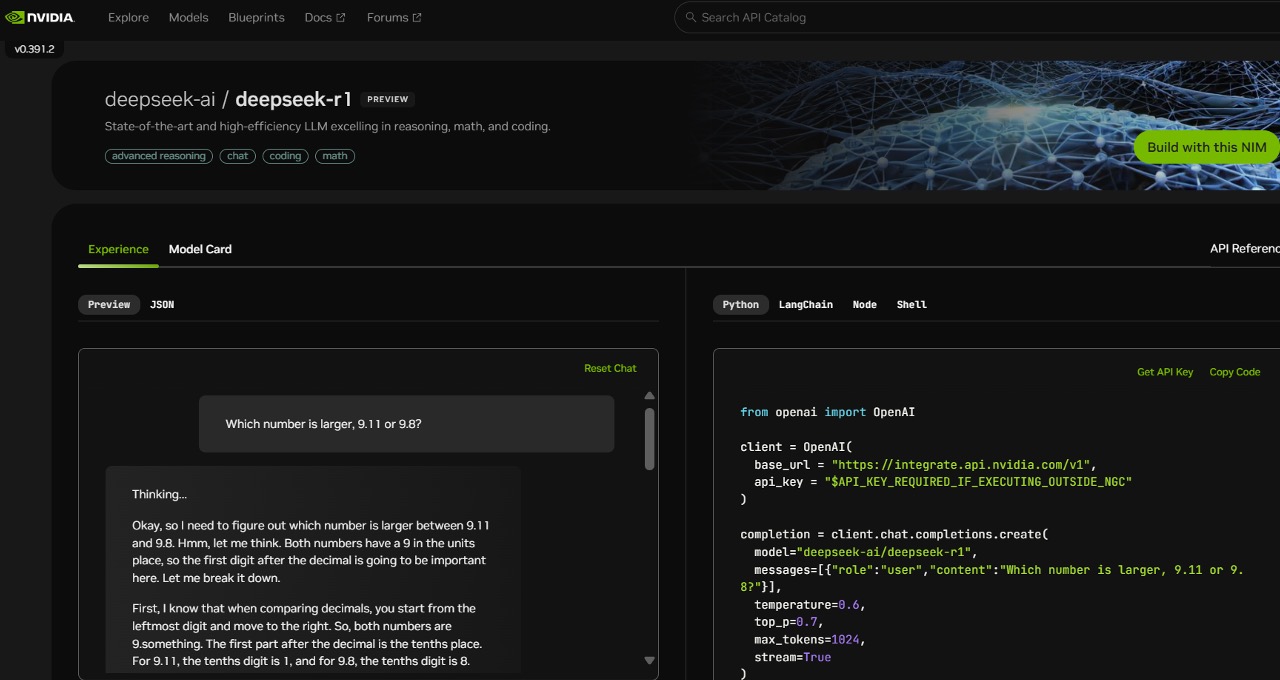
DeepSeek-R1 Now Live With NVIDIA NIM

DeepSeek-R1: A State-of-the-Art Reasoning Model for Agentic AI Inference

DeepSeek-R1: A Perfect Example of Test-Time Scaling

DeepSeek-R1 is an open model with state-of-the-art reasoning capabilities. Instead of offering direct responses, reasoning models like DeepSeek-R1 perform multiple inference passes over a query, conducting chain-of-thought, consensus, and search methods to generate the best answer.

The Importance of Test-Time Scaling

Performing this sequence of inference passes – using reason to arrive at the best answer – is known as test-time scaling. DeepSeek-R1 is a perfect example of this scaling law, demonstrating why accelerated computing is critical for the demands of agentic AI inference.

Model Quality and Test-Time Compute

As models are allowed to iteratively “think” through the problem, they create more output tokens and longer generation cycles, so model quality continues to scale. Significant test-time compute is critical to enable both real-time inference and higher-quality responses from reasoning models like DeepSeek-R1, requiring larger inference deployments.

High-Quality Inference and Real-Time Performance

R1 delivers leading accuracy for tasks demanding logical inference, reasoning, math, coding, and language understanding while also delivering high inference efficiency.

Introducing the DeepSeek-R1 NIM Microservice

To help developers securely experiment with these capabilities and build their own specialized agents, the 671-billion-parameter DeepSeek-R1 model is now available as an NVIDIA NIM microservice on build.nvidia.com. The DeepSeek-R1 NIM microservice can deliver up to 3,872 tokens per second on a single NVIDIA HGX H200 system.

Getting Started with the DeepSeek-R1 NIM Microservice

Developers can test and experiment with the application programming interface (API), which is expected to be available soon as a downloadable NIM microservice, part of the NVIDIA AI Enterprise software platform. The DeepSeek-R1 NIM microservice simplifies deployments with support for industry-standard APIs. Enterprises can maximize security and data privacy by running the NIM microservice on their preferred accelerated computing infrastructure.

Creating Customized DeepSeek-R1 NIM Microservices

Using NVIDIA AI Foundry with NVIDIA NeMo software, enterprises will also be able to create customized DeepSeek-R1 NIM microservices for specialized AI agents.

Conclusion

The DeepSeek-R1 model is a large mixture-of-experts (MoE) model that incorporates an impressive 671 billion parameters, supporting a large input context length of 128,000 tokens. The model uses an extreme number of experts per layer, with each layer having 256 experts, with each token routed to eight separate experts in parallel for evaluation.

Frequently Asked Questions

Q: What is the main goal of the DeepSeek-R1 model?
A: The main goal of the DeepSeek-R1 model is to provide state-of-the-art reasoning capabilities for agentic AI inference.

Q: What is test-time scaling?
A: Test-time scaling refers to the process of using reason to arrive at the best answer, which requires multiple inference passes over a query.

Q: What is the importance of test-time compute for reasoning models like DeepSeek-R1?
A: Test-time compute is critical to enable both real-time inference and higher-quality responses from reasoning models like DeepSeek-R1, requiring larger inference deployments.

Q: How can I get started with the DeepSeek-R1 NIM microservice?
A: Developers can experience the DeepSeek-R1 NIM microservice on build.nvidia.com and can test and experiment with the API, which is expected to be available soon as a downloadable NIM microservice, part of the NVIDIA AI Enterprise software platform.

Intel has received $2.2B in federal grants for chip production

0

Semiconductor Giant Intel Receives $2.2 Billion in Federal Grants

Intel Receives First Tranche of Grants

Semiconductor giant Intel Corporation has already received $2.2 billion in federal grants from the U.S. Department of Commerce through the U.S. CHIPS and Science Act, the company shared during its Thursday earnings call. According to Dave Zinsner, Intel’s co-interim CEO, executive vice president, and CFO, the company received the first tranche of $1.1 billion in federal grants at the end of 2024 and an additional $1.1 billion in January 2025.

Grants Based on Milestones

These grants are based on reaching certain milestones, Zinsner added. Another $5.66 billion has yet to be dispersed. The company was awarded a total of $7.86 billion in federal grants to build semiconductors in the U.S. in November as part of the U.S. Department of Commerce’s U.S. CHIPS and Science Act.

Plan for Grant Funding

When Intel was awarded its grant money in November, the company said it was planning to put the funds toward manufacturing and advanced packaging, or toward techniques to assemble and integrate multiple semiconductor chips into one package. This will be carried out at Intel facilities across Arizona, New Mexico, Ohio, and Oregon.

Background on the U.S. CHIPS and Science Act

The U.S. CHIPS and Science Act was signed into federal law by former president Joe Biden in 2022 in an effort to increase domestic semiconductor manufacturing. The act set aside $52 billion in subsidies for domestic chip manufacturers.

Uncertainty under the Trump Administration

While already two years old, the CHIPS Act faces some uncertainty under the Trump administration. If President Donald Trump’s federal funding freeze, which is currently being blocked by a federal judge, does go into effect, it would affect the Commerce Department employees focused on the CHIPS Act, according to Bloomberg reporting.

Intel’s Outlook

Zinsner had a rosier outlook, though. When asked by an analyst, he said that Intel has already been in communication with the Trump administration and "feels really good" about the administration’s outlook on bringing semiconductor manufacturing back to the United States.

Conclusion

In conclusion, Intel has received significant funding from the U.S. Department of Commerce to support its efforts in building semiconductors in the U.S. The company has already received $2.2 billion in grants and plans to use the funds to advance its manufacturing and packaging capabilities.

FAQs

Q: What is the total amount of grant funding Intel has received?
A: Intel has received $2.2 billion in federal grants from the U.S. Department of Commerce through the U.S. CHIPS and Science Act.

Q: How much of the grant funding has been dispersed?
A: Intel has received the first tranche of $1.1 billion in federal grants at the end of 2024 and an additional $1.1 billion in January 2025. Another $5.66 billion has yet to be dispersed.

Q: What is the purpose of the grant funding?
A: The grant funding is intended to support Intel’s efforts in building semiconductors in the U.S. The company plans to use the funds to advance its manufacturing and packaging capabilities.

Q: Is the CHIPS Act facing uncertainty under the Trump administration?
A: Yes, the CHIPS Act faces some uncertainty under the Trump administration. If President Donald Trump’s federal funding freeze, which is currently being blocked by a federal judge, does go into effect, it would affect the Commerce Department employees focused on the CHIPS Act.

Microsoft 365 Copilot Gains Financial Services Confidence

Brokerage Firms Can Now Use Microsoft 365 Copilot with Confidence, Meets SEC Compliance Requirements

Under new SEC rules, financial services firms must keep detailed records of transactions and communications to protect investors and help prevent fraud. These firms need to know that the products and services they employ are capable of meeting the stringent requirements of the regulation.

Microsoft has partnered with records management consulting firm Cohasset Associates to produce an expanded assessment of Microsoft 365 services, including Microsoft Copilot and Microsoft Loop. This report gives firms clarity that they can innovate broadly with the new generative AI capabilities of Copilot and explore the unique collaborative workspace capabilities of Microsoft Loop, while also remaining confident of their ability to ensure compliance.

What the New SEC Rules Require

In a nutshell, SEC Rules 17a-4 and 18a-6 impose new requirements on recordkeeping that will impact many firms. These rules apply to brokers, dealers, and members of national security exchanges, and they require that certain types of records be preserved for certain amounts of time to facilitate regulatory examinations and compliance checks. Additionally, SEC Rule 18a-6 is tailored to security-based swap entities, and specifically targets records related to security-based swap transactions.

The primary goal of all these rules is to protect investors and maintain the integrity of financial markets by ensuring that all transactions are properly documented and can be reviewed if necessary. The regulation includes requirements for the following:

  • Recordkeeping: Firms must keep records of all their transactions, including trade confirmations, account statements, and communications with clients.
  • Retention periods: The rule specifies how long these records must be kept. For example, some records need to be retained for at least six years, with the first two years’ records being easily accessible.
  • Accessibility: The records must be stored in a way that they can be quickly accessed if needed for audits or investigations.

Helping Ensure Compliance through an Independent Assessment from Cohasset Associates

When the SEC revised Rules 17a-4 and 18a-6 in October 2022 to keep pace with rapid technological advances, Microsoft enlisted Cohasset Associates to produce an independent assessment of its compliance capabilities. The latest Cohasset Associates assessment is an update to their earlier report, and it includes detailed evaluations and recommendations for how to implement and configure controls within Copilot and Microsoft Loop to ensure compliance.

Easier and More Efficient Compliance with Microsoft Cloud for Financial Services

Helping firms reduce the friction of meeting compliance requirements while embracing new opportunities through technology is a core tenet of Microsoft Cloud for Financial Services. Microsoft exists to help capital markets firms, banks, insurers, and others harness the benefits of cloud and AI technologies with a fit-for-purpose cloud platform, off-the-shelf accelerators, a broadly aligned partner ecosystem, and comprehensive investments to promote compliance and transparency.

Discover More

To help financial institutions quickly embrace cloud and AI technologies, Microsoft is committed to ensuring that our services remain compliant with all major regulations worldwide. For more information and to learn more on how we empower firms to unlock business value and deepen customer relationships in the era of AI:

Conclusion

Microsoft 365 Copilot with its innovative generative AI capabilities and Microsoft Loop with its unique collaborative workspace capabilities can help brokerage firms innovate while ensuring compliance with SEC rules. With the latest assessment from Cohasset Associates, firms can confidently use Microsoft 365 Copilot and Microsoft Loop, while reducing the friction of meeting compliance requirements.

FAQs

Q: What are the new SEC rules for financial services firms?

A: SEC Rules 17a-4 and 18a-6 impose new requirements on recordkeeping, retention periods, and accessibility of records for financial services firms.

Q: How can firms ensure compliance with the new SEC rules?

A: Firms can ensure compliance by implementing controls within Microsoft 365 Copilot and Microsoft Loop, as recommended in the Cohasset Associates assessment, and by maintaining detailed records of transactions and communications.

Q: What are the benefits of using Microsoft Cloud for Financial Services?

A: Microsoft Cloud for Financial Services helps firms reduce the friction of meeting compliance requirements while embracing new opportunities through technology, promoting compliance and transparency, and empowering firms to unlock business value and deepen customer relationships in the era of AI.

Q: Is Microsoft committed to ensuring compliance with all major regulations worldwide?

A: Yes, Microsoft is committed to ensuring that our services remain compliant with all major regulations worldwide, and provides a range of solutions to help financial services firms ensure compliance with regulatory requirements.

Unlocking Hidden Insights: Aetion’s AI-Driven Approach to Patient Populations

0

The Power of Real-World Data: Unlocking Insights with Aetion’s Smart Subgroups Interpreter

Introduction

Real-world data collected from patient journeys offers a wealth of insights into patient characteristics and outcomes, as well as the effectiveness and safety of medical innovations. Researchers ask questions about patient populations in the form of structured queries, but without the right choice of structured query and deep familiarity with complex real-world patient datasets, many trends and patterns can remain undiscovered.

Aetion’s Solution

Aetion is a leading provider of decision-grade real-world evidence software to biopharma, payors, and regulatory agencies. The company provides comprehensive solutions to healthcare and life science customers to transform real-world data into real-world evidence. Aetion’s technology uses the science of causal inference to generate real-world evidence on the safety, effectiveness, and value of medications and clinical interventions.

Smart Subgroups Interpreter

The Smart Subgroups Interpreter is a feature of Aetion’s Discover application, which uses unsupervised learning methods to uncover hidden insights. This feature identifies clusters of patients with similar characteristics, such as similar prevalence profiles of diagnoses, procedures, and therapies. These subgroups are further classified and labeled by generative AI models based on each subgroup’s prevalent characteristics.

How it Works

The Smart Subgroups Interpreter combines elements of unsupervised machine learning with generative AI to uncover hidden patterns in real-world data. The workflow includes:

  • Create the patient population: Users define a patient population using the Aetion Measure Library (AML) features, which standardize variable definitions using scientifically validated algorithms.
  • Generate features for the patient population: The AEP computes over 1,000 AML features for each patient across various categories, such as diagnoses, therapies, and procedures.
  • Build clusters and summarize cluster features: The Smart Subgroups component trains a topic model using the patient features to determine the optimal number of clusters and assign patients to clusters. The prevalences of the most distinctive features within each cluster, as determined by a trained classification model, are used to describe the cluster characteristics.
  • Generate cluster names and answer user queries: A prompt engineering technique for Anthropic’s Claude 3 Haiku on Amazon Bedrock generates descriptive cluster names and answers user queries.

Solution Overview

The solution uses Amazon Simple Storage Service (Amazon S3) and Amazon Aurora for data persistence and data exchange, and Amazon Bedrock with Anthropic’s Claude 3 Haiku models for cluster names generation. Discover and its transactional and batch applications are deployed and scaled on a Kubernetes on AWS cluster to optimize performance, user experience, and portability.

Outcomes

The Smart Subgroups Interpreter enables users to discover patterns among patient populations using natural language queries, even without prior expertise in real-world data. Users can now turn findings from such discoveries into hypotheses for further analysis across Aetion’s software, generating decision-grade evidence in a matter of minutes, rather than days, and without the need for support staff.

Conclusion

In this post, we demonstrated how Aetion uses Amazon Bedrock and other AWS services to help users uncover meaningful patterns within patient populations, even without prior expertise in real-world data. These discoveries lay the groundwork for deeper analysis within Aetion’s Evidence Platform, generating decision-grade evidence that drives smarter, data-informed outcomes.

Frequently Asked Questions

Q: What is the Smart Subgroups Interpreter?
A: The Smart Subgroups Interpreter is a feature of Aetion’s Discover application that uses unsupervised learning methods to uncover hidden insights and identify clusters of patients with similar characteristics.

Q: How does the Smart Subgroups Interpreter work?
A: The Smart Subgroups Interpreter combines elements of unsupervised machine learning with generative AI to uncover hidden patterns in real-world data.

Q: What is Aetion’s technology?
A: Aetion’s technology uses the science of causal inference to generate real-world evidence on the safety, effectiveness, and value of medications and clinical interventions.

Q: What is Amazon Bedrock?
A: Amazon Bedrock is a fully managed service that provides access to high-performing foundation models from leading AI startups and Amazon through a unified API.

Google’s Gemini AI App is Getting Faster with Flash 2.0

0

Google Upgrades Gemini App with Gemini 2.0 Flash AI Model

Google announced that the Gemini app is getting its Gemini 2.0 Flash AI model, which delivers fast responses and stronger performance across various key benchmarks.

Improved Performance

The upgraded model provides everyday help with tasks like brainstorming, learning, or writing. The change is rolling out to Gemini’s web and mobile apps and will be available to all users.

Transition Period

Google also states that users will still be able to use Gemini 1.5 Flash and 1.5 Pro for the next few weeks.

Origins of Gemini 2.0

The company first introduced Gemini 2.0 in December and promised to get it in its products quickly. At the time, it launched an experimental version of Gemini Flash 2.0 to Gemini users.

Image Generation Capabilities

On Thursday, Google also announced that Gemini’s image generation capabilities now use the newest version of the company’s Imagen 3 AI text-to-image generator. According to Google, the model delivers richer details and textures and follows your instructions with greater accuracy.

Conclusion

The upgraded Gemini 2.0 Flash AI model will provide users with faster and more accurate responses to their queries, making it easier to complete everyday tasks. With the transition period allowing users to continue using previous versions, users can easily adapt to the new model.

FAQs

Q: What does the Gemini 2.0 Flash AI model do?

A: The upgraded model provides fast responses and stronger performance across various key benchmarks, helping with tasks like brainstorming, learning, or writing.

Q: How will users be affected by the upgrade?

A: The change is rolling out to Gemini’s web and mobile apps and will be available to all users. Users will still be able to use Gemini 1.5 Flash and 1.5 Pro for the next few weeks.

Q: What is the Imagen 3 AI text-to-image generator?

A: The Imagen 3 AI text-to-image generator is a model that delivers richer details and textures and follows your instructions with greater accuracy.

Have a.gov email address? You can get Perplexity Pro free for a year

Government Employees Can Get a Free Year of Perplexity Pro

What’s the Offer?

Perplexity is offering a free one-year subscription to Perplexity Pro to anyone with an official email address ending in.gov. This includes federal, state, county, and local government workers.

How to Activate the Offer

Activating the offer is simple. All account holders with a.gov email will see a banner appear on their Perplexity homepage prompting them to redeem a free year of Perplexity Pro. If you don’t have an account yet, you can create one from the Perplexity website for free by clicking on "Sign up."

What is Perplexity Pro?

Perplexity Pro is a paid subscription to the AI chatbot Perplexity that provides bonuses such as:

  • 300 Pro searches a day
  • Access to other powerful AI models
  • File analysis
  • Access to a special Discord channel
  • And more

How Much Does Perplexity Pro Usually Cost?

Usually, Perplexity Pro subscription runs $20 a month or $200 a year.

Who Else Has Received Similar Offers?

Perplexity has offered similar deals to other groups in the past, including Comcast customers (that deal still appears to be active) and college students at one of 45 selected campuses.

Conclusion

Perplexity’s offer is a great opportunity for government employees to try out its AI chatbot and its Pro features for free. With its powerful AI models and high-quality sources, daily searches can become more streamlined and contribute to increased productivity at work.

FAQs

Q: Who is eligible for the free one-year subscription to Perplexity Pro?
A: Anyone with an official email address ending in.gov, including federal, state, county, and local government workers.

Q: How do I activate the offer?
A: All account holders with a.gov email will see a banner appear on their Perplexity homepage prompting them to redeem a free year of Perplexity Pro. If you don’t have an account yet, you can create one from the Perplexity website for free by clicking on "Sign up."

Q: What does Perplexity Pro offer?
A: Perplexity Pro offers bonuses such as 300 Pro searches a day, access to other powerful AI models, file analysis, access to a special Discord channel, and more.

Q: How much does Perplexity Pro usually cost?
A: Perplexity Pro usually costs $20 a month or $200 a year.

Apple’s Revenue Grows 4 Percent

0

Apple’s iPhone Sales Disappoint Despite AI Features

Revenue and Profit Rise, but Sales Fall Short of Expectations

Apple, the tech giant, announced its quarterly results on Thursday, revealing a modest 0.8% decrease in iPhone sales, which fell short of expectations. The company’s revenue increased 4% to $124.3 billion, while its profit rose 7% to $36.33 billion. Despite the company’s efforts to revitalize its iPhone business with new AI features, the results failed to meet Wall Street analysts’ expectations.

AI Features Not Enough to Boost Sales

The company’s new AI features, including its AI system called Apple Intelligence, were heavily promoted, but the iPhone 16, which was released in September, did not have the expected impact on sales. The AI features were initially available only in the United States and later expanded to other English-speaking countries, but they have yet to be released in China, the company’s second-largest market.

China Sales Decline

Apple’s sales in China fell 11% to $18.51 billion, with the company’s share of the smartphone market in China dropping 2.4 percentage points to 15.5% last year, according to Counterpoint Research. The company’s inability to release its AI features in China has weakened the iPhone’s appeal in the market.

AI Features Face Disappointment

Some of the AI features, such as the news notifications system, have been met with disappointment from customers. The company announced that it would disable the feature due to concerns that it was misrepresenting media reports. "There was so much optimism that they had the golden egg with the iPhone 16, but fast forward to today, and it feels like the rug has been pulled out from under them," said David Wagner, head of equity at Aptus Capital Advisors. "There’s been a slower AI uptake."

Supply Chain Concerns

Apple is also facing potential supply chain disruptions due to the threat of additional tariffs on goods from China and other countries. President Trump has threatened to impose tariffs on goods from China, where Apple makes most of its iPhones, and on products shipped from countries like Vietnam, where Apple has moved some of its manufacturing. Any tariffs would cut into Apple’s profits or force the company to raise prices.

Services Division Remains Strong

The company’s services segment, which includes the sales of apps, Apple TV+, and Apple Pay, continues to be the strongest-performing part of its business. The division saw a 14% increase in sales to $26.34 billion, driven by the company’s ability to collect a cut of revenue from over a billion subscriptions sold across iPhones and iPads.

Conclusion

Apple’s quarterly results demonstrate that the company’s efforts to revitalize its iPhone business with AI features have fallen short of expectations. The company’s sales in China have declined, and the AI features have faced disappointment from customers. However, the company’s services division remains strong, and Apple expects revenue to rise in the current quarter.

Frequently Asked Questions

Q: What were Apple’s quarterly results?
A: Apple’s revenue increased 4% to $124.3 billion, while its profit rose 7% to $36.33 billion.

Q: How did Apple’s iPhone sales perform?
A: iPhone sales fell 0.8% year-over-year, falling short of expectations.

Q: Why did Apple’s iPhone sales decline?
A: The company’s iPhone 16, which was released in September, did not have the expected impact on sales, and the AI features have yet to be released in China, the company’s second-largest market.

Q: What is the outlook for Apple’s services division?
A: The company expects revenue to rise in the current quarter, driven by its ability to collect a cut of revenue from over a billion subscriptions sold across iPhones and iPads.

AI to Rescue Rural Hospitals

At his confirmation hearing on Wednesday before the Senate Finance Committee, Robert F. Kennedy Jr., Trump’s controversial pick to lead the Health and Human Services, said rural hospitals will be a priority if he is confirmed as health secretary.

Rural Hospital Priority

Kennedy told the committee that President Trump is determined to end the “hemorrhage of rural hospitals” through the use of AI and telemedicine, and that he asked Kennedy to address the issue if he is confirmed.

“These are innovations that I saw the other day at Cleveland Clinic, which has developed an AI nurse that you cannot distinguish from a human being that has diagnostics as good as any doctor.”

Kennedy added, “We can provide concierge care to every American in this country, even remote parts of Wyoming, Montana and Alaska.”

Current Challenges

According to the American Hospital Association (AHA), rural hospitals’ low patient volumes make it hard for them to manage the high fixed costs associated with operating a hospital.

As a result, AHA asserts that rural facilities are vulnerable to policy and market changes, and to Medicare and Medicaid payment cuts.

Proposed Solutions

Kennedy said there are opportunities to provide personnel to rural hospitals and that he intends to use his power, because he has seen the priority the issue of rural hospitals has been given by both Democrats and Republicans on this committee.

“I intend to make that a priority if I’m privileged to be confirmed,” Kennedy said.

Large Trend

The AHA notes that rural Americans are more likely to be uninsured, have lower incomes, and are, on average, older and less healthy than Americans living in metropolitan areas.

President Donald Trump recently announced the formation of Project Stargate, an at least $500 billion investment to build the physical and virtual infrastructure to power AI construction, including “colossal data centers” and campuses nationwide, with one of its goals to improve health outcomes.

Conclusion

Robert F. Kennedy Jr., Trump’s controversial pick to lead the Health and Human Services, has stated his intention to make rural hospital challenges a priority if confirmed as health secretary. AI and telemedicine are proposed as solutions to improve healthcare outcomes and address the specific challenges faced by rural hospitals.

Frequently Asked Questions

Q: What is Project Stargate?

A: Project Stargate is an investment of at least $500 billion to build physical and virtual infrastructure to power AI construction, with the goal to improve health outcomes.

Q: How will AI improve healthcare outcomes for rural hospitals?

A: AI technology can improve healthcare outcomes by enabling remote diagnosis, treatment, and monitoring, improving access to medical care for rural communities, and reducing the pressure on rural hospitals.
