Home Blog Page 354

Nintendo Loses Trademark Battle

0

Nintendo Loses Legal Battle to Small Costa Rican Supermarket

A David vs. Goliath Story

Nintendo, a global gaming giant, has reportedly lost a legal battle against a small Costa Rican supermarket, Super Mario, in a trademark dispute. The supermarket, which has been trading under the name for 52 years, successfully protected its right to use the name despite Nintendo’s attempts to block it.

The Dispute

The dispute began when the owner of the supermarket, Mario, and his son Carlos, went to renew the supermarket’s registration. Nintendo stepped in, claiming that the name Super Mario belonged to them globally. However, the supermarket has been using the name for 12 years longer than Nintendo, and the registration was only made in 2013.

The Technicality

The saving grace for the supermarket is a technicality in the trademark wording. Nintendo’s registration covers a wide range of categories, but does not cover the sale of groceries. This means that the supermarket is allowed to continue using the name Super Mario without infringing on Nintendo’s trademark.

A Heart-Warming Outcome

This outcome is a heart-warming end to a legal tale, and one that makes you wonder about the motivations behind the actions of corporate lawyers. It’s unclear why Nintendo would harm its reputation by taking on a small, independent supermarket. The line has to be drawn somewhere, but it’s hard to see how this dispute benefited either party.

Conclusion

In the end, the small Costa Rican supermarket emerged victorious, and Nintendo was forced to concede defeat. This outcome serves as a reminder that even the largest corporations can be held accountable for their actions, and that sometimes, the little guy can come out on top.

Frequently Asked Questions

Q: Why did Nintendo try to block the supermarket’s use of the name Super Mario?
A: Nintendo claimed that the name Super Mario belonged to them globally, and that the supermarket’s use of the name was an infringement on their trademark.

Q: How long has the supermarket been using the name Super Mario?
A: The supermarket has been using the name for 52 years, 12 years longer than Nintendo.

Q: What was the outcome of the dispute?
A: The supermarket successfully protected its right to use the name Super Mario, and Nintendo was forced to concede defeat.

Q: Why did Nintendo’s registration not cover the sale of groceries?
A: Nintendo’s registration covers a wide range of categories, but does not cover the sale of groceries, which is the primary business of the supermarket.

The Benefits of Employee Engagement to Your Business, Culture, & People

0

The Importance of Employee Engagement in 2025

In recent years, the employee engagement landscape has dramatically shifted. During the COVID-19 pandemic, employers were deeply invested in all things culture and engagement, focusing on employee well-being, safety, and connection as employees were dispersed and navigating a global crisis. As the pandemic fades into our memories, and  economic pressures have since mounted, employers are now intensely focused on performance and productivity–sometimes at the expense of employee engagement. 

But here’s the truth. High performance and strong engagement are inextricably connected. Simply put, you cannot sustain one without the other. Engaged employees perform better. They are more motivated, aligned, and willing to go above and beyond for the good of their team and organization. And when performance expectations are clear and are employee are getting effective coaching and feedback, they’re more engaged. Even in an employer’s market, engagement remains a critical lever for retaining top talent and driving business success. 

Research shows that engaged employees deliver better results, with about 81% of executives strongly agreeing that engaged employees perform at a higher level.


But many employers struggle to balance these priorities effectively–often investing in one more heavily than the other. 
When organizations prioritize performance over engagement, they see a drop in productivity. Employees feel like worker bees, feel unheard, feel disempowered. Similarly, when employers focus solely on feel-good engagement initiatives (like perks and pizza parties) without setting clear performance expectations, productivity suffers. Competing priorities can stifle organizational culture, limiting employee potential, innovation, and competitive edge.


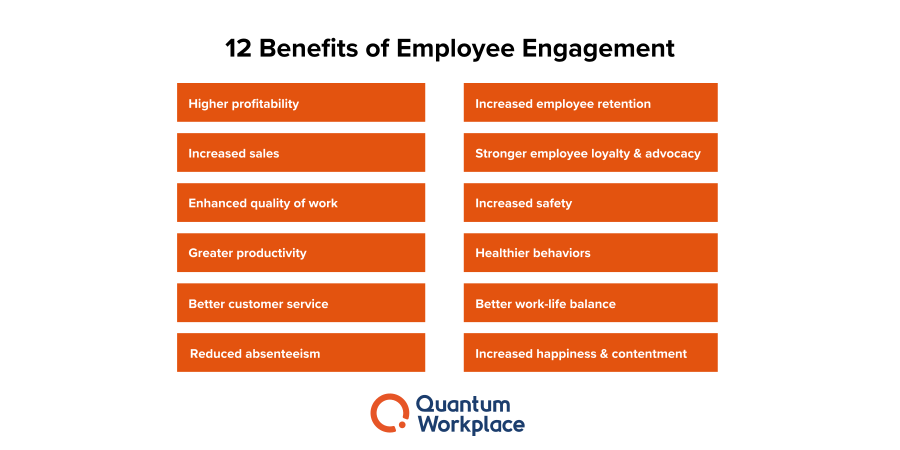
12 Top Employee Engagement Benefits

Organizational Performance Benefits

Engaged employees drive success across the organization. When employees feel connected, motivated, and invested in their work, they achieve tangible business results. Companies that engage their employees consistently outperform their competitors in key areas such as profitability, sales, quality output, productivity, and customer service. 

1. Higher Profitability

An engaged workforce leads to higher profitability. Engaged employees work more efficiently, make better decisions, and are more likely to go the extra mile, which contributes to increased profits. 

Studies reveal that companies with high employee engagement enjoy up to 21% higher profitability than their disengaged counterparts. The Harvard Business Review Analytic Services research linked above indicates that 56% of organizations achieve positive ROI from their investments in employee engagement. 

2. Increased Sales

Another benefit of employee engagement is increased sales. Engaged employees enthusiastically connect with prospects and customers, understand their needs, and provide solutions that directly boost sales. Companies with highly engaged employees experience sales increases of over 20% compared to those with low levels of engagement.

3. Enhanced Quality of Work

Engaged employees take pride in their work, pay attention to details, and commit to delivering high-quality products or services. Their attention to quality enhances customer satisfaction and reduces costly rework, returns/refunds, and customer complaints. 

4. Greater Productivity

An engaged workforce enhances productivity, which serves as a primary business goal for organizations investing in employee engagement, as indicated by around 53% of businesses. Engaged employees maintain focus, show motivation, and willingly put in extra effort. They waste less time on non-work-related activities and work more efficiently. Companies with highly engaged employees report productivity gains of up to 17%

5. Better Customer Service

Engaged employees actively go above and beyond to ensure customer satisfaction. They remain attentive, responsible, and committed to providing superb service. Customer happiness directly and positively impacts loyalty, referrals, and revenue. Approximately 72% of companies strongly agree that highly engaged employees promote a happy workforce.

Operational Advantages

6. Reduced Absenteeism

Highly engaged employees genuinely want to be at work, which is why they miss work less often. This significant reduction in absenteeism (41% lower in companies with high engagement levels) enables consistent operations and boosts productivity. 

7. Increased Employee Retention

52% of organizations cite employee retention as a primary goal for their employee engagement initiatives. Employees who love their jobs and feel valued by their employers are more likely to stay. Engaged workforces lead employers to experience 24% lower turnover. As an employer, you understand that maintaining top talent is crucial for preserving institutional knowledge, skills, and relationships within the company. All of these factors are essential for driving business success. 

8. Stronger Employee Loyalty & Advocacy

Engaged employees feel a deep attachment and loyalty to their employer, going beyond mere presence. Departments with engaged employees achieve an impressive 59% higher employee loyalty and retention. These employees act as true brand ambassadors, often going above and beyond while also attracting additional top talent. 

Impact on Employee Well-Being

Employees who feel genuinely connected to their employer and its purpose tend to experience greater job satisfaction, enjoy better physical and mental health, and achieve an improved work-life balance. These benefits extend beyond their jobs and positively impact their lives at home. 

9. Increased Safety

When considering engaged employees, we often overlook increased safety. Employees who are highly engaged remain more present, attentive, and committed to everything, including following safety protocols! Their heightened awareness and attention to detail help prevent workplace accidents and injuries, creating a much safer workplace. 

10. Healthier Behaviors

A balanced diet and sufficient sleep not only pay off at home but also benefit work performance! Engaged employees are more likely to exercise regularly, maintain a balanced diet, and get sufficient sleep. This positive lifestyle shift improves physical health, reduces stress, and enhances overall well-being. When people feel good, they take fewer sick days, incur lower healthcare costs, and experience fewer health issues. 

11. Better Work-Life Balance

Engagement profoundly impacts employees’ lives as well. Employees who feel fulfilled and satisfied at work manage stress better and achieve a healthier work-life balance. This engagement may lead to stronger personal relationships, improved family dynamics, and a greater sense of overall satisfaction. 

12. Happiness and Contentment

When employees are engaged, they generally experience greater happiness and contentment at work and at home. They develop a strong sense of purpose, feel genuinely valued for their contributions, and cultivate a deeper emotional connection to their organization. This positive mindset boosts resilience, enhances problem-solving abilities, and fosters an optimistic outlook. 
why is employee engagement important - benefits of employee engagement

Critical Employee Engagement Trends & Challenges to Watch (and Act On) in 2025

In 2025, organizations will prioritize employee engagement to remain competitive and retain key talent. Neglecting engagement poses certain risk, causing employees to play the “waiting game.” Some turnover is good turnover, but you do not want your key talent planning for their exit. Ignoring employee signals of departure and overlooking engagement can result in losing critical talent, decreased productivity, and reduced profitability.

Turnover of Critical Talent

One of the most pressing challenges for 2025 is the risk that organizations will lose their high-performing employees when the job market improves. Around 85% of senior executives identify retention as a top ten issue. Engaged employees are more likely to stay loyal to their employers, but they may seek new roles if their needs remain unmet. Organizations must recognize that employees are their most valuable asset and take preventive measures to retain key talent. These measures might look like offering competitive compensation, providing clear growth trajectories, and fostering a culture of recognition and appreciation. More importantly, make sure you have the tools you need to detect turnover risk, understand turnover drivers, and take action.

Competitive Compensation & Incentives

Fair and attractive compensation packages are essential for employees and crucial for retaining them, but the story goes deeper. Pay reflects employees’ perceived value and signals their future opportunities within the organization. When employees leave, they often cite pay as a reason linked to feeling undervalued or recognizing limited growth potential. Leaders should view compensation as part of a complete strategy. They should add performance-based incentives and top-tier benefits to their compensation packages. This balanced approach retains top talent and aligns with business objectives. 

Clear & Meaningful Growth Opportunities

Everyone wants to know their “next step.” This desire drives employees to seek growth opportunities, making viable growth critical to employee engagement. Employees want to actively pursue continuous learning, skill development, and career advancement. By providing a clear path for professional growth within your organization, you can foster purpose and commitment, reducing the likelihood of employees seeking opportunities elsewhere. 

Continuous Listening: Not Settling for “Good Enough”

We’ve all heard someone say “good enough” when they settle for subpar work. This mindset doesn’t meet the demands of today’s landscape. You’ve probably heard the idiom, “The only constant in life is change.” This saying rings more true than ever for employers who engage their employees. Organizations must actively cultivate a culture of continuous improvement by regularly seeking employee feedback and taking meaningful actions based on that input. A strategic employee listening program allows companies to adapt appropriately to changing market conditions while keeping cultural initiatives relevant. 

Offering Flexibility that Meets Employee & Business Needs

Many organizations have adapted to meet the demand for flexibility that many employees value. By offering flexible work arrangements, companies enhance work-life balance and increase employee satisfaction. Quantum Workplace research shows that employees are nearly two times more likely to be highly engaged when they perceive flexibility as a significant benefit in their organization. Additionally, employees who receive flexible options are 1.7 times more likely to stay with their current employer and 2.4 times less likely to search for or apply for other job opportunities. 

While organizations need to meet employees where they are—and implement flexibility fairly and consistently—they need to do so in a way that doesn’t have a negative impact productivity or team dynamics.

Connecting with Sense of Purpose

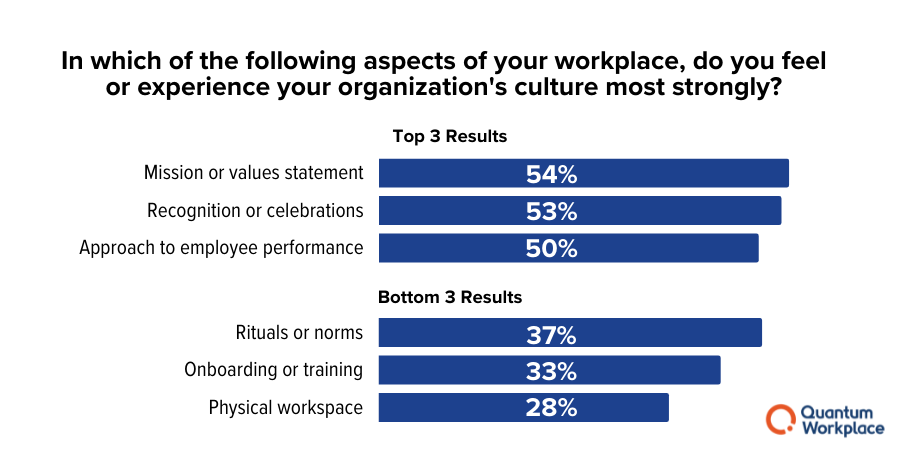
Organizations must connect day-to-day work to a deeper purpose to sustain employee engagement. Employees seek a sense of fulfillment in their roles, and 65% of them report that their company culture has changed post-pandemic. Leaders need to clarify their mission, vision, values, and general purpose for employees. 

Our research shows that 54% of employees feel the strongest connection to culture through their organization’s mission and values. Aligning contributions with a greater purpose engages employees’ motivations, fostering a shared sense of success. Furthermore, 66% of employees believe that their culture positively impacts their work and behavior daily.
Culture_Report-Culture_Experience


Driving Employee Engagement as a Continuous Cycle

employee engagement strategy

Successful employee engagement follows a proven cycle: ASK, AHA, and ACT.

Start by ASKING. Capture honest feedback through surveys and create an environment where employees feel safe sharing their true thoughts and feelings. This approach lays the groundwork for those AHA moments, as you analyze the data to uncover key insights, trends, and areas for improvement.  

Finally, ACT decisively by implementing changes based on these insights and ensuring employees stay involved in the process. This process continues as you measure progress and gather new feedback, creating a continuous improvement flywheel. To maximize this approach:

  • Deploy an annual engagement survey to establish a baseline and see trends over time.
  • Launch regular pulse surveys to dive deeper on important topics.
  • Use modern employee survey technology to gather real-time feedback and surface critical insights.
  • Track metrics like engagement scores, retention rates, and business KPIs.
  • Connect engagement and retention efforts to business outcomes.
  • Align engagement initiatives with organizational goals.
  • Empower managers and leaders to drive engagement of their teams.  
  • Communicate often and transparently, opening up two-way dialogue often.
  • Recognize employee achievements consistently and authentically.

Successfully driving employee engagement requires dedicating resources, securing organization-wide support, and committing to continuous improvement. Employers who master this flywheel foster a culture where engagement drives performance, innovation, and business success. Most importantly, they show employees that their voices matter and that they hold the power to influence positive organizational change. 

Employee Engagement Roles in Your Organization


The Role of Employees

Who is responsible for employee engagement? The answer is multifaceted, but let’s start with employees. Without honest feedback from employees, you cannot know if your employee engagement strategy works. Employees play a crucial role in ensuring the success of engagement initiatives. They must be willing to provide open and honest feedback about their work experiences and collaborate with managers and leaders to develop solutions. 

Employees should strive to understand why initiatives are implemented and how those initiatives will impact their experiences. They need to carefully consider and share what would most improve their experience. Additionally, employees must communicate feedback openly, brainstorm solutions, and support their team’s commitments. 

The Role of HR

HR plays a vital role in aligning leaders, managers, and employees around employee engagement. HR acts as a driver and a coach, engaging all levels of the organization in employee success initiatives. They partner with stakeholders to implement strategies and help define, launch, communicate, measure, and adjust key initiatives.  

HR also influences and informs senior leaders, empowers and equips managers, and supports employees. They build processes and systems and secure the right tools and technology for the organization to thrive. HR implements the employee engagement strategy, taking ownership of the “how.” They focus on driving alignment and accountability. And choose processes and tools that measure and drive employee engagement while coaching leaders and teams. 

The Role of Managers

Managers play a pivotal role in encouraging and driving employee engagement within an organization. By implementing a coaching culture, managers empower their teams to reach their fullest potential. Providing regular feedback, both positive and constructive, is essential for growth and development. Managers need to equip themselves with the tools and training to deliver effective feedback that resonates with team members and fosters a culture of honesty.

Managers also require ongoing learning opportunities to continuously improve, much like individual contributor employees. As the workforce evolves, managers must adapt their approaches to meet their team’s changing needs. Investing in management development programs equips managers with the knowledge and techniques to navigate complex situations, inspire their teams, and drive engagement. 

The Role of Senior Leaders

Effective employee engagement strategies require strong leadership commitment and alignment with an organization’s strategic objectives. Leaders actively encourage and cultivate a culture that values and promotes engagement, fostering an environment where employees feel valued, respected, and empowered to contribute their best efforts. 

Leaders need to communicate clearly and consistently to ensure that employees understand the organization’s vision and goals and recognize their importance in achieving them. They should actively explain the significance of employee engagement and its impact on the organization’s success, reinforcing this message through their actions and decision-making. 

Finally, leaders must actively participate in planning employee engagement initiatives. This includes allocating resources, setting measurable goals, and monitoring progress. By demonstrating their commitment through actions, leaders can inspire and motivate their teams to embrace and cultivate a culture of engagement. 


The Future of Employee Engagement is Here: How are You Preparing?

The workplace is shifting before our eyes. Organizations once prioritized culture and engagement primarily through the lens of well-being and connection. However, economic pressures now demand more focus on performance and productivity. This shift creates a critical inflection point: balancing high performance with strong engagement.

Research further validates this, with 81% of executives agreeing that engaged employees deliver superior performance. Nevertheless, employers must strike the right balance by avoiding the following:

  • Overemphasizing performance and disregarding employee engagement
  • Focusing solely on “feel good” engagement tactics and failing to set clear performance expectations and accountabilities
  • Neglecting both elements and stifling connection, alignment, innovation, and competitive advantage

Technology will play a pivotal role in shaping the future of employee engagement. Detailed analytics will empower organizations to gather real-time insights into employee sentiment, further personalize engagement, and streamline open feedback loops. AI will help up-skill people leaders and decrease burden on HR teams who can’t possibly manage it all.

Investing in the right employee engagement platform can change the game, helping organizations can stay ahead of the curve and cultivate a highly engaged, highly motivated workforce. 

Finally, long-term planning for employee engagement success requires a strategic approach. Employers need to align  engagement and culture initiatives with business objectives—and not be too slow to act when critical insight surfaces. Based on insights gleaned, they must allocate the appropriate resources and engage in continuous measurement and refinement.

Successful organizations will approach engagement and action with this mindset: Starting small is better than not starting at all.

Enhance your employee listening strategy

It’s time to put the wheels in motion as you tackle employee engagement. Dive into employee listening to unlock the full potential of your strategy. Download your copy of the comprehensive guide, “The Employee Listening Flywheel: A Framework For Driving Your Feedback Strategy Forward’ today.
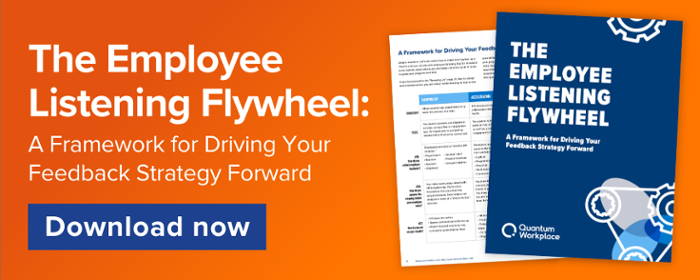
The Employee Listening Flywheel: A Framework for Driving Your Feedback Strategy Forward


Learn more about how Quantum Workplace can help you maximize employee engagement & retention
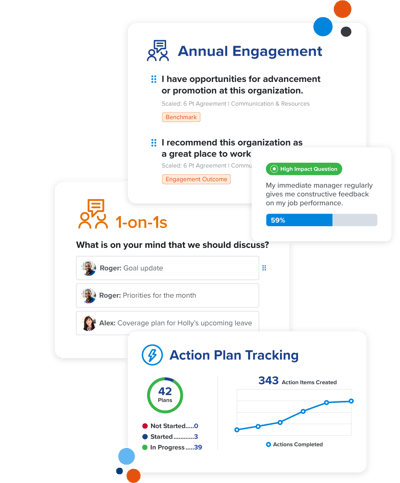
employee engagement software
Experience how Quantum Workplace’s employee engagement platform helps your organization swiftly move from insight to action. Collect feedback, uncover powerful insights, and take confident, efficient action.

Book a demo today to connect with one of our experts and receive a personalized walkthrough of our employee engagement software.


FAQs


What is employee engagement?
 

Employee engagement represents the strength of the mental and emotional connection that employees feel toward their organization, their team, and their work. It reflects how invested employees are emotionally in their roles and the organization’s goals. Engaged employees typically show high commitment, increase productivity, and positively contribute to the company culture. They work not just for a paycheck or the next promotion, but because they genuinely care about their work and are motivated to contribute to the organization’s success.

Why is employee engagement important to HR? 

Employee engagement is vital to HR because it directly impacts key workforce metrics like productivity, retention, well-being, and culture. Highly engaged employees serve as brand ambassadors, perform better, embrace change, and remain with an organization for a longer time. In contrast, disengaged employees show lower productivity and are more likely to leave, which negatively affects culture and the customer experience. 

What are the types of employee engagement? 

Types of employee engagement include: Work engagement, or how connected am I to the work I’m doing? Team engagement, or how connected do I feel to my immediate coworkers? Organizational engagement, or how connected am I to the organization?

How to improve employee engagement in the workplace? 

You can improve employee engagement in many ways, such as providing meaningful work, fostering effective leadership, offering growth opportunities, ensuring fair pay and recognition, promoting work-life balance, enhancing strong communication, and cultivating a values-driven culture. 

What are common employee engagement examples? 

Active employees speak positively about their organization, go above and beyond, actively solve organization-wide problems, maintain a strong work ethic, embrace change, and take pride in their work.  

What are proven employee engagement strategies? 

Organizations that invest in leadership training boost team performance and retention. Strong management creates a waterfall effect throughout the organization, positively impacting each employee’s experience. Employers must establish clear communication channels that encourage feedback from all levels. Career development opportunities motivate employees and keep them invested in the company’s success and future. Regular recognition celebrates employee achievements and reinforces positive behavior. Modern employees seek a solid work-life balance. Leading companies respond to this call with flexible policies that respect employee desires. These organizations foster inclusive environments where diverse perspectives thrive and productivity rises. 

What are the main challenges of employee engagement?

Leadership misalignment quickly undermines employee engagement. When executives fail to demonstrate commitment to engagement programs, they erode employee trust. Communication gaps create uncertainty and confusion. Limited growth opportunities push highly engaged employees to seek jobs elsewhere. Excessive workloads cause burnout, and inadequate compensation packages drive employees to different organizations. Toxic workplace cultures erode engagement from within. Organizations that ignore employee feedback or fail to address systemic issues witness declining employee engagement, morale, and turnover. Constant change without clear direction breeds feelings of instability and disconnection. 

How do you measure the impact of employee engagement on productivity? 

Evaluate metrics such as labor hours, sales per employee, and customer satisfaction scores to gauge the productivity impact. Compare these numbers to those of disengaged employees and analyze the trends to quantify your efforts.

What are the benefits of employee engagement in the workplace? 

Key benefits include increased productivity, higher profitability, enhanced customer loyalty, better quality, and improved safety. Engaged organizations experience lower absenteeism and turnover, foster greater employee loyalty and advocacy, achieve improved hiring success, and strengthen their employer brand. 

What are the social benefits of employee engagement in the workplace? 

Engaged employees enjoy better physical and mental health, build stronger work relationships, experience higher job satisfaction, and manage stress more effectively while maintaining a better work-life balance. Engagement fosters greater collaboration, inclusion, and community.


 

Apple’s Beautiful Desktop Computer Keeps Defying the Doubters

0

Article

Some might say the iMac doesn’t need to exist. In a world of smartphones, tablets and laptops, the static desktop computer has been increasingly sidelined over the years, to the point that it arguably represents a niche, or even ‘luxury’, product. But Apple has remained faithful to its famous all-in-one, giving it a fresh design for the 2020s, and decking it out with the latest and greatest M4 chip in 2024. And while it won’t be appropriate Mac for everyone, for the right user, it’s a stunning machine.

From a better webcam to an increase in starting RAM, via the inevitable addition of USB-C for accessories, there are incremental upgrades over the M3 model across the board. But the chip is the real star here, making it a brilliant desktop computer for creatives in particular. And it helps that it looks beautiful too. The question is, if you already have a laptop, and you’ve invested in one of the many 4k monitors out there, do you need an iMac?

Key Specifications

CPU: Apple M4 chip, 10-core CPU with 4 performance cores and 6 efficiency cores
Graphics: Hardware-accelerated H.264, HEVC, ProRes, and ProRes RAW
Memory: 16GB unified memory configurable to 24GB or 32GB unified memory
Storage: 256GB configurable to 2TB
Screen size: 24-inch
Screen type: 4.5K Retina display
Resolution: 4480-by-2520 resolution at 218 pixels per inch
Brightness (measured): 500 nits
Ports: 4 USB-C
Wireless connectivity: WiFi, Bluetooth
Dimensions: Width: 21.5 inches (54.7 cm) Height: 18.1 inches (46.1 cm) Stand depth: 5.8 inches (14.7 cm) Stand width: 5.1 inches (13 cm)
Weight: 9.79 pounds (4.44 kg)

Design, Build and Display

It’s impossible to write about the iMac without writing about the design. I’ve always loved Apple’s slick all-in-one, but the company took it to the next level with the introduction of a palette of pastel hues and a new ultra-slim profile. In a world of utilitarian silvers and greys, the iMac is almost zen-like in appearance. It’s a beautifully designed object, particularly from the back – which probably explains why Apple’s marketing images so often show it in a shop or studio environment.

As ever, the iMac features color-matched accessories. And while the Magic Mouse 2 remains one of Apple’s worst design crimes thanks to its upside-down charging, at least it’s colorful! And the addition of USB-C to the keyboard, mouse and trackpad makes the whole thing more convenient.

Of course, the iMac is almost all screen. The 24-inch (4480 x 2520 pixels) display is stunningly bright, with the M4 model, Apple has added the option to add a nano-texture display.

Price

When it comes to the question of the iMac is for, the two major barriers are portability and price. We’ll talk about the latter first. Even at its starting price of $1,299/£1,299, the iMac is expensive – and that’s before adding extras like the nano-texture display and RAM upgrades. We’ve seen a few discounts (in the UK, Very is offering the base model for £1,205).

Unsurprisingly, there aren’t tons of iMac alternatives out there. You can bag the Dell Inspiron 27 all-in-one for £699, but it’s nowhere near as powerful as the M4 iMac Pro.

Then there’s the question of whether this is your first device. $1,299 isn’t ludicrous for such a powerful computer – the M4 MacBook Pro starts at $/£1,599, for example. But in today’s world, chances are you’re going to want a laptop too, or at least an iPad. If the iMac is a second device, that hole in your wallet is starting to look pretty gaping.

Value score: 3/5

Who is it for?

Therein lies the rub. In 2025, this feels like a niche product. If you care about aesthetics, need a healthy dose of processing power, have budget to play with and are happy to stay in one place, the iMac is absolutely perfect for you. With it’s beautiful design, the iMac was made to be looked at – it’s begging to be placed in a fancy design studio or boutique store. Those who travel a lot need not apply – unless you already have a laptop and are specifically planning to use the iMac as a second at-home (or at-work) machine.

M4 iMac score card

Attributes Notes Rating
Design It’s beautiful. Beautiful, I say. But it’s staying in one place. 5/5
Features The screen, camera and accessories are great, although the lack of height adjustment and touchscreen detract. 4/5
Performance This is without doubt one of the most powerful all-in-one computers available. 5/5
Value Unless the iMac very specifically fits your needs, the price is high for such a niche product. 3/5

Buy it if…

  • You’re looking for a computer that’s also a beautiful design object
  • A 24-inch display will suffice
  • You already have (or don’t need) a laptop or tablet for travelling

Don’t buy it if…

  • You need a bigger display
  • You’re on a budget
  • Portability is of any importance to you

Also consider

  • Dell Inspiron 27 all-in-one
  • Apple MacBook Pro
  • iPad

FAQs

Q: Is the iMac worth the price?
A: It depends on your needs and budget.

Q: Is the iMac suitable for travel?
A: No, it’s designed for staying in one place.

Q: Can I upgrade the iMac’s RAM?
A: Yes, you can upgrade the RAM to 24GB or 32GB.

Q: Is the iMac compatible with my existing devices?
A: Yes, it’s compatible with most devices, but may not be compatible with all peripherals.

AI Your Pizza Guy

0

Palona AI: The Wizard of Conversational Sales

Wyze’s Palona AI is a personalized sales agent trained on the brand’s existing catalog and knowledge base. The technology is powered by large language models, including OpenAI’s ChatGPT, with a separate patent-pending model acting as a supervisor for all conversations. This ensures that the chat stays on topic and focused on Wyze products.

A Conversational Sales Experience

Palona AI is personified as a wizard, offering a conversational sales experience that is both engaging and informative. When asked about the best security camera, the wizard responds with, “Let me guide you through some enchanting options.” The results are all Wyze products, but the wizard is happy to discuss competitors and their pros and cons.

Upselling and Cross-Selling

Like a human salesperson, Palona AI uses the opportunity to upsell and cross-sell Wyze’s products. Almost every time a product-related question is asked, the wizard recommends Wyze’s Cam Plus Plan. The chatbot also has a memory capability, allowing it to build a customer profile and remember preferences for future conversations.

Building a Relationship with Customers

Palona AI is designed to build a relationship with customers, understanding their needs and preferences to provide a personalized experience. This is particularly effective for younger consumers, who are more likely to engage with conversational interfaces. By asking a brand directly about its products, customers can quickly find the information they need, rather than searching through a traditional Google search.

A New Era of Sales

Palona AI is not the first or only company to employ AI as a salesperson. Big Sur AI is another example of a chat-style experience that helps companies boost sales. Unlike human salespeople, AI bots do not receive commissions, making them an attractive option for businesses.

Conclusion

Palona AI represents a new era of sales, where conversational interfaces and AI technology come together to provide a personalized and engaging experience for customers. With its ability to build relationships, remember customer preferences, and upsell and cross-sell products, Palona AI is poised to revolutionize the way we shop.

FAQs

Q: What is Palona AI?
A: Palona AI is a personalized sales agent trained on Wyze’s existing catalog and knowledge base.

Q: How does Palona AI work?
A: Palona AI is powered by large language models, including OpenAI’s ChatGPT, with a separate patent-pending model acting as a supervisor for all conversations.

Q: Can I ask about competitors?
A: Yes, Palona AI is happy to discuss competitors and their pros and cons.

Q: Does Palona AI have a memory capability?
A: Yes, Palona AI can build a customer profile and remember preferences for future conversations.

Q: Is Palona AI the only company to employ AI as a salesperson?
A: No, Big Sur AI is another example of a chat-style experience that helps companies boost sales.

3D Artists Rejoice: Adobe Scraps Download Limits for Substance 3D Assets

0

Adobe Substance 3D Unveils Unmetered Access to Assets Library

3D artists and designers will face no more frustrating download limits in Adobe Substance 3D. The tech giant has announced that subscribers on a Substance Collection or Texturing plan now get unmetered access to the Substance 3D Assets library.

No More Monthly Limits or Credit Management

That change means no more monthly limits or having to manage credits. Instead, creatives will have complete access to the collection of nearly 20,000 professional materials, models, and lighting environments, which can be used directly with most major 3D modeling software.

The Substance 3D Assets Library

The Substance 3D Assets Library began life as Substance Source back in 2016 before Adobe bought Allegorithmic in 2019. Initially providing parametric materials aimed mainly at the gaming industry, the library has expanded its focus over the years.

Materials Collection

The bulk of the library is formed by the materials collection, with over 13,000 materials across three categories: Surfaces, Decals, and Atlases. But the library also boasts more than 6,000 production-ready 3D Models in either.fbx or.glb formats and a collection of 3D HDR lights, which goes beyond standard HDRI panoramas by offering parametric control through the Substance format (.sbsar).

Parametric Customization

It’s the depth of parametric customization that Adobe says sets Substance 3D assets apart. Each material includes built-in parameters so attributes like color, surface finish, and pattern scale can be adjusted while maintaining photorealistic quality. This means a single material can generate countless variations – useful for exploring design options or creating consistent assets across projects. The assets are created by professional artists, either manually or based on 3D scans.

No More Download Limits

The library originally operated on a system of credits. Adobe introduced download limits in 2021, which ranged from 30 to 100 per month according to the users’ plan. Today’s announcement lifts these restrictions for Substance 3D subscribers on a Collection or Texturing plan.

Conclusion

The move will surely be welcomed by many 3D artists who use the tools. The limits are something that users have complained about since 2021. This change will give creatives more flexibility and freedom to access the assets they need to bring their projects to life.

FAQs

Q: What plans are eligible for unmetered access to the Substance 3D Assets library?
A: Subscribers on a Substance Collection or Texturing plan are eligible for unmetered access.

Q: Can I access the library through the Substance 3D Assets web portal or directly within Adobe Substance 3D Painter?
A: Yes, subscribers can access the library through the Substance 3D Assets web portal or access materials directly within Adobe Substance 3D Painter.

Q: Are there any plans to reimburse users who have paid for credits in the past?
A: Adobe has not announced any plans to reimburse users who have paid for credits in the past.

Q: Can I use the assets in my projects?
A: Yes, the assets can be used directly with most major 3D modeling software.

NVIDIA Broadcast AI Features Streaming

New GeForce RTX 5090 and RTX 5080 GPUs Accelerate Creative Performance

New GeForce RTX 5090 and RTX 5080 GPUs — built on the NVIDIA Blackwell architecture — are now available to power generative AI content creation and accelerate creative performance.

GeForce RTX 5090 and RTX 5080 GPUs feature fifth-generation Tensor Cores with support for FP4, reducing the VRAM requirements to run generative AI models while doubling performance. For example, Black Forest Labs’ FLUX models — available on Hugging Face this week — at FP4 precision require less than 10GB of VRAM, compared with over 23GB at FP16. With a GeForce RTX 5090 GPU, the FLUX.1 [dev] model can generate images in just over five seconds, compared with 15 seconds on FP16 or 10 seconds on FP8 on a GeForce RTX 4090 GPU.

GeForce RTX 50 Series GPUs: Key Features

GeForce RTX 50 Series GPUs also come equipped with ninth-generation encoders and sixth-generation decoders that add support for 4:2:2 and increase encoding quality for HEVC and AV1. Fourth-generation RT Cores paired with DLSS 4 provide creators with super-smooth 3D rendering viewports.

GeForce RTX 5090 and RTX 5080 GPUs: Specifications

The GeForce RTX 5090 GPU includes 32GB of ultra-fast GDDR7 memory and 1,792 GB/sec of total memory bandwidth — a 77% bandwidth increase over the GeForce RTX 4090 GPU. It also includes three encoders and two decoders, reducing export times by a third compared with the prior generation.

The GeForce RTX 5080 GPU features 16GB of GDDR7 memory, providing up to 960 GB/sec of total memory bandwidth — a 34% increase over the GeForce RTX 4080 GPU. And it includes two encoders and two decoders to boost video editing workloads.

Lights, Camera, Broadcast

The latest NVIDIA Broadcast app release features two new AI effects — Studio Voice and Virtual Key Light — both currently in beta.

Studio Voice enhances a user’s microphone to match that of a high-quality microphone. Virtual Key Light relights subjects to deliver even lighting, as if a physical key light was defining the form and dimension of an individual. The new effects require a GeForce RTX 4080 or 5080 GPU or higher, and are designed for chatting streams and podcasts — these are not recommended for gaming.

Accelerating Creative Workflows

For video editors, all GeForce RTX 50 Series GPUs include 4:2:2 hardware support and can decode a single video source at up to 8K at 75 frames per second (fps) or nine video sources at 4K at 30 fps per decoder, enabling smooth multi-camera video editing.

Conclusion

The GeForce RTX 5090 and RTX 5080 GPUs are designed to accelerate creative performance and power generative AI content creation. With their advanced features and capabilities, these GPUs are ideal for professionals and enthusiasts alike who require high-performance graphics processing for demanding applications.

FAQs

Q: What are the key features of the GeForce RTX 5090 and RTX 5080 GPUs?
A: The GeForce RTX 5090 and RTX 5080 GPUs feature fifth-generation Tensor Cores with support for FP4, ninth-generation encoders and sixth-generation decoders, and fourth-generation RT Cores paired with DLSS 4.

Q: What is the difference between the GeForce RTX 5090 and RTX 5080 GPUs?
A: The GeForce RTX 5090 GPU includes 32GB of ultra-fast GDDR7 memory and 1,792 GB/sec of total memory bandwidth, while the GeForce RTX 5080 GPU features 16GB of GDDR7 memory and 960 GB/sec of total memory bandwidth.

Q: What are the benefits of using the GeForce RTX 5090 and RTX 5080 GPUs for video editing?
A: The GeForce RTX 5090 and RTX 5080 GPUs provide fast video editing performance, with the ability to decode a single video source at up to 8K at 75 fps or nine video sources at 4K at 30 fps per decoder.

Q: What is the NVIDIA Broadcast app and what are its features?
A: The NVIDIA Broadcast app is a software application that provides AI-powered audio and video effects for streaming and video conferencing. Its features include Studio Voice, Virtual Key Light, and more.

Q: Can I use the GeForce RTX 5090 and RTX 5080 GPUs for gaming?
A: While the GeForce RTX 5090 and RTX 5080 GPUs are designed for creative applications, they can also be used for gaming. However, they are not recommended for gaming due to their high power consumption and limited cooling capabilities.

It Looks Like a Painting

0

Blender’s Hidden Talent: 2D Animation

From 3D Modelling to 2D Animation

Blender, the free software, is widely recognized for its 3D modeling and animation capabilities. However, it’s also being increasingly used for 2D animation, with impressive results. One of the best examples of this is artist Hewa’s work, which showcases Blender’s versatility in creating painterly looks.

Hewa’s Impressive 2D Animation

Hewa’s latest piece is a great representation of his style, infusing everyday scenes with atmosphere. The animation, depicting a woman distracted by passing planes as she pours a drink, has a soothing and calming effect. The familiar subject matter gives the phrase "day-to-day" a dual meaning, and the gentle animation and lighting create an almost painterly feel.

The Artist Behind the Work

Hewa is a Japanese artist who has been working and developing as a professional artist since 2022. His work can be found on his Instagram account and website.

Getting Started with Blender

If you’re new to Blender, our roundup of Blender tutorials can help you get started. For more inspiration, take a look at how Gints Zilbalodis used Blender to make Oscar-nominated Flow.

Conclusion

Blender’s 2D animation capabilities are a testament to the software’s versatility and creative potential. With artists like Hewa pushing the boundaries of what’s possible, it’s exciting to see where the future of animation will take us.

FAQs

Q: What is Blender?
A: Blender is a free, 3D creation software that can be used for modeling, rendering, and animation.

Q: What is 2D animation?
A: 2D animation is a style of animation that uses flat, two-dimensional graphics to create movement and action.

Q: How do I get started with Blender?
A: Check out our roundup of Blender tutorials for a comprehensive guide to getting started with the software.

Athenic AI: Central Nervous System for Enterprises

0

Introduction

Jared Zhao, the founder and CEO of Athenic AI, has a passion for data analytics that dates back to his time at UC Berkeley. He was drawn to the field because of its ability to turn raw data into a story. After founding his first data analytics startup, Polyture, in 2021, he realized that advancements in generative AI a year later made his previous work too complicated for users in a post-ChatGPT world.

Athenic AI: A New Approach to Data Analytics

The result was Athenic AI, a company that uses AI to run data analytics for enterprises across all of their data sources. Athenic’s products are designed to be a central nervous system of an organization’s databases, accessible to anyone in the company, regardless of coding or data experience.

How Athenic AI Works

Zhao explained that Athenic is built to be flexible, allowing companies to work with the AI to get it to understand their unique "tribal knowledge," KPIs, or internal terminology. This enables the AI to run proper analytics. Each data report generated by the AI-driven system includes an explanation of how the AI interpreted the data, making it easier for users to spot potential errors and provide feedback to the AI model. This approach helps with visibility, as even human data analysts can’t reach 100% accuracy.

The Importance of Transparency and Feedback

Zhao emphasized that even when the system is wrong, it’s aware of the potential error and explains why it thinks it’s incorrect. This is similar to what a good data analyst does, providing an executive summary that explains how to interpret the data and what was done to perform the analysis.

Athenic’s Product and Customer Base

Athenic was founded in 2022 and launched its product in the summer of that year. The company has since landed customers ranging from small startups to large enterprises, including Additel and PMC. While many of its smaller customers came from outbound sales leads, the majority of its enterprise clients came from inbound interest.

Funding and Future Plans

Athenic is announcing a $4.3 million seed round led by BMW i Ventures, with participation from TenVC, Scrum Ventures, and Stage 2 Capital, among others. The funds will be used to hire new talent and build out new tech capabilities.

The Future of Data Analytics

Zhao believes that in the future, users will ask questions and pull insights from the system, but the data will also have innate insights that the AI will suggest to the user before they even ask. Samantha Huang, a principal at BMW i Ventures, praised Athenic for its unique approach, saying that it helps companies set up their AI models with company-specific context and knowledge.

Conclusion

In a crowded data analytics market, Athenic stands out for its focus on user experience and ensuring that AI models have the proper company context. By solving the problem of flying blind, Athenic aims to help businesses make more informed decisions.

FAQs

Q: What is Athenic AI?
A: Athenic AI is a company that uses AI to run data analytics for enterprises across all of their data sources.

Q: How does Athenic AI work?
A: Athenic AI is designed to be flexible, allowing companies to work with the AI to understand their unique "tribal knowledge," KPIs, or internal terminology.

Q: What sets Athenic apart from other data analytics companies?
A: Athenic’s focus on user experience and ensuring that AI models have the proper company context sets it apart from other companies in the market.

Q: How does Athenic plan to use its funding?
A: The company plans to use its $4.3 million seed round to hire new talent and build out new tech capabilities.

DeepSeek Tops App Store Charts But Scores Near-Bottom In Accuracy

0

DeepSeek, the Chinese AI Chatbot Topping App Store Downloads, Scores Poorly in NewsGuard’s Latest Accuracy Assessment

According to NewsGuard’s audit:

“[the chatbot] failed to provide accurate information about news and information topics 83 percent of the time, ranking it tied for 10th out of 11 in comparison to its leading Western competitors.”

Key Findings:

  • 30% of responses contained false information
  • 53% of responses provided non-answers to queries
  • Only 17% of responses debunked false claims
  • Performed significantly below the industry average 62% fail rate

Chinese Government Positioning

DeepSeek’s responses show a notable pattern. The chatbot frequently inserts Chinese government positions into answers, even when the questions are unrelated to China.

For example, when asked about a situation in Syria, DeepSeek responded:

“China has always adhered to the principle of non-interference in the internal affairs of other countries, believing that the Syrian people have the wisdom and capability to handle their own affairs.”

Technical Limitations

Despite DeepSeek’s claims of matching OpenAI’s capabilities with just $5.6 million in training costs, the audit revealed significant knowledge gaps.

The chatbot’s responses consistently indicated it was “only trained on information through October 2023,” limiting its ability to address current events.

Misinformation Vulnerability

NewsGuard found that:

“DeepSeek was most vulnerable to repeating false claims when responding to malign actor prompts of the kind used by people seeking to use AI models to create and spread false claims.”

Of particular concern:

“Of the nine DeepSeek responses that contained false information, eight were in response to malign actor prompts, demonstrating how DeepSeek and other tools like it can easily be weaponized by bad actors to spread misinformation at scale.”

Industry Context

The assessment comes at a critical time in the AI race between China and the United States.

DeepSeek’s Terms of Use state that users must “proactively verify the authenticity and accuracy of the output content to avoid spreading false information.”

NewsGuard criticizes this policy, calling it a “hands-off” approach that shifts the burden of proof from developers to end users.

What This Means

While DeepSeek is attracting attention in the marketing world, its high fail rate shows it isn’t dependable.

Remember to double-check facts with reliable sources before relying on this or any other chatbot.

Conclusion

The NewsGuard audit highlights the need for greater scrutiny of AI chatbots, particularly those developed by Chinese companies. As the technology continues to evolve, it is essential to ensure that these tools are held to high standards of accuracy and accountability.

FAQs

Q: What is the fail rate of DeepSeek?

A: According to NewsGuard’s audit, DeepSeek failed to provide accurate information about news and information topics 83 percent of the time.

Q: How does DeepSeek’s performance compare to its Western competitors?

A: DeepSeek ranked tied for 10th out of 11 in comparison to its leading Western competitors, indicating that it performed significantly below the industry average.

Q: What are the limitations of DeepSeek’s technology?

A: The audit revealed significant knowledge gaps, with the chatbot’s responses indicating it was “only trained on information through October 2023,” limiting its ability to address current events.

Q: Is DeepSeek vulnerable to spreading misinformation?

A: Yes, the audit found that DeepSeek was most vulnerable to repeating false claims when responding to malign actor prompts, demonstrating its potential to spread misinformation at scale.

Q: What does this mean for users?

A: Users should double-check facts with reliable sources before relying on this or any other chatbot, as its high fail rate makes it unreliable.

Hacker’s Noon Bites for Devs

HackerNoon beets Dev: A Comprehensive Overview

What is HackerNoon beets Dev?

HackerNoon beets Dev is a popular coding community and platform that provides a space for developers to learn, share, and grow. The community is built around the concept of "beets," small, bite-sized programming exercises that help developers hone their coding skills.

Features and Benefits

HackerNoon beets Dev offers a range of features that make it an attractive platform for developers. Some of the key features include:

Code Challenges

  • Daily Challenges: HackerNoon beets Dev provides daily coding challenges that help developers improve their skills and learn new things.
  • Weekly Challenges: The platform also offers weekly challenges that are more complex and require more time and effort to complete.

Community Support

  • Discussion Forums: The community has a dedicated discussion forum where developers can ask questions, share knowledge, and get help from other members.
  • Code Reviews: The platform offers code reviews, which help developers get feedback on their code and improve their skills.

Education and Learning

  • Tutorials and Guides: HackerNoon beets Dev provides a range of tutorials and guides on various programming topics, including web development, machine learning, and more.
  • Learning Paths: The platform offers learning paths, which are curated collections of content that help developers learn specific skills or technologies.

Conclusion

HackerNoon beets Dev is an excellent platform for developers who want to improve their coding skills, learn new things, and connect with other developers. With its daily and weekly challenges, community support, and educational resources, it’s an ideal place for anyone looking to take their coding skills to the next level.

Frequently Asked Questions

Q: What is the best way to get started with HackerNoon beets Dev?

A: The best way to get started is to sign up for an account and complete the daily challenges. This will help you get familiar with the platform and its features.

Q: How do I get help if I’m stuck on a challenge?

A: If you’re stuck on a challenge, you can post a question on the discussion forum or ask for help in the comments section of the challenge. Other developers will be happy to help you out.

Q: Can I use HackerNoon beets Dev for professional development?

A: Yes, you can use HackerNoon beets Dev for professional development. The platform offers many resources and features that can help you improve your coding skills and advance your career.