Home Blog Page 368

Back Your Vision

0

A Day in the Life of Tom Gent, Co-Founder of Founder Creative

Could you walk me through a typical day in your role?

One of the things I love most about my role is that there’s rarely a day that is the same each week. The variety is what keeps things fresh and exciting. Day-to-day I can be developing ideas for a pitch, chatting to new prospective clients, working closely with a director as a treatment comes together, feeding back on an edit or being out on location for a shoot. It’s a broad range in my role as Head of Creative, so every day is so different and that’s why I love what I do.

What was your early career like?

I’d say my journey into the industry properly began when I moved down to London and started at MTV in 2003. It was such an exciting time to be working there and was still seen as a leading creative content maker. Camden, where the office was based, was an incredibly vibrant and creative place, and around the early 2000s was an amazing time for British acts.

How did your role as Creative Producer at BBC Sport inform your career?

Music and sport are my two passions, so to have the chance to cut my teeth at the best Sports broadcaster in the world was a dream come true. There was a pecking order, in BBC Sport, and you had to earn your stripes and prove you were good enough for certain responsibilities. It was a little bit old school in that respect. Over time I was able to work on some incredible events. From summer and winter Olympics to World Cups and everything in between, such as Match of the Day, F1, Ski Sunday, and Wimbledon. My time at BBC Sport was the pivotal moment of my career.

I was able to learn from some incredible people who had years of experience and were willing to pass it on to people like myself. Looking up to those around you and observing was brilliant for my development. I learnt how to write and produce interviews and documentaries, direct crews in studios, and work with presenters to get the best out of them.

What are your favorite tools?

Slack and WhatsApp are our saviors, especially as we often have multiple teams running different projects at any one time. Frame.io is also a brilliant tool for being able to view edits and give speedy feedback. Nice and easy in terms of seeing all feedback in one place and being able to keep things moving. Viewing things on trains and on location is often necessary, so it’s an awesome bit of kit when fast feedback is needed.

What are your thoughts on AI?

AI is clearly going to play a huge role in video production and the industry as a whole. We know that other agencies are using AI already to put together pitch decks in half a day as opposed to weeks, which is incredible to think of, and a bit scary. AI is currently in its infancy, but it feels like it’s going to be quite an incredible journey over the next couple of years in terms of how it’s going to shape the industry and transform the way we find ourselves working. I think there should be a little bit of caution applied though, and there’s always a need for humans in all of this in the end.

What would be your dream project?

A dream project would be taking a leaf out of the Nike ads from the mid-90s and early 2000s, to bring together amazing footballing talent and do something that puts a smile on people’s faces. Everybody loves creating a piece of work that sticks with people, but this is even more challenging nowadays due to the sheer amount of content out there. But those ads are so memorable, so being able to pull something together like that for this generation is a dream of mine.

What career advice would you give your younger self?

Back yourself and your ideas. Value your own time. Try to say no to things if you don’t fully believe in them and speak up. Don’t stay in one place too long or ever feel like you’re standing still. Look to try and do something different which gets you noticed. It’s important to back yourself and know your worth.

FAQs

Q: What inspired you to start Founder Creative?
A: I wanted to bring my passion for storytelling and creativity to the world of sport and gaming.

Q: What’s the most challenging part of your job?
A: Client expectations, tight deadlines, and having to wear many hats as a creative lead.

Q: What’s the most rewarding part of your job?
A: Seeing our work come to life and hearing feedback from clients that our content has made a meaningful impact.

Q: How do you stay inspired and motivated?
A: I’m constantly seeking out new sources of inspiration, whether it’s through travel, reading, or conversations with others in the industry. I also believe in surrounding myself with talented, driven people who push me to be my best self.

Plotly Bolsters Popular Python Data Viz Tool with GenAI

Plotly Dash: The Power of Code-First Data Visualization

The Flexibility of Plotly Dash

Plotly Dash is a Python-based data visualization tool that has gained immense popularity among data scientists. With its ability to generate visualizations and explore data through a natural language interface powered by generative AI, Plotly Dash is revolutionizing the way we approach data analysis.

A Natural Language Interface

The new GenAI capability in Plotly Dash enables users to use natural language to drive their visualization. By using a large language model (LLM) to generate Python code for Plotly, it allows non-technical users to use the tool. This new capability is made possible through the App Studio, a GUI-based component of Plotly Dash Enterprise.

A Code-First Approach

Plotly Dash’s code-first approach is what sets it apart from other data visualization tools. It allows users to create bespoke data science Web apps that enable deep data exploration. This approach is particularly appealing to data scientists who are comfortable working from the command line.

Open-Source and Extensible

Plotly Dash is an open-source project that is highly extensible. It allows users to integrate machine learning algorithms and reuse code, making it an ideal choice for data scientists who need to build complex data visualizations.

A New Era of Data Exploration

The new GenAI capability in Plotly Dash is a game-changer for data exploration. It enables users to use natural language to drive their visualization, making it more accessible to non-technical users. This is a significant step forward in the world of data science.

Conclusion

In conclusion, Plotly Dash is a powerful tool for data visualization and exploration. Its code-first approach, combined with the new GenAI capability, makes it an ideal choice for data scientists who need to build complex data visualizations. With its open-source nature and extensibility, Plotly Dash is here to stay.

Frequently Asked Questions

Q: What is Plotly Dash?
A: Plotly Dash is a Python-based data visualization tool that is widely used by data scientists.

Q: What is the new GenAI capability in Plotly Dash?
A: The new GenAI capability in Plotly Dash enables users to use natural language to drive their visualization.

Q: What is the App Studio in Plotly Dash?
A: The App Studio is a GUI-based component of Plotly Dash Enterprise that enables visual creation in the tool.

Q: What is the advantage of using Plotly Dash over other data visualization tools?
A: Plotly Dash’s code-first approach and extensibility make it an ideal choice for data scientists who need to build complex data visualizations.

Q: Is Plotly Dash open-source?
A: Yes, Plotly Dash is an open-source project.

The New Goldsmiths’ Company Logo

0

The Goldsmiths’ Company Unveils Fresh New Visual Identity

Heritage Meets Contemporary Design

The Goldsmiths’ Company, a trade guild with almost 700 years of history in the jewellery and silversmith industry, has unveiled a striking new visual identity that updates its rich heritage for a fresh contemporary audience. The new visual identity is a masterful blend of heritage and contemporary design, showcasing the guild’s flair for traditional timelessness with a dynamic modern twist.

A Leopard’s Head: A Timeless Icon

The new logo features a contemporary reimagining of a leopard’s head, an iconic symbol in the Goldsmiths’ Coat of Arms. The leopard’s head was the first British hallmark – originally known as the King’s mark – and is still used today by the London Assay Office. "The leopard’s head is a visual expression of our past, our present, and our future, and of the creative industry we champion and support," says Prime Warden of the Goldsmiths’ Company, Richard Reid. "It is a timeless icon, interpreted in hundreds of ways by different craftspeople over the centuries. It felt only right to explore and build upon this legacy, by ‘leading with the leopard’ in our new brand designs."

A New Visual Language

The new visual identity is a result of a collaboration between the Goldsmiths’ Company and branding agency Steve Edge Design. The design features a bold new logo, a refined visual language, and a vibrant colour palette inspired by the colours present in Goldsmiths’ Hall, from the carpets and furnishings to the sandstone and bricks on the Hall’s façade and the gilded Corinthian columns in its rooms.

Icons and Logos

The new visual identity includes a range of icons and logos, each with its own unique character and style. "Each of these symbols can be used on their own, separate from the Coat of Arms, providing freedom of expression through silhouettes and graphic shapes," says Senior Design Director Tom West.

Colour Palette and Typeface

The new visual identity also features a fresh colour palette and a custom-designed typeface, Romie, which adds a refined embellishment to the new identity, bringing a timeless quality to the contemporary redesign.

Conclusion

The new visual identity is a testament to the captivating power of symbolism, heritage, and legendary craftsmanship. It signals a moment of evolution for the Goldsmiths’ Company as it looks ahead to the next 700 years. "Our new visual identity is beautiful, modern and distinctive and also honours and reflects the pride and passion in our company, its history and cultural heritage," concludes Richard Reid.

FAQs

Q: What is the significance of the leopard’s head in the Goldsmiths’ Company’s new visual identity?
A: The leopard’s head is a timeless icon, interpreted in hundreds of ways by different craftspeople over the centuries. It is a visual expression of the company’s past, present, and future, and of the creative industry it champions and supports.

Q: Who collaborated on the new visual identity?
A: The new visual identity was created in collaboration with branding agency Steve Edge Design.

Q: What inspired the new visual language?
A: The new visual language was inspired by the colours present in Goldsmiths’ Hall, from the carpets and furnishings to the sandstone and bricks on the Hall’s façade and the gilded Corinthian columns in its rooms.

Q: What is the significance of the custom-designed typeface, Romie?
A: Romie adds a refined embellishment to the new identity, bringing a timeless quality to the contemporary redesign.

9 Animation Styles to Know

0

Animation is essentially the presentation of images in rapid succession to create the illusion of movement, and there are many ways that this can be done, from traditional hand-drawn animation to stop-motion and digital 3D animation. Each has its own look and feel, and the right type of animation for your project will depend on the look and feel that you want to create, as well as the resources and skills you have available.

First up, 2D animation, or vector animation, is used in everything from traditional cartoons and anime to video games and explainer videos. You’ll have seen plenty of this style on television shows like The Simpsons and Family Guy.

We don’t see the world in 2D, so this style of animation isn’t aiming for realism, but it’s simplicity can create a strong emotional connection with the audience, making it a powerful and effective animation style. It’s relatively accessible compared to 3D animation (see below) and it allows a lot of flexibility since almost any style of art can be used.

There are various 2D animation techniques. Traditionally, artists would draw characters and backgrounds by hand, scan them into a computer and then layer them to create the moving image. Drawings don’t need to be done for every frame since the same image can be used multiple times. A second of animation is 24 frames, but most 2D animations animate every second frame, resulting in 12 frames per second.

In 2D animation, we see a subject from one angle. But the advances in computers allowed experiments with 3D views to begin in the 1960s. This paved the way for the 3D animation we see today in big-screen blockbusters from the likes of Pixar (Toy Story) and DreamWorks (Shrek).

The advantage of 3D animation is that it’s more lifelike since it allows assets to be seen from all angles, allowing them to be rotated and moved like real objects. This makes it useful for scientific and medical videos and also allows the addition of more complex visual effects like realistic textures and lighting, which can create a more immersive experience.

Cel animation is often referred to simply as traditional animation. It’s one of the oldest animation techniques, dating back to the 19th century. Every frame is drawn by hand using ink on celluloid sheets, which are then photographed frame by frame to create the illusion of movement.

Motion capture is a more-recent animation technique that’s comparable to rotoscoping but uses sensors and markers to capture the movements of an actor more accurately and transfer them to a 3D digital character, which may then be combined with live-action footage.

Motion graphics deserves a mention of its own. Although it can use some of the animation techniques we’ve already looked at, it’s more associated with graphic design, and includes things like animated logos, film and TV credits and other overlays on television. It can be 2D or 3D, and it can use a wide variety of styles.

How Does Animation Work?

Essentially, animation involves creating many images, or frames, each one very slightly different from the previous. When the images are shown in quick succession, it creates an illusion of movement, like what happens with video recordings. Animation can be created using any technique that allows the required images to be captured and joined together, whether that’s by photographing hand-drawn illustrations, puppets or models or by rigging digital models.

How Did Animation Develop?

Some consider the history of animation to begin in the early 19th century with the phenakistiscope, a cardboard disc showing images that appear to move when it’s spun. In 1868, John Barnes Linnett patented the kineograph – what we now know as a flipbook – which allowed the animation of a linear sequence of drawings. The German film pioneer Max Skladanowsky then employed the same technique using photographs.

Émile Cohl’s Fantasmagorie (1908) is widely considered to be the first example of a cartoon. Some 700 frames were drawn on paper and then shot onto negative film. This is the basic idea of cel animation, which was used from the early days of Disney right up until the 1990s. As early as the 1930s, rotoscoping was used in tandem with cel animation, using live-action footage as a guide for animation artists.

Advances in computer technology in the 1960s and 1970s allowed the development of digital animation techniques, including pixel art animation and 3D animation. The latest technological advance influencing the history of animation is AI, with some AI video models allowing still images to be animated quickly and easily. Whether this will be considered a desirable development remains open to debate.

Animation is a powerful tool for storytelling, and there are many different styles and techniques to choose from. Whether you’re looking to create a 2D animation, a 3D animation, or something in between, there’s an animation style out there that can help you achieve your goals.

Q: What is the difference between 2D and 3D animation?
A: 2D animation is a style of animation that uses flat, two-dimensional images, while 3D animation uses three-dimensional models and environments.

Q: What is motion capture animation?
A: Motion capture animation is a technique that uses sensors and markers to capture the movements of an actor and transfer them to a 3D digital character.

Q: What is motion graphics?
A: Motion graphics is a style of animation that combines graphic design and animation to create dynamic, moving graphics for use in film, television, and other media.

Q: How does animation work?
A: Animation involves creating many images, or frames, each one slightly different from the previous, and then showing them in quick succession to create the illusion of movement.

SocialSelling Radar: Be Prepared for Every Lead

What I Built

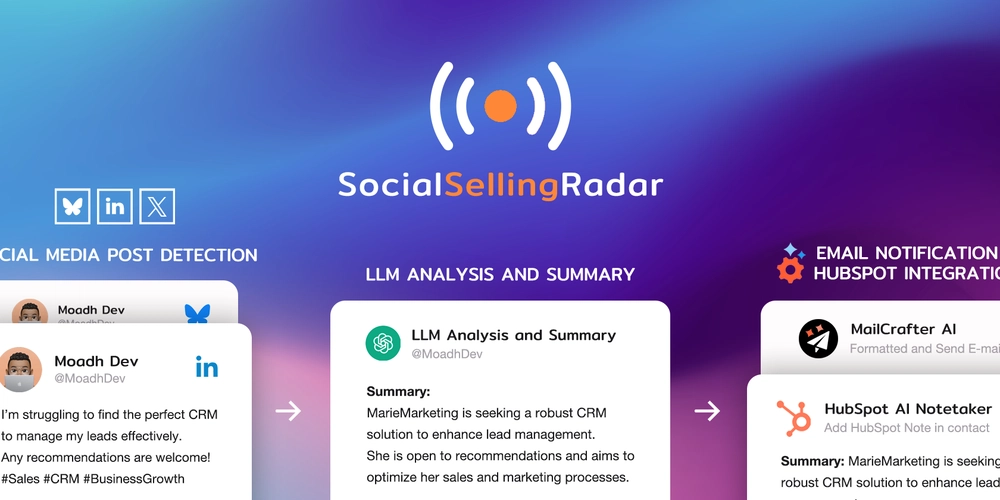
SocialSelling Radar is an AI agent that analyzes the latest posts published by a specific individual on the social media platform of your choice (LinkedIn, Twitter, or Bluesky) in order to detect interest signals, identify needs, and uncover new sales opportunities. By providing a concise summary, it helps you effectively target prospects and refine your Social Selling strategies.

Key Features

  • Targeted Analysis: The user selects a specific profile (e.g., a potential lead) and chooses the platform (LinkedIn, Twitter, or Bluesky) to retrieve recent posts.
  • LLM Analysis: Utilizes a language model to analyze the data from recent posts and identify needs as well as topics of interest.
  • Integrations:
    • HubSpot AI Notetaker: Automatically creates notes in the HubSpot contact record, allowing you to maintain a direct history of information.
    • MailCrafter AI: Sends the analysis results via a formatted, visually appealing email.

Demo

Agent Link: SocialSelling Radar

Agent.ai Experience

I loved building an agent so easily, thanks to the native features already offered by Agent.ai: social media integrations, AWS Serverless Functions, web API calls, LLM… and much more. It provides a very promising glimpse of the future of AI Agents: this is just the beginning, and the more the platform offers new options to integrate, the more we will be able to accomplish.

Conclusion

SocialSelling Radar is a powerful AI agent that can help you streamline prospecting efforts, collect relevant insights about a specific prospect, and centralize key data within a CRM and/or through email notifications. With its targeted analysis, LLM analysis, and integrations, it is an essential tool for any sales professional looking to improve their Social Selling strategies.

Frequently Asked Questions

Q: What is SocialSelling Radar?
A: SocialSelling Radar is an AI agent that analyzes the latest posts published by a specific individual on the social media platform of your choice (LinkedIn, Twitter, or Bluesky) in order to detect interest signals, identify needs, and uncover new sales opportunities.

Q: What are the key features of SocialSelling Radar?
A: The key features of SocialSelling Radar include targeted analysis, LLM analysis, and integrations with HubSpot AI Notetaker and MailCrafter AI.

Q: How do I get started with SocialSelling Radar?
A: To get started with SocialSelling Radar, simply select a specific profile (e.g., a potential lead), choose the platform (LinkedIn, Twitter, or Bluesky), and retrieve recent posts. Then, use the analysis results to identify opportunities and sales signals.

Q: What are the benefits of using SocialSelling Radar?
A: The benefits of using SocialSelling Radar include streamlining prospecting efforts, collecting relevant insights about a specific prospect, and centralizing key data within a CRM and/or through email notifications.

How Small Chinese AI Start-up DeepSeek Shocked Silicon Valley

DeepSeek’s AI Breakthrough Stuns the World

A Small Chinese Artificial Intelligence Lab’s Technical Recipe for Cutting-Edge Model

A small Chinese artificial intelligence lab stunned the world this week by revealing the technical recipe for its cutting-edge model, turning its reclusive leader into a national hero who has defied US attempts to stop China’s high-tech ambitions.

DeepSeek’s R1 Model Release

DeepSeek, founded by hedge fund manager Liang Wenfeng, released its R1 model on Monday, explaining in a detailed paper how to build a large language model on a bootstrapped budget that can automatically learn and improve itself without human supervision.

US Companies’ Reaction

US companies including OpenAI and Google DeepMind pioneered developments in reasoning models, a relatively new field of AI research that is attempting to make models match human cognitive capabilities. In December, the San Francisco-based OpenAI released the full version of its o1 model but kept its methods secret. DeepSeek’s R1 release sparked a frenzied debate in Silicon Valley about whether better resourced US AI companies, including Meta and Anthropic, can defend their technical edge.

Liang’s Rise to Fame

Liang has become a focal point of national pride at home. This week, he was the only AI leader selected to attend a publicised meeting of entrepreneurs with the country’s second-most powerful leader, Li Qiang. The entrepreneurs were told to "concentrate efforts to break through key core technologies."

Liang’s Background

In 2021, Liang started buying thousands of Nvidia graphic processing units for his AI side project while running his quant trading fund High-Flyer. Industry insiders viewed it as the eccentric actions of a billionaire looking for a new hobby. "When we first met him, he was this very nerdy guy with a terrible hairstyle talking about building a 10,000-chip cluster to train his own models. We didn’t take him seriously," said one of Liang’s business partners.

DeepSeek’s Focus on Research

Industry insiders say DeepSeek’s singular focus on research makes it a dangerous competitor because it is willing to share its breakthroughs rather than protect them for commercial gains. DeepSeek has not raised money from outside funds or made significant moves to monetise its models.

Conclusion

DeepSeek’s recent model releases demonstrate that "there is no moat when it comes to AI capabilities," said Ritwik Gupta, AI policy researcher at the University of California, Berkeley. The company’s ability to train a model with 671bn parameters using just 2,048 Nvidia H800s and $5.6mn has stunned the industry.

FAQs

Q: What is DeepSeek’s R1 model?
A: DeepSeek’s R1 model is a large language model that can automatically learn and improve itself without human supervision.

Q: How did Liang Wenfeng, the founder of DeepSeek, start his AI journey?
A: Liang started buying thousands of Nvidia graphic processing units for his AI side project while running his quant trading fund High-Flyer in 2021.

Q: What is the significance of DeepSeek’s model release?
A: DeepSeek’s model release has sparked a frenzied debate in Silicon Valley about whether better resourced US AI companies can defend their technical edge.

Q: What is the focus of DeepSeek’s research?
A: DeepSeek’s focus is on research and engineering, with a goal of developing human-level AI.

Q: What is the future of DeepSeek?
A: It remains an open question whether DeepSeek can continue to be competitive as the industry evolves, with US rivals building mega "clusters" of Nvidia’s next-generation Blackwell chips.

Verizon Customers Eligible for Free Samsung Galaxy S25 Phone

Samsung Galaxy S25 Series: Exclusive Preorder Offers and Prices from Verizon

Introduction

This week, Samsung unveiled its newest lineup of Galaxy S25 smartphones at its Unpacked event in San Jose, California. The new lineup includes three new phone models — the Galaxy S25, Galaxy S25+, and Galaxy S25 Ultra, all of which are available for preorder now.

Exclusive Preorder Offers from Verizon

Verizon is offering exclusive preorder offers, prices, and bundles to celebrate the new launch. Current and new customers can get the new Galaxy S25 or Galaxy S25+ for free or $1,000 off the S25 Ultra. To take advantage of this offer, customers need to buy a new Galaxy S25 series phone, trade-in their current device, and sign up for a Verizon Unlimited Ultimate plan. The discounts will be given as trade-in credits over 36 months.

Business Offers

New and current customers adding a line can also get a new Galaxy S25 or Galaxy S25+ for free with select trade-ins and a Business Unlimited plan.

Pricing and Plans

Here are Verizon’s rates for the new Galaxy S25 series if you’re looking to purchase any of the new models without taking advantage of their promotional offers:

  • Galaxy S25 Ultra: starts at $36 a month for 36 months on Verizon Device Payment ($1,300 retail, 0% APR)
  • Galaxy S25+: starts at $28 a month for 36 months on Verizon Device Payment ($1,000 retail, 0% APR)
  • Galaxy S25: starts at $22 a month for 36 months on Verizon Device Payment ($800 retail, 0% APR)

Additional Offers

As part of their promotional offers, Verizon is also giving away a free Galaxy Watch 7 or Galaxy Tab S9 FE 5G with the purchase of a new Galaxy S25 series phone. This offer is available to customers who buy a new Galaxy S25 series phone, trade-in their current device, and sign up for a Verizon Unlimited Ultimate plan.

Conclusion

The Samsung Galaxy S25 series is now available for preorder, and Verizon is offering exclusive offers and bundles to celebrate the launch. Whether you’re looking for a new phone or want to upgrade your current device, Verizon has a range of options available. Be sure to check out their promotional offers and pricing plans to find the best deal for you.

Frequently Asked Questions

Q: What are the exclusive preorder offers from Verizon?
A: Verizon is offering free or $1,000 off the S25 Ultra, as well as a free Galaxy Watch 7 or Galaxy Tab S9 FE 5G with the purchase of a new Galaxy S25 series phone.

Q: What are the requirements to take advantage of Verizon’s promotional offers?
A: Customers need to buy a new Galaxy S25 series phone, trade-in their current device, and sign up for a Verizon Unlimited Ultimate plan.

Q: Are there any business offers available?
A: Yes, new and current customers adding a line can get a new Galaxy S25 or Galaxy S25+ for free with select trade-ins and a Business Unlimited plan.

Q: What are the pricing and plans for the new Galaxy S25 series?
A: The pricing and plans for the new Galaxy S25 series are as follows: Galaxy S25 Ultra starts at $36 a month for 36 months on Verizon Device Payment, Galaxy S25+ starts at $28 a month for 36 months on Verizon Device Payment, and Galaxy S25 starts at $22 a month for 36 months on Verizon Device Payment.

Frames Are Cool But I Rant Anyways

0

FRAMES from Runway is Cool – but I Rant Anyways 😉

What is Runway?

Runway is an open-source, Python-based framework for natural language processing (NLP) and machine learning (ML) tasks. Its primary focus is on text data processing, and it offers a range of tools for preprocessing, sentiment analysis, topic modeling, and more.

Why is FRAMES from Runway Cool?

FRAMES is a fantastic addition to the Runway ecosystem, offering a range of pre-trained models and tools for natural language processing. With FRAMES, you can leverage the power of pre-trained language models for a variety of tasks, such as:

  • Sentiment analysis
  • Text classification
  • Named entity recognition
  • Text generation

What is FRAMES Used For?

FRAMES is used for a wide range of applications, including:

  • Customer service chatbots
  • Social media monitoring
  • Text classification
  • Sentiment analysis
  • Language translation

How to Get Started with FRAMES?

To get started with FRAMES, you can:

  • Install the FRAMES package from PyPI
  • Explore the FRAMES documentation and examples
  • Join the Runway community for support and resources

Join and Support Me

If you found this content helpful, consider supporting me:

FAQs

Q: What is FRAMES?
A: FRAMES is an open-source, Python-based framework for natural language processing and machine learning tasks.

Q: What is FRAMES used for?
A: FRAMES is used for a wide range of applications, including customer service chatbots, social media monitoring, text classification, sentiment analysis, and language translation.

Q: How do I get started with FRAMES?
A: To get started with FRAMES, you can install the FRAMES package from PyPI, explore the FRAMES documentation and examples, and join the Runway community for support and resources.

Q: How can I support you?
A: You can support me by buying me a coffee, joining my Facebook Group, joining my Discord Group, subscribing to my AI Newsletter, or supporting me on Patreon.

Samsung and Google’s AI partnership is a bigger win than you think – and I’m worried for Apple

Samsung’s AI-Packed Galaxy Smartphones: A New Era of Cross-Device Integration

At its Unpacked event, Samsung announced its new lineup of AI-packed Galaxy smartphones, featuring an on-device LLM that learns from your habits and multimodal AI that can take action based on what it sees and hears.

Samsung’s Vision for an Open AI Ecosystem

Samsung wants its ecosystem to be persistent across all its devices, understanding that the lines between tablets, smartphones, and laptops are starting to blur. "Consumers’ lives are not as binary as they used to be," said Danielle Moten, Samsung’s director of PC product. "We’ve taken the ability to continue what you’re doing from device to device."

Integrated AI Platform

Samsung’s partnership with Google and its Integrated AI Platform aims to break down barriers between different functions, ultimately transcending the app structure as we know it altogether. This platform is backed by Samsung’s partnership with Google’s Project Astra, which imbues its devices with cutting-edge features like screen share and live video streaming, setting the Galaxy devices apart from other Androids (even Google’s own Pixel line).

Samsung’s Strategy

Many of these features have been informed by Apple, which has a reputation for having (arguably) the best integration across its own ecosystem. Samsung seemingly wants to take a page from Apple’s book, but do it better, with the understanding that deep cross-device integration is what keeps users embedded within the ecosystem.

Conclusion

Samsung’s vision is to attract new users by expanding its market share across the wearable, laptop, and smartphone markets, uniting all of these products under one usability stream and fueled by useful, unique AI features. With its partnership with Google, Samsung is positioning itself as the arbiter of AI innovation, opposite Apple, and bringing the gains made by Google’s Gemini to a living, breathing ecosystem that can scale en masse.

FAQs

Q: What is Samsung’s vision for its AI-packed Galaxy smartphones?
A: Samsung wants its ecosystem to be persistent across all its devices, understanding that the lines between tablets, smartphones, and laptops are starting to blur.

Q: What is Samsung’s partnership with Google?
A: Samsung has partnered with Google to bring its Integrated AI Platform to its devices, featuring cutting-edge features like screen share and live video streaming.

Q: How does Samsung’s strategy differ from Apple’s?
A: Samsung is focusing on deep cross-device integration, unlike Apple, which has a reputation for having (arguably) the best integration across its own ecosystem.

Q: What is Google’s Gemini?
A: Google’s Gemini is a search engine that can be used across different devices and operating systems, allowing for a seamless experience across devices.

Eutect optimizes soldering and tinning processes using ‘modern automation concepts’

0

Modern automation concepts from Eutect optimize existing soldering and tinning processes, offering companies in demanding industries, such as rail technology or green energy manufacturing, decisive advantages in terms of quality, cost reduction, efficiency and sustainability.

Matthias Fehrenbach, CEO of Eutect, says: “Companies that require the highest quality and efficiency benefit from our modern automation concepts for optimizing existing selective soldering and tinning processes.

“Manufacturers that have been producing products such as film capacitors or relays for rail technology for decades are increasingly looking for efficient, cycle-time-optimized and cost-reducing automation concepts We are noticing this quite clearly from the inquiries we are receiving.”

Lars Iwers, marketing and sales representative at Eutect, says: “Our innovative automation solutions, coupled with our unique soldering process technology, ensure reproducible results, cost reduction and process stability, making them an ideal solution for industries such as rail technology and green energy.”

The goal of Eutect’s automation solutions is very clear: to increase product quality while simultaneously reducing costs. In the area of selective soldering, the reconstruction of existing automation solutions not only increases product quality, but also significantly reduces manufacturing costs.

Eutect’s automated soldering systems guarantee consistent results, since essential process parameters such as temperature, process time and material usage can be controlled precisely.

“This eliminates sources of error that can arise during manual processing or when using outdated systems,” Iwers continues. Especially in rail technology and green energy, precise and durable soldered joints are of crucial importance.

“Thanks to modern automation concepts, the stability, electrical conductivity and lifespan of our customers’ end products have increased significantly.

“Eutect has continuously developed its own soldering processes to improve efficiency and reliability. These advancements are particularly relevant in industries where products must function properly for decades,” says Iwers, who is currently processing a wide range of inquiries from these industries.

Modern automation also allows for higher production speeds, which means that peaks in demand from end customers can be handled at any time. Eutect’s automated soldering systems work considerably faster than manual or outdated soldering systems.

The Eutect technical center determines possible cycle times through preliminary evaluations, allowing customers to plan with security. More efficient cycle times, a high degree of automation and parallel processes increase throughput while minimizing unplanned downtime.

In addition, resource efficiency and sustainability are high on the agenda among the enquiring manufacturing companies. Eutect’s modern machine concepts are not only energy-efficient but also minimize material losses.

Eutect’s soldering process modules require minimal service and maintenance time, which in turn increases uptime, availability and process reliability. These Eutect-specific factors also ensure lower operating costs over the entire service life.

“Eutect’s automated soldering systems offer excellent process stability and a high degree of reproducibility,” emphasizes Iwers.

Thanks to seamless monitoring and process control, deviations can be detected and corrected immediately. This is a decisive advantage when scaling production and adapting to new requirements. Thanks to the option of comprehensive process documentation, Eutect’s selective soldering machines also meet the highest standards in terms of traceability and quality assurance.

Fehrenbach says: “With our modern solutions, our customers can sustainably increase their competitiveness. Higher efficiency, lower costs and consistently high product quality enable them to succeed in the global market. At the same time, the solutions set new standards in the areas of sustainability and process reliability.”