Home Blog Page 378

Operator AI Agent

0

OpenAI Unveils "Operator" AI Agent for Automating Web Tasks

Introducing Operator: A Computer-Using Agent for the Web

OpenAI has announced a "research preview" of an AI agent called Operator, designed to perform tasks on the web for users. This innovative technology uses a "Computer-Using Agent" model that combines the power of GPT-4o’s vision capabilities with advanced reasoning through reinforcement learning.

How Operator Works

Operator can "see" a webpage through screenshots and "interact" with it using a mouse and keyboard, allowing it to take action on the web without requiring custom API integrations. The agent can use reasoning to self-correct if it gets stuck and will give the user control if needed. It will also ask the user to approve actions like sending an email and block disallowed content.

Designed with Security in Mind

OpenAI has designed Operator to refuse harmful requests and block disallowed content. The company is collaborating with companies like DoorDash, Instacart, OpenTable, Priceline, StubHub, Thumbtack, and Uber to address real-world needs while respecting established norms.

Current Limitations

While Operator is a powerful tool, it’s not perfect yet. It has problems with complex interfaces like creating slideshows or managing calendars. OpenAI cautions that not everything might work as expected, but they are working to improve the agent’s capabilities.

Future Plans

Down the line, OpenAI plans to bring Operator to its Plus, Team, and Enterprise users and integrate these capabilities into ChatGPT.

Frequently Asked Questions

Q: What is the cost of using Operator?
A: Operator is currently available for subscribers of OpenAI’s $200 per month ChatGPT Pro tier.

Q: Can I use Operator with my current ChatGPT subscription?
A: No, Operator is currently only available for ChatGPT Pro subscribers.

Q: Will Operator be available for non-subscribers in the future?
A: OpenAI has not announced plans to make Operator available to non-subscribers at this time.

Q: What kind of tasks can Operator perform?
A: Operator can perform a wide range of tasks, including browsing the web, interacting with websites, and automating repetitive tasks.

Q: Is Operator secure?
A: Yes, OpenAI has designed Operator to refuse harmful requests and block disallowed content, prioritizing user safety and security.

The Open Weight Definition: A New Take on OSAID

The Open Source Alliance Unveils Open Weight Definition

Open-source and artificial intelligence (AI) developers and leaders agree that open-source AI is important. Despite the best efforts of the Open Source Initiative (OSI) to create an open-source AI definition (OSAID), there is still much disagreement on what should and shouldn’t be included in an OSAID.

The Open Weight Definition (OWD)

Springing from this disagreement, the newly formed Open Source Alliance (OSA) has released its take on OSAID: the Open Weight Definition (OWD). The OWD is a new framework that balances closed and open-source AI integrity. The framework is designed to address the complexities and challenges posed by the rapid development of AI technology. It aims to provide a clear standard for what constitutes "open source" in AI models, particularly large language models (LLMs).

Key Components of the OWD

The OWD includes three key components:

  • Model Weights Accessibility: The definition emphasizes making model weights available to developers and researchers.
  • Dataset Information: While not requiring full access to training data, the definition stresses the need for detailed information about dataset contents and collection methods.
  • Architecture Transparency: The framework encourages disclosure of model architecture information to facilitate improvements and modifications.

Industry Reaction

Amanda Brock, OpenUK’s CEO, supports the OWD, stating that it is a welcome step towards defining open weights. Stefano Maffulli, the OSI’s executive director, responded by saying that the Linux Foundation community already has a definition of open weights in the Model Openness Framework.

Open-Source Lawyer’s Perspective

Heather Meeker, a prominent open-source lawyer, addressed the issue of open-weight standardization. She wrote that there is a fundamental misunderstanding that needs to be addressed – the assumption that the principles of open source software licensing can directly apply to Neural Net Weights (NNWs). Meeker proposed an Open Weights Permissive License, which focuses on the original idea of openness and preserving the original goals of Freedom Zero of free software and open source.

Conclusion

The debate surrounding open-source AI is ongoing, with different parties proposing their own definitions. While the OWD is a step towards defining open weights, it is unclear whether it will become a de facto standard. The industry needs to come together to find a unified definition of open-source AI.

FAQs

Q: What is the Open Weight Definition (OWD)?
A: The OWD is a new framework that balances closed and open-source AI integrity, aiming to provide a clear standard for what constitutes "open source" in AI models.

Q: What are the key components of the OWD?
A: The OWD includes Model Weights Accessibility, Dataset Information, and Architecture Transparency.

Q: What is the reaction from the industry?
A: Industry leaders, including Amanda Brock and Stefano Maffulli, have expressed support and skepticism towards the OWD.

Q: What is the perspective of open-source lawyers?
A: Heather Meeker, a prominent open-source lawyer, has proposed an Open Weights Permissive License and emphasized the need for a clear definition of open-source AI.

Engineering Managers: Navigating Complexity

The Engineering Manager’s Role: Navigating Complexity and Trust

Engineering Managers (EMs) operate at the intersection of strategy, execution, and culture. Their role is multifaceted, demanding constant negotiation between high-level organizational goals and granular operational realities.

The Classical Firm Structure and the EM’s Role

Prof. Aswath Damodaran’s theory of the classical firm emphasizes the concept of a trust deficit, stemming from the conflicting priorities of various stakeholders. Shareholders and the Board of Directors seek to maximize wealth, driving growth and profitability. Customers demand reliable, high-quality products and services at a fair price. Governments and regulators focus on compliance with laws, regulations, and ethical standards. Banks and investors expect sound financial management to secure returns and ensure repayment.

Segment 1: Leadership and Strategy

High-Level Goal: Align engineering initiatives with organizational objectives while fostering innovation and growth.

Challenges:

  • Balancing immediate delivery timelines with long-term technical investments like architecture improvements or tech debt reduction.
  • Navigating conflicting signals from leadership — prioritizing short-term ROI while laying the groundwork for future scalability.

Blind Spots:

  • Over-focus on metrics like velocity or uptime without considering team morale and sustainability.
  • Failure to advocate for technical initiatives in leadership discussions, leading to eventual burnout or system fragility.

Practical Insight:

Create a transparent roadmap that incorporates both strategic milestones and operational necessities. Use this roadmap to advocate for technical priorities while showcasing their long-term business impact.

Segment 2: Internal Teams

High-Level Goal: Empower teams to deliver quality software efficiently while maintaining morale and collaboration.

Challenges:

  • Managing diverse personalities and skill sets within the team.
  • Resolving conflicts between product demands and team capacity.
  • Addressing issues like tech debt without demoralizing the team by overloading them.

Blind Spots:

  • Misjudging the team’s capacity to adapt to rapid changes, resulting in over commitment or burnout.
  • Failing to create psychological safety, which stifles innovation and candid feedback.

Practical Insight:

Hold regular retrospectives focused on team health and process efficiency, not just technical output. Proactively communicate trade-offs to product stakeholders to shield teams from unnecessary pressure.

Segment 3: External Stakeholders

High-Level Goal: Deliver high-quality products that meet customer expectations while minimizing escalations.

Challenges:

  • Managing SLA agreements and prioritizing escalations without derailing ongoing work.
  • Aligning customer needs with organizational capabilities and product roadmaps.

Blind Spots:

  • Over-prioritizing escalations can create a fire-fighting culture, leaving no room for innovation.
  • Lack of visibility into evolving customer needs due to siloed communication with product teams.

Practical Insight:

Build strong relationships with customer success teams and encourage direct feedback loops from customers. Use this feedback to preemptively address common issues in future product releases.

Segment 4: Cross-Functional Relationships

High-Level Goal: Foster alignment across departments to enable seamless delivery and innovation.

Challenges:

  • Bridging the gap between technical and non-technical stakeholders (e.g., translating engineering constraints into business terms).
  • Managing dependencies across teams, particularly during large initiatives.

Blind Spots:

  • Assuming alignment across departments without validating it through regular check-ins or shared metrics.
  • Ignoring process bottlenecks caused by misaligned priorities.

Practical Insight:

Effective cross-functional collaboration relies on regular sync-ups to track progress, resolve roadblocks, and ensure transparency. A clear goal owner should align teams, document risks, and address issues promptly. Before release, a go/no-go meeting ensures alignment and readiness.

Blind Spots Across the Board

Across these segments, EMs face blind spots that can hinder their effectiveness:

  • Neglecting Culture: Overemphasizing delivery without fostering a healthy, collaborative culture.
  • Ignoring Feedback Loops: Failing to build mechanisms for continuous feedback across teams and stakeholders.
  • Tunnel Vision: Becoming too focused on either technical or managerial responsibilities, at the expense of the other.

When Organizations May Not Need EMs

Not every culture or team structure benefits from the presence of EMs. Flat, self-managed teams with strong collaborative norms may thrive without traditional EMs. For example:

  • Startups with highly autonomous developers and direct access to leadership often minimize the need for EMs.
  • Teams working on narrow, well-defined scopes may not require a formal manager.

Conclusion: The Tightrope Walk

The role of an Engineering Manager is one of constant complexity and trade-offs. While the trust deficit described in the classical firm structure doesn’t always apply in modern organizations, the challenges of navigating competing priorities remain central to the role.

By embracing self-awareness, building robust feedback loops, and fostering alignment across teams and stakeholders, EMs can successfully navigate this complexity. Whether in startups or enterprise environments, the EM’s ability to bridge organizational silos and deliver value is what defines their success.

FAQs

What is the primary goal of an Engineering Manager?

The primary goal of an Engineering Manager is to align engineering initiatives with organizational objectives while fostering innovation and growth.

What are the key challenges an Engineering Manager faces?

The key challenges an Engineering Manager faces include balancing competing priorities, managing diverse stakeholders, and navigating technical and non-technical complexities.

How can an Engineering Manager build trust with their team?

An Engineering Manager can build trust with their team by fostering a culture of transparency, open communication, and continuous feedback.

When might an organization not need an Engineering Manager?

Not every culture or team structure benefits from the presence of an Engineering Manager. Flat, self-managed teams with strong collaborative norms may thrive without traditional EMs.

The Definitive Guide to Running Effective Employee Surveys

0

Employee surveys are powerful tools to gather valuable insights and feedback directly from employees. By providing employees with a voice and a platform to share their perspectives, employers can better understand employee experiences, sentiments, and needs. The data and insights gleaned from employee feedback are critical in creating a competitive, highly engaged, high-performance culture.

Engaged employees serve as the cornerstone of any successful organization. They drive productivity, innovation, and customer satisfaction. Employee surveys create a direct line of communication between employers and employees, allowing organizations to make data-driven decisions (rather than decisions based on hunches or loud voices) and develop informed strategies to enhance the employee experience

In this blog, we’ll explore:

  • The advantages of employee surveys
  • Building an employee survey strategy that support continuous employee listening
  • Getting started with employee surveys (and how to level up)
  • Employee survey types and their purposes
  • Employee survey design best practices
  • Optimizing your employee survey response rates
  • How to analyze and—most importantly—ACT on employee survey results
  • What to look for in employee survey vendors and platforms

The advantages of employee surveys

Regular employee surveys provide many benefits and can yield a significant return on investment for organizations, including:

Improved employee engagement and retention.

By actively listening to and addressing employee concerns, employee surveys can help organizations foster a more positive and engaging work environment, reducing unwanted turnover and associated costs. However, not just any employee survey platform can help with this. Leaders need the right tools to connect employee survey data to retention data. Your survey platform should have retention analytics that help you identify groups at high risk of turnover, uncover reasons for that risk, and help you take action. It should be working in the background to analyze the feedback you gather and determine what’s impacting retention–especially of your most critical talent.

Better employee performance.

Most executives agree that engaged employees perform better.  They are more motivated, committed, and productive, which improves organizational performance and profitability. Employee surveys can also help uncover the factors that are helping or hindering individual, team, and organizational potential. By asking questions like, “Do you clearly understand your performance expectations?” or, “Does your manager regularly give you feedback that helps you perform better?” you can gain clarity around pockets of the organization that might be struggling to perform. And work with managers to improve engagement and performance.

Better decision-making.

Employee survey data helps leaders make better decisions. You get incredibly valuable insights into your workforce’s sentiment and challenges. With this knowledge, your leaders can make more informed decisions that align with employees’ needs and expectations and move the business forward. This type of data is especially valuable when it comes to the age-old challenge of change management.

Our research shows it’s not change in itself that disengages employees—it’s all about the communication. When employees feel they have input and awareness before, during, and after change—rather than simply learning about it after it occurs— they are more engaged. This helps businesses facilitate change with greater confidence, effectiveness, and buy in, which ultimately accelerates success and impact.

Insights into organizational strengths and opportunities.

Employee surveys help you uncover hidden truths. They elevate what your organization is doing well and where there are obstacles to tackle. This helps organizational leaders and people teams develop more targeted interventions and fuel continuous growth. You get more insight that helps you adapt, pivot, and grow as an organization. All of this leads to better business outcomes and a competitive advantage you simply can’t have without employee feedback. Now, let’s dive deeper into how to build an effective employee survey plan!

Building your employee survey strategy: the Employee Listening Flywheel

Employee listening goes beyond simply conducting surveys; it’s a cycle of understanding, validating, and enhancing the employee experience. The Employee Listening Flywheel is Quantum Workplace’s complete framework to help you establish a continuous employee feedback strategy. 

Key Components of the Employee Listening Flywheel

Ask. Build trust while giving every employee a voice. 

Aha! Analyze and understand employee feedback.

  • Review survey data to prioritize improvement
  • Look for patterns and trends of significance
  • Determine what has the most significant impact
  • Find and share pockets of excellence
  • Uncover where improvements are needed

Act. Drive (and communicate) change from feedback.

  • Turn insights into action
  • Develop innovative initiatives based on feedback
  • Make small, simple changes to habits, behaviors, and processes (the little things add up!)
  • Implement relevant changes where needed
  • Show employees that sharing feedback leads to change

Ask (Again!) Measure progress and adjust.

  • Ask for more feedback
  • Gauge the impact of changes made (you’ll win some and lose some)
  • Continue the flywheel for more momentum and insights

Consider the Employee Listening Flywheel as a continuously turning wheel, with each rotation generating more momentum than the previous one. When you invest time and energy in the flywheel, your feedback cycles become more efficient, build employee trust, increase participation, target actions more effectively, and amplify impact.


Employee Listening Best Practices

  • Be consistent with an employee listening strategy.
  • Communicate actions taken based on employee feedback.
  • Involve stakeholders of all levels in employee listening.
  • Engrain feedback and ensure that it’s part of the company culture.
  • Focus on continuous improvement instead of one-time fixes. 

Successful organizations don’t approach employee surveys and engagement as a one-time project. They implement an ongoing cycle of employee listening and action, ensuring work improves daily. Each rotation of the Flywheel propels organizations toward the next achievable step, often one they never knew was possible. Your organization increases in agility and strength, leaving you thinking “Why didn’t we implement this sooner?!” 

➡️ Get your copy of the Employee Listening Flywheel to start building (or evolving) your employee survey strategy >>


Getting Started with Employee Surveys (and how evolve)

Your organization can build a successful employee survey program at its own pace. If you need a roadmap to ramp up, accelerate, or achieve excellence in gathering and acting on employee feedback, we have you covered. 
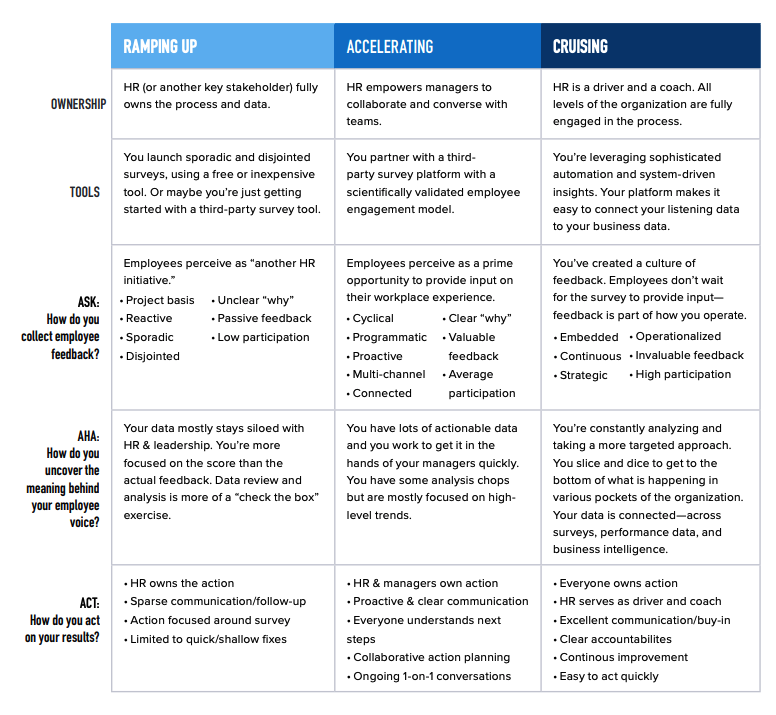
employee listening flywheel - getting started with employee surveys

Level 1: Ramping Up – Getting Started

Your organization should initially focus on creating and solidifying the foundation of its employee listening strategy. This involves conducting an annual engagement survey to gauge sentiment and highlight initial opportunities for improvement. At this stage, you measure success by achieving a baseline response rate, identifying clear priorities, and creating basic action plans. 

Level 2: Accelerating – Building Momentum 

As your program gains momentum, you can introduce more survey types (such as pulse surveys and lifecycle surveys) to gather more frequent and targeted feedback. Practice makes perfect with employee surveys. You can apply what you learn from prior employee surveys to enhance survey design, communication strategies, and data analysis. At this stage, you should aim for improved response rates, increased survey frequency, and a more robust implementation of action plans. 

Level 3: Cruising – Achieving Excellence

Mature employee survey programs leverage a continuous feedback loop. They use a variety of surveys, seamlessly integrate insights, and quickly move to action and impact. Excellence looks like seamless survey administration processes, ongoing data analysis, organization-wide engagement  in action planning, and clearly measurable impacts of your initiatives. When you get to this level, you can expect outcomes like improved employee engagement, tangible increases in key business metrics, and a rewarding culture of listening and taking action.

Building a Comprehensive Employee Listening Strategy

An effective employee listening strategy includes various survey types tailored to capture feedback at multiple points in time throughout the employee lifecycle. By adopting a more robust approach, organizations gain a holistic understanding of employee sentiment, identify opportunities for improvement, and drive real change. 
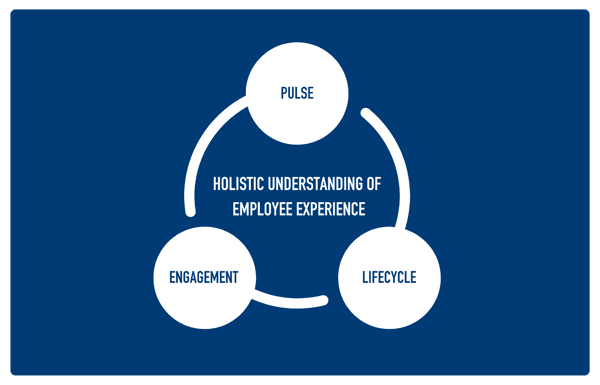
employee survey types and purposes


Employee Survey Types & Purposes

Employee Engagement Surveys

Employee engagement surveys are the cornerstone of any healthy employee listening strategy. Typically conducted annually or bi-annually, these surveys assess levels of employee engagement, job satisfaction, and workplace culture. They cover various topics, including leadership, career development, work-life balance, and job satisfaction. 

Pulse Surveys

Pulse surveys live up to their name by being frequent and designed to capture real-time feedback on specific topics or initiatives. These short and focused surveys enable organizations to gather insights and quickly address emerging issues. Organizations can conduct monthly, quarterly, or as-needed pulse surveys, empowering them to stay in tune with employee sentiment and respond promptly. 

Employee Lifecycle Surveys

Organizations administer lifecycle surveys at key milestones in the employee journey. For example, candidate or onboarding surveys for new employees, check-ins for employees transitioning in their careers, and exit surveys or stay surveys to help inform employee retention strategies. Lifecycle surveys offer valuable insights into the employee experience at critical junctures, allowing organizations to identify areas to improve, which positively transforms employee experience. 

Employee Survey Frequency & Timing

The frequency and timing of employee surveys are critical to establishing a healthy listening strategy. Organizations typically conduct annual or bi-annual engagement surveys but should administer pulse surveys more frequently. Lifecycle surveys occur when specific events or milestones arise in an employee’s journey. Conduct surveys at least annually, ideally four to five times per year.

Employee Survey Design & Best Practices

Use a Validated Employee Engagement Model

If you take one best practice away from this article, it’s critically important that you leverage a survey partner that uses a validated survey methodology that actually measures engagement. Otherwise, you’re just gathering feedback and guessing at where might be best to aim.

A well-researched, validated survey methodology (like Quantum Workplace’s e9 employee engagement model) guarantees that you measure what truly matters for engagement and business success. And that your actions will be more fruitful as a result.

Be Mindful of Your Survey Content

Effective survey design is also essential for obtaining accurate, actionable feedback. Best practices include:

  • Keeping surveys concise and focused
  • Using clear, unambiguous language
  • Incorporating numerical and open-ended questions
  • Ensuring survey questions are relevant and aligned your goals

Use a 6-Point Likert Scale

The scale you use for collecting feedback might not seem like an important detail. But it matters! Quantum Workplace recommends using a 6-point Likert Scale. It encourages respondents to take a clear stance by providing a balanced range of response options without a neutral midpoint, resulting in more meaningful data and insights.

Optimize Your Employee Survey Response Rate

To obtain reliable data, you must maximize survey response rates. Here are strategies to improve employee survey response rates:

  • Communicating the importance and purpose of the survey
  • Ensuring confidentiality and anonymity
  • Offering incentives or rewards for participation
  • Utilizing multiple communication channels available
  • Providing more than enough time for completion 

Organizations can unlock the full potential of employee feedback by implementing a thorough employee listening strategy that incorporates multiple survey types, follows design and administrative best practices, and leverages proven frameworks. 

Now that you’ve gathered employee feedback, it’s time to turn those insights into action.


Turning Employee Survey Feedback Into Action

Collecting employee feedback through surveys is the first step, not the final one! It is crucial to analyze the data collected, create action plans, measure the impact of those plans, and communicate those results transparently to drive real organization-wide change and improve the employee experience. If you don’t act, you’re likely hurting engagement. So only survey on topics and questions you are willing and able to take action on. If you can’t or won’t address something that surfaces, be transparent with your employees instead of letting the results collect dust.

Learn more about Quantum Workplace’s AFTER Framework for employee survey action planning >>


A Framework for Analyzing Employee Survey Results

Establish a data analysis framework to extract valuable insights from employee survey responses. Begin by analyzing the response rate. Aim for 70-80% in larger organizations and 80-90% in smaller organizations to ensure meaningful data. 

Next, establish a systematic analysis approach that includes:

  • Evaluating favorability scores across questions and demographics
  • Using heat mapping to identify patterns and potential problem areas
  • Analyzing comment themes and sentiments using text analytics
  • Benchmarking against industry standards
  • Empowering managers with team-specific insights

This structured approach uncovers strengths, pinpoints improvement opportunities, and prioritizes actions based on potential impact. 

How to Communicate Employee Survey Results

Transparent communication after your employee surveys is vital to build trust and maintain employee engagement throughout the employee survey process.

  • STEP ONE: Share high-level survey results and action plans with all employees.
  • STEP TWO: Conduct town hall meetings or focus groups to discuss findings.
  • STEP THREE: Provide regular updates on progress and achievements.
  • STEP FOUR: Celebrate success and recognize contributions.

Organizations have the opportunity to foster a culture of continuous improvement and reinforce the value of employee feedback when keeping employees informed and involved. 

Creating Action Plans from Employee Survey Results

After analyzing the data, you need to develop an action plan addressing the identified concerns. A practical action plan should:

  • Align priorities with business goals
  • Involve employees in solution development
  • Assign clear ownership and timelines
  • Establish measurable objectives
  • Create accountability through tracking

Cross-functional teams can involve employees and seek their input to ensure that action plans remain relevant, practical, and, most importantly, aligned with organizational priorities. Remember, 95% of employees report high engagement when their leaders effectively act on survey results. 

Measuring the Impact of Employee Surveys & Action Plans

Once you’ve implemented action, you must be able to measure effectiveness and impact. This helps leaders understand if the changes made as a result of feedback truly had the impact intended. Establish key performance indicators aligned with survey goals, conduct follow-up pulse surveys to track progress, analyze relevant metrics, and gather qualitative feedback. By continuously monitoring progress, organizations can adjust and course-correct as needed while demonstrating the tangible benefits of their employee listening efforts. 

Real-World Employee Survey Success Stories

Strategic employee surveys can drive organizational transformation. Don’t take our word for it. Discover how three organizations harnessed the power of a well-designed listening strategy and transformed their workplace culture to achieve measurable business outcomes. 

Mutual-of-Omaha-logo-2


Mutual of Omaha leveraged multiple employee survey types to create a layered listening strategy. Their engagement surveys revealed significant improvements in vision clarity among senior leadership groups. And they didn’t stop there! Pulse surveys helped Mutual of Omaha navigate post-pandemic work arrangements and talent retention, with new hire surveys maintaining an impressive 94% favorability rating. 

Dentsply_sirona_logo.svg-1


Dentsply Sirona showed how targeted employee surveys can drive specific organizational initiatives. The implemented an all-employee pulse survey focused on mission, vision, and values, which later became the foundation for their #StandTogether campaign. By regularly collecting employee feedback and taking action, engagement surveys helped the organization understand their dispersed employees needs. Quantum Workplace’s employee survey analytics helped managers create targeted engagement action plans. The results? Employee engagement scores rose and turnover decreased.

GrantT


Grant Thornton’s sophisticated approach to employee surveys uncovered crucial insights. They learned that while strong relationships help retain employees, the real drivers of engagement in their workforce are impactful work, growth opportunities, and appreciation. Through regular pulse survey implementation and deployment, Grant Thornton leaders were empowered with real-time insights that led to data-driven decisions about workplace improvement. 


Employee Survey Tools & Implementation

Organizations must actively use employee listening tools to effectively capture, analyze, and act on employee feedback. These tools streamline the entire survey process by designing and distributing surveys, analyzing data, and planning actions. Remember these features when you choose an employee survey platform to ensure they align with your organization’s unique needs and goals. 

Essential Employee Survey Platform Features

The right survey platform combines powerful technology with strategic partnerships that help you collect meaningful feedback and drive real organizational change through your employees.
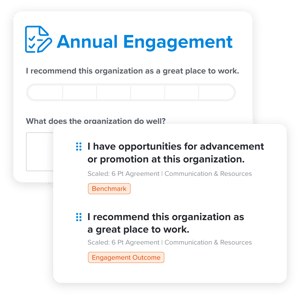
employee survey tools

Research-Backed Survey Builder

You don’t want to be pulling survey questions out of thin air when it comes to measuring employee engagement. Look for a survey tool that provides a user-friendly survey builder with a library of research-backed survey questions. You should be able to customize your surveys to a certain degree, but it’s important that your survey provider provides a solid foundation for proper measurement, including a variety of best practice templates. Also, building the survey should not give you a migraine. It should be easy pull in questions and set up any branching logic and skip patterns.
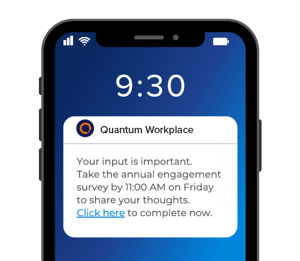
 

employee survey platform sms texting

Easy Distribution and Access

Distributing your employee surveys through multiple channels (such as email, text messaging, or a mobile app) ensures all employees can participate and share their honest feedback. You need survey technology that helps you reach remote and frontline workers. Features that drive strong participation rates, like and automated reminders and response rate tracking, make HR’s job easier and increase quality of your feedback.


employee survey platform survey analyticsRobust & Intuitive Reporting and Analytics

Reporting and analytics provide real-time insights into survey results. They help you make sense of what to do with your data. This is an area you shouldn’t cut corners when it comes to investing in employee survey tools. If you can’t easily understand and act on the data, there’s really no point in collecting it in the first place. Look for employee survey software that offers easy-to-understand dashboards and reports that surface what is most important—and also let you slice and dice to your heart’s desire. Better data = better action = better business outcomes.


employee survey software action planning toolsEfficient & Effective Action Planning and Follow-Up

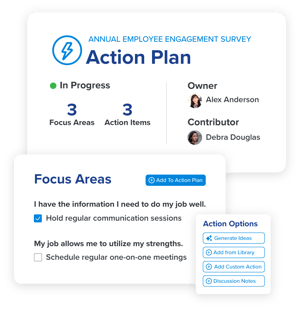
The most important piece of your entire employee listening strategy is action. The right survey platform must help you facilitate action planning and follow-up after the survey is over. This includes tools for creating action plans, assigning tasks, tracking progress, and communicating updates to employees. HR should not be responsible for action plans—it’s a responsibility that MUST be shared with managers and employees. Decision-makers should seek a platform that provides frameworks and guidance for leading and implementing meaningful improvements across the organization.


Seamless Integration Capabilities

It’s important that your employee survey tools are synced with the rest of your employee and business data. Be sure to ask about integration capabilities with your HRIS and other key systems. A seamless flow of data will provide a more holistic view of the employee experience and improve the quality of your analytics and insights—making them easier for you to take action on, efficiently and effectively.

Comprehensive Support & Value-Adding Partnership

There are plenty of survey tools out there, even some free ones. But truly talent-minded HR teams know better than to under-invest in their employee survey technology. You need a trustworthy partner that acts as an extension of your team. Someone who doesn’t just bring tools, but expertise, insight, and support that levels you and your organization up. Investing in the right partner will save you lots of time, money, and headaches in the long run, helping you feel confident in your strategy and the results you achieve. 


Criteria for Choosing Your Employee Survey Vendor

Understanding what matters simplifies your choice of an employee survey vendor. By carefully evaluating these factors, you will gather the information needed to choose an employee survey vendor that aligns with your organization’s goals, supports your employee listening strategy, and delivers a strong return on investment. 

✔️ Survey Customization

Evaluate a vendor’s ability to customize surveys to meet your organization’s requirements. Consider aspects such as question types, branding, and language translations. Identify what makes your organization unique and express how you want that uniqueness to appear in your surveys.

✔️ Scalability

Evaluate the vendor’s capability to grow alongside your organization. As your needs increase, whether it’s accommodating higher survey volumes or a more significant number of employees being surveyed, the vendor must align with your current and future requirements.

✔️ Reporting & Analytics

Evaluate the vendor’s reporting and analytics capabilities for depth and quality. Ensure they provide actionable insights into employee feedback. This functionality allows employees to manage the surveys, saving time and effort.

✔️ Integration Capabilities

Can the vendors you evaluate seamlessly integrate with your existing HR systems and tools? Although this functionality may initially seem minor, proper integration streamlines data flow and processes.

✔️ Security & Compliance

Ensure the vendor adheres to industry-standard security protocols and relevant data privacy regulations. You may encounter other data considerations based on your organization’s specific needs. Speak up and ask if you have any questions!

✔️ User Experience

Prioritize a user-friendly platform that has historically engaged many clients. The platform should encourage high participation rates and reduce employee survey fatigue.

✔️ Multi-lingual Support

If your organization operates globally, select a vendor to accommodate this need. Also, seek vendors with multilingual survey capabilities for your diverse employee population.

✔️ Mobile Compatibility

A mobile interface is crucial, and mobile compatibility is more critical than ever. Optimize the platform for mobile devices so employees can conveniently provide feedback from anywhere.

✔️ Automation & Scheduling

Choose a platform that automates survey scheduling and distribution to streamline the process and reduce manual efforts.  

✔️ Employee Engagement Benchmarks

What does great look like? Industry-specific benchmarking helps a great vendor answer that question. Gain the context needed to elevate your employee survey efforts from good to great. 

✔️ Dedicated Support Team

Assess a vendor’s support accessibility. Determine if they are committed to providing dedicated support resources. Ensure that support goes beyond simply onboarding and remains continuous.

✔️ User Training & Onboarding

Your organization should choose a vendor that provides thorough training and onboarding. This process will prepare your team for success and equip you to leverage the platform effectively.

✔️ Change Management Resources

Evaluate how the vendor manages change. Do they offer guidance? Are they using best practices to encourage adoption and maintain engagement?


Employee Surveys: Return on Investment Considerations

When choosing an engagement survey provider, look beyond the technology specifications and consider the return on investment. The right partner becomes an extension of your team, bringing extensive expertise, providing strategic guidance, and demonstrating a genuine commitment to your organization’s success. Those factors translate directly to an increased likelihood of return on investment.

Why? While automated tools can gather data, knowledgeable and experienced partners drive true organization-wide transformation by understanding your goals and working with you to translate insights into impact. Seek a provider who offers robust services and ongoing support. Someone who will be there after you sign the contract to help your organization achieve meaningful and lasting results.

Here are some additional areas to consider when evaluating potential return on investment.

Pricing

Ultimately, many of these decisions are based on price. Consider factors tied to a vendor’s pricing model, such as survey volume, employee population size, and additional features, functionality, or services. 

Cost Savings

Assess potential cost savings – we promise they exist! Consider the cost reductions from streamlining survey processes, reducing manual employee efforts, and improving employee engagement, performance, and retention. 

Business Impact

Look at a vendor’s track record in delivering formative business outcomes. These may include increased productivity, improved customer satisfaction, and enhanced organizational performance. 

Long-Term Value

Earlier, we mentioned that your vendor must meet your organization where it is today and be ready for the future. Is your vendor of choice committed to continuous innovation and platform development? This is essential information to uncover to ensure that the platform remains relevant and valuable in the long run. 

Read more about how to calculate the ROI of employee engagement >>


Level up your employee survey strategy with Quantum Workplace
engagement_product-imagery_collage-1
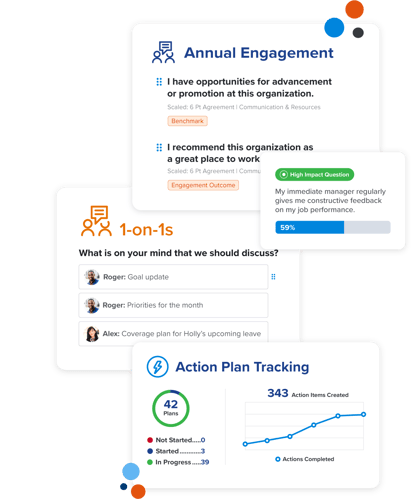
Experience the power of Quantum Workplace’s employee engagement software in helping you understand and improve employee experience.

Our comprehensive suite of employee survey tools includes:

  • Employee engagement surveys
  • Pulse surveys
  • Employee lifecycle surveys
  • Robust engagement & retention analytics
  • AI-powered action planning tools

Schedule a personalized demo to discover how our platform can transform your employee listening strategy. Take the first step toward building a more engaged, productive, resilient workforce. 

BOOK A DEMO WITH A SURVEY EXPERT >>


Frequently Asked Questions

Why is employee listening important to organizations?

Organizations uncover valuable insights that improve business outcomes by gathering and responding to employee feedback. Regularly listening to employees helps identify issues before they tangibly impact performance, uncovers opportunities, and creates a bridge built on respect and continuous improvement between employees and employers. 

How often should we conduct employee surveys?

An organization’s goals, available resources, and the specific type of survey being conducted determine the frequency of employee surveys. Many organizations prefer to conduct comprehensive engagement surveys annually and complement them with shorter pulse surveys more frequently. This approach helps organizations better understand the employee experience while capturing real-time feedback and monitoring progress throughout the year. 

How do we design effective employee survey questions? 

Designing effective employee survey questions is crucial for gathering meaningful data and translating that data into actionable insights. To achieve this, use clear and concise language, avoid leading or biased questions, and ensure the questions relate to the survey’s objectives. Balance numerical and open-ended questions to capture all responses and informative insights effectively. Additionally, make sure the questions you include help measure engagement. A vendor with a well-researched model for engagement plays a vital role in ensuring success. 

What are the best practices for employee survey administration? 

Administrators must effectively manage the survey to ensure high response rates and accurate data collection. They should communicate the survey’s purpose and importance, guarantee anonymity and confidentiality to encourage more open responses, provide ample time for completion, and offer multiple response options. Administrators must also follow up with reminders and ask individuals at all levels of the organization to encourage survey participation. 

How do we increase employee survey response rates? 

Increase employee survey response rates to obtain an accurate sample and reliable data. Promote the survey through various employee channels, involve leadership to endorse survey participation, and survey as accessible and user-friendly as possible. Communicate the impact of previous survey results and your actions to underscore the value of participating.  

What should we look for in an employee survey platform? 

When you evaluate employee survey platforms, consider factors such as ease of use, customization, analytics and reporting capabilities, mobile compatibility, HR system integration, and security and data privacy. Additionally, seek a platform that provides export support, best practice guidance, and a proven track record of successful implementations in organizations similar to yours. 

How do we analyze and act on employee survey results? 

Conduct analysis and action planning to translate employee survey responses into meaningful change. Identify key trends, areas of concern, what’s going well, and any demographic or department-specific differences. Based on impact and feasibility, prioritize areas for improvement. Develop specific action plans with clear objectives, assigned owners, and timelines. Communicate the results and action plans, continuously monitoring progress and adjusting as needed. 

What are some examples of successful employee survey programs? 

Successful employee survey programs require companies to listen, analyze, and act on feedback continually. For instance, a company that conducts an annual engagement survey alongside frequent pulse surveys takes steps to create cross-functional teams that review and act on the results. They consistently communicate the progress and actions they take based on employee feedback. This commitment demonstrates that they are willing to put in the effort, and as a result, their employees feel appreciated and are happier than ever! 

How do we measure ROI on employee survey initiatives? 

Measuring the ROI for employee survey initiatives proves crucial for demonstrating value and justifying continued investment. You can track improvements such as engagement and satisfaction scores, turnover and absenteeism reductions, productivity and performance increases, and positive changes in customer satisfaction or financial metrics linked to an improved employee experience.

It’s All Good, and You’re Perfect

0

The Epidemic of Perfection

The Rise of "You’re Perfect" and "It’s All Good"

Recently, I’ve been told that I’m perfect, something I’m perfectly aware I’ve never been nor ever will be. This generous assessment has come from strangers when I apologize for bumping into them and from the exceedingly cheerful salespeople at the store where my daughter shops for clothes. "No, you’re perfect!" they’ll insist when I explain the need to rest my Gen X weariness on the fitting room floor where a modest "No problem" would have sufficed.

The Urge Toward Pronounced Perfection

The urge toward pronounced perfection is annoyingly catchy. Almost against my will, I now respond to emails with a knee-jerk "Perfect!" where I once would have said something more in line with the nevermind sensibility of my generation. "Sounds good," for example, or "OK."

The Role of Artificial Intelligence

Even our artificial intelligence exhorts us to greater heights of enthusiasm. To an email in which an acquaintance notes pleasantly, "It was nice seeing you last night," Gmail suggests a more boisterous reply: "It was great to see you too!" or "So fun!" Our chatbots likewise communicate with endless effervescence, just as we have taught them to do(!).

The Pressure to Be Good

When not being perfect, we are decidedly good. Should I so much as display a downbeat facial expression when fumbling a social nicety, the response is nothing short of impassioned: "No, you’re good!" Being good is for everyone. We are all good now that "You’re all good" has replaced both the Commonwealth "No worries" and the American standard "That’s OK."

The Critique of "It’s All Good"

But is it all good, really? It’s hard not to read something slightly defensive into this relentlessly bright veneer. Even when the zeal seems genuine, if misguidedly so, the new affirmative language has an almost oppressive bent. Most of us are willing to believe we are OK or that we are at least not a problem. It was easy to be no big deal. But who among us can live up to being all good, let alone perfect, all the time?

The Rise of "It’s All Good" in Popular Culture

The rise of "It’s all good" is commonly thought to have originated, like much American vernacular, in Black culture. According to a New Yorker article dedicated to the popularity of the phrase, M.C. Hammer’s 1994 hit "It’s All Good" was instrumental. Now everyone seems to use "It’s all good," sometimes as a way to shut down conversation around something that may actually be pretty bad.

The Impact on Everyday Interactions

Everyday chitchat once defaulted to a certain bland "I’m OK, you’re OK" neutrality. People were always "fine," even if we weren’t remotely fine and in no mood to discuss it. As far as everyone else was concerned, we would insist it was "no problem."

The Perils of "Toxic Positivity"

But this does create a vague aura of dishonesty around our daily interactions, and may even perpetuate it. One teacher friend pointed out what he called the "toxic positivity" of A.I.-generated college recommendation letters (yes, they’re becoming common), which tend to blurt out the same saccharine phrases of endorsement. Just as all kids cannot be geniuses, all assessments and the emotions that convey them cannot be this oppressively upbeat.

Conclusion

It’s hard not to see mindless optimism as an effort to balance the forceful nastiness and negativity of social media. It’s as if our emotional expressions have become as polarized as our politics, with the extremes loudly articulated at the expense of the old middling opinions and equivocal feelings.

FAQs

  • Q: What is the origin of "It’s all good"?
    A: The rise of "It’s all good" is commonly thought to have originated in Black culture.
  • Q: What is the impact of "It’s all good" on everyday interactions?
    A: It creates a vague aura of dishonesty around our daily interactions, and may even perpetuate it.
  • Q: What is "toxic positivity"?
    A: "Toxic positivity" refers to the excessive and insincere use of positive language, often used to mask negative emotions or to avoid difficult conversations.

Brutalist’s AI Controversy Sparks Ethical Debate

0

The Use of AI in Filmmaking: A Controversial Debate

The Brutalist: A Film at the Center of the Controversy

Brady Corbet’s period drama The Brutalist was highly anticipated by film and architecture fans alike, bringing the promise of a powerful tale inspired by history and heritage. Since its release, the film has been criticized for its use of AI augmentation, and while the director defends its usage, it calls forth an important ethical debate about the use of AI in filmmaking.

AI in Filmmaking: A Growing Concern

It’s no secret that AI productivity tools are becoming widely used across all industries, yet in creative sectors, AI remains a highly controversial topic. While The Brutalist’s integration of AI technology is a notable example, critics fear that it may be the tip of the iceberg, ushering in a new era of synthetic AI embellishment.

The Film’s Use of AI

In an enlightening interview with Red Shark News, editor Dávid Jancsó discusses the film’s "subtle and sensitive use of AI," including voice editing and specific background drawings. To refine the Adrien Brody and Felicity Jones’ Hungarian dialect, the team used AI technology from Respeecher, making tweaks to vocal sounds and intonations to maximize authenticity.

Criticism and Controversy

A series of architectural drawings created in the style of the fictional architect was created using Gen AI, a detail that some fans strongly criticized. "They used AI in The Brutalist not only to avoid paying visual artists for their work but also to manipulate the actors’ accents, a fundamental aspect of… acting. This is a disgrace," one user claimed. "The use of generative AI visuals honestly feels like it spits in the face of the themes of a movie about art and architecture and the human condition," another added.

The Director’s Defense

Despite heated critique, director Brady Corbet defended the film’s use of AI, responding in a statement to Variety, "The aim was to preserve the authenticity of Adrien and Felicity’s performances in another language, not to replace or alter them, and done with the utmost respect for the craft." Regarding the AI imagery, Corbet says: “Judy Becker and her team did not use AI to create or render any of the buildings. All images were hand-drawn by artists. To clarify, in the memorial video featured in the background of a shot, our editorial team created pictures intentionally designed to look like poor digital renderings circa 1980.”

Conclusion

Whether or not you agree with The Brutalist’s use of AI, the irony of its use in a film centered around human artistry is hard to ignore. While the film’s AI use was arguably considered and sparse, in the wake of SAG-AFTRA strikes and open letters protesting ‘unethical’ AI usage, it seems there will always be uncomfortable tension around the future of AI in filmmaking.

Frequently Asked Questions

Q: What is the purpose of using AI in filmmaking?
A: The purpose of using AI in filmmaking is to enhance the creative process, improve efficiency, and create new possibilities for storytelling.

Q: Is the use of AI in The Brutalist unique?
A: No, the use of AI in The Brutalist is not unique. Many films have utilized AI tools, including Respeecher, to achieve specific effects.

Q: Is the use of AI in The Brutalist ethical?
A: The use of AI in The Brutalist has been criticized for its potential to manipulate the actors’ performances and the use of generative AI visuals. Whether or not this is ethical is a matter of debate.

Solidigm Celebrates World’s Largest SSD with 122 Day

Solidigm’s 122TB SSD: A Game-Changer for Data Centers

A New Era in Storage Capacity

Solidigm recently shipped a new solid-state drive (SSD) featuring 122.88TB of storage capacity, the world’s largest SSD, with enough storage to pack 4PB of data into a 1U rack. This massive feat of data storage has led to the celebration of "122 Day," with even the company’s hometown of Rancho Cordova, California, getting in on the act.

The D5-P5336 Line: A Data Center SSD

The new drive is part of the D5-P5336 line, a data center SSD that uses the latest Quad-Level Cell (QLC) storage technology. This space-saving design delivers an enormous amount of fast storage capacity in a package that’s 72% smaller than a typical 30TB hard drive.

Power Efficiency and Density

The space savings also help on the power side of the equation. Solidigm says the D5-P5336 consumes 84% less energy than a comparable HDD plus triple-level cell (TLC) hybrid setup, and offers 3.4 times more terabytes per watt versus 30TB TLC. This power efficiency and density enables partners like VAST Data to pack 2PB into a 1U chassis using the 61.44TB variant of the D5-P5336, a figure that will likely double with the 122TB drive.

Performance

The D5-P5336 can read at rates up to 7,400MB per second (sequential) and write data at speeds up to 3,000 MB/s (sequential), making the drive useful for the most demanding analytics, AI, and edge use cases. Only Solidigm’s high-end D7-PS1010 and D7-PS1030 series, which utilize the faster charge trap technology and PCIe 5.0 connections, are faster in Solidigm’s lineup, topping out at 14,500 MB/s reads and 4,100 MB/s writes.

Celebrating 122 Day

The delivery of a big, fast, and efficient SSD is cause for celebration on the Solidigm campus. In advance of the day, the company mailed out Lego replicas of the drives. The Greater Sacramento Economic Council got in on the action, and the City of Rancho Cordova even proclaimed today as "122 Day."

A Milestone Achievement

The engineering accomplishment of Solidigm is a testament to the company’s commitment to innovation and excellence. As Xin Guo, senior vice president and head of data center engineering, said, "Solidigm has been at the forefront of storage innovation for decades, and our latest D5-P5336 drive enables more efficient and more scalable data center and edge designs, helping data center architects solve their power and space efficiency problems."

FAQs

Q: What is the purpose of "122 Day"?
A: "122 Day" is a celebration of Solidigm’s new 122TB SSD, the world’s largest SSD, and its ability to pack 4PB of data into a 1U rack.

Q: What is the D5-P5336 line?
A: The D5-P5336 line is a data center SSD that uses the latest Quad-Level Cell (QLC) storage technology and is designed for high-performance applications.

Q: How does the D5-P5336 compare to other SSDs?
A: The D5-P5336 consumes 84% less energy than a comparable HDD plus triple-level cell (TLC) hybrid setup, and offers 3.4 times more terabytes per watt versus 30TB TLC.

Q: What are the performance capabilities of the D5-P5336?
A: The D5-P5336 can read at rates up to 7,400MB per second (sequential) and write data at speeds up to 3,000 MB/s (sequential).

OpenAI Fights to Keep ChatGPT Data in Indian Court

A Global Battle Over Copyright and AI

OpenAI has argued in an Indian court that removing the training data behind ChatGPT service would clash with its legal obligations in the United States.

A Legal Showdown

The statement was issued in response to a lawsuit filed by Indian news agency ANI, which accused the AI business of using its content without permission.

Jurisdiction Dispute

OpenAI stated that Indian courts lack jurisdiction in the case since OpenAI has no offices nor operations in the country. In its January 10 filing to the Delhi High Court, OpenAI emphasized that it is already defending similar lawsuits in the US, where it is required to preserve its training data during ongoing litigation.

A Global Battle Over Copyright and AI

OpenAI is no stranger to such disputes, facing a wave of lawsuits from copyright holders worldwide. In the US, the New York Times filed a similar case against the company, accusing it of misusing its content. OpenAI has consistently denied such allegations, claiming its systems rely on the fair use of publicly available data.

Concerns Over Competition

ANI has also expressed concern about unfair competition, citing OpenAI’s partnerships with major news organizations like Time Magazine, The Financial Times, and France’s Le Monde. ANI says that these agreements give OpenAI an edge.

Conclusion

The case is scheduled to be heard by the Delhi High Court on January 28. OpenAI is transitioning from a non-profit to a for-profit company, raising $6.6 billion last year. In recent months, OpenAI has secured high-profile deals with media outlets from around the world, highlighting its efforts to strengthen its commercial partnerships while managing regulatory concerns worldwide.

FAQs

Q: What is the controversy surrounding OpenAI’s use of training data?
A: OpenAI is accused of using Indian news agency ANI’s content without permission to train its AI model, ChatGPT.

Q: How has OpenAI responded to the allegations?
A: OpenAI has denied the allegations, claiming its systems rely on the fair use of publicly available data.

Q: What is the jurisdictional dispute in the case?
A: OpenAI argues that Indian courts lack jurisdiction since it has no offices or operations in the country.

Q: What are the implications of this case for the AI industry?
A: The case highlights the need for AI companies to consider the legal implications of their use of training data and the importance of respecting the intellectual property rights of others.

Data Breach Hitting PowerSchool

Massive Data Breach Exposes Sensitive Information of Millions of Students and School Personnel

Parents, students, teachers, and administrators throughout North America are reeling from what could be the biggest data breach of 2025: an intrusion into the network of a cloud-based service storing detailed data of millions of pupils and school personnel.

PowerSchool Hack Exposes Sensitive Information

The hack, which came to light earlier this month, hit PowerSchool, a Folsom, California, firm that provides cloud-based software to some 16,000 K–12 schools worldwide. The schools serve 60 million students and employ an unknown number of teachers. Besides providing software for administration, grades, and other functions, PowerSchool stores personal data for students and teachers, with much of that data including Social Security numbers, medical information, and home addresses.

Stolen Information Includes Social Security Numbers and Medical Information

On January 7, PowerSchool revealed that it had experienced a network intrusion two weeks earlier that resulted in the “unauthorized exportation of personal information” customers stored in PowerSchool’s Student Information System (SIS) through PowerSource, a customer support portal. Information stolen included individuals’ names, contact information, dates of birth, medical alert information, Social Security Numbers, and unspecified “other related information.”

Fallout Across North America

Since then, schools throughout the US and Canada have reported the devastating fallout. On Monday, for instance, the Toronto District School Board notified parents, students, and former students that the breach exposed sensitive information of all students in the district between 1985 and 2024. Data stolen varied by the years students were enrolled, but the stolen info included:

  • First, middle, and last names
  • Date of birth
  • Gender
  • Health card number
  • Grade level and school information
  • Start/end date as a student
  • Ontario Education Number
  • EQAO accommodation information
  • Medical information (i.e., allergies, conditions, injuries)
  • Home addresses
  • Home phone numbers
  • TDSB student number
  • TDSB email address
  • First Nations, Métis, and Inuit information
  • Residency status
  • Principal/vice principal notes (including discipline notes)
Conclusion

The PowerSchool data breach is a stark reminder of the importance of data security and the potential consequences of a network intrusion. As the investigation into the breach continues, it is essential for schools and parents to remain vigilant and take steps to protect sensitive information.

FAQs

Q: What was the extent of the data breach?
A: The breach exposed sensitive information of millions of students and school personnel, including Social Security numbers, medical information, and home addresses.

Q: Which schools were affected?
A: The breach affected schools in the US and Canada, with the Toronto District School Board being one of the most recent victims.

Q: What is being done to mitigate the damage?
A: PowerSchool has notified affected schools and parents, and is working to identify and contain the breach. The company is also providing resources and support to affected individuals.

Q: What can I do to protect my personal information?
A: It is essential to remain vigilant and take steps to protect your personal information. Monitor your credit reports, and consider placing a freeze on your credit reports to prevent unauthorized access. Additionally, be cautious of phishing scams and other attempts to steal your personal information.

Thousands of Users Report ChatGPT Outage

0

ChatGPT Experiences Disruption in Service

Technical Issues Cause Widespread Outage

ChatGPT, a popular conversational AI service, was hit with a technical issue on Thursday morning, leaving thousands of users unable to access the site. The disruption was reported by the website Down Detector, which showed over 4,000 problems with the site, starting shortly after 6 a.m.

Error Messages and Frustration

Users who tried to access the site were met with error messages, causing frustration and inconvenience. The outage was widespread, with many users taking to social media to vent their frustration.

OpenAI’s Response

OpenAI, the company behind ChatGPT, was initially unavailable for comment. However, the company did later issue a statement, saying that the issue had been resolved. According to the statement, the problem occurred between 6:33 and 7:23 a.m. Eastern time, during which "customers experienced elevated error rates."

Service Disruption Continues for Some Users

Although the issue seemed to be resolved by 8:30 a.m., some users continued to report difficulties accessing the site. Many users experienced repeated outages, with the site going down and then coming back up again.

Background and Context

On Tuesday, President Trump announced a joint venture between OpenAI, SoftBank, and Oracle to create at least $100 billion in computing infrastructure to power artificial intelligence. OpenAI’s chief executive, Sam Altman, was present at the White House for the announcement.

Legal Issues

The New York Times has sued OpenAI and its partner, Microsoft, accusing them of copyright infringement of news content related to A.I. systems. OpenAI and Microsoft have denied these claims.

Conclusion

The disruption to ChatGPT’s service on Thursday morning highlights the importance of having robust infrastructure and contingency plans in place to handle unexpected technical issues. While the issue was eventually resolved, it is crucial for companies like OpenAI to prioritize the user experience and provide transparent communication during outages.

Frequently Asked Questions

Q: What caused the outage?
A: The cause of the outage is currently unknown.

Q: How many users were affected?
A: According to Down Detector, over 4,000 users reported problems with the site.

Q: How long did the outage last?
A: The outage lasted for several hours, with some users experiencing repeated outages.

Q: What did OpenAI say about the issue?
A: OpenAI issued a statement saying that the issue had been resolved and that between 6:33 and 7:23 a.m. Eastern time, "customers experienced elevated error rates."