
Home Blog Page 415

Rendering Nodes as React Components

Creating a React Graph Component using D3.js

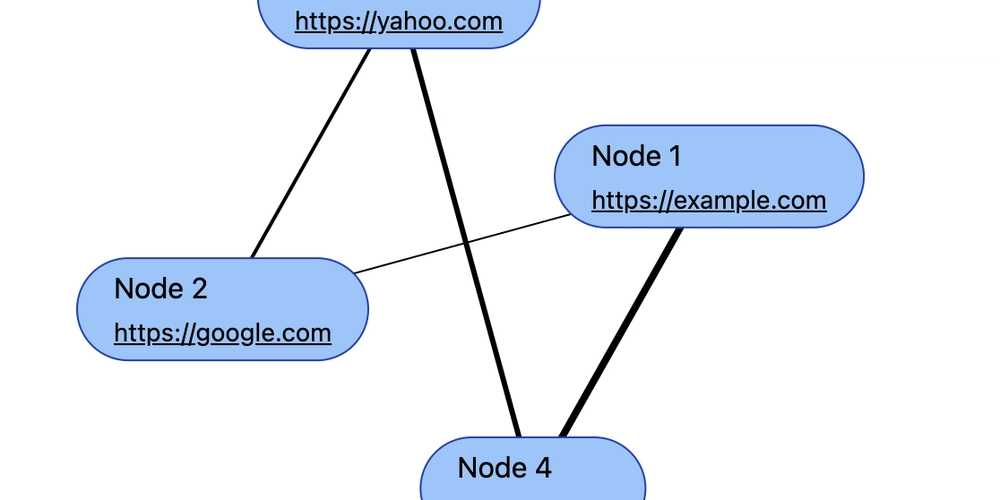
Today, we’ll create a graph component that uses React and D3.js. Usually, when someone speaks about a graph in D3.js, they mean a representation of entities as circles and relationships between them – "edges" or "links" connecting them. For many cases, this representation is more than enough. However, recently, I’ve met the necessity to render a React component instead of just a simple circle. This would give us great freedom in ways to display the information in the node, because the main pain point in SVG is the inability to comfortably deal with text, flexbox, etc.

Getting Started

First, we need to set up a Vite+React+Typescript project using bun as the package manager:

bun create vite

We also need to add some packages to render the graph:

bun add d3-force d3-selection

Additionally, we need type definitions for the d3 packages, which come separately:

bun add -D @types/d3-force @types/d3-selection

Defining the Data Type

Now, we need to define the type of data. We’ll use the d3-force package’s generics for type safety.

// Graph.tsx
import { SimulationLinkDatum, SimulationNodeDatum } from 'd3-force';

interface GraphNode extends SimulationNodeDatum {
  id: string;
  name: string;
  url: string;
}

interface GraphLink extends SimulationLinkDatum<GraphNode> {
  strength: number;
}

Extending the d3-force Generics

We’ll extend our interfaces from the generics from d3-force:

// Graph.tsx

import { SimulationLinkDatum, SimulationNodeDatum } from 'd3-force';

interface GraphNode extends SimulationNodeDatum {
  id: string;
  name: string;
  url: string;
}

interface GraphLink extends SimulationLinkDatum<GraphNode> {
  strength: number;
}

Creating the Node Component

We’ll create a Node component that will render a div with a class name "bg-blue-300 rounded-full border border-blue-800 px-5 py-1" and an h2 with the node’s name and an a tag with the node’s URL.

// Node.tsx
import { GraphNode } from '../Graph';

export function Node({ node }: { node: GraphNode }) {
  return (
    <div className="bg-blue-300 rounded-full border border-blue-800 px-5 py-1">
      <h2>{node.name}</h2>
      <a
        className="inline-block text-sm underline"
        href={node.url}
      >
        {node.url}
      </a>
    </div>
  );
}

Conclusion

In this article, we’ve created a React graph component using D3.js. We’ve defined the type of data and extended the d3-force generics for type safety. We’ve also created a Node component that renders a div with a class name "bg-blue-300 rounded-full border border-blue-800 px-5 py-1" and an h2 with the node’s name and an a tag with the node’s URL.

FAQs

Q: What is the purpose of using d3-force in this example?
A: The purpose of using d3-force is to create a graph component that uses React and D3.js. It allows us to create a graph with nodes and edges.

Q: What is the difference between d3-force and d3-selection?
A: d3-force is used for creating a graph with nodes and edges, while d3-selection is used for selecting elements in an SVG.

Q: Can I use d3-force without d3-selection?
A: No, you can’t use d3-force without d3-selection. d3-force relies on d3-selection for selecting elements in an SVG.

Breaking Down the Barriers of Diabetes Diagnosis with AI

Researchers Using Artificial Intelligence to Revolutionize Diabetes Diagnosis

Researchers at Stanford have been using artificial intelligence (AI) to dive deeper into diabetes diagnosis — and the results could mean better, more accessible care.

Understanding the Complexity of Diabetes

We commonly understand diabetes as being either Type 1 or Type 2. But in recent years, scientists have discovered important variations, or subtypes, within Type 2 — which makes up 95% of diagnoses — that shed light on the risk of contracting related conditions, like kidney, heart, or liver issues.

Overcoming the Challenges of Traditional Metabolic Tests

"Understanding the physiology behind [diabetes] requires metabolic tests done in a research setting, but the tests are cumbersome and expensive and not practical for use in the clinic," explained Tracey McLaughlin, MD, an endocrinology professor at Stanford.

Developing an Algorithm for Accurate Diagnosis

Using data collected by glucose monitors, researchers developed an algorithm identifying three of the four most common subtypes of Type 2 diabetes. Compared to clinical data, the algorithm "predicted metabolic subtypes, such as insulin resistance and beta-cell deficiency, with greater accuracy than the traditional metabolic tests" — roughly 90% of the time.

The Impact of Accurate Diagnosis on Treatment Efficacy

Knowing a patient’s subtype can impact treatment efficacy. Doctors can develop personalized medicine plans and better focus resources from patient to patient, reducing costs. Plus, the study applies AI to data already being easily collected by a person’s glucose monitor, meaning the algorithm doesn’t require a larger or more complicated clinical setting to work.

The Future of Accessible Health Care

Researchers believe the algorithm will make health information more available at home for those who may not have access to healthcare infrastructure due to geography, poverty, or other factors. Considering almost 13% of the US population has been diagnosed with diabetes, these nuances could make a big difference in treatment options and efficacy — especially if AI can gather better insights from data collected by a wearable that patients often already have and need.

Conclusion

The study marks another step forward toward accessible health tech, which could revolutionize the way people with diabetes receive care. By using AI to analyze data collected by glucose monitors, patients may be able to get a more accurate diagnosis and receive more targeted treatment, leading to better health outcomes.

FAQs

Q: How does the algorithm work?
A: The algorithm uses data collected by glucose monitors to identify common subtypes of Type 2 diabetes.

Q: How accurate is the algorithm?
A: The algorithm is approximately 90% accurate in predicting metabolic subtypes.

Q: What are the potential benefits of the algorithm?
A: The algorithm could lead to more accurate diagnoses, personalized treatment plans, and reduced healthcare costs. It could also make health information more accessible to those who may not have access to healthcare infrastructure.

Q: What’s next for the research?
A: The researchers plan to continue refining the algorithm and exploring its potential applications in other areas of healthcare.

ChatGPT’s New Feature

0

Update: Some users report that the new options have disappeared. It is possible they were released prematurely.

Early Ethscriptions May Become Multi-Millionaire Makers

0

Ethscriptions: The Future of Digital Wealth

What is an Ethscription?

Ethscriptions are still an early concept in the Blockchain world, but they have endless potential. As we see the early Ethscriptions pop up, we believe they will be the gems and diamonds of the Blockchain world in the future, potentially worth millions.

The Concept of Ethscriptions

With Ethscriptions, we are seeing the first appearance of this fantastic new concept, which will seem almost like the early gold prospecting times of the nineteenth century at some point in the distant future. We are without a doubt, seeing explosive growth when it comes to all things crypto, and especially now with Ethscriptions.

How Do Ethscriptions Work?

Ethscriptions use Ethereum "call data" – included within a smart contract – which permits a "cheaper" and "more decentralised" mining process in comparison to conventional smart contract-based methods. This allows users to "describe" an image provided it is under 96 kilobytes in size.

The Potential of Ethscriptions

As it stands, users are currently limited to image-only inscriptions, yet the protocol will permit different file types to be included in future. Music website Genius.com co-founder Tom Lehman developed Ethscriptions, describing the initiative as a "huge success" on Twitter, and announced almost 30,000 Ethscriptions had been generated within the first 18 hours of the project going live.

The Future of Ethscriptions

It remains to be seen whether Ethscriptions will enjoy the same level of popularity as Bitcoin Ordinals. In under six months, the total number of Ordinals inscribed on Bitcoin skyrocketed from zero to 10 million. However, with the potential for growth and development, Ethscriptions have the potential to revolutionize the way we think about digital wealth.

Conclusion

In conclusion, Ethscriptions are an exciting new concept that has the potential to change the way we think about digital wealth. With their early beginnings, it’s hard to predict what the future holds, but one thing is certain – Ethscriptions are an exciting development in the Blockchain world.

FAQs

Q: What is an Ethscription?
A: An Ethscription is a new concept in the Blockchain world that uses Ethereum "call data" to permit a "cheaper" and "more decentralised" mining process.

Q: How do Ethscriptions work?
A: Ethscriptions use Ethereum "call data" – included within a smart contract – which permits a "cheaper" and "more decentralised" mining process in comparison to conventional smart contract-based methods.

Q: What is the potential of Ethscriptions?
A: The potential of Ethscriptions is vast, with the ability to revolutionize the way we think about digital wealth. With their early beginnings, it’s hard to predict what the future holds, but one thing is certain – Ethscriptions are an exciting development in the Blockchain world.

Campspot Scores Data Pipeline Win with Apache Airflow and Astronomer

Searching for the Perfect Campsite Can be a Hit-and-Miss Affair

Searching for the perfect campsite can be a hit-and-miss affair, as one seeks the perfect combination of a view, sufficient parking, and proximity to neighbors and services, among other factors. When it came to selecting a tool to manage its big data pipeline, the online reservation company Campspot didn’t have to look any further than Apache Airflow and, eventually, the hosted Airflow service from Astronomer.

The Data-Driven World of Campspot

If you’ve got a hankering for some camping, then Campspot is a good place to start. Founded in 2015 in Grand Rapids, Michigan, the software-as-a-service (SaaS) company lets customers make reservations at more than 2,700 private campgrounds, RV resorts, cabins, and “glamping” locations in the United States and Canada. All told, Campspot manages the reservations for more than 230,000 campsites across North America, which has helped earn the company the nickname “the Expedia of campgrounds.”

Data Management Challenges

While campers might measure their overall satisfaction by the number of s’mores consumed per day, Campspot’s partners–the campground owners–need just a bit more data. For instance, every day, they need to know which of their campsites are reserved, how many total are reserved, and how that compares to previous time periods.

The Data Platform Team

The responsibility of keeping the campground owners’ data appetite properly sated falls to John Marriott, manager of Campspot’s data platform team. According to Marriott, the company runs a nightly batch job that takes the latest data from the homegrown reservation management system and rolls it up into its data warehouse. This data is then bundled up into PDF or CSV reports that are either emailed to Campspot partners or made available for viewing on a Web-based dashboard. The company also offers a “signals” product to its partners that compares their existing reservations to an anonymized set of competitors in their space.

The Data Pipeline Conundrum

Prior to 2022, managing all of these data transformation jobs was mostly a manual affair. It was up to individual engineers to decide how data a data pipeline should be constructed to enable data to flow from the reservation system, which runs on a mix of Postgres, MySQL, and DynamoDB databases, into its data warehouse, which runs on a combination of Snowflake and Postgres.

The Solution: Apache Airflow and Astronomer

Marriott and his team realized they needed to get a handle on these data pipeline jobs. They had heard of tools that can automate the execution of thousands of data pipelines. They perceived that Apache Airflow was the early leader in this space, and after investigating Airflow, they adopted it in 2022.

Ease of Use

Apache Airflow’s ease of use was a major selling point for Campspot. While Airflow offers a few different ways to work with the product, including GUIs, Campspot’s developers are code-first types, and they gravitated to Airflow’s command-line and programmatic interfaces. Similarly, they also liked how Airflow and its Python-based batch jobs easily fit into their existing DevOps workflows.

The Switch to Astronomer

As an AWS shop, Campspot decided to take advantage of AWS’s Amazon Managed Workflows for Apache Airflow (MWAA) offering out of the gate. While AWS’s managed Airflow environment was better than what they had in place before, Campspot found that MWAA wasn’t as easy to manage as they had initially hoped.

Conclusion

In conclusion, Campspot’s switch to Apache Airflow and Astronomer’s Astro environment has streamlined their data pipeline, allowing them to focus on what matters most – delivering high-quality data to their partners. With Airflow, Campspot has been able to automate the execution of thousands of data pipelines, reducing the complexity and increasing the efficiency of their data management process.

Frequently Asked Questions

Q: What is the main challenge in managing data pipelines?
A: The main challenge is to automate the execution of thousands of data pipelines, reducing the complexity and increasing the efficiency of the data management process.

Q: What is Apache Airflow?
A: Apache Airflow is an open-source platform for programmatically defining, scheduling, and monitoring workflows.

Q: What is Astronomer’s Astro environment?
A: Astronomer’s Astro environment is a hosted Airflow service that provides a managed platform for running and monitoring Airflow workflows.

Q: How does Campspot use Apache Airflow?
A: Campspot uses Apache Airflow to automate the execution of thousands of data pipelines, reducing the complexity and increasing the efficiency of their data management process.

Q: What are the benefits of using Apache Airflow?
A: The benefits of using Apache Airflow include automating the execution of thousands of data pipelines, reducing the complexity and increasing the efficiency of the data management process, and providing a scalable and flexible platform for managing large-scale data pipelines.

Groww Seeks $7B Value in IPO

0

India’s Largest Retail Stockbroker Groww to File for IPO in 10-12 Months

Valuation of $6-8 Billion Expected

Groww, India’s largest retail stockbroker, is planning to file for an initial public offering (IPO) in 10-12 months, seeking a valuation between $6 billion and $8 billion, according to sources familiar with the matter. This would be the first IPO by a digital trading platform in India, with a targeted valuation more than double its last valuation of $3 billion in October 2021.

IPO Preparation Underway

Groww has begun talks with investment banks and will soon choose advisors for the IPO. The company, which also enables customers to invest in mutual funds and make UPI transactions, shifted its domicile to India from the U.S. last year as part of IPO preparations.

Growing User Base

The trading app has pulled ahead of competitors in India’s crowded retail investing market, with 13.2 million active users in December, compared to closest rival Zerodha’s 8.1 million users, according to National Stock Exchange data. Groww is adding between 325,000 to 550,000 new users every month, more than twice the rate of its competitors.

India’s IPO Boom

India has emerged as a bright spot for tech listings globally, with seven technology startups going public in 2024. Food delivery platform Swiggy’s $1.35 billion IPO was the largest tech listing in the world last year. More than 20 Indian startups are planning IPOs in 2025, including business-to-business marketplace Zetwerk, managed workspace provider Table Space, Prosus-owned PayU, and pharmaceutical platform PharmEasy.

Factors Contributing to IPO Surge

According to Abhinav Bharti, JPMorgan’s head of equity capital markets for India, India’s growing domestic capital and policy continuity are among the factors contributing to the IPO surge in the country. "No other country globally provides you with this much political certainty and continuity of policy," Bharti said. "You can argue against a policy decision, but you cannot argue against the fact that they have been consistent."

Conclusion

Groww’s IPO is expected to be a significant milestone in India’s growing tech startup ecosystem, which has seen a surge in listings in recent years. With a valuation of $6-8 billion, the company is poised to make a significant impact in the retail investing market.

FAQs

Q: What is the expected valuation of Groww’s IPO?
A: The expected valuation is between $6 billion and $8 billion.

Q: How many active users does Groww have?
A: Groww has 13.2 million active users, according to National Stock Exchange data.

Q: How many Indian startups are planning IPOs in 2025?
A: More than 20 Indian startups are planning IPOs in 2025, including business-to-business marketplace Zetwerk, managed workspace provider Table Space, Prosus-owned PayU, and pharmaceutical platform PharmEasy.

Q: What are the factors contributing to the IPO surge in India?
A: India’s growing domestic capital and policy continuity are among the factors contributing to the IPO surge, according to Abhinav Bharti, JPMorgan’s head of equity capital markets for India.

Projected Masterpiece: Art Abstract Expressionism

0

Burning Passion

For some collectors, the sky is the limit in terms of what they are willing to pay in the name of very good desirable art.

The Most Expensive Paintings Ever Sold

The above painting titled Burning Passion is a very recent work (2022) using the abstract expressionist style that is called Spontaneous Emotional Ejection.

The Art World’s Most Coveted Paintings

1. Salvator Mundi by Leonardo da Vinci

Price Paid for Painting: $450 million

Salvator Mundi, translated to "Savior of the World," is not only the world’s most expensive painting—it’s possibly the most controversial painting, as well. Many scholars doubt that the work was entirely done by Leonardo da Vinci, citing the overall composition doesn’t align completely with da Vinci’s style.

2. Interchange by Willem de Kooning

Price Paid for Painting: $300 million

Regarded as the "artist’s artist," Dutch-American artist Willem de Kooning shaped the abstract expressionist style with his gestural works often based on figures, landscapes, and still life.

3. The Card Players by Paul Cézanne

Price Paid for Painting: $250 million

During the 1890s, Paul Cézanne created a series of five works depicting labor workers playing cards. The calm nature of the painting—which depicts two men immersed in a game—is a departure from Cézanne’s previous dramatic and colorful works.

4. Nafea Faa Ipoipo? by Paul Gauguin

Price Paid for Painting: $210 million

Nafea Faa Ipoipo?, translated to "When Will You Marry?", is one of the first paintings Paul Gaugin painted after his first trip to Tahiti in 1891.

5. Number 17A by Jackson Pollock

Price Paid for Painting: $200 million

A leader in the abstract expressionist movement, Jackson Pollock rose to fame for his "drip" technique, where Pollock would pour paint onto canvas—often laid onto the floor—as a way to convey emotion through movement.

6. The Standard-Bearer by Rembrandt

Price Paid for Painting: $198 million

Touted as one of Rembrandt’s most vibrant masterpieces, The Standard-Bearer is a 1636 self-portrait of the Dutch Golden Age artist.

7. Shot Sage Blue Marilyn by Andy Warhol

Price Paid for Painting: $195 million

Andy Warhol’s Shot Sage Blue Marilyn shook the art scene when it sold for just over $195 million to American art dealer Larry Gagosian during Christie’s sale in 2022.

8. No. 6 (Violet, Green and Red) by Mark Rothko

Price Paid for Painting: $186 million

In line with many of his works, Mark Rothko’s No. 6—completed in 1951—features two expanses of violet and vibrant red separated by a ban of green.

9. Portraits of Maerten Soolmans and Oopjen Coppit by Rembrandt van Rijn

Price Paid for Painting: $180 million

The pair of full-length wedding portraits of Marten Soolmans and Oopjen Coppit were completed by a young Rembrandt in 1634.

10. Water Serpents II by Gustav Klimt

Price Paid for Painting: $170 million

Completed in 1907, Water Serpents II is the second in a series depicting the sensual nature of the female form.

Conclusion

The art world is full of masterpieces that have been sold for astronomical prices. These paintings are not only valuable but also hold significant cultural and historical importance.

FAQs

Q: What is the most expensive painting ever sold?
A: Salvator Mundi by Leonardo da Vinci, sold for $450 million.

Q: Who is the most expensive artist?
A: Leonardo da Vinci, with his painting Salvator Mundi selling for $450 million.

Q: What is the most expensive abstract expressionist painting?
A: Number 17A by Jackson Pollock, sold for $200 million.

Q: Who is the most expensive contemporary artist?
A: Andy Warhol, with his painting Shot Sage Blue Marilyn selling for $195 million.

Q: What is the most expensive Impressionist painting?
A: The Card Players by Paul Cézanne, sold for $250 million.

Nvidia’s AI avatar sat on my computer screen and weirded me out.

0

Nvidia Unveils AI Avatar R2X at CES 2025

Prototype AI Avatar

Nvidia unveiled a prototype AI avatar at CES 2025 that lives on your PC’s desktop. The AI assistant, R2X, looks like a video game character, and it can help you navigate apps on your computer.

Features and Functionality

The R2X avatar is rendered and animated using Nvidia’s AI models, and users can run the avatar on popular LLMs of their choice, such as OpenAI’s GPT-4o or xAI’s Grok. Users can talk with R2X through text and voice, upload files to it for processing, or even enable the AI assistant to view what’s happening live on your screen or camera.

Tech Companies Creating AI Avatars

Tech companies are creating a lot of AI avatars recently, not just in video games but also for enterprise and consumer customers. The early demoes are strange, but some think these avatars are a promising user interface for AI assistants. With R2X, Nvidia is trying to combine generative video game capabilities with cutting-edge LLMs to create an AI assistant that looks and feels like a human.

Open Sourcing the Avatars

The company plans to open source these avatars in the first half of 2025. Nvidia sees this as a new user interface for developers to build with, allowing users to plug in their favorite AI software products or even run these avatars locally.

Limitations and Bugs

R2X is still a prototype, and even Nvidia admits there are still some bugs to work out. In demos with TechCrunch, Nvidia’s avatar had an uncanny-valley feel to it — its face sometimes got stuck in odd positions, and its tone felt a little aggressive at times. And broadly, I find it a little odd to have a humanoid avatar stare at me while I work.

Demos and Functionality

R2X generally offered helpful instructions and accurately viewed what was on the screen. But at one point, the avatar gave us incorrect instructions, and later on, the avatar stopped being able to view the screen at all. This may be an issue with the underlying AI model (in this case, GPT-4o), but the example shows the limitations of this early technology.

In one demo, an Nvidia product lead showed how R2X can view, and assist users with, the apps on your screen. Specifically, R2X helped us use Adobe Photoshop’s generative fill feature. The photo we selected was of Nvidia CEO Jensen Huang standing in an Asian restaurant with two restaurant workers. Nvidia’s avatar hallucinated and gave the wrong instructions for where to find the generative fill feature in Photoshop. It later lost the ability to view the screen, but after switching the AI model we used to xAI’s Grok, the avatar regained its screen viewing abilities.

Future Development

Nvidia is working to give these AI avatars agentic abilities as well, so that R2X could one day take actions on your desktop. These abilities seem to be a long way out, and they would likely require partnerships with software makers like Microsoft and Adobe, which are trying to develop similar agentic systems themselves.

Conclusion

Nvidia’s R2X AI avatar is an interesting prototype that combines generative video game capabilities with cutting-edge LLMs to create an AI assistant that looks and feels like a human. While there are still some bugs to work out, R2X has the potential to revolutionize the way we interact with AI assistants.

FAQs

Q: What is R2X?
A: R2X is a prototype AI avatar that lives on your PC’s desktop and can help you navigate apps on your computer.

Q: What can R2X do?
A: R2X can talk with users through text and voice, upload files to it for processing, or even enable the AI assistant to view what’s happening live on your screen or camera.

Q: What are the limitations of R2X?
A: R2X is still a prototype, and even Nvidia admits there are still some bugs to work out. In demos with TechCrunch, Nvidia’s avatar had an uncanny-valley feel to it — its face sometimes got stuck in odd positions, and its tone felt a little aggressive at times.

Q: Will R2X be open sourced?
A: Yes, Nvidia plans to open source these avatars in the first half of 2025.

Q: Can R2X join Microsoft Teams meetings?
A: Yes, R2X will be able to join Microsoft Teams meetings, acting as a personal assistant.

Student Art Blog Trending Top Google Search Number One – Art Abstract Expressionism Artist UK

0

Art Abstract Expressionism Artist UK: The Top-Ranking Student Art Blog

The Power of Google

Art students join our blog for one reason, and one reason only. Quite simply – we are the very best student art blog there is.

Ranking #1 in Google Analytics

Art Abstract Expressionism Artist UK is obviously already a fantastic very popular art blog in its own right, and it is now being said in wider circles that it will become the very best top recommended art blog there is in NFT entrepreneurship and now also Ethereum Blockchain Ethscriptions too. We rank No.1 in Google analytics for NFT website viewing.

The Secret to Success

The higher your organic CTR, the higher you’ll generally rank. That’s because a high CTR tells Google that your page is what searchers are looking for. And they’ll boost your page’s rankings to make it easier for people to find. Use Short, Descriptive URLs: These are good for SEO in general.

What We Offer

We are first and foremost an art blog aimed at student artwork. But for those in the business of trying to drive organic traffic, Google is the all-powerful. It crawls the web, determining which pages are the most useful and relevant for its users for virtually any topic. We don’t just trust Google’s results, we rely on them.

How to Reach the Top of Google Search

Getting your small business on the first page of Google might seem unrealistic, However if you get with a high traffic fantastic blog like Art Abstract Expressionism Artist UK then you stand a very good chance of reaching the top of Google Search.

Conclusion

With our expertise in NFT entrepreneurship and Ethereum Blockchain Ethscriptions, we are confident that we can help you achieve your goals. Our blog is the perfect platform for artists to showcase their work and connect with like-minded individuals. Join us today and take the first step towards success.

Frequently Asked Questions

Q: What makes Art Abstract Expressionism Artist UK the top-ranking student art blog?

A: Our blog is the best because we offer a unique blend of NFT entrepreneurship, Ethereum Blockchain Ethscriptions, and student artwork. Our expertise in these areas sets us apart from other art blogs.

Q: How can I get my business to rank higher on Google?

A: To increase your Google ranking, focus on creating high-quality content that resonates with your target audience. Use short, descriptive URLs and optimize your page for search engines.

Q: What kind of content does Art Abstract Expressionism Artist UK offer?

A: We offer a range of content related to NFT entrepreneurship, Ethereum Blockchain Ethscriptions, and student artwork. Our blog is a great resource for artists looking to showcase their work and connect with like-minded individuals.

Nvidia Cosmos Wins Best of CES 2025

Nvidia’s Cosmos: A New Software Platform for AI-Powered Robotics and Autonomous Vehicles

At the opening keynote of CES 2025, Nvidia co-founder and CEO Jensen Huang unveiled "Cosmos," a set of AI technologies that forms a new software platform. Cosmos includes "state-of-the-art generative world foundation models," as Huang called them.

Filling the Gap in Robotics and Autonomous Vehicles Training Data

Cosmos taps generative AI to fill the biggest gap that’s keeping robots from becoming more useful: training data. As Huang says, "In order to train a robot, you need a lot of data." This technology has the potential to enable robotics and autonomous vehicle makers to make important leaps forward in the years ahead.

Award-Winning Technology

For that reason, ZDNET and the rest of the CNET Group awarded Nvidia Cosmos two official Best of CES awards for 2025. You can see all 12 of the Best of CES winners selected by the CNET Group (ZDNET, CNET, PCMag, Mashable, and Lifehacker) in partnership with the organization that runs CES.

How Cosmos Works

Cosmos works in conjunction with Nvidia’s physics simulation tool, Omniverse. Omniverse generates simulations, and Cosmos then turns them into photo-realistic video imagery to train robots and automobiles. "Take thousands of drives and turn them into billions of miles" is how Huang characterized the interplay between Omniverse and Cosmos.

Cosmos and Omniverse in Action

Huang was surrounded onstage by a number of existing models of general-purpose humanoid robots. He called Cosmos "the world’s first world foundation model," noting it is trained on 20 million hours of video. "It’s really about teaching the AI to understand the physical world."

Impact on Robotics and Autonomous Vehicles

Huang compared the Cosmos project to Meta Platforms’s wildly popular Llama large language model, saying, "We really hope it will do for the world of robotics and AI what Llama has done for enterprise AI." The Cosmos code is available under an open-source license on GitHub.

Nvidia’s Automotive Partnerships

Huang Emphasized Nvidia’s automotive partners in his CES 2025 keynote. Nvidia has inked a deal for Toyota, the world’s largest car manufacturer, to use the company’s autonomous driving chips and software in multiple different models of car. "The AV revolution has arrived," said Huang, meaning autonomous vehicles. "Today, Toyota and Nvidia are going to partner together to create their next-generation AVs." Self-driving cars will be the "first trillion-dollar robotics market," Huang predicted.

Other Announcements

Other announcements in the keynote included GEFORCE "Blackwell," the latest version of the company’s gaming GPU, which is slashed in price from its predecessor 4090 to $549 from $1,599, available starting this month, with laptop versions coming in March; and Project DIGITS, a compact personal computer optimized for AI development, running a new version of the Grace-Blackwell combined CPU and GPU chip, called GB10.

Conclusion

Nvidia’s Cosmos is a groundbreaking technology that has the potential to revolutionize the robotics and autonomous vehicle industries. With its ability to generate realistic video imagery and train robots and automobiles, Cosmos is a game-changer for companies looking to make a name for themselves in these fields.

Frequently Asked Questions (FAQs)

Q: What is Nvidia’s Cosmos?
A: Cosmos is a set of AI technologies that forms a new software platform for robotics and autonomous vehicles.

Q: What is the purpose of Cosmos?
A: Cosmos is designed to fill the biggest gap that’s keeping robots from becoming more useful: training data.

Q: How does Cosmos work?
A: Cosmos works in conjunction with Nvidia’s physics simulation tool, Omniverse, to generate photo-realistic video imagery and train robots and automobiles.

Q: What are the potential applications of Cosmos?
A: Cosmos has the potential to enable robotics and autonomous vehicle makers to make important leaps forward in the years ahead.
