Home Blog Page 419

Robotics plans

0

OpenAI’s Revived Robotics Department Reveals Plans for Custom Robots and Sensors

Rebooting the Robotics Department

OpenAI disbanded its robotics department, only to bring it back. Now, through a social media post from its hardware director and newly published job descriptions, OpenAI is revealing more about its plans for the revived team.

Developing Custom Robots with Custom Sensors

In a post on X on Friday, Caitlin Kalinowski, who joined OpenAI to lead hardware last November from Meta’s AR glasses division, said that OpenAI will develop its own robots — complete with a custom sensor suite.

Job Listings Provide Additional Insights

In the post, Kalinowski spotlighted new OpenAI robotics job listings with additional information. According to the listings, OpenAI’s robotics team will focus on "general-purpose," "adaptive," and "versatile" robots that can operate with human-like intelligence in "dynamic," "real-world" settings.

New Sensors and Computational Elements

OpenAI plans to create new sensors and computational elements for its robotics, which will be powered by AI models that the company develops internally. "Working across the entire model stack, we integrate cutting-edge hardware and software to explore a broad range of robotic form factors," reads one of the listings. "We strive to seamlessly blend high-level AI capabilities with the physical constraints of physical robotic platforms."

Contract Workers and Limbs

One of the listings implies that OpenAI intends to employ contract workers to test its robotic prototypes. Another suggests that the company’s robots might have limbs.

Humanoid Robots and Full-Scale Production

The Information recently reported that OpenAI has explored building its own humanoid robot. Whatever form they end up taking, OpenAI’s robots will — if all goes according to plan — reach "full-scale production" someday, one description reads.

Robotics Industry Trends

Robotics is a hot commodity, with the sector raising over $6.4 billion from VCs last year, according to Crunchbase. Companies like Bright Machines and Collaborative Robotics, which develop software and systems for factory manufacturing, appear to have successfully found a niche.

Conclusion

OpenAI’s revived robotics department is working on developing custom robots with custom sensors, with plans to create new sensors and computational elements powered by AI models. The company is seeking engineers with experience designing mechanical systems intended for high volume production and is exploring the possibility of employing contract workers to test its robotic prototypes.

FAQs

Q: What is OpenAI’s focus for its revived robotics department?
A: OpenAI’s robotics team will focus on developing "general-purpose," "adaptive," and "versatile" robots that can operate with human-like intelligence in "dynamic," "real-world" settings.

Q: What kind of sensors and computational elements will OpenAI create for its robotics?
A: OpenAI plans to create new sensors and computational elements for its robotics, which will be powered by AI models that the company develops internally.

Q: Will OpenAI’s robots have limbs?
A: According to one of the job listings, OpenAI’s robots might have limbs.

Q: What is the goal for OpenAI’s robots?
A: OpenAI’s robots will — if all goes according to plan — reach "full-scale production" someday.


Fastest Growing Jobs in AI-Powered Economy

The Future of Jobs: Technology and AI to Drive Divergent Change

Technology is predicted to be the most divergent driver of labor market change, with broadening digital access expected to create and displace more jobs than any other macro trend, according to the World Economic Forum (WEF).

About 170 million new jobs (equivalent to 14% of today’s employment) will be created this decade, according to the WEF’s ‘Future of Jobs Report 2025’. At the same time, 92 million roles will be displaced, creating a net employment increase of 78 million jobs.

Not surprisingly, artificial intelligence (AI) and information processing technology are expected to create 11 million jobs, while simultaneously displacing 9 million others, more than any other technology trend. Robotics and autonomous systems are expected to be the largest job displacer, with a net decline of five million jobs from 2025 to 2030.

However, there is good news about new emerging tech trends like AI. Three of the technology trends — broadening digital access, advancements in AI and information processing, and robotics and autonomous systems technologies — also feature prominently as drivers of the fastest-growing jobs.

Change is the new normal in employment trends.

The WEF report notes the shifting paradigm in the human-machine future of work. The interplay between humans, machines, and algorithms is redefining job roles across industries. Automation is expected to drive changes in people’s ways of working, with the proportional share of tasks performed solely or predominantly by humans expected to decline as technology becomes more versatile.

Survey respondents estimate that 47% of work tasks today are performed mainly by humans alone, with 22% performed mainly by technology (machines and algorithms), and 30% completed by a combination of both. By 2030, employers expect these proportions to be nearly evenly split across the three approaches.

The Human-Machine frontier.

Growth and decline drivers for jobs are based on several factors. Five factors will drive a net creation of 78 million jobs globally by 2030: technological changes, the green transition, demographic shifts, geoeconomic fragmentation, and economic uncertainty. Among these drivers, technological change is expected to have the biggest impact on jobs by 2030, creating and displacing them.

The largest growing category of jobs is farmworkers — 34 million additional jobs by 2030, adding to the 200 million farmworkers today. Delivery drivers, software developers, building construction workers, and shop salespersons complete the top five fastest-growing jobs.

The largest growing and declining jobs by 2030.

According to WEF, employers expect 39% of key skills required in the job market to change by 2030. This figure represents significant disruption but is down from 44% in 2023.

Technological skills are projected to grow in importance more rapidly than any other skill in the next five years. AI and big data are at the top of the list, followed by networks and cybersecurity, and technological literacy.

The job market is in flux.

Creative thinking and resilience, flexibility, and agility are also rising in importance, along with curiosity and lifelong learning. Other fast-rising skills are leadership and social influence, talent management, analytical thinking, and environmental stewardship.

These are the core skills to focus on in 2025.

Today’s core skills blend cognitive, self-efficacy, and engagement skills. Looking ahead to 2030, technology skills dominate the fastest-growing skills, driven by ongoing digital change.

The impact of AI is clear.

So, how will businesses respond to AI developments? The increased use of emerging technologies is prompting half of businesses to realign their organizations. Accelerated AI innovation is creating a strong demand for skilled talent, with over two-thirds of employers planning to hire for AI-specific roles, even as 40% foresee workforce adjustments in response to the technology’s adoption.

To learn more about the WEF’s Future of Jobs Report 2025, you can find the full report here.

FAQs:

Q: What is the predicted impact of technology on the job market?
A: Technology is expected to create and displace more jobs than any other macro trend, with 170 million new jobs and 92 million roles displaced by 2030.

Q: Which technology trend is expected to create the most jobs?
A: Artificial intelligence (AI) and information processing technology are expected to create 11 million jobs, while simultaneously displacing 9 million others.

Q: What are the fastest-growing jobs?
A: The largest growing category of jobs is farmworkers — 34 million additional jobs by 2030, adding to the 200 million farmworkers today. Delivery drivers, software developers, building construction workers, and shop salespersons complete the top five fastest-growing jobs.

Q: What skills are expected to grow in importance?
A: Technological skills are projected to grow in importance more rapidly than any other skill in the next five years, with AI and big data at the top of the list, followed by networks and cybersecurity, and technological literacy.

Hugging Face Settles Patent Infringement Suit with FriendliAI

0

Hugging Face Settles Patent Infringement Lawsuit with FriendliAI

Lawsuit Background

FriendliAI, a Korean AI startup, filed a lawsuit against Hugging Face, a leading AI developer platform, in 2022, alleging that Hugging Face had infringed on one of its patents for "batching with iteration-level scheduling".

Settlement Agreement

On January 8, FriendliAI and Hugging Face reached a "confidential agreement" and have agreed to dismiss the suit "with prejudice", meaning it cannot be brought back to court. The agreement was filed in the U.S. District Court for the Northern District of Delaware.

Terms of the Settlement

The agreement stipulates that "FriendliAI and Hugging Face hereby stipulate to dismissal… without costs and fees to any party of this case. The court shall retain jurisdiction over the parties’ settlement agreement."

Hugging Face’s Response

Hugging Face had not responded to a request for comment at the time of publication.

Background on the Patent

FriendliAI’s patented technology, described in an application to the U.S. Patent and Trademark Office, improves the process of batching data fed into an AI system to allow the system to process multiple requests at once. The patent also covers AI systems that allow finished requests from within a batch to be sent to a user and new requests to be added to a batch before the full batch has been processed.

Infringement Allegations

FriendliAI claimed that the "server" component of Hugging Face’s Text Generation Inference tool used its patented method to batch incoming requests. The company was seeking compensatory damages, enhanced damages for "willfulness", a court order blocking further infringement or awarding a licensing fee, and attorneys’ fees and costs.

About Hugging Face

Hugging Face is one of the largest repositories of AI tools and models in the world, with a total of $235 million in backing from investors including Google, Amazon, Nvidia, Intel, and Salesforce. The company develops its own AI models and offers consulting services to help enterprises fine-tune, customize, and deploy AI.

Conclusion

The settlement agreement between FriendliAI and Hugging Face brings an end to the patent infringement lawsuit, with neither party disclosing the terms of the agreement. The outcome highlights the importance of respecting intellectual property rights in the AI industry, where innovation and competition are crucial for growth and success.

FAQs

Q: What was the lawsuit about?
A: The lawsuit was about patent infringement, with FriendliAI alleging that Hugging Face had used its patented technology for "batching with iteration-level scheduling".

Q: What was the outcome of the lawsuit?
A: The lawsuit was settled, with both parties agreeing to dismiss the case "with prejudice".

Q: What is Hugging Face?
A: Hugging Face is a leading AI developer platform that hosts AI models and tools, develops its own models, and offers consulting services to help enterprises deploy AI.

Microsoft Accuses Group of Developing Tool to Abuse its AI Service in New Lawsuit

0

Microsoft Sues Group for Bypassing Safety Guardrails of Cloud AI Products

Legal Action Against Group for Illegal Access to Azure OpenAI Service

Microsoft has taken legal action against a group of individuals who allegedly developed and used tools to bypass the safety guardrails of its cloud AI products. The company claims that the group, referred to as "Does" in the complaint, used stolen customer credentials and custom-designed software to break into the Azure OpenAI Service, a fully managed service powered by OpenAI’s technologies.

Accusations of Violating Laws and Regulations

According to the complaint filed in the U.S. District Court for the Eastern District of Virginia, the group of 10 individuals allegedly violated the Computer Fraud and Abuse Act, the Digital Millennium Copyright Act, and a federal racketeering law by illegally accessing and using Microsoft’s software and servers to create "offensive" and "harmful and illicit content." Microsoft did not provide specific details about the abusive content generated.

Unauthorized Access and API Key Theft

The company claims that it discovered in July 2024 that customers with Azure OpenAI Service credentials, specifically API keys, were being used to generate content that violates the service’s acceptable use policy. An investigation revealed that the API keys had been stolen from paying customers.

"Hacking-as-a-Service" Scheme

Microsoft alleges that the group created a "hacking-as-a-service" scheme, using stolen Azure OpenAI Service API keys belonging to U.S.-based customers. The group developed a client-side tool called de3u, which allowed users to leverage stolen API keys to generate images using DALL-E, one of the OpenAI models available to Azure OpenAI Service customers. De3u also attempted to prevent the Azure OpenAI Service from revising the prompts used to generate images, which can happen when a text prompt contains words that trigger Microsoft’s content filtering.

Microsoft’s Response

In response to the allegations, Microsoft has taken legal action and is seeking injunctive and "other equitable" relief and damages. The company has also put in place countermeasures and added additional safety mitigations to the Azure OpenAI Service targeting the activity it observed.

Conclusion

Microsoft’s legal action against the group accused of bypassing the safety guardrails of its cloud AI products highlights the importance of protecting intellectual property and preventing the misuse of technology. The company’s efforts to take down the illegal services and disrupt the "hacking-as-a-service" scheme demonstrate its commitment to ensuring the safe and responsible use of its products.

FAQs

Q: What is the Azure OpenAI Service?
A: The Azure OpenAI Service is a fully managed service powered by OpenAI’s technologies, allowing customers to create and deploy AI models.

Q: What is de3u?
A: De3u is a client-side tool developed by the group accused of bypassing the safety guardrails of Microsoft’s cloud AI products, allowing users to leverage stolen API keys to generate images using DALL-E.

Q: What is the purpose of the legal action taken by Microsoft?
A: The legal action is aimed at stopping the group’s illegal activities, including the creation of "offensive" and "harmful and illicit content," and seeking damages for the harm caused.

Q: What measures has Microsoft taken to prevent similar incidents in the future?
A: Microsoft has put in place countermeasures and added additional safety mitigations to the Azure OpenAI Service targeting the activity it observed.

Nvidia Stuns CES, OpenAI Teases AGI

0

AI News from the Past Week

Nvidia News

Nvidia has been busy this past week, announcing several new AI-related products and services. Here are a few highlights:

Nvidia RTX 5070, 5080, 5090

Nvidia has announced its new RTX 5070, 5080, and 5090 graphics cards, which feature improved performance and AI-enhanced features.

Nvidia Mini AI Super Computer

Nvidia has also unveiled its new Mini AI Super Computer, a compact and powerful system designed for AI research and development.

Nvidia Agentic AI Blueprints

Nvidia has released its Agentic AI Blueprints, a set of pre-trained AI models that can be used for a wide range of applications, from robotics to healthcare.

Nvidia Nemotron LLMs

Nvidia has announced its Nemotron LLMs, a new line of large language models that can be used for a variety of natural language processing tasks.

Nvidia Cosmos – Digital Twins

Nvidia has also unveiled its Cosmos – Digital Twins, a new platform that allows users to create realistic digital simulations of physical systems and environments.

Other AI News

In addition to Nvidia’s announcements, there were several other notable AI-related developments this past week. Here are a few highlights:

DeepMind World Simulation

DeepMind has announced its World Simulation, a new platform that allows users to create realistic digital simulations of real-world environments and scenarios.

Google Daily Listen

Google has launched its Daily Listen, a new AI-powered podcast that features a daily discussion on a wide range of topics.

Microsoft Open-Source Phi-4

Microsoft has released its Open-Source Phi-4, a new AI-powered programming framework that allows developers to create scalable and efficient AI applications.

X Launches Grok iPhone app

X has launched its Grok iPhone app, a new AI-powered language translation tool that can translate text and speech in real-time.

Sam Altman Knows How To Get To AGI

Sam Altman, the CEO of Y Combinator, has written a blog post outlining his thoughts on how to achieve artificial general intelligence (AGI).

Stability AI SPAR3D

Stability AI has released its SPAR3D, a new AI-powered 3D modeling and rendering tool that can be used for a wide range of applications, from film and television to architecture and gaming.

Adobe Releases Transparent Video AI

Adobe has released its Transparent Video AI, a new tool that allows users to easily create transparent videos and animations.

Samsung Smart Fridge and Smart Home

Samsung has launched its Smart Fridge and Smart Home, a new line of smart appliances that can be controlled and monitored remotely using AI-powered voice assistants.

AI Smart Mirror

A startup called Halliday has launched its AI Smart Mirror, a new smart mirror that uses AI to provide users with personalized beauty advice and recommendations.

Halliday Lens-Free Smart Glasses

Halliday has also launched its Lens-Free Smart Glasses, a new line of smart glasses that use AI to provide users with augmented reality experiences and information.

VLC Adds AI Video Subtitles

VLC has added AI-powered video subtitles to its media player, allowing users to easily access and view video content with subtitles.

Putin Deepfake Movie

A deepfake video of Russian President Vladimir Putin has been circulating online, showcasing the potential dangers of AI-powered disinformation and propaganda.

Conclusion

This past week has seen a number of exciting AI-related developments, from new product announcements to breakthroughs in research and innovation. As AI continues to evolve and improve, we can expect to see even more innovative applications and uses of this technology in the future.

FAQs

Q: What is Nvidia’s Mini AI Super Computer?
A: Nvidia’s Mini AI Super Computer is a compact and powerful system designed for AI research and development.

Q: What is Stability AI SPAR3D?
A: Stability AI SPAR3D is a new AI-powered 3D modeling and rendering tool that can be used for a wide range of applications, from film and television to architecture and gaming.

Q: What is Adobe’s Transparent Video AI?
A: Adobe’s Transparent Video AI is a new tool that allows users to easily create transparent videos and animations.

Q: What is Samsung’s Smart Fridge and Smart Home?
A: Samsung’s Smart Fridge and Smart Home is a new line of smart appliances that can be controlled and monitored remotely using AI-powered voice assistants.

Q: What is Halliday’s AI Smart Mirror?
A: Halliday’s AI Smart Mirror is a new smart mirror that uses AI to provide users with personalized beauty advice and recommendations.

Q: What is VLC’s AI Video Subtitles?
A: VLC’s AI Video Subtitles is a new feature that allows users to easily access and view video content with subtitles.

NVIDIA Announces Isaac GR00T Blueprint

Over the next two decades, the market for humanoid robots is expected to reach $38 billion. To address this significant demand, particularly in industrial and manufacturing sectors, NVIDIA is releasing a collection of robot foundation models, data pipelines, and simulation frameworks to accelerate next-generation humanoid robot development efforts.

NVIDIA Isaac GR00T Blueprint for Synthetic Motion Generation

Announced by NVIDIA founder and CEO Jensen Huang today at the CES trade show, the NVIDIA Isaac GR00T Blueprint for synthetic motion generation helps developers generate exponentially large synthetic motion data to train their humanoids using imitation learning.

Imitation learning — a subset of robot learning — enables humanoids to acquire new skills by observing and mimicking expert human demonstrations. Collecting these extensive, high-quality datasets in the real world is tedious, time-consuming, and often prohibitively expensive. Implementing the Isaac GR00T blueprint for synthetic motion generation allows developers to easily generate exponentially large synthetic datasets from just a small number of human demonstrations.

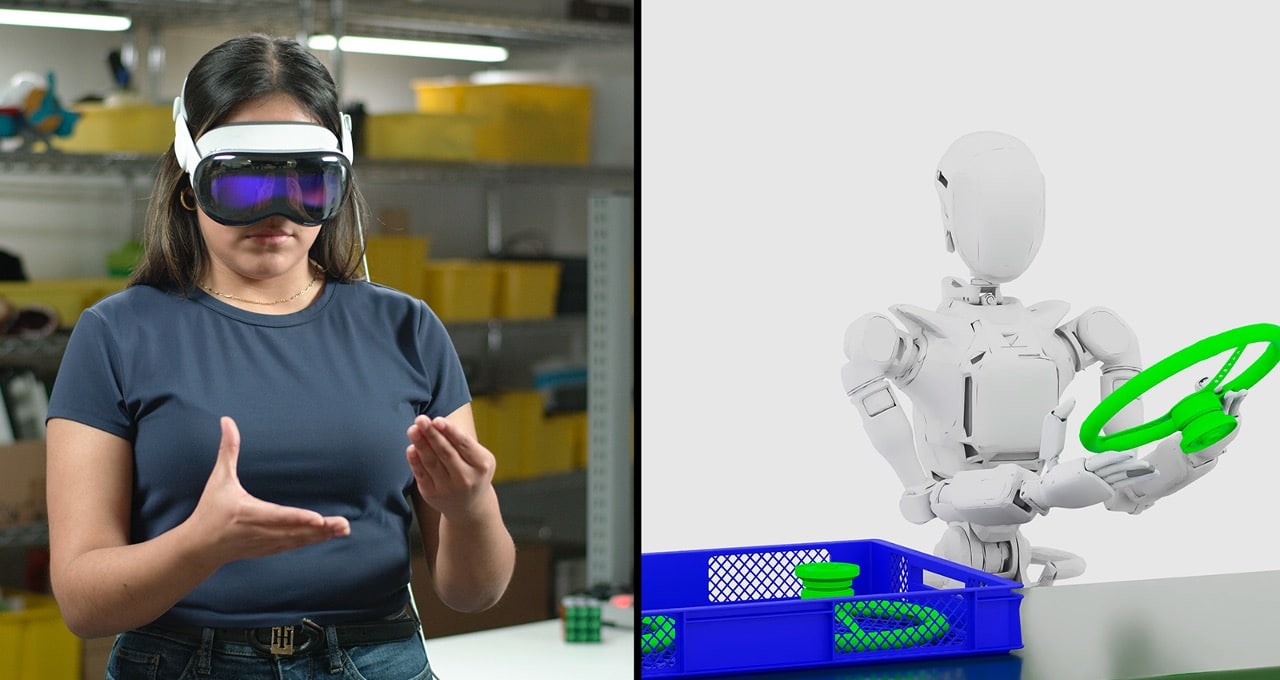
Starting with the GR00T-Teleop workflow, users can tap into the Apple Vision Pro to capture human actions in a digital twin. These human actions are mimicked by a robot in simulation and recorded for use as ground truth.

The GR00T-Mimic workflow then multiplies the captured human demonstration into a larger synthetic motion dataset. Finally, the GR00T-Gen workflow, built on the NVIDIA Omniverse and NVIDIA Cosmos platforms, exponentially expands this dataset through domain randomization and 3D upscaling.

World Foundation Models Narrow the Sim-to-Real Gap

NVIDIA also announced Cosmos at CES, a platform featuring a family of open, pretrained world foundation models purpose-built for generating physics-aware videos and world states for physical AI development. It includes autoregressive and diffusion models in a variety of sizes and input data formats. The models were trained on 18 quadrillion tokens, including 2 million hours of autonomous driving, robotics, drone footage, and synthetic data.

In addition to helping generate large datasets, Cosmos can reduce the simulation-to-real gap by upscaling images from 3D to real. Combining Omniverse — a developer platform of application programming interfaces and microservices for building 3D applications and services — with Cosmos is critical, because it helps minimize potential hallucinations commonly associated with world models by providing crucial safeguards through its highly controllable, physically accurate simulations.

An Expanding Ecosystem

Collectively, NVIDIA Isaac GR00T, Omniverse, and Cosmos are helping physical AI and humanoid innovation take a giant leap forward. Major robotics companies have started adopting and demonstrated results with Isaac GR00T, including Boston Dynamics and Figure.

Humanoid software, hardware, and robot manufacturers can apply for early access to NVIDIA’s humanoid robot developer program.

Conclusion

The NVIDIA Isaac GR00T Blueprint for synthetic motion generation, along with the NVIDIA Omniverse and Cosmos platforms, is poised to revolutionize the development of next-generation humanoid robots. By generating large synthetic datasets and reducing the simulation-to-real gap, developers can accelerate their efforts to create more advanced and capable humanoids.

FAQs

Q: What is the expected market size for humanoid robots?
A: The market for humanoid robots is expected to reach $38 billion over the next two decades.

Q: What is imitation learning?
A: Imitation learning is a subset of robot learning that enables humanoids to acquire new skills by observing and mimicking expert human demonstrations.

Q: What is the GR00T-Teleop workflow?
A: The GR00T-Teleop workflow captures human actions in a digital twin using the Apple Vision Pro and records them for use as ground truth.

Q: What is Cosmos?
A: Cosmos is a platform featuring a family of open, pretrained world foundation models purpose-built for generating physics-aware videos and world states for physical AI development.

Understated May Dominate 2025 Design Trend

0
  1. The rise of not quite minimalism

Welcome to the new age of minimalism: it’s simple, but it’s definitely not boring. While maximalist in its use of vibrant colours and bold typography, the ‘not quite minimalism’ trend retains a focus on negative space, clean lines, and uncluttered layouts.

Think of the now ubiquitous green shade of Charli XCX’s album Brat, with its low-resolution images, carefree font choice, and simple design. This trend demonstrates how minimalism can evolve beyond the expected by integrating eye-catching elements without sacrificing clarity or functionality.

Defined by simple layouts, clashing colours and bold typography that create contrast, this aesthetic appeals to brands that want to be modern and approachable; that want to appeal to younger audiences and stand out from the crowd.

  1. Functional and serene designs reflect consumer values

Calm, practical and elegant: functional and serene design trends emphasise practicality, natural textures, and muted tones, as inspired by Japandi design – a blend of Japanese minimalism and Scandinavian functionality. This aesthetic resonates with consumers who are seeking simplicity in a fast-paced, turbulent world.

With soft, neutral colour palettes, this quiet and calming trend offers a form of timeless escapism from a loud and non-stop news cycle.

This trend works well for (but is not limited to) industries like wellness, beauty, and eco-conscious retail, for example skincare line Naturium or Rare Beauty. The sharp uptick in brands embracing this aesthetic suggests a growing preference for a grounded, minimalist feel.

  1. Nostalgic networks leverage retro minimalism

The emerging nostalgic networks trend highlights simple layouts, basic geometric shapes, and muted colour schemes, evoking the early digital aesthetics of video games and low-fi TV. This pared down style is minimalist by nature, appealing to tech-savvy brands by emphasising visuals that tap into retro-tech nostalgia, balancing innovation with simplicity.

This aesthetic approach – used by brands like MSCHF and Palace Skateboards – is particularly emotive and nostalgic for Gen Z and Millennials, who will be transported back to their childhood bedrooms hunched over a Game Boy, Walkman or Nintendo.

  1. A need for human imperfection over synthetic overload

This year will see trends that push back against synthetic perfection increase in popularity. Etches and imprints and the elevation of childlike textures celebrate imperfection while relying on minimalistic design principles. Think clean layouts enhanced with tactile, playful, human-made elements.

By leaning into raw and organic details, these trends offer warmth and relatability without the sensory overwhelm often associated with our dear (and loud) friend, maximalism. Trendy London bakery Jolene, and well-known lifestyle brand White Stuff, utilise this trend with their hand-scrawled, imperfect font logos that feel personal and relaxed.

Conclusion:

In 2025, these simpler, more minimal aesthetics are going to take centre stage. Not because they reject boldness, but because they can adapt to integrate vibrant and nostalgic elements in ways that prioritise clarity, functionality, and authenticity: something consumers are yearning for in an overwhelming world.

FAQs:

Q: What is the rise of not quite minimalism?
A: The rise of not quite minimalism is a design trend that combines elements of minimalism with bold typography and vibrant colours, creating a unique and modern aesthetic.

Q: What is functional and serene design?
A: Functional and serene design is a design trend that emphasizes practicality, natural textures, and muted tones, creating a calming and elegant aesthetic.

Q: What is nostalgic networks leverage retro minimalism?
A: Nostalgic networks leverage retro minimalism is a design trend that combines elements of retro design with modern simplicity, creating a nostalgic and emotive aesthetic.

Q: What is the need for human imperfection over synthetic overload?
A: The need for human imperfection over synthetic overload is a design trend that celebrates imperfection and raw, organic details, offering warmth and relatability without the sensory overwhelm often associated with synthetic perfection.

The Dark Side of Desire

The Porn Industry: From the Shadows to the Spotlight

The Evolution of Pornography

Once a taboo, confined to magazines and hidden VHS tapes, the porn industry has undergone a dramatic transformation. The advent of the internet in the late 20th century brought about a revolution, turning pornography into a global phenomenon. With the rise of smartphones, high-speed internet, and streaming platforms, porn is now more accessible than ever. The industry’s financial success, estimated at over $100 billion globally, is a testament to its pervasive influence.

The Danger of Easy Access: A Crisis for Our Youth

The First Exposure

In today’s digital age, pornography is alarmingly accessible to young audiences. Studies indicate that the average age of first exposure to porn is now around 11 years old. For many adolescents, pornography becomes their first and, often, only source of sexual education. Without proper guidance, this can lead to a distorted understanding of sex, relationships, and consent.

The Descent: From Soft Porn to Hardcore Extremes

The Slippery Slope

Pornography consumption often starts innocuously, with “soft” content that romanticizes sexual encounters. However, over time, many users find themselves desensitized and seeking more extreme content. This progression isn’t accidental—it’s a result of the brain’s reward system adapting, pushing individuals to seek higher levels of stimulation.

The Dark Connection: Pornography and Sexual Violence

The Research Speaks

Numerous studies have established a troubling link between porn consumption and sexual violence. Research shows that individuals who frequently consume violent porn are more likely to exhibit sexually aggressive behavior. The normalization of rape culture, fueled by the portrayal of sexual violence in porn, distorts societal views on consent and sexual behavior.

Beyond the Screen: The Broader Impacts of Porn Addiction

Psychological Addiction

Pornography can be as addictive as substances like drugs or alcohol. The cycle of addiction involves a constant need for more extreme content to achieve the same level of arousal, leading to a downward spiral that is difficult to escape.

A Call for Action

Recognizing the harmful effects of pornography is the first step in addressing this issue. Public health initiatives, stricter regulations, and comprehensive sex education are crucial in mitigating the impact of porn on our society. By promoting healthy, respectful relationships and challenging the normalization of sexual violence, we can begin to reverse the damage caused by the widespread consumption of porn.

Conclusion

The intersection of porn addiction and the normalization of rape is a complex and deeply troubling issue. As the porn industry continues to thrive, its impact on society cannot be ignored. Understanding the progression from soft to hardcore content, the desensitization to violence, and the direct links to sexual crime is essential in addressing this problem. By raising awareness and implementing effective policies, we can work towards creating a safer and more respectful society.

FAQs

Q: What is the average age of first exposure to porn?
A: According to studies, the average age of first exposure to porn is around 11 years old.

Q: What is the estimated financial success of the porn industry?
A: The porn industry is estimated to be worth over $100 billion globally.

Q: What are the psychological impacts of porn addiction?
A: Porn addiction can lead to psychological addiction, strain on relationships, and a distorted view of sexual consent.

Q: What are the links between porn consumption and sexual violence?
A: Numerous studies have established a link between porn consumption and sexual violence, showing that individuals who frequently consume violent porn are more likely to exhibit sexually aggressive behavior.

Q: What are the broader impacts of porn addiction?
A: The broader impacts of porn addiction include psychological addiction, strain on relationships, and a distorted view of sexual consent.

New World Breaking Through

0

Fears of Falling Global Fertility

I wish that worry over falling global fertility was not quite so right-wing-coded. I agree there is something troubling about countries that have ceased to reproduce themselves. There is tragedy in how many people don’t end up having the families they desire.

Falling Fertility Rates Across the World

In April, the Centers for Disease Control and Prevention announced that the U.S. fertility rate had fallen to a new low of around 1.6 births per woman — well below the 2.1 that is broadly considered an adequate replacement rate. The European Union average is closer to 1.5, with Germany recently falling below the U.N.’s “ultralow fertility” line of 1.4. South Korea is down to 0.78 births per woman, a rate at which the country will sharply contract over a few generations. The only wealthy country with a fertility rate above the replacement rate is Israel.

Consequences of Shrinkage

It is harder for societies to remain stable as they shrink; South Korea’s demographic crisis has contributed to its recent political turmoil. Growth becomes elusive when populations decline. Fewer adults supporting more retirees is a recipe for discontent.

Lack of Solutions

In practice, we see none of the things that would address these issues. Anti-immigrant sentiment rises, as it has both here and in Europe, and gender relations worsen, as they have in South Korea. People are a source of power, growth is a source of optimism, and shrinking societies fear long-term decline. Russia’s falling birthrates seem to have played some role in President Vladimir Putin’s decision to invade Ukraine.

A New Era of Instability

As countries across the world see their populations fall — some of them quickly — we are entering a new demographic era, and I am skeptical that it will be a stable one.

Conclusion

Any one of these challenges would be plenty on its own. Together, they augur a new and frightening era. I find myself returning to a famous translation of a line from Antonio Gramsci: “The old world is dying, and the new world struggles to be born: Now is the time of monsters.”

Frequently Asked Questions

What is the concern about falling fertility rates?
The concern is that shrinking populations will lead to economic and societal instability, making it difficult for countries to sustain themselves in the long term.

What is the replacement rate?
The replacement rate is the average number of children a woman must have to replace herself and her partner in the next generation. A fertility rate above the replacement rate indicates a growing population, while a rate below the replacement rate indicates a declining population.

Which country has the highest fertility rate above the replacement rate?
Israel has the highest fertility rate above the replacement rate, with an average of 3.2 children per woman.

What is the impact of demographic crisis on countries?
The demographic crisis can have severe consequences for countries, including increased pressure on healthcare and social security systems, a shrinking workforce, and potential long-term economic decline.

Can anything be done to address these concerns?
Yes, countries can adopt policies such as increasing immigration, investing in education and workforce development, and promoting gender equality and family-friendly policies to address the concerns around falling fertility rates.

Nvidia-Backed PCs to Run Linux

Nvidia’s Project Digits: A Linux-Powered PC with AI Supercomputer Power

A New Era in PC Performance

Nvidia’s Project Digits is a desktop with AI supercomputer power that runs DGX OS, a customized Ubuntu Linux 22.04 distro. This powerful machine is powered by MediaTek and Nvidia’s Grace Blackwell Superchip, a $3,000 personal AI that combines Nvidia’s Blackwell GPU with a 20-core Grace CPU built on the Arm architecture.

AI Performance and Specifications

Project DIGITS can deliver up to 1 petaflop of AI performance at FP4 precision and support 200-billion-parameter large language models. This impressive chip is designed to bridge the gap between the Linux operating system used by AI developers and Microsoft by using the Windows Subsystem for Linux (WSL).

Why Native Linux?

Why not use native Linux as the primary operating system on this new chip family? Linux, after all, already runs on the Grace Blackwell Superchip. Windows doesn’t. It’s that simple. Linux runs well with Nvidia chips, and recent benchmarks show that open-source Linux graphic drivers work with Nvidia GPUs as well as its proprietary drivers.

Canonical and Ubuntu

Canonical, Ubuntu Linux’s parent company, has long worked closely with Nvidia. Ubuntu already provides Blackwell drivers. Canonical claims, with reason, to offer the best-in-class integrations with Nvidia hardware. These next-generation PCs will be built for Linux.

MediaTek and the Partnership

MediaTek, known for its leadership in smartphone chips, is poised to play a crucial role in this new venture. The collaboration will allow MediaTek to sell the desktop CPU PC vendors. Rick Tsai, MediaTek’s vice chairman and CEO, expressed enthusiasm about the partnership: "Our collaboration with Nvidia on the GB10 Superchip aligns with MediaTek’s vision of helping make great technology accessible to anyone."

The Future of PC Performance

The first consumer products featuring this technology are expected to hit the market later this year. I’m looking forward to running Linux on it. Come on in! The operating system’s fine.

Conclusion

Nvidia’s Project Digits is a Linux-powered PC that combines AI supercomputer power with the efficiency of Arm-based architectures. With the collaboration between Nvidia, MediaTek, and Canonical, we can expect a new generation of AI-powered PCs with significantly enhanced capabilities.

FAQs

Q: What is the price of Project Digits?
A: Project Digits costs $3,000.

Q: What operating system does Project Digits run?
A: Project Digits runs DGX OS, a customized Ubuntu Linux 22.04 distro.

Q: What is the performance of Project Digits?
A: Project Digits can deliver up to 1 petaflop of AI performance at FP4 precision and support 200-billion-parameter large language models.

Q: Why does Project Digits use native Linux?
A: Project Digits uses native Linux because it’s the best choice for this chip family, allowing for efficient performance and seamless integration with Nvidia’s GPU expertise.