Home Blog Page 422

NVIDIA Enhances Autonomous Mobility with Cosmos World Foundation Models

Autonomous Vehicle Development Accelerated with NVIDIA Cosmos

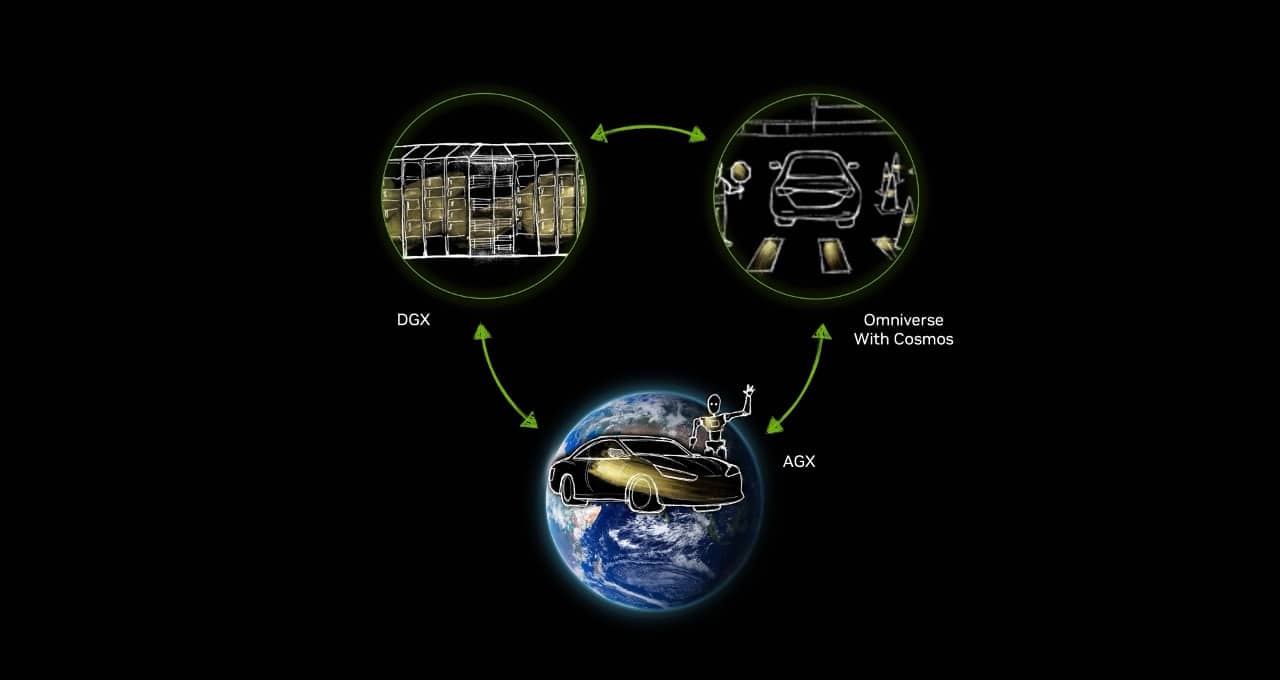
Autonomous vehicle (AV) development is made possible by three distinct computers: NVIDIA DGX systems for training the AI-based stack in the data center, NVIDIA Omniverse running on NVIDIA OVX systems for simulation and synthetic data generation, and the NVIDIA AGX in-vehicle computer to process real-time sensor data for safety.

Introducing NVIDIA Cosmos

At the CES trade show, NVIDIA today announced a new part of the equation: NVIDIA Cosmos, a platform comprising state-of-the-art generative world foundation models (WFMs), advanced tokenizers, guardrails and an accelerated video processing pipeline built to advance the development of physical AI systems such as AVs and robots.

Data Flywheel

With Cosmos added to the three-computer solution, developers gain a data flywheel that can turn thousands of human-driven miles into billions of virtually driven miles — amplifying training data quality. “The AV data factory flywheel consists of fleet data collection, accurate 4D reconstruction and AI to generate scenes and traffic variations for training and closed-loop evaluation,” said Sanja Fidler, vice president of AI research at NVIDIA.

Benefits

Developing physical AI models has traditionally been resource-intensive and costly for developers, requiring acquisition of real-world datasets and filtering, curating and preparing data for training. Cosmos accelerates this process with generative AI, enabling smarter, faster and more precise AI model development for autonomous vehicles and robotics.

Transportation Leaders Adopting Cosmos

Transportation leaders are using Cosmos to build physical AI for AVs, including:

  • Waabi, a company pioneering generative AI for the physical world, will use Cosmos for the search and curation of video data for AV software development and simulation.
  • Wayve, which is developing AI foundation models for autonomous driving, is evaluating Cosmos as a tool to search for edge and corner case driving scenarios used for safety and validation.
  • AV toolchain provider Foretellix will use Cosmos, alongside NVIDIA Omniverse Sensor RTX APIs, to evaluate and generate high-fidelity testing scenarios and training data at scale.
  • In addition, ridesharing giant Uber is partnering with NVIDIA to accelerate autonomous mobility. Rich driving datasets from Uber, combined with the features of the Cosmos platform and NVIDIA DGX Cloud, will help AV partners build stronger AI models even more efficiently.

Availability

Cosmos WFMs are now available under an open model license on Hugging Face and the NVIDIA NGC catalog. Cosmos models will soon be available as fully optimized NVIDIA NIM microservices.

Conclusion

NVIDIA Cosmos is a game-changer for autonomous vehicle development, enabling developers to accelerate the development of physical AI models with generative AI. With its data flywheel capabilities, Cosmos amplifies training data quality, making it an essential tool for transportation leaders.

FAQs

Q: What is NVIDIA Cosmos?

A: NVIDIA Cosmos is a platform comprising state-of-the-art generative world foundation models (WFMs), advanced tokenizers, guardrails and an accelerated video processing pipeline built to advance the development of physical AI systems such as AVs and robots.

Q: What are the benefits of using NVIDIA Cosmos?

A: Developing physical AI models has traditionally been resource-intensive and costly for developers, requiring acquisition of real-world datasets and filtering, curating and preparing data for training. Cosmos accelerates this process with generative AI, enabling smarter, faster and more precise AI model development for autonomous vehicles and robotics.

Q: Who is using NVIDIA Cosmos?

A: Transportation leaders such as Waabi, Wayve, Foretellix, and Uber are using Cosmos to build physical AI for AVs.

Q: How can I get started with NVIDIA Cosmos?

A: Cosmos WFMs are now available under an open model license on Hugging Face and the NVIDIA NGC catalog. Cosmos models will soon be available as fully optimized NVIDIA NIM microservices.
Niftyzk Tutorial 2: Commit-Reveal Scheme

Scaffolding a Commit-Reveal Scheme with Niftyzk

Introduction

This tutorial will contain information about the generated code. This is the continuation of the previous tutorial, Niftyzk Tutorial 1. You should read that one first.

Scaffolding a New Project

Let’s scaffold a new project using niftyzk init. We will select a commit-reveal scheme with Poseidon hash and add 2 inputs for tamper-proofing, address and amount.

niftyzk init

Setting up your current directory
? What project do you want to scaffold? Commit-Reveal Scheme
? Choose the hashing algorithm to use: Poseidon
? Do you wish to add tamperproof public inputs? (E.g: walletaddress): yes
? Enter the name of the public inputs in a comma separated list (no numbers or special characters): address,amount
Generating circuits
Generating javascript
Done
Run npm install in your project folder

The Circuits Directory

Navigate to the /circuits/ directory to see the generated code. It should contain 2 files, circuits.circom which is the entry point and commitment_hasher.circom which contains the hashing implementation.

circuits.circom

pragma circom 2.0.0;
include "./commitment_hasher.circom";

template CommitmentRevealScheme(){
    // Public inputs
    signal input nullifierHash;
    signal input commitmentHash;
    signal input address;
    signal input amount;

    // Private inputs
    signal input nullifier;
    signal input secret;

    // Hidden signals to validate inputs so they can't be tampared with
    signal addressSquare;
    signal amountSquare;

    component commitmentHasher = CommitmentHasher();

    commitmentHasher.nullifier <== nullifier;
    commitmentHasher.secret <== secret;

    // Check if the nullifierHash and commitment are valid
    commitmentHasher.nullifierHash === nullifierHash;
    commitmentHasher.commitment === commitmentHash;

    // An extra operation with the public signal to avoid tampering
    addressSquare <== address * address;
    amountSquare <== amount * amount;

}

component main {public [nullifierHash,commitmentHash,address,amount]} = CommitmentRevealScheme();

JavaScript Code

First, we look at the library that was scaffolded and then the tests.

The project depends on ffjavascript, snarkjs, circomlib, circomlibjs, and circom_tester.

lib/index.js contains the source code for the client-side code.

First, you will see the functions for generating circuit inputs:

// new public and private inputs and new templates.
// So first we have the merkle tree root as a new public input and pathElements and pathIndices,
// these contain the merkle proof. The levels variable specifies the size of the merkle tree,
// the default 20 will give a lot of branches to work with.

template MerkleTreeChecker(levels) {
    signal input leaf;
    signal input root;
    signal input pathElements[levels];
    signal input pathIndices[levels];

    component selectors[levels];
    component hashers[levels];

    signal levelHashes[levels];

    levelHashes[0] <== leaf;

    for (var i = 1; i < levels; i++) {
        selectors[i] = DualMux();
        hashers[i] = HashLeftRight();

        selectors[i].in[1] <== levelHashes[i - 1];
        selectors[i].in[0] <== pathElements[i];
        selectors[i].s <== pathIndices[i];

        hashers[i].left <== selectors[i].out[0];
        hashers[i].right <== selectors[i].out[1];

        levelHashes[i] <== hashers[i].hash;
    }

    root === levelHashes[levels - 1];
}

Merkle Tree Commands

The project gives you a few commands to work with from the CLI to interact with merkle trees manually. There are many use-cases, for example if you want to manage a tree for withdrawing airdrops, you might just manipulate it manually.

lib/run.js contains the commands:

  • new: creates a new merkle tree with a similar output.
  • proof: asks you for a root hash and a commitment to verify. It will split out a JSON which contains the merkle proof.
  • verify: asks you for the merkle root and the proof and verifies the proof.

Conclusion

I hope this saves you a lot of time developing your circuits.

FAQs

Q: What is a commit-reveal scheme?
A: A commit-reveal scheme is a way to prove possession of a secret without revealing the secret itself.

Q: What is Poseidon hash?
A: Poseidon hash is a cryptographic hash function used in this tutorial.

Q: What are the public inputs in the circuit?
A: The public inputs in the circuit are nullifierHash, commitmentHash, address, and amount.

Q: What are the private inputs in the circuit?
A: The private inputs in the circuit are nullifier and secret.

The Best AI Tech of CES 2025

Bee AI-Wearable: A Unique Implementation of AI in Wearables

It is difficult to find an implementation of AI in a wearable that is truly unique, but I have never heard of anything like the Bee AI-wearable. The wristband listens to your conversations all day, unless manually paused with the button on it, and uses that information to get to know you, provide AI summaries of your conversations, transcripts, and actionable insights.

How it Works

The Bee AI-wearable uses the data collected from your conversations to build a personalized profile of you. This profile is used to provide AI summaries of your conversations, transcripts, and actionable insights. The wearable also features a chatbot that you can use to chat with to learn more about anything that happened in your day, such as referring to what someone said in an earlier conversation, or even how to improve your own behaviors.

Integration with Third-Party Services

The Bee AI-wearable can also be integrated with third-party services like Google Calendar and Gmail. This allows you to access your schedule and emails directly from the wearable, making it a convenient tool for managing your daily tasks.

Features and Benefits

The Bee AI-wearable has several features and benefits that make it a unique and valuable tool. Some of the key features include:

Battery Life

The battery life of the Bee AI-wearable is seven days, making it a convenient and portable device that you can wear every day.

Comfort

The Bee AI-wearable is designed to be comfortable to wear, with a sleek and modern design that fits easily on your wrist.

Data Security

The Bee AI-wearable is designed with data security in mind. The data collected from your conversations is stored securely and is not shared with anyone. The wearable also has a button that you can use to pause the recording of your conversations at any time.

Pricing and Availability

The Bee AI-wearable is available for purchase now for iOS devices, with an Android offering coming later this month before the official launch. The wearable costs $50, making it an affordable and accessible tool for anyone interested in trying out AI-powered wearables.

Conclusion

The Bee AI-wearable is a unique and innovative device that uses AI to provide personalized insights and summaries of your conversations. With its comfortable design, long battery life, and secure data storage, it is a valuable tool for anyone interested in trying out AI-powered wearables.

FAQs

Q: Is the Bee AI-wearable available for Android devices?

A: The Bee AI-wearable is currently available for iOS devices, with an Android offering coming later this month before the official launch.

Q: How does the Bee AI-wearable store my data?

A: The Bee AI-wearable stores your data securely and does not share it with anyone. The data is also not saved, so you can be sure that your conversations are private and confidential.

Q: Can I pause the recording of my conversations at any time?

A: Yes, the Bee AI-wearable has a button that you can use to pause the recording of your conversations at any time. This allows you to take control of your data and ensure that your conversations remain private and confidential.

Q: Is the Bee AI-wearable compatible with third-party services?

A: Yes, the Bee AI-wearable is compatible with third-party services like Google Calendar and Gmail. This allows you to access your schedule and emails directly from the wearable, making it a convenient tool for managing your daily tasks.

Project DIGITS: Nvidia’s AI-Powered Desktop

Nvidia Announces Project DIGITS: A New $3000 Desktop Computer for AI and HPC Applications

At the 2025 CES event, Nvidia announced a new $3000 desktop computer developed in collaboration with MediaTek, powered by a new cut-down Arm-based Grace CPU and Blackwell GPU Superchip. The new system is called "project DIGITS" (not to be confused with the Nvidia The Deep Learning GPU Training System: DIGITS). The platform offers a series of new capabilities for both the AI and HPC markets.

Scant Specs

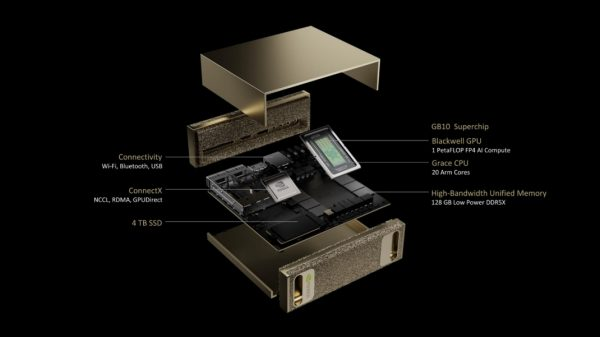
The new GB10 Superchip features an Nvidia Blackwell GPU with latest-generation CUDA cores and fifth-generation Tensor Cores, connected via NVLink-C2C chip-to-chip interconnect to a high-performance Nvidia Grace-like CPU, which includes 20 power-efficient Arm cores (ten Arm Cortex-X925 and ten Cortex-A725 CPU cores). Although no specs were available, the GPU side of the GB10 is assumed to offer less performance than the Grace-Blackwell GB200. To be clear; the GB10 is not a binned or laser-trimmed GB200. The GB200 Superchip has 72 Arm Neoverse V2 cores combined with two B200 Tensor Core GPUs.

Project DIGITS Features

The defining feature of the DIGITS system is the 128GB (LPDDR5x) of unified, coherent memory between CPU and GPU. This memory size breaks a "GPU memory barrier" when running AI or HPC models on GPUs; for instance, current market prices for the 80GB Nvidia A100 vary from $18,000 to $20,000. With unified, coherent memory, PCIe transfers between CPU and GPU are also eliminated.

AI on the Desktop

Nvidia reports that developers can run up to 200-billion-parameter large language models to supercharge AI innovation. Additionally, using Nvidia ConnectX networking, two Project DIGITS AI supercomputers can be linked to run up to 405-billion-parameter models. With Project DIGITS, users can develop and run inference on models using their own desktop system, then seamlessly deploy the models on accelerated cloud or data center infrastructure.

HPC Cluster Anyone?

What may not be widely known is that the DIGITS is not the first desk-side Nvidia system. In 2024, GPTshop.ai introduced a GH200-based desk-side system. HPCwire provided coverage that included HPC benchmarks. Unlike the DIGITS project, the GPTshop systems provide the full heft of either the GH200 Grace-Hopper Superchip and GB200 Grace-Blackwell Superchip in a desk-side case. The increased performance also comes with a higher cost.

Conclusion

Project DIGITS is a significant step towards making AI and HPC more accessible to developers and researchers. The unified, coherent memory and power-efficient design make it an attractive option for those who need to run large AI models or HPC applications on their desktop.

FAQs

Q: What is the price of the DIGITS system?
A: The price of the DIGITS system is $3000.

Q: What is the processing power of the DIGITS system?
A: The processing power of the DIGITS system is equivalent to a petaflop (at FP4 precision).

Q: Can I use the DIGITS system for HPC applications?
A: Yes, the DIGITS system can be used for HPC applications, thanks to its unified, coherent memory and power-efficient design.

Q: Can I run large language models on the DIGITS system?
A: Yes, the DIGITS system can run up to 200-billion-parameter large language models, making it a powerful tool for AI innovation.

Microsoft Sues AI Service Over Illicit Content

Microsoft Takes Action Against Cybercriminals Exploiting Generative AI Systems

Microsoft has taken legal action against a group of foreign-based cybercriminals who allegedly used sophisticated software to bypass the company’s guardrails and generate harmful and illicit content using its generative AI services.

Banned Content

Microsoft and other technology companies have banned the use of their generative AI systems to create certain types of content. This includes materials that feature or promote sexual exploitation or abuse, are erotic or pornographic, or attack, denigrate, or exclude people based on their race, ethnicity, national origin, gender, gender identity, sexual orientation, religion, age, disability status, or similar traits. Additionally, the use of AI systems to create content containing threats, intimidation, promotion of physical harm, or other abusive behavior is also prohibited.

Code-Based Restrictions Bypassed

Microsoft has developed guardrails that inspect both prompts inputted by users and the resulting output for signs the content requested violates these terms. However, these code-based restrictions have been repeatedly bypassed in recent years through hacks, some benign and performed by researchers, and others by malicious threat actors.

Lawsuit Allegations

Masada wrote in a court filing:

Microsoft’s AI services deploy strong safety measures, including built-in safety mitigations at the AI model, platform, and application levels. As alleged in our court filings unsealed today, Microsoft has observed a foreign-based threat–actor group develop sophisticated software that exploited exposed customer credentials scraped from public websites. In doing so, they sought to identify and unlawfully access accounts with certain generative AI services and purposely alter the capabilities of those services. Cybercriminals then used these services and resold access to other malicious actors with detailed instructions on how to use these custom tools to generate harmful and illicit content. Upon discovery, Microsoft revoked cybercriminal access, put in place countermeasures, and enhanced its safeguards to further block such malicious activity in the future.

Legal Action

The lawsuit alleges that the defendants’ service violated the Computer Fraud and Abuse Act, the Digital Millennium Copyright Act, the Lanham Act, and the Racketeer Influenced and Corrupt Organizations Act, and constitutes wire fraud, access device fraud, common law trespass, and tortious interference. The complaint seeks an injunction enjoining the defendants from engaging in “any activity herein.”

Conclusion

Microsoft’s actions demonstrate its commitment to ensuring that its generative AI services are not used for illegal or harmful activities. The company will continue to develop and improve its safety measures to prevent similar incidents from occurring in the future.

Frequently Asked Questions

Q: What type of content is prohibited from being created using generative AI systems?

A: Prohibited content includes materials that feature or promote sexual exploitation or abuse, are erotic or pornographic, or attack, denigrate, or exclude people based on their race, ethnicity, national origin, gender, gender identity, sexual orientation, religion, age, disability status, or similar traits.

Q: How do guardrails inspect the content requested?

A: Microsoft’s guardrails inspect both prompts inputted by users and the resulting output for signs the content requested violates the prohibited terms.

Q: Have other technology companies also banned the use of generative AI systems?

A: Yes, other technology companies have also banned the use of their generative AI systems to create certain types of content.

Meta Goes MAGA Mode

0

Meta’s Content Moderation Changes: What’s New and What it Means for Users

Meta’s Decision to Tackle Misinformation and Hate Speech

This week, Meta announced a series of content moderation changes that will have a significant impact on the way its platforms deal with misinformation and hate speech. The company’s new policies aim to reduce the spread of false information and promote a safer online environment.

What the Changes Mean for Users

The new policies will result in the removal of more harmful and misleading content from Meta’s platforms. Users can expect to see a reduction in the spread of fake news, conspiracy theories, and other types of harmful content. Additionally, the company will be more proactive in addressing hate speech and other forms of online harassment.

Is Meta Caving to Censorship Pressure?

Some have criticized Meta’s decision, accusing the company of caving in to pressure from the right on censorship. However, the company insists that its new policies are aimed at promoting a safer and more trustworthy online environment.

The Future of Artificial Intelligence: A Huge Year Ahead

2025 is Already Shaping Up to Be a Pivotal Year for A.I.

With the development of new A.I. models like OpenAI’s o3, Google’s Gemini 2.0, and DeepSeek from China, 2025 is set to be a game-changer for the tech industry. These models are sparking discussions about the potential for superintelligence and its implications for humanity.

A Round of HatGPT

We’ll also be playing a round of HatGPT, a popular game that challenges us to come up with ridiculous and humorous responses to given prompts.

Additional Reading

Credits

  • "Hard Fork" is hosted by Kevin Roose and Casey Newton and produced by Whitney Jones and Rachel Cohn.
  • This episode was edited by Rachel Dry.
  • Our executive producer is Jen Poyant.
  • Engineering by Chris Wood and original music by Dan Powell, Elisheba Ittoop, Marion Lozano, Sophia Lanman, and Rowan Niemisto.
  • Fact-checking by Caitlin Love.

Special Thanks

  • Paula Szuchman
  • Pui-Wing Tam
  • Dahlia Haddad
  • Jeffrey Miranda

Conclusion

In conclusion, Meta’s content moderation changes aim to create a safer online environment by reducing the spread of misinformation and hate speech. The company’s decisions are a step in the right direction, but only time will tell if they are effective. Meanwhile, 2025 is shaping up to be an exciting year for A.I., with new models and developments that could have far-reaching implications for humanity.

Frequently Asked Questions

Q: What are the main changes in Meta’s content moderation policy?
A: The company is removing more harmful and misleading content from its platforms and being more proactive in addressing hate speech and online harassment.

Q: Is Meta caving to censorship pressure?
A: No, the company insists that its new policies are aimed at promoting a safer and more trustworthy online environment.

Q: What’s the significance of 2025 for A.I.?
A: The year is set to be a game-changer for A.I., with the development of new models like o3, Gemini 2.0, and DeepSeek, which could have far-reaching implications for humanity.

NVIDIA Advances Agentic AI with Nemotron Model Families

Artificial Intelligence Enters a New Era: Agentic AI

Artificial intelligence is entering a new era — agentic AI — where teams of specialized agents can help people solve complex problems and automate repetitive tasks.

Llama Nemotron Models Optimize Compute Efficiency, Accuracy for AI Agents

Built with Llama foundation models, NVIDIA Llama Nemotron models provide optimized building blocks for AI agent development. This builds on NVIDIA’s commitment to developing state-of-the-art models, such as Llama 3.1 Nemotron 70B, now available through the NVIDIA API catalog.

Customize and Connect to Business Knowledge With NVIDIA NeMo

The Llama Nemotron and Cosmos Nemotron model families are coming in Nano, Super, and Ultra sizes to provide options for deploying AI agents at every scale.

Customization and Integration

Enterprises can customize the models for their specific use cases and domains with NVIDIA NeMo microservices to simplify data curation, accelerate model customization and evaluation, and apply guardrails to keep responses on track. With NVIDIA NeMo Retriever, developers can also integrate retrieval-augmented generation capabilities to connect models to their enterprise data.

Conclusion

Agentic AI is the next frontier of AI development, and delivering on this opportunity requires full-stack optimization across a system of LLMs to deliver efficient, accurate AI agents. The NVIDIA Llama Nemotron family built on Llama can help enterprises quickly create their own custom AI agents.

FAQs

Q: What is agentic AI?
A: Agentic AI is a new era of AI development where teams of specialized agents can help people solve complex problems and automate repetitive tasks.

Q: What are Llama Nemotron models?
A: Llama Nemotron models are optimized building blocks for AI agent development, built with Llama foundation models, providing high accuracy and compute efficiency.

Q: How can enterprises customize Llama Nemotron models?
A: Enterprises can customize the models for their specific use cases and domains with NVIDIA NeMo microservices, simplifying data curation, accelerating model customization and evaluation, and applying guardrails to keep responses on track.

Q: How can I get access to Llama Nemotron and Cosmos Nemotron models?
A: Llama Nemotron and Cosmos Nemotron models will be available soon as hosted application programming interfaces and for download on build.nvidia.com and Hugging Face. Access for development, testing, and research is free for members of the NVIDIA Developer Program.

Investing in Stocks and Bonds Under Trump

0

Financial Markets in a State of Flux

Financial markets have been choppy since the November election, and for good reason. With the next presidential administration promising sharp policy changes on a broad range of economic issues, there is plenty to be nervous about.

Uncertainty Abounds

The new proposals are dizzying. The president-elect says he wants to deport millions of immigrants; impose tariffs on all countries, especially China; slash taxes; expand the use of cryptocurrency; eliminate wind-powered electric generation; and increase production of fossil fuels.

It’s impossible to know which policies are fanciful, which will be carried out or what all the economic and market consequences might be. No wonder the markets are confused.

A Glimmer of Hope

Still, if you need solace, most investors need only check their portfolios. If you have held stocks since the end of 2022, when the market picture improved radically, there’s a good chance that your portfolio has had a spectacular performance. All you really needed to do was hold a piece of the broad U.S. stock market in a cheap, diversified index fund. Bond returns have been mediocre, as the final annual numbers on the portfolio performance of ordinary investors reveal, but U.S. equities have paid off handsomely, with annual returns for the S&P 500 of roughly 25% for each of the last two calendar years.

A Word of Caution

While those gaudy returns are comforting – especially after the calamities of 2022, when inflation soared, interest rates rose and both stocks and bonds sank in value – they aren’t predictions. No one knows where the stock, bond and commodity markets will end up when 2025 is over.

History Has a Lesson to Teach

But history suggests a sobering lesson: Stocks and sectors go out of fashion. What worked over the last two years may not work in the next one. Periods of outsize returns are followed by market declines, sooner or later.

Reducing Volatility

I have no idea where the markets are going over the short term. But if you want to reduce the volatility of your investments in the years ahead, I think it’s important to go beyond U.S. stocks and the handful of big tech companies that have been driving domestic returns lately. Hold diversified, fixed-income investments, too, as well as a broad range of international equities.

Recent Returns

After a brief surge from Election Day through Nov. 11, stocks stalled, and for the last three months of the year, the average U.S. domestic stock fund rose less than 1 percent, according to Morningstar, the financial services company. The average actively managed fund lagged the broad, large-capitalization S&P 500 index, which gained 2.3% in the quarter.

Performance in the Quarter

Performance in the quarter was worse for bond funds. Taxable funds lost 2.5% and municipal bond funds lost nearly a percentage point.

The Future is Uncertain

The culprit was rising yields, which have been increasing despite the Federal Reserve’s cuts in short-term interest rates. The bond market’s assessment of the economy – and of the inflation risks posed by the incoming administration’s policies – is less sanguine than the Fed’s. The market sees a strong possibility of sharply rising prices, while there are a range of opinions within the Fed, the central bank overall has judged inflation to be heading downward. Rising bond yields are likely behind the stock market’s stumble, too.

A Word of Caution

When you extend your gaze back to 2024 as a whole, investment returns look better. Domestic stock funds rose 17.3% for the year, though they badly underperformed the S&P 500. BofA Global Research, a unit of Bank of America, found that 64% of actively managed, large capitalization funds failed to beat the market. That underperformance has been occurring regularly for decades, Bank of America found. That poor record is why I rely mainly on broad index funds, which merely try to match market returns.

International Stocks

Most international stock funds didn’t keep up with their U.S. counterparts. They lost 6.7% for the quarter and gained 5.5% for the year.

Risk Taking

For the best returns, you needed to place bets on particular companies or sectors, and be smart or lucky enough to get it right. Investments bathed in the glamour of artificial intelligence were big winners in 2024. Nvidia, which makes chips for A.I., gained 171%. It trailed only two other S&P 500 stocks. One was Palantir Technologies, a military contractor that uses A.I., which returned 340.5%. The other was Vistra, an operator of nuclear power plants that have come into high demand because of the voracious power needs of companies developing A.I.; it rose 258%.

Other Sectors

Funds that concentrated on banks – which could borrow money at low rates last year, because of the Fed, and lend it out at much higher ones, thanks to the bond market – also prospered, with a return of 27.6% for the year.

MicroStrategy and Bitcoin

Then there was MicroStrategy, whose main business is buying and holding Bitcoin. MicroStrategy rose 359% in 2024, a windfall that will evaporate if Bitcoin goes out of fashion, as it did in 2022.

Most People’s Investments

Most people investing for retirement took fewer risks – and reaped lesser rewards – but still had strong returns. Funds with an allocation of 50 to 70% stock, with the remainder in bonds, gained 11.9% for the year on average, Morningstar said. Those with 70 to 85% stock, with the remainder in bonds, rose more than 13%. High-quality bonds pulled down investor returns, but they have historically been safer than stock and are often a balm when the stock market falls.

Remember the ’90s

Tech stocks have bolstered returns before. They were the key to outstanding market performance in the 1990s, the dot-com era. From 1995 through 1998, the S&P 500 gained more than 20% annually, and came close to 20% in 1999, largely on the strength of tech stocks.

A Word of Caution

But the market rose too high, forming a bubble that burst in March 2000. Starting that year, for three consecutive years, stocks had catastrophic losses. If you invested in stocks for the first time in late 1999, your holdings would have been underwater until well into 2006. Returns for an entire decade were disappointing.

Conclusion

By some metrics, stocks aren’t as extravagantly priced today as they were then, but they are high enough to be concerning. As a permanent investor, I’m seeking a solid return over my entire lifetime, and I’m acutely aware that years of gains can be wiped out in a market crash, if you aren’t prepared for trouble.

Frequently Asked Questions

Q: What’s the best way to reduce the volatility of my investments in the years ahead?

A: Consider holding diversified, fixed-income investments, as well as a broad range of international equities.

Q: What’s the best way to prepare for a market correction?

A: Consider rebalancing your portfolio to restore a mix of assets that you can live with, and be prepared for a potential market decline.

Q: What’s the best way to invest in the current market?

A: Consider holding

Hyperparameters in AI Model Fine-Tuning

What is Fine-Tuning?

Imagine someone who’s great at painting landscapes deciding to switch to portraits. They understand the fundamentals – colour theory, brushwork, perspective – but now they need to adapt their skills to capture expressions and emotions.

The challenge is teaching the model the new task while keeping its existing skills intact. You also don’t want it to get too ‘obsessed’ with the new data and miss the big picture. That’s where hyperparameter tuning saves the day.

LLM fine-tuning helps LLMs specialise. It takes their broad knowledge and trains them to ace a specific task, using a much smaller dataset.

Why Hyperparameters Matter in Fine-Tuning

Hyperparameters are what separate ‘good enough’ models from truly great ones. If you push them too hard, the model can overfit or miss key solutions. If you go too easy, a model might never reach its full potential.

Think of hyperparameter tuning as a type of business automation workflow. You’re talking to your model; you adjust, observe, and refine until it clicks.

7 Key Hyperparameters to Know When Fine-Tuning

1. Learning Rate

This controls how much the model changes its understanding during training. This type of hyperparameter optimisation is critical because if you as the operator…

  • Go too fast, the model might skip past better solutions,

For fine-tuning, small, careful adjustments (rather like adjusting a light’s dimmer switch) usually do the trick. Here you want to strike the right balance between accuracy and speedy results.

2. Batch Size

This is how many data samples the model processes at once. When you’re using a hyper tweaks optimiser, you want to get the size just right, because…

  • Larger batches are quick but might gloss over the details,

Medium-sized batches might be the Goldilocks option – just right. Again, the best way to find the balance is to carefully monitor the results before moving on to the next step.

3. Epochs

An epoch is one complete run through your dataset. Pre-trained models already know quite a lot, so they don’t usually need as many epochs as models starting from scratch. How many epochs is right?

  • Too many, and the model might start memorizing instead of learning (hello, overfitting),

Too few, and it may not learn enough to be useful.

4. Dropout Rate

Think of this like forcing the model to get creative. You do this by turning off random parts of the model during training. It’s a great way to stop your model being over-reliant on specific pathways and getting lazy. Instead, it encourages the LLM to use more diverse problem-solving strategies.

5. Weight Decay

This keeps the model from getting too attached to any one feature, which helps prevent overfitting. Think of it as a gentle reminder to ‘keep it simple.’

6. Learning Rate Schedules

This adjusts the learning rate over time. Usually, you start with bold, sweeping updates and taper off into fine-tuning mode – kind of like starting with broad strokes on a canvas and refining the details later.

7. Freezing and Unfreezing Layers

Pre-trained models come with layers of knowledge. Freezing certain layers means you lock-in their existing learning, while unfreezing others lets them adapt to your new task. Whether you freeze or unfreeze depends on how similar the old and new tasks are.

Common Challenges to Fine-Tuning

Fine tuning sounds great, but let’s not sugarcoat it – there are a few roadblocks you’ll probably hit:

  • Overfitting: Small datasets make it easy for models to get lazy and memorise instead of generalise. You can keep this behaviour in check by using techniques like early stopping, weight decay, and dropout,

Computational costs: Testing hyperparameters can seem like playing a game of whack-a-mole. It’s time-consuming and can be resource intensive. Worse yet, it’s something of a guessing game. You can use tools like Optuna or Ray Tune to automate some of the grunt work.

Every task is different: There’s no one-size-fits-all approach. A technique that works well for one project could be disastrous for another. You’ll need to experiment.

Tips to Fine-Tune AI Models Successfully

Keep these tips in mind:

  • Start with defaults: Check the recommended settings for any pre-trained models. Use them as a starting point or cheat sheet,

Consider task similarity: If your new task is a close cousin to the original, make small tweaks and freeze most layers. If it’s a total 180 degree turn, let more layers adapt and use a moderate learning rate,

Keep an eye on validation performance: Check how the model performs on a separate validation set to make sure it’s learning to generalise and not just memorising the training data.

Start small: Run a test with a smaller dataset before you run the whole model through the training. It’s a quick way to catch mistakes before they snowball.

Final Thoughts

Using hyperparameters make it easier for you to train your model. You’ll need to go through some trial and error, but the results make the effort worthwhile. When you get this right, the model excels at its task instead of just making a mediocre effort.

FAQs

Q: What is fine-tuning in AI?
A: Fine-tuning is the process of adjusting a pre-trained AI model to fit a specific task or dataset.

Q: Why is hyperparameter tuning important?
A: Hyperparameter tuning is important because it helps you adjust the model’s learning rate, batch size, and other settings to achieve the best results for your specific task.

Q: What are some common challenges to fine-tuning?
A: Some common challenges to fine-tuning include overfitting, computational costs, and the need to experiment with different techniques and settings.

Q: How do I get started with fine-tuning?
A: To get started with fine-tuning, start by reviewing the recommended settings for your pre-trained model and adjusting them based on your specific task and dataset.

Deploying a Live Project with Buildpacks

Deploying with Buildpacks: A Step-by-Step Guide

Hello connection! Recently, I had the opportunity to deploy a project live without even creating a Dockerfile, thanks to the awesome Buildpacks. It’s a super efficient and simple way to package your applications for deployment. No more manual Dockerfile writing, just build, deploy, and go!

Step-by-Step Guide to Deploying with Buildpacks

Here’s a step-by-step guide to deploying with Buildpacks:

Step 1: Install the Buildpack CLI

Start by installing the pack CLI tool for working with Buildpacks:

curl -sSL “https://lnkd.in/gnk2--ej” download/pack-$(uname -s)-$(uname -m)” -o /usr/local/bin/pack
chmod +x /usr/local/bin/pack

Step 2: Prepare Your Project

Make sure your project has the necessary files like:

  • package.json (for Node.js apps)
  • requirements.txt (for Python apps)
  • Or other language-specific files.

Step 3: Build Your App Image

Run the following command to build your app image:

pack build my-app-image — builder paketobuildpacks/builder:base

Step 4: Test the Image Locally

Run the image locally to check everything works:

docker run -d -p 8080:8080 my-app-image

Now, open http://localhost:8080 in your browser. If it’s up and running, you’re good to go!

Step 5: Push the Image to a Registry

Once you’re satisfied, push your image to DockerHub or any container registry:

docker tag my-app-image /my-app
docker push /my-app

Step 6: Deploy to the Cloud

Finally, deploy the image to your preferred cloud provider — AWS, GCP, Azure, or Kubernetes.

What Makes Buildpacks So Powerful?

Buildpacks make things so much easier:

  • Automatic Dependency Detection: It figures out all your app’s dependencies and installs them automatically.
  • No Dockerfile Needed: Focus on coding, not Dockerfiles.
  • Optimized for Production: It builds images that are ready to go live!
  • Multi-language Support: Whether you’re using Node.js, Python, or others, it works across the board.

Conclusion

Buildpacks are a game-changer for developers looking for a streamlined, hassle-free deployment process. You don’t have to get caught up in Dockerfile details — just pack and deploy!

FAQs

Q: What is Buildpacks?
A: Buildpacks is a tool that allows you to package your applications for deployment without writing a Dockerfile.

Q: What are the benefits of using Buildpacks?
A: Buildpacks provides automatic dependency detection, no need for Dockerfile, optimized for production, and multi-language support.

Q: How do I get started with Buildpacks?
A: You can start by installing the Buildpack CLI and following the step-by-step guide provided in this article.

Q: Can I use Buildpacks with my existing project?
A: Yes, you can use Buildpacks with your existing project by following the steps provided in this article.